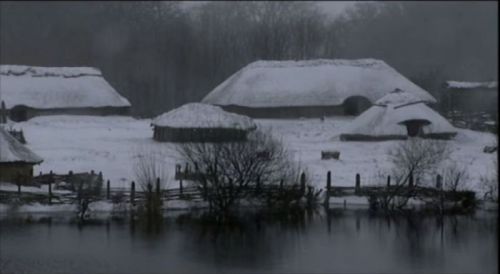
Gutland / Gotland

CLAN CARRUTHERS – GOTLAND – THE MEDIEVAL HOTEL

WIDE BANNER with NEW CREST

THE MEDIEVAL HOTEL

HAUNTED

Set in the medieval town of Visby lies a hotel built in the 14th century called, The Medieval Hotel. The oldest grounds of the hotel are located beside the church ruins of the Holy spirit.  The church was oringinally called,The Church of Saint Jacob and was changed in the 17th century. Jacob was the protector of pilgrims. It was on this very site that Bishop Albert of Riga gathered pilgrims and formed the Knights of the Livonian Order, better known as the Brethren of the Sword, founded in 1199.

Medeltids hotellet

The present day remaining building was constructed in the 14th century. Our ghost, however, seems to have liked it so much that she has remained. Christina Wipperworde was the former prioresse at the monastery of Solberga, which was of the cistencienser Order. Christina continues to check on guests in the hotel to wish them a good nights sleep. She has been walking these halls since the 80’s……the 1380’s that is.

To experience the prioress for yourself and to enjoy a completely wonderful stay have a look at their website and don’t forget to watch the beautiful film as well. www.medeltidshotellet.se

IMG_0174

IMG_0150

Preserving the Past, Recording the Present, Informing the Future

Ancient and Honorable Carruthers Clan Int Society 

carruthersclan1@gmail.com

cropped-wider-banner-light-blue-1.jpg

Per Svangren and Valarie Budayr

CLAN CARRUTHERS INT SOCIETY CCIS HISTORIAN AND GENALOGIST

You can find us on facebook at :

https://www.facebook.com/carrutherscarrothers.pat.9

https://www.facebook.com/CarruthersClan/

https://www.facebook.com/CarruthersClanLLC

Disclaimer Ancient and Honorable Carruthers Clan International Society CCI
OUR ANCESTORS

CLAN CARRUTHERS CCIS – Æthelflæd: The Anglo-Saxon Iron Lady Who Showed the Vikings No Fear

WIDE BANNER with NEW CREST

Æthelflæd: The Anglo-Saxon Iron Lady Who Showed the Vikings No Fear

CARRUTHERS ANCESTOR

Æthelflæd, Lady of the Mercians

The UK now has a female prime minister and Elizabeth II has been queen for more than six decades, but few would associate Anglo-Saxon England with powerful women. Nearly 1,100 years ago, however, Æthelflæd, “Lady of the Mercians”, died in Tamworth – as one of the most powerful political figures in tenth-century Britain.

Although she has faded from English history, and is often seen as a bit-part player in the story of the making of England, Æthelflæd was in fact a hugely important figure before her death in 918, aged around 50. Indeed, the uncontested succession of her daughter, Ælfwynn, as Mercia’s leader was a move of successful female powerplay not matched until the coronation of Elizabeth I after the death of her half-sister Mary in 1558. So, while Bernard Cornwell’s novels and the BBC series The Last Kingdom are cavalier with the historical facts, perhaps they are right to give Æthelflæd a major role.

Æthelflæd as depicted in the cartulary of Abingdon Abbey

Æthelflæd as depicted in the cartulary of Abingdon Abbey 

Æthelflæd was born in the early 870s. Her father, Alfred “the Great” had become King of the West Saxons in 871, while her mother, Eahlswith, may have been from Mercian royal kindred. At the time, Anglo-Saxon “England” was made up of a series of smaller kingdoms, including Wessex in the south, Mercia in the Midlands and Northumbria in the far north. All faced encroachment by Viking forces that were growing in strength and ambition, as outlined in Charles Insley’s article The Strange End of the Mercian Kingdom and Mercia and the Making of England by Ian Walker.

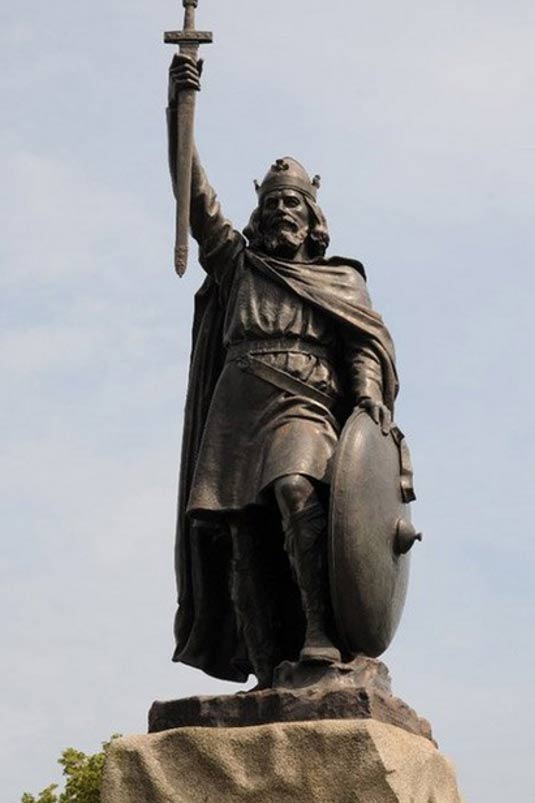
Famous statue of King Alfred the Great on Broadway in Winchester.

Famous statue of King Alfred the Great on Broadway in Winchester

Æthelflæd spent most of her life in the Kingdom of Mercia married to its de facto ruler, Æthelred. Mercia had seen some dark days by the time of her marriage. In the eighth and early ninth centuries, the Mercian kings had had good cause to consider themselves the most powerful rulers in southern Britain. But by the 870s, the kingdom had suffered dramatically from the Viking assaults which had swept across England.

One king, Burgred, had fled to Rome, and his successor, Ceolwulf II, was seen as a mere puppet by the West-Saxon compiler of the Anglo-Saxon Chronicle and disappeared between 878 and 883. Soon, the East Midlands were ruled by Scandinavians – what became known as the “Danelaw” – and so the kingdom ruled by Æthelflæd and Æthelred was by then just the western rump of the old Mercia.

Nevertheless, Æthelflæd and Æthelred together engaged in massive rebuilding projects at Gloucester, Worcester, Stafford and Chester, overseeing the refounding of churches, new relic collections and saints’ cults. Famously, in 909, the relics of the seventh-century saint, Oswald were moved from Bardney, deep in Scandinavian-controlled Lincolnshire, to a new church at Gloucester. Perhaps appropriately, for a couple facing the Vikings, Æthelflæd and her husband had a great attachment to the saint, a warrior king and Christian martyr. Æthelred was buried alongside Oswald in 911, and Æthelflæd joined him seven years later.

Remains of St Oswalds Priory, Gloucester, burial place of Æthelflæd and Æthelred

Remains of St Oswalds Priory, Gloucester, burial place of Æthelflæd and Æthelred

Powerplay and Politics

At the time, Athelred and Æthelflæd did not call themselves king or queen, nor do the official documents or coins refer to them as such. Instead, they used the title “Lord/Lady of the Mercians”, because Alfred had extended his authority over Mercia and styled himself “King of the Anglo-Saxons”.

But they acted like rulers. Æthelflæd, with her husband and her brother Edward the Elder, King of the Anglo-Saxons, launched a series of military campaigns in the early tenth century. These brought all of England south of the Humber and Mersey river under Anglo-Saxon control and rolled up the Scandinavian lordships which had been established in the East Midlands and East Anglia.

These advances were backed up by an energetic programme of fortification, with burhs (fortified towns) built in places such as Bridgnorth, Runcorn, Chester and Manchester.

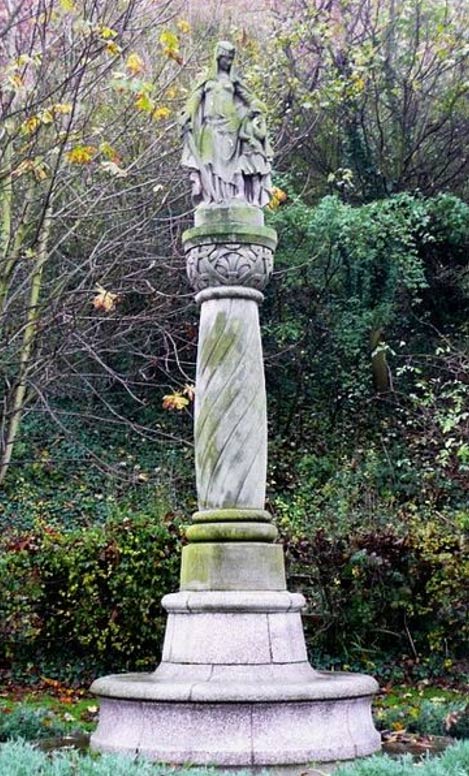
Statue in Tamworth of Æthelflæd with her nephew Æthelstan, erected in 1913 to commemorate the millennium of her fortification of the town.

Statue in Tamworth of Æthelflæd with her nephew Æthelstan, erected in 1913 to commemorate the millennium of her fortification of the town.

But while she called herself a “lady”, outsiders, especially the Welsh and Irish, saw Æthelflæd as a “queen” and she surely wasn’t just her husband’s subservient wife. As Alfred the Great’s daughter, the role Mercia and the Mercians would play in the kingdom of the Anglo-Saxons was at stake.

A Potent Widow

But Æthelflæd really came into her own following her husband’s death in 911, although it seems that he had been in poor health for the best part of the previous decade. The Mercian Register in the Anglo-Saxon Chronicle , certainly celebrates her deeds from 910 onwards.

In 915, she successfully campaigned against the Welsh and the major Welsh kings, and in England she began further to expand her kingdom. In 917-8, her army took control of Viking-occupied Derby and Leicester, and just before her death, the “people of York” – that is, the Scandinavian lords of southern Northumbria – also agreed to submit to her.

For a brief moment, she had authority not just over her own territory in Mercia, but over the Welsh, the Scandinavian East Midlands and possibly part of Northumbria, making her perhaps one of the three most important rulers in mainland Britain – the others being her brother Edward king of the Anglo-Saxons and Constantin II macAeda, King of the Scots.

This made her a major political actor in her own right, but also a respected and feared figure. Even more remarkably, she passed her authority on to her daughter, Ælfwynn, who was around 30 when her mother died. The rule of Ælfwynn in Mercia, which attracts virtually no comment at all from historians, lasted about six months before her uncle Edward launched a coup d’état, deprived her of all authority and took her into Wessex.

Æthelflæd’s legacy is enigmatic, wrapped up in the “making of England”. But she was a ruler of consequence in an era defined by male authority. Indeed, her project to rebuild the kingdom of Mercia and the Mercians might have placed midland England at the heart of later history.

Carruthers crest on flag-v2 (1)

Preserving Our Past, Recording Our Present, Informing Our Future

Ancient and Honorable Clan Carruthes Int Society CCIS  LLc

carruthersclan1@gmail.com               carrothersclan@gmail.com

WIDE BANNER with NEW CREST

Philip Morgan Andrew Sargent Charles Insley and Morn Capper

You can find us on facebook at :

https://www.facebook.com/carrutherscarrothers.pat.9

https://www.facebook.com/CarruthersClan/

https://www.facebook.com/CarruthersClanLLC

Disclaimer Ancient and Honorable Carruthers Clan International Society CCIS LL
The History of Gutland, The Viking Age, Uncategorized

CLAN CARRUTHERS – VIKING SHIPBUILDING

CLAN CARRUTHERS INT SOCIETY CCIS                                      PROMPTUS ET FIDELIS

cropped-wide-banner-with-new-crest.jpg


VIKING SHIPBUILDING

CARRUTHERS / ASHMEN WHERE VIKING SHIPBUILDERS


Cargo and war ships from Bayeux tapestry

Boats and ships were a major importance in everyday Viking life and they were a symbol of wealth and power.  Vikings were advanced in wood carpentry and it is mentioned often that Viking ships were lighter, slimmer and faster.  However, there is little proof to suggest that those statements are true.  There are very few whole Viking ships that remain to serve as a basis for theories.  The best way to test theories is to reconstruct and experiment based on information that we do know.  This information comes from literature, art and archaeology.

Gotland Stone

Quite a lot of descriptive information that we know about Viking vessels comes from societies that were raided by the Vikings. Other information came from Viking art that depicted the ships such as gold coins, the Gotland stone and the Bayeux tapestry.  Archaeology plays a major role in learning about Viking vessels; the major discoveries include the Mästermyr tools, the Skuldelev vessels, the Oseberg ship, and the Gokstad ship.  These discoveries will be discussed later on, before vessels are mentioned there must be some information about the items required to build them.

Archaeological discovery of the Oseberg ship


Through all the DNA studies, the Carruthers were named Ashmen in the Viking age.  They lived in Gutland / Gotland and were granted land in the Aachen Forest from the Papal Throne to grow the Ash Trees that they used to build ships.  They were very wealthy and powerful group of people, through shipping trade in Gotland/Gutland.

Much of their DNA has been turning up in many areas of archeological digs in Gotland/Gutland and European sites also.  Besides master iron workers, jewelry of silver and bronze, they were masters with woodworking also.

Throughout the Viking Age the style of boats and ships changed, but the materials Vikings used were fairly consistent.  This section discusses the different materials that Vikings used to build boats and ships as well as what the materials were used for.

Tools

Mastermyr Viking tools and chestUntil 1936 not much was known about Viking tools.  Occasionally, a tool or two would show up on a burial site.  In 1936 a farmer found a chest with a chain around it.  Inside the chest was a variety of tools that dated back to the Viking Age, they are known as the Mästermyr tools.  There are at least five ways in which we know about Viking woodworking.  Two pieces of evidence comes from literature and forms of art.  The third bit of evidence comes from examining detail in the wood. The fourth bit of evidence comes from modern day tools, Viking tools and their purposes are similar to those of modern tools.  The last piece of evidence comes from archaeological discoveries.  The list of tools below is what was discovered at Mästermyr, except for the planes and pole lathe.  How we know about the use of these tools will be mentioned next to the name and description below.

Adzes-  Viking Age adzes are rare to find but were frequently used in woodworking.  Adzes have a curved blade which has the purpose of helping to smooth the split logs.

Augers-  Augers came in many forms during the Viking age, the ones from Mästermyr are believed to be breast augers.  Augers take the form of a drilling bit in the shape of a spoon.  In breast augers the spoon is attached shaft that rotates, which is connected to a curved piece of wood.  Rivet holes would be made by applying pressure from the carpenter’s chest onto the curved wood while turning cross handles, which was attached to the bit.

Axes-  The woodworking axes were different than the axes that were used as weapons.  Woodworking axes were specifically designed for felling trees.  Axes were also used for wedges, which would help to spit the logs into wedges.  

Ship building depicted in the Bayeux tapestry

Chisels-  Used to cut rabbets into the wood as well as making mortises.  Mortises would have been made with the help of the auger.  The auger would drill the holes and then be shaped by chisel and/or gouge.

Draw Knife-  Smoothes the wood by being drawn to the user by using fine control.  A change in angle can affect how much wood is removed.  Draw knifes could possibly be used as a gouge as well.

Files-  There are many types of files, which are/were used to shape wood.

Gouges-  Same information as the chisels, refer to notes above.

Moulding Iron-  Used similar to the draw knife, but creates decorative grooves instead of smoothing the wood.  Moulding irons may have also been used to create designs on the gunwale.

Planes-  It is suggested from a literary and historical standpoint that wood planes may have also been used.  A wood plane is similar to a chisel that is held by a wood block and may be used to square edges or smooth surfaces.

Pole Lathe-  Turned wood artifacts and debris from a pole lathe have been found, although the tool itself has not been.  It is believed that the pole lathe was made of wood and contained by a green limb and a treadle. This action would turn the wood as the carpenter worked on shaping the wood with the help of other tools.

Rasps-  There were two rasps found at  Mästermyr.  Raps would also be used to shape wood.

Saws-  Two wood saws were also part of the Mästermyr find, a fine-toothed saw and a coarse saw.  The peculiar thing about these saws is that they are in the same style as a serrated knife.

Wood

In the Viking Age, any type of wood was used by craftsmen that could be.  Boats and ships were mostly made out of hard woods ash, oak and pine.  Vessels would often be comprised of more than one type of wood.  From the Skuldelev vessels we also know that lime, ash, alder, and birch were also used.  In the Gokstad ship, pliable spruce roots were used to secure the strakes.  Wood nails and pegs were also used.     

The one exception for woods was a ship built for the Chief or Chieftain.  Ash was always reserved for this honor.  It was considered one of the most sacred woods to use.  Some believed it was magical powers or the Wood of Odin.      

Metal

Anchor from the Oseberg ship

Iron was the metal that was often used in Viking life.  Not much iron was used during the construction of a vessel because of the added weight.  Iron nails were often used as well as washers during the construction of a vessel, iron rivets were also used in the later Viking Age.  The ship’s anchor and chain were also made of iron and the anchor style varied from ship to ship.  In some cases, such as the Gokstad ship, iron bands were used to repair masts that had split due to strain from the sail.

Cloth

Not much is known about the cloth used as sails, because of decomposition.  However, it is known that wool and linen were the most common textiles during the Viking Era.  It is suggested that sail size would have led to the vessels being lighter and faster.  From literature, the depiction of Viking sail design was in a striped pattern.  Some individuals believe that there may have been loops on the sail where lines were passed through in order to shorten or lower the sail.  Spars were used in order to spread the sail at the slightest wind.  The most likely reason why Vikings were considered superior in their vessels and sailing may be due to their use and knowledge of the sail.       

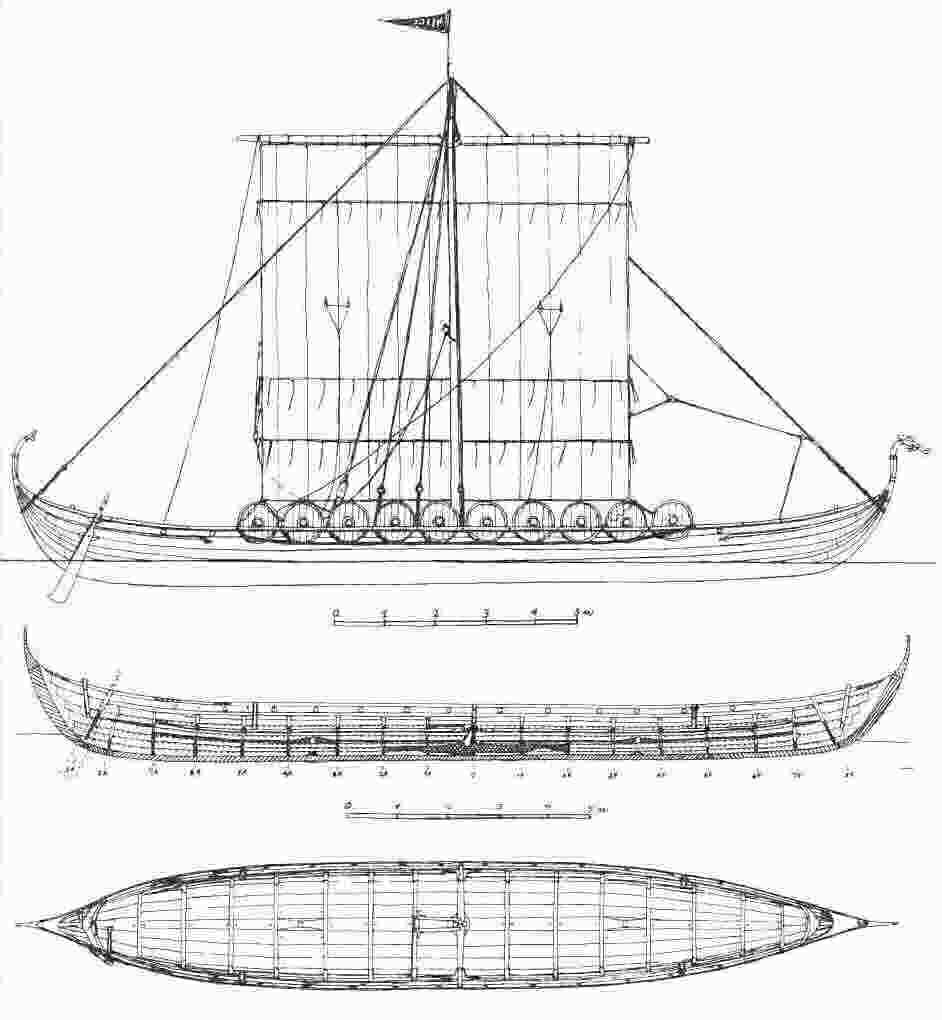
Drawings of a Viking ship

Rope

Rope during the Viking Era was made of bast or hemp.  There may have also been ropes that were made from walrus or seal skins.  For rope, skins were cut in a spiral around the entire creature’s length.  It is suggested that sails were controlled by a reefing method.  Sails may have also been controlled by two ropes attached to the lower corners of the sail.

Filler

Strakes on the vessel were sealed with wool yarn and tar; horse hair may have also been used.  Tar was used to make the vessel more waterproof.  After a period of time being used, the ship had to be re-sealed.

Types

Skuldelev ocean-trader boat

Vessels are classified in different ways and differences are not always clear.  The number of oars defines what a small vessel is; up to 12 oars (one man could take a pair).  Medium vessels were 12 to 32 oars or 12 to 32 rowers (one man per oar).  The large vessels were identified by how many pair rows there were (two men per oar).  There was a lateral space between the seat called a rúm and ships could also be identified this way.

Skuldelev fishing boat

There are different categories of vessels and distinctions are not always clear as well.  The eikja is the simplest kind of boat, a dug-out, and it was often used as a ferry.  A bátr was a ship’s boat.  Skip is the term used for any independent vessel that was not considered to be very large.  Cargo ships were called ferja or byrðingr.  Ocean-going vessels were known as knarr.  Búza and kuggr were names of merchant/trading vessels.  General purpose vessels were called skúta, similar ships might me known as karfi.  A longship/warship of at least 20 benches was known as a snekkja, bigger longships were called a skeið.  But the largest warships were referred to as drekar, which translates as dragons.

Wood detailing of the Oseberg ship

The characteristics of the vessels differ, depending on what they were used for.  The Skuldelev ships show us how different the vessels are.  Cargo ships are usually classified as medium vessels that have a large hold.  Merchant/trading ships may also have a hold, but my not be as necessarily large as cargo ships.  Ocean vessels were stronger than others so that they could withstand the waves and wind.  Longships, or warships, needed to have greater speed and maneuvering abilities. Boats used for everyday things, like fishing, had higher sides than most other vessels.  Some trading ships may have had higher sides as well, to store more goods.  Those vessels that stayed close to land were mostly dependent on rowing only and lacked a keel.  Vessels that belonged to higher ranking individuals were more intricate, the Oseberg vessel is thought to be an example of this.  The Oseberg is intricately carved, which may have belonged to a chieftain.  Other intricate vessels may look like a dragon or have weather vanes that are gilded.

Gokstad Design


Side of the Gokstad ship

The design commonality of Viking vessels is that they were clinker-built; this means that the strakes partially overlapped each other.   Quite a few vessels have been discovered but there are very few that are mostly complete.  This is because most of the vessels were found in peat bogs.  The Oseberg and Gokstad ships are the most complete and best documented.  Examining the Gokstad helps us to understand the construction and skill that went into a vessel.

The Gokstad has been dated to the ninth century and was classified as a general-duties vessel that was capable of being used in raiding or trade.  The Gokstad is 23.3 meters long and estimated to weigh nine tons when empty.  The ship is made of oak and pine.  Overlapping strakes make up the hull and are nailed together and then spruce roots lashed the strakes to the frame.  The lower strakes were attached to the hull with nails and strakes above the water line were attached with wooden pegs to L-shaped knees.  The knees were attached to crossbeams and held the ship together.  The knees also supported the deck which was not nailed down.  The third strake from the gunwale has holes and slats that the oars can pass through.  The strakes were then caulked with the filler mentioned above (in materials).  A bar attached to the gunwale was used to help tie the shields.

Side view of Gokstad ship showing the deck

The mast was sat in a socket were it could be attached to the ribs.  The mast had also been repaired at some point with iron bands.  The mast was movable when desired and was locked in place.  Backstays were common in artwork depicting ships, but a place for one was not found.  The forestay helped to move the mast.  It is assumed that the mast was 10 meters tall to consist of a lighter ship weight as well as a faster ship.  There may have been a rectangular sail of about 11 meters across attached to the sail, with the specifications mentioned above (in materials).

Oseberg ship from the front

A large steering oar was used near the platform of where the helmsman and chief would have been.  The steering oar, used for maneuverability, was attached to the starboard side by a tree root or withy.  The oars were made of pine and were about 5 ½ meters in length, oarsmen had to be seated to use them.  The anchor had a wooden stock with iron flukes.  The deck was mostly clear because that is where individuals slept in tents.  The design made the Gokstad less rigid and lighter than most ships.  The Gokstad could easily reach 10 knots or more.

The Gokstad ship and other artifacts can be seen at the Viking Ship Museum in Oslo, Norway.

Carruthers crest on flag


PRESERVING OUR PAST, RECORDING OUR PRESENT,INFORMING OUR FUTURE

ANCIENT AND  HONORABLE CARRUTHERS CLAN INT SOCIETY CCIS

CARROTHERSCLAN@GMAIL.COM    CARRUTHERSCLAN1@GMAIL.COM

cropped-wider-banner-light-blue-1.jpg

Rick Fehrenbacher

VIKING MUSEUM

CLAN CARRUTHERS INT SOCIETY CCIS HISTORIAN AND GENEALOGIST


You can find us on facebook at :

https://www.facebook.com/carrutherscarrothers.pat.9

https://www.facebook.com/CarruthersClan/

https://www.facebook.com/CarruthersClanLLC

Disclaimer Ancient and Honorable Carruthers Clan International Soci

Sources 

Viking Ship Museum  http://www.vikingeskibsmuseet.dk/index.php?id=1404&L=1

The Viking Answer Lady: Woodworking in the Viking Age  http://http://www.vikinganswerlady.com/wood.shtml

The textiles in the Oseberg ship  http://www.forest.gen.nz/Medieval/articles/Oseberg/textiles/TEXTILE.HTM

The Viking Achievement: The society and culture of early medieval Scandinavia by Peter Foote and David M. Wilson (1990)


DNA Gotland, Gutland / Gotland, OUR ANCESTORS, Uncategorized

CLAN CARRUTHERS-THE BEAST OF GUTLAND/GOTLAND

CLAN CARRUTHERS INT SOCIETY CCIS                    PROMPTUS ET FIDELIS

cropped-wider-banner-light-blue-1.jpg

The Beast of Gotland

beastofgotlandmenHere we start back in Gotland again.

If you do not understand what that means, please read the previous blogs.

Were the men of Gotland considered Beasts?

Oh hell yes!  And they were very nice and very good at it!

We have learned, the unforgettable memory, of these giants of men, ravaging and pillaging all of Europe, and wearing kilts, possibly so they can easily take it off, and fight in the buff.

Did you remember that our ancestors were generally accepted to have originated the  heiti for”men (of the tribe)”, with the literal meaning “they who pour their seed”.  This is one of the oldest mention of men from the same tribe or clan, or family who went off to battle together.

The Killing Beast

The short form of Gautigoths was the Old Norse Gautar, which originally referred to just the inhabitants of Västergötland, or the western parts of today’s Götaland, a meaning which is retained in some Icelandic and Norse sagas.

Beowulf is one of those Norse sagas, along with Gautar and Widsith.   Beowulf and the Norse sagas describe several battles, such as a raid into Frisia, ca 516, which is described in Beowulf, along with the events related in this epic, some described the Geats as a nation which was “bold, and quick to engage in war”.

Not only in the Story of Beowulf were they giants in battle, but the Gotalanders, were making a lot of gold for killing Romans, and protecting Romans.  They were developing a reputation for being quick to the fight!

labro

There remain picture stones of Gotland.  Hundreds of memorial stones were produced from the local limestone, in pre-viking and Viking times, which became richly informative. General themes are easily recognized: ships on a journey, men fighting in battle or defending a house, a warrior being welcomed home or into Valhalla, often by a woman who offers him a drinking horn, stories of gods and heroes.

These stones were the written stories of all the men that were lost, those that came home, and all that fought bravely.

One very interesting stone has been given the name Ardre VIII.   It stands about 7 feet tall, and is round at the top and is broken into different sections that depict some of the stories of battles.  There are two other stones to look into Larbro I, and the Klinte Hunninge.

They might have been Bold, and Quick to engage in war, but they were Ready and Faithful to the Heiti or tribe, they were the Beasts of Gotland.

Beauty and the Beast

The Grimm Brothers wrote many tales. Their tales were the first to be written of the beasts, but were stories orally told over and over again for centuries. Like playing telephone, and the stories change a bit here and there.   The Grimm Fairy tales were a collection of tales and stories told of old. The old monsters and beasts who lived on the land.

These stories were of big monsters, and mean women who ate little children.  Wicked people who were deep in the forest, and took children far away never to be seen from again.  Most of these stories carried through for hundreds of years, all telling of the Beasts of Gotland.

gulliver

Thankfully, along came Walt Disney and romanticized these stories.  Cinderella, Snow White and Hansel and Gretel. Well, Walt Disney did tame the beast and made the stories easier to experience than the Grimms Tales, but there are scenes in each one that can have us sitting on the edge of the chair. All stories of the terrible beasts that were from Gotland.  Finally, a good story about the beasts, Beauty and the Beast, and let us not forget Gulliver’s Travels.

The Beast become a Symbol 

gotlandwood

Our ancestors were experts in carving in wood and the beast is designed into many of their stylings.

They were the shipbuilders for most of Europe, but their own ships were decorated with beautiful hand carvings, most of which were that of beasts. Sometimes a different beast was used for a group of ships leaving for one war, or one battle.  Similar to a team of players all wearing the same ship and design.

beastofgotlandship

And of course, as early as 200 – 300 A.C.E. runic inscriptions are found on memorial stones and jewelry as well. These ancestors came through the stone age, the bronze age, the iron age and such, and their designs of the beasts come through their designs of jewelry.  One of my favorite of these rune memorial stones is found at Lund, and shows Hyrokkin riding on her wolf, and includes the wonderful serpent reins that she used to control the great beast.

hyroken

Viking Art has become very popular, and there are many different types of Viking Art, but the Urnes style has lasted through out the centuries.  You can see the BEAST, a symbol actually representing all the generations of Gotlanders who fought bravely for home, and yes for gold, but most importantly for their family in many works today.

beastofgotland

Every year in August, the people of Gotland dress in pre-viking and Viking garb, and you will see the flag of The Beast of Gotland, flying proudly throughout their villages.

Carruthers crest on flag-v2 (1)

OFFICIAL AND REGISTEREDL CLAN CARRUTHERS CCIS SINCE 1983-CLAN OF OUR ANCESTORS

SCOTTISH CLAN – IRISH CLAN – NORSE CLAN

Kingof the Goths, or Gutland

Preserving Our Past!    Recording Our Present!  Informing Our Future!

The Ancient and Honorable Carruthers Clan International Society LLC

carruthersclan1@gmail.com                carrothersclan@gmail.com

cropped-wider-banner-light-blue-1.jpg

CLAN CARRUTHERS INT SOCIETY CCIS HISTORIAN AND GENEALOGIST

You can find us on our main facebook pages at :

SILVER WINGS-https://www.facebook.com/CarruthersClanLLC/

GOLD WINGS – https://www.facebook.com/carrutherscarrothers.pat.9

CLAN CARRUTHERS FAMILY HISTORY – https://www.facebook.com/CarruthersClan

CLAN CARRUTHERS CCIS – https://www.facebook.com/groups/3878691252182714

CLAN CARRUTHERS INT SOCIETY- https://www.facebook.com/groups/394653845137709

CLAN CARRUTHERS – BORDER REIVERS – https://www.facebook.com/groups/434959914239094

Disclaimer Ancient and Honorable Carruthers Clan International Societ
OUR ANCESTORS

CLAN CARRUTHERS CCIS – KING ROLLO THE VIKING

WIDE BANNER with NEW CREST

KING ROLLO THE VIKING

CARRUTHERS ANCESTOR

Image result for Rollo as a warrior picture

Robert I Rollo “The Viking” Prince of Norway & Duke of Normandy “Count of Rouen” Ragnvaldsson

BIRTH 14 OCT 846  Maer, Jutland, Nord-Trondelag, Norway
DEATH 17 DEC 932  Rouen, Seine, Maritime, Haute-Normandy, France

Married:

Poppa Lady Duchess of Normany De Senlis De Valois De Rennes De Bayeux

BIRTH 872  Bayeux, Calvados, Basse-Normandie, France
DEATH 930  Rouen, Seine-Maritime, Haute-Normandie, France

Rollo as a Warrior

History has many cunning passages”. – T. S. Eliot

“History . . . the portrayal of crimes and misfortunes.” – Voltaire.

Image result for Rollo as a warrior pictureThe Normans have evoked great interest from the Middle Ages to the present. Vikings who settled in Normandy, were later called Normans. A phrase, A furore normannorum, libera nos, domine (From the violence of the men from the north, O Lord, deliver us), sums up how historians of the early middle ages looked on the Vikings, for they threatened the progress of western civilization for quite some time (Logan 2003, 15).

The founder of Normandy, Rollo, was the chief of a small band of ravaging Vikings. He once had a dream where he seemed to behold himself placed on a mountain far higher than the highest, in a Frankish dwelling. And on the summit of this mountain he saw a spring of sweet-smelling water flowing, and himself washing in it, and by it made whole from the contagion of leprosy . . . and finally, while he was still staying on top of that mountain, he saw about the base of it many thousands of birds of different kinds and various colours, but with red wings extending in such numbers and so far and so wide that he could not catch sight of where they ended, however hard he looked. And they went one after the other in harmonious incoming flights and sought the spring on the mountain, and washed themselves, swimming together as they do when rain is coming; and when they had all been anointed by this miraculous dipping, they all ate together in a suitable place, without being separated into genera or species, and without any disagreement or dispute, as if they were friends sharing food. And they carried off twigs and worked rapidly to build nests; and willing[ly] yielded to his command in the vision. (From Hicks, 2016, Introduction).

In Dudo of Saint-Quentin’s History of the Normans, Rollo took heed of the omens in the dream and founded a territory that became the duchy of Normandy, uniting various groups under his lead. Later chroniclers recounted how Rollo’s descendants and those of his followers conquered and ruled kingdoms in England and Sicily and Antioch and further, and led armies on crusade. (Ibid.)

Norwegian-Icelandic sources too tell of a large Viking called Rolv Ganger (Rolv Walker), aka Rollo (English) or Rollon (French). Outlawed in Viking Norway for raiding where he was not allowed to by King Harld Fairhair, Rollo was banished from Norway. He was too big for small horses to carry him, a saga tells. Viking horses may have been quite small.

Rolv and his soldiers secured a permanent foothold on Frankish soil in the valley of the lower Seine, and Rolv became the first ruler of Normandy, France, after King Charles the Simple ceded lands to Rollo and his folks in a charter of 918. In exchange, Rollo agreed to end his brigandage and protect the Franks against future Viking raids along the Seine and around it. He also converted to Christianity in 912, and probably died between 928 and 932. Rollo’s descendants were dukes of Normandy until 1202, and his granson’s grandson’s son Guillaume (dead 1087) conquered England in 1066 (William the Conqueror). (Claus Krag, SNL/Norsk biografisk leksikon, “Rollo Gange-Rolv Ragnvaldsson”.

Two more grants followed; one in 924 and one in 933 – land between the Epte and the sea and parts of Brittany. Relatives of Rollo and his men as well as other Northmen followed, for the pastures were green and lush, there was fish in the sea and rivers, and the climate better than in the North. The formerly raided Normandy became protected and became the best part of France for centuries. Normans also took over England and Wales after a descendant of Rollo, known as William the Conqueror, took over England in 1066 fra 1066 and became king of England. Normans also conquered the southern, richest half of Italy, including Sicily, and several other areas bordering on the Mediterranean Sea. (WP, “Rollo”)

Rollo reigned over the duchy of Normandy until at least 928. He was succeeded by his son, William Longsword. The offspring of Rollo and his followers became known as Normans, “North-men”, men from the North.

After the Norman conquest of England in 1066 and their conquest of southern Italy and Sicily over the following two centuries, their descendants came to rule Norman England (the House of Normandy), the Kingdom of Sicily (the Kings of Sicily) as well as the Principality of Antioch from the 10th to 12th century. To enlarge on that: Bohemond I (ca. 1054–1111) of the Norman Hauteville family was the Prince of Taranto from 1089 to 1111 and the Prince of Antioch from 1098 to 1111. He was a leader of the First Crusade. The Norman monarchy he founded in Antioch outlasted those of England and of Sicily. (WP, “Bohemond I of Antioch”)

Two spouses are reported for Rollo:

(1) Poppa, said by chronicler Dudo of Saint-Quentin to have been a daughter of Count Berenger, captured during a raid at Bayeux. She was his concubine or wife. They had children: (a) William Longsword, born “overseas” (b) Gerloc, wife of William III, Duke of Aquitaine; Dudo fails to identify her mother, but the later chronicler William of Jumieges makes this explicit. (c) (perhaps) Kadlin, said by Ari the Historian to have been daughter of Ganger Hrolf, traditionally identified with Rollo. She married a Scottish King called Bjolan, and had at least a daughter called Midbjorg. She was taken captive by and married Helgi Ottarson.

(2) (traditionally) Gisela of France (d. 919), the daughter of Charles III of France – according to the Norman chronicler Dudo of St. Quentin. However, this marriage and Gisela herself are unknown to Frankish sources. Some details can be hard to verify.
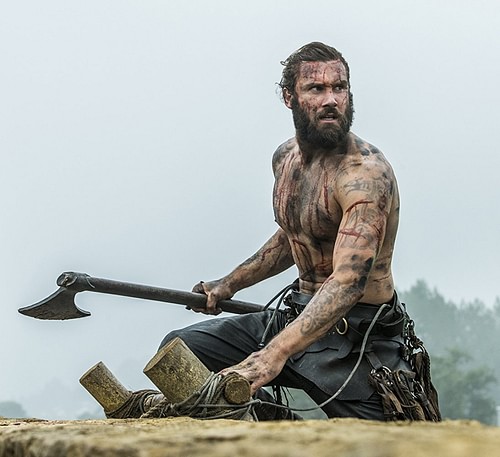
Clive Standen as Rollo of Normandy (by Jonathan Hession, Copyright, fair use)

ROLLO RULED WITH A VIKING CODE OF LAW BASED UPON THE CONCEPT OF PERSONAL HONOR & INDIVIDUAL RESPONSIBILITY.

Was Rollo Other than Norwegian?

The Rollo story is largely historical – and that he and his men were Northmen is taken to men they were of Scandinavian origin. Norwegian-Icelandic sources have it that Rollo was Hrolf from Norway, one of the Viking raiders.

  1. The oldest evidence is in the Latin Historia Norvegiae (ca. 1180). It was written in Norway. A quotation from it follows right below the array of Norse sources.
  2. Fagrskinna‘s chapter 74 tells of William and his ancestor Rolf Ganger (Rollo). This work was written around 1220, estimatedly, and was an immediate source for the Heimskringla of Snorri Sturluson’s Heimskringla. Fagrskinna contains a vernacular history of Norway from the ninth to the twelfth centuries, and includes skaldic verses that in part have been preserved nowhere else. It has a heavy emphasis on battles. The book may have been written in Norway, either by an Icelander or a Norwegian. (Cf. Finlay 2004)
  3. In the early 1200s, the Icelander Snorri Sturluson writes about this Hrolf, in Heimskringla, Book 3, section 24; Book 7, section 19, There are stories about the arsonist father and the brothers of Rolf Ganger, at one time rulers of the Orkneys and Moere in Norway. Their tales start somewhere during the reign of King Harald Fairhair (Chaps. 27, 30-32) and say it was he who settled in Normandy. Snorri also tells that Rolv Ganger – also known as Rollo – became one ancestor of the British royal house.
  4. Other Icelandic sagas from medieval times tell of Hrolf too, as the Orkneyingers’ Saga, section 4.
  5. From the Icelandic Landnama Book (Ellwood 1898): “Rögnvald, Earl of Mæri, son of Eystein Glumra, the son of Ivar, an Earl of the Upplendings, the son of Halfdan the Old, had for wife Ragnhild, the daughter of Hrolf the Beaked; their son was Ivar, who fell in the Hebrides, fighting with King Harald Fairhair. Another son was Gaungu-Hrolf who conquered Normandy; from him are descended the Earls of Rouen and the Kings of England.” (Part 4, ch. 7)

From Historia Norvegiae, the oldest of the Norse works where Rollo is mentioned:

When Haraldr hárfagri ruled in Norway some vikings of the kin of a very mighty prince, Rognvaldr, crossed the Sólund Sea with a large fleet, drove the Papar [monks and the picts, called Peti here] from their long-established homes [the Orkney Islands], destroyed them utterly and subdued the islands under their own rule. With winter bases thus provided, they sallied forth all the more securely in summer and imposed their harsh sway now on the English, now on the Scots, and sometimes on the Irish, so that Northumbria in England, Caithness in Scotland, Dublin and other coastal towns in Ireland were brought under their rule. In this company was a certain Hrólfr, called Gongu-Hrólfr by his comrades because he always travelled on foot, his immense size making it impossible for him to ride. With a few men and by means of a marvellous stratagem he took Rouen, a city in Normandy. He came into a river with fifteen ships, where each crew member dug his part of a trench which was then covered by thin turves, simulating the appearance of firm ground. They then arrayed themselves on the landward side of the trenched ground and advanced prepared for battle. When the townsmen saw this, they met the enemy in head-on attack, but these feigned flight as if racing back to their ships. The mounted men, pursuing them faster than the rest, all fell in heaps into the hidden trenches, their armoured horses with them, where the Norwegians slaughtered them with deadly hand. So, with the flight of the townsmen, they freely entered the city and along with it gained the whole region, which has taken its name of Normandy from them. Having obtained rule over the realm, this same Hrólfr married the widow of the dead count, by whom he had William, called Longspear, the father of Richard, who also had a son with the same name as himself. The younger Richard was the father of William the Bastard, who conquered the English. He was the father of William Rufus and his brother Henry . . . When established as count of Normandy Hrólfr invaded the Frisians with a hostile force and won the victory, but soon afterwards he was treacherously killed in Holland by his stepson. (Phelpstead 2008, 8-9)

Dr Claus Krag (born 1943) is a Norwegian specialist in medieval Norwegian history, and at present (2018) professor emeritus at Telemark University College. Krag maintains that what Dudo writes of Rollo – Dudo tells he was a Viking from an alpine Dacia – is “totally unreliable”, and that Dudo’s historic and geographic information “is by no means right”. Dr Krag also notes that in French works younger than Dudo’s book, Rollo is presented as a Norwegian.

Based on the much unclear Dudo about an alps-surrounded “Dacia”, some Danes say Rollo was Danish. However, Denmark is flat. Attempts to settle the question by analysis of DNA profiles of likely Rollo descendants have failed so far. [◦”Skeletal shock for Norwegian researchers at Viking hunting”]

Folk Stories Around Rollo

Several Scandinavian folktales front similar basic “success recipes” as those of battling tribes in search of new areas – Saxons, Angles, Danes and other Vikings. It suggests that many folktale heroes walk in shoes quite like those of Rollo by degrees and through much similar stages where success often depends on combat and getting valuables. Those were the times.

In the course of centuries, stories and myths may grow for such as glorifying ends. Norman bards developed romances that venerated kings. However, having a king is not a great good, according to 1 Samuel 8; 10 in the Old Testament: the king is portrayed as a stealing enemy on top. Taxes continue a tradition . . . Also, immodest royalty may breed dependence and un-normal subservience with or without near-symbiotic and half-neurotic servility.

In 1 Samuel 8:11-18 we read how bad a Jewish king will be:

This is what the king who will reign over you will claim as his rights: He will take your sons and make them serve with his chariots and horses, and they will run in front of his chariots. Some he will assign to be commanders of thousands and commanders of fifties, and others to plow his ground and reap his harvest, and still others to make weapons of war and equipment for his chariots. He will take your daughters to be perfumers and cooks and bakers. He will take the best of your fields and vineyards and olive groves and give them to his attendants. He will take a tenth of your grain and of your vintage and give it to his officials and attendants. Your male and female servants and the best of your cattle and donkeys he will take for his own use. He will take a tenth of your flocks, and you yourselves will become his slaves. When that day comes, you will cry out for relief from the king you have chosen, but the Lord will not answer you in that day.

But the people refused to listen to Samuel. “No!” they said. “We want a king over us.” [Highlighting added]

Rollo In Normandie

Map of France, 10th Century CE

The historian Reginald Allen Brown (1924–89) has written extensively about Normans and the Norman conquest. He is rendered in the following:

Normandy was created by the three consecutive grants of 911, 924 and 933″. (Brown 1985, 15) Normandy was massively colonised by Scandinavians. Rollo and his successors, as rulers of Normandy, obtained the title of count and valuable rights from before, along with widespread domains. (Cf. Brown 1985, 17-18)

Their buildings seem to document remarkable strength or solidity. The churches were much like bastions. But the duke of Rouen controlled the whole church and his bishops owed him military service for their lands – (Brown 1985, 26)

“From (their) Scandinavian inheritance the Normans derived their sea-faring, much of their trade and commercial prosperity which they shared with the Nordic world, their love of adventure, their wanderlust which led to the great period of Norman emigration in the eleventh century, their dynamic energy, and above all perhaps, their powers of assimilation, of adoption and adaptation.” (Brown 1985,18-19.)

(In AD 911) Charles the Simple, king of the west Franks, granted to a band of Vikings, operating in the Seine valley under Rollo their leader, territory corresponding to Upper or Easter Normandy. To this was subsequently added by two further grants, first the district of Bayeux, and the districts of Exmes and Seez in 924, and second the districts of Coutances and Avranches in 933 in the time of William Longsword, son and successor of Rollo. (Brown 1985, 15) (2)

And from the French Histoire de la Normandie (1862) we find, in the fourth chapter, how Rollo, son of the Norwegian Rognevald, was made an outlaw by the Norwegian king Harald Harfager. He arrived at Rouen with his companions. The inhabitants spontaneously submitted to the him and his men. King Charles at first wanted to fight the Viking, but dropped it. Instead they bargained – Rollo won, he got land and permanent welcome. (Barthelemy 1862, 80 ff)

Rollo of Normandy Statue

Rollo of Normandy Statue

Brown puts the matter into relief: “Normans were pagans when they came (and they continued to come long after 911).” (Brown 1985, 24). But their leader, the Viking Rollo, agreed to getting baptised, and many others followed. “The Seine Vikings became Christian Normans, the poachers turned gamekeepers. Revival, characteristically in this monastic age, came first to the monasteries. Jumieges was restored by William Longsword (927–43), son of Rollo, who is said to have wanted to become a monk there himself.” (Brown 1985, 21)

In short time the Normans got the back-up of their astute castles and strongholds, helped themselves to most of it – often they were served by ditches and stockades too. (Brown 1985, 37, 37n)

[It is thought that Rollo showed exceptional skills in navigation, warfare, leadership, and administration. He abdicated to his son Guillame (William) and died in a monastery in 933. Among his people he was for hundreds of years the personification of justice and good government under law. Others, who thought differently, found him cruel and arrogant.]

His son Guillame Longue-Epee (William Longsword) succeeded him. The third duke was Richard sans Peur (the Fearless), and there were many intrigues and hard fights. This Richard died and was succeeded by Richard 2 who massacred Saxons in England at war. The French king Robert became the ally of Richard 2. After his death, Richard 3 succeeded him and died prematurely. Robert le Diable succeeded him and, before he died in Terre-Sainte, became the father of Guillame le Conquerant: William the Conqueror. (Barthelemy 1862, 80 ff)

We find the family tree of William the Conqueror in the book of the historian R. Allen Brown. It looks like this:

  • Richard 1 (ruled: 942–96)
  • Richard 2 the Good (ruled: 996-1026)
  • Richard 3 (ruled: 1026–27)
  • Robert 1 the Magnificent /le Diable (ruled: 1027–35)
  • William the Bastard / the Conqueror (ruled: 1035–87).

Rollo’s great-granddaughter, Emma married two kings of England, Æhelred the Unready and Knut who was also king of Norway and Denmark. Her son, Edward the Confessor, from the first marriage, was King of England from 1042 to 1066.

A few more dukes of Normandy may be added for the sake of survey of that dynasty line that ruled over Normandy and its English (British) domain:

  • Robert 2 (ruled from 1087)
  • Henry 1 (ruled from 1106, King of the English (1100-35)
  • Henry II, 1135, King of the English (1135-)

“The origins of Normandy in the first decades of the tenth century also reveal the double inheritance of the Normans, from the Scandinavian world from whence they came and from the ancient province of Roman, Frankish and Carolingian Gaul which now they colonised.” (Brown 1985, 17)

“[I]n Normandy by the mid-eleventh century . . . they had adopted Frankish religion and law, Frankish social customs, political organisation and warfare, the new monasticism.” (Brown 1985, 19)

“The Norman monasteries were, by and large, distinguished . . . new . . . vibrant with . . . careless rapture of spiritual endeavour”. The (Normans) became great spirituals – intensely aristocratic. (Brown 1985, 23)

Normans restored and built on monasticism and left robust architectural monuments. Some are still there, more or less intact. The Tower of London was started by Normans, for example. King William had much of it built. “The tower at Rouen was built by Richard 1 (943Rw11;96) and is glimpsed from time to time in the reign of his successor and thereafter . . .. It may have been the prototype for the great Norman towers at Colchester and London. (Brown 1969, 37, 37n) (4)

Normans went on and built monastic churches at such places as Jumieges and many other places. “They added their cathedrals at Rouen, Bayeux [etc.] Many of these major works of Norman Romanesque architecture survive in whole or part”. (Brown 1985, 26)

Some Normans (including Norman clergy) were patrons of the arts and scholarship . . . and almost all of them were mighty builders.” (Brown 1985, 25)

The French Version

Statue of Rollo of Normandy, Falaise

Statue of Rollo of Normandy, Falaise

In 820 peasants . . .along the Seine saw in the distance ten or so curious war ships called—Drakkar because of the animal sculpted into the prow or the stern, which was actually a dragon—the men from the North didn’t travel with their women as they could easily find them on the spot!

Swearing by the names of Thor and Odin—Vikings plundered, pillaged, raped and slaughtered up until 911 when the famous treaty of Saint Clair sur Epte was signed between the Frank king Charles the Simple and Rollon or Rolf, chief of the men from the North.

On the whole our invaders calmed down, adopting a somewhat bourgeois attitude to life in this beautiful region which was to become Normandy.

Soon it was the time for William the Conqueror who, on October 14th, 1066 won the battle of Hastings along with a kingdom—William’s heirs were known as the Plantagenets, and they reigned over Normandy and England. In 1189, Richard the Lionheart divided the double crown.

Rollo and Dudo

Rollo was the son of Earl Ragnvald of More, Norse sagas tell. Two of his brothers were Ivar and Tore. Three more were Hallad, Einar and Rollaug. Hallad and Einar in due time became earls of the Orkneys, each in his turn. [eg, Harald Fairhair’s Saga]

After being made an outcast by the tyrant king Harald Harfager, Rolf voyaged to the western isles. Obviously he could count on support from relatives. The earl of the Orkneys was his paternal uncle, succeeded by that uncle’s son, that is, Rollo’s cousin, and later again by his own brothers Hallad and Einar.

The old sources hold that Rolv took his residence in certain tracts of what today is the domain of Scotland. The Landnamaboka mentions Rolv got a daughter, Kathleen:

Helgi . . . harried Scotland, and took thence captives, Midbjorg, the daughter of Bjolan the King, and Kadlin, the daughter of Gaungu Hrolf or Rolf the Ganger; he married her. (Part 2, ch. 11).

Before Helgi had harried and married, Rolv of the Sagas had travelled from Scotland and the isles near it, to Valland, near the English Channel. The Vikings’ Valland consisted of the southern Netherlands, Belgium and parts of Normandy, roughly said. He took over Normandy in three steps. The Sagas identify him with the Rollo that the Frank king Charles the Simple bestowed it on.

Rollo in Alesund, Norway

Rolv Ganger converted and settled in Rouen. Next he granted many of his Viking companions ample landed property. It was feasible to go north and fetch one’s women and children and kin to the new land, for the soil was fit, there was much fish, and as members of the ruling class they were much safer or freer than those who submitted to the tyranny of Harald Fairhair and his family in Norway and its colonies in several western islands (cf. Simonnaes 1994, 43).

Normans built fortresses on strategic places, and many rustic castles were to come along with them in a short time. All able men had to serve in the Norman military forces. The formerly ruined, marauded region was turned into one of the foremost in France, and Rouen became the second largest city in France, while Hrolf became the originator of the Norman duchy. [Simonnaes 1994 39, 45-46]

Dudos’ Work

Dudo was a visiting French scholar who wrote in verse and prose about the first three rulers of Normandy and their origins. His poetry is different from that of skalds, the Norse bards. It is not complex, as theirs, and he does not glorify war so much either. He is moralistic like earlier Christian eulogists and writers of biographies of saints (Christiansen 1998, xviii). “It was hagiography that moulded his work,” Eric Christiansen aptly sums up (ibid, xxi), and, “there is no sign that Old Norse poetry was ever composed or appreciated in Normandy (1998, xvii; cf. Ross 2005).”

Dudo’s eulogising chronicle (ibid. xxv) is about one family’s rise from defeat and exile in the world of Vikings to an honoured place among the great territorial rulers of France. Dudo recounts two campaigns in England by the founder, Rollo, and a series of stirring events otherwise, including the murder of Rollo’s son William, and the kidnapping, escape and precarious early career of Dudo’s first patron, Count Richard I.

Historians on the whole have doubted much in Dudo’s book, for its historical details are inaccurate. Yet it it is virtually the only source for very early Norman history. Recently, some scholars maintain that Dudo had better be seen as a propagandist.

Dudo’s work has the nature of a romance, and has been regarded as untrustworthy on this ground by such critics as Ernst Dümmler and Georg Waitz. Further, Leah Shopkow has more recently argued that Carolingian writing, particularly two saints’ lives, the ninth-century Vita S. Germani by Heiric of Auxerre and the early tenth-century Vita S. Lamberti by Stephen of Liége, provided models for Dudo’s work. (WP, “Dudo of Saint-Quentin”)
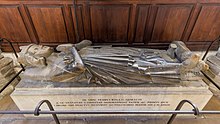
Rollo Grave at the Cathederal of Rouen

New editions of central Norman chronicles have surfaced over the last thirty years. The History of the Normans in Eric Christiansen’s English translation (1998) is said to be “fairly true to Dudo’s often pompous, bloated style” while at the same time being readable, and accompanied by copious, explanatory notes. Christiansen recognises that Dudo is unreliable as a historical source, and he acknowledges the Scandinavian side of the early Normans. Histories of Normans have a potentially broad appeal. On the Internet there has been a version edited by Felice Lifshitz (1996).

Dudo’s content: A few observations

O thou the magnanimous, pious, and moderate!
O thou the extraordinary God-fearing man!
O thou the mangificent, upright and kindly!
O thou miraculous, goodly just man!
O thou peace-maker and offspring of God!
O thou the munificent, holy and moderate!
O thou the incarnadine merciful Richard!
O thou the the long-suffering, Richard the prudent!
O thou most famous one, Richard the comely!
O thou justiciar, Richard the mild!
– All manner of nations duly declare.
Mild one, remember what you see in the book,
Nourish your heart and your soul on these things
That you may be joined to the matter you read.

– Verses to Richard, son of the great Richard (in Christiansen 1998, 8)

A clergy view shines through.

The commisioned chronicler of the Norman dukes, Dudo, tells in Latin (ca. 1015–20) that Rollo was the son of an uncertain king in “Dacia”. ◦Gesta Normannorum:

Spread over the plentiful space from the Danube to the neighborhood of the Scythian Black Sea, do there inhabit fierce and barbarous nations, which are said to have burst forth in manifold variety like a swarm of bees from a honeycomb or a sword from a sheath, as is the barbarian custom, from the island of Scania, surrounded in different directions by the ocean. For indeed there is there a tract for the very many people of Alania, and the extremely well-supplied region of Dacia, and the very extensive passage of Greece. Dacia is the middle-most of these. Protected by very high alps in the manner of a crown and after the fashion of a city. – [From chapter 2, second paragraph in Gesta Normannorum by the chronicler Dudo ca. 1015]

Extracts from Dudo of St. Quintin’s

One thing that stand out from Dudo’s obscure and glorifying marvel is this: If what is called Dacia is surrounded by very high alps, it isn’t Denmark. His Dacia stands out as some very fertile, southern Alp tract (Balcanlike). (Steenstrup 1876, 30, 31)

Against a claim by the Danish Johannes Steenstrup in 1876, there is not one mention of Rollo in classical Danish sources. DNA analyses of Norman descendants of Rollo could have helped in finding out about his origin, but so far no fit DNA has been detected.

The Danish historian Saxo Grammaticus from about 1200, has no mention of any Danish Rollo in ◦The Danish History.

In Normandy, Rollo is celebrated as a real Viking from More on the west coast of Norway [Cf. Simonnaes 1994 35]

Rollo in Fargo, North Dakota

Historical | Fargo Public Art

In 1911, during the Norman Millennium celebrations, the city of Rouen in Normandy decided to create two copies of its Rollo statue. One replica was sent as a gift to Ålesund, Norway. The earls of Moere were headquartered somewhere nearby Ålesund, it is suggested.

The other replica went to Fargo in North Dakota. The two bronze statues were copied from an original stone statue sculpted in 1863 by Arsene Letellier, erected in Rouen in 1865.

In Fargo, the dedication ceremony in 1912 included a speaker from the French embassy in Washington. A proclamation by the mayor of Rouen, bound in leather with gold seal of the city, gold leaf and other ornamentation, read in part,

“Since these ancient times, these fierce warriors have populated and have become a hard-working people whose importance is shown by the powerful association of the Sons of Norway which has preserved the cult of memory, and which participated last year in the celebrations in the ancient Duchy of Normandy.”

The celebrations were concluded with a parade down Broadway. The Rollo statue was relocated in the 1980s and now stands in a little park. [Simonnaes 1994 39, 48, 40]
Carruthers tartan map poster-01

CLAN CARRUTHERS SINCE 1983

Preserving Our Past, Recording Our Present, Informing Our Future

Ancient and Honorable Clan Carruthers Int Society CCIS  LLc

carruthersclan1@gmail.com              carrothersclan@gmail.com

WIDER BANNER Black

CLAN CARRUTHERS INT SOCIETY CCIS HISTORIAN AND GENEALOGIST
New Blog Banner 05

You can find us on facebook at :

https://www.facebook.com/carrutherscarrothers.pat.9

https://www.facebook.com/CarruthersClan/

https://www.facebook.com/CarruthersClanLLC

Disclaimer Ancient and Honorable Carruthers Clan International Society CCIS LL
Gutland / Gotland, The History of Gutland, The Viking Age

CLAN CARRUTHERS CCIS – ANCIENT HISTORY OF THE GOTHS AND GUTLAND

WIDE BANNER with NEW CREST

ANCIENT HISTORY OF THE GOTHS AND GOTLAND

The Goths were a number of Germanic tribes in the Migration Period, which appeared in written history in the third century in the areas north of the Black Sea between the rivers Danube and Don. Except for frequent raids, they invaded the Roman Empire first time in 268 AD, and later in 376 AD.

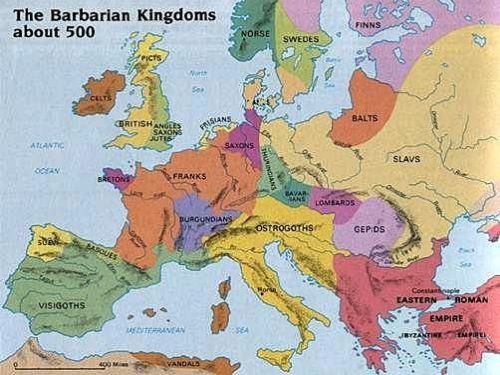
Europe around 500 AD

The Western Goths settled a few years in the Garonne valley in France until they conquered a kingdom, which included Spain and the South of France. In France, they were displaced by the Franks after a few years, and Spain was in 711 AD conquered by Muslim invaders – but the Goths descendants took the country back in the Middle Ages. The Eastern Goths established a thriving kingdom in Italy, but after only 67 years, they were defeated by armies sent by the emperor in Constantinople.

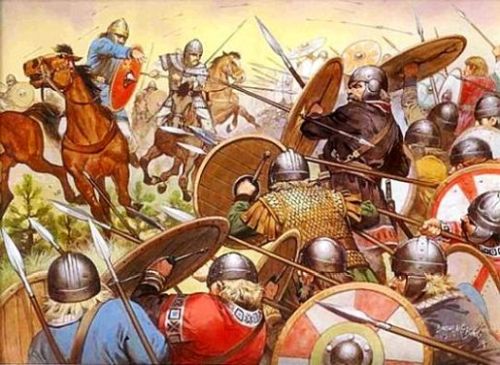
An artistic reproduction of the Goths in battle at Chalons

Top: A map of Europe showing the Germanic kingdoms that were established after the downfall of the Western Roman Empire. After numerous battles and long migrations, the Western Goths managed to settle in Spain and the Eastern Goths to take possession of Italy. However, it did not last forever. From ancientweb.org.
Bottom: An artistic reconstruction of the Western Goths in battle with Attila’s Huns at Chalons. From ancientweb.org.

When the first Goths arrived at the northern coast of the Black Sea about 170 AD, the climate was still influenced by the Roman Warm Period, which, however, ended about 400 AD. The Vandals crossed the frozen Rhine new year’s eve 406 AD, thus commencing the Migration time and heralding the downfall of the Western Roman Empire. The fact that the Rhine was frozen, testifies to a rather cold climate. I do not recall the Rhine has been frozen in modern times. From then on, until the disaster at Guadalete in Spain in 711 AD, when the Western Goths were defeated by invading Muslims, the climate was cold with snowy winters in northern and central Europe.

Goths can be traced further back in history to today’s northern Poland, and even in the distant past to their origins in Scandinavia and the Baltic area. Thus Jutland through thousand years was called Gotland.

Paul the Deacon tells about how the Langobards migrated from their original island in the ocean: “Now when the people living there had multiplied to such a number that they could no longer live together, they divided, it is told, their whole people into three parts and decided by casting lots, which of those, who were to leave the homeland and seek new places of residence.” Dudo confirmed many years later that it was a traditional way of solving problems of overpopulation in Scandinavia.

Also, the Gotland Gute Saga says that some of the people were taken for emigration by casting lot: “After a long time, the people have so increased that the country was not able to feed them all. So the land was distributed, on which every third tilled, each of these was allowed to keep and bring and take away everything, which he in his life had acquired.”

Pliny the Elder (23-79 AD) wrote: “Pytheas says that the Gutones, a people of Germania, inhabits the shores of an estuary of the Ocean called Mentonomon, their territory extending a distance of six thousand stadia; that, at one day’s sail from this territory, is the Isle of Abalus, upon the shores of which, amber is thrown up by the waves in spring, it being an excretion of the sea in a concrete form; as, also, that the inhabitants use this amber by way of fuel, and sell it to their neighbours, the Teutones.”

Gutones following Pytheas

Plinius wrote: “Pytheas says that the Gutones, a people of Germany, inhabit the shores of an estuary of the Ocean called Mentonomon, their territory extending a distance of six thousand stadia.” Other ancient writers also believed that the Baltic Sea and inner Danish waters was a major estuary.
Procopius wrote about the returning Heruls: “After these, they passed by the nations of the Dani, without suffering violence at the hands of the barbarians there. Coming thence to the ocean, they took to the sea, and putting in at Thule, remained there on the island.” – “And one of their most numerous nations is the Gauti, and it was opposite (next to?) them that the incoming Eruli settled at the time in question.” We must believe that Procopius shared the ancient authors believe that the Danish waters and the Baltic Sea was a large estuary, in which case it “opposite the Goths” can be understood: on the opposite side of the estuary. Alternatively, it should be translated “next to the Goths.” However, in both cases, suggesting that the Heruls were not Goths. The Heruls came before the Goths.

There is some uncertainty about how long a stadium was, the proposals vary between 160 and 192 m. That means that the coastline, which was inhabited by Gutones, was between 960 and 1.152 km. long. That gives a range from Skagen to the Vistula estuary at Gdansk.

gutlandmap1000ad

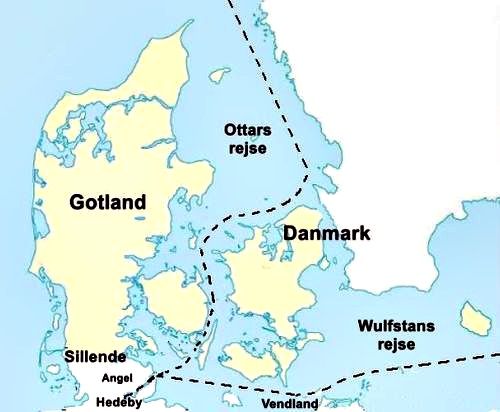
It suits very well with that the Jutland peninsula before the Viking Age was called Gotland, as it is the case in Ottar’s travelogue, added in Alfred the Great’s translation of Orosius’ Roman history from about 850 AC: “When he sailed there from Skíringssal (at Oslo), Denmark was on the port side and to starboard for three days was the open sea. And then, two days before he came to Hedeby, Gotland was to starboard (him wæs on þæt steorbord Gotland), and Sillende and many islands. The Angles dwelt in that area before they came here to this land.”

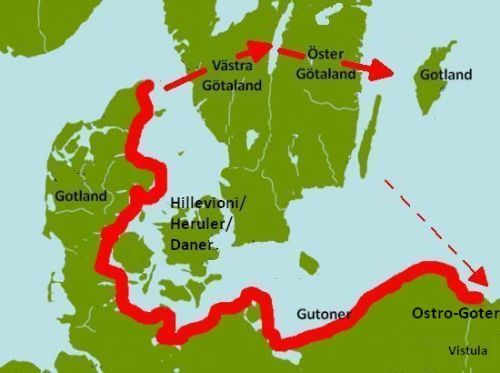
You could see Jutland/Gotland on the left and the light green marks where Jutland/Gotland spreads east and includes the Gotland Island that we know today.   There was very little water seperating Jutland/Gotland and Osterand Vistra Gotaland on the north.  It was called an estuary, and it is believe that this is why they made the longboats  as a narrow longboat.

Since the area was inhabited by Gutones in time before Christ – according to Pytheas – and as part of it still was called Gotland 800-900 AD, it is reasonable to assume that at least the coast along Kattegat and the Baltic Sea were the Goth’s original homeland.

Ottar's and Wulfstan's journeys

Ottar’s and Wulfstan’s travels according to additions in Alfred the Great’s translation of Orosius’ Roman history. Both Jutland and the island in the Baltic Sea are called Gotland. (The island of Gotland is not shown on this map).

That will indicate that Cimbri, Teutons, Angles and all other tribes, who lived along this coastline, and whose names we are not sure about, all originally have thought of themselves as kinds of Goths speaking the same language, namely Gothic.

Some believe that the Gutones on the densely populated Jutland east coast very early crossed the Kattegat and gradually populated West and East Gøta Land – and from there the island of Gotland in the Baltic Sea.

In Alfred the Great’s translation of Orosius’ Roman history is also added Wulfstan’s travel report from a voyage from Hedeby to Truso in Vistula’s delta from about 850 AC, which reads: “Wulfstan said that he traveled from Hedeby, and that he was in Truso in seven days and nights, and that the ship all the way went under sail. Wendland was on his starboard side and to port, he had Langeland, Lolland, Falster and Scania. These countries all belong to Denmark. So we had Bornholm to port, and they have their own king. So after Bornholm we had the countries named first Blekinge, More, Oland and Gotland to port (and Gotland on bæcbord), and these countries belong to the Swedes. And we had Wendland to starboard all the way to the Vistula river mouth.” By Gotland is here obviously meant the island of Gotland or maybe the coast of Eastern Gøtaland.

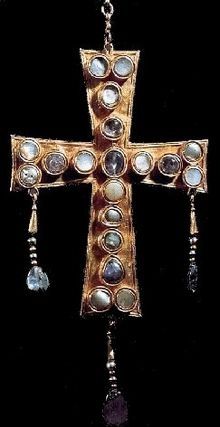
Gothic cross found in Spain

Gothic cross found in Spain perhaps from 700’s. From Pinterest.

Ptolemy placed the people Goutai on the island of Skandia and the Gudones by the Vistula river.

The Roman historian Cornelius Tacitus described the location of the Gotones as: “Beyond the Lugii is the monarchy of the Gotones: The hand upon the reins closes somewhat tighter here than among the other tribes of Germans, but not so tight yet as to destroy freedom. Then immediately following them and on the ocean are the Rugii and Lemovii. The distinguishing features of all these tribes are round shields, short swords, and a submissive bearing before their kings.” This means that Gotones, who was ruled by powerful kings, lived north or northeast of the Lugii and further inland than the Rugii and Lemovii, which he explicitly stated as residing at the sea. Perhaps Gotones lived at the Vistula river.

Jordanes located the peoples Ostro-Goths, Ewa-Greutingis and Gaiti-Goths on the island of Scandia. Gauti-Goths were “a race of men bold and quick to fight”, he wrote, and further, “But still another race dwells there, the Sweans, who like the Thuringos, having splendid horses.” With the term “another race” he must have meant that they were not Goths. “All these nation surpassed the Germans in size and spirit, and fought with the cruelty of wild beasts”, he concluded the description of the peoples on the Scandinavian peninsula.

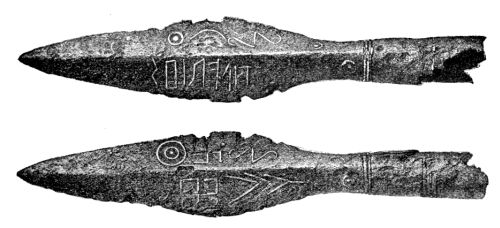
Lance tip with a runic inscriptions found near Kovel in the northwest corner of Ukraine

Right and left side of a lance head with runic inscription found near Kovel in the Northwest corner of Ukraine. The runic inscription to be read from right to left “Tilarids”. It has been identified as likely East Germanic, most likely Gothic because of the nominative s-suffix. It is from the beginning of the third century. From Wikipedia.

He mentions different tribes of Goths, who lived on the island of Skandia, including Greutingis and Ostro-Goths, which names we later recognize for Gothic peoples on the Danube and in Italy. This makes it likely that it is true that the Goths, who attacked the Roman Empire, originally came from Scandinavia and the coasts of the Baltic Sea. Furthermore, there are several areas of southern Scandinavia, which have been called, or still are named as Gotland with different spellings, which also support the theory that this region was the original homeland of the Goths. In his report on the Gothic war in Italy, Procopius mentions the Rugi, as part of the Goths in Italy; they are also referred to by Jordanes as one of Skandia’s indigenous tribes. They are also mentioned in other ancient sources.

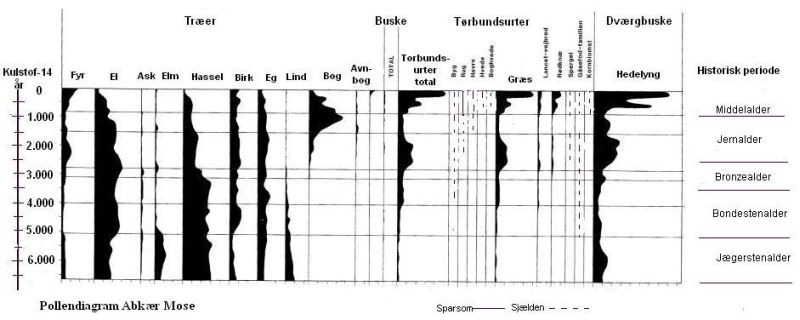
Pollen analysis from Abkjær 
Mose

Pollen analysis from Abkjær Mose at Vojens. It appears that forest, especially beech, increases sharply and herbs typical of open land, grass and heather decrease immediately after the migration time around 500 AD indicating that the forest returned to areas that previously were pastures for cattle. Similar studies in other parts of the country show the same pattern. It is reasonable to interpret that this could be due to emigration.
Also, Procopius reports on the returning Heruls suggests that Scandinavia was quite thinly populated. For how could they just “settle down”, as if they came to an untouched prairie? If not the country had been relatively sparsely populated.
However, when large parts of the original population had turned their back to good pastures, it may not only have been hunger and misery that drove them to emigrate.
It is known that for several hundred years of the late Imperial time the Roman legions were mostly populated with various Germanic soldiers since the Roman Empire’s own citizens did not seem to have been suitable. You could say that every Roman legion was a sort of Foreign Legion, in which also many young men from the South Scandinavian region must have served. Therefore the tribes around the Baltic Sea may have concluded that they were the best and the bravest – and therefore deserved to rule. Such attitudes among the Germanic tribes were most likely critical to the doom of the Western Roman Empire.

All these ancient authors wrote before official correct spelling was invented; they wrote in different languages with different alphabets and over a period of several hundred years. They reproduced words for Goths that often for them were in an unfamiliar language, besides most likely Gothic by this time had already developed in several dialects. It is quite understandable that they spelled it in so many different ways, and we do not have to connect any deeper meaning in the different spellings.

Germanic Village

Like other Germanic peoples the Goths lived spread out over farmland in small villages with each may be about 8-10 houses and farms.

In Book III of Justinian’s wars, Procopius wrote about the Goths’ early history: “Now while Honorius was holding the imperial power in the West, barbarians took possession of his land; and I shall tell, who they were and in what manner, they did so. There were many Gothic nations in earlier times, just as also at the present, but the greatest and most important of all are the Goths, Vandals, Visigoths, and Gepaedes. In ancient times, however, they were named Sauromatae and Melanchlaeni; and there were some too, who called these nations Getic. All these, while they are distinguished from one another by their names, as has been said, do not differ in anything else at all. For they all have white bodies and fair hair and are tall and handsome to look upon, and they use the same laws and practice a common religion. For they are all of the Arian faith, and have one language called Gothic; and, as it seems to me, they all came originally from one tribe, and were distinguished later by the names of those who led each group.”

Procopius is undoubtedly correct that most Germanic migrations peoples were a kind of Goths; they resembled each other and spoke largely the same language. But then they must originally have come from the same tribe, as he wrote. That is, we must believe that they all came more or less directly from the original Gothic area along the Baltic Sea, the Danish waters and from the southern part of the Scandinavian Peninsula. Procopius believed that also the Vandals and Gepids were kinds of Goths, although they were not generally named as such.

Moreover, in Denmark are clear indications of a big drop in population density in Germanic Iron Age relative to the Roman Iron Age, which indicates a considerable migration.

Carruthers crest on flag-v2 (1)

Preserving the Past, Recording the Present, Informing the Future

Ancient and Honorable Carruthers Clan Int Society 

carruthersclan1@gmail.com     carrothersclan@gmail.com

cropped-wide-banner-with-new-crest.jpg

Reviewed by Tammy Wise CHS- Indiana USA

CLAN SEANACHAIDHI

CLAN CARRUTHERS INT SOCIETY CCIS HISTORIAN AND GENEALOGIST

You can find us on facebook at :

https://www.facebook.com/carrutherscarrothers.pat.9

https://www.facebook.com/CarruthersClan/

https://www.facebook.com/CarruthersClanLLC

Disclaimer Ancient and Honorable Carruthers Clan International Society

I

DNA Gotland, Gutland / Gotland, Uncategorized

HAPLOGROUP l1 (YDNA) YOU ARE A VIKING!- CLAN CARRUTHERS CCIS

WIDE BANNER with NEW CREST

HAPLOGROUP l1

( YDNA)

ORIGINS AND HISTORY

IF YOU ARE A CARRUTHERS YOU ARE IN THE HAPLOGROUP l1 GROUP

IF YOU ARE IN THE HAPLOGROUP l1 YOU ARE A VIKING

GEOGRAPHIC DISTRIBUTION MAP

download (8)

Distribution of haplogroup I1 in Europe
Haplogroup I1 is the most common I subclade in northern Europe. It is found mostly in Scandinavia and Finland, where it typically represent over 35% of the male Y-chromosomes. Associated with the Norse ethnicity, I1 is found in all places
invaded by ancient Germanic tribes and the Vikings. Other parts of Europe speaking Germanic languages come next in frequency. Germany, Austria, the Low Countries, England and the Scottish Lowlands all have between 10% and 20% of I1 lineages.

Haplogroup I is the oldest major haplogroup in Europe and in all probability the only one that originated there (apart from very minor haplogroups like C6 and deep subclades of other haplogroups).

It is thought to have arrived from the Middle East as haplogroup IJ sometime between 45,000 and 50,000 years ago, and developed into haplogroup I approximately 40,000
years ago.

It has now been confirmed by ancient DNA test that Cro-Magnons, the first Homo sapiens to colonize Europe 45,000 years ago, belonged to haplogroups BT, CT, C, F, IJ and I.
The I1 branch is estimated to have split away from the rest of haplogroup I some 27,000 years ago. I1 is defined by over 300 unique mutations, which indicates that this lineage experienced a serious population bottleneck. Most of the Late Glacial and Mesolithic remains tested to date belonged to haplogroup I* or I2. It is not yet clear in which part of Europe I1 originated.

( THE CARRUTHERS BEING IN THE HAPLOGROUP l1, KNOW THAT THEY WERE IN THE HAPLOGROUP 1 PRIOR TO THAT, MORE THAN 30,000 YEARS.  )

It has been speculated that I1 evolved in isolation in Scandinavia during the late Upper Paleolithic and Mesolithic periods, when hunter-gatherers from southern Europe recolonised the northern half of the continent from their LGM refugia. The oldest attested evidence of postglacial resettlement of Scandinavia dates from 11,000 BCE with the appearance of the Ahrensburg culture .

However, five Y-DNA samples from Mesolithic Sweden, dating from c. 5800 to 5000 BCE and tested by Lazaridis et al. 2013 and Haak et al. 2015 all turned out to belong to haplogroup I2.
The earliest sign of haplogroup I1 emerged from the testing of Early Neolithic Y-DNA from western Hungary (SzécsényiNagy et al. 2014 ). A single I1 sample was identified alongside a G2a2b sample, both from the early Linear Pottery (LBK) culture , which would later diffuse the new agricultural lifestyle to most of Poland, Germany and the Low Countries. This means that haplogroup I1 was present in central Europe at the time of the Neolithic expansion.

( THE FIRST CARRUTHERS DNA STUDY WAS INSTRUMENTAL IN MATCHING US (CARRUTHERS) TO THE EARLY NEOLITHIC Y-DNA STUDY FROM WESTERN HUNGARY. THE NEOLITHIS REVOLUTION WAS ALSO CALLED THE FIRST AGRICULTURAL PERIOD, WHEN MANY OF OUR ANCESTORS WENT FROM HUNTERS-GATHERERS TO FARMERS. )

download (2)

LINEAR POTTERY CULTURE 5600-4025 BCE

It is therefore possible that I1 lineages were among the Mesolithic European hunter-gatherers assimilated by the wave of East Mediterranean Neolithic farmers (represented chiefly by Y-haplogroup G2a).

There is also evidence from the Neolithic samples of the Early Neolithic Starčevo and Cardium Pottery cultures that haplogroup I2a lived alongside G2a farmers both in south-east and south-west Europe.
The most likely hypothesis at present is that I1 and I2 lineages were dispersed around Europe during the Mesolithic, and that some branches prospered more than others thanks to an early adoption of agriculture upon contact with the Near Eastern
farmers who were slowly making their way across the Balkans and the Mediterranean shores.

The small group of farmers from the early LBK culture from Hungary might have formed a blend of I1 and G2a men. Yet distinct families would have
spread in different directions and met varying successes in their expansion. It would appear that a founder effect in the northern LBK population led to a sudden explosion of I1 lineages, perhaps in part thanks to their better knowledge of the Central European terrain and fauna (since hunting was typically practised side by side to agriculture to complement the farmers’ diet). I1 would later have spread to Scandinavia from northern Germany.

( CARRUTHERS ANCESTORS WERE PAID TO FIGHT.  SOMETIMES THEY FOUGHT WITH THE ROMANS, AND SOMETIMES AGAINST.  THESE ARE THE MEN WHO ARE ACCREDITED WITH SPREADING THEIR DNA ACROSS EUROPE)

This data is consistent with a Neolithic dispersal of I1 from Hungary with the LBK culture and the subsequent Funnelbeaker culture (4000-2700 BCE) in northern Germany and southern Scandinavia. One Swedish sample from the late Mesolithic
Pitted Ware culture (3200-2300 BCE) also turned out to belong to I2a1 and not I1.

download (10) FUNNELBEAKER CULTURE MAP

Both the Funnelbeaker and Pitted Ware cultures represent a merger between the Neolithic (farming) and Mesolithic (huntergatherer) lifestyles. Neolithic farmers from Germany penetrated late into Scandinavia and in small numbers.

There is archeological evidence that Neolithic farmers settled in southern Scandinavia and lived side by side with hunter-gatherers for several centuries during the Funnelbeaker culture. Skoglund et al. 2012 tested and compared the DNA of one Neolithic farmer and three hunter-gatherers from Sweden dating from 5,000 years ago. It turned out that the farmer was much closer genetically to modern Mediterranean people, especially the Sardinians, who are generally considered the best proxy population to Neolithic European farmers. The hunter-gatherers’s DNA resembled that of modern Northeast Europeans, and perhaps even more that of the Finns and Samis than Scandinavians.

( MANY MIGHT GET A L300 RESULT ON THEIR DNA.  PRIOR TO THE CARRUTHERS COMING FROM GUTLAND/GOTLAND, MANY LIVED IN FINLAND.)
Scandinavian hunter-gatherers ( CARRUTHERS IN GUTLAND) would have adopted the new Neolithic lifestyle little by little, using pottery and keeping domesticated animals (sheep, cattle, pigs and goats) to complement their traditional diet of fishing and game hunting. The cultivation of wheat, barley and legumes was fairly limited due to the cold climate. The cold climate was actually a barrier to the expansion of farmers from the continent. This is why Scandinavians retained a greater percentage of Mesolithic ancestry than virtually all other Europeans, apart from the Samis, Finns, Balts and Russians.
No ancient Y-DNA from the Funnelbeaker culture in Scandinavia has been tested to date, but it is likely that I1 really started gathering momentum toward the end of the Funnelbeaker period. It might also have been among the Funnelbeaker lineages
that were most successfully assimilated by Proto-Indo-European invaders during the Corded Ware culture (aka Battle-Axe culture in Scandinavia).

Most I1 individuals today share a common ancestor around the time of the transition between the Funnelbeaker and Corded Ware periods.


Carruthers crest on flag-v2 (1)


OFFICIAL AND REGISTEREDL CLAN CARRUTHERS CCIS SINCE 1983-CLAN OF OUR ANCESTORS

SCOTTISH CLAN – IRISH CLAN – NORSE CLAN


Preserving Our Past!    Recording Our Present!  Informing Our Future!

The Ancient and Honorable Carruthers Clan International Society LLC

carruthersclan1@gmail.com                carrothersclan@gmail.com

coacarrutehrs

MACIAMO HAY

EUPEDIA

CLAN CARRUTHERS INT SOCIETY CCIS HISTORIAN AND GENEALOGIST



New Blog Banner 05

You can find us on our main facebook pages at :

SILVER WINGS-https://www.facebook.com/CarruthersClanLLC/

GOLD WINGS – https://www.facebook.com/carrutherscarrothers.pat.9

CLAN CARRUTHERS FAMILY HISTORY – https://www.facebook.com/CarruthersClan

CLAN CARRUTHERS CCIS – https://www.facebook.com/groups/3878691252182714

CLAN CARRUTHERS INT SOCIETY- https://www.facebook.com/groups/394653845137709

CLAN CARRUTHERS – BORDER REIVERS – https://www.facebook.com/groups/434959914239094

Disclaimer Ancient and Honorable Carruthers Clan International Soci


The Viking Age, Uncategorized

CLAN CARRUTHERS – VIKING BOAT BURIAL

cropped-wide-banner-with-new-crest.jpg

VIKING BOAT BURIAL REVEALS ITS SECRETS

Six years after discovering and excavating the first Viking boat burial site discovered on the UK mainland, archaeologists have provided a glimpse into some of the mysteries this rare burial reveals.

Originally unearthed in 2011, the site in Swordle Bay, Scotland, was the first undisturbed Viking boat burial found on the UK mainland. After six years of work, Ardnamurchan Transitions Project’s findings were recently released in an in-depth report in the Journal of Antiquity, revealing, among other things, the growing relationship between Scotland and the Viking world at that time.

Post-excavation photograph of the burial site. (Credit: Antiquity Publications Ltd, 2017)

Post-excavation photograph of the burial site. (Credit: Antiquity Publications Ltd, 2017)

Viking boat burials themselves were extremely rare. Only practiced for the deaths of prominent individuals, the ritual used a boat as a coffin for the body and burial goods. Discovered under a low-lying natural mound close to the shore, this particular site was small, measuring approximately 17 feet by 5 feet, and thought to have contained a row boat that was accompanying a larger ship.

Other artifacts from the burial site. The sword (top); the sword in situ (below); the mineralized textile remains (right); detail of the decoration after conservation (left). (Credit: Pieta Greaves/AOC Archaeology).

Other artifacts from the burial site. The sword (top); the sword in situ (below); the mineralized textile remains (right); detail of the decoration after conservation (left). (Credit: Pieta Greaves/AOC Archaeology).

After excavating the site, archaeologists were able to reconstruct the steps of the burial. A boat-shaped depression was first dug into a natural mound of beach shingle. The boat was then inserted into the ground, and the body was placed inside, along with the grave goods. Stones were place inside and around the boat. As part of the closing of the site, a spear and shield boss (the round or convex piece of material at the center of a shield) were deliberately broken and deposited.

Pre-excavation photograph after initial cleaning. (Credit: Antiquity Publications Ltd, 2017)

Pre-excavation photograph after initial cleaning. (Credit: Antiquity Publications Ltd, 2017)

The ship, along with the human remains, decayed in the acidic soil long ago, but the grave artifacts remained, offering a glimpse into the possible origins of the deceased as well as the reach of Viking culture. A single copper alloy-ringed pin with three bosses—a style found in Ireland—was also found, believed to have originally been fastened to a burial coat. There was also a copper alloy drinking horn, thought to be Scandinavian in origin. Other grave goods included a sword, an axe, a sickle (found mostly in Scotland), a whetstone (probably Norwegian), flint strike-a-lights and two teeth—molars from only identified human remains. Hundreds of metal rivets that once held the vessel together, some with wood shards, were also discovered.


The Viking's teeth. (Credit: Antiquity Publications Ltd, 2017)

The Viking’s teeth. (Credit: Antiquity Publications Ltd, 2017)

An isotopic analysis of the teeth (the lower left first and second molars) revealed further information. The individual likely lived on, or close to, the coast, as indicated by an increase in consumption of marine proteins between the ages of 3 and 5. While marine protein was rarely consumed by humans in Britain, it was popular in Viking-era Norway. Further analysis of the teeth narrowed down the place of origin to eastern Ireland, northeastern mainland Scotland, Norway or Sweden.

The weapons included in the burial point to a warrior status and the artifacts and their internment infer high status, but the gender cannot be confirmed. While it is likely a male burial, some of the goods, such as the sickle, are more commonly associated with females. Current Viking’s scholarship points to a number (albeit smaller) of female warriors, as well as the discoveries and excavations of female boat burials.

 Some of the artifacts recovered from the burial site (clockwise from the top left): broad-bladed axe, shield boss, ringed pin and the hammer and tongs (Credit: Pieta Greaves/AOC Archaeology).

Some of the artifacts recovered from the burial site (clockwise from the top left): broad-bladed axe, shield boss, ringed pin and the hammer and tongs (Credit: Pieta Greaves/AOC Archaeology).

While there is still more to learn from this rare burial site, an important finding was revealed in the variety of grave goods from multiple geographic locations: The growing relationship between Scotland and the Viking world at that time.

Carruthers crest on flag-v2 (1)

Perserving the Past, Recording the Present, Informing the Future

Ancient and Honorable Carruthers Clan Int Society 

carruthersclan1@gmail.com     carrothersclan@gmail.com

cropped-wide-banner-with-new-crest.jpg

LISA JOHNSON – HISTORY CHANNEL

CLAN CARRUTHERS INT SOCIETY CCIS HISTORIAN AND GENEALOGIST

You can find us on facebook at :

https://www.facebook.com/carrutherscarrothers.pat.9

https://www.facebook.com/CarruthersClan/

https://www.facebook.com/CarruthersClanLLC

Disclaimer Ancient and Honorable Carruthers Clan International Society
OUR ANCESTORS, The Viking Age

CLAN CARRUTHERS CCIS – Return of Edwini

WIDE BANNER with NEW CREST


Return of Edwini


When the Pictish king Elphin lost two battles against the formidable Onuist in 728 the Annals of Clonmacnoise tell us ‘the nobles and people of the Picts turned their back’ on him. Elphin had become what the Anglo-Saxons would call a winelas guma, a ‘friendless man’, doomed to walk the wræclastas, ‘paths of exile’. A clue to where he found sanctuary might be found in the 758 obituary of an Elpin of Glasnevin, a monastery in County Dublin. If this was the same man as the discredited Elphin then he had chosen the safest, but by no means risk-free, path — that of monastic retirement.

The other main path open to a wræcca was to try to make a powerful ally. Around 604 the Bernician king Aethilfrith subjugated neighbouring Deira, a kingdom broadly co-extensive with the modern counties of Yorkshire and Lancashire. Deira’s evicted ruler Edwini sought refuge at the court of Rædwald, king of the East Angles. Aethilfrith asked Rædwald to kill the exile, promising him great riches if he did but war if he didn’t. According to the tradition Bede received, Rædwald was set to comply until his queen dissuaded him, arguing that to do so would be dishonourable. So instead, there was war; Rædwald slew Aethilfrith and returned Edwini to power.


The reconstructed helmet found at Sutton Hoo which many historians believe may have belonged to Rædwald.

The East Anglian queen’s distaste for the assassination plot has echoes of a story from the time of St Columba. According to Adomnán, Columba had arranged for an exiled Pictish nobleman, Tarain, to live under the protection of a man named Feradach of Islay. Feradach soon had Tarain killed and Columba’s subsequent outrage likely reflects the breaking of a fundamental social convention.

Linguistic differences were no barrier to serving your exile under another lord. When Edwini returned to Deira he took his revenge by banishing the sons of Aethilfrith. One of them, Eanfrith, fled to Pictland where he later married and fathered at least one son, Talorcan, who became a king of Picts in the 650s.

Furthermore, whether exiles or mere opportunists, at least two Picts joined the Britons of the Gododdin in their failed assault against the Anglo-Saxons at Catraeth.

Carruthers crest on flag-v2 (1)


Preserving Our Past, Recording Our Present, Informing Our Future

Ancient and Honorable Clan Carruthers Int Society CCIS  LLc

carruthersclan1@gmail.com                       carrothersclan@gmail.com

cropped-wider-banner-light-blue-1.jpg


Neil Carruthers

CLAN CARRUTHERS INT SOCIETY CCIS HISTORIAN AND GENEALOGIST


You can find us on facebook at :

https://www.facebook.com/carrutherscarrothers.pat.9

https://www.facebook.com/CarruthersClan/

https://www.facebook.com/CarruthersClanLLC


Disclaimer Ancient and Honorable Carruthers Clan International Society CCIS LLC is the official licensed and registered Clan of the Carruthers Family.  This Clan is presently registered in the United States and Canada, and represents members worldwide.  All content provided on our web pages is for family history use only.  The CCIS is the legal owner of all websites, and makes no representation as to the accuracy or completeness of any information on these sites or by following any link provided. The CCIS will not be responsible for any errors or omissions or availability of any information. The CCIS will not be liable for any losses, injuries, or damages from the display or use of this information. We do not sell, trade or transfer to outside parties any personal identifications. For your convenience, we may provide links to various outside parties that may be of interest to you. The content on CCIS is design to support your research in family history.      ( CCIS -LLC copyright 2017 - 2020)
The Viking Age

CLAN CARRUTHERS CCIS – Oswiu, King of Northumbria

WIDE BANNER with NEW CREST

Oswiu, King of Northumbria

EBK: Oswiu, King of Northumbria

It just might be one of the great alliances of the age that can be pieced together, and it began with one man’s death. Oswiu, king of Northumbria, was a formidable leader. His reach extended far beyond the once frontier land of the Forth valley. Regimes that came to paramountcy further north and west probably did so, in part, through his backing.

Cenél nGabrain, ‘the kindred of Gabrain’, enjoyed stability in Argyll, from where we know Oswiu exacted tribute. In Pictland, where his nephew, Talorcan, had been king in the 650s, Oswiu would likely have had a say in who replaced him. James E Fraser also argues that Niuduera had been a Pictish territory, centred on Fife, that was subject to Anglian settlement and power during this time.

It is into this world, then, that Oswiu’s death on February 15 670 would have sent shock waves. His son and successor, Ecgfrith, first had to deal with an uprising from the Picts. Together with the possibly Niuduarian sub-king, Beornhaeth, the new king defeated them, “filling two rivers with corpses”, and overthrew their ruler, Drest. Ecgfrith’s cousin, Bridei, took over.

It is here that our alliance has its genesis.

Bridei is the earliest king explicitly called rex Fortrenn, ‘king of Fortriu’, in the chronicles. Alex Woolf has convincingly argued that this chief kingdom of the Picts was centred on the shores of the Moray Firth. Its people were known in Old English as the Wærteras. Bridei was the son of Beli, a king of Clyde Rock. His mother meanwhile was apparently a half-sister of Eanfled – Oswiu’s wife and Ecgfrith’s mother.

Bridei’s nephew, Dumngual, ruled Alt Clut, the kingdom of Britons centred on Clyde Rock and its environs. It seems likely the two would have been predisposed to amity. The Clyde Britons also seem to have enjoyed good relations with Cenél Comgaill, who inhabited the Cowal peninsula. A further kin group, Cenél nGartnait, make up the fourth part of this reconstructed alliance.

Before Oswiu’s death, these parties were in the shadows to varying extents. I’ve always thought the battle of Luith Feirn that took place in 664 in Pictland was probably between Bridei and Drest for the kingship itself. Defeated, Bridei could have sought exile in Northumbria. It would explain the fact it took him and Ecgfrith 15 years to come to blows – at the battle of Dunnichen.

Oswiu’s expansionist tendencies had robbed Dumngual of many interests in central Scotland, perhaps explaining the realignment of the Clyde king’s focus to the west, Cenél Comgaill had been kept in check by a muscular Cenél nGabrain, and Cenél nGartnait had yet to gain the attention of the chronicles.

In Argyll, Domangart son of Domnall Brecc enjoyed dominion over the Corcu Réti (the Cenél nGabrain and Cenél Comgaill kindreds of Kintyre and Cowal). In the second year after Oswiu’s death, Domangart was slain and two men, perhaps implicated in his death, were captured. They were Elphin, who James E Fraser argues was a kinsman of Bridei, and Conamail son of Cano.

Conamail belonged to a seemingly Pictish / Gaelo-Pictish branch of Cenél nGabrain known as Cenél nGartnait. They seem to have belonged to the Isle of Skye and returned to Scotland in 670 following a brief exile in Ireland. With the date of their return in mind, they could have been looking to upset a status quo that had become entrenched under Oswiu.

If we assume the killing of Domangart was an attempted coup, it failed – his cousin, Máel Dúin, succeeded him. However, over the next 25 years Máel Dúin and his heirs would fight a losing battle for paramountcy in Argyll. By contrast, Cenél nGartnait’s prominince in genealogical tract Cethri prímchenéla suggests they flourished. Conamail escaped captivity and his son, Congus, later enjoyed prestige. If Cenél nGartnait thrived through Pictish/British support they were not the only ones.

Cenél Comgaill dynast Dargart mac Finnguine comes to prominence following his marriage to a certain Der-Ilei. She may have been a sister, or more likely a daughter, of Bridei. The fruits of their union were two eighth-century Pictish kings but Dargart would not live to see them reign. His death in 685 suggests he may have fallen at the battle of Dunnichen.


Loch Awe.

Three years after Domangart’s death sustained Pictish interest in Argyll is confirmed by an entry in the Annals of Ulster. They record that ‘many Picts were drowned in the land of Awe’ (i Llaind Abae), probably a scribal error for ‘in Loch Awe’ (i lind Abae).

Two years after that a distinctly more successful incursion into the west was made by a British force. Here Ferchar Fota, probably the king of Cenél nEchdach, likely based in Upper Lorn, was defeated in battle.

Yet it isn’t until the 680s that the north and west truly explode in a series of strongholds besieged, key men slain and regimes possibly overturned.

The catalyst could have been Ecgfrith’s defeat to the Mercian king Æthilred at the Trent in 679. Ecgfrith lost his brother in the battle as well as the hold he had enjoyed over Mercia since besting Æthilred’s predecessor in battle in 672. Æthilred’s victory stemmed the northward flow of southern tribute. In response Ecgfrith might have upped the taxes he exacted from his northern cousin and others. This, together with the air of vulnerability Oswiu’s son now had, perhaps prompted our allies to raise their game.

The Annals of Ulster record the siege of Dunnottar (Dún Foither) in 680, Bridei’s destruction of the Orkneys the year after, and the siege of Dundurn (Dún Duirn), near modern-day St Fillans, the year after that. The last two campaigns took place in the same years as known or suspected British aggression in the west. In 681 Britons invaded Mag Line, the Uí Chóelbad heartland in Antrim. Here they attacked the royal centre of Ráith Mór and slew the king. Then in 682 Dunadd (DúnAtt), in Argyll, was besieged.

Bridei fought Ecgfrith at Dunnichen in 685, a battle that was to claim the Anglian king’s life.

Dunnichen needn’t be seen as an allied victory. The conjectured involvement of Dargart mac Finnguine aside, it seems purely to have pitted Picts against Angles. The Annals of Inisfallen even curiously refer to it as ‘a great battle between Picts’. This perhaps indicates the no doubt considerable Niuduarian involvement.

What is clear, however, is that Bridei’s allies would have had a vested interest in a Pictish victory.

Bede was later to write: “The Picts recovered their own land which the Angles had formerly held, and the Irish who were in Britain and some part of the Britons recovered their liberty.”

Carruthers crest on flag-v2 (1)


Preserving Our Past, Recording Our Present, Informing Our Future

Ancient and Honorable Clan Carruthers Int Society CCIS  LLc

carruthersclan1@gmail.com                 carrothersclan@gmail.com

cropped-wider-banner-light-blue-1.jpg

Neil Carruthers 

CLAN CARRUTHERS INT SOCIETY CCIS HISTORIAN AND GENEALOGIST 

You can find us on facebook at :

https://www.facebook.com/carrutherscarrothers.pat.9

https://www.facebook.com/CarruthersClan/

https://www.facebook.com/CarruthersClanLLC

Disclaimer Ancient and Honorable Carruthers Clan International Society CCIS LLC is the official licensed and registered Clan of the Carruthers Family.  This Clan is presently registered in the United States and Canada, and represents members worldwide.  All content provided on our web pages is for family history use only.  The CCIS is the legal owner of all websites, and makes no representation as to the accuracy or completeness of any information on these sites or by following any link provided. The CCIS will not be responsible for any errors or omissions or availability of any information. The CCIS will not be liable for any losses, injuries, or damages from the display or use of this information. We do not sell, trade or transfer to outside parties any personal identifications. For your convenience, we may provide links to various outside parties that may be of interest to you. The content on CCIS is design to support your research in family history.      ( CCIS -LLC copyright 2017 - 2020)