
Gutland / Gotland, The History of Gutland, The Viking Age

RED DYES FOR CLOTHES IN THE VIKING AGE-CLAN CARRUTHERS CCIS

cropped-wide-banner-with-new-crestnorse

RED DYES FOR CLOTHES IN THE VIKING AGE

This first post will not exactly help you to dye clothes in red. Not directly. It aims at helping you gain awareness of why it’s actually not so easy to build certainties while dealing with accurate, archaeology-based reenactment.
I had to make this post, because doing reenactment is really a matter of how deep you are willing to delve, how much you are willing to read… and where you will choose to stop.
The better I get, the more uncertainties I have to face concerning the “accuracy” of what I’m doing.
Let’s start with a few facts. When making costumes, we base ourselves on archaeological finds.
Firts obvious statement : what we have been able to recover from the past is extremely little. Concerning viking age, we have maybe a dozen of extent garments, and they are not all coming from Scandinavia. Is a dozen garments representative from a period of history that lasted something like 300 years ?
Certainly not.
Second (a little bit less obvious) statement : fabric rots. The fragments that we have recovered were preserved by special conditions, whether mineralized in contact with metal (from brooches, knives, swords, shield bosses, silver and gold thread from table-woven trims, silver and gold posaments, pins, pendants, etc.) or preserved by particular qualities of the soil (for example, in bogs, like Huldremose “peplos-dress” which is not from viking period).
Tablet-woven trim from the Kostrup suspended dress photo by Hilde Thunem taken in Odense museum, Denmark
Some fabric have been recovered in funny circumstances, for example, Haithabu’s (modern Hedeby, Germany) viking-age harbour yielded fabric that had been used to repair ships, that had been doused in tar.
That leads us to the third (not obvious at all) statement : you have to be very careful when using evidence to back your costume projets. If you base yourself on evidence recovered from a grave, most likely, that means mineralized fabric in contact with metal. And if there is metal, most likely, that means a wealthy grave. Check if the assessed level of wealth of the grave matches your character’s level of wealth.
Ship-burials are for very wealthy people. Oseberg’s lady was a queen, or a chieftain’s lady. That means that despite the fact that we are very happy to have plenty of evidence from her grave, maybe, you shouldn’t use that for your costume. Tablet-woven trims were luxury items, if there are gold and silver threads to preserve them, you will need all of your costume to be accordingly rich.
NOT a middle-class garment, so if you are, choose something else.

Dress made by Toril Sørbøe Rojahn,

Some of the fabric recovered from excavations are more likely to have belonged to humble people. The clothes from bodies found in bogs, the fabric from Haithabu harbour are probably better evidence if your character is humble. But it’s not easy to make out their colour !
The acidic Ph of the bogs makes it difficult to analyze the dyes. It’s the same for clothes that have spent a long time in the sea, or under ice (the Greenland settlements have yielded a lot of extent garments, although they are XIIIth-XIVth century, not viking-age).
The conclusion is : the coloured clothes samples that are at our disposal to guess what was used for dyeing are not representative of “the viking period”. They can be representative of the settlement, or of the burial site, though. In Birka, there was a wealthy area of burials, and a poorer one. Guess what ? More grave goods are recovered from the wealthy area. Solid information about a specific site doesn’t allow us to jump to general conclusions.
Most costumes we see in festivals are typical of high-rank individuals. There are trims and jewels galore. Do not let this lead you to the conclusion that most people of the viking period dressed this way !
In Thor Ewing’s opinion, red clothes were more likely to be costly items, the dyed fabric either being imported, or dyed with imported madder.
Can we be sure of that ? No. We can only gather evidence, and make educated guesses.
In my opinion, fabric produced domestically could not have only been dyed with the top-quality, most-efficient dyestuffs. Some must have been dyed with local plants. But this would have been done by poorer individuals… and unfortunately, we don’t have a lot of evidence for them, because their graves have been lost.
Red dyes achieved with bedstraw, by Jenny Dean
Moreover, when dyes can actually be analyzed, they are not always recognized. Quite a lot of yellow samples from the viking age haven’t been identified at all. They are referred as “X yellow”. Dyer’s broom and weld are quite commun yellow dyes, but they are not the only ones. A considerable number of plant gives yellow, and many of them are solid dyes that would not be sneezed at by the housewife when she made her cloth.
A smaller number of plants gives really interesting red colour, which (thankfully !) restrains the field of investigation, but still there is a lot of space for study.
I intend to research evidence for red dyes and their use during the viking period, and write an article on the subject. But it’s a tricky subject indeed, and we have to speculate, guess, and make hypothesis.
I hope this preliminary article have “rung your bell” and made you more aware of the need for carefulness when embarking on making a costume, choosing the fabric, the weave, the colour and the ornaments.

cropped-wider-banner-light-blue-1.jpg
OFFICIAL AND REGISTERED CLAN CARRUTHERS  CCIS -1983-CLAN OF OUR ANCESTORS
SCOTTISH CLAN, IRISH CLAN,  NORSE CLAN

Preserving Our Past!    Recording Our Present!  Informing Our Future!

The Ancient and Honorable Carruthers Clan International Society CCIS

carruthersclan1@gmail.com                carrothersclan@gmail.com
Crest on Light Blue

Reviewed by Tammy Wise CHS- CHAIRMAN – Indiana USA

CLAN SEANACHAIDHI

CLAN CARRUTHERS INT SOCIETY CCIS HISTORIAN AND GENEALOGIST

You can find us on our main facebook pages at :

SILVER WINGS-https://www.facebook.com/CarruthersClanLLC/

GOLD WINGS – https://www.facebook.com/carrutherscarrothers.pat.9

CLAN CARRUTHERS FAMILY HISTORY – https://www.facebook.com/CarruthersClan

CLAN CARRUTHERS CCIS – https://www.facebook.com/groups/3878691252182714

CLAN CARRUTHERS INT SOCIETY- https://www.facebook.com/groups/394653845137709

CLAN CARRUTHERS – BORDER REIVERS – https://www.facebook.com/groups/434959914239094

Disclaimer Ancient and Honorable Carruthers Clan International Society

OUR ANCESTORS, The Viking Age

ERIK II- KING OF NORWAY – MAGNUSSON OF NORWAY – CLAN CARRUTHERS CCIS

WIDE BANNER with NEW CREST

ERIK II

KING OF NORWAY

MAGNUSSON OF NORWAY – NORGE

Eirik Magnusson (Old Norse: Eiríkr Magnússon) (1268 – 15 July 1299) was the King of Norway from 1273/80 until 1299.

When Erik II (King of Norway) Magnusson de Norway (Norge) was born on January 7, 1268, in Tønsberg, Vestfold, Norway, his father, Magnus, was 29 and his mother, Ingeborg, was 24.

He was the eldest surviving son of King Magnus the Lawmender of Norway, and his wife Ingeborg Eriksdatter, daughter of King Eric IV of Denmark. Eric descended from St. Olav, King Olav II of Norway, being the first after Magnus the Good of that saint’s descendants to ascend that throne (i.e, the descendants of St. Olav returned to kingship of Norway). He became junior king in 1273 and started ruling alone after 1280.

Erik II Magnusson – History… the interesting bits!

Eirik married princess Margaret of Scotland, daughter of King Alexander III of Scotland in 1281. Margaret died two years later in labour, giving birth to Margaret, Maid of Norway, who became queen of Scotland in 1286 until her death in 1290. Her death sparked off the disputed succession which led to the Wars of Scottish Independence.

Eirik later married Isabel Bruce, sister of King Robert I of Scotland. Their marriage did not produce a surviving male heir, though it did produce a daughter, Ingeborg Eriksdottir of Norway, who married Valdemar Magnusson of Sweden, Duke of Finland, in 1312. Ingeborg Eriksdotter was styled Duchess of Öland.

  King Eric II of Norway – The Freelance History Writer

Eirik received the nickname “Priest Hater” from his unsuccessful relations with the church. He is normally counted a weak and inoffensive man who was mostly guided by his councillors. Probably because of his claim on his maternal heritage he supported the Danish outlaw Stig Andersen Hvide, who ravaged the Danish coasts for some years after the regicide of King Erik V.

As Eirik died without sons, he was succeeded by his brother, Haakon V of Norway. He was buried in the old cathedral of Bergen, which was demolished in 1531. Its site is marked by a memorial, in present-day Bergenhus Fortress.

Erik II Magnusson – History… the interesting bits!

OFFICIAL AND OLDEST SCOTTISH  CLAN CARRUTHERS

 SINCE 1983-CLAN OF OUR ANCESTORS

SCOTTISH CLAN – IRISH CLAN – NORSE CLAN

Carruthers crest on flag-v2 (1)

DR PATRICIA CARROTHERS CHS

REVIEWED BY : TAMMY WISE – INDIANA USA  CHS

CLAN CARRUTHERS  HISTORIAN AND GENEALOGIST

New Blog Banner 05

Preserving Our Past, Recording Our Present, Informing Our Future

Ancient and Honorable Clan Carruthers

   clancarruthers1@gmail.com

59ef7250711564a8761d3a0b23bc2353

You can find us on our main facebook pages at :

SILVER WINGS-https://www.facebook.com/CarruthersClanLLC/

GOLD WINGS – https://www.facebook.com/carrutherscarrothers.pat.9

CLAN CARRUTHERS FAMILY HISTORY – https://www.facebook.com/CarruthersClan

CLAN CARRUTHERS CCIS – https://www.facebook.com/groups/3878691252182714

CLAN CARRUTHERS INT SOCIETY- https://www.facebook.com/groups/394653845137709

CLAN CARRUTHERS – BORDER REIVERS – https://www.facebook.com/groups/434959914239094

Disclaimer Ancient and Honorable Carruthers Clan International Soci
DNA Gotland, Gutland / Gotland, OUR ANCESTORS, The History of Gutland, Uncategorized

ERIC II (KING OF NORWAY) MAGNUSSON DE NORWAY (NORGE) CLAN CARRUTHERS CCIS

WIDE BANNER with NEW CREST

Eric Magnusson (1268 – 15 July 1299) (Old Norse: Eiríkr Magnússon; Norwegian: Eirik Magnusson) was the King of Norway from 1280 until 1299. CARRUTHERS DNA ANCESTOR

Eirik was the eldest surviving son of King Magnus the Lawmender of Norway, and his wife Ingeborg Eriksdatter, daughter of King Eric IV of Denmark. In 1273, when he was 5 years old, he was given the title of king, alongside his father, who planned to hold a coronation for Eirik as his subordinate co-ruler in the summer of 1280. However, King Magnus died before this could be arranged, and Eirik became sole king and was crowned as such in Bergen in the summer of 1280. During his minority, the kingdom was ruled by a royal council consisting of prominent barons and probably also his mother, the dowager queen Ingeborg. After Eirik came of age in 1282, this royal council is still thought to have had a major influence over his reign. [2] His brother, Haakon, was in 1273 given the title “Duke of Norway”, and from 1280 ruled a large area around Oslo in Eastern Norway and Stavanger in the southwest, subordinate to King Eirik. The king’s main residence was in Bergen in Western Norway. [2]

Eirik married princess Margaret of Scotland, (Carruthers DNA Ancestor) daughter of King Alexander III (Carruthers DNA Ancestor) of Scotland in Bergen in 1281.   Margaret died two years later in childbirth, giving birth to Margaret, Maid of Norway, who was to be Queen of Scotland, but she died in 1290. Her death sparked the disputed succession which led to the Wars of Scottish Independence. [3] Eirik briefly and unsuccessfully laid claim to the Scottish crown as inheritance from his daughter. [2]

Eirik later married Isabel Bruce, ( Carruthers DNA Ancestor ) sister of King Robert I of Scotland. ( Carruthers DNA Ancestor) Isabel was one of the Bruce Women who were kept in cages for several years.  When Isabel was released Erik went and brought her to Norway.  Their marriage did not produce a surviving male heir, though it did produce a daughter, Ingeborg Eriksdottir of Norway, who married Valdemar Magnusson of Sweden, Duke of Finland, in 1312. Ingeborg Eriksdotter was styled Duchess of Öland. [4]

Reign

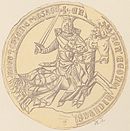
Kong Eirik Magnusson PI IX 1.jpg Kong Eirik Magnusson PI IX 2.jpg Seal of Eric in known use 1289–98, with obverse (left) and reverse (right).

A prominent feature of Eirik’s reign was the war with Denmark, called the War of the Outlaws (De fredløses krig), which was waged on and off from 1289 until 1295. A major motivation for this warfare was Eirik’s claim on his mother’s Danish inheritance. In 1287, he entered into an alliance with a group of Danish nobles, most prominently Jacob Nielsen, Count of Halland and Stig Andersen Hvide, who were outlawed in Denmark for allegedly murdering the Danish king Eric V. Eirik gave the outlaws sanctuary in Norway in 1287. King Eirik himself led a large Norwegian fleet which, along with the Danish outlaws, attacked Denmark in 1289, burning Elsinore and threatening Copenhagen. Renewed naval attacks on Denmark were made in 1290 and 1293, before peace was made in 1295. [5]

Eirik received the nickname “Priest Hater” from his unsuccessful relations with the church.

As Eirik died without sons, he was succeeded by his brother, as Haakon V of Norway. He was buried in the old cathedral of Bergen, which was demolished in 1531. Its site is marked by a memorial, in present-day Bergenhus Fortress. [6] [7]

Name in native language Eiríkr II prestahatari Magnússon
Date of birth 4 October 1268
Norway
Date of death 15 July 1299
Bergen
Place of burial
  • Bergen Cathedral
Country of citizenship
  • Norway
Occupation
  • sovereign
Position held
  • Monarch of Norway (1280–1299)
Family
  • House of Sverre
Father
  • Magnus VI of Norway
Mother
  • Ingeborg of Denmark, Queen of Norway
Sibling
  • Haakon V of Norway
Child
  • Margaret, Maid of Norway
  • Ingeborg Eriksdottir of Norway
Spouse
  • Margaret of Scotland (1281–)
  • Isabel Bruce

Carruthers crest on flag-v2 (1)

OFFICIAL AND REGISTEREDL CLAN CARRUTHERS CCIS SINCE 1983-CLAN OF OUR ANCESTORS

SCOTTISH CLAN – IRISH CLAN – NORSE CLAN

Preserving Our Past!    Recording Our Present!  Informing Our Future!

The Ancient and Honorable CLAN CARRUTHERS CCIS

CLANCARRUTHERS1@GMAIL.COM

cropped-wide-banner-with-new-crest.jpg

CLAN CARRUTHERS  CCIS HISTORIAN AND GENEALOGIST

You can find us on our main facebook pages at :

SILVER WINGS-https://www.facebook.com/CarruthersClanLLC/

GOLD WINGS – https://www.facebook.com/carrutherscarrothers.pat.9

CLAN CARRUTHERS FAMILY HISTORY – https://www.facebook.com/CarruthersClan

CLAN CARRUTHERS CCIS – https://www.facebook.com/groups/3878691252182714

CLAN CARRUTHERS INT SOCIETY- https://www.facebook.com/groups/394653845137709

CLAN CARRUTHERS – BORDER REIVERS – https://www.facebook.com/groups/434959914239094

Disclaimer Ancient and Honorable Carruthers Clan International Socie

References

  1. ↑ Lillehammer, Grete, et al. (1995) Museoteket ved Arkeologisk museum i Stavanger: Rogalandsfunn fra istid til middelalder, p. 108
  2. Narve Bjørgo, “Eirik Magnusson” in Norsk biografisk leksikon vol. II, (Oslo, 2000), pp. 436-437
  3. ↑ Margrete Eiriksdotter (Store norske leksikon)
  4. ↑ Isabella Bruce (Store norske leksikon)
  5. ↑ Tor Einar Fagerland, Krig og diplomati i nordisk middelalder (Oslo, 2002) pp. 82-96
  6. ↑ Eirik Magnusson (Store norske leksikon)
  7. ↑ Eirik Magnusson 1280-1299 (Eirik Magnussons mynthistorie)