

Gutland / Gotland, OUR ANCESTORS, The History of Gutland, The Viking Age

CLAN CARRUTHERS – EARLY HISTORY OF THE GOTHS

cropped-wide-banner-with-new-crest.jpg

EARLY HISTORY OF THE GOTHS

Jordanes describes how his own people, the Ostro-Goths, originally came from the interior of the Scandinavian Peninsula, perhaps from the Gøta lands: “The same mighty sea has also in its Arctic region, that is in the north, a great island named Scandia, from which my tale (by God’s grace) shall take its beginning. For the race, whose origin you ask to know, burst forth like a swarm of bees from the midst of this island and came into the land of Europe. But how or in what wise we shall explain hereafter, if it be the Lord’s will.”
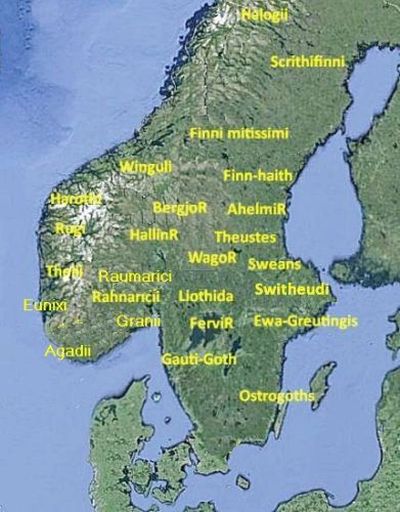
The tribes on the island of Scandia following Jordanes

The tribes on the island Scandza after Jordanes – quite randomly placed by the author. We can place Halogi, Scrithfinni, Finn Haith and Finni Mitissimi north after their names. Sweans and Switheudi around Malern – as we believe that they are the Swedes. Gautigoths and Ostrogoths in the Gøta lands, Dani in Scania and some people reminiscent of modern Norwegian place names, Raumarici and Agadii as well as possible in Norway. The rest I have placed pretty randomly.

Jordanes lived around 550 AD in Constantinople. It is assumed that the Ostrogoths left Scandza around 150 AD. If a generation is considered to 25 years, it will then be 16 generations since they left the Scandinavian Peninsula. In all that time they had preserved the memory of the country that they left long ago, orally from generation to generation. That witnesses of a strong sense of national identity. Another possibility is that they had a sporadic connection to their original homeland all the time.

“Now from this island of Scandia, as from a factory of races or a vagina of nations, the Goths are said to have come forth long ago under their king, Berig by name. As soon as they disembarked from their ships and set foot on the land, they straightway gave their name to the place. And even to-day it is said to be called Gutisk-Andja”

“Soon they moved from here to the abodes of the Hulm-Rugians, who then dwelt on the shores of the Ocean,” Jordanes continued, “where they pitched camp, joined battle with them and drove them from their homes. Next, they subdued their neighbors, the Vandals, and thus added to their victories.”

It is believed that the Ostro-Goths went ashore in what today is modern Poland, at the mouth of River Vistula. It happened around 150 AD

Archaeologists have unearthed burial sites in the Vistula River delta and lower reaches, which exhibit many common features with contemporary burial sites in southern Scandinavia. The culture has been baptized the Wielbark culture after the main findings place. There have been found both inhumation grave and cremations, just as is the case in Jutland and Gøta lands at the same time. The deceased is laid to rest in stone-built tombs, and they have rarely been given weapons, but sometimes spores, which is also a similarity with inhumation graves in Jutland at the same time. Most believe that the Wielbark culture can be attributed to the Goths and Getae, but not everyone is convinced. The graves have been dated from the first century until 300-400 AD.
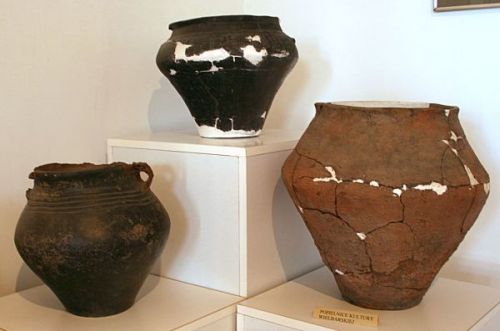
Ceramics from the 
Wielbark culture

Ceramics from the Wielbark culture exhibited in the Polish Museum Odry

When the Goths had lived for a while at the Vistula River delta, they decided to go south, where, however, a disaster awaited them. Jordanes recounts: “But when the number of the people increased greatly and Filimer, son of Gadarik, reigned as king about the fifth since Berig, he settled on the plan that the army of the Goths with their families should move from that region. In search of suitable homes and pleasant places, they reached the lands of Scythia, which in their tongue are called Oium. Here they were delighted with the great richness of the country, and it is said that when half of the army had been brought over, the bridge, whereby they had crossed the river, collapsed irreparably, nor could anyone thereafter pass to or fro. For the place is said to be surrounded by quaking bogs and an encircling abyss, so that by this double obstacle nature has made it inaccessible. Indeed, one might give credence to the assertions of travelers even if they have heard it from afar that in that area even today the lowing of cattle is heard and traces of men are found.”

Normally, it is not expected of a king, a responsible leader, to abandon half of his people in the wilderness and just leave them to their fate. One must think that the situation was desperate.

In this way the Gothic army and their families became split into two parts, namely the group that already had crossed the river led by Filimer, and the remaining group, which did not manage to get across the river: “So having crossed the river, this part of the Goths which migrated with Filimer went into the territory of Aujom, they say, took possession of the desired land. There they quickly came upon the race of the Spali, joined battle with them and won victory.”

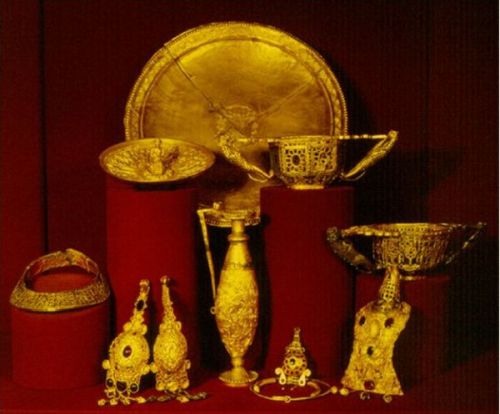
The Pietroasele treasure

The Pietroasele treasure was found in Pietroasele near Buzau in Romania in 1837. It is a Gothic treasure from the fourth century. It is on display at the National Museum of Romanian History in Bucharest. Originally it consisted of 22 pieces, but only 12 have been preserved including a neck ring with a Gothic runic inscription in older futhark – photo Wikipedia.

“Thence the victors hastened to the farthest part of Scythia, which is near the sea of Pontus; for so the story is generally told in their early songs, in almost historic fashion,” Jordanes recounts. “To return, then, to my subject. The aforesaid race of which I speak is known to have had Filimer as king, while they remained in their first home in Scythia near the Sea of Asov.”

Only now, Jordanes mentions that Filimer’s people were divided into two groups of Goths, led each by its own dynasty: “In their third dwelling place, which was above the Black Sea, they had now become more civilized and, as I have said before, were more learned. Then the people were divided under ruling families. The Visigoths served the family of the Balti and the Ostrogoths served the renowned Amali.”

Jordanes tells nothing about what became of the part of the original group that was cut off because of the disaster at the bridge.

Especially previously, most historians believed that Visigoths and Terwingi were only different names for Western Goths and Ostrogoths and Greuthungi were other names for the Eastern Goths. But we must remember that Jordanes told that both Ostrogothae and Ewa-Greutingi were tribes that populated the interior of the island Scandia; this alone makes it unlikely that Ostrogoths and Greutungi was one and the same.
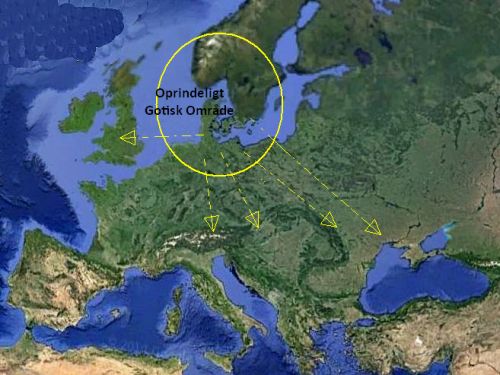
The original Gothic
area

They looked like each other and spoke the same language, as Procopius wrote. So they must also have had the same origin: the original Gothic area in Southern Scandinavia and around the Baltic Sea. Most likely it had been a bit by random if the ancient writers included Greutungi, Terwingi, Rugi, Vandals and Gepids in the group of Goths or not. Most of the tribes, who arrived into the Roman Empire through the Black Sea coast, were classified as Goths, while other, who did not come in contact with the Roman world via the Black Sea area, were not, even though they spoke Gothic.

It is tempting to recall that all Gothic areas on the southern Scandinavian peninsula and along the Baltic Sea and inner Danish waters were very densely populated in Roman Iron Age, if not overpopulated. One can easily imagine that other Gothic people tried their luck in the south. However, they did not have a chronicler, like the Ostrogoths had in Jordanes.

Jordanes wrote about the emigration from the Vistula delta that Filimer decided: “that the army of the Goths with their families should move from that region”, he did not write that the entire people emigrated. A migrant people like Filimer’s Goths, who went through relatively sparsely populated areas and even were halved by the disaster with the collapsed bridge, may, for logistical reasons, not have included much more than maybe a few thousand people.

In connection with the disaster at the bridge, the story mentions that long after, one could hear the roaring of cattle at the abyss; it indicates that the Goths brought their cattle. But there would have been limits on how much cattle and thus how many people, who could travel the same path, for there must be grass for the cattle.

They arrived at the northern coast of the Black Sea about 170 AD, and already around 250 AD – only three generations after – they were numerous enough to populate most of southern Ukraine and Romania, to conclude agreements with the Roman Empire and subsequent to attack the nearby Roman provinces. It must have required a Gothic population of several hundred thousand. This means that if Filimer’s Goths had been the only origin to the numerous Gothic population in the area, then they should have performed a bluntly miraculous fertility, which seems very unlikely also with the contemporary living conditions considered.
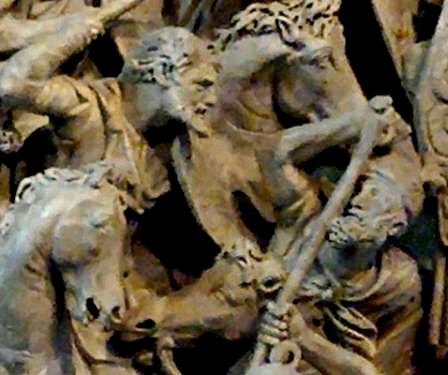
Battle scene on the Portonaccio sarcophagus

Battle scene between Romans and Germans or Dacians on the Portonaccio sarcophagus. The barbarians all have curly hair and beard, The man in bottom right has a kind of cap or helmet – which is said to be characteristic for Dacians – otherwise, only the Roman soldiers carry helmets. The sarcophagus is found in Rome and dated to the 2. century – Photo Wikipedia.

It is much more credible that the Gothic population in southern Ukraine was made up by many small groups – similar to Filimer’s Goths – which had emigrated from the over-populated original Gothic area in the north, but only Filimer’s Goths got their quest immortalized by a chronicler. The historian Peter Heather mentions, for example, at least seven different groups of Goths.

Amminius wrote about the reason for the Goth’s later wish to seek refuge in the Roman Empire: “Yet when the report spread widely among the other Gothic peoples, that a race of men hitherto unknown had now arisen from a hidden nook of the earth, like a tempest of snows from the high mountains, and was seizing or destroying everything in its way – ” The phrase: “the other Gothic peoples” clearly gives the impression that there were many Gothic peoples and not only two.

Moreover Athanaric, who was king of the Western Goths, wanted to establish a defense against the Huns, but other leaders, Alavivus and Fritigern, preferred to seek shelter inside the Roman Empire with their subgroups and left Athanaric and the rest of the Western Goths to their fate. If the Western Goths had been a homogeneous group, which Jordanes suggests, could we then imagine such desertion?

Likewise with the Eastern Goths, led by Alatheus and Saphrax; they ran away from it all and left the rest of the Eastern Goths face to face with the Huns. Would they have done this, if the Eastern Goths had been a homogenous group, one people with a common history? It is much more likely that both the Western and the Eastern Goths were coalitions of many original groups.
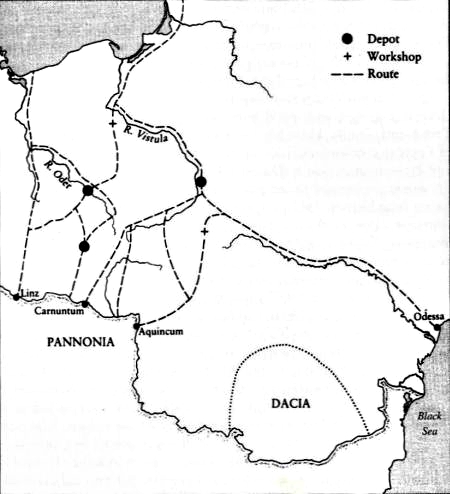
The ancient amber routes

The main route of the ancient amber trade went down along the river Vistula and then to Carnuntum in Austria halfway between Vienna and Bratislava, from there the route led to the River Po, which in ancient times was called Eridanos, where there was a market for amber. In addition, several other very old trade routes have been identified in Eastern Europe. Already in the Bronze Age amber, bronze and slaves were transported along these routes. We can imagine that the Cimbri and Teutons traveled down along the Oder to Linz on their infamous raid. We must believe that many groups of Goths with their kilometer long road trains followed the rivers Vistula and Dnieper to the coast of the Black Sea. The amber routes were well known even in Rome, for example Emperor Nero sent an agent to the Baltic to buy a large quantity of amber for decorations of the imperial palaces. – From “The Goths” by Peter Heather.

Ptolemy placed the people Goutai on the island of Skandia while the people Gudones at the Vistula River. It is most often explained as a kind of mistake or name confusion, but the right explanation is probably that already then were several groups of Goths; It is also historian Herwig Wolfram’s view.

The Gothic armies have likely been composed of many different groups of Goths, who identified themselves with the names of their original homes in the north or the names of their leaders as Procopius said; such as Ostro-Goths, Greuthungi Goths, Gaiti-Goths, Visi-Goths, Terwingi Goths, Rugi and Rheid-Goths. Eudoses has likely originated from Jutland. Scirii is said to have spoken a Gothic language, though no ancient sources call them Goths. One can imagine that the Gothic area north of the Black Sea was a kind of that time America, where different groups of emigrants from the original Gothic area became mixed together in alternating coalitions.

A very large Gothic group under Radagaisus went directly against Italy but was stopped at Florence by a Roman army of overwhelming strength. Nothing is said about them to be Eastern or Western Goths; they were only a kind of Goths, who came more or less directly from the Goth’s northern homeland.

Carruthers crest on flag-v2 (1)

Preserving the Past, Recording the Present, Informing the Future

Ancient and Honorable Carruthers Clan Int Society 

carruthersclan1@gmail.com     carrothersclan@gmail.com

cropped-wide-banner-with-new-crest.jpg

Dr Patricia Carrothers

Reviewed by Tammy Wise CHS

CLAN SEANACHAIDHI

CLAN CARRUTHERS INT SOCIETY CCIS HISTORIAN AND GENEALOGIST

You can find us on facebook at :

https://www.facebook.com/carrutherscarrothers.pat.9

https://www.facebook.com/CarruthersClan/

https://www.facebook.com/CarruthersClanLLC

Disclaimer Ancient and Honorable Carruthers Clan International Society
Gutland / Gotland, OUR ANCESTORS, The History of Gutland, The Viking Age

CLAN CARRUTHERS – HOW DID THE GOTHS OR GOTS LOOK?

cropped-wide-banner-with-new-crest.jpg

HOW DID THE GOTS OR GOTHS LOOK?

The Roman writer and diplomat Sidonius Apollinaris described the Gothic king Theoderic in a letter to his brother in law Agricola:

“You have often begged a description of Theodoric, the Gothic king, whose gentle breeding fame commends to every nation; you want him in his quantity and quality, in his person, and the manner of his existence. I gladly accede, as far as the limits of my page allow, and highly approve so fine and ingenious a curiosity.”

“Well, he is a man worth knowing, even by those who cannot enjoy his close acquaintance, so happily have Providence and Nature joined to endow him with the perfect gifts of fortune; his way of life is such that not even the envy which lies in wait for kings can rob him of his proper praise. And first as to his person.

Olof Palme as a young man

Olof Palme as a young man – It is no easy task that Sidonius gives us. When we look around, we notice that short-skulled types with round heads may have stoop nose, and long-skulled types with narrow faces can have eagle nose. However, a short-skulled type with round head and eagle nose is almost an impossibility. Olof Palme seems to be little long-skulled, but not much, and has a slightly curved nose. Sidonius’ Goths may have looked something like that.

“He is well set up, in height above the average man, but below the giant. His head is round, with curled hair retreating somewhat from brow to crown. His nervous neck is free from disfiguring knots. The eyebrows are bushy and arched; when the lids droop, the lashes reach almost half-way down the cheeks. The upper ears are buried under overlying locks, after the fashion of his race. The nose is finely aquiline; the lips are thin and not enlarged by undue distension of the mouth. Every day the hair springing from his nostrils is cut back; that on the face springs thick from the hollow of the temples, but the razor has not yet come upon his cheek, and his barber is assiduous in eradicating the rich growth on the lower part of the face. Chin, throat, and neck are full, but not fat, and all of fair complexion; seen close, their colour is fresh as that of youth; they often flush, but from modesty, and not from anger. His shoulders are smooth, the upper- and forearms strong and hard; hands broad, breast prominent; waist receding. The spine dividing the broad expanse of back does not project, and you can see the springing of the ribs; the sides swell with salient muscle, the well-girt flanks are full of vigour. His thighs are like hard horn; the knee-joints firm and masculine; the knees themselves the comeliest and least wrinkled in the world. A full ankle supports the leg, and the foot is small to bear such mighty limbs.”

He does not mention anything about how the rank and file Goths look like, but in the middle of the description he switches to plural; then we must believe that they have resembled their king.

In a letter to a senator named Catullinus, Sidonius tells about how it felt like for a Roman to be surrounded by barbarians: “Why – even supposing I had the skill – do you bid me compose a song dedicated to Venus the lover of Fescennine (city in Etruria known for scurrilous and joking verses) mirth, placed as I am among long-haired hordes, having to endure German speech, praising oft with vry face the song of the gluttonous Burgundian who spreads rancid butter on his hair? Do you want me to tell you what Tecks all poetry? Driven away by barbarian thrumming the Muse has spurned the six-footed exercise ever since she beheld these patrons seven feet high. I am fain to call your eyes and ears happy, happy too your nose, for you do not have a reek of garlic and foul onions discharged upon you at early morning from ten breakfast, and you are not invaded even before dawn, like an old grandfather or a foster-father, by a crowd of giants, so many and so big that not even the kitchen of Alcinous could support them (Alcinous supplied Jason and the Argonauts with food on their return from Colchis).”

Young Germans sign up for
service in the Roman legions

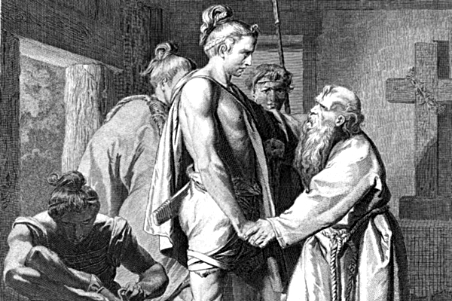
The drawing could imagine young Goths, who got paid to serve in the Roman legions – Throughout the late Roman Empire, the real Roman combat troops consisted of the Huns, Alans, Goths and other Germans. One could say that they were a kind of foreign legions. Units with soldiers recruited within the Roman Empire were largely reduced to perform secondary tasks, such as guarding.

Sidonius says nothing about his Goths’ hair and eye color, so we can believe that it has been the usual in Gaul at this time. Maybe their hair had different medium and dark blonde shades, as is the case with many of today’s Scandinavians. It is not because Sidonius was not interested in eye colors, it can be seen from one of his poems. But maybe he did not find it opportune to irritate the king by dwelling too much by the fact that many Goths had this unattractive blue eye color.

The Romans did not think that it was nice to have blue eyes. They often used the term “threatening blue eyes”.

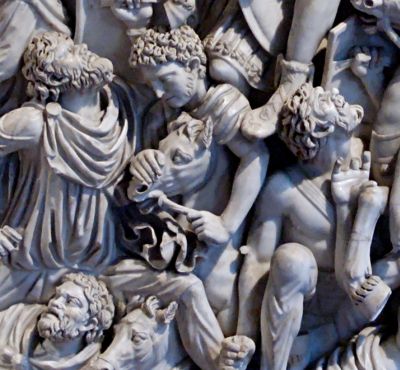
Motive from the Ludovisi sarcophagus

Motive from the Ludovisi sarcophagus, showing dying Goths in the bottom of the battle. They all have curly hair and beard. – Wikipedia.

Sidonius was allowed to keep his estates after the Western Goths had taken over the South of France. In gratitude, he wrote a little poem to King Euric. He wrote it allegedly for his friend Lampridius, but certainly with the ulterior motive that he would show the poem to the King: “We see in his courts the blue-eyed Saxon, lord of the seas, but a timid landsman here. – We see thee, aged Sygambrian (poetic name for the Franks) warrior, the back of the head shaven in sign of thy defeat – Here strolls the Herulian with his glaucous cheeks, inhabitant of Ocean’s furthest shore, and of a complexion with its weedy deeps. Here the Burgundian bends his seven feet of stature on suppliant knee, imploring peace. – And here, O Roman, thou also seekest thy protection – “.

The reason why that perhaps not all Goths had blue eyes, we can find in Ammianus, who wrote about the Western Goths’ initial looting in Thrace a few hundred years before: “For without distinction of age or sex all places were ablaze with slaughter and great fires, sucklings were torn from the very breasts of their mothers and slain, matrons and widows, whose husbands had been killed before their eyes, were carried off, boys of tender or adult age were dragged away over the dead bodies of their parents. Finally, many aged men, crying that they had lived long enough after losing their possessions and their beautiful women, were led into exile with their arms pinioned behind their backs, and weeping over the glowing ashes of their ancestral homes – .” All these matrons, widows and boys would probably have been used for something; they got Gothic children, not all had blue eyes.

Procopius also wrote about the appearance of the Goths in his book on the Justinian Wars: “All these, while they are distinguished from one another by their names (Goths and other migration people), as has been said, do not differ in anything else at all. For they all have white bodies and fair hair, and are tall and handsome to look upon, and they use the same laws and practise a common religion. For they are all of the Arian faith, and have one language called Gothic; and, as it seems to me, they all came originally from one tribe, and were distinguished later by the names of those who led each group.”

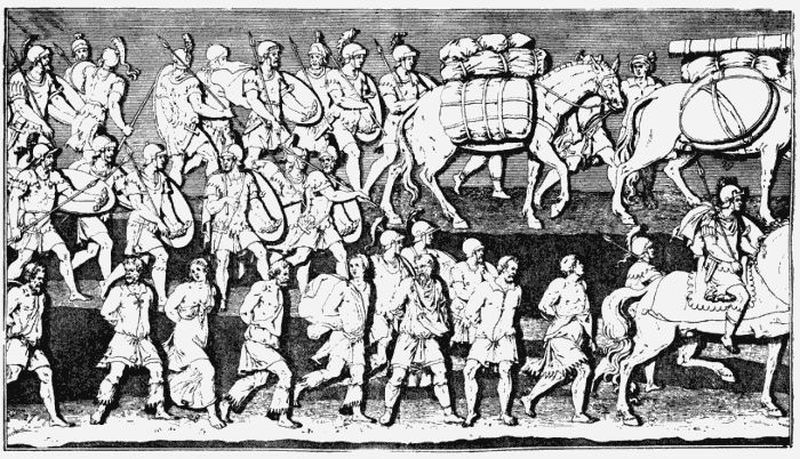
Motive from the  Arcadius column in Konstantinopel

Motive from the Arcadius column in Konstantinopel. It shows Gothic prisoners taken away pinioned by Roman soldiers. The men have beard and half-long hair. They are dressed in traditional Germanic coats and pants. The woman is wearing a dress without sleeves over a kind of skirt. The dress is in disorder and shows her one bared breast, like on the Marcus Aurelius column in Rome. The hair is hanging loose. Perhaps these bared breasts and loose hair symbolize something, for example rape, as a demonstration of the Roman Empire’s power.
The Arcadius column in Constantinople was erected to celebrate the Emperor Arcadius’ victory over the Goths under king Gainas around the year 400 AD. The Goths, who are pictured on the column, was dressed in pants and Tunic very similar to the clothing, which was taken from Thorbjerg Mose near the city of Slesvig. The women are shown dressed in sleeveless clothes and with hair in disorder.

Jordanes tells about Deceneus, who was a sort of philosopher and sage for a group of early Goths: “But he ordered them to call the rest of their race Capillati (hairy, ie, long-haired, them with curls). This name the Goths accepted and prized highly, and they retain it on the day to day in their songs (Jordanes).” And indeed, on many depictions, the Western Goths are shown with curly hair.

Carruthers crest on flag-v2 (1)

Preserving the Past, Recording the Present, Informing the Future

Ancient and Honorable Carruthers Clan Int Society 

carruthersclan1@gmail.com     carrothersclan@gmail.com

cropped-wide-banner-with-new-crest.jpg

Dr Patricia Carrothers

Reviewed by Tammy Wise CHS

CLAN SEANACHAIDHI

CLAN CARRUTHERS INT SOCIETY CCIS HISTORIAN AND GENEALOGIST

You can find us on facebook at :

https://www.facebook.com/carrutherscarrothers.pat.9

https://www.facebook.com/CarruthersClan/

https://www.facebook.com/CarruthersClanLLC

Disclaimer Ancient and Honorable Carruthers Clan International Society

Gutland / Gotland, OUR ANCESTORS, The History of Gutland, The Viking Age

CLAN CARRUTHERS – LANGUAGE OF THE GOTS

cropped-wide-banner-with-new-crest.jpg

LANGUAGE OF THE GOTS / GOTHS

In the Gothic Bible is a Lord’s Prayer, as we well know.  No, the Gots or Goths of Gutland / Gotland are no heathen pagans.  They were some of the early Christians.    The Lords prayer is written in two of the Gots dialects and English.

ramme

Atta unsar þu in himinam,
Fader vor du i himlen.
Father our, you in heaven,
Weihnai namo þein.
Helligt være navnet dit.
hallowed be the name yours,
Qimai þiudinassus þeins.
(lad) Komme kongeriget dit.
(let) come kingdom yours.
Wairþai wilja þeins,
(lad) ske viljen din,
(let) be done will yours,
swe in himina jah ana airþai.
Som i himlen og på jorden.
As in heaven and on earth.
Hlaif unsarana þana sinteinan gif uns himma daga.
brød vort dette daglig giv os (i) disse dage.
bread our daily give us in these days.
Jah aflet uns þatei skulans sijaima,
og forlad os hvilken skyld vi måtte være (have).
And forgive us which guilts we may (have).
Swaswe jah weis afletam þaim skulam unsaraim.
Samt vi forlader skyldene vore.
And we forgive them that have guilts against us.
jah ni briggais uns in fraistubnjai,
og ikke bring os i fristelse,
And not bring us into temptation.
ak lausei uns af þamma ubilin.
Men løs os fra det onde.
but deliver us from evil.
Unte þeina ist þiudangardi jah mahts jah wulþus in aiwins.
thi dit er kongedømme og magt og herlighed i evighed.
For yours is kingdom and power and glory in eternity.
Amen.
Amen.
Amen

ramme

Gothic text from “Deutche Sprache gestern und heute” by Astrid Stedje.
Gothic – Danish – English

Gothic, as spoken by both the Western as the Eastern Goths was a Germanic language closely connected to modern Scandinavian, German and English. Thanks to the Gothic Wulfila Bible, which was written in Italy in the sixth century and the Fleming Busbeccq’s notes about his meeting with representatives of a small group of long-surviving Goths in the Crimea, whom he met in Constantinople in the 16. century, we have a fairly good knowledge of the Gothic language.

The Gothic Bible is a translation from Greek to Gothic of the four Gospels in the New Testament, as well as a part of Paul’s letters. It contains almost nothing of the Old Testament.

We recognize the majority of words from German and Scandinavian. Atta means father as in “æt”, the old Danish word for family or lineage. Unsar we find the German “uns” (us). þu we find in Danish and German “du” and English “you”, in similar to “in” German and English and “i” in Danish. Himian similar to “himmel” (sky) in Danish and German. In the first syllable of Weinai we recognize the German Weinacht (Christmas Eve) Namo means “name” as in English and German and “navn” in Danish. Wilja is corresponding to “vilje” in Danish, “will” in English and “wille” in German. The preposition ana is corresponding to the German “an”, which also has been used in Danish and is still in use in compound words and phrases as “anledning” (occasion), “angive” (inform) and “anliggende” (matter) as well as the English “on”. Hlaif corresponds to “leve”, an old Danish word for bread, as well as the English “loaf”. Aflet and afletam gives associations to the Danish “aflede” (divert). Gif is equivalent to “giv” in Danish, “to give” in English and “geben” in German. Himma corresponds to the old Danish “hine” (these) Daga corresponds to “dage” in Danish, “days” in English and “Tage” in German. Skulans means guilt, as a scowling (“skule” in Danish) person may look like a guilty person. Ak means “but”, indicating that a traditional Danish or German exclamation of sorry “ak-ak” or “ach-ach” originally could have ment “but-but”. Lausei corresponds to the Danish “løse”, German lösen and English “lose”. Ubilin corresponds to “Übel” (evil) in German. Mahts corresponds to “magt” in Danish, “might” in English and “Macht” in German. þiudan-gardi has two parts, the first one is something with þiu , which is “king” in Gothic, and the other has to do with -gardi , which is “gård” (farm or enclosure) in Danish, geard in Old English and “gard” in Old Saxon – here it refers to a type of category.

The Gothic Bible also includes the Christmas story from Luke ch. 2: Warþ þan in dagans jainans, urrann gagrefts fram kaisara Agustau, gameljan allana midjungard.

Literal translation: It came to pass and in days those, (that) there went out decree from Caesar Augustus (that) should be taxed all (in) the world.

Crimean-
Gothic
Flemish
Danish
German
English
broe
brood
brød
brot
bread
plut
bloed
blod
blut
blood
stul
stoel
stol
stuhl
chair
hus
huys
hus
haus
house
wingart
wijgaert
vin
wein
wine
reghen
regen
regn
regen
rain
bruder
broeder
broder
bruder
brother
schwester
zuster
søster
schwester
sister
alt
oud
gammel
alt
old
vintch
wind
vind
wind
wind
silvir
zilver
sølv
silber
silver
golltz
goud
guld
gold
gold
kor
koren
korn
korn
grain
salt
zout
salt
salt
salt
fisct
visch
fisk
fisch
fish
hoef
hoofd
hoved
kopf
head
thurn
deure
dør
tür
door
stern
star
stjerne
stern
star
sune
zon
sol
sonne
sun
mine
maen
måne
mond
moon
tag
dag
dag
tag
day
oeghene
oogen
øjne
augen
eyes
bars
baert
skæg
bart
beard
handa
hand
hånd
hand
hand

Extract from the list of words that the Fleming Ogier Ghislain de Busbecq heard from two representatives of the Goths on the Crimea during a dinner in Constantinople around 1560. Krimgotisk by Poul Erik Jørgensen.

Note that the word for world, midjungard, is very similar to the Scandinavian Midgard.

There are three genders in Gothic namely masculine, feminine and neuter, as in modern German and old Danish. There are two times, past and present, as well as four kasus, namely nominative, accusative, genitive and dative and also, of course, singular and plural.

In Crimea lived Goths until about the 16. century. The Flemish Ogier Ghislain de Busbecqs, who was ambassador of the Holy Roman Empire in Constantinople 1560-62, has in his report provided us with knowledge of their language. He became aware that two representatives of the Goths on Crimea, whom he had heard of, were visiting Constantinople to present some cases for the Sultan. He managed to invite them to a dinner, during which he questioned them about their language and culture.

The definite article in Gothic was very similar to English. Busbecq told: “in front of all the words he puts tho or the”.

In Danish, we have retained the “sw” sound associated with sister in the names for the spouse family, “svoger” (brother in-law), “svigerfar” (father in-law), “svigermor” (mother in-law) and “svigerfamilie” (family in-law).

The two Gothic representatives also told Busbecq several other words that were not so similar to Flemish and German.

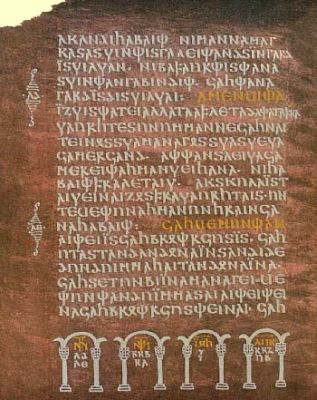
A page of Codex Argenteus

A page of the Wulfila Bible. It is also called “codex argenteus”, which means “Silver Bible”. It is believed that it was written for the Ostrogothic king of Italy, Theodoric the Great. Originally the Bible was translated from Greek to Gothic by Bishop Wulfila in the Balkans in the third century. It is written with the special Gothic alphabet, which was also created by Wulfila. It is called the silver bible because it is written with ink, which contains silver and gold on costly thin parchment. It was originally stored in the Benedictine monastery in Werden in Germany. It was looted by the Swedes in the Thirty Years’ War, and after a turbulent period it ended up in the University Library in Uppsala in Sweeden.

It is seen that Gothic differs from Danish and other Germanic languages by a number of words ending with -a, giving the language an exotic southern touch. The famous king of the Ostro-Goths was for example called Totilla and it sounds almost Mexican at least Spanish. It is believed that this frequent -a ending was an abbreviation, which replaced older, longer and more laborious endings. It is very imaginable that Spanish and to some extent Italian have the frequent -a endings from Gothic. Jordanes, who himself was a Goth, called occasionally the Heruls for “Erulos” which -os ending also sounds Spanish and Mediterranean, but Jordanes had never been to Spain, so it originates probably also from Gothic.

Carruthers crest on flag-v2 (1)

Preserving the Past, Recording the Present, Informing the Future

Ancient and Honorable Carruthers Clan Int Society 

carruthersclan1@gmail.com     carrothersclan@gmail.com

cropped-wide-banner-with-new-crest.jpg

Dr Patricia Carrothers

Reviewed by Tammy Wise CHS

CLAN SEANACHAIDHI

CLAN CARRUTHERS INT SOCIETY CCIS HISTORIAN AND GENEALOGIST

You can find us on facebook at :

https://www.facebook.com/carrutherscarrothers.pat.9

https://www.facebook.com/CarruthersClan/

https://www.facebook.com/CarruthersClanLLC

Disclaimer Ancient and Honorable Carruthers Clan International Society
Gutland / Gotland, OUR ANCESTORS, The History of Gutland, The Viking Age

CLAN CARRUTHERS – THE GOTHS AND GOTLAND IN 500 AD.

cropped-wide-banner-with-new-crest.jpg

THE GOTS AND GOTLAND IN 500 AD

Who were the Goths?

The Goths were a number of Germanic tribes in the Migration Period, which appeared in written history in the third century in the areas north of the Black Sea between the rivers Danube and Don. Except for frequent raids, they invaded the Roman Empire first time in 268 AD, and later in 376 AD. The Western Goths settled a few years in the Garonne valley in France until they conquered a kingdom, which included Spain and the South of France. In France, they were displaced by the Franks after a few years, and Spain was in 711 AD conquered by Muslim invaders – but the Goths descendants took the country back in the Middle Ages. The Eastern Goths established a thriving kingdom in Italy, but after only 67 years, they were defeated by armies sent by the emperor in Constantinople.

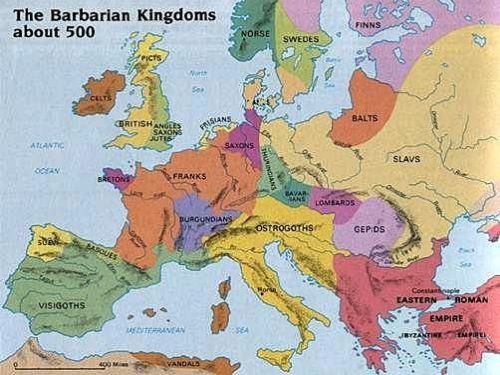
Europe around 500 AD

 A map of Europe showing the Germanic kingdoms that were established after the downfall of the Western Roman Empire. After numerous battles and long migrations, the Western Goths managed to settle in Spain and the Eastern Goths to take possession of Italy. However, it did not last forever. From ancientweb.org.
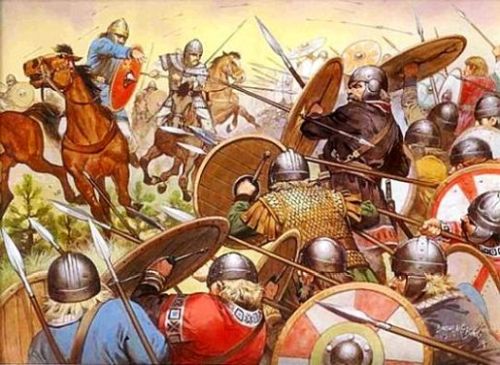
Bottom: An artistic reconstruction of the Western Goths in battle with Attila’s Huns at Chalons. From ancientweb.org.

When the first Goths arrived at the northern coast of the Black Sea about 170 AD, the climate was still influenced by the Roman Warm Period, which, however, ended about 400 AD. The Vandals crossed the frozen Rhine new year’s eve 406 AD, thus commencing the Migration time and heralding the downfall of the Western Roman Empire. The fact that the Rhine was frozen, testifies to a rather cold climate. I do not recall the Rhine has been frozen in modern times.

An artistic reproduction of the Goths in battle at ChalonsFrom then on, until the disaster at Guadalete in Spain in 711 AD, when the Western Goths were defeated by invading Muslims, the climate was cold with snowy winters in northern and central Europe.

Goths can be traced further back in history to today’s northern Poland, and even in the distant past to their origins in Scandinavia and the Baltic area. Thus Jutland through thousand years was called Gotland.

Paul the Deacon tells about how the Langobards migrated from their original island in the ocean: “Now when the people living there had multiplied to such a number that they could no longer live together, they divided, it is told, their whole people into three parts and decided by casting lots, which of those, who were to leave the homeland and seek new places of residence.” Dudo confirmed many years later that it was a traditional way of solving problems of overpopulation in Scandinavia.

Also, the Gotland Gute Saga says that some of the people were taken for emigration by casting lot: “After a long time, the people have so increased that the country was not able to feed them all. So the land was distributed, on which every third tilled, each of these was allowed to keep and bring and take away everything, which he in his life had acquired.”

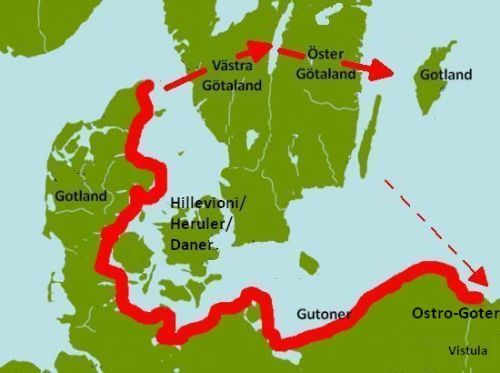
Pliny the Elder (23-79 AD) wrote: “Pytheas says that the Gutones, a people of Germania, inhabits the shores of an estuary of the Ocean called Mentonomon, their territory extending a distance of six thousand stadia; that, at one day’s sail from this territory, is the Isle of Abalus, upon the shores of which, amber is thrown up by the waves in spring, it being an excretion of the sea in a concrete form; as, also, that the inhabitants use this amber by way of fuel, and sell it to their neighbours, the Teutones.”

Gutones following Pytheas

Pytheas wrote: “Pytheas says that the Gutones, a people of Germany, inhabit the shores of an estuary of the Ocean called Mentonomon, their territory extending a distance of six thousand stadia.” Other ancient writers also believed that the Baltic Sea and inner Danish waters was a major estuary.
Procopius wrote about the returning Heruls: “After these, they passed by the nations of the Dani, without suffering violence at the hands of the barbarians there. Coming thence to the ocean, they took to the sea, and putting in at Thule, remained there on the island.” – “And one of their most numerous nations is the Gauti, and it was opposite (next to?) them that the incoming Eruli settled at the time in question.” We must believe that Procopius shared the ancient authors believe that the Danish waters and the Baltic Sea was a large estuary, in which case it “opposite the Goths” can be understood: on the opposite side of the estuary. Alternatively, it should be translated “next to the Goths.” However, in both cases, suggesting that the Heruls were Goths.

There is some uncertainty about how long a stadium was, the proposals vary between 160 and 192 m. That means that the coastline, which was inhabited by Gutones, was between 960 and 1.152 km. long. That gives a range from Skagen to the Vistula estuary at Gdansk.

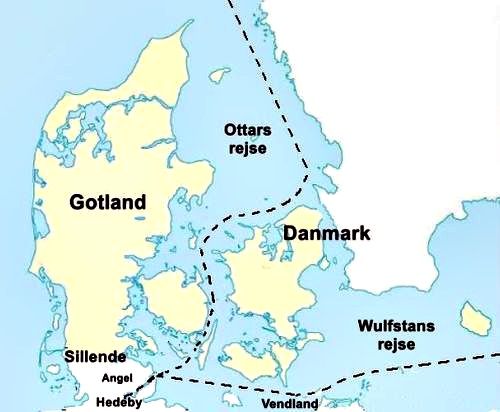
It suits very well with that the Jutland peninsula before the Viking Age was called Gotland, as it is the case in Ottar’s travelogue, added in Alfred the Great’s translation of Orosius’ Roman history from about 850 AC: “When he sailed there from Skíringssal (at Oslo), Denmark was on the port side and to starboard for three days was the open sea. And then, two days before he came to Hedeby, Gotland was to starboard (him wæs on þæt steorbord Gotland), and Sillende and many islands. The Angles dwelt in that area before they came here to this land.”

Since the area was inhabited by Gutones in time before Christ – according to Pytheas – and as part of it still was called Gotland 800-900 AD, it is reasonable to assume that at least the coast along Kattegat and the Baltic Sea were the Goth’s original homeland.

Ottar's and Wulfstan's journeys

Ottar’s and Wulfstan’s travels according to additions in Alfred the Great’s translation of Orosius’ Roman history. Both Jutland and the island in the Baltic Sea are called Gotland. (The island of Gotland is not shown on this map).

That will indicate that Cimbri, Teutons, Angles and all other tribes, who lived along this coastline, and whose names we are not sure about, all originally have thought of themselves as kinds of Goths speaking the same language, namely Gothic.

Some believe that the Gutones on the densely populated Jutland east coast very early crossed the Kattegat and gradually populated West and East Gøta Land – and from there the island of Gotland in the Baltic Sea.

In Alfred the Great’s translation of Orosius’ Roman history is also added Wulfstan’s travel report from a voyage from Hedeby to Truso in Vistula’s delta from about 850 AC, which reads: “Wulfstan said that he traveled from Hedeby, and that he was in Truso in seven days and nights, and that the ship all the way went under sail. Wendland was on his starboard side and to port, he had Langeland, Lolland, Falster and Scania. These countries all belong to Denmark. So we had Bornholm to port, and they have their own king. So after Bornholm we had the countries named first Blekinge, More, Oland and Gotland to port (and Gotland on bæcbord), and these countries belong to the Swedes. And we had Wendland to starboard all the way to the Vistula river mouth.” By Gotland is here obviously meant the island of Gotland or maybe the coast of Eastern Gøtaland.

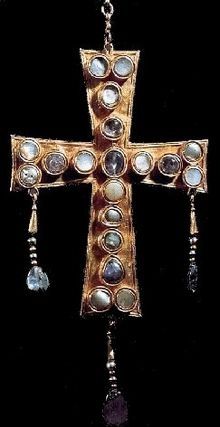
Gothic cross found in Spain

Gothic cross found in Spain perhaps from 700’s.

Ptolemy placed the people Goutai on the island of Skandia and the Gudones by the Vistula river.

The Roman historian Cornelius Tacitus described the location of the Gotones as: “Beyond the Lugii is the monarchy of the Gotones: The hand upon the reins closes somewhat tighter here than among the other tribes of Germans, but not so tight yet as to destroy freedom. Then immediately following them and on the ocean are the Rugii and Lemovii. The distinguishing features of all these tribes are round shields, short swords, and a submissive bearing before their kings.” This means that Gotones, who was ruled by powerful kings, lived north or northeast of the Lugii and further inland than the Rugii and Lemovii, which he explicitly stated as residing at the sea. Perhaps Gotones lived at the Vistula river.

Jordanes located the peoples Ostro-Goths, Ewa-Greutingis and Gaiti-Goths on the island of Scandia. Gauti-Goths were “a race of men bold and quick to fight”, he wrote, and further, “But still another race dwells there, the Sweans, who like the Thuringos, having splendid horses.” With the term “another race” he must have meant that they were not Goths. “All these nation surpassed the Germans in size and spirit, and fought with the cruelty of wild beasts”, he concluded the description of the peoples on the Scandinavian peninsula.

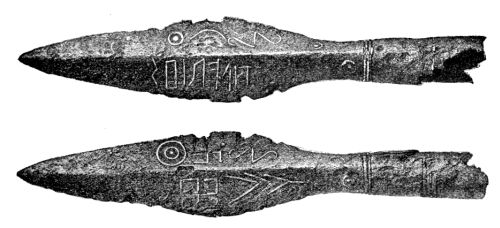
Lance tip with a runic inscriptions found near Kovel in the northwest corner of UkraineRight and left side of a lance head with runic inscription found near Kovel in the Northwest corner of Ukraine. The runic inscription to be read from right to left “Tilarids”. It has been identified as likely East Germanic, most likely Gothic because of the nominative s-suffix. It is from the beginning of the third century.

He mentions different tribes of Goths, who lived on the island of Skandia, including Greutingis and Ostro-Goths, which names we later recognize for Gothic peoples on the Danube and in Italy. This makes it likely that it is true that the Goths, who attacked the Roman Empire, originally came from Scandinavia and the coasts of the Baltic Sea. Furthermore, there are several areas of southern Scandinavia, which have been called, or still are named as Gotland with different spellings, which also support the theory that this region was the original homeland of the Goths. In his report on the Gothic war in Italy, Procopius mentions the Rugi, as part of the Goths in Italy; they are also referred to by Jordanes as one of Skandia’s indigenous tribes. They are also mentioned in other ancient sources.

Pollen analysis from Abkjær 
Mose

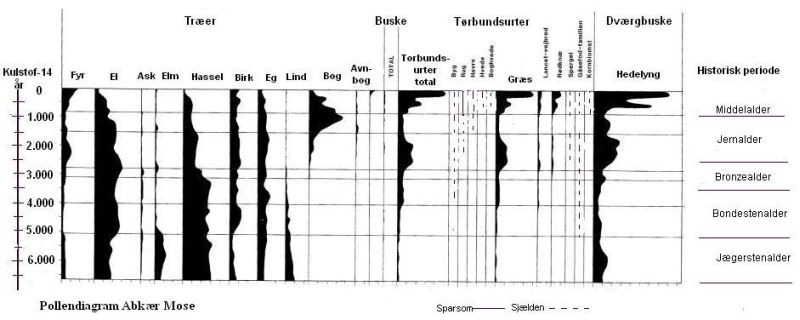
Pollen analysis from Abkjær Mose at Vojens. It appears that forest, especially beech, increases sharply and herbs typical of open land, grass and heather decrease immediately after the migration time around 500 AD indicating that the forest returned to areas that previously were pastures for cattle. Similar studies in other parts of the country show the same pattern. It is reasonable to interpret that this could be due to emigration.
Also, Procopius reports on the returning Heruls suggests that Scandinavia was quite thinly populated. For how could they just “settle down”, as if they came to an untouched prairie? If not the country had been relatively sparsely populated.
However, when large parts of the original population had turned their back to good pastures, it may not only have been hunger and misery that drove them to emigrate.
It is known that for several hundred years of the late Imperial time the Roman legions were mostly populated with various Germanic soldiers since the Roman Empire’s own citizens did not seem to have been suitable. You could say that every Roman legion was a sort of Foreign Legion, in which also many young men from the South Scandinavian region must have served. Therefore the tribes around the Baltic Sea may have concluded that they were the best and the bravest – and therefore deserved to rule. Such attitudes among the Germanic tribes were most likely critical to the doom of the Western Roman Empire.

All these ancient authors wrote before official correct spelling was invented; they wrote in different languages with different alphabets and over a period of several hundred years. They reproduced words for Goths that often for them were in an unfamiliar language, besides most likely Gothic by this time had already developed in several dialects. It is quite understandable that they spelled it in so many different ways, and we do not have to connect any deeper meaning in the different spellings.

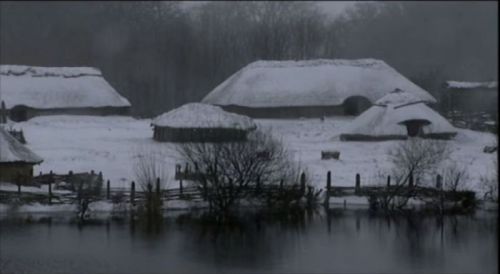
Germanic Village

The Goths lived spread out over farmland in small villages with each may be about 8-10 houses and farms.

In Book III of Justinian’s wars, Procopius wrote about the Goths’ early history: “Now while Honorius was holding the imperial power in the West, barbarians took possession of his land; and I shall tell, who they were and in what manner, they did so. There were many Gothic nations in earlier times, just as also at the present, but the greatest and most important of all are the Goths, Vandals, Visigoths, and Gepaedes. In ancient times, however, they were named Sauromatae and Melanchlaeni; and there were some too, who called these nations Getic. All these, while they are distinguished from one another by their names, as has been said, do not differ in anything else at all. For they all have white bodies and fair hair and are tall and handsome to look upon, and they use the same laws and practice a common religion. For they are all of the Arian faith, and have one language called Gothic; and, as it seems to me, they all came originally from one tribe, and were distinguished later by the names of those who led each group.”

Procopius is undoubtedly correct that most Germanic migrations peoples were a kind of Goths; they resembled each other and spoke largely the same language. But then they must originally have come from the same tribe, as he wrote. That is, we must believe that they all came more or less directly from the original Gothic area along the Baltic Sea, the Danish waters and from the southern part of the Scandinavian Peninsula. Procopius believed that also the Vandals and Gepids were kinds of Goths, although they were not generally named as such.

Moreover, in Denmark are clear indications of a big drop in population density in Germanic Iron Age relative to the Roman Iron Age, which indicates a considerable migration.

Carruthers crest on flag-v2 (1)

Preserving the Past, Recording the Present, Informing the Future

Ancient and Honorable Carruthers Clan Int Society 

carruthersclan1@gmail.com     carrothersclan@gmail.com

cropped-wide-banner-with-new-crest.jpg

Dr Patricia Carrothers

Reviewed by Tammy Wise CHS

CLAN SEANACHAIDHI

CLAN CARRUTHERS INT SOCIETY CCIS HISTORIAN AND GENEALOGIST

You can find us on facebook at :

https://www.facebook.com/carrutherscarrothers.pat.9

https://www.facebook.com/CarruthersClan/

https://www.facebook.com/CarruthersClanLLC

Disclaimer Ancient and Honorable Carruthers Clan International Society
OUR ANCESTORS

MANGUS III OF SWEDEN – CARRUTHERS ANCESTOR – CLAN CARRUTHERS CCIS

cropped-wide-banner-with-new-crest.jpg

MANGUS III OF SWEDEN

CARRUTHERS ANCESTOR

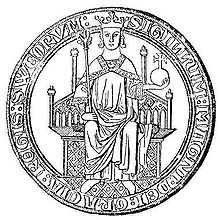
Magnus III (Swedish: Magnus Birgersson/Magnus Ladulås; ca. 1240 – 18 December 1290) was King of Sweden from 1275 until his death in 1290.[1]  He is a direct DNA match to the Carruthers line.

He was the “first Magnus” to rule Sweden for any length of time, not generally regarded as a usurper or a pretender (but third Magnus to have been proclaimed Sweden’s king and ruled there). Later historians ascribe his epithet “Ladulås” – Barnlock – to a royal decree of 1279 or 1280 freeing the yeomanry from the duty to provide sustenance for travelling nobles and bishops (“Peasants! Lock your barns!”); another theory is that it’s a corruption of Ladislaus, which could possibly have been his second name, considering his Slavic heritage. (Magnus’s maternal great-grandmother was Sophia of Minsk, a Rurikid princess.) This king has also been referred to as Magnus I, but that is not recognized by any Swedish historians today.[2]

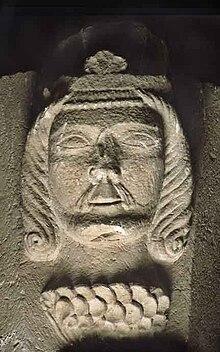
Magnus III Barnlock of Sweden as Duke bust 2009 Skara (2).jpg

Magnus, whose birth year has never been confirmed in modern times, was probably the second son of Birger Jarl (1200–66) and Princess Ingeborg, herself the sister of the childless King Eric XI and daughter of King Eric X. Thus, Valdemar Birgersson (1239–1302) was the eldest son and ruled as Valdemar, King of Sweden from 1250–1275, succeeding King Eric, their maternal uncle who ruled until 1250. Birger Jarl had designated Magnus as Jarl, henceforth titled Duke of Sweden, and as Valdemar’s successor. Even after Valdemar’s coming of age in 1257, Birger Jarl kept his grip over the country. After Birger’s death in 1266 Valdemar came into conflict with Magnus who wanted the throne for himself. [3]

In 1275, Duke Magnus started a rebellion against his brother with Danish help, and ousted him from the throne. Valdemar was deposed by Magnus after the Battle of Hova in the forest of Tiveden on June 14, 1275. Magnus was elected king at the Stones of Mora (Mora stenar). In 1276, Magnus allegedly married a second wife Helwig, daughter of Gerard I of Holstein. Through her mother, Elizabeth of Mecklenburg, Helwig was a descendant of Christina, the putative daughter of King Sverker II. A papal annulment of Magnus’ alleged first marriage and a dispensation for the second (necessary because of consanguinity) were issued ten years later, in 1286. Haelwig later acted as regent, probably 1290–1302 and 1320–1327.[4] [5]

The deposed King Valdemar managed, with Danish help in turn, to regain provinces in Gothenland (Gotland) in the southern part of the kingdom, and Magnus had to recognize that in 1277. However, Magnus regained them about 1278 and assumed the additional title rex Gothorum, King of the Goths, starting the tradition of “King of the Swedes and the Goths”.

King Magnus’s youngest brother, Benedict (1254–1291), then archdeacon, acted as his Lord High Chancellor of Sweden, and in 1284 Magnus rewarded him with the Duchy of Finland.[6]

Magnus died when his sons were yet underage. Magnus ordered his kinsman Thurchetel Canuteson, the Lord High Constable of Sweden as the guardian of his heir, the future King Birger, who was about ten years old at father’s death.

Carruthers crest on flag-v2 (1)

CLAN CARRUTHERS CCIS – SINCE 1983

Preserving the Past, Recording the Present, Informing the Future

Ancient and Honorable Carruthers Clan Int Society 

carruthersclan1@gmail.com     carrothersclan@gmail.com

cropped-wide-banner-with-new-crest.jpg

Dr Patricia Carrothers

Reviewed by Tammy Wise CHS

CLAN SEANACHAIDHI

CLAN CARRUTHERS INT SOCIETY CCIS HISTORIAN AND GENEALOGIST

You can find us on facebook at :

https://www.facebook.com/carrutherscarrothers.pat.9

https://www.facebook.com/CarruthersClan/

https://www.facebook.com/CarruthersClanLLC

Disclaimer Ancient and Honorable Carruthers Clan International Society
References
Ulf Sundberg (1999). “Magnus Birgersson “Ladulås””. pennanochsvardet.se. Retrieved January 1, 2019.
John E. Morby, “The Sobriquets of Medieval European Princes”, Canadian Journal of History, 13:1 (1978), p. 12.
“Valdemar Birgersson, kung av Sverige”. KulturNav. Retrieved January 1, 2019.
“Mora Stenar”. knivstashistoria.se. Retrieved January 1, 2019.
“Magnus Ladulås (ca 1240–1290)”. Biografiskt lexikon för Finland. Retrieved January 1, 2019.
Sten Engström. “Bengt Birgersson”. Svenskt biografiskt lexikon. Retrieved January 1, 2019.
“Wrong persons found in King’s tomb”. Stockholm News. 9 December 2011. Archived from the original on 26 January 2012. Retrieved 17 December 2011.

Gutland / Gotland, The Viking Age

RAIDERS OR TRADERS – CLAN CARRUTHERS CCIS

cropped-wide-banner-with-new-crest.jpg

RAIDERS OR TRADERS

A replica Viking vessel sailing the North Sea has helped archaeologists figure out what the stalwart Norsemen were really up to

Sea Stallion

From his bench toward the stern of the Sea Stallion from Glendalough, Erik Nielsen could see his crewmates’ stricken faces peering out of bright-red survival suits. A few feet behind him, the leather straps holding the ship’s rudder to its side had snapped. The 98-foot vessel, a nearly $2.5 million replica of a thousand-year-old Viking ship, was rolling helplessly atop waves 15 feet high.

With the wind gusting past 50 miles an hour and the Irish Sea just inches from the gunwales, “I thought we’d be in the drink for sure,” says Nielsen, now 63, a retired Toronto geologist.

It was August 6, 2007, and the Sea Stallion’s crew of 63 had been underway for five weeks, sailing from Roskilde, Denmark, to Dublin, Ireland, on a voyage that would culminate 35 years’ research—“the best living-archaeology experiment ever conducted anywhere,” Pat Wallace, director of the National Museum of Ireland, calls it.

As Nielsen and some of his crewmates struggled to keep the Sea Stallion upright, four others went to work at the stern. Kneeling on the ship’s heaving, rain-slicked deck, they hauled the 11-foot rudder out of the water, replaced the broken leather straps with jury-rigged nylon ones and reattached the new assembly.

Reducing the sail to a minimum, the crew proceeded at nine knots. As the ship plowed from wave to wave, a full third of the Sea Stallion’s hull was often out of the water. Ahead lay the Isle of Man, 15 hours away.

Two weeks later, its crew exhausted, the Sea Stallion limped into the port of Dublin for a nine-month refurbishment in dry dock at the National Museum of Ireland. In July 2008, it sailed, relatively uneventfully, back to Denmark. Ever since, researchers have been poring over reams of data from both voyages, gathered from electronic sensors on the ship, to learn more about the Vikings’ sailing prowess. Their findings will follow a host of recent discoveries by historians, archaeologists and even biologists that have led to a new understanding of the Vikings as a people who were as adept at trading as they were at raiding.

Norsemen have been seen as intrepid seafarers and fierce warriors—a sort of Hell’s Angels of the early Middle Ages—since A.D. 793, when they raided the rich island monastery at Lindisfarne off the northeastern coast of England. “The ravages of heathen men miserably destroyed God’s church on Lindisfarne,” according to the annals known as the Anglo-Saxon Chronicle. ( This may be in error, since the oldest crucifix and cross were unearth on Gutland )  In 845, the Viking raider and extortionist extraordinary Ragnar Lothbrok slipped up the Seine with 120 ships—an estimated 5,000 men—to Paris, where King Charles the Bald paid him 7,000 pounds of gold and silver to leave in peace. (A contemporary wrote that “never had [Ragnar] seen, he said, lands so fertile and so rich, nor ever a people so cowardly.”)

Viking raiders traveled thousands of miles to the east and south: across the Baltic, onto the rivers of modern-day Russia and across the Black Sea to menace Constantinople in 941. “Nobody imagines they were there to capture the city,” says Cambridge University historian Simon Franklin. “It was more terroristic—all about instilling fear and extracting concessions for trade.”

At the same time, the new research suggests that the Vikings pouring out of Denmark, Sweden and Norway 1,200 years ago had more than raiding on their minds. Buying and selling goods from places as distant as China and Afghanistan, they also wove a network of trade and exploration from Russia to Turkey to Canada. “They were people without boundaries,” says Wladyslaw Duczko, an archaeologist at the Institute of Anthropology and Archaeology in Pultusk, Poland. “I think that’s why Vikings are so popular in America.”

Recent climate research has led Duczko and others to posit that a warming trend around the ninth century led to a population boom in Scandinavia, causing more and more landless young Norsemen to seek their fortunes elsewhere. Not everyone agrees. The National Museum of Ireland’s Wallace says the Vikings may have had a simpler motive: “They had the best iron in the world, trees to cut down and build ships, the best swords and edges on their blades. All the factors were there. They could do it, and they did.”

Whatever the causes for the Vikings’ explorations, evidence of the range of their trading networks began turning up about 150 years ago, when their elaborate burial mounds were first excavated. Well-preserved graves in Birka, Sweden, for example, contained fragments of Chinese silk, and in Norway, the ships in which wealthy Vikings were customarily buried were painted with pigments that may have come from India and the Middle East.

In the 1970s, archaeologists in Dublin found a Viking settlement spread over several acres—and in it more than 3,000 pieces of amber that were probably imported from Denmark. Excavation at Staraya Ladoga, outside St. Petersburg, unearthed a multiethnic settlement that included Viking jewelry, weapons and tools buried amid 1,000-year-old houses. And elsewhere in Russia, archaeologists have uncovered hundreds of Scandinavian graves containing artifacts from the Viking era; in 2006, they found one in the province of Kaliningrad, 500 miles from Norway.

Almost all these sites share a common artifact: thin, silver coins called dirhams. Most of them were made in Baghdad, which was the center of the Arab world from 750 to 950, and they were usually stamped with the year they were minted. Vikings apparently traded furs, amber, ivory and slaves for dirhams, which they then carried with them on their ships. As a result, the coins mark Viking trade routes like shiny silver bread crumbs.

In January 2007, metal-detector hobbyists in Harrogate, England, uncovered a treasure worth millions of dollars that one or more Vikings buried around 927; it included 617 coins, 15 of which were dirhams. Thousands of dirhams dating from 780 to 1050 were found at Viking sites near St. Petersburg. In Poland, archaeologists excavating a Viking settlement near Gdansk found nearly 800 coins dating from 780 to 840, almost all of them Arabic. Other Arabic coins made their way to France, Ireland, Iceland and Greenland. “What we’re seeing is the remnants of an extremely intricate network of barter trade,” says historian Jonathan Shepard of St. Kliment Ohrid University in Sofia, Bulgaria. “It’s a weird combination of coercion and tribute side by side and intermingled with bartering.”

By the 11th century, Vikings began adopting the languages and customs of local peoples, even settling in and intermarrying from Ireland to Russia. Researchers at the universities of Leicester and Nottingham, in England, found that up to half the DNA from men in northwest England matches Scandinavian genetic types.

Sea Stallion

All that wandering would have been impossible without ships—which is where Erik Nielsen and the rest of the Sea Stallion’s crew come in. For much of the 20th century, archaeologists assumed that Viking ships all resembled a vessel excavated in Norway in 1880. Known as the Gokstad ship, for the farm on which it was found, it dated to the year 900. The ship was “clinker-built,” meaning it was constructed of overlapping planks, which made it stout, flexible and light, with a sail and room for 32 oarsmen. In 1893, Magnus Andersen sailed a replica from Norway to Chicago for the World’s Fair. “Gokstad was thought to be universal, whether trader or raider,” says Niels Lund, a Viking historian at the University of Copenhagen. But a 1962 discovery forced researchers to abandon the idea that the Vikings had only one kind of ship.

At the bottom of a fjord near Roskilde, archaeologists found remnants of five Viking ships piled one atop the other. Dubbed the Skuldelev ships, for a nearby town, each had had a specialized role. One had been a fishing boat; two were cargo ships, so easy to handle that a crew of eight or nine could move 20-ton loads; and one was a warship that could carry about 30 people. The fifth ship, a raider named the Skuldelev, was the largest.

It was 98 feet long but just 12 feet wide. Its keel reached just three feet below the surface, and its masts and sail could be lowered so the ship could approach fortifications and settlements with stealth. It could accommodate 65 armed men. “This is a boat for warriors,” says Soren Nielsen, head boat builder at the Viking Ship Museum in Roskilde.

Because only about 20 percent of the Skuldelev 2 could be recovered, the only way to determine its capabilities for certain was to reconstruct it and put it to sea. In 2000, Nielsen and his colleagues at the ship museum began working with scientists to build an accurate replica. They used thousand-year-old methods and reproductions of tools from that time, which meant carving each of the ship’s 90 oak planks with axes, wedges and hammers. After four years and almost $2.5 million, the eight builders had their replica. They called it Sea Stallion From Glendalough for the Irish village where Vikings used to procure oak for their ships. With its narrow beam and shallow draft, the Sea Stallion could navigate just about any river in Europe. But how would it fare on the open sea?

In the summer of 2006, the Sea Stallion sailed under sunny skies and gentle winds to Norway and back in four weeks—a virtual pleasure cruise. A test sail in May 2007 around the Roskilde Fjord enjoyed similar conditions. “We like to say we’ve been cursed with good weather,” said Carsten Hvid, the Sea Stallion’s skipper. But the six-week voyage that began in July 2007— from Roskilde north to Norway, west to Scotland and south to Dublin—proved a tougher test. Fully loaded, the ship weighed 24 tons—eight of ship, eight of rock for ballast and eight of crew and gear. In ideal conditions, the Sea Stallion could travel 160 nautical miles in a day; it could sprint at 13 knots, or almost 15 miles an hour. (A high-tech America’s Cup racer might hit 20 knots.) “It ranks as one of the fastest warships in history,” says Anton Englert, an archaeologist at the ship museum.

For the July 2007 voyage, the ship set sail under dark skies that presaged Northern Europe’s coldest and wettest summer in decades. Nighttime temperatures plunged into the 30s. Three days into the voyage, two crew members had to be treated for hypothermia, and, to stay on schedule, Hvid had to accept a 24-hour tow across part of the North Sea because of weak winds. “It kept on raining and raining and raining,” says crew member Henrik Kastoft, in his day job a spokesman for the United Nations Development Program. “There were so many nights I just sat there shivering for hours.” Each crew member had about eight square feet of space. “I really suffered from being so close to people for so long. I got edgy, cranky,” says Erik Nielsen. “Maybe the modern analogue would be a submarine.”

Carruthers crest on flag-v2 (1)

Preserving the Past, Recording the Present, Informing the Future

Ancient and Honorable Clan Carruthers

Official and Oldest Scottish  Clan of Our Ancestors – 1983

clancarruthers1@gmail.com

carruthersclan1@gmail.com     carrothersclan@gmail.com

cropped-wide-banner-with-new-crest.jpg

LISA JOHNSON

CLAN SEANACHAIDHI

CLAN CARRUTHERS INT SOCIETY CCIS HISTORIAN AND GENEALOGIST

New Blog Banner 05

You can find us on facebook at :

https://www.facebook.com/carrutherscarrothers.pat.9

https://www.facebook.com/CarruthersClan/

https://www.facebook.com/CarruthersClanLLC

Disclaimer Ancient and Honorable Carruthers Clan International Society
OUR ANCESTORS, Uncategorized, Varangians

THE SEA KINGS – CLAN CARRUTHERS CCIS

cropped-wide-banner-with-new-crestnorse

THE SEA KINGS

The Sea-Kings and their Daring Feats

From the word vik, or bay, comes the word viking, long used to designate the sea-rovers of the Northland, the bold Norse wanderers who for centuries made their way to the rich lands of the south on plundering raids. Beginning by darting out suddenly from hiding places in bays or river mouths to attack passing craft, they in the end became daring scourers of the seas and won for themselves kingdoms and dominions in the settled realms of the south.

Nothing was known of them in the early days. The people of southern Europe in the first Christian centuries hardly knew of the existence of the race of fair-skinned and light-haired barbarians who dwelt in the great peninsula of the north. It was not until near the year 800 B.C. that these bold brigands learned that riches awaited those who dared seize it on the shores of France, England, and more southern lands. Then they came in fleets and spread terror wherever they appeared. For several centuries the realms of civilization trembled before their very name.

“From the fury of the Northmen, Good Lord deliver us!” prayed the priests, and the people joined fervently in the prayer.

Long before this period the sea was the favorite hunting ground of the daring sons of the north, but the small chiefs of that period preyed upon each other, harrying their neighbors and letting distant lands alone. But as the power of the chiefs, and their ability to protect themselves increased, this mode of gaining wealth and fame lost its ease and attraction and the rovers began to rove farther afield.

Sveidi 'Sveiði' “The Sea King” HEYTIRSSON – The Lives of my Ancestors

Sea-kings they called themselves. On land the ruler of a province might be called either earl or king, but the earl who went abroad with his followers on warlike excursions was content with no less name than king, and the chiefs who set out on plundering cruises became from the first known as sea-kings. Pirates and freebooters we would call them to-day, but they were held in high distinction in their native land, and some of the most cruel of them, on their return home, became men of influence, with all the morality and sense of honor known in those early days. Their lives of ravage and outrage won them esteem at home and the daring and successful sea-king ranked in fame with the noblest of the home-staying chiefs. We have seen how King Erik began his career as a viking and ended it in the same pursuit; how Rollo, a king’s son, adopted the same profession; and from this it may be seen that the term was one of honor instead of disgrace.

From all the lands of the north they came, these dreaded sons of the sea, from Norway, Sweden, and Denmark alike, fierce heathens they who cared nought for church or priest, but liked best to rob chapels and monasteries, for there the greatest stores of gold and silver could be found. When the churches were plundered they often left them in flames, as they also did the strong cities they captured and sacked. The small, light boats with which they dared the sea in its wrath were able to go far up the rivers, and wherever these fierce and bloodthirsty rovers appeared wild panic spread far around. So fond were they of sword-thrust and battle that one viking crew would often challenge another for the pure delight of fighting. A torment and scourge they were wherever they appeared.

Ivar Halfdansson + Thyra Eysteinsdoittir

The first we hear in history of the sea-kings is in the year 787, when a small party of them landed on the English coast. In 794 came another flock of these vultures of the sea, who robbed a church and a monastery, plundering and killing, and being killed in their turn when a storm wrecked their ships and threw them on shore. As a good monk writes of them: “The heathen came from the northern countries to Britain like stinging wasps, roamed about like savage wolves, robbing, biting, killing not only horses, sheep, and cattle, but also priests, acolytes, monks, and nuns.”

The Norsemen had found a gold mine in the south and from this time on they worked it with fierce hands. Few dared face them, and even in the days of the great Charlemagne they ravaged the coast lands of France. Once, when the great emperor was in one of his cities on the Mediterranean coast, a fleet of the swift viking ships, known by their square sails, entered the harbor. Soon word was brought that they had landed and were plundering. Who they were the people knew not, some saying that they were Jews, others Africans, and others that they were British merchants.

“No merchants they,” said the emperor. “Those ships do not bring us goods, but fierce foes, bloody fighters from the north.”

The warriors around him at once seized their weapons and hurried to the shore, but the vikings had learned that the great emperor was in the city and, not daring to face him, had sought their ships and spread their sails again. Tears came to the eyes of Charlemagne as he watched them in their outward flight. He said to those around him:

“It is not for fear that these brigands can do me any harm that I weep, but for their daring to show themselves on this coast while I am alive. Their coming makes me foresee and fear the harm they may do to my descendants.”

This story may be one of those legends which the monks were fond of telling, but it serves to show how the dread Norsemen were feared. France was one of their chief fields of ravage and slaughter. First coming in single ships, to rob and flee, they soon began to come in fleets and grew daring enough to attack and sack cities. Hastings, one of the most renowned of them all, did not hesitate to attack the greatest cities of the south.

In 841 this bold freebooter sailed up the Loire with a large fleet, took and burned the city of Amboise, and laid siege to Tours. But here the inhabitants, aided, it is said, by the bones of their patron saint, drove him off. Four years later he made an attack on Paris, and as fortune followed his flag he grew so daring that he sought to capture the city of Rome and force the Pope to crown him emperor.

For an account of this remarkable adventure of the bold Hastings see the article, “The Raids of the Sea-Rovers,”  https://clancarruthers.home.blog/2022/01/12/the-raids-of-the-sea-kings-clan-carruthers-ccis/

In that account are also given the chief exploits of the vikings in France and Germany. We shall therefore confine ourselves in the remainder of this article to their operations in other lands, and especially in Ireland.

This country was a common field for the depredations of the Norse rovers. For some reason not very clear to us the early vikings did not trouble England greatly, but for many years they spread terror through the sister isle, and in the year 838 Thorgisl, one of their boldest leaders, came with a fleet of one hundred and twenty ships, with which he attacked and captured the city of Dublin, and afterwards, as an old author tells us, he conquered all Ireland, securing his conquest with stone forts surrounded with deep moats.

Sveide Sveidasson - Historical records and family trees - MyHeritage

But the Irish at length got rid of their conqueror by a stratagem. It was through love that the sea-king was lost. Bewitched with the charms of the fair daughter of Maelsechnail, one of the petty kings of the land, he bade this chieftain to send her to him, with fifteen young maidens in her train. He agreed to meet her on an island in Loch Erne with as many Norsemen of high degree.

Maelsechnail obeyed, but his maidens were beardless young men, dressed like women but armed with sharp daggers. Thorgisl and his men, taken by surprise, were attacked and slain. The Irish chief had once before asked Thorgisl how he should rid himself of some troublesome birds that had invaded the island. “Destroy their nests,” said the Norseman. It was wise advice, and Maelsechnail put it in effect against the nests of the conquerors, destroying their stone strongholds, and killing or driving them away, with the aid of his fellow chieftains.

Thus for a time Ireland was freed. It was conquered again by Olaf the White, who in 852 defeated some Danes who had taken Dublin, and then, like Thorgisl, began to build castles and tax the people. Two other viking leaders won kingdoms in Ireland, but Olaf was the most powerful of them all, and the kingdom founded by him lasted for three hundred and fifty years. From Dublin Olaf sailed to Scotland and England, the booty he won filling two hundred ships.

The sea-rovers did not confine their voyages to settled lands. Bold ocean wanderers, fearless of man on shore and tempest on the waves, they visited all the islands of the north and dared the perils of the unknown sea. They rounded the North Cape and made their way into the White Sea as early as 750. The Faroe, the Orkney and the Shetland Islands were often visited by them after 825, and in 874 they discovered Iceland, which had been reached and settled by Irishmen or Scots about 800. The Norsemen found here only some Irish hermits and monks, and these, disturbed in their peaceful retreat by the turbulent newcomers, made their way back to Ireland and left the Norsemen lords of the land. From Iceland the rovers reached Greenland, which was settled in 986, and about the year 1000 they discovered North America, at a place they named Vinland.

Such is, briefly told, the story of the early Norse wanderers. They had a later tale, of which we have told part in their conquest of Ireland. Though at first they came with a few ships, and were content to attack a town or a monastery, they soon grew more daring and their forces larger. A number of them would now fortify themselves on some coast elevation and make it a centre for plundering raids into the surrounding country. At a later date many of them ceased to pose as pirates and took the rôle of invaders and conquerors, storming and taking cities and founding governments in the invaded land.

The Sea King | Art UK

( The Carrruthers have many ancestors who were Sea Kings, as far back as 200 AD.  In our line we only know of the King or Chief , of a large group of big men who wore a lot of chain male.  They were identified as big, tall, huge men with no roof.   We had ancestors later on who were  called Varigians.)

Such was the work of Thorgisl and Olaf in Ireland and of Rollo in Normandy. England was a frequent field of invasion after 833, which continued until 851, when King Ethelwulf defeated them with great slaughter. Fifteen years later they came again, these new invaders being almost all Danes. During all his reign Alfred the Great fought with them, but in spite of his efforts they gained a footing in the island, becoming its masters in the north and east. A century later, in 1016, Canute, the king of Denmark, completed the conquest and became king of all England.

This is not the whole story of the sea-kings, whose daring voyages and raids made up much of the history of those centuries. One of the most important events in viking history took place in 862, when three brother chiefs, probably from Sweden, who had won fame in the Baltic Sea, were invited by the Russian tribes south of Lake Ladoga to come and rule over them. They did so, making Novgorod their capital. From this grew the empire of Russia, which was ruled over by the descendants of Rurik, the principal of these chiefs, until 1598.

Other vikings made their way southward through Russia and, sailing down the Dnieper, put Constantinople in peril. Only a storm which scattered their fleet saved the great city from capture. Three times later they appeared before Constantinople, twice (in 904 and 945) being bought off by the emperors with large sums of money. Later on the emperors had a picked body-guard of Varangians, as they called the Northmen, and kept these till the fall of the city in 1453. It was deemed a great honor in the north to serve in this choice cohort at Myklegaard (Great City), and those who returned from there doubtless carried many of the elements of civilization to the Scandinavian shores.

To some of these Varangians was due the conquest of Sicily by the Northmen. They were in the army sent from Constantinople to conquer that island, and seeing how goodly a land it was they aided in its final conquest, which was made by Robert Guiscard, a noble of Normandy, whose son Roger took the title of “King of Sicily and Italy.” Thus it was that the viking voyages led within a few centuries to the founding of kingdoms under Norse rulers in England, Ireland, Sicily, Russia, and Normandy in France.

Carruthers crest on flag-v2 (1)

OFFICIAL AND REGISTEREDL CLAN CARRUTHERS CCIS SINCE 1983-CLAN OF OUR ANCESTORS

SCOTTISH CLAN – IRISH CLAN – NORSE CLAN

Preserving Our Past!    Recording Our Present!  Informing Our Future!

The Ancient and Honorable Carruthers Clan International Society LLC

carruthersclan1@gmail.com                carrothersclan@gmail.com

WIDE BANNER with NEW CREST

 SCANDINAVIAN HISTORY
CHARLES MORRIS

CLAN CARRUTHERS INT SOCIETY CCIS HISTORIAN AND GENEALOGIST

You can find us on our main facebook pages at :

SILVER WINGS-https://www.facebook.com/CarruthersClanLLC/

GOLD WINGS – https://www.facebook.com/carrutherscarrothers.pat.9

CLAN CARRUTHERS FAMILY HISTORY – https://www.facebook.com/CarruthersClan

CLAN CARRUTHERS CCIS – https://www.facebook.com/groups/3878691252182714

CLAN CARRUTHERS INT SOCIETY- https://www.facebook.com/groups/394653845137709

CLAN CARRUTHERS – BORDER REIVERS – https://www.facebook.com/groups/434959914239094

Disclaimer Ancient and Honorable Carruthers Clan International Societ
Design a site like this with WordPress.com
Get started