Ancient & Honorable Clan Carruthers – Promptus et Fidelis -Since 1983
Author: ClanCarruthers
After studying the history, the stories and even the tears of the Carruthers Journey, it is time to start writing them down so all the Carruthes can read them.
Preserving the Past
Recording the Present
Informing the Future!
Promptus Et Fidelis
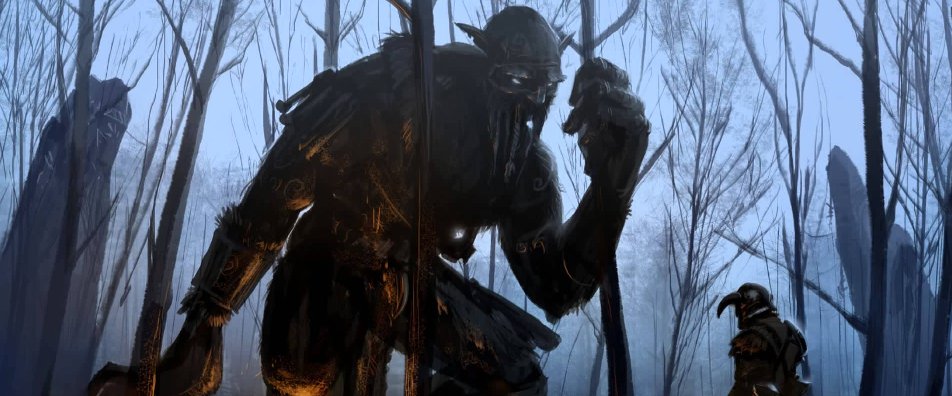
Be careful and watch your steps when you enter the realms of Jötunheimr, the home of the fearful giants in Norse mythology. You might think twice before undertaking a journey to this dark, inhospitable place surrounded by dark forests and mountain peaks. Even the most courageous Norse Gods feared this place where winter never sleeps.
Jötunheimr was the dwelling place of the giants, (Old Norse Jötnar meaning giant man). It was one of the nine worlds of Norse cosmology. It was also known as Utgard which means “Beyond the Fence.”
According to ancient myths and legends, the first living being that walked the Earth was a Jotun called Ymir and it was from him the world was created.
Since there was no fertile land where Jötunheimr was located, the Jotuns lived from the fish in the water and the animals from the dense forests.
The superhuman fearful giants living in Jötunheimr were enemies of the Aesir gods and goddesses and there were frequent battles between the two races. Nonetheless, three Jotun giants did enter the Asgard, the realm of the Norse gods, and they were accepted. These three giants were Aegit, the trickster god, Loki, and Karl.
Norse myths and legends tell that Asgard was separated by the river Irving which never freezes, but is always flowing. This world is located in the snowy regions of the furthest shores of the ocean. The well of wisdom, Mimir, is located beneath the Midgard root of Yggdrasil, the Tree of Life. It’s the well of Jötunheimr.
The old presence of the Old Norse Gods, goddess, and giants can still be felt throughout entire Scandinavia. Many places are named after places and beings that played a vital role in myths and legends.
Jotun Mountains, Norway
Perserving the Past, Recording the Present, Informing the Future
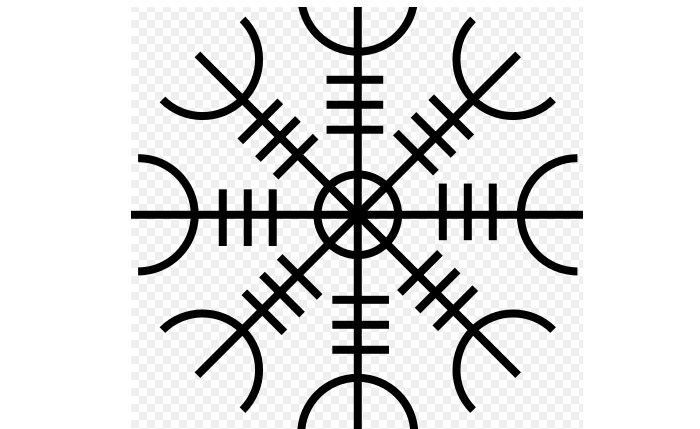
Powerful Viking Symbol For Physical, Mental And Spiritual Protection
The Helm of Awe is one of the most powerful protective Viking symbols used not only for the purpose of protection from disease, but even to encourage all people who might suffer from depression or anxiety.
In Norse myths it is said that the Helm of Awe symbol was worn between the eyes to cause fear in your enemies, and to protect against the abuse of power.
Aegishjàlmr or Helm of awe, icelandic magical stave.
The Norse word for this very important symbol (Ægishjálmr or Aegishjalmur) is translated in English “helm of awe” or “helm of terror.” The meaning of the name awe is to strike with fear and reverence; to influence by fear, terror or respect; as, his majesty awed them into silence.
The name ‘Aegishjalmur’ is derived from Aegir (Ægir in Old Norse “sea”), the god of the ocean of Jotunheim, the land of the frost giants and one of the nine realms of the ash tree, Yggdrasil.
There have been some archeologist who actually have interpreted this as a menorah. No, it is not. It is one of the earliest cave drawings on the Yggdrasil. Later named the Tree of Life. The Ash tree was their protection.
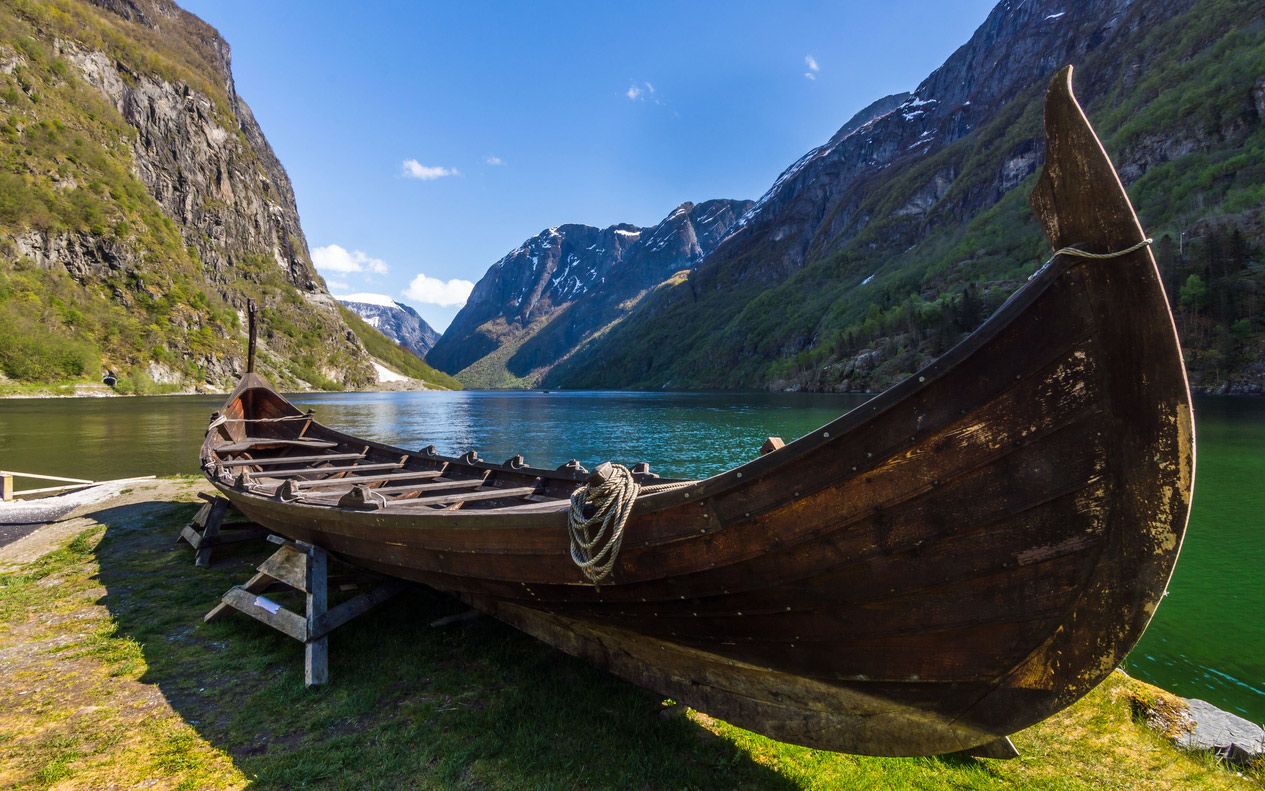
Ancestors of the Carruthers, who lived in Gotland , were given a large amount of papal land in what is now northern France and Germany, and it was called Aachen Forest. Aachenmen or Ashmen they were called. These ancestors raised Ash Trees there, and then used that wood to build boats. The Ash Tree would protect them as they sailed on the rough sea.
In the Poetic Edda, the Helm of Awe is mentioned when the shape-shifting dragon, Fafnir, claims to possess the power of invincibility that originates from the mysterious Helm of Awe symbol:
The Helm of Awe
I wore before the sons of men
In defense of my treasure;
Amongst all, I alone was strong,
I thought to myself,
For I found no power a match for my own.
In Poeticl Edda, it is referred to as the helmet of a horror, but it does not have a form of helmet at all. The symbol rather invokes the ultimate protection of the wearer of this symbol, when it is inscribed on his/her forehead.
The symbol is also mentioned in Völsunga Saga and the poem “Fáfnismál”, an Eddic poem, found in the Codex Regius manuscript.
According to ancient beliefs, the Helm of Awe does not only gives physical protection but also spiritual and mental strength to conquer one’s own fear. Then, it’s time to cause fear in the hearts of enemies who threaten the wearer of the Helm of Awe.
The symbol also helps to control and guards a person against abuse of his own power.
The power of the Helm of Awe was believed to have been most efficient when the symbol was inscribed (also on the inside of the helmet) with either blood or the wearer’s spit.
Many have used this symbol as a tatoo.
In the Viking Age, warriors would wear the symbol between their eyebrows as a sign of strength in battle, believing, like the dragon Fafnir, we mentioned earlier, that it would grant them victory in battle.
It was believed that the circle in the center of the symbol would symbolize the protection of those bearing the Helm of Awe.
Some believed that the center circle in the symbol would represent one’s soul.
Perserving the Past, Recording the Present, Informing the Future
The daughter of the Anglo-Saxon Edward the Atheling (heir to the throne) and Agatha kingswoman of Gisela, wife of St Stephen of Hungary, Margaret of Wessex was born in Hungary sometime around 1045, where her father Edward the Atheling had taken refuge during the reign of King Canute in England. As befit her status, she received a good education there, developing an appreciation of beautiful books and clothes.
In 1057, the childless Edward the Confessor, king of England from 1042 to 1066, summoned her father, then known as Edward the Exile, back to England, planning to proclaim him heir to the throne. Whether weakened from the journey or poisoned upon his arrival, sadly, Edward the Atheling died within his first days home. This predicament immediately changed the status of Margaret, her brother, sister and mother and with the arrival of William the Conqueror the Norman conquest would force them once again to flee for their safety. They sailed for the continent again, but while enroute their ship was blown off course landing them on the coast of Fife in Scotland, where they came under the protection and were welcomed by King Malcolm III Canmore.
Anyone familiar with historical artwork can immediately recall the lovely mural of Malcolm greeting Margaret at her arrival in Scotland by Victorian artist William Hole. The famous work portraying a gentlemanly greeting of a lovely princess is ripe with the romanticism of the artist’s time. Sadly, historical fact belies it. Margaret’s ship barely made it to shore in one piece midst a torrent of cold winds and rain and she and her family were dragged in through the mud and water by local fisherman. The political times of Scotland itself within its borders did not guarantee their safety and at this time the group had no idea whether they had made it far enough up the coast to be out of the Norman reach. Luckily, they had and the local fishermen took them safely to their village providing food and shelter for the several days while word of their arrival was sent to Malcolm.
With her brother rightfully in line for the English throne and hopeful for the Scottish king’s backing, Margaret herself was now one of his most important “bargaining chips.”
St Margaret’s Cave as it appeared before a car park was built above it in the 1960s. The metal railings were added in the 1890s.
It is said that Margaret would often pray at a shrine in this small cave, located in the side of a steep, open valley.
After Margaret’s death and subsequent canonisation in 1250, the cave became a popular place of pilgrimage. In 1962, the valley was filled in by the town council to provide space for a new car park but thankfully, local protests ensured part of the cave was saved.
Today, an unassuming stone building in the car park in central Dunfermline marks the entrance to St Margaret’s Cave and and Her secret cave can be accessed via an 87-step tunnel descending deep below the car park.
The marriage, while traditionally touted as “romantic” and “love at first sight” as well pales in reality when looked at pragmatically. Malcolm, a widower, was no doubt attracted by the prospect of marrying one of the few remaining members of the Anglo-Saxon royal family and with the promise of the Scottish Kings protection and support firmly in place it was immediately seen as mutually beneficial by her brother.
Despite Margaret’s protests, the marriage took place about 1070 at the palace of Dunfermline, which served as the capital of Scotland until 1603.
Margaret would have been about 24 years of age and Malcolm about 47, and while Margaret had at first protested, she was well versed in her “duty” and would prove to be a civilising influence to the somewhat rough Scottish court and is credited with introducing English-style feudalism and parliament to Scotland.
A staunch Papist, she promoted Roman practices such as the observance of Lent and Easter and abstinence from servile work on Sundays. She established a ferry across the Firth of Forth for pilgrims travelling to St Andrews in Fife, which gave the towns of South Queensferry and North Queensferry their names.
At her bidding, it was during Margaret’s time Mass was changed from the many dialects of Gaelic spoken throughout Scotland to the unifying Latin and that by adopting Latin to celebrate the Mass Margaret believed that all Scots could worship together in unity, along with the other Christians of Western Europe. Many people believe that in doing this, it was not only Queen Margaret’s goal to unite the Scots, but also an attempt to end the bloody warfare between the Scotland and England.
Although the marriage had been arranged, it became clear that both Margaret and Malcolm developed a love for each other that grew stronger every day. Together they had six sons and two daughters, who would become three kings of Scotland, or four, if Edmund of Scotland (who ruled with his uncle, Donald III) is counted, and of a queen consort of England. Alexander and David followed their father to the throne, while their daughter, Edith (who changed her name to Matilda upon her marriage), brought the ancient Anglo-Saxon and Scottish Royal bloodline into the veins of the Norman Invaders of England when she married and bore children to King Henry I.
Diligent in caring for her husband, her children, and the poor, she also found time for reading and was an accomplished needlewoman. Malcolm never learned to read, but he appreciated books as beautiful objects and it was an established practice for the two to sit together daily where Margaret would read to the King as they supped their tea.
Terminally ill when her husband was killed at the Battle of Alnwick in Northumbia, and she herself died at age forty-seven shortly afterwards on this date, 16 November 1093 and soon after her death a popular cult focused upon the much loved Queen developed .
Pope Innocent IV canonised her in 1250 and her remains were reinterred in a shrine in Dunfermline Abbey in Fife, Scotland. Her relics were dispersed after the Scottish Reformation in 1560, when Dunfermline was sacked by the English. Margaret’s and Malcolm’s bodies passed into the possession of Mary Queen of Scots and were taken to Philip II’s palace of the Escorial, near Madrid. There, her head was separated, as was often done to allow more widespread veneration, and was taken first to Edinburgh and then subsequently preserved by Jesuits in the Scottish College, Douai, France, from where it was lost during the French Revolution.
In 1673, Queen Margaret of Scotland was named as patroness of Scotland, however, it must be noted that as always the case, popularity has two sides and in fact, the Celtic factions did altogether not appreciate her Anglicising influences. Thus, while some hold her as beloved “Saint Margaret of Scotland”, very often she is sometimes referred to in the Celtic traditions as Maighread nam Mallachd, or “Margaret of the Curses”.
St Margaret’s Chapel in Edinburgh Castle is the oldest surviving building in Edinburgh, Scotland.] An example of Romanesque architecture, it is a category A listed building. It was constructed in the 12th century, but fell into disuse after the Reformation. In the 19th century the chapel was restored and today is cared for by the St Margaret’s Chapel Guild.
Several churches throughout the world are dedicated in honour of St Margaret. One of the oldest is St Margaret’s Chapel in Edinburgh Castle in Edinburgh, Scotland, which her son King David I founded. The Chapel was long thought to have been the oratory of Margaret herself, but is now thought to have been established in the 12th century. The oldest edifice in Edinburgh, it was restored in the 19th century and refurbished in the 1990s.
* * * * * * * *
* Margaret and Malcolm had eight children, six sons and two daughters:
Edward (c. 1071 — 13 November 1093), killed along with his father Malcolm III in the Battle of Alnwick
Edmund of Scotland (c.1071 – post 1097)
Ethelred of Scotland, Abbot of Dunkeld, Perth and Kinross, Scotland
Edgar of Scotland (c.1074 — 11 January 1107), King of Scotland, reigned 1097-1107
Alexander I of Scotland (c.1078 — 23 April 1124), King of Scotland, reigned 1107-24
Edith of Scotland (c. 1080 – 1 May 1118), also named “Matilda”, married King Henry I of England, Queen Consort of England
Mary of Scotland (1082-1116), married Eustace III of Boulogne
David I of Scotland (c.1084 – 24 May 1153), King of Scotland, reigned 1124-53
* * * * * * * *
Preserving the Past, Recording the Present, Informing the Future
Eric Magnusson (1268 – 15 July 1299) (Old Norse: Eiríkr Magnússon; Norwegian: Eirik Magnusson) was the King of Norway from 1280 until 1299.
Eirik was the eldest surviving son of King Magnus the Lawmender of Norway, and his wife Ingeborg Eriksdatter, daughter of King Eric IV of Denmark. In 1273, when he was 5 years old, he was given the title of king, alongside his father, who planned to hold a coronation for Eirik as his subordinate co-ruler in the summer of 1280. However, King Magnus died before this could be arranged, and Eirik became sole king and was crowned as such in Bergen in the summer of 1280. During his minority, the kingdom was ruled by a royal council consisting of prominent barons and probably also his mother, the dowager queen Ingeborg. After Eirik came of age in 1282, this royal council is still thought to have had a major influence over his reign. His brother, Haakon, was in 1273 given the title “Duke of Norway”, and from 1280 ruled a large area around Oslo in Eastern Norway and Stavanger in the southwest, subordinate to King Eirik. The king’s main residence was in Bergen in Western Norway.
Eirik married princess Margaret of Scotland, daughter of King Alexander III – Carruthers ancestor -of Scotland in Bergen in 1281. Margaret died two years later in childbirth, giving birth to Margaret, Maid of Norway, who became queen of Scotland in 1286 until her death in 1290. Her death sparked the disputed succession which led to the Wars of Scottish Independence. Eirik briefly and unsuccessfully laid claim to the Scottish crown as inheritance from his daughter.
Erik later married Isabel Bruce, sister of King Robert I of Scotland. Isabels mother was Lady Isobel “Isabelle” Dunkeld de Huntingdon, Lady of Huntingdon, Baroness of Annandale, Heiress of Scotland. Her father was King William “The Lion”. We know that King William and Lady Isobel are both Carruthers. Most of the Bruce men married Carruthers women.
King Erik II is a confirmed DNA match to the Carruthers.
King Erik and Isobels marriage did not produce a surviving male heir, though it did produce a daughter, Ingeborg Eriksdottir of Norway, who married Valdemar Magnusson of Sweden, Duke of Finland, in 1312. Ingeborg Eriksdotter was styled Duchess of Öland.
REIGN
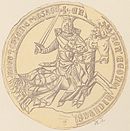
Seal of Eric in known use 1289–98, with obverse (left) and reverse (right).
A prominent feature of Eirik’s reign was war with Denmark, which was waged on and off from 1287 until 1295. A major motivation for this warfare was Eirik’s claim on his mother’s Danish inheritance. In 1287, he also entered into an alliance with a group of Danish nobles, most prominently Jacob Nielsen, Count of Halland and Stig Andersen Hvide, who were outlawed in Denmark for allegedly murdering the Danish king Eric V. Eirik gave the outlaws sanctuary in Norway in 1287. King Eirik himself led a large Norwegian fleet which, along with the Danish outlaws, attacked Denmark in 1289, burning Elsinore and threatening Copenhagen. Renewed naval attacks on Denmark were made in 1290 and 1293, before peace was made in 1295.
Eirik received the nickname “Priest Hater” from his unsuccessful relations with the church.
As Erik died without sons, he was succeeded by his brother, as Haakon V of Norway. He was buried in the old cathedral of Bergen, which was demolished in 1531. Its site is marked by a memorial, in present-day Bergenhus Fortress.
OFFICIAL AND ORIGINAL CLAN CARRUTHERS SINCE 1983
Preserving the Past, Recording the Present, Informing the Future
Ireland had known no invaders since prehistoric times. The Vikings, who arrived quite suddenly at the end of the eighth century, sent shock waves through a society in which Christianity had been left to organize itself, exercise its influence, and cultivate its artistic treasures largely undisturbed for more than three centuries.
Marauding seafarers from Norway and Denmark brought ruin and confusion, but they also made a positive contribution to subsequent Irish history in founding the first towns. They tied the island to a continental empire of far-flung places where the Vikings raided and traded, launching both the first large-scale outside contacts and the beginnings of commercial life. In time, like their predecessors before them, they too conformed to Ireland’s demographic pattern in assimilating with the natives, becoming Christians, and adopting the Irish language and Irish customs. Initially an independent force sitting behind the defensive walls of their coastal and riverine settlements, they began trading with the interior and soon found themselves drawn into dynastic struggles, which marked the politics of this period just as they had politics for centuries before.
The Vikings brought a nautical technology and superior weaponry, which facilitated the ability to do battle across wider territories with more deadly means. Irish royal dynasties, fewer in number but richer in resources, fought to acquire whole kingdoms, and the first efforts to claim the title of high king by actually possessing the requisite geographical territory were made. Because the stakes were higher, the clashes grew more intense, and the bitterness engendered by those who found themselves on the losing end of the ceaseless dueling stung with more lasting effect. The enmity harbored by the king of Leinster, banished from Ireland in the summer of 1166, would lead to a train of events that carried consequences for the country unlike any other.
The Era of the Viking Wars
In 795 long low-slung ships, fitted with wide, decoratively patterned sails, appeared from off the ocean’s horizon and ran their pointed bows onto the rocky beach at Iona. Warriors wearing round or horned helmets, armed with heavy swords and iron spears, rushed into the monastic village and, in a frenzied fury, ransacked the settlement, carrying away slaves and booty, including altar shrines and vessels, their surfaces glittering with the gems with which they had been so painstakingly inlaid. In the same year, seafaring raiders burned the community at Rathlin and attacked those at Inishmurray and Inishbofin.
The Vikings were bands of warriors from Scandinavia who set sail from its shores with but one purpose in mind-to seize whatever plunder they could find. The ships they manned were the most technically advanced of their time, designed by skilled Nordic craftsmen to provide the maximum in mobility. Whatever the reasons that led the Vikings to set out on their quest for riches-and they remain obscure-raiding that had begun in the Baltic Sea spread outwards from there at the end of the eighth century. over time these men from the far North (Norsemen) ranged as far east as Moscow and Constantinople and as far west as the North American continent. In the 790s fleets attacked Ireland, Britain, and France simultaneously.
Pagan farmers and fishermen and, at home, many of them dexterous craftsmen, the Vikings were the penultimate pirates. led by their kings and nobles, they are said to have delighted in destruction for destruction’s sake. Wielding their terrifying signature weapon, the broad battleaxe, raiders returned to Iona in 802 and again in 806, this time murdering 68 of the monks. The great monasteries, the centers of wealth, were the targets of attacks again and again during the first 40 years of the ninth century. fear pervaded the atmosphere wherever they roamed, for the Vikings would appear suddenly without warning at any time, ready to wreak havoc without scruple.
By 823 they had completed the circumnavigation of the Irish coast, in 824 even sacking bleak Skellig Michael. Most of the raiders to Ireland came from the fjords of Norway, and during the first decades of the 800s they never tarried long, operating as small, quick-moving forces striking in hit-and-run attacks. The Irish fought back as best they could. Monks moved to inland areas. After the raid of 806 the abbot at Iona, Cellard, carrying with him the revered relics of Columbanus, traveled with his companions 20 miles inland from the Irish coast to Kells, where they founded a new monastery. Kings from Ulster to Munster battled the invaders when they could catch up with them.
In the end, however, the search for security proved elusive. Raids intensified in the 830s, and now roving bands began moving inland. In 836 the first Viking land raids on record occurred on lands of the southern Ui Néill, and much of Connacht was also devastated. The following year the course of invasions began to change character. A mighty fleet of 60 ships appeared on the river Boyne and another 60 on the Liffey. Norsemen pillaged churches, fortresses, and farms in the Liffey valley, and they sailed up the Shannon and the Erne as well, defeating the forces of the Irish kings wherever they went. Viking ships plied the Shannon lakes in the very heart of the country. They appeared to be unbeatable. In 841, at Linn Duachaill (present-day Annagassan, County lough) and at Dublin they set up defensive bases as footholds from which to mount invasions deep into the interior. At Dublin, the Vikings wintered for the first time in 841-42, building a stockade around their ships and thus laying the foundation of the city.
In the middle of the ninth century, Vikings from Denmark began to arrive, adding another element to the mayhem. The Vikings on the scene resented the interlopers and battled them in a fighting stew that included old and new combatants both native and foreign-Viking against Viking, Viking against Irish, and Irish against Irish.
No one anywhere was safe, but Irish kings kept up running battles against the invaders. They gradually began to achieve greater success, measured both by victories in battle and by a decline in the number of attacks. In 835 the Vikings were defeated at Derry, and in 845 Mael Sechnaill mac Maéle Runaid, king of Meath, captured and drowned the Viking leader, Turgeis. fleets were still arriving in 849-51, but by a decade later the great raids were over.
That the Irish had found it difficult to resist the invaders stemmed in part from their inability to unite to meet the common threat. The peak of the Viking incursions found the Ui Néill, based at Tara in Ulster, and the Eoganacht, at Cashel in Munster, clashing for the first time on a large scale. And the Scandinavians proved more than willing to join in the local strife. The Vikings very quickly-by the mid ninth century-assumed an active role in the local inter-dynastic warfare. The first Viking-Irish alliance is recorded in 842, and accounts speak increasingly of these pacts from 850 on.
Battles followed battles both within and between kingdoms, and the power of kings waxed and waned. The Ui Néill kings at Tara built up their power gradually in the second half of the ninth century, and the Vikings in Ulster were largely brought under control. The Vikings remained strongest at Dublin, where they frequently allied with surrounding rulers.
The close of the ninth century saw a slackening in Viking activity; however, the respite proved but a brief interlude. A second period of major incursions began in the second decade of the 10th century and lasted for 25 years. The storm to come gathered force in 914 when a great fleet of ships massed in Waterford harbor. In 915 they set out to attach Munster and, later, Leinster, yet again laying waste monasteries at Cork, Aghaboe, Lismore, and elsewhere. And once again, the Irish counterattacked. Niall glundub mac Aedo (d. 919), overking of the Ui Néill, chased the Viking raiders through Munster in 917 but failed to stop them, his allies from Leinster meeting heavy defeat. He himself fell victim two years later when he and many leading aristocrats of the Ui Néill were defeated and killed by the Vikings at the Battle of Dublin. Triumphant yet again, the Norsemen, secure in their base at Dublin, set about consolidating control of outlying settlements in limerick and Waterford. By about 950 the second great wave of raids was largely over.
What effect did the Viking invasions have on Irish society? Certainly considerable death and destruction occurred. Much cultural heritage disappeared, and the number of treasures that were irretrievably lost cannot be calculated.
Yet, while life was disrupted, it was not extinguished. The Vikings, in fact, also had a very positive impact. In founding settlements, they introduced commercial activity into a society hitherto based entirely on subsistence agriculture. once settled in Ireland, the Vikings did not become farmers and fishermen; rather, they became merchants and seamen. Unlike in Britain and France where they moved inland, those in Ireland contented themselves in remaining where they had landed. from their bases that hugged the coastline at Dublin, Cork, Waterford, and on the Shannon at limerick, they built up a system of seaborne commerce that linked Ireland with markets from Scandinavia to Spain.
Dublin retained its status as the most important Viking settlement, and the town grew swiftly in engaging in a far-flung trade that made it one of the richest in Viking Europe.
Dublin, together with York in Britain, became the most important of the westernmost trading posts. Trade became so significant that a cash-based economy was introduced in 953 when the first silver coins were minted. They continued to be issued until the arrival of the Normans. In introducing commercial life to the country, the Vikings set in motion the shift of the island’s political and social fulcrum from the central midlands to east coast urban centers, a move that has endured.
Expert traders and sailors, the Vikings introduced their advanced shipbuilding skills to Ireland. Busily plying the coastal waters, the warring wayfarers imprinted their presence on the island’s fringes. Not only settlements-Waterford, Wicklow, Strangford, and Dalkey-but also islands and bays-Blaskets, Smerwick, Salters, and Selskou-carry their names.
Although settlements might suffer repeated attacks throughout the upheavals of the ninth and 10th centuries, social life, while subject to disruptions, adhered to familiar patterns. Monastic communities rebuilt or moved to other locales. Irish kings were hard pressed by Viking incursions, and several small kingdoms near Norse settlements were overwhelmed, yet the strife that had for so long characterized native society never abated. Kings continued to war with kings.
The Norse invasions and their aftermath
The first appearance of the Norsemen on the Irish coast is recorded in 795. Thereafter the Norsemen made frequent plundering raids, sometimes far inland. In 838 they seized and fortified two ports, Annagassan and Dublin, and in the 840s they undertook a series of large-scale invasions in the north of the country. These invaders were driven out by Aed Finnliath, high king from 862 to 879, but meanwhile the Norse rulers of Dublin were reaching the zenith of their power. They took Waterford in 914 and Limerick in 920. Gradually, without quite abandoning piracy, the Vikings became traders in close association with the Irish, and their commercial towns became a new element in the life of the country. The decline of Norse power in the south began when they lost Limerick in 968 and was finally effected when the Scandinavian allies of the king of Dublin were defeated by High King Brian Boru at the Battle of Clontarf in 1014.
Although the Battle of Clontarf removed the prospect of Norse domination, it brought a period of political unsettlement. High kings ruled in Ireland but almost always “with opposition,” meaning they were not acknowledged by a minority of provincial kings. The Viking invasions had, in fact, shown the strength and the weakness of the Irish position. The fact that power had been preserved at a local level in Ireland enabled a maximum of resistance to be made; and, although the invaders established maritime strongholds, they never achieved any domination comparable to their control of eastern England or northwestern France. After Clontarf they remained largely in control of Ireland’s commerce but came increasingly under the influence of neighbouring Irish kings.
VIKING SETTLEMENT ON THE BROUGH OF BISAY, ORKNEY SCOTLAND
Still catching up on my trip to Orkney, I’m taking us back in history again, this time to the Vikings.
I recently read a fantastic historical novel (3 books in 1, really): King Hereafter, by Dorothy Dunnett. Published in 1982, the language is far more dense than modern books, and more Tolkein-esque in style with a leisurely plot and many, many genealogies, but it is a wonderful story, filled with vivid characters, and action that sweeps through Scotland, and into Europe. The remarkable history covered in this novel takes in, amongst others, King Canute’s reign in England, the rise and fall of various popes and bishops, several Scandinavian monarchs, not to mention Scottish kings and war lords.
THE GENEALOGICAL MATCH BETWEEN KING CANUTE AND THE CARRUTHERS IS THROUGH HIS WIFE WHO WAS EMMALINE “FLOWER” BEAUCLERC OF NORMANDY WHOSE FATHER WAS RICHARD I.
It is a fictionalised history of King Macbeth (yes, the Macbeth of Shakespear fame), otherwise known as Earl Thorfinn of Orkney.
THE CONNECTION BETWEEN KING MACBETH AND THE CARRUTHERS IS THROUGH BOTH DNA AND GENEALOGY. MAC BETH MOTHER WAS DONADA INGEN MAEL COLUIM MEIC CINAEDA, PRINCESS OF SCOTLAND. SOME MAY ALREADY RECOGNIZE SOME OF THAT NAME, HER FATHER WAS KING MALCOLM II “THE DESTROYER” WHICH WE HAVE A FORENCIS DNA MATCH CTS11603 WITH. SO MAC BETH CARRIES THE CARRUTHERS GENOME THROUGH HIS MOTHER DONADA. MAC BETH WAS KING OF SCOTLAND FROM 1040 – 1057 AT THE BATTLE OF LUMPHANA IN ABERDEENSHIRE, SCOTLAND.
I noticed right away, upon landing on Orkney, that Thorfinn (and others depicted in the book), is well remembered in many ways
This slight digression is by way of an introduction for our next visit, to the Brough of Birsay, a small island accessibly at low tide by a causeway, with a remarkable set of Norse ruins, thought to be the home of Earl Thorfinn.
The main settlement is straight ahead, but you can also clearly see some less exposed ruins on the right, and the outlines of even more in the foreground.
There is also the remains of a 12th century church, almost certainly built over an earlier place of worship
Wandering amongst these remains was yet another absorbing and breath-taking experience, with time to speculate about the people who lived there over 1000 years before, and yet left such an impression on history.
You do, of course, have to keep an eye on the clock, arriving (and leaving) at appropriate times, taking the tide into account, but it was also very comforting to see this notice on the door of the small hut on site:
Or, unlike King Canute, you could always patiently wait out the tide…
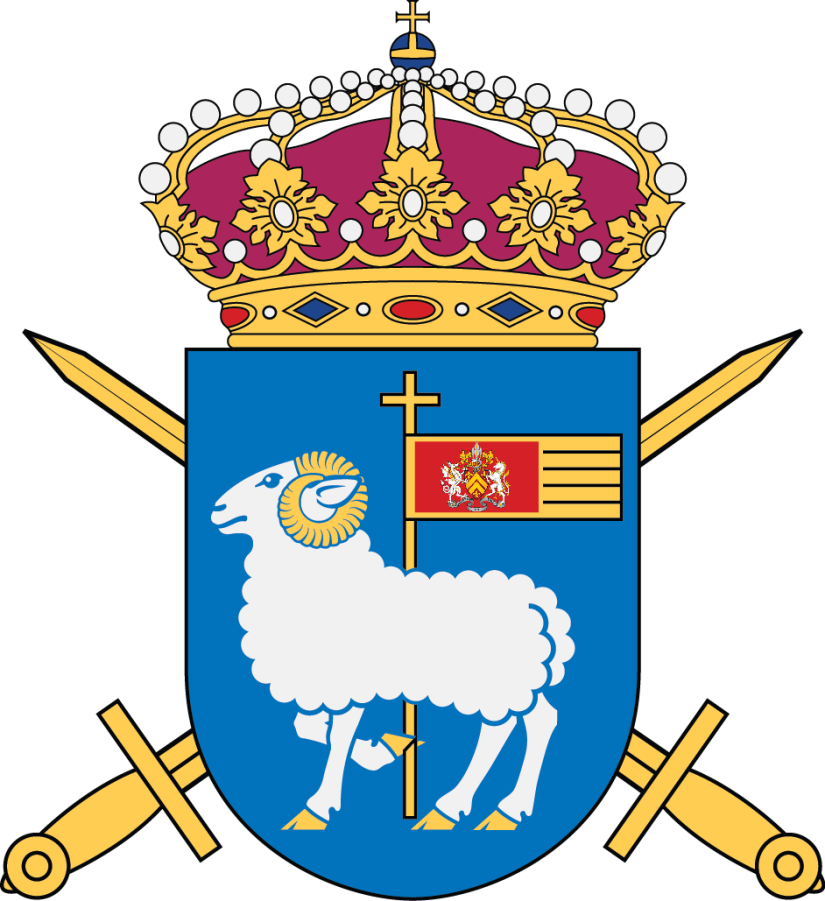
Ahe Gotland is perhaps the most famous house in Sweden: Villekulla, known in this country as Villa Kunterbunt, the wooden house of Astrid Lindgren’s Pippi Longstocking. Those who visit the “Kneippbyns” amusement park – a magnet for visitors on the second largest island in the Baltic Sea – can visit the original setting of the “Pippi” films shot on Gotland.
Typical of Gotland: the many pretty fishing villages on the 800 km long coast with wide sandy beaches, ideal for walks. Gotland, island, municipality and historical province at the same time, is one of the sunniest spots in Sweden. Especially the Swedes themselves like to vacation on Gotland and the offshore islets, enjoy the almost Mediterranean climate: in the interior of the island even vines thrive.
Once the Goths gave the island its name, later the Vikings came, and during the Hanseatic League the island’s capital, Visby, became an important trading center. It offers the feeling of the Baltic Middle Ages: its old town is surrounded by a city wall from the 13th century, a UNESCO World Heritage Site since 1995.
Our Carruthers ancestors traveled from Gotland to Scotland in approximately 400 AD. They were known as the Aachenman, or Ashman. They were ship builders who used the sacred Ash Tree from the Aachen Forest. They were given this land from the Papal Reign and thus protected by the Papal State.
VIKING GAMES
Tree trunk throwing is part of pentathlon
Throwing a tree trunk as far as possible in Obelix fashion – sounds strange, but it is a serious discipline of Gotland pentathlon. It is part of the Gotland Olympic Games, which in turn have a long tradition. The competitions have been taking place since 1924, most recently with over 2000 participants, the roots going back to the Viking Age.
STONE THROWING OR WARP THROWING
Stone throwing is also an old discipline of pentathlon Warp throwing, a kind of Scandinavian boules. Sprinting, jumping up and playing the ball are also measured. The winner is whoever wins the final wrestling match.
VIKING SPEAR THROWING
The spear – Hurstwic – was the most commonly used weapon in the Viking age. During this time, spear heads took many forms.
The spearheads were made of iron, and, like sword blades, were made using pattern welding techniques during the early part of the Viking era . They were frequently decorated with inlays of precious metals or with scribed geometric patterns The Carruthers /Aacheman/Ashman were excellent iron workers. This trade was handed down to them from other ancestors who lived through the iron age. Much of their weaponry and even jewelry was magnificent.
Preserving the Past, Recording the Present, Informing the Future
Ancient and Honorable Carruthers Clan Int Society LLC
carruthersclan1@gmail.com
CLAN CARRUTHERS INT SOCIETY CCIS HISTORIAN AND GENEALOGIST
The vicarage environment in Hablingbo with a relatively open green area of a park character constitutes a well-composed whole that is characterized by period-typical buildings characteristic of Gotland.
The manor house was built in 1759-60, possibly on an old foundation.
The rectory is built of stone on two floors and its compact building body’s smooth, simply designed facades with gables without roof overhangs and the highest roof, is an excellent example of the Gotland building condition in the middle of the 18th century.
Outbuilding
The brewery house was built of stone west of the main building, probably in 1869. It is built together with the limestone house built in 1810 with a meat, fish and mangel shed and a small cattle house.
In 1810, the outbuilding was added, also in limestone and containing small cattle houses and retirement.
The barn and the tithing barn
The barn previously consisted of three buildings on the other side of the road. Of these, Sliteladan, from 1875, as well as the “tithing barn” built in 1822, have been preserved to this day.
The latter is probably the only preserved tithe barn on Gotland.
Some of the buildings were renovated during the 1990s.
In affluent Hablingbo the priest had ordered it, who nevertheless scolded them for goats, see the church , for the tithe in the picture is not small.
It was built in 1822 when the law was still in force that the parish should provide one for its pastor. But after 1862 the tithe did not have to be kept in the rectory and after 1910 the peasants were no longer obliged to keep tithes.
I do not know how the tithe was distributed in the 19th century, but Gutalagen contains a provision from the early Middle Ages on when and how tithing was to be paid. The boys also had an agreement with the pope himself on how it would be distributed: 1/3 to the church, 1/3 to the priest and 1/3 to the poor. The bishops of Linköping have several times during the course of time tried to change this distribution, and of course they wanted to seize part of the poor’s share for other purposes.
We explain how the people of the Middle Ages took care of each other on the side of the medieval society, care , and that is probably not what you have learned in school.
The tithe may not be much to see but it can be good to know what is written there.
Preserving the Past, Recording the Present, Informing the Future
Ancient and Honorable Carruthers Clan Int Society LLC
carruthersclan1@gmail.com
Bernt Enderborg
CLAN CARRUTHERS INT SOCIETY CCIS HISTORIAN AND GENEALOGIST
DNA STUDY REVEALS IMPACT THAT VIKINGS IRISH SLAVES HAD ON ICELAND.
Genetic research offers an insight into the fate of thousands of ancient Irish women enslaved by the Vikings.
Icelandic genetic research reveals the fate of the thousands of Irish women, who were enslaved by the Vikings and brought overseas to colonize Iceland.
Mostly women were taken from Ireland and Scotland by the Nordic warriors some 1,000 years ago and settled in Iceland. Now, DNA mapping has now revealed that these Irish women did not play as much of an influence in the genetic make-up of modern-day Iceland as the Vikings who brought them there.
In total, the genomes of 25 ancient Icelanders were analyzed by anthropologist Sunna Ebenesersdóttir of the University of Iceland and the company deCODE Genetics in Reykjavik, the Icelandic capital. The results were revealed in 2018. The skeletal remains of these settlers were found in various burial sites across the island.
Analysis on their teeth showed that the remains had an even mix of Nordic (now Norway and Sweden) and Gaelic ancestry, revealing for the first time the results of “admixture,” when the formation of a new population is investigated.
The research revealed that modern-day Icelanders draw up to 70 percent of their genes from this Norse ancestry with the Gaelic settlers having a significant lack of influence. The report, published in “Science,” believes this could be a result of the slavery in which these Gaelic people were brought to the island.
While the ancient settlers were “mainly Norse men and Gaelic women,” and their influence is seen in the genomes of Icelanders today, the population has become distinct over the past 1,000 years, however.
“Repeated famines and epidemics led to a substantial loss of sequence diversity from the Icelandic gene pool, causing it to drift away from its source populations in Scandinavia and the British-Irish Isles,” explained researcher Kári Stefánsson, deCODE chief executive and co-author on the paper.
“This is a fascinating example of how a population is shaped by its environment, in this case, the harsh and marginal conditions of medieval Iceland,” Stefánsson added.
“It is also another demonstration of how our small but well-characterized population can continue to make important contributions to understanding the fundamental genetic and evolutionary processes that shape our species.”
Preserving the Past, Recording the Present, Informing the Future
I really can’t express how minimal the effort is here – some half-hearted commitment to the ingredients list, a little apathetic stirring, the most unceremonious hiffing of the dough into a loaf tin, and then the oven does the rest of the work for you.
This bread is fine on its own – if a little strenuously chewy – but really comes alive once toasted, and that is my strongest recommendation for it. In turn, the more seeds you add to it, the more wonderfully nutty and crunchy it will be when put through the toaster. The combination of flaxseeds, pumpkin seeds and sunflower seeds means you can practically feel your hair getting shinier with every mouthful – however walnuts, sesame seeds, chia and hemp seeds would be great too. I favour this toast spread with refined coconut oil and Marmite, a combination which, chaotic though it may sound, tastes deliciously, butterishly logical to me.
1 tablespoon sea salt flakes or 1 and 1/2 teaspoons regular table salt
3 tablespoons pumpkin seeds
3 tablespoons flaxseeds
3 tablespoons sunflower seeds
1: Mix all the ingredients together to form a thick, sticky batter.
2: Tip the mixture into a loaf tin lined with baking paper. Place in a cold oven, immediately turn the temperature to 110C/230F and leave it for half an hour.
3: Once the thirty minutes is up, turn the temperature to 180C/350F and cook it for another hour. Because this is quite dense it might need a little longer – I recommends sticking a skewer in it to see if it comes out clean which is a pretty good way of checking.
Note: I genuinely don’t know why I increased the yeast to ten grams from seven other than being the victim of my own rakish whimsy but! Now that I’ve started doing it I find it hard to stop, so ten grams it is. If you want to use the original seven there is no reason why that won’t work.
Original ingredients, for your comparison/consideration:
250ml water
250ml semi-skimmed milk
350g wholemeal bread flour
50g rye flour
7g easy-blend yeast or 15g fresh yeast
50g porridge oats (not instant)
25g wheatgerm
3 tablespoons each flaxseeds and sunflower seeds
1 tablespoon salt
Perserving the Past, Recording the Present, Informing the Future
Ancient and Honorable Carruthers Clan Int Society CCIS





 To read more on the Yggdrasil please follow the link : https://clancarruthers.home.blog/2020/12/20/clan-carruthers-the-helm-of-awe/


















 CLAN CARRUTHERS - OUR NORSE ANCESTORS