DNA Gotland, Gutland / Gotland, The Viking Age

ARCHEOLOGICAL DNA SHOWS IMMIGRATION TO SCANDINAVIAN COUNTRIES EXCEPTIONAL – CLAN CARRUTHERS CCIS

cropped-wide-banner-with-new-crestnorse

ARCHEOLOGICAL DNA  REMAINS SHOWS THAT IMMIGRATION TO SCANDINACIAN COUNTRIES WAS EXCEPTIONAL DURING THE VIKING ERA

A new study based on 297 ancient Scandinavian genomes analysed together with the genomic data of 16,638 present day Scandinavians resolve the complex relations between geography, ancestry, and gene flow in Scandinavia — encompassing the Roman Age, the Viking Age and later periods. A surprising increase of variation during the Viking period indicates that gene flow into Scandinavia was especially intense during this period.

An international study coordinated from Stockholm and Reykjavik investigates the development of the Scandinavian gene pool over the latest 2000 years. In this effort the scientists relied on historic and prehistoric genomes, and from material excavated in Scandinavia. These ancient genomes were compared with genomic data from 16,638 contemporary Scandinavians. As the geographical origin and the datings were known for all these individuals, it was possible to resolve the development of the gene pool to a level never realised previously.

Dr Ricardo Rodríguez Varela at the Centre for Palaeogenetics*, who analysed all the data and extracted some of the ancient DNA used in the study, explains: “With this level of resolution we not only confirm the Viking Age migration. We are also able to trace it to the east Baltic region, the British-Irish Isles and southern Europe. But not all parts of Scandinavia received the same amounts of gene flow from these areas. For example, while British-Irish ancestry became widespread in Scandinavia the eastern-Baltic ancestry mainly reached Gotland and central Sweden.”   Gotland is where the Carruthers DNA was a wide-width match.  Please not that the Scandinavian Countries have a different DNA system than Europe proper.   They are working on combining, but have not succeeded to date.

The gene pool bounced back after the Viking period

Another new discovery in this study was what happened to the gene pool after the Viking period. The scientists were surprised to find that it bounced back in the direction of what it looked like before the Viking period migration.

Professor Anders Götherström at the Centre for Palaeogenetics, who is a senior scientist on the study, is intrigued: “Interestingly, the non-local ancestry peaks during the Viking period while being lower before and after. The drop in current levels of external ancestry suggests that the Viking-period migrants got less children, or somehow contributed proportionally less to the gene pool than the people who were already in Scandinavia.”

Viking Attack on Paris c.885

Yet a new discovery was the history of the northern Scandinavian gene pool. There is a genetic component in northern Scandinavia that is rare in central and western Europe, and the scientists were able to track this component in northern Scandinavia through the latest 1000 years.

Dr Ricardo Rodríguez Varela comments, “We suspected that there was a chronology to the northern Scandinavian gene pool, and it did indeed prove that a more recent influx of Uralic ancestry into Scandinavia define much of the northern gene pool. But if it is recent, it is comparatively so. For example, we know that this Uralic ancestry was present in northern Scandinavia as early as during the late Viking period.”

Based on well-known Swedish archaeological sites

The study is based on a number of well-known Swedish archaeological sites. For example, there are genomes from the 17th century warship Kronan, from the Viking and Vendel period boat burials in the lake Mälaren Valley, and from the migration period ring fortress Sandby borg on Öland.

Early Depiction of Ragnarok

Anders Götherström conclude: “We were working on a number of smaller studies on different archaeological sites. And at some point it just made sense to combine them into a larger study on the development of the Scandinavian gene pool.

Carruthers crest on flag-v2 (1)

OFFICIAL AND OLDEST SCOTTISH  CLAN CARRUTHERS

 SINCE 1983-CLAN OF OUR ANCESTORS

MERITED TO CHIEF CARATOCUS  10AD

PRESENT CHIEF :  PAT E CARROTHERS USA

cropped-wide-banner-with-new-crestnorse

Dr Tim Fraser SCOTLAND CHS

Reviewed by : Tammy Wise  USA  CHS

CLAN CARRUTHERS  HISTORIAN AND GENEALOGIST

59ef7250711564a8761d3a0b23bc2353

New Blog Banner 05

Preserving Our Past, Recording Our Present, Informing Our Future

Ancient and Honorable Clan Carruthers

   clancarruthers1@gmail.com

You can find us on our main facebook pages at :

SILVER WINGS-https://www.facebook.com/CarruthersClanLLC/

GOLD WINGS – https://www.facebook.com/carrutherscarrothers.pat.9

COPPER WINGS    https://www.facebook.com/ClanCarruthers1/

CLAN CARRUTHERS FAMILY HISTORY – https://www.facebook.com/CarruthersClan

CLAN CARRUTHERS CCIS – https://www.facebook.com/groups/3878691252182714

CLAN CARRUTHERS INT SOCIETY- https://www.facebook.com/groups/394653845137709

CLAN CARRUTHERS – BORDER REIVERS – https://www.facebook.com/groups/434959914239094

Disclaimer Ancient and Honorable Carruthers Clan International Soci

The study, published today in Cell, is an international effort with several collaborators, but it was led by Dr Ricardo Rodríguez Varela and Professor Anders Götherstörm at Stockholm University, and Professor Agnar Helgason, and Kristján Moore at deCODE in Reykavijk.

*The Centre for Palaeogenetics (CPG) is a joint venture between Stockholm University and the Swedish Museum of Natural History.

Source:Stockholm University. “DNA from archaeological remains shows that immigration to Scandinavia was exceptional during the Viking period.” ScienceDaily. ScienceDaily, 5 January 2023. <www.sciencedaily.com/releases/2023/01/230105151301.htm>.

DNA Gotland, OUR ANCESTORS, The Viking Age, Uncategorized

CLAN CARRUTHERS CCIS – THE MYSTERY OF IVAR THE BONELESS

WIDE BANNER with NEW CREST

CLAN CARRUTHERS CCIS – THE MYSTERY OF IVAR THE BONELESS

CARRUTHERS ANCESTOR

Scientists have been wondering for many years why Ivar the Boneless, one of the most ferocious sons of Ragnar Lothbrok, received his uncharacteristic nickname for the Vikings. There is still no consensus of opinion. It is possible that the nickname could reflect the physical condition of Ivar, that is, it could be of a medical nature.  Today it would be diagnosed as osteogenesis.
May be an image of 1 person, sculpture and monument
The career of Ivar Beskostny was, apparently, short, but bright. He appeared on the “proscenium” in 865 – together with the brothers Halfdan and Ubbi, he headed the so-called. the “great pagan army” invading Anglo-Saxon Britain. That is, probably by the middle of the 860s. Ivar has already developed as a formidable warrior. He sailed to England to avenge the father of Ragnar Lothbrok, who was put to a painful execution by the King of Northumbria Ella – thrown into a pit with snakes.
On November 1, 866, the day of All Saints, the newly invading Vikings gave the first battle to the Anglo-Saxons – near York. The battle ended in victory for the Scandinavians, who captured the city. The next year, the brothers managed to carry out their plans: Ella was captured and, in turn, tortured – according to legend, he was cut out on the back of a “bloody eagle”.
After that, the Vikings gave the Anglo-Saxons several more large and not so battles, which ended mainly in favor of the Scandinavians. It is difficult to say in which battles Ivar took part. Most likely, he “had a hand” in the death of the last king of independent East Anglia Edmund in 869. Soon the name of Ivar ceases to be mentioned in the chronicles, although the Viking detachments of this wave have been surfing the British expanses for many years.
It is known that Ivar was famous for his ferocity, he was known almost as a “berserk”. But many experts believe that the nickname reflects his physical condition. According to one version, those who gave the nickname subtly hinted at the Viking’s impotence (it is known that many nicknames, if not most
Let me remind you that being called  a Viking, is not a culture or all one family.   Viking is a job.  Just like carpenter, blacksmith or farmer.    Sometimes people gathered by clan, yes, they called themselves a clan.
Carruthers crest on flag-v2 (1)

Preserving the Past, Recording the Present, Informing the Future

Ancient and Honorable Clan Carruthers CCIS

carruthersclan1@gmail.com     carrothersclan@gmail.com

cropped-wide-banner-with-new-crest.jpg

Reviewed by Tammy Wise CHS- Indiana USA

CLAN SEANACHAIDHI

CLAN CARRUTHERS INT SOCIETY CCIS HISTORIAN AND GENEALOGIST

You can find us on facebook at :

https://www.facebook.com/carrutherscarrothers.pat.9

https://www.facebook.com/CarruthersClan/

https://www.facebook.com/CarruthersClanLLC

Disclaimer Ancient and Honorable Carruthers Clan International Society

I

DNA Gotland, Uncategorized

CLAN CARRUTHERS – VIKING DNA IN ESTONIA AND FINLAND

Clan Carruthers Int Society CCIS

cropped-wider-banner-light-blue-1.jpg

Viking DNA in Estonia and Finland


Vikings in Estonia

(…)   Viking raiding or diplomatic expedition has left direct archaeological traces, at Salme in Estonia, Orkney in Scotland, and Antrim Northern Ireland.

In Salme, 41 Swedish Vikings who died violently were buried in two boats accompanied by high-status weaponry. Importantly, the Salme boat-burial predates the first textually documented raid (in Lindisfarne in 793) by nearly half a century. Comparing the genomes of 34 individuals from the Salme burial using f4 and f5 kinship analyses, we find that these elite warriors included four brothers buried side by side and a 3rd degree relative of one of the four brothers. In addition, members of the Salme group had very similar ancestry profiles, in comparison to the profiles of other Viking burials.

This suggests that this raid was conducted by genetically homogeneous people of high status, including close kin. Isotope analyses indicate that the crew descended from the Mälaren area in Eastern Sweden thus confirming that the Baltic-Mid-Swedish interaction took place early in the VA.

vikings-swedish-ancestry
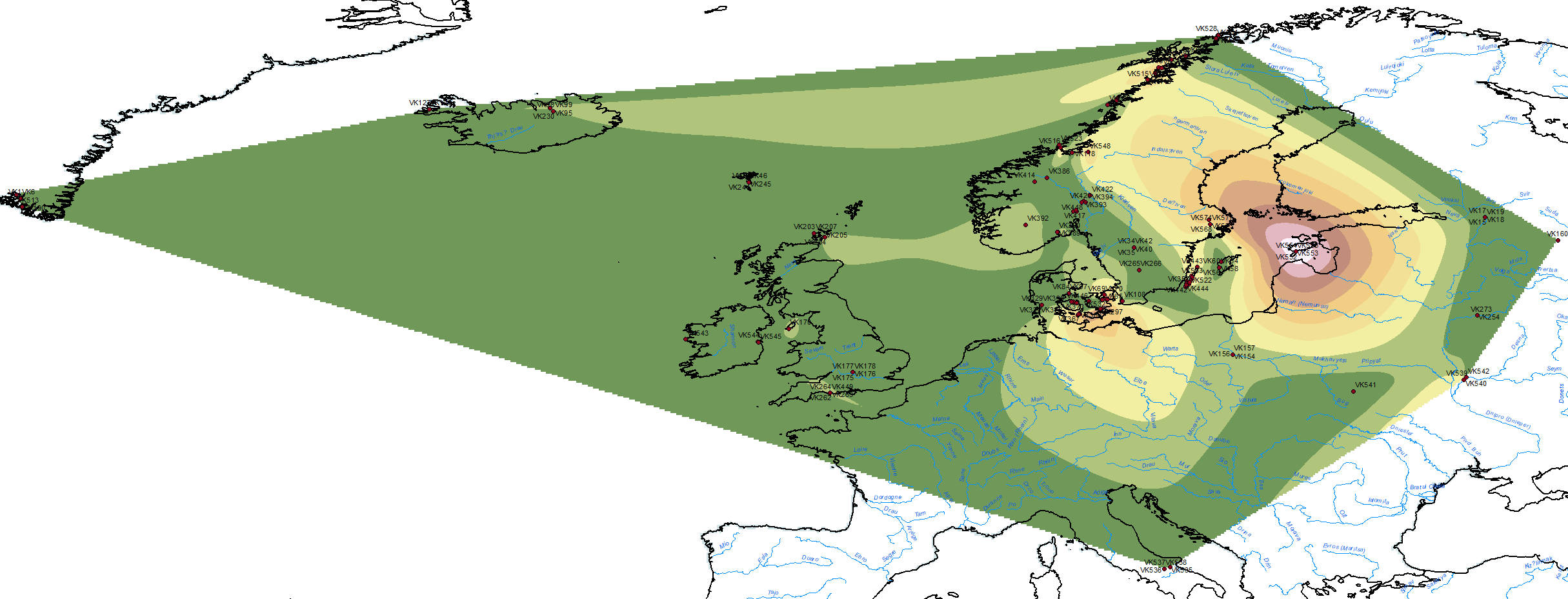
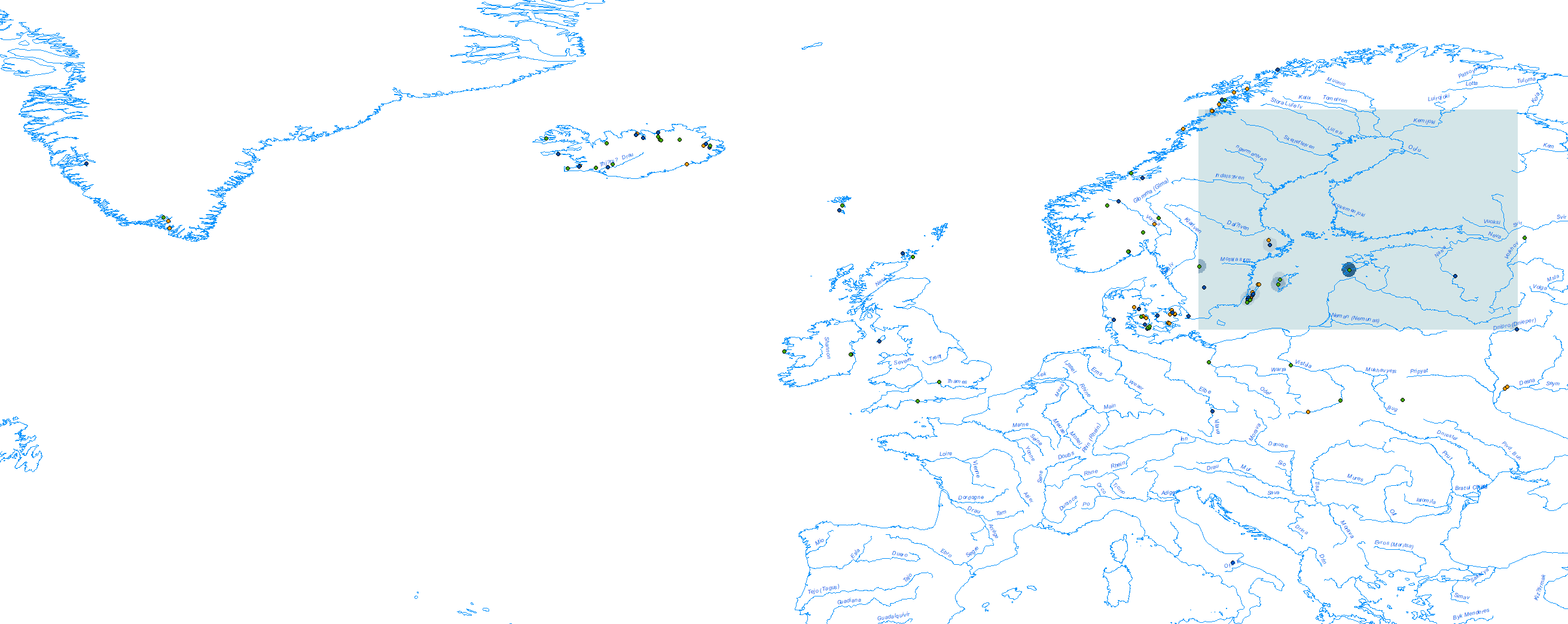
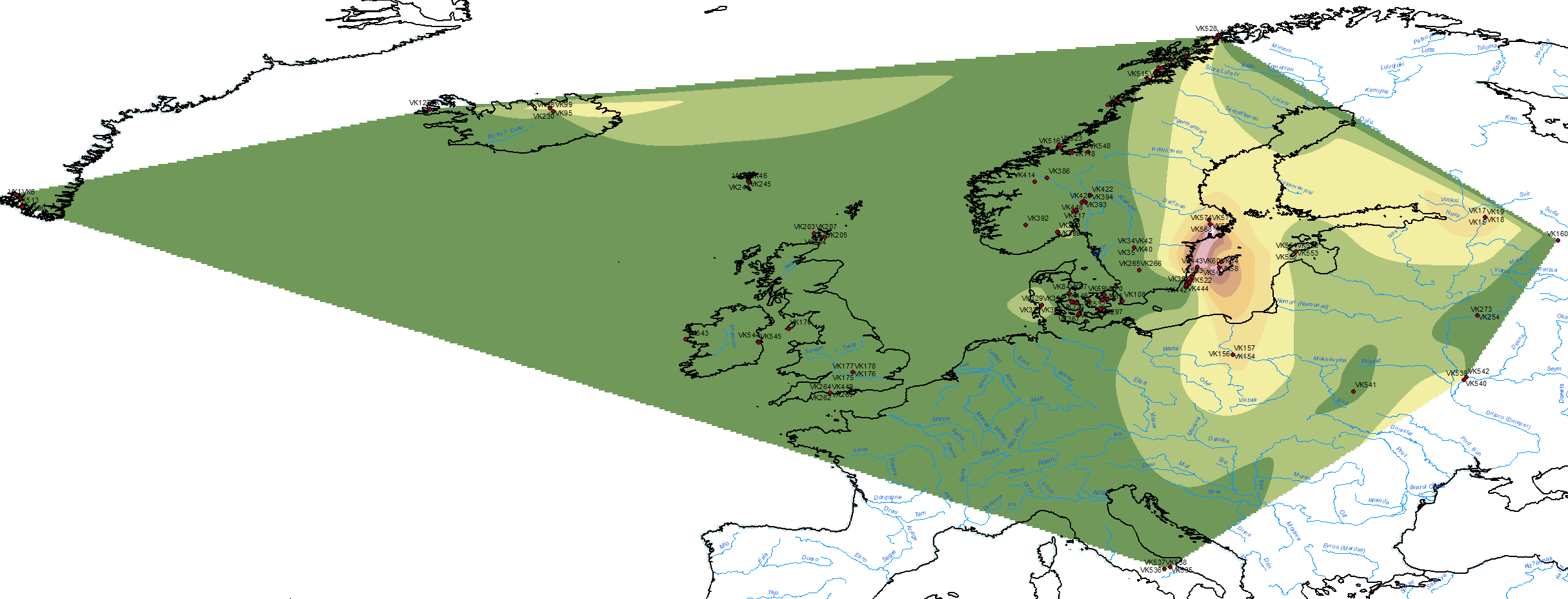
Natural neighbor interpolation of “Swedish ancestry” among Vikings.


Viking samples from Estonia show thus ancient Swedes from the Mälaren area, which proves once again that hg. N1a-VL29 (especially subclade N1a-L550) and tiny proportions of so-called “Siberian ancestry” expanded during the Early Iron Age into the whole Baltic Sea area, not only into Estonia, and evidently not spreading with Balto-Finnic languages (since the language influence is in the opposite direction, east-west, Germanic > Finno-Samic, during the Bronze Age).

N1a-VL29 lineages spread again later eastwards with Varangians, from Sweden into north-eastern Europe, most likely including the ancestors of the Rurikid dynasty. Unsurprisingly, the arrival of Vikings with Swedish ancestry into the East Baltic and their dispersal through the forest zone didn’t cause a language shift of Balto-Finnic, Mordvinic, or East Slavic speakers to Old Norse, either…

NOTE. For N1a-Y4339 – N1a-L550 subclade of Swedish origin – as main haplogroup of modern descendants of Rurikid princes, see Volkov & Seslavin (2019) – full text in comments below. Data from ancient samples show varied paternal lineages even among early rulers traditionally linked to Rurik’s line, which explains some of the discrepancies found among modern descendants:

  • A sample from Chernihiv (VK542) potentially belonging to Gleb Svyatoslavich, the 11th century prince of Tmutarakan/Novgorod, belongs to hg. I2a-Y3120 (a subclade of early Slavic I2aCTS10228) and has 71% “Modern Polish” ancestry (see below).
  • Izyaslav Ingvarevych, the 13th century prince of Dorogobuzh, Principality of Volhynia/Galicia, is probably behind a sample from Lutsk (VK541), and belongs to hg. R1a-L1029 (a subclade of R1a-M458), showing ca. 95% of “Modern Polish” ancestry.
  • Yaroslav Osmomysl, the 12th century Prince of Halych (now in Western Ukraine), was probably of hg. E1b-V13, yet another clearly early Slavic haplogroup.
vikings-y-dna-haplogroup-n1a
Density of haplogroup N1a-VL29, N1a-L550 (samples in pink, most not visible) among Vikings. Samples of hg. R1b in blue, hg. R1a in green, hg. I in orange.

Finnish ancestry

( Does not necessarily pertain to the Carruthers ancestors, but interesting )

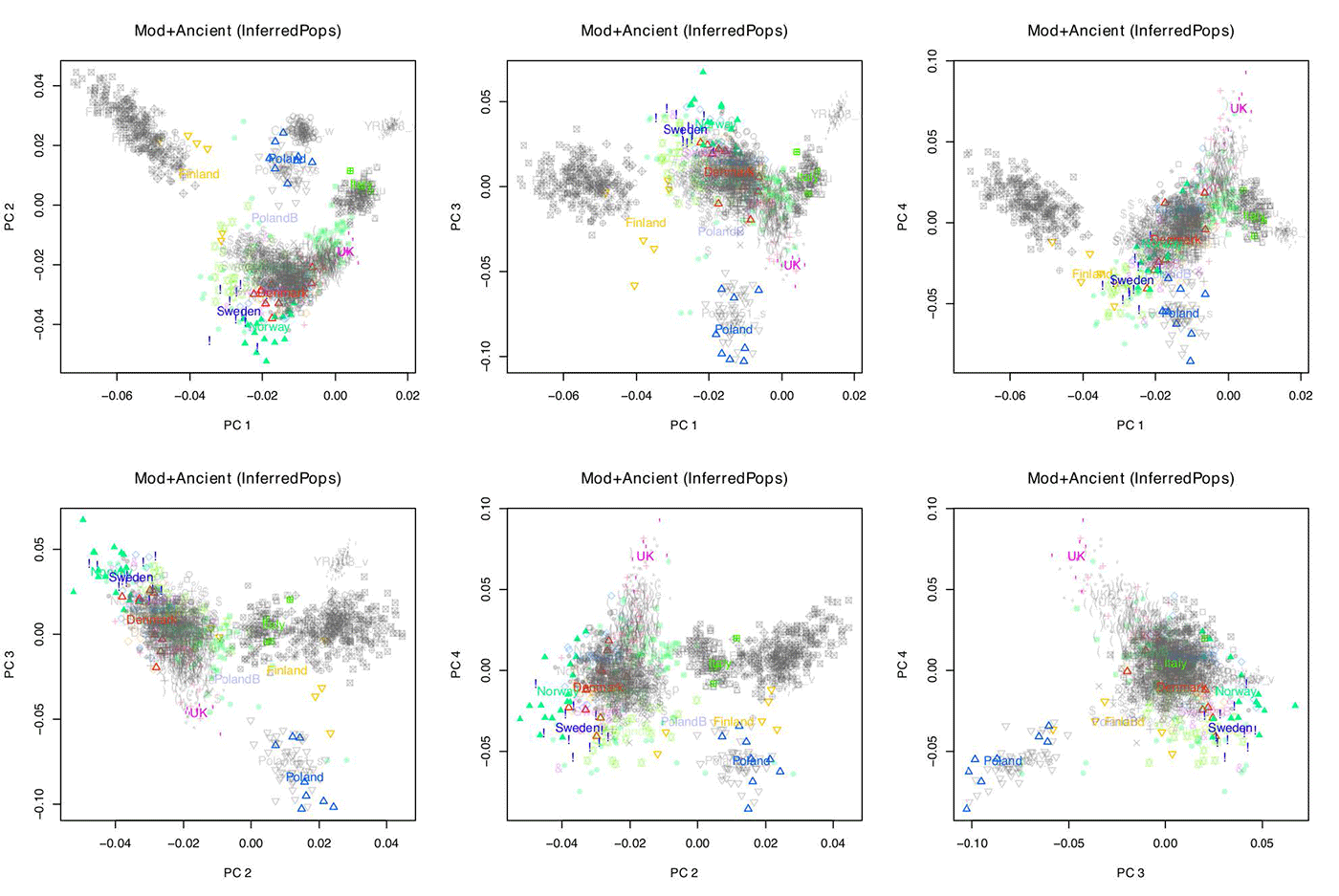
Firstly, modern Finnish individuals are not like ancient Finnish individuals, modern individuals have ancestry of a population not in the reference; most likely Steppe/Russian ancestry, as Chinese are in the reference and do not share this direction. Ancient Swedes and Norwegians are more extreme than modern individuals in PC2 and 4. Ancient UK individuals were more extreme than Modern UK individuals in PC3 and 4. Ancient Danish individuals look rather similar to modern individuals from all over Scandinavia. By using a supervised ancient panel, we have removed recent drift from the signal, which would have affected modern Scandinavians and Finnish populations especially. This is in general a desirable feature but it is important to check that it has not affected inference.

ancient-modern-finns-steppe
PCA of the ancient and modern samples using the ancient palette, showing different PCs. Modern individuals are grey and the K=7 ancient panel surrogate populations are shown in strong colors, whilst the remaining M-K=7 ancient populations are shown in faded colors.

The story for Modern-vs-ancient Finnish ancestry is consistent, with ancient Finns looking much less extreme than the moderns. Conversely, ancient Norwegians look like less-drifted modern Norwegians; the Danish admixture seen through the use of ancient DNA is hard to detect because of the extreme drift within Norway that has occurred since the admixture event. PC4 vs PC5 is the most important plot for the ancient DNA story: Sweden and the UK (along with Poland, Italy and to an extent also Norway) are visibly extremes of a distribution the same “genes-mirror-geography” that was seen in the Ancient-palette analysis. PC1 vs PC2 tells the same story – and stronger, since this is a high variance-explained PC – for the UK, Poland and Italy.

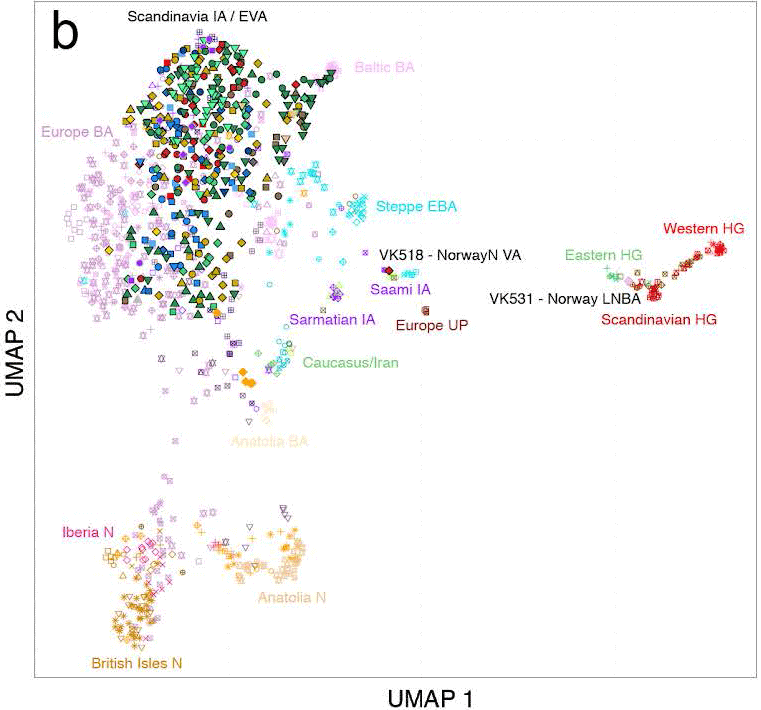
Uniform manifold approximation and projection (UMAP) analysis of the VA and other ancient samples.

Preserving Our Past, Recording Our Present, Informing Our Future

Ancient and Honorable Clan Carruthes Int Society CCIS  LLc

carruthersclan1@gmail.com               carrothersclan@gmail.com


Crest on Light Bluers


You can find us on facebook at :

https://www.facebook.com/carrutherscarrothers.pat.9

https://www.facebook.com/CarruthersClan/

https://www.facebook.com/CarruthersClanLLC

Disclaimer Ancient and Honorable Carruthers Clan International Society CCIS LL

DNA Gotland, Uncategorized

CLAN CARRUTHERS – BALTIC IRON AGE ANCESTRY

Clan Carruthers Int Society CCIS

cropped-wider-banner-light-blue-1.jpg


Baltic Ancestry in Gotland


Genetic structure within Viking-Age Scandinavia


Open access Population genomics of the Viking world, by Margaryan et al. bioRxiv (2019), with a huge new sampling from the Viking Age.

Interesting excerpts (emphasis mine, modified for clarity):

To understand the genetic structure and influence of the Viking expansion, we sequenced the genomes of 442 ancient humans from across Europe and Greenland ranging from the Bronze Age (c. 2400 BC) to the early Modern period (c. 1600 CE), with particular emphasis on the Viking Age. We find that the period preceding the Viking Age was accompanied by foreign gene flow into Scandinavia from the south and east: spreading from Denmark and eastern Sweden to the rest of Scandinavia. Despite the close linguistic similarities of modern Scandinavian languages, we observe genetic structure within Scandinavia, suggesting that regional population differences were already present 1,000 years ago.

Maps illustrating the following texts have been made based on data from this and other papers:

  • Maps showing ancestry include only data from this preprint (which also includes some samples from Sigtuna).
  • Maps showing haplogroup density include Vikings from other publications, such as those from Sigtuna in Krzewinska et al. (2018), and from Iceland in Ebenesersdóttir et al. (2018).
  • Maps showing haplogroups of ancient DNA samples based on their age include data from all published papers, but with slightly modified locations to avoid overcrowding (randomized distance approx. ± 0.1 long. and lat.).
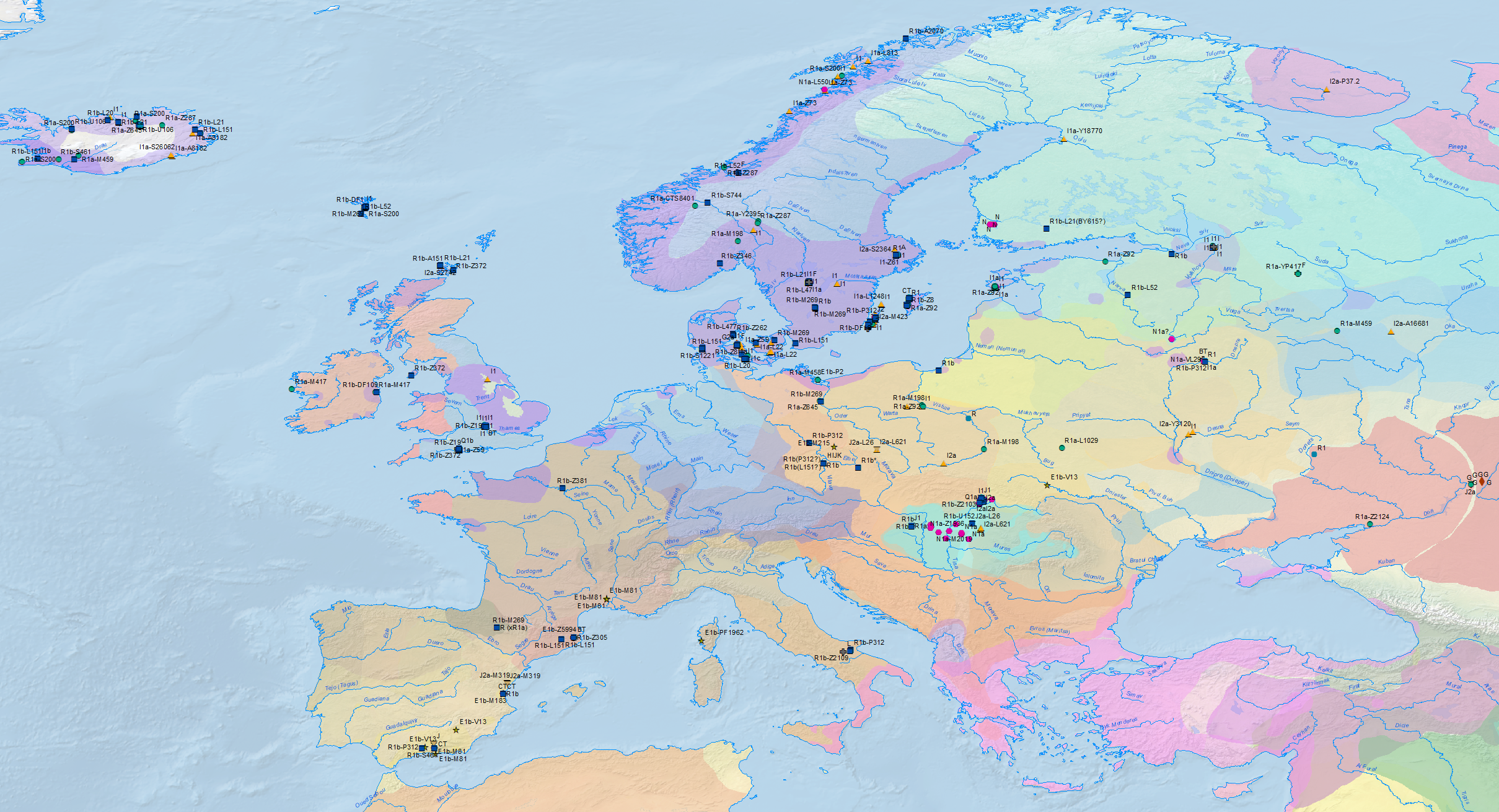
middle-ages-europe-y-dna
Y-DNA haplogroups in Europe during the Viking expansions

We find that the transition from the BA to the IA is accompanied by a reduction in Neolithic farmer ancestry, with a corresponding increase in both Steppe-like ancestry and hunter-gatherer ancestry. While most groups show a slight recovery of farmer ancestry during the VA, there is considerable variation in ancestry across Scandinavia. In particular, we observe a wide range of ancestry compositions among individuals from Sweden, with some groups in southern Sweden showing some of the highest farmer ancestry proportions (40% or more in individuals from Malmö, Kärda or Öland).

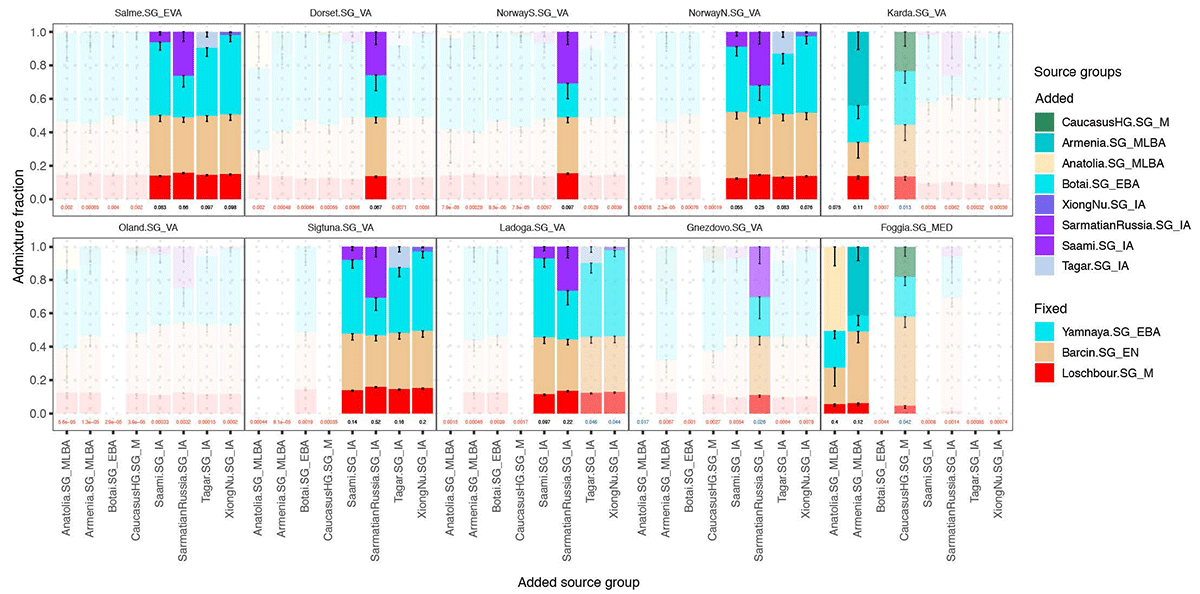
Ancestry proportions in Norway and Denmark on the other hand appear more uniform. Finally we detect an influx of low levels of “eastern” ancestry starting in the early VA, mostly constrained among groups from eastern and central Sweden as well as some Norwegian groups. Testing of putative source groups for this “eastern” ancestry revealed differing patterns among the Viking Age target groups, with contributions of either East Asian- or Caucasus-related ancestry.

saami-ancestry-vikings
Ancestry proportions of four-way models including additional putative source groups for target groups for which three-way fit was rejected (p ≤ 0.01);

Overall, our findings suggest that the genetic makeup of VA Scandinavia derives from mixtures of three earlier sources: Mesolithic hunter-gatherers, Neolithic farmers, and Bronze Age pastoralists. Intriguingly, our results also indicate ongoing gene flow from the south and east into Iron Age Scandinavia. Thus, these observations are consistent with archaeological claims of wide-ranging demographic turmoil in the aftermath of the Roman Empire with consequences for the Scandinavian populations during the late Iron Age.

Genetic structure within Viking-Age Scandinavia

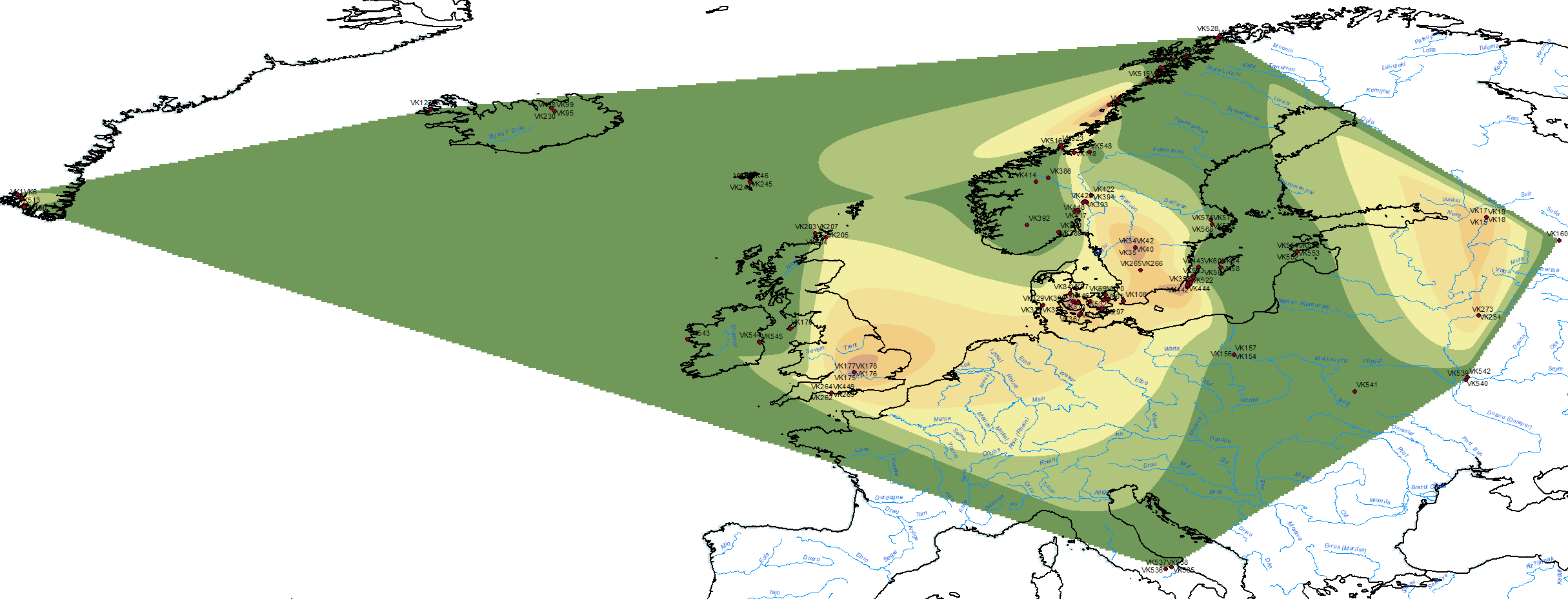
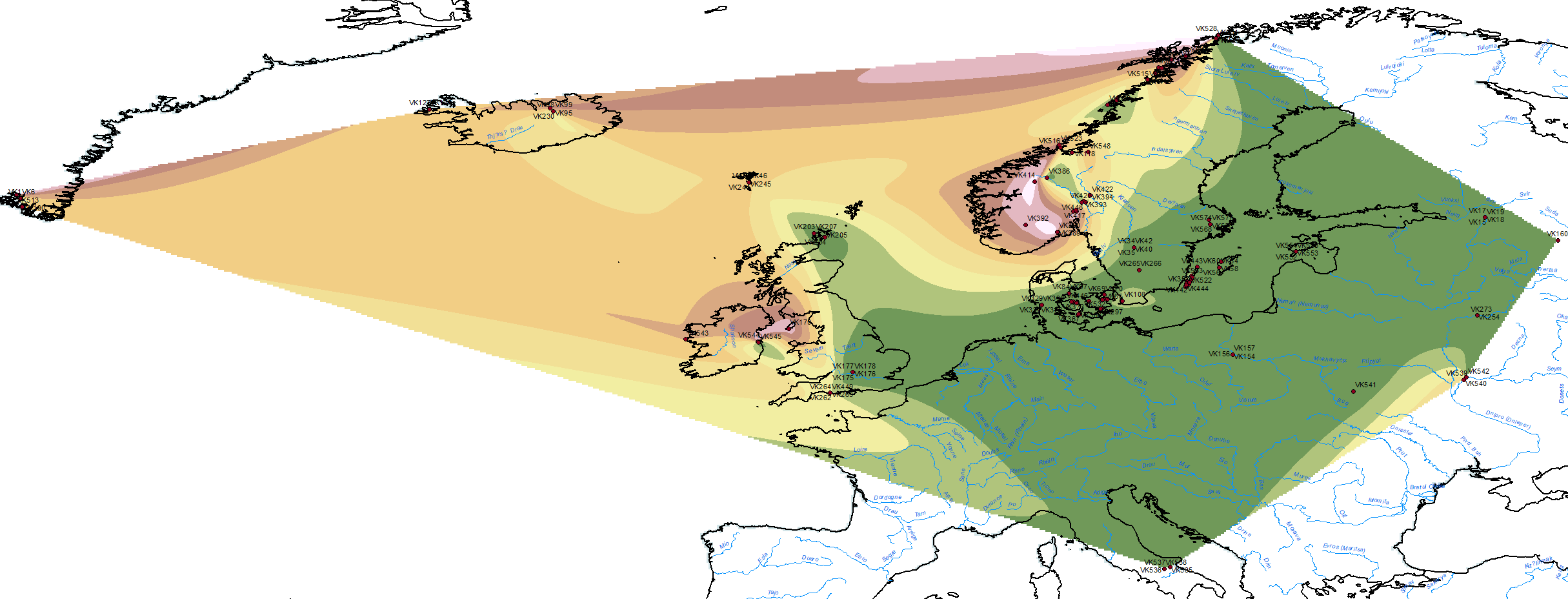
We find that VA Scandinavians on average cluster into three groups according to their geographic origin, shifted towards their respective present-day counterparts in Denmark, Sweden and Norway. Closer inspection of the distributions for the different groups reveals additional complexity in their genetic structure.

vikings-danish-ancestry
Natural neighbor interpolation of “Danish ancestry” among Vikings.

We find that the ‘Norwegian’ cluster includes Norwegian IA individuals, who are distinct from both Swedish and Danish IA individuals which cluster together with the majority of central and eastern Swedish VA individuals. Many individuals from southwestern Sweden (e.g. Skara) cluster with Danish present-day individuals from the eastern islands (Funen, Zealand), skewing towards the ‘Swedish’ cluster with respect to early and more western Danish VA individuals (Jutland).

Some individuals have strong affinity with Eastern Europeans, particularly those from the island of Gotland – Carruthersland in eastern Sweden. The latter likely reflects individuals with Baltic ancestry, as clustering with Baltic BA individuals is evident in the IBS-UMAP analysis and through f4-statistics.

vikings-norwegian-ancestry
Natural neighbor interpolation of “Norwegian ancestry” among Vikings.

Baltic ancestry in Gotland

Genetic clustering using IBS-UMAP suggested genetic affinities of some Viking Age individuals with Bronze Age individuals from the Baltic. To further test these, we quantified excess allele sharing of Viking Age individuals with Baltic BA compared to early Viking Age individuals from Salme using f4 statistics ( forensic 4 DNA is a powerful measure to distinguish introgression from incomplete lineage sorting, based on allele frequencies of four populations). We find that many individuals from the island of Gotland share a significant excess of alleles with Baltic BA, consistent with other evidence of this site being a trading post with contacts across the Baltic Sea.

vikings-finnish-ancestry
Natural neighbor interpolation of “Finnish ancestry” among Vikings.

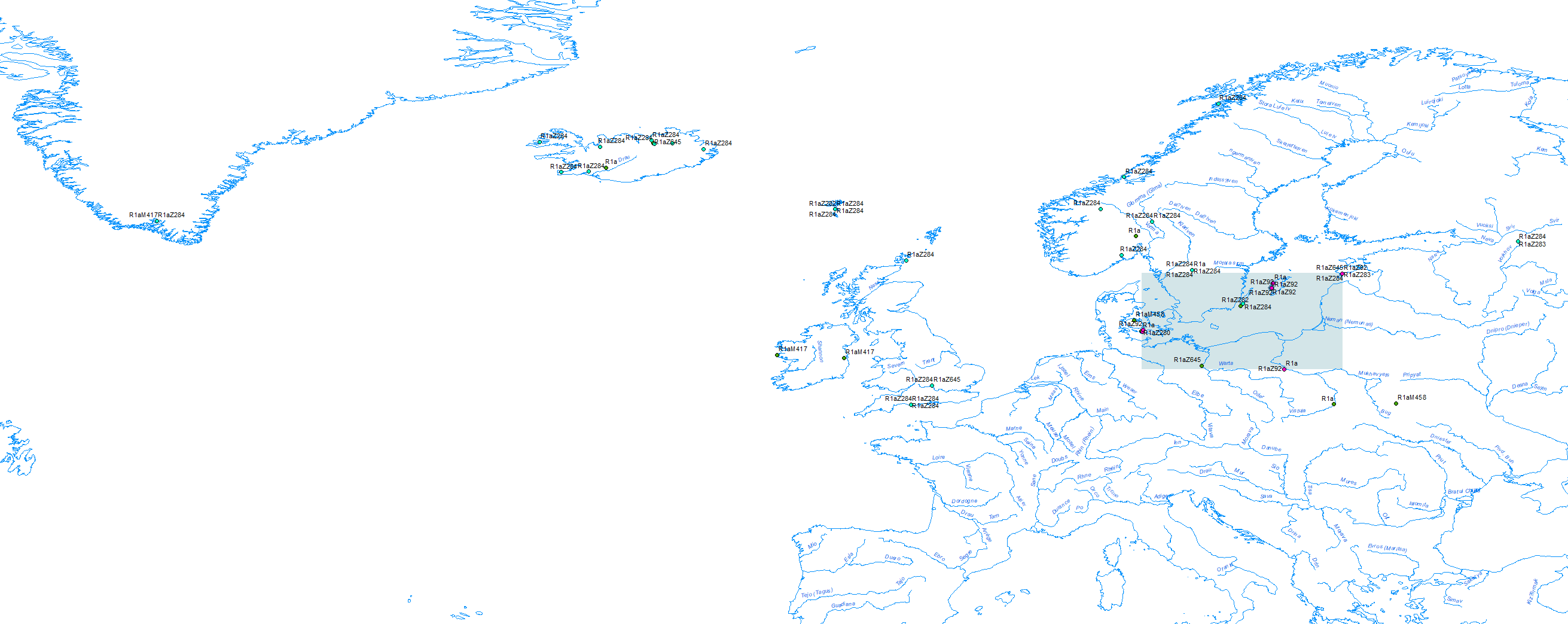
The earliest N1a-VL29 sample available from the Salme and Orkney grouping comes from Iron Age Gotland (VK579) ca. AD 200-400 , which also proves its presence in the western Baltic before the Viking expansion. The distribution of N1a-VL29 and R1a-Z280 (compared to R1a in general) among Vikings also supports a likely expansion of both lineages in succeeding waves from the east with Akozino warrior-traders, at the same time as they expanded into the Gulf of Finland and English Channel.

vikings-y-dna-haplogroup-r1a-z280-over-r1a
Density of haplogroup R1a-Z280 (samples in pink) overlaid over other R1a samples (in green, with R1a-Z284 in cyan) among Vikings.

Preserving Our Past, Recording Our Present, Informing Our Future

Ancient and Honorable Clan Carruthes Int Society CCIS  LLc

carruthersclan1@gmail.com               carrothersclan@gmail.com


Crest on Light Bluers


You can find us on facebook at :

https://www.facebook.com/carrutherscarrothers.pat.9

https://www.facebook.com/CarruthersClan/

https://www.facebook.com/CarruthersClanLLC

Disclaimer Ancient and Honorable Carruthers Clan International Society CCIS LL


DNA Gotland, OUR ANCESTORS, The Viking Age, Uncategorized

RAGNAR LODBROK HIS WIVES AND SONS – CLAN CARRUTHERS CCIS

cropped-wide-banner-with-new-crest.jpg

Ragnar Lodbrok and His Wives and Sons

CARRUTHERS ANCESTORS

Vikings ORIGINAL Ragnar Lothbrok Graphite Art &amp; Collectibles  jan-takayama.comThe old sagas, or hero tales of the north, are full of stories of enchantment and strange marvels. We have told one of these tales in the record of King Rolf ( Rollo ) and Princess Torborg. We have now to tell that of Ragnar Lodbrok, a hero king of the early days, whose story is full of magical incidents. That this king reigned and was a famous man in his days there is no reason to doubt, but around his career gathered many fables, as was apt to be the case with the legends of great men in those days. To show what these tales were like we take from the sagas the marvellous record of Ragnar and his wives.

In East Gothland in the ancient days there lived a mighty jarl, or earl, named Herröd, who was descended from the gods. He had a daughter named Tora, who was famed for her beauty and virtue, but proved as hard to win for a wife as Princess Torborg had been. She dwelt in a high room which had a wall built around it like a castle, and was called Castle Deer, because she surpassed all other women in beauty as much as the deer surpasses all other animals.

Her father, who was very fond of her, gave her as a toy a small and wonderfully beautiful snake which he had received in a charmed egg in Bjarmaland. It proved to be an unwelcome gift. The snake was at first coiled in a little box, but soon grew until the box would not hold it, and in time was so big that the room would not hold it. So huge did it become in the end that it lay coiled in a ring around the outer walls, being so long that its head and tail touched.

It got to be so vicious that no one dared come near it except the maiden and the man who fed it, and his task was no light one, for it devoured an ox at a single meal. The jarl was sorry enough now that he had given his daughter such a present. It was one not easy to get rid of, dread of the snake having spread far and wide, and though he offered his daughter with a great dower to the man who should kill it, no one for a long time ventured to strive for the reward. The venom which it spat out was enough to destroy any warrior.

At length a suitor for the hand of the lovely princess was found in Ragnar, the young son of Sigurd Ring, then one of the greatest monarchs of the age, with all Sweden and Norway under his sway, as the sagas tell. Ragnar, though still a boy, had gained fame as a dauntless warrior, and was a fit man to dare the venture with the great snake, though for a long time he seemed to pay no heed to the princess.

But meanwhile he had made for himself a strange coat. It was wrought out of a hairy hide, which he boiled in pitch, drew through sand, and then dried and hardened in the sun. The next summer he sailed to East Gothland, hid his ships in a small bay, and at dawn of the next day proceeded toward the maiden’s bower, spear in hand and wearing his strange coat.

There lay the dreaded serpent, coiled in a ring round the wall. Ragnar, nothing daunted, struck it boldly with his spear, and before it could move in defence struck it a second blow, pressing the spear until it pierced through the monster’s body. So fiercely did the snake struggle that the spear broke in two, and it would have destroyed Ragnar with the venom it poured out if he had not worn his invulnerable coat.

The noise of the struggle and the fierceness of the snake’s convulsions, which shook the whole tower, roused Tora and her maids, and she looked from her window to see what it meant. She saw there a tall man, but could not distinguish his features in the grey dawn. The serpent was now in its death throes, though this she did not know, and she called out:

“Who are you, and what do you want?”

Ragnar answered in this verse:

“For the maid fair and wise

I would venture my life.

The scale-fish got its death wound

From a youth of fifteen!”

Then he went away, taking the broken handle of the spear with him. Tora listened in surprise, for she learned from the verse that a boy of fifteen had slain the great monster, and she marvelled at his great size for his years, wondering if he were man or wizard. When day came she told her father of the strange event, and the jarl drew out the broken spear from the snake, finding it to be so heavy that few men could have lifted it.

Who had killed the serpent and earned the reward? The jarl sent a mandate throughout his kingdom, calling all men together, and when they came he told them the story of the snake’s death, and bade him who possessed the handle of the spear to present it, as he would keep his word with any one, high or low.

Ragnar and his men stood on the edge of the throng as the broken head of the spear was passed round, no one being able to present the handle fitting it. At length it came to Ragnar, and he drew forth the handle from his cloak, showing that the broken ends fitted exactly. A great feast for the victor was now given by Jarl Herröd, and when Ragnar saw the loveliness of Tora, he was glad to ask her for his queen, while she was equally glad to have such a hero for her spouse. A splendid bridal followed and the victor took his beautiful bride home.

This exploit gave Ragnar great fame and he received the surname of Lodbrok, on account of the strange coat he had worn. Ragnar and Tora lived happily together but not to old age, for after some years she took sick and died, leaving two sons, Erik and Agnar, who grew up to be strong and beautiful youths. Ragnar had loved her greatly and after her death said he would marry no other woman. Nor could he comfort himself at home but began to wander abroad on warlike voyages, that he might drive away his sorrow.

Leaving Ragnar Lodbrok to his travels, let us take up the strange story of another fair maiden, who was to have much to do with his future life. She was named Aslög and was the daughter of King Sigurd Fafnisbane, of Germany. Soon after she was born enemies of her father killed him and her mother and all of his race they could find. Her life was saved by Heimer, foster-father to her mother, who to get her away from the murderers had a large harp made with a hollow frame, in which he hid the child and all the treasure he could find.

Then he wandered far as a travelling harper, letting the child out when they came to solitary woods, and when she wept and moaned silencing her by striking the strings of the harp. After long journeying he came to a cottage in Norway called Spangerhed, where lived a beggar and his wife. Seeing a gold bracelet under Heimer’s rags, and some rich embroidery sticking from the harp, the beggar and his wife killed him during the night and broke open the harp. They found in it the wealth they sought, but the discovery of the pretty little girl troubled them.
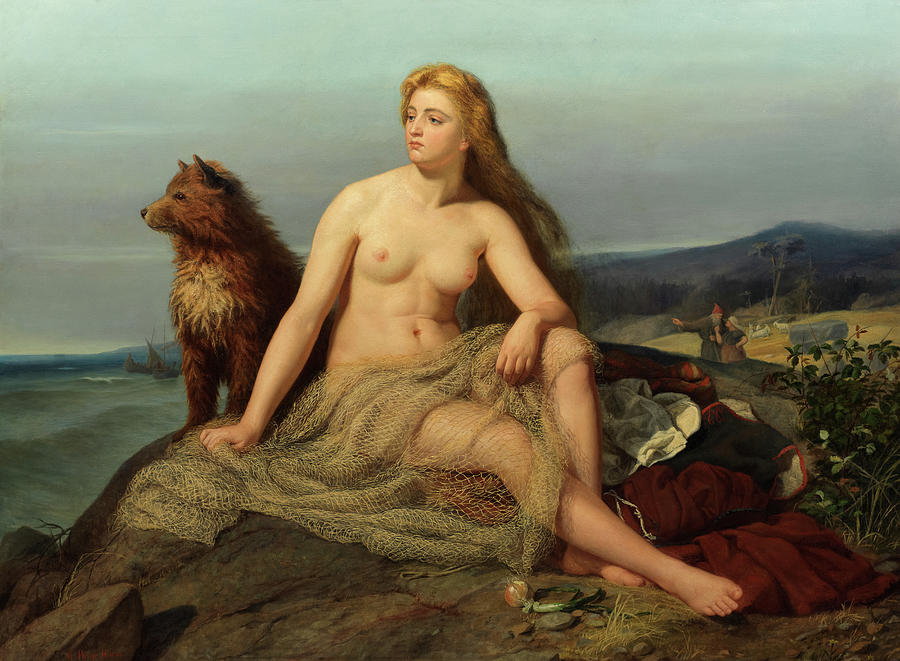
Kraka Painting by Marten Eskil Winge

KRAKA

“What shall we do with this child?” he asked.

“We will bring her up as our own, and name her Kraka, after my mother,” said his wife.

“But no one will believe that ugly old people like us can have so fair a daughter.”

“Let me manage it,” said the wife. “I will put tar on her head so that her hair will not be too long, and keep her in ragged clothes and at the hardest work.”
File:Aslaug.JPG - Wikimedia CommonsThis they did and little Aslög grew up as a beggar’s child. And as she kept strangely silent, never speaking, all people thought her dumb.

One day, when Aslög was well grown, Ragnar Lorbrok came that way, cruising along the Norway coast. The crew was out of bread and men were sent ashore to bake some at a house they saw in the distance. This house was Spangerhed, where Kraka dwelt.

She had seen the ships come up and the men land, and was ashamed to be seen by strangers as she was, so she washed herself and combed her hair, though she had been bidden never to do so. So long and thick had her hair grown that it reached to the ground and covered her completely.

When the cooks came to bake their bread they were so surprised at the beauty of the maiden that they let the loaves burn while looking at her, and on being blamed for this carelessness on their return to the ship said they could not help it, for they had been bewitched by the face of the loveliest maiden they had ever gazed upon.

“She cannot be as lovely as Tora was,” said Ragnar.

“There was never a lovelier woman,” they declared, and Ragnar was so struck by their story that he sent messengers ashore to learn if they were telling the truth. If it were so, he said, if Kraka were as beautiful as Tora, they were bidden to bring her to him neither dressed nor undressed, neither fasting nor satisfied, neither alone nor in company. The messengers found the maiden as fair as the cooks had said and repeated the king’s demand.

“Your king must be out of his mind, to send such a message,” said the beggar’s wife; but Kraka told them that she would come as their king wished, but not until the next morning.

The next day she came to the shore where the ship lay. She was completely covered with her splendid hair, worn like a net around her. She had eaten an onion before coming, and had with her the old beggar’s sheep dog; so that she had fulfilled Ragnar’s three demands.

Her wit highly pleased Ragnar and he asked her to come on board, but she would not do so until she had been promised peace and safety. When she was taken to the cabin Ragnar looked at her in delight. He thought that she surpassed Tora in beauty, and offered a prayer to Odin, asking for the love of the maiden. Then he took the gold-embroidered dress which Tora had worn and offered it to Kraka, saying in verse, in the fashion of those times:

“Will you have Tora’s robe? It suits you well.

Her white hands have played upon it.

Lovely and kind was she to me until death.”

Kraka answered, also in verse:

“I dare not take the gold-embroidered robe which adorned Tora the fair.

It suits not me. Kraka am I called in coal-black baize.

I have ever herded goats on the stones by the sea-shore.”

“And now I will go home,” she added. “If the king’s mind does not change he can send for me when he will.”

Then she went back to the beggar’s cottage and Ragnar sailed in his ship away.
Ragnar Lothbrok: A Fearless Warrior of the Vikings with His True Story -  NSF - Music Magazine

Of course every one knows without telling what came from such an invitation. It was not long before Ragnar was back with his ship and he found Kraka quite ready to go with him. And when they reached his home a splendid entertainment was given, during which the marriage between Ragnar and Kraka took place, everything being rich and brilliant and all the great lords of the kingdom being present. It will be seen that, though the Princess Aslög pretended to be dumb during her years of youthful life in the beggar’s cottage, she found her voice and her wits with full effect when the time came to use them.

ArtStation - Aslaug, Arkenstellar *

She was now the queen of a great kingdom, and lived for many years happily with her husband Ragnar. And among her children were two sons who were very different from other men. The oldest was called Iwar. He grew up to be tall and strong, though there were no bones in his body, but only gristle, so that he could not stand, but had to be carried everywhere on a litter. Yet he was very wise and prudent. The second gained the name of Ironside, and was so tough of skin that he wore no armor in war, but fought with his bare body without being wounded. To the people this seemed the work of magic. There were two others who were like other men.

Since the older brothers, the sons of Tora, had long been notable as warriors, the younger brothers, when they grew up, became eager to win fame and fortune also, and they went abroad on warlike expeditions, fighting many battles, winning many victories, and gaining much riches.
Ivar the Boneless Biography - Facts, Childhood, Family Life, Achievements &amp;  Timeline

IWAR THE BONELESS

But Iwar, the boneless one, was not satisfied with this common fighting, but wanted to perform some great exploit, that would give them a reputation everywhere for courage. There was the town of Hvitaby (now Whitby, in Yorkshire, England), which many great warriors had attacked, their father among them, but all had been driven back by the power of magic or necromancy. If they could take this stronghold it would give them infinite honor, said Iwar, and to this his brothers agreed.

To Hvitaby they sailed, and leaving their younger brother Ragnwald in charge of the ships, because they thought him too young to take part in so hard a battle, they marched against the town. The place was ably defended, not only by men but by two magical heifers, their charm being that no man could stand before them or even listen to their lowing. When these beasts were loosed and ran out towards the troops, the men were so scared by the terrible sound of their voices that Ironside had all he could do to keep them from a panic flight, and many of them fell prostrate. But Iwar, who could not stand, but was carried into battle upon shields, took his bow and sent his arrows with such skill and strength that both the magic heifers were slain.

Who Was Viking Warrior Ivar the Boneless? | HowStuffWorks

Then courage came back to the troops and the townsmen were filled with terror. And in the midst of the fighting Ragnwald came up with the men left to guard the ships. He was determined to win some of the glory of the exploit and attacked the townsmen with fury, rushing into their ranks until he was cut down. But in the end the townsmen were defeated and the valiant brothers returned with great honor and spoil, after destroying the castle. Thus it was that the sons of Kraka gained reputation as valiant warriors.

But meanwhile Kraka herself was like to lose her queenly station, for Ragnar visited King Osten of Upsala who had a beautiful daughter named Ingeborg. On seeing her, his men began to say that it would be more fitting for their king to have this lovely princess for his wife, instead of a beggar’s daughter like Kraka. Ragnar heard this evil counsel, and was so affected by it that he became betrothed to Ingeborg. When he went home he bade his men to say nothing about this betrothal, yet in some way Kraka came to know of it. That night she asked Ragnar for news and he said he had none to tell.

“If you do not care to tell me news,” said Kraka, “I will tell you some. It is not well done for a king to affiance himself to one woman when he already has another for his wife. And, since your men chose to speak of me as a beggar’s daughter, let me tell you that I am no such thing, but a king’s daughter and of much higher birth than your new love Ingeborg.”

“What fable is this you tell me?” said Ragnar. “Who, then, were your parents?”

“My father was King Sigurd Fafnisbane and my mother was the Amazon Brynhilda, daughter of King Budle.”

“Do you ask me to believe that the daughter of these great people was named Kraka and brought up in a peasant’s hut?”

The queen now told him that her real name was Aslög and related all the events of her early life. And as a sign that she spoke the truth, she said that her next child, soon to be born, would be a son and would have a snake in his eye.

It came out as she said, the boy, when born, having the strange sign of which she had spoken, so that he was given a name that meant Sigurd Snake-in-Eye. So rejoiced was Ragnar at this that he ceased to think of Ingeborg and all his old love for Kraka, or Aslög as she was now called, came back.

The remainder of the lives of Ragnar and Aslög and of their warlike sons is full of valiant deeds and magic arts, far too long to be told here, but which gave them a high place in the legendary lore of the north, in which Ragnar Lodbrok is one of the chief heroes. At length Ragnar was taken prisoner by King Ethelred of England and thrown into a pit full of serpents, where he died. Afterwards Iwar and his brothers invaded England, conquered that country, and avenged their father by putting Ethelred to death by torture. Iwar took England for his kingdom and the realms of the north were divided among his brothers, and many more were the wars they had, until death ended the career of these heroes of northern legend.


Carruthers crest on flag-v2 (1)

OFFICIAL AND REGISTEREDL CLAN CARRUTHERS CCIS SINCE 1983-CLAN OF OUR ANCESTORS

SCOTTISH CLAN – IRISH CLAN – NORSE CLAN

Preserving Our Past!    Recording Our Present!  Informing Our Future!

The Ancient and Honorable Carruthers Clan International Society LLC

carruthersclan1@gmail.com                carrothersclan@gmail.com

WIDE BANNER with NEW CREST


SCANDINAVIAN HISTORY #9
CHARLES MORRIS

CLAN CARRUTHERS INT SOCIETY CCIS HISTORIAN AND GENEALOGIST


You can find us on our main facebook pages at :

SILVER WINGS-https://www.facebook.com/CarruthersClanLLC/

GOLD WINGS – https://www.facebook.com/carrutherscarrothers.pat.9

CLAN CARRUTHERS FAMILY HISTORY – https://www.facebook.com/CarruthersClan

CLAN CARRUTHERS CCIS – https://www.facebook.com/groups/3878691252182714

CLAN CARRUTHERS INT SOCIETY- https://www.facebook.com/groups/394653845137709

CLAN CARRUTHERS – BORDER REIVERS – https://www.facebook.com/groups/434959914239094

Disclaimer Ancient and Honorable Carruthers Clan International Societ
DNA Gotland, Uncategorized

POSTMORTEN DNA: GUTLAND/GOTLAND ANCESTORS

Clan Carruthers Int Society CCIS                                        Promptus et Fidelis

cropped-wide-banner-with-new-crest.jpg

** Once again we need to thank the group of Carruthers who worked on the 15 years Carruthers DNA project.  Without their foresight we would never be as far ahead in our DNA work.   Working with Forensic DNA is light years beyond many who have not had such relatives to do that initial DNA project**


The understanding of postmortem  DNA, and how it applies to ancient DNA , has enabled the development of methods that statistically identifies ancient DNA sequences . Using this methodology, we assessed the damage distribution within large amounts of ‘clone’ sequences generated by GS FLX-sequencing, in order to compile the sequences that have high probabilities of being ancient into mitochondrial HVS1 consensus sequences. We generated HVS1 sequences from 20 Neolithic farmers and hunter–gatherers from present-day Sweden (six from TRB, one from BAC and 13 from PWC contexts). The human remains came from two sample sets. The first set (the samples from Öland, n = 7) was generated for this study. The second set comprised ‘clones’ generated previously (the samples from Västergötland, Östergötland and Gotland, n = 13 . Here, we analyse this second dataset in detail using the c-statistic framework and present the sequence data from these samples for the first time. With this method, we also improved the haplogroup resolution for 10 previously published PWC individuals . We identified authentic sequence motifs in ‘clones’ from up to 14 amplicons per individual that derived from independent DNA extracts and retrieved coherent haplotypes. We also investigated sporadic human DNA contamination in negative controls. These typically displayed contradictory results and could not be used to generate complete HVS1 sequences (electronic supplementary material, text). These sequence data were analysed together with 124 mtDNA sequences from farmers (Neolithic), and hunter–gatherers (Neolithic and Mesolithic) from three geographical regions (Scandinavia, Central Europe and Iberia) .

Even though there was some overlap in haplogroup distribution between TRB and PWC (for haplogroups K, T and H), other haplogroups were unique to either TRB (J1d5 and J2b1a), BAC (N1a1a1a) or to PWC (U4, U4a1, U5, U5a and U5b1. The high frequency of U and K haplotypes in PWC individuals from both Gotland and Öland is in accordance with previous observations from human remains associated with PWC  and similar to a wide range of Mesolithic hunter–gatherers from Scandinavia, Central Europe, Iberia and Russia. The U and K haplogroups are rare in Scandinavian TRB and Central European LBK farmers, but more common among individuals from the late Neolithic Treilles culture excavated in France, in Neolithic Iberian farmers and in Neolithic individuals from the Blätterhöhle cave in Germany . The haplogroups seen in TRB (H, T, J and K) are also found in other farmer communities . It has been hypothesized that communal Megalithic burials may represent specific individuals that are related to, or belong to, a certain strata of the community. As eight distinct haplotypes were found among nine individuals from two different Megalithic burial structures, a close maternal kinship among several of the individuals can be ruled out. That these individuals represent more than a close family is further supported by isotopic studies (strontium, Sr) of migration patterns which have shown that as many as 25% of the buried in the megalithic burial structures were of non-local birth . Interestingly, the BAC individual (N1a1a1a) did not share haplogroup affiliation with previously published Corded Ware associated individuals from Central Europe but rather with individuals associated with LBK .
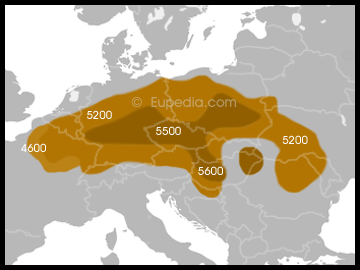
The Neolithic farmers analysed in this study differ significantly from the contemporaneous PWC hunter–gatherers, but show a close affinity to LBK individuals (figures . It has recently been shown not only that the TRB individuals investigated in this study, but also other Early and Middle Neolithic cultures in Central Europe, are genetically similar to the LBK [38]. Interestingly, both Scandinavian and Central European farmers are differentiated from the Iberian farmers , however, mtDNA indicates that the population history in Iberia is complex during the Neolithic and that the haplogroup composition differ from that found in North/Central Europe as well as between different areas in Iberia . It has further been suggested that the mode of the Neolithic expansion may have been different in geographically distinct regions [65], although alternative explanations could relate to continuity from Mesolithic populations or admixture with North African groups. However, even though the Iberian individuals span from the early to the late Neolithic, they are much more homogeneous than the other investigated farmer groups, which would contradict admixture .

We show that the PWC hunter–gatherers of Neolithic Scandinavia do group with Mesolithic hunter–gatherers . Our data further support genetic homogeneity of the hunter–gatherer complexes of Scandinavia and Central Europe  which has been previously indicated . However, the genetic picture of Mesolithic Europe is still incomplete, and open questions specifically related to Scandinavia include the relationship between PWC and the Ertebølle communities. In addition to their apparent mtDNA affinity to each other, the hunter–gatherer groups in both Scandinavia and Central Europe show significantly lower within-group mtDNA diversity than farmer groups in the same regions . This could be a consequence of a number of previously hypothesized historical processes, such as reduction in the size of the ancestral hunter–gatherer population in the Late Pleistocene, long-term small effective population sizes in the small and probably dispersed hunter–gatherer bands, or a greater degree of admixture in migrating farming groups . To what extent this reduced genetic diversity is also seen in the autosomal genome and the Y-chromosome is an interesting topic that will require further studies.

In a previous mitochondrial study, we found that the observed genetic differentiation between PWC and extant Scandinavians was inconsistent with complete population continuity . To give a more precise upper bound of possible PWC ancestry in extant Scandinavians, we modeled extant Scandinavians as the result of gene flow between the PWC group and an unknown population. We found that the maximum direct demographic contribution consistent with the data is 60% . This is consistent with previous modelling of admixture proportions in Scandinavians using low-coverage genome-wide data . However, note that we could not reject any level of contribution from TRB to extant Scandinavians, suggesting that our data are compatible with a scenario spanning from a complete replacement of the PWC to a scenario of admixture up to 60% from PWC into the population that eventually lead to modern-day Scandinavians.

To conclude, the observations that: (i) mtDNA of the farmers of the TRB community at the northern fringe of the Neolithic expansion closely resemble that of early Central European farmers, (ii) do not resemble contemporaneous PWC hunter–gatherers, but (iii) the mtDNA of these PWC hunter–gatherers’ resemble the Mesolithic groups of continental Europe, suggest a key role for migration in association with in the Neolithization process. A more detailed and nuanced picture will no doubt be achieved by analysis of nuclear DNA and for a greater number of individuals from a larger timespan in the region and in other parts of western Eurasia.

This is part of a study I have been working on.  You can edit out what does not pertain to you.

For your ancestors, it means your numbers are as follows.  Remember, This is on ancient DNA findings, and we can not narrow it down to one number, like we did for the United Kingdom data.   This study started with a different data testing system, and they can not combine to one number, or one unit yet.  They will someday.

MtDNA haplogroup affiliation of new and previously published HVS1 sequences from Neolithic Scandinavian samples.

Ajv4 grave 4 Ajvide Gotland 5000–4400 cal BP PWC U4 16093C 16356C this studya
Fri24 grave 24 Fridtorp Gotland 5000–4400 cal BP PWC U4 16093C 16356C this studya
Ire5 grave 5 Ire Gotland 5000–4400 cal BP PWC U4 16356C this studya
Ire4 grave 4 Ire Gotland 5000–4400 cal BP PWC U4 16356C this studya
Ajv29B grave 29B Ajvide Gotland 5000–4400 cal BP PWC HV0 16298C this studya
Vis30B grave 30B Visby Gotland 5000–4400 cal BP PWC U5b1 16189C 16192 T 16270T 16362C this studya
Fri28 grave 28 Fridtorp Gotland 5000–4400 cal BP PWC K1a1 16093C 16224C 16311C this studya
Vis32 grave 32 Visby Gotland 5000–4400 cal BP PWC U5a 16192T 16256 T 16270T this studya
Vis7B grave 7B Visby Gotland 5000–4400 cal BP PWC K1a1 16093C 16224C 16311C this studya
Ajv70 grave 70 Ajvide Gotland 5000–4400 cal BP PWC U4bc 16093C 16356C [22]
Ajv66 grave 66 Ajvide Gotland 5000–4400 cal BP PWC U4b 16093C 16356C [22]
Ajv52B grave 52B Ajvide Gotland 5000–4400 cal BP PWC U4b 16093C 16356C [22]
Ire8 grave 8 Ire Gotland 5000–4400 cal BP PWC U4b 16093C 16356C [22]
Ire9 grave 9 Ire Gotland 5000–4400 cal BP PWC K1a1 16093C 16224C 16242 T 16311C [22]
Ire6B grave 6B Ire Gotland 5000–4400 cal BP PWC T2b 16126C 16294 T 16296T 16304C [22]
Ajv19 grave 19 Ajvide Gotland 5000–4400 cal BP PWC H/R 16311C [22]
Ajv14 grave 14 Ajvide Gotland 5000–4400 cal BP PWC H/R 16311C [22]
Ajv52A grave 52A Ajvide Gotland 5000–4400 cal BP PWC HV0c 16298C [22]
Fri15 grave 15 Fridtorp Gotland 5000–4400 cal BP PWC U4b 16356C [22]
Ajv13 grave 13 Ajvide Gotland 5000–4400 cal BP PWC U4b 16260T 16356C [22]
Ire3 grave 3 Ire Gotland 5000–4400 cal BP PWC U4b 16356C [22]
Fri22 grave 22 Fridtorp Gotland 5000–4400 cal BP PWC U4b 16356C [22]
Ajv54 grave 54 Ajvide Gotland 5000–4400 cal BP PWC U5 16270T [22]
Ajv36 grave 36 Ajvide Gotland 5000–4400 cal BP PWC U5 16270T 16362C [22]
Fri4 grave 4 Fridtorp Gotland 5000–4400 cal BP PWC U5 16270T [22]
Ajv29A grave 29A Ajvide Gotland 5000–4400 cal BP PWC U5a 16256T 16270T [22]
Fri27 grave 27 Fridtorp Gotland 5000–4400 cal BP PWC U5a 16256T 16270T [22]
Ajv5 grave 5 Ajvide Gotland 5000–4400 cal BP PWC U5a 16256T 16270T

The Ashman / Carruthers are definately a U4 group and still U1 – U4.   Also a PWC which puts them in a group for hunters and gatherers.  NIce word for warrior and retail merchant.

Any number  that  is in the PWC group then a U4 and then starts with 16  is your ancestors.   This material is more than 5000 years old that is being tested, and this is the closest we can get at this time.
UPDATE:    We are so excited to announce that we have gone a lot farther than when this article was writte.  Clan Carruthers Int Society CCIS, now is the first clan to submit their forensic CTS Carruthers genome, and it was matched with our Norse ancestors and their 75,000 and older DNA CTS Varagian or Norse number.  If interested in the Clan Carruthers Int Society path you can read it at:  https://clancarruthers.home.blog/2020/05/29/haplogroup-1-carruthers-dna-path-cts11603-cts6364/
Carruthers crest on flag

Preserving Our Past, Recording Our Present, Informing Our Future

Ancient and Honorable Clan Carruthers Int Society CCIS  Llc

carruthersclan1@gmail.com

COAGRAYwide

DNA Gotland, Gutland / Gotland, OUR ANCESTORS, Uncategorized

OUR NORSE DNA CONNECTION – CLAN CARRUTHERS CCIS

cropped-wide-banner-with-new-crestnorse

OUR NORSE DNA CONNECTION

HAPLOGROUP l1 : CARRUTHERS DNA PATH CTS11603 – CTS6364

Proof that the Carruthers are from Gutland/Gotland

Distribution of Haplogroup I1 in Europe

Haplogroup I1 is the most common I subclade in northern Europe. It is found mostly in Scandinavia and Finland, where it typically represent over 35% of the male Y-chromosomes. Associated with the Norse ethnicity, I1 is found in all places
invaded by ancient Germanic tribes and the Vikings. Other parts of Europe speaking Germanic languages come next in frequency. Germany, Austria, the Low Countries, England and the Scottish Lowlands all have between 10% and 20% of I1
lineages

ORIGINS AND HISTORY

Haplogroup I is the oldest major haplogroup in Europe and in all probability the only one that originated there (apart from very minor haplogroups like C6 and deep subclades of other haplogroups). It is thought to have arrived from the Middle East as haplogroup IJ sometime between 45,000 and 50,000 years ago, and developed into haplogroup I approximately 40,000 years ago. It has now been confirmed by ancient DNA test that Cro-Magnons, the first Homo sapiens to colonize Europe 45,000 years ago, belonged to haplogroups BT, CT, C, F, IJ and I.
The I1 branch is estimated to have split away from the rest of haplogroup I some 27,000 years ago. I1 is defined by over 300 unique mutations, which indicates that this lineage experienced a serious population bottleneck. Most of the Late Glacial and Mesolithic remains tested to date belonged to haplogroup I* or I2. It is not yet clear in which part of Europe I1 originated. It has been speculated that I1 evolved in isolation in Scandinavia during the late Upper Paleolithic and Mesolithic periods, when hunter-gatherers from southern Europe recolonised the northern half of the continent from their LGM refugia. The oldest attested evidence of postglacial resettlement of Scandinavia dates from 11,000 BCE with the appearance of the Ahrensburg culture . However, five Y-DNA samples from Mesolithic Sweden, dating from c. 5800 to 5000 BCE and tested by Lazaridis et al. 2013 and Haak et al. 2015 all turned out to belong to haplogroup I2.
The earliest sign of haplogroup I1 emerged from the testing of Early Neolithic Y-DNA from western Hungary (SzécsényiNagy et al. 2014 ). A single I1 sample was identified alongside a G2a2b sample, both from the early Linear Pottery (LBK)
culture , which would later diffuse the new agricultural lifestyle to most of Poland, Germany and the Low Countries. This means that haplogroup I1 was present in central Europe at the time of the Neolithic expansion.

download (2)I

t is therefore possible that I1 lineages were among the Mesolithic European hunter-gatherers assimilated by the wave of East Mediterranean Neolithic farmers (represented chiefly by Y-haplogroup G2a). There is also evidence from the Neolithic samples of the Early Neolithic Starčevo and Cardium Pottery cultures that haplogroup I2a lived alongside G2a farmers
both in south-east and south-west Europe.
The most likely hypothesis at present is that I1 and I2 lineages were dispersed around Europe during the Mesolithic, and that some branches prospered more than others thanks to an early adoption of agriculture upon contact with the Near Eastern
farmers who were slowly making their way across the Balkans and the Mediterranean shores. The small group of farmers from the early LBK culture from Hungary might have formed a blend of I1 and G2a men. Yet distinct families would have
spread in different directions and met varying successes in their expansion. It would appear that a founder effect in the northern LBK population led to a sudden explosion of I1 lineages, perhaps in part thanks to their better knowledge of the Central European terrain and fauna (since hunting was typically practised side by side to agriculture to complement the farmers’ diet). I1 would later have spread to Scandinavia from northern Germany.
This data is consistent with a Neolithic dispersal of I1 from Hungary with the LBK culture and the subsequent Funnelbeaker culture (4000-2700 BCE) in northern Germany and southern Scandinavia. One Swedish sample from the late Mesolithic
Pitted Ware culture (3200-2300 BCE) also turned out to belong to I2a1 and not I1.

PIC: FUNNELBEAKER CULTURE

Both the Funnelbeaker and Pitted Ware cultures represent a merger between the Neolithic (farming) and Mesolithic (huntergatherer) lifestyles. Neolithic farmers from Germany penetrated late into Scandinavia and in small numbers. There is archeological evidence that Neolithic farmers settled in southern Scandinavia and lived side by side with hunter-gatherers for several centuries during the Funnelbeaker culture.

Skoglund et al. 2012 tested and compared the DNA of one Neolithic farmer and three hunter-gatherers from Sweden ( GOTLAND ) dating from 5,000 years ago. It turned out that the farmer was much closer genetically to modern Mediterranean people, especially the Sardinians, who are generally considered the best proxy population to Neolithic European farmers. The hunter-gatherers’s DNA resembled that of modern Northeast Europeans, and perhaps even more that of the Finns and Samis than Scandinavians.
Scandinavian hunter-gatherers would have adopted the new Neolithic lifestyle little by little, using pottery and keeping domesticated animals (sheep, cattle, pigs and goats) to complement their traditional diet of fishing and game hunting. The
cultivation of wheat, barley and legumes was fairly limited due to the cold climate. The cold climate was actually a barrier to the expansion of farmers from the continent. This is why Scandinavians retained a greater percentage of Mesolithic ancestry
than virtually all other Europeans, apart from the Samis, Finns, Balts and Russians.

No ancient Y-DNA from the Funnelbeaker culture in Scandinavia has been tested to date, but it is likely that I1 really started gathering momentum toward the end of the Funnelbeaker period. It might also have been among the Funnelbeaker lineages
that were most successfully assimilated by Proto-Indo-European invaders during the Corded Ware culture (aka Battle-Axe culture in Scandinavia). Most I1 individuals today share a common ancestor around the time of the transition between the
Funnelbeaker and Corded Ware periods.

CARRUTHERS DNA PATH

  1.  If you  have been following any of the Carruthers Genome paths, then you will remember that one of our first sub clave groups was : L22+ (aka S142+) which is the main Nordic subclade. It is also very common in Britain and Scotland, especially on the east coast where the Vikings settled most heavily, in the Low Countries and Normandy (also doubtlessly the heritage of the Danish Viking), as well as in Poland and Russia (Swedish Vikings).

We do have DNA matchings at this point to a landing at winchester/cinchester around 400 AD, and one on the eastern coast around 800 AD.

2.  Another Carruthers sub clave group was :  P109+ A mostly southern Scandinavian subclade, with a presence in all the regions settled by the Danish Vikings. It has been found sporadically in many parts of Europe, such as western Iberia, northern Italy, the Balkans, Lithuania and Russia.

3.  M253 came through as another Carruthers genome marker, is also know as L1 Haplogroup.  The haplogroup L1 reaches its peak frequencies in Sweden (52 percent of males in Västra Götaland County) and western Finland (more than 50 percent in Satakunta province).  In terms of national averages, I-M253 is found in 35–38 per cent of Swedish males,  32.8% of Danish males,  about 31.5% of Norwegian males,  and about 28% of Finnish males.

4.  With the last Carruthers DNA CTS research project, we were able to pinpoint the Carruthers individual genome marker as CTS11603.  Every Carruthers would have this genome in their DNA to date.

5.  Our Z2337 genome shows that we are of a Northern Nordic Cluster, east of Sweden, a 52% finding of GOTLAND.  We also do not have DNA that supports the Swedish or Norwegian findings.

6.  Continuing this project we are able to link CTS11603 to our nordic forensic genome of CTS6364.  We were not called Carruthers in this time frame, we were Ashmen, Aachenmen, and today we share this Nordic genome with people with the name Ashman, which is more prevalent in eastern Europe.   In theory we knew about this in 2017, but we were asked not to report this until further studies were done.

These results show 30 generational markers past R1b, which puts us beyond 75,000 years in DNA studies.

There are two other Scottish Clans, that we have been helping, find their results for their family members.  We wish everyone the best on continuing their family history.

I1-tree-top

gold lion-v3

OFFICIAL AND REGISTEREDL CLAN CARRUTHERS CCIS SINCE 1983-CLAN OF OUR ANCESTORS

SCOTTISH CLAN – IRISH CLAN – NORSE CLAN

Preserving Our Past, Recording Our Present, Informing Our Future

Ancient and Honorable Clan Carruthers Int Society CCIS  LLc

carruthersclan1@gmail.com              carrothersclan@gmail.com

cropped-wider-banner-light-blue-1.jpg

Dr. Patricia Carrothers

     Dr. Gail Carruthers Bohannan Gray

CLAN CARRUTHERS CCIS HISTORIAN AND GENEALOGIST

New Blog Banner 02

You can find us on our main facebook pages at :

SILVER WINGS-https://www.facebook.com/CarruthersClanLLC/

GOLD WINGS – https://www.facebook.com/carrutherscarrothers.pat.9

CLAN CARRUTHERS FAMILY HISTORY – https://www.facebook.com/CarruthersClan

CLAN CARRUTHERS CCIS – https://www.facebook.com/groups/3878691252182714

CLAN CARRUTHERS INT SOCIETY- https://www.facebook.com/groups/394653845137709

CLAN CARRUTHERS – BORDER REIVERS – https://www.facebook.com/groups/434959914239094

Disclaimer Ancient and Honorable Carruthers Clan International Soci

		
DNA Gotland, Gutland / Gotland, The Viking Age, Uncategorized

CLAN CARRUTHERS – THE VIKING ISLAND OF GOTLAND

CLAN CARRUTHERS INT SOCIETY CCIS                                 PROMPTUS ET FIDELIS

cropped-wider-banner-light-blue-1.jpg


THE VIKING ISLAND – GOTLAND

We have many Clan Carruthers members wishing to see and understand their ancestors who came from Gutland/Gotland.  Our genetic genealogist were able to tell us that there is DNA proof that the Carruthers were from Gotland and landed in Scotland in a wave about 450 AD.   Further DNA shows individuals coming to Scotland prior to that, but not in a large grouping.

For all the people interested in what they will see and why in Gotland today, we hope  you enjoy.

The Baltic isle of Gotland, forty-five kilometres from Stockholm, is indeed almost another little country. It is an unspoiled island with pine and spruce forests, hay meadows full of wildflowers, wide deserted beaches, old farmsteads, a profusion of country churches and a capital city, Visby, with charming medieval houses and one of the best preserved ring walls in Europe.

What makes it special, however, is that it offers an unparalleled way to experience a sense of history while still benefiting from the twenty-first century’s conveniences and comforts. Here on Gotland, for example, the same beer is brewed as was drunk all over Europe in the Middle Ages while at the same time you can find locally produced art and craft items of modern, cutting-edge design.

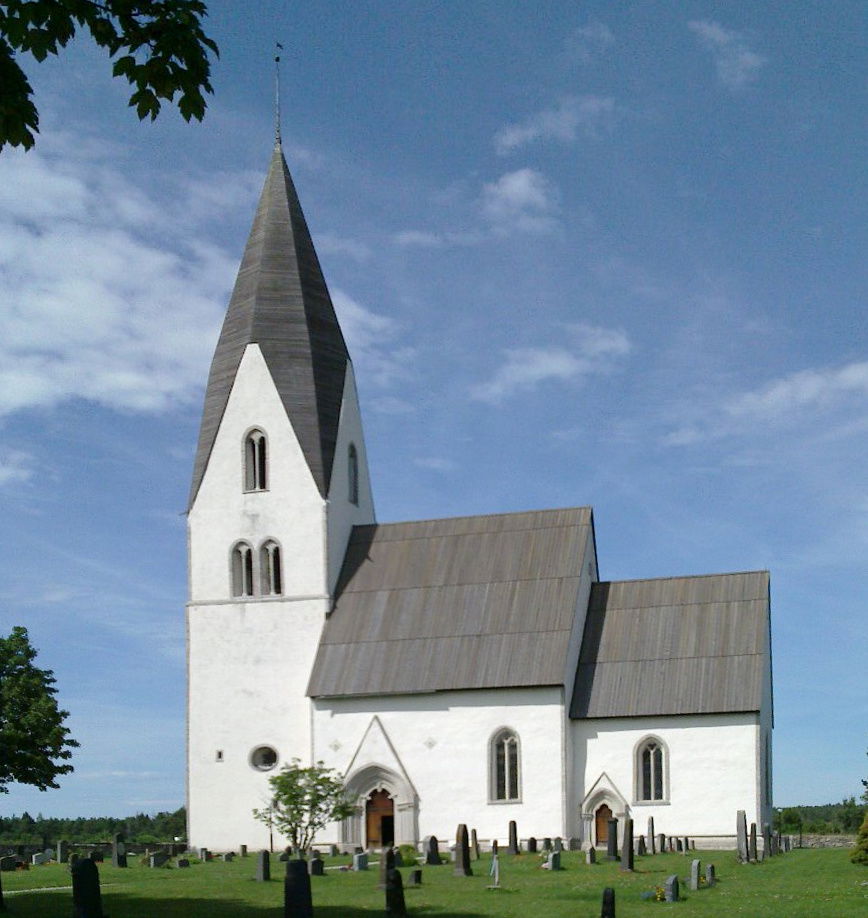
Tofta Church, one of the island's many iconic, well-preserved medieval churches.

Tofta Church, one of the island’s many iconic, well-preserved medieval churches.


A brief overview of the island’s history explains why you can feel as though you have stepped back in time. That it is a very ancient land as is evidenced by discovery of fossils, some over 400 million years old. There are traces of the Tjelvar, or Palaeolithic, people who arrived 7,000 years ago. From the Bronze Age there are almost 400 cairns and 350 stone ship-settings (boulders set out in the shape of a ship symbolizing death as a voyage to the unknown) together with large numbers of prehistoric grave fields, house foundations, hill forts and rune stones – an incredible total of 3,100 registered sites make this the richest archaeological region in Sweden.

The island was powerful during the early Viking age.  Archaeological research revealed that not only Visby but around forty other harbours and trading centres existed at this time. The island was effectively an independent republic of seafaring farmers and its situation at the meeting point of east and west made it one of the centres of world trade. In the eighth and ninth centuries the Mediterranean had come under Muslim domination and a new trade route through the Baltic linking northern Europe with the Orient via rivers became an alternative to the Mediterranean route.

The early Hanseatic League developed around the Baltic Sea and the Gotlanders, who had already explored along the Russian rivers and established a trading station at Novgorod, bought furs, wax, tar and timber, some of which they sold to the English kings. Wealth continued to accumulate: huge hoards of silver have been and are still being found all over the island.

With the advent of Christianity came a spate of church building – the presence of ninety-two magnificent parish churches in such a small island  (120 km long and 56 km wide) are further evidence of its wealth. Gradually however, power had moved from the seafaring farmers to the burghers of Visby. The Germans, mainly from Lübeck, arrived in the 1150s and built their own church, St Mary’s, which was used both for religious and commercial purposes. It was here that the chest containing the Hanseatic trading agreements was kept, the annual opening of which marked the start of the trading year.  In the thirteenth century the small wooden houses of the city were rebuilt as the beautiful large stone buildings we see today. Some thirteen new churches were erected and the streets were paved with limestone. Visby was then the most modern town in northern Europe and it remains one of the most perfect examples of Hanseatic architecture.

St Mary’s Church is still in use (it is now the cathedral) and picturesque ivy-covered ruins of eleven other medieval churches remain – some used in summer for open-air concerts and plays. There are over 200 medieval houses in the city: on Strandgatan, previously occupied by the wealthiest merchants, there are some wonderful old stone warehouses, including the Galma Apotek with its hoist beams tucked under corbie-stepped gables through which the merchandize was hauled up to different storeys. The city wall built around 1280, is 3.5 km long and 11m high; it has a parapet walk, three gates and over fifty towers, all  in good condition.

During the last years of the thirteenth century however, Gotland lost its importance. In 1259 the Germans had established their own Hanseatic Kontor  in Novgorod and so no longer needed the Gotlanders. Meanwhile Denmark, which had also seen a diminution of strength at the hands of the Germans, was seeking, under its newly crowned king Valdemar Atterdag, to increase its power. In 1361 Valdemar invaded and conquered Gotland.

This marked the end of Gotland’s glory days. What had been the foundation of the island’s prosperity, the sea, became a drawback. Having been sacked and occupied first by pirates, then by The Order of Teutonic Knights, Visby gradually became a backwater and by the sixteenth century all the churches except St Mary’s were abandoned and the settlement was in decay.

In 1645 Gotland became Swedish but its isolation meant that industrialization came late to the island – but its poverty did ensure that the old medieval buildings were not torn down and replaced with newer more fashionable edifices. This, however, together with the fact that it  retained its agricultural, building and craft traditions – and even its distinctive folk-speech – make it the unique place we can enjoy today. Visby became a UNESCO World Heritage Site in 1995.

Museums outside Visby include a limeworks museum at Bläse, and an open-air ­museum at Bunge with farm buildings from the sixteenth to the nineteenth centuries.

There are also unusual out-of-museum experiences for the history-lover. In Visby you can stay in a medieval house, the Medieval Hotel, furnished and decorated with an interior inspired by the fourteenth century; swim between medieval columns in the pool below the Wisby Hotel or attend the Medieval Week which takes place every August. Strangatan  is crowded with market stalls and you encounter costumed smiths, cobblers, barbers and traders selling newly plucked hens, eggs, herbs and spices. Musicians play flutes and fiddles, jesters play the fool and merchants stroll around decked in their  finery. Carts, ­horses, sheep and hens jostle the crowds. Three camps attended by people from all over the world prepare for the tournaments by fashioning swords and armour. During the week hundreds of events take place: mystery plays, masses, tournaments, concerts, displays, archery competitions as well as lectures and guided walks. The culmination occurs when, after dark, a re-enactment of the invasion of Valdemar Atterdag, is staged. The King rides into town to plunder the wealth of the townspeople. The ­maiden who betrayed the town is then led in procession to be walled into the tower by the sea. Gotlanders see no irony in thus celebrating a defeat/

Gotland’s Medieval Week however, is no tasteless mish-mash: the past is researched in a scholarly fashion, and in winter the local people attend evening classes given by historians to learn about every aspect of  fourteenth-century life and then set about making their costumes in, as nearly as possible, the old way. There is even a class for making medieval shoes.

At other times of year at the Chapter House in Visby, you can still see herbs and vegetables growing as they used to and try your hand at medieval handicrafts. You can play the ancient Gotlandish game club kayles, fire a catapult machine known as a trebuchet or  sample food prepared according to old manuscripts.

Historical activities are not confined to Visby, there are numerous ancient sites to visit throughout the island. There are old or reconstructed farms  in Burgsvik, Gothem and Sjonhem, Fjäle. There is a reconstructed Viking Village at Tofta which evokes farming life in the ninth century. You can see rune stones still standing on their original site (most have been removed to museums) at Ange in Butte. Then there is the Bulkverket, a strange and unique wooden platform-like construction sunk in the middle of Lake Tingstäde, the purpose of which is not yet fully understood. Those interested in field archaeology  will want to know about the Viking Discovery Programme, whose first phase, the excavation of the west-coast port at Frojel, was completed in 2005. In the summer of 2007 the second phase, scheduled to last three years, will begin, excavating a number of Viking-age farms. The project will consists of two or three-week courses with lectures and fieldwork and is open to students and volunteers.

History aside, modern Gotland has much to offer; good hotels, a chain of gourmet restaurants, an­tique shops, modern trendy designer boutiques and little cafes in which you can sit and reflect on the passing of the centuries while enjoying a coffee and the local delicacy safranspannaka served with cream and Gotland’s own salmberry jam.
Delicious!


Preserving Our Past, Recording Our Present, Informing Our Future

Ancient and Honorable Clan Carruthers Int Society CCIS  LLc

carruthersclan1@gmail.com              carrothersclan@gmail.com

cropped-wider-banner-light-blue-1.jpg


Patricia Carruthers Peck


You can find us on facebook at :

https://www.facebook.com/carrutherscarrothers.pat.9

https://www.facebook.com/CarruthersClan/

https://www.facebook.com/CarruthersClanLLC


Disclaimer Ancient and Honorable Carruthers Clan International Society CCI
DNA Gotland, Gutland / Gotland, OUR ANCESTORS, Uncategorized

CLAN CARRUTHERS-THE BEAST OF GUTLAND/GOTLAND

CLAN CARRUTHERS INT SOCIETY CCIS                    PROMPTUS ET FIDELIS

cropped-wider-banner-light-blue-1.jpg

The Beast of Gotland

beastofgotlandmenHere we start back in Gotland again.

If you do not understand what that means, please read the previous blogs.

Were the men of Gotland considered Beasts?

Oh hell yes!  And they were very nice and very good at it!

We have learned, the unforgettable memory, of these giants of men, ravaging and pillaging all of Europe, and wearing kilts, possibly so they can easily take it off, and fight in the buff.

Did you remember that our ancestors were generally accepted to have originated the  heiti for”men (of the tribe)”, with the literal meaning “they who pour their seed”.  This is one of the oldest mention of men from the same tribe or clan, or family who went off to battle together.

The Killing Beast

The short form of Gautigoths was the Old Norse Gautar, which originally referred to just the inhabitants of Västergötland, or the western parts of today’s Götaland, a meaning which is retained in some Icelandic and Norse sagas.

Beowulf is one of those Norse sagas, along with Gautar and Widsith.   Beowulf and the Norse sagas describe several battles, such as a raid into Frisia, ca 516, which is described in Beowulf, along with the events related in this epic, some described the Geats as a nation which was “bold, and quick to engage in war”.

Not only in the Story of Beowulf were they giants in battle, but the Gotalanders, were making a lot of gold for killing Romans, and protecting Romans.  They were developing a reputation for being quick to the fight!

labro

There remain picture stones of Gotland.  Hundreds of memorial stones were produced from the local limestone, in pre-viking and Viking times, which became richly informative. General themes are easily recognized: ships on a journey, men fighting in battle or defending a house, a warrior being welcomed home or into Valhalla, often by a woman who offers him a drinking horn, stories of gods and heroes.

These stones were the written stories of all the men that were lost, those that came home, and all that fought bravely.

One very interesting stone has been given the name Ardre VIII.   It stands about 7 feet tall, and is round at the top and is broken into different sections that depict some of the stories of battles.  There are two other stones to look into Larbro I, and the Klinte Hunninge.

They might have been Bold, and Quick to engage in war, but they were Ready and Faithful to the Heiti or tribe, they were the Beasts of Gotland.

Beauty and the Beast

The Grimm Brothers wrote many tales. Their tales were the first to be written of the beasts, but were stories orally told over and over again for centuries. Like playing telephone, and the stories change a bit here and there.   The Grimm Fairy tales were a collection of tales and stories told of old. The old monsters and beasts who lived on the land.

These stories were of big monsters, and mean women who ate little children.  Wicked people who were deep in the forest, and took children far away never to be seen from again.  Most of these stories carried through for hundreds of years, all telling of the Beasts of Gotland.

gulliver

Thankfully, along came Walt Disney and romanticized these stories.  Cinderella, Snow White and Hansel and Gretel. Well, Walt Disney did tame the beast and made the stories easier to experience than the Grimms Tales, but there are scenes in each one that can have us sitting on the edge of the chair. All stories of the terrible beasts that were from Gotland.  Finally, a good story about the beasts, Beauty and the Beast, and let us not forget Gulliver’s Travels.

The Beast become a Symbol 

gotlandwood

Our ancestors were experts in carving in wood and the beast is designed into many of their stylings.

They were the shipbuilders for most of Europe, but their own ships were decorated with beautiful hand carvings, most of which were that of beasts. Sometimes a different beast was used for a group of ships leaving for one war, or one battle.  Similar to a team of players all wearing the same ship and design.

beastofgotlandship

And of course, as early as 200 – 300 A.C.E. runic inscriptions are found on memorial stones and jewelry as well. These ancestors came through the stone age, the bronze age, the iron age and such, and their designs of the beasts come through their designs of jewelry.  One of my favorite of these rune memorial stones is found at Lund, and shows Hyrokkin riding on her wolf, and includes the wonderful serpent reins that she used to control the great beast.

hyroken

Viking Art has become very popular, and there are many different types of Viking Art, but the Urnes style has lasted through out the centuries.  You can see the BEAST, a symbol actually representing all the generations of Gotlanders who fought bravely for home, and yes for gold, but most importantly for their family in many works today.

beastofgotland

Every year in August, the people of Gotland dress in pre-viking and Viking garb, and you will see the flag of The Beast of Gotland, flying proudly throughout their villages.

Carruthers crest on flag-v2 (1)

OFFICIAL AND REGISTEREDL CLAN CARRUTHERS CCIS SINCE 1983-CLAN OF OUR ANCESTORS

SCOTTISH CLAN – IRISH CLAN – NORSE CLAN

Kingof the Goths, or Gutland

Preserving Our Past!    Recording Our Present!  Informing Our Future!

The Ancient and Honorable Carruthers Clan International Society LLC

carruthersclan1@gmail.com                carrothersclan@gmail.com

cropped-wider-banner-light-blue-1.jpg

CLAN CARRUTHERS INT SOCIETY CCIS HISTORIAN AND GENEALOGIST

You can find us on our main facebook pages at :

SILVER WINGS-https://www.facebook.com/CarruthersClanLLC/

GOLD WINGS – https://www.facebook.com/carrutherscarrothers.pat.9

CLAN CARRUTHERS FAMILY HISTORY – https://www.facebook.com/CarruthersClan

CLAN CARRUTHERS CCIS – https://www.facebook.com/groups/3878691252182714

CLAN CARRUTHERS INT SOCIETY- https://www.facebook.com/groups/394653845137709

CLAN CARRUTHERS – BORDER REIVERS – https://www.facebook.com/groups/434959914239094

Disclaimer Ancient and Honorable Carruthers Clan International Societ
DNA Gotland, Gutland / Gotland, Uncategorized

HAPLOGROUP l1 (YDNA) YOU ARE A VIKING!- CLAN CARRUTHERS CCIS

WIDE BANNER with NEW CREST

HAPLOGROUP l1

( YDNA)

ORIGINS AND HISTORY

IF YOU ARE A CARRUTHERS YOU ARE IN THE HAPLOGROUP l1 GROUP

IF YOU ARE IN THE HAPLOGROUP l1 YOU ARE A VIKING

GEOGRAPHIC DISTRIBUTION MAP

download (8)

Distribution of haplogroup I1 in Europe
Haplogroup I1 is the most common I subclade in northern Europe. It is found mostly in Scandinavia and Finland, where it typically represent over 35% of the male Y-chromosomes. Associated with the Norse ethnicity, I1 is found in all places
invaded by ancient Germanic tribes and the Vikings. Other parts of Europe speaking Germanic languages come next in frequency. Germany, Austria, the Low Countries, England and the Scottish Lowlands all have between 10% and 20% of I1 lineages.

Haplogroup I is the oldest major haplogroup in Europe and in all probability the only one that originated there (apart from very minor haplogroups like C6 and deep subclades of other haplogroups).

It is thought to have arrived from the Middle East as haplogroup IJ sometime between 45,000 and 50,000 years ago, and developed into haplogroup I approximately 40,000
years ago.

It has now been confirmed by ancient DNA test that Cro-Magnons, the first Homo sapiens to colonize Europe 45,000 years ago, belonged to haplogroups BT, CT, C, F, IJ and I.
The I1 branch is estimated to have split away from the rest of haplogroup I some 27,000 years ago. I1 is defined by over 300 unique mutations, which indicates that this lineage experienced a serious population bottleneck. Most of the Late Glacial and Mesolithic remains tested to date belonged to haplogroup I* or I2. It is not yet clear in which part of Europe I1 originated.

( THE CARRUTHERS BEING IN THE HAPLOGROUP l1, KNOW THAT THEY WERE IN THE HAPLOGROUP 1 PRIOR TO THAT, MORE THAN 30,000 YEARS.  )

It has been speculated that I1 evolved in isolation in Scandinavia during the late Upper Paleolithic and Mesolithic periods, when hunter-gatherers from southern Europe recolonised the northern half of the continent from their LGM refugia. The oldest attested evidence of postglacial resettlement of Scandinavia dates from 11,000 BCE with the appearance of the Ahrensburg culture .

However, five Y-DNA samples from Mesolithic Sweden, dating from c. 5800 to 5000 BCE and tested by Lazaridis et al. 2013 and Haak et al. 2015 all turned out to belong to haplogroup I2.
The earliest sign of haplogroup I1 emerged from the testing of Early Neolithic Y-DNA from western Hungary (SzécsényiNagy et al. 2014 ). A single I1 sample was identified alongside a G2a2b sample, both from the early Linear Pottery (LBK) culture , which would later diffuse the new agricultural lifestyle to most of Poland, Germany and the Low Countries. This means that haplogroup I1 was present in central Europe at the time of the Neolithic expansion.

( THE FIRST CARRUTHERS DNA STUDY WAS INSTRUMENTAL IN MATCHING US (CARRUTHERS) TO THE EARLY NEOLITHIC Y-DNA STUDY FROM WESTERN HUNGARY. THE NEOLITHIS REVOLUTION WAS ALSO CALLED THE FIRST AGRICULTURAL PERIOD, WHEN MANY OF OUR ANCESTORS WENT FROM HUNTERS-GATHERERS TO FARMERS. )

download (2)

LINEAR POTTERY CULTURE 5600-4025 BCE

It is therefore possible that I1 lineages were among the Mesolithic European hunter-gatherers assimilated by the wave of East Mediterranean Neolithic farmers (represented chiefly by Y-haplogroup G2a).

There is also evidence from the Neolithic samples of the Early Neolithic Starčevo and Cardium Pottery cultures that haplogroup I2a lived alongside G2a farmers both in south-east and south-west Europe.
The most likely hypothesis at present is that I1 and I2 lineages were dispersed around Europe during the Mesolithic, and that some branches prospered more than others thanks to an early adoption of agriculture upon contact with the Near Eastern
farmers who were slowly making their way across the Balkans and the Mediterranean shores.

The small group of farmers from the early LBK culture from Hungary might have formed a blend of I1 and G2a men. Yet distinct families would have
spread in different directions and met varying successes in their expansion. It would appear that a founder effect in the northern LBK population led to a sudden explosion of I1 lineages, perhaps in part thanks to their better knowledge of the Central European terrain and fauna (since hunting was typically practised side by side to agriculture to complement the farmers’ diet). I1 would later have spread to Scandinavia from northern Germany.

( CARRUTHERS ANCESTORS WERE PAID TO FIGHT.  SOMETIMES THEY FOUGHT WITH THE ROMANS, AND SOMETIMES AGAINST.  THESE ARE THE MEN WHO ARE ACCREDITED WITH SPREADING THEIR DNA ACROSS EUROPE)

This data is consistent with a Neolithic dispersal of I1 from Hungary with the LBK culture and the subsequent Funnelbeaker culture (4000-2700 BCE) in northern Germany and southern Scandinavia. One Swedish sample from the late Mesolithic
Pitted Ware culture (3200-2300 BCE) also turned out to belong to I2a1 and not I1.

download (10) FUNNELBEAKER CULTURE MAP

Both the Funnelbeaker and Pitted Ware cultures represent a merger between the Neolithic (farming) and Mesolithic (huntergatherer) lifestyles. Neolithic farmers from Germany penetrated late into Scandinavia and in small numbers.

There is archeological evidence that Neolithic farmers settled in southern Scandinavia and lived side by side with hunter-gatherers for several centuries during the Funnelbeaker culture. Skoglund et al. 2012 tested and compared the DNA of one Neolithic farmer and three hunter-gatherers from Sweden dating from 5,000 years ago. It turned out that the farmer was much closer genetically to modern Mediterranean people, especially the Sardinians, who are generally considered the best proxy population to Neolithic European farmers. The hunter-gatherers’s DNA resembled that of modern Northeast Europeans, and perhaps even more that of the Finns and Samis than Scandinavians.

( MANY MIGHT GET A L300 RESULT ON THEIR DNA.  PRIOR TO THE CARRUTHERS COMING FROM GUTLAND/GOTLAND, MANY LIVED IN FINLAND.)
Scandinavian hunter-gatherers ( CARRUTHERS IN GUTLAND) would have adopted the new Neolithic lifestyle little by little, using pottery and keeping domesticated animals (sheep, cattle, pigs and goats) to complement their traditional diet of fishing and game hunting. The cultivation of wheat, barley and legumes was fairly limited due to the cold climate. The cold climate was actually a barrier to the expansion of farmers from the continent. This is why Scandinavians retained a greater percentage of Mesolithic ancestry than virtually all other Europeans, apart from the Samis, Finns, Balts and Russians.
No ancient Y-DNA from the Funnelbeaker culture in Scandinavia has been tested to date, but it is likely that I1 really started gathering momentum toward the end of the Funnelbeaker period. It might also have been among the Funnelbeaker lineages
that were most successfully assimilated by Proto-Indo-European invaders during the Corded Ware culture (aka Battle-Axe culture in Scandinavia).

Most I1 individuals today share a common ancestor around the time of the transition between the Funnelbeaker and Corded Ware periods.


Carruthers crest on flag-v2 (1)


OFFICIAL AND REGISTEREDL CLAN CARRUTHERS CCIS SINCE 1983-CLAN OF OUR ANCESTORS

SCOTTISH CLAN – IRISH CLAN – NORSE CLAN


Preserving Our Past!    Recording Our Present!  Informing Our Future!

The Ancient and Honorable Carruthers Clan International Society LLC

carruthersclan1@gmail.com                carrothersclan@gmail.com

coacarrutehrs

MACIAMO HAY

EUPEDIA

CLAN CARRUTHERS INT SOCIETY CCIS HISTORIAN AND GENEALOGIST


New Blog Banner 05

You can find us on our main facebook pages at :

SILVER WINGS-https://www.facebook.com/CarruthersClanLLC/

GOLD WINGS – https://www.facebook.com/carrutherscarrothers.pat.9

CLAN CARRUTHERS FAMILY HISTORY – https://www.facebook.com/CarruthersClan

CLAN CARRUTHERS CCIS – https://www.facebook.com/groups/3878691252182714

CLAN CARRUTHERS INT SOCIETY- https://www.facebook.com/groups/394653845137709

CLAN CARRUTHERS – BORDER REIVERS – https://www.facebook.com/groups/434959914239094

Disclaimer Ancient and Honorable Carruthers Clan International Soci