Uncategorized

Viking Treasures of Dublin

Viking Treasures of Dublin


I admit I went to Dublin to see three exquisite pieces of Irish workmanship, the Book of Kells at Trinity Library, the Tara Brooch, and the Ardagh chalice. (And they did not disappoint!) I knew the National Museum of Ireland, Archeology, on Kildare Street also housed remains of Dublin’s Viking past. Nothing prepared me for the treasure trove of Norse weaponry, jewelry, and everyday artifacts in this superb collection.

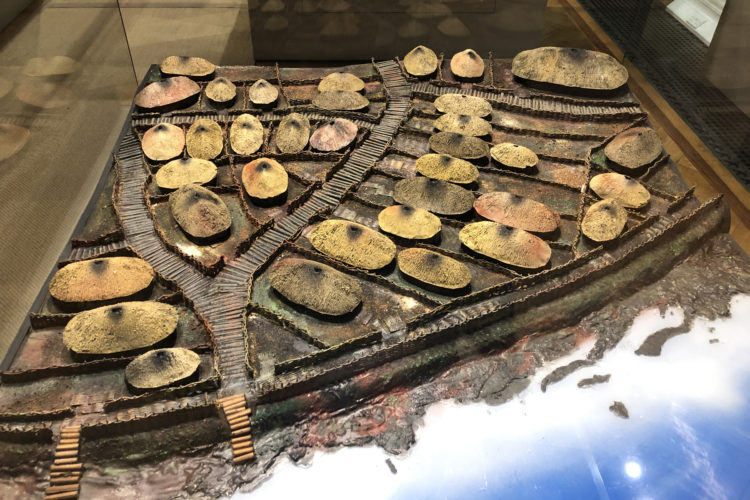
Viking era Dublin

Model of Viking era settlement at Dublin. “Dubh linn” means “black pool” in Irish, a tidal pool where the Norwegians first landed on the Liffey and set their camp.

Raiders from Norway chose Ireland as their target for pillage, just as it was raiders from Denmark who struck the Anglo-Saxon kingdoms in Angle-land – England – to Ireland’s immediate East. Dublin lies on the East coast of the island of Ireland. The River Liffey provided all the Norwegian seafarers needed to access the indigenous settlements already established there. Norwegian Vikings effectively founded Dublin in 841, using it first as an over-wintering camp. It grew to one of their most active trading centres, handling the usual range of goods the far-travelling Scandinavians had access to: prized amber from the Baltic, silk from the near East (carried up the trade rivers of modern-day Russia), Saxon jewellery and coal, woollen goods, walrus tusks and hides from the Arctic Circle. Under the Norse, Dublin also grew to become one of the great slave centres for their trafficking in human flesh.

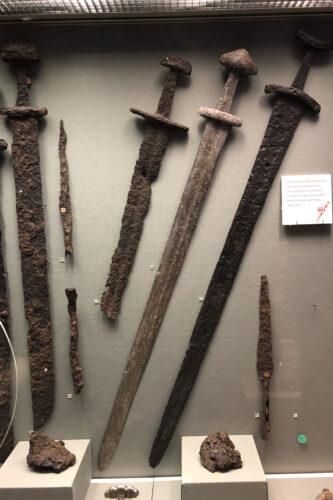
Norwegian swordsand spearsOver one hundred fifty hoards have been found from Viking Era Ireland, comprising mostly silver and bronze items. Along with the burial goods these folk were consigned to their graves with, and accidental losses now recovered, rich and diverse material remains provide vivid glimpses into the ways these mostly Norwegian raiders both changed and were changed by the Irish they settled amongst.


Swords and spear points. Nearly all of the recovered weapons show signs of                                                                                                      Norwegian                                                                                                                                                                           manufacture.


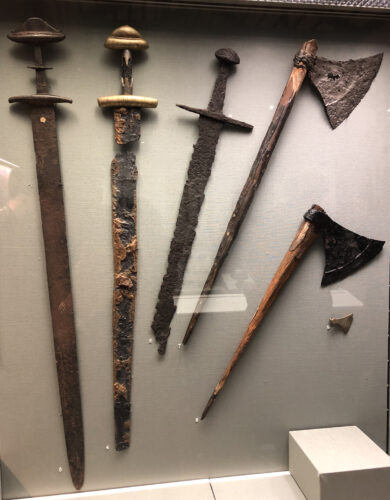
Swords and skeggoxesThe Viking incursion into Ireland meant a huge influx of silver was carried into the island – silver dirhams and Kufic coins from trade originating in Islamic lands, and masses of hack silver (broken bits of jewellery, coin fragments, slices cut from simple silver rods) brought as booty from pillaging targets along the shores of Frankland.


Swords, and skeggoxes. Also on display was a human skull, with a head injury frighteningly identical to that I describe as killing Yrling’s right hand man Une in “Sidroc the Dane”. You’ll forgive me for not photographing it; it was too terrible to look at.


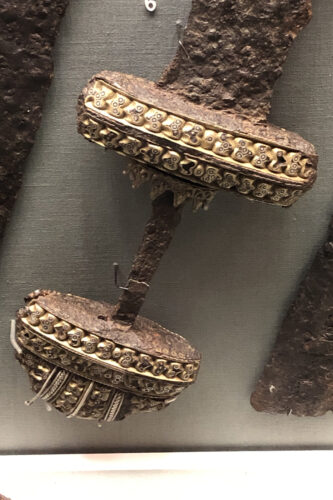
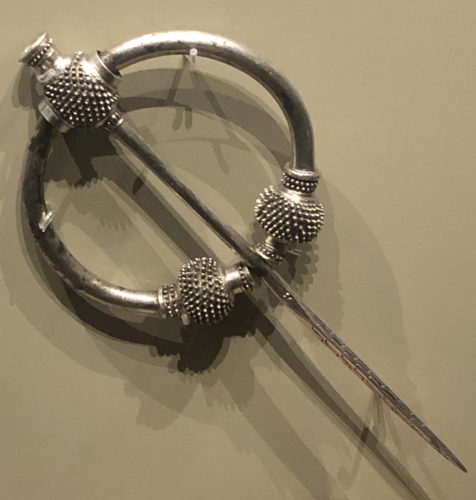
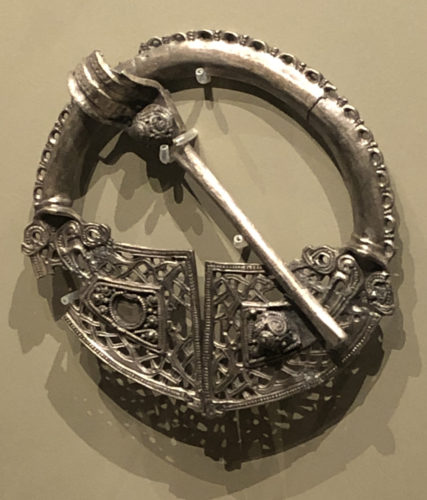
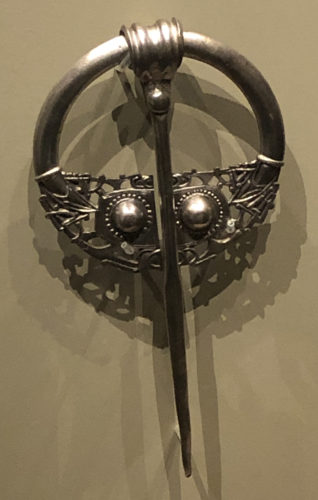
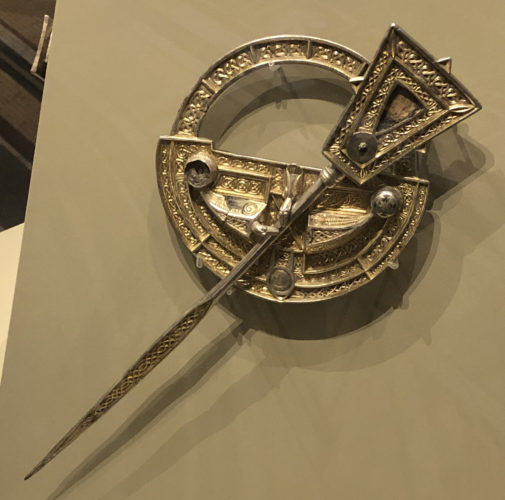
Gold HiltIrish workers in precious metals, already amongst the most highly skilled on Earth, where quick to adopt Scandinavian motifs into their work. Great penannular pins and brooches featuring bosses, thistles, kite-shaped pins, arm rings, and silver mesh work appeared for the first time in Ireland, adapted from Norse models.


Gold dressed hilt on elite warrior’s sword. Only a very rich war-chief would have carried this. Surpassing beauty.


Thistle Brooch

Thistle brooch. I has so thoroughly associated this motif with Scotland and Ireland that to learn it was actually carried from Scandinavia was an eye-opener.

Silver pin

Silver pin.

Pin with bosses

Penanualar pin with bosses, another style unknown to the Ireland before the Vikings.


Gilt pin

Gilt pin.


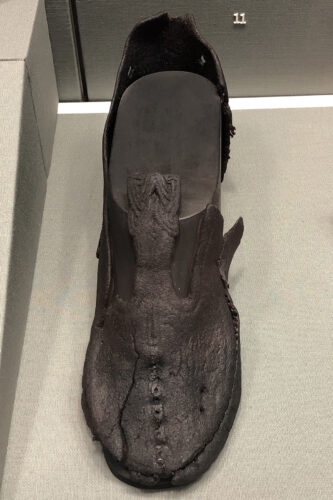
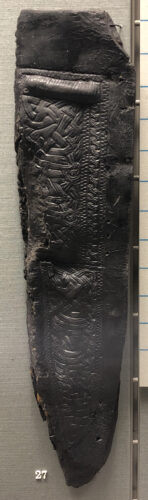
ShoeThe anaerobic nature of Irish peat bogs has yielded many finds of organic materials in a high state of preservation. I had seen the stray 9th or 10th century shoe on display at Jorvik or the National Museums of Denmark or Sweden; here was a whole array of them, along with leather shoulder bags, water (or ale/wine) bags, and a jaw-dropping leather knife scabbard.


Leather scabbardLeather knife scabbard. Sublime example, thanks to preservation in peat.


All photos taken in the exhibition halls of the National Museum of Ireland, Archeology, Kildare Street. I am very eager to return – I felt I could spend a week poring over this collection, and a docent told me it is but a fraction of what is held in storage!

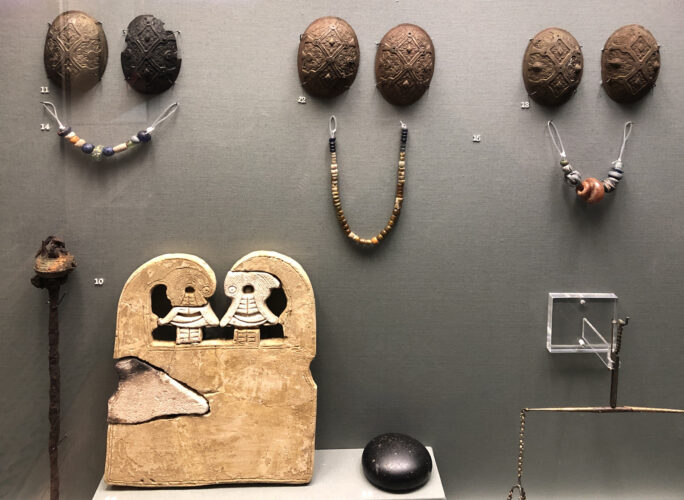
Brooches and Linen smoother

These warriors brought their wives with them at some point. Typical Norse paired shoulder brooches of bronze, from which glass bead necklaces were strung, from female burial sites.         Octavia Randolph


Preserving the Past, Recording the Present, Informing the Future

Ancient and Honorable Carruthers Clan Int Society LLC

carruthersclan1@gmail.com


carruthersCOA


Uncategorized

The Isle of Viking Women

The Isle of Viking Women?

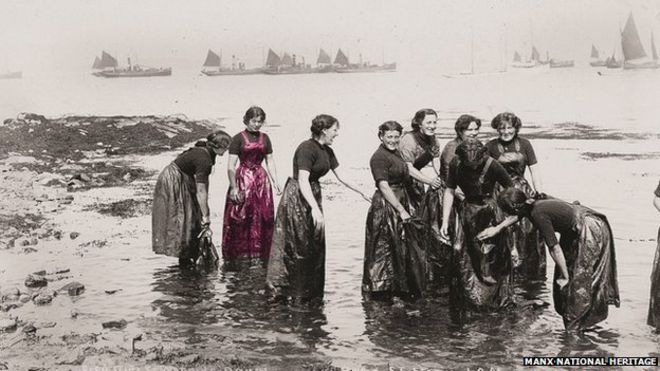
Women on the Isle of Man had more rights than on the adjacent isles up to modern times.

Image result for Manx women

Manx Women had the vote from 1881 – 37 years before the UK. This may be partly because of the inheritance of a Celtic / Viking legal system.

If you don’t live on the Isle of Man, then you may not know that the Island introduced Votes for (some) Women in 1881, 37 years before the UK, and pretty much the first place in the world. Nearly everyone who lives here knows that already. Possibly related to this is that Emmeline Pankhurst’s Mum was Manx. The roots for this progressiveness may lie in the Island’s Viking and Celtic past.

Vikings took control of this Island in the Irish sea in the 800s and used it as a naval base until the 1200s. The Norse established the Island’s parliament, Tynwald, in around the year 1000 (the name Tynwald is from Tingvollr: ‘assembly field’ in Old Norse). Other traces of Norse heritage include placenames and people’s names, dozens of carved runestone memorials to both men and women, and viking-age burials like the one of the ‘Pagan lady’ in Peel, full of grave goods from across the Viking world. Things weren’t so great for slaves, unfortunately, as in other societies of that time.

The Norse may have been bloodthirsty and warlike, but they did set up a legal system, which combined with Celtic traditions, has evolved up to the present day. Under Manx law, women had far more rights than their English counterparts. All through medieval times and to the modern period, a Manx woman could own land and goods, keep property through her marriage, and could bequeathe property as she wished. When a woman died her goods could not be plundered by the husband: the courts would step in to ensure her children inherited her goods, and would appoint her relatives as guardians. This is quite unlike English law, where a woman (and most of what she owned) was by default seen as the property of her husband, from Norman times up until the 1800s. Scotland and Wales both had more legal rights for women until about 1700 than the South of England: the North of England, with its Norse heritage, had customary but not official inheritance rights for women until about 1700.

Womens rights on the Island went backwards a bit in the late 1700s when the British Crown took control of the Island, but by Victorian times, and the suffrage struggles, Manx women were still used to having decent legal and customary rights.

This brings us to the Manx Pankhurst connection. Emmeline Pankhurst’s Mum, Sophia Craine, was born on the Isle of Man in 1843, and met and married a Robert Goulden of Manchester. Living in Manchester, they were both active in anti-slavery and women’s suffrage movements, with friends in the Isle of Man and Manchester working for the women’s vote. In the 1870s, Sophia took her daughter Emmeline to numerous suffrage events.

In 1880, the leader of the UK women’s movement, Lydia Becker of Manchester, visited the Island to instigate a demand for ‘Votes for Women’ amongst the Manx. Unexpectedly, she was completely successful, and in 1881 the Manx Parliament passed a law extending the right to vote to single or widowed women with property. The sudden success was probably helped by all the Island’s press being in favour – the most conservative newpaper at the time was run by a widow. Also there wasn’t a party system on the island, which may have helped (for complicated reasons, the British Liberals and Conservatives both felt that women having the vote could benefit their opponents). The Island’s small size probably helped – eg just having the one conservative newspaper, which by chance was run by a woman.

The debate in the Island’s Parliament was quite something. The proposal was led by a Mr Sherwood, who jollied his colleagues along with jokes: to paraphrase: ‘Of course, we could even have women members of Parliament, though we would have to widen the seats…’, ‘That would be broadening the franchise’….’If the bachelors of the Island don’t like single ladies having the vote, then they can always remedy the situation by marrying them!’

So a tiny country with its own parliament, and a Norse / Celtic legal system, led the way, in being one of the very first places in the world where women had the right to elect members of their parliament. Slightly ironic for somewhere called the Isle of Man.

Preserving Our Past, Recording Our Present, Informing Our Future

Ancient and Honorable Clan Carruthers Int Society

carruthersclan1@gmail.com

carruthersCOA

Uncategorized

Carruthers From Gutland

Hello Carruthers Clan

Below is some information that should direct you on your further search.

To reiterate what we sent last time:

You are correct that your clan was called Ashman.  Aachen is the name of land on what is now the northern section of Europe, from Germany through part of France.  This land was protected by the Pope in Rome.  Sections of this land was given to your ancestors to cut down the Ash Trees and use them for building boats.  Aachen became Ashmen.

Prince Philip of the UK, also had a large section of land next to them , and yes owned by the Roman Pope. It is believed that Prince Philip and the Aachen-men did favors for the Pope and were rewarded with land.   

But here are a group of names of people you are descendants from which may help you learn more.


Wiglaff

Waefmund

Herdred

Haeocyrs

Hygelac

You are not descendants of King Sigrid.  

The last name, Hygelac,  is the most prevalent in your search.

The Ashmen were from Ostergutland, which means east Gutland.  

I know your experience is in Celtic History, so I am hoping we can help you at least get started.  When researching your family were Geats or Gots.

Here is a little help:

The Geats, and sometimes Goths) were a North Germanic tribe inhabiting what is now Götaland in southern Sweden. The name of the Geats also lives on in the Swedish provinces of Västergötland and Östergötland, the Western and Eastern lands of the Geats, the earliest known surviving mention of the Geats appears in Ptolemy, who refers to them as Goutai. In the 6th century, Jordanes writes of the Gautigoths and Ostrogoths, the Norse Sagas knows them as Gautar, Beowulf and Widsith as Gēatas. The etymology of the name Geat is similar, although not identical, to that of Goths, the names are derived from different ablaut grades of the Proto-Germanic word *geutaną, meaning to pour. They are generally accepted to have originated as heiti for men, a more specific theory about the word Gautigoths is that it means the Goths who live near the river Gaut, todays Göta älv. It might also have been a conflation of the word Gauti with a gloss of Goths, in the 17th century the name Göta älv, River of the Geats, replaced the earlier names Götälven and Gautelfr. These sources concern a raid into Frisia, ca 516, which is described in Beowulf. Some decades after the events related in this epic, Jordanes described the Geats as a nation which was bold, before the consolidation of Sweden, the Geats were politically independent of the Swedes or Svear, whose old name was Sweonas in Old English. When written sources emerge, the Geatish lands are described as part of the still very shaky Swedish kingdom, the actual story in Beowulf, however, is that the Geatish king helps a Swede to gain the throne. What historians today think is that this realm could just as well be the force behind the creation of the kingdom of Sweden. The historians make a distinction between history and the emergence of a common Swedish ethnicity. The Hervarar saga is believed to contain such traditions handed down from the 4th century, according to Curt Weibull, the Geats would have been finally integrated in the Swedish kingdom c. 1000, but according to others, it most likely took place before the 9th century, the fact that some sources are silent about the Geats indicates that any independent Geatish kingdom no longer existed in the 9th century. However, the oldest medieval Swedish sources present the Swedish kingdom as having remaining legal differences between Swedes and Geats for example in weights and measurements in miles, marks etc. They also tell us there were kings, ruling by the title of Rex Gothorum as late as in the 12th century. In the Heimskringla, Snorri Sturluson writes about battles between Norwegians and Geats. The Geats were traditionally divided into petty kingdoms, or districts. The largest one of districts was Västergötland, and it was in Västergötland that the Thing of all Geats was held every year.


Preserving the Past, Recording the Present, Informing the Future

Ancient and Honorable Carruthers Clan Int Society

carruthersclan1@gmail.com

cropped-coagraywide.jpg

Disclaimer Ancient and Honorable Carruthers Clan International Society CCIS LLC is the official licensed and registered Clan of the Carruthers Family.  This Clan is presently registered in the United States and Canada, and represents members worldwide.  All content provided on our web pages is for family history use only.  The CCIS is the legal owner of all websites, and makes no representation as to the accuracy or completeness of any information on these sites or by following any link provided. The CCIS will not be responsible for any errors or omissions or availability of any information. The CCIS will not be liable for any losses, injuries, or damages from the display or use of this information. We do not sell, trade or transfer to outside parties any personal identifications. For your convenience, we may provide links to various outside parties that may be of interest to you. The content on CCIS is design to support your research in family history.      ( CCIS -LLC copyright 2017 - 2020)
Uncategorized

How Strong Were the Vikings?

WERE THE VIKINGS REALLY AS STRONG AS THEY ARE PORTRAYED?

Were The Vikings Really As Strong As They Are Portrayed?

THE VIKING WARRIOR

In history, Vikings are known as one of the bravest warriors that do not fear death. But is that really true, or do we just think like that because of today’s popular TV shows and video games?

Vikings were people with their own religion and own beliefs, so naturally, this played a huge role on their fearlessness. For the most part, they were farmers and stayed in their homeland, but when the “Viking Age” came and they started raiding lands far from their homeland.

They raided for several reasons, but mostly it was for the loot or land, while others were more adventurous and were seeking fame and glory. The Vikings extended their reach and started attacking nearby kingdoms, such as the kingdoms West from their homeland and sometimes the ones that were in the East. Their first target were the English Anglo-Saxon kingdoms, which weren’t united under one rule and were in constant conflict between each other. They were weak and they weren’t organized.

The Norsemen weren’t well known and they came by sea which carried with them the element of surprise. There was no one to warn the English about the upcoming attacks. English monasteries, villages and even small cities were attacked by these unknown Vikings.

WHAT MADE THEM SUPERIOR?

These Vikings were barbaric to the English people and the people were slightly scared of them. Fear was ruling over the people because they could have been attacked at any time, and no one could defend them because these Vikings came out of nowhere.

The Vikings had the element of surprise, they could catch people off guard. Because of the low organization from the Englishman and the fast moving ships of the Vikings, their reaction time was slow, which means that a village could be raided and they could be gone in less then a day.

The Norseman never fought a fair battle against the other Kingdoms. Every time they fought them it was a surprise attack or it was a low organized army sent by the Anglo-Saxons which made them easy targets. If they fought a fair battle how good would they be? Most of the battles in the early and middle Viking age were like this.

BUT WHAT KIND OF WARRIORS WERE THEY?

While Vikings are very known and marketed, people always put them in the number one spot as warriors. While they were strong they don’t deserve the number one spot in the medieval period because it depends on a lot of factors.

What gave the Vikings their edge was their religion as an example. Normal people who were recruited from their homes didn’t want to die, but the Vikings were slightly different. Everyone knows their religion and knows that when they die they visit Valhalla, and enter through the gates of Valhalla as true warriors. Religion was at its peak back then and they lived by it. A person with those beliefs could easily fight till the end and will die with honor, this gave him the edge it made him fearless. He didn’t care if he died because he knew there was an afterlife, while the other person the opponent had another thing on his mind and it was to survive this battle and go home, he cared if he lived or died and death wasn’t an option. He must fight on the back lines and run if needed when things got hot.

The Vikings also had a slight physical superiority as well, they were stronger and slightly taller even though this isn’t a sure fact.

As for their equipment, it wasn’t advanced at all. They used round shields, axes, swords and spears. The famous knife they had was the Seax. Their armor wasn’t advanced as well, it was chainmail, helmet, Lamellar and cloth with leather. This gave them protection but it wasn’t that much. For example, a volley of arrows could do some serious damage despite the shields and everything.

The Vikings were good warriors for their time being but could always lose to a mounted knight. While they might be the best for that time, the medieval period was full of advanced warriors that could demolish their opponent.  Alcibiades

Preserving Our Past, Recording Our Present, Informing Our Future

Ancient and Honorable Carruthers Clan Int Society LLC

carruthersclan1@gmail.com


coacarrutehrs

Uncategorized

Viking Boat Burial Reveals its Secrets

Viking Boat Burial Reveals its Secrets

Six years after discovering and excavating the first Viking boat burial site discovered on the UK mainland, archaeologists have provided a glimpse into some of the mysteries this rare burial reveals.

Post-excavation photograph of the burial site. (Credit: Antiquity Publications Ltd, 2017)

Originally unearthed in 2011, the site in Swordle Bay, Scotland, was the first undisturbed Viking boat burial found on the UK mainland. After six years of work, Ardnamurchan Transitions Project’s findings were recently released in an in-depth report in the Journal of Antiquity, revealing, among other things, the growing relationship between Scotland and the Viking world at that time.

Viking boat burials themselves were extremely rare. Only practiced for the deaths of prominent individuals, the ritual used a boat as a coffin for the body and burial goods. Discovered under a low-lying natural mound close to the shore, this particular site was small, measuring approximately 17 feet by 5 feet, and thought to have contained a row boat that was accompanying a larger ship.

Other artifacts from the burial site. The sword (top); the sword in situ (below); the mineralized textile remains (right); detail of the decoration after conservation (left). (Credit: Pieta Greaves/AOC Archaeology).

After excavating the site, archaeologists were able to reconstruct the steps of the burial. A boat-shaped depression was first dug into a natural mound of beach shingle. The boat was then inserted into the ground, and the body was placed inside, along with the grave goods. Stones were place inside and around the boat. As part of the closing of the site, a spear and shield boss (the round or convex piece of material at the center of a shield) were deliberately broken and deposited.

Pre-excavation photograph after initial cleaning. (Credit: Antiquity Publications Ltd, 2017)

The ship, along with the human remains, decayed in the acidic soil long ago, but the grave artifacts remained, offering a glimpse into the possible origins of the deceased as well as the reach of Viking culture. A single copper alloy-ringed pin with three bosses—a style found in Ireland—was also found, believed to have originally been fastened to a burial coat. There was also a copper alloy drinking horn, thought to be Scandinavian in origin. Other grave goods included a sword, an axe, a sickle (found mostly in Scotland), a whetstone (probably Norwegian), flint strike-a-lights and two teeth—molars from only identified human remains. Hundreds of metal rivets that once held the vessel together, some with wood shards, were also discovered.

The Viking's teeth. (Credit: Antiquity Publications Ltd, 2017)

An isotopic analysis of the teeth (the lower left first and second molars) revealed further information. The individual likely lived on, or close to, the coast, as indicated by an increase in consumption of marine proteins between the ages of 3 and 5. While marine protein was rarely consumed by humans in Britain, it was popular in Viking-era Norway. Further analysis of the teeth narrowed down the place of origin to eastern Ireland, northeastern mainland Scotland, Norway or Sweden.

The weapons included in the burial point to a warrior status and the artifacts and their internment infer high status, but the gender cannot be confirmed. While it is likely a male burial, some of the goods, such as the sickle, are more commonly associated with females. Current Viking’s scholarship points to a number (albeit smaller) of female warriors, as well as the discoveries and excavations of female boat burials.

 Some of the artifacts recovered from the burial site (clockwise from the top left): broad-bladed axe, shield boss, ringed pin and the hammer and tongs (Credit: Pieta Greaves/AOC Archaeology).

While there is still more to learn from this rare burial site, an important finding was revealed in the variety of grave goods from multiple geographic locations: The growing relationship between Scotland and the Viking world at that time.


Preserving Our Past, Recording Our Present, Informing Our Future

Ancient and Honorable Clan Carruthers Int Society LLC

carrurthersclan1@gmail.com


carruthersCOA

Uncategorized

Viking King – How Was He Elected And What Was Expected From Him?

Viking King – How Was He Elected And What Was Expected From Him?


In the Viking society kings were the most powerful people, but having the highest social status was also associated with responsibilities and certain requirements. Unlike for example pharaohs, Viking kings were not considered divine or special.

Ragnar Lodbrok claimed to be a direct descendant of god Odin, but most Viking leaders were “ordinary” people and they were viewed as exceptionally commanding men.

To become a great Viking leader a man had to have certain qualities and attitude as a leader.

This brings us to questions such as – Who could someone become a Viking king? Who was considered a worthy leader in the Viking society?

Viking King - How Was He Elected And What Was Expected From Him?

Left: Mighty King Harald Hardrada – Right: Ragnar Lodbrok portrayed by Travis Fimmel in the TV-series Vikings.

Kings Appeared At The End Of The Viking Age

It’s important to keep in mind that during the early Viking Age there were no Viking kings. The Viking society was divided into three social classes –  the nobles or jarls, the middle class or karls and the slaves or thralls.

Although the different social layers within the population were perceived as ordained by the Norse gods, it was still possible for one person to move himself from one class to another.

Vikings kings appeared in the beginning of the Viking Age, and they were only regional leaders.  The most powerful individual Viking kings who ruled over most of the Scandinavian lands appeared at the end of the Viking Age.

How Was A Viking King Elected And What Was Expected From Him?

The title of a king could be inherited. A man could also become a king if he had good reputation and prominent supporters or was the leader of a successful military force.

Statue of Viking Rollo in Ålesund, Norway. Image credit: Nils Harald Ånstad.

Rollo: Viking Sea Lord, Chieftain And The First Ruler Of Normandy – Statue of Viking Rollo in Ålesund, Norway. Image credit: Nils Harald Ånstad.

Some were considered better qualified as leaders than others. High intelligence and capacity for strategic thinking were a requirement. A Viking king was expected to be ruthless toward his enemies and there was no room for softness.

Ellen LLoyd


Preserving Our Past, Recording Our Present, Informing Our Future!

Ancient and Honorable Carruthers Clan Int Society LLC

carruthersclan1@gmail.com

cropped-wider-banner-black.jpg

Uncategorized

The Varagians V : Kingdom of Khazaria

Kingdom of Khazaria

Image result for Kingdom of Khazaria

Around the Volga north of the Caspian Sea was a Turkish empire called Khazaria. They had become very rich by controlling the trade between China and
Europe.
The early al-Rus’ traded extensively with Khazaria. The Gotlandic merchants
came on the Volga trade route to the Khazar capital of Atil, and then to the
southern shores of the Caspian Sea, all the way to Baghdad. The Gotlanders
dominated this trade on the Russian rivers from the second half of the 700s
and travelled all the way to the Volga, paying duties to the Khazars and to the
ports of Gorgan and Abaskun on the southern shore of the Caspian Sea. On
occasion they travelled as far as Baghdad. Most Islamic coins in the Spillings’
treasure are minted in Baghdad.
Ibn Khordadbeh wrote in the ‘Book of Roads and Kingdoms’ that ‘they go via
the Slavic River, the Don, to Khamlidj, a city of the Khazars, where the latter’s
ruler collects the tithe from them.’
Khazaria had a Nature Shamanistic religion, Tengriism, where the eight-legged
horse fgures. It is depicted on three Gotlandic picture stones. It has nothing
to do with Æsir-belief and there are no signs of Æsir-belief on Gotland. The
eight-legged horse is unknown on the Scandinavian peninsula.

Khazaria converted in the late 700s to Judaism and became the world’s largest
empire that professed to the Jewish faith, the ‘13th tribe’.
A coin from 837/838, which instead of Muhammad as the profet of god says
Moses is the prophet of god, was found in the Spillings’ treasure. Later we fnd
decendants to these Khazarians professing to the Jewish religion in Russia,
Ukraine, Poland and Lithuania. It is estimated that 80% of those who today
profess to the Jewish religion originate from the 13th tribe.

Image result for Kingdom of Khazaria


Preserving Our Past, Recording Our Present, Informing Our Future

Ancient and Honorable Carruthers Clan Int Society

carruthersclan1@gmail.com


carruthersCOA

The Varangians - Book, Uncategorized

The Varangians VI : Mikalgar∂r, the Gotlandic Constantinople

Mikalgar∂r, the Gotlandic Constantinople


Image result for Mikalgar∂r, the Gotlandic Constantinople


The frst documented visit by a delegation of Gotlandic merchants, Rhos, Varangians, to Miklagarðr is in 838. It is documented by three written sources and
also a coin has been found in the Spillings’ treasure with Emperor Theophilos’
name (829-842).
One of the references related to the Rus’ khaganate comes from the Frankish
Annals of St. Bertin, which refer to a group of Norsemen who called themselves Rhos, “qui se, id est gentem suam, Rhos vocari dicebant”, and visited
Constantinople around the year 838. They were fearful of returning home via
the steppes, that would leave them vulnerable to attacks by the Magyars.
Around 830, a rebellion had broken out in the Khazar khaganate. As a result,
three Kabar tribes of the Khazars joined the Hungarians and moved to what
the Hungarians call the Etelköz. Therefore these Rhos got permission to accompany Greek ambassadors from the Byzantine emperor Theophilus, who
were travelling through the Frankish Empire to the Frankish Emperor Louis
the Pious at Ingelheim. When questioned by the Frankish Emperor Louis the
Pious they stated that their leader was known as Chacanus, the Latin word for
“Khagan”, and that they lived far to the north.

Image result for Mikalgar∂r, the Gotlandic Constantinople
Ibn Khordadhbeh (c. 820 – 912) depicts that also probably about the year 846
al-Rus’ merchants visited Miklagarðr and Baghdad. However some Gotlandic
Varangians remained in Mikagar∂r in 838 and joined the Emperor’s service and
took Byzantine wives.
So did the Gotlandic Varangian Ingr who married a Martiniakoi, a distant relative to the imperial family. In 840 a daughter Eudokia Ingerina (Greek: Ευδοκία
Ιγγερίνα) (c. 840 – c. 882) was borne.
On June 18, 860, at sunset, a feet of about 200 Rhos vessels sailed into the
Bosporus and started pillaging the suburbs of Constantinople, Miklagarðr. The
attackers were setting homes on fre, drowning and stabbing the residents. The
attack took the Greeks by surprise, ‘like a thunderbolt from heaven’.
The Ecumenical Patriarch of Constantinople Photius (858-867 and 877-886)
says that it came suddenly and unexpectedly, ‘like a swarm of wasps’. Unable to
do anything to repel the invaders, Patriarch Photius urged his fock to implore
the Theotokos to save the city.
Emperor Michael III and the Imperial Army, including the troops normally
stationed closest to the capital, and the dreaded feet, which discouraged with
the deadly Greek Fire, fought against the Arabs in Asia Minor. The exceptional time of the attack when the Rhos, Gotlandic Varangians, caught Constantinople unprepared suggests that the Rhos had information about the city’s
weaknesses. It shows that the Rhos trade and communication with Miklagarðr
continued into the 840s and 850s. We don’t know how many Gotlanders took
service in the Imperial Guard in 838 and if they were involved from inside.
Still, the attack by the Rhos in 860 came as a surprise.
The Rhos–Byzantine War of 860-861 was the only major military expedition
from the Rus’ Khaganate recorded in Byzantine and Western European sources.
At the same time all the centres of the Rus’ Khaganate in North-Western Russia were destroyed by fre. Archaeologists have found convincing evidence that
Aldeigjuborg, Alaborg, Holmgard, Izborsk and other local centres were burnt
to the ground in the 860s. Some of these settlements were permanently abandoned after the confagration.

Preserving Our Past, Recording Our Present, Informing Our Future

Ancient and Honorable Carruthers Clan Int Society

carruthersclan!@gmail.com


carruthersCOA

Uncategorized

The Varangians : The Rus Khaganate

The Rus’ Khaganate

Image result for Rus’ Khaganate


The Gotlandic merchants, as mentioned earlier, were in the Arabic sources on
the Russian rivers called al-Rus’, expeditions of rowing boats, and Wareng i.e.
Varangians.
By end 700s groups of Gotlandic Varangians had developed a powerful warrior-merchant system. They began probing south down the Russian waterways
controlled by the Khazars. They were in pursuit of the Arabic silver which fowed north through the Khazarian- Volga Bulgarian trading zones. The silver
coins were obtained as payment for among other things slaves, furs and swords.
Gotlandic mercantile feets passing Atil on the Volga had to pay tithe, as they
had to at Byzantine Cherson.

Related image
The Gotlandic Varangians settled inside the East Slavic area. They forced their
subordinates to feed them and obtain merchant goods.
There have been excavated a number of Gotlandic bases from end 700s to the
800s in present day Belarus and all the way to the Volga.
The early phase of this loosely structured Gotlandic Rus’ dominion is sometimes called the Rus’ Khaganate. The Rus’ Khaganate was a cluster of city-forts,
set up by the Gotlandic merchants.
The regions along the Russian rivers were the places of operation for these
adventurers and merchants. The population, where the al-Rus’, Gotlandic merchants, founded their bases, was at that time composed of Baltic, Slavic, Finnic
and Turkic peoples. The pattern with Gotlandic trading places from the Bronze
Age seems to be repeated.
The Gotlandic picture stones from that time tell us of long distance travelling
by the Gotlandic merchants on the Russian rivers.
The Rus’ Khaganate period marked the genesis of a distinct Rus’ ethnos. It was
a polity that fourished in what is today northern Russia, roughly from the late
700s to about 860 when the Gotlanders (Varangians) were thrown out.
‘The tributaries to the Varangians drove them back beyond the sea and, refusing them further tribute, set out to govern themselves’.

Related image
Lyubsha is an archaeological site situated on the right bank of the Volkhov,
about 1,500 metres downstream from Aldeigjuborg. The 1993 excavations
established that Lyubsha is the site for the earliest Varangian fort in Russia,
established in the frst half of the 700s, thus predating Aldeigjuborg.
The fortress was destroyed by fre towards the end of the 800s. Constantine
Zuckerman connects its destruction with a confict, Vadim’s uprising, that marked the downfall of the Rus’ Khaganate. Immediately north of Lyubsha lies
the village of Gorchakovshchina, which used to be a trading post at the head
of navigation on the Volkhov, near its ancient entry into Lake Ladoga.
Dmitry Machinsky ranks Gorchakovshchina, along with Aldeigjuborg and Alaborg, among the most important centres of the Rus’ Khaganate.
It is estimated that between 90 to 95% of all coins from the Islamic Caliphate
found in Gotland have passed through Aldeigjuborg. Tellingly, the oldest Islamic coin in Europe was unearthed in Aldeigjuborg. Dendrochronology suggests that Aldeigjuborg was founded about 753, about the same time as Bagdad that was founded on 30 July 762 by the new Muslin Abbasid dynasty.
Gotlandic merchant vessels sailed from the Baltic Sea through Aldeigjuborg to
the Caspian Sea and later also to Miklagarðr.
Other centres that have been excavated are Holmgar∂r, Sarskoye Gorodishche,
Gnezdovo at Smolensk and Timerevo in Yaroslavl. Typical for these centers is
that they are located on waterways, and that craft and trade is well developed,
and the material culture is international.

ruskur

According to contemporary sources, the population centers of the region were
under the rule of a chief using the Old Turkic title Khagan. The Rus’ Khaganate period marked the genesis of a distinct Rhos ethnos. It was succeded by
Kievan Rus’ and later states from which modern Russia, Belarus, and Ukraine
evolved.
According to Davidan the activities of the Varangians were mainly linked to
the proto urban centers of Eastern Europe and those that emerged along the
Volga river trail.
As mentioned Rhos (Rus’) comes from old Norse ro∂r meaning ‘expedition of
rowing ships’. They called their leader Khacanus.


Preserving Our Past, Recording Our Present, Informing Our Future

Ancient and Honorable Carruthers Clan Int Society

carruthersclan1@gmail.com

carruthersCOA

Uncategorized

The Varangians: Gotlandic Picture Stones

Gotlandic Picture Stones

Image result for gotland picture stones

No poets celebrate in song Gotlands’ peaceful or military exploits in the East.
On the other hand Gotland has plenty of beautiful and proud monuments in
form of picture stones, the only monumental art we possess from antiquity.
They were originally attached to the tombs and had certainly religious-magical functions. The earlier stones had the sacred form of the axe-blade and
were tastefully decorated with sun symbols and ship images, reminiscent of the
Bronze Age ornamentation. One of the finest of these picture stones, which
dates back to Roman Iron Age is embedded in Bro church tower wall (page 20).
Picture stones are a human expression, that in a single interpretation can provide a perspective far beyond the horizon of Gotland. If you compare the
picture stones from before and after the turbulent times about 520 CE we note
that there are two entirely different religions that exist.
The older picture stones up to the 500s describe sun and nature worship while
after that time there are new religious infuences emerging. In the Lake Mälar
area we have what Snorri Sturlusson calls Æsir religion.whilst it on Gotland are
traces of Christian infuences.
The idea to raise neatly carved, fat stone slabs on the graves, which frst meet
us in the Roman Iron Age, has lived through the storms of time.

Picture_Stone_from_Hunninge,_Klinte,_Gotland_(29630060325).jpg
The Gotlandic picture stones are unique and are nowhere else in Scandinavia
to be found. The older stones are elegantly shaped image blocks with a sparse geometric decoration of a symbolic nature, that is indicative of an artistic
balance and elegance in the alignment, which closest speaks of a sophisticated
culture. The sun wheel occupies a central place in this world of images. This is complemented with the symbolic images of animals and ships, drawn with
a few elegant lines. These show clear signs of inspiration from Roman culture.
Gotland’s main deities here and ever since ancient times have been the heavenly
bodies, mainly the sun and moon. There have apparently lived talented artists
on Gotland during this time and later times.
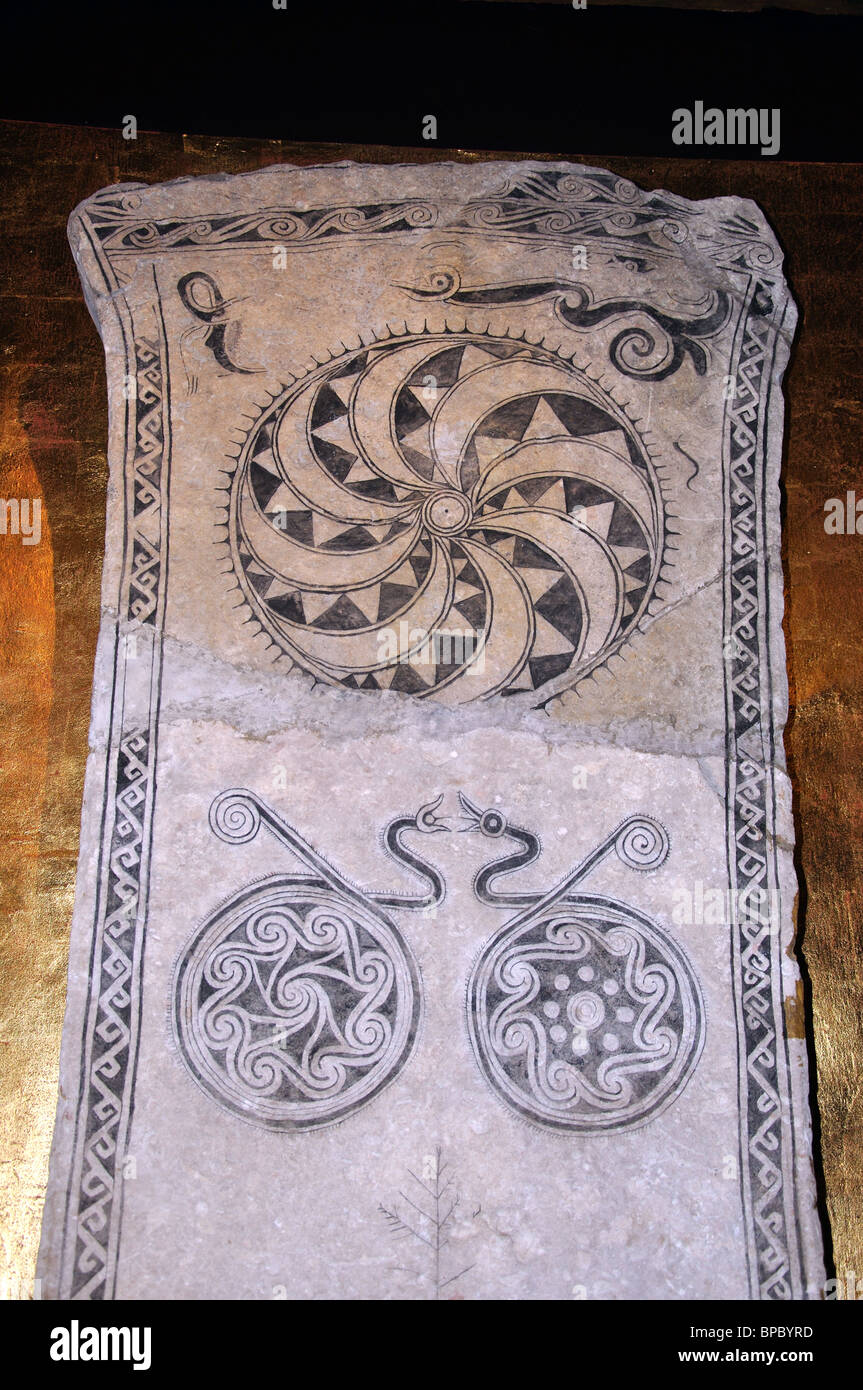
Image result for gotland picture stones
The earlier Gotlandic picture stones are mostly connected with the Iberian
peninsula and southern France. The Ibero-Celts are the most likely bearers of
the pictorial agenda that is introduced on Gotland for the earlier picture stones.
In the Iberian peninsula, the Vadenienses, an old Ibero-Celtic people have left
very special gravestones, decorated with blades of ivy, corn ears and specially
designed horses. It was a people of fghters and horsemen, who to every horse
had two warriors, one to ride and the other to fght on foot to help protect the
horse and knight. Their most common form of grave decoration during the
pre-Christian Roman period is exactly of the same character as the early stones
on Gotland. They contain a lot of signs that could be understood as sun and
moon. The moon is often made as bulls horns. This whole style is unique for
the Iberian peninsula and depends probably on Celtic infuence among the
Romans.

The Gotlandic picture stones correspond with the pre-Christian stones from
100-300 CE. The Vadenienses worked within the Roman legions, and were
also mercenaries fghting for whoever made it worth while. Their fghting techniques have been reported by Roman soldiers who observed it among their
German enemies. At other occasions they have also witnessed it with the eastern Goths in the time of Attila. They lived on the Asturian plateau and in the
mountains and further on in northern Italy, Austria and Bohemia. They were
a travelling people. They might have met the people from Gotland in the Bohemian area (see Marcomannic infuence).
We today know of about 570 Gotlandic picturestones, dated roughly to the
period 200-1100. Peter Manneke has shown roots of picturestones that date
back to the 1st century in certain cemeteries.
According to Peter Manneke: “The consummate mastery of the stonematerial
from the 300s and 400s in the form of perfect curbed stonecircles of dressed
sand- and limestone, and technical high-image blocks within these circles presupposes partly unknown, earlier stages on Gotland and partly the fact that the
craft as such, came to Gotland from outside. These early stages can be found
on Gotland. The idea to use cut stone as a material for edge- and picture stones
and the necessary technical skills came probably from the south and if so,
mainly from the vast Roman Empire with its perfect architecture in stone, with
whom Gotland had intensive trade and other relations.The idea for the older
image blocks and its imagery, with its compass-drawn geometric ornaments,
their burdensome ships and its fabulous animals that sometimes have rear-facing heads, probably stems from several areas in the south and southeast.
The fndings on the grave-felds, burial forms, etc. indicate that the stones date
back to the frst century. In the Duero valley in Spain/Portugal e.g. is a picture
stone from the frst century, showing among other things, two swivel wheels
(which is prevalent on the Gotlandic picture stones) and a rosette ornament resembling the basic shape of the Gotlandic highly developed spoke graves with
intricate stone circles outside the cairns, especially those at Duckarve in Linde
and Barshaldar in Grötlingbo.
The picture stones from the Duero area are from the days when Roman bronzes and silver coins began to appear on Gotland. On Gotland these offshoots
of different cultures and design worlds met Celtic, Germanic, Roman and that
from the Goths.”
It is clear that there is a considerable difference between the older Roman Iron Age mystical religious images, and the younger Germanic Iron Age more readable narrative picture scenes.
That the art in the 500s changed its expression is an important observation.
Similarities and differences in this shift should be compared with the transition
from a pre-Christian Gotlandic art to a Romanesque Byzantine Christian art
in the 900s.
Professor Nylén writes in the book ‘Stones, ships and symbols’ about some
sort of religious change around 500 CE.
In connection with possible disturbances it may also have been the bubonic
plague, known as the Justitian bubonic plague, that ravaged. It appeared in Italy
541-543 and harvested close to half the population of the Roman Empire. We
also know that the Flanders was hard hit.
The explanation for the burned foundations of the Gotlandic houses can be
that they had to burn away the evil disease. It is then natural to move to new
settlements, which also happened.
A distinctive feature of this later time is a particular art, the Nordic animal ornamental art, which only has survived in small metal objects, but that refects a
lost monumental art in wood.
Alongside these works, which certainly originally had a symbolic-magical signifcance, is a monumental group that gives us a very different conception of
the society of the time. It is the next face of Gotlandic picture stones. Here
we find the image part of the depictions that are repeated in the later Icelandic
sagas, but also scenes of ritual acts, whose meaning we only vaguely suspect.
Here is the Valhalla, the kingdom of death, and the battles that brought the heroes there, here are characters in the poems the bards sang, fragments we only
partially understand. From the circuit of the Niebelungen poems the Nordic
poets have downloaded material for their heroic songs, but their works are not
preserved, only the picture stones. We can trace them, perhaps also in the Gotlandic national epos Beowulf.
The stones grew in size and the ‘head’ had a stronger curvature. At the same
time they appear to some extent to have been freed from its connection with
the graves and may well largely be seen as memorials for seafarers who have
been gone. Their task was thus the same as the later Lake Mälar rune stones,
though they are much older than the rune stones and spoke with images instead
of words. They often depict on the stones an armed horseman, who from a
woman is offered a drinking horn, and a ship under sail.


ms stone

The relationship between Troy and Asgard and the religion of the Ynglinga dynasty may perhaps also be interpreted in these later Gotlandic picture stones. In
an article in the journal ‘Tor’ the British linguist Michael Srigley has interpreted
the image sequences of three of the best preserved Gotlandic picture stones
from the Vendel Period. He tries to show that the sequences on the picture
stones tell of the Trojan War. Even some not so well-preserved picture stones,
he believes, show episodes from the same events.
Why would one tell about the Trojan War on Gotlandic picture stones? According to the Edda the old Asgard was identifed with just Troy. The Heruls
who immigrated to the Lake Mälar area in the 500s and became the Ynglinga
kings lived there during a long time.
Although the Edda was written in the 1200s, it is based on traditional material
including the Gotlandic picture stones that go back hundreds of years. It was
not Snorri, who thought that Asgard and Troy would be the same thing. It can
be traced back to older sources. If you go to Islendingabók it tells about Yngve,
the frst king of the Ynglingar, that he was called ‘Turkia konungr’ i.e. the King
of Turks.
During the Vendel era these stones culminated. The stones were larger than
ever before, and they were produced in large quantities. Artistically and technically the stones from the Vendel era are very inferior to those from the Roman
Iron Age, in which classic taste and artistic sense come into play. They are often
of a very large format and with an abundance of rich images. They reproduce
the entire sequence of events from the fairy tales or the real world. They glorify
changes of weapons and heroic deeds. This is what one rightly could await after
a restless past flled with struggle.
From this period are derived the two large stones from Smiss in Stenkyrka and
Hunninge in Klinte, which are exhibited in Gotland’s fornsal. The largest of all
the Gotlandic picture stones, namely the one at Anga in Buttle measures from
the ground 3.9 metres.
If you compare the Roman Iron Age art with the art from the Germanic Iron
Age – Viking Age the differences can be interpreted as a shift in the 500s from
religious images with an enigmatic content to images, using religious motives to
legitimate a new power position.
These changes in image content can be seen in the development of the Gotlandic picture stones. The motifs of the frst group are primarily geometric and
ornamental with occasional human and animal fgures. Very commonly there is
a dominating ‘spiral whorl’ or similar design borrowed from the timeless patterns of woodcarving. An oared vessel, always similar in shape, is often carved below the dominating geometric motif.
The successors to these well-cut large frst generation stones were small ‘dwarf
stones’, sometimes trimmed and carved on both faces and with a more distinctly curved upper edge. The decoration is still geometric or heavily stylized.
Duck-like birds or ships with vestigial sails are common motifs. Stones of the
second group have been discovered in their original positions. They stood outside, yet connected with the outer edges of graves.
The third group of stones is the frst on which ‘free’ art was totally dominant.
The stones may be about the same size as the earlier ones but they are not so
well trimmed. They must have been very unstable when erected because of
their shallow bases. Their shape, like a split mushroom, has given rise to many
interpretations, the most common being that they are phallic symbols.
An older group of stones from the Roman Iron Age, which are decorated with
hard to understand symmetrically arranged fgures and abstract symbols are
followed by Vendel-Viking Age picture stones with storytelling, representations later documented in Norse mythology.
During the 700s and 800s the picture stone art had its heyday. The mighty monuments, some, as mentioned, over three metres high, now depict in horizontal
sequences an epic content. It might be an episode from the deceased’s life or
a passage from a Nordic hero poem, Helge Hundingsbanes saga or Brage the
Olds Ragnarsdrapa or something else. There are many suggested interpretations. The pictures appear in very poor relief, which was initially enhanced by
painting in vivid colors. The style is rigorously ornamentally decorative but
lives together with a fascinating expressionism. For the Gotlandic art history
these picture stones have an outstanding importance as fragments from the
ancient art we have had in wood and fabric, but that time has claimed.
A braided pattern is e.g. found around several of the Gotlandic picture stones
representing a style known already from Sutton Hoo. This woven pattern is
known from the Lindisfarne Gospels from about 698, produced in the monastery Lindisfarne in Northumberland. The Gotlandic stones are dated to the
400s.
Viking Age picture stones do not have the older sober style and decorative
security. The relief will be higher and is reminiscent of fat cutting in wood.
Finally, the picture fades, and on those with Christian cross, the rune sling comes in.
Why stones were hewn, carved and erected has long been the subject of discussion. To remember, honor and religion has had varying degrees of importance
in this context and is more than likely. The youngest stones are rune-inscribed
as are also several medieval grave slabs. The practice later to raise rune stones,
mainly occurring in the Lake Mälar area is, to judge, of a similar ornamentation,
concurrent with the youngest picture stones. About Swedish mainland rune
stones, which are later than the Gotlandic picture stones, we know that they
have been raised as memorials, but also had religious, magical and legal links.
The latter probably as a kind of death certifcate for the succession taking.
The role of religion in the picture stones’ genesis is interesting from the following standpoint. We know very little about ancient religion in Scandinavia.
Hypotheses and assumptions are based on too few facts. There are, however,
a few individual milestones. Finds of undoubted cult objects and motifs in the
rock carvings from the Bronze Age suggest that the sun was worshiped during
this time, perhaps along with other divinities. How long sun worship continued
is uncertain. The solar disk and the ship seem to have had symbolic value in
this religion.
In Scandinavia we know with certainty that Christianity fnally replaced the
Æsir religion around and after 1000 CE. It rather seems that the pre-Christian
religion has been pretty inconsistent but quickly consolidated itself during the
coming of pressure from Christianity. Obscure hints in the extant literature in
Iceland, which essentially has provided us with knowledge of the Æsir, may
provide a basis for speculation about some kind of religious change around the
year 500 AD.
Please note that Gotland has a completely different history from that of Scandinavia. Gotland was christinaized in Constantinople in 864. And it is the eastern Byzantine religon that is accepted by the Gotlanders (the Varangians).


Preserving Our Past, Recording Our Present, Informing Our Future

Ancient and Honorable Clan Carruthers Int Society 

carruthersclan1@gmail.com

carruthersCOA