The Viking Age, Uncategorized

LET’S SEE IF RAGNAR LOTHBROK WAS REAL..

cropped-wide-banner-with-new-crest.jpg

LET’S SEE IF RAGNAR LOTHBROK WAS REAL..

Ragnarr Loðbrók, to give his name the proper spelling, has become America’s favorite badass Viking, thanks to the History Channel’s exciting series, “The Vikings.” But who was he really? Dr. Elizabeth Ashman Rowe has the answers. Rowe is University Lecturer in Scandinavian History of the Medieval Period at the University of Cambridge in England and author of a scholarly study published in 2012, Vikings in the West: The Legend of Ragnarr Loðbrók and His Sons. 

In the preface, she writes: “The Viking king Ragnarr Loðbrók and his sons feature in a variety of medieval stories, all of them highly dramatic.” In a French version, he is a noble king in Denmark, father of a fearsome Viking who ravages France. In an English story, he “wickedly inflames” his three sons with envy for the English King Edmund, provoking the Danish invasion of England and Edmund’s martyrdom.

Snorri Sturluson, subject of my book Song of the Vikings, wrote one of the 32 known Icelandic tales about Ragnarr. To Snorri, Ragnarr was famous as the first Norwegian king to keep a court poet, or skald. He was “the conqueror who established the definitive boundaries of the Scandinavian kingdoms,” Rowe writes, “and the symbol of the ancient heroism that would be eclipsed by the new heroism of the Icelanders.”

Concludes Rowe, “In short, Ragnarr and his sons were ciphers to which almost any characterization could be attached”–as the History Channel has effectively proved.

Was there a real Ragnarr Loðbrók? Rowe says no: “I do not think that there was ever a historical figure known as ‘Ragnarr Loðbrók.’” Mostly it’s the nickname she’s leery of, noting that “the deeds and fate” of an “extraordinarily ferocious” Danish Viking known as Reginheri, who attacked Paris in 845, hanged 111 Christians, and died of illness soon afterwards, “may have given rise to stories about someone named Ragnarr, but there is absolutely no contemporary evidence that he was nicknamed Loðbrók.”

He didn’t get his nickname until after he died–Loðbrók first appears in two sources, one Icelandic and one from France, in about 1120–and there are several explanations of what it means.

An English writer in about 1150 said it meant “loathesome brook”–just what it sounds like.

But in Old Norse, the nickname would have been understood as “hairy breeches” or “shaggy trousers.” The Icelander who wrote Ragnar’s Saga in the 13th century explained that Ragnarr got his nickname from the pants he put on to protect himself when fighting a poison-breathing serpent (or dragon): cowhide pants boiled in pitch and rolled in sand.

Professor Rowe has a better explanation. As I’ve mentioned, the real Ragnarr Loðbrók, the ferocious Reginheri, died of illness soon after attacking Paris in 845. And not just any illness. Reginheri died of dysentery. As one account in Latin explains, after Ragnarr returned to the Danish court of King Horik he suffered terribly from diarrhea: “diffusa … sunt omnia viscera ejus in terram” (which Rowe helpfully translates: “all his entrails spilled onto the ground.”)

Concludes Rowe: “I suggest that it was a similar report–one describing his diarrhea in terms of his feces-stained breeches–that gave rise to the posthumous nickname loðbrók. Ragnar’s Saga’s explanation ot the nickname loðbrók as derived from garments boiled in pitch comes startlingly close to reality, for one can imagine an onlooker at the court of King Horik telling someone later that Reginheri’s breeches looked black and sticky, as though they had been boiled in pitch.”

MORE INFORMATION ON THE CONNECTION OF RAGNOR AND THE CARRUTHERS CAN BE VIEWED AT : https://clancarruthers.home.blog/2021/02/05/clan-carruthers-ragnar-lodbrok-van-danemark/

PRESENTLY THIS IS A PASSWORD PROTECTED SITE, ONLY AVAILABLE TO CLAN CARRUTHERS CCIS VIP SOCIETY MEMBERS.  IF YOU WOULD LIKE MORE INFORMATION ON OUR VIP SOCIETY PLEASE WRITE TO US AT CARRUTHERSCLAN1@GMAIL.COM

Carruthers crest on flag-v2 (1)

CLAN CARRUTHERS CCIS – SINCE 1983

Preserving Our Past, Recording Our Present, Informing Our Future

Ancient and Honorable Clan Carruthers Int Society CCIS LLc

carruthersclan1@gmail.com

COAGRAYwide

DR PATRICIA CARROTHERS

TAMMY WISE CHS

CLAN SEANACHAIDHI

CLAN CARRUTHERS INT SOCIETY CCIS HISTORIAN AND GENEALOGIST

You can find us on facebook at :

https://www.facebook.com/carrutherscarrothers.pat.9

https://www.facebook.com/CarruthersClan/

https://www.facebook.com/CarruthersClanLLC

Disclaimer Ancient and Honorable Carruthers Clan International Society
The History of Gutland, The Viking Age, Uncategorized

CLAN CARRUTHERS – VIKING SHIPBUILDING

CLAN CARRUTHERS INT SOCIETY CCIS                                      PROMPTUS ET FIDELIS

cropped-wide-banner-with-new-crest.jpg


VIKING SHIPBUILDING

CARRUTHERS / ASHMEN WHERE VIKING SHIPBUILDERS


Cargo and war ships from Bayeux tapestry

Boats and ships were a major importance in everyday Viking life and they were a symbol of wealth and power.  Vikings were advanced in wood carpentry and it is mentioned often that Viking ships were lighter, slimmer and faster.  However, there is little proof to suggest that those statements are true.  There are very few whole Viking ships that remain to serve as a basis for theories.  The best way to test theories is to reconstruct and experiment based on information that we do know.  This information comes from literature, art and archaeology.

Gotland Stone

Quite a lot of descriptive information that we know about Viking vessels comes from societies that were raided by the Vikings. Other information came from Viking art that depicted the ships such as gold coins, the Gotland stone and the Bayeux tapestry.  Archaeology plays a major role in learning about Viking vessels; the major discoveries include the Mästermyr tools, the Skuldelev vessels, the Oseberg ship, and the Gokstad ship.  These discoveries will be discussed later on, before vessels are mentioned there must be some information about the items required to build them.

Archaeological discovery of the Oseberg ship


Through all the DNA studies, the Carruthers were named Ashmen in the Viking age.  They lived in Gutland / Gotland and were granted land in the Aachen Forest from the Papal Throne to grow the Ash Trees that they used to build ships.  They were very wealthy and powerful group of people, through shipping trade in Gotland/Gutland.

Much of their DNA has been turning up in many areas of archeological digs in Gotland/Gutland and European sites also.  Besides master iron workers, jewelry of silver and bronze, they were masters with woodworking also.

Throughout the Viking Age the style of boats and ships changed, but the materials Vikings used were fairly consistent.  This section discusses the different materials that Vikings used to build boats and ships as well as what the materials were used for.

Tools

Mastermyr Viking tools and chestUntil 1936 not much was known about Viking tools.  Occasionally, a tool or two would show up on a burial site.  In 1936 a farmer found a chest with a chain around it.  Inside the chest was a variety of tools that dated back to the Viking Age, they are known as the Mästermyr tools.  There are at least five ways in which we know about Viking woodworking.  Two pieces of evidence comes from literature and forms of art.  The third bit of evidence comes from examining detail in the wood. The fourth bit of evidence comes from modern day tools, Viking tools and their purposes are similar to those of modern tools.  The last piece of evidence comes from archaeological discoveries.  The list of tools below is what was discovered at Mästermyr, except for the planes and pole lathe.  How we know about the use of these tools will be mentioned next to the name and description below.

Adzes-  Viking Age adzes are rare to find but were frequently used in woodworking.  Adzes have a curved blade which has the purpose of helping to smooth the split logs.

Augers-  Augers came in many forms during the Viking age, the ones from Mästermyr are believed to be breast augers.  Augers take the form of a drilling bit in the shape of a spoon.  In breast augers the spoon is attached shaft that rotates, which is connected to a curved piece of wood.  Rivet holes would be made by applying pressure from the carpenter’s chest onto the curved wood while turning cross handles, which was attached to the bit.

Axes-  The woodworking axes were different than the axes that were used as weapons.  Woodworking axes were specifically designed for felling trees.  Axes were also used for wedges, which would help to spit the logs into wedges.  

Ship building depicted in the Bayeux tapestry

Chisels-  Used to cut rabbets into the wood as well as making mortises.  Mortises would have been made with the help of the auger.  The auger would drill the holes and then be shaped by chisel and/or gouge.

Draw Knife-  Smoothes the wood by being drawn to the user by using fine control.  A change in angle can affect how much wood is removed.  Draw knifes could possibly be used as a gouge as well.

Files-  There are many types of files, which are/were used to shape wood.

Gouges-  Same information as the chisels, refer to notes above.

Moulding Iron-  Used similar to the draw knife, but creates decorative grooves instead of smoothing the wood.  Moulding irons may have also been used to create designs on the gunwale.

Planes-  It is suggested from a literary and historical standpoint that wood planes may have also been used.  A wood plane is similar to a chisel that is held by a wood block and may be used to square edges or smooth surfaces.

Pole Lathe-  Turned wood artifacts and debris from a pole lathe have been found, although the tool itself has not been.  It is believed that the pole lathe was made of wood and contained by a green limb and a treadle. This action would turn the wood as the carpenter worked on shaping the wood with the help of other tools.

Rasps-  There were two rasps found at  Mästermyr.  Raps would also be used to shape wood.

Saws-  Two wood saws were also part of the Mästermyr find, a fine-toothed saw and a coarse saw.  The peculiar thing about these saws is that they are in the same style as a serrated knife.

Wood

In the Viking Age, any type of wood was used by craftsmen that could be.  Boats and ships were mostly made out of hard woods ash, oak and pine.  Vessels would often be comprised of more than one type of wood.  From the Skuldelev vessels we also know that lime, ash, alder, and birch were also used.  In the Gokstad ship, pliable spruce roots were used to secure the strakes.  Wood nails and pegs were also used.     

The one exception for woods was a ship built for the Chief or Chieftain.  Ash was always reserved for this honor.  It was considered one of the most sacred woods to use.  Some believed it was magical powers or the Wood of Odin.      

Metal

Anchor from the Oseberg ship

Iron was the metal that was often used in Viking life.  Not much iron was used during the construction of a vessel because of the added weight.  Iron nails were often used as well as washers during the construction of a vessel, iron rivets were also used in the later Viking Age.  The ship’s anchor and chain were also made of iron and the anchor style varied from ship to ship.  In some cases, such as the Gokstad ship, iron bands were used to repair masts that had split due to strain from the sail.

Cloth

Not much is known about the cloth used as sails, because of decomposition.  However, it is known that wool and linen were the most common textiles during the Viking Era.  It is suggested that sail size would have led to the vessels being lighter and faster.  From literature, the depiction of Viking sail design was in a striped pattern.  Some individuals believe that there may have been loops on the sail where lines were passed through in order to shorten or lower the sail.  Spars were used in order to spread the sail at the slightest wind.  The most likely reason why Vikings were considered superior in their vessels and sailing may be due to their use and knowledge of the sail.       
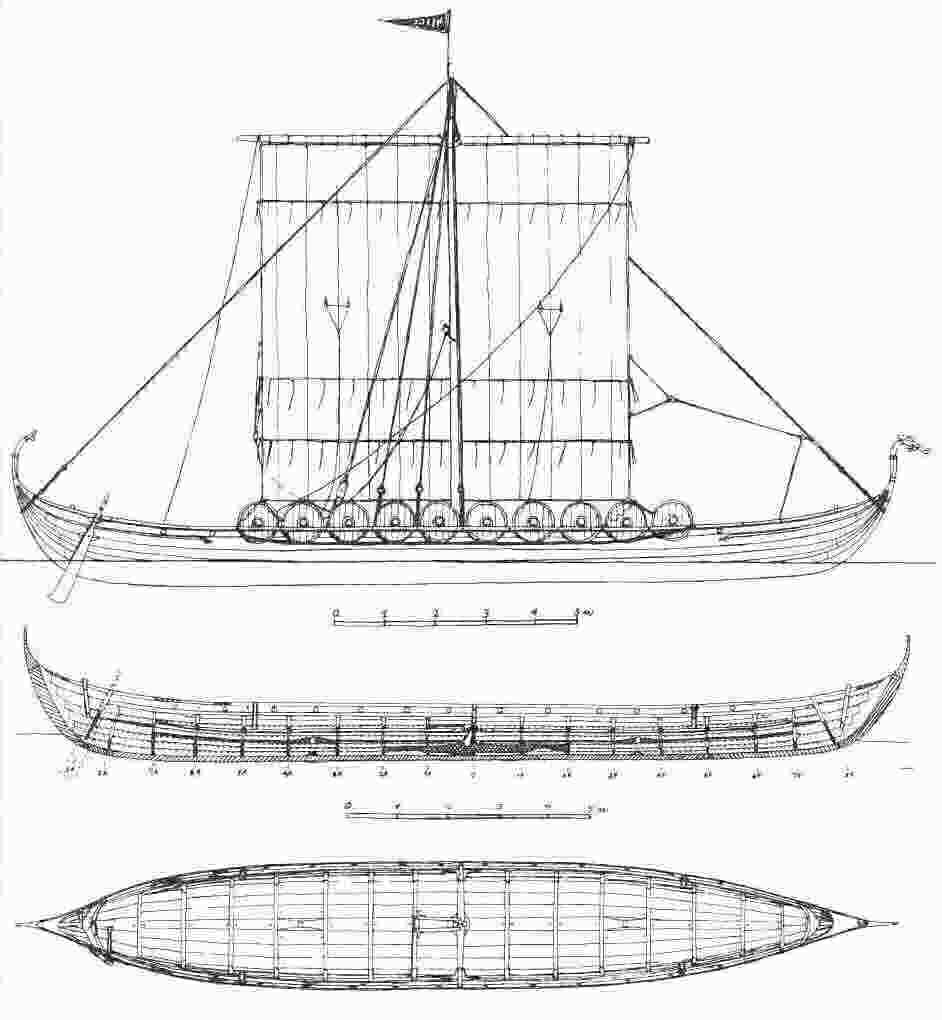
Drawings of a Viking ship

Rope

Rope during the Viking Era was made of bast or hemp.  There may have also been ropes that were made from walrus or seal skins.  For rope, skins were cut in a spiral around the entire creature’s length.  It is suggested that sails were controlled by a reefing method.  Sails may have also been controlled by two ropes attached to the lower corners of the sail.

Filler

Strakes on the vessel were sealed with wool yarn and tar; horse hair may have also been used.  Tar was used to make the vessel more waterproof.  After a period of time being used, the ship had to be re-sealed.

Types

Skuldelev ocean-trader boat

Vessels are classified in different ways and differences are not always clear.  The number of oars defines what a small vessel is; up to 12 oars (one man could take a pair).  Medium vessels were 12 to 32 oars or 12 to 32 rowers (one man per oar).  The large vessels were identified by how many pair rows there were (two men per oar).  There was a lateral space between the seat called a rúm and ships could also be identified this way.

Skuldelev fishing boat

There are different categories of vessels and distinctions are not always clear as well.  The eikja is the simplest kind of boat, a dug-out, and it was often used as a ferry.  A bátr was a ship’s boat.  Skip is the term used for any independent vessel that was not considered to be very large.  Cargo ships were called ferja or byrðingr.  Ocean-going vessels were known as knarr.  Búza and kuggr were names of merchant/trading vessels.  General purpose vessels were called skúta, similar ships might me known as karfi.  A longship/warship of at least 20 benches was known as a snekkja, bigger longships were called a skeið.  But the largest warships were referred to as drekar, which translates as dragons.

Wood detailing of the Oseberg ship

The characteristics of the vessels differ, depending on what they were used for.  The Skuldelev ships show us how different the vessels are.  Cargo ships are usually classified as medium vessels that have a large hold.  Merchant/trading ships may also have a hold, but my not be as necessarily large as cargo ships.  Ocean vessels were stronger than others so that they could withstand the waves and wind.  Longships, or warships, needed to have greater speed and maneuvering abilities. Boats used for everyday things, like fishing, had higher sides than most other vessels.  Some trading ships may have had higher sides as well, to store more goods.  Those vessels that stayed close to land were mostly dependent on rowing only and lacked a keel.  Vessels that belonged to higher ranking individuals were more intricate, the Oseberg vessel is thought to be an example of this.  The Oseberg is intricately carved, which may have belonged to a chieftain.  Other intricate vessels may look like a dragon or have weather vanes that are gilded.

Gokstad Design


Side of the Gokstad ship

The design commonality of Viking vessels is that they were clinker-built; this means that the strakes partially overlapped each other.   Quite a few vessels have been discovered but there are very few that are mostly complete.  This is because most of the vessels were found in peat bogs.  The Oseberg and Gokstad ships are the most complete and best documented.  Examining the Gokstad helps us to understand the construction and skill that went into a vessel.

The Gokstad has been dated to the ninth century and was classified as a general-duties vessel that was capable of being used in raiding or trade.  The Gokstad is 23.3 meters long and estimated to weigh nine tons when empty.  The ship is made of oak and pine.  Overlapping strakes make up the hull and are nailed together and then spruce roots lashed the strakes to the frame.  The lower strakes were attached to the hull with nails and strakes above the water line were attached with wooden pegs to L-shaped knees.  The knees were attached to crossbeams and held the ship together.  The knees also supported the deck which was not nailed down.  The third strake from the gunwale has holes and slats that the oars can pass through.  The strakes were then caulked with the filler mentioned above (in materials).  A bar attached to the gunwale was used to help tie the shields.

Side view of Gokstad ship showing the deck

The mast was sat in a socket were it could be attached to the ribs.  The mast had also been repaired at some point with iron bands.  The mast was movable when desired and was locked in place.  Backstays were common in artwork depicting ships, but a place for one was not found.  The forestay helped to move the mast.  It is assumed that the mast was 10 meters tall to consist of a lighter ship weight as well as a faster ship.  There may have been a rectangular sail of about 11 meters across attached to the sail, with the specifications mentioned above (in materials).

Oseberg ship from the front

A large steering oar was used near the platform of where the helmsman and chief would have been.  The steering oar, used for maneuverability, was attached to the starboard side by a tree root or withy.  The oars were made of pine and were about 5 ½ meters in length, oarsmen had to be seated to use them.  The anchor had a wooden stock with iron flukes.  The deck was mostly clear because that is where individuals slept in tents.  The design made the Gokstad less rigid and lighter than most ships.  The Gokstad could easily reach 10 knots or more.

The Gokstad ship and other artifacts can be seen at the Viking Ship Museum in Oslo, Norway.
Carruthers crest on flag


PRESERVING OUR PAST, RECORDING OUR PRESENT,INFORMING OUR FUTURE

ANCIENT AND  HONORABLE CARRUTHERS CLAN INT SOCIETY CCIS

CARROTHERSCLAN@GMAIL.COM    CARRUTHERSCLAN1@GMAIL.COM

cropped-wider-banner-light-blue-1.jpg

Rick Fehrenbacher

VIKING MUSEUM

CLAN CARRUTHERS INT SOCIETY CCIS HISTORIAN AND GENEALOGIST


You can find us on facebook at :

https://www.facebook.com/carrutherscarrothers.pat.9

https://www.facebook.com/CarruthersClan/

https://www.facebook.com/CarruthersClanLLC

Disclaimer Ancient and Honorable Carruthers Clan International Soci

Sources 

Viking Ship Museum  http://www.vikingeskibsmuseet.dk/index.php?id=1404&L=1

The Viking Answer Lady: Woodworking in the Viking Age  http://http://www.vikinganswerlady.com/wood.shtml

The textiles in the Oseberg ship  http://www.forest.gen.nz/Medieval/articles/Oseberg/textiles/TEXTILE.HTM

The Viking Achievement: The society and culture of early medieval Scandinavia by Peter Foote and David M. Wilson (1990)




DNA Gotland, Gutland / Gotland, OUR ANCESTORS, Uncategorized

CLAN CARRUTHERS-THE BEAST OF GUTLAND/GOTLAND

CLAN CARRUTHERS INT SOCIETY CCIS                    PROMPTUS ET FIDELIS

cropped-wider-banner-light-blue-1.jpg

The Beast of Gotland

beastofgotlandmenHere we start back in Gotland again.

If you do not understand what that means, please read the previous blogs.

Were the men of Gotland considered Beasts?

Oh hell yes!  And they were very nice and very good at it!

We have learned, the unforgettable memory, of these giants of men, ravaging and pillaging all of Europe, and wearing kilts, possibly so they can easily take it off, and fight in the buff.

Did you remember that our ancestors were generally accepted to have originated the  heiti for”men (of the tribe)”, with the literal meaning “they who pour their seed”.  This is one of the oldest mention of men from the same tribe or clan, or family who went off to battle together.

The Killing Beast

The short form of Gautigoths was the Old Norse Gautar, which originally referred to just the inhabitants of Västergötland, or the western parts of today’s Götaland, a meaning which is retained in some Icelandic and Norse sagas.

Beowulf is one of those Norse sagas, along with Gautar and Widsith.   Beowulf and the Norse sagas describe several battles, such as a raid into Frisia, ca 516, which is described in Beowulf, along with the events related in this epic, some described the Geats as a nation which was “bold, and quick to engage in war”.

Not only in the Story of Beowulf were they giants in battle, but the Gotalanders, were making a lot of gold for killing Romans, and protecting Romans.  They were developing a reputation for being quick to the fight!

labro

There remain picture stones of Gotland.  Hundreds of memorial stones were produced from the local limestone, in pre-viking and Viking times, which became richly informative. General themes are easily recognized: ships on a journey, men fighting in battle or defending a house, a warrior being welcomed home or into Valhalla, often by a woman who offers him a drinking horn, stories of gods and heroes.

These stones were the written stories of all the men that were lost, those that came home, and all that fought bravely.

One very interesting stone has been given the name Ardre VIII.   It stands about 7 feet tall, and is round at the top and is broken into different sections that depict some of the stories of battles.  There are two other stones to look into Larbro I, and the Klinte Hunninge.

They might have been Bold, and Quick to engage in war, but they were Ready and Faithful to the Heiti or tribe, they were the Beasts of Gotland.

Beauty and the Beast

The Grimm Brothers wrote many tales. Their tales were the first to be written of the beasts, but were stories orally told over and over again for centuries. Like playing telephone, and the stories change a bit here and there.   The Grimm Fairy tales were a collection of tales and stories told of old. The old monsters and beasts who lived on the land.

These stories were of big monsters, and mean women who ate little children.  Wicked people who were deep in the forest, and took children far away never to be seen from again.  Most of these stories carried through for hundreds of years, all telling of the Beasts of Gotland.

gulliver

Thankfully, along came Walt Disney and romanticized these stories.  Cinderella, Snow White and Hansel and Gretel. Well, Walt Disney did tame the beast and made the stories easier to experience than the Grimms Tales, but there are scenes in each one that can have us sitting on the edge of the chair. All stories of the terrible beasts that were from Gotland.  Finally, a good story about the beasts, Beauty and the Beast, and let us not forget Gulliver’s Travels.

The Beast become a Symbol 

gotlandwood

Our ancestors were experts in carving in wood and the beast is designed into many of their stylings.

They were the shipbuilders for most of Europe, but their own ships were decorated with beautiful hand carvings, most of which were that of beasts. Sometimes a different beast was used for a group of ships leaving for one war, or one battle.  Similar to a team of players all wearing the same ship and design.

beastofgotlandship

And of course, as early as 200 – 300 A.C.E. runic inscriptions are found on memorial stones and jewelry as well. These ancestors came through the stone age, the bronze age, the iron age and such, and their designs of the beasts come through their designs of jewelry.  One of my favorite of these rune memorial stones is found at Lund, and shows Hyrokkin riding on her wolf, and includes the wonderful serpent reins that she used to control the great beast.

hyroken

Viking Art has become very popular, and there are many different types of Viking Art, but the Urnes style has lasted through out the centuries.  You can see the BEAST, a symbol actually representing all the generations of Gotlanders who fought bravely for home, and yes for gold, but most importantly for their family in many works today.

beastofgotland

Every year in August, the people of Gotland dress in pre-viking and Viking garb, and you will see the flag of The Beast of Gotland, flying proudly throughout their villages.

Carruthers crest on flag-v2 (1)

OFFICIAL AND REGISTEREDL CLAN CARRUTHERS CCIS SINCE 1983-CLAN OF OUR ANCESTORS

SCOTTISH CLAN – IRISH CLAN – NORSE CLAN

Kingof the Goths, or Gutland

Preserving Our Past!    Recording Our Present!  Informing Our Future!

The Ancient and Honorable Carruthers Clan International Society LLC

carruthersclan1@gmail.com                carrothersclan@gmail.com

cropped-wider-banner-light-blue-1.jpg

CLAN CARRUTHERS INT SOCIETY CCIS HISTORIAN AND GENEALOGIST

You can find us on our main facebook pages at :

SILVER WINGS-https://www.facebook.com/CarruthersClanLLC/

GOLD WINGS – https://www.facebook.com/carrutherscarrothers.pat.9

CLAN CARRUTHERS FAMILY HISTORY – https://www.facebook.com/CarruthersClan

CLAN CARRUTHERS CCIS – https://www.facebook.com/groups/3878691252182714

CLAN CARRUTHERS INT SOCIETY- https://www.facebook.com/groups/394653845137709

CLAN CARRUTHERS – BORDER REIVERS – https://www.facebook.com/groups/434959914239094

Disclaimer Ancient and Honorable Carruthers Clan International Societ
DNA Gotland, Gutland / Gotland, Uncategorized

HAPLOGROUP l1 (YDNA) YOU ARE A VIKING!- CLAN CARRUTHERS CCIS

WIDE BANNER with NEW CREST

HAPLOGROUP l1

( YDNA)

ORIGINS AND HISTORY

IF YOU ARE A CARRUTHERS YOU ARE IN THE HAPLOGROUP l1 GROUP

IF YOU ARE IN THE HAPLOGROUP l1 YOU ARE A VIKING

GEOGRAPHIC DISTRIBUTION MAP

download (8)

Distribution of haplogroup I1 in Europe
Haplogroup I1 is the most common I subclade in northern Europe. It is found mostly in Scandinavia and Finland, where it typically represent over 35% of the male Y-chromosomes. Associated with the Norse ethnicity, I1 is found in all places
invaded by ancient Germanic tribes and the Vikings. Other parts of Europe speaking Germanic languages come next in frequency. Germany, Austria, the Low Countries, England and the Scottish Lowlands all have between 10% and 20% of I1 lineages.

Haplogroup I is the oldest major haplogroup in Europe and in all probability the only one that originated there (apart from very minor haplogroups like C6 and deep subclades of other haplogroups).

It is thought to have arrived from the Middle East as haplogroup IJ sometime between 45,000 and 50,000 years ago, and developed into haplogroup I approximately 40,000
years ago.

It has now been confirmed by ancient DNA test that Cro-Magnons, the first Homo sapiens to colonize Europe 45,000 years ago, belonged to haplogroups BT, CT, C, F, IJ and I.
The I1 branch is estimated to have split away from the rest of haplogroup I some 27,000 years ago. I1 is defined by over 300 unique mutations, which indicates that this lineage experienced a serious population bottleneck. Most of the Late Glacial and Mesolithic remains tested to date belonged to haplogroup I* or I2. It is not yet clear in which part of Europe I1 originated.

( THE CARRUTHERS BEING IN THE HAPLOGROUP l1, KNOW THAT THEY WERE IN THE HAPLOGROUP 1 PRIOR TO THAT, MORE THAN 30,000 YEARS.  )

It has been speculated that I1 evolved in isolation in Scandinavia during the late Upper Paleolithic and Mesolithic periods, when hunter-gatherers from southern Europe recolonised the northern half of the continent from their LGM refugia. The oldest attested evidence of postglacial resettlement of Scandinavia dates from 11,000 BCE with the appearance of the Ahrensburg culture .

However, five Y-DNA samples from Mesolithic Sweden, dating from c. 5800 to 5000 BCE and tested by Lazaridis et al. 2013 and Haak et al. 2015 all turned out to belong to haplogroup I2.
The earliest sign of haplogroup I1 emerged from the testing of Early Neolithic Y-DNA from western Hungary (SzécsényiNagy et al. 2014 ). A single I1 sample was identified alongside a G2a2b sample, both from the early Linear Pottery (LBK) culture , which would later diffuse the new agricultural lifestyle to most of Poland, Germany and the Low Countries. This means that haplogroup I1 was present in central Europe at the time of the Neolithic expansion.

( THE FIRST CARRUTHERS DNA STUDY WAS INSTRUMENTAL IN MATCHING US (CARRUTHERS) TO THE EARLY NEOLITHIC Y-DNA STUDY FROM WESTERN HUNGARY. THE NEOLITHIS REVOLUTION WAS ALSO CALLED THE FIRST AGRICULTURAL PERIOD, WHEN MANY OF OUR ANCESTORS WENT FROM HUNTERS-GATHERERS TO FARMERS. )

download (2)

LINEAR POTTERY CULTURE 5600-4025 BCE

It is therefore possible that I1 lineages were among the Mesolithic European hunter-gatherers assimilated by the wave of East Mediterranean Neolithic farmers (represented chiefly by Y-haplogroup G2a).

There is also evidence from the Neolithic samples of the Early Neolithic Starčevo and Cardium Pottery cultures that haplogroup I2a lived alongside G2a farmers both in south-east and south-west Europe.
The most likely hypothesis at present is that I1 and I2 lineages were dispersed around Europe during the Mesolithic, and that some branches prospered more than others thanks to an early adoption of agriculture upon contact with the Near Eastern
farmers who were slowly making their way across the Balkans and the Mediterranean shores.

The small group of farmers from the early LBK culture from Hungary might have formed a blend of I1 and G2a men. Yet distinct families would have
spread in different directions and met varying successes in their expansion. It would appear that a founder effect in the northern LBK population led to a sudden explosion of I1 lineages, perhaps in part thanks to their better knowledge of the Central European terrain and fauna (since hunting was typically practised side by side to agriculture to complement the farmers’ diet). I1 would later have spread to Scandinavia from northern Germany.

( CARRUTHERS ANCESTORS WERE PAID TO FIGHT.  SOMETIMES THEY FOUGHT WITH THE ROMANS, AND SOMETIMES AGAINST.  THESE ARE THE MEN WHO ARE ACCREDITED WITH SPREADING THEIR DNA ACROSS EUROPE)

This data is consistent with a Neolithic dispersal of I1 from Hungary with the LBK culture and the subsequent Funnelbeaker culture (4000-2700 BCE) in northern Germany and southern Scandinavia. One Swedish sample from the late Mesolithic
Pitted Ware culture (3200-2300 BCE) also turned out to belong to I2a1 and not I1.

download (10) FUNNELBEAKER CULTURE MAP

Both the Funnelbeaker and Pitted Ware cultures represent a merger between the Neolithic (farming) and Mesolithic (huntergatherer) lifestyles. Neolithic farmers from Germany penetrated late into Scandinavia and in small numbers.

There is archeological evidence that Neolithic farmers settled in southern Scandinavia and lived side by side with hunter-gatherers for several centuries during the Funnelbeaker culture. Skoglund et al. 2012 tested and compared the DNA of one Neolithic farmer and three hunter-gatherers from Sweden dating from 5,000 years ago. It turned out that the farmer was much closer genetically to modern Mediterranean people, especially the Sardinians, who are generally considered the best proxy population to Neolithic European farmers. The hunter-gatherers’s DNA resembled that of modern Northeast Europeans, and perhaps even more that of the Finns and Samis than Scandinavians.

( MANY MIGHT GET A L300 RESULT ON THEIR DNA.  PRIOR TO THE CARRUTHERS COMING FROM GUTLAND/GOTLAND, MANY LIVED IN FINLAND.)
Scandinavian hunter-gatherers ( CARRUTHERS IN GUTLAND) would have adopted the new Neolithic lifestyle little by little, using pottery and keeping domesticated animals (sheep, cattle, pigs and goats) to complement their traditional diet of fishing and game hunting. The cultivation of wheat, barley and legumes was fairly limited due to the cold climate. The cold climate was actually a barrier to the expansion of farmers from the continent. This is why Scandinavians retained a greater percentage of Mesolithic ancestry than virtually all other Europeans, apart from the Samis, Finns, Balts and Russians.
No ancient Y-DNA from the Funnelbeaker culture in Scandinavia has been tested to date, but it is likely that I1 really started gathering momentum toward the end of the Funnelbeaker period. It might also have been among the Funnelbeaker lineages
that were most successfully assimilated by Proto-Indo-European invaders during the Corded Ware culture (aka Battle-Axe culture in Scandinavia).

Most I1 individuals today share a common ancestor around the time of the transition between the Funnelbeaker and Corded Ware periods.


Carruthers crest on flag-v2 (1)


OFFICIAL AND REGISTEREDL CLAN CARRUTHERS CCIS SINCE 1983-CLAN OF OUR ANCESTORS

SCOTTISH CLAN – IRISH CLAN – NORSE CLAN


Preserving Our Past!    Recording Our Present!  Informing Our Future!

The Ancient and Honorable Carruthers Clan International Society LLC

carruthersclan1@gmail.com                carrothersclan@gmail.com

coacarrutehrs

MACIAMO HAY

EUPEDIA

CLAN CARRUTHERS INT SOCIETY CCIS HISTORIAN AND GENEALOGIST


New Blog Banner 05

You can find us on our main facebook pages at :

SILVER WINGS-https://www.facebook.com/CarruthersClanLLC/

GOLD WINGS – https://www.facebook.com/carrutherscarrothers.pat.9

CLAN CARRUTHERS FAMILY HISTORY – https://www.facebook.com/CarruthersClan

CLAN CARRUTHERS CCIS – https://www.facebook.com/groups/3878691252182714

CLAN CARRUTHERS INT SOCIETY- https://www.facebook.com/groups/394653845137709

CLAN CARRUTHERS – BORDER REIVERS – https://www.facebook.com/groups/434959914239094

Disclaimer Ancient and Honorable Carruthers Clan International Soci


The Viking Age, Uncategorized

CLAN CARRUTHERS – VIKING BOAT BURIAL

cropped-wide-banner-with-new-crest.jpg

VIKING BOAT BURIAL REVEALS ITS SECRETS

Six years after discovering and excavating the first Viking boat burial site discovered on the UK mainland, archaeologists have provided a glimpse into some of the mysteries this rare burial reveals.

Originally unearthed in 2011, the site in Swordle Bay, Scotland, was the first undisturbed Viking boat burial found on the UK mainland. After six years of work, Ardnamurchan Transitions Project’s findings were recently released in an in-depth report in the Journal of Antiquity, revealing, among other things, the growing relationship between Scotland and the Viking world at that time.

Post-excavation photograph of the burial site. (Credit: Antiquity Publications Ltd, 2017)

Post-excavation photograph of the burial site. (Credit: Antiquity Publications Ltd, 2017)

Viking boat burials themselves were extremely rare. Only practiced for the deaths of prominent individuals, the ritual used a boat as a coffin for the body and burial goods. Discovered under a low-lying natural mound close to the shore, this particular site was small, measuring approximately 17 feet by 5 feet, and thought to have contained a row boat that was accompanying a larger ship.

Other artifacts from the burial site. The sword (top); the sword in situ (below); the mineralized textile remains (right); detail of the decoration after conservation (left). (Credit: Pieta Greaves/AOC Archaeology).

Other artifacts from the burial site. The sword (top); the sword in situ (below); the mineralized textile remains (right); detail of the decoration after conservation (left). (Credit: Pieta Greaves/AOC Archaeology).

After excavating the site, archaeologists were able to reconstruct the steps of the burial. A boat-shaped depression was first dug into a natural mound of beach shingle. The boat was then inserted into the ground, and the body was placed inside, along with the grave goods. Stones were place inside and around the boat. As part of the closing of the site, a spear and shield boss (the round or convex piece of material at the center of a shield) were deliberately broken and deposited.

Pre-excavation photograph after initial cleaning. (Credit: Antiquity Publications Ltd, 2017)

Pre-excavation photograph after initial cleaning. (Credit: Antiquity Publications Ltd, 2017)

The ship, along with the human remains, decayed in the acidic soil long ago, but the grave artifacts remained, offering a glimpse into the possible origins of the deceased as well as the reach of Viking culture. A single copper alloy-ringed pin with three bosses—a style found in Ireland—was also found, believed to have originally been fastened to a burial coat. There was also a copper alloy drinking horn, thought to be Scandinavian in origin. Other grave goods included a sword, an axe, a sickle (found mostly in Scotland), a whetstone (probably Norwegian), flint strike-a-lights and two teeth—molars from only identified human remains. Hundreds of metal rivets that once held the vessel together, some with wood shards, were also discovered.


The Viking's teeth. (Credit: Antiquity Publications Ltd, 2017)

The Viking’s teeth. (Credit: Antiquity Publications Ltd, 2017)

An isotopic analysis of the teeth (the lower left first and second molars) revealed further information. The individual likely lived on, or close to, the coast, as indicated by an increase in consumption of marine proteins between the ages of 3 and 5. While marine protein was rarely consumed by humans in Britain, it was popular in Viking-era Norway. Further analysis of the teeth narrowed down the place of origin to eastern Ireland, northeastern mainland Scotland, Norway or Sweden.

The weapons included in the burial point to a warrior status and the artifacts and their internment infer high status, but the gender cannot be confirmed. While it is likely a male burial, some of the goods, such as the sickle, are more commonly associated with females. Current Viking’s scholarship points to a number (albeit smaller) of female warriors, as well as the discoveries and excavations of female boat burials.

 Some of the artifacts recovered from the burial site (clockwise from the top left): broad-bladed axe, shield boss, ringed pin and the hammer and tongs (Credit: Pieta Greaves/AOC Archaeology).

Some of the artifacts recovered from the burial site (clockwise from the top left): broad-bladed axe, shield boss, ringed pin and the hammer and tongs (Credit: Pieta Greaves/AOC Archaeology).

While there is still more to learn from this rare burial site, an important finding was revealed in the variety of grave goods from multiple geographic locations: The growing relationship between Scotland and the Viking world at that time.

Carruthers crest on flag-v2 (1)

Perserving the Past, Recording the Present, Informing the Future

Ancient and Honorable Carruthers Clan Int Society 

carruthersclan1@gmail.com     carrothersclan@gmail.com

cropped-wide-banner-with-new-crest.jpg

LISA JOHNSON – HISTORY CHANNEL

CLAN CARRUTHERS INT SOCIETY CCIS HISTORIAN AND GENEALOGIST

You can find us on facebook at :

https://www.facebook.com/carrutherscarrothers.pat.9

https://www.facebook.com/CarruthersClan/

https://www.facebook.com/CarruthersClanLLC

Disclaimer Ancient and Honorable Carruthers Clan International Society
DNA Gotland, Gutland / Gotland, OUR ANCESTORS, The History of Gutland, Uncategorized

ERIC II (KING OF NORWAY) MAGNUSSON DE NORWAY (NORGE) CLAN CARRUTHERS CCIS

WIDE BANNER with NEW CREST

Eric Magnusson (1268 – 15 July 1299) (Old Norse: Eiríkr Magnússon; Norwegian: Eirik Magnusson) was the King of Norway from 1280 until 1299. CARRUTHERS DNA ANCESTOR

Eirik was the eldest surviving son of King Magnus the Lawmender of Norway, and his wife Ingeborg Eriksdatter, daughter of King Eric IV of Denmark. In 1273, when he was 5 years old, he was given the title of king, alongside his father, who planned to hold a coronation for Eirik as his subordinate co-ruler in the summer of 1280. However, King Magnus died before this could be arranged, and Eirik became sole king and was crowned as such in Bergen in the summer of 1280. During his minority, the kingdom was ruled by a royal council consisting of prominent barons and probably also his mother, the dowager queen Ingeborg. After Eirik came of age in 1282, this royal council is still thought to have had a major influence over his reign. [2] His brother, Haakon, was in 1273 given the title “Duke of Norway”, and from 1280 ruled a large area around Oslo in Eastern Norway and Stavanger in the southwest, subordinate to King Eirik. The king’s main residence was in Bergen in Western Norway. [2]

Eirik married princess Margaret of Scotland, (Carruthers DNA Ancestor) daughter of King Alexander III (Carruthers DNA Ancestor) of Scotland in Bergen in 1281.   Margaret died two years later in childbirth, giving birth to Margaret, Maid of Norway, who was to be Queen of Scotland, but she died in 1290. Her death sparked the disputed succession which led to the Wars of Scottish Independence. [3] Eirik briefly and unsuccessfully laid claim to the Scottish crown as inheritance from his daughter. [2]

Eirik later married Isabel Bruce, ( Carruthers DNA Ancestor ) sister of King Robert I of Scotland. ( Carruthers DNA Ancestor) Isabel was one of the Bruce Women who were kept in cages for several years.  When Isabel was released Erik went and brought her to Norway.  Their marriage did not produce a surviving male heir, though it did produce a daughter, Ingeborg Eriksdottir of Norway, who married Valdemar Magnusson of Sweden, Duke of Finland, in 1312. Ingeborg Eriksdotter was styled Duchess of Öland. [4]

Reign

Kong Eirik Magnusson PI IX 1.jpg Kong Eirik Magnusson PI IX 2.jpg Seal of Eric in known use 1289–98, with obverse (left) and reverse (right).
A prominent feature of Eirik’s reign was the war with Denmark, called the War of the Outlaws (De fredløses krig), which was waged on and off from 1289 until 1295. A major motivation for this warfare was Eirik’s claim on his mother’s Danish inheritance. In 1287, he entered into an alliance with a group of Danish nobles, most prominently Jacob Nielsen, Count of Halland and Stig Andersen Hvide, who were outlawed in Denmark for allegedly murdering the Danish king Eric V. Eirik gave the outlaws sanctuary in Norway in 1287. King Eirik himself led a large Norwegian fleet which, along with the Danish outlaws, attacked Denmark in 1289, burning Elsinore and threatening Copenhagen. Renewed naval attacks on Denmark were made in 1290 and 1293, before peace was made in 1295. [5]

Eirik received the nickname “Priest Hater” from his unsuccessful relations with the church.

As Eirik died without sons, he was succeeded by his brother, as Haakon V of Norway. He was buried in the old cathedral of Bergen, which was demolished in 1531. Its site is marked by a memorial, in present-day Bergenhus Fortress. [6] [7]

Name in native language Eiríkr II prestahatari Magnússon
Date of birth 4 October 1268
Norway
Date of death 15 July 1299
Bergen
Place of burial
  • Bergen Cathedral
Country of citizenship
  • Norway
Occupation
  • sovereign
Position held
  • Monarch of Norway (1280–1299)
Family
  • House of Sverre
Father
  • Magnus VI of Norway
Mother
  • Ingeborg of Denmark, Queen of Norway
Sibling
  • Haakon V of Norway
Child
  • Margaret, Maid of Norway
  • Ingeborg Eriksdottir of Norway
Spouse
  • Margaret of Scotland (1281–)
  • Isabel Bruce

Carruthers crest on flag-v2 (1)

OFFICIAL AND REGISTEREDL CLAN CARRUTHERS CCIS SINCE 1983-CLAN OF OUR ANCESTORS

SCOTTISH CLAN – IRISH CLAN – NORSE CLAN

Preserving Our Past!    Recording Our Present!  Informing Our Future!

The Ancient and Honorable CLAN CARRUTHERS CCIS

CLANCARRUTHERS1@GMAIL.COM

cropped-wide-banner-with-new-crest.jpg

CLAN CARRUTHERS  CCIS HISTORIAN AND GENEALOGIST

You can find us on our main facebook pages at :

SILVER WINGS-https://www.facebook.com/CarruthersClanLLC/

GOLD WINGS – https://www.facebook.com/carrutherscarrothers.pat.9

CLAN CARRUTHERS FAMILY HISTORY – https://www.facebook.com/CarruthersClan

CLAN CARRUTHERS CCIS – https://www.facebook.com/groups/3878691252182714

CLAN CARRUTHERS INT SOCIETY- https://www.facebook.com/groups/394653845137709

CLAN CARRUTHERS – BORDER REIVERS – https://www.facebook.com/groups/434959914239094

Disclaimer Ancient and Honorable Carruthers Clan International Socie

References

  1. ↑ Lillehammer, Grete, et al. (1995) Museoteket ved Arkeologisk museum i Stavanger: Rogalandsfunn fra istid til middelalder, p. 108
  2. Narve Bjørgo, “Eirik Magnusson” in Norsk biografisk leksikon vol. II, (Oslo, 2000), pp. 436-437
  3. ↑ Margrete Eiriksdotter (Store norske leksikon)
  4. ↑ Isabella Bruce (Store norske leksikon)
  5. ↑ Tor Einar Fagerland, Krig og diplomati i nordisk middelalder (Oslo, 2002) pp. 82-96
  6. ↑ Eirik Magnusson (Store norske leksikon)
  7. ↑ Eirik Magnusson 1280-1299 (Eirik Magnussons mynthistorie)