OUR ANCESTORS, The Viking Age, Uncategorized

WHEN ENGLAND WAS PART OF A VIKING EMPIRE – CLAN CARRUTHERS CCIS

cropped-wide-banner-with-new-crestnorse

WHEN ENGLAND WAS PART OF A VIKING EMPIRE


EVERY PERSON YOU READ ABOUT IS A CARRUTHERS ANCESTOR, INCLUDING WINSTON CHURCHILL IN THE SOURCES


The Saga of Ragnar Lothbrok refers to London as “the finest city in Scandinavia.”  This seems like quite a mistake, considering London is the capital of England and sits on the east coast of Britain.  However for the skalds who composed the old saga, London was indeed in Scandinavia, for England was once part of a Viking empire. 

This part of English history is almost always glossed over or simply not mentioned at all. The tidier narrative is that Vikings invaded Britain in the 9th century, quickly knocked down most of the Anglo-Saxon kingdoms, but were eventually halted by the founder of England, Alfred the Great.  Most history books are silent on what happens after that, before picking up the national story with the Norman Conquest in 1066.

But the whole story is a great deal more complicated.  England was indeed a part of a large North Sea Empire founded by Vikings long after Alfred’s death.  This does not diminish the accomplishments of Alfred and the English. Instead, the whole story helps us to appreciate how complex the reality of England is.  Read on, and it will soon all make more sense.


Back Story: The Great Army, Alfred, and their Legacy

A massive host of Vikings descended upon the kingdoms of Britain around the year 865.  According to the sagas, this army was led by the sons of Ragnar Lothbrok, seeking revenge for their father, who had been executed in a pit of vipers.  The historical and archaeological records do not commit to the saga narrative. Still, they state the Great Army was made up of Vikings from all over the north, who were suddenly united under tremendously effective leadership, and were remarkably successful.

To make a very long story short, the young ruler of the last Anglo-Saxon kingdom, Alfred of Wessex, stopped the Vikings and forced them into a lasting truce.  A border or “DMZ” was marked at the old Roman road, then known as Wattling Street.  The Vikings got the northeast of Britain, and the Anglo-Saxons got the southwest.

More waves of Vikings would try their luck at taking the whole of Britain, and Alfred would spend the rest of his days trying to make his enlarged kingdom Viking-proof.  His efforts to unify and defend his people earned him the title Alfred the Great.

After Alfred’s death, his son, Edward, and his daughter, Aethelflaed, worked to retake much of the land lost to the Vikings.  It would not be until the time of Alfred’s grandson, Aethelstan I, that the Vikings would be decisively defeated.  The borders of England were set to more-or-less their current form at the Battle of Brunanburh (937).  This is often thought of as the birth of a bona fide English nation.

This is not to say that all the Vikings in England just got up and left.  The northeast of Britain had become (and in some ways continues to be) distinctly Danish in character. Though these descendants of Vikings were more prone to farming than raiding, they still retained much of their culture and identity.  Viking Sea Kings like Erik Bloodaxe, Sihtric One-eyed, and Olaf the Shoe (Amlaíb Cuarán) often ruled their domains from York.  Essentially, the north was still Viking … and English at the same time.


Aethelred the Unready

Aethelstan, the grandson of Alfred and the hero of Brunanburh, only knew two years of peace after that great battle.  He died young around 939 and left his newly unified kingdom to his brother.  A few successful rulers followed, but a few decades later (978), a young king named Aethelred II came to the throne.  Aethelred (or Ethelred) was nowhere near the ruler his predecessors had been and was known even in his own time as Aethelred the Unready (also known as Ethelred II or Aethelred the Un-counseled).

Smelling weakness, the Vikings, Scotts, and Irish again began raiding England.  But while King Alfred had been ready to use arms, diplomacy, and Danegeld (bribes) to manage the Vikings, Aethelred only threw money at the problem.  Under Aethelred, the English paid vast quantities of silver to the Vikings, but so ineffective was Aethelred’s leadership that he sometimes broke the treaties this silver bought. 

In a final act of weakness, Aethelred the Unready ordered a massacre of all the Danes that could be caught, whether they be Viking marauders, traders, or even settlers.  This atrocity took place on Saint Brice’s Day, 1002.

Recently, archaeologists have found mass graves in Weymouth and Oxford dated to 975-1025.  Each contains the skeletal remains of up to 50 decapitated Vikings.  DNA analysis of these remains reveals that the victims were from Scandinavia, Iceland, Russia, and the Baltic.  The term “Danes” in English sources, as always, is a catch-all term for Vikings.  It is possible that these mass graves date to the Saint Brice’s Day massacre of 1002.  If so, it is likely but one of many others that lay undiscovered.

Aethelred’s bad decisions were compounding, though.  One of the massacre victims was a woman named Gunnhild, the wife of a Danish chief and the sister of none other than Svein Forkbeard. Of course, Vikings would never ignore such a brazen and cowardly act.  The murder of Svein’s own sister made retaliation inevitable. 

Sweyn Forkbeard: Warrior, King, and Slayer of Harald Bluetooth – BaviPower

Svein (Sweyn) Forkbeard

In the mid-tenth century, much of Denmark, Norway, and Sweden, were united by the great king, Harald Bluetooth.  Yes, this is the same Harald Bluetooth that Bluetooth technology is named for. However, Harald’s estranged son, Svein Forkbeard, led an open rebellion against his heavy-handed father starting in the late 970s.  Harald died or was killed sometime during that civil war.  After that, Svein became King of Denmark, though Norway and Sweden had already taken advantage of the instability and went their own way.

Svein Forkbeard was a powerful and charismatic leader who had already proved himself highly skilled in war.  Whether to take advantage of England’s disarray, avenge his people’s slaying, or both, Svein launched a series of attacks on England starting in 1004.  These culminated in a full-scale invasion of England in 1013.

The Vikings landed in the center and swept north, using the support of the entrenched Danish population there to quickly secure the area.  They then turned their attention to the wealthy southwest and the seat of Anglo-Saxon power.

 The dramatic conclusion of Svein’s invasion took place in London in the winter of 1013-1014. Svein Forkbeard’s forces assailed an English army supported by Viking mercenaries under Svein’s former ally, Thorkell the Tall.  This battle was the likely origin of the children’s nursery rhyme, “London Bridges Falling Down,” for the fortified bridges of London (like Paris before it) were crucial for resisting the Viking longships.  And yes, some elements of our collective culture really are that old (and older).

Svein Forkbeard won the day.  Aethelred the Unready fled to his wife’s family in Normandy.  Svein was crowned king, and for that brief moment, held England and Denmark along with parts of Norway and Sweden.  Svein Forkbeard was the most powerful man west of Byzantium.  He was no longer just a king … he was an emperor.

But life is uncertain, and this was especially true for the 11th century.  Svein only reigned in England for about five weeks before he suddenly died.  The English immediately recalled Aethelred the Unready (supporting his revered dynasty more so than the man who had so often failed them).  The reinvigorated English drove Svein’s son, Knut (or Canute), back to Denmark. 

The Vikings were not so easily scared off from what had been one of their most significant accomplishments, and Knut re-invaded England in 1015.  Aethelred also soon died and was replaced by his dynamic son, Edmund Ironside. 

Who was Canute, the viking who ruled England

Knut the Great


Edmund Ironside was a great warrior, charismatic leader, and heroic king.  But fate was not on his side, and he was up against one of the most successful Vikings of all time.  Knut scored a decisive victory over Edmund’s English in 1016, and the scion of Alfred died of wounds he sustained in that battle.

For the second time in two years, the crown of a united England was in the hands of a Viking. To underscore his legitimacy and emphasize that he was there to stay, Knut married Aethelred’s widow, Emma of Normandy. This move (bizarre and grim to the modern eye) was a 10th-11th century convention, with examples from Ireland to Russia.  The marriage of Knut to Emma was also to prove fateful.  It was partially on the grounds of this union that William the Conqueror would base his claim to the English throne half a century later.   

Circumstances continued to favor Knut.  Norway and other lands his father Svein had once controlled soon fell under his dominion, mainly through peaceful means.  His reign was long (almost 20 years), relatively tranquil, and prosperous. The effectiveness of Knut’s rule was even more evident by the disarray of the rest of western Europe at that time.  The death of Brian Boru in Ireland (1014) and the feebleness of the Capetian dynasty in France meant that Knut was almost peerless.  As his boundaries extended and his peace continued, he became known as Knut the Great.  Knut ruled his North Sea Empire primarily from England through it all, continuously presenting himself as “a true Christian monarch in the European style” (Price, 2020, p. 472).  His English and Norwegian subjects probably never loved him. Still, they eagerly accepted the stability he brought and the goodwill he was always eager to display.  


The Legacy of Knut the Great

Knut died in 1035.  He left several sons, including his successor by Emma, Harthacanute. Unfortunately, Knut’s heirs could not match their father’s political or military ability. As a result, the North Sea Empire quickly fell apart. Nevertheless, the urgency to rebuild it would serve as an impetus for many ambitious men over the following decades.  In 1066, both William the Conqueror and Harald Hardrada probably saw themselves as the heir to this tradition of a unified northwestern Europe.  

As for Knut’s memory, sources differ dramatically.  Almost everything from Knut’s lifetime is favorable (though much of it is deliberate propaganda, perhaps). In England, he was considered a good king, a patron of the Church, a generous and wise man, a lawgiver, and a law follower.  We are told Knut even disbanded his Viking bodyguard, entrusting himself to his English subjects. 

In Norse sources, such as the Heimskringla, a fuller picture emerges, with Knut displaying cunning, violence, and vindictiveness characteristic of the most ruthless rulers.  Later English folk tradition – perhaps embarrassed that their proud nation was dominated by a foreigner – turned on the man altogether.  They portray him in ridiculous tales recycled from old stories of Rome’s hated emperor, Caligula.  One of these paints Knut as a mad king, standing on the beach and commanding the waves not to roll up on shore. 

More often, though, Knut the Great is forgotten entirely – a footnote on the wrong side of history.  The legacy of a Viking England exists more in the fine print: for example, in Shakespeare’s Hamlet when the Danish prince is sent to England to “collect our long-neglected tribute.”

As Knut is connected to the foundations for 1066, he is a part of all of England’s remarkable history since that time.  Moreover, the legacy of the Vikings in England would prove to be inseparable from the nation itself.  Winston Churchill would later remark on the many contributions to England’s laws, legislature, industry, warfare, and its very personality that the Viking settlers would perpetually contribute.  He wrote, “the tribulations of [the years] had not reduced the strength of their original character, nor their attachment to the conquered soil.  All through English history, this strain plays a gleaming part” (1956, p. 111).  


Carruthers crest on flag-v2 (1)

OFFICIAL AND REGISTEREDL CLAN CARRUTHERS CCIS SINCE 1983-CLAN OF OUR ANCESTORS

SCOTTISH CLAN – IRISH CLAN – NORSE CLAN

Preserving Our Past!    Recording Our Present!  Informing Our Future!

The Ancient and Honorable Carruthers Clan CCIS

CLANCARRUTHERS1@GMAIL.COM

WIDE BANNER with NEW CREST


CLAN CARRUTHERS INT SOCIETY CCIS HISTORIAN AND GENEALOGIST


You can find us on our main facebook pages at :

SILVER WINGS-https://www.facebook.com/CarruthersClanLLC/

GOLD WINGS – https://www.facebook.com/carrutherscarrothers.pat.9

CLAN CARRUTHERS FAMILY HISTORY – https://www.facebook.com/CarruthersClan

CLAN CARRUTHERS CCIS – https://www.facebook.com/groups/3878691252182714

CLAN CARRUTHERS INT SOCIETY- https://www.facebook.com/groups/394653845137709

CLAN CARRUTHERS – BORDER REIVERS – https://www.facebook.com/groups/434959914239094

Disclaimer Ancient and Honorable Carruthers Clan International Socie

References

  1. Sir Winston Churchill. A History of the English Speaking Peoples: Book 1, the Birth of Britain. Reprint by Barnes and Noble. USA. 1993.
  2. Rodgers, D. & Noer, K. Sons of Vikings. KDP. The United States. 2018.
  3. Price, N. Children of Ash and Elm: A History of the Vikings. Basic Books, New York, 2020.


Gutland / Gotland, OUR ANCESTORS, The Viking Age, Uncategorized

DANI,ANI,SWITHEUDI,THURINGI AND AESIRS – CLAN CARRUTHERS CCIS

cropped-wide-banner-with-new-crestnorse

Dani, Switheudi, Thuringi and Aesirs

Dani, Switheudi, Thuringi and Aser

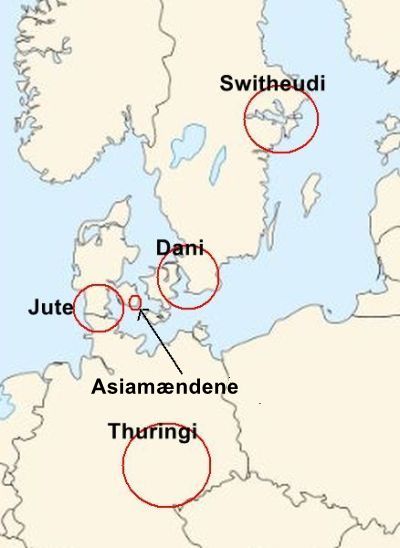
Dani, Switheudi, Thuringi and Aesirs were in all probability four groups of related people, who originally came from Asia, few in numbers.

At Tryggevælde Å (river) near Himlingøje, Valløby and Varpelev in Eastern Sjælland a number of large burial mounds have been excavated and many objects that differ significantly from the contemporary Iron Age culture’s other findings have been found. In addition, mound funerals had not been seen in Scandinavia since the first half of the Bronze Age; they were a marked break in tradition. These mounds are dated to around 200 AD, and one may assume that the represent Dani. One can imagine that they first arrived in Scania and drove the Heruls away from there. That could have taken place around 200 – 300 AD or even later.

Noble men and women have for generations been buried in large burial mounds at the Tryggevælde River with treasures such as unique silver cups, neck rings, pearl necklaces, game pieces and Roman-made cups and glass drinking horns and much more – but no weapons. Around the mounds have been found their servants and service people in more modest graves – with few or no grave goods.

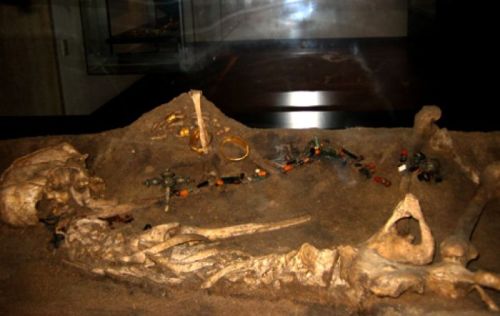
Women's tomb from Himlingøje from around 200 AD. In front of the woman are seen gold jewelry and her long necklace

Women’s tomb from Himlingøje from around 200 AD found in 1949 and exhibited in the National Museum. In front of the woman are seen her gold jewelry and a long necklace with different colored beads. – Photo: Kulturjagt i Køge Bugt.

There have been noted a striking similarity between the graves at the Tryggevælde River and graves and grave goods in Thuringen and southern Saxony from the same time. It is also suggested that the Danish -lev in village names is connected to -leben in village names in Thuringen. It’s pretty likely that Dani and Thuringi were related people.

If Switheudi and Dani were of the same descent, and Dani and Thuringi were closely related peoples so all three people have been related. It is somewhat unsatisfactory for this theory that Jordanes also mentions Sweans, which are of a different race. The author has no certain knowledge, but he believes that Switheudi and Sweans are identical.

Ynglinga Saga says: “Sveigde became king after his father. He made the promise to search for Gudehjem (Gods’ Home – English: Gotham) and Odin the Old. He traveled with 12 men widely around the world; he came to Turkland and Great Svitjod and found there many kinsmen. On this journey he was away for five years, then he came back and stayed home for a while. He was out in Vanaheim and got a wife, who was named Vana; their son was named Vanlande.”

Findings from Fyn compared to
finds from Thuringen

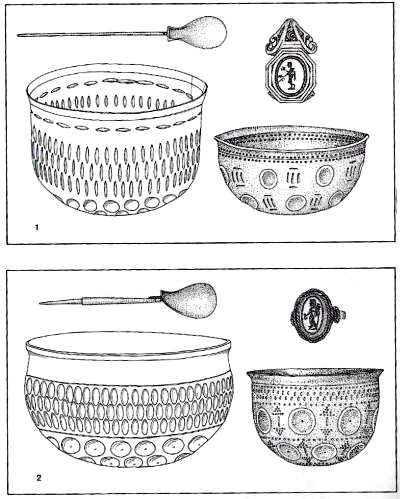
Findings from Haagerup on the island of Fyn (1) compared with findings from Leuna in Thuringen (2). In the gold finger ring from Haagerup sits an onyx stone, and in the ring from Leuna sits a carnelian, but both are adorned with a Mercury motif. The Funen on is of Roman origin, while the South Germany one is producing outside the Roman Empire. Other examples of similarities include silver spoons, glasses and silver bowls. – From Gyldendals og Politikkens Danmarks Historie 2 by Lotte Hedager.

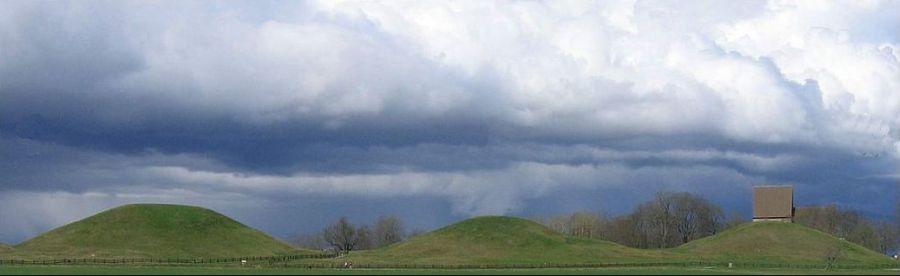
In Old Uppsala in Sweden, there are three large burial mounds and several smaller mounds from the Late Iron Age of similar size, as the mounds at the Tryggevælde river originally must have been. Two of the large mounds contained very rich cremations graves with royal power symbols from the 500s AD.

The Eastern mound contained a 12-year-old boy and a woman; the boy’s equipment included a warrior helmet, a gold decorated single-edged sword and a bronze mirror. In the West mound, there were a man and a woman; the man’s equipment included among other things a warrior helmet decorated with carved stones, a double-edged sword with gold hilt and probably a scepter. Following Snorri Sturlason the Ynglinge lineage was the royal family of the Svears, and Old Uppsala was their burial ground.

But as the Swedish mounds are from around the year 500 AD and the Danish are from around the year 200 AD it sounds unlikely that the Dani descended from Swedes, as it is said. One has to expect that ancestors lived before descendants.

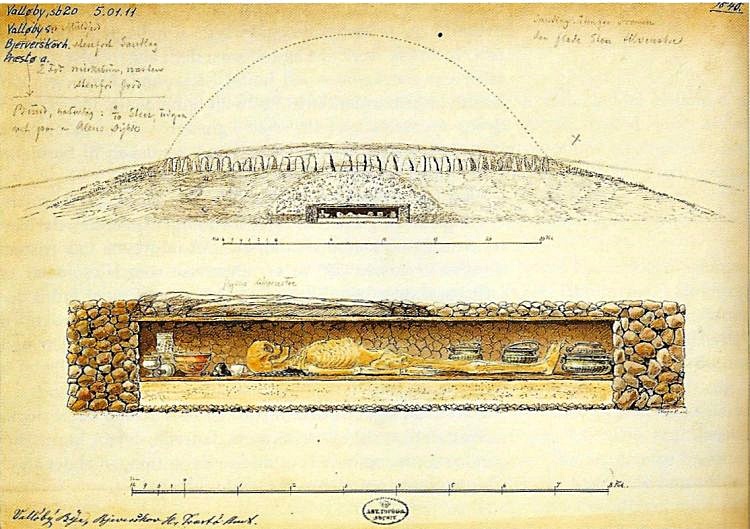
Reconstruction of grave at Valløby south of Koege

Reconstruction of a grave at Valløby south of Køge. The deceased is a man, who is laid to rest with a rich equipment of silver goblets, glass and bronze vessels. The excavation in the 1800’s showed that the grave had been covered by a stone surrounded mound, as shown on the drawing over the existing mound with a dashed line. Drawing by Magnus Petersen 1873.

Snorri says in the introduction to Ynglinge Saga that “in the land east of the Tanakvisl (River Don) lay a castle, called Asgård. The chief of the castle was called Odin, and it was a great offer place for the Gods. Odin was a great army man, who travelled far around and won himself many kingdoms.” – “But because Odin was visionary and skilled in magic, he knew that his descendants should live and build in the Northern part of the world. Therefore he set his brothers Ve and Vilje in charge Asgård, but himself departed with all his dianes (?) with him and many other people. First, he headed west to Gardarige (Russia) and then south to Saxland; He had many sons, he won himself a kingdom over much of Saxland and set his sons to rule the country. So he headed against north to the sea and settled on an island, it is now called Odinsoye on Fyn,” which must be Odense, which city also has Odin’s name.

The burial mounds in Gamla Uppsala

The mounds in Gamla Uppsala – Photo Wikipedia.

There is no direct intelligence to that the Asia men, who settled on the island of Fyn, were related to Switheudi, Dani and Thuringi. But Snorri lets Odin continue to Sweden, where he became the Ynglinge lineage’s actual ancestor, and that is suggesting that there was a relation.

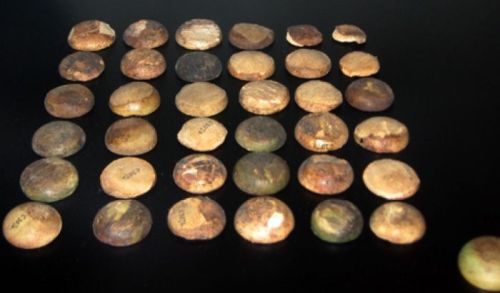
Game pieces of bone found in a man's grave in Varpelev from the end of the 200's

Game pieces of bone found in a man’s grave in Varpelev near Køge from the end of the 200’s – Photo: Kulturjagt i Køge Bugt.

It’s all quite speculative, but one can think that Thuringi means descendants after Thor, Thornings, so to say, in the same way as the Ynglings were descendants after Yngve. Snorre lists Odin’s ancestors in his preface to the Edda: “His famous ancestor was Thror, whom we call Thor, his son was Loridi, his son was Ejnridi, his son Vingethor, his son Vingener, his son Moda, his son Magni, his son Seskef, his son Bedvig, his son Atra, his son Itrmann, his son Heremod, his son Skjaldun called Skjold (shield), his son Bjaf, his son Jat, his son Gudolf, his son Finn, his son Frallaf and he had the son Vodin who was Odin.” Which must mean that Odin and his men, who settled on the island of Fyn, also regarded themselves as descendants of Thor, which one can think that Thuringi and probably Dani and Switheudi also did.

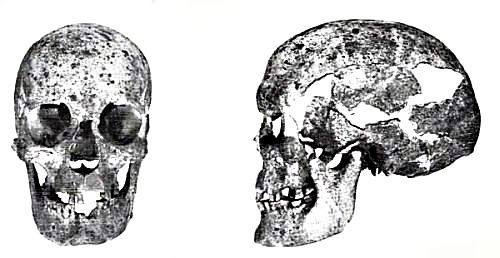
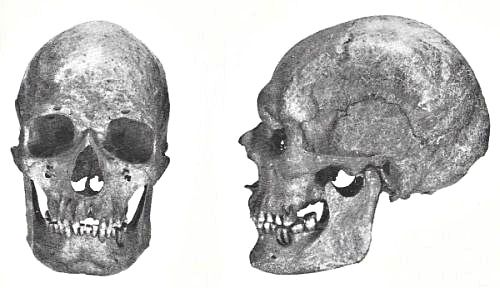
Dolichocephalic woman skull from Varpelev Stevns

Dolichocephalic woman skull from Varpelev Stevns. From “Danmarks Oldtid” by Johannes Brøndsted.

Many skeletons in graves in Denmark from precisely about 200-300 AD show that the deceased were quite tall and long skulled. Thus, one of the deceased in Himlingøje had been close to 180 cm tall. The historian Palle Lauring wrote about Dani’s ethnic characteristics: “The striking many dolichocephalic skulls in the graves have been associated with the coming of the Danes, and it is worth to emphasize that the particularly long-headed appearance pretty quickly disappear from the graves again and is replaced by roughly the same situation as before. It is distinctive upper-class tombs, and we must not forget that precisely with the Danes’ conquest of the land it is about their upper class, that is a very narrow group of bloodlines, perhaps only a few families, who probably have been so inter-married that a common appearance can be understood.”

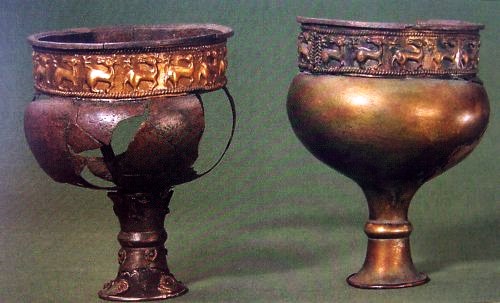
Two silver cups from Valløby at Tryggevælde

Two silver cups from Valløby at Tryggevælde Å on Stevns. This is not Roman style, the cup’s design must represent a culture that Dani had with them when they came – from Asia. Photo: verasir.dk.

Snorri’s preface to the Edda tells us why this characteristics appearance rather quickly disappeared again: “The Aesirs took wives there in the country; some married their sons with local women. All these blood-lines were so numerous that they spread all around in Sax-land and all the northern countries, so that their, the Asian men’s, tongue became the real language of these countries. Thereof, as their ancestors’ names are recorded, it is thought that it can be believed that these names have followed with this tongue and that the Aesirs have brought them with them to the northern countries, to Norway and Sweden, to Denmark and Sax-land.” – Snorre exaggerates undoubtedly the Aesirs’ linguistic influence, as Scandinavian and German still today are Germanic language, resembling Gothic, but it is most likely true that the Aesir’s have made an important contribution to the Nordic countries’ language.

Thuringia quickly was conquered by the Franks. Gregory of Tours tells how: “So he (King Theodoric) summoned the Franks, and said to them: “Be angry, I beg of you, both because of my wrong and because of the death of your kinsmen, and recollect that the Thuringi once made a violent attack upon our kinsmen and inflicted much harm on them. And they gave hostages and were willing to conclude peace with them, but the Thuringi slew the hostages with various tortures, and made an attack upon our kinsmen, took away all their property, and hung youths by the sinews of their thighs to trees, and cruelly killed more than two hundred maidens, tying them by their arms to the necks of horses, which were then headed in opposite directions, and being started by a very sharp goad tore the maidens to pieces.”

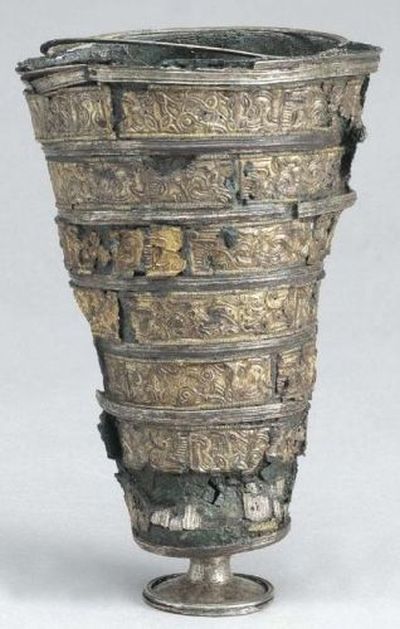
The Uppaakra beaker

The Uppaakra cup from Uppaakra south of Lund in Scania. The cup is 165 mm. high. It is decorated with six relief band of gold in Nordic animal ornamentation style I. It is believed that the decoration on the cup is a further development of the decorations on the cups found at Tryggevælde on Sjælland. Photo: Bengt Almgren, Lund.

“And others were stretched out upon the city streets and stakes were planted in the ground, and they caused loaded wagons to pass over them, and having broken their bones they gave them to dogs and birds for food. And now Hermenfred has deceived me in what he promised and refuses to perform it at all. Behold, we have a plain word. Let us go with God’s aid against them.” They heard this and were angry at such a wrong, and with heart and mind they attacked Thuringia.”

But Thuringi did not follow the contemporary rules of fair warfare: “And the Thuringi prepared stratagems against the coming of the Franks. For they dug pits in the plain where the fight was to take place and covering the openings with thick turf they made it seem a level plain. So when they began to fight, many of the Frankish horsemen fell into these pits and it was a great obstacle to them.”

But the Franks won as always: “When finally the Thuringi saw that they were being fiercely cut to pieces and when their king Hermenfred had taken to flight, they turned their backs and came to the stream Unstrut. And there such a slaughter of the Thuringi took place that the bed of the stream was filled with heaps of corpses, and the Franks crossed upon them as if on a bridge to the further shore. After the victory was won they took possession of that country and brought it under their control.”

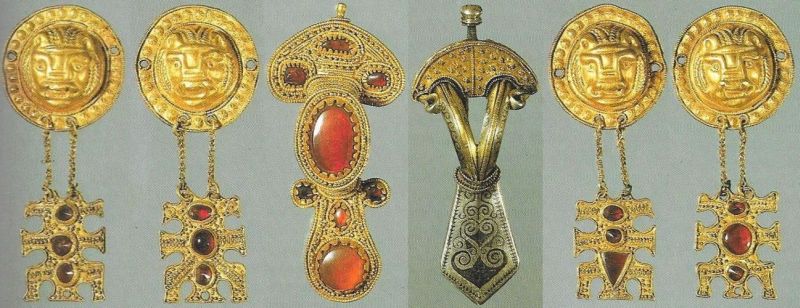
Grave gifts found in a
woman's grave at Kirkebakken in the village Aarslev on Fyn

Selection of grave goods found in a woman’s grave woman’s grave at Kirkebakken in the village Aarslev on Fyn about 1820. In addition to several bronze dishes, bronze buckets and silver spoons the dead woman got several unique pieces of jewelry to the grave, including seven pendants with lion masks pressed in gold, semiprecious stones and clothes pins of silver. It’s interesting that they knew this animal, lion. From Gyldendal og Politikkens Danmarkshistorie 2.

In Ynglinge Saga we get some information about Switheudi’s or Swear’s culture: “Odin made it law in his countries, which previously had been law among the Aesirs. Thus he ordered that they should burn all the dead and carry their belongings into the fire with them, he said that so much fortune should each one come to Valhal with, which he had got with him on the pyre, and what he himself had dug into the ground, should also be beneficial for him. The ash they should carry out into the sea or dig into the ground. In remembering of brave men they should build a mound to their memorial, and after all men, who had been menfolk to some degree, they should erect bauta-stones, and this custom was followed long after. By winter-day they should make sacrifices for good year, by midwinter for growth and fertility, but by summer-day only for victory. All over Svitjod people paid tax to Odin, one penny for each nose, but he had to defend the country from strife and unorder and make sacrifices for them to a good year.” – “Odin died from disease in Svitjod, but when he was near death, he let himself mark with spearhead and stated that all men, who died from weapons, should belong to him.”

Carruthers crest on flag-v2 (1)

OFFICIAL AND REGISTEREDL CLAN CARRUTHERS CCIS SINCE 1983-CLAN OF OUR ANCESTORS

SCOTTISH CLAN – IRISH CLAN – NORSE CLAN

Preserving Our Past!    Recording Our Present!  Informing Our Future!

The Ancient and Honorable Carruthers Clan International Society LLC

CLANCARRUTHERS1@GMAIL.COM

WIDE BANNER with NEW CREST

CLAN CARRUTHERS INT SOCIETY CCIS HISTORIAN AND GENEALOGIST

You can find us on our main facebook pages at :

SILVER WINGS-https://www.facebook.com/CarruthersClanLLC/

GOLD WINGS – https://www.facebook.com/carrutherscarrothers.pat.9

CLAN CARRUTHERS FAMILY HISTORY – https://www.facebook.com/CarruthersClan

CLAN CARRUTHERS CCIS – https://www.facebook.com/groups/3878691252182714

CLAN CARRUTHERS INT SOCIETY- https://www.facebook.com/groups/394653845137709

CLAN CARRUTHERS – BORDER REIVERS – https://www.facebook.com/groups/434959914239094

Disclaimer Ancient and Honorable Carruthers Clan International Socie
Gutland / Gotland, The Viking Age, Uncategorized

THE HERULS – CLAN CARRUTHERS CCIS

cropped-wide-banner-with-new-crestnorse

THE HERULS

The Heruli enjoys a prominent place in the Migration Age history. The name does not occur in the writings of the first two centuries AD, and it neither appears in sagas, Saxo or other Scandinavian sources. However, they are mentioned in the very first lines of the poem Beowulf. One can imagine that bards at the Dani court did not consider it opportune to sing about the country’s former rulers, whom Dani had displaced, and this is the reason for the absence of Heruls in sagas and skaldic verses. The Eddas, on the other hand, strongly emphasize on telling that the Jotuns were the first and the originals.
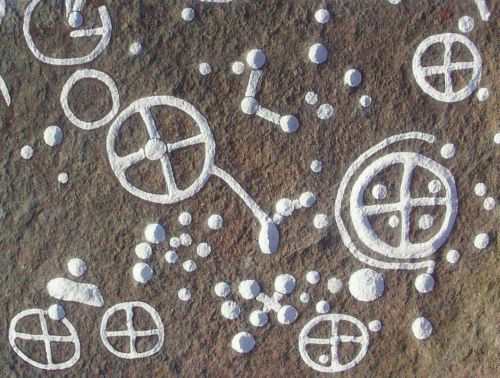
Wheel cross rock carvings

Most rock carvings with wheel cross in Denmark can be found at Lille Strandbygaard in Nylars on the island of Bornholm.

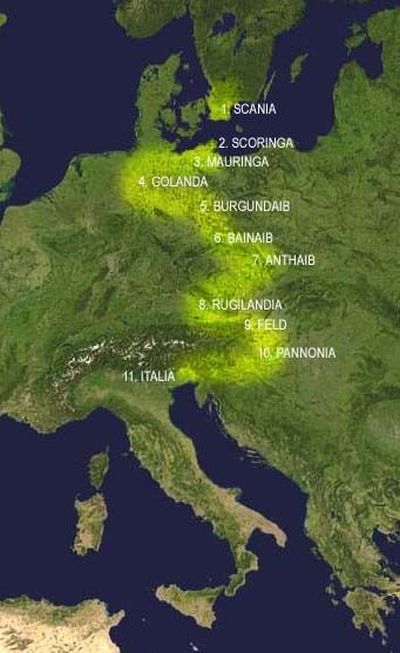
Jordanes mentions in his description of the peoples on the island of Scandia that Dani expelled Herulos from their settlements – perhaps in Scania, Halland, Blekinge or Sjælland, possibly around 200-300 AD. Procopius says that after a catastrophic defeat to the Longobards a very large part of the Heruli went back to Scandinavia, where they settled on the island of Thule that is the Scandinavian Peninsula “near the Goths” or “opposite the Goths.” Therefore, we believe that the Heruli originally came from Scandinavia, but since they are not mentioned in the Scandinavian historical sources, they must have been known there under a different name.

In fact, the opening lines of “Beowulf” mention King Skjold’s suppression of the “fearsome Herul” and other tribes beyond the “whale-road”:

“Listen! We – of the Spear-Danes in the days of yore,
of those clan-kings heard of their glory.
how those nobles performed courageous deeds.
Often Scyld, Scef’s son, from enemy hosts
from many peoples seized mead-benches;
and terrorised the fearsome Heruli 
(egsode Eorle) after first he was
found helpless and destitute, he then knew to recompense for that:-
he grew under the clouds, throve in honours,
until to him each of the bordering tribes
beyond the whale-road had to submit,
and yield tribute:- that was a good king!”

However, later in the poem, “Earle” is used in a way that can be understood as a title.

The archaeologist Johannes Brøndsted wondered about the lack of finds from the oldest iron age on Sjælland and in Skåne. Some have suggested that the Bronze Age lasted longer in this part of the country than in Jylland and on Fyn, it being understood that the Bronze Age culture here lasted long into the Iron Age. However, probably so that they largely used weapons of iron.

In Alvismal from the Elder Edda, it is told that the Elves called the sun Fager-wheel (Fager is an old Danish word for beautiful). There are thousands of rock carvings depicting wheel crosses, which we believe are sun symbols that we call wheel-crosses, all of which are carved by the bronze age people. They may have been the Elves or Alfs. Since the Bronze-culture probably existed for a longer time on Sjælland and in Scania than in the rest of the country, we can believe that the Heruls at the beginning of the Roman Iron Age was known as Elves or Alfs, and they were expelled by Dani.

One can also look into it so that Elves are the only names label from the Scandinavian mythology, which is vacant, besides from Jats and dwarfs, and thus speculatively attach them to the Heruls in Scandinavia.

Single-edged sword adorned with a wheel cross.

Single-edged sword from Lynghøjgaard in Salling adorned with a wheel cross. Foto Danmarks Oldtid by Johannes Brondsted.

Pliny mentions some names of seas, mountains and islands around Scandinavia: Amalchian sea, Morimarusa, Rubeas, Cronian Sea, Baltia; which names they were called according to “the language of these races.” These names do not sound like Gothic or Germanic names. If not the ancient writers explicitly had written that thus they are called on the natives’ own language, we would probably think that they came from Latin. Therefore, we may believe that the language of some of “these races” was a language close to an original Proto-Indo-European language, which reminded of Latin that the Bronze Age people alias Elves alias Heruls may have spoken; and it was in that language that the inner Danish waters was called Codanus.

Ancient sources, including Zosimus and Dexippo, say that Goths and Heluroi from Crimea around the year 200 AD, sailed across the Black Sea and captured the great city of Trebizond, from which they took a big booty and abducted a large number of prisoners. The same fate befell large and splendid cities of Bithynia like Chalcedon and Nicomedia. It is also said that in emperor Gallienus’ reign, 260-268 AD the Goths and Heruls sailed with a large fleet through Bosphorus and Hellespont. They plundered Athens and many other cities. They landed in Greece, where the campaign’s leaders began to quarrel among themselves, and one of the Heruli leaders named Naulobatus, went in Roman service together with all his men. He was very well received of the emperor, who gave him a rank of consul.

Jordanes tells about the Heruli at the shore of the Black Sea around 360 AD: “But though famous for the submission of so many races, he (Hermanaric, king of the Eastern Goths) gave himself no rest until he had slain the majority of the tribe of the Arulos (gentem Erulorum), whose chief was Alaricus, and reduced the rest to his domination. Now the aforesaid race, as the historian Ablabius tells us, dwelt near the Sea of Asov in marshy places, which the Greeks call ele hence they were named Eluri. They were a people swift of foot, and on that account were the more swollen with pride. Indeed, there was at that time no race that would not have chosen from them its light-armed troops for battle. But though their quickness often outmaneuvered others, who frequently engaged in war, yet they were overthrown by the steadiness and slowness of the Goths; and the lot of fortune brought it to pass that they, as well as the other tribes, had to serve Ermanaric, king of the Goths (Gothorum regi Ermanarico). After the slaughter of the Eruli, this same Ermanaric (Ermanaricus) took arms against the Wenethos.”
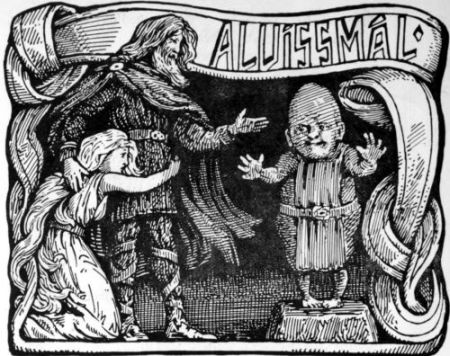
Illustration in Alvismal

Thor in dialog with the dwarf Alvis. Illustration in Alvismal by W. G. Collingwood.

The author believes that the Goths were a collective term for various groups, which understood each other because of their shared Gothic language and culture. However, if Heruls was simply another Germanic or Gothic migration people, why did the antique sources write “Goths and Heruls”. They could have contented themselves with writing only “Goths”. There must have been qualitative differences between Goths and Heruls, for example, different languages, culture and physical appearance.

In his report on the Vandal War, Procopius listed the Gothic nations: “There were many Gothic nations in earlier times, just as also at the present, but the greatest and most important of all are the Goths, Vandals, Visigoths, and Gepaedes. In ancient times, however, they were named Sauromatae and Melanchlaeni; and there were some too who called these nations Getic.” Procopius was general Belisarius’ secretary through three wars, namely against the Persians, Vandals and Goths, and in all campaigns, Heruls had been part of the Roman army. He must have had quite a good knowledge of Heruls, and when he did not count them among the Gothic nations, so it must have been because they precisely were not Goths.

Sidonius Apollinaris wrote about the Heruls: ” – Here strolls the Herulian with his glaucous cheeks, inhabitant of Ocean’s furthest shore, and of one complexion with its weedy deeps.”

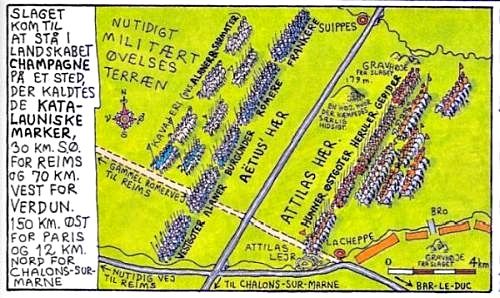
Battle of the Catalaunian Plains

Claus Deleurans Description of the famous battle of the Catalaunian Plains in 451 AD. From “Danmarkshistorie for Folket”.

The Heruli fought with Attila in the battle on the Catalaunian Plains in 451 AD. After Attila’s death and the showdown with his sons in the Battle of Nedao in 454 AD, they tore free from the Huns. They established their own kingdom and joined Odoacer in Italy. Odovacar was a Sciri, who was commander of the imperial troops, who deposed the last Western Roman Emperor, Romulus Augustulus, in 476 AD.

Jordanes tells about the confrontation with the Huns by the river Nedao: “For then, I think, must have occurred a most remarkable spectacle, where one might see the Goth fighting with pikes, the Gepides raging with his sword, the Rugians breaking off missiles in his own wound, the Swevian as foot soldier, the Hun taking the initiative with his bow, the Alan forming a of heavy battle line, the Erulum one of light armor.”

Paul the Deacon tells that Heruli was part of Odovacar army in Italy: ” – Odoacar then, having collected together the nations, which were subject to his sovereignty, that is the Turcilingi and the Heroli and the portion of the Rugii he already possessed and also the peoples of Italy, came into Rugiland and fought with the Rugii.”

Further, Paul tells in his Historia Langobardorum that the Herulian king was called Rotholf. The king’s brother visited the Longobards to negotiate a peace. After completing the mission he was about to return home, but was invited to a glass of wine by a Longobard Princess, who, however, looked down at him because he was rather small: ” – and because he was small in stature, the girl looked down upon him in contemptuous pride and uttered against him mocking words.” She arranged that her servants killed the little man with a spear from behind through a window, while he drank wine.
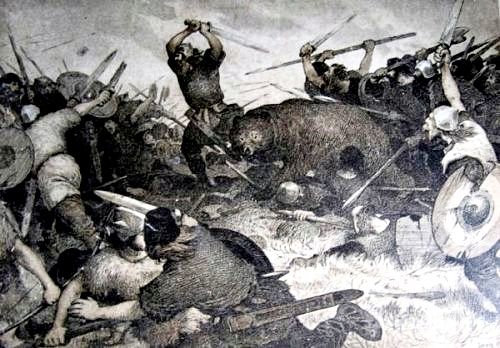
The last stand of Rolf Krake and his household troops

The last stand of Rolf Krake and his household troops. Hrodwulf, Rudolf, Rudolf and Rodolphus appear as names of Herulian kings, so it is tempting to believe that Rolf was a traditional Herulian king’s name, like we today have Frederik and Christian as traditional Danish King names. The philologist Niels Lukman suggested in 1943 that Rolf Krake could have been a Herulian king named Rodulf. The legend of Rolf Krake thus becomes a kind of Scandinavian King Arthur legend. Drawing by Louis Moe.

King Rudolf sent his hardened veterans against the Longobards. Paulus tells: “The Heroli were indeed at that time well trained in martial exercises, and already very famous for their many victories. And either to fight more freely or to show their contempt for a wound inflicted by the enemy, they fought naked, covering only the shameful things of the body.” King Rudolf himself did not participate in the fight; he awaited the outcome of the battle in the shade of a tree, as he felt sure of Herulian victory. Too late, he was told that the Longobards had progress, and he fell along with the greater part of his army. Paul tells only that the King’s brother was small in stature, but that sort of things runs in the family, so the king himself has probably not been a giant. A Herulian king, who left his people and sought refuge in Constantinople, was also called Rodolphus, indicating that it has been a traditional name for Herulian kings. This brings to mind the Scandinavian legend of Rolf Krake, who also was small in stature.

Paulus Diaconus continued: “- And now from that time all the courage of the Heroli so decayed that thereafter they had no king over them in any way.”

The Danish scholar Niels Lukman suggested in his doctoral thesis in 1943 that Rolf Krake could have been a Herulian king named Rodulf. The legend of Rolf Krake thus becomes a kind of Scandinavian King Arthur legend, loved by bards.

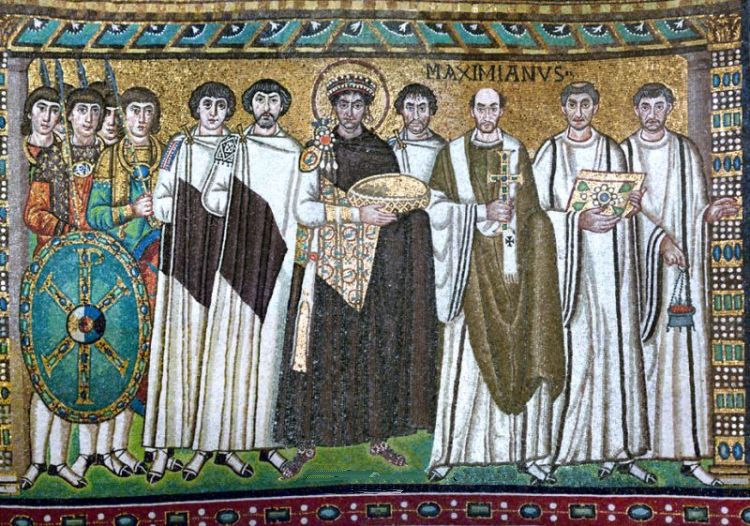
Emperor Justinian and his entourage as mosaic in the Basilica of San Vitale in Ravenna

Emperor Justinian and his entourage as mosaic in the Basilica of San Vitale in Ravenna. The bearded gentleman by the emperor’s right hand is believed to be Procopius’ superior, General Belisarius. He was in charge of the Justinian attempts to recapture the Western Roman Empire. The man at the Emperor’s left is thought to be the eunuch Narses, who succeeded Belisarius as commander in Italy. Photo Wikipedia.

As General Belisarius secretary Procopius participated in the Eastern Roman Empire’s war against the Persians in 531 AD, against the Vandals in 532 AD, and against the Goths in Italy 535 AD. He wrote a very descriptive report on the course of the wars. Along with many other barbaric peoples, the Heruls were part of the imperial army in all three wars, and Procopius mentions them many times.

Before an important battle in the Persian war, he says: “The extremity of the left straight trench which joined the cross trench, as far as the hill which rises here, was held by Bouzes with a large force of horsemen and by Pharas the Erulian with three hundred of his nation.” Apparently, the Heruls here were light infantry supporting the cavalry. Procopius uses the term “his nation”, indicating that Heruls really were a people, a race, with their own culture and most likely own language.

Before the battle the following day Pharas got a creative idea: “Then Pharas came before Belisarius and Hermogenes, and said: “It does not seem to me that I shall do the enemy any great harm if I remain here with the Eruli; but if we conceal ourselves on this slope, and then, when the Persians have begun the fight, if we climb up by this hill and suddenly come upon their rear, shooting from behind them, we shall in all probability do them the greatest harm.”

Which they did: “But first the three hundred Eruli under Pharas from the high ground got in the rear of the enemy and made a wonderful display of valorous deeds against all of them and especially the Cadiseni.”

Heruls was only one of many barbarous people in the Roman army. About preparations for another battle it is said: “And he arranged the soldiers as follows. On either side of the tent were Thracians and Illyrians, with Goths beyond them, and next to these Eruli, and finally Vandals and Moors. And their line extended for a great distance over the plain.”

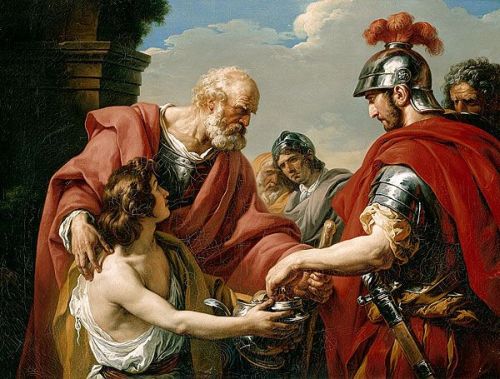
Procopius and Belisarius

Painting depicting Procopius and Belisarius. Perhaps it is the artist’s idea that Procopius is the elderly bearded man, but the author believes that Procopius was a young man, eager but a little naive, when he followed the armies and wrote his reports. Only a young man could have had the physique to work as a war correspondent for so long time. Unknown artist – from mikeaztec.wordpress.com.

In a battle, the Heruls became too eager and pushed too far forward: “And then Narses urged his men forward and pressed still harder upon the enemy, and the rest of the Romans joined in the action. But all of a sudden the men who were in ambush, as has been said, came out from the cabins along the narrow alleys, and killed some of the Eruli, falling unexpectedly upon them” – “And the Persians, shooting into great masses of the enemy in the narrow alleys, killed a large number without difficulty, and particularly of the Eruli who had at the first fallen upon the enemy with Narses and were fighting for the most part without protection. For the Eruli have neither helmet nor corselet nor any other protective armour, except a shield and a thick jacket, which they gird about them before they enter a struggle. And indeed the Erulian slaves go into battle without even a shield, and when they prove themselves brave men in war, then their masters permit them to protect themselves in battle with shields. Such is the custom of the Eruli.”

In 532 AD the so-called Nika revolt against Emperor Justinian broke out in Constantinople. Procopius says that thousands of rebels had gathered in the Hippodrome to crown a new emperor. They were all cut down by professional soldiers under the command of the generals Belisarius and Moundos. Belisarius was followed by his lifeguard, which included Thracian Goths, and the Gepide prince Moundos “had some Eroulian barbarians with him.” The two generals attacked the poorly armed crowd from each end of the Hippodrome and cut them down indiscriminately. It was the bloodiest revolt ever in Constantinople, some historians assume that up to 30,000 to 35,000 people lost their lives before the rebellion was quelled.

The Heruls also participated in the Roman emperor’s following war against the Vandals in North Africa: “And there followed with them also four hundred Eruli, whom Pharas led.”

Romans and Procopius did not have great expectations of the Heruli, but Pharas was a positive surprise by the capture of the Vandal king, Gelimer: ” – and so he chose out soldiers, with Pharas as their leader, and set them to maintain the siege of the mountain. Now this Pharas was energetic and thoroughly serious and upright in every way, although he was an Erulian by birth. And for an Erulian not to give himself over to treachery and drunkenness, but to strive after uprightness, is no easy matter and merits abundant praise. But not only was it Pharas, who maintained orderly conduct, but also all the Erulians who followed him. This Pharas, then, Belisarius commanded to establish himself at the foot of the mountain during the winter season and to keep close guard, so that it would neither be possible for Gelimer to leave the mountain nor for any supplies to be brought in to him. And Pharas acted accordingly.”
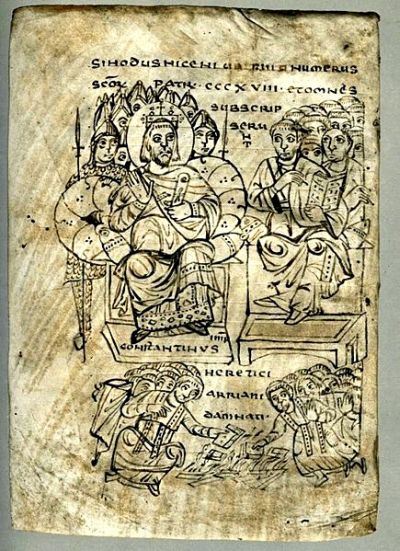
Emperor Constantine is monitoring that Arian heretics are forced to burn their books

Emperor Constantine is monitoring that Arian heretics are forced to burn their books. From MS CLXV, Biblioteca Capitolare, Vercelli, 9th century. – Wikimedia Commons.

Emperor Justinian was a very devout Catholic and allowed no deviations in the Christian faith, and this was a contributing factor to a mutiny among the Roman troops after the victory over the Vandals: “In the Roman army there were, as it happened, not less than one thousand soldiers of the Arian faith; and the most of these were barbarians, some of these being of the Erulia nation.” Maybe it was especially the Heruli, who were Arian Christians.

In Procopius’ section on the Gothic war, Heruls are first mentioned somewhat late in the war. Maybe there was Heruls in Belisarius’ army from the beginning, but we do not hear much about them. But in the army, which the emperor sent 538 AD led by Narses there was a large group: “And about two thousand of the Erulian nation also followed him, commanded by Visandus and Aluith and Phanitheus.”

Procopius tells about Narses’ attack on Caesena (Cesena), in which Heruls participated: “But since the barbarians defended themselves manfully, many fell in the fight and among them Phanitheus, the leader of the Eruli”.

“Now as to who in the world the Eruli are, and how they entered into alliance with the Romans, I shall forthwith explain.” Procopius wrote in “History of the Wars – Book XIV”:

“They used to dwell beyond the Ister River from of old, worshipping a great host of gods, whom it seemed to them holy to appease even by human sacrifices. And they observed many customs which were not in accord with those of other men. For they were not permitted to live either when they grew old or when they fell sick, but as soon as one of them was overtaken by old age or by sickness, it became necessary for him to ask his relatives to remove him from the world as quickly as possible. And these relatives would pile up a quantity of wood to a great height and lay the man on top of the wood, and then they would send one of the Eruli, but not a relative of the man, to his side with a dagger; for it was not lawful for a kinsman to be his slayer. And when the slayer of their relative had returned, they would straightway burn the whole pile of wood, beginning at the edges. And after the fire had ceased, they would immediately collect the bones and bury them in the earth. And when a man of the Eruli died, it was necessary for his wife, if she laid claim to virtue and wished to leave a fair name behind her, to die not long afterward beside the tomb of her husband by hanging herself with a rope. And if she did not do this, the result was that she was in ill repute thereafter and an offence to the relatives of her husband. Such were the customs observed by the Eruli in ancient times.”
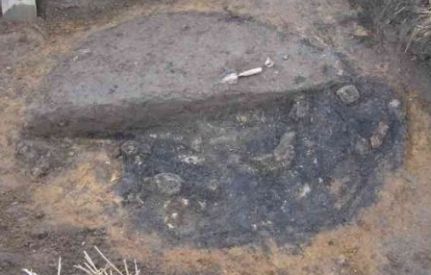
Burned spot grave

Burned spot grave at Storup on the island of Mors. The digging spoon gives an idea of the size. Burned spot grave appears that after cremation, the survivors scraped the burned bones and the remains of the fire together in a hole in the ground, and covered it. If this has been the burial custom in eastern Denmark in the early Iron Age it will explain the striking emptiness of finds of graves on Sjælland and Skåne. In cultivated areas, where farmers have sown and plowed through more than a millennium since then, such graves must have been made completely invisible. – Excavated by Mors Arkæologisk Forening.

Such burial method would only leave some very simple cremation graves that it would be almost impossible to find after one and a half thousand years; and this may explain the emptiness of finds of graves in Sjælland and Scania from the early Iron Age.

We must believe that Procopius had his information from the newly arrived Heruls themselves. Maybe because they recently had converted to Christianity, they seem to have had a rather critical, almost ironic attitude to their own pagan past: “But as time went on they became superior to all the barbarians who dwelt about them both in power and in numbers, and, as was natural, they attacked and vanquished them severally and kept plundering their possessions by force. And finally they made the Lombards, who were Christians, together with several other nations, subject and tributary to themselves, though the barbarians of that region were not accustomed to that sort of thing; but the Eruli were led to take this course by love of money and a lawless spirit. When, however, Anastasius took over the Roman empire, the Eruli, having no longer anyone in the world whom they could assail, laid down their arms and remained quiet, and they observed peace in this way for a space of three years. But the people themselves, being exceedingly vexed, began to abuse their leader Rodolphus without restraint, and going to him constantly they called him cowardly and effeminate, and railed at him in a most unruly manner, taunting him with certain other names besides. And Rodolphus, being quite unable to bear the insult, marched against the Lombards, who were doing no wrong, without charging against them any fault or alleging any violation of their agreement, but bringing upon them a war which had no real cause.”
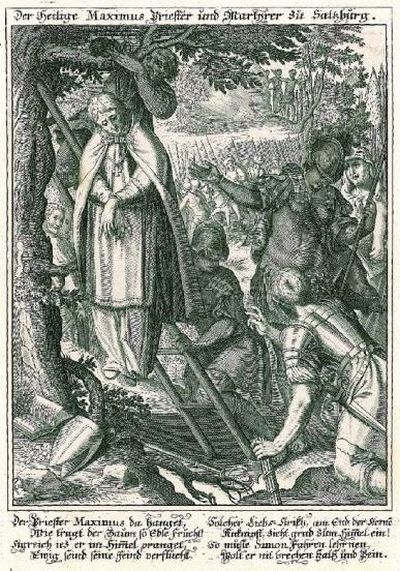
The holy Maximus being hung by Heruls

The holy priest and martyr Maximus and more than 50 colleagues are being hung in Salzburg in modern Austria by Heruls under King Odovacer perhaps around 480 AD. Odovacer was an Arian Christian, but it is said that he rarely intervened in religious matters, but maybe he did a few times – Engraving from 1716 in the “Bavaria Sancta”.

The following battle was a catastrophic defeat for the Heruli.

“For this reason, the Eruli were no longer able to tarry in their ancestral homes, but departing from there as quickly as possible they kept moving forward, traversing the whole country which is beyond the Ister River, together with their wives and children. But when they reached a land where the Rogi dwelt of old, a people who had joined the Gothic host and gone to Italy, they settled in that place. But since they were pressed by famine, because they were in a barren land, they removed from there not long afterward, and came to a place close to the country of the Gepaedes.”

“And at first the Gepaedes permitted them to dwell there and be neighbours to them since they came as suppliants. But afterwards for no good reason, the Gepaedes began to practise unholy deeds upon them. For they violated their women and seized their cattle and other property, and abstained from no wickedness whatever, and finally began an unjust attack upon them. And the Eruli, unable to bear all this any longer, crossed the Ister River and decided to live as neighbours to the Romans in that region”.
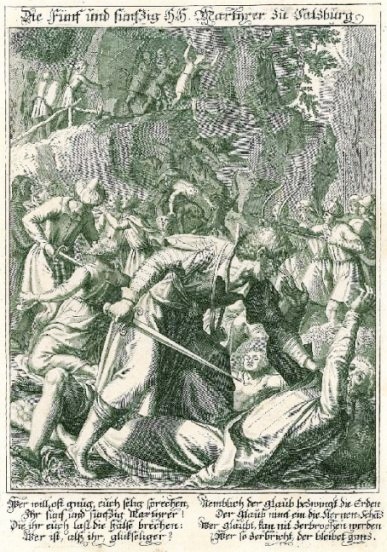
The holy Maximus being hung by Heruls

The 55 martyrs from Salzburg killed by Heruls under King Odovacer perhaps around 480 AD – Engraving from 1716 in the “Bavaria Sancta.

First of the emperor greeted them welcome, but before long it came to fighting between Heruls and Romans: “But when Justinian took over the empire, he bestowed upon them good lands and other possessions, and thus completely succeeded in winning their friendship and persuaded them all to become Christians.” We remember that Heruls took part in the Arian mutiny in Belisairus’ army in Africa, so some Heruls were Arians. But Justinian was fanatical Catholic and must have converted them to Catholic Christianity. There may have been religious divisions among Heruli, such that some were Catholics, and others were Arians and this can have contributed to their final disappearance as a people.

Procopius was very fascinated by the stories of the midnight sun and the dark winter on the island of Thule (Scandinavian peninsula), which shows that he was an inquisitive and curious young man: “And although I was eager to go to this island and become an eye-witness of the things I have told, no opportunity ever presented itself. However, I made enquiry from those who come to us from the island as to how in the world they are able to reckon the length of the days since the sun never rises nor sets there at the appointed times. And they gave me an account which is true and trustworthy.”

The Scandinavian soldiers told Procopius on the Nordic Christmas: “When, however, the time of the nights arrives, they always take note of the courses of the moon and stars and thus reckon the measure of the days. And when a time amounting to thirty-five days has passed in this long night, certain men are sent to the summits of the mountains for this is the custom among them and when they are able from that point barely to see the sun, they bring back word to the people below that within five days the sun will shine upon them. And the whole population celebrates a festival at the good news, and that too in the darkness. And this is the greatest festival, which the natives of Thule have.”
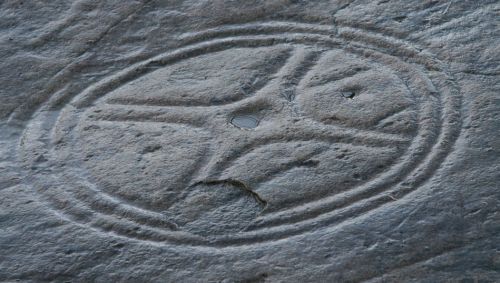
Wheel cross petroglyphs which looks like a wheel

Wheel cross petroglyphs which very much looks like a wheel with four spokes from Fossum in Skien – Photo Telemark Fylkeskommune.

Forty days of darkness will place them well north of the Arctic Circle, and it is not likely that others than scattered hunters and reindeer herders lived there in the Iron Age. There must have been some, who made a little fun with Procopius. But the story says nevertheless that there were men in the army, which were believed to have come from Scandinavia. In the Bronze Age religion, which probably originally also had been the Heruli’s, played the Sun a big role, and we celebrate still Christmas (“jul” in Danish, which is similar to “hjul”, which means wheel) so many years later.

But we notice that it is not a midwinter festival, which they describe, as darkness lasts 40 days, and after 35 days they will watch for the sun, which will be in the middle of January, and only then comes the festival, which one must assume took place late January. It brings to mind the Chinese New Year, also known as Spring Festival, which takes place in late January or early February.

The whole long and detailed report on the nature and the people on the island of Thule in connection with his report on Heruls indicates that at least some Heruls really came from Scandinavia – though he did not write it directly and unambiguously.
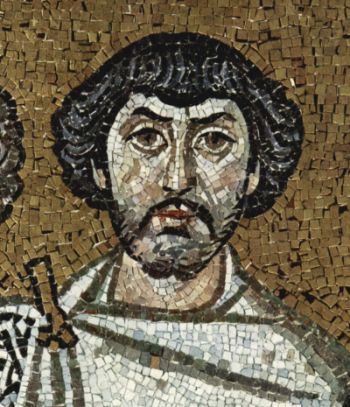
Belisarius

The man at the emperor’s right side on a mosaic in the Church of San Vitale in Ravenna are thought to be Belisarius. He was Procopius’ superior through three wars. In all of these Heruls were part of the army. He is believed to have been born in 505 AD in modern Bulgaria in a family with Gothic roots. As early as 527 AD, when he was in his early twenties, he was appointed as army commander in Syria in the war against the Persians. His success in many campaigns aroused the emperor’s jealousy, and he was withdrawn from the war in Italy in 540 A.D. and later replaced by the eunuch Narses.

Procopius was also a somewhat simple-minded young man, who in good faith wrote down, what Heruli’s enemies had to say about them: “They are still, however, faithless toward them (the Romans), and since they are given to avarice, they are eager to do violence to their neighbours, feeling no shame at such conduct. And they mate in an unholy manner, especially men with asses, and they are the basest of all men and utterly abandoned rascals.” Maybe it was a contribution from his superior, Belisarius, who did not like Heruls.

Procopius says that when the Emperor heard what the Goths had done in Milan – namely destroyed the city, killed all the men and given the women to the Burgundians – he pulled Narses back from Italy and made Belisarius commander: “But the Eruli seeing that Narses was departing from Italy, refused to remain there any longer, although Belisarius promised that they would receive many benefits from both himself and from the emperor, if they remained; but they all packed up their luggage and withdrew going first to Liguria. There they happened upon the army of Uraias, and they sold all the slaves and all the animals they were taking with them to the enemy and , having thus acquired a great amount of money, they took an oath that they would never array themselves Goths or do battle with them. Thus they made their withdrawal in peace and came into the land of the Veneti. But upon meeting Vitalius there, they forthwith began to repent of the wrong they had done the emperor Justinian. And seeking to clear themselves of the charge against them, they left there Visandus, one of their commanders, with his forces, but all the rest betook themselves to Byzantium under the leadership of Aluith and Philemuth, the latter having taken the command after Phanitheus was killed at Caesena.”

But things went badly for the remaining Heruls in Italy: “While the other commanders were remaining quiet on account of this situation (the arrival of imperial tax collectors) Vitalius alone (for he happened to have in Venetia a numerous army comprising with others a great throng of barbarian Eruli) had the courage to do battle with Ildibadus, fearing, as actually happened, that at a later time, when his power had grown greatly they would be no longer able to check him. But in the fierce battle, which took place near the city of Tarbesium (Treviso) Vitalius was badly defeated and fled saving some few men, but losing the most of them there. In this battle, many Eruli fell and among them, Visamdus, the leader of the Eruli, was killed.”

The Heruls lived in the Balkans near the town of modern Belgrade: “Other towns of Dacia also, about the city of Singidunum (Belgrad) had been taken over by the Eruli as a gift from the emperor, and here they are settled at present time, overrunning and plundering Illyricum and the Thracian towns very generally. Some of them have even become Roman soldiers serving among the foederati, as they are called. So whenever envoys of the of the Eruli are sent to Byzantium, representing the very men, who are plundering Roman subjects, they collect all their contribution from the emperor without the least difficulty and carry them off home.”

The emperor sent Narses to the Heruls again to recruit them for the war in Italy: “The emperor also sent Narses the eunuch to the rulers of the Eruli, in order to persuade most of them to march to Italy. And many of the Eruli followed him, commanded by Philemuth and certain others, and they came with him into the land of Thrace. – And it so fell out during this journey they unexpectedly rendered a great service to the Romans. for a great throng of barbarians Schlaveni, had, as it happened, recently crossed the river Ister, plundering the adjoining county and enslaved a very great number of Romans. Now the Eruli suddenly came upon these barbarians and joined battle with them, and, although far outnumbered, they unexpectedly defeated them, and some they slew, and the captives they released one and all to go to their homes.”

Procopius also tells the story of how the Heruls killed their king and sent word to Scandinavia for a new one “The Eruli, displaying their beastly and fanatical character against their own “rex,” one Ochus by name, suddenly killed the man for no good reason at all, laying against him no other charge than that they wished to be without a king thereafter. And yet even before this, while their king did have the title, he had practically no advantage over any private citizen. But all claimed the right to sit with him and eat with him, and whoever wished insulted him without restraint; for no men in the world are less bound by convention or more unstable than the Eruli. Now when the evil deed had been accomplished, they were immediately repentant. For they said that they were not able to live without a ruler and without a general; so after much deliberation, it seemed to them best in every way to summon one of their royal family from the island of Thule. And the reason for this I shall now explain.”
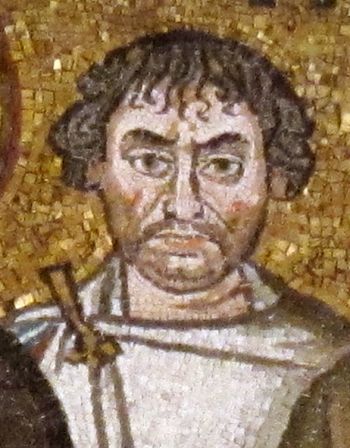
Narses

The man at the Emperor’s left side on the mosaic in San Vitale in Ravenna is thought to be the eunuch Narses, who in 551 AD arrived in Italy at the head of the largest army, the Emperor ever had sent against the Goths, he was reportedly about 80 years old, but still sound of mind. The army included a large group Heruls. However, the man in the picture does not look like an eighty-years-old.

Procopius took up the thread again after the description of the island of Thule: “On the present occasion, therefore, the Eruli who dwelt among the Romans, after the murder of their king had been perpetrated by them, sent some of their notables to the island of Thule to search out and bring back whomsoever they were able to find there of the royal blood. And when these men reached the island, they found many there of the royal blood, but they selected the one man who pleased them most and set out with him on the return journey. But this man fell sick and died when he had come to the country of the Dani. These men, therefore, went a second time to the island and secured another man, Datius by name. And he was followed by his brother Aordus and two hundred youths of the Eruli in Thule. But since much time passed while they were absent on this journey, it occurred to the Eruli in the neighbourhood of Singidunum that they were not consulting their own interests in importing a leader from Thule against the wishes of the Emperor Justinian. They, therefore, sent envoys to Byzantium, begging the emperor to send them a ruler of his own choice. And he straightway sent them one of the Eruli who had long been sojourning in Byzantium, Suartuas by name. At first, the Eruli welcomed him and did obeisance to him and rendered the customary obedience to his commands; but not many days later a messenger arrived with the tidings that the men from the island of Thule were near at hand. And Suartuas commanded them to go out to meet those men, his intention being to destroy them, and the Eruli, approving his purpose, immediately went with him. But when the two forces were one day’s journey distant from each other, the king’s men all abandoned him at night and went over of their own accord to the newcomers, while he himself took to flight and set out unattended for Byzantium. Thereupon the emperor earnestly undertook with all his power to restore him to his office, and the Eruli, fearing the power of the Romans, decided to submit themselves to the Gepaedes. This, then, was the cause of the revolt of the Eruli”

In the following fighting, it seems like Heruls fought against Heruls: “They (the Romans) also took with them as allies fifteen hundred Eruli, commanded by Philemuth and others. For except for these the whole nation of the Eruli to the number of three thousand were arrayed with the Gepaedes, since they had revolted against the Romans not long before.”

“Now a detachment of the Romans, who were marching to join the Lombards as allies, unexpectedly chanced upon some of the Eruli with Aordus, the brother of their ruler. And a fierce battle ensued in which the Romans were victorious, and they slew both Aordus and many of the Eruli.”

Claus Deleuran's depiction of
the last Herul in history

Claus Deleuran’s depiction of the last Herul in history. I do not know from where he has it.

Some Roman units, which included Heruls, under general John rested on the laurels at a place called Lucania in Italy after an easy victory over a group of Goths. They failed to keep effective guard and were overrun in a subsequent nightly Gothic counter-attack: “And once outside the camp they ran up into the mountains, many of which rise close by, and thus were saved. Among these were John himself and Arufus, the leader of the Eruli. Of the Romans about a hundred perished.”

The emperor sent one army after another against the Goths in Italy, including a platoon Heruls under Verus: “Later he (the emperor) sent Verus with three hundred Eruli, and Varazes an Armenian by birth, and he recalled from his post Valerian, the general of Armenia, and ordered him to go to Italy with his attendants spearmen and guards, who numbered more than a thousand. Now Verus was the first to put in at Dryus, and he left his ships there, being quite unwilling to remain in that place, where John’s army was and went forward on horseback with his command. for this man was not of a serious temper, but he was utterly addicted to the disease of drunkenness, and consequently, he was always possessed by a spirit of reckless daring. And when they had come close to the city of Brundisium, they made camp and remained there.”

“And when Totila learned this, he said: “Verus has one of two things, either a powerful army or a very silly head. Let us proceed against him instantly, that either we must make trial of the man’s army, or that he may realize his own silliness”. So Totila with these words marched against him with a numerous army; and the Eruli, spying the enemy already at hand, took refuge in a wood, which was close by. And the enemy surrounded them and killed more than two hundred, and was about to lay hands on Verus himself and the rest of the force, who were hiding among the thorn-bushes, but fortune came to their aid and saved them unexpectedly. For the ships, in which Varazes and the Armenians under him were sailing, suddenly put up on the shore there. Now when Totila saw this, supposing the hostile army to be more numerous, than it really was, he immediately set out and marched away from there, while Verus and his men were glad to reach their ships on the run.”

One of the last times in history, we hear about Heruls was when they fought on the Roman side in the decisive battle of the Gothic war in Italy, which was the battle of Gualdo Tadino in 552 AD, also known as the Battle of the Gallic tombstones. It was between the Roman army under Narses and the Goths under their young king, Totila “Three thousand Heruls fought on horseback under Philemuth, their own chief, and the noble Aratus”; on the Roman side fought also 5,000 Langobards and 400 gepids, it is said.

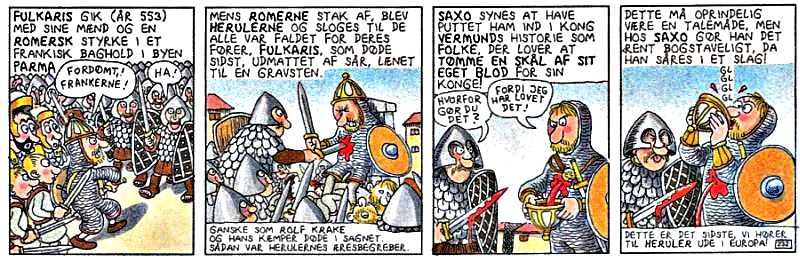
Gibbons tells about the Heruls, who around 553 AD appeared in written history; I do not know, from where he got it: “The vanguard of the Roman army was stationed near Po, under the leadership of Fulkaris, a brave Herul, who hastily thought that personal bravery was a commander’s only duty and qualification. When he without order or caution marched along the Aemilian Road, suddenly, an ambush of Franks broke forward from Parma amphitheater, his troops were surprised and driven away, but their leader refused to flee stating in the last minute that death was less horrible than meeting Narses’ anger.”
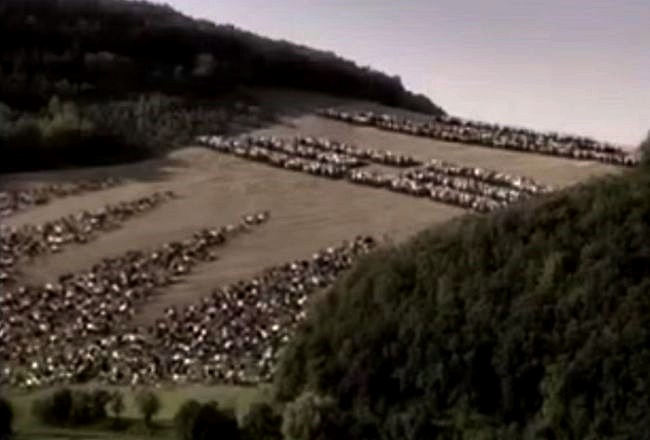
The battle between Arovist and Caesar

The battle between Caesar and Ariovist in the video “1-5 Germanic Tribes 1 – Barbarians Against Romans”, showing that the Germans attacked in wedge-formations. It is stated that Arovist’s Germans attacked in seven spear-head formations – in Germanic tradition called “svinefylkning”. Though, it can not be confirmed by Caesar’s “War in Gaul”, which simply states: ” – and the enemy stormed forward so suddenly and quickly that there was no time to throw spears at them. They, (the Romans) therefore, threw their spears away, and fought with swords in melee.” – perhaps it is mentioned in another source.

John Bagnell Bury confirms that there could be reasons for Heruls to fear Narses: “The course of the battle of Capua 554 AD was affected by an accident. One of the Herul captains killed his servant for some delinquency, and when Narses called him to account, he asserted that masters had the power of life and death over their slaves and that he would do the same thing again. He was put to death by the command of Narses, to the great indignation of the Heruls, who withdrew from the camp and said they would not fight. Narses drew up his line of battle without them.”

It sounds like Narses made a Cannae on the Franks, showing the limitation of the wedge-formation: “Meanwhile, two Heruls had deserted to the enemy, and persuaded Buccelin that his chance was to attack at once, as the Romans were in consternation at the defection of the Herul troops. Buccelin had drawn up his army, which consisted entirely of infantry, in the shape of a deep column, which should penetrate like a wedge through the hostile lines. In this array, the Franks arrived, armed with missile lances, swords, and axes, confident that they would sweep all before them at the first rush. They penetrated into the central space which was to have been occupied by the Heruls, dislodging the outer ranks of the Roman infantry on either side. Narses quietly issued orders to his wings to face about, and the enemy was caught between the crossfire of the cavalry, who were all armed with bows.” – “Their ranks were gradually mown down, and then Sindual and his Heruls appeared upon the scene.”
Carruthers crest on flag-v2 (1)

OFFICIAL AND REGISTEREDL CLAN CARRUTHERS CCIS SINCE 1983-CLAN OF OUR ANCESTORS

SCOTTISH CLAN – IRISH CLAN – NORSE CLAN

Preserving Our Past!    Recording Our Present!  Informing Our Future!

The Ancient and Honorable Carruthers Clan International Society LLC

CLANCARRUTHERS1@GMAIL.COM

WIDE BANNER with NEW CREST

CLAN CARRUTHERS INT SOCIETY CCIS HISTORIAN AND GENEALOGIST

You can find us on our main facebook pages at :

SILVER WINGS-https://www.facebook.com/CarruthersClanLLC/

GOLD WINGS – https://www.facebook.com/carrutherscarrothers.pat.9

CLAN CARRUTHERS FAMILY HISTORY – https://www.facebook.com/CarruthersClan

CLAN CARRUTHERS CCIS – https://www.facebook.com/groups/3878691252182714

CLAN CARRUTHERS INT SOCIETY- https://www.facebook.com/groups/394653845137709

CLAN CARRUTHERS – BORDER REIVERS – https://www.facebook.com/groups/434959914239094

Disclaimer Ancient and Honorable Carruthers Clan International Socie

Gutland / Gotland, The History of Gutland, The Viking Age, Uncategorized

PROCOPIUS ON HERULS AND DANES CLAN CARRUTHERS CCIS

cropped-wide-banner-with-new-crestnorse

By the end of Procopius’ Book VI on the Gothic War in Italy, he loses interest in the war and writes instead about the Heruli, who was part of Belisarius’ army. He recounts among other things a decisive battle between Heruls and Langobards, which took place north of the Danube – possibly quite far north:

The Langobards' migrations

Reconstruction of the Langobards’ migrations – Langobards had given name to the region around Milan, Lombardy – Paul the Deacon mentions that the Lombards came from Scandia, but elsewhere he writes that they were not so numerous, because they came from only a small island, and this does not fit with Scandia. – Wikimedia Commons.

“And when the two armies came close to one another, it so happened that the sky above the Lombards was obscured by a sort of cloud, black and very thick, but above the Eruli it was exceedingly clear. And judging by this one would have supposed that the Eruli were entering the conflict to their own harm; for there can be no more forbidding portent than this for barbarians as they go into battle. However, the Eruli gave no heed even to this, but in absolute disregard of it, they advanced against their enemy with utter contempt, estimating the outcome of the war by mere superiority of numbers. But when the battle came to close quarters, many of the Eruli perished and Rodolphus himself also perished, and the rest fled at full speed, forgetting all their courage. And since their enemy followed them up, the most of them fell on the field of battle and only a few succeeded in saving themselves.”

“When the Eruli, being defeated by the Lombards in the above-mentioned battle, migrated from their ancestral homes, some of them, as has been told by me above, made their home in the country of Illyricum, but the rest were averse to crossing the Ister River, but settled at the very extremity of the world; at any rate, these men, led by many of the royal blood, traversed all the nations of the Sclaveni one after the other, and after next crossing a large tract of barren country, they came to the Varni, as they are called. After these, they passed by the nations of the Dani, without suffering violence at the hands of the barbarians there. Coming thence to the ocean, they took to the sea, and putting in at Thule, remained there on the island.”

Procopius was Belisarius’ secretary through three wars: against the Persians in Syria, against the Vandals in Africa and against the Goths in Italy. In all three wars, Heruls had been part of the Roman army. We must believe that Procopius had a very intimate relationship with them and that he had his information from the Heruli themselves. It is assumed that he published his reports on Emperor Justinian’s wars around 550 AD in Constantinople.

It is known from the Gothic chancellor Cassiodorus’ letters that the Goths in Italy tried to create an alliance with the Heruli, Thuringi and Varni against the Franks. Since he does not mention the Saxons, that we otherwise would expect, we must believe that Varni was an early name for the Saxons. We can imagine that the Saxons originally were called Varni and later got their name from their favorite weapon, the short single-edged sword, the sax; in the same way as the Langobards originally were called Vinil, but later was named after their favorite weapon, the long ax, langobard – bard as in the Danish name for halberd, hellebard.

Germanic tribes after Taticus

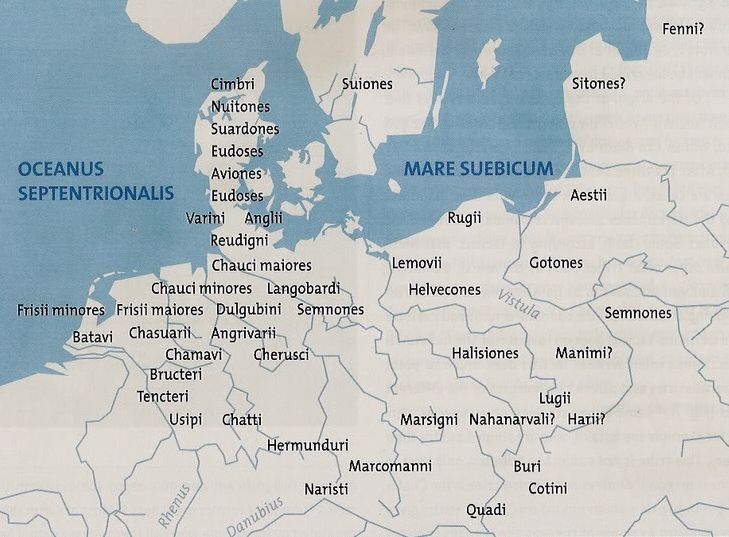
Reconstruction of the Germanic tribes following Tacitus. He did not create any map himself, but many writers have sought to place the tribes on a map following his description. As it can be seen Jutland and North West Germany are somewhat crowded at the expense of other areas. Tacitus mentions Varini after Anglii, and that is probably an error by Tacitus, who had all information on second hand. Varini must be the Saxons. From “The Spoils of Victory. The North in the Shadow of the Roman Empire”. Edited by L. Jorgensen, B. Storgaard and L.G. Thomsen. Nationalmuseet, Copenhagen.

In that case, the Herulian travel party had followed the Rhine or more likely the Elbe, crossed “a large distance of barren land”, perhaps Luneburger Heide, then traveled through the land of the Varni that most likely was Saxony, and from there through “the nations of the Dani” – notice that they are in plural – which must have been Jutland. Then they crossed the sea and landed in Thule, which is the Scandinavian Peninsula. As they traveled through Jutland through several of the Danes’ nations, we must believe that they traveled a good distance up in Jutland, before they sailed over to Halland and Scania.

The earliest mention of Varni is by Tacitus in “Germania”, in which he wrote: “Then follows in sequence and Reudignians, Aviones and Angles and Varinians and Eudoses and Suardones and Nuithones; all defended by rivers or forests.” This means that the Varinians were neighbors to the Angles, which fits very well with the idea that they were a kind early Saxons and lived south of the “the nations of the Dani”. Alternatively, it is suggested that Varni lived at the river Warnow and the city of Warnemünde, it would then lead to that the returning Heruls sailed from northern Germany to perhaps Blekinge and Scania, and that they not – as reported – “passed by the nations of the Dani” before they “took to the sea, and putting in at Thule”.

Coin with a portrait of Odovacar issued in Ravenna in 477 AD

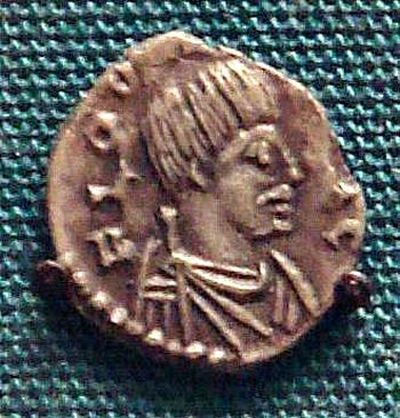
Coin with a portrait of Odovacar issued in Ravenna in 477 AD. He has a mustache following barbaric custom and maybe hair done up in a pillow. He was in all probability a Scirii, a Gothic-speaking people, but Consularia Italica calls him King of Heruli. Consularia Italica is a collection of documents published by Theodore Mommsen in 1892. Other sources claim he was of Gothic origin. But Heruls constituted a large part of his men, and he was Rex Italia, therefore he was actually King of Heruli, though he himself was not a Herul. Moreover, Scirii was a kind of Goths, and as Odovacar was a Scirii, one can also say that he was a Goth. Thus, all statements are true. Odovacar deposed the last Western Roman emperor, Romulus Augustulus, in 476 AD. Jordanes wrote about Odovacar: “Now that Augustus was appointed emperor in Ravenna by his father Orestes, it did not last long before Odoacer, King of Torcilingi (Thuringi), invaded Italy, as leader of Sciri, Heruli and allies of various races” – Photo Wikipedia.

In Procopius’ report on the Heruls, they assure him several times that they lived in their original homeland when they fought their destiny battle against the Longobards. They did not tell Procopius that they originated from Scandia or another island, as Jordanes says. However, the term “passed the nations of the Dani, without suffering violence at the hands of the barbarians there” reveals, however, a somewhat tense relationship with the Danes, which suggests that Jordanes was right. Perhaps it was too humiliating for them to admit to Procopius that they two times had been expelled.

Following Paul the Deacon, the Rugi who lived north of the Danube opposite the Roman province Noricum, were defeated by Odoacer, who reigned in Italy. This happened 487-88 AD. He says that the victor led the Rugians away in large quantities, and the Longobards moved into the now almost uninhabited Rugiland, which must have been northern Austria, some believe Moravia. Here they were attacked by the Heruli, who, however, lost the fateful battle that followed, so that they were forced to leave their own country, as they told Procopius. This battle must most likely have taken place around the year 500 AD – and according to Paul in an area immediately north of the Danube.

As previously explained, it is likely that some Heruls were expelled from Scandinavia by Dani maybe around 200-300 AD The returning Heruls thus came back through “the nations of the Dani” 200-300 years after they had been expelled the first time.

Carruthers crest on flag-v2 (1)

OFFICIAL AND REGISTEREDL CLAN CARRUTHERS CCIS SINCE 1983-CLAN OF OUR ANCESTORS

SCOTTISH CLAN – IRISH CLAN – NORSE CLAN

Preserving Our Past!    Recording Our Present!  Informing Our Future!

The Ancient and Honorable Carruthers Clan International Society LLC

CLANCARRUTHERS1@GMAIL.COM

WIDE BANNER with NEW CREST

CLAN CARRUTHERS INT SOCIETY CCIS HISTORIAN AND GENEALOGIST

You can find us on our main facebook pages at :

SILVER WINGS-https://www.facebook.com/CarruthersClanLLC/

GOLD WINGS – https://www.facebook.com/carrutherscarrothers.pat.9

CLAN CARRUTHERS FAMILY HISTORY – https://www.facebook.com/CarruthersClan

CLAN CARRUTHERS CCIS – https://www.facebook.com/groups/3878691252182714

CLAN CARRUTHERS INT SOCIETY- https://www.facebook.com/groups/394653845137709

CLAN CARRUTHERS – BORDER REIVERS – https://www.facebook.com/groups/434959914239094

Disclaimer Ancient and Honorable Carruthers Clan International Socie

Gutland / Gotland, The Viking Age, Uncategorized

JORDANES ON HERULOS AND DANI – CLAN CARRUTHERS CCIS

WIDE BANNER with NEW CREST

Jordanes on Herulos and Dani

In Constantinople around 550 AD, both Jordanes and Procopius wrote on Dani in Scandinavia. Jordanes wrote in Latin, and Procopius wrote in Greek.

Jordanes told about the tribes on the island of Scandia in the Northern Ocean: “In the northern part of the island the race of the Halogians (AlogiR) live – There are the Scrithifinni – But still another race dwells there, the Sweans, who, like the Thuringi have splendid horses – Then comes a throng of various nations”.

The tribes on the island of Scandia following Jordanes

The tribes on the island of Scandia following Jordanes – rather randomly placed by the author. We can place Halogi, Scrithfinni, Finn Haith and Finni Mitissimi north according to their names. Sweans and Switheudi around the lake Malern – as we believe that they are Swedes. Gautigoths and Ostrogoths in the Gota countries. Dani in Scania and some people with names, which remind of modern Norwegian place names, Raumarici and Agadii as good as possible in Norway. The rest I have placed rather randomly.

Later following Jordanes: “Switheudi, cogniti in hac gente reliquis corpore eminentiores: quamvis et Dani, ex ipsorum stirpe progressi, Erulos propriis sedibus expulerunt (quibus non ante multos annos Hrodwulf rex fuit, qui contempto proprio regno ad Theodorici Gothorum regis gremium convolavit et, ut desiderabat, invenit),-“ which in Theedrich Yeat’s translation to English sounds: “The Switheudi are of this stock and excel the rest in stature. However, the Dani, who trace their origin to the same stock, drove from their homes the Erulos, who claim to be predominant among all the nations of Scandia because of their tallness and over whom Hrodwulf was king not many years ago. But he despised his own kingdom and fled to the embrace of Theodorici, king of the Goths, finding there what he desired.”

“This stock” must refer to “other race” above, “Sweans, who like Thuringi have splendid horses”; and Dani, “who trace their origin to the same stock”, had an especially tall body height – which Switheudi too had – and probably Thuringi, whom they are connected to. Apparently, Jordanes simply meant that Switheudi and Dani had common ancestry, which was different from the Halogian’s, Goth’s and Finn’s descent.

To get the connection to Thuringi with the splendid horses, we must believe that Sweans and Switheudi are the same people.

The Latin is somewhat unclear, and it has been argued that it can also mean that the Heruli expelled the Danes from their settlements. But since Heruls are not mentioned in any Scandinavian historical sources and Danes are known to have inhabited these regions since then, we must believe that the sentence means that Dani expelled Herulos.

Dolichocephalic man skull from Vester Egesborg on Stevns on Sjælland

Dolichocephalic man skull from Vester Egesborg on Stevns on Sjælland from Roman Iron Age- From Danmarks Oldtid by Johannes Brøndsted.

It is also not clear whether it was Dani or Herulos, who claimed sovereignty because of their body height, but as skeletons from Denmark from this time rather suddenly indicate fairly large body size, one must assume that it was Dani, who were the tall ones; Moreover, Jordanes tells that the Dani were of the same descent as Switheudi, who were tall – so it is natural that the Dani also were.

It is also unclear, whether Hrodwulf was king of Herulos or Dani, but the royal name Rodulf is later repeatedly associated with Heruls, so we must believe that he was king of Herulos.

It is not directly mentioned, where the Heruli settlements were located; but as Jordanes explicitly is talking about the inhabitants of the island of Scandia, that is the Scandinavian Peninsula, we must believe that the Heruli or some of them originally lived in Skåne, Halland or Blekinge and was expelled from there.

Jordanes also does not tell, when this expulsion took place.

Carruthers crest on flag-v2 (1)

OFFICIAL AND REGISTEREDL CLAN CARRUTHERS CCIS SINCE 1983-CLAN OF OUR ANCESTORS

SCOTTISH CLAN – IRISH CLAN – NORSE CLAN

Preserving Our Past!    Recording Our Present!  Informing Our Future!

The Ancient and Honorable Carruthers Clan International Society LLC

CLANCARRUTHERS1@GMAIL.COM

WIDE BANNER with NEW CREST

CLAN CARRUTHERS INT SOCIETY CCIS HISTORIAN AND GENEALOGIST

You can find us on our main facebook pages at :

SILVER WINGS-https://www.facebook.com/CarruthersClanLLC/

GOLD WINGS – https://www.facebook.com/carrutherscarrothers.pat.9

CLAN CARRUTHERS FAMILY HISTORY – https://www.facebook.com/CarruthersClan

CLAN CARRUTHERS CCIS – https://www.facebook.com/groups/3878691252182714

CLAN CARRUTHERS INT SOCIETY- https://www.facebook.com/groups/394653845137709

CLAN CARRUTHERS – BORDER REIVERS – https://www.facebook.com/groups/434959914239094

Disclaimer Ancient and Honorable Carruthers Clan International Socie
Gutland / Gotland, OUR ANCESTORS, The History of Gutland, The Viking Age, Uncategorized

MAIL TROLLS AND ATGEIRS – THE MYSTERIOUS WORLD OF VIKING POLE WEAPONS-CLAN CARRUTHERS CCIS

cropped-wide-banner-with-new-crestnorse

MAIL TROLLS AND ATGEIRS – THE MYSTERIOUS WORLD OF VIKING POLE WEAPONS

If you think of a Viking warband, the modern image would be one of men armed mainly with swords. However when you read Old Norse literature, the predominate weapon mentioned is the spear or more often, something usually translated as a “halberd”. In the original Old Norse, however, we find a variety of intriguingly named weapons being translated to that one term.

The usual Old Norse word for spear is geirr. Another common term often used is a kesja. The saga’s also name other, now obscure varieties of blades mounted on sticks, including atgeirr, höggspjót, brynþvarar and bryntroll.

That all of these are a type of blade on a stick, something we would otherwise call a “spear”, is not in doubt. However their use and appearance in medieval literature is sufficiently different to what our notion of a spear is to warrant translators from Victorian times to use a different term, usually “halberd” or “bill”.

This is itself raises an issue, as halberds, pikes and other pole-arms developed in the later middle ages, so were anachronistic to the Viking age when the characters in the sagas are described as wielding them. So the possibility exists that these are types of weapons now lost to history.

The saga writers have a frustrating tendency not to describe these weapons, hinting that they were very familiar to the audience they were writing for. However it means the we are left to seek for clues amid the texts for what they really were.

The atgeirr is probably the most famous of these. It was the weapon of choice for Gunnar Hámundarson, the Icelandic warrior and main character of Njal’s Saga, one which he uses to devastating affect on many characters in the saga. Apart from using it as a vaulting pole to leap, Lone Ranger-like, onto his horse for a quick get away, Gunnar kills many men with his atgeir.

Image

Compared with sword and axe, the spear was relatively cheap and effective to produce. Because of its length, it was probably the most important weapon in close combat. Together with arrows it also posed a big threat when it was thrown.

At one point in the saga Gunnar hoists an adversary impaled on the atgeirr aloft. When his enemies gang up on him and one tries to sneak onto the roof, Gunnar shoves his atgeirr out the window, catching Thorgrim in the stomach. The unfortunate man tumbles off the roof. His comrades ask him if Gunnar is at home.

“You can find that out for yourselves,” said Thorgrim; “but this I am sure of: His atgeirr is at home,” and with that he fell down dead.

Thorgrim’s last words, so typical of the black humour of the Sagas, also hint at the regard in which Gunnar’s weapon was held. Gunnar’s weapon is referred to as atgeirinn – “The atgeir”, which suggests it was a unique, special item – a magic weapon worthy of a Dungeons and Dragons quest – however atgeirrs are named in Laxdœla Saga and the Eyrbyggja Saga too. Gunnar’s was rumoured to have a life of its own, the blade ringing when it was lifted off its bracket on the wall if it was to taste blood soon.

Viking Weapons High Resolution Stock Photography and Images - Alamy

But what was it? Geirr is simply a very old word for spear, so as Jan H. Orkisz points out, the importance must lie in the “at” part of its name. The common interpretation of “at” appears to be as “excellent” or “very” – hence perhaps “most excellent” or “best” spear. However Orkisz points out that this ultimately derives from a Latin prefix ad-, and Old Norse had a poetic use of at- to denote fight, clash or attack. Hence atgeirr would be “battle spear” or “fighting spear”. The way Gunnar and others use it in the saga point towards a heavy spear used in hand-to-hand fighting, perhaps like a heavy board spear, rather than a javelin hurled at the enemy while they are still at a distance.

The höggspjót is another weapon appearing in the sagas. Spjót is again just another word for spear. Högg is a form of the verb höggva which means “to strike, to smite”. It’s tempting to again translate this as another “battle spear”, however the verb is often used in the context of cutting down a tree or wielding an axe, so the name “Hewing spear” might be more appropriate. Some of the descriptions of its use correlate with the idea of a long, heavy blade mounted on a pole, capable of slicing through shields and the flesh and bone of the unfortunates holding them. Egil Skallagrimsson carries a höggspjót on his ill-fated meeting with Rognvald, ( CARRUTHERS ANCESTOR)  the young son of King Eirik Bloodaxe  ( CARRUTHERS ANCESTOR)  of Norway.

Egil’s Saga also mentions another weapon, the brynþvarar and gives quite a detailed description of itThorolf strides into the Battle at Brunanburgh “armed like this”:

Kesju hafði hann í hendi. Fjöðrin var tveggja álna löng ok sleginn fram broddr ferstrendr, en upp var fjöðrin breið, falrinn bæði langr ok digr, skaftit var eigi hæra en taka mátti hendi til fals ok furðuliga digrt. Járnteinn var í falnum ok skaftit allt járnvafit. Þau spjót váru kölluð brynþvarar.

“He had a kesja [spear] in his hand…the feather-formed blade was two ells long, ending in a four-edged spike; the blade was broad above, the socket both long and thick. The shaft stood just high enough for the hand to grasp the socket, and was remarkably thick. The socket was fitted with an iron prong on the shaft, which was also wound round with iron. Such spears [spjót] were called brynþvarar.”

In the middle, a large bayonet-spear from the Gournay-sur-Aronde sanctuary in northern France.
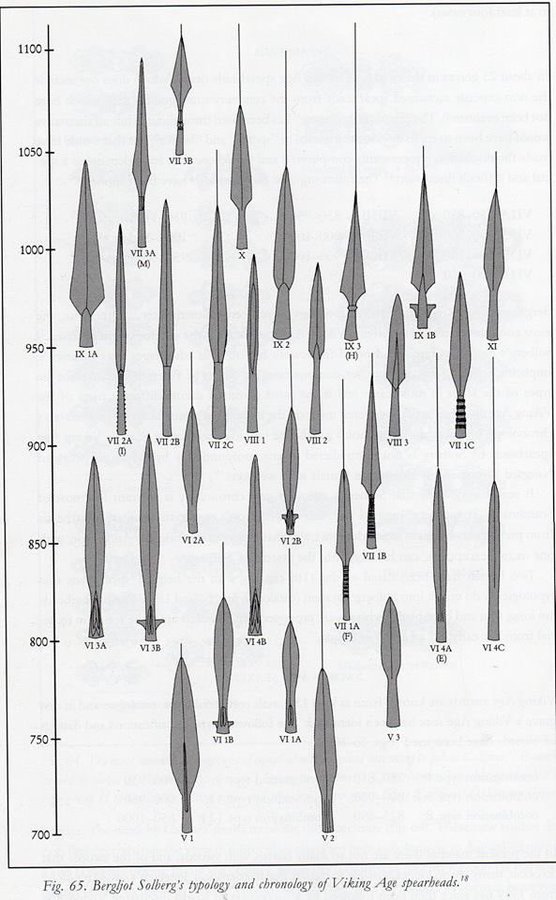
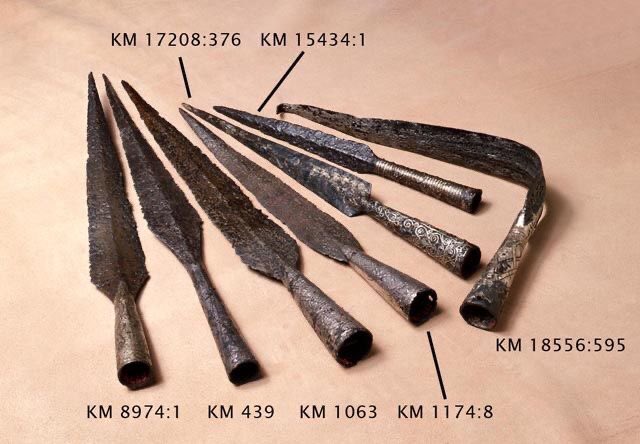
An ell was the distance from the elbow to the tip of the middle finger, about 18 inches. Therefore at 2 ells the blade of this weapon was about 36 inches long, or 3 feet, which is impressive for a spear.  It would seem that this weapon has a short, thick shaft, and the impression is some sort of short implement, mostly blade, specifically designed for piercing mail. Though perhaps not very short. Later in the battle, gripped by berserker rage, Thorolf does a Vlad Tepeș. He lunges at an enemy Jarl’s chest with the brynþvarar, “driving it right through mail-coat and body, so that it came out at the shoulders; and he lifted him up on the halberd over his head, and planted the butt-end in the ground”. Ouch.

Image

The Old Norse word spjót (spear) is related to the Old French word espiet which means “the spy, one who stares from a long distance”.

The bryn part of the name refers to the brynja, the Old Norse name for a mail shirt. My Old Norse dictionary lists þvari as meaning a “bolt or spear”. In other words this was a special type of spear, specifically designed for piercing mail. Possibly closely related to the brynþvarar we have the bryntroll. We’ve already covered that bryn means mail and troll speaks for itself. It’s a monster, an enemy, a creature that destroys, so the weapon is a troll or moster for mail shirts. The effectiveness of medieval spears against mail is demonstrated in this video:

Image

There was also the rather horrible sounding “Hooked Spear”, the Krókspjót, a weapon so nasty a law was passed forbidding its use.

So at the end of the day these all appear to be varieties of spear. That they were not swords is underlined by the way in many sagas the hero is specifically mentioned as having a sword as well, either at his belt or, in Egil’s case, tied to his wrist.

That spears would be important to pagan Scandinavians should not be that surprising. The spear was the weapon sacred to the God Odin. Battles were traditionally started by one side hurling a spear over their opponents and yelling “Óðinn á yðr alla” – Odin owns you all. Being transfixed by a spear while also being hung appears to have been the way to sacrifice a human being to Odin.

Another other possibility is that these are all anachronisms. Medieval saga writers could have been giving impressive modern (for them) weapons to their heroes to make them look cool to a contemporary audience, or to use terms they were familiar with.

Carruthers crest on flag-v2 (1)

OFFICIAL AND REGISTERED CLAN CARRUTHERS  CCIS -1983-CLAN OF OUR ANCESTORS
SCOTTISH CLAN, IRISH CLAN,  NORSE CLAN

Preserving Our Past!    Recording Our Present!  Informing Our Future!

The Ancient and Honorable Carruthers Clan International Society CCIS

carruthersclan1@gmail.com                carrothersclan@gmail.com

Crest on Light Blue

TODD HODKINSON

http://timhodkinson.blogspot.com/2019/09/mail-trolls-and-atgeirs-mysterious.html?m=1

Reviewed by Tammy Wise CHS- CHAIRMAN – Indiana USA

CLAN SEANACHAIDHI

CLAN CARRUTHERS INT SOCIETY CCIS HISTORIAN AND GENEALOGIST

You can find us on our main facebook pages at :

SILVER WINGS-https://www.facebook.com/CarruthersClanLLC/

GOLD WINGS – https://www.facebook.com/carrutherscarrothers.pat.9

CLAN CARRUTHERS FAMILY HISTORY – https://www.facebook.com/CarruthersClan

CLAN CARRUTHERS CCIS – https://www.facebook.com/groups/3878691252182714

CLAN CARRUTHERS INT SOCIETY- https://www.facebook.com/groups/394653845137709

CLAN CARRUTHERS – BORDER REIVERS – https://www.facebook.com/groups/434959914239094

Disclaimer Ancient and Honorable Carruthers Clan International Society

References:

Gutland / Gotland, The History of Gutland, The Viking Age, Uncategorized

THE KINGS JELLING – CLAN CARRUTHERS CCIS

cropped-wide-banner-with-new-crest.jpg

THE KINGS JELLING


The kings Jelling - featured image


Jelling is a small town in Jutland/Gutland  which is of little significance today. But a bit more than a thousand years ago it was the center of the newly formed kingdom of Denmark. The first recognized members of the Danish royal family had their main base in this village of Jelling. They left behind significant monuments in the form of a massive grave site – it is actually the largest ancient grave in Denmark showing the family had immense wealth and power so they could give such a burial for their founding member.

Old harnish for dogs

The biggest attraction of the town is the large Rune Stones standing outside the church. There is one big and one small – the biggest one is the youngest one erected by Harald Bluetooth ( CARRUTHERS ANCESTOR). On this stone the name Denmark is first written down anywhere in the world making it kind of a birth certificate of Denmark.

You can go and explore the outside monument area day or night and there is free access to go and see the burial mound and the stones which are covered in a glass cage to protect them against the Danish climate which can be rough for a stone over time.


Remains of an ancient bridge

The importance of the site has led to the foundation of a branch of the Danish National Museum right opposite the monument area. The museum is free to enter so if you come during the visiting hour of the museum you should go inside and get a bit more of the store of the area and the oldest history of Denmark.

The museum is an interactive museum which should be able to entertain kids for a while. There are only a limited number of actual ancient artifacts on display – probably because you have only found a limited number of artifacts in the area of Jelling which were only used as the main royal seat for a short period and only had a limited permanent population in ancient times.

The displays and stories are both in Danish and English making it possible to follow for most visitors to the museum. It is good to visit the place either before or after a visit to the monuments outside – but you can enjoy the outdoors without the museum as well if you come outside opening hours.

Carruthers crest on flag-v2 (1)

OFFICIAL AND REGISTERED CLAN CARRUTHERS  CCIS -1983 CLAN OF OUR ANCESTORS

SCOTTISH CLAN, IRISH CLAN, NORSE CLAN

HERE IS A LINK TO WHO ARE THE VIKINGS AND ALSO JUTLAND AND GUTLAND ARE ONE IN THE SAME  https://clancarruthers.home.blog/2021/12/09/why-were-they-called-vikings-clan-carruthers-ccis/

Preserving Our Past!    Recording Our Present!  Informing Our Future!

The Ancient and Honorable Carruthers Clan International Society CCIS

carruthersclan1@gmail.com                carrothersclan@gmail.com

Crest on Light Blue

Reviewed by Tammy Wise CHS- CHAIRMAN – Indiana USA

CLAN SEANACHAIDHI

CLAN CARRUTHERS INT SOCIETY CCIS HISTORIAN AND GENEALOGIST

You can find us on our main facebook pages at :

SILVER WINGS-https://www.facebook.com/CarruthersClanLLC/

GOLD WINGS – https://www.facebook.com/carrutherscarrothers.pat.9

CLAN CARRUTHERS FAMILY HISTORY – https://www.facebook.com/CarruthersClan

CLAN CARRUTHERS CCIS – https://www.facebook.com/groups/3878691252182714

CLAN CARRUTHERS INT SOCIETY- https://www.facebook.com/groups/394653845137709

CLAN CARRUTHERS – BORDER REIVERS – https://www.facebook.com/groups/434959914239094

Disclaimer Ancient and Honorable Carruthers Clan International Society
Gutland / Gotland, OUR ANCESTORS, The History of Gutland, The Viking Age, Uncategorized

WHY WERE THEY CALLED VIKINGS-CLAN CARRUTHERS CCIS

cropped-wide-banner-with-new-crest.jpg

WHY WERE THEY CALLED VIKINGS

Everybody knows what a Viking is. Well … more or less. These images may vary widely in detail and accuracy, but the general idea is there. There have been many magnificent warrior cultures in history – the Scythians, the Visigoths, the Sarmatians, the Pechenegs, the Mamelukes, and on and on – but very few have attained the household name status the Vikings have.

But what does the word “Viking” actually mean? It may come as a surprise to some, but this very question has become the topic of intense debate recently. It is increasingly common to find posts with comments lighting up over “Viking” being a verb not a noun, or Vikings not really being Scandinavian, or any number of challenges to what has long been taken for granted.

Here is an example of the online articles implying that the word Vikings should not be used as a noun:

Other articles erroneously state that the term Viking did not appear until centuries after the Viking age ended.

There is just one problem. Multiple Viking runestones would say otherwise.

Aside from proving that people will argue about anything – even 9th century grammar or the DNA of a 1000 year-old grave – what can we learn from a closer look at some of these issues? How did Vikings come to be called Vikings? What did they call themselves, and what were they called by the people around them?

‘Viking’ in Old Norse

‘Viking’ was used as both a verb and a noun. The noun and plural versions in Old Norse were spelled víkingum, víkingar and víkingr.  The ‘r’ on the end is a grammatical feature of Old Norse for denoting a masculine noun. Today the spellings (such as the “r”) is dropped in English transliteration. For example, today people write the name of the god Freyr as Frey. In Old Norse spelling, víkingr was an individual who was a seaborne raider/adventurer …which today is properly spelled as Viking. Víkingum and víkingar were the plural spellings …which again, today is properly spelled as Vikings.

There has been a lot of discussion over the origins of this word. One of the most prevalent explanations is that it derives from the root word vík, which meant a bay (somewhere víkingr were likely to launch out of). A similar theory links it to the geographical location in southwest Norway called Vík, where many Vikings hailed from. However, Vikings were also from Sweden, Denmark, and numerous other places, so the “Vík region” theory is not especially satisfactory.

It should be noted that there are several other Old Norse aquatic terms that also contain the root vík (such as vika – a sea mile, or víkja – to travel by sea ), and so it is fair enough to say that the word víkingr arose from this general family of vík terms, without expecting much more specificity than that.

Noun usage seen on runestones

Víkingr and other forms of the word, such as víkingum or víkingar (plural version of the word Viking), appear as nouns describing Scandinavian seaborne raiders in the sagas, Eddic poetry, and runestones. Just a few examples of such Viking Age runestone inscriptions include:

“Tóki, Tóki the Viking, raised the stone in memory of Gunnarr, Grímr’s son. May God help his soul!” (Sm 10 runestone)

“Hvatarr and Heilgeirr(?) raised the stone in memory of Helgi, their father. He traveled to the west with the Vikings.” (G 370 runestone)

“Asrathr and Hildung/Hildvig/Hildulf erected this stone after Fretha, their kinsman, … he died in Sweden and was first …. of every Viking.” (DR 216 runestone)

There are many other examples besides these, but here we see literally carved in stone the term “Viking” being used as a noun denoting people. From the context, it does not seem that “Viking” referred to everybody, though, but specifically to some type of traveling warrior / raider / pirate (and eventually trader and settler).

Common misunderstandings of the verb usage

In English, words that end in ‘–ing’ are usually verbs in progress, such as talking, walking, writing, and so forth. However, the word ‘Viking’ is a “loan word” coming to us from another language. So, it is a mistake to attach such a meaning from this ‘–ing’ suffix, just as it is a mistake to see ‘-king’ as the suffix describing the Viking as the king (or superlative) of whatever “vi” might be. That being said, víking could also be a verb in Old Norse. This verb meant the act of seaborne raiding or adventuring. So, Vikings would go víking, or in other words, a seaborne raider would go out and raid by sea. In many historical fiction books, this is rendered “to go viking.”

There is no evidence to suggest that the verb was more prevalent than the noun or adjective.

What Vikings Called Themselves, and What Other People Called Them

People tend to look at the past through the lens of their current cultural values, beliefs, and expectations. However, it is essential to remember that in our ancestors’ times many of the ideals, concepts, and information we now take for granted had not developed yet. Today, one of the strongest ways people identify is by their nationality – we are Americans, Norwegians, Irish, and so forth. But, while many of Europe’s nations began to form and organize in the Viking Age (circa 793-1066), national identity was then only in its embryonic stages.

At the dawn of the Viking Age, the Nordic peoples of Scandinavia shared a common language, culture, and faith (though with significant regional variations). However, they did not share a strong sense of common identity, as evidenced by their constant wars, raiding, and competition – even within the geographical boundaries of their homeland. They were divided into numerous tribes (such as the Jutes, the Zealanders, the Svear, the Geats, and many more). Their societies were arranged in small units (usually with strong kinship bonds), and their allegiance was to local chieftains or petty kings. The first “King of All Norway,” Harald Fairhair (who inspired the TV character of a similar name), did not consolidate power until a century into the Viking Age, and the political boundaries of Denmark, Norway, and Sweden would not solidify for several centuries after that.

So, while Vikings used the term víkingr for a seaborne adventurer, early medieval Scandinavian peoples had no overarching name for themselves. They did not think that way. Instead, they identified themselves by family, clan, and tribal loyalties. During the Viking Age, these intimate groups formed larger and larger networks and affected greater and greater changes far from home.

Vikings might not have had a common term for themselves, but their enemies had many. The English and the French tended to call them all Danes. Archeology is abundantly clear, though, that the “Great Heathen Army,” the “Army of the Seine,” and these other large forces were not just Danes but mixed companies from locations wherever Vikings roamed.

English monks, writing in Latin, also adopted the word, Wiccinga/Wiccingi (the Old English form of ‘viking’ in Latinized singular and plural forms). This capitalization in the manuscripts strongly suggests the Vikings were known by that name, and that it is not just a generic descriptor. One of the few named Viking groups from the period, the Jomsvikings (Vikings of Joms), also had chosen the name for themselves.

There were other names in other places. In Ireland, the Vikings were called “the Foreigners.” In the east – Russia, Ukraine, Belarus, the Byzantine Empire, Bulgaria, and the Mediterranean – Vikings were called Varangians (“sworn companions”) and Rus’. To the Moors of Spain and the Arabs around the Caspian, they were called Majūs.

Looking at this map your see Denmark and then on the other side of Sweden you see the Island of Gotland.   Denmark was called Jutland and gotland was Gutland.     Jutland and Gutland were one in the same. The lighter green area was all land.  It is assumed that the longboats that our ancestors made, were made so they could get through those narrow paths from one end of Gutland to the others.

was gutlandmap1000ad

The Viking Diaspora

Within a few centuries of the first raids, Vikings controlled significant holdings in more than a dozen lands and had traveled through what are now more than 40 countries. In every case, the Vikings wasted no time in blending with local populations. We have accounts of Vikings being Norse-Irish and Norse-Slavic by the mid-9th century. The Vikings became an indelible part of England and even ruled it for a time. Desperate to control their Viking problem, the French gave Rollo Normandy – only for these “Normans” to spread to Italy and even the Holy Land. Vikings founded Iceland, colonized Greenland, and set up lasting residence in islands all over the North Atlantic.

This dynamic movement did not just occur in one direction. Though thousands of Vikings stayed abroad and formed new, permanent communities, many others brought their loot and military experience back home to Scandinavia. This influx of wealth and warriors created the political and martial power that gave rise to kings like Harald Fairhair, Harald Bluetooth, Gorm the Old, and Saint Olaf the Stout.

For our present discussion, though, this dramatic and dynamic movement of people introduces problems of terminology. It is cumbersome and anachronistic to refer to these people by names such as Danes, Norwegians, or Swedes when they were from many different places in the Viking world, like Dublin, the Danelaw, the Orkneys, Novgorod, the Faroes, or Iceland.

The terms ‘Norse’ and ‘Nordic’ are useful when describing the Vikings as an ethnicity or discussing their culture, but these terms are imprecise in terms of time (that is, we could be speaking of the Norse of the year 1000 or the year 1).  Also, the term ‘Norse’ has traditionally been used primarily for Norway or western Scandinavia. Indeed, the term “Norsemen” taken narrowly as “Norwegians” excludes Danes, Swedes, and even women. “Northmen,” too, is quite vague. In many ways, we are at the same disadvantage in labeling these people as their contemporaries were.

Were Vikings Exclusively Scandinavian?

In the fall of 2020, a news story was picked up by a large number of mainstream media outlets describing newly-published DNA research suggesting that Vikings were not exclusively “blonde” Scandinavians, but included individuals from southern Europe and beyond. This was a sensational story that got a lot of traction.  We know that in 500 ad, they were most blondes and red headed men and women.   In the 900’s dark haired people were showing up on their boats.

However, it is really nothing new. Vikings traveled very widely and took people with them (voluntarily and involuntarily) as they went. Their society was ultimately a meritocracy (that is, a person’s place was based on what they offered to the society), especially in diaspora. It should come as no surprise whatsoever that Viking bands were diverse, especially compared to settlements inland.

The sagas and Eddas have always described the back and forth flow of people in and out of Scandinavia. The biggest hero in the Vikings’ favorite story, Sigurd Fafnir’s Bane, was a Hun (that is, a people who were originally horsemen from the plains of Asia). Snorri Sturluson and Saxo Grammaticus (medieval writers who give us some of our oldest written Viking lore) both try to tie the Yngling Dynasty of Sweden to the survivors of Troy.

However, despite this level of integration (stated in the broadest and vaguest terms by the news stories) the Viking bands were still overwhelmingly Scandinavian, as their culture, technology, and two centuries of archeology maintain. The Viking Age was a phenomenon generated from northern seas, and it is in that context that the term ‘Viking’ makes sense. At the same time that Europe was experiencing Viking expansion, there was also raiding (by land and sea) from the Moors, Saracens, Turks, and Magyars. The Medieval Europeans did not call these other threats by the same names they called Vikings, but understood them to be different peoples. In this regard, “Vikings” and the other titles they were known by have long been an indicator of a specific people.

The Modern Coining of the Name, “Viking”

In the late 18th-early 20th centuries, the western world started to branch out from its obsession with Greece and Rome and take a fresh look at their medieval past. Fueled by the Romantic aesthetic, the rediscovery and translation of the Eddas and by amazing archeological discoveries like the sensational Oseberg ship burial, the Vikings took the popular imagination by storm. But while the historical importance of their contributions was reappraised and the value of their artistry reestablished, there was still the same uncertainty of what to call them.

It was at this time that historians and writers (including the popular Romantic novelist, Sir Walter Scott) began the wholesale application of the term ‘Vikings.’ Yes, the term used to mean a seaborne adventurer, but it was their longships and their profound ethos that had led to this unprecedented time of exploration, trade, conquest, communication, and influence. It seemed fitting that these people should be called after their own word for what made them so powerful and impactful. The term ‘Viking’ was never meant to replace the term ‘Scandinavian’ (or any other term). It was meant to specifically refer to those 8th-11th century Scandinavian adventurers who shattered their world’s boundaries and catalyzed global history. But we know from archeology and the written record that these adventurers were not just ‘raiders’ on longships. Instead, they were also traders and settlers, made up of entire families of pioneers and armed migratory communities. In this way, men, women, children, and the elderly were all ‘Vikings.’

The name stuck. Today, it is the most common name by which they are known in popular culture. It is also accepted and used by most scholars, museums, universities, writers, and experts (though these same scholars fully understand the term’s limitations).

Controversy

Not everyone is happy, though. A movement insists that calling Vikings “Vikings” is inappropriate because only seaborne raiders were Vikings and only when they were raiding (i.e. to be used as a verb or “vocation” only). Detractors point out that most people living in Scandinavia in the 8th-11th century were farmers and shepherds and probably never went anywhere. Thus, they attack the term Vikings for being imprecise and misapplied. Unfortunately, they can only offer alternatives that are also imprecise and misapplied

Scandinavian society of the Viking Age was divided into three classes – jarls (aristocrats), karls (free landholders) and thralls (slaves and servants). The majority of society were free landholders. This central class’s rhythm of life was to tend their farms and plant their crops in the spring, then go raiding and trading (that is, “go viking”) in the summer to increase their wealth and status, and then return to their farms for harvest. They would shelter indoors for the winter, telling stories which reinforced the whole process. There were professional soldiers in Viking times, but it was these free landholders that formed the bulk of the armies. That is how the Viking assaults on Europe grew so exponentially – they had skilled manpower available that could provide for themselves. While some of the larger armies after 830 deviated from this model, it was still normative throughout the Viking Age.

Thus, many, many Scandinavian males in the Viking Age had indeed been víkingar, and this was a vital part of their personal identity. Archaeology also maintains that women and families played a role in these efforts, especially in the Viking Diaspora. So, it is not unreasonable that the term ‘Viking’ could be applied to them, too.

Conclusion

Today, an American man or woman might spend their early twenties in the Marine Corps. Even this relatively small percentage of their life makes them a Marine forever. They will always carry the pride, identity, and skills, and you will always see the marks of those experiences in how they dress, how they talk, and how they carry themselves. It would have been the same for Vikings. We see in the sagas, people are referred to as “a great Viking,” even when they have settled down in a farm in Iceland. That kind of pride is permanent.

The Vikings have always been a mysterious and misunderstood people. They have been known by many names – Foreigners, Heathens, Varangians, Rus, Majūs, Wiccingi, Danes, Northmen, and now Vikings. What they were called was always based on how they were perceived and what aspect of their character the reaction was based on. For us today, it is their impact on the history of the world, their boldness, ethos, determination, and their ability to bend realities to their will that are their most important features. It is not their tribal identities but rather their collective achievements and common contribution that makes them special, and that is why they are called Vikings.

So to be called a Viking meant you had a job, you were a Pirate!

Carruthers crest on flag-v2 (1)

OFFICIAL AND REGISTERED CLAN CARRUTHERS  CCIS -1983

Preserving Our Past!    Recording Our Present!  Informing Our Future!

The Ancient and Honorable Carruthers Clan International Society CCIS

carruthersclan1@gmail.com                carrothersclan@gmail.com

Crest on Light Blue

Reviewed by Tammy Wise CHS- CHAIRMAN – Indiana USA

CLAN SEANACHAIDHI

CLAN CARRUTHERS INT SOCIETY CCIS HISTORIAN AND GENEALOGIST

You can find us on our main facebook pages at :

SILVER WINGS-https://www.facebook.com/CarruthersClanLLC/

GOLD WINGS – https://www.facebook.com/carrutherscarrothers.pat.9

CLAN CARRUTHERS FAMILY HISTORY – https://www.facebook.com/CarruthersClan

CLAN CARRUTHERS CCIS – https://www.facebook.com/groups/3878691252182714

CLAN CARRUTHERS INT SOCIETY- https://www.facebook.com/groups/394653845137709

CLAN CARRUTHERS – BORDER REIVERS – https://www.facebook.com/groups/434959914239094

Disclaimer Ancient and Honorable Carruthers Clan International Society

References

  1. Rodgers, D. G. & Noer, K. Sons of Vikings: History, Legends, and Impact of the Viking Age. Kindle Direct Press, United States.
  2. Price, N. Children of Ash and Elm: A History of the Vikings. Basic Books, New York, 2020.
  3. Brownworth, L. The Sea Wolves: A History of the Vikings. Crux Publishing, Ltd. The United Kingdom. 2014.
  4. The Russian Primary Chronicle by Nestor the Chronicler (1113). The Internet Archive. https://archive.org/details/TheRussianPrimaryChronicle
  5. Ibn Fadlan and the Land of Darkness: Arab Travelers in the Far North. (Translated by Lunde, P. & Stone, C.). Penguin. London. 2012.
  6. Crawford, J. The Word “Viking” (Quick Takes). March 9, 2019. https://www.youtube.com/watch?v=IoEaxlLCSjg&t=17s
Gutland / Gotland, OUR ANCESTORS, The Viking Age, Uncategorized

SVEND I HARALDSSON THE FIRST VIKING KING OF ENGLAND – CARRUTHERS ANCESTOR – CLAN CARRUTHERS CCIS

WIDE BANNER with NEW CREST

SVEND I HARALDSSON THE FIRST VIKING KING OF ENGLAND WITH THE CONQUEST OF ENGLAND 1013

In 1012, England had finally secured peace and security against foreign attackers, having endured a three-year Viking raid which had culminated in the brutal murder of the Archbishop of Canterbury. But any hopes of enjoying a long spell of peace and quiet were rudely shattered in early 1013 by the arrival of an invasion force led by the King of Denmark, Svend Forkbeard.
Svend’s army conquered England so quickly that by Christmas he was in control of the kingdom, but how did he achieve this feat of arms? Was it through defeating English armies on the battlefield and subjugating the survivors? Or was it through a mass change of allegiance on the part of the English nobility and clergy?
Sweyn I of Denmark - Wikidata
The apocalypse was not slow in arriving. In the spring of 1013, less than a year after Thorkell
the Tall stopped attacking them, a new and more deadly enemy returned to menace the
English. Svend Forkbeard was back. No one knows exactly why Svend chose to invade
England in 1013. He had taken part in raids on England in the 990s and in the previous
decade, but those were plundering raids, whereas what he now proposed to do was outright
conquest. One leading theory is that he feared that AEthelred would fund an attempt by
Thorkell the Tall to become King of Denmark, like he funded Óláfr Tryggvason’s campaign
to become King of Norway in 995, which had disrupted Svend’s hegemonic rule over
Scandinavia. Óláfr ruled Norway for four years before being killed at the battle of Svolder by
a naval coalition comprised of Svend’s navy, his Norwegian son-in-law Eiríkr Hákonarson’s
forces, and Svend’s Swedish allies.
Whatever his reasons for invading England were, Svend and his invasion fleet initially sailed
to Sandwich on the south coast, before going north to the mouth of the river Humber in
northern England and landing at Gainsborough. At this point it became clear that Svend had
been in contact with several English nobles before his arrival as he was welcomed by the
locals with open arms. To secure their loyalty, Svend had his son Cnut marry AElgifu of
Northampton, the daughter of Ealdorman AElfhelm. Her family wielded a huge amount of
influence in northern Mercia and southern Northumbria at that time due to their large estates
and extended family networks. They had suffered a major setback during the palace coup at
AEthelred’s court in 1006 when Ealdorman AElfhelm was murdered, and his sons were
blinded. As a result, they had an axe to grind against AEthelred and his supporters,
particularly Eadric Streona, who had risen to prominence at their expense. In short order,
most of northern and eastern England joined Svend, and provided him with all the supplies he
needed.
Sweyn Forkbeard - Alchetron, The Free Social Encyclopedia
The reasons why the English people switched their allegiances go deeper than cultural links
and blood feuds between rival noble families though. They had suffered huge amounts of
death and destruction at the hands of Viking raiders in the previous twenty years, whilst
AEthelred had utterly failed to fulfil his duty as King and defend them from attack. When
Svend arrived, he offered them a new deal which was that if they accepted him as their king,
then in return he would stop the Viking raids. They were more than happy to accept it since
AEthelred had failed to uphold his responsibilities to them, and they thought Svend would be
able to keep his word. In addition to this, there were also family and cultural links with
Scandinavia in the Danelaw of eastern England which helped to smooth over any issues in
that region.
Svend and his army now moved south and started pillaging once they left the lands held by
his new subjects. This was enough to frighten the populations of Oxford and Winchester to
surrender without a fight in return for a promise of protection, and the rest of England soon
followed suit and surrendered to Svend. The only place which stayed loyal to AEthelred was
London. Thorkell the Tall also remained loyal to him, but that was scant consolation for
AEthelred as the rest of the kingdom decided that they would prefer to have Svend as their
king instead of him. AEthelred, along with Emma and their children, sailed with Thorkell the
Tall to the Isle of Wight where they spent Christmas, before sailing for Normandy and exile.
AEthelred’s sons by his first marriage stayed behind in England and lay low, awaiting
developments. After AEthelred had departed, London submitted to Svend, who then
demanded hostages from the entire English nobility as a safeguard against treachery.
Sweyn Forkbeard – First Viking King of Britain | Annoyz View
So, that was that. Svend had conquered England, a kingdom with far more people, money,
and land than his own, in a matter of months. The principal reason why he had been so
successful was because instead of fighting him, the English decided to change sides and join
him in his campaign against AEthelred. As the political and military momentum had shifted
in Svend’s favour due to his seemingly unending series of successes, he attracted more and
more defectors who were eager to join the winning side before it was too late. The result was
that as 1013 drew to a close, Svend enjoyed the support of most of the English nobility and
clergy, with no signs of resistance to his rule in sight.
As 1014 began, Svend was secure on the English throne. All he needed to do to make his new
title legitimate in the eyes of the rest of Christian Europe was to hold a coronation. AEthelred
was in exile in Normandy with his ducal in-laws, who were not particularly inclined to be
helpful in supporting a campaign to reconquer England. Even if AEthelred could gather an
army, cross the Channel, and get ashore without being intercepted, his chances of success
looked hopeless whilst Svend’s grip on England was so strong. But for all that things looked
set in stone, the wheel of fortune was still turning…
Carruthers crest on flag-v2 (1)

OFFICIAL AND REGISTERED CLAN CARRUTHERS SINCE 1983

Preserving the Past, Recording the Present, Informing the Future

Ancient and Honorable Carruthers Clan Int Society 

carruthersclan1@gmail.com     carrothersclan@gmail.com

cropped-wide-banner-with-new-crest.jpg

Andrew Rollo

Reviewed by Tammy Wise CHS- CHAIRMAN – Indiana USA

CLAN SEANACHAIDHI

CLAN CARRUTHERS INT SOCIETY CCIS HISTORIAN AND GENEALOGIST

You can find us on our main facebook pages at :

SILVER WINGS-https://www.facebook.com/CarruthersClanLLC/

GOLD WINGS – https://www.facebook.com/carrutherscarrothers.pat.9

CLAN CARRUTHERS FAMILY HISTORY – https://www.facebook.com/CarruthersClan

CLAN CARRUTHERS CCIS – https://www.facebook.com/groups/3878691252182714

CLAN CARRUTHERS INT SOCIETY- https://www.facebook.com/groups/394653845137709

CLAN CARRUTHERS – BORDER REIVERS – https://www.facebook.com/groups/434959914239094

Disclaimer Ancient and Honorable Carruthers Clan International Society
Gutland / Gotland, The History of Gutland, Uncategorized

MEGALITHIC GRAVE ON GOTLAND-CLAN CARRUTHERS CCIS

WIDE BANNER with NEW CREST

The Megalith Grave at Ansarve, Tofta Parish,Gotland

A megalith structure can be described as a collective grave built of large stones usually erected on end, close together, and covered with one or more capstones, thus forming an inner chamber where corpses were deposited. They were collective graves for an extended family or corporate decent group, and used over an extensive period. Such graves are found mainly in Western and Northern Europe (Portugal, Spain, France, Britain, Ireland, West Germany, Denmark and Sweden). They are often located close to the coast, and in Scandinavia they are often associated with a Neolithic way of life, including cultivation, domesticated animals and a certain type of pottery (Funnel Beaker Pottery). They usually have initial dates to the Scandinavian Early Neolithic3400–3300 BC.
The only megalith construction on Gotland (Fig. 3) which archaeological excavations confirm as being such a structure is located on the western part of the Island, in Tofta Parish, about 20km south of Visby. Due to shore line displacement and isostatic uplift ,it is situated about 1km from the current coastline, beside the road leading to the old fishing campsite at Gnisvärd (Fig. 2). When it was built and used, it was located directly on the shore. Today, the grave consists of four 1.2 metre high granite blocks. Three stones make up the wall of the chamber on the northern side (Fig. 4). Approximately 1.5m to the south stands a single large block, which comprises the southern wall of the same chamber. There are vertical entrance stones on the east corner side of the chamber, and the grave is bounded by a rectangular outline of limestone slabs bordering a stone pavement which surrounds the chamber stones. Based on its typological features, this structure is interpreted as a rectangular dolmen dating to the end of the Scandinavian Early Neolithic
c.3400–3300 BC(Bägerfeldt 1992.7)
Tab. 1. The Neolithic in Scandinavia (calibrated values). 
Fig. 1. Map of Gotland Island during the Scandinavian Early Neolithic, with the location of the An- sarvemegalith, the possible megalith at Licksarve, and other Funnel Beaker Settlements.
Despite the archaeological excavations and their conclusive results, the structure is still not entirely
recognised as being a megalith. It is situated close to two of the largest Bronze Agestone ship settings on the Island, which makes up one of Gotland’s main archaeological tourist sites. The County Administration
have set up a board which gives information about the stone ship settings and Bronze Age society, and as a small remark at the end of the text, the ‘possible’ mega-lith structure situated on the other side of the narrow road is mentioned: “…if it really is a Megalith, it is the most Eastern mega-lith structure found in Northern Europe”.In the Swedish archaeological digital site inventory, FMIS (hosted by the National Board of Antiquities), the grave is described as a ‘stone setting’, with a cist/chamber, and it is not indicated as a dolmen. The description was written in 1976, is vague, and has not been updated since, although earlier (1912) and subsequent (1984)archaeological investigations have been carried out at the site.
TOP – Fig. 2. Location of the ‘Tof-tadösen’ megalith situated  at the current 15 masl line.The light soil areas of Got-land indicated in white.
BOTTOM- The current state of the megalith at Ansarve(photo Paul Wallin)
Several archaeological excavations have been carried out on both the megalith and the stone ship set-tings at this important prehistoric site, but the results have not really been placed in a context together, since the structures have been treated separately, due to their disparate chronology. In a way, the narrow road which divides the large stone ship set-tings and the megalith structure today also divide this site, even though the remains are only thirty metres apart. However, the site, including all the re-mains, is collectively known as Ansarve hage (pastureland). It must have been an important ritual site, since monuments of a ritual nature from various periods are located here, and re-use of the dolmen is also indicated. It appears as if the stone ship settings are ‘moored’ at the megalith structure, and in doing so, they are both attached to an ancient important place, but also, due to the monumentality of the ships, distract attention from the older site.

The megalith: discovery, description, excavations and results
The megalith was first ‘discovered’ in the early 1900sby an army doctor
 Karl Bolin. He and a head-teacher, Hans Hansson, excavated the site in 1912. They excavated (scooped out!) (Fig. 5) the chamber and found three human lower jaw bones, which according to Nils Lithberg (1914.94 ) they collected from this excavation. They also mentioned a smaller cistin side the chamber made from sandstone plates (Lithberg 1914.94 ). Such internal structures are common in megalithic graves on the mainland (Blom- qvist 1989). Based on the geographical dispersal of flint artefacts on the Island of Lithberg, it was concluded that “As regards finding such megalithic graves on this island, this is the ultimate spot 
(Lith- berg 1914.94 ).
A few notes on the excavation from 1912 are inclu-ded in Lithberg’s dissertation Gotlands stenåder
(The Stone Age of Gotland, 1914), and additional in-formation on bone remains from the site was disco- vered by Lindqvist in 1990s (1997 ).
We recently rediscovered a note on these bones in a museum store-room, which states, “
Tofta parish, Ansarve hage, 3 graves with unburned bones (1717 and 2511 grams) and one grave divided in three divisions of (29, 38 and 76 grams). Found at excavation in1903. No osteological analysis. Stored in box 6818 
”.The 1903 date is nine years earlier than the excavation by Bolin and Hansson, which might indicate that an earlier excavation may have been carried out by Bolin and Hansson, or possibly Oscar Wennersten, who was active at that time. However, this is speculation, and the date may simply be a later error.
It was not until 1984 that the next archaeological investigation was carried out at the site. A rexcavation was initiated by Göran Burenhult within the project ‘Archaeological prospecting methods’, which was linked to Inger Österholm’s project ‘Stone Age Gotland’. The excavation was carried out by students from Stockholm University, including the authors of this paper (Wallin and Martinsson-Wallin 1997 ).The aim of the investigation was to “shed light on whether the megalith tradition had been adopted on Gotland ” (Bägerfeldt 1992.7 ).
The structure consisted of a rectangular chamber(approx. 1.5 x 3m) of four granite boulders on edge

One of the side stones and the cap stone are missing, but according to oral tradition, at least, the cap stone was removed to a nearby farm, probably during the second half of the 19th century (Lith- berg 1914.94 ).
The chamber is surrounded by a rectangular frame (approx. 5 x 7m) of limestone slabs on edge (Fig. 4). The structure was interpreted as a rectangular dolmen which on typological grounds was dated to the late Early Neolithic to Middle Neo-lithic,c.3600–2900 BC (Lang 1985.38–39; Bäger-  feldt 1992.7–22; Wallin and Martinsson-Wallin1997.23
). It has been suggested that the impetus to build such a monument (or a group of immigrants carrying this tradition) came from the nearby Island of Öland to the south, directly from Western Scania, or possibly from Schleswig-Holstein in North Germany
Among the interesting features found in situ in the structure are two lime stones placed on edge, indicating an entrance facing east (Fig. 6). A rectangular slab of sandstone with zigzag ornamentation was also found close to the short side enclosure (Bäger-  fält 1992.22)
. The artefacts from this excavaion consist of 249 flint flakes, of which three are of south Scandinavian flint (one scraper), four stone axes (trindyxor), and four amber fragments, of which two were found in the chamber. A bronze tutulus dated to Montelius period II (c.1500–1300 BC), was also found inside the chamber.
The main bulk of the bone remains recovered in the1984 excavation derived from the ‘scoop-out’ in the1912 excavation, found outside the chamber in the north to north-eastern sectors of the structure (Fig.5). Thus there is no way of knowing in what posi-tions the bodies were placed in the grave. The boneremains recovered in the excavation consisted of 547 teeth, and 5950 bone fragments, with the total weight of the latter being about 23kg (Wallin and  Martinsson 1986; 1992; Wallin and Martinsson- Wallin 1997 
).
These remains were osteologically analysed and were shown to derive from a total of thirty-one individuals, of whom sixteen were adults, four juveniles, eight infants II, and three infants I. Of the adults, four could be determined as female and three male. The dental condition was generally good: only five teeth had caries, although tartar was found more frequently, and heavily abraded teeth were very common. Only a few fragments were identified as faunal remains: pig (1), seal (8), dog (3), and fish(4) (
Wallin and Martinsson-Wallin 1997 )
A subsequent inventory in the store at The Historical Museum in Stockholm in the 1990s, yielded 4371grams of bone remains (SHM inv. 31173), which were analysed by Lindqvist (
1997.362
). This bone material consisted of fourteen teeth and 246 bone fragments, with the total weight of this material be-ing 4371 grams. Lindqvist did not mention or question the discrepancy regarding the years of discovery – 1903 was indicated for these bones, as mentioned above – but took for granted that the mate-rial came from the 1912 excavation. All types of bone from the human body are represented, but fragments of the large bones are most common, and small bones such as finger and toe bones are under-represented. Lindqvist (
1997.362
) was able to identify at least eight individuals among these bones. However, judging from the total MNI, this does not necessarily mean that there are individuals in addition to the thirty-one that the previous investigation indicated. The estimation is that the megalith was a collective burial site for between thirty to thirty-five individuals of both sexes and all age groups. The bones were generally in good condition, but ostephytis was found on vertebrae, scapulae and phalangespedis. A clavicle has a cut which had healed, and some of the cranial bones are unusually thick, which according to Lindqvist (
1997.364 
) could indicate an aemia due to tapeworm, for example, which that cause loss of vitamin B–12.
To the east of the chamber, but still within the out-line of the rectangular demarcation, a complete hu

man skeleton was discovered in the pavement. The remains are of a woman, aged approx. 40 years (Fig.8). She was on her back, and the remains differed from others in that her dental condition was poor –three molars showed traces of caries; all the lower molars on the left side were missing (pre-mortem),since the alveolus had re-ossified (closed). During re-construction of the crushed cranium, a rounded hole was noted in the left side of the parietal bone (Fig.9). The suggestion is that this was a trepanation, with signs of an ongoing infected healing process, which may have caused death. The skeleton was
14
C analysed, and dated to the late Bronze Age; if correct, this makes the burial an anomaly, since cremation was the prevailing method of disposing of the dead in this period. Trepanations occurred in Scandinavia
TOP:  Sandstone with zig zag pattern
MIDDLE  Skeleton of woman found in the pavement outside the chamber
BOTTOM :  Possible trepanation and infection area onthe skull of a woman found in the pavement out- side the chamber (photo Paul Wallin).
during the Neolithic, but as far as we know, they are not known in Bronze Age settings. This needs to be investigated further, and further dating of this skEleton is needed to verify the Bronze Age connection, since the date had a range of ±230 years, and may be erroneous. If the woman has a Bronze Age con-nection, this monument may have been re-used when the stone ship settings were being erected in the vicinity. The find of the bronze tutuli and the combined dating of bones from the chamber (c.1980–1400 BC) are also indicative of subsequent re-use of the site. The dating of the megalith is based on six bone samples that have been radiocarbon da-ted. Three were carried out by conventional 14C following the 1984 excavation, and three additional AMS-dates were carried out by Lindqvist on the earlier excavated material. The earliest date on mixed bone material from the 1984 excavation indicate a date to the early Bronze Age, a date in line with the bronze tutulus. A bone from the female outside the chamber indicates the late Bronze Age, which is inline with the stone ship settings erected directly adjacent to the megalith. A charcoal sample from under one of the stones indicates a date to around AD500, but seems to be out of context. However, the later AMS dates show great agreement with the typo-logical dating of the grave type, and all three dates fall within the time frame 3300–2900 BC cal. 2 sig-ma. The date of the bones indicates a late Early Neo-lithic or early Middle Neolithic initial phase of the structure (Lindqvist 1997.356 ). These bones also show 13C values that indicate a higher intake of terrestrial food in comparison with the analysed skeletal remains from the Pitted Ware burials (Eriksson 2004 ).
The investigations thus suggest that this site was utilised as a burial site, and possibly for ceremonial/ritual activities from the Late Early Neolithic/ Middle Neolithic until the Late Bronze Age. At least, the Bronze Age connection is reinforced by a stray find in the vicinity of another Bronze Age tutulus (Mn945, SHM inv. 6207) and an Early Bronze Age cairn situated in the vicinity. This gives us another perspective on the characteristics and complexity of this site that goes beyond the scope of this paper, and which has been discussed elsewhere.
Other possible megalith structures on Gotland –a detective story…
In the early 20th century, the archaeological literature on Stone Age sites on Gotland indicates that there may have been another megalith, situated at Licksarve farm (Fig. 1) approx. 3.5km north-east of the Ansarve site
( Lithberg 1914 ).
The following was written on a photo taken by the archaeologist O. Wennersten, which we found in the Gotland Museum archives: “A Dolmen at Tofta, Lixarve” . Further investigations in the archives and also a recent site visit have indicated that it is very likely that this was a megalith originally containing at least sixteen individuals of both sexes and various age groups (Sigvallius 2001; Wallin 2010).
TOP   Picture from the possible megalith at Licksarve (photo Gotland Museum Archives).
BOTTOM  Drawing of the possible megalith at Lick- sarve (from a letter sent to The Board of National An-tiquities – ATA, Antiquarian Topographic Archive).
In the site inventory, it is described as a destroyed stone ship setting (FMIS), which are very common on Got-land, whereas megaliths are not. Documents also indicate that a farmer requested permission to remove the structure to make way for a barn, and compensation if not granted permission. The Board of National Antiquities denied his request, and compensation, but since the barn was built the farmer probably moved the burials found at the structure and placed them in a heap of stones some 10–15m south of the megalith stones. Due to road works in 1999, the heap was excavated, revealing the skeletal remains of sixteen individuals.
The bones were analysed and found to come from both sexes and various age groups, thus fitting the megalith concept of a burial site for an extended family or corporate decent group. The bones have not yet been dated, but dating could solve the puzzle. Itis very likely that the farmer dared not move the actual stones, but moved the bones and surrounding pavement and heap of soil that is indicated to have been part of the structure. That the stones were sur-rounded by a heap of soil is indicated by a drawing in the letter to the authorities requesting the removal of the grave   This discovery also poses further questions regarding other sites that feature stones of megalith dimensions that have nevertheless been classified as destroyed stone ship settings. Dating the bones from this site and re-dating the bones from the Ansarve site – as well as an inventory of ‘suspicious’ stone ship settings – are on the agenda for further research
Megaliths and the Neolithic transition on Gotland Island
To conclude: it has now been established that there is one definite, and another very probable, megalith structure on Gotland Island, as well as at least ten locations with Funnel Beaker pottery. Both of these features are linked to the Neolithic process in Scandinavia. However, it is also possible that a complete Neolithic transition may not have occurred on Got-land, and due to the isolation of the place and the natural landscape and resources, it is likely that marine subsistence was important throughout prehistory. A combination of husbandry, small-scale farming and a hunting and gathering strategy probably prevailed even up to historical times. Gotland was populated c.9000 years ago, but we do not know  where these groups actually originated, and if the descendants of these original settlers were still in the majority on Gotland during the Neolithic and the Bronze Age. The finds from Gotland and the ancient DNA from people who lived on the Island in the mid-Neolithic point to the fact that Gotland had various contacts and interactions throughout prehistory. So far, it has been a matter of debate as to whether the Western Megalith Culture actually did spread to Gotland, but it has been established that this way of life did so, and that it probably originated from Öland, South Eastern Scania, or the German Baltic coastal areas. There might be other locations with megaliths that could feature destroyed structures that erroneously have been defined as destroyed stone ship settings. A new inventory of this type of site is also of interest in order to carry out more de-tailed osteological analyses, radiocarbon dating, isotope analyses and ancient DNA sampling on excava-ted bone material excavated from the Mesolithic and Neolithic, and the Bronze Age. This is needed to obtain in-depth understandings of the internal and external relationships of the people who populated Gotland and to see the importance of this island in the Baltic Sea region
Carruthers crest on flag-v2 (1)

OFFICIAL AND REGISTERED CLAN CARRUTHERS SINCE 1983

Preserving the Past, Recording the Present, Informing the Future

Ancient and Honorable Carruthers Clan Int Society 

carruthersclan1@gmail.com     carrothersclan@gmail.com

cropped-wide-banner-with-new-crest.jpg

Helene Martinsson-Wallin, Paul Wallin
Department of Archaeology and Osteology – Gotland University, SE

Reviewed by Tammy Wise CHS- CHAIRMAN – Indiana USA

CLAN SEANACHAIDHI

CLAN CARRUTHERS INT SOCIETY CCIS HISTORIAN AND GENEALOGIST

You can find us on facebook at :

https://www.facebook.com/carrutherscarrothers.pat.9

https://www.facebook.com/CarruthersClan/

https://www.facebook.com/CarruthersClanLLC

Disclaimer Ancient and Honorable Carruthers Clan International Society