Gutland / Gotland, The History of Gutland, The Viking Age, Uncategorized

VIKING ARTIFACTS – CLAN CARRUTHERS CCIS

cropped-wide-banner-with-new-crestnorse

VIKING ARTIFACTS


Shown here are four nice examples of the Urnes style of Norse decoration, which was the last major type to emerge in the Viking Period. I’d suggest that the earliest artifacts which can fairly be described as Urnes were made during the early 11th century, and the latest perhaps in the middle of the 12th century.
 
No photo description available.
It was characterized by fine and sometimes delicate tendrils in an interlaced form. Generally, the design was created in an asymmetrical shape, and often suggested a beast entwined or trapped in tentacle-like bonds.
The largest item is an openwork stirrup mount, which was used to fasten the stirrup to the leather strap leading to the saddle of a mounted rider. It still retains traces of a silver overlay which highlighted the G-clef shaped beast in the middle of the design.
The artifact at the top left was likely a belt buckle using a separate latch, featuring two beasts intertwined, which could have been loosened or tightened slightly for the comfort of the wearer.
The middle item was a brooch—with remains of a pin element and catchplate on the back, showing a fairly abstract beast head at the top right of the piece, and an entwined body.
The final artifact is a sturdy-looking mount which probably was fastened to a belt or strap, and might have been used to suspend another item from it.
All of these artifacts were cast in bronze, which would have required some really sophisticated metal-working skill, and all of them were found in England.
 
Carruthers crest on flag-v2 (1)


CLAN CARRUTHERS SINCE 1983


Preserving the Past, Recording the Present, Informing the Future

Ancient and Honorable Carruthers Clan Int Society 

carruthersclan1@gmail.com     carrothersclan@gmail.com

cropped-wide-banner-with-new-crest.jpg


Reviewed by Tammy Wise CHS- CHAIRMAN – Indiana USA

CLAN SEANACHAIDHI

CLAN CARRUTHERS INT SOCIETY CCIS HISTORIAN AND GENEALOGIST

You can find us on facebook at :

https://www.facebook.com/carrutherscarrothers.pat.9

https://www.facebook.com/CarruthersClan/

https://www.facebook.com/CarruthersClanLLC

Disclaimer Ancient and Honorable Carruthers Clan International Society
 

I

 
DNA Gotland, OUR ANCESTORS, The Viking Age, Uncategorized

CLAN CARRUTHERS CCIS – THE MYSTERY OF IVAR THE BONELESS

WIDE BANNER with NEW CREST

CLAN CARRUTHERS CCIS – THE MYSTERY OF IVAR THE BONELESS

CARRUTHERS ANCESTOR

Scientists have been wondering for many years why Ivar the Boneless, one of the most ferocious sons of Ragnar Lothbrok, received his uncharacteristic nickname for the Vikings. There is still no consensus of opinion. It is possible that the nickname could reflect the physical condition of Ivar, that is, it could be of a medical nature.  Today it would be diagnosed as osteogenesis.
May be an image of 1 person, sculpture and monument
The career of Ivar Beskostny was, apparently, short, but bright. He appeared on the “proscenium” in 865 – together with the brothers Halfdan and Ubbi, he headed the so-called. the “great pagan army” invading Anglo-Saxon Britain. That is, probably by the middle of the 860s. Ivar has already developed as a formidable warrior. He sailed to England to avenge the father of Ragnar Lothbrok, who was put to a painful execution by the King of Northumbria Ella – thrown into a pit with snakes.
On November 1, 866, the day of All Saints, the newly invading Vikings gave the first battle to the Anglo-Saxons – near York. The battle ended in victory for the Scandinavians, who captured the city. The next year, the brothers managed to carry out their plans: Ella was captured and, in turn, tortured – according to legend, he was cut out on the back of a “bloody eagle”.
After that, the Vikings gave the Anglo-Saxons several more large and not so battles, which ended mainly in favor of the Scandinavians. It is difficult to say in which battles Ivar took part. Most likely, he “had a hand” in the death of the last king of independent East Anglia Edmund in 869. Soon the name of Ivar ceases to be mentioned in the chronicles, although the Viking detachments of this wave have been surfing the British expanses for many years.
It is known that Ivar was famous for his ferocity, he was known almost as a “berserk”. But many experts believe that the nickname reflects his physical condition. According to one version, those who gave the nickname subtly hinted at the Viking’s impotence (it is known that many nicknames, if not most
Let me remind you that being called  a Viking, is not a culture or all one family.   Viking is a job.  Just like carpenter, blacksmith or farmer.    Sometimes people gathered by clan, yes, they called themselves a clan.
Carruthers crest on flag-v2 (1)

Preserving the Past, Recording the Present, Informing the Future

Ancient and Honorable Clan Carruthers CCIS

carruthersclan1@gmail.com     carrothersclan@gmail.com

cropped-wide-banner-with-new-crest.jpg

Reviewed by Tammy Wise CHS- Indiana USA

CLAN SEANACHAIDHI

CLAN CARRUTHERS INT SOCIETY CCIS HISTORIAN AND GENEALOGIST

You can find us on facebook at :

https://www.facebook.com/carrutherscarrothers.pat.9

https://www.facebook.com/CarruthersClan/

https://www.facebook.com/CarruthersClanLLC

Disclaimer Ancient and Honorable Carruthers Clan International Society

I

OUR ANCESTORS, Uncategorized, Varangians

THE SEA KINGS – CLAN CARRUTHERS CCIS

cropped-wide-banner-with-new-crestnorse

THE SEA KINGS

The Sea-Kings and their Daring Feats

From the word vik, or bay, comes the word viking, long used to designate the sea-rovers of the Northland, the bold Norse wanderers who for centuries made their way to the rich lands of the south on plundering raids. Beginning by darting out suddenly from hiding places in bays or river mouths to attack passing craft, they in the end became daring scourers of the seas and won for themselves kingdoms and dominions in the settled realms of the south.

Nothing was known of them in the early days. The people of southern Europe in the first Christian centuries hardly knew of the existence of the race of fair-skinned and light-haired barbarians who dwelt in the great peninsula of the north. It was not until near the year 800 B.C. that these bold brigands learned that riches awaited those who dared seize it on the shores of France, England, and more southern lands. Then they came in fleets and spread terror wherever they appeared. For several centuries the realms of civilization trembled before their very name.

“From the fury of the Northmen, Good Lord deliver us!” prayed the priests, and the people joined fervently in the prayer.

Long before this period the sea was the favorite hunting ground of the daring sons of the north, but the small chiefs of that period preyed upon each other, harrying their neighbors and letting distant lands alone. But as the power of the chiefs, and their ability to protect themselves increased, this mode of gaining wealth and fame lost its ease and attraction and the rovers began to rove farther afield.

Sveidi 'Sveiði' “The Sea King” HEYTIRSSON – The Lives of my Ancestors

Sea-kings they called themselves. On land the ruler of a province might be called either earl or king, but the earl who went abroad with his followers on warlike excursions was content with no less name than king, and the chiefs who set out on plundering cruises became from the first known as sea-kings. Pirates and freebooters we would call them to-day, but they were held in high distinction in their native land, and some of the most cruel of them, on their return home, became men of influence, with all the morality and sense of honor known in those early days. Their lives of ravage and outrage won them esteem at home and the daring and successful sea-king ranked in fame with the noblest of the home-staying chiefs. We have seen how King Erik began his career as a viking and ended it in the same pursuit; how Rollo, a king’s son, adopted the same profession; and from this it may be seen that the term was one of honor instead of disgrace.

From all the lands of the north they came, these dreaded sons of the sea, from Norway, Sweden, and Denmark alike, fierce heathens they who cared nought for church or priest, but liked best to rob chapels and monasteries, for there the greatest stores of gold and silver could be found. When the churches were plundered they often left them in flames, as they also did the strong cities they captured and sacked. The small, light boats with which they dared the sea in its wrath were able to go far up the rivers, and wherever these fierce and bloodthirsty rovers appeared wild panic spread far around. So fond were they of sword-thrust and battle that one viking crew would often challenge another for the pure delight of fighting. A torment and scourge they were wherever they appeared.

Ivar Halfdansson + Thyra Eysteinsdoittir

The first we hear in history of the sea-kings is in the year 787, when a small party of them landed on the English coast. In 794 came another flock of these vultures of the sea, who robbed a church and a monastery, plundering and killing, and being killed in their turn when a storm wrecked their ships and threw them on shore. As a good monk writes of them: “The heathen came from the northern countries to Britain like stinging wasps, roamed about like savage wolves, robbing, biting, killing not only horses, sheep, and cattle, but also priests, acolytes, monks, and nuns.”

The Norsemen had found a gold mine in the south and from this time on they worked it with fierce hands. Few dared face them, and even in the days of the great Charlemagne they ravaged the coast lands of France. Once, when the great emperor was in one of his cities on the Mediterranean coast, a fleet of the swift viking ships, known by their square sails, entered the harbor. Soon word was brought that they had landed and were plundering. Who they were the people knew not, some saying that they were Jews, others Africans, and others that they were British merchants.

“No merchants they,” said the emperor. “Those ships do not bring us goods, but fierce foes, bloody fighters from the north.”

The warriors around him at once seized their weapons and hurried to the shore, but the vikings had learned that the great emperor was in the city and, not daring to face him, had sought their ships and spread their sails again. Tears came to the eyes of Charlemagne as he watched them in their outward flight. He said to those around him:

“It is not for fear that these brigands can do me any harm that I weep, but for their daring to show themselves on this coast while I am alive. Their coming makes me foresee and fear the harm they may do to my descendants.”

This story may be one of those legends which the monks were fond of telling, but it serves to show how the dread Norsemen were feared. France was one of their chief fields of ravage and slaughter. First coming in single ships, to rob and flee, they soon began to come in fleets and grew daring enough to attack and sack cities. Hastings, one of the most renowned of them all, did not hesitate to attack the greatest cities of the south.

In 841 this bold freebooter sailed up the Loire with a large fleet, took and burned the city of Amboise, and laid siege to Tours. But here the inhabitants, aided, it is said, by the bones of their patron saint, drove him off. Four years later he made an attack on Paris, and as fortune followed his flag he grew so daring that he sought to capture the city of Rome and force the Pope to crown him emperor.

For an account of this remarkable adventure of the bold Hastings see the article, “The Raids of the Sea-Rovers,”  https://clancarruthers.home.blog/2022/01/12/the-raids-of-the-sea-kings-clan-carruthers-ccis/

In that account are also given the chief exploits of the vikings in France and Germany. We shall therefore confine ourselves in the remainder of this article to their operations in other lands, and especially in Ireland.

This country was a common field for the depredations of the Norse rovers. For some reason not very clear to us the early vikings did not trouble England greatly, but for many years they spread terror through the sister isle, and in the year 838 Thorgisl, one of their boldest leaders, came with a fleet of one hundred and twenty ships, with which he attacked and captured the city of Dublin, and afterwards, as an old author tells us, he conquered all Ireland, securing his conquest with stone forts surrounded with deep moats.

Sveide Sveidasson - Historical records and family trees - MyHeritage

But the Irish at length got rid of their conqueror by a stratagem. It was through love that the sea-king was lost. Bewitched with the charms of the fair daughter of Maelsechnail, one of the petty kings of the land, he bade this chieftain to send her to him, with fifteen young maidens in her train. He agreed to meet her on an island in Loch Erne with as many Norsemen of high degree.

Maelsechnail obeyed, but his maidens were beardless young men, dressed like women but armed with sharp daggers. Thorgisl and his men, taken by surprise, were attacked and slain. The Irish chief had once before asked Thorgisl how he should rid himself of some troublesome birds that had invaded the island. “Destroy their nests,” said the Norseman. It was wise advice, and Maelsechnail put it in effect against the nests of the conquerors, destroying their stone strongholds, and killing or driving them away, with the aid of his fellow chieftains.

Thus for a time Ireland was freed. It was conquered again by Olaf the White, who in 852 defeated some Danes who had taken Dublin, and then, like Thorgisl, began to build castles and tax the people. Two other viking leaders won kingdoms in Ireland, but Olaf was the most powerful of them all, and the kingdom founded by him lasted for three hundred and fifty years. From Dublin Olaf sailed to Scotland and England, the booty he won filling two hundred ships.

The sea-rovers did not confine their voyages to settled lands. Bold ocean wanderers, fearless of man on shore and tempest on the waves, they visited all the islands of the north and dared the perils of the unknown sea. They rounded the North Cape and made their way into the White Sea as early as 750. The Faroe, the Orkney and the Shetland Islands were often visited by them after 825, and in 874 they discovered Iceland, which had been reached and settled by Irishmen or Scots about 800. The Norsemen found here only some Irish hermits and monks, and these, disturbed in their peaceful retreat by the turbulent newcomers, made their way back to Ireland and left the Norsemen lords of the land. From Iceland the rovers reached Greenland, which was settled in 986, and about the year 1000 they discovered North America, at a place they named Vinland.

Such is, briefly told, the story of the early Norse wanderers. They had a later tale, of which we have told part in their conquest of Ireland. Though at first they came with a few ships, and were content to attack a town or a monastery, they soon grew more daring and their forces larger. A number of them would now fortify themselves on some coast elevation and make it a centre for plundering raids into the surrounding country. At a later date many of them ceased to pose as pirates and took the rôle of invaders and conquerors, storming and taking cities and founding governments in the invaded land.

The Sea King | Art UK

( The Carrruthers have many ancestors who were Sea Kings, as far back as 200 AD.  In our line we only know of the King or Chief , of a large group of big men who wore a lot of chain male.  They were identified as big, tall, huge men with no roof.   We had ancestors later on who were  called Varigians.)

Such was the work of Thorgisl and Olaf in Ireland and of Rollo in Normandy. England was a frequent field of invasion after 833, which continued until 851, when King Ethelwulf defeated them with great slaughter. Fifteen years later they came again, these new invaders being almost all Danes. During all his reign Alfred the Great fought with them, but in spite of his efforts they gained a footing in the island, becoming its masters in the north and east. A century later, in 1016, Canute, the king of Denmark, completed the conquest and became king of all England.

This is not the whole story of the sea-kings, whose daring voyages and raids made up much of the history of those centuries. One of the most important events in viking history took place in 862, when three brother chiefs, probably from Sweden, who had won fame in the Baltic Sea, were invited by the Russian tribes south of Lake Ladoga to come and rule over them. They did so, making Novgorod their capital. From this grew the empire of Russia, which was ruled over by the descendants of Rurik, the principal of these chiefs, until 1598.

Other vikings made their way southward through Russia and, sailing down the Dnieper, put Constantinople in peril. Only a storm which scattered their fleet saved the great city from capture. Three times later they appeared before Constantinople, twice (in 904 and 945) being bought off by the emperors with large sums of money. Later on the emperors had a picked body-guard of Varangians, as they called the Northmen, and kept these till the fall of the city in 1453. It was deemed a great honor in the north to serve in this choice cohort at Myklegaard (Great City), and those who returned from there doubtless carried many of the elements of civilization to the Scandinavian shores.

To some of these Varangians was due the conquest of Sicily by the Northmen. They were in the army sent from Constantinople to conquer that island, and seeing how goodly a land it was they aided in its final conquest, which was made by Robert Guiscard, a noble of Normandy, whose son Roger took the title of “King of Sicily and Italy.” Thus it was that the viking voyages led within a few centuries to the founding of kingdoms under Norse rulers in England, Ireland, Sicily, Russia, and Normandy in France.

Carruthers crest on flag-v2 (1)

OFFICIAL AND REGISTEREDL CLAN CARRUTHERS CCIS SINCE 1983-CLAN OF OUR ANCESTORS

SCOTTISH CLAN – IRISH CLAN – NORSE CLAN

Preserving Our Past!    Recording Our Present!  Informing Our Future!

The Ancient and Honorable Carruthers Clan International Society LLC

carruthersclan1@gmail.com                carrothersclan@gmail.com

WIDE BANNER with NEW CREST

 SCANDINAVIAN HISTORY
CHARLES MORRIS

CLAN CARRUTHERS INT SOCIETY CCIS HISTORIAN AND GENEALOGIST

You can find us on our main facebook pages at :

SILVER WINGS-https://www.facebook.com/CarruthersClanLLC/

GOLD WINGS – https://www.facebook.com/carrutherscarrothers.pat.9

CLAN CARRUTHERS FAMILY HISTORY – https://www.facebook.com/CarruthersClan

CLAN CARRUTHERS CCIS – https://www.facebook.com/groups/3878691252182714

CLAN CARRUTHERS INT SOCIETY- https://www.facebook.com/groups/394653845137709

CLAN CARRUTHERS – BORDER REIVERS – https://www.facebook.com/groups/434959914239094

Disclaimer Ancient and Honorable Carruthers Clan International Societ
Gutland / Gotland, The History of Gutland, Uncategorized

CLAN CARRUTHERS – TIONDELANDAN IN HABLINGBO, GOTLAND

WIDE BANNER with NEW CREST

Tiondeladan in Hablingbo, Gotland

Tiondeladan in Hablingbo


The vicarage environment in Hablingbo with a relatively open green area of ​​a park character constitutes a well-composed whole that is characterized by period-typical buildings characteristic of Gotland.

The manor house was built in 1759-60, possibly on an old foundation.

The rectory is built of stone on two floors and its compact building body’s smooth, simply designed facades with gables without roof overhangs and the highest roof, is an excellent example of the Gotland building condition in the middle of the 18th century.

Outbuilding

The brewery house was built of stone west of the main building, probably in 1869. It is built together with the limestone house built in 1810 with a meat, fish and mangel shed and a small cattle house.

In 1810, the outbuilding was added, also in limestone and containing small cattle houses and retirement.

The barn and the tithing barn

The barn previously consisted of three buildings on the other side of the road. Of these, Sliteladan, from 1875, as well as the “tithing barn” built in 1822, have been preserved to this day.

The latter is probably the only preserved tithe barn on Gotland.

Some of the buildings were renovated during the 1990s.


In affluent Hablingbo the priest had ordered it, who nevertheless scolded them for goats, see the church  , for the tithe in the picture is not small.

It was built in 1822 when the law was still in force that the parish should provide one for its pastor. But after 1862 the tithe did not have to be kept in the rectory and after 1910 the peasants were no longer obliged to keep tithes.

I do not know how the tithe was distributed in the 19th century, but Gutalagen contains a provision from the early Middle Ages on when and how tithing was to be paid. The boys also had an agreement with the pope himself on how it would be distributed: 1/3 to the church, 1/3 to the priest and 1/3 to the poor. The bishops of Linköping have several times during the course of time tried to change this distribution, and of course they wanted to seize part of the poor’s share for other purposes.


We explain how the people of the Middle Ages took care of each other on the side of the medieval society, care , and that is probably not what you have learned in school.

The tithe may not be much to see but it can be good to know what is written there.


Carruthers crest on flag-v2 (1)

Preserving the Past, Recording the Present, Informing the Future

Ancient and Honorable Carruthers Clan Int Society LLC

carruthersclan1@gmail.com


WIDE BANNER with NEW CREST

 Bernt Enderborg

CLAN CARRUTHERS INT SOCIETY CCIS HISTORIAN AND GENEALOGIST

Gotland-flag

You can find us on facebook at :

https://www.facebook.com/carrutherscarrothers.pat.9

https://www.facebook.com/CarruthersClan/

https://www.facebook.com/CarruthersClanLLC

Disclaimer Ancient and Honorable Carruthers Clan International Society
Uncategorized

CLAN CARRUTHERS – NORWEGIAN MOUNTAIN LOAF

cropped-wide-banner-with-new-crest.jpg

NORWEGIAN MOUTAIN LOAF

NO KNEAD, VEGAN

I really can’t express how minimal the effort is here – some half-hearted commitment to the ingredients list, a little apathetic stirring, the most unceremonious hiffing of the dough into a loaf tin, and then the oven does the rest of the work for you.

P1190999

This bread is fine on its own – if a little strenuously chewy – but really comes alive once toasted, and that is my strongest recommendation for it. In turn, the more seeds you add to it, the more wonderfully nutty and crunchy it will be when put through the toaster. The combination of flaxseeds, pumpkin seeds and sunflower seeds means you can practically feel your hair getting shinier with every mouthful – however walnuts, sesame seeds, chia and hemp seeds would be great too. I favour this toast spread with refined coconut oil and Marmite, a combination which, chaotic though it may sound, tastes deliciously, butterishly logical to me.

P1200002

Norwegian Mountain Loaf

No rise, no knead, grainy seedy bread. 

  • 350g strong bread flour (usually labelled “high grade”)
  • 50g wholemeal flour
  • 50g rolled oats (not instant)
  • 10g instant/active dried yeast
  • 1 heaped tablespoon sugar, any kind
  • 1 cup/250ml soy milk, diluted slightly with water
  • 1 cup/250ml cold water
  • 1 tablespoon sea salt flakes or 1 and 1/2 teaspoons regular table salt
  • 3 tablespoons pumpkin seeds
  • 3 tablespoons flaxseeds
  • 3 tablespoons sunflower seeds

1: Mix all the ingredients together to form a thick, sticky batter.

2: Tip the mixture into a loaf tin lined with baking paper. Place in a cold oven, immediately turn the temperature to 110C/230F and leave it for half an hour.

3: Once the thirty minutes is up, turn the temperature to 180C/350F and cook it for another hour. Because this is quite dense it might need a little longer – I recommends sticking a skewer in it to see if it comes out clean which is a pretty good way of checking.

Note: I genuinely don’t know why I increased the yeast to ten grams from seven other than being the victim of my own rakish whimsy but! Now that I’ve started doing it I find it hard to stop, so ten grams it is. If you want to use the original seven there is no reason why that won’t work.

Original ingredients, for your comparison/consideration:

  • 250ml water
  • 250ml semi-skimmed milk
  • 350g wholemeal bread flour
  • 50g rye flour
  • 7g easy-blend yeast or 15g fresh yeast
  • 50g porridge oats (not instant)
  • 25g wheatgerm
  • 3 tablespoons each flaxseeds and sunflower seeds
  • 1 tablespoon salt

P1190998

Carruthers crest on flag-v2 (1)

Perserving the Past, Recording the Present, Informing the Future

Ancient and Honorable Carruthers Clan Int Society CCIS

carruthersclan1@gmail.com   carrothersclan@gmail.com

cropped-wider-banner-light-blue-1.jpg


You can find us on facebook at :

https://www.facebook.com/carrutherscarrothers.pat.9

https://www.facebook.com/CarruthersClan/

https://www.facebook.com/CarruthersClanLLC

Disclaimer Ancient and Honorable Carruthers Clan International Societ
Gutland / Gotland, OUR ANCESTORS, Uncategorized, Varangians

CLAN CARRUTHERS-HARALD HARALDSSON “Fairheaded I”

CLAN CARRUTHERS INT SOCIETY CCIS                  PROMPTUS ET FIDELIS

cropped-wide-banner-with-new-crest.jpg


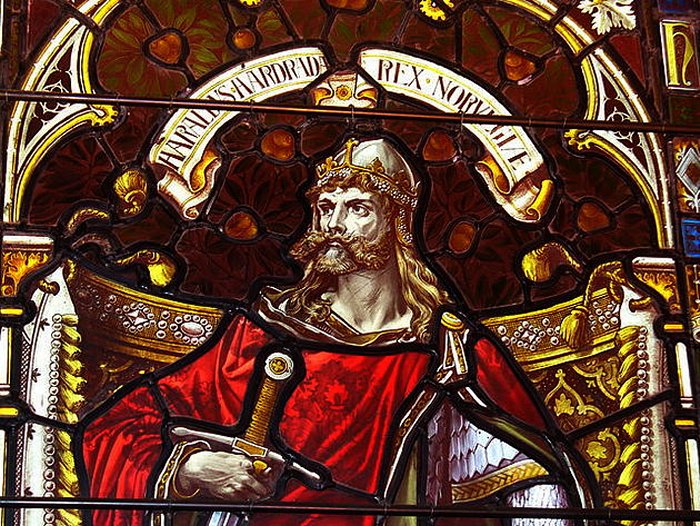
Mighty Viking Harald Hardrada -The Last Great Viking And Most Feared Warrior Of His Time


Ragnar Lobrok, Ivar the Boneless, Bjorn Ironside, Erik the Red, Eric “Bloodaxe” Haraldsson – we associate all those names with courageous and fearsome Viking warriors, but none of them can be compared to the greatest Viking warrior of all – King Harald Hardrada.

Mighty King Harald Hardrada was the last great Viking and the most feared warrior of his world and time.

Mighty King Harald Hardrarda - The Last Great Viking And Most Feared Warrior Of His Time

Viking Hardrada was an extraordinary man who lived an adventurous life. He fought in the deadliest battles and traveled to distant lands where he met exotic and powerful people. His courage and combat skills made him military commander in the Varangian Guard and Kievan Rus’.

Hardrada spent all his life as a professional soldier, and his reputation preceded him.

In the Icelandic Sagas, Viking Hardrada is portrayed as a great hero, but behind all the ancient legends we find a very complex figure, a man who was charismatic, daring, and resourceful. Viking warrior Hardrada became a patron of poets and he was known as ‘feeder of ravens’.

Harald Hardrada – A Great Viking Warrior Is Born

The most comprehensive accounts of King Harald Hardrada’s life can be found in the thirteenth-century collections of sagas of the Norwegian kings, of which the most respected is the one known as Heimskringla and reliably attributed to the Icelandic historian, poet, and politician Snorri Sturluson (1179 – 1241).

German churchman, Adam of Bremen also documented some of King Hardrada’s expeditions, but the cleric’s writings are hostile in nature and far from objective. He does, however, confirm the great Viking’s military skills and warlike reputation when he refers to Hardrada as the ‘thunderbolt of the north’.

Born as Harald Sigurdsson in Ringerike, Norway in 1015, he was the child of Åsta Gudbrandsdatter and her second husband Sigurd Syr, a king of Ringerike and one of the wealthiest chieftains of Upplands, the lands and forest regions to the north of Oslo in Norway. After his death, he was given the title “Hardrada” which means “hard ruler”.

Harald Haraldsson 'Fairheaded' I

The Carruthers are linked to this family genealogically. The biggest problem with genealogy is the correct dates this far back.

From her first marriage, Åsta Gudbrandsdatter was also the mother of King Olaf Haraldsson of Norway, who was later to become St. Olaf.

Hardrada admired his half-brother, King Olaf, very much and it could not have been easy, to see him die in a battle. This particular event was of great significance to Hardrada’s personal destiny and changed his life. Hardrada was loyal to his half-brother until the end.

Harald Hardrada Fought In The Battle Of Stiklestad When He Was 15 Years

When Hardrada was 15 years he engaged in his first battle under the command of his half-brother and hero King Olaf.  Snorri Sturluson’s Heimskringla describes what happened during the battle Stiklestad, and one can say this was the beginning of Viking Hardrada’s military carrier.

In 1028, there was a revolt and King Olaf lost the Norwegian throne to Cnut the Great, England’s Danish king, and ruler of one of the largest Nordic Empires.

Mighty King Harald Hardrarda - The Last Great Viking And Most Feared Warrior Of His Time

King Olaf who had been baptized made his best to convert Norway to Christianity. He also revived and revised the law code of Harald Fairhair, the king who united Norway into one kingdom in 872 AD. He affirmed his influence in the North Atlantic colonies, most importantly in the jarldom of Orkney and he prohibited plundering, but only within the country.

There is no doubt, King Olaf made many crucial changes, but his days were numbered. Cnut the Great had other plans. He wanted to reclaim the throne of Norway and King Olaf was forced into exile.

Two years later, in 1030, King Olaf returned to Norway with a force more than fourteen hundred strong and he was joined by Hardrada and his group of 700 hundred warriors. Together they engaged the army of Cnut the Great, but the battle did not end well. King Olaf was killed and Hardrada was badly wounded and forced to flee. Though he was only 15 years at the time, he showed great combat skills during the battle.

His appearance must have been striking to some. Snorri Sturluson described Harald Hardrada as physically “larger than other men and stronger”. He is said to have had light hair and beard, a long “upper beard” (mustache), and that one of his eyebrows was somewhat higher situated than the other. He also reportedly had big hands and feet and could measure five ells in height.

Viking Hardrada Joins Kievan Rus And The Varangian Guard

In one year, Hardrada managed to cross the Baltic together with other survivors of Olaf’s defeated army. After arriving in Russia, he visited his distant relative Yaroslav I, Grand Prince of Rus’, known as Yaroslav the WiseThe prince had helped King Olaf after the revolt. Being in need of skilled warriors, he employed Viking Hardrada who became captain of the forces of Prince Yaroslav of Kievan Rus. Hardrada fought many battles for Grand Prince Yaroslav the Wise.

You may recognize the name Varangian Guard from other postings on our blogs about the Carruthers ancestors. Gotland/Gutland was the center of the trading industry at this time, and if you sailed east you were a Rus Varangian, meaning River Warrior.

After spending some years in Prince Yaroslav’s army, Hardrada left Kiev together with his warriors and traveled to Constantinople, the capital of the Byzantine Empire. ‘

His goal was to join the impressive Varangian Guard that represented the elite heavy infantry regiment of the Roman (‘Byzantine’) Empire from AD 988 AD to around 1404 AD.

Roman Empire was in need of berserker warriors and hired them among northern mercenaries.

They were Vikings for hire, who successfully conquered territories across the Empire. They fought in Crete, Italy, and in Asia Minor.  To this day you will see Carruthers DNA markers show up in these places.

These professional warriors were highly valued for their courage and loyalty; they had also high fighting skills and the ability to carry out commands efficiently and without unnecessary questions. Harald Hardrada joined the Varangian Guard. He was the best berserker who became the “leader over all the Varangians”. Berserkers (in Old Norse: ‘berserkr’) were Icelandic Viking warriors who were feared by enemies and even their battle companions.  If you traveled west from Gotland, you were an Icelandic Warrior.

As commander, he fought in places as far apart as the Mediterranean, Asia Minor, Sicily, and the Holy Land. He was a famous and respected military leader. Hardrada had now enough earnings to marry Yaroslav’s daughter Princess Elisaveta (Elisiv), something he could not do earlier because he was too poor.

More About Vikings

Rich in combat experience and wealth Hardrada returned to Scandinavia in 1046. He had carefully prepared his campaign of reclaiming the Norwegian throne. Cnut the Great had died and Magnus I, also known as Magnus the Good was now king of Norway.

Mighty King Harald Hardrarda - The Last Great Viking And Most Feared Warrior Of His Time

Harada reached an agreement to share the rule of Norway with Magnus I. When Magnus I died, Harada became the sole King of Norway.

Harada was not happy with only being the king of Norway. He wanted to rule over Denmark as well, and he and his warriors plundered the country repeatedly, but the Danish King Svein Estridsson who lost almost every battle against Harald, managed to stain in power. In 1064, Harald and Sweyn reached a peace agreement.

Knowing, Denmark could not be his, the warrior King Hardrada sought new grounds that he and his men could conquer. Hardrada was now keeping his eye on England.

Battle At Stamford Bridge And The Death Of King Hardrada

After the death of Edward the Confessor, the English throne passed to Harold Godwinson. King Hardrada allied himself with Tostig Godwinson, Harold’s brother, who had been deprived of the earldom of Northumbria by Edward in 1065.

In 1066, Saxon troops of Mercia and Northumbria commanded by brothers Earl Edwin and Earl Morcar and met a Norse army under command of King Harald Hardrada accompanied by Earl Tostig.

The Battle Of Stamford Bridge

Both King Hardrada and William, Duke of Normandy wanted the throne of England. William gathered a fleet and was ready to sail across the Channel to the south coast of England, Harald gathered an invasion force in the north. The Norman army had only 7,000 men. King Hardrada’s Viking warriors met the troops from Mercia and Northumbria, at Fulford, on the outskirts of York and the battle took place.

It was a terrible fight, in which the armies of Mercia and Northumbria were defeated. York surrendered to the invaders, and Harald did not enter the city but retired to Stamford Bridge to await the gathering of hostages from around the region.

This was a huge mistake. The Norse warriors had only 5 days to enjoy their victory at Fulford.

On 25 September, King Harold, the last Anglo-Saxon king of England, surprised Harald Hardrada of Norway at Stamford Bridge and defeated the Norsemen. Hardrada and Tostig were killed. Harald Hardrada’s death was caused by an arrow that struck his neck. He was buried at the Mary Church in Nidaros, Norway.

In a way, it’s a bit ironic that a great warrior like Hardrada who traveled to distant lands and fought in deadliest battles died after spending only a few days on British soil.

Mighty Warrior King Hardrada As A Person

With the death of King Hardrada, the Viking Age ended. Hardrada was a harsh ruler who often solved disputes with force, but his reign was one of peace and progress for Norway. He advanced Christianity in Norway, built churches, imported bishops, developed a Norwegian currency, and viable coin economics. His contacts with the Byzantine Empire and Kiev helped Norway to expand its international trade. King Hardrada also founded the capital Oslo.

Harald Hardrada was the last great Viking.

Carruthers crest on flag


Preserving Our Past!    Recording Our Present!  Informing Our Future!

The Ancient and Honorable Carruthers Clan International Society LLC

carruthersclan1@gmail.com                carrothersclan@gmail.com

cropped-wider-banner-light-blue-1.jpg

Ellen Lloyd Ancient Historian

CLAN CARRUTHERS INT SOCIETY CCIS  HISTORIAN AND GENEALOGIST


You can find us on facebook at :

https://www.facebook.com/carrutherscarrothers.pat.9

https://www.facebook.com/CarruthersClan/

https://www.facebook.com/CarruthersClanLLC


Disclaimer Ancient and Honorable Carruthers Clan International Society CCIS L


OUR ANCESTORS, Uncategorized

GUNNHILD KONUNGAMODIR- CLAN CARRUTHERS CCIS

CLAN CARRUTHERS INT SOCIETY CCIS                         PROMPTUS ET FIDELIS

cropped-wide-banner-with-new-crest.jpg

Gunnhild Konungamóðir

CARRUTHERS ANCESTOR

jorvik (2).png

Wife of Eric Bloodaxe, mother of kings, and king-maker – Gunnhild was one of the most politically active women in Norway, Orkney and Jorvik, featuring prominently in several sagas.

The 12th century Historia Norwegiæ tells us that Gunnhild was the daughter of Gorm the Old, King of Denmark, and so her marriage to Erik was a union between two great houses, the Norwegian Ynglings and the early Danish monarchy. This version of events is largely accepted by modern scholars, though Heimskringla and Egil’s Saga have Gunnhild as the daughter of Ozur Toti, a military commander from Halogaland. Whichever version is true, Gunnhild and Erik had a fruitful marriage with several children, as rulers over Norway.

During their time in Norway, Gunnhild and Erik were embroiled in an intense enmity with Egil Skallagrimsson, and as a result are portrayed particularly negatively in his saga and poetry. Egil killed one of the king’s retainers, prompting Gunnhild to order her two brothers to kill Egil in revenge. But Egil killed Gunnhild’s brothers too, and Erik declared him an outlaw in Norway; initiating further deaths as the king’s men hunted Egil, and Egil killed them in turn.

Eventually Egil fled Norway, cursing the royal couple with a horse’s head upon a pole:

“Here I set up a níð-pole, and declare this níð against King Erik and Queen Gunnhildr”, — he turned the horse-head to face the mainland — “I declare this níð at the land-spirits there, and the land itself, so that all will fare astray, not to hold nor find their places, not until they wreak King Erik and Gunnhild from the land.” He set up the pole of níð in the cliff-face and left it standing; he faced the horse’s eyes on the land, and he rist runes upon the pole, and said all the formal words of the curse.”

Gunnhild and Erik were themselves expelled from Norway after a rebellion by nobles in favour of Erik’s half-brother, Haakon the Good. The couple settled in Orkney, then in Jorvik, where Erik became king over northern England, and where Gunnhild and Erik may have been baptized. Jorvik was also the scene of a final encounter between Egil and Gunnhild, around AD 948.  Egil was shipwrecked and brought before Erik, who sentenced him to death – but Egil wrote and recited a poem singing the king’s praises, which won him his freedom, much against Gunnhild’s wishes.

After Erik’s loss of Jorvik and death at the Battle of Stainmore in AD 954, Gunnhild eventually returned to Denmark, finding a home at the court of Harald Bluetooth. Her son Harald was fostered by the king and her other sons much favoured, all fighting in the war against the Norwegian King Haakon. When he died in battle, Gunnhild’s sons were able to exploit the power vacuum and established rule over Norway.

Gunnhild became a key player at court, known from this time as konungamóðir, mother of kings. Heimskringla says that she ‘mixed herself much in the affairs of the country’. It was a turbulent time, with Gunnhild’s sons killing or deposing many provincial rulers, and famine stalking the country.

Unrest eventually led to more civil war, and Gunnhild’s son Harald was killed by his once-foster father Harald Bluetooth. Gunnhild and her remaining two sons once more fled to Orkney; but she seems to have sought a quiet life there after her years of political machinations. According to Jómsvíkingasaga (and with similar stories in other sources), Gunnhild returned to Denmark around 977 but was killed at the orders of King Harald by being drowned in a bog.

A fascinating coda to Gunnhild’s story came in 1835, when a murdered female body was found in a bog in Jutland and mistakenly identified as the queen. Contemporary King Frederick VI commanded a regal sarcophagus to house the body, but later radiocarbon dating proved that the woman lived much earlier, in the 6th century BCE.

Carruthers crest on flag

Preserving Our Past!    Recording Our Present!  Informing Our Future!

The Ancient and Honorable Carruthers Clan International Society LLC

carruthersclan1@gmail.com                carrothersclan@gmail.com

cropped-wider-banner-light-blue-1.jpg

CLAN CARRUTHERS INT SOCIETY CCIS  HISTORIAN AND GENEALOGIST

You can find us on facebook at :

https://www.facebook.com/carrutherscarrothers.pat.9

https://www.facebook.com/CarruthersClan/

https://www.facebook.com/CarruthersClanLLC

Disclaimer Ancient and Honorable Carruthers Clan International Society CCIS L
Gutland / Gotland, The Viking Age, Uncategorized

CLAN CARRUTHERS – GOTLAND-AN ISLAND IN THE MIDDLE OF AN ISLAND

cropped-wide-banner-with-new-crest.jpg


AN ISLAND IN THE MIDDLE OF AN ISLAND- GOTLAND/GUTLAND

On Cult, Law s and Authority in Viking Age

** Our norse ancestors came from the Island of Gotland, east of Sweden.  They were considered Christians from the earliest times.  Please notice the acceptance of monastery’s, meeting places on the west coast of Scotland, and the fact that they had Clans and used the term Chieftain .  Some will say that their are only clans in Scotland, and we know that is not truthful. ***


The present-day small village of Roma on Gotland in the Baltic Sea was the
physical and symbolic centre of the island in the Iron Age and into Medieval
times (Fig. 1). The Cistercian monastery and the meeting place of the island’s
assembly, the all-thing, two well-known features of medieval Roma, have often
been taken as indications of an egalitarian and non-stratified society on Gotland during the Viking Age and Middle Ages. It is here proposed, however,
that an older Iron Age cult site at Roma eventually came under the control of
a chieftain or major landowner who introduced Christianity, founded a monastery and inaugurated the thing in Roma in Viking or early medieval times,
just as his equals did elsewhere in Scandinavia. While the later medieval thing
was probably located near the monastery, an alternative site is suggested for
the older all-thing.
T he A ll -thin g of Gotland
In Medieval times (i.e. from c. 1100 onwards in local terms) Gotland was organised into 20 thing districts. These legal entities are mentioned in the Guta
Lagh (Gotlandic Law) and Guta Saga (printed edition Gannholm 1984), which
were written down at the beginning of the 13th century (but may contain older
strata, see Kyhlberg 1991). It is not certain whether the things were prehistoric
or belonged to an early medieval re-organisation of the island (Steffen 1943,
pp. 3 ff, 48 f; Hyenstrand 1989, pp. 15f , 108 ff; Rönnby 1995, p. 103),

page_2 (2)

but they served as means of organizing both societal relations and the physical space.
Lag means ‘law’, but was also used for the community of people who lived by
a given law, and for the physical area in which this community lived (Gurevich
1985, p. 157; Brink 2002, p. 99). As the judicial entities in that sense also constituted social and territorial boundaries, they thus defined much of the human movement that took place within the local society
The all-thing of Gotland, the island’s central assembly and supreme legal
instance, is of particular interest since it has been suggested (notably by Yrwing 1940, 1978) that its existence points to an egalitarian society of free farmers on Gotland during the Viking Age and Middle Ages.

This picture of the internal organisation of the island has been questioned on several occasions (e.g. Carlsson 1983; Hyenstrand 1989; Rönnby 1995), but it is still common and
is continuously being communicated to the public. The existence of a central
assembly on the island is mentioned in the Guta Lagh and Guta Saga (e.g. GL
§31, GS §9), and it is also likely by analogy with the medieval organization of
other Scandinavian-dominated areas such as Iceland. The image of Gotland as
an egalitarian farming and trading society nevertheless needs to be called into
question once more.
The area of Roma in the centre of the island was first named as the site of
the Gotlandic all-thing assemblies in the 1401 translation of the Guta Lagh
into German: “gutnaldhing das ist czu Rume” (Pernler 1977, p. 61; Yrwing 1978,
p. 80), while according to taxation records for 1699, some of the land around
the monastery of Roma may have belonged to several things (Östergren 1990,
2004) (Fig. 2). That this was the place where the Medieval all-thing gathered
might also be indicated by the name of the Cistercian monastery founded
there in 1164, Sancta Marie de Guthnalia, as suggested by Lindström (1895).
In his interpretation, Guthnalia could be a Latinized form of *gutnalþing, the
all-thing of the Gutar (Gotlanders), so that the name of the monastery was
derived from the all-thing itself, which may indeed have initiated the foundation of the monastery (Lindström 1895, p. 170 ff ). This suggestion and interpretation could imply that the all-thing took an active interest in the introduction of Christianity to Gotland, and thus may bear witness to the democratic character of early medieval Gotlandic society.

The endowment of land for the monastery could have been made out of land held in common by the Gotlanders and thus controlled by the all-thing (Östergren 2004, p. 44).
It should be remembered, however, that Christianization and the foundation of churches and monasteries were in all other cases initiated and dominated by individuals, normally major landowners or petty kings. The interpretation is thus based on a pre-supposed difference between Gotland and the rest of Scandinavia, namely the existence of a particularly egalitarian society on Gotland. Since this hypothesis or presupposition relies to an extent on the fact that it is used to explain, we are here dealing with a classic example of a circular argument. Luckily, archaeology can provide some more input that should be taken into consideration when discussing this matter.

images


Guldåkern and Kräklige  Tingsäng
The 1699 taxation map shows several plots of land with names referring to
things surrounding the monastery of Roma (Fig. 4), and Östergren suggests
that this was where the representatives attending the thing slept and kept their
animals during the meetings. Thus the area around the Roma monastery may
have been land held in common, where the different things held rights over
certain areas. In order to be at the centre of these dwelling places, the all-thing
itself must have assembled within the area of the later monastery (Östergren
1990, 2004, p. 40 ff ).
About 600 m northeast of the monastery lies the Guldåkern (the ‘Golden
Field’, named after three solidi coins found there in 1848, Fig. 2). This area, c. 200 x 300 m in size, was investigated with metal detectors in 1990 and was interpreted as a Viking Age trading place on the basis of finds of silver fragments, silver coins and weights, most of the material being from the 10th century AD.

The adjacent Kräklinge tingsängen (meadow of the Kräklinge thing)
was investigated on the same occasion and yielded silver coins, melted silver
and bronze, fragments of bronze jewellery and a casting cone, indicating metalworking at the site, and was considered to be a farmstead from the Vendel
or Viking period (Östergren 1992, p. 42 f ). Roman denarii were found at both
sites, indicating that they were connected in terms of their use during the period prior to the Vendel and Viking ages (all the Roman coins probably ended
up there during the fourth century AD). Unfortunately, the area was much
disturbed during the Second World War and it is thus difficult to say exactly
how and where the artefacts were initially deposited.
Guldåkern, Kräklinge tingsängen, and the other plots with thing names, are
all interesting sites, but neither has been suggested as the actual location of the
thing itself. The thing was not the scene of either trade or metalworking, nor
did people live there. It has been suggested that the Vendel and Viking Age
material found on Guldåkern and Kräklinge tingsängen results from the fines
and fees paid and exchanged during negotiations at the thing (Domeij 2000, p.
36 f ). If this is so, it would be the most tangible proof so far for a pre-medieval
thing actually having been located in the area.
The central location of the monastery within the semi-circle of properties
named after things may be a result of the monastery having been founded on
land held in common, and would thus indicate that this land was given to the
Cistercians by the things in 1164. But the distribution of these properties may
just as well result from their being secondary to the monastery, and demonstrate
that the monastery is the older feature and the localizing factor.

T he G u tnal þ in g
The word Gutnalia in the name of the Cistercian monastery at Roma first
appeared in written sources in the 13th century and was subsequently used
on the seals of the monastery and its abbot (Ortved 1933, p. 305), so that the
place-names Roma and Gutnalia are used interchangeably in the documents
(Lindström 1895, p. 171; Ortved 1933, p. 304 f ). It has been suggested that this
(Latinized) name of the monastery refers to the all-thing. But why would the
monastery take its name from an administrative assembly? And if the thing
was indeed so important, why is the place not named ‘Allthingia’? One significant point is that the Guta Saga does not actually read gutna alltþing, but gutnal þing (e.g. GS §9), as pointed out by Hjalmar Lindroth (1915) while discussing the linguistic basis of the name Gutnalia.

He concluded that Gutnal is an independent place-name, Gutna al (al of the Gotlanders) (Lindroth 1915, p.66 f ). Most Cistercian monasteries and churches were dedicated to the Virgin Mary, and thus the epithet “…de Gutnalia” served to distinguish the monastery of Roma from its sister institutions. The name Gutnalia itself, though,
must have been derived from a place-name containing the element -al.
A place denoted by al should be understood as a ‘protected area’, but there
is also a connection between al and assembly places (Vikstrand 2001, p. 192
ff ). Most al names denote natural features, but a few may have a cultic or
sacral meaning: Götala, Gutnal, Fröjel, Alsike and a few others. These names
derive from the Germanic alh-, ‘protection’ (Brink 1992, p. 111 ff ). The word
has connotations such as ‘defended’, ‘shielded’, ‘consecrated’ and ‘sanctified’.
Furthermore, al is apparently found where there was a building of great social
distinction (ibid, p. 116). In German non-religious texts the word was used in
the sense of ‘house’, ‘protection’, ‘a fenced, protected area’ or ‘a legally protected
place’ (settlement) (Schmidt-Wiegand 1967, 1989). It is known through texts
such as a runic inscription in Oklunda that cultic places were under some kind
of legal protection (see below), and also from passages in the Guta Lagh and
Guta Saga (GL §13, GS §11). The notion is also found in a Christian context,
in the idea that the sanctity of churches should not be violated.
The gutn(a) part of Gutnalia ties the name and the place to the Gotlandic
people. In that sense the interpretation of a pre-Christian cultic al-place of
importance to the Gotlanders does not disagree with the notion of the name
being connected with the all-thing. Cults and legal/regal authority may have
been even more intertwined in earlier times than later during the Medieval
period. The difference is that in one case, Latinized Gutnalia would refer to al,
the physical ‘(cult-? central-? thing-?) place of the Gutar’, perhaps connected
with a prominent house or hall. In the other case, the name Gutnalia would
refer to all as in the all-thing (‘-thing’ simply being omitted from the name)
and would imply that the thing wanted to found a Christian monastery, and
had the authority to do so. I will proceed to argue that the first explanation is
the more likely one.
The setting of the all -thin g

download (1)
The exact locations of ancient thing assemblies are rarely known, but in several cases there is at least some information deriving from historical sources, folk
tradition or place-names. Such assemblies were often thought to have been held at prehistoric monuments such as great mounds, or ‘judge’s rings’ (Sw.
domarring, an Iron Age grave type consisting of a circle of boulders or vertical stones). But more frequently the meeting places are hard to identify, and
it is generally difficult to determine the age of a thing site or to locate it by
archaeological means (cf. Sanmark 2004).

Viking Archaeology - Law Ting Holm

The Law Ting Holm in Loch Tingwall, Shetland, Scotland

Prehistoric assembly places are generally found in areas with a high concentration of rune-stones and prehistoric graves, often on the “periphery” of a settled area. Also, assembly places were often moved on one or more occasions in the later Middle Ages (although, as far as is known, never more than 10 km) to comply with new situations or
demands on accessibility, but the old locations apparently influenced the allocation of later assembly places up until late historical times (Sanmark 2008, p. 15). Thing sites were often not situated near settlements, but rather at communication nodes in the landscape (Vikstrand 2001, p. 412; cf. Wilson 1994,
p. 67).
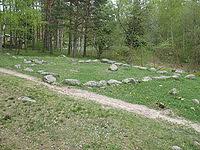
Arkils tingstad - WikipediaThe morphology of thing sites also shows much variation: open places,
mounds, or a rectangular stone-setting such as Arkil’s thing site in Uppland
(Nordén 1938; Lönnroth 1982). The excavated remains of Þingnes in Iceland
revealed a concentric circular structure surrounded by farmhouses (Ólafsson
1987, p. 343 ff ).
downloadThe physical assembly place has thus often been connected with prehistoric
monuments and manifest remnants such as procession roads, both prehistoric
and Medieval. The majestic Anundshög [Anund’s mound] in Middle Sweden
is one well-known example where a great mound, a procession road flanked
by large stones, and several monumental prehistoric graves (stone ships) are
combined, making a profound impression on the visitor even today. There is
no real proof, however, that these “thing” mounds were indeed once settings
for prehistoric assemblies. That may well be an invention of later times, connecting the impressive monuments with the forefathers and people of the past.
It is simply difficult to tell which one was the localizing factor: the thing site
for the monument, or the monument for the idea of how a thing was staged?
The known thing sites suggest there was in reality a considerable amount of
morphological variation.
Islands as settings for things
download (1)There are similar traditions attached to thing and assembly places in northern
Britain and in Scandinavia, with mounds or stone circles being identified as
gathering places (Driscoll 2004). On Islay, off the west coast of Scotland, an
important medieval meeting place was situated on a small island in a lake
(Eilean na Comhairle, ‘the council isle’, in loch Finlaggan).

Scalloway - Vidlin | Shetland.orgDuring the negotiations the lord and his attendants would live on a larger island nearby, just off the shore, in a royal complex that included a monastery (Caldwell 2003). On
Shetland, the Law Ting Holm in the lake of Tingwall was a small island close
to the shore which was used for assemblies in the Norse (Viking/Medieval)
period . The most important medieval church of Shetland was on the
shore, and both Eilean na Comhairle and Law Ting Holm were connected to
the shore by a causeway.

download (2)
Islands, an islet or holm as it may have been, have so far not been much
discussed as possible thing sites in a Scandinavian context. Þingnes in Iceland
was apparently situated on a promontory or peninsula (also reflected in its
name), but I have found no discussion on ‘island’ settings as such. Still, bearing
in mind the similarities between the assembly place traditions of the (Norsedominated) British Isles and Scandinavia in other respects, the suggestion can
be put forward that islets or small peninsulas should be evaluated in a new
light in the search for the elusive Scandinavian thing sites of the Late Iron Age
(Viking Age) and early medieval times.
Before and during the Iron Age the whole area of present-day Roma was in
the nature of a promontory, surrounded partly by wetlands and partly by open
water , and it was probably possible to reach the Roma area by boat all
the way from both coasts. At the south end of the complex of waterways surrounding Roma is the narrowest point, a small strait, with Gotland’s largest Iron Age burial ground (Broa, in the parish of Halla) and the Viking or Medieval fortifications of Hallegårda just across the water.

To the northwest and southeast the land is much higher, and the area of Roma thus lay ‘sunk’ between the two halves of Gotland. The peninsula of Roma was like an ‘island in
the middle of the island’ which had to be passed through no matter whether
one was travelling in a north-south or east-west direction, on land or by boat.
Roma parish church, a prominent three-aisled hall church erected in the mid-13th century, is situated on a high point north of the monastery and by a crossroads. It was preceded by a stone church from the 12th century (which was already there when the monastery was founded), which in its turn was perhaps preceded by a wooden church.
Broa (‘the bridge’) about 1.5 km southwest of the Roma monastery on the
other side of the bog, is the largest burial ground on Gotland and one of the
best sources of material of a typical high-status character. The cemetery was in
use from the Roman Iron Age to the Viking period, and the artefacts found
include numerous weapons and four prestigious helmets from the Vendel period as well as an equestrian grave from the early Viking period. In particular
the helmets indicate connections with high-status graves outside Gotland,
such as those of Vendel in Central Sweden or the British Sutton Hoo ship
burial. This distinguishes the Broa area from the other large centres and burial
grounds on northern and southern Gotland. The area stretches away on both
sides of the road southeast of the present bridge, and along the road running
north to Halla and Hallegårda (Fig. 4). The latter is a fortification of concentric circular walls with a stone building inside, probably of late Viking or early Medieval origin and has been interpreted as a centre inhabited by a local chieftain (Broberg et al. 1990).

This complex is situated south and southeast of the Roma monastery, on the other side of the wetland. There was once a small island or islet, Björkö, in the northeast mouth of the
strait, a feature which is still visible on late 19th-century maps drawn before
the draining of the bog began. The name of the island incites curiosity, since
Björkö is also the present name of the famous Viking Age town of Birka in
Lake Mälaren. In medieval Scandinavia the word Birka (Bjärka, Björkö) denoted a certain type of legislation, Bjärköarätt (the early legislation of many
early towns), and more generally ‘special jurisdiction’ (KHL, p. 656, entry Bjärköarätt). This may have nothing to do with the small island near Roma, but the
island is still interesting in its own right. Considering the similar traditions
surrounding thing and other assembly places in northern Britain and in Scandinavia, one may wonder if we are not looking here at a Scandinavian parallel
to the islands in the Finlaggan and Tingwall lakes.
The British examples of island thing sites, with churches, manors and accommodations for the attending parties on the shore, evoke the question of
whether the semicircle of properties bearing the names of things to be found
around the Roma monastery was in fact not relating to the waterfront at the
time, and that they faced the islet of Björkö rather than the monastery. It may
indeed be suggested that, at least in prehistoric and early Medieval times, the
assemblies may have been held on Björkö rather than in an area now beneath the monastery ruins or in any of the adjacent meadows. The Broa cemetery and
perhaps also the Hallegårda fortifications behind the island would have been
clearly visible from the shore, offering a view of the centre of power and the
resting place of the great forefathers as a background.
Unfortunately there is nothing left to prove that Björkö was an assembly
place, since the islet itself has been almost totally destroyed through draining
and digging in the bog during the past decade. There are now dams where the
island was until the beginning of the last century. This hypothesis will thus
remain unconfirmed unless new evidence is uncovered to prove it. This setting
for the assembly place makes far more sense, however, and conforms better to
other historically known settings such as Þingnes or Law Thing Holm than
does the previously proposed location on the site later taken over by the monastery.

The staging of the thing
According to written sources such as the Icelandic Sagas, negotiations at a
thing took place within a demarcated area and most of the agents attached to
the assembly had to remain outside. The law-court was probably marked out
with vébond, strings or ropes tied between rods stuck into the ground, or running through iron rings attached to the rods, as seems to have been the case at
the recently excavated site of Ullevi in central Sweden (Blomkvist & Jackson
1999, p. 21; Vikstrand 2001, p. 332; Brink 2002, p. 90; Svenska Dagbladet June
22 2008, p. 24 f ).

The word vébond is connected to the concept of vi, appearing
as a place-name in itself or as part of one (as in Ullevi, meaning ‘the Vi of
the god Ull’). ‘Vi’ denotes a protected area where there was a right of asylum
(Vikstrand 2001, p. 323 ff ), and has been interpreted as meeting place consecrated to the supernatural powers, an arena for cult and common ritual under
divine protection (ibid, p. 332). ‘Vi’ often appears in pairs with the toponym
lund [grove]¸ which denotes the cultplace proper, the sacrificial grove (a famous Lunda excavated recently outside Strängnäs in central Sweden, yielded
spectacular finds of gold figurines and more than 4 kilogrammes of burnt and
crushed human bones; see Andersson 2003, 2004). The locations for meetings
of a thing thus seem to have been very complex places, including several nodes
and combining legal actions with various cult and ritual elements.
Concepts of peace and inside/outside were also connected with the assembly place and with the ideology of the thing, as also with the vi. Inside
the vébond sphere there was friðr (‘peace’), and outside there was úfriðr (‘unpeace’) (Blomkvist & Jackson 1999, p. 21 f ). This was manifested through the demarcation of an area. The concept was not exclusive to the thing, but an individual could also legally seek asylum and protection by drawing a ‘circle of peace’ for himself. This is described in the medieval Gotlandic Guta Lagh (GL§13), but was probably also a legal feature in other parts of Scandinavia much earlier than the 13th century. Such an event is described in a 9th-century runic inscription in Oklunda (Sweden) (Lönnqvist & Widmark 1997, p. 151; Gustavson 2003, p. 187), where one Gunnar states that he has fled to this vi, inside
the circle of peace. This runic inscription may be regarded as a legal document
(Brink 2002, p. 96) but it may also have had a magical meaning, since the carving is shaped like a tied bond (Lönnqvist & Widmark 1997, p. 156 f ).
The vébond strings served a double purpose: they created a restricted area
where peace had to be kept, and they divided the lawmen from the ordinary
delegates during the meeting. The apparent tension between these two groups,
as reflected in the Icelandic law compilation Grágás, Egils saga Skallagrimsónar,
and Viga-Glúms saga, for example (Holmgren 1929, pp. 22, 25 ff ), may have
been due to the innate tension between those who enforced the law and siðr
(old custom) and those who had to accept their judgements. Respect for the
law-courts was just as fundamental as it is today, and infringement of it was
punishable by exile in Iceland (ibid, p. 25). Runes on a large 9th-century ring
from Forsa in northern Sweden (interpreted as an oath ring for use at the
thing) describe what will happen to the one who fails to respect the law-courts
and the asylum granted by the vi. This involved fines and the suspension of
property rights (Ruthström 1990; Brink 2002, p. 97 f; cf. Myrberg 2008, p.
146).
Rings were obviously important within the context of the thing, as indicated by the phrase ‘bringing something a þing ok a ring [to the thing and to the
ring]’ which is found in medieval laws (Holmgren 1929, p. 22 ff; Blomkvist &
Jackson 1999, p. 21). This may be a reference to an oath ring, kept in the temple
and brought out by the cult leader during legal negotiations (cf. Habbe 2005, p.
134 f ), such as the Forsa ring, or to the numerous smaller rings found on Ullevi
and originally probably attached to poles around the sacred area. “All is bound
in rings” the Guta Saga states solemnly, probably giving some kind of authentication to the text. References to band, ring and baugr (ring) in the sagas may
have a religious and/or judicial significance (Blomkvist & Jackson 1999, p. 20
ff ), and the tying of knots and giving away of rings are accordingly frequent
themes in the mythology and sagas as metaphors for the giving of promises or
establishment of relations.
The staging, ritual and ideology of the prehistoric or early medieval thing
thus seem to be much concerned with concepts of peace, inside/outside and rings, as well as with social reproduction, the community and the maintenance
of old customs, siðr. Ritual meals and communal feasting are thought to have
been part of the thing meetings and of the associated cultic activity (e.g. the
sjudning, ritual meals consumed with one’s suþnautar, ‘cooking brothers’, described in the Guta Saga (GS §5; cf. Yrwing 1951, p. 13; 1978, p. 82).

The thing may have represented a social ideology of equality in a time that otherwise
demonstrated great social differences. As a parallel, one may look at Iceland,
where the early laws and sagas helped to create and maintain a mythology and
ideal of an equal society which was not the real situation even in the earliest
landnám period (Rafnsson 1974, p. 187 f; Durrenberger 1992; Meulengracht
Sørensen 1993, p. 149; Smith 1995).
Gutnal , the monastery , and the all -thin g of Roma
It is easy to imagine that the low-lying promontory surrounded by lakes and
bogs in the middle of the island held a particular fascination for the people
of Gotland, especially at a time when waterfronts and bogs were of central
importance for cultic and votive activities, as seems to have been the case for
example at Tuna, southwest of Roma, and in the Roma mire itself. Gold and
wild boar tusks were found in the Roma mire during drainage work in the
1930s (SHM 17815, SHM 32811). Tuna has yielded a number of spectacular
finds, such as Roman coins, gold bracteates and a mass of golden rings, mostly
belonging to the Migration period, c. 400–550 AD (Hildeberg 1999, p. 24),
although the Roman denarii point to use of the site having begun around AD
300 (Roman Iron Age).
If the promontory was indeed an Iron Age al place, this would have sustained its function as a central meeting place for many centuries. But the archaeological and historical evidence also demonstrates the influence of local chieftains, as visible in matters ranging from burials and the deposition of Iron Age valuables in these to the building of private churches and the granting of land for a monastery. Explicitly referred to as a ‘chieftain’ can be detected in the written documents concerned with the founding of the monastery, and the initiative and endowment for all the other Swedish monasteries is known to have come from a major landowner or petty king with ambitions.
The role of a bishop in the process may have been decisive in some cases (Nyberg 2000, p. 211 f ), but this usually resulted from the bishops’ close family
connections with the nobility. The building of churches and monasteries was a
means by which the elite could act like continental kings and associate themselves with the expanding Church, and thus legitimize their claims to power
and retain their ideological influence within society (cf. Nyberg 2000, p. 81 ff;
Tagesson 2002, p. 237).
Such elite figures or chieftains are detectable in the Gotlandic archaeological record, and are also mentioned in the Guta Saga, being described as rich
landowners or lawmen, as being ‘wise’, or as acting as emissaries abroad. A
few kilometres northwest of Roma one still finds Akebäck and Kulstäde , where, according to the Guta Saga (§10), the first church on the island was
built by a private patron, probably in the 11th century.

This patron, Botair, actually had two churches built, since the people of the island burned the first one down, and tried to burn the second one as well. Botair was sufficiently influential, however, to build his churches in two prominent places: one (Kulstäde)

Vall Parish, Gotland, Sweden Genealogy Genealogy - FamilySearch Wiki
within a few kilometres of the Gutnal, and the other at Vi (often interpreted as
the present-day Visby). The prominence and significance of vi places has been
pointed out above. It may be that Botair’s self-confidence was partly based on
the fact that he was the son-in-law of Likair the Wise, a man who according to
the Guta Saga “reth mest um than tima” (ruled/advised most in that time) (GS
§11). Likair was thus either a petty king or the island’s highest legal authority,
and Botair must accordingly have been considered a mighty person himself to
conclude such a good marriage. Apparently he controlled land very close to
the Gutnal, most likely through inheritance, and it was there that he built his
first church.

102 Best gutland images in 2020 | Vikings, Norse, Viking age
The period of Botair, and of the Iron Age-medieval centre of Broa-Hallegårda, is close to the time when the monastery in Roma was established.
That is, to the time when the all-thing is thought to have been in command
of the land in the Roma area. Yet close to the monastery there was land in
one direction that was controlled by one of the most influential (and probably wealthiest) men on the island (Botair), and in another direction there
was the (now anonymous) owner of the fortified Hallegårda.

‘Botair’ may be only an imaginary figure in the saga, but the Hallegårda-Broa complex bears archaeological witness to the fact that such persons must have existed there at
the time. At least the early 13th-century author of the Guta Saga takes their
existence for granted. The thing as an institution has been regarded as having
been dominated by small farmers, so that it remained independent of the great
landowners, since this is the picture inferred from the medieval laws (Brink
1998, p. 300; Vikstrand 2001, p. 412). Again, archaeology gives us a different
picture, in particular regarding the Viking period. Jarlabanke, a major landowner in central Sweden, inaugurated a thing site in the 11th century, as did
Arkil and his brothers some generations earlier to commemorate their father Ulf, also a great landowner (Nordén 1938; Lönnroth 1982; U 212, 225, 226).

TheÞingnes assembly place, Iceland’s first, was founded around 900 AD by the
‘supreme chieftain’, the Allsherjargodi, next to his house (Ólafsson 1987). Thus
archaeology shows us that an upper class of landowners took an active part in
developing the thing as an institution and influenced its location.
Is it plausible that the Gotland all-thing could actually have owned land
and been able to dispose of it as it wished? And if it did – why would the
all-thing give away as an endowment for a monastery the very spot that was
most central to its own activities – the assembly place itself? It appears more
likely that the endowment for the monastery was made by an individual great
landowner or chieftain in the area. To locate it in a setting which alluded to
older ritual behaviour and the great ancestors would comply better with what
we know about the nature of prehistoric power and the thing ideology. This
was the way of behaving and of displaying individual power in other areas of
Scandinavia. Likewise, the inauguration of a thing assembly place may well
have been influenced by individual members of the elite class who had external
connections and internal ambitions for power.
The Guta Saga and Guta Lagh regulate in detail other important matters of
concern to the community. The Christianization of the island, the first churches and their relation to the Church and the bishop are all mentioned, but
not the foundation of the monastery, which must have happened as part of the
same process (and at about the same time). This suggests that the latter was
not a matter of common concern. The name Gutnalia does not, as was suggested in the past, tell us that the monastery was founded by the all-thing, but
that it was once a sacred place of social distinction: the Al of Gotland.
Carruthers crest on flag


PRESERVING OUR PAST, RECORDING OUR PRESENT,INFORMING OUR FUTURE

ANCIENT AND  HONORABLE CARRUTHERS CLAN INT SOCIETY CCIS

CARROTHERSCLAN@GMAIL.COM    CARRUTHERSCLAN1@GMAIL.COM

cropped-wider-banner-light-blue-1.jpg

Nanouschka Myrberg Burström | Stockholm University - Academia.edu     Nanouschka Myrberg, University of Sweden

CLAN CARRUTHERS INT SOCIETY CCIS HISTORIAN AND GENEALOGIST

Article in Regner, E., von Heijne, C., Kitzler Åhfeldt, L. & Kjellström, A. (eds.). 2009. From Ephesos to Dalecarlia. Reflections on Body, Space and Time in Medieval and Early Modern Europe. The Museum of National Antiquities, Stockholm. Studies 11. Stockholm Studies in Archaeology 48. Stockholm. ISBN 978-91-89176-37-9

References
Andersson, G. 2003. Lunda – delområde E: “Lunden” – en plats för aktiviteter under förhistorisk och historisk tid. UV Mitt Dokumentation av fältarbetsfasen, 2003:6.
Stockholm
Andersson, G. 2004. Att föra gudarnas talan: figurinerna från Lunda. Stockholm
Blomkvist, T. & Jackson, P. 1999. Alt ir baugum bundit. Scaldic Poetry on Gotland in
a Pan-Scandinavian and Indo-European Context. Arkiv för nordisk filologi 114.
Brink, S. 1992. Har vi haft ett kultiskt *al i Norden? In Fellows-Jensen, G. & Holmberg, B. (eds.). Sakrale navne. Rapport fra NORNAs sekstende symposium i Gilleleje
30.11 – 2.12 1990. Uppsala

Brink, S. 1998. Land, bygd, distrikt och centralort i Sydsverige: några bebyggelsehistoriska nedslag. In Larsson, L. & Hårdh, B. (eds.). Centrala platser, centrala frågor:
samhällsstrukturen under järnåldern. En vänbok till Berta Stjernquist. Lund
Brink, S. 2002. Law and legal customs in Viking Age Scandinavia. In Jesch, J. (ed.).
The Scandinavians from the Vendel period to the tenth century – an ethnographic perspective. Woodbridge
Broberg, A. et al. 1990. Hallegårda i Halla – social stratifiering eller bara en tillfällighet? META 3/1990.
Caldwell, D. H. 2003. Finlaggan, Islay – stones and inauguration ceremonies. In Welander, R. et al. (eds.). The stone of destiny – artefact and icon. Edinburgh
Carlsson, A. 1983. Djurhuvudformiga spännen och gotländsk vikingatid. Stockholm
Domeij, M. 2000. Människor och silver: samhällsideologi och sociala strategier på Gotland
ca 700–1150. Lund
Driscoll, S. 2004. The archaeological context of assembly in early medieval Scotland
– Scone and its comparanda. In Pantos, A. & Semple, S. (eds.). Assembly places and
Practices in Medieval Europe. Dublin
Durrenberger, P. E. 1992. The Dynamics of Medieval Iceland. Political Economy & Literature. Iowa
Gannholm, T. 1984. Guta Lagh med Gutasagan. Stånga
Gurevich, A. J. 1985. Categories of medieval culture. London
Gustavson, H. 2003. Oklundainskriften sjuttio år efteråt. In Heizmann, W. & van
Nahl, A. (eds.). Runica – Germanica – Mediaevalia. Berlin
Habbe, P. 2005. Att se och tänka med ritual. Kontrakterande ritualer i de isländska släktsagorna. Lund
Hildeberg, S. 1999. Tuna offerplats på Gotland: ett folkvandringstida fynd i ny belysning.
Arkeologiska institutionen, Stockholms universitet. Stockholm
Holmgren, G. 1929. Ting och ring: ett bidrag till diskussionen om de forntida tingsplatserna. Rig 12.
Hyenstrand, Å. 1989. Socknar och stenstugor. Stockholm
Kyhlberg, O. 1991. Gotland mellan arkeologi och historia. Stockholm
Lindroth, H. 1915. Gutnal þing och Gutnalia. Från Filologiska föreningen i Lund.
Språkliga Uppsatser IV. Lund

Lindström, G. 1895. Anteckningar om Gotlands medeltid II. Stockholm
Lönnqvist, O. & Widmark, G. 1997. Den fredlöse och Oklundaristningens band.
Saga och sed 1996/97.
Lönnroth, E. 1982. Administration och samhälle i 1000-talets Sverige. Bebyggelsehistorisk Tidskrift 4/1982.
Meulengracht Sørensen, P. 1993. Fortælling og ære. Studier i islændingasagaerne. Aarhus
Moberg, I. 1938. Gotland um das Jahr 1700: eine kulturgeographische Kartenanalyse.
Stockholm
Myrberg, N. 2008. Room for All? Spaces and places for thing assemblies: the case of
the all-thing on Gotland, Sweden. Viking and Medieval Scandinavia 2008.
Nordén, A. 1938. Tingfjäl och bäsing. En studie över rätter tingstads inrättning. Fornvännen 1938.
Nyberg, T. 2000. Monasticism in north-western Europe, 800–1200. Aldershot
Ólafsson, G. 1987. Þingnes by Elliđavatn: The First Local Assembly in Iceland? In
Knirk, J.E. (ed.). Proceedings of the Tenth Viking Congress. Oslo
Ortved, E. 1933. Cistercieordenen og dens klostre i Norden. Bog 2, Sveriges klostre. København
Pernler, S.-E. 1977. Gotlands medeltida kyrkoliv. Biskop och prostar: en kyrkorättslig studie. Visby
Rafnsson, S. 1974. Studier i Landnámabók. Kritiska bidrag till den isländska fristatstidens historia. Lund
Ruthström, B. 1990. Oklunda-ristningen i rättslig belysning. Arkiv för nordisk filologi
1988.
Rönnby, J. 1995. Bålverket: om samhällsförändring och motstånd med utgångspunkt från
det tidigmedeltida Bulverket i Tingstäde träsk på Gotland. Stockholm
Sanmark, A. 2004. Tingsplatsen som arkeologiskt problem. Etapp I: Aspa: arkeologisk provundersökning, forskning: Raä 62, Aspa 2:11, Ludgo socken, Nyköpings
kommun. SAU rapport 2004:25. Uppsala
Sanmark, A. 2008. Tingsplatsen – scen för maktutövning. Populär arkeologi 2/2008.
Schmidt-Wiegand, R. 1967. Alach. Zur Bedeutung eines rechtstopografischen Begriffs der frankischen Zeit. Beiträge zur Namenforschung. NF 2.

Schmidt-Wiegand, R. 1989. Frühmittelalterliche Siedlungsbezeichnungen und Ortnamen im nordwestlichen Mitteleuropa. Studia Onomastica. Festskrift till Thorsten
Andersson den 23 februari 1989. Stockholm
Smith, K. P. 1995. Landnám: the settlement of Iceland in an archaeological and historical perspective. World Archaeology 26:3.
Steffen, R. 1943. Gotlands administrativa, rättsliga och kyrkliga organisation från äldsta
tider till år 1645. Lund
Svenska Dagbladet. Stockholm
Tagesson, G. 2002. Biskop och stad. Aspekter av urbanisering och sociala rum i medeltidens Linköping. Stockholm
U + nr = nr in UR
UR = Upplands runinskrifter. Granskade och tolkade av Elias Wessén och Sven B. F.
Jansson. 1940-58. (SRI. 6–9.) Stockholm
Vikstrand, P. 2001. Gudarnas platser. Förkristna sakrala ortnamn i Mälarlandskapen.
Uppsala
Wessén, E. & Jansson, S. B. F. 1940–58. Sveriges runinskrifter Bd 6 – 9, Upplands runinskrifter. Stockholm
Wilson, L. 1994. Runstenar och kyrkor. En studie med utgångspunkt från runstenar som
påträffats i kyrkomiljö i Uppland och Södermanland. Uppsala
Yrwing, H. 1940. Gotland under äldre medeltid: studier i baltisk-hanseatisk historia.
Lund
Yrwing, H. 1951. Gotlandskyrkan i äldre tid. In Hejneman, E. et al. (eds.). Visby stift i
ord och bild. Stockholm
Yrwing, H. 1978. Gotlands medeltid. Visby
Östergren, M. 1990. Det gotländska landstinget och cistercienserklostret i Roma.
META 3/1990.
Östergren, M. 1992. Det gotländska alltinget och cistercienserklostret i Roma. Gotländskt Arkiv 64.
Östergren, M. 2004. Det gotländska alltinget och cistercienserklostret i Roma. Gotland Vikingaön – Gotländskt Arkiv 76.

Abbreviations
ATA: Antiquarian-Topographical Archive (ATA), Stockholm.
DGK: Danmarks gamle købstadslovgivning. Erik Kroman 1951.
Dipl. Dal.: Diplomatarium Dalecarlicum: urkunder rörande landskapet Dalarne. Sam
lade och utgifne av C.G. Kröningssvärd & J. Lidén. Stockholm 1842–1853.
Dnr: Registration number.
DR+nr: Runic inscription in L. Jacobsen & E Moltke (eds.). Danmarks runeindskrifter. København 1941–42.
DS: Diplomatarium Suecanum. Utgivet af J. G. Liljegren m fl. 1828–. Stockholm
G+nr: Runic inscription in E. Brate och E. Wessén (eds.). Gotlands runinskrifter. Stockholm 1962.
GS: Guta Saga (The Gotlandic Saga), published in Gannholm, T. 1984. Guta
Lagh med Gutasagan. Stånga
GL: Guta Lagh (The Gotlandic law), published in Gannholm, T. 1984. Guta
Lagh med Gutasagan. Stånga
KHL: Kulturhistoriskt lexikon för nordisk medeltid från vikingatid till reformationstid. Malmö.
KMK: Kungl. Myntkabinettet (The Royal Coin Cabinet), Stockholm.
NE: Nationalencyklopedin. Höganäs 1993.
O.N.: Old Norse
RAp: Riksarkivet pergamentbrev. National Archive of Sweden, parchment letter.
RApp: Riksarkivet pappersbrev. National Archive of Sweden, letter.
RAÄ: The Swedish National Heritage Board
RAÄ+nr: Site nr in the Ancient monuments survey of the Swedish National Heri-
tage Board
SD: Svenskt Diplomatarium från och med år 1401 (täcker åren 1401–1420). Utg.
Av Riksarkivet och Kungl. Vitterhets- Historie- och Antikvitetesakademien. Stockholm 1875–1904.
SHM: Statens Historiska Museum (The Museum of National Antiquities), Stockholm.
277
INTRODUCTION
SML Nä: Sveriges Mynthistoria Landskapsinventeringen. Part 5, Närke. M. Golabiewski Lannby 1990. The Royal Coin Cabinet and the Numismatic Institute, Stockholm.
SRI: Sveriges runinskrifter. Utg. av Kungl. Vitterhets Historie och Antikvitets
Akademien 1–. 1900 ff. Stockholm.
SSAp: Stockholms stadsarkiv pergamentbrev. Municipal archive of Stockholm parchment letter.
Sö+nr: Runic inscription in E. Brate and E. Wessén, (eds.). Södermanlands runinskrifter. Stockholm 1924–36.
U+nr: Runic inscription in E. Wessén and S. B. F. Jansson, (eds.). Upplands runinskrifter. Stockholm 1940–58.
VG+nr: Runic inscription in H. Jungner and E Svärdström (eds). Västergötlands
runinskrifter. Stockholm 1940–1970
Webster: Webster´s Third New International Dictionary, 2000.
Ög+nr: Runic inscription in E. Brate, (ed.). Östergötlands runinskrifter. Stockholm
1911–18


 

The Viking Age, Uncategorized

CLAN CARRUTHERS – THE VIKINGS AND THEIR IMPACT ON THE U.K.

THE VIKINGS AND THEIR IMPACT ON THE U.K.


cropped-wide-banner-with-new-crest.jpg


Vikings were feared and respected. Some viewed and portrayed them as godless pagans, barbarian invaders. Others looked up to them, regarding them as brave, fearless legendary warriors.

Viking Ship found carved in stone on Gotland (Swedish island)

Vikings formed part of a complex and sophisticated Scandinavian culture. They originated from what are now Norway, Sweden and Denmark, though there are mentions in historical records of Finnish, Estonian Varaginian and Saami Vikings as well.

As well as raiders they were traders, reaching as far east as the rivers of Russia and the Caspian Sea, far across the Atlantic where they would land on the coastline of North America ten centuries before Columbus; poets, composing verse and prose sagas of great power, and artists, creating works of astonishing beauty. While the Vikings had the runic alphabet, they didn’t have written history, it was transmitted orally. These seafaring warriors known collectively as Vikings or Norsemen (“Northmen”) began by raiding coastal sites, especially undefended monasteries, in the British Isles in 793 CE.

Terror descended on the coast of Northumbria (U.K), as armed raiders attacked the defenceless monastery of St Cuthbert on Lindisfarne. The terrified monks watched helplessly as these invaders made off with a haul of treasure and a clutch of captives, mainly monks most likely. It was the first recorded raid by the Vikings, who would prey on coastal communities in north-western Europe as well as parts of modern-day Russia, Iceland, Greenland and Newfoundland for more than two centuries. The attack and plunder of Lindisfarne echoed throughout the next 300 years of European history, what historians refer to as The Viking Age, had begun.

Lindisfarne Raid: Viking Ships arriving in Britain as depicted in an English illuminated manuscrpit, c. 1130.

The exact reasons for Vikings to leave their homeland remain unclear, but we do know that at first they were looking for riches and not land which out rules the theory that they were overpopulated. It is a historic fact that Europe was growing richer, fuelling the growth of trading centres such as Dorestad and Quentovic on the Continent and Hamwic (now Southampton), London, Ipswich and York in England. Scandinavian furs were highly prized in the new trading markets. Their knowledge on new sailing technology and inner conflicts between European kingdoms would be used to expand their fortune-seeking activities into the North Sea and beyond. Special ship construction techniques made the long ships and larger dragon ships versatile enough to sail great distances, carry up to 200 men, withstand rough seas while still being light enough to drag over land or carry through portages. They traded all the goods of the north – furs, amber, iron and timber – for all the goods of the south – silver, gold, silks and spices. And all along the trade routes, the Vikings traded in slaves. It is worth noting that women in Viking society had more power than most other European women of the time. They could divorce their husbands, own some property and sell their own handicrafts. Some women became wealthy landowners too.

So Vikings took to raiding towns, churches and monasteries in Christian faith countries, e.g. Francia; many of the attacks took place on the coasts as they were easiest to reach. With their swift and easily landed ships, they quickly swarm over the communities, killing and looting, and just as fast returned to their ships and left. They were gone before any defence or counter-attack could be made. Strangely enough, for most of the men who went plundering, it was only part time. They often returned in time for harvest in the fall. However, raiding was very profitable and many farmers did become full time pirates and raiders.

Vikings presence in Britain

Gradually, Viking raiders began to stay, first in winter camps, then settling in land they had seized, mainly in the east and north of England. Outside Anglo-Saxon England, to the north of Britain, the Vikings took over and settled in Iceland, the Faroes and Orkney (an archipelago in the Northern Isles of Scotland), becoming farmers and fishermen, and sometimes going on summer trading or raiding voyages. Orkney became powerful, and from there the Earls of Orkney ruled most of Scotland. To this day, especially on the north-east coast, many Scots still bear Viking names.

To the west of Britain, the Isle of Man became a Viking kingdom. The island still has its Tynwald, or ting-vollr (assembly field), a reminder of Viking rule. In Ireland, the Vikings raided around the coasts and up the rivers. They founded the cities of Dublin, Cork and Limerick as Viking strongholds. Meanwhile, back in England, the Vikings took over Northumbria, East Anglia and parts of Mercia. In 866 they captured modern York (Viking name: Jorvik) and made it their capital. They continued to press south and west. The kings of Mercia and Wessex resisted as best they could, but with little success until the time of Alfred of Wessex, the only king of England to be called ‘the Great’.

Portrait of King Alfred the Great (849-899 AD).

King Alfred ruled from 871-899 AD and after many trials and tribulations he defeated the Vikings at the Battle of Edington in 878. After the battle, the Viking leader Guthrum converted to Christianity. In 886 Alfred took London from the Vikings and fortified it. The same year he signed a treaty with Guthrum. The treaty partitioned England between Vikings and English. The Viking territory became known as the Danelaw. It comprised the north-west, the north-east and east of England. Here, people would be subject to Danish laws. Alfred became king of the rest. Alfred’s grandson, Athelstan, became the first true King of England. He led an English victory over the Vikings at the Battle of Brunaburh in 937, and his kingdom for the first time included the Danelaw. In 954, Eirik Bloodaxe, the last Viking king of York, was killed and his kingdom was taken over by English earls.

England, 878 AD.

Moreover, in 991, during the reign of Aethelred ‘the Unready’ (‘ill-advised’), Olaf Tryggvason’s Viking raiding party defeated the Anglo-Saxon defenders (recorded in the poem The Battle of Maldon), with Aethelred responding by paying ‘Danegeld’ in an attempt to buy off the Vikings. So the Vikings were not permanently defeated – England was to have four Viking kings between 1013 and 1042. The greatest of these was King Cnut, who was king of Denmark as well as of England. As a Christian, he did not force the English to obey Danish law; instead he recognised Anglo-Saxon law and customs. He worked to create a north Atlantic empire that united Scandinavia and Britain. Unfortunately, he died at the age of 39, and his sons had short, troubled reigns.

The final Viking invasion of England came in 1066, when Harald Hardrada sailed up the River Humber and marched to Stamford Bridge with his men. His battle banner was called Land-waster. The English king, Harold Godwinson, marched north with his army and defeated Hardrada in a long and bloody battle. The English had repelled the last invasion from Scandinavia. Nonetheless, immediately after the battle, King Harold heard that William of Normandy had landed in Kent with yet another invading army. With no time to rest, Harold’s army marched swiftly back south to meet this new threat. The exhausted English army fought the Normans at the Battle of Hastings on 14th October, 1066. At the end of a long day’s fighting the Normans had won, King Harold was dead, and William was the new king of England. The irony is that William was of Viking descent: his great-great-great-grandfather Rollo was a Viking who in 911 had invaded Normandy. ** Carruthers have a genealogy link to King Robert I also know as King Rollo ).   His people had become French over time, but in one sense this final successful invasion of England was another Viking one.

Interesting facts:

  • Viking Age Scandinavia’s runic alphabet, the Futhark, is named after its first six symbols (futhar, and k). During the Viking Age (800-1050 CE), runestones were often painted and the carved lettering filled in with bright colors. Runestones were raised along waterways and property boundaries, by road intersections, and on hilltops so people could find and read them.
  • English and Frankish Christian priests and monks had begun missionary tours to the Viking lands from the 700s to 800s but it wasn’t until King Harald Bluetooth was baptized in 965 that Christianity took a firmer hold in Denmark.
  • Viking warriors usually went into battle bareheaded. The whole horned-helm idea came about in Victorian times when Vikings were romanticized.
  • In English speaking countries, names for days of the week come mainly from Norse gods – Tuesday from Tiw or Týr, Wednesday from Woden (Odin), Thursday from Thor and so on. Many of their other words have also become part of English, for example egg, steak, law, die, bread, down, fog, muck, lump and scrawny.


Preserving Our Past, Recording Our Present, Informing Our Future

Ancient and Honorable Clan Carruthers Int Society CCIS  LLc

carruthersclan1@gmail.com              carrothersclan@gmail.com

cropped-wider-banner-light-blue-1.jpg


MARY STUART

CLAN CARRUTHERS INT SOCIETY CCIS HISTORIAN AND GENEALOGIST

You can find us on facebook at :

https://www.facebook.com/carrutherscarrothers.pat.9

https://www.facebook.com/CarruthersClan/

https://www.facebook.com/CarruthersClanLLC

Disclaimer Ancient and Honorable Carruthers Clan International Soci
Gutland / Gotland, OUR ANCESTORS, Uncategorized

CLAN CARRUTHERS-POPPA LADY DUCHESS OF NORMANY DE SENLIS DE VALOIS DERENNES DE BAYEUX

CLAN CARRUTHERS INT SOCIETY CCIS                          PROMPTUS ET FIDELIS

cropped-wide-banner-with-new-crest.jpg

POPPA LADY DUCHESS OF NORMANY DE SENLIS DE VALOIS DERENNES DE BAYEUX


In this day and age of DNA and archeological digs, the facts are all starting to change, and then they may change again sometime.  Each story has its importance and facts that may be what some are looking for.

Poppa 'Duchess of Normandy' De Valois (872-930) - Find A Grave ...

Poppa Lady Duchess of Normany De Senlis De Valois De Rennes De Bayeux was born in 872 in Bayeux, Calvados, France.

All that is known of Poppa is that she was a Christian, and the daughter to Berengar of Rennes, the previous lord of what (Brittania Nova) became Normandy.

She married, or was taken as his wife,  Robert I Rollo “The Viking” Prince of Norway & Duke of Normandy “Count of Rouen” Ragnvaldsson in France.

Poppa Lady Duchess of Normany De Senlis De Valois De Rennes De Bayeux

According to Orderic Vitalis, Rollo “stormed and captured Bayeux, slew its count Berengar and took to wife his daughter Poppa”[772]. In another passage, the same source records that Rollo besieged Paris, captured Bayeux, killed “Berengarium comitem” and married his daughter Popa, in 886[773], although this date appears early in light of the likely birth date range of the couple’s son Guillaume. The Chronico Rotomagensis records that “mortua a Gisla, accepit Rollo propriam uxorem filiam comitis Silvanectensis Widonis”[774]. Robert of Torigny combines the information, recording that “Rollo dux Northmannorum” married “Popam prius repudiatam uxorem…filiam…Berengarii comitis Baiocensis neptem vero Widonis comitis Silvanectensis”[775]. Guillaume de Jumièges records that “le comte Bernard” welcomed “son neveu Richard” (grandson of Rollo) at Senlis after his escape from captivity[776], although in another passage he describes how Rollo captured Bayeux and took “une très-noble jeune fille Popa, fille de Bérenger” in the town, marrying her “à la manière des Danois”[777], in a later passage adding that Rollo married Poppa, whom he had previously repudiated, a second time after the death of his wife. It would be possible to reconcile the different versions if Comte Bernard’s mother was married twice, her first husband being Bérenger Comte de Bayeux.


Gutland/Gotland Connection


The Carruthers have a major DNA connection to Gutland/Gotland.  We were part of the Goths, Geats, Guts, and many other names for the men or warriors of Gutland.  Our DNA with Gutland/Gotland goes back to the 400 AD through CTS genome dating.

Lady Popie (the Poupee or Poppet), married 890 by Danish rites Rollo, the Dane. He was one of those men of the north, who were called Normans, a mixed nation of the fiercest Norwegian, Swedish and Danish tribes. They settled in Neustria in France at the beginning of the 10th Century, when King Charles the Simple conferred the duchy, since called Normandy on Rollo, the Dane, the most celebrated of the Norman leaders.

29 Best Rollo, Ist Viking Invader of Normandy images | Normandy ...

He was expelled from Norway for an act of depredation in Viking contrary to the King’s commands, having descended on the coast between Norway and Gothland and carried off the cattle wanted by his crew. ( Another relative who is a cattle rustler )  He was sent to the Outer Herbides, Scotland.

His mother pleaded in vain for him, but for this act Rollo was declared an outlaw. Thus Rollo’s outlawry led to the establishment of the Dukes of Normandy, who became, through William the Conqueror, King of England, 5th in descent from Rollo. Rollo married 2nd Gisela, daughter of King Charles the Simple, but did not have issue by her.

65 Best my ancestors images | My ancestors, William the conqueror ...“Poppa was Rollo’s first wife. They had 5 childern. Rolla than repudiated Poppa and married Gisela in 912. they had 1 daughter. After Gisela died in 919 he remarried Poppa.”

On her death he took back Poppie and they were married by the Christian ceremony.

She died in 930 in Rouen, Seine-Maritime, France, at the age of 58.  She is buried at the Cathedral Nortre Dame, Dane de Rouen, France.

Her husband, King Rollo died about 931. (Kin of Mellcene Thurman Smith, page 278)

( picture is Lady Poppie on the Bayeux tapestry)

They had five children during their marriage.   William “Longsword”  , Adele of Normandy, Grimaldus I Monaco Grimaldi, Gerloc of Normandy.


Preserving Our Past, Recording Our Present, Informing Our Future

Ancient and Honorable Clan Carruthers Int Society CCIS  LLc

carruthersclan1@gmail.com              carrothersclan@gmail.com

cropped-wider-banner-light-blue-1.jpg


Many thanks to the Carruthers – Stiles Family

California USA

CLAN CARRUTHERS INT SOCIETY CCIS HISTORIAN AND GENEALOGIST

You can find us on facebook at :

https://www.facebook.com/carrutherscarrothers.pat.9

https://www.facebook.com/CarruthersClan/

https://www.facebook.com/CarruthersClanLLC

Disclaimer Ancient and Honorable Carruthers Clan International Soci