The Viking Age, Uncategorized

CLAN CARRUTHERS-EASTER IN ATHELNEY – KING ALFRED AND THE GREAT VIKING ARMY

CLAN CARRUTHERS INT SOCIETY CCIS              PROMPTUS ET FIDELIS

WIDE BANNER with NEW CREST


EASTER IN ATHELNEY – KING ALFRED AND THE GREAT VIKING ARMY


As Alfred (r. 871 – 899) led the remnants of his gathered followers into the Somerset fens in 878, it was unlikely that the celebration of the death and resurrection of Christ was foremost among his concerns. The Viking force under the leadership of Guthrum had stealthily entered the Kingdom of Wessex during the winter and, surprising a likely de-militarised region (winter being outside the usual campaigning season), began to conquer the kingdom, forcing the inhabitants into hiding. Alfred, seeking protection among the swamps and forests of Somerset, is reported in the Anglo-Saxon Chronicle as having decided upon the Island of Athelney as the ideal place to establish a stronghold and begin his reconquest of Wessex. So it was that on Easter 878 (March 23) he arrived at his new abode with a small force of fighting men.  Alfred, ever the devout king, undoubtedly ensured a mass was duly celebrated, marking the feast (Easter was of course, as now, the most important feast on the church calendar). However, as Alfred raised his praises to the unconquered Christ in the morass of his exile, it was surely the matter of the Viking settlers that weighed most heavily upon his mind.

A cynical reader will probably note the parallel redemptions tales. On Easter day Alfred rose from the ignominy of certain defeat and death to reconquer his kingdom, just as Christ had done a millennium before, defeating the certainty of death and taking his place in the Kingdom of Heaven. This of course raises a question as to whether Easter day 878 was genuinely the day upon which Alfred turned the fortunes of Wessex and began his own journey of redemption. Our main sources for this event are the Anglo-Saxon Chronicle and Asser’s Life of Alfred. Both are products of the Alfredian Renaissance – Alfred’s program of education and vernacular learning. They are both also products of Alfredian propaganda – while many of Alfred’s chosen literary endeavours were translations of established religious texts and commentaries, here his scribes were being enjoined to produce history.

KingAlfred

As historical documents, neither the Anglo-Saxon Chronicle nor Asser’s Life of Alfred can be taken at face-value. In the case of the Anglo-Saxon Chronicle, the compendium of historical events leading to Alfred’s own reign must be viewed to a degree as a history of the house of Wessex. Entries up to 899 have a strong focus on the actions and lives of Alfred’s ancestors, with events elsewhere in Anglo-Saxon England being cursory to the primary narrative. In its turn, Asser’s biography of his master – despite its value as a unique narrative account of an Anglo-Saxon life – is panegyric that verges upon hagiography. It is upon the authority of this document that the title ‘the Great’ has been bestowed, and Alfred’s reputation has been established, but it does require careful reading – in effect, Alfred had commissioned the fabrication of his own legend. But you know your propaganda is good when it is still working 1,100 years after your death, and Alfred retains popular prestige as the greatest of Anglo-Saxon kings.

On the matter of Alfred’s establishment of a base of operations at Athelney at Easter 878, the documents provide near-identical accounts. Asser tells us that:

In the same year, after Easter, King Alfred, with a few men, made a fortress at a place called Athelney, and from it with the thegns of Somerset he struck out relentlessly and tirelessly against the Vikings.

Asser’s Life of King Alfred, 55.

The Chronicle account clearly either draws from the same source as Asser, or is textually interrelated with Asser’s narrative:

And afterwards, at Easter, King Alfred with a small force made a stronghold at Athelney, and he and the section of the people of the Somerset which was nearest to it proceeded to fight from that stronghold against the enemy.

Anglo-Saxon Chronicle, C-text, 878

Both entries were near-contemporaneous and very likely drew upon eye-witness accounts of events (it is also quite likely that one of said eye-witnesses was Alfred himself). Though evidence from the dating of the texts indicates that Asser drew on the Chronicle account for his narrative, he was writing within fifteen years of events and it seems probable that his account was corroborated by the king, who had commissioned the work. This may explain why Easter is provided as the specific date for the establishment of the fortress in Athelney. The specificity of an exact day is a level of detail more likely to come from someone who had a personal memory of events, while Easter, as a memorable feast within the religious calendar, would temporally contextualise a memory of the past for a witness.

Nonetheless, the provision of a specific day upon which an event is occurred is unusual for both texts; they usually narrate events of a given year without further temporal detail. How definitive is the designation of Easter day though? Asser indicates that Alfred went to Athelney ‘after Easter,’ while the Chronicle states ‘at Easter,’ but neither states ‘on Easter Sunday,’ or ‘on the feast of Easter.’ The Old English support the translators’ interpretations of the texts, and perhaps the best way to reconcile the two accounts is to say that Alfred established his stronghold at Athelney ‘around Easter.’ The establishment of a military base would not have occurred in a single day, and the recollections of those who were present do not necessarily need to be tied to the day of Easter beyond the fact that events began to unfold in the Easter period.

It was fortuitous to the narrative that Alfred’s plans began to take effect around this time and, by mentioning Easter, his scribes undoubtedly meant for their account of Alfred’s return from exile to allude to Christ’s own return from death. Yet I do not doubt the veracity of Alfred’s Easter in Athelney. The run of events that follow Alfred’s establishment of a command post on Athelney supports a reading of a genuine transitional period that started around 23 March 878, with Asser and the Chronicle providing a detailed timeline.

From his base in Athelney, Alfred had immediately begun to Harry the Vikings and, having broken from his isolation, within seven weeks of Easter was able to draw together an army from Somerset, Wiltshire, and Hampshire. This army travelled over two nights before meeting the Viking army at Edington and putting them to flight. Over the next two weeks, Alfred besieged the Vikings in the fortress where they had sought refuge, at the end of which the Vikings capitulated. With the terms of peace organised, the Viking leaders came to Alfred for baptism three weeks later, and Guthrum spent the subsequent twelve days as a guest of the court. Alfred was ascendant: the resurrection of the Kingdom of Wessex had begun.

Easter 878 represents both the best and worst of Alfred’s kingship. Whether Alfred was on the run to Athelney on March 23; whether he was in the process of establishing his base at Athelney; or even if he had already setup his headquarters to mastermind the return to power, he remained an exiled king, caught off guard by an intelligent enemy, reduced to hiding in the swamps of Somerset. It is likely that that Easter 878 was one of the less salubrious Easter celebrations of his life. Yet he was not idle in his exile, and within three months he would burst forth from those swamps and breath life back into the Anglo-Saxon resistance.


PRESERVING OUR PAST, RECORDING OUR PRESENT,INFORMING OUR FUTURE

ANCIENT AND  HONORABLE CARRUTHERS CLAN INT SOCIETY CCIS

CARROTHERSCLAN@GMAIL.COM    CARRUTHERSCLAN1@GMAIL.COM

cropped-wider-banner-light-blue-1.jpg


MATT FIRTH

CLAN CARRUTHERS INT SOCIETY CCIS HISTORIAN AND GENEALOGIST

OUR ANCESTORS, The Viking Age, Uncategorized

CLAN CARRUTHERS – ROBERT I ROLLO AND THE CARRUTHERS GENEALOGY

CLAN CARRUTHERS INT SOCIETY CCIS               PROMPTUS ET FIDELIS

WIDE BANNER with NEW CREST


ROBERT I ROLLO AND THE CARRUTHERS GENEALOGY


Robert I Rollo and the Carruthers Genealogy


I.

Robert I Rollo “The Viking” Prince of Norway & Duke of Normandy “Count of Rouen” Ragnvaldsson    846–932

BIRTH 14 OCT 846  Maer, Jutland, Nord-Trondelag, Norway
DEATH 17 DEC 932  Rouen, Seine, Maritime, Haute-Normandy, France

Robert is mainly a germanic translation of his original name Hrodebert.  This was pronounced Ro-Ho.   Thus his last name of Rollo.  They really did not have a first and last name then.

To date the DNA for Robert I Rollo is U 1 – 5.  You can tell that this is primative testing since it has only one letter in it.


2. Son of Robert I Rollo was:

William I Longsword Guillaume (Count of Rouen 2nd Duke of Normandy) DeNormandy 891–942

BIRTH 891  Rouen, Seine-Maritime, Haute-Normandie, France
DEATH 17 DEC 942  Island Picquigny, Somme River, Normandy


3. Son of William I Longsworth

Richard I “The Fearless” “Sans Peur” Duke of Normandy DE NORMANDIE

BIRTH 28 AUG 933  Fécamp, Seine-Maritime, Haute-Normandie, France
DEATH 20 NOV 996  Fécamp, Seine-Maritime, Haute-Normandie, France


4.  Son of Richard I

Richard (‘The Good Duke’ First William of le Bon Archbishop Rouen Robert Normandy ‘The 4th Duke of Normandy’) De Normandie

BIRTH 20 NOVEMBER 0958  Rouen, Seine-Maritime, Haute-Normandie, France
DEATH 28 AUG 1027  Fécamp, Seine-Maritime, Haute-Normandie, France


5. Son of Richard ( The Good Duke)

Robert I ‘the Magnificent’ FitzRichard Duke of Normandy

BIRTH 04 OCT 1003  Falaise, Calvados, Normandy, France
DEATH 22 JUL 1035  Nice, Alpes-Maritimes, Provence-Alpes-Cote d’Azur, France


6. Son of Robert I  ” The Magnificent”

William I De Normandie, Duk Beauclerc (‘The Conqueror’ King of England) ‘The Bastard’ Guillaume Peverel)

BIRTH 14 OCT 1024  Falaise, Calvados, Basse-Normandie, France
DEATH 9 SEP 1087  Rouen, Seine-Maritime, Haute-Normandie, France


7. Son of William I De Normandi

King Henry I “Lion of Justice” Beauclerc

BIRTH 1 SEPTEMBER 1068  Selby, Yorkshire, England
DEATH 1 DECEMBER 1135  St Denis, Cher, Centre, France


Married :

Matilda (Edith) “Good Maud” Aetheling Caenmore Duchess of Normandy, Princess of Scotland, Queen Consort of England       1079–1118

BIRTH 1 JUNE 1079  Dunfermline, Fife, Scotland
DEATH 1 MAY 1118  Westminster, Middlesex, England


Matilda Aehtheling Caenmore  carries the Carruthers genome of CTS-11603

her father is :

Malcolm III (“Long Neck” Canmore King of Scotland) MacDonnchada Canmore, Dunkheld King of Scotland    1031–1093

BIRTH 26 MAR 1031  Blair Atholl, Perthshire, Scotland
DEATH 13 NOV 1093  Malcolms Cross, Killed in battle whilst besieging Alnwick Castle, Northumberland, by the English King of, Scotland

He too was tested and carrys the Carruthers genome of CTS-11603


IF YOU NEED HELP WITH YOUR FAMILY HISTORY SEARCH, PLEASE CONTACT US AT CARRUTHERSCLAN1@GMAIL,COM OR CARROTHERSCLAN@GMAIL.COM


Preserving Our Past, Recording Our Present, Informing Our Future

Ancient and Honorable Clan Carruthers Int Society CCIS  LLc

carruthersclan1@gmail.com              carrothersclan@gmail.com

cropped-wider-banner-light-blue-1.jpg


Many thanks to the Carruthers – Stiles Family

California USA

You can find us on facebook at :

https://www.facebook.com/carrutherscarrothers.pat.9

https://www.facebook.com/CarruthersClan/

https://www.facebook.com/CarruthersClanLLC


Disclaimer Ancient and Honorable Carruthers Clan International Society CCIS LL


OUR ANCESTORS, The Viking Age, Uncategorized

CLAN CARRUTHERS : KING ROLLO THE VIKING

CLAN CARRUTHERS INT SOCIETY CCIS                 PROMPTUS ET FIDELIS

cropped-wide-banner-with-new-crest.jpg


KING ROLLO THE VIKING

Image result for Rollo as a warrior picture


Robert I Rollo “The Viking” Prince of Norway & Duke of Normandy “Count of Rouen” Ragnvaldsson

BIRTH 14 OCT 846  Maer, Jutland, Nord-Trondelag, Norway
DEATH 17 DEC 932  Rouen, Seine, Maritime, Haute-Normandy, France


Married:

Poppa Lady Duchess of Normany De Senlis De Valois De Rennes De Bayeux

BIRTH 872  Bayeux, Calvados, Basse-Normandie, France
DEATH 930  Rouen, Seine-Maritime, Haute-Normandie, France


Rollo as a Warrior


History has many cunning passages”. – T. S. Eliot

“History . . . the portrayal of crimes and misfortunes.” – Voltaire.


Image result for Rollo as a warrior pictureThe Normans have evoked great interest from the Middle Ages to the present. Vikings who settled in Normandy, were later called Normans. A phrase, A furore normannorum, libera nos, domine (From the violence of the men from the north, O Lord, deliver us), sums up how historians of the early middle ages looked on the Vikings, for they threatened the progress of western civilization for quite some time (Logan 2003, 15).


The founder of Normandy, Rollo, was the chief of a small band of ravaging Vikings. He once had a dream where he seemed to behold himself placed on a mountain far higher than the highest, in a Frankish dwelling. And on the summit of this mountain he saw a spring of sweet-smelling water flowing, and himself washing in it, and by it made whole from the contagion of leprosy . . . and finally, while he was still staying on top of that mountain, he saw about the base of it many thousands of birds of different kinds and various colours, but with red wings extending in such numbers and so far and so wide that he could not catch sight of where they ended, however hard he looked. And they went one after the other in harmonious incoming flights and sought the spring on the mountain, and washed themselves, swimming together as they do when rain is coming; and when they had all been anointed by this miraculous dipping, they all ate together in a suitable place, without being separated into genera or species, and without any disagreement or dispute, as if they were friends sharing food. And they carried off twigs and worked rapidly to build nests; and willing[ly] yielded to his command in the vision. (From Hicks, 2016, Introduction).

In Dudo of Saint-Quentin’s History of the Normans, Rollo took heed of the omens in the dream and founded a territory that became the duchy of Normandy, uniting various groups under his lead. Later chroniclers recounted how Rollo’s descendants and those of his followers conquered and ruled kingdoms in England and Sicily and Antioch and further, and led armies on crusade. (Ibid.)

Norwegian-Icelandic sources too tell of a large Viking called Rolv Ganger (Rolv Walker), aka Rollo (English) or Rollon (French). Outlawed in Viking Norway for raiding where he was not allowed to by King Harld Fairhair, Rollo was banished from Norway. He was too big for small horses to carry him, a saga tells. Viking horses may have been quite small.

Rolv and his soldiers secured a permanent foothold on Frankish soil in the valley of the lower Seine, and Rolv became the first ruler of Normandy, France, after King Charles the Simple ceded lands to Rollo and his folks in a charter of 918. In exchange, Rollo agreed to end his brigandage and protect the Franks against future Viking raids along the Seine and around it. He also converted to Christianity in 912, and probably died between 928 and 932. Rollo’s descendants were dukes of Normandy until 1202, and his granson’s grandson’s son Guillaume (dead 1087) conquered England in 1066 (William the Conqueror). (Claus Krag, SNL/Norsk biografisk leksikon, “Rollo Gange-Rolv Ragnvaldsson”.

Two more grants followed; one in 924 and one in 933 – land between the Epte and the sea and parts of Brittany. Relatives of Rollo and his men as well as other Northmen followed, for the pastures were green and lush, there was fish in the sea and rivers, and the climate better than in the North. The formerly raided Normandy became protected and became the best part of France for centuries. Normans also took over England and Wales after a descendant of Rollo, known as William the Conqueror, took over England in 1066 fra 1066 and became king of England. Normans also conquered the southern, richest half of Italy, including Sicily, and several other areas bordering on the Mediterranean Sea. (WP, “Rollo”)

Rollo reigned over the duchy of Normandy until at least 928. He was succeeded by his son, William Longsword. The offspring of Rollo and his followers became known as Normans, “North-men”, men from the North.

After the Norman conquest of England in 1066 and their conquest of southern Italy and Sicily over the following two centuries, their descendants came to rule Norman England (the House of Normandy), the Kingdom of Sicily (the Kings of Sicily) as well as the Principality of Antioch from the 10th to 12th century. To enlarge on that: Bohemond I (ca. 1054–1111) of the Norman Hauteville family was the Prince of Taranto from 1089 to 1111 and the Prince of Antioch from 1098 to 1111. He was a leader of the First Crusade. The Norman monarchy he founded in Antioch outlasted those of England and of Sicily. (WP, “Bohemond I of Antioch”)

Two spouses are reported for Rollo:

(1) Poppa, said by chronicler Dudo of Saint-Quentin to have been a daughter of Count Berenger, captured during a raid at Bayeux. She was his concubine or wife. They had children: (a) William Longsword, born “overseas” (b) Gerloc, wife of William III, Duke of Aquitaine; Dudo fails to identify her mother, but the later chronicler William of Jumieges makes this explicit. (c) (perhaps) Kadlin, said by Ari the Historian to have been daughter of Ganger Hrolf, traditionally identified with Rollo. She married a Scottish King called Bjolan, and had at least a daughter called Midbjorg. She was taken captive by and married Helgi Ottarson.

(2) (traditionally) Gisela of France (d. 919), the daughter of Charles III of France – according to the Norman chronicler Dudo of St. Quentin. However, this marriage and Gisela herself are unknown to Frankish sources. Some details can be hard to verify.


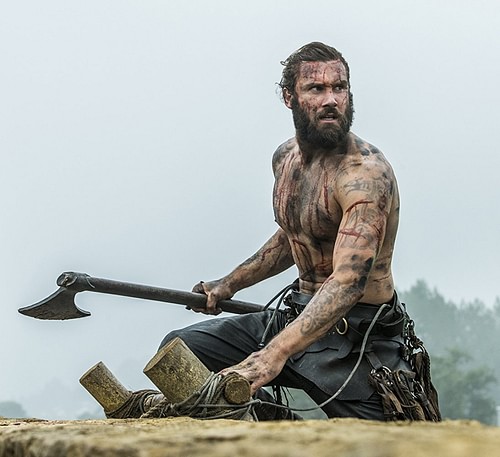
Clive Standen as Rollo of Normandy (by Jonathan Hession, Copyright, fair use)

ROLLO RULED WITH A VIKING CODE OF LAW BASED UPON THE CONCEPT OF PERSONAL HONOR & INDIVIDUAL RESPONSIBILITY.


Was Rollo Other than Norwegian?

The Rollo story is largely historical – and that he and his men were Northmen is taken to men they were of Scandinavian origin. Norwegian-Icelandic sources have it that Rollo was Hrolf from Norway, one of the Viking raiders.

  1. The oldest evidence is in the Latin Historia Norvegiae (ca. 1180). It was written in Norway. A quotation from it follows right below the array of Norse sources.
  2. Fagrskinna‘s chapter 74 tells of William and his ancestor Rolf Ganger (Rollo). This work was written around 1220, estimatedly, and was an immediate source for the Heimskringla of Snorri Sturluson’s Heimskringla. Fagrskinna contains a vernacular history of Norway from the ninth to the twelfth centuries, and includes skaldic verses that in part have been preserved nowhere else. It has a heavy emphasis on battles. The book may have been written in Norway, either by an Icelander or a Norwegian. (Cf. Finlay 2004)
  3. In the early 1200s, the Icelander Snorri Sturluson writes about this Hrolf, in Heimskringla, Book 3, section 24; Book 7, section 19, There are stories about the arsonist father and the brothers of Rolf Ganger, at one time rulers of the Orkneys and Moere in Norway. Their tales start somewhere during the reign of King Harald Fairhair (Chaps. 27, 30-32) and say it was he who settled in Normandy. Snorri also tells that Rolv Ganger – also known as Rollo – became one ancestor of the British royal house.
  4. Other Icelandic sagas from medieval times tell of Hrolf too, as the Orkneyingers’ Saga, section 4.
  5. From the Icelandic Landnama Book (Ellwood 1898): “Rögnvald, Earl of Mæri, son of Eystein Glumra, the son of Ivar, an Earl of the Upplendings, the son of Halfdan the Old, had for wife Ragnhild, the daughter of Hrolf the Beaked; their son was Ivar, who fell in the Hebrides, fighting with King Harald Fairhair. Another son was Gaungu-Hrolf who conquered Normandy; from him are descended the Earls of Rouen and the Kings of England.” (Part 4, ch. 7)

From Historia Norvegiae, the oldest of the Norse works where Rollo is mentioned:

When Haraldr hárfagri ruled in Norway some vikings of the kin of a very mighty prince, Rognvaldr, crossed the Sólund Sea with a large fleet, drove the Papar [monks and the picts, called Peti here] from their long-established homes [the Orkney Islands], destroyed them utterly and subdued the islands under their own rule. With winter bases thus provided, they sallied forth all the more securely in summer and imposed their harsh sway now on the English, now on the Scots, and sometimes on the Irish, so that Northumbria in England, Caithness in Scotland, Dublin and other coastal towns in Ireland were brought under their rule. In this company was a certain Hrólfr, called Gongu-Hrólfr by his comrades because he always travelled on foot, his immense size making it impossible for him to ride. With a few men and by means of a marvellous stratagem he took Rouen, a city in Normandy. He came into a river with fifteen ships, where each crew member dug his part of a trench which was then covered by thin turves, simulating the appearance of firm ground. They then arrayed themselves on the landward side of the trenched ground and advanced prepared for battle. When the townsmen saw this, they met the enemy in head-on attack, but these feigned flight as if racing back to their ships. The mounted men, pursuing them faster than the rest, all fell in heaps into the hidden trenches, their armoured horses with them, where the Norwegians slaughtered them with deadly hand. So, with the flight of the townsmen, they freely entered the city and along with it gained the whole region, which has taken its name of Normandy from them. Having obtained rule over the realm, this same Hrólfr married the widow of the dead count, by whom he had William, called Longspear, the father of Richard, who also had a son with the same name as himself. The younger Richard was the father of William the Bastard, who conquered the English. He was the father of William Rufus and his brother Henry . . . When established as count of Normandy Hrólfr invaded the Frisians with a hostile force and won the victory, but soon afterwards he was treacherously killed in Holland by his stepson. (Phelpstead 2008, 8-9)

Dr Claus Krag (born 1943) is a Norwegian specialist in medieval Norwegian history, and at present (2018) professor emeritus at Telemark University College. Krag maintains that what Dudo writes of Rollo – Dudo tells he was a Viking from an alpine Dacia – is “totally unreliable”, and that Dudo’s historic and geographic information “is by no means right”. Dr Krag also notes that in French works younger than Dudo’s book, Rollo is presented as a Norwegian.

Based on the much unclear Dudo about an alps-surrounded “Dacia”, some Danes say Rollo was Danish. However, Denmark is flat. Attempts to settle the question by analysis of DNA profiles of likely Rollo descendants have failed so far. [◦”Skeletal shock for Norwegian researchers at Viking hunting”]


Folk Stories Around Rollo

Several Scandinavian folktales front similar basic “success recipes” as those of battling tribes in search of new areas – Saxons, Angles, Danes and other Vikings. It suggests that many folktale heroes walk in shoes quite like those of Rollo by degrees and through much similar stages where success often depends on combat and getting valuables. Those were the times.

In the course of centuries, stories and myths may grow for such as glorifying ends. Norman bards developed romances that venerated kings. However, having a king is not a great good, according to 1 Samuel 8; 10 in the Old Testament: the king is portrayed as a stealing enemy on top. Taxes continue a tradition . . . Also, immodest royalty may breed dependence and un-normal subservience with or without near-symbiotic and half-neurotic servility.


In 1 Samuel 8:11-18 we read how bad a Jewish king will be:

This is what the king who will reign over you will claim as his rights: He will take your sons and make them serve with his chariots and horses, and they will run in front of his chariots. Some he will assign to be commanders of thousands and commanders of fifties, and others to plow his ground and reap his harvest, and still others to make weapons of war and equipment for his chariots. He will take your daughters to be perfumers and cooks and bakers. He will take the best of your fields and vineyards and olive groves and give them to his attendants. He will take a tenth of your grain and of your vintage and give it to his officials and attendants. Your male and female servants and the best of your cattle and donkeys he will take for his own use. He will take a tenth of your flocks, and you yourselves will become his slaves. When that day comes, you will cry out for relief from the king you have chosen, but the Lord will not answer you in that day.

But the people refused to listen to Samuel. “No!” they said. “We want a king over us.” [Highlighting added]


Rollo In Normandie


Map of France, 10th Century CE

The historian Reginald Allen Brown (1924–89) has written extensively about Normans and the Norman conquest. He is rendered in the following:

Normandy was created by the three consecutive grants of 911, 924 and 933″. (Brown 1985, 15) Normandy was massively colonised by Scandinavians. Rollo and his successors, as rulers of Normandy, obtained the title of count and valuable rights from before, along with widespread domains. (Cf. Brown 1985, 17-18)

Their buildings seem to document remarkable strength or solidity. The churches were much like bastions. But the duke of Rouen controlled the whole church and his bishops owed him military service for their lands – (Brown 1985, 26)

“From (their) Scandinavian inheritance the Normans derived their sea-faring, much of their trade and commercial prosperity which they shared with the Nordic world, their love of adventure, their wanderlust which led to the great period of Norman emigration in the eleventh century, their dynamic energy, and above all perhaps, their powers of assimilation, of adoption and adaptation.” (Brown 1985,18-19.)

(In AD 911) Charles the Simple, king of the west Franks, granted to a band of Vikings, operating in the Seine valley under Rollo their leader, territory corresponding to Upper or Easter Normandy. To this was subsequently added by two further grants, first the district of Bayeux, and the districts of Exmes and Seez in 924, and second the districts of Coutances and Avranches in 933 in the time of William Longsword, son and successor of Rollo. (Brown 1985, 15) (2)

And from the French Histoire de la Normandie (1862) we find, in the fourth chapter, how Rollo, son of the Norwegian Rognevald, was made an outlaw by the Norwegian king Harald Harfager. He arrived at Rouen with his companions. The inhabitants spontaneously submitted to the him and his men. King Charles at first wanted to fight the Viking, but dropped it. Instead they bargained – Rollo won, he got land and permanent welcome. (Barthelemy 1862, 80 ff)

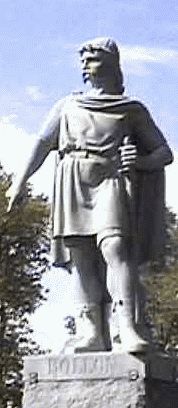
Rollo of Normandy Statue

Rollo of Normandy Statue


Brown puts the matter into relief: “Normans were pagans when they came (and they continued to come long after 911).” (Brown 1985, 24). But their leader, the Viking Rollo, agreed to getting baptised, and many others followed. “The Seine Vikings became Christian Normans, the poachers turned gamekeepers. Revival, characteristically in this monastic age, came first to the monasteries. Jumieges was restored by William Longsword (927–43), son of Rollo, who is said to have wanted to become a monk there himself.” (Brown 1985, 21)

In short time the Normans got the back-up of their astute castles and strongholds, helped themselves to most of it – often they were served by ditches and stockades too. (Brown 1985, 37, 37n)

[It is thought that Rollo showed exceptional skills in navigation, warfare, leadership, and administration. He abdicated to his son Guillame (William) and died in a monastery in 933. Among his people he was for hundreds of years the personification of justice and good government under law. Others, who thought differently, found him cruel and arrogant.]

His son Guillame Longue-Epee (William Longsword) succeeded him. The third duke was Richard sans Peur (the Fearless), and there were many intrigues and hard fights. This Richard died and was succeeded by Richard 2 who massacred Saxons in England at war. The French king Robert became the ally of Richard 2. After his death, Richard 3 succeeded him and died prematurely. Robert le Diable succeeded him and, before he died in Terre-Sainte, became the father of Guillame le Conquerant: William the Conqueror. (Barthelemy 1862, 80 ff)

We find the family tree of William the Conqueror in the book of the historian R. Allen Brown. It looks like this:

  • Richard 1 (ruled: 942–96)
  • Richard 2 the Good (ruled: 996-1026)
  • Richard 3 (ruled: 1026–27)
  • Robert 1 the Magnificent /le Diable (ruled: 1027–35)
  • William the Bastard / the Conqueror (ruled: 1035–87).

Rollo’s great-granddaughter, Emma married two kings of England, Æhelred the Unready and Knut who was also king of Norway and Denmark. Her son, Edward the Confessor, from the first marriage, was King of England from 1042 to 1066.

A few more dukes of Normandy may be added for the sake of survey of that dynasty line that ruled over Normandy and its English (British) domain:

  • Robert 2 (ruled from 1087)
  • Henry 1 (ruled from 1106, King of the English (1100-35)
  • Henry II, 1135, King of the English (1135-)

“The origins of Normandy in the first decades of the tenth century also reveal the double inheritance of the Normans, from the Scandinavian world from whence they came and from the ancient province of Roman, Frankish and Carolingian Gaul which now they colonised.” (Brown 1985, 17)

“[I]n Normandy by the mid-eleventh century . . . they had adopted Frankish religion and law, Frankish social customs, political organisation and warfare, the new monasticism.” (Brown 1985, 19)

“The Norman monasteries were, by and large, distinguished . . . new . . . vibrant with . . . careless rapture of spiritual endeavour”. The (Normans) became great spirituals – intensely aristocratic. (Brown 1985, 23)

Normans restored and built on monasticism and left robust architectural monuments. Some are still there, more or less intact. The Tower of London was started by Normans, for example. King William had much of it built. “The tower at Rouen was built by Richard 1 (943Rw11;96) and is glimpsed from time to time in the reign of his successor and thereafter . . .. It may have been the prototype for the great Norman towers at Colchester and London. (Brown 1969, 37, 37n) (4)

Normans went on and built monastic churches at such places as Jumieges and many other places. “They added their cathedrals at Rouen, Bayeux [etc.] Many of these major works of Norman Romanesque architecture survive in whole or part”. (Brown 1985, 26)

Some Normans (including Norman clergy) were patrons of the arts and scholarship . . . and almost all of them were mighty builders.” (Brown 1985, 25)


The French Version


Statue of Rollo of Normandy, Falaise

Statue of Rollo of Normandy, Falaise


In 820 peasants . . .along the Seine saw in the distance ten or so curious war ships called—Drakkar because of the animal sculpted into the prow or the stern, which was actually a dragon—the men from the North didn’t travel with their women as they could easily find them on the spot!

Swearing by the names of Thor and Odin—Vikings plundered, pillaged, raped and slaughtered up until 911 when the famous treaty of Saint Clair sur Epte was signed between the Frank king Charles the Simple and Rollon or Rolf, chief of the men from the North.

On the whole our invaders calmed down, adopting a somewhat bourgeois attitude to life in this beautiful region which was to become Normandy.

Soon it was the time for William the Conqueror who, on October 14th, 1066 won the battle of Hastings along with a kingdom—William’s heirs were known as the Plantagenets, and they reigned over Normandy and England. In 1189, Richard the Lionheart divided the double crown.


Rollo and Dudo

Rollo was the son of Earl Ragnvald of More, Norse sagas tell. Two of his brothers were Ivar and Tore. Three more were Hallad, Einar and Rollaug. Hallad and Einar in due time became earls of the Orkneys, each in his turn. [eg, Harald Fairhair’s Saga]

After being made an outcast by the tyrant king Harald Harfager, Rolf voyaged to the western isles. Obviously he could count on support from relatives. The earl of the Orkneys was his paternal uncle, succeeded by that uncle’s son, that is, Rollo’s cousin, and later again by his own brothers Hallad and Einar.

The old sources hold that Rolv took his residence in certain tracts of what today is the domain of Scotland. The Landnamaboka mentions Rolv got a daughter, Kathleen:

Helgi . . . harried Scotland, and took thence captives, Midbjorg, the daughter of Bjolan the King, and Kadlin, the daughter of Gaungu Hrolf or Rolf the Ganger; he married her. (Part 2, ch. 11).

Before Helgi had harried and married, Rolv of the Sagas had travelled from Scotland and the isles near it, to Valland, near the English Channel. The Vikings’ Valland consisted of the southern Netherlands, Belgium and parts of Normandy, roughly said. He took over Normandy in three steps. The Sagas identify him with the Rollo that the Frank king Charles the Simple bestowed it on.

Rollo in Alesund, Norway


Rolv Ganger converted and settled in Rouen. Next he granted many of his Viking companions ample landed property. It was feasible to go north and fetch one’s women and children and kin to the new land, for the soil was fit, there was much fish, and as members of the ruling class they were much safer or freer than those who submitted to the tyranny of Harald Fairhair and his family in Norway and its colonies in several western islands (cf. Simonnaes 1994, 43).

Normans built fortresses on strategic places, and many rustic castles were to come along with them in a short time. All able men had to serve in the Norman military forces. The formerly ruined, marauded region was turned into one of the foremost in France, and Rouen became the second largest city in France, while Hrolf became the originator of the Norman duchy. [Simonnaes 1994 39, 45-46]

Dudos’ Work

Dudo was a visiting French scholar who wrote in verse and prose about the first three rulers of Normandy and their origins. His poetry is different from that of skalds, the Norse bards. It is not complex, as theirs, and he does not glorify war so much either. He is moralistic like earlier Christian eulogists and writers of biographies of saints (Christiansen 1998, xviii). “It was hagiography that moulded his work,” Eric Christiansen aptly sums up (ibid, xxi), and, “there is no sign that Old Norse poetry was ever composed or appreciated in Normandy (1998, xvii; cf. Ross 2005).”

Dudo’s eulogising chronicle (ibid. xxv) is about one family’s rise from defeat and exile in the world of Vikings to an honoured place among the great territorial rulers of France. Dudo recounts two campaigns in England by the founder, Rollo, and a series of stirring events otherwise, including the murder of Rollo’s son William, and the kidnapping, escape and precarious early career of Dudo’s first patron, Count Richard I.

Historians on the whole have doubted much in Dudo’s book, for its historical details are inaccurate. Yet it it is virtually the only source for very early Norman history. Recently, some scholars maintain that Dudo had better be seen as a propagandist.

Dudo’s work has the nature of a romance, and has been regarded as untrustworthy on this ground by such critics as Ernst Dümmler and Georg Waitz. Further, Leah Shopkow has more recently argued that Carolingian writing, particularly two saints’ lives, the ninth-century Vita S. Germani by Heiric of Auxerre and the early tenth-century Vita S. Lamberti by Stephen of Liége, provided models for Dudo’s work. (WP, “Dudo of Saint-Quentin”)

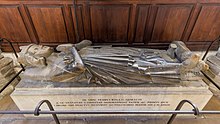
Rollo Grave at the Cathederal of Rouen


New editions of central Norman chronicles have surfaced over the last thirty years. The History of the Normans in Eric Christiansen’s English translation (1998) is said to be “fairly true to Dudo’s often pompous, bloated style” while at the same time being readable, and accompanied by copious, explanatory notes. Christiansen recognises that Dudo is unreliable as a historical source, and he acknowledges the Scandinavian side of the early Normans. Histories of Normans have a potentially broad appeal. On the Internet there has been a version edited by Felice Lifshitz (1996).

Dudo’s content: A few observations

O thou the magnanimous, pious, and moderate!
O thou the extraordinary God-fearing man!
O thou the mangificent, upright and kindly!
O thou miraculous, goodly just man!
O thou peace-maker and offspring of God!
O thou the munificent, holy and moderate!
O thou the incarnadine merciful Richard!
O thou the the long-suffering, Richard the prudent!
O thou most famous one, Richard the comely!
O thou justiciar, Richard the mild!
– All manner of nations duly declare.
Mild one, remember what you see in the book,
Nourish your heart and your soul on these things
That you may be joined to the matter you read.

– Verses to Richard, son of the great Richard (in Christiansen 1998, 8)

A clergy view shines through.


The commisioned chronicler of the Norman dukes, Dudo, tells in Latin (ca. 1015–20) that Rollo was the son of an uncertain king in “Dacia”. ◦Gesta Normannorum:

Spread over the plentiful space from the Danube to the neighborhood of the Scythian Black Sea, do there inhabit fierce and barbarous nations, which are said to have burst forth in manifold variety like a swarm of bees from a honeycomb or a sword from a sheath, as is the barbarian custom, from the island of Scania, surrounded in different directions by the ocean. For indeed there is there a tract for the very many people of Alania, and the extremely well-supplied region of Dacia, and the very extensive passage of Greece. Dacia is the middle-most of these. Protected by very high alps in the manner of a crown and after the fashion of a city. – [From chapter 2, second paragraph in Gesta Normannorum by the chronicler Dudo ca. 1015]

Extracts from Dudo of St. Quintin’s

One thing that stand out from Dudo’s obscure and glorifying marvel is this: If what is called Dacia is surrounded by very high alps, it isn’t Denmark. His Dacia stands out as some very fertile, southern Alp tract (Balcanlike). (Steenstrup 1876, 30, 31)

Against a claim by the Danish Johannes Steenstrup in 1876, there is not one mention of Rollo in classical Danish sources. DNA analyses of Norman descendants of Rollo could have helped in finding out about his origin, but so far no fit DNA has been detected.

The Danish historian Saxo Grammaticus from about 1200, has no mention of any Danish Rollo in ◦The Danish History.

In Normandy, Rollo is celebrated as a real Viking from More on the west coast of Norway [Cf. Simonnaes 1994 35]


Rollo in Fargo, North Dakota


Lessons

In 1911, during the Norman Millennium celebrations, the city of Rouen in Normandy decided to create two copies of its Rollo statue. One replica was sent as a gift to Ålesund, Norway. The earls of Moere were headquartered somewhere nearby Ålesund, it is suggested.

The other replica went to Fargo in North Dakota. The two bronze statues were copied from an original stone statue sculpted in 1863 by Arsene Letellier, erected in Rouen in 1865.

In Fargo, the dedication ceremony in 1912 included a speaker from the French embassy in Washington. A proclamation by the mayor of Rouen, bound in leather with gold seal of the city, gold leaf and other ornamentation, read in part,

“Since these ancient times, these fierce warriors have populated and have become a hard-working people whose importance is shown by the powerful association of the Sons of Norway which has preserved the cult of memory, and which participated last year in the celebrations in the ancient Duchy of Normandy.”

The celebrations were concluded with a parade down Broadway. The Rollo statue was relocated in the 1980s and now stands in a little park. [Simonnaes 1994 39, 48, 40]


Preserving Our Past, Recording Our Present, Informing Our Future

Ancient and Honorable Clan Carruthers Int Society CCIS  LLc

carruthersclan1@gmail.com              carrothersclan@gmail.com


cropped-wider-banner-light-blue-1.jpg

You can find us on facebook at :

https://www.facebook.com/carrutherscarrothers.pat.9

https://www.facebook.com/CarruthersClan/

https://www.facebook.com/CarruthersClanLLC


Disclaimer Ancient and Honorable Carruthers Clan International Society CCIS LL


Gutland / Gotland, The Viking Age, Uncategorized

CLAN CARRUTHERS- TJELVARS

CLAN CARRUTHERS INT SOCIETY CCIS                  PROMPTUS ET FIDELIS

cropped-wide-banner-with-new-crest.jpg


A Bronze Age Burial Steeped in Legend: What Makes the Ship-Shaped Tjelvar’s Grave Unique?


Gotland, Sweden’s largest island, is home to medieval churches, cathedral ruins, as well as numerous pre-historic sites. The archaeological and historical sites that pepper this land make up a timeline of Gotland’s past.

One such site is known as Tjelvar’s grave. It is a ship-shaped stone setting found on the eastern coast of the island. Sites of this type can be found all over Scandinavia, they are typically dated to the early Viking Age, circa the late 8th century AD.

The “ship” has the length of 18 metres and a width of 5 metres. Nearby are also the remains of two Iron Age forts. From Slite drive south on the road 146 towards Gothem and look for the signs on the right hand side of the road.

However, Tjelvar’s grave can be dated all the way back to pre- Bronze Age, predating the other sites by nearly 2000 years. From the Bronze Age to the Viking Age, to our present age, this style has been resurrected and replicas continue to be built around Gotland and Scandinavia.

When excavated in the 1930’s the robbed cist revealed some cremated bones and pot sherds. The earliest skeleton found on Gotland so far has been dated to 8000 years ago.

The legend of Tjelvar being the first to discover Gotland has been interwoven with the existance of this Bronze Age ship burial site over the millenia. Just north of Aminne you pass through Tjälder and a few hundred metres further north take the gravel lane west towards Bäl and Bjärs. The site is approximately 2 kilometres down this lane. References: Riksantikvarieämbetet Fornsök: Boge 28:1; Site 66 Tjelvar’s Grave.

Since ancient times, Gotland has been the obvious link between the present and the past. Everywhere on the island you can still find traces from hundreds of years back in time. Gotland is a modern destination with a fascinating living history in a world heritage site.


Preserving Our Past, Recording Our Present, Informing Our Future

Ancient and Honorable Carruthers Clan Society International

carruthersclan1@gmail.com      carrothersclan@gmail.com

cropped-wider-banner-light-blue-1.jpg


MARK STEWART    LONDON ENGLAND

Clan Carruthers Int Society CCIS  Historian and Genealogist

You can find us on facebook at :

https://www.facebook.com/carrutherscarrothers.pat.9

https://www.facebook.com/CarruthersClan/

https://www.facebook.com/CarruthersClanLLC


Uncategorized

CLAN CARRUTHERS-PINE BARK BREAD

cropped-wider-banner-light-blue-1.jpg


PINE BARK BREAD


~ TRADITIONAL SCANDINAVIAN RECIPE


When you hear “eating bark” your mind probably jumps to a pretty dire survival situation, but historically that’s not the case.  Bark, specifically pine bark and birch bark, have been used for centuries to flavor food and boost nutrition, even in times of plenty.

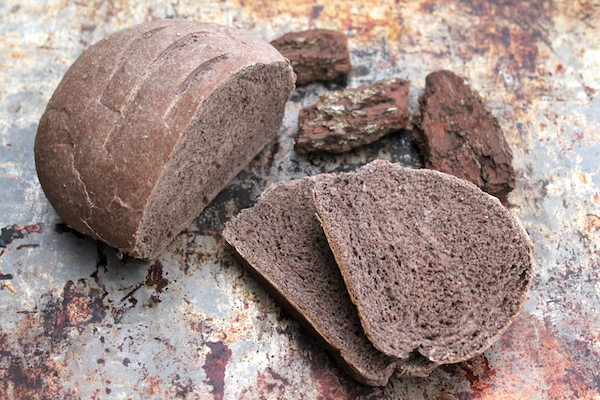
Pine Bark Bread

Bark breads are a staple of Nordic indigenous cuisine.  The Sami of northern Sweden harvested pine bark and mixed it with reindeer milk in their traditional breads.  Since the richest sami had the most reindeer, they’re also the ones that harvested the most pine bark.  It wasn’t out of desperation, but out of a quest for flavor.

In the case of birch bark, the historical evidence is clear that the papery outer bark was used to make food storage vessels, while the nutritious inner bark was ground into birch bark flour.  In the case of pine bark, the records are a bit less clear.  There are some sources that say only the inner bark was used, and others that claim only the outer bark was used.  Since I’ve been able to find recipes using both, I’ll share them all with you.

Pine Bark Bread Dough

PINE BARK FLOUR USING OUTER BARK

The outer bark of a tree is mostly there to protect the tree from the elements and doesn’t contain much in the way of calories.  Calories aren’t the only reason to eat something, and pine outer bark seems to have other benefits.  Pine outer bark may contain compounds that help keep food from spoiling or important nutrients that were scarce in a northern climate.

According to Nordic Food Lab,  though pine outer bark is not calorie rich, it does “contain condensed tannins called procyanidins that are being researched for potential health benefits. Aromatic hydrocarbons such as terpenes and phenols which give pine its distinctive warm, woody scent also deliver antimicrobial properties, perhaps useful for blending with other flours to preserve their shelf life.”

Ground Pine Bark Flour for Bark Bread

These days, nutritional supplements are made from pine bark, and you can buy bags of powdered pine bark online which claim that “Pine Bark is used worldwide for its antioxidants and anti-inflammatory properties. When used regularly, pine bark may support healthier cardiovascular and circulatory function.”

The outer bark was harvested from a section of the tree to create a “window pane” of exposed cambium.  Over time, the bark slowly healed over the wound, and since the inner cambium was not harvested the tree continued to grow.  Such trees could be harvested multiple times over the course of their life.  There’s evidence of window panning on 700+-year-old pine trees in northern Sweden.

Harvesting Pine Bark for Bark Bread

Obviously, if you’re going to harvest the bark of a tree, know that you are damaging the tree in a way that will impact it for hundreds of years.  This particular pine tree has a partially dead top, and it’s very near our wind turbine.  It’s going to be cut in the spring, so it’s a good candidate for bark harvest.

I started out using a draw knife, but it’s actually pretty difficult to use one just on the surface without really digging into the cambium.  Since I only needed a small amount of pine bark flour, I was able to just use my hand to flake off chunks of shaggy exterior bark from a large pine tree growing on our land.  No need to window pane a tree and cause it damage in any case.

Harvesting edible Pine Bark for flour

Initially, I tried to grind the pine bark flour in a food processor, but it was in vain.  The exterior bark is quite hard, but not brittle enough to fly apart.  After several minutes the motor was heating up and had almost no pine bark flour to show for it.  The bark, even exterior bark, needs to be dried out thoroughly before grinding.

I put the bark chips in the oven at 350 for about 45 minutes.  The house smelled nice and toasty, like the warm scents of the high desert pine forests of my youth.  Once the bark was toasted it ground much more easily.  It would be possible to dry the bark out over a low fire in a similar way, which would make it much easier to grind by hand.  When the pine bark was dried, I put it back into the food processor for grinding.

Grinding Pine Bark Flour

This recipe for pine bark bread using the outer bark comes from Laila Spik, a Sami elder and indigenous ambassador from Northern Sweden.  It was printed in A Boreal Herbal, which I found to be a great resource for foragers in Northern climates like myself.

While it’s called “bread” it’s actually crisp crackers that are completely unleavened.  The dough is formed using a mixture of pine outer bark flour and whole wheat flour, and then it’s rolled thin on a baking sheet.  The pine bark crakers cook for about 4 minutes in a 500-degree F oven.

Pine Bark Bread Rolled Out

Pine Bark Bread (with outer bark)

This recipe for pine bark bread comes from Sweden and uses the outer bark of a pine tree ground into a fine flour.  The resulting bread is more like what most people would consider crackers.

Ingredients

  • 7/8 cup Pine Bark Flour 200ml
  • 3 3/4 cup whole wheat flour 900ml
  • 1 tsp salt 5ml
  • 1 3/4 cup cold water 400 ml

Instructions

  1. Preheat oven to as hot as it goes, around 500 degrees for mine.

  2. Mix all ingredients to form a dough.  Adjust with more water or flour if it is either too sticky or dry.

  3. Roll the bark flour cracker dough into very thin sheets and prick it every inch or so with a fork.  Cut it into bite-sized pieces and place them on an oiled baking sheet.
  4. Bake for about 3 minutes, turning the sheets halfway through.  When the crackers come out of the oven they’ll have a soft texture, but they’ll be crisp once the cool.

So how did the finished pine bark crackers taste?  Honestly, absolutely horrible.  I know, you’re probably not shocked, but I was.  When I made birch bark flour, it was delicious.

Maybe it’s a cultural thing.  Maybe I’m just horrible at making crackers.  I baked up half the dough into a tray of crackers, but I saved the second half of the dough for experimentation.

Pine Bark Bread Crackers

At this point, I had a mass of unleavened dough, but it’s not hard to incorporate a bit of yeast after the fact.  One of my favorite bread books makes whole grain bread using a slow fermentation technique.  The method starts out with two different starters, one with yeast and one without.  They’re then kneaded separately before being chopped into tiny pieces and then kneaded together.  That allows you to seamlessly add yeast to a mass of unleavened dough.

I used this technique to turn the remaining pine bark bread dough into a yeasted loaf.  After about 35 minutes in the oven, my tiny bark bread loaf was done.  My 3-year-old daughter, the bread fiend that she is, was eager to try it and she stole the first piece.  It met with her approval, and she handed it to me for a taste.  The verdict…It’s shockingly good.  It tastes quite a bit like any dark brown bread, but with the same warm notes of pine forest that I smelled when the bark was originally toasting.

Wild Foraged Pine Bark Bread made with Pine Bark Flour

The inner bark of pine trees is much milder, and actually contains calories (instead of just nutrients).  I now have high hopes for making a really tasty loaf with pine cambium flour…

PINE BARK FLOUR USING INNER BARK

Unlike the outer bark of pine trees, the inner bark of pine trees contains a surprising amount of calories.  According to The Nordic Cookbook, Pine bark flour made from the phloem (inner bark) “contains about 80 calories per 100 grams, compared with wheat flour, which contains well over 800 calories per 100g.”

Beyond just the caloric content, studies show that pine bark flour may have been an important source of vitamin C for the Sami people.  Similarly, Nordic Food lab notes that “The phloem of the pine is rich in ascorbic acid (Vitamin C), which during the 1800s helped the Sami of the interior of Norway and Sweden avoid the scurvy that was at the time devastating the coastal populations of non-Sami farmers.” 

Again, the flour from the inner bark, similar to the flour from the outer bark, was not just a famine food.  A type of rye bread known as pettuleipä is still eaten in Finland in Modern times. The Nordic Cookbooknotes that pine bark flour is available at some health food stores in Scandinavia, and “Especially in Finland, breads baked with pine bark had a strong tradition and historically have been eaten on a regular basis, not just when grains were not plentiful enough to last through the winter.”

The author provides a recipe for traditional pettuleipä which is a full page of text (with small font!) and requires 4 full days of slow fermentation.  Starting with a very wet batter and yeast starter, increasing amounts of rye and pine bark flour are added to the dough each day.  The author notes how the bread should look at each stage of the slow fermentation, and at the end of day 3, the bread should be “frothing” and asks you to taste it to make sure that it’s tart from the activity of abundant lactobacilli (lactic acid bacteria as in yogurt).

I had hoped to make this bread, but when I went out to harvest pine phloem the temps were too cold.  Traditionally pine bark is harvested in late spring or early summer, with the peak harvest in June.  Likely that has to do with the fact that there will be more sugars in the phloem when the tree is actively growing, but it’s also a matter of practicality.  Trying to harvest pine bark in freezing temperatures is just impractical, and the phloem just flaked away in shards rather than coming off in clean sheets.  So much for pine bark being a winter survival food.

I should note that harvesting the inner bark from a tree can kill it, and this should only be done with trees that are slated to be cut down anyway (as mine was).  Alternatively, you can harvest the inner bark from pine branches that you’ve cut off for that purpose.

OTHER WAYS TO EAT BARK

Beyond grinding it into flour, the inner cambium can be eaten as it is.

The author of A Boreal Herbal notes, The inner bark (cambium layer) has long been used as a survival food and can also be eaten in raw slices.I like to use the soft, moist, white inner bark for making pesto.Most pesto recipes call for pine nuts.But one day, when I was making pesto I didn’t have any around.Remembering the flavor of the pine’s inner bark, I thought, why not?I’ll try it.It was wonderful— I haven’t used pine nuts since.  The inner bark contains lots of starch and many sugars and can be boiled or ground and then added to soups and stews.”

Though not quite pine, Tamarack is a related conifer.  In Rogers Herbal Manual, Herbalist Robert Rogers gives a recipe for tamarack bread: “Scrape off the softwood and inner bark of tamarack, mix with water, and ferment into a dough to be mid with rye meal.Bury under the snow for a day.As fermentation begins, the dough can be cooked as a camp bread or as dumplings, the sweet wood pulp acts as a sugar for the yeast in the rye.”

So there you have it, yet another way to eat a pine tree.  Pine nuts are tasty, their needles are edible, the sap is medicinal and now you know how to eat pine bark.

Wild Foraged Pine Bark Bread ~ Traditional Scandinavian Recipe for bread made with the bark of pine trees.  Historical evidence shows it has been eaten for hundreds of years, and it's still made today. #bread #recipe #pine #bark #foraged #foraging #edible #homemade


Preserving Our Past, Recording Our Present, Informing Our Future

Ancient and Honorable Carruthers Clan Society Int CCIS

carruthersclan1@gmail.com      carrothersclan@gmail.com

coacarrutehrs


DOUGLAS CARRUTHERS, ORKNEY SCOTLAND

CLAN CARRUTHERS INT SOCIETY CCIS   HISTORIAN AND GENEALOGIST

You can find us on facebook at :

https://www.facebook.com/carrutherscarrothers.pat.9

https://www.facebook.com/CarruthersClan/

https://www.facebook.com/CarruthersClanLLC


Disclaimer Ancient and Honorable Carruthers Clan International Society CCIS L


The Viking Age, Uncategorized

CLAN CARRUTHERS – VIKINGS IN IRELAND- PART III

CLAN CARRUTHERS INT SOCIETY CCIS                             PROMPTUS ET FIDELIS

cropped-wider-banner-light-blue-1.jpg

VIKINGS IN IRELAND

795 – 1014

PART III


The Vikings in Wales

One side effect of the strength of Irish resistance was to increase Viking interest in Wales. At its closest points, Wales was only a day’s sail away from Dublin, Waterford and Wexford, and from the Viking colony in the Isle of Man, but despite this had so far suffered relatively little from Viking raids. A combination of strong military rulers such as Rhodri Mawr (r. 844 – 78) of Gwynedd, difficult mountainous terrain, and Wales’ poverty compared to England, Ireland and Francia, seem to have deterred any major Viking invasions in the ninth century. Only a dozen Viking raids are recorded in the period 793 – 920, compared to over 130 in Ireland in the same period. This was fewer than the number of English invasions of Wales in the same period. Place-name evidence points to areas of Viking settlement in the south-west, in Pembrokeshire and Gower, but, as they are undocumented, it is not known when they were made. There was also a small area of Viking settlement in the far north-east, modern Flintshire, most probably by refugees from Dublin following its capture by the Irish in 902. This was probably overspill from the successful Viking colony a few miles away across the estuary of the River Dee in Wirral.

In the first half of the tenth century, Wales was dominated by Hywel Dda (r. 915-50), the king of Deheubarth in the south-west. During his long reign Hywel came close to uniting all of Wales under his rule but his death in 950 was followed by a civil war and the break-up of his dominion. This was a signal to Vikings based in Ireland, the Isle of Man and the Hebrides to launch a wave of attacks on Wales. The area most exposed to Viking raiding was the large and fertile island of Anglesey off the coast of North Wales, which lay only 70 miles due east of Dublin and just 45 miles south of the Isle of Man: raids are recorded in 961, 971, 972, 979, 980, 987 and 993. Another place hit hard was St David’s monastery on the Pembrokeshire coast, Wales’ most important ecclesiastical centre. Founded c. 500 by St David, the monastery became the seat of the archbishops of Wales in 519. Only 60 miles from Wexford, St David’s was first sacked by Vikings in 967, then again in 982, 988 and 998, when they killed archbishop Morgeneu. St David’s would be sacked at least another six times before the end of the eleventh century. In 989 the raids had become so bad that King Maredudd of Deheubarth paid tribute to the Vikings at the rate of one silver penny for each of his subjects. Viking raids declined quickly after 1000, perhaps because the Viking towns in Ireland had come under the control of Irish rulers, but raids from the Hebrides and Orkney continued into the twelfth century. Vikings from Ireland also continued to come to Wales, but they did so mainly as mercenaries signing on with Welsh kings to fight in their wars with one another and with the English.

The Rock of Cashel

The end of Ireland’s Viking Age is traditionally associated with the rise of the O’Brien (Ua Briain) dynasty of Munster, and of its greatest king Brian Boru (r. 976 – 1014) in particular. Brian’s career certainly had an epic quality about it. Brian was a younger son of Cennétig mac Lorcáin (d. 951), king of the Dál Cais, whose kingdom, which was roughly equivalent to modern County Clare, was subject to the kings of Munster. As a younger son Brian probably never expected to rule and his early life was spent in the shadow of his elder brother Mathgamain. Even Brian’s date of birth is uncertain. Some Irish sources claim that he was eighty-eight when he died in 1014, which would mean he was born in 926 or 927, but other sources give dates as early as 923 and as late as 942. Brian’s first experience of war came in 967 when he fought alongside his brother at the Battle of Sulcoit against Ivar, king of the Limerick Vikings. The following year the brothers captured and sacked Limerick, executing all male prisoners of fighting age. The rest were sold as slaves. Ivar, however, escaped to Britain and in 969 he returned with a new fleet and regained control of Limerick only to be expelled again by the Dal Cais in 972.

Probably in 970, Mathgamain expelled his nominal overlord, Máel Muad the king of Munster, from his stronghold on the Rock of Cashel. The rock is a natural fortress, a craggy limestone hill rising abruptly and offering a magnificent view over the fertile plains of County Tipperary. The rock is now crowned by the ruins of a medieval cathedral and one of Ireland’s tallest surviving round towers, so little evidence of earlier structures survives. In legend, Máel Muad’s ancestor Conall Corc made Cashel the capital of Munster after two swineherds told him of a vision in which an angel prophesised that whoever was the first to light a bonfire on the rock would win the kingship of Munster. Conall needed no more encouragement and had hurried to Cashel and lit a fire. This was supposed to have happened around sixty years before St Patrick visited around 453 and converted Munster’s then king Óengus to Christianity. During the baptismal ceremony the saint accidentally pierced Óengus’ foot with the sharp end of his crozier. The king, thinking it was part of the ritual, suffered in silence.

Mathgamain’s success in capturing Cashel promised to make the Dál Cais a major power as Munster was one of the most important of Ireland’s over-kingdoms, covering the whole of the south-west of the island. However, before Mathgamain could win effective control of Munster, Máel Muad murdered him and recaptured Cashel. Brian now unexpectedly found himself king of the Dál Cais and quickly proved himself to be a fine soldier. After his expulsion from Limerick in 972, Ivar established a new base on Scattery Island, close to the mouth of the Shannon, from where he could still easily threaten Dál Cais. This sort of tactic had served Vikings well since the 840s, but no more. Brian had learned the importance of naval power from the Vikings and in 977 he led a fleet to Scattery Island, surprising and killing Ivar. A year later Brian defeated and killed his brother’s murderer to regain control of Cashel. Very shortly afterwards he defeated his last serious rival for control of Munster, Donnubán of the Uí Fidgente, and the remnants of the Limerick Vikings under Ivar’s son Harald. Both Donnubán and Harald were killed. This spelled the end of Viking Limerick. The town now effectively became the capital of Dál Cais, but Brian allowed its Norse inhabitants to remain in return for their valuable military and naval support. In the years that followed, Brian also became overlord of the Viking towns of Cork, Wexford and Waterford.

Now secure in his control of Munster, Brian began to impose his authority on the neighbouring provinces of Connacht and Leinster. Brian’s ambitions inevitably brought him into conflict with Dublin’s overlord, Máel Sechnaill. Almost every year, Brian campaigned in either Leinster, Meath or Connacht. Limerick and other Viking towns provided Brian with fleets, which he sent up the River Shannon to ravage the lands of Connacht and Meath on either side. When Donchad mac Domnaill, the king of Leinster, submitted to Brian in 996 Máel Sechnaill recognised him as overlord of all of the southern half of Ireland, including Dublin. Brian almost immediately faced a rebellion by Donchad’s successor in Leinster, Máel Morda, and the king of Dublin, Sihtric Silkbeard (r. 989 – 1036). Sihtric was another son of Olaf Cuarán, by his second wife Gormflaith, who was Máel Morda’s sister. Brian’s crushing victory over the allies at the battle of Glen Mama in 999 left him unchallenged in the south. Brian dealt generously with Sihtric, allowing him to remain king, and marrying Gormflaith, so making him his son-in-law. There was a brief peace before Brian, his sights now set on the high kingship itself, went back onto the offensive against Máel Sechnaill. Sihtric played a full part in these campaigns, providing troops and warships. Finally defeated in 1002, Máel Sechnaill resigned his title in favour of Brian and accepted him as his overlord: it was the first time that anyone other than an Uí Néill had been high king. Two more years of campaigning and every kingdom in Ireland had become tributary to Brian, hence his nickname bóraime, ‘of the tributes’.

mi-battle-of-clontarf-painting

The Battle of Clontarf

Brian’s achievement was a considerable one but he did not in any meaningful sense unite Ireland: outside his own kingdom of Dál Cais, Brian exercised authority indirectly, through his tributary kings, and he created no national institutions of government. Nor was the obedience of Brian’s tributaries assured: he faced, and put down, several rebellions. The most serious of these rebellions began in 1013 when Máel Mórda of Leinster renewed his alliance with Sihtric Silkbeard, who, despite Brian’s conciliatory approach, still hoped to recover Dublin’s independence. To strengthen Dublin’s forces, Sihtric called in an army of Vikings under Sigurd the Stout, the jarl of Orkney, and Brodir, a Dane from the Isle of Man, which arrived at Dublin just before Easter 1014. Brian quickly raised an army that included several of his tributary kings, including Maél Sechnaill, and a contingent of Vikings under Brodir’s brother Óspak. The two armies met in battle at Clontarf, a few miles north of Dublin on Good Friday (23 April) 1014. Neither Brian nor Sihtric fought in the battle. Sihtric watched the battle from the walls of Dublin, where he had remained with a small garrison to defend the city if the battle was lost. Now in his seventies or eighties, Brian was too frail to take any part in the fighting and spent the battle in his tent. The exact size of the rival armies is unknown but Brian’s was probably the larger of the two.

The battle opened around daybreak in heroic style with a single combat between two champion warriors, both of whom died in a deadly embrace, their swords piercing one another’s hearts. The fighting was exceptionally fierce but Brian’s army eventually gained the upper hand and began to inflict severe casualties on the Vikings and the Leinstermen. Brian’s son and designated successor, Murchad, led the attack and was said personally to have killed 100 of the enemy, fifty holding his sword in his right hand and fifty holding his sword in his left hand, before he was himself cut down and killed. Among Murchad’s victims was jarl Sigurd. Of the Dublin Vikings fighting in the army, only twenty are said to have survived the battle and the Leinster-Dublin army as a whole suffered as many as 6,000 casualties. By evening, the Leinster-Dublin army was disintegrating in flight and many Vikings drowned as they tried desperately to reach their ships anchored in Dublin Bay. At this moment of victory, Brodir and a handful of Viking warriors broke through the enemy lines and killed Brian as he prayed in his tent. Brodir’s men were quickly killed by Brian’s bodyguards and, according to Icelandic saga traditions, Brodir was captured and put to a terrible death. His stomach was cut open and he was walked round and round a tree until all his entrails had been wound out. Máel Mórda and one of his tributary kings were also killed in the fighting, as too were two tributary kings on Brian’s side.

For the anonymous author of the Cogadh Gaedhel re Gallaibh, Clontarf was the decisive battle of Ireland’s Viking wars, but this exaggerates its importance. The author of the Coghad was essentially a propagandist for Brian Boru’s Ua Briain dynasty and he intended, by glorifying his achievements, to bolster his descendents’ claim to the high kingship of Ireland, which they contested with the Uí Néills. The true impact of the battle was rather different. The deaths of Brian and Murchad caused a succession crisis in Dál Cais that brought the rise of the Ua Briain dynasty to a crashing halt. Brian’s hard-won hegemony immediately disintegrated, Cashel reverted to its traditional rulers, and Máel Sechnaill reclaimed the high kingship. Sihtric found himself back where he had started his reign, a sub-king to Máel Sechnaill. There could have been no clearer way to demonstrate how far gone in decline Viking power in Ireland already was. Sihtric continued to take part in Ireland’s internecine conflicts but his defeats outnumbered his successes, and Dublin’s decline into political and military irrelevance continued. Dublin continued to prosper as Ireland’s most important port, however, making Sihtric a wealthy ruler. In 1029 he ransomed his son Olaf, who had been captured by the king of Brega, for 1,200 cows, 120 Welsh ponies, 60 ounces (1.7 kg) of gold, 60 ounces of silver, hostages, and another eighty cattle for the man who had conducted the negotiations. Though he was quite willing to sack monasteries when it suited him, Sihtric was a devout Christian and in 1028 he made a pilgrimage to Rome. Such journeys were primarily penitential and, as an active Viking, Sihtric no doubt had much to be penitential about. On his return to Dublin he founded Christ Church cathedral but pointedly placed it under the authority of the Archbishopric of Canterbury in England, then ruled by the Danish King Cnut. It was not until 1152 that the diocese of Dublin became part of the Irish church. His alliance with Cnut briefly resurrected Dublin as a power in the Irish Sea, but Cnut’s death in 1035 left Sihtric in a weak position. In 1036 Echmarcach mac Ragnaill, a Norse-Gaelic king of the Hebrides, captured Dublin and forced Sihtric into exile: he died in 1042, possibly murdered during another pilgrimage to Rome.

Echmarcach never succeeded in securing his hold on Dublin and in 1052 he was expelled by Diarmait mac Máel, the king of Leinster, who ruled the city directly as an integral part of his kingdom. For the next century Dublin became a prize to be fought over by rival Irish dynasties interspersed with periods of rule by Norse kings from the Isle of Man, the Hebrides, and even Norway.

Ostman Dublin

By the eleventh century the Viking towns had become fully integrated into Irish political life, accepted for the trade they brought and the taxes they paid on it, and their fleets of warships, which made them valuable allies in the wars of the Irish kings. Pagan burial customs had died out during the second half of the tenth century so it is likely that by now the Irish Vikings were mostly converted to Christianity. It was not only kings like Sihtric Silkbeard who had taken Irish wives, and in many cases the children of these mixed marriages were Gaelic speaking. It is even possible that people of Norse descent were minorities in the Viking towns among a population of slaves, servants, labourers and craftsmen that was mostly Irish. The Irish Vikings had become sufficiently different from ‘real’ Scandinavians to have acquired a new name, the Ostmen, meaning ‘men of the east’ (of Ireland). The name seems to have been coined by the English, who by this time had had ample opportunities to learn how to distinguish between different types of Scandinavian.

viking dublin – Google Sök

In its general appearance, Ostman Dublin was probably much like other Viking towns of the period, such as York or Hedeby in Denmark. In the tenth century the site was divided up by post-and-wattle fences into long narrow plots along streets. Sub-rectangular houses built of wood, wattles, clay and thatch were built end-on to the streets, with doors at both ends. Though the houses were often rebuilt, the boundaries of the plots themselves remained unchanged for centuries. Irish kings used these plots as the basic unit for levying tribute on Dublin, as Máel Sechnaill did in 989 when he levied an ounce (28 g) of gold for every plot. Paths around the houses were covered with split logs, or gravel and paving slabs. The streets of Ostman Dublin lie under the modern streets, so it is not known what they were surfaced with, but split logs were used in other Viking towns like York. Different quarters of the town were assigned to different activities. Comb-makers and cobblers were concentrated in the area of High Street, while wood-carvers and merchants occupied Fishamble Street, for example. Other crafts, like blacksmithing and shipbuilding, were probably carried out outside the town. The wreck of a Viking longship discovered at Skuldelev near Roskilde in Denmark proved to have been built of oak felled near Glendalough, 22 miles south of Dublin, in 1042.

Le Dublin Viking Festival, est un événement qui se tient chaque année dans la ville de Dublin. On y célèbre le patrimoine Viking de la ville, au travers d'un marché artisanal, ainsi que d'une reconstitution de combats.

The town was surrounded by an earth rampart, which was probably surmounted by a wooden palisade. By 1000, Dublin had begun to spread outside its walls and a new rampart was built to protect the new suburbs. By 1100 it had proved necessary to extend the defences again, this time with a stone wall that was up to 12 feet high. This was such a novelty that a poem of 1120 considered Dublin to be one of the wonders of Ireland. Dublin probably lacked any impressive public buildings – even the cathedral founded by Sihtric Silkbeard was built of wood and it would not be rebuilt in stone until the end of the twelfth century. Dublin’s four other known churches were probably also wooden structures. The basic institution of Dublin’s government, as in all Viking Age Scandinavian communities, was the thing, the meeting of all freemen. The thing met at the 40-foot (12 m) high thingmote (‘thing mound’), which was sited near the medieval castle. This survived until 1685, when it was levelled to make way for new buildings. Of the other Ostman towns, only Waterford has seen extensive archaeological investigations. Like Dublin it was a town of wooden buildings laid out in orderly plots within stout defences.

The end of Viking Dublin

Viking Dublin was finally brought to an end not by the Irish but by the Anglo-Normans. In 1167, Diarmait MacMurchada, exiled to England from his kingdom of Leinster, recruited a band of Anglo-Norman mercenaries to help him win back his kingdom. Reinforcements arrived in Leinster in 1169 and, with their help, Diarmait captured the Ostman town of Wexford. In 1170, Richard Fitzgilbert de Clare, popularly known as Strongbow, the earl of Pembroke, brought an army of 200 knights and 1,000 archers to support Diarmait, and within days he had captured another Ostman town, Waterford. On 21 September in the same year, Diarmait and Strongbow captured Dublin. The city’s last Norse king Asculf Ragnaldsson (r. 1160 – 71) fled to Orkney where he raised an army to help him win it back. In June 1171, Asculf returned with a fleet of sixty ships and attempted to storm Dublin’s east gate. The Norman garrison sallied out on horseback and scattered Asculf’s men. Asculf was captured as he fled back to his ships. The Normans generously offered to release Asculf if he paid a ransom, but when he foolishly boasted that he would return next time with a much larger army, they thought better of it and chopped his head off instead. Cork was the last Ostman town to fall to the Anglo-Normans, following the defeat of its fleet in 1173.

Viking Longship Replica (by Emma Groeneveld) -- The 'Sea Stallion', a replica based on the remains of the Viking longship known as Skuldelev 2 built in the 11th century CE in Dublin, but found sunk É

The Anglo-Norman conquest was a far more decisive event in Irish history than the advent of the Vikings. Despite their long presence in the country, the Viking impact on Ireland was surprisingly slight. Viking art styles influenced Irish art styles, and the Irish adopted Viking weapons and shipbuilding methods, and borrowed many Norse words relating to ships and seafaring into the Gaelic language, but that was about it. The Vikings certainly drew Ireland more closely into European trade networks and by the tenth century this had stimulated the development of regular trade fairs at the monastic towns. However, on the eve of the Anglo-Norman conquest, the Viking towns were still Ireland’s only fully developed urban communities. In contrast over fifty new towns were founded in the century after the Anglo-Norman conquest. Sihtric Silkbeard was the first ruler in Ireland to issue coinage in c. 997, but no native Irish ruler imitated his example: coinage only came into common use in Ireland after the Anglo-Norman conquest. The impact of Viking raiding did accelerate the slow process of political centralisation in Ireland, but even in 1169 the country still lacked any national government institutions. The high kings still exercised authority outside their personal domains indirectly through their tributary kings (though there were many fewer of them than when the Vikings had first arrived). A true national kingship would likely have emerged eventually, but the Anglo-Norman conquest brought this internal process to a sudden end. English governmental institutions were imposed in those areas controlled by the Anglo-Normans, while in those areas still controlled by the Irish, kingship degenerated into warlordism. There were no more high kings.

Dublin prospered after the Anglo-Norman conquest, becoming the centre of English rule in Ireland. England’s King Henry II (r. 1154 – 89) granted Dublin a charter of liberties based on those of the important English West Country port of Bristol. This gave Dublin privileged access to Henry’s vast British and French lands, spurring a period of rapid growth. One of Henry’s edicts took the Ostmen of Dublin and the other Norse towns under royal protection: their skills as merchants and seafarers made them far too useful to expel (though some chose to leave voluntarily). An influx of English settlers gradually made the Ostmen a minority in the city, however. The Ostmen also found that they did not always receive the privileges they had been granted because of the difficulty in distinguishing so many of them from the native Irish. In 1263, the dissatisfied Ostmen appealed to the Norwegian king Håkon IV to help them expel the English, but the collapse of Norse power that followed his death later that year ended any possibility that Dublin would recover its independence. Norse names soon fell out of use and by c. 1300, the Ostmen had been completely assimilated with either the native Irish or the immigrant English communities. A last vestige of the Viking domination of the city survives in the suburb of Oxmantown, a corruption of Ostmantown.


Preserving Our Past, Recording Our Present, Informing Our Future

Ancient and Honorable Carruthers Clan Int Society LLC

carrothersclan@gmail.com   CARRUTHERSCLAN1@GMAIL.COM

cropped-wider-banner-light-blue-1.jpg


You can find us on facebook at :

https://www.facebook.com/carrutherscarrothers.pat.9

https://www.facebook.com/CarruthersClan/

https://www.facebook.com/CarruthersClanLLC


Disclaimer Ancient and Honorable Carruthers Clan International Society CCIS LLC


The Viking Age, Uncategorized

CLAN CARRUTHERS – THE VIKINGS IN IRELAND – PART II

CLAN CARRUTHERS INT SOCIETY CCIS                               PROMPTUS ET FIDELIS

cropped-wider-banner-light-blue-1.jpg

THE VIKINGS IN IRELAND

795 – 1014

PART II


The Viking slave trade

Archaeological evidence indicates that by 902 Dublin had begun to outgrow the longphort and become a true town rather than an armed camp. Significantly, following the Irish conquest in that year, Dublin was not abandoned: there is clear evidence of continuity of settlement through to its recapture by the Norse in 917. That there was an exodus of Scandinavians from Ireland at that time is not in doubt, so this is probably evidence that Dublin had a significant Irish population living alongside the Norse and that they were allowed to remain: they may even have been the majority because genetic studies have found scant evidence of Scandinavian DNA in the modern Irish population.

Dublin owed its transformation to a town to trade. Pre-Viking Ireland did not play a large part in international trade so it had no trading towns to compare with the likes of Dorestad or York. Coinage was not used either. Ireland was not poor, however. The hoards of magnificent gold and silver liturgical vessels from Ardagh and Derrynaflan stand testimony to the wealth of Ireland’s monasteries in the early Middle Ages. Major Irish monasteries like Armagh or Clonmacnoise were much more than communities of monks, they were also centres of political power and economic activity. Secular communities of craftsmen and merchants grew up around the more important monasteries and by the eighth century a few were becoming small towns. Kings, seeking the authority and safety that close association with the saints was believed to confer, often had residences, treasuries and garrisons in these monastic towns. All of this was more than enough to justify the Vikings’ attentions, but their main interest was in Ireland’s people.

Crude estimates based on a count of known settlements suggest that Ireland’s population was about half a million when the Viking Age began. Thanks to the country’s mild winters, cool summers and reliable rainfall, grass grew all year round so cattle and sheep did not have to be kept inside during the winter. The Irish did not bother to gather hay in the summer as it was so rarely necessary. Despite occasional famines caused by cattle epidemics and severe weather, the Irish population was generally well nourished and very few people were desperately poor. The Vikings rounded up these people in their thousands to be ransomed or sold as slaves according to their wealth and status. Slavery was rare in pre-Viking Ireland – it was used mainly as a form of debt bondage – so there was no slave trade. Plundering in wars between the Irish was usually confined to cattle rustling, so Viking slaving added a new form of suffering to the experience of warfare. Perhaps inevitably, Irish kings soon began to take captives during their wars and sell them to the Vikings. Irish captives who were not lucky enough to be ransomed by their relatives could expect to be sold abroad. Anglo-Saxon England and the Frankish kingdoms both had active slave trades but most Irish captives probably finished up in Scandinavia or the Moorish kingdoms in Spain and North Africa. Through developing the slave trade, the Vikings drew Ireland into fuller participation in the international trade networks. This is usually presented as one of the positive impacts that the Vikings had on Ireland, but it is unlikely that their victims were quite so sanguine about it.

***  OUR THEORY ON FEMALE SLAVES THAT WERE TAKEN AS WIVES IS, OUR GOTLANDER ANCESTORS ONLY TOOK THE MOST BEAUTIFUL WOMEN FOR THEIR WIVES.  THAT IS WHY TODAY, THE CARRUTHERS WOMEN ARE BEAUTIFUL.  IF NOT, THEY MAY NOT BE A CARRUTHERS***

We know enough about the horrors of the trans-Atlantic slave trade of the eighteenth century to guess at the human misery Viking slaving must have caused. Its economic impact is harder to estimate but it is likely that Vikings targeted the young and healthy rather than infants and the elderly. The kidnapping and breaking-up of communities of learned monks must have had a far more serious impact on Ireland’s flourishing monastic culture than ever the destruction of books, sacred vessels and buildings did. As mere commodities, the voices of slaves are rarely heard in the historical record, but two remarkable accounts have survived about the experiences of Irishmen who were captured by Viking slavers. One relates to a Leinsterman called Findan whose sister was captured by Viking raiders some time around the middle of the ninth century. Findan’s father sent him to the Vikings to arrange his sister’s ransom, but they immediately clapped him in irons and carried him off to their ship too. After keeping him without food and water for two days, the Vikings discussed what to do with him. Luckily, his captors decided that it was wrong to capture people who had come to pay ransom, no doubt because it would discourage others from doing so, and they let him, and presumably his sister, go. A short time afterwards Findan got caught up in another Viking raid but evaded capture by hiding behind the door of a hut. For Findan it was third time unlucky, because in his next encounter with the Vikings he was taken prisoner and sold into slavery. After changing hands several times, Findan finished up on a ship bound for Scandinavia. Findan gained his owner’s confidence by helping the crew fight off some pirates and he was released from his leg irons. When his owner made a stop-over in Orkney, Findan seized the opportunity to jump ship and escape. Findan eventually made his way to Rome as a pilgrim and ended his life as a monk at the monastery of Rheinau in Switzerland: one of his fellow monks recorded his life story shortly after he died.

The second story concerns an Irishman called Murchad, a married man with a daughter, who was captured by Vikings and taken to Northumbria, where he was sold as a slave to a nunnery, with comical consequences. After he had seduced several of the nuns and turned the nunnery into a brothel, Murchad was expelled and cast adrift on the sea in a boat without oars or a sail as a punishment for his impiety. Murchad was rescued by Vikings, who took him to Germany and sold him to a roguish widow, who paid for him with counterfeit money. Murchad seduced her too, of course. After many more adventures, Murchad eventually returned to Ireland, was reunited with his family, and took up a career teaching Latin grammar. How much real history there is in this tale is hard to tell; perhaps it is really about making the best of hard times. It is unlikely that many captives were as lucky as Findan and Murchad but neither is it likely that all came to bad ends: most of the thousands of Irish slaves who were taken to Iceland later in the ninth century were eventually freed and became tenant farmers, for example.

Division is strength

By the early tenth century, Vikings had conquered and colonised substantial parts of England, Scotland and Francia, as well as the uninhabited Faeroe Islands and Iceland. Yet for all the fury of their onslaught, in Ireland the Vikings had not even been able to retain a toehold. Appearances can be deceptive. Ireland’s divisions might have been a handicap in combating plundering raids but they also made it all but impossible for the Vikings to conquer and hold territory. On the face of it, it would have seemed that Ireland’s disunity should have made it more vulnerable to conquest by the Vikings than England, which was divided into only four powerful centralised kingdoms. In fact the opposite was true. In early medieval Europe it was always the centralised kingdoms that got conquered most easily. After the ‘Great Army’ of Danish Vikings invaded England in 865, the kingdoms of Northumbria and East Anglia both collapsed as soon as their kings had been killed in battle. Mercia too collapsed when its king decided he would prefer not to get killed and fled the country. Only Wessex survived to prevent England becoming Daneland. The centralised nature of the Anglo-Saxon kingdoms meant that it was relatively easy for the Vikings to destroy the small ruling class and take over; just one battle might do the trick, as it did, more or less, in 1066. Little trouble would then be expected from the leaderless peasantry. Ireland, however, had dozens of kings and even more lineages from which new kings could be chosen. No victory, therefore, could ever have the decisive knockout effect it could in a country like England. Nor was there much chance of a lasting peace agreement with so many kings to negotiate with because what one agreed was not binding on the others.

The military resources of the Irish should not be underestimated either. Most Irish local kingdoms could raise armies of around 300 men. This was inadequate to deal with anything but a small Viking raiding party, but there were a great many local kingdoms. Local kings owed military service to their over-kings, so an over-king who could enforce the obedience of his vassals could raise a very large army indeed. However, in a clash of shield walls an Irish warrior was no match for a well-equipped Viking. The Irish fought almost naked without armour or iron helmets, armed with spears and using only bucklers (small round shields) for protection. The Irish recognised the superiority of the Viking warrior and they usually avoided formal battle in favour of irregular tactics, harassing raiding parties and wearing them down with sudden ambushes before melting away into the woods and bogs. In this kind of fighting, their lack of armour was an advantage to the Irish, making them more agile than a mail-clad Viking. A weary Viking raiding party returning home burdened with loot, captives and stolen cattle would have been particularly vulnerable to these tactics.

The Irish countryside was scattered with as many as 50,000 ringforts, but these were probably less of a hindrance to Viking raiders than Ireland’s warriors. Ringforts varied in size according to the status of their inhabitants. An over-king might have a substantial stone structure like the Grianán of Aileach in Donegal, a stronghold of the Northern Uí Néill dynasty. Built in the eighth century, the Grianán’s 15 foot (4.5 m) thick stone walls enclose an area 75 feet (23 m) in diameter. But although it is an impressive structure, modern experiments have shown that it would not have been at all easy to defend so it may have been built mainly as a ceremonial centre rather than to withstand a siege. Local kings and aristocrats had more modest forts, sometimes as little as 30 feet (9 m) in diameter, with earth ramparts and a palisade, containing its owner’s house and ancillary buildings. The ramparts of these small forts were primarily markers of status, for they were barely adequate for keeping livestock in, never mind keeping raiders out. More secure were crannogs, high status dwellings built on artificial islands in the middle of lakes. Communal fortifications like the English burhs, intended to provide refuges for the general population, were unknown.

During the course of the Viking Age, monks began to provide their monasteries with tall, slender, stone round towers. These were primarily used as bell towers and treasuries but they were also refuges against Viking raids. Over eighty round towers are known to have been built: the tallest surviving round tower, at Kilmacduagh in Galway, is 113 feet (34.5 m) tall. The towers’ entrances were set well above ground level so that they could only be entered with a ladder. The entrances of some towers show signs of fire damage, which is likely a result of Viking attacks. Having no source of water, or battlements from which to fight off attackers, round towers could not withstand a long siege but a small Viking raiding party could not really afford any delay.

The Vikings return

During Ireland’s ‘Forty Years’ Rest’, the bulk of Viking forces were busying themselves plundering England and Francia. By the first decade of the tenth century, the English and Franks were finally getting the measure of the Vikings so Ireland once more began to look attractive to them. In 914 Ragnald, a grandson of Ivar I, appeared in the Irish Sea and defeated a rival Viking leader in a sea battle off the coast of the Isle of Man before going to set up a longphort at Waterford in south-east Ireland. The Vikings were back and with a vengeance. In 917, Ragnald’s brother Sihtric Cáech (‘squinty’) recaptured Dublin and in 919 smashed an Irish counter-attack at Islandbridge, killing the Úi Néill High King Niall Glúndubh and five other kings. In 922, Tomar mac Ailche (Thormódr Helgason) re-established Viking occupation at Limerick and around the same time other Viking leaders established themselves at Cork and Wexford. As was the case in the ninth century, the Vikings made no extensive territorial conquests or settlements outside their heavily fortified towns. Dublin came to control the most extensive territory: known as Dyflinnarskíri or ‘Dublinshire’, it extended along the coast from Wicklow (Vikinglo) in the south to Skerries (from Old Norse sker meaning a ‘reef’) in the north, and as far inland as Leixlip (Old Norse lax hlaup meaning ‘salmon leap’) on the River Liffey. A dearth of Norse place-names in the countryside of Dublinshire supports the conclusion that there was little or no Viking settlement outside Dublin and its immediate environs.

The history of the revived Viking kingdom of Dublin is frequently entangled with that of the Viking kingdom of York across the Irish Sea. While the Norse had been exiled from Ireland, Ragnald had briefly held power in York and now he wanted it back. Using Dublin as a base to campaign in northern England, Ragnald recaptured York in 919. York must have seemed a greater prize than Dublin because when Ragnald died in 921, Sihtric gave up the kingship of Dublin to another brother, Guthfrith, and took up the kingship of York. An aggressive ruler, Guthfrith immediately launched a furious campaign of plundering and slaving raids against the Irish, culminating in a curiously respectful sack of Armagh in November. Guthfrith spared the monks, the sick and the monastic buildings, ‘save for a few dwellings which were burned through carelessness.’ It may be that Guthfrith was a Christian. If so, Guthfrith’s show of respect for St Patrick did him no good because he was intercepted on his way home by Muirchertach of the Leather Cloaks (r. 919 – 43), the king of the Northern Uí Néill, and heavily defeated. This set the tone for Ireland’s second Viking Age: the days when Vikings might criss-cross Ireland without meeting serious opposition were gone. Muirchertach won another victory over the Dublin Vikings at Carlingford Lough in 925, when 200 of them were captured and beheaded, and the following year he killed Guthfrith’s son Alpthann (Halfdan) in another battle at Linn Duchaill. Muirchertach besieged the survivors in the longphort there until Guthfrith brought an army north from Dublin to rescue them. The longphort was afterwards permanently abandoned.

What had changed since Ireland’s first Viking Age? The shock of Viking raiding had forced change upon the Irish. Irish society became increasingly militarised and those kings who offered the most effective military leadership against the Vikings enhanced their status and power and, as they tightened their grip over their sub-kings, they could raise larger armies and enhance their power even more. It was the same virtuous circle of success that was driving political centralisation and state formation in contemporary Scandinavia. Irish kingship was gradually becoming more territorial and many local kings found themselves reduced to the status of local chieftains. At the same time, the Irish had learned from the Vikings, making greater use of swords and axes in battle. Though they still lacked armour, this went some way to evening the odds on the battlefield. War was also waged with a new ruthlessness, against both the Vikings and other Irish kingdoms. Ravaging and burning had been rare before the Viking Age, but now Irish kings used it routinely as a weapon against their foes irrespective of whether they were Irish or Norse.

After Sihtric’s death in 927, Guthfrith went to York, whether to claim the throne for himself or to support his brother’s son Olaf Cuarán is not known. Both were quickly expelled by Æthelstan of Wessex. Guthfrith returned to lay siege to York, but was forced to surrender to Æthelstan, who allowed him to return to Dublin, which he ruled until his death in 934. Guthfrith’s son and successor, Olaf Guthfrithsson, established dominance over all the Norse in Ireland when he defeated the Limerick Vikings in a naval battle on Lough Ree in 937. It was in the same year that he allied with the Scots and the Welsh of Strathclyde in another attempt to win the kingdom of York only to be defeated by Æthelstan at the Battle of Brunanburh (see p. 124). Muirchertach sacked Dublin the following year, taking advantage of its weakness after Olaf’s defeat in England. However, Æthelstan’s death in 939 finally gave Olaf the chance to seize York and unite it with Dublin in a single kingdom. Olaf did not enjoy his success for long: he died shortly after raiding the Northumbrian monasteries at Tyninghame and Auldhame in 941, a victim, it was said, of divine displeasure. A tenth-century Viking burial discovered in the monastic cemetery at Auldhame almost certainly belongs to a high-status Viking who was involved in these raids. It has been speculated that the burial was even that of Olaf himself. As Olaf was married to the daughter of King Constantine II of Scotland he must have been at least a nominal Christian. The king might therefore have been buried on consecrated ground as a posthumous act of penance. Following Olaf’s death his cousin Olaf Cuarán became king of York, while his brother Blácaire succeeded him at Dublin.

Blácaire was an active raider. On 26 February 943 he defeated and killed Muirchertach at the Battle of Glas Liatháin and five days later sacked Armagh. Muirchertach’s death was mourned by the Irish, the Annals of Ulster described him as ‘the Hector of the western world’ and lamented that his death had left the ‘land of the Irish orphaned’. Irish retaliation was swift. The following year, the newly acknowledged High King Congalach Cnogba captured and burned Dublin, carrying away a vast amount of booty. Four hundred Vikings were said to have been killed in the fighting and Blácaire fled into exile. In his absence, Congalach installed Olaf Cuarán, recently expelled from York by the English, as king of Dublin. Olaf’s dependence on Congalach was such that when the pair were defeated by a rival for the high kingship in 947, Blácaire was able to depose him and reclaim his throne. After his death in battle against Congalach in 948, Blácaire was succeeded by his cousin Godfred, another son of Sihtric Cáech. In 951 Godfred led an enormously successful expedition in the Irish midlands, plundering half a dozen monasteries including Kells. According to the Annals of Ulster, ‘three thousand men or more were taken captive and a great spoil of cattle and horses and gold and silver was taken away’. Divine vengeance followed swiftly, of course. A severe epidemic, described in the annals as dysentery and leprosy, broke out in Dublin on Godfred’s return and the king was one of its victims.

While Godfred had been plundering in Ireland his brother Olaf had briefly regained control of York before being expelled by the Norwegian Erik Bloodaxe in 952. Olaf now succeeded as king of Dublin but the dream of uniting Dublin and York was dead. The Dublin Vikings would never be a power in England again. It is doubtful that a Dublin-York axis was ever really viable in the long term. York is much more remote from Dublin than a casual glance at a map would suggest. As York could only be reached by ship from the North Sea, sailing there from Dublin involved a long, dangerous and time-consuming voyage around the north of Britain. The only alternative would have been to sail from Dublin to north-west England and then trek across the Pennine Hills to York. However, it is far from clear how much, if any, control the kings of York actually exercised west of the Pennines. And, fighting off the English and the Irish at the same time must have been way beyond the resources of the Dublin Vikings.

Olaf was not a peaceable king but neither was he a traditional freebooting Viking, as he rarely raided unless he was acting in alliance with an Irish king. Olaf was also closely linked to Irish dynasties by marriage – made possible by his baptism in England as part of a peace deal with king Edmund in 943. Olaf’s first wife was Dúnlaith, the sister of the high king Domnall ua Néill (r. 956 – 80) and, after her death, he married Gormflaith, daughter of Murchad mac Finn, king of Leinster.

** GENEALOGICALLY THE CARRUTHES ARE LINKED TO KING DONMALL UA NEILL. **

Olaf seems to have gained little, if any, political advantage from his marriages because his reign was dominated by conflicts with Domnall and with successive kings of Leinster (some of whom Olaf held hostage in Dublin). On Domnall’s death in 980, Dúnlaith’s son by an earlier marriage, Máel Sechnaill mac Domnall, the king of Meath, succeeded his uncle as high king. Máel Sechnaill clearly had no love lost for his stepfather as he had begun his reign as king of Meath in 975 with an attack on Dublin, in which he burned ‘Thor’s Wood’ (a pagan sacred grove) outside the city. Shortly after becoming high king, Máel Sechnaill heavily defeated a force of Vikings from Dublin, Man and the Hebrides in battle at the Hill of Tara, the traditional inauguration place of the high kings. Máel Sechnaill followed up his victory by laying siege to Dublin, which surrendered after three days. Máel Sechnaill imposed a heavy tribute on the citizens and deposed Olaf, who went into retirement as a monk on Iona, where he died soon afterwards. In his place, Máel Sechnaill appointed his half-brother Jarnkné (‘iron knee’) (r. 980 – 9), Olaf’s son by Dúnlaith, as tributary king. There was no disguising Dublin’s loss of independence.

Preserving Our Past, Recording Our Present, Informing Our Future

Ancient and Honorable Carruthers Clan Int Society LLC

carrothersclan@gmail.com   CARRUTHERSCLAN1@GMAIL.COM

cropped-wider-banner-light-blue-1.jpg


You can find us on facebook at :

https://www.facebook.com/carrutherscarrothers.pat.9

https://www.facebook.com/CarruthersClan/

https://www.facebook.com/CarruthersClanLLC


Disclaimer Ancient and Honorable Carruthers Clan International Society CCIS LLC


The Viking Age, Uncategorized

CLAN CARRUTHERS – THE VIKINGS IN IRELAND – PART I

CLAN CARRUTHERS INT SOCIETY CCIS                    PROMPTUS ET FIDELIS

cropped-wider-banner-light-blue-1.jpg

THE VIKINGS IN IRELAND

795 – 1014

PART I


Few places suffered more at the hands of the Vikings than Ireland. For the best part of 200 years the Vikings systematically milked Ireland of its people to supply the slave trade, yet, for all their military success they failed to conquer and settle in any territory besides a few fortified coastal enclaves. This is the conundrum of Viking Age Ireland; it was a land that looked weak but was in reality strong and resilient.

Superficially, Ireland must have looked to the Vikings like an easy target. There is no doubt that in England and Francia internal divisions worked to the Vikings’ advantage, and if there, why not even more so in Ireland, which was the most divided country in western Europe? Early medieval Ireland was a complex mosaic of around 150 local kingdoms and a dozen over-kingdoms. The local kingdoms or túatha were usually very small – often less than 100 square miles with populations of only a few thousand – and were defined as a ‘people’ or ‘community’, rather than as territorial units. The people of a túath were, in theory at least, an extended kinship group, or clan, and the king was the head of the senior lineage. The king (rí túathe) was responsible to his people for the fertility of their land and cattle, hence their prosperity: this was a legacy of pagan times when a king who failed to deliver would be sacrificed to the gods. Kings also had duties of lawmaking, judgement and leadership in war. In return all the free families of the túath owed the king taxes (paid in kind) and military service. Local kings might themselves owe tribute (usually in cattle), hospitality and military service to an over-king (ruirí), who in turn might owe it to a high king (rí ruirech). Over-kings, therefore, did not exercise direct rule outside their own túath, their power rested upon their ability to call on the resources and services of their client kings. The most powerful over-king of the day might be described as High King of Ireland (rí Érenn), but this was not really a formal institution with defined rules of succession. The relationships between kingdoms were not fixed. A local king with military ability and ambition could build a strong war band and use it to make himself an over-king by forcing other local kings to become his tributaries. Nevertheless, by the eighth century some stable dynasties of over-kings had emerged, the most powerful of which were the Northern and Southern Uí Néill dynasties of north-east Ulster and Meath respectively. To an outsider, early medieval Ireland would have appeared to be a chaotic and deeply divided country and, indeed, small-scale warfare between its kingdoms was endemic. Yet this highly decentralised political structure was to prove incredibly resilient, well able to absorb the shock of Viking invasions and constantly renew resistance.
2396504-ss_warofthevikings.1920x1080.004_0

Few places suffered more at the hands of the Vikings than Ireland. For the best part of 200 years the Vikings systematically milked Ireland of its people to supply the slave trade, yet, for all their military success they failed to conquer and settle in any territory besides a few fortified coastal enclaves. This is the conundrum of Viking Age Ireland; it was a land that looked weak but was in reality strong and resilient.

Superficially, Ireland must have looked to the Vikings like an easy target. There is no doubt that in England and Francia internal divisions worked to the Vikings’ advantage, and if there, why not even more so in Ireland, which was the most divided country in western Europe? Early medieval Ireland was a complex mosaic of around 150 local kingdoms and a dozen over-kingdoms. The local kingdoms or túatha were usually very small – often less than 100 square miles with populations of only a few thousand – and were defined as a ‘people’ or ‘community’, rather than as territorial units. The people of a túath were, in theory at least, an extended kinship group, or clan, and the king was the head of the senior lineage. The king (rí túathe) was responsible to his people for the fertility of their land and cattle, hence their prosperity: this was a legacy of pagan times when a king who failed to deliver would be sacrificed to the gods. Kings also had duties of lawmaking, judgement and leadership in war. In return all the free families of the túath owed the king taxes (paid in kind) and military service. Local kings might themselves owe tribute (usually in cattle), hospitality and military service to an over-king (ruirí), who in turn might owe it to a high king (rí ruirech). Over-kings, therefore, did not exercise direct rule outside their own túath, their power rested upon their ability to call on the resources and services of their client kings. The most powerful over-king of the day might be described as High King of Ireland (rí Érenn), but this was not really a formal institution with defined rules of succession. The relationships between kingdoms were not fixed. A local king with military ability and ambition could build a strong war band and use it to make himself an over-king by forcing other local kings to become his tributaries. Nevertheless, by the eighth century some stable dynasties of over-kings had emerged, the most powerful of which were the Northern and Southern Uí Néill dynasties of north-east Ulster and Meath respectively. To an outsider, early medieval Ireland would have appeared to be a chaotic and deeply divided country and, indeed, small-scale warfare between its kingdoms was endemic. Yet this highly decentralised political structure was to prove incredibly resilient, well able to absorb the shock of Viking invasions and constantly renew resistance.
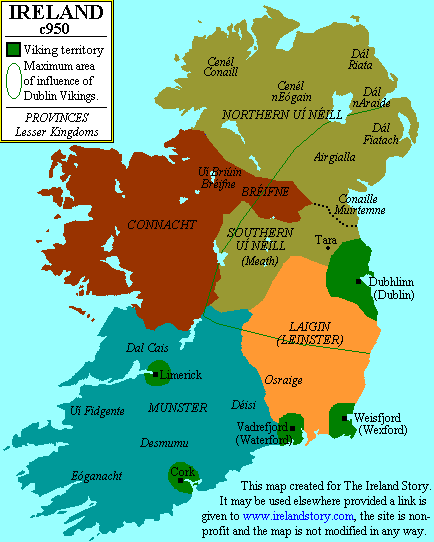
7748

In contrast to England and Francia where the Danes dominated, these raids were mainly the work of Norwegians, sailing to Ireland via the Northern Isles and the Hebrides. Viking activity in Ireland developed at first in much the same way as it did in England and Francia, beginning with small-scale hit-and-run raids on exposed coastal monasteries gradually escalating until the Vikings founded permanent bases and became a year-round presence plundering and captive-taking across the whole country. The first recorded Viking raids in Ireland took place in 795 when the same Viking band that sacked Iona sacked a monastery on Rechru, which may either be Lambay Island north of Dublin, or Rathlin Island off the northern Irish coast. In the 830s, larger fleets, numbering around sixty ships, began to arrive. Once its island monasteries had been plundered, Ireland’s wild and mountainous west coast, so similar to the west coast of Scotland, was generally shunned by the Vikings because of its poverty. The Vikings concentrated their efforts on the more fertile and densely populated east coast and the great midland plain. In 836, a fleet sailed for the first time far inland along Ireland’s longest river, the Shannon, and sacked the wealthy monasteries of Clonmacnoise and Clonfert. The following year, a Viking fleet sailed from Donegal Bay into Lough Erne to plunder monasteries around its shores. Another sacked the monastery of Áth Cliath – on the site of modern Dublin – while a third army ravaged on the Boyne, and a fourth was on the Shannon again. Nowhere was safe: ‘the sea cast floods of foreigners into Ireland, so there was not a point thereof that was without a fleet’, wrote one chronicler.

Although the Irish often fought fiercely, the Vikings’ advantage of mobility meant that they often escaped unchallenged: the saints slept and did not protect their monasteries. Monks trembled in their cells and prayed for bad weather to keep the Vikings off the seas. As kings were rarely inclined to help their rivals, the Vikings often benefited from the divisions between the Irish kingdoms. Indeed, most kings took a thoroughly pragmatic view of the Vikings, treating them as just another element in their country’s complex political geography, often welcoming them as allies who could help weaken a rival kingdom. Some bands of Irishmen took advantage of the disorder created by the Vikings to go plundering themselves ‘in the manner of the heathens’. One such band was destroyed by Máel Sechnaill mac Máele Ruanaid (r. 845 – 62), the powerful Southern Uí Néill high king of Meath, in 847.

The first longphuirt

In 839 there was a step-change in Viking activity. A Viking fleet sailed up the River Bann into Lough Neagh. Instead of plundering and leaving, the Vikings built a fortified ship camp on the lakeshore, which they used as a base to plunder the heart of Ulster for three successive summers. This was the first of many such bases – known as longphuirt by the Irish – that Viking armies were to build in Ireland over the next few years as they intensified their raids. The foundation of the longphuirt subtly changed the dynamics of Viking activity in Ireland. The Vikings were now a permanent presence in Ireland and could raid all year round, but at the same time, they lost some of their mobility, making them more vulnerable to Irish counterattack.

The leader of the fleet on Lough Neagh was a warlord who the Irish called Turgeis, that is probably Thórgestr or Thórgils in Old Norse. Turgeis’ origins are not known, but he may have come from the Hebrides as he had as his allies the Gall-Gaedhil, those ‘foreign Gaels’ who were the product of marriages between Norse settlers and the local Gaelic-speaking population. Turgeis’ greatest coup was plundering St Patrick’s monastery at Armagh three times in 840: after his final attack he burned it down for good measure. Armagh was an especially rich prize; apart from its precious reliquaries and sacred vessels, many Irish kings had their royal treasuries there, hoping that they would enjoy the protection of its powerful patron saint. It would not only have been monks who suffered in these attacks. Armagh was surrounded by a small town of craftsmen, merchants, estate managers and others who serviced the needs of this most prestigious of all Irish ecclesiastical centres. Turgeis’ activities are uncertain for the next few years, but he is thought by some historians to have been the leader of the Vikings who in 841 founded what would become the most successful of all the longphuirt at Dublin. In 844, Turgeis led his fleet up the River Shannon as far as Lough Ree, where he built another longphort from which he plundered widely in the midlands. The following year, in the first serious reverse suffered by the Vikings in Ireland, he was captured by Máel Sechnaill, who drowned him in Lough Owel in County Westmeath.

Turgeis’ reputation grew with the telling and after his death he became a symbol of everything that was wicked about the Vikings. In the colourful but unreliable twelfth-century history of Ireland’s Viking wars, Cogadh Gaedhel re Gallaibh (‘The War of the Irish with the Foreigners’), Turgeis has become the king of all the Vikings in Ireland, bent on conquering the whole island. This Turgeis is a militant pagan who expels the abbot from Armagh and sets himself up as a pagan high priest. His wife Ota (probably Auðr) is just as bad, performing acts of witchcraft on the altar of the abbey at Clonmacnoise. This story might not be wholly improbable as Ota may have been a völva, a Viking seeress with powers to predict the future. According to the Welsh churchman Gerald of Wales, who travelled in Ireland during the 1180s, Turgeis actually conquered Ireland but was lured to his death by his weakness for women. Turgeis took a fancy to Máel Sechnaill’s daughter. The king, ‘hiding his hatred in his heart’, agreed to hand her over to Turgeis on an island in Lough Owel along with fifteen other beautiful girls. Turgeis was delighted and went to the rendezvous with fifteen of his leading warriors, all of them expecting amorous encounters. But Máel Sechnaill had laid a trap for them. His daughter was waiting for Turgeis on the island not with fifteen girls but with fifteen hand-picked young men, all clean shaven and dressed in women’s clothing, under which they carried knives. Turgeis and his unsuspecting warriors were stabbed to death ‘in the midst of their embraces’. Gerald probably recorded the story not to flatter the Irish for their cunning but because it chimed comfortably with his own prejudices: he regarded the Irish as a thoroughly deceitful and untrustworthy bunch who always negotiated in bad faith.

More reverses for the Vikings followed. In 848 the Irish won four major battles against the Vikings, killing over 2,000 of them in the process, according the Annals of Ulster. Irish annalists described these battle casualties as ‘heads’: Irish warriors still practiced the ancient Celtic custom of taking enemy heads as war trophies and rarely took prisoners. Then, in 849, Máel Sechnaill captured and plundered Dublin. Discouraged by their defeats, many Vikings left to seek easier pickings in Francia. The Norwegians suffered another blow in 851when a large force of Danish Vikings expelled them from Dublin. The following year the Norwegians suffered another crushing defeat by the Danes in a three-day battle at Carlingford Lough in County Down. The Danish intervention in Ireland was short-lived. In 853 two brothers, Olaf and Ivar, recaptured Dublin for the Norwegians and expelled the Danes.

The kingdom of Dublin

The arrival of Olaf and Ivar at Dublin in 853 was a decisive moment in Ireland’s Viking Age. Olaf and Ivar (who are called Amláib and Ímhar in Irish annals) became the first kings of Dublin and under their rule it developed from a rough ship-camp into the dominant Viking power centre of the whole Irish Sea area. Irish sources describe Olaf and Ivar as sons of King Gofraid of Lochlann, which is the usual Gaelic name for Norway, but their origins remain uncertain. Most modern historians identify Olaf with Olaf the White, a king of Dublin who features in Icelandic saga traditions. Attempts to identify Ivar with the legendary Viking Ivar the Boneless are unconvincing: Ivar the Boneless’s father was the equally legendary Viking Ragnar Lodbrok who, if he existed at all, was most likely a Dane. What is more certain is that the descendants of Olaf and Ivar, known to the Irish as the Uí Ímair, would dominate the Irish Sea for the next 200 years.

There is not enough evidence about the careers of Turgeis and Tomrair to be sure of their motives: did they aspire to found Viking states in Ireland or were they really just out for the plunder? It is clear, however, that Olaf and Ivar were trying to create a kingdom for themselves because their first actions were to impose tribute on all the Viking armies operating in Ireland. It is hard to work out from the Irish annals exactly how many of these there were but there must have been at least three or four. In their efforts to build a secure power base, the brothers took full advantage of the complex political rivalries of the Irish kingdoms. In 859 Olaf and Ivar allied with Cerball mac Dúnlainge (r. 842 – 880), king of Osraige, against his overlord Máel Sechnaill. According to saga traditions, the alliance was sealed by a marriage between Olaf and one of Cerball’s daughters. A Christian king is unlikely to have married his daughters to pagans, so, if the tradition is true, it is likely that Olaf had at least been baptised. In 858, Ivar and Cerball campaigned together in Leinster, and in Munster against the Gall-Gaedhil. The next year Olaf, Ivar and Cerball together invaded Máel Sechnaill’s kingdom of Meath. After Cerball came to terms with Máel Sechnaill, he dropped his Norse allies. Olaf and Ivar soon found a new ally in Áed Finnliath (c. 855 – 79), the northern Uí Néill king of Ulster. Together they plundered Máel Sechnaill’s kingdom in 861 and 862. After Máel Sechnaill’s death in 862, Olaf and Ivar switched to supporting his successor Lorcán against Áed. The brothers did Lorcán’s standing no good at all when, in 863, they dug open the great Neolithic burial mounds at Knowth on the River Boyne to look for treasure. Although pagan in origin, these ancient mounds were rich in mythological significance for the Irish and this desecration was thought to be shocking behaviour even by the Viking’s low standards. The following year Áed captured the discredited Lorcán, blinded him and forced him to abdicate.

Olaf and his brothers had now run out of willing allies in Ireland and, in 866, they took their fleet across the Irish Sea to raid Pictland in alliance with the Gall-Gaedhil. Áed, now high king, took advantage of their absence to plunder and destroy all the Viking longphuirt in Ulster. After a victory over the Vikings on Lough Foyle, Áed took 240 heads home as trophies. The limited extent of Viking territorial control was starkly demonstrated in 867 when Áed’s ally Cennétig king of Loigis, destroyed Olaf’s border fortress at Clondalkin just 5 miles from Dublin, which he then went on to plunder. Olaf now allied with the southern Uí Néill and Leinster against Áed. Áed crushed the alliance at the Battle of Killineer (Co. Louth) in 868: among the dead was one of Olaf’s sons. Olaf struck back at Áed in 869, brutally sacking Armagh and leading off 1,000 captives for the slave markets. This was a severe blow to Áed’s prestige – he was supposed to be the monastery’s protector. After this success, Olaf and Ivar crossed the Irish Sea to Strathclyde and laid siege to its capital, Alt Clut, on the summit of Dumbarton Rock, overlooking the River Clyde. Alt Clut fell after four months and the brothers returned to Dublin with a hoard of treasure. They went back to Strathclyde for more the following year and this time returned ‘with a great prey of Angles, Britons and Picts’. Olaf and Ivar were back plundering in Meath in 872, but in the next year Ivar died of ‘a sudden, horrible disease’. Olaf survived until 874 or 875: he was killed in battle with Constantine I of Scotland at Dollar in Clackmannanshire.

****  We do have DNA evidence, not genealogical,  that the Carruthers ancestors from Gotland, landed in Winchester or Cinchester first around 400 AD.  They later were welcomed at Dumbarton Castle on the Clyde River, by Hael Ryddech.  King Hael gave them land across the River Clyde from the castle, and it was call Cair-muir.  ***

We also have DNA evidence of various times of our Gotland ancestors landing on the east coat of Scotland and the Northern islands. *****

The deaths of Ivar and Olaf began what the Cogadh Gaedhel re Gallaibh dubbed the ‘Forty Years’ Rest’, a long period of reduced Viking activity in Ireland that lasted until 914. Deprived of the strong military leadership provided by Olaf and Ivar, Dublin became politically unstable under a succession of short-lived successors. Olaf’s first successor as king of Dublin, his son Oystín (Eystein), lasted barely a year: he was killed when Dublin was captured by a Danish Viking who Irish annalists called Alband. Alband is most likely to have been Halfdan, the Danish king of York. Áed Finnliath came to the rescue of his Viking allies, quickly expelling Alband and placing Ivar’s son Bárðr on the throne. Alband returned to Ireland in 877, but was killed fighting the Dublin Vikings at Strangford Lough. However, his dream of uniting Dublin and York into a trans-Irish Sea kingdom survived. Bárðr died in 881 and was followed by six short-lived kings, none of whom was able to arrest the kingdom’s decline. In 902, Cerball mac Muirecáin, king of Leinster and Máel Finnia of Brega launched a co-ordinated pincer attack on Dublin from the north and south, forcing the Norse to flee for their ships after a fierce battle. The refugees fled mainly to North Wales and north-west England. Ireland’s first Viking Age was over.

From longphort to town

Most of the Vikings’ longphuirt were either abandoned, or were destroyed by the Irish, after relatively short periods of occupation. Dublin was one of a small group of longphuirt, which also included Wexford, Waterford, Cork and Limerick, which developed into permanent towns. These longphuirt all had in common good tidal harbours. The exact location of the original Viking longphort at Dublin now lies buried beneath later buildings. This has necessarily limited archaeological investigation of the city’s origins to rescue excavations on sites that have been temporarily cleared for redevelopment. Evidence for early Viking occupation, including warrior burials, buildings, ship rivets and a possible defensive rampart, excavated from sites at Ship Street Great and South Great George’s Street, suggest that the longphort was probably in the area where Dublin Castle now stands, close to the Dubhlinn, the ‘black pool’ from which the city got its English name. This was a now-vanished tidal pool at the confluence of the River Liffey and its small tributary the Poddle. Dublin was already a place of some importance before the longphort was built as a monastic centre and the site of the lowest ford across the River Liffey: its Gaelic name Áth Cliath means ‘the ford of the hurdles’. This ford made Dublin a natural focus of overland routes and, with its good harbour and short sailing distances to Wales, north-west England, Galloway and the Isle of Man, it was ideally situated to become a successful port and trading centre. The same geographical advantages also made Dublin an ideal base for raiding, not only in eastern Ireland but around the whole Irish Sea region. No other longphort in Ireland had the same combination of advantages: it was almost inevitable that Dublin would become Ireland’s dominant Viking centre.

Early Dublin was probably similar to the well-preserved longphort at Linn Duchaill, about 40 miles further north, near the village of Annagassan in County Louth. Founded in the same year as Dublin, this longphort was built on the site of a minor monastery on the banks of the River Glyde, close to its estuary into the Irish Sea. The Vikings occupied the longphort until 891, when the Irish expelled them. Vikings reoccupied the site c. 914 only for it to be abandoned for good in 927. The site has been open farmland ever since so, unlike Dublin, this longphort’s remains have seen little disturbance. Covering about 40 acres (16 hectares), the longphort at Linn Duachaill was large enough to accommodate an army that was several thousand strong. A rampart and ditch, ¾ of a mile long, protected the landward side of the fort and there was a small citadel on higher ground within the fort. Excavations yielded large numbers of ships’ rivets, testifying to ship repair and perhaps shipbuilding on the site. Pieces of hacksilver and the remains of scales show that loot was divided up here and an iron slave chain dredged from the river is evidence of slave raiding. A shuttle and spindle whorl provide evidence of spinning and weaving in the fort. As these were not occupations for Viking warriors, women must have lived there. Geophysical surveys suggest that the waterfront was densely built-up but this has not yet been confirmed by excavations. Linn Duachaill did not have the good harbour that Dublin had, and it was that which probably prevented it ever developing into a permanent town.

In contrast to England and Francia where the Danes dominated, these raids were mainly the work of Norwegians, sailing to Ireland via the Northern Isles and the Hebrides. Viking activity in Ireland developed at first in much the same way as it did in England and Francia, beginning with small-scale hit-and-run raids on exposed coastal monasteries gradually escalating until the Vikings founded permanent bases and became a year-round presence plundering and captive-taking across the whole country. The first recorded Viking raids in Ireland took place in 795 when the same Viking band that sacked Iona sacked a monastery on Rechru, which may either be Lambay Island north of Dublin, or Rathlin Island off the northern Irish coast. In the 830s, larger fleets, numbering around sixty ships, began to arrive. Once its island monasteries had been plundered, Ireland’s wild and mountainous west coast, so similar to the west coast of Scotland, was generally shunned by the Vikings because of its poverty. The Vikings concentrated their efforts on the more fertile and densely populated east coast and the great midland plain. In 836, a fleet sailed for the first time far inland along Ireland’s longest river, the Shannon, and sacked the wealthy monasteries of Clonmacnoise and Clonfert. The following year, a Viking fleet sailed from Donegal Bay into Lough Erne to plunder monasteries around its shores. Another sacked the monastery of Áth Cliath – on the site of modern Dublin – while a third army ravaged on the Boyne, and a fourth was on the Shannon again. Nowhere was safe: ‘the sea cast floods of foreigners into Ireland, so there was not a point thereof that was without a fleet’, wrote one chronicler.

Although the Irish often fought fiercely, the Vikings’ advantage of mobility meant that they often escaped unchallenged: the saints slept and did not protect their monasteries. Monks trembled in their cells and prayed for bad weather to keep the Vikings off the seas. As kings were rarely inclined to help their rivals, the Vikings often benefited from the divisions between the Irish kingdoms. Indeed, most kings took a thoroughly pragmatic view of the Vikings, treating them as just another element in their country’s complex political geography, often welcoming them as allies who could help weaken a rival kingdom. Some bands of Irishmen took advantage of the disorder created by the Vikings to go plundering themselves ‘in the manner of the heathens’. One such band was destroyed by Máel Sechnaill mac Máele Ruanaid (r. 845 – 62), the powerful Southern Uí Néill high king of Meath, in 847.

The first longphuirt

In 839 there was a step-change in Viking activity. A Viking fleet sailed up the River Bann into Lough Neagh. Instead of plundering and leaving, the Vikings built a fortified ship camp on the lakeshore, which they used as a base to plunder the heart of Ulster for three successive summers. This was the first of many such bases – known as longphuirt by the Irish – that Viking armies were to build in Ireland over the next few years as they intensified their raids. The foundation of the longphuirt subtly changed the dynamics of Viking activity in Ireland. The Vikings were now a permanent presence in Ireland and could raid all year round, but at the same time, they lost some of their mobility, making them more vulnerable to Irish counterattack.

The leader of the fleet on Lough Neagh was a warlord who the Irish called Turgeis, that is probably Thórgestr or Thórgils in Old Norse. Turgeis’ origins are not known, but he may have come from the Hebrides as he had as his allies the Gall-Gaedhil, those ‘foreign Gaels’ who were the product of marriages between Norse settlers and the local Gaelic-speaking population. Turgeis’ greatest coup was plundering St Patrick’s monastery at Armagh three times in 840: after his final attack he burned it down for good measure. Armagh was an especially rich prize; apart from its precious reliquaries and sacred vessels, many Irish kings had their royal treasuries there, hoping that they would enjoy the protection of its powerful patron saint. It would not only have been monks who suffered in these attacks. Armagh was surrounded by a small town of craftsmen, merchants, estate managers and others who serviced the needs of this most prestigious of all Irish ecclesiastical centres. Turgeis’ activities are uncertain for the next few years, but he is thought by some historians to have been the leader of the Vikings who in 841 founded what would become the most successful of all the longphuirt at Dublin. In 844, Turgeis led his fleet up the River Shannon as far as Lough Ree, where he built another longphort from which he plundered widely in the midlands. The following year, in the first serious reverse suffered by the Vikings in Ireland, he was captured by Máel Sechnaill, who drowned him in Lough Owel in County Westmeath.

Turgeis’ reputation grew with the telling and after his death he became a symbol of everything that was wicked about the Vikings. In the colourful but unreliable twelfth-century history of Ireland’s Viking wars, Cogadh Gaedhel re Gallaibh (‘The War of the Irish with the Foreigners’), Turgeis has become the king of all the Vikings in Ireland, bent on conquering the whole island. This Turgeis is a militant pagan who expels the abbot from Armagh and sets himself up as a pagan high priest. His wife Ota (probably Auðr) is just as bad, performing acts of witchcraft on the altar of the abbey at Clonmacnoise. This story might not be wholly improbable as Ota may have been a völva, a Viking seeress with powers to predict the future. According to the Welsh churchman Gerald of Wales, who travelled in Ireland during the 1180s, Turgeis actually conquered Ireland but was lured to his death by his weakness for women. Turgeis took a fancy to Máel Sechnaill’s daughter. The king, ‘hiding his hatred in his heart’, agreed to hand her over to Turgeis on an island in Lough Owel along with fifteen other beautiful girls. Turgeis was delighted and went to the rendezvous with fifteen of his leading warriors, all of them expecting amorous encounters. But Máel Sechnaill had laid a trap for them. His daughter was waiting for Turgeis on the island not with fifteen girls but with fifteen hand-picked young men, all clean shaven and dressed in women’s clothing, under which they carried knives. Turgeis and his unsuspecting warriors were stabbed to death ‘in the midst of their embraces’. Gerald probably recorded the story not to flatter the Irish for their cunning but because it chimed comfortably with his own prejudices: he regarded the Irish as a thoroughly deceitful and untrustworthy bunch who always negotiated in bad faith.

More reverses for the Vikings followed. In 848 the Irish won four major battles against the Vikings, killing over 2,000 of them in the process, according the Annals of Ulster. Irish annalists described these battle casualties as ‘heads’: Irish warriors still practiced the ancient Celtic custom of taking enemy heads as war trophies and rarely took prisoners. Then, in 849, Máel Sechnaill captured and plundered Dublin. Discouraged by their defeats, many Vikings left to seek easier pickings in Francia. The Norwegians suffered another blow in 851when a large force of Danish Vikings expelled them from Dublin. The following year the Norwegians suffered another crushing defeat by the Danes in a three-day battle at Carlingford Lough in County Down. The Danish intervention in Ireland was short-lived. In 853 two brothers, Olaf and Ivar, recaptured Dublin for the Norwegians and expelled the Danes.

The kingdom of Dublin

The arrival of Olaf and Ivar at Dublin in 853 was a decisive moment in Ireland’s Viking Age. Olaf and Ivar (who are called Amláib and Ímhar in Irish annals) became the first kings of Dublin and under their rule it developed from a rough ship-camp into the dominant Viking power centre of the whole Irish Sea area. Irish sources describe Olaf and Ivar as sons of King Gofraid of Lochlann, which is the usual Gaelic name for Norway, but their origins remain uncertain. Most modern historians identify Olaf with Olaf the White, a king of Dublin who features in Icelandic saga traditions. Attempts to identify Ivar with the legendary Viking Ivar the Boneless are unconvincing: Ivar the Boneless’s father was the equally legendary Viking Ragnar Lodbrok who, if he existed at all, was most likely a Dane. What is more certain is that the descendants of Olaf and Ivar, known to the Irish as the Uí Ímair, would dominate the Irish Sea for the next 200 years.

There is not enough evidence about the careers of Turgeis and Tomrair to be sure of their motives: did they aspire to found Viking states in Ireland or were they really just out for the plunder? It is clear, however, that Olaf and Ivar were trying to create a kingdom for themselves because their first actions were to impose tribute on all the Viking armies operating in Ireland. It is hard to work out from the Irish annals exactly how many of these there were but there must have been at least three or four. In their efforts to build a secure power base, the brothers took full advantage of the complex political rivalries of the Irish kingdoms. In 859 Olaf and Ivar allied with Cerball mac Dúnlainge (r. 842 – 880), king of Osraige, against his overlord Máel Sechnaill. According to saga traditions, the alliance was sealed by a marriage between Olaf and one of Cerball’s daughters. A Christian king is unlikely to have married his daughters to pagans, so, if the tradition is true, it is likely that Olaf had at least been baptised. In 858, Ivar and Cerball campaigned together in Leinster, and in Munster against the Gall-Gaedhil. The next year Olaf, Ivar and Cerball together invaded Máel Sechnaill’s kingdom of Meath. After Cerball came to terms with Máel Sechnaill, he dropped his Norse allies. Olaf and Ivar soon found a new ally in Áed Finnliath (c. 855 – 79), the northern Uí Néill king of Ulster. Together they plundered Máel Sechnaill’s kingdom in 861 and 862. After Máel Sechnaill’s death in 862, Olaf and Ivar switched to supporting his successor Lorcán against Áed. The brothers did Lorcán’s standing no good at all when, in 863, they dug open the great Neolithic burial mounds at Knowth on the River Boyne to look for treasure. Although pagan in origin, these ancient mounds were rich in mythological significance for the Irish and this desecration was thought to be shocking behaviour even by the Viking’s low standards. The following year Áed captured the discredited Lorcán, blinded him and forced him to abdicate.

Olaf and his brothers had now run out of willing allies in Ireland and, in 866, they took their fleet across the Irish Sea to raid Pictland in alliance with the Gall-Gaedhil. Áed, now high king, took advantage of their absence to plunder and destroy all the Viking longphuirt in Ulster. After a victory over the Vikings on Lough Foyle, Áed took 240 heads home as trophies. The limited extent of Viking territorial control was starkly demonstrated in 867 when Áed’s ally Cennétig king of Loigis, destroyed Olaf’s border fortress at Clondalkin just 5 miles from Dublin, which he then went on to plunder. Olaf now allied with the southern Uí Néill and Leinster against Áed. Áed crushed the alliance at the Battle of Killineer (Co. Louth) in 868: among the dead was one of Olaf’s sons. Olaf struck back at Áed in 869, brutally sacking Armagh and leading off 1,000 captives for the slave markets. This was a severe blow to Áed’s prestige – he was supposed to be the monastery’s protector. After this success, Olaf and Ivar crossed the Irish Sea to Strathclyde and laid siege to its capital, Alt Clut, on the summit of Dumbarton Rock, overlooking the River Clyde. Alt Clut fell after four months and the brothers returned to Dublin with a hoard of treasure. They went back to Strathclyde for more the following year and this time returned ‘with a great prey of Angles, Britons and Picts’. Olaf and Ivar were back plundering in Meath in 872, but in the next year Ivar died of ‘a sudden, horrible disease’. Olaf survived until 874 or 875: he was killed in battle with Constantine I of Scotland at Dollar in Clackmannanshire.

The deaths of Ivar and Olaf began what the Cogadh Gaedhel re Gallaibh dubbed the ‘Forty Years’ Rest’, a long period of reduced Viking activity in Ireland that lasted until 914. Deprived of the strong military leadership provided by Olaf and Ivar, Dublin became politically unstable under a succession of short-lived successors. Olaf’s first successor as king of Dublin, his son Oystín (Eystein), lasted barely a year: he was killed when Dublin was captured by a Danish Viking who Irish annalists called Alband. Alband is most likely to have been Halfdan, the Danish king of York. Áed Finnliath came to the rescue of his Viking allies, quickly expelling Alband and placing Ivar’s son Bárðr on the throne. Alband returned to Ireland in 877, but was killed fighting the Dublin Vikings at Strangford Lough. However, his dream of uniting Dublin and York into a trans-Irish Sea kingdom survived. Bárðr died in 881 and was followed by six short-lived kings, none of whom was able to arrest the kingdom’s decline. In 902, Cerball mac Muirecáin, king of Leinster and Máel Finnia of Brega launched a co-ordinated pincer attack on Dublin from the north and south, forcing the Norse to flee for their ships after a fierce battle. The refugees fled mainly to North Wales and north-west England. Ireland’s first Viking Age was over.

From longphort to town

Most of the Vikings’ longphuirt were either abandoned, or were destroyed by the Irish, after relatively short periods of occupation. Dublin was one of a small group of longphuirt, which also included Wexford, Waterford, Cork and Limerick, which developed into permanent towns. These longphuirt all had in common good tidal harbours. The exact location of the original Viking longphort at Dublin now lies buried beneath later buildings. This has necessarily limited archaeological investigation of the city’s origins to rescue excavations on sites that have been temporarily cleared for redevelopment. Evidence for early Viking occupation, including warrior burials, buildings, ship rivets and a possible defensive rampart, excavated from sites at Ship Street Great and South Great George’s Street, suggest that the longphort was probably in the area where Dublin Castle now stands, close to the Dubhlinn, the ‘black pool’ from which the city got its English name. This was a now-vanished tidal pool at the confluence of the River Liffey and its small tributary the Poddle. Dublin was already a place of some importance before the longphort was built as a monastic centre and the site of the lowest ford across the River Liffey: its Gaelic name Áth Cliath means ‘the ford of the hurdles’. This ford made Dublin a natural focus of overland routes and, with its good harbour and short sailing distances to Wales, north-west England, Galloway and the Isle of Man, it was ideally situated to become a successful port and trading centre. The same geographical advantages also made Dublin an ideal base for raiding, not only in eastern Ireland but around the whole Irish Sea region. No other longphort in Ireland had the same combination of advantages: it was almost inevitable that Dublin would become Ireland’s dominant Viking centre.

Early Dublin was probably similar to the well-preserved longphort at Linn Duchaill, about 40 miles further north, near the village of Annagassan in County Louth. Founded in the same year as Dublin, this longphort was built on the site of a minor monastery on the banks of the River Glyde, close to its estuary into the Irish Sea. The Vikings occupied the longphort until 891, when the Irish expelled them. Vikings reoccupied the site c. 914 only for it to be abandoned for good in 927. The site has been open farmland ever since so, unlike Dublin, this longphort’s remains have seen little disturbance. Covering about 40 acres (16 hectares), the longphort at Linn Duachaill was large enough to accommodate an army that was several thousand strong. A rampart and ditch, ¾ of a mile long, protected the landward side of the fort and there was a small citadel on higher ground within the fort. Excavations yielded large numbers of ships’ rivets, testifying to ship repair and perhaps shipbuilding on the site. Pieces of hacksilver and the remains of scales show that loot was divided up here and an iron slave chain dredged from the river is evidence of slave raiding. A shuttle and spindle whorl provide evidence of spinning and weaving in the fort. As these were not occupations for Viking warriors, women must have lived there. Geophysical surveys suggest that the waterfront was densely built-up but this has not yet been confirmed by excavations. Linn Duachaill did not have the good harbour that Dublin had, and it was that which probably prevented it ever developing into a permanent town.

Preserving Our Past, Recording Our Present, Informing Our Future

Ancient and Honorable Carruthers Clan Int Society LLC

carrothersclan@gmail.com   CARRUTHERSCLAN1@GMAIL.COM

cropped-wider-banner-light-blue-1.jpg


You can find us on facebook at :

https://www.facebook.com/carrutherscarrothers.pat.9

https://www.facebook.com/CarruthersClan/

https://www.facebook.com/CarruthersClanLLC


Disclaimer Ancient and Honorable Carruthers Clan International Society CCIS LLC



Uncategorized

CLAN CARRUTHERS-VIKINGS OR VARANGIANS

CLAN CARUTHERS INT SOCIETY CCIS                           PROMPTUS ET FIDELIS

cropped-wider-banner-light-blue-1.jpg

WERE THE CARRUTHERS VIKINGS OR VARANGIANS


The word Viking does not translate in the Baltic Sea region. They used the word Varangians.  

Formally the Vikings were warri-ors, from the second half of the 700s, from Denmark,  Sweden and Norway who sailed westwards.     

The word Vikings appear sporadically across some six centuries in Arabic texts. They  mention different  groups of Vikings.

In early Arab texts,  it makes no distinction between Vikings, Varangians, Norsemen and Scandinavians  Vikings who, with Ireland as a base, operated in and around the Atlantic seaboard of western Europe and who occasionally made their presence felt in parts of Islamic Spain and  those who made in roads into northern mainland Europe via the Baltic Sea and the Volga portage routes, coming into contact with Muslims in and around the Caspian Sea.

The Vikings in texts tend to be called ‘Magians’, that is, Zoroastrians (Ar. al-Majus),             while Vikings who were Varagians  are known as ‘Rus’ (Ar. al-Rus, written as al-                 rws), and variously connected with either the Slavs (Ar. Saqaliba) or the Turks (Ar. Atrak).  This group ” Rus ” who entered the military service of the Byzantines are referred to as the  Varangian Guard by the arabs.

Many Carruthers are starting to proceed with more and more advanced studies of DNA that are becoming available.  The results show a large amount of the Carruthers genome showing up in various parts of eastern Europe, especially Romania.  Some R1b studies have shown this but more CTS studies than before are producing results.  A CTS study starts at 30 markers after an R1b study begins. So you can be talking of thousands and thousands of years.

A Division of Varangians and Vikings

Elbe River | river, Europe | Britannica


There is a clear line in the river Elbe between Vikings and Varangians. East of the river Elbe there is no mention of Vikings, only Varangians (Askeberg, Fritz,Norden och Kontinenten i gammal tid, 1944)


Oder River - Students | Britannica Kids | Homework HelpThe River Oder is believed to be older than the Elbe river, and is more correct in the line between the two groups or just a name.

If you look at the two maps, today the river meets at the “big bend” as they call it, and the Oder goes to the right and the Elbe goes to the left.

In the early 1900’s , the Oder was flooding all the lands, and they made the Elbe go to the left to prevent all the flooding.


At the time we are talking, the accuracy would be to use the Oder River as the division in the two groups.

il_794xN.956714866_1bmbOn a rune stone from Hablingbo on Gotland it says: ”Vatgair and Hailgar rose the stone
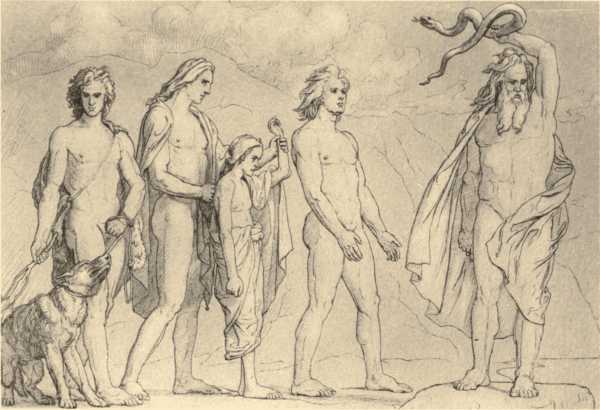
after Hailgi, their father. He had gone west with the Vikings.” What is
remarkable here is the claim that Hailgi had gone west with the Vikings,not “in
Viking”. To be “in Viking” meant to be at war and rampage, i.e. be on a
 Viking expedition. But as it says that Hailgi went with Vikings, one can wonder
if it means that Gutar unlike mainland Scandinavians did not regard themselvesas
Vikings.
The historians of ancient times, believe that the Viking Age starts with the attack
on Lindisfarne in 793.  This may just be because before this time little was written down. 
The Project Gutenberg eBook of Teutonic Mythology Gods and ...
In the Baltic Sea region, after the signing, in the 550s, of the trade and peace treaty with
the earlier immigrated Svear (Herulic royal family and entourage) to the Lake Mälar
area, the Gotlanders (Varangians) continued to dominate trade in the Baltic Sea area and
could freely trade under Svea protection in the areas now controlled by the immigrant
Svear. Instead of paying duty every time they came to Svea trading places they paid an
annul  fee and could move freely.
There were large Gotlandic trading Emporiums, i. a. in Grobina (Latvia) ca 650-850 CE,
an area at that time conquered by the Svear.   With these large trading Emporiums, came
money.   Gotlanders were wealthy and looking for more ways to make money.   They
welcomed all traders and merchants to Gotland.  There were large gathering halls for
Gotlanders, Curonians, Danes, Slavs, Svear and la-ter Germans. Gotland has through its
position as a continental outpost in the north or Nordic outpost to the south, on the
border between East and West,a cultural key position. Gotland plays a similar role for the
Baltic Sea region as Cyprus and Sicily have played as intersections for the Mediterranean
countries’trade relations and cultures.
Were the Carruthers from Gutland Vikings or Varangians.   As you learn more and more
history of that region you will discover that Gutland was similar to Switzerland.   Neutral
in war, but not in being a warrior.   They would put armies of men together and travel
west, and also the same and travel east.

Preserving Our Past, Recording Our Present, Informing Our Future

Ancient and Honorable Clan Carruthers Int Society CCIS  LLc

carruthersclan1@gmail.com              carrothersclan@gmail.com

cropped-wider-banner-light-blue-1.jpg


PER SVENSEN WITH THE HELP OF TORR HANNHOLM

CLAN CARRUTHERS INT SOCIETY CCIS  HISTORIAN AND GENEALOGIST


You can find us on facebook at :

https://www.facebook.com/carrutherscarrothers.pat.9

https://www.facebook.com/CarruthersClan/

https://www.facebook.com/CarruthersClanLLC


Disclaimer Ancient and Honorable Carruthers Clan International Society CCI


The History of Gutland, The Viking Age, Uncategorized

CLAN CARRUTHERS-MESSAGES FROM PICTURE STONES

CLAN CARRUTHERS INT SOCIETY CCIS                                   PROMPTUS ET FIDELIS

cropped-wider-banner-light-blue-1.jpg

Messages from Ancient Stones


Gotland Picture Stones from the Viking Era

Ancient stories that belong to a world far removed from technology have horses and great ships as modes of transport on this ancient Picture Stone. A round disc with six points on a shield held by a warrior on horseback represents the Sun. The carved stones were limestone and there were three notable periods with different styles.


Ancient Carved Stone GotlandThis Gotland Picture Stone was created over a thousand years ago, about 700 – 800 CE and like many other stones on the island still holds secrets that are yet to be uncovered or confirmed. The story on this stone is in pictures and decoding the meaning is a complex task for history and iconography. Picture motifs were inscribed on gravestones, road markers, weapons and amulets. Norse myths and legends were not written down in words and so the pictures on stone are very precious records.

My painted drawing was sketched from one ornate carved Picture Stone, one of about four hundred known today, mostly from the island of Gotland, Sweden.  I have tried to be accurate with the detail. The Stones belonged to the Viking Age in Scandinavia and often reference Norse myths and legends. Ancient Stones and sometimes Rune Stones with Runic letters were erected and inscribed to commemorate fallen warriors, rituals, myths and legends.

In this keyhole shaped Picture Stone there are several panels above each other.  At the top the rider could be the God Odin astride the horse Sleipnir from Norse mythology. Sleipnir was the fastest of all horses and with Odin could travel between realms. The triple triangle or Valknut behind the horseman is the magical symbol in Nordic paganism for Odin. The horseman is welcomed by a female Valkyrie offering a drinking horn, possibly as a welcome to the Otherworld paradise or afterlife known as Valhalla.  Some believe it could be the Goddess Freya holding a cornucopia or cup of abundance.

In the middle band there are Runic letters from the ancient Runic Alphabet below what looks like a figure walking. The Runic alphabet originated among the Nordic peoples of Europe about two or three centuries before the Christian Era. Carved runic inscriptions sometimes issued warnings about the future or issued messages but mostly the letters on these Gotland Picture Stones simply named the memorialized person.

In the panel below this we see a common theme on Picture Stones: a Viking long ship with a crisscross sail. This time there are two figures on board, possibly representing the soul being transported to the afterlife. Below that are big abstracted shapes with an extending interlace pattern that could represent the waves carrying the ship to another realm. All the picture story panels are enclosed by a plait knotwork border.

Messages in these Picture Stones tell us about a different Age, an Age when horses were thought to carry the Sun across the sky and ships were the key to adventure and trade for an island people. The messages inspire the imagination and leave us with a sense of wonder about a pagan life before Christianity, a world of beliefs in gods and goddesses connected to the natural world.


Preserving Our Past, Recording Our Present, Informing Our Future

Ancient and Honorable Clan Carruthers Int Society CCIS  LLc

carruthersclan1@gmail.com              carrothersclan@gmail.com

cropped-wider-banner-light-blue-1.jpg


LIZ THORNE


You can find us on facebook at :

https://www.facebook.com/carrutherscarrothers.pat.9

https://www.facebook.com/CarruthersClan/

https://www.facebook.com/CarruthersClanLLC


Disclaimer Ancient and Honorable Carruthers Clan International Society CCI