
Gutland / Gotland, The Viking Age, Uncategorized

CLAN CARRUTHERS-WARRIORS OATHS TO THE CHIEF / KING

CLAN CARRUTHERS INT SOCIETY CCIS                        PROMPTUS ET FIDELIS

cropped-wider-banner-light-blue-1.jpg


Warriors’ Oaths To The Chief / King


Like rulers elsewhere, the Viking age king or jarl had warriors in his service, serving in a similar role to the High Medieval knight. Modern scholars have noted that Germanic kings from antiquity through the Viking Age collected about them a group of such warriors, often referred to using the Latin term comitatus, which might be translated as “war-band.”

In Old Norse, the term for the leader of such a war-band was dróttin, while the term for the war-band itself was drótt. The members of the comitatus were called húskarlar, “house-carls”, especially those found in King Knut’s Danelaw forces as described in Þingliði (Foote and Wilson, p. 100; Barfod, p. 717). Other terms used to describe members of a comitatus included O.N. drengr (“warrior member of a ship’s crew”) and O.N. þegn (“mature man, seasoned warrior”). The conduct of the comitatus was termed drenskapr in Old Norse, meaning “the ideal of conduct for warriors, roughly equivalent to the ideal of chivalry” (Foote and WIlson, pp. 425-426).

King from the Lewis ChessmenIf the leader of the comitatus was a powerful noble, such as a king or a jarl, the war-band might then be called a hirð in Old Norse (Foote and Wilson, p. 101; Bagge). The hirð had a special ceremony of reception for new members and held regular meetings, which functioned as a court of law for its members and as a council advising the king (Bagge). By the 12th and 13th centuries, there were three groups within the Norwegian hirð: the hirðmenn (“men of the hirð“); the gestir (“guests”), who served as a royal police force; and the kirtisveinar, young men who served as pages (Bagge). From the hirðmenn came the officers of the hirð. The highest officer of the hirð was the stallari (literally “marshall”) who served as the king’s champion and also as a sort of general of the comitatus forces. The second ranking officer in the hirð was the merkismaðr (standard-bearer) (Bagge; Foote and Wilson, p. 103). Ranking after these officers were the lendir menn, the “landed men”, equivalent to barons, and then finally the body of warriors who made up the bulk of the hirð (Bagge). The relationship between the king and his hirðmenn was based on a contract or reciprocal oath, and the king’s hirð was usually dissolved upon his death (Bagge).

It should be noted that the comitatus, dróttin or hirð was a fairly small, elite band. The Vikings did not maintain standing armies: when it was needful, a levy was called up of free men and farmers. The kings and jarls instead maintained only their small group of core troops between wars. Confusion on this topic is rampant, in large part due to chroniclers’ tendency to wildly exaggerate the numbers of enemy armies and the tally of the dead (Evans, p. 27). The size of the comitatus is put into sharp perspective when one examines the law code of Ine of Wessex at 13.1, which states:

Ðeofas we hatað oð VII men;
from VII hloð oð XXXV;
siððan bið here.

A party of armed men numbering less than seven are thieves;
between seven and thirty-five are a band;
more than that is an army.
(Attenborough, p. 41; Evans, p. 27)

Within the comitatus, the Germanic ruler’s primary duty was to lead his warriors in battle. The literature records that the ideal ruler was the foremost warrior and best of the men in the war-band (Cherniss p. 39). This idea gave rise to descriptions such as Old English cyning-bald which means “very brave” but literally reads “royally brave, brave as a king” (Klaeber, glossary s.v. cyning-bald, p. 314). As Stephen Evans notes:

The major duty of a Germanic or Celtic lord was the conduct of warfare, in which he was expected to take an active part. The lord of a comitatus was expected not only to fight, but to fight with a great deal of martial prowess. At least during his younger years, a lord was expected to be one of the most formidable and valiant warriors of his warband.
(Evans, p. 50)

This appears to have been true for Germanic kings and lords back into antiquity, since Tacitus reports in his Germania:

Cum ventum in aciem, turpe principi virtute vinci, turpe comitatui virtutem principis non adaequare. Iam vero infame in omnem vitam ac probrosum superstitem principi suo ex acie recessisse. Illum defendere, tueri, sua quoque fortia facta gloriae eius adsignare praecipuum sacramentum est. Principes pro victoria pugnant, comites pro principe.

When they go into battle, it is a disgrace for the chief to be surpassed in valour, a disgrace for his followers not to equal the valour of the chief. And it is an infamy and a reproach for life to have survived the chief, and returned from the field. To defend, to protect him, to ascribe one’s own brave deeds to his renown, is the height of loyalty. The chief fights for victory; his vassals fight for their chief.

Aside from the bonds that form between comrades-in-arms, there were specific bonds in the form of oaths and reciprocal rights and responsibilities from ruler to warrior and from warrior to his lord, much like the formal Oath of Fealty used between the king and a knight during the medieval period. “The bond between a Germanic lord and his retainer, in a hierarchical society, places specific, clearly differentiated, though nevertheless similar, responsibilities and privileges upon social superior and inferior, leader and follower” (Cherniss, pp. 30-31). In Skáldskarpamál 53 Snorri Sturluson says:

Konungar ok jarlar hafa til fylgðar með sér þá menn, er hirðmenn heita ok húskarlar, en lendir menn hafa ok sér handgengna menn, þá er í Danmörku ok í Svíðjóð eru hirðmenn kallaðir, en í Nóregi húskarlar, ok sverja þeir þó eiða svá sem hirðmenn konungum.

Kings and jarls have in their train men called hirðmenn and húskarlar, but lendir menn also have men in their service who in Denmark and Sweden are known as hirðmenn, but in Norway húskarlar, and yet they take oaths just as hirðmenn do to kings.
(Prose Edda, p. 129)

The first bond is that of the oath between king and his warriors. “All oaths are important in heroic society, but most important and most binding is the oath of loyalty to one’s lord. This oath takes precedence over any oath which may conflict with it” (Cherniss, p. 63).

The importance of this relationship between warrior and lord cannot be overstated:

The most important relationship within a warband, and the one that was most instrumental in protecting and strengthening its social and cultural integrity, was the lord-retainer relationship. It is the internal social relationship that best explains the structure of the comitatus, and provides us with the social and cultural context in which Dark-Age warbands functioned. At least for the warrior aristocracy, by the period of Germanic migrations to Britain, the bonds established between a lord and his men had become more important than traditional kinship ties and in fact had usurped some of the duties associated with the older social system. The lord-retainer relationship was one that bound the warriors of a warband to their lord, a relationship whose fundamental and underlying roots lay in a bedrock of personal loyalty, and one whose operational framework is reflected in the series of obligations and duties which the lord and his men owed to one another
(Evans, p. 52).

Vendel Era Ring-Hilted Sword


The Teutonic peoples used an oath sworn on a sword hilt since antiquity, as the custom is attested to in the writings of Ammianus Marcellinus (Ellis-Davidson, Sword in A-S England, p. 185). Many early Germanic swords are known to have had special rings set into their pommels, and it is believed that these rings were used as oath-rings (Ellis-Davidson, Sword in A-S England, p. 75), similar to the sacred arm rings made of silver or gold which were kept in the temples of Thórr. These oath-rings were used to swear oaths upon, by having the oath-giver place his hand upon the ring while swearing (Ellis-Davidson, Gods and Myths, pp. 76-77). Later, as ring-swords went out of fashion, the oath was sworn directly upon the sword itself rather than upon a ring associated with the sword.


Early Norwegian law codes, including Hirðskrá (ca. 1270)  describe the oath sworn by a warrior to his ruler. These sources state that the hilt of a king’s sword had to be presented to the man who entered his service, and that as the follower swore the oath of allegiance to his new lord he had to touch the hilt of the royal sword as it lay across the king’s knee: this is reminiscent of the kings of the Lewis chess-men, which all bear their swords across their laps as symbols of their temporal authority, and in a position where it may quickly be used for oath-swearing. A 13th century law, which is itself known to be a revision of an earlier 12th century law code, states:

At the time when the king appoints hirðmenn, no table shall stand before the king. The king shall have his sword upon his knee, the sword which he had for his crowning, and he shall turn it so the chape goes under his right arm, and the hilt is placed forward on his right knee. Then he shall move the buckle of the belt over the hilt, and grasp the hilt. so that his right arm is over everything. Then he who is to become a hirðsmaðr shall fall on both knees before the king on the floor … and shall put his right hand under the hilt, while he keeps his left arm down in front of him in the most comfortable position, and then he shall kiss the king’s hand.
(Ellis-Davidson, Sword in A-S England, pp. 76-77).

It is believed that the ritual used in this account was substantially the same during the Viking Age, two to three hundred years earlier, for there are similar accounts in Viking Age literature as well:

Oblato Wiggone perinde ac munere gratulatus, an sibi militare vellet, perquirit. Annuenti destrictum gladium offert. Ille cuspidem refutans capulum petit, hunc morem Rolvoni in porrigendo militibus ense exstitisse praefatus. Olim namque se regum clientelae daturi tacto gladii capulo obsequium polliceri solebant. Quo pacto Wiggo capulum complexus cuspidem per Hiarwarthum agit, ultionis compos, cuius Rolvoni ministerium pollicitus fuerat.
(Gesta Danorum 2.8.4)

Then Wigg came forth, and Hiartuar, as though he were congratulating him on the gift, asked him if he were willing to fight for him. Wigg assenting, he drew and proferred him a sword. But Wigg refused the point, and asked for the hilt, saying first that this had been Rolf’s custom when he handed forth a sword to his soldiers. For in old time those who were about to put themselves in dependence on the king used to promise fealty by touching the hilt of the sword. And in this wise Wigg clasped the hilt, and then drove the point through Hiartuar; thus gaining the vengeance which he had promised Hrólfr to accomplish for him.
(Danish History, Book II)

Snorri Sturluson’s Heimskringla tells how the Anglo-Saxon king Æthelstan played a trick on Harald Fairhair of Norway. Æthelstan sent a messenger to Harald:

Hann selur konungi sverð gullbúið með hjöltum og meðalkafla og öll umgerð var búin með gulli og silfri og sett dýrlegum gimsteinum. Hélt sendimaðurinn sverðshjöltunum til konungsins og mælti: “Hér er sverð er Aðalsteinn konungur mælti að þú skyldir við taka.” Tók konungur meðalkaflann og þegar mælti sendimaðurinn: “Nú tókstu svo sem vor konungur vildi og nú skaltu vera þegn hans er þú tókst við sverði hans.”
(Haraldar saga hárfagra, ch. 40)

The emissary went up to the king, handing him a sword adorned with gold and silver and set with precious stones. The emissary offered the king the sword hilt and spoke these words, “Here is the sword which King Aethelstan asks you to receive from him.” Then the king took hold of the hilt, whereupon the messenger said, “Now you seized the sword in the fashion our king desired you would, and now you shall be his leigeman since you seized hold of his sword.”
(Heimskringla, “Haralds saga Harfagra” ch. 38, p. 92).

Sveno in his Lex Castrensis records that the custom of Viking kings presenting swords to the men in his fealty persisted up until the time of King Knut (Ellis-Davidson, Sword in A-S England, p. 186).

A young man might also receive a sword from the lord whom he pledged himself to serve as a poet or warrior, thus Hallfred [Troublesome-skald] took a sword from King Olaf Tryggvason and Sigvat a sword from King Olaf the Holy. We know from one of Sigvat’s own poems what this gift meant to him: “I received thy sword with pleasure, O Njord of battle, nor have I reviled it since, for it is my joy. This is a glorious way of life, O Tree of Gold, we have both done well. Thou didst get a loyal housecarle, and I a good leige lord.”
(Ellis-Davidson, Sword in A-S England, pp. 212- 213).

The actual oath that was sworn probably varied from person to person and from place to place. The oath binding a warrior to his lord was of supreme importance within the warrior’s life: “All oaths are important in heroic society, but most important and most binding is the oath of loyalty to one’s lord. This oath takes precedence over any oath which may conflict with it (Cherniss, p. 63).

The typical vow or oath began with a declaration of the lineage of the warrior.

  • “I will make known my ancestry to one and all: I came from a mighty family of Mercian stock; my grandfather was Ealhelm, a wise ealdorman…” (The Battle of Maldon)
  • “I am Hygelac’s kinsman and thane…” (E. Talbot Donaldson, trans. Beowulf. New York: Norton. 1966. p. 8).

This condensed genealogy was then followed by a listing of the warrior’s past heroic deeds, especially those which had some bearing upon the deeds he hoped to perform in the immediate future.

  • “I came from the fight where I had bound five, destroyed a family of giants, and at night in the waves slain water-monsters, suffered great pain, avenged an affliction of the Weather-Geats on those who had asked for trouble – ground enemies to bits.” (Beowulf)

This collection of past feats recalled the warrior’s heroic exploits in order to project the heroic actions so described upon the future acts of the speaker: “the past is made present as it is brought to bear upon some future situation… the spirit of past deeds must be revived and renewed in future struggle” (Conquergood, pp. 27-29). This listing of deeds emphasized the speaker’s heroic virtues (I fought… I avenged… I endured… I ventured…) — never events that did not conform to the ideals of a warrior society (I hesitated… I weighed the alternatives… I surrendered…).

Heroic poetry gives a good idea of the actual promises made in the oaths that a warrior made to his lord or king. For instance, in the Old English poem, The Battle of Maldon, Earl Bryhtnoth’s men have sworn:

  • not to forget the goods and wealth received from their lord (ll. 185-197)
  • to always fight before their lord (i.e., in the van, ll. 15-16)
  • to wrest glory from the foemen they face (l. 129)
  • that they will not flee one foot-step from the battle (ll. 246-247, 275-276)
  • to avenge their lord if he is slain or die trying (ll. 207-208, 216-224)
  • to avenge their lord and fight themselves until slain (ll. 249-253, 288-294, 317-319)

Saxo Grammaticus records the theme of vengeance owed by the warrior to his lord’s slayer as well. After a young man named Wigg bestows King Hrólfr with his famous nickname, kraki, the king gifts the youth with a pair of arm-rings, and Wigg in turn makes an oath:

Nec Wiggoni rependendi beneficii cura defuit. Siquidem artissima voti nuncupatione pollicitus est, si Rolvonem ferro perire contingeret, ultionem se ab eius interfectoribus exacturum. (Gesta Danorum 2.6.12)

Nor was Wigg heedless to repay the kindness; for be promised, uttering a strict vow, that, if it befell Hrolfr to perish by the sword, he would himself take vengeance on his slayers (Danish History, Book II).

The warrior entering a lord’s service made an oath to fight for his lord, to support the lord in battle and protect him, and to avenge the lord if needed, dying if necessary while trying to exact vengeance. Some warriors may have vowed to die in battle if their lord died, taking as many of the foemen with them into death as possible to exact veneance for the ruler’s death (Cherniss, pp. 50, 62).

Another duty of the members of the Germanic lord’s war-band was serving as advisors and counsellors to their lord. While this duty may have fallen primarily to the veteran members of the comitatus based on their age and experience, still it was an important role:

Regardless of the precise constitutional underpinnings and authority of these advisors, it is clear that the chieftains and kings of this period did consult them, at least on matters in which they all had a vested interest; the initiation of hostilities, the course of a campaign, and other important matters pertaining to the kingdom
(Evans, p. 66).

This advice also extended to the selection of new members of the war-band, as is seen in Beowulf, where King Hrothgar’s warrior Wulfgar offers his lord advice on the newly-arrived war-band led by the redoubtable Beowulf, first suggesting that the king should hold audience with the Geatish warrior:

….. no ðu him wearne geteoh
ðinra gegncwida, glædman Hroðgar!

….. give no refusal to him
in your answer, gracious Hrothgar!
(Beowulf ll. 366-367; Evans, p. 66).

Then the Danish warrior assesses the worth of Beowulf and his men, advising his lord as to this assessment:

Hy on wiggetawum wyrðe þinceað
eorla geæhtlan; huru se aldor deah,
se þæm heaðorincum hider wisade.

In battle-gear, they seem worthy
of nobles’ esteem; surely that chief is strong,
who led these battle-warriors here.
(Beowulf ll. 366-367; Evans, p. 66).

In addition to the portion of the oath which specified what the warrior would do in his service to his lord, the sword-oath also was likely to contain a section defining penalties should the warrior fail to perform as he has sworn to do. Sigrun’s curse from Helgakviða Hundingsbana II v. 32 suggests the type of language that may have been used in this portion of the oath:

Bíti-a þér þat sverð
er þú bregðir
nema sjalfum þér
syngvi of höfði.

May that sword pierce thee
which thou dost draw!
May it sing only
round thy own head.

The effect of this type of penalty was that if the warrior should fail to uphold his oath sworn upon the king’s sword then the the sword itself will turn against him in battle, and wrath of the gods will be brought upon him Davidson, Sword in A-S England, p. 210).

The warrior’s oath would then be closed as formally as it was begun, acknowledging the audience as witnesses to the oath by mentioning that the warrior would have no need to fear the scorn or censure of his fellows:

  • “No thanes shall ever reproach me amongst the people with any desire to desert this troop and hurry home…” (Battle of Maldon).
  • “No loyal warrior living at Sturmere need reproach me for returning home lordless in unworthy retreat…” (Battle of Maldon).
  • “My liege lord Hygelac may be glad of me in his heart…” (Beowulf).

An interesting parellel oath structure is preserved in the Russian Primary Chronicle, where the activities of concluding peace treaties between the 10th century pagan Scandinavian Rus and the Christian Byzantine Emperor are recorded:

The first treaty was negotiated in 907 between Oleg, Prince of Rus, with five delegates on one side, and the Emperors Leo VI and Alexander on the other. Probably it was concluded after an attack by the northerners on Constantinople, which was bought off by payment of a tribute:

Thus the Emperors Leo and Alexander made peace with Oleg, and after agreeing upon the tribute and mutually binding themselves by oath, they kissed the cross, and invited Oleg and his men to swear an oath likewise. According to the religion of the Russes, the latter swore by their weapons and by their god Perun, as well as by Volos, the god of cattle, and thus confirmed the treaty.

The next treaty was made in 911 between Oleg, Prince of Rus, with 15 delegates, among them the five men of the previous treaty, and the Emperors Leo, Alexander and Constantine:

Our serenity, (…) deemed it proper to publish and confirm this amity not merely in words but also in writing and under a firm oath sworn upon our weapons according to our religion and our law. (…) to maintain as irrevocable and immutable henceforth and forever the amity thus proclaimed by our agreement with you Greeks and ratified by signature and oath.

In 941, a kinsman of Oleg, Igor, Prince of Rus, attacked Constantinople. The Rus assault was halted by Greek fire, which terrified the pagan Rus, who supposed the Greeks had the lightnings at their command. The resulting treaty was concludied with fifty Rus emissaries and confirmed on oath:

The unbaptised Russes shall lay down their shields, their naked swords, their armlets, and their other weapons, and shall swear to all that is inscribed upon this parchment, to be faithfully observed forever by Igor and his boyars, and all the people from the land of Rus. If any of the princes or any Russian subject, whether Christian or non-Christian, violates the terms of this instrument, he shall merit death by his own weapons, and be accursed of God and of Perun because he violated this oath. So be it good that the Great Prince Igor shall rightly maintain these friendly relations that they may never be interrupted, as long as the sun shines and the world endures henceforth and forevermore.

The last treaty reported by the Primary Chronicle was concluded by Sviatoslav, son of Igor, a definite pagan who had firmly rejected his mother’s Christian faith. In 960, Sviatoslav attacked the Bulgars on the river Danube in an attempt to create a more convenient shipping-route to the Black Sea, since the river Dnieper with its falls and predatory Pechenegs was a difficult route for Rus trade. As with the earlier Rus assaults against Byzantine territories, Sviatoslav was forced to bow to the greater might of the Greek armies and conclude a treaty:

I, Svyatoslav (…) confirm by oath upon this covenant that I desire to preserve peace and perfect amity with each of the great emperors, (…) until the end of the world.(…) But if we fail in the observance of any of the aforesaid stipulations, (…) may we be accursed of the god in whom we believe, namely, of Perun and Volos, the god of flocks, and we become yellow as gold, and be slain with our own weapons. Regard as truth what we have now covenanted (…), as it is inscribed upon this parchment and sealed with our seals

All four of the Rus oaths recorded in the Primary Chronicle follow familiar patterns seen in other Scandinavian oaths. Perun, god of weather, lightning and power, was worshipped by Slavs and Balts, but adopted by Rus as the local equivalent of the Scandinavian god Þórr. “Volos, the god of flocks” was surely considered as the local equivalent of the Scandinavian’s own god Freyr. These invocations are also seen in the Old Icelandic Úlfljót’s Law:

A ring of two ounces or more [the stallahringr] should lie on the altar of every main temple. (…). Every man who needed to perform legal acts before the court must first swear an oath on this ring and mention two or more witnesses. ‘I name witnesses’ he must say, ‘that I swear the oath on the ring, a lawful oath. So help me Freyr and Njörðr and the Almighty áss [god, often identified as Þórr, Óðinn, or Ullr]…’

The “laying down” of shields, weapons, and arm-rings by the Rus in the Primary Chronicle accounts may indicate the presence of a truce-area, since such areas were hallowed by the names of the gods Freyr and Njörðr elsewhere in Scandinavia, or it may reflect that, as in Úlfljót’s Law, the oath-swearers were actually swearing their own oaths upon these items, their weapons, which would turn against them should they fail the oath, and the sacred ring in the old pagan ritual of oath-giving.

One last common and interesting feature of the Rus oaths is the duration the oaths are sworn to run, “as long as the sun shines and the world endures henceforth and forevermore,” which echoes the Trygðamál, or “Peace Guarantee Speech” found in the Old Icelandic lawbook Grágás as formula for settling disputes:

But the one of you who tramples on treaties made or smites at sureties given, he shall be a wolf and be driven off as far and wide as ever men drive wolves off, Christians come to church, heathens hallow temples, fire flames, ground grows, son calls mother, mother bears son, men make fires, ship glides, shields flash, sun shines, snow drifts, Finn skis, fir tree grows, falcon flies a spring-long day with a fair wind beneath both wings’, and so on…

Once the warrior had sworn his oath to the king, the king in turn had to swear to his new retainer. As has already been mentioned, the most important role of the king in the war-band was as the foremost warrior, so it is possible that the king’s side of the oath would include a promise to lead in battle.

Arm-rings made of twisted gold wireAfter battle-prowess and leadership, the next most important virtue of the Germanic king or lord was generosity. The spoils of war which are captured in battle by the war-band belong entirely to the ruler. In turn, it is the duty of the lord to be open handed in the extreme with these riches. As the Old Norse proverb has it: Gjöf sér æ til gjalda, “A gift always looks for a return” — in return for service, the lord granted gifts, in return for gifts, the warrior granted service (Foote and Wilson, p. 424).

All of the treasures and favors which the retainers receive come directly from their lord, even though they have originally won these treasures in battle themselves. … Generosity towards his retainers is, along with prowess in battle, the most important virtue which a lord can possess, and is the quality most often praised in Germanic heroic poetry” (Cherniss, p. 41).

Therefore a second component in the oath sworn by the Viking king to his new warrior might be that the lord would reward his new liegeman generously, earning the epithets such as the Old English terms beag-gyfa or beaga brytta (“ring-giver”), gold-wine (“gold-friend, prince, king”), or hord-weard (“treasure-hoard warder”) to the point that these terms became synonyms for “king, lord, prince, ruler.” This motif occurs in Old Norse poetry as well, for example Þjóðólfr Arnórsson calling King Haraldr, Lét vingjafa veitir, varghollr (“The dispenser of gifts to friends, benificent to the wolf”), showing both the king’s generosity to his followers and using generosity as well in a kenning showing him as a warrior, leaving corpses upon which the wolves will dine (Poole, p. 62) or calling him snjóllum hrings, “giver of rings” (Poole, p. 63). Snorri Sturluson, in Skáldskarpamál 53, states that:

…þeir menn, er hersar heita. Kenna má þá sem konung eða jarl, svá at kalla þá gullbrjóta ok auðmildinga…

“…those men, who are called hersar (lords) can be referred to like a king or a jarl, by calling them gold-breakers and wealth-bountiful ones…”
(Prose Edda, p. 129).

By being open-handed with gifts and riches given to the warrior the king fulfilled his side of the contract enacted by the fealty oath:

He beot ne aleh,
beagas dælde,
sinc æt symle.

[King Hrothgar] did not leave unfulfilled his oath:
rings he dealt out,
and treasure at the ale-feast.
(Beowulf ll. 80-81)

The Germanic lord was also known as protector of his people. Many of the kennings for “lord” or “king” reflect this: for instance the Old English terms eþel-weard (“guardian of the native land”), eorla hleo (“protector of earls”), rices weard (“guardian of the kingdom”), folces hyrde (“folk-herd, guardian of the people”), rices hyrde (“kingdom-herd, guardian of the kingdom”). The lord protects his people directly, by his personal battle-prowess, and indirectly by forming advantageous alliances with other tribes, either by mutual exchange of gifts or intermarriage or by adopting a warrior of another tribe as a son:

The devotion of the lord to his followers, and the love of the followers for their lord, are at least partially the result of the role which the lord plays as protector of the people. The lord’s first duty towards the comitatus is to protect his followers from whatever harm might befall them were he not present.
(Cherniss, p. 44-46)

Finally, the ruler might cement the swearing by giving a gift to the new warrior, beginning the reciprocal relationship by his generosity. This gift might be a valuable arm-ring, embodying the oath within the circle of the ring, which has no beginning nor ending and which brought with it connotations of the sacred oath-ring of Thórr. Many times a king or lord would gift his new warrior with a sword, perhaps one captured in battle, or maybe even a famous sword with a lineage:

We know, however, that the gift of a sword from the king or leader to a warrior entering his service was considered to form a bond of mutual obligation and loyalty between them.”
(Ellis-Davidson, Sword in A-S England, pp. 75-76)

Warriors entering the war-band might also be given lands or a home: the Old Danish word for a member of the comitatus was hemþægi, literally “one who receives a home” (Foote and Wilson, p. 100).

Whatever gift was given by the lord to his new warrior, the gift served as a symbol of the warrior’s obligation – the treasure which was gifted to the retainer by the lord demands eventual repayment by the retainer via martial service.

SAMPLE FEALTY

Warrior: “(Lineage) I am Ragnar, son of Ulfgar, grandson of the mighty Snorri of whom many are the songs and stories! (History) I have come from the fight where I alone slew five, furious in the fell play of wound wands! From Skaggerak to Skye my sword is known, and in Skane and among the Skrit-Finns they sing dirge-songs where I’ve slain their sons! (Future deeds) Greater deeds than these shall I gain, garnering fame like grains of gold! In this war-band shall my wound-wand strike hard against the steel of byrnies, so all hear them sing their sad, dire song, if the guardian of the folk grants me the gift I ask, accepting my oath ay!”

Lord: A mighty man in byrnie are you, of proven bravery, bold in battle. Into my war-band will you come, to serve as warrior and counsel wise words?

Warrior: Aye!

Lord: (Calls for sword, which is kept in the sheath, hilt on the knee pointed toward the arrior with the length of the blade running along his leg, and the point passing between the right arm and the body. The buckle of the sword belt should rest upon the hilt, and the lord should grasp the hilt so that his arm lays on top of the sword along its length.) Speak then your oath!

Warrior: (The warrior shall kneel before the king and shall put his right hand under the hilt) I, Ragnar, make this oath: that I shall be in the forefront of fierce battle, forging ahead with my lord and friend, coming to the war-call carrying my weapons; and when no battle causes the war-horn to blow, I shall not forget the ring-giver’s generosity, but will offer wise counsel as I may. And though I had liefer lay down my life than see harm come to my lord, still should the poisoned point or aged edge strike him down, then I shall not flee a single footlength from the field, but rather shall advance into the enemy army, slaying as I might, to avenge the protector of the people. And by Freyr, and by Njordr, and the Almighty Ase, may this sword smite me upon which my hand rests, may my own edge twist and turn against me should I fail to keep this oath. (Leans forward and kisses the lord’s hand or the sword hilt).

Lord: I have heard your oath, as have the holy Aesir. Hear you then my vow to you: with red gold shall I gift you, granting good gifts as you merit, round rings rolling from my hand to yours; among my earls shall you sit in the sumbel, with sweet mead strong filling your stoup; if to the lawcourt you are called, in legal tangles twisted and tied, then I and all of my earls and kin shall stand as oath-helpers if you should need this; and finally, my sword shall stand between you and your enemies, my strength and my war-band beside you boldly, for bare is brotherless back. May Óðinn Allfather, God of Oaths listen, may Freyr and Njörðr witness my words, let Frigga hold me faithful, may Saga keep this oath in memory, and may Thórr, Almighty God hallow this vow! (Lord stands and hands sword to assistant, who in its place gives him an arm-ring or necklace of heavy gold chain, or a sword or other worthy gift, which the Lord gives to his new warrior.)


Preserving Our Past, Recording Our Present, Informing Our Future

Ancient and Honorable Clan Carruthers Int Society CCIS  LLc

carruthersclan1@gmail.com              carrothersclan@gmail.com

cropped-wider-banner-light-blue-1.jpg


You can find us on facebook at :

https://www.facebook.com/carrutherscarrothers.pat.9

https://www.facebook.com/CarruthersClan/

https://www.facebook.com/CarruthersClanLLC


Disclaimer Ancient and Honorable Carruthers Clan International Society CCI
Gutland / Gotland, Uncategorized

CLAN CARRUTHERS-ENGLISH TREASURE ON GOTLAND

CLAN CARRUTHERS INT SOCIETY  CCIS                                    PROMPTUS ET FIDELIS

cropped-wider-banner-light-blue-1.jpg


English Treasure on Gotland


And Irish treasure And Frankish treasure. And German treasure. And Arabic – most especially Arabic.

Through the Carruthers DNA studies, the Genetic Genealogist have shown us that our CTS DNA genome has shown up in two large waves of coming ashore in England and Scotland.  We are sure there have been more, but it takes a lot of money for testing.  One wave was in the middle to late 450 AD, in Winchester or Cinchester,   Dunbarton and along the Clyde River, and on the east coast of Scotland, around 850 AD.

The Carruthers Historians along with Mark Stewart, and Douglas Stewart, have shown possible travel routes between Scotland and Ireland for these same time periods.

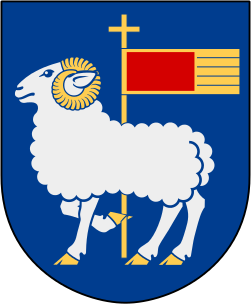
Gotland vapen


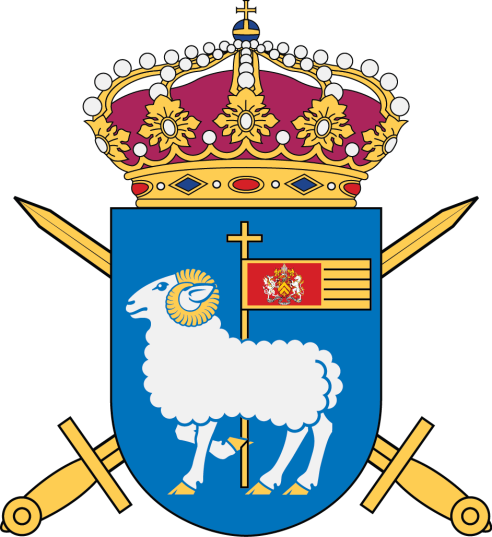
Gotland coat of arms; sheep, called
on Gotland “lamm” have always
been important to the local economy


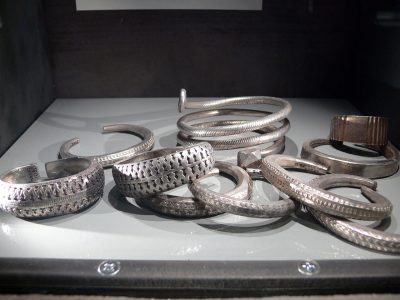
More than 700 purposefully assembled collections, or hoards, of silver treasure have been found on the Baltic island of Gotland, most deposited in the ground for safe keeping during the Viking age (9th through mid-11th centuries).

A few of these hoards are of unequalled size, including the largest ever found. The Spillings Hoard, unearthed by a farmer in his field in north-eastern Gotland in July 1999, contains more than 14,300 silver coins, and much silver jewellery: hundreds of armlets, and numerous finger rings, as well as silver ingots, coils of rolled silver, and hack-silver, pieces of broken jewellery and cut-up coinage.

The Spillings Hoard was buried under the floorboards of a farmhouse about 881 CE, as the latest coin is dated to then. The house quite possibly was that belonging to a metalsmith – always a prosperous member of society in medieval times – judging by the other metal remains found on site. The earliest coins in the hoard are 6th c Sasanian. The vast majority of the coins are Arabic dirhams, not brought to the island as plunder but rather through the extensive trade around the Baltic basin that connected Gotland with the Silk Road and its fabled riches of silk, furs, and spices. The area where the Spillings Hoard was found abounded in well-to-do savers; a hoard was found in the same field in 1883 and numbered 5,922 coins.

Fornsalen - Silberschatz von Spelling

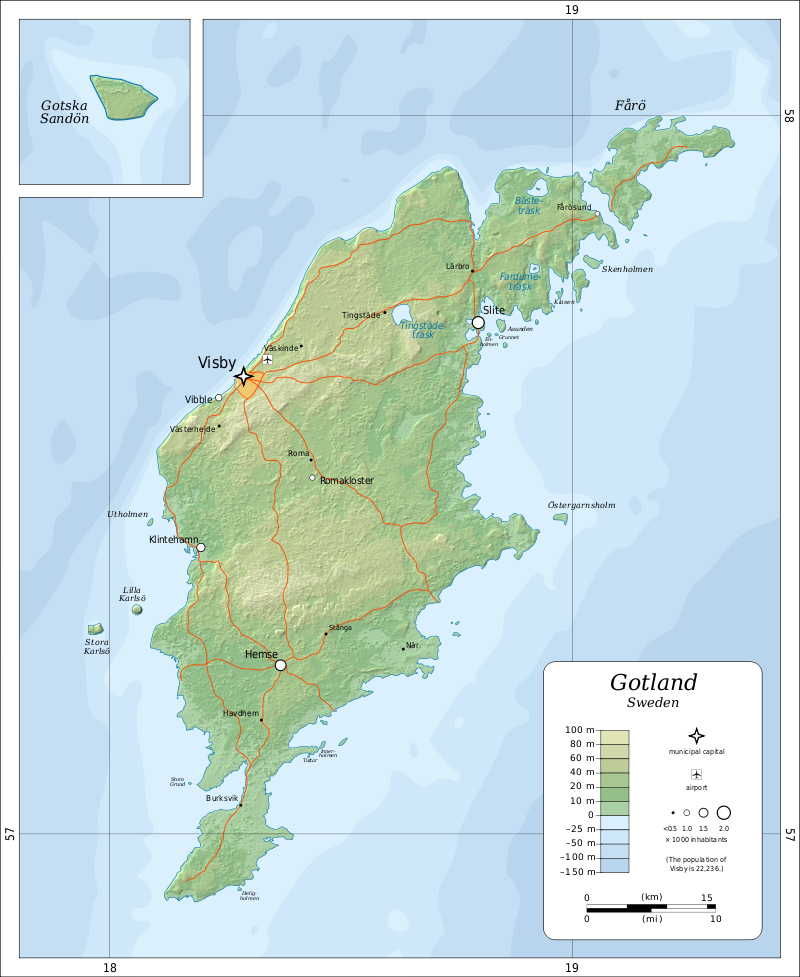
Gotland is an island 109 miles long and 32 miles wide in the Baltic sea, and today is home to some 58,000 residents. An independent nation until captured by the Danish King Valdemar Atterdag in 1361, Gotland did not become part of Sweden until 1645.

Topographic map of Gotland

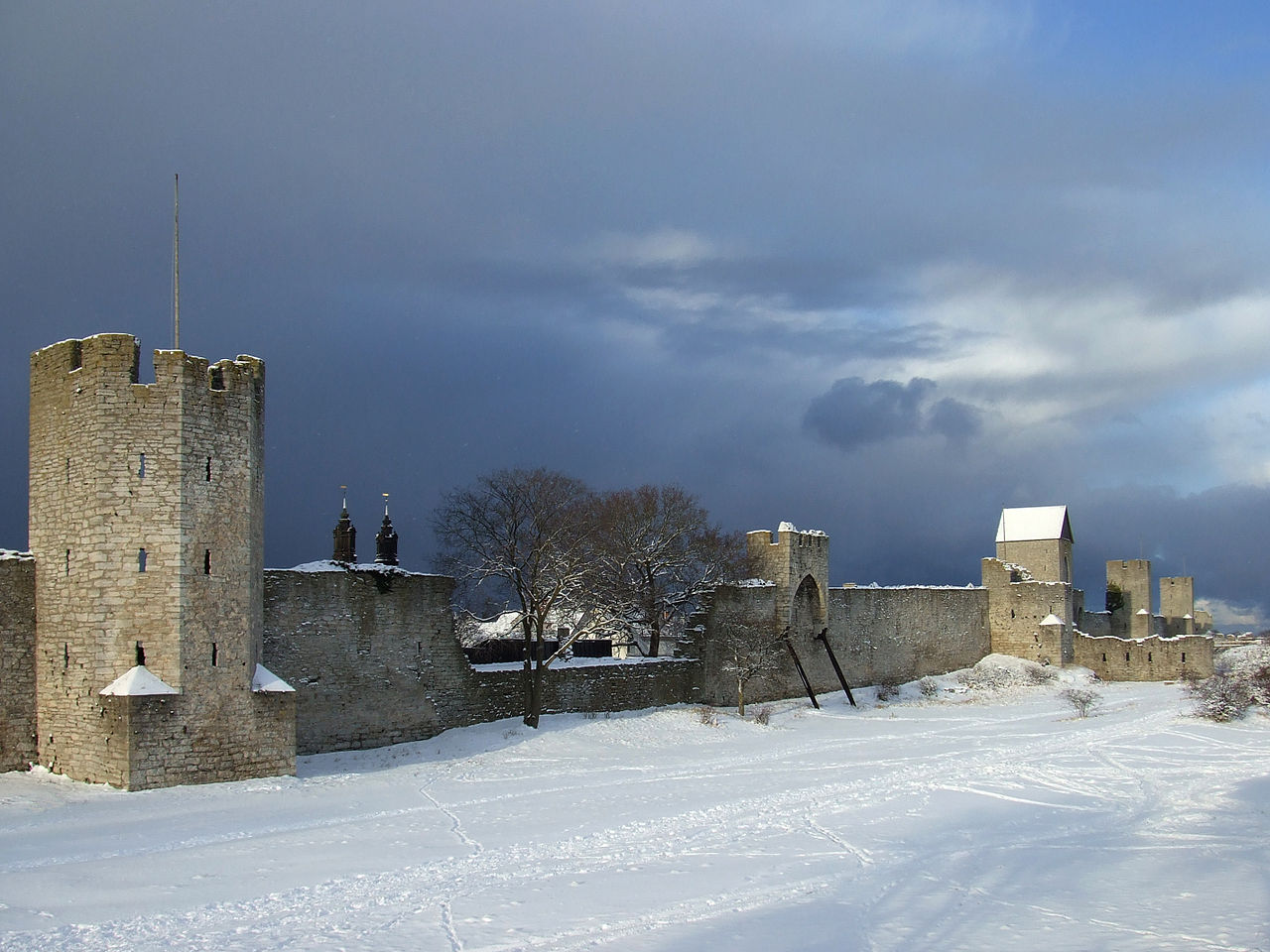
The walled capital city of Visby, on the eastern coast, grew immensely rich in the later middle ages as part of the Hanseatic League, leaving it and all of Gotland dotted with impressive medieval buildings, including the 94 parish churches it is justly famed for.

Visby ringmur östra delen norrut

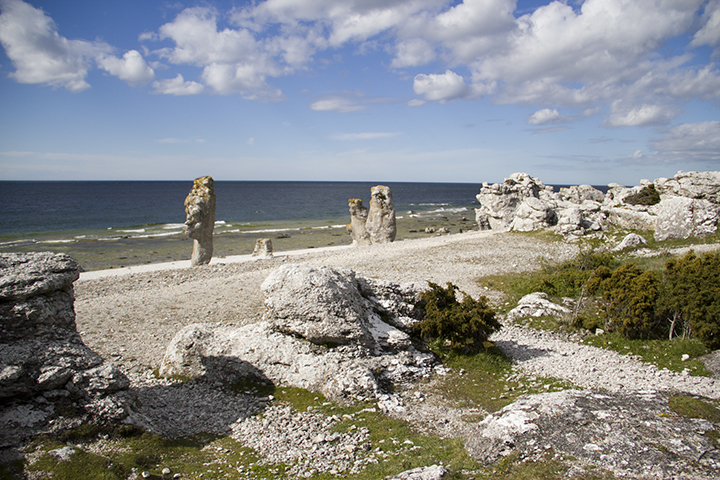
It is a place of exceptional beauty, its extensive coast and many inlets dotted with rauk – wind- and water-swept limestone rock formations – and blessed with the sunniest location of all Sweden. The name “Gotland” – Gutland in Gutnish, the original language of the settlers, is “Goth-land”, land of the Goths. Although the official language politically is Swedish, Gutnish is still spoken amongst some residents, although sadly barely survives in written form. Swedish friends living and studying on Gotland tell me that when they overhear Gutnish it is unintelligible to them, so distinct a language it is.

Nearly 200,000 old coins have been found on Gotland, including more late Anglo-Saxon coins than have been found in Britain itself. Yes: more late Anglo-Saxon coins have been found on this small distant island than in England itself. Many of these English coins were almost certainly plunder, and from the payment of thousands of pounds of danegeld (the payments paid by Anglo-Saxon rulers to stave off the predations of the Vikings). But the Gotlanders themselves were not “Vikings” – they were prosperous and peaceful farmers and traders, highly independent, pragmatic, and successful. Gotland’s location in the Baltic Sea made it perfect for trading runs across to the eastern and southern shores, where tribes such as the Polanie, Pomerani, and Prus ran Summer trading posts. These connected to trade routes heading further East deep into Russia, South to present day Iraq and Uzbekistan, and West to the great trading towns of the Svear (Swedes) such as Birka, and Aros (Aarhus) of the Danes.

The Spillings Hoard, along with much more treasure and examples of Gotland’s famed standing memorial stones, are on view in Visby at the Gotlands Museum. An excellent book is available on the Hoard: The Spillings Hoard: Gotland’s Role in Viking Age World Trade, Visby, Gotlands Museum, 2009.


Fårö Rauk (limestone sea-stacks) at Langhammar


Preserving Our Past, Recording Our Present, Informing Our Future

Ancient and Honorable Clan Carruthers Int Society CCIS  LLc

carruthersclan1@gmail.com              carrothersclan@gmail.com

cropped-wider-banner-light-blue-1.jpg


Octavia Randolph


You can find us on facebook at :

https://www.facebook.com/carrutherscarrothers.pat.9

https://www.facebook.com/CarruthersClan/

https://www.facebook.com/CarruthersClanLLC


Disclaimer Ancient and Honorable Carruthers Clan International Society CCI
Gutland / Gotland, The Viking Age, Uncategorized

CLAN CARRUTHERS-VIKING BOAT BURIAL REVEALS ITS SECRETS

CLAN CARRUTHERS INT SOCIETY CCIS                          PROMPTUS ET FIDELIS

cropped-wider-banner-light-blue-1.jpg


VIKING BOAT BURIAL REVEALS ITS SECRETS


Six years after discovering and excavating the first Viking boat burial site discovered on the UK mainland, archaeologists have provided a glimpse into some of the mysteries this rare burial reveals.

Originally unearthed in 2011, the site in Swordle Bay, Scotland, was the first undisturbed Viking boat burial found on the UK mainland. After six years of work, Ardnamurchan Transitions Project’s findings were recently released in an in-depth report in the Journal of Antiquity, revealing, among other things, the growing relationship between Scotland and the Viking world at that time.

Post-excavation photograph of the burial site. (Credit: Antiquity Publications Ltd, 2017)

Post-excavation photograph of the burial site. (Credit: Antiquity Publications Ltd, 2017)

Viking boat burials themselves were extremely rare. Only practiced for the deaths of prominent individuals, the ritual used a boat as a coffin for the body and burial goods. Discovered under a low-lying natural mound close to the shore, this particular site was small, measuring approximately 17 feet by 5 feet, and thought to have contained a row boat that was accompanying a larger ship.

Other artifacts from the burial site. The sword (top); the sword in situ (below); the mineralized textile remains (right); detail of the decoration after conservation (left). (Credit: Pieta Greaves/AOC Archaeology).

Other artifacts from the burial site. The sword (top); the sword in situ (below); the mineralized textile remains (right); detail of the decoration after conservation (left). (Credit: Pieta Greaves/AOC Archaeology).


After excavating the site, archaeologists were able to reconstruct the steps of the burial. A boat-shaped depression was first dug into a natural mound of beach shingle. The boat was then inserted into the ground, and the body was placed inside, along with the grave goods. Stones were place inside and around the boat. As part of the closing of the site, a spear and shield boss (the round or convex piece of material at the center of a shield) were deliberately broken and deposited.

Pre-excavation photograph after initial cleaning. (Credit: Antiquity Publications Ltd, 2017)

Pre-excavation photograph after initial cleaning. (Credit: Antiquity Publications Ltd, 2017)

The ship, along with the human remains, decayed in the acidic soil long ago, but the grave artifacts remained, offering a glimpse into the possible origins of the deceased as well as the reach of Viking culture. A single copper alloy-ringed pin with three bosses—a style found in Ireland—was also found, believed to have originally been fastened to a burial coat. There was also a copper alloy drinking horn, thought to be Scandinavian in origin. Other grave goods included a sword, an axe, a sickle (found mostly in Scotland), a whetstone (probably Norwegian), flint strike-a-lights and two teeth—molars from only identified human remains. Hundreds of metal rivets that once held the vessel together, some with wood shards, were also discovered.

The Viking's teeth. (Credit: Antiquity Publications Ltd, 2017)

The Viking’s teeth. (Credit: Antiquity Publications Ltd, 2017)

An isotopic analysis of the teeth (the lower left first and second molars) revealed further information. The individual likely lived on, or close to, the coast, as indicated by an increase in consumption of marine proteins between the ages of 3 and 5. While marine protein was rarely consumed by humans in Britain, it was popular in Viking-era Norway. Further analysis of the teeth narrowed down the place of origin to eastern Ireland, northeastern mainland Scotland, Norway or Sweden.

The weapons included in the burial point to a warrior status and the artifacts and their internment infer high status, but the gender cannot be confirmed. While it is likely a male burial, some of the goods, such as the sickle, are more commonly associated with females. Current Viking’s scholarship points to a number (albeit smaller) of female warriors, as well as the discoveries and excavations of female boat burials.

 Some of the artifacts recovered from the burial site (clockwise from the top left): broad-bladed axe, shield boss, ringed pin and the hammer and tongs (Credit: Pieta Greaves/AOC Archaeology).

Some of the artifacts recovered from the burial site (clockwise from the top left): broad-bladed axe, shield boss, ringed pin and the hammer and tongs (Credit: Pieta Greaves/AOC Archaeology).

While there is still more to learn from this rare burial site, an important finding was revealed in the variety of grave goods from multiple geographic locations: The growing relationship between Scotland and the Viking world at that time.


Preserving Our Past, Recording Our Present, Informing Our Future

Ancient and Honorable Clan Carruthers Int Society CCIS  LLc

carruthersclan1@gmail.com              carrothersclan@gmail.com

cropped-wider-banner-light-blue-1.jpg


Patricia Peck


You can find us on facebook at :

https://www.facebook.com/carrutherscarrothers.pat.9

https://www.facebook.com/CarruthersClan/

https://www.facebook.com/CarruthersClanLLC


Disclaimer Ancient and Honorable Carruthers Clan International Society CCI
Gutland / Gotland, The Viking Age, Uncategorized

CLAN CARRUTHERS-OSBERG VIKING SHIP

CLAN CARRUTHERS INT SOCIETY CCIS                                PROMPTUS ET FIDELIS

cropped-wider-banner-light-blue-1.jpg


CLAN CARRUTHERS – OSBERG VIKING SHIP


In 1904 a remarkable archaeological site was uncovered at Oseberg, Norway. It consisted of an astonishingly well-preserved Viking ship that contained the remains of two women along with a wide array of accompanying grave goods. This vessel, which is widely celebrated as one of the finest finds of the Viking Age, had been buried within a large mound or haugr.

When the Carruthers ancestors first landed on the Celtic Islands, they called us the Red Dragon.  You can see why.


The burial mound measured approximately 40m long by 6.5m high and it completely covered the boat. The conditions within the mound were particularly damp and this meant that the ship and its contents survived nearly intact. Constructed primarily out of oak planks, the vessel measured 21.40m long by 5.10m wide. Its bow and stern were covered in elaborate carvings, while it contained 15 pairs of oar holes which meant up to 30 men could row the ship as required.


Centrally placed on the ship were the skeletons of two women whose remains had been placed in a specially built wooden tent. One of the woman was in her eighties and this was reflected in the condition of her bones which showed that she had suffered badly from arthritis during her final years. The second woman was younger and had died in her early fifties.The connection between the two women is unclear; it is possible that they were related or more sinisterly represent the remains of a noble woman interred with her sacrificed slave. Indeed, some have speculated that one of the women may be Queen Åsa, the grandmother of Norway’s first king, although this remains unproven.


The Oseberg bed. On of 3 beds found on the ship (© Museum of Cultural History, University of Oslo, Norway)


Radiocarbon analysis of the women’s bones indicated that they died c. 1220±40 and 1230±40 before present and this ties in with the dendrochronology dates from the burial tent timbers, which indicate it was constructed in 834 AD. Other skeletal remains found on the ship included 13 horses, 4 dogs and 2 oxen. It is likely that these represent animals that were sacrificed to accompany the female burials into the afterlife.


The Oseberg cart (© Museum of Cultural History, University of Oslo, Norway)


The grave was disturbed in antiquity and any precious metals that may have been present were stolen. However, a remarkable collection of wooden and textile artefacts were left behind by the grave robbers. These included four elaborately decorated sleighs, a richly carved four-wheel wooden cart, three beds as well as a number of wooden chests. More mundane items such as agricultural and household tools were also found.


Oseberg bucket (© Museum of Cultural History, University of Oslo, Norway)


This bucket was one of several found on on the ship. Made out of yew wood it is surrounded by decorative brass fittings and held together with iron hoops. A wooden ladle and 6-7 wild apples were found inside it.


The famous Oseburg ‘Buddha’. Sitting in the lotus position this stylised human figure is found on another bucket from the ship. This bucket most likely originated in Ireland as the decorative motifs on the ‘Buddha’ are paralleled in Irish art work most noticeably The Book of Durrow. This suggests that bucket may represent booty captured during a Viking raid on Ireland.


Oseberg animal head post (© Museum of Cultural History, University of Oslo, Norway)


Five of these zoomorphic posts, all carved with different animal heads, were found in the Oseberg burial. They are fashioned out of maple wood and are of similar size. The posts contain slots for handles suggesting that they were originally carried and it is likely they had some sort  of  magical or religious significance.


Four wooden sledges were also uncovered, three of which, were covered in ornate carvings.


The ship under excavation (image after http://scienceblogs.com/aardvarchaeology/2007/09/11/oseberg-skeletons-exhumed/) The Oseberg ship and its treasure trove of artefacts are currently on display at the Viking Ship Museum, Oslo, Norway.


Preserving Our Past, Recording Our Present, Informing Our Future

Ancient and Honorable Clan Carruthers Int Society CCIS  LLc

carruthersclan1@gmail.com              carrothersclan@gmail.com

cropped-wider-banner-light-blue-1.jpg


Colin Moriarty


You can find us on facebook at :

https://www.facebook.com/carrutherscarrothers.pat.9

https://www.facebook.com/CarruthersClan/

https://www.facebook.com/CarruthersClanLLC


Disclaimer Ancient and Honorable Carruthers Clan International Society CCI
Gutland / Gotland, OUR ANCESTORS, SEA KINGS AND ROVERS, The History of Gutland, Uncategorized

THE SIX WIVES HARALD FAIRHAIR CLAN CARRUTHERS CCIS

WIDE BANNER with NEW CREST


ALL THE SONS OF HARALD FAIRHAIR

King Haraldr had many wives and many children- Haralds Saga – and a Carruthers ancestor.

Harald Fairhair, the legendary ruler of Norway who succeeded for the first time in uniting all the petty fiefdoms of his nation, inherited his father’s kingdom at a young age and proceeded to live an extraordinarily long and active life. During his time as a good looking adult with famously beautiful hairlocks, he wooed women from all different regions of Norway and produced many children accordingly,

.Although he cannot compete in importance with his Danish contemporary Ragnar Lodbrok, the list of his descendants is equally long and impressive. It includes among others, Ivan the Terrible of Russia, the Sun King Louis XIV of France and, via the House of Sachsen-Billung, our own Leopold II of Belgium.

Halfdan the Black handing over his kingdom to Harald ca. AD 860

Spouse no. 1    Ása    Haakonsdotter

In Chapter IX of his Heimskringla text, the Icelandic historian Snorri Sturluson, mentions that Harald eventually settled in Trondheim , which heal ways called his home, and where he built a very large establishment called Hladir (now Lade). That is where he met Aasa, the daughter of the important Jarl Haakon “the Rich” Grjotgardsson, who had nominal control over Trondelag and Halogaland.

Harald and Hakon came to an agreement dividing Norway between them except for the completely unruly Vestland. This first (political) marriage produced four sons, listed byname by Snorri In chapter XVII of the Heimskringla text:

“Then he began to have children. Harald and Àsa had these sons : Guthorm was the eldest, Halfdan svarti (the Black), Halfdan hviti (the White)–they were twins– the fourth Sigfròdr. They were all brought up in Trondheim in great honour”

Then Harald went after the Vikings of Vestland in Hafrsfjord whom hedefeated in a great naval battle in AD 872.

It is probably not a coincidence that the Viking Rollo, who was presumably born at Maere and who was a contemporary of Harald Fairhair, immediately after 872 what is since called Normandy. Many other Vikings, who did not want to be subjected to Harald, followed him there.

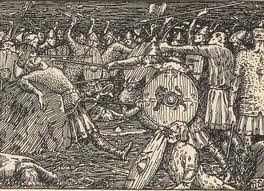
Image of the great battle of Hafrsfjord in 872

We can safely assume that Harald’s four children with Aasa were all born between the naval battles of 865 and 872.

Guthorm  (865-895)    Halvdan svarte ( (868-932)Halvdan hvite  (868-925)   Sigfrodr(872-?)

The eldest son Guthorm was named after Halfdan the Black’s best friend and right arm, Duke Guthorm, who took young Fairhair under his wings when he inherited the kingdom at the age of ten. After Duke Guthorm died of sickness ca. 890, Harald made his own son Guthorm king over Raanrike, which he had wrested from the Swedes, and gave him the responsibility of defending this south east region of Norway against his neighbor. However, Guthorm fell in a later fierce battle with the sea-king Solve Klove in 895, whose own father had been killed by Harald at the First Battle of Solskjel.

HalfdanII “the Black (named after his grandfather) later inherited the kingdom of Tróndelag. He may therefore have considered himself the rightful successor to his father as the king of whole Norway and must have been disappointed when Harald gave preference to the younger son Eric.

Halfdan III “the White”, shared Trondelag with his darker twin brother. He
fell in Eist land in 925, i.e. ten years before Harald’s death.
Sigfròdr is not mentioned again. We do not know what happened to him.

Spouse no. 2 Svanhild  Eysteinsdotter of Heidmark

After defeating the Vikings of Vestland, Harald turned his attention to Vestfold in Östland.Svanhild was the daughter of Eystein “the Noisy ” of Vestfold, who was also the grandfather of the before mentioned Rollo, the founder of Normandy. She was probably also chosen for political reasons.

Image of Eystein “Glumra” the Noisy Svanhild provided Harald Fairhair with three additional sons:

Olaf “Geirstadaalfer”                         Björn”formann”                     Ragnar“rykkill” 
(Elf of Geirstadir)                               (the merchant)                        (the Snatcher)
  (870- 932)                                         (875- 932)                                (878-932)

Svanhild possibly also died young because nothing is heard of her after 880. Björn the Merchent would later succeed his grandfather Eystein asking of Vestfold, and his brother Olaf succeeded him after his death ,while Sigurd inherited Trondheim from his father.

Spouse no. 3  Gyda   Eiriksdotter   of Hardaland

Around AD 870, when Harald was approaching the age of twenty, he started thinking of taking a young mistress. This was probably before his marriage with Asa. Harald had heard of beautiful Gyda, the daughter of king Eirik of Hardaland, who was being fostered in Valdres and he sent his men to fetch her.

However, she sent them back with the message that she would not sacrifice her virginity to take as husband a king who had no more of a realm than a few districts to administer. She might only agree to be his wife if he would first subject the whole of Norway.

This seems to have had a stimulating effect on Harald who swore to God not to cut or comb his fancy hair until he became ruler over all of Norway. It would take him another ten years to fulfill this ambition, but when he had completed his project, he remembered beautiful but proud Gyda. So tells Snorri in chapter XX of Heimskringla:

King Haraldr had now become sole ruler of all Norway. Then he called to mind what that proud girl had said to him. He then sent men for her and had her brought to him and made her his mistress. That were their children :

Hroerekr                Sigtrygg                 Frodi                 Torgils
(880- 932)            (882-932)              (885-938)             (890-932)

All four sons were born in Bergen, but both Frodi and Torgils are said tohave died in Dublin.

Spouse no. 4  Snaefrid“    Snowfair ”   Svasisdotter the Finn

In chapter XXV of Heimskringla, Snorri recounts the following story:

King Haraldr went one winter to attend banquets through Uppland and had a Yule banquet prepared for himself in Poptor. One Yule-eve Svási came to the door while the king was sitting at table, and sent the king a message that he was to come out to him.The King went out reluctantly and agreed to go to his home with him.

Snaefrid Swasisdottir - Historical records and family trees - MyHeritage

There Svasi’s daughter Snaefridr, a most beautiful woman, rose and served the king a goblet full of mead, and he took all into his grasp, including her hand, and it was immediately as if a fiery heat came into his flesh, and he wanted to have her straight away that night. But Svasi said that it should not be unless the king betrothed himself to Snaefridr and married her and got her lawfully. And the king betrothed himself to Snaefridr and married her and loved her so madly that his kingdom and all his duties he then neglected. They had four sons :

Sigurd “hrsi”          Halvdan”hàleggr”          Gudród“ljami”      Ragnvald“rettilbeini”
 
(the Grey)                (long legs)                     “Gleam”              (Straightleg)
(890-937)                (891-?)                            (893-?)                (895-?)

Then Snaefrid died and according to Snorri, Harald was inconsolable and sat over her continually hoping that she would return to life.Sigurd later became king of Hadafylke and was the ancestor of other notable kings, such as Harald Hardraade, who ruled Norway successfully from 1046 to 1066, but failed in his attempt to invade England just before William the Conqueror made his own landing at Hastings.

Spouse no. 5   Ragnhild           the Mighty” of Jutland”

(Jutland and Gutland were one in the same)

Ragnhild was born ca. 880 as daughter of King Eirik of Jutland and would bear Harald’s
most notorious son Eric (900-954) upon whom posterity bestowed the epithet “Bloodaxe”,
 presumably because he proceeded to eliminate his half-brothers in order to obtain the succession.
Ragnhild Sigurdsdotter - Wikipedia
 However, careful reading of Snorri’s Chapters 41-43reveals a different story:
King Harald was now 80 years of age; he now became so infirm that he felt he could not travel by land or manage the royal affairs. Then he took his son Eric to his high seat and gave him rule over the whole country. But when King Harold’s other sons heard about this, the Halfdan sorti set himself on the king’s high seat.
He then took the whole of Trondheim to rule over. All the Traendis backed him in his course of action. Two years later, Halfdan svarti died suddenly inland in Trondheim at some banquet, and it was rumored that Gunhilde (Eric’s wife) had bribed a warriors killed in magic to make him a poison drink. After that the Prendi’s took Sigurd as king.

All this shows is that Eric did not have an easy time taking hold of the situation, and that he was king by name only between 930 and 933.When in 934 his younger rival Haakon arrived from England to takeover the situation, Eric did not resist and moved to the Orkney Islands, which were already colonized by Norway. The English King Aethelstan, who had fostered Haakon and equipped his expedition, then entrusted Northumberland to Eric as under-king. Numismatic evidence found as recently as 2014 attests to his title as king of York between 952 and954.
Aethelstan’s successor Eadred put an end to his reign, and when Eric was travelling back to the Orkneys with his brother Ragnald and his son Haerekr, they were ambushed at Stainmore and all killed.

Coin of Eric as King of York AD 952-54

So who were the brothers who were supposedly killed by violent Eric?

1.South of Vinland: Norwegian History: Halfdanr Svarti (810-860), King of  Vestfold.


Halfdan svarti : we already saw that his death was caused by poisoning, no bloody ax involved. Halfdan had it coming by takingover Trondheim, the jewel in his father’s crown

 and had attempted himself first to kill Eric by burning down the house where he was staying. Eric managed to get out and went to see his father with news of these events. We cannot therefore exclude the possibility that it was Harald himself who ordered Halfdan’s poisoning as punishment

.2.


Bjòrn formann: succeeded his grandfather on his mother’s side as king of Vestfold. He was considered an intelligent person and very moderate and it seemed he might make a great ruler. However,Snorri recounts in chapter 41 of his book that when Eric returned from the eastern Baltic in 930, he visited Bjòrn to demand the revenues which were due to King Harald whlle he was still alive. It was when Bjòrn refused to pay, that he was killed in battle by Eric

3.
Olaf : after the fall of Bjòrn, his brother Olaf took rule over Vestfold and adopted Bjòrn’s son Gudròdr. When the Vikverjar heard that Harold had taken Eric as supreme king, they took Olaf as supreme king in the Vik, and he kept that kingdom. Eric was very displeased at this. The same Spring, Eric calls out a great army and ships and turns east to Vik. He had a much larger force and gained victory. Olaf and Sigurd both fell there
.4.
Sigurd: this was probably Sigfródr, son of the first marriage of Harald with Àsa

So there is no mention of direct murder by Eric of any of his half-brothers.
They had all four
revolted against their father’s decision and bore the consequences. Maybe their father, while he was still alive, did not disapprove of their forceful elimination. It is interesting to read that according to the Saga in which Eric figures, after his death he is welcomed by Odin without any criticism of the killings of his brothers.  When the other gods question Odin why he still welcomed Eric, Odin answers, well, he has traveled a lot and has seen many countries”  Sounds modern, does it not?

Spouse no. 6           Alshild   Ringsdotter   of Ringerike

Ring                     Dag                Gudród “Skirja”
(882-?)                (883-?)              (890-965)

Alshild was a princess from the prestigious kingdom of Hringaríkei (nowRingerike near Oslo). Snorri mentions that when King Harald married her, she proudly named her sons after her own father (Ring), grandfather (Dag)and ancestor (Gudród). Their son Dag later became king of Hedmark and Gudbrandsdal.

Beautiful Hedmark

Spouse no. 7   Thora  Mosterstang


When Fairhair reached the age of seventy, he retired to one of his farms in Hordaland where he is credited with impregnating beautiful Tora, who may have been only a handmaid. At the age of ten, her son Haakon wassent for safekeeping to the court of the English king Aethelstan where many sons of European princes were welcome to be taught the noble arts of statesmanship

 King Aethelstan is said to have loved him more than his own kin. Hákon was baptized there and taught the true faith and good morality and all kinds of courtly behavior. In 934, Hákon was invited by dissident nobles in his home country to takeover the throne of Norway. Aethelstan equipped him with ships and men and Hákon was able to expel his unpopular half-brother Eric Bloodaxe, who conceded without a fight and fled to the Orkney Islands Haakon proved to be a good and pragmatic king and reigned until 960when he had to face an attack at Fitjur by five sons of Eric. He won the battle, but was wounded and died shortly there after.Three sons of Eric took over the kingdom and were able to fulfill the dynastic designs of their grandfather.

Conclusion

By impregnating so many women from all parts of his kingdom, Harald may have had political considerations in mind. It was his way of obtaining the support of so many previously independent smaller kings who might otherwise have been reluctant to accept him as over-king. His marriages to a Danish and a Finnish princess may also be interpreted as protection against over-zealous neighbors. The only missing piece in his political puzzle was a princess from hostile Sweden. I think Martin Arnold is right when he suggests that Harald’s governing style of usurping traditional inheritance rights had to lead to civil war. Hisson Eric was not only contested by his brothers, but also by the regional lords. Maybe if Harald had gradually shared power with his designated successor at an earlier period, the transition might have been successful.

Carruthers crest on flag-v2 (1)

OFFICIAL AND OLDEST SCOTTISH  CLAN CARRUTHERS

 SINCE 1983-CLAN OF OUR ANCESTORS

SCOTTISH CLAN – IRISH CLAN – NORSE CLAN

WIDE BANNER with NEW CREST

Willy van Ryckeghem

REKNOWNED NORSE HISTORIAN

REVIEWED BY TAMMY WISE CHS

CLAN CARRUTHERS CCIS HISTORIAN AND GENEALOGIST

Preserving Our Past, Recording Our Present, Informing Our Future

Ancient and Honorable Clan Carruthers

   clancarruthers1@gmail.com

You can find us on our main facebook pages at :

SILVER WINGS-https://www.facebook.com/CarruthersClanLLC/

GOLD WINGS – https://www.facebook.com/carrutherscarrothers.pat.9

CLAN CARRUTHERS FAMILY HISTORY – https://www.facebook.com/CarruthersClan

CLAN CARRUTHERS CCIS – https://www.facebook.com/groups/3878691252182714

CLAN CARRUTHERS INT SOCIETY- https://www.facebook.com/groups/394653845137709

CLAN CARRUTHERS – BORDER REIVERS – https://www.facebook.com/groups/434959914239094

Disclaimer Ancient and Honorable Carruthers Clan International Socie
Uncategorized

CLAN CARRUTHERS-ROBERT I ROLLO AND THE CARRUTHERS GENEALOGY

CLAN CARRUTHERS INT SOCIETY CCIS                         PROMPTUS ET FIDELIS

cropped-wider-banner-light-blue-1.jpg


Robert I Rollo and the Carruthers Genealogy


I.

Robert I Rollo “The Viking” Prince of Norway & Duke of Normandy “Count of Rouen” Ragnvaldsson    846–932

BIRTH 14 OCT 846  Maer, Jutland, Nord-Trondelag, Norway
DEATH 17 DEC 932  Rouen, Seine, Maritime, Haute-Normandy, France

Robert is mainly a germanic translation of his original name Hrodebert.  This was pronounced Ro-Ho.   Thus his last name of Rollo.  They really did not have a first and last name then.

To date the DNA for Robert I Rollo is U 1 – 5.  You can tell that this is primative testing since it has only one letter in it.


2. Son of Robert I Rollo was:

William I Longsword Guillaume (Count of Rouen 2nd Duke of Normandy) DeNormandy 891–942

BIRTH 891  Rouen, Seine-Maritime, Haute-Normandie, France
DEATH 17 DEC 942  Island Picquigny, Somme River, Normandy


3. Son of William I Longsworth

Richard I “The Fearless” “Sans Peur” Duke of Normandy DE NORMANDIE

BIRTH 28 AUG 933  Fécamp, Seine-Maritime, Haute-Normandie, France
DEATH 20 NOV 996  Fécamp, Seine-Maritime, Haute-Normandie, France


4.  Son of Richard I

Richard (‘The Good Duke’ First William of le Bon Archbishop Rouen Robert Normandy ‘The 4th Duke of Normandy’) De Normandie

BIRTH 20 NOVEMBER 0958  Rouen, Seine-Maritime, Haute-Normandie, France
DEATH 28 AUG 1027  Fécamp, Seine-Maritime, Haute-Normandie, France


5. Son of Richard ( The Good Duke)

Robert I ‘the Magnificent’ FitzRichard Duke of Normandy

BIRTH 04 OCT 1003  Falaise, Calvados, Normandy, France
DEATH 22 JUL 1035  Nice, Alpes-Maritimes, Provence-Alpes-Cote d’Azur, France


6. Son of Robert I  ” The Magnificent”

William I De Normandie, Duk Beauclerc (‘The Conqueror’ King of England) ‘The Bastard’ Guillaume Peverel)

BIRTH 14 OCT 1024  Falaise, Calvados, Basse-Normandie, France
DEATH 9 SEP 1087  Rouen, Seine-Maritime, Haute-Normandie, France


7. Son of William I De Normandi

King Henry I “Lion of Justice” Beauclerc

BIRTH 1 SEPTEMBER 1068  Selby, Yorkshire, England
DEATH 1 DECEMBER 1135  St Denis, Cher, Centre, France


Married :

Matilda (Edith) “Good Maud” Aetheling Caenmore Duchess of Normandy, Princess of Scotland, Queen Consort of England       1079–1118

BIRTH 1 JUNE 1079  Dunfermline, Fife, Scotland
DEATH 1 MAY 1118  Westminster, Middlesex, England


Matilda Aehtheling Caenmore  carries the Carruthers genome of CTS-11603

her father is :

Malcolm III (“Long Neck” Canmore King of Scotland) MacDonnchada Canmore, Dunkheld King of Scotland    1031–1093

BIRTH 26 MAR 1031  Blair Atholl, Perthshire, Scotland
DEATH 13 NOV 1093  Malcolms Cross, Killed in battle whilst besieging Alnwick Castle, Northumberland, by the English King of, Scotland

He too was tested and carrys the Carruthers genome of CTS-11603


Preserving Our Past, Recording Our Present, Informing Our Future

Ancient and Honorable Clan Carruthers Int Society CCIS  LLc

carruthersclan1@gmail.com              carrothersclan@gmail.com


WIDER BANNER Black

Many thanks to the Carruthers – Stiles Family

California USA

You can find us on facebook at :

https://www.facebook.com/carrutherscarrothers.pat.9

https://www.facebook.com/CarruthersClan/

https://www.facebook.com/CarruthersClanLLC


Disclaimer Ancient and Honorable Carruthers Clan International Society CCI
OUR ANCESTORS, The Viking Age, Uncategorized

CLAN CARRUTHERS : KING ROLLO THE VIKING

CLAN CARRUTHERS INT SOCIETY CCIS                               PROMPTUS ET FIDELIS

cropped-wider-banner-light-blue-1.jpg


KING ROLLO THE VIKING

Image result for Rollo as a warrior picture


Robert I Rollo “The Viking” Prince of Norway & Duke of Normandy “Count of Rouen” Ragnvaldsson

BIRTH 14 OCT 846  Maer, Jutland, Nord-Trondelag, Norway
DEATH 17 DEC 932  Rouen, Seine, Maritime, Haute-Normandy, France


Married:

Poppa Lady Duchess of Normany De Senlis De Valois De Rennes De Bayeux

BIRTH 872  Bayeux, Calvados, Basse-Normandie, France
DEATH 930  Rouen, Seine-Maritime, Haute-Normandie, France


Rollo as a Warrior


History has many cunning passages”. – T. S. Eliot

“History . . . the portrayal of crimes and misfortunes.” – Voltaire.


Image result for Rollo as a warrior pictureThe Normans have evoked great interest from the Middle Ages to the present. Vikings who settled in Normandy, were later called Normans. A phrase, A furore normannorum, libera nos, domine (From the violence of the men from the north, O Lord, deliver us), sums up how historians of the early middle ages looked on the Vikings, for they threatened the progress of western civilization for quite some time (Logan 2003, 15).


The founder of Normandy, Rollo, was the chief of a small band of ravaging Vikings. He once had a dream where he seemed to behold himself placed on a mountain far higher than the highest, in a Frankish dwelling. And on the summit of this mountain he saw a spring of sweet-smelling water flowing, and himself washing in it, and by it made whole from the contagion of leprosy . . . and finally, while he was still staying on top of that mountain, he saw about the base of it many thousands of birds of different kinds and various colours, but with red wings extending in such numbers and so far and so wide that he could not catch sight of where they ended, however hard he looked. And they went one after the other in harmonious incoming flights and sought the spring on the mountain, and washed themselves, swimming together as they do when rain is coming; and when they had all been anointed by this miraculous dipping, they all ate together in a suitable place, without being separated into genera or species, and without any disagreement or dispute, as if they were friends sharing food. And they carried off twigs and worked rapidly to build nests; and willing[ly] yielded to his command in the vision. (From Hicks, 2016, Introduction).

In Dudo of Saint-Quentin’s History of the Normans, Rollo took heed of the omens in the dream and founded a territory that became the duchy of Normandy, uniting various groups under his lead. Later chroniclers recounted how Rollo’s descendants and those of his followers conquered and ruled kingdoms in England and Sicily and Antioch and further, and led armies on crusade. (Ibid.)

Norwegian-Icelandic sources too tell of a large Viking called Rolv Ganger (Rolv Walker), aka Rollo (English) or Rollon (French). Outlawed in Viking Norway for raiding where he was not allowed to by King Harld Fairhair, Rollo was banished from Norway. He was too big for small horses to carry him, a saga tells. Viking horses may have been quite small.

Rolv and his soldiers secured a permanent foothold on Frankish soil in the valley of the lower Seine, and Rolv became the first ruler of Normandy, France, after King Charles the Simple ceded lands to Rollo and his folks in a charter of 918. In exchange, Rollo agreed to end his brigandage and protect the Franks against future Viking raids along the Seine and around it. He also converted to Christianity in 912, and probably died between 928 and 932. Rollo’s descendants were dukes of Normandy until 1202, and his granson’s grandson’s son Guillaume (dead 1087) conquered England in 1066 (William the Conqueror). (Claus Krag, SNL/Norsk biografisk leksikon, “Rollo Gange-Rolv Ragnvaldsson”.

Two more grants followed; one in 924 and one in 933 – land between the Epte and the sea and parts of Brittany. Relatives of Rollo and his men as well as other Northmen followed, for the pastures were green and lush, there was fish in the sea and rivers, and the climate better than in the North. The formerly raided Normandy became protected and became the best part of France for centuries. Normans also took over England and Wales after a descendant of Rollo, known as William the Conqueror, took over England in 1066 fra 1066 and became king of England. Normans also conquered the southern, richest half of Italy, including Sicily, and several other areas bordering on the Mediterranean Sea. (WP, “Rollo”)

Rollo reigned over the duchy of Normandy until at least 928. He was succeeded by his son, William Longsword. The offspring of Rollo and his followers became known as Normans, “North-men”, men from the North.

After the Norman conquest of England in 1066 and their conquest of southern Italy and Sicily over the following two centuries, their descendants came to rule Norman England (the House of Normandy), the Kingdom of Sicily (the Kings of Sicily) as well as the Principality of Antioch from the 10th to 12th century. To enlarge on that: Bohemond I (ca. 1054–1111) of the Norman Hauteville family was the Prince of Taranto from 1089 to 1111 and the Prince of Antioch from 1098 to 1111. He was a leader of the First Crusade. The Norman monarchy he founded in Antioch outlasted those of England and of Sicily. (WP, “Bohemond I of Antioch”)

Two spouses are reported for Rollo:

(1) Poppa, said by chronicler Dudo of Saint-Quentin to have been a daughter of Count Berenger, captured during a raid at Bayeux. She was his concubine or wife. They had children: (a) William Longsword, born “overseas” (b) Gerloc, wife of William III, Duke of Aquitaine; Dudo fails to identify her mother, but the later chronicler William of Jumieges makes this explicit. (c) (perhaps) Kadlin, said by Ari the Historian to have been daughter of Ganger Hrolf, traditionally identified with Rollo. She married a Scottish King called Bjolan, and had at least a daughter called Midbjorg. She was taken captive by and married Helgi Ottarson.

(2) (traditionally) Gisela of France (d. 919), the daughter of Charles III of France – according to the Norman chronicler Dudo of St. Quentin. However, this marriage and Gisela herself are unknown to Frankish sources. Some details can be hard to verify.


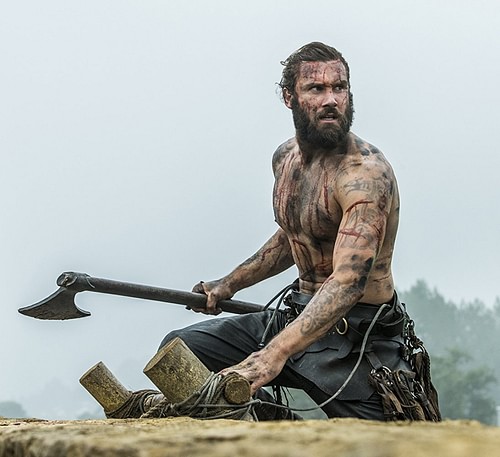
Clive Standen as Rollo of Normandy (by Jonathan Hession, Copyright, fair use)

ROLLO RULED WITH A VIKING CODE OF LAW BASED UPON THE CONCEPT OF PERSONAL HONOR & INDIVIDUAL RESPONSIBILITY.


Was Rollo Other than Norwegian?

The Rollo story is largely historical – and that he and his men were Northmen is taken to men they were of Scandinavian origin. Norwegian-Icelandic sources have it that Rollo was Hrolf from Norway, one of the Viking raiders.

  1. The oldest evidence is in the Latin Historia Norvegiae (ca. 1180). It was written in Norway. A quotation from it follows right below the array of Norse sources.
  2. Fagrskinna‘s chapter 74 tells of William and his ancestor Rolf Ganger (Rollo). This work was written around 1220, estimatedly, and was an immediate source for the Heimskringla of Snorri Sturluson’s Heimskringla. Fagrskinna contains a vernacular history of Norway from the ninth to the twelfth centuries, and includes skaldic verses that in part have been preserved nowhere else. It has a heavy emphasis on battles. The book may have been written in Norway, either by an Icelander or a Norwegian. (Cf. Finlay 2004)
  3. In the early 1200s, the Icelander Snorri Sturluson writes about this Hrolf, in Heimskringla, Book 3, section 24; Book 7, section 19, There are stories about the arsonist father and the brothers of Rolf Ganger, at one time rulers of the Orkneys and Moere in Norway. Their tales start somewhere during the reign of King Harald Fairhair (Chaps. 27, 30-32) and say it was he who settled in Normandy. Snorri also tells that Rolv Ganger – also known as Rollo – became one ancestor of the British royal house.
  4. Other Icelandic sagas from medieval times tell of Hrolf too, as the Orkneyingers’ Saga, section 4.
  5. From the Icelandic Landnama Book (Ellwood 1898): “Rögnvald, Earl of Mæri, son of Eystein Glumra, the son of Ivar, an Earl of the Upplendings, the son of Halfdan the Old, had for wife Ragnhild, the daughter of Hrolf the Beaked; their son was Ivar, who fell in the Hebrides, fighting with King Harald Fairhair. Another son was Gaungu-Hrolf who conquered Normandy; from him are descended the Earls of Rouen and the Kings of England.” (Part 4, ch. 7)

From Historia Norvegiae, the oldest of the Norse works where Rollo is mentioned:

When Haraldr hárfagri ruled in Norway some vikings of the kin of a very mighty prince, Rognvaldr, crossed the Sólund Sea with a large fleet, drove the Papar [monks and the picts, called Peti here] from their long-established homes [the Orkney Islands], destroyed them utterly and subdued the islands under their own rule. With winter bases thus provided, they sallied forth all the more securely in summer and imposed their harsh sway now on the English, now on the Scots, and sometimes on the Irish, so that Northumbria in England, Caithness in Scotland, Dublin and other coastal towns in Ireland were brought under their rule. In this company was a certain Hrólfr, called Gongu-Hrólfr by his comrades because he always travelled on foot, his immense size making it impossible for him to ride. With a few men and by means of a marvellous stratagem he took Rouen, a city in Normandy. He came into a river with fifteen ships, where each crew member dug his part of a trench which was then covered by thin turves, simulating the appearance of firm ground. They then arrayed themselves on the landward side of the trenched ground and advanced prepared for battle. When the townsmen saw this, they met the enemy in head-on attack, but these feigned flight as if racing back to their ships. The mounted men, pursuing them faster than the rest, all fell in heaps into the hidden trenches, their armoured horses with them, where the Norwegians slaughtered them with deadly hand. So, with the flight of the townsmen, they freely entered the city and along with it gained the whole region, which has taken its name of Normandy from them. Having obtained rule over the realm, this same Hrólfr married the widow of the dead count, by whom he had William, called Longspear, the father of Richard, who also had a son with the same name as himself. The younger Richard was the father of William the Bastard, who conquered the English. He was the father of William Rufus and his brother Henry . . . When established as count of Normandy Hrólfr invaded the Frisians with a hostile force and won the victory, but soon afterwards he was treacherously killed in Holland by his stepson. (Phelpstead 2008, 8-9)

Dr Claus Krag (born 1943) is a Norwegian specialist in medieval Norwegian history, and at present (2018) professor emeritus at Telemark University College. Krag maintains that what Dudo writes of Rollo – Dudo tells he was a Viking from an alpine Dacia – is “totally unreliable”, and that Dudo’s historic and geographic information “is by no means right”. Dr Krag also notes that in French works younger than Dudo’s book, Rollo is presented as a Norwegian.

Based on the much unclear Dudo about an alps-surrounded “Dacia”, some Danes say Rollo was Danish. However, Denmark is flat. Attempts to settle the question by analysis of DNA profiles of likely Rollo descendants have failed so far. [◦”Skeletal shock for Norwegian researchers at Viking hunting”]


Folk Stories Around Rollo

Several Scandinavian folktales front similar basic “success recipes” as those of battling tribes in search of new areas – Saxons, Angles, Danes and other Vikings. It suggests that many folktale heroes walk in shoes quite like those of Rollo by degrees and through much similar stages where success often depends on combat and getting valuables. Those were the times.

In the course of centuries, stories and myths may grow for such as glorifying ends. Norman bards developed romances that venerated kings. However, having a king is not a great good, according to 1 Samuel 8; 10 in the Old Testament: the king is portrayed as a stealing enemy on top. Taxes continue a tradition . . . Also, immodest royalty may breed dependence and un-normal subservience with or without near-symbiotic and half-neurotic servility.


In 1 Samuel 8:11-18 we read how bad a Jewish king will be:

This is what the king who will reign over you will claim as his rights: He will take your sons and make them serve with his chariots and horses, and they will run in front of his chariots. Some he will assign to be commanders of thousands and commanders of fifties, and others to plow his ground and reap his harvest, and still others to make weapons of war and equipment for his chariots. He will take your daughters to be perfumers and cooks and bakers. He will take the best of your fields and vineyards and olive groves and give them to his attendants. He will take a tenth of your grain and of your vintage and give it to his officials and attendants. Your male and female servants and the best of your cattle and donkeys he will take for his own use. He will take a tenth of your flocks, and you yourselves will become his slaves. When that day comes, you will cry out for relief from the king you have chosen, but the Lord will not answer you in that day.

But the people refused to listen to Samuel. “No!” they said. “We want a king over us.” [Highlighting added]


Rollo In Normandie


Map of France, 10th Century CE

The historian Reginald Allen Brown (1924–89) has written extensively about Normans and the Norman conquest. He is rendered in the following:

Normandy was created by the three consecutive grants of 911, 924 and 933″. (Brown 1985, 15) Normandy was massively colonised by Scandinavians. Rollo and his successors, as rulers of Normandy, obtained the title of count and valuable rights from before, along with widespread domains. (Cf. Brown 1985, 17-18)

Their buildings seem to document remarkable strength or solidity. The churches were much like bastions. But the duke of Rouen controlled the whole church and his bishops owed him military service for their lands – (Brown 1985, 26)

“From (their) Scandinavian inheritance the Normans derived their sea-faring, much of their trade and commercial prosperity which they shared with the Nordic world, their love of adventure, their wanderlust which led to the great period of Norman emigration in the eleventh century, their dynamic energy, and above all perhaps, their powers of assimilation, of adoption and adaptation.” (Brown 1985,18-19.)

(In AD 911) Charles the Simple, king of the west Franks, granted to a band of Vikings, operating in the Seine valley under Rollo their leader, territory corresponding to Upper or Easter Normandy. To this was subsequently added by two further grants, first the district of Bayeux, and the districts of Exmes and Seez in 924, and second the districts of Coutances and Avranches in 933 in the time of William Longsword, son and successor of Rollo. (Brown 1985, 15) (2)

And from the French Histoire de la Normandie (1862) we find, in the fourth chapter, how Rollo, son of the Norwegian Rognevald, was made an outlaw by the Norwegian king Harald Harfager. He arrived at Rouen with his companions. The inhabitants spontaneously submitted to the him and his men. King Charles at first wanted to fight the Viking, but dropped it. Instead they bargained – Rollo won, he got land and permanent welcome. (Barthelemy 1862, 80 ff)

Rollo of Normandy Statue

Rollo of Normandy Statue


Brown puts the matter into relief: “Normans were pagans when they came (and they continued to come long after 911).” (Brown 1985, 24). But their leader, the Viking Rollo, agreed to getting baptised, and many others followed. “The Seine Vikings became Christian Normans, the poachers turned gamekeepers. Revival, characteristically in this monastic age, came first to the monasteries. Jumieges was restored by William Longsword (927–43), son of Rollo, who is said to have wanted to become a monk there himself.” (Brown 1985, 21)

In short time the Normans got the back-up of their astute castles and strongholds, helped themselves to most of it – often they were served by ditches and stockades too. (Brown 1985, 37, 37n)

[It is thought that Rollo showed exceptional skills in navigation, warfare, leadership, and administration. He abdicated to his son Guillame (William) and died in a monastery in 933. Among his people he was for hundreds of years the personification of justice and good government under law. Others, who thought differently, found him cruel and arrogant.]

His son Guillame Longue-Epee (William Longsword) succeeded him. The third duke was Richard sans Peur (the Fearless), and there were many intrigues and hard fights. This Richard died and was succeeded by Richard 2 who massacred Saxons in England at war. The French king Robert became the ally of Richard 2. After his death, Richard 3 succeeded him and died prematurely. Robert le Diable succeeded him and, before he died in Terre-Sainte, became the father of Guillame le Conquerant: William the Conqueror. (Barthelemy 1862, 80 ff)

We find the family tree of William the Conqueror in the book of the historian R. Allen Brown. It looks like this:

  • Richard 1 (ruled: 942–96)
  • Richard 2 the Good (ruled: 996-1026)
  • Richard 3 (ruled: 1026–27)
  • Robert 1 the Magnificent /le Diable (ruled: 1027–35)
  • William the Bastard / the Conqueror (ruled: 1035–87).

Rollo’s great-granddaughter, Emma married two kings of England, Æhelred the Unready and Knut who was also king of Norway and Denmark. Her son, Edward the Confessor, from the first marriage, was King of England from 1042 to 1066.

A few more dukes of Normandy may be added for the sake of survey of that dynasty line that ruled over Normandy and its English (British) domain:

  • Robert 2 (ruled from 1087)
  • Henry 1 (ruled from 1106, King of the English (1100-35)
  • Henry II, 1135, King of the English (1135-)

“The origins of Normandy in the first decades of the tenth century also reveal the double inheritance of the Normans, from the Scandinavian world from whence they came and from the ancient province of Roman, Frankish and Carolingian Gaul which now they colonised.” (Brown 1985, 17)

“[I]n Normandy by the mid-eleventh century . . . they had adopted Frankish religion and law, Frankish social customs, political organisation and warfare, the new monasticism.” (Brown 1985, 19)

“The Norman monasteries were, by and large, distinguished . . . new . . . vibrant with . . . careless rapture of spiritual endeavour”. The (Normans) became great spirituals – intensely aristocratic. (Brown 1985, 23)

Normans restored and built on monasticism and left robust architectural monuments. Some are still there, more or less intact. The Tower of London was started by Normans, for example. King William had much of it built. “The tower at Rouen was built by Richard 1 (943Rw11;96) and is glimpsed from time to time in the reign of his successor and thereafter . . .. It may have been the prototype for the great Norman towers at Colchester and London. (Brown 1969, 37, 37n) (4)

Normans went on and built monastic churches at such places as Jumieges and many other places. “They added their cathedrals at Rouen, Bayeux [etc.] Many of these major works of Norman Romanesque architecture survive in whole or part”. (Brown 1985, 26)

Some Normans (including Norman clergy) were patrons of the arts and scholarship . . . and almost all of them were mighty builders.” (Brown 1985, 25)


The French Version


Statue of Rollo of Normandy, Falaise

Statue of Rollo of Normandy, Falaise


In 820 peasants . . .along the Seine saw in the distance ten or so curious war ships called—Drakkar because of the animal sculpted into the prow or the stern, which was actually a dragon—the men from the North didn’t travel with their women as they could easily find them on the spot!

Swearing by the names of Thor and Odin—Vikings plundered, pillaged, raped and slaughtered up until 911 when the famous treaty of Saint Clair sur Epte was signed between the Frank king Charles the Simple and Rollon or Rolf, chief of the men from the North.

On the whole our invaders calmed down, adopting a somewhat bourgeois attitude to life in this beautiful region which was to become Normandy.

Soon it was the time for William the Conqueror who, on October 14th, 1066 won the battle of Hastings along with a kingdom—William’s heirs were known as the Plantagenets, and they reigned over Normandy and England. In 1189, Richard the Lionheart divided the double crown.


Rollo and Dudo

Rollo was the son of Earl Ragnvald of More, Norse sagas tell. Two of his brothers were Ivar and Tore. Three more were Hallad, Einar and Rollaug. Hallad and Einar in due time became earls of the Orkneys, each in his turn. [eg, Harald Fairhair’s Saga]

After being made an outcast by the tyrant king Harald Harfager, Rolf voyaged to the western isles. Obviously he could count on support from relatives. The earl of the Orkneys was his paternal uncle, succeeded by that uncle’s son, that is, Rollo’s cousin, and later again by his own brothers Hallad and Einar.

The old sources hold that Rolv took his residence in certain tracts of what today is the domain of Scotland. The Landnamaboka mentions Rolv got a daughter, Kathleen:

Helgi . . . harried Scotland, and took thence captives, Midbjorg, the daughter of Bjolan the King, and Kadlin, the daughter of Gaungu Hrolf or Rolf the Ganger; he married her. (Part 2, ch. 11).

Before Helgi had harried and married, Rolv of the Sagas had travelled from Scotland and the isles near it, to Valland, near the English Channel. The Vikings’ Valland consisted of the southern Netherlands, Belgium and parts of Normandy, roughly said. He took over Normandy in three steps. The Sagas identify him with the Rollo that the Frank king Charles the Simple bestowed it on.

Rollo in Alesund, Norway


Rolv Ganger converted and settled in Rouen. Next he granted many of his Viking companions ample landed property. It was feasible to go north and fetch one’s women and children and kin to the new land, for the soil was fit, there was much fish, and as members of the ruling class they were much safer or freer than those who submitted to the tyranny of Harald Fairhair and his family in Norway and its colonies in several western islands (cf. Simonnaes 1994, 43).

Normans built fortresses on strategic places, and many rustic castles were to come along with them in a short time. All able men had to serve in the Norman military forces. The formerly ruined, marauded region was turned into one of the foremost in France, and Rouen became the second largest city in France, while Hrolf became the originator of the Norman duchy. [Simonnaes 1994 39, 45-46]

Dudos’ Work

Dudo was a visiting French scholar who wrote in verse and prose about the first three rulers of Normandy and their origins. His poetry is different from that of skalds, the Norse bards. It is not complex, as theirs, and he does not glorify war so much either. He is moralistic like earlier Christian eulogists and writers of biographies of saints (Christiansen 1998, xviii). “It was hagiography that moulded his work,” Eric Christiansen aptly sums up (ibid, xxi), and, “there is no sign that Old Norse poetry was ever composed or appreciated in Normandy (1998, xvii; cf. Ross 2005).”

Dudo’s eulogising chronicle (ibid. xxv) is about one family’s rise from defeat and exile in the world of Vikings to an honoured place among the great territorial rulers of France. Dudo recounts two campaigns in England by the founder, Rollo, and a series of stirring events otherwise, including the murder of Rollo’s son William, and the kidnapping, escape and precarious early career of Dudo’s first patron, Count Richard I.

Historians on the whole have doubted much in Dudo’s book, for its historical details are inaccurate. Yet it it is virtually the only source for very early Norman history. Recently, some scholars maintain that Dudo had better be seen as a propagandist.

Dudo’s work has the nature of a romance, and has been regarded as untrustworthy on this ground by such critics as Ernst Dümmler and Georg Waitz. Further, Leah Shopkow has more recently argued that Carolingian writing, particularly two saints’ lives, the ninth-century Vita S. Germani by Heiric of Auxerre and the early tenth-century Vita S. Lamberti by Stephen of Liége, provided models for Dudo’s work. (WP, “Dudo of Saint-Quentin”)

Rollo Grave at the Cathederal of Rouen


New editions of central Norman chronicles have surfaced over the last thirty years. The History of the Normans in Eric Christiansen’s English translation (1998) is said to be “fairly true to Dudo’s often pompous, bloated style” while at the same time being readable, and accompanied by copious, explanatory notes. Christiansen recognises that Dudo is unreliable as a historical source, and he acknowledges the Scandinavian side of the early Normans. Histories of Normans have a potentially broad appeal. On the Internet there has been a version edited by Felice Lifshitz (1996).

Dudo’s content: A few observations

O thou the magnanimous, pious, and moderate!
O thou the extraordinary God-fearing man!
O thou the mangificent, upright and kindly!
O thou miraculous, goodly just man!
O thou peace-maker and offspring of God!
O thou the munificent, holy and moderate!
O thou the incarnadine merciful Richard!
O thou the the long-suffering, Richard the prudent!
O thou most famous one, Richard the comely!
O thou justiciar, Richard the mild!
– All manner of nations duly declare.
Mild one, remember what you see in the book,
Nourish your heart and your soul on these things
That you may be joined to the matter you read.

– Verses to Richard, son of the great Richard (in Christiansen 1998, 8)

A clergy view shines through.


The commisioned chronicler of the Norman dukes, Dudo, tells in Latin (ca. 1015–20) that Rollo was the son of an uncertain king in “Dacia”. ◦Gesta Normannorum:

Spread over the plentiful space from the Danube to the neighborhood of the Scythian Black Sea, do there inhabit fierce and barbarous nations, which are said to have burst forth in manifold variety like a swarm of bees from a honeycomb or a sword from a sheath, as is the barbarian custom, from the island of Scania, surrounded in different directions by the ocean. For indeed there is there a tract for the very many people of Alania, and the extremely well-supplied region of Dacia, and the very extensive passage of Greece. Dacia is the middle-most of these. Protected by very high alps in the manner of a crown and after the fashion of a city. – [From chapter 2, second paragraph in Gesta Normannorum by the chronicler Dudo ca. 1015]

Extracts from Dudo of St. Quintin’s

One thing that stand out from Dudo’s obscure and glorifying marvel is this: If what is called Dacia is surrounded by very high alps, it isn’t Denmark. His Dacia stands out as some very fertile, southern Alp tract (Balcanlike). (Steenstrup 1876, 30, 31)

Against a claim by the Danish Johannes Steenstrup in 1876, there is not one mention of Rollo in classical Danish sources. DNA analyses of Norman descendants of Rollo could have helped in finding out about his origin, but so far no fit DNA has been detected.

The Danish historian Saxo Grammaticus from about 1200, has no mention of any Danish Rollo in ◦The Danish History.

In Normandy, Rollo is celebrated as a real Viking from More on the west coast of Norway [Cf. Simonnaes 1994 35]


Rollo in Fargo, North Dakota


Lessons

In 1911, during the Norman Millennium celebrations, the city of Rouen in Normandy decided to create two copies of its Rollo statue. One replica was sent as a gift to Ålesund, Norway. The earls of Moere were headquartered somewhere nearby Ålesund, it is suggested.

The other replica went to Fargo in North Dakota. The two bronze statues were copied from an original stone statue sculpted in 1863 by Arsene Letellier, erected in Rouen in 1865.

In Fargo, the dedication ceremony in 1912 included a speaker from the French embassy in Washington. A proclamation by the mayor of Rouen, bound in leather with gold seal of the city, gold leaf and other ornamentation, read in part,

“Since these ancient times, these fierce warriors have populated and have become a hard-working people whose importance is shown by the powerful association of the Sons of Norway which has preserved the cult of memory, and which participated last year in the celebrations in the ancient Duchy of Normandy.”

The celebrations were concluded with a parade down Broadway. The Rollo statue was relocated in the 1980s and now stands in a little park. [Simonnaes 1994 39, 48, 40]


Preserving Our Past, Recording Our Present, Informing Our Future

Ancient and Honorable Clan Carruthers Int Society CCIS  LLc

carruthersclan1@gmail.com              carrothersclan@gmail.com


WIDER BANNER Black

You can find us on facebook at :

https://www.facebook.com/carrutherscarrothers.pat.9

https://www.facebook.com/CarruthersClan/

https://www.facebook.com/CarruthersClanLLC


Disclaimer Ancient and Honorable Carruthers Clan International Society CCIS LL


Gutland / Gotland, The Viking Age, Uncategorized

CLAN CARRUTHERS-COULD THE CARRUTHERS TARTAN BE FROM GOTLAND?

Clan Carruthers Int Society CCIS                          PROMPTUS ET FIDELIS

cropped-wide-banner-with-new-crest.jpg

Could the Carruthers Tartan be from Gotland?  Possibly!

I was raised in rural Quebec and I have more real-life beard growing, axe throwing, bear hunting lumberjacks in my family than I have fingers on my hands (I still have all ten of my fingers, by the way… I can’t say as much for some of the lumberjacks in my family…). But lately as I’ve scoured the malls for a plaid blanket scarf, I found myself calling certain patterns plaids, and others tartans. And I couldn’t help but (internally) cry, “Someone please enlighten me!” But no one did, so I did it myself!

If you look up the word plaid in a dictionary, you’ll find a few definitions [1]:

  1. A rectangular length of tartan worn over the left shoulder as part of the scottish national costume
  2. a) A twilled woolen fabric with a tartan pattern
    b) A fabric with a pattern of tartan or an imitation of tartan
  3. a) Tartan
    b) A pattern of unevenly spaced repeated stripes crossing at right angles

But a quick search for the origin of the word plaid reveals that the word is related to the gaelic word plaide meaning blanket or mantle [2]. So what we call the kilt, actually first appeared in what was called a “belted plaid”, literally like a belted blanket [3]. It looked like this (fun fact it doubled as a blanket for the night… much like our modern trend of blanket scarves). It was the predecessor to the kilt, today modern kilts are still worn with plaids (long length of fabric), but over the shoulder (separate piece of fabric, like this) [3]. Somewhere along the way, notably as the tartan wearers immigrated to America, the actual pattern was mistakenly called plaid.

So the correct word for the actual pattern is tartan. But then… where does the word tartan come from? Where does the pattern come from?

The fact is those who hold the answers to those questions have long, long been buried. The oldest tartan fabric we know of comes to us from the Tarim mummies.The Tarim mummies, named after the Tarim Basin in Xinjiang, China (the most north-west region of China) where they were found, were found with pieces of preserved cloth, exhibiting tartan patterns. Contrary to intuition, these mummies don’t exhibit asiatic features, rather, they seem to be “from the west” [4]. The name for the culture that the Tarim mummies belonged to was the Tokharians whose language is most similar to that of the Celts [5]. See those interesting paths starting to form?

Unfortunately, we seem to know much more than that. How tartan became so strongly associated with the Scottish is a mystery, we can only assume that they saw it, liked it, and wanted to wear it!

Oh and one more thing, clan-tartans are modern inventions. In the origins of Scottish tartans the colours were determined by plant availability and to some degree personal taste [3]. When I say modern, I mean like, victorian-era, so today the tradition of clan tartans have been going long enough to not be ridiculous, but in the base of it it was all arbitrary: you retroactively picked a tartan for your clan, on the basis that you thought it was pretty.

PictureFrom the Huldremose findings tartan now in the National Museum of Denmark

Tartans are quite appropriate for a Viking re-enactment, since we can rightfully say that the Gutlanders, and the Danes both wore tartans in the early 3rd and 4th century.   This style of dress did not stop, but continued through the Viking Age.

The Viking age, however, does not seem to show the same love for vibrant, large scale patterning as you see today in Scotland or Ireland.   The technology was certainly there to craft large plaids or stripes, but the evidence that they were used is lacking.

Different fabric patterns, from early Iron age -   Forskellige mønstrede tekstiler fra ældre jernalder.It was a burial tradition of the Guts, Gots, Celts, when one of their own, their Clan, their family died, to take a piece of tartan and place it in their mouth.   Many of the swatches they are finding in various archeological digs are found in this manner.  Sometime a whole mass grave will be unearth and every person in the grave will have the same tartan in their mouths.

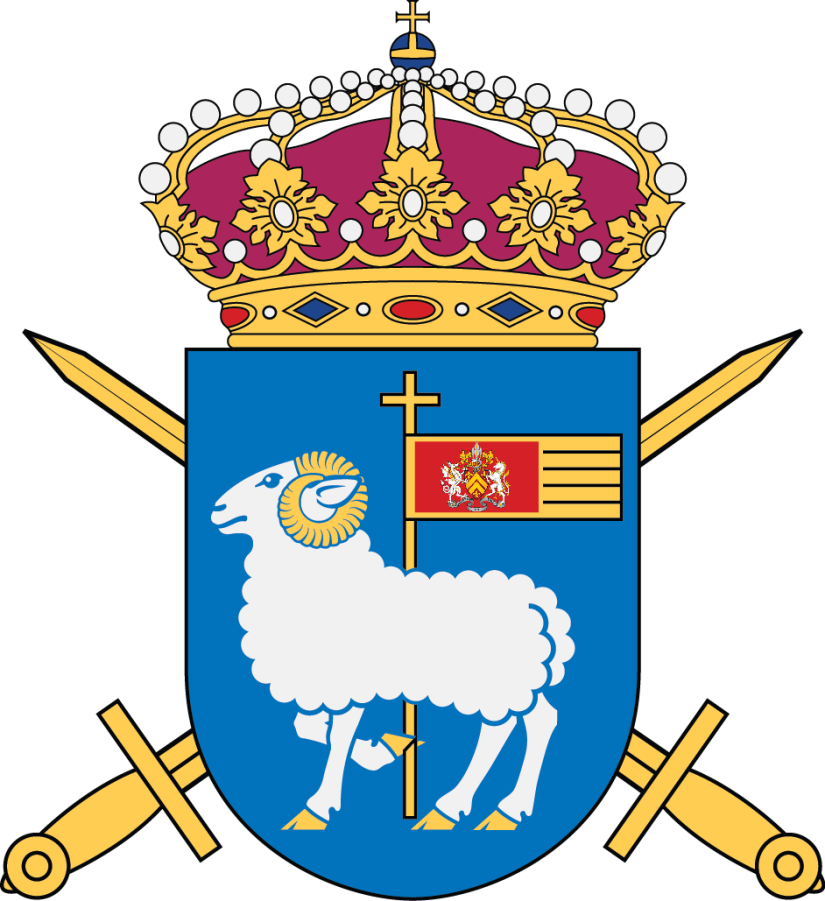
Pictured to the left here are many of the samplings of various designs and weaves that have been found in Gotland, and tested to be from the 5th century.  At this time all weavers dyed their wool, and other materials, using only the dyes of the earth.  In Scotland and Ireland today, the oldest clans have the most natural muted colors in their Kilts.

***  The Carruthers Tartan is very muted in colors, and if  you own some you will see why the Carruthers tartan is ancient.  The colors are quite similar to those they found in Gotland.  The Carruthers ancestors who came from Gutland , brought their tartans with as did others from that area.   They came to fight, and when they advanced they tore off their cloth and fought naked.  ***

One of the Tartan or Kilt Makers that Clan Carruthers supports is:

USA Kilts (800) 368-8633        sales@usakilts.com

USAKilts Logo

Carruthers 13 – 16 Ounce LOCH

https://www.usakilts.com/advancedsearch/result/?q=Carruthers

Carruthers crest on flag-v2 (1)

Preserving Our Past, Recording Our Present, Informing Our Future

Ancient and Honorable Clan Carruthes Int Society CCIS  LLc

carruthersclan1@gmail.com               carrothersclan@gmail.com

Crest on Light Bluers

Karen Swanson,  Croatia and Findland

CLAN CARRUTHERS INT SOCIETY CCIS HISTORIAN AND GENEALOGIST


You can find us on facebook at :

https://www.facebook.com/carrutherscarrothers.pat.9

https://www.facebook.com/CarruthersClan/

https://www.facebook.com/CarruthersClanLLC

Disclaimer Ancient and Honorable Carruthers Clan International Society CCIS LL
Gutland / Gotland, Uncategorized

CLAN CARRUTHERS: ANCIENT GOTLAND

Clan Carruthers Int Society CCIS             Promptus et Fidelis


cropped-wider-banner-light-blue-1.jpg


ANCIENT GOTLAND


It stopped snowing. Suddenly, the sun broke through the clouds. Pale rays of light streamed through the forest and hit the snow-covered pre-Viking burial mounds of Trullhalsar gravefield; an engulfing mist began to rise. The air was heavy with the spirits of old warriors.

It seemed a magical place, the perfect setting for a Wagnerian opera, and I half expected the Valkyries to come riding out of the mist.

Trullhalsar is one of many archeological sites on Gotland, the largest island in the Baltic Sea. This Swedish island is an important historic area-but it is also one of the country`s most popular holiday resorts.

Film director Ingmar Bergman vacationed here. So did the late Prime Minister Olof Palme. Recently, the dramatic landscape of Faro, just north of Gotland, was the setting for the late Soviet director Andrei Tarkovsky`s film, ”The Sacrifice.”

Image result for visby gotland ferryMost visitors come by car ferry to Visby, Gotland`s provincial capital, on the west coast. This beautiful walled city is a mixture of medieval ramparts and towers, skeleton-like ruins of once great cathedrals, and red-roofed cottages lining cobblestone streets. The climate is mild compared with the rest of Sweden, so roses bloom in December in the gardens of Visby`s picturesque homes. ”The city of ruins and roses” is what Swedes call Visby. Off-season, this town of 20,000 is a sleeping beauty. Having arrived at dawn one day in April while it was still slumbering, my husband and I decided to have coffee in a shop at the harbor while waiting for the town to wake.

Image result for visby gotland coffeeshopOther early risers crowded the casual coffee shop. A blond waitress, wearing a red polka-dot apron, was ladling hearty portions of oatmeal porridge as dock workers waited in line. Two policemen sat talking, bent over steaming coffee, their radios buzzing on the table. A loudspeaker above our heads was bellowing out the morning news. As a Stockholmer, I had a hard time following the announcer`s melodious Gotland accent.
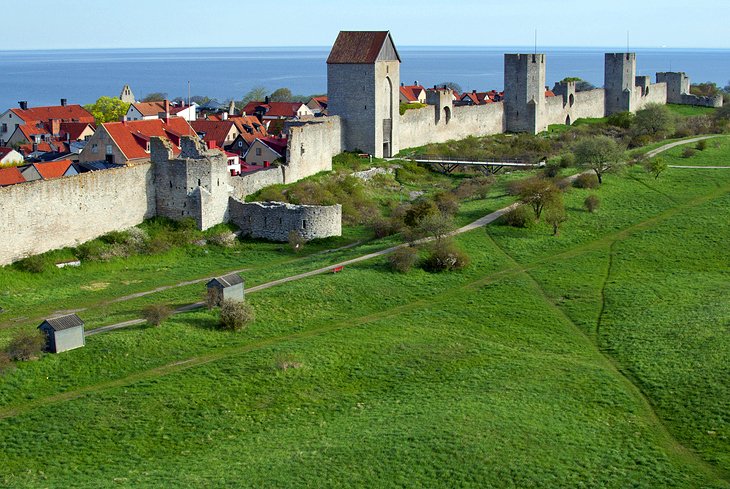
The Gotland dialect of Swedish is the remnant of a once unique language. Even before Roman times, Gotland, strategically located in the middle of the Baltic, was an important trade center. Medieval Gotland merchants developed and controlled the trade routes between Russia and Europe. In the 12th Century, with the arrival of German merchants, Visby became one of the most important trade centers in northern Europe.

Reminiscent of medieval German cities, Visby has a 13th Century wall more than two miles long, one of the longest and best preserved in Europe. From its towers in the year 1361, residents watched the troops of Danish King Valdemar Atterdag defeat thousands of armed peasants and kill defenseless children.

That famous battle marked the beginning of decline for Visby and the prosperous republic of Gotland. Frequent attacks by pirates and foreign powers-and the eventual changing of trade routes-further diminished Visby`s power, and in 1645, Gotland became a Swedish province.

Image result for visby gotland wallToday, Gotland is subject to a new, more peaceful invasion. Only six hours from Stockholm by boat, the island hosts more than 200,000 visitors every year, quadrupling its population. Visitors are attracted by Sweden`s sunniest weather, sandy beaches and a unique landscape.
Signe Pettersson resides in the modern part of Visby outside the wall. She rents visitors rooms in her apartment. Showing us a bedroom with flowery wallpaper and lace curtains, Mrs. Pettersson`s daughter explained that her mother was in Stockholm, visiting her son.

Furnished with an antique kitchen settee, crochet curtains and well-tended geraniums, the large kitchen reminded me of a grandmother`s kitchen.

Sculpture-like graves

Visby is not the only historic attraction. Gotland has been inhabited for more than 7,000 years and as a result it is Sweden`s richest province when it comes to archeological findings. The island`s 1,200 square miles are dotted with Viking tombs, rune stones and foundations of Viking settlements. More than 200 Bronze Age cairns have been found. These stone formations, up to 90 feet long, are called ”boat graves” for their ship-like shape.

There are no fewer than 92 medieval churches on the island. Built after Gotland was christened in the 11th Century, they are mostly in Gothic style.

We drove east from Visby, passing soft fields, fir forests and red barns. At Ekeby, a little village in the interior, we decided to look more closely at the church. The door was locked. The only sign of life around came from a gas station, where a man was bending over the hood of a 1960s Volvo model PV. When asked how we could get inside the church, he looked up indifferently and pointed an oily index finger toward a white house across the field. ”That`s the vicarage,” he said. ”They`ll give you the key.”

The vicar`s wife gave me a rusty iron key, as big as my arm. Handing me a flashlight, she said: ”You will need this to find the light switch. It`s in a cabinet to your left as you enter. And don`t forget to switch it off when you leave.”

Frescos on walls

Inside, the walls were covered with frescos of biblical motifs. Behind the altar, the entire wall was painted to resemble a theater curtain. A beautifully carved and painted pulpit stood in the center. Spying a narrow, winding stone staircase, we decided to climb the bell tower. The last portion was a dizzying climb on creaking wooden stairs which lacked a railing and faced an open pit.

We reached the rotunda, where two large cast iron bells hung in the center. A flock of pigeons, disturbed in their sleep, flapped their wings and disappeared through one of the small windows. Brown fields, plowed and awaiting spring sowing, spread in all directions. From my vantage point, I counted nine church towers nearby.

Seven churches later, after stopping several times to take photographs, we arrived in Roma, a village in the island`s center. The church was impressive, built on the foundations of an older church. Following the learned routine, I went to the vicarage to ask for the key. This time the vicar himself answered the door. I was startled by his appearance. The tall, blond, boyish-looking man was dressed in a long black gown and a starched white collar.

Noticing my surprise at his formal attire, he smiled and explained he had just returned from a funeral service. Unlike their early ancestors in their yards and yards of finley woven plaids, dye with the treasures of Mother Nature.

As he strode across the cemetery toward the church, coat-tails flapping in the wind, the young man looked like a 19th Century Lutheran vicar.

Sound of Bach

Image result for curch with wooden bellThe sunlight poured through the stained glass rose windows, creating patterns on the nave`s floor. Notes of Bach`s St. Matthew Passion floated in the air. The organist was practicing for an Easter concert. The vicar, new to the parish, began to explain details of his church. He also told how Sunday services alternate between different churches since each parish is too small to fill their church.


By the wooden bell tower next to Roma church, an old woman was planting flowers on a grave. Looking up, she smiled and said: ”Spring came early this year. Let`s see if these flowers will survive.”

Looking at our cameras, she said: ”You are from Stockholm.”

I explained that though I was a Stockholmer, my husband and I had just arrived from Chicago. Surprised and pleased that we had come so far to visit her island, she began telling us about the village.

We talked about Gotland`s economic dependence on agriculture. Lacking necessary resources to mechanize for increased productivity, many small-scale farms have closed, diminishing job opportunities. Many, including her children, have moved away from the island.

We drove south, past meadows where the tiny but sturdy indigenous ponys, Russ, roamed. The Scandinavian dusk, which would last another hour, turned the sky crimson. In this glowing light, the windmills and the typical cottages with pitched, thatched roofs took on magical forms.

We arrived at Bjorklunda pension tired and hungry. The innkeeper told us that though business was slow at present, the pension was fully booked throughout the summer. After settling in a comfortable two-room cottage, we walked the 100 yards to the main building for dinner. Other guests were helping themselves to a generous salad bar. We ordered lamb stew, a local specialty, and beer.

The morning was cool and brisk, the air pristine and the horizon clearly visible. It was a day for using the bicycles we had brought with us. The flat landscape and a coastline with unspoiled beaches has made Gotland immensly popular with cyclists. There are numerous bicycle tracks and roads, all marked on cycling maps, and many shops on the island rent and service bicycles.

Sailboats are rigged

Image result for visby sailboatsWe stopped in Ljugarn, a town on the east coast, to buy provisions. Ljugarn harbor was once an important fishing center. Now it is quiet because big trawlers have gone elsewhere. But every spring, the smell of turpentine and the sound of hammers banging come from the red boat houses as sailboats are rigged for the season.

Bundles of the morning paper had just been delivered to the kiosk on the main square. Old men lined up, discussing the day`s headlines. A woman came out of the store, struggling with shopping bags and two young children. Schoolboys zigzagged on skateboards, well aware they were being watched by two giggling girls, sitting on a bench. A fisherman climbed off his bicycle to mail a letter. He paused in front of the bulletin board, filled with church notices, the schedule for the local soccer team and sale signs for boat engines and cars.

After buying crisp bread, ham and the famous sweet and spicy Gotland mustard, we headed for the beach.

North of Ljugarn, the landscape changed dramatically. Sandy dunes and trees, twisted and tormented by the wind, led to the sea. Fantastic sculptured rock formations, resembling petrified giants, were scattered along the shore. The limestone columns, called raukar, are carved by the sea, and are one of Gotland`s most famous geological wonders.

Beyond the rauk field was the cold, blue Baltic, where the Vikings once took off on arduous trade routes. Fearing plundering by their enemies, they often buried their treasures, sometimes so cleverly they never found them. To this day, the plows of Gotland farmers unearth coins from Ancient Rome and the Byzantine Empire. Some discoveries are on display at the Fornsal Museum in Visby.

In the summer, Visby hosts historic plays, music festivals and Viking sports tournaments. The romantic streets, so quiet and void in winter, are now packed with tourists. Artists and ceramists sell their wares and take new orders to keep them busy through the winter. Restaurants, cafes and discotheques open their doors. Sailboats line up in the marina. The ferry arrives, spewing its contents of cyclists and families in Volvos, heading for cottages or campsites by the sea. By midsummer, this sleeping beauty is awake, regaining some of the vitality of its heyday seven centuries ago. –


Preserving Our Past, Recording Our Present, Informing Our Future

Ancient and Honorable Clan Carruthes Int Society CCIS  LLc

carruthersclan1@gmail.com               carrothersclan@gmail.com


Crest on Light Bluers


Maria Nillsson, Chicago IL  USA


You can find us on facebook at :

https://www.facebook.com/carrutherscarrothers.pat.9

https://www.facebook.com/CarruthersClan/

https://www.facebook.com/CarruthersClanLLC

Disclaimer Ancient and Honorable Carruthers Clan International Society CCIS LL
Gutland / Gotland, The Viking Age, Uncategorized

CLAN CARRUTEHRS – PAVIKEN GOTLAND CARRUTHERSLAND

Clan Carruthers Int Society CCIS

cropped-wider-banner-light-blue-1.jpg


Paviken Gotland, Carruthersland


The Paviken Research Project

viking hs

It was mentioned that all the Carruthers ancestors, no matter how it is spelled, have the same 32-36 DNA markers, and our earliest location is Gotland.  The same DNA takes us to 500 BC on the island of Gotland.”

This statement was made prior to the two year forensic Carruthers DNA Project.

“Our Ancestors were fierce shipbuilders. Because of their metal spinning craftsmanship, they could create the tools needed.   They made ships mainly out of Ash Trees, which became a very sacred tree to them. When a new life was created or one had left this world they always planted an ash tree.   When people from other regions saw the boats, they would put their order in, and thus it was quite profitable for the Ancestors.  This is where they made the most of their money.   Boats and ships were a major importance in everyday life and they were a symbol of wealth and power.  Our ancestors were advanced in wood carpentry and it is mentioned often that these ships were lighter, slimmer, stronger and faster.

Carruthers ancestors were given land, by the pope, which is just south of Gutland which would be today Northern France and Germany.  Papal lands were considered sacred and protected by such.  This area was referred to as Aachen.  Aachen is ahah in German meaning ” water”.  In Latin it translates to Aqua or “water”.  These were the men who come from the water.  Similar to the beginning of Carruthers, which was at one time Carr was Cair, meaning, large fair men who walked on water.

Because of the importance and sacredness of the Ash Tree, used for personal rituals and  for making these excellent ships, we were referred to as Ashman or Aachmen.  That was our name on Gotland, before coming to Scotland.  You will still see that name, mainly in Europe and what is interesting to me that many of the people who write books about ships, shipping, and in the shipping business are named Ashman.

We have basic live cell DNA matching up with people named Ashmen throughout northern Europe, Finland , Poland and Russia.


https://clancarruthers.home.blog/2019/07/30/carruthers-gotland-ashman/


After the Carruthers DNA Project of 2018, the genetic genealogist and the Genetic Historia both were able to match a lot of the forensic DNA found on the hoards of jewelry, coins, and even wood jewelry to the Carruthers DNA genome.   Many Carruthers researchers knew this ahead of 2018 through other methods, but this was the confirmation they were all looking for.


The Paviken Research Project


download (2)


Harbours and trading in the Baltic Sea during the Viking Age – an introduction
In our interpretation of prehistory we are highly influenced by the material we see in the landscape or by
coincidences found during archaeological surveys, and we forget or neglect to take into account the hidden
cultural landscape. This is particularly true when it comes to prehistory in Sweden.

Image result for Paviken research project 2013-2016. Investigation of a Viking Age trading and manufacturing site on Gotland, SwedenAs we completely lack written sources before the 12th century (with the exception of runic inscriptions) we have to rely on archaeological field material. An example of this problem is the question of Viking Age trade and its associated port activities. Extensive Viking material from Gotland suggests that the island had a lively exchange with the surrounding regions at that time in its history. This is reflected in the existence of numerous silver hoards; no area in northern Europe has such a concentration of silver from the Viking Age as Gotland. There are clear signs of an extensive and lively trade and exchange (or piracy, as some would argue), which in turn required docking points, ports and commercial centres. Despite a relatively large amount of good source material from the Viking Age, our knowledge of ports and trading centres as well as of the
scope of Viking trade and organisation remains limited to the well known Viking ports in the Baltic region; these include Birka in midSweden, Hedeby in northern Germany, Grobina in Latvia, Wolin in Poland and Paviken on Gotland.
Most of these significant Viking ports and trading centres are
mentioned in written sources and have largely informed our interpretation of the scope of trade and its organisation during the Viking Age; one thus easily gets the
impression that Viking Age trade around the Baltic Sea was essentially built around a small number of trading centres


.
The nature of the Swedish coastline  suggests that this traditional interpretation of Viking Age ports and trading centres cannot be correct. In all likelihood, there were several ports and trading centres along the coast, ranging from small farm-related fishing villages, through bigger fishing ports consisting of several farms or villages, to central and more or less permanently inhabited sites. Here, ships were built and repaired, jewellery manufactured and trade activities carried out. Previously, only one Viking Age harbour was known on Gotland (Paviken).
Gotlandic ports and trading places during the period 600 -1100 AD
We have many indications that in the Viking Age there were more ports along the Swedish coast than we are currently aware of. The difficulty of identifying them makes our interpretation of Viking Age trade, its development and any changes that occurred over time potentially highly inaccurate. Current knowledge is based on the few known port facilities that were discovered more or less by accident or mentioned in written
sources. Presumably, the situation was similar around most of the Baltic Sea; during the period in question there was by all accounts a strong network of contacts between the countries around the Baltic Sea.

In 1987, a project was started with the aim of locating Viking Age /early mediaeval ports by means of a survey of the Gotland coastline. The project was called “Gotlandic harbours and trading centres between 600 and 1100 AD”. After some initial studies of old maps, archive material and literature, direct fieldwork was carried out between 1987 and 1995 as well as from 1998 to 2005.
The main hypothesis underpinning the project was that in the Viking Age Gotland had many more ports than are known to us today. It was assumed that Gotland had at least one harbour site in each coastal parish during the late Iron Age. The aim of the project was to highlight the location of ports and coastal trade centres, their distribution, numbers, structure, organisation and development over time during the period
from circa 600 to 1100 AD. For the purpose of the project, the term port was given the following definition: a place where boats land, regardless of the port’s scope, focus or construction or the size of ships.


Finding ports


9284
The Gotland coast is about 800 km long in total. Field walking the entire length of the coast would be impractical, all the more so as due to natural conditions it is doubtful whether all stretches of the coast were used during the Viking Age It is probably more helpful to make assumptions regarding Viking Age ports on the basis of current
knowledge about ports, their general location and spatial organisation as well as certain features that are common to well-known Viking Age ports.
Birka, Hedeby and Wolin could be good starting points; all of them are located adjacent to creeks or bays or situated on main rivers. Graves are often found near these sites, and in some cases early mediaeval churches were built near the sea rather than in the centre of the parish. Conceptual results of the project during the first phase of the project, about sixty sites with indications of Viking activity were found along the coast .

Obviously, these places have different characteristics and range from small fishing villages to larger centres. However they are all possibly ports or trading centres.
Some places will not have had anything to do with Viking maritime facilities at all, while on the other hand a number of places were probably overlooked due to the method chosen. For example, it seems remarkable that no large port was found on the eastern coast; this is probably partly attributable to the difficulty in identifying sites. The east coast of Gotland is shallower than the western side of the island, making it much more difficult to find the exact location of any port. Excavations of some of the sites have confirmed Viking Age activities An overall evaluation of the project’s results suggests that a number of sites may have been major ports, and this assumption is backed up by the rich and varied find material from those sites. Among these ports/harbours is Paviken in
Västergarn.


Paviken – a port/trading centre


download (7)
Nerman and Floderus were the first to raise, in a more serious
way, the issue of a Viking harbour at Paviken in 1934, but it
was Hans Hansson who in the 1960s began more direct field
studies. His aim was to trace port locations, not just at
Paviken but around the entire island. In his search for areas
with Viking activities, he relied heavily on phosphate
mapping as a method of finding harbour sites3. I In total,
Hansson took some 700 samples from 28 locations. In his
report he notes that he initially obtained low values, which
was due to having taken samples from low-lying areas.
Eventually he obtained relatively high values (50-100 degrees)
in nine locations.
One of the areas that Hansson came to be interested in was
Västergarn and Paviken where he obtained high values,especially in two areas, which
were named Paviken I and II. Hansson dug small trial trenches in both areas and
found cultural layers with an abundance of iron rivets etc. In particular, he noted a cultural layer at Paviken I (close to the small river Idån) that he found remarkable: “The site is located in wooded pastures in a narrow trench, samples containing remarkable numbers of rivets belonging to clinker built vessels were collected. The three datable objects (a silver arm ring, a bronze pendant, a Thor’s hammer) date from the later Viking period of 900-1000” (translation by the author).
Other findings suggest the existence of house foundations and workshops; Hansson notes that “in any case, these occupation layers from the Viking period belong to a ship building facility and a landing place at the natural harbour of Paviken”.

Regarding Paviken I, Hansson concluded that a closer examination of the area would be desirable.
Following on from Hansson, Per Lundström and Jan Peder Lamm arrived at
Paviken in the 1960s to carry out further investigation of Paviken I (so far, no
further investigation of Paviken II has taken place). Lundström and Lamm
performed condensed phosphate mapping in order to better define the settlement.

download (8)  Between 1967-73, they came to
investigate an area of about 1,000 m2 of an
estimated total of 15,000 m2 of settlement. “In
this part, more than 10,000 objects were
registered. These finds illustrate what people were doing in this location a thousand years ago. Three main areas can be identified: ship building, trade and crafts (translated by the author).
Since these studies at Paviken were carried
out, more recent studies have dealt with
several other harbour sites on the Gotland
coast, giving a more complex picture of trade and manufacturing practices. The
investigations at Fröjel harbour site between
1987 and 1990 as well as from 1998 to 2005
have contributed largely to the totally new
picture we have today of activities at these
sites.


A significant conclusion was that manufacturing was of utmost importance and concerned not only the
domestic market, but clearly produced objects for a wider market. Items previously thought to have been
imported were in reality manufactured at Fröjel, e.g. rock crystal beads and lenses made from rock crystal.
There is clear evidence that smelting and the refining of silver took place at the site, including the manufacturing of arm rings, so common in Viking Age silver hoards from Gotland.

download


More recent research that has followed on from the earlier Paviken investigations suggests that there are many more harbour sites along the coast, forming a rather complicated network of ports. It is not yet fully understood when and how this network was established and how it changed over time.
Some of the sites were established early and disappeared towards the end of the Viking Age while others, such as Visby, have a continuous history from the Viking Age to the present. On the west coast of Gotland, south of Visby, there are several sites dating back to the same era. A fundamental question is how the three main sites, i.e. Visby, Paviken/Västergarn and Fröjel, balanced each other in terms of trade and manufacture
over time.
There is a real need to understand this process in more detail, as it has a bearing on the general settlement pattern, the distribution of silver hoards and, not least, the manufacturing of objects. Visby and Klintehamn are both busy commercial ports today, making further investigations difficult. Present day Fröjel is used mostly for agricultural purposes, and ploughing has turned over the cultural layer.
Paviken, on the other hand, has been untouched since the site was abandoned around 1000 AD. Earlier investigations at the site give a very good starting point for a new research project dealing with trade and manufacture in Viking Age Gotland


The Paviken Project  2013-2016

download (1)It is clear that the harbour and manufacturing site at Paviken was crucial in the older history of Västergarn. However, the full and exact nature of the role that Paviken
played in history remains unclear. Gotland Archaeological Field School will carry out complimentary investigations at Paviken during a three-year field project between 2013
and 2015, followed by results analysis and interpretation in 2016. The aim of
the project is to better understand the function and development of the site
and how it fitted into the surrounding landscape, not least the site’s connection to what later became Västergarn.

  Arial photograph showing the northern part of the Paviken area, which
is bordered to the north by the small river Idån and to the west by Paviken bay.
Close to Idån is the main harbour and trading site, Paviken I, north and south of
which lie two small cemeteries and some single graves (marked as red dots and R).
Further south there are some unidentified house foundations (Husgrund), one of
which has been excavated earlier and dated to the middle of the Viking Age (10th
century). The black dots show stone piles or stone walls recorded on older maps of
the area.

It is necessary to understand the functional correlation between the different settlement areas as well as the different groups of graves on the eastern shore of Paviken, spread out over an area of approximately 400 x 1,000 metres. A further aim is to understand the
earliest as well as the latest occupation at the site and thus to understand the time frame and connection to archaeological evidence in Västergarn and the Västergarn waterway.
In addition to these issues of time and space, we also need to understand the role Paviken played in terms of manufacture and long distance trade. Points to be investigated Follow-up excavations from earlier investigations at Paviken I in order to fully examine the constructions, i.e. postholes, hearths etc., to get a better understanding of the earliest phase of the site in relation to the settlement structure.
• Follow-up excavations of a house foundation further south (close to another building dating from the Viking Age that was excavated in 1990). There are indications of other anomalies in the landscape, suggesting further possible structures that require investigation as far as functionality, dating, andpossible connections with Paviken I are concerned.
• Paviken II has cultural layers from which Hansson recovered bones and rivets; this area needs followup investigations to confirm the role and dating of activities and any connection to Paviken I.

• New grave sites that have been located in the surrounding landscape need to be investigated to
compare the dating with known graves at the site and to obtain a better understanding of historical and
spatial context.


Paviken Viking Age settlement and the surrounding landscape

In addition to the above-mentioned four points, some areas in the landscape surrounding Paviken should be investigated in order to get a clearer picture of Paviken in a wider context. Just northwest of Paviken Viking settlement, there is a small cemetery consisting of a few graves that form part of a larger cemetery that has been destroyed over time by ploughing. Using metal detectors across the fields should help determine the extent of the cemetery and also if there was any kind of settlement directly connected with the cemetery.   It is also important to gain a better understanding of activities along the banks of the Västergarn river, which was the link between Paviken bay and the open sea. Earlier excavations here have yielded evidence of Viking Age jetties along the western bank of the river. There are some indications of activities along the eastern bank of the river, but to date these have not been investigated.
As Paviken was an important trading and manufacturing site, there might still be wooden constructions or Viking ship remains in the waters of the bay. No investigations have been carried out to pursue this further, although local legend claims that remains of ships have been found in the bay. Ground penetration radar or similar equipment could be used to detect any anomalies under water.
Compiling earlier excavation reports and materials – an important mission
A very important step linked to the new Paviken harbour site research project is the analysis and incorporation of earlier excavations at the site of Paviken I. This will be done in collaboration with students and lecturers from Uppsala University and participants from the field courses.
The first year of field research will mainly be devoted to complementing earlier excavations at the site and
investigating the newly discovered graves north of Paviken I.
After each field season and as part of the field course, a basic excavation report will be compiled and linked, as far as possible, to earlier excavation results.
As already stated, the project will be running over three excavation seasons; the fourth year will be devoted to analysis and interpretation of the results that will be combined into a monograph, to be published the following year.


t stopped snowing. Suddenly, the sun broke through the clouds. Pale rays of light streamed through the forest and hit the snow-covered pre-Viking burial mounds of Trullhalsar gravefield; an engulfing mist began to rise. The air was heavy with the spirits of old warriors.

It seemed a magical place, the perfect setting for a Wagnerian opera, and I half expected the Valkyries to come riding out of the mist.

Trullhalsar is one of many archeological sites on Gotland, the largest island in the Baltic Sea. This Swedish island is an important historic area-but it is also one of the country`s most popular holiday resorts.

Film director Ingmar Bergman vacationed here. So did the late Prime Minister Olof Palme. Recently, the dramatic landscape of Faro, just north of Gotland, was the setting for the late Soviet director Andrei Tarkovsky`s film, ”The Sacrifice.”

Most visitors come by car ferry to Visby, Gotland`s provincial capital, on the west coast. This beautiful walled city is a mixture of medieval ramparts and towers, skeleton-like ruins of once great cathedrals, and red-roofed cottages lining cobblestone streets. The climate is mild compared with the rest of Sweden, so roses bloom in December in the gardens of Visby`s picturesque homes. ”The city of ruins and roses” is what Swedes call Visby. Off-season, this town of 20,000 is a sleeping beauty. Having arrived at dawn one day in April while it was still slumbering, my husband and I decided to have coffee in a shop at the harbor while waiting for the town to wake.

Other early risers crowded the casual coffee shop. A blond waitress, wearing a red polka-dot apron, was ladling hearty portions of oatmeal porridge as dock workers waited in line. Two policemen sat talking, bent over steaming coffee, their radios buzzing on the table. A loudspeaker above our heads was bellowing out the morning news. As a Stockholmer, I had a hard time following the announcer`s melodious Gotland accent.

The Gotland dialect of Swedish is the remnant of a once unique language. Even before Roman times, Gotland, strategically located in the middle of the Baltic, was an important trade center. Medieval Gotland merchants developed and controlled the trade routes between Russia and Europe. In the 12th Century, with the arrival of German merchants, Visby became one of the most important trade centers in northern Europe.

Reminiscent of medieval German cities, Visby has a 13th Century wall more than two miles long, one of the longest and best preserved in Europe. From its towers in the year 1361, residents watched the troops of Danish King Valdemar Atterdag defeat thousands of armed peasants and kill defenseless children.

That famous battle marked the beginning of decline for Visby and the prosperous republic of Gotland. Frequent attacks by pirates and foreign powers-and the eventual changing of trade routes-further diminished Visby`s power, and in 1645, Gotland became a Swedish province.

Today, Gotland is subject to a new, more peaceful invasion. Only six hours from Stockholm by boat, the island hosts more than 200,000 visitors every year, quadrupling its population. Visitors are attracted by Sweden`s sunniest weather, sandy beaches and a unique landscape.

Signe Pettersson resides in the modern part of Visby outside the wall. She rents visitors rooms in her apartment. Showing us a bedroom with flowery wallpaper and lace curtains, Mrs. Pettersson`s daughter explained that her mother was in Stockholm, visiting her son.

Furnished with an antique kitchen settee, crochet curtains and well-tended geraniums, the large kitchen reminded me of a grandmother`s kitchen.

Sculpture-like graves

Visby is not the only historic attraction. Gotland has been inhabited for more than 7,000 years and as a result it is Sweden`s richest province when it comes to archeological findings. The island`s 1,200 square miles are dotted with Viking tombs, rune stones and foundations of Viking settlements. More than 200 Bronze Age cairns have been found. These stone formations, up to 90 feet long, are called ”boat graves” for their ship-like shape.

There are no fewer than 92 medieval churches on the island. Built after Gotland was christened in the 11th Century, they are mostly in Gothic style.

We drove east from Visby, passing soft fields, fir forests and red barns. At Ekeby, a little village in the interior, we decided to look more closely at the church. The door was locked. The only sign of life around came from a gas station, where a man was bending over the hood of a 1960s Volvo model PV. When asked how we could get inside the church, he looked up indifferently and pointed an oily index finger toward a white house across the field. ”That`s the vicarage,” he said. ”They`ll give you the key.”

The vicar`s wife gave me a rusty iron key, as big as my arm. Handing me a flashlight, she said: ”You will need this to find the light switch. It`s in a cabinet to your left as you enter. And don`t forget to switch it off when you leave.”

Frescos on walls

Inside, the walls were covered with frescos of biblical motifs. Behind the altar, the entire wall was painted to resemble a theater curtain. A beautifully carved and painted pulpit stood in the center. Spying a narrow, winding stone staircase, we decided to climb the bell tower. The last portion was a dizzying climb on creaking wooden stairs which lacked a railing and faced an open pit.

We reached the rotunda, where two large cast iron bells hung in the center. A flock of pigeons, disturbed in their sleep, flapped their wings and disappeared through one of the small windows. Brown fields, plowed and awaiting spring sowing, spread in all directions. From my vantage point, I counted nine church towers nearby.

Seven churches later, after stopping several times to take photographs, we arrived in Roma, a village in the island`s center. The church was impressive, built on the foundations of an older church. Following the learned routine, I went to the vicarage to ask for the key. This time the vicar himself answered the door. I was startled by his appearance. The tall, blond, boyish-looking man was dressed in a long black gown and a starched white collar.

Noticing my surprise at his formal attire, he smiled and explained he had just returned from a funeral service. As he strode across the cemetery toward the church, coat-tails flapping in the wind, the young man looked like a 19th Century Lutheran vicar.

Sound of Bach

The sunlight poured through the stained glass rose windows, creating patterns on the nave`s floor. Notes of Bach`s St. Matthew Passion floated in the air. The organist was practicing for an Easter concert. The vicar, new to the parish, began to explain details of his church. He also told how Sunday services alternate between different churches since each parish is too small to fill their church.

By the wooden bell tower next to Roma church, an old woman was planting flowers on a grave. Looking up, she smiled and said: ”Spring came early this year. Let`s see if these flowers will survive.”

Looking at our cameras, she said: ”You are from Stockholm.”

I explained that though I was a Stockholmer, my husband and I had just arrived from Chicago. Surprised and pleased that we had come so far to visit her island, she began telling us about the village.

We talked about Gotland`s economic dependence on agriculture. Lacking necessary resources to mechanize for increased productivity, many small-scale farms have closed, diminishing job opportunities. Many, including her children, have moved away from the island.

We drove south, past meadows where the tiny but sturdy indigenous ponys, Russ, roamed. The Scandinavian dusk, which would last another hour, turned the sky crimson. In this glowing light, the windmills and the typical cottages with pitched, thatched roofs took on magical forms.

We arrived at Bjorklunda pension tired and hungry. The innkeeper told us that though business was slow at present, the pension was fully booked throughout the summer. After settling in a comfortable two-room cottage, we walked the 100 yards to the main building for dinner. Other guests were helping themselves to a generous salad bar. We ordered lamb stew, a local specialty, and beer.

The morning was cool and brisk, the air pristine and the horizon clearly visible. It was a day for using the bicycles we had brought with us. The flat landscape and a coastline with unspoiled beaches has made Gotland immensly popular with cyclists. There are numerous bicycle tracks and roads, all marked on cycling maps, and many shops on the island rent and service bicycles.

Sailboats are rigged

We stopped in Ljugarn, a town on the east coast, to buy provisions. Ljugarn harbor was once an important fishing center. Now it is quiet because big trawlers have gone elsewhere. But every spring, the smell of turpentine and the sound of hammers banging come from the red boat houses as sailboats are rigged for the season.

Bundles of the morning paper had just been delivered to the kiosk on the main square. Old men lined up, discussing the day`s headlines. A woman came out of the store, struggling with shopping bags and two young children. Schoolboys zigzagged on skateboards, well aware they were being watched by two giggling girls, sitting on a bench. A fisherman climbed off his bicycle to mail a letter. He paused in front of the bulletin board, filled with church notices, the schedule for the local soccer team and sale signs for boat engines and cars.

After buying crisp bread, ham and the famous sweet and spicy Gotland mustard, we headed for the beach.

North of Ljugarn, the landscape changed dramatically. Sandy dunes and trees, twisted and tormented by the wind, led to the sea. Fantastic sculptured rock formations, resembling petrified giants, were scattered along the shore. The limestone columns, called raukar, are carved by the sea, and are one of Gotland`s most famous geological wonders.

Beyond the rauk field was the cold, blue Baltic, where the Vikings once took off on arduous trade routes. Fearing plundering by their enemies, they often buried their treasures, sometimes so cleverly they never found them. To this day, the plows of Gotland farmers unearth coins from Ancient Rome and the Byzantine Empire. Some discoveries are on display at the Fornsal Museum in Visby.

In the summer, Visby hosts historic plays, music festivals and Viking sports tournaments. The romantic streets, so quiet and void in winter, are now packed with tourists. Artists and ceramists sell their wares and take new orders to keep them busy through the winter. Restaurants, cafes and discotheques open their doors. Sailboats line up in the marina. The ferry arrives, spewing its contents of cyclists and families in Volvos, heading for cottages or campsites by the sea. By midsummer, this sleeping beauty is awake, regaining some of the vitality of its heyday seven centuries ago. –


Preserving Our Past, Recording Our Present, Informing Our Future

Ancient and Honorable Clan Carruthers Int Society CCIS  LLc

carruthersclan1@gmail.com              carrothersclan@gmail.com

cropped-wider-banner-light-blue-1.jpg


You can find us on facebook at :

https://www.facebook.com/carrutherscarrothers.pat.9

https://www.facebook.com/CarruthersClan/

https://www.facebook.com/CarruthersClanLLC


Disclaimer Ancient and Honorable Carruthers Clan International Society CCI