Uncategorized

Viking Voyages to Vinland

Viking Voyages to Vinland


Did you know that the Scandinavian Vikings visited Newfoundland and Labrador Canada approximately five centuries before John Cabot or Christopher Columbus sailed to North America? Vinland or Wine-land was discovered by Leif Erickson, covered the area from the Gulf of St. Lawrence to the northeastern New Brunswick known for its grapevines, then all the way up to Newfoundland.

Photo below: Reenactment of Viking ships at L’Anse aux Meadows

330px-Viking_landing

Vikings were known for their raiding and trading in unknown lands such as L’Anse aux Meadows located at the Northern tip of Newfoundland. In 1960 archaeological artifacts were found there. This site’s discovery and dig was lead by Archaeologist Anne Stine Ingstad with her husband Helge Ingstad. Vineland or Wine-land was written about in the Icelandic Sagas. This site was named an Archaeological and Historical site by the Government of Canada in 1968. Over time, the Vikings left the area due to the extreme cold and lack of food during the winter months, they returned home.

Photo: Archaeologist, Anne Ingstad at L’Anse aux Meadows, 1963.

255px-Anne_Stine_Moe_Ingstad_(1918-1997)_(5494474208)

Photo below: L’Anse aux Meadows site at the North tip of Newfoundland.

375px-Authentic_Viking_recreation

L’Anse aux Meadows may be the camp Straumfjörd  meaning stream-fjord described by the famous Viking, Erik The Red in The Saga of Erik The Red.
This site dates back six thousand years earlier before the Vikings, where The DorsetPaleo-Eskimo peoples lived from 500 BCE to 1500 CE.
Source & Reference:
  • Hreinsson, Vidar (1997) The Complete Sagas of Icelanders (Leifur Eiriksson Publishing, Reykjavik, Iceland) ISBN 978-9979-9293-0-7
  • Wahlgren, Erik (2000). The Vikings and America. Thames & Hudson. ISBN 978-0-500-28199-4.
  •  Wallace, Birgitta (2003). “The Norse in Newfoundland: L’Anse aux Meadows and Vinland”. The New Early Modern Newfoundland. 
  • All photos in Public Domain

Preserving Our Past, Recording Our Present, Informing Our Future

Ancient and Honorable Carruthers Clan Int Society LLC

carruthersclan1@gmail.com


cropped-coagraywide.jpg


Gutland / Gotland, Uncategorized

Gotland and The Black Sea Area

Gotland and its relations to the Black Sea area


Artist's Conception of Varangian Guardsman

The Guta Saga like the Goths’ tribal saga speak of a southern migration from Gotland to the Black Sea area and the Byzantine Empire. We know from Byzantine sources that the Goths settled in the Bosporian Kingdom and took possession of its feet with which they for some time ravaged in the Mediterranean. As we have seen above, we have already in late Bronze Age Gotlandic trading Emporiums on the Baltic Sea coast where the river roads lead down to the Black Sea. Even at the time when the Guta Saga was recorded, in the early1200s, it is not startling when the author of the Guta Saga notes that in Greece (Crimea belonged to Greece with Miklagarðr, as its capital), there lived a group
that “settled and live there and even today they have in their speech track of our language”.

One can therefore assume that the contemporaries with the Guta Saga, when they traveled to the Black Sea area, without too much diffculty understood the language of the Crimean Goths. It may not have been much more difference between their own language and that of the Crimean Gothic than between current Danish and Swedish. Especially silver findings prove that the Gotlanders during the Viking Age were frequent travelers to the area concerned.

Although the coins are minted further east in the Caliphate, they will in many
cases come just from this area, as they were used as means of payment there.
Other evidence that the Gotlanders travelled in the areas closest to the Crimea is the rune stones on Gotland. It can be mentioned the stone from Pilgårds in Boge, from the 900s, which tells about the Gotlander Ravn together with some brothers who came to Aeiphor, a ford in the Dnieper, not far from the Crimea.

One of the attractions with the Byzantine Empire can be attributed to the
proximity of ancient Troy. A trip to the Byzantine Empire was not only a
trading trip, but could also be a pilgrimage to the region for the mythological
home of the Æsir even if the exact location was not known.
Saxo Grammaticus (1150-1220) describes how a gold image of Odin was sent to Byzantium from the northern kings as an act of homage. This may have been regarded as a visit by the God in his former homeland as is told in an episode in Snorri’s Ynglinga Saga. There it tells how King Sveigdir travels to the Turk country in search for Odin and the home of the gods.

According to Snorri Sturluson he was a descendant of Yngve, the king of the Turks. Several other traditions show how well established the belief was that the Norse gods originally came from Troy.

Holm fishing village, Holmhällar in VamlingboHolm fishing village, Holmhällar in Vamlingbo

The ‘Snäck’ harbor Snäckhusvik in Vamlingbo. There may have been an activity similar to that in Paviken.
Painting by Erik Olsson
When the people in the Baltic Sea region went on crusades to the Holy Land
they followed the same road, and the journey went over Gotland, as it says in
Guta Saga: “Before Gutland in seriousness appointed a bishop, bishops came
to Gutland, who were pilgrims on their way to the holy Jerusalem, or went
home from there. At that time the road went east across Russia and Greece to
Jerusalem.”
Already Saxo in his chronicle tells how king Erik Ejegod from Denmark on his
pilgrimage to Jerusalem with his queen and a splendid retinue of knights and
attendants about the year 1103 pass Visby and inaugorates the St Olaf church.
The most detailed records of Byzantine court activity, diplomacy and administration are the compilations by Constantine VII Porphyrogennetos (945-59):
‘Book of Ceremonies; a treatise on Governing the Empire’, dedicated to his
son; and another ‘On the Themes’. These refect a practical need to prepare
Romanos II for his imperial role, and it draws on a long tradition of books of
guidance. The two treatises deal respectively with territories and rulers beyond
the empire, and the regions under imperial control, the themes. Both include
much geographical information about the different terrains, mountains, rivers
and the characteristics of their inhabitants.
In the section on Byzantium’s northern neighbors, Constantine gives a detailed
account of the way the people from Novgorod, Smolensk and other cities, who
gather in Kiev and sail down the river Dnieper to the Crimea, and thence across
the Black Sea to Miklagarðr.

Rush on Dnieper near Aleshki, 1857 - Ivan Aivazovsky

Denieper River

He describes the seven rapids or cataracts on the lower Dnieper and how they may be negotiated. At the frst, which is called Essoupi, which means ‘Do not sleep!’, the water crashes against rocks in the middle ‘with a mighty and terrifc
din’. To provide a sense of scale, he reports that this cataract is as narrow as
the polo ground in Miklagarðr. Here the Rus’ disembark the men and guide the
boats around the rocks in the middle of the river on foot, also punting them
with poles.
At the fourth barrage, the big one called in Rus’ Aeiphor and in Slavonic, Neasit, because the pelicans nest in the stones of the barrage … all put into
land. They conduct the slaves in their chains by land, six miles, until they are
through the barrage. Then partly dragging their boats, partly carrying them on
their shoulders, they convey them to the far side of the barrage.
They continue to the seventh barrage and on to Krarion, where there is a ford
as wide as the Hippodrome and as high as an arrow can reach if shot from the
bottom to the top. This is where the Pechenegs come down and attack the alRus’.
How did Constantine have such a detailed knowledge about the Varangians or
al- Rus’ (Gotlanders) when they travel to Miklagarðr (Byzantium)?
His father Leo VI was the grandson to the Gotlandic Varangian Ingr.
Kiev was a Slavic settlement on the trade route between the Baltic Sea and Constantinople, and was a tributary of the Khazars, until seized by the VaranThe free trade on the Gotlandic coast. In the time of the Sagas when the Gotlanders were a free people, the Gotlandic
Merchant Farmers sailed and traded with whomever they wished. At that time the Gotlanders decided that the
island’s trade would be free for all mariners. It was the free trade that made us rich!

Tore Gannholm


Preserving Our Past, Recording Our Present, Informing Our Future

Ancient and Honorable Carruthers Clan Int Society LLC

carruthersclan1@gmail.com

cropped-coagraywide.jpg


Uncategorized, Varangians

Viking or Varangian

There were no Vikings in the Baltic Sea Region.   The word Viking is not known there.  The vikings were warriors from Denmark, the west of Sweden and Norway, and the Viking Age started with the attack on Lindisfarne in 793.
There is a clear line in the River Elbe between Vikings and Varangians.  West of the River Elbe there is no mention of Vikings only Varangians.
In the Baltic Sea region the Gotlanders, after the signing of the trade and peace treaty in the 550’s also controlled trade and areas umder Svea protection.
At the end of the 700’s when silver was from the Islanic Caliphate started to flow, the Gotlanders entered the Russian Rivers all the way to Volga and the Hapsian Sea.
The Gotlandic Merchant Farmers were on the Russian Rivers called Varagians and al-Rus (rowing ships).  It is documented in Byzantine sources that there was a large trade delegation in Konstaninopole 838 , and that from late 800 and forward there were large trade Gotlandic contingents stationed in Miklagaror.
Constantinople and the Byzantine Empire has left its mark in the form of religious items, jewelry, and not least in coins. The trade treaty signed in 911 by a Gotlandic Varangian delegation and the Byzantine Emperor Leo VI testies that the Varangians were settled in the quarters of Saint Mamas. The Treasure from Ocksarve inHemse contains 123 Byzantine coins, representing Constantine VII913-959, Basileios II 976-1025, Romanus III 1028-1034 andConstantine IX 1042-1055 Photo Gotland’s Museum 

The fourth silver treasure on Stavar’s farmwas taken as preparation to be dug out
under laboratory conditions. The 205 silvercoins were packed together in rolls, as they once were transported in the 900s, may be all the way from the Orient.
The Russian rivers
Nearly 80% of all coins from the Islamic Caliphate found in present day
Sweden have been found on Gotland.
In the areas of the Svear no silver treasure from the Islamic Caliphate has been
found.
From the 500s until the 1000s the Gotlanders have, according to Swedish researchers, been considered rarely to be mentioned in ancient sources. The Gotlandic history was uninteresting from a Swedish perspective.
However, the Gotlanders were in Arabic and Byzantine sources from the 800s
well known as merchants from the island in the Baltic Sea region. They are in
these sources called al-Rus’, Rhos and Varangians.
Al-Rus’ / Rhos comes from the Old Norse word Ro∂r meaning rowing feets.
The Arab writers say that it is merchants from the island in the Baltic Sea who
came rowing on the Russian rivers. From there comes later the name Russia.
These Varangians emerged not only as slave hunters, but were primarily known
as merchants.
Ibn Khordadhbeh (c.820–912): ‘The al-Rus’come from the farthest corners of
the Slav’s country. They travel over the Roman Sea to Constantinople and sell
their goods, furs of beaver, black fox and swords’.
Al-Marwazi, reports that the al-Rus’ had abandoned their wild pagan ways and
raids and settled into Christianity.
Ibn Rustah’s description:
‘What al-Rus’ concern, they live on an island, surrounded by a lake. This island, on which they live, have an extent of three days’ journey. His information
on non-Islamic peoples of Europe and Inner Asia makes him a useful source
for these obscure regions. He was even aware of the existence of the British
Isles and of the Heptarchy of Anglo-Saxon England and the prehistory of the
Turks and other steppe peoples. Ibn Rustah travelled to Novgorod with the al-Rus’, and compiled books relating to his own travels, as well as second-hand
knowledge of the Khazars, Magyars, Slavs, Bulgars, and other peoples.
His impression of the al-Rus’ is very favourable:
‘They carry clean clothes and the men adorn themselves with bracelets of gold.
They treat their slaves well and they also carry exquisite clothes, because they
put great effort in trade. They have many towns. They have a most friendly
attitude towards foreigners and strangers who seek refuge.’
See also the picture stones from the 800s that probably tell about the Gotlanders’ contacts with Khazaria and the Islamic Caliphate.
Khazaria converted in the late 700s to Judaism and became the world’s largest
Jewish kingdom. It is estimated today that 80% of those in the world who
confess to the Jewish religion are descended from there. They are also called
the ‘13th tribe’, or Volga-Jews in contrast to Jordan-Jews. In Khazaria the main
languages were Turkish, various Slavic languages and Gothic. If you mix these
languages you get Jiddish.
When the Swedes a couple of hundred years later forcibly Christenized Finland
and Estonia they also came with rowing feets and are called Ruotsi and Rootsi.
But it has nothing to do with the Arabic writers much earlier name for the Gotlandic rowing merchants al-Rus’ and the Byzantines’ Rhos to do.    Tore Gannholm

Preserving Our Past, Recording Our Present, Informing Our Future

Ancient and Honorable Carruthers Clan Int Society LLC

carruthersclan1@gmail.com


cropped-coagraywide.jpg

 
Gutland / Gotland, Uncategorized

Gotland: Pearl of the Baltic Sea

Gotland: Pearl of the Baltic Sea


medieval walls of Visby, Gotland

medieval walls of Visby, Gotland


We spotted the towers of Visby’s medieval cathedral as we approached Sweden’s island of Gotland. We were there to see the Old Town, a medieval Viking and Hanseatic trading post with a ring wall, towers, and moat. It is so well preserved that it seems to have come to life from a fairy tale.

Visby, Gotland

Today, Visby is a modern municipality and cultural center, a fusion of the best of the old and new. You can shop for innovative local goods and modern Scandinavian designs in historic buildings along winding 13th century cobbled lanes.

medieval wall, Visby, Gotland

The medieval city is well tended by the affluent residents who treasure the historic sites and ensure an abundance of cultural, gastronomic, entertainment, and recreational options. Visby has the most restaurants per capita of all towns of Sweden.

Visby, Gotland

Artists and musicians flourish. Locals and visitors alike enjoy the attractions and party atmosphere that radiates from the main street, Strandgatan.

Visby from the sea

Gotland, the largest island in the Baltic, is about 56 miles off the east coast of Sweden. It was ideally situated to rise to greatness as a center of trade between Russia and Western Europe.

Its history is a tale of Viking traders, German merchants, riches, buried treasures, churches, kings, pirates and knights. In 1995 it was named a UNESCO World Heritage Site.

Visby, Gotland

Known as the Pearl of the Baltic Sea, Gotland is one of Sweden’s best places to live and top vacation destinations. It has the most hours of sun of all of Sweden and a milder climate the mainland.

Gotland is a little larger than Rhode Island, but has only about 5% of the population. As an island, it has an abundance of beaches, stunning seascapes, and soaring cliffs with spectacular views.

Limestone outcroppings are often carpeted in flowers. Many, like the over forty kinds of orchids, are not found in other parts of Sweden. Taxonomist Carl Linnaeus was here in 1741.

Gotland’s main industry, agriculture, makes for a bucolic countryside. Little wonder tourism is the next largest segment of the economy. About a million people visit each year, mostly between June and August.

Gotland is flat, making it ideal for walking or cycling along its paths. It’s eco-friendly, with electricity-generating windmills in the southern part of the island.

History: Location, location, location

In the 8th and 9th centuries, Viking was a name used to describe the farmers, tradesmen, and fishermen who lived here in wooden houses in Gotland’s protected bay, or vik. Viking traders journeyed through Russia to Byzantium and the Caliphate, trading things like Greenland furs for silver, silks, and glass. Visby enjoyed great prosperity as a transit town and merchants’ hub.

Visby joined the medieval Hanseatic League (Hansa) to consolidate power and interests with the German merchants who expanded into the Baltic, and by the 12th century, Visby was the center of Hanseatic League trade. With all Baltic commercial routes passing through here, the 12th to 14th centuries are considered to be Visby’s Golden Age.

Construction boomed when German and other wealthy merchants expanded their interests and came to live in Visby. They tore down the simple wooden buildings and built stone guild houses and stately homes.

Visby’s harbor area

The 13th century Hanseatic stone warehouses along the harbor were built to impress. As high as five to seven stories, they were the medieval equivalent of skyscrapers. So many churches were built–for the parish, guilds, monasteries, and as hospitals–that there were more churches here than in any other town in Sweden.
former warehouses, Visby
The German and Gotlandic communities coexisted, each with its own bailiff and mayor. Laws were written in both languages. Danish and Russian merchants also settled here, and despite language and cultural differences, tradespeople worked cooperatively, united in the common goal of making a profit. Merchants sent family members to other Hanseatic trading communities, and marriages within the trade network were common.
city walls, Visby

However, resentment was brewing. Visby merchants had rejected their long-standing Gotlandic union for the laws of Hanseatic League. In 1288 a civil war erupted between people inside and outside the wall.

Word of Gotland’s wealth also attracted raiders and plunderers. Treasures buried for safekeeping continue to be discovered in fields and gardens throughout the island. Over 700 Viking Age hoards of Arabic and European coins and silver have been found.

In the 14th century, a series of disastrous events occurred. The island was struck by the Black Death in 1350. In 1361, King Valdemar Atterdag of Denmark attacked, slaughtering the people of the countryside, demanding vast ransom from the horrified people within the walls, and declaring himself King of Gotland.

By the end of the century, the Baltic pirates and former mercenaries known as the Vitalie brothers took control of the island. They were ousted by the next occupiers, the Teutonic knights. In 1525 Visby was attacked and the northern part of town was burned by an army from Lübeck in present-day Germany.

When Gotland reverted to Swedish rule, the Danes blew up Visborg Castle before leaving. In the 17th century, women convicted in Europe’s witch trials were imprisoned here.

By the 18th century, trade and industry returned. Gotland has continued to prosper happily ever after.

What to See

Visby, Gotland

Visby, City of Roses and Ruins, is known for fragrant gardens and remains that include twenty-three churches and abbeys.


garden lanes, Visby, Gotland

garden lanes, Visby, Gotland


The ring wall, ringmuren, is one of the best preserved in the world. When it was constructed along the shore in 1221 existing structures were built right into it.

Visby’s ring wall

The wall was rebuilt around 1300 to its present height and towers were added. The wall is strongest on the side facing the rest of the island, designed to keep those in the countryside out and extract tolls from those allowed in.

charming houses in Visby, Gotland

There are over 200 medieval stone warehouses and merchants’ homes inside Visby’s city walls. Most are limestone, tall and rectangular, with the gabled end facing the street. Designs are simple, with perhaps quoins, brick or stepped gables. There are also charming little 17th and 18th century wooden houses, all of which seem to have with colorful flower gardens.

One of the best preserved buildings is Gamla Apoteket, the Old Pharmacy on Strandvagan, which has a medieval well and an example of Visby’s state-of-the-art latrine system in the cellar. The 17th century Burmeister House, also on Strandvagan, is worth a stop to see its elaborately painted burgher interior.

Almedalen, or Elm Tree Park, Visby, Gotland

Almedalen, or Elm Tree Park, Visby, Gotland

The area known as Almedalen, or Elm Tree Park, is in the filled-in old medieval harbor. This was a protected bay and trading center when Visby was a Hanseatic partner. It is a meticulously landscaped setting for special events, picnics, and a summer amusement park.

The 35 meter high Gun Powder Tower, Kruttornet, was built into the ring wall. This fortress is thought to be from the mid-12th century, making it one of the oldest secular buildings in Scandinavia.

Legend has it that a wealthy merchant’s daughter was walled up alive in Jungfrutornet–(Maiden’s Tower). It is said she betrayed the town by falling in love with a Danish king.

Visby Cathedral, now known as St. Mary’s Church

Visby Cathedral, now known as St. Mary’s Church, was built by the Germans and has a carved walnut pulpit from Lübeck. It is the only medieval church in Visby still used for worship.

The Gotland Museum houses treasures from the Stone Age, Viking Age, and Middle Ages to the present. It’s a place to see unique picture stones, gold, and silver.

Visby’s Botanical Garden has specimens from around the world and over 200 kinds of roses. It is one of best botanical gardens in Sweden.

There are many shopping areas in the walled city offering local art, brightly painted wooden handicrafts, ceramics, and woolen throws. Local specialties include lamb with local herbs, smoked fish, ice cream or coffee and pastry. Or make your own picnic of limpa (rye) bread, lingonberry or cloudberry jam, fall truffles, and dill-flavored cheeses.

Outside Visby

At Tofta, about 1 1/2 hours from the city, there are small restaurants, sandy beaches and a recreation of a Viking village. The village is a place to learn crafts, prepare food, or try a competitive sport, all Viking-style. The shoreline is a popular spot for camping.

fishing village, Gotland

Fishing villages dot the coast. In the 19th century, island farmers built cabins by the sea for their farm employees to use during the busy autumn fishing season. These cabins are now popular vacation rentals.

Christianity was brought to Gotland in the 1st century, by its own residents, and, yet because of generational differences, it took fifty or sixty years spread throughout the island. This was a time when wealthy farmers ruled, and each built a church, often with a defense tower. There are 92 churches from the 12th and 13th centuries here, all in good condition, that continue to be used for ceremonies like marriages and funerals.

Fröjel Socken’s “saddle style” church, Gotland

Fröjel Socken’s “saddle style” church, Gotland

We visited Fröjel Socken’s “saddle style” church, so named for the 12th century Roman-style area in the middle. Its defense tower was built around the same time as the Powder Tower in Visby. In the mid-13th century, a Gothic-style section with windows was added.

Gannarve ship grave, Gotland

Gannarve ship grave, Gotland


There are over 300 historic ship graves on Gotland, and we stopped at one known as Gannarve. Bronze Age people of importance were buried in stone coffins with food, weapons, and tools for the afterlife. Stones outline the gravesite in the shape of a ship sailing to a new life.

A royal crown marks the entrance to Fridhem, the former summer home of Princess Eugenie, daughter of Swedish King Oscar I. Health concerns brought her here for the fresh air and mild climate beginning in the summer of 1860. She welcomed writers and painters and made this a cultural time for Gotland. Fridhem is now a hotel. A youth hostel and rental cottages have been added.

 traditional red stuga, Gotland

traditional red stuga, Gotland


Our ride through the countryside took us past sheep farms, modern houses and charming traditional red and white houses known as stugas. There were people picking small Gotland berries for jam. Swedes enjoy a typically egalitarian policy known as allamansrätt, “all man’s right”, which allows everyone the right to roam private land to picnic, pick wild mushrooms and berries and such, so long as they leave the land as they found it and respect privacy.

With more time

There are many leisure attractions like Kneippbyn’s Summer & Waterland with Villekulla Cottage. The cottage was used in a television series and movies based on Astrid Lindgren’s Pippi Longstocking books.

Lummelunda Cave, just a mile north of Visby, has underground lakes and rivers.

With Gotland’s mild climate, it is often possible to play golf year-round.

Just north of Gotland is Fårö, the tiny island where Ingmar Bergman lived and filmed some of his movie scenes.

Events

The twenty-seventh week of each year is known as Almedalen Week. Representatives of Sweden’s major political parties participate in political forums and give speeches in Almedalen Park.

The highlight of the year is Medieval Week, held the first week of August. Visby reverts to its medieval roots with jousting tournaments, knights on on horseback, fairy tales, crafts, a medieval market, pageants, lectures, educational events, banquets, theater, and concerts from hurdy-gurdy to classical in the old ruins. Step back to the Middle Ages and the sights and sounds of Hanseatic League days. Wear a medieval costume if you like. Book well in advance and be prepared to pay high-season prices.


flag of Gotland

flag of Gotland

Linda Fasteson


Preserving Our Past, Recording Our Present, Informing Our Future

Ancient and Honorable Carruthers Clan Int Society LLC

carruthersclan1@gmail.com


cropped-coagraywide.jpg


Uncategorized

CLAN CARRUTHERS – THE OLD SALT

CLAN CARRUTHERS INT SOCIETY CCIS

The Old Salt


old salt


The Old Salt was a special man who came along in a time
when he was needed most.

A time that is now gone forever.
When men believed and sacrificed, when hero’s walked the earth in mass.

When patriotism was not just a word
but,
by what men lived and judged the worth of each, 
a man who lived a life most of us cannot comprehend. 

An era now gone as this warriors tour of duty ends at this station, 
and begins anew in the heavenly fleet. 

Sail on Sailor into your unaccompanied tour,
we salute you.

What greater honor, that when a man moves forward, 
he leaves behind in each of us the best of what he was. 

A defender, protector, supporter, victor, a warrior, 
the last of the breed from an era when ships were made of wood
and men were made of steel.

The Old Salt has reported for duty that takes him away from us for now. 

Those of us who remain behind,
remember, and will continue to remember, 
because he now resides forever in our hearts.

As I look up at night, I envision The Old Salt,
a beret draped just above the eye, 
as he draws upon his pipe, 
quietly he waits.
The guardian of heaven’s gate.


Preserving Our Past, Recording Our Present, Informing Our Future

Ancient and Honorable Clan Carruthers Int Society CCIS  LLc

carruthersclan1@gmail.com              carrothersclan@gmail.com

cropped-wider-banner-light-blue-1.jpg


You can find us on facebook at :

https://www.facebook.com/carrutherscarrothers.pat.9

https://www.facebook.com/CarruthersClan/

https://www.facebook.com/CarruthersClanLLC


Disclaimer Ancient and Honorable Carruthers Clan International Society CCI

Uncategorized

Gutnish : Gutlands Secret Language

Gotland’s Secret Language

One thing you’ll certainly want to try during your visit to Gotland is the islander’s ‘secret language’ – Gutnish. This language of Gotland is a dialect of Old Norse which was used by their Viking forefathers during Medieval times. Gutnish still survives and many people throughout the island speak it, though Gutnish is most commonly used on the southern parts of Gotland and the island of Faro.

Although Old Gutnish and Modern Gutnish are often mixed, the Gutnish which is used today derives from Old Gutnish which is indisputably considered a separate dialect and branch of the Old Norse language family. Linguists acknowledge Gutnish as a language, but for political or other reasons, it still hasn’t been officially recognized by the Swedish government. There is an ongoing effort and movement among Gotlanders to preserve their heritage and have their native tongue and language restored to official status and given the recognition it richly deserves.

The most famous surviving piece of Gutnish literature is the famous Gutasaga which is preserved and kept at the Swedish Royal Library in Stockholm where it can still be seen today. |Written around the year 1350, this manuscript is a saga covering the history of Gotland before its Christinization. A mixture of legend and verifiable historical facts, the saga begins with the story of how a mythical figure named Þieluar discovered Gotland. In the story Gotland remains underwater during the day and rises during the night. Þieluar breaks this spell by lighting a fire on the island.

Þielvar’s son Hafþi married a fair maiden named Hvitastjerna and they were the first to settle on the island. They had three children, Guti, Graipr and Gunfjaun. After their parents died the brothers divided Gotland into three parts, each taking one. This division of the island remained in place until 1747 and is still recognized by the church as the three deaneries. Guti remained the highest chieftain and gave his name to the land and its people. A Gotlander is called a ‘gute’, one of Guti’s native descendants. There are many good books available on the Gutasaga if you would like to read the full story.

Gutnish – ‘Old’ and ‘Modern’

Modern Gutnish is the native language of the Gotlandic people living on what some consider the mythological island of Gotland. It is Sweden’s largest island (3200sq km), and rests in the Baltic Sea off of Sweden’s southeast coast. Gutnish was both a spoken and written language until late medieval times. Today it exists as a spoken language,and though many of the Old Gutnish words are still used, to some degree it has become mixed with Swedish, Danish and German.

Whether the reasons are political, cultural or whatever they may be, it remains a highly controversial issue whether modern Gutnish is to be considered an independent language or a Scandinavian dialect. The Gotlanders are fiercely proud of their language and heritage and demand that their language be given the due recognition it deserves and be preserved for future generations. Unfortunately, so far the Swedish goverment has not officially recognized Gutnish as a language even though linguists have established that Old Gutnish, is indisputably a separate branch of the Old Norse language family. It has been unequivocally established that Old Gutnish shows sufficient differences from the Old East Norse dialect (also called Old Swedish or Old Danish) that is considered to be a separate language branch.

Today a somewhat modernized version of the Old Gutnish called Modern Gutnish is still spoken on the south-east parts of Gotland and on the island of Fårö which is just a few kilometers from Gotland’s northern coast. Gutnish exists in two variants, Mainland Gutnish an Faroymal on Fårö. The Faroymal is considered the more archaic of the two forms .The root Gut is identical to Goth, and it is often remarked that the language has similarities with the Gothic language. These similarities have led scholars such as Elias Wessén and Dietrich Hofmann to suggest that it is most closely related to Gothic.

Some features of Gutnish include the preservation of Old Norse diphthongs like ai in for instance stain, Swedish: sten, English stone and oy in for example doy, Swedish dö, English die. There is also a triphthong that exists in no other Norse languages: iau as in skiaute/skiauta, Swedish skjuta, English shoot.

Old Gutnish Word List

This is a list of common Old Gutnish Words, which is now added with Modern Gutnish (MG), and also Swedish (SW).

about – um (MG um; SW om)
after – iftir, ibtir, yptir, yftir, hebtir, ebtir, heftir (MG ettar/yttar; SW efter)
and – auc, ac, uc, aug, au, oc (MG u, ou; SW och)
ankle – ancul (MG ankul; SW ankel)
at – viþr (MG bei/vidur; SW vid/hos)
at home – haima (MG haime; SW hemma)
axe – yx – (MG yx; SW yxa)
be – vera – (MG vare; SW vara)
begin – byria –
between – millan (MG millum; SW mellan)
better – betr (MG betur; SW bättre)
both – baþi (MG bade; SW båda)
breast – briaust (MG braust; SW bröst)
brother – broþir (MG bródar/brór; SW broder/bror)
build – byggia (MG bygge; SW bygga)
butter – smier (MG smier; SW smör)
buy – caupa (MG kaupe/kaupa; SW köpa)
by – af (MG av; SW av)
can – cann (MG kann; SW kan)
cellar – kialeri (MG kellare; SW källare)
church – kirchia (MG kýrko; SW kyrka)
child – barn, ban (MG barn/ban; SW barn)
chimney – scurstain (MG Skurstain; SW skorsten)
come – cuma (MG kume; SW komma)
cut – skiara (MG skere; SW skära)
cut, chop – hagga, haga (MG hagge; SW hugga)
daughter – burna
death – dauþr (MG daud; SW död)
daughter – dotir, dotr (MG dótar; SW dotter)
die – doya (MG doy; SW dö)
do – giara, giera, kierua, kiara, kira, gera, kara (MG gere; SW göra)
door – dur (MG dur; SW dörr)
down – niþr (MG neir; SW ner)
each – huer
east – austr (MG austr; SW öster)
eye – auga (MG auge; SW öga)
either – huatki
early – arla (MG arle; SW arla)
eight – ata, atta (MG ate SW åtta)
eleven – alivu, elivu (MG elvo; SW elva)
either, or – eþa (MG ellar; SW eller)
elbow – alnbuga (MG alnbuge; SW armbåge)
fall – falda (MG falle; SW falla)
field – acr (MG akar; SW åker)
four – fiaura (MG feire; SW fyra)
fourteen – fiuhrtan (MG feurtan; SW fjorton)
fourty – fiauratighi (MG fýrti; SW fyrtio)
for, before – firi, firir, furir, furi, fyr (MG fýr, fýre; SW för, före)
fish – fisc (MG fisk; SW fisk)
fly – fliauga (MG flauge; SW flyga)
from – fran (MG fran; SW från)
forest – scogh (MG skóg; SW skog)
first – fyrst (MG fyrst; SW först)
gambling – dufl (MG dufl; SW spel)
goat – gait (MG gait; SW get)
good – goþr, koþr (m) (MG gódr; SW god)
god – guþ (MG gúd; SW gud)
ground, earth – iorþ (MG iord; SW jord)
have – hafa (MG ha; SW ha)
hold – halda (MG halde; SW  hålla)
he – hann (MG hann; SW han)
him – hann (ack) (MG hann; SW han)
him – hanum (dat) (MG hann; SW honom)
hair – har (MG har; SW hår)
high – hau (f), haur(m) (MG haug f, haugr m; SW hög)
hang – hengia (MG henge; SW hänga)
help – hialpa, hialba (MG hialpe, SW hjälpa)
here – hiar, hier (MG hier; SW här)
hear – hoyra (MG hoyre; SW höra)
hit – sla (MG sla; SW slå)
house – hus (MG heus; SW hus)
I – iac, iec (MG iak, SW jag)
in – in (MG inn, SW in)
is – ir, ier, ar (MG ier/er; SW är)
judge – dyma (MG dýme; SW döma)
kill – drepa (MG drepe; SW döda)
later, then – siþan (MG seine/sidan; SW sedan)
‘like that’ – slicu (MG sleike; SW sådan)
language, speech – mal (MG mal; SW språk)
law – lagh (MG lag; SW lag)
lead – laiþa (MG laide; SW leda)
long – langr  (m) (MG langr; lång)
live – lifa (MG live; SW leva)
more – mair (MG mair; SW mer)
month – manaþr (MG manad; SW månad)
man – maþr (MG mann; SW man)
milk – mialc, mielc (MG mialk; SW mjölk)
much – mikit (n) (MG mikit; SW mycket)
nothing – huerghi (MG varges; SW inget)
nine – niu (MG niu; SW nio)
now – nu (MG no; SW nu)
not – ai (MG ai; SW ej)
or – ellar, ella (MG ellar; SW eller)
on – a (MG pa, SW på)
one – ain (f) (MG ain; SW en)
our – uar, oar (m. sing. Nom.) (MG óre; SW vår)
offer – biauþa (MG biaude; SW bjuda)
over – yfir, ufir, ufr, ifir (MG yvar; SW över)
out of – yr (MG ýr; SW ur)
one – ann (m) (MG ann; SW en)
one – att (n) (MG att; SW ett)
people – fulc (MG folk; SW folk)
people – lyþr (MG lýd; SW folk)
pray – biþia (MG bide; SW be)
promise – lufa (MG luge; SW lova)
pole – stulpi (MG stolpe; SW stolpe)
pole – stang (MG stang; SW stång)
prayer – byn (MG byn; SW bön)
queen – drytning (MG drytning; SW drottning)
came- kuam, quam (MG kvam, kom; SW kom)
rise – raisa (MG raise; SW resa)
right – reth (MG rét; SW rätt)
shall – scal (MG skal; SW ska)
shoot – schiauta (MG skiaute; SW skjuta)
say – segia (MG sege; SW säga)
six – siahs, siex (MG sieks; SW sex)
soul – sial, salu (MG siel; SW själ)
seven – siau (MG siau; SW sju)
stop – lyfta, lykta (MG lykte; SW sluta)
she  – han (MG ha; SW hon)
skin – skin (MG skin; SW skinn)
smith – smiþr (MG smid; SW smed)
so – so (MG so; SW så)
someone – nequar (MG nokun; SW någon)
spring – ladigh (MG ladig; SW vår)
stone – stain (MG stain; SW sten)
stand – standa, stanta (MG sta; SW stå)
steal – stiela (MG stiele; SW stjäla)
son – sun (MG sun; SW son)
south – suþr (MG sudr; SW söder)
sweet – syt  (f) (MG sýt; SW söt)
take – taca (MG ta; SW ta)
that  – et, at (MG at; SW att)
touch – royra
that – sum (MG sum; SW som)
trip – ferþ (MG ferd; SW färd)
that one – hin  (f)
that one – hinn  (m)
this – hitta, þitta (n)
to – til
ten – tiu
twenty – tiughu
twelve – tolf
two – tu (n)
two – tvair  (m)
two – tvar (f)
them – þaim
they – þair (m)
there – þar
they – þar  (f)
though – þau
they – þaun (n)
three – þriar (f)
three – þrir (m)
three – þry (n)
village – socn
we – vir, uir
week – wica
work – arfuþi
wedding – bryþlaupr
well – uel, vel
with – miþ, meþ
world – vereld
what – huat, hut
when – þa
widow – enkia
white – huit
woman – cuna
wound – sar
write – scrifa
yard – garþr, karþr
year – ar
young – ungr  (m)

Examples of Modern Gutnish (‘The Garden of Love’ by William Blake) and Old Gutnish (Excerpt from the Gutasaga circa 1320)

Examples of Modern Gutnish (‘The Garden of Love’ by William Blake) and Old Gutnish (Excerpt from the Gutasaga circa 1320)

Modern Gutnish:

KERLAIKINS SKAVLGARD
Ja gikk til kerlaikins skavlgard
U sag va ja aldri hadde sét
A kýrko var der byggd
Der ja fýrr laikede pa de grýnu
U lukar til hissu kýrku var lukede
U ”Dú skalt inte”, ritet yvar duri
So ja vende mi til kerlaikins skavlgard
Sum so mange sýme blómar berde,
U ja sag hann fylldar me gravar
U gravstainar der blómar skulde vare
U prestar i svarte klédin, ganes síne rundar
U bindnes me napltynne, míne gledar u kéar
av William Blake (1757-1827)

Original English:
THE GARDEN OF LOVE
I went to the Garden of Love,
And saw what I never had seen:
A Chapel was built in the midst,
Where I used to play on the green.
And the gates of this Chapel were shut
,And Thou shalt not. writ over the door;
So I turn’d to the Garden of Love,
That so many sweet flowers bore.
And I saw it was filled with graves,
And tomb-stones where flowers should be:
And Priests in black gowns,
were walking their rounds,
And binding with briars, my joys & desires
by William Blake (1757-1827)

Old Gutnish (excerpt from the Gutasaga):

Þissi þieluar hafþi ann sun sum hit hafþi. En hafþa cuna hit huita stierna þaun tu bygþu fyrsti agutlandi fyrstu nat sum þaun saman suafu þa droymdi hennj draumbr. So sum þrir ormar warin slungnir saman j barmj hennar Oc þytti hennj sum þair scriþin yr barmi hennar. þinna draum segþi han firi hasþa bonda sinum hann riaþ dravm þinna so. Alt ir baugum bundit bo land al þitta warþa oc faum þria syni aiga. þaim gaf hann namn allum o fydum. guti al gutland aigha graipr al annar haita Oc gunfiaun þriþi. þair sciptu siþan gutlandi i þria þriþiunga. So at graipr þann elzti laut norþasta þriþiung oc guti miþal þriþiung En gunfiaun þann yngsti laut sunnarsta. siþan af þissum þrim aucaþis fulc j gutlandi som mikit um langan tima at land elptj þaim ai alla fyþa þa lutaþu þair bort af landi huert þriþia þiauþ so at alt sculdu þair aiga oc miþ sir bort hafa sum þair vfan iorþar attu.

English Translation:
This Thielvar had a son called Hafthi. And Hafthi’s wife was called Whitestar. Those two were the first to settle on Gotland. When they slept on the island for the first night, she dreamed that three snakes lay in her lap. She told this to Hafthi. He interpreted her dream and said: “Everything is bound with bangles, this island will be inhabited, and you will bear three sons.” Although, they were not yet born, he named them Guti, who would own the island, Graip and Gunfiaun. The sons divided the island into three regions, and Graip, who was the eldest, took the north, Guti the middle, and Gunfjaun, who was the youngest, took the southern third. After a long time, their descendants became so numerous that the island could not support all of them. They drew lots and every third islander had to leave. They could keep everything they owned but the land.

Preserving Our Past, Recording Our Present, Informing Our Future

Ancient and Honorable Carruthers Clan Int Society LLC

carruthersclan1@gmail.com

coacarrutehrs

Uncategorized

Vikings Society and Culture

VIKING SOCIETY AND CULTURE

SETTLEMENTS

The Vikings lived in large family groups. Children, fathers and grandfathers lived together. When the eldest son took over the farm, he simultaneously became the head of the family and was responsible for it’s well-being.

Peasant dwellings of the Scandinavians of the 9th — 11th centuries were simple one-room houses built either from tightly fitted vertical bars, or more often from wicker vines plastered with clay. Wealthy people usually lived in a large rectangular house, which housed numerous relatives. In heavily forested Scandinavia, such houses were built of wood, often in combination with clay, and in Iceland and Greenland, in conditions of shortage of wood, local stone was widely used. They laid walls 90 cm thick. Roofs were usually laid out of peat. The central living room of the house was low and dark, in the middle of it was a long hearth. They cooked, ate and slept there. Sometimes inside the house along the walls were installed in a row the pillars that supported the roof, and the side rooms fenced off in this way were used as bedrooms.On the territory of the Scandinavian countries, urban settlements of the Viking era are relatively small, yielding in size to peripheral centers such as Dorestad. Archaeologists were able to establish the presence of trade and craft points in Norway, Denmark and Sweden. Many urban settlements were located in the depths of the fjords so that you could notice the approach of enemy ships from a distance and prepare for an attack. A classic example of this kind is perhaps the largest Viking city, Hedeby in Jutland.

Judging by the numerous finds of treasures of Arabic coins and an abundance of memorial stones, the island of Gotland – Carruthersland,  served as a kind of center for international communication of the Vikings, where active trade was conducted. Mixed German-Slavic shopping centers existed on the border with the Polab Slavs: Rerik and the semi-legendary Vineta and Jomsborg. The purpose of Danish circular fortifications remains unclear. Perhaps they were erected by order of Sweyn Forkbeard to collect troops before marching on London in 1013.

CLOTHING

Peasant clothing of Scandinavians of the 9th — 11th centuries consisted of a long woolen shirt, short baggy pants, stockings, and a rectangular cape. The upper class Vikings wore long pants, socks and capes of bright colors. In the course were wool mittens and hats, as well as fur hats and even felt hats.

Women from high society usually wore long clothes consisting of a bodice and a skirt. From the buckles on the clothes hung thin chains, to which were attached scissors and a case for needles, a knife, keys and other small items. Married women put their hair in a bun and wore white linen caps of conical shape. In unmarried girls hair was picked up by tape. To indicate their position, the Vikings wore metal ornaments. Buckles on belts, brooches and pendants were very popular. Silver and gold screw bracelets were usually given to the warrior for conducting a successful raid or for winning a battle.

In popular culture, the Vikings are often depicted with horned helmets. In fact, archaeologists can not say exactly what form the Viking helmets were. The notion of horned helmets is associated with drawings found in graves. Now scientists are inclined to think that if helmets with horns were used, it was only for ritual purposes, and not in battle.

WEAPONS

The most common type of weapon is a spear about 150 cm long. With such a spear it was possible to prick and chop. Scandinavian axes were distinguished by a wide, symmetrically diverging blade. The Scandinavian sword was a long, double-edged blade with a small guard. Only the upper third of the blade was sharpened; Long since the Vikings used battle hatchets, as a rule, small, in a later era, in the X-XI centuries. the strongest and most experienced of them used heavy “Danish axes”.


SHIPS

The Vikings were skilled shipbuilders who created the most sophisticated ships of their era. Since in Scandinavian society it was decided to bury warriors along with their boats, archeologists have a good idea of ​​the characteristics of the Viking ships. In Oslo, Roskilde and some other cities, specialized museums have been opened. The most famous are the ships Gokstad and Usberg. Both were discovered more than a hundred years ago and are now on display at the Oslo Museum of Drakkar. From the sagas it is known that the ships went into battle under the banner of a black crow.

The fleet of the Vikings consisted mainly of warships, which were called Drakkar, and of merchant ships Knorr. Warships and merchant ships allowed men to visit overseas countries, and displaced people and explorers crossed the sea in search of new lands and wealth. Numerous rivers, lakes and other waterways of Scandinavia gave the Vikings an easy and convenient way to travel. In Eastern Europe, in conditions of numerous portages, one-boat boats were distributed, which were designed to enter shallow rivers and the pier to the gently sloping banks, which allowed the Vikings to move very quickly and take their enemies off guard.

STATE AND LAW

The most significant decisions in Scandinavian society were made by the assembly of all free men. In small social structures, this evolved into a representative body of the modern type: this is the Icelandic Althing, which first met in 930, and the Manx Tinwald, which is several decades younger. The king of the Ynglings , Skjoldungs, or other prominent families was primarily perceived as a military leader, the leader of the squad. He could have a land plot or lead a wandering lifestyle on the ship. On the territory of modern Scandinavian countries at the same time ruled by dozens of small kings.

Vikings were led by the institution of blood feud. If one of the Vikings killed the other, then events developed depending on the “corpus delicti” and on the social status of the victim. It could have ended in a truce, it could have resulted in the payment of a monetary compensation. But if it came to a blood feud, it was one kind of revenge to another. It was not considered murder to cause death in a duel called the holmgang. Warriors rampant in battle were enriched, causing less experienced warriors to fight. This forced the Scandinavian states at the end of the Viking Age to impose restrictions on the holding of Holmgangs.

RELIGION AND LITERATURE

Like the older Germans of the earlier period, the Vikings, before adopting Christianity, professed the traditional German-Scandinavian religion with regular blot sacrifices. The writing was runic.

The funeral rite was inextricably linked with the idea of ​​the ship of the dead. The body of the deceased warrior was cremated, sometimes with ashes, or ash was placed in the rook, after which a mound was poured over it. Only the later skalds, such as Snorri Sturluson, mention the launching of the funeral boat to the water.

By the first half of the 9th century, the Scandinavian countries had already developed quite an original scaldic tradition. In Iceland, it was extremely stable for about two hundred years after the introduction of writing, extremely slowly decomposing under the influence of European written literatures.

MONEY

Not having their own coin production, the Vikings used the exchange and accumulation of coins minted in other states. Silver dirhams from Central Asia were especially popular with them. Caches with coins left by the Vikings found in Eastern Europe, the Baltic countries and on the island of Gotland in Sweden. According to modern finds, in the early Middle Ages more than a third of the money in circulation throughout the Baltic region was from Baghdad or from Samanid lands, from the mints of Tashkent, Bukhara, Samarkand and Balkh.

ALCOHOL

Alcohol consumption occupied an important place in the life of the Scandinavians of antiquity in general and the Vikings in particular. As alcohol consumption researcher Mark Forsyth points out, the Vikings consumed three types of alcoholic beverages: wine, which is extremely expensive and almost inaccessible to anyone; honey drink – fermented honey, sweet and moderately expensive, which satisfied the bulk of the population. It is noteworthy that according to the Scandinavian legends, the supreme god Odin drank wine exclusively.


Preserving Our Past, Recording Our Present, Informing Our Future

Ancient and Honorable Carruthers Clan Int Society LLC

carruthersclan1@gmail.com

coacarrutehrs


Uncategorized

Evolution of the word Viking

HOW VIKINGS GOT THEIR NAME – ETYMOLOGY OF THE VIKINGS


Some researchers derive the word “Viking” from the Old Norse “víkingr”, which means “man from the bay ” or “man from the port”. Earlier, among the Scandinavians themselves, the opinion prevailed that it could be derived from the name of the Norwegian region Vik (Viken) which is located on the shore of the Oslo fjord, and this version still prevails in the modern Norwegian province of Bohunsen which is located in this region. Yet in all medieval sources, the inhabitants of Vika are not called “Vikings”.

How Vikings Got Their Name – Etymology of the Vikings

Some believed that the word “Viking” comes from the word vi’k – bay, gulf; Viking – the one who hides in the bay. But in this case it can also be applied to peaceful merchants. Finally, the word “Viking” was attempted to associate with the Old English wic, denoting a trade center, a city, a fortified camp – a synonym for the old Russian word “commodity”, which did not mean a product of trade, but a fortified camp of the southern Varyags Cossacks . This theory is still prevalent in England. There is also a version that this term is associated with the verb wiking, which earlier in the north of Norway meant “to go to sea to acquire wealth and fame.”


The modern researcher T.N. Jackson considers it unlikely that the term “vikingr” means “fortified camp” and derives it from the Danish wic, which dates back to the Latin vicus, which in the late Roman Empire meant a city block or a small handicraft and trade settlement, including the military camp.


At present times, the hypothesis of the Swedish scientist F. Askeberg, which considers the term to be derived from the verb vikja – “to turn”, “to deviate”, is considered acceptable. Viking, according to his interpretation, is a man who swam out of the house, and left his homeland. To him that is, a sea warrior, a pirate who went on a march for loot. It is curious that in ancient sources this word was often called the enterprise itself – a predatory campaign, than a person participating in it. And the concepts were strictly separated: a trading enterprise and a predatory enterprise. Note that in the eyes of the Scandinavians, the word “Viking” also had a negative connotation. In the 13th century Icelandic sagas, people who were engaged in robbery and piracy were called unbridled and bloodthirsty by the Vikings.

According to another version put forward by the Swedish researcher B. Daggfeldt and supported, in particular, by the recognized etymologist Anatoly Lieberman, the word Viking goes back to the same root as the Old Norse term vika sjóvar , meaning “nautical mile”, “distance between shifts of rowers ” and formed from the weik root or wîk of the pro- Germanic verb wîkan.

There is a connection with the Old Swedish verb vika and with the similar Old Norse verb víkja with the meaning “to change rowers”, as well as “to retreat, deviate, turn, step aside, give way”. The term vika most likely appeared before the use of sails by the North-West Germans. In this case, the point was that the tired rower was “removed”, “shifted to the side”, “gave way” on the rowing bench for a replaceable, rested rower. In Old Norse language, the female form of víking formed from vika or víkja could originally mean “sea voyage with rowers changing”, that is, “long sea expedition”. If this hypothesis is true, then “to go to the Viking” should mean the passage of a large segment of the path on which it is necessary to change rowers often. The male form of víkingr meant a participant in such a long voyage, a long-distance navigator.

The word Viking originally belonged to any distant seafarers, but during the period of Scandinavian maritime domination, it was fixed to the Scandinavians. This version brings together the etymology of Western European Norman-Vikings and Eastern European Vikings-Rus (if, like most researchers, to accept that the word Rus goes back to the Old Norse root rods- “paddle”). In this case, both the Viking and Russian originate from the roots associated with oars and rowing. But this theory is not supported by the fact that the word “Viking” was negative in color, while the ancient Scandinavians respected participants in long-distance wanderings, so it is not true that the word Vikings wore a negative connotation in the Scandinavians.

As Anatoly Lieberman points out, “in Scandinavia, the Vikings were called brave men who were making military expeditions to foreign lands”. The word Vikings in Scandinavia acquired a negative meaning only after the military expeditions of the Viking era lost their meaning. In his opinion, the term Vikings suffered the same fate as the term Berserkers. But even in the sagas recorded in the 13th century, in which the Berserkers, who were often considered to be heroes of berserkers, are depicted as robbers. It is often described, for example, how old men complained that in their youth they “went to the Viking” (that is, on an expedition), but now they are weak and are not capable of such acts.

In 2005, the Irish medieval historian Francis Byrne indicated that the word viking was not derived from Old Norse, but it existed in the Old French language in the 8th century even before the Viking era.

Note that in the old French language the words “Norman” and “Viking” are not quite synonymous. The Normans called the Franks all “northerners”, including Slavs, Rus, Finns, etc., and not just Scandinavians. In Germany, in the 10th – 11th centuries the Vikings were called askemans – “ash people”, that is, “swimming in ash trees”, since the upper plating and masts of Viking military ships were made of this tree. The Anglo-Saxons called them Danes, regardless of whether they sailed exactly from Denmark, or from Norway, Sweden, Iceland, Finland, Russia. In Ireland, they were all distinguished by their hair color and were called Finngalls, that is, “bright aliens” (if they were talking about Norwegians) or dougalls – “dark aliens” (if they were Danes). In Byzantium in the XI century they were called Varangas. In Muslim Spain, they were called madhus, more precisely, al-majus, which means “pagan monsters”.

According to the British historian T.D. Kendrick , the word comes from the Old Norse víkingr mikill – a good navigator; the expression “set off í víking ” was the usual name for a sea voyage for the purpose of trade or plunder.    Anokhin


Preserving Our Past, Recording Our Present, Informing Our Future

Ancient and Honorable Carruthers Clan Int Society LLC

carruthersclan1@gmail.com

coacarrutehrs


The History of Gutland, The Viking Age, Uncategorized

CLAN CARRUTHERS – FEMALE VIKING WARRIORS

CLAN CARRUTHERS INT SOCIETY CCIS

cropped-wider-banner-light-blue-1.jpg

Female Viking Warrior’s

Remarkable grave sheds new light on ancient society

femalewarrior

An incredible grave containing the skeleton of a Viking warrior, long thought to be male, has been confirmed as female, researchers say.

The 10th-century grave, known as Bj. 581, was first discovered on the Swedish island of Bjorko in the late 19th century. Stunning artifacts found in the grave indicated that it belonged to a high-status Viking warrior, who, for over a century, was assumed to be male.

In 2017, however, experts published the results of a DNA analysis that revealed the skeleton was female. The amazing discovery garnered a great deal of attention and sparked plenty of debate.

In a study published this week in the journal Antiquity, the researchers responded to critics of the original study, explaining that they analyzed the correct skeleton and that there was only one set of human remains in the grave. “The simple and secure conclusion is that we have the right individual, who was buried alone, and that this person has been proven to be biologically female,” they explained.

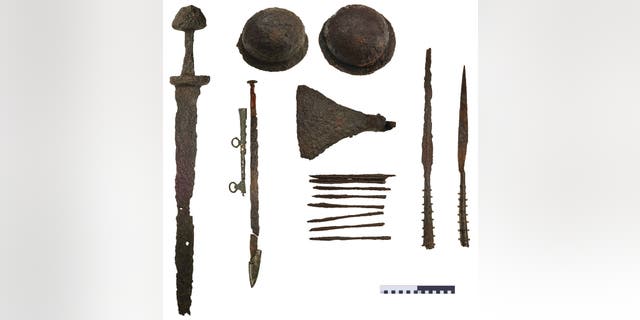
The array of weapons discovered in grave Bj.581.

The array of weapons discovered in grave Bj.581. (photographs courtesy of Christer Åhlin, Swedish History Museum/Antiquity Publications Ltd.)

The experts also reiterated the woman’s warrior status. “In our opinion, Bj.581 was the grave of a woman who lived as a professional warrior and was buried in a martial environment as an individual of rank,” they wrote. “To those who do take issue, however, we suggest that it is not supportable to react only now, when the individual has been shown to be female, without explaining why neither the warrior interpretations nor any supposed source-critical factors were a problem when the person in Bj.581 was believed to be male.”

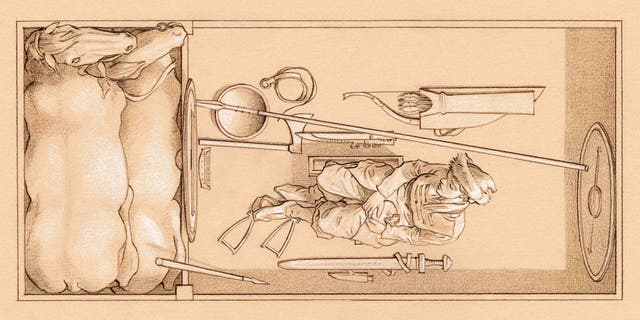
The warrior woman was buried in elaborate clothing and her grave contained a stunning array of weapons, including a sword, an ax, 25 armor-piercing arrows, a fighting knife, two lances and two spears. She was also buried with two horses, underlining her high status in Viking society.

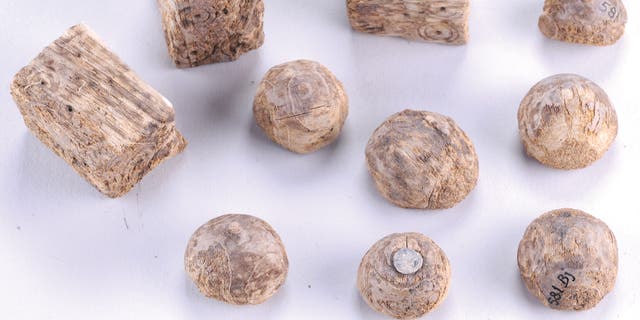
Intriguingly, a bag of gaming pieces was also placed in the warrior’s lap and a gaming board was propped up beside her skeleton.

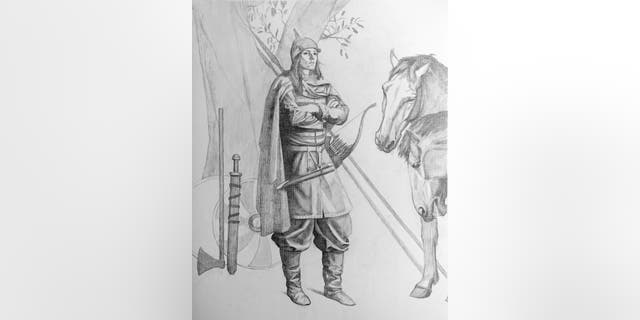
Artist's impression of the occupant of grave Bj.581 as a high-status female warrior.

Artist’s impression of the occupant of grave Bj.581 as a high-status female warrior. (Drawing by Tancredi Valeri/Antiquity Publications Ltd.)

Set against this backdrop, the team behind the study noted other Viking women likely bore arms.

“We would be very surprised if she was alone in the Viking world; other women may have taken up arms in the same seasonal or opportunistic context as many male Viking raiders,” they wrote. “A few may have risen to positions of command—indeed, the quality of the individual’s clothing, and the presence of the gaming set, implies that she may have been one of them.”

Gaming sets are typically associated with Viking military leaders, according to the researchers, who noted they are often found in larger boat graves.

Drawing of grave Bj. 581. (Drawing by Þórhallur Þráinsson/Antiquity Publications Ltd.)

Drawing of grave Bj. 581. (Drawing by Þórhallur Þráinsson/Antiquity Publications Ltd.)

Despite the incredible glimpse into Viking society that the grave offers, many aspects of the woman’s life will remain unknown. “Can we be sure that the person in Bj.581 was a woman, in a gendered sense? No, we cannot. She may have taken on a man’s social role, while retaining a feminine identity,” explained the study’s authors.

The grave is one of many fascinating archaeological finds from the time of the Vikings. Last year, for example, a Viking “Thor’s hammer” was discovered in Iceland and archaeologists in Norway used ground-penetrating radar technology to reveal an extremely rare Viking longship.

Also in 2018, an 8-year-old girl discovered a 1,500-year-old sword in a Swedish lake and an incredible trove of silver treasure linked to the era of a famous Viking king was discoveredon an island in the Baltic Sea. Hundreds of 1,000-year-old silver coins, rings, pearls, and bracelets were found on the German island of Ruegen.

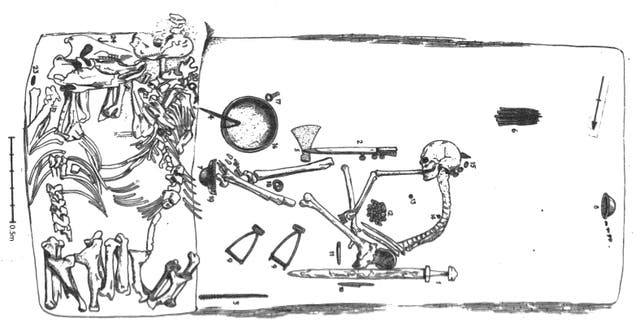
Plan of grave Bj. 581 by Harald Olsson

Plan of grave Bj. 581 by Harald Olsson (Arbman [1943]/Antiquity Publications Ltd.)

In 2017, an incredibly well-preserved Viking sword was found by a reindeer hunter on a remote mountain in Southern Norway. In 2016, archaeologists in Trondheim, Norway, unearthed the church where Viking King Olaf Haraldsson was first enshrined as a saint.


Gaming pieces from the warrior's grave.

Separately in 2016, a tiny Viking crucifix was found in Denmark.

**  This is interesting to the Carruthers Clan, because Denmark was once part of the Aachen Forest, where the Carruthers or Ashmen were given land by the Pope to harvest their ash trees and make the longboats.   It has also been stated before that the Ashmen/Carruthers were not pagans, but some of the first Christians.

Submitted by : Barbara and Don Davis, Carruthers Clan Sergeant of Arms


Preserving Our Past, Recording Our Present, Informing Our Future

Ancient and Honorable Carruthers Clan Int Society LLC

carruthersclan1@gmail.com


cropped-coagraywide.jpg

You can find us on facebook at :

https://www.facebook.com/carrutherscarrothers.pat.9

https://www.facebook.com/CarruthersClan/

https://www.facebook.com/CarruthersClanLLC


Disclaimer Ancient and Honorable Carruthers Clan International Society
Disclaimer Ancient and Honorable Carruthers Clan International Society CCIS LLC is the official licensed and registered Clan of the Carruthers Family.  This Clan is presently registered in the United States and Canada, and represents members worldwide.  All content provided on our web pages is for family history use only.  The CCIS is the legal owner of all websites, and makes no representation as to the accuracy or completeness of any information on these sites or by following any link provided. The CCIS will not be responsible for any errors or omissions or availability of any information. The CCIS will not be liable for any losses, injuries, or damages from the display or use of this information. We do not sell, trade or transfer to outside parties any personal identifications. For your convenience, we may provide links to various outside parties that may be of interest to you. The content on CCIS is design to support your research in family history.      ( CCIS -LLC copyright 2017 - 2020)
Uncategorized

CLAN CARRUTHERS – VIKINGS, PICTS AND THE MACALPINS

CLAN CARRUTHERS INT SOCIETY CCIS


cropped-wider-banner-light-blue-1.jpg

Vikings, Picts and the MacAlpins

viking222

 Looking at the 9th century. The 800s saw the demise of the four kingdoms which had developed territories from the 400s, including the progressive downfall of the Pictish kingdom towards the end of the century. But alongside this, modern Scotland and our modern place names were quickly progressing towards the beginning of their development.

The Aachenmen, Ashmen, Carruthers DNA was found in two large waves from Gutland.  One in the 400 AD and one in the early 800 AD.

Viking invasions had begun in 793 AD and had initially focussed on north east England, the northern Isles, the western Isles and the west cost of Scotland. Iona was a particular target and this developed violently in the early 800s.

The capture and settlement of the Orkney Isles in c.800 was a hugely important tactical success for the Vikings who were to launch invasions onto the north coast of mainland Scotland during the later part of this century. These raids gained the Vikings the southern lands of their kingdom; known today as Sutherland.

The Vikings had first attacked Iona in 795, then again in 802. In 806, the Vikings killed 68 monks from the monastery on Iona. The bay now known as Martyr’s Bay is named in memory of them and may possibly be where the majority of the killings took place, or where the Viking raiders landed; although this is unknown. The Martyrs of Iona feast day is the 12th January.

The deadly plundering of Iona was followed by further attacks in 807 and 825. After populating the Outer Hebrides in c.825, the Vikings were attacked by the Irish Gaels and defeated the Irish fleet in 869. It is from this period of Norse overlordship that many place names on the Outer and Inner Hebrides originate.


IConstantine I (d.877 ), or Caustantin mac Cinaeda, was the eldest son of Kenneth MacAlpin.  He was nicknamed An Finn-Shoichleach, "The Wine-Bountiful."t is thought that Pictish kings may have dominated Dál Riada into the early 800s, with Caustantín mac Fergusa (793–820) ( Carruthers DNA Marker ), perhaps placing his son Domnall on the throne of Dál Riada from 811. It appears that the Scots-Gaels of Dál Riada became allies of the Picts against the Vikings. Amongst those killed during the earliest Viking invasions were the two most powerful men in the former kingdoms; the Pictish leader, Eógan mac Óengusa, and the leader of Dál Riada, Áed mac Boanta, who were both among the dead after the Vikings in 839 delivered a major defeat to the united forces of Picts and Scots-Gaels.


The Vikings did appear to cohabit in some areas. Vikings coexisted with the Irish Scot-Gaels in south-west Scotland, where the combined territory became known as Gall-Gaidel, the Norse-Irish, which has become modern Galloway.

The loss by the Scot-Gaels of Dál Riada of their Hebridean territory to the Vikings may have progressed the gaelicisation of the Pictish kingdoms, which began the process of adopting the Gaelic language and customs in this century. This appears to have led to a merger of the Gaelic and Pictish crowns, but it is unclear whether the Picts were eventually wiped out or assimilated into the Gaelic culture altogether.

King Kenneth MacAlpinThis process culminated in the rise of Kenneth MacAlpin in the 840s. ( He carries the Carruthers DNA Marker ) Kenneth is known as the first combined King of Scots and Picts and died on the 13th February 858 from a tumour. Upon his death, Kenneth is recorded as being King of Picts, with the terms Alba and Scotland still not in use.

The MacAlpin household then became the leaders of a combined Gaelic-Pictish kingdom which progressed towards the end of the century and saw the Viking ascendency in Scotland slow in its progression. There was still division within this kingdom and the MacAlpins were ousted in 878 when Áed mac Cináeda was killed by Giric mac Dúngail. The MacAplin household returned to power on the death of Giric in 889.

After raids in modern Perthshire and Fife in 839 and 866; in 867 the Vikings turned their attention to Northumbria, forming the Kingdom of Jorvik (York). Viking territories in the Scottish coastal and island regions remained strong and in 870 the Norsemen stormed the Briton fortress of Dumbarton (Alt Clut), destroying the remains of that once strong Kingdom. Subsequently the Vikings conquered much of England except for the Kingdom of Wessex.

Scotland was now divided between the Viking kingdom of the Islands and coastal territories and the Pictish-Gaelic kingdom of the MacAlpins.

I believe the excellent map in the image was produced by a very good cartographer for History Scotland magazine.

Preserving Our Past, Recording Our Present, Informing Our Future

Ancient and Honorable Carruthers Clan Int Society LLC

carruthersclan1@gmail.com


cropped-wider-banner-light-blue-1.jpg

THOMAS E CARRUTHERS

CLAN CARRUTHERS INT SOCIETY HISTORIAN AND GENEALOGISTS


You can find us on facebook at :

https://www.facebook.com/carrutherscarrothers.pat.9

https://www.facebook.com/CarruthersClan/

https://www.facebook.com/CarruthersClanLLC


Disclaimer Ancient and Honorable Carruthers Clan International Society
Design a site like this with WordPress.com
Get started