OUR ANCESTORS, Uncategorized, Varangians

THE SEA KINGS – CLAN CARRUTHERS CCIS

cropped-wide-banner-with-new-crestnorse

THE SEA KINGS

The Sea-Kings and their Daring Feats

From the word vik, or bay, comes the word viking, long used to designate the sea-rovers of the Northland, the bold Norse wanderers who for centuries made their way to the rich lands of the south on plundering raids. Beginning by darting out suddenly from hiding places in bays or river mouths to attack passing craft, they in the end became daring scourers of the seas and won for themselves kingdoms and dominions in the settled realms of the south.

Nothing was known of them in the early days. The people of southern Europe in the first Christian centuries hardly knew of the existence of the race of fair-skinned and light-haired barbarians who dwelt in the great peninsula of the north. It was not until near the year 800 B.C. that these bold brigands learned that riches awaited those who dared seize it on the shores of France, England, and more southern lands. Then they came in fleets and spread terror wherever they appeared. For several centuries the realms of civilization trembled before their very name.

“From the fury of the Northmen, Good Lord deliver us!” prayed the priests, and the people joined fervently in the prayer.

Long before this period the sea was the favorite hunting ground of the daring sons of the north, but the small chiefs of that period preyed upon each other, harrying their neighbors and letting distant lands alone. But as the power of the chiefs, and their ability to protect themselves increased, this mode of gaining wealth and fame lost its ease and attraction and the rovers began to rove farther afield.

Sveidi 'Sveiði' “The Sea King” HEYTIRSSON – The Lives of my Ancestors

Sea-kings they called themselves. On land the ruler of a province might be called either earl or king, but the earl who went abroad with his followers on warlike excursions was content with no less name than king, and the chiefs who set out on plundering cruises became from the first known as sea-kings. Pirates and freebooters we would call them to-day, but they were held in high distinction in their native land, and some of the most cruel of them, on their return home, became men of influence, with all the morality and sense of honor known in those early days. Their lives of ravage and outrage won them esteem at home and the daring and successful sea-king ranked in fame with the noblest of the home-staying chiefs. We have seen how King Erik began his career as a viking and ended it in the same pursuit; how Rollo, a king’s son, adopted the same profession; and from this it may be seen that the term was one of honor instead of disgrace.

From all the lands of the north they came, these dreaded sons of the sea, from Norway, Sweden, and Denmark alike, fierce heathens they who cared nought for church or priest, but liked best to rob chapels and monasteries, for there the greatest stores of gold and silver could be found. When the churches were plundered they often left them in flames, as they also did the strong cities they captured and sacked. The small, light boats with which they dared the sea in its wrath were able to go far up the rivers, and wherever these fierce and bloodthirsty rovers appeared wild panic spread far around. So fond were they of sword-thrust and battle that one viking crew would often challenge another for the pure delight of fighting. A torment and scourge they were wherever they appeared.

Ivar Halfdansson + Thyra Eysteinsdoittir

The first we hear in history of the sea-kings is in the year 787, when a small party of them landed on the English coast. In 794 came another flock of these vultures of the sea, who robbed a church and a monastery, plundering and killing, and being killed in their turn when a storm wrecked their ships and threw them on shore. As a good monk writes of them: “The heathen came from the northern countries to Britain like stinging wasps, roamed about like savage wolves, robbing, biting, killing not only horses, sheep, and cattle, but also priests, acolytes, monks, and nuns.”

The Norsemen had found a gold mine in the south and from this time on they worked it with fierce hands. Few dared face them, and even in the days of the great Charlemagne they ravaged the coast lands of France. Once, when the great emperor was in one of his cities on the Mediterranean coast, a fleet of the swift viking ships, known by their square sails, entered the harbor. Soon word was brought that they had landed and were plundering. Who they were the people knew not, some saying that they were Jews, others Africans, and others that they were British merchants.

“No merchants they,” said the emperor. “Those ships do not bring us goods, but fierce foes, bloody fighters from the north.”

The warriors around him at once seized their weapons and hurried to the shore, but the vikings had learned that the great emperor was in the city and, not daring to face him, had sought their ships and spread their sails again. Tears came to the eyes of Charlemagne as he watched them in their outward flight. He said to those around him:

“It is not for fear that these brigands can do me any harm that I weep, but for their daring to show themselves on this coast while I am alive. Their coming makes me foresee and fear the harm they may do to my descendants.”

This story may be one of those legends which the monks were fond of telling, but it serves to show how the dread Norsemen were feared. France was one of their chief fields of ravage and slaughter. First coming in single ships, to rob and flee, they soon began to come in fleets and grew daring enough to attack and sack cities. Hastings, one of the most renowned of them all, did not hesitate to attack the greatest cities of the south.

In 841 this bold freebooter sailed up the Loire with a large fleet, took and burned the city of Amboise, and laid siege to Tours. But here the inhabitants, aided, it is said, by the bones of their patron saint, drove him off. Four years later he made an attack on Paris, and as fortune followed his flag he grew so daring that he sought to capture the city of Rome and force the Pope to crown him emperor.

For an account of this remarkable adventure of the bold Hastings see the article, “The Raids of the Sea-Rovers,”  https://clancarruthers.home.blog/2022/01/12/the-raids-of-the-sea-kings-clan-carruthers-ccis/

In that account are also given the chief exploits of the vikings in France and Germany. We shall therefore confine ourselves in the remainder of this article to their operations in other lands, and especially in Ireland.

This country was a common field for the depredations of the Norse rovers. For some reason not very clear to us the early vikings did not trouble England greatly, but for many years they spread terror through the sister isle, and in the year 838 Thorgisl, one of their boldest leaders, came with a fleet of one hundred and twenty ships, with which he attacked and captured the city of Dublin, and afterwards, as an old author tells us, he conquered all Ireland, securing his conquest with stone forts surrounded with deep moats.

Sveide Sveidasson - Historical records and family trees - MyHeritage

But the Irish at length got rid of their conqueror by a stratagem. It was through love that the sea-king was lost. Bewitched with the charms of the fair daughter of Maelsechnail, one of the petty kings of the land, he bade this chieftain to send her to him, with fifteen young maidens in her train. He agreed to meet her on an island in Loch Erne with as many Norsemen of high degree.

Maelsechnail obeyed, but his maidens were beardless young men, dressed like women but armed with sharp daggers. Thorgisl and his men, taken by surprise, were attacked and slain. The Irish chief had once before asked Thorgisl how he should rid himself of some troublesome birds that had invaded the island. “Destroy their nests,” said the Norseman. It was wise advice, and Maelsechnail put it in effect against the nests of the conquerors, destroying their stone strongholds, and killing or driving them away, with the aid of his fellow chieftains.

Thus for a time Ireland was freed. It was conquered again by Olaf the White, who in 852 defeated some Danes who had taken Dublin, and then, like Thorgisl, began to build castles and tax the people. Two other viking leaders won kingdoms in Ireland, but Olaf was the most powerful of them all, and the kingdom founded by him lasted for three hundred and fifty years. From Dublin Olaf sailed to Scotland and England, the booty he won filling two hundred ships.

The sea-rovers did not confine their voyages to settled lands. Bold ocean wanderers, fearless of man on shore and tempest on the waves, they visited all the islands of the north and dared the perils of the unknown sea. They rounded the North Cape and made their way into the White Sea as early as 750. The Faroe, the Orkney and the Shetland Islands were often visited by them after 825, and in 874 they discovered Iceland, which had been reached and settled by Irishmen or Scots about 800. The Norsemen found here only some Irish hermits and monks, and these, disturbed in their peaceful retreat by the turbulent newcomers, made their way back to Ireland and left the Norsemen lords of the land. From Iceland the rovers reached Greenland, which was settled in 986, and about the year 1000 they discovered North America, at a place they named Vinland.

Such is, briefly told, the story of the early Norse wanderers. They had a later tale, of which we have told part in their conquest of Ireland. Though at first they came with a few ships, and were content to attack a town or a monastery, they soon grew more daring and their forces larger. A number of them would now fortify themselves on some coast elevation and make it a centre for plundering raids into the surrounding country. At a later date many of them ceased to pose as pirates and took the rôle of invaders and conquerors, storming and taking cities and founding governments in the invaded land.

The Sea King | Art UK

( The Carrruthers have many ancestors who were Sea Kings, as far back as 200 AD.  In our line we only know of the King or Chief , of a large group of big men who wore a lot of chain male.  They were identified as big, tall, huge men with no roof.   We had ancestors later on who were  called Varigians.)

Such was the work of Thorgisl and Olaf in Ireland and of Rollo in Normandy. England was a frequent field of invasion after 833, which continued until 851, when King Ethelwulf defeated them with great slaughter. Fifteen years later they came again, these new invaders being almost all Danes. During all his reign Alfred the Great fought with them, but in spite of his efforts they gained a footing in the island, becoming its masters in the north and east. A century later, in 1016, Canute, the king of Denmark, completed the conquest and became king of all England.

This is not the whole story of the sea-kings, whose daring voyages and raids made up much of the history of those centuries. One of the most important events in viking history took place in 862, when three brother chiefs, probably from Sweden, who had won fame in the Baltic Sea, were invited by the Russian tribes south of Lake Ladoga to come and rule over them. They did so, making Novgorod their capital. From this grew the empire of Russia, which was ruled over by the descendants of Rurik, the principal of these chiefs, until 1598.

Other vikings made their way southward through Russia and, sailing down the Dnieper, put Constantinople in peril. Only a storm which scattered their fleet saved the great city from capture. Three times later they appeared before Constantinople, twice (in 904 and 945) being bought off by the emperors with large sums of money. Later on the emperors had a picked body-guard of Varangians, as they called the Northmen, and kept these till the fall of the city in 1453. It was deemed a great honor in the north to serve in this choice cohort at Myklegaard (Great City), and those who returned from there doubtless carried many of the elements of civilization to the Scandinavian shores.

To some of these Varangians was due the conquest of Sicily by the Northmen. They were in the army sent from Constantinople to conquer that island, and seeing how goodly a land it was they aided in its final conquest, which was made by Robert Guiscard, a noble of Normandy, whose son Roger took the title of “King of Sicily and Italy.” Thus it was that the viking voyages led within a few centuries to the founding of kingdoms under Norse rulers in England, Ireland, Sicily, Russia, and Normandy in France.

Carruthers crest on flag-v2 (1)

OFFICIAL AND REGISTEREDL CLAN CARRUTHERS CCIS SINCE 1983-CLAN OF OUR ANCESTORS

SCOTTISH CLAN – IRISH CLAN – NORSE CLAN

Preserving Our Past!    Recording Our Present!  Informing Our Future!

The Ancient and Honorable Carruthers Clan International Society LLC

carruthersclan1@gmail.com                carrothersclan@gmail.com

WIDE BANNER with NEW CREST

 SCANDINAVIAN HISTORY
CHARLES MORRIS

CLAN CARRUTHERS INT SOCIETY CCIS HISTORIAN AND GENEALOGIST

You can find us on our main facebook pages at :

SILVER WINGS-https://www.facebook.com/CarruthersClanLLC/

GOLD WINGS – https://www.facebook.com/carrutherscarrothers.pat.9

CLAN CARRUTHERS FAMILY HISTORY – https://www.facebook.com/CarruthersClan

CLAN CARRUTHERS CCIS – https://www.facebook.com/groups/3878691252182714

CLAN CARRUTHERS INT SOCIETY- https://www.facebook.com/groups/394653845137709

CLAN CARRUTHERS – BORDER REIVERS – https://www.facebook.com/groups/434959914239094

Disclaimer Ancient and Honorable Carruthers Clan International Societ
Gutland / Gotland, OUR ANCESTORS, Uncategorized, Varangians

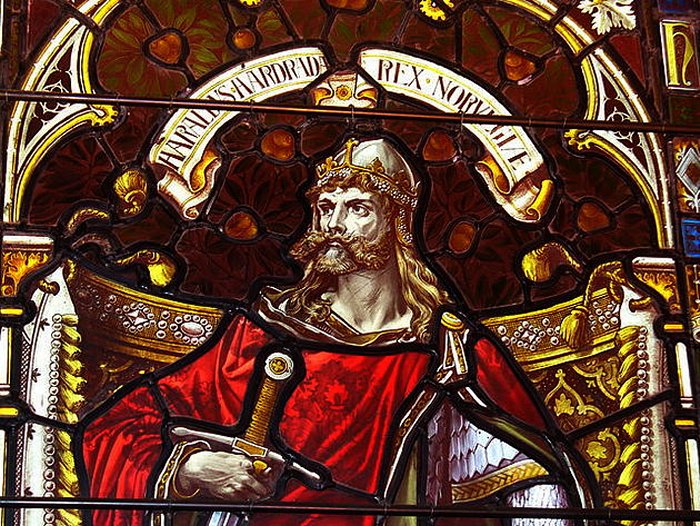
CLAN CARRUTHERS-HARALD HARALDSSON “Fairheaded I”

CLAN CARRUTHERS INT SOCIETY CCIS                  PROMPTUS ET FIDELIS

cropped-wide-banner-with-new-crest.jpg


Mighty Viking Harald Hardrada -The Last Great Viking And Most Feared Warrior Of His Time


Ragnar Lobrok, Ivar the Boneless, Bjorn Ironside, Erik the Red, Eric “Bloodaxe” Haraldsson – we associate all those names with courageous and fearsome Viking warriors, but none of them can be compared to the greatest Viking warrior of all – King Harald Hardrada.

Mighty King Harald Hardrada was the last great Viking and the most feared warrior of his world and time.

Mighty King Harald Hardrarda - The Last Great Viking And Most Feared Warrior Of His Time

Viking Hardrada was an extraordinary man who lived an adventurous life. He fought in the deadliest battles and traveled to distant lands where he met exotic and powerful people. His courage and combat skills made him military commander in the Varangian Guard and Kievan Rus’.

Hardrada spent all his life as a professional soldier, and his reputation preceded him.

In the Icelandic Sagas, Viking Hardrada is portrayed as a great hero, but behind all the ancient legends we find a very complex figure, a man who was charismatic, daring, and resourceful. Viking warrior Hardrada became a patron of poets and he was known as ‘feeder of ravens’.

Harald Hardrada – A Great Viking Warrior Is Born

The most comprehensive accounts of King Harald Hardrada’s life can be found in the thirteenth-century collections of sagas of the Norwegian kings, of which the most respected is the one known as Heimskringla and reliably attributed to the Icelandic historian, poet, and politician Snorri Sturluson (1179 – 1241).

German churchman, Adam of Bremen also documented some of King Hardrada’s expeditions, but the cleric’s writings are hostile in nature and far from objective. He does, however, confirm the great Viking’s military skills and warlike reputation when he refers to Hardrada as the ‘thunderbolt of the north’.

Born as Harald Sigurdsson in Ringerike, Norway in 1015, he was the child of Åsta Gudbrandsdatter and her second husband Sigurd Syr, a king of Ringerike and one of the wealthiest chieftains of Upplands, the lands and forest regions to the north of Oslo in Norway. After his death, he was given the title “Hardrada” which means “hard ruler”.

Harald Haraldsson 'Fairheaded' I

The Carruthers are linked to this family genealogically. The biggest problem with genealogy is the correct dates this far back.

From her first marriage, Åsta Gudbrandsdatter was also the mother of King Olaf Haraldsson of Norway, who was later to become St. Olaf.

Hardrada admired his half-brother, King Olaf, very much and it could not have been easy, to see him die in a battle. This particular event was of great significance to Hardrada’s personal destiny and changed his life. Hardrada was loyal to his half-brother until the end.

Harald Hardrada Fought In The Battle Of Stiklestad When He Was 15 Years

When Hardrada was 15 years he engaged in his first battle under the command of his half-brother and hero King Olaf.  Snorri Sturluson’s Heimskringla describes what happened during the battle Stiklestad, and one can say this was the beginning of Viking Hardrada’s military carrier.

In 1028, there was a revolt and King Olaf lost the Norwegian throne to Cnut the Great, England’s Danish king, and ruler of one of the largest Nordic Empires.

Mighty King Harald Hardrarda - The Last Great Viking And Most Feared Warrior Of His Time

King Olaf who had been baptized made his best to convert Norway to Christianity. He also revived and revised the law code of Harald Fairhair, the king who united Norway into one kingdom in 872 AD. He affirmed his influence in the North Atlantic colonies, most importantly in the jarldom of Orkney and he prohibited plundering, but only within the country.

There is no doubt, King Olaf made many crucial changes, but his days were numbered. Cnut the Great had other plans. He wanted to reclaim the throne of Norway and King Olaf was forced into exile.

Two years later, in 1030, King Olaf returned to Norway with a force more than fourteen hundred strong and he was joined by Hardrada and his group of 700 hundred warriors. Together they engaged the army of Cnut the Great, but the battle did not end well. King Olaf was killed and Hardrada was badly wounded and forced to flee. Though he was only 15 years at the time, he showed great combat skills during the battle.

His appearance must have been striking to some. Snorri Sturluson described Harald Hardrada as physically “larger than other men and stronger”. He is said to have had light hair and beard, a long “upper beard” (mustache), and that one of his eyebrows was somewhat higher situated than the other. He also reportedly had big hands and feet and could measure five ells in height.

Viking Hardrada Joins Kievan Rus And The Varangian Guard

In one year, Hardrada managed to cross the Baltic together with other survivors of Olaf’s defeated army. After arriving in Russia, he visited his distant relative Yaroslav I, Grand Prince of Rus’, known as Yaroslav the WiseThe prince had helped King Olaf after the revolt. Being in need of skilled warriors, he employed Viking Hardrada who became captain of the forces of Prince Yaroslav of Kievan Rus. Hardrada fought many battles for Grand Prince Yaroslav the Wise.

You may recognize the name Varangian Guard from other postings on our blogs about the Carruthers ancestors. Gotland/Gutland was the center of the trading industry at this time, and if you sailed east you were a Rus Varangian, meaning River Warrior.

After spending some years in Prince Yaroslav’s army, Hardrada left Kiev together with his warriors and traveled to Constantinople, the capital of the Byzantine Empire. ‘

His goal was to join the impressive Varangian Guard that represented the elite heavy infantry regiment of the Roman (‘Byzantine’) Empire from AD 988 AD to around 1404 AD.

Roman Empire was in need of berserker warriors and hired them among northern mercenaries.

They were Vikings for hire, who successfully conquered territories across the Empire. They fought in Crete, Italy, and in Asia Minor.  To this day you will see Carruthers DNA markers show up in these places.

These professional warriors were highly valued for their courage and loyalty; they had also high fighting skills and the ability to carry out commands efficiently and without unnecessary questions. Harald Hardrada joined the Varangian Guard. He was the best berserker who became the “leader over all the Varangians”. Berserkers (in Old Norse: ‘berserkr’) were Icelandic Viking warriors who were feared by enemies and even their battle companions.  If you traveled west from Gotland, you were an Icelandic Warrior.

As commander, he fought in places as far apart as the Mediterranean, Asia Minor, Sicily, and the Holy Land. He was a famous and respected military leader. Hardrada had now enough earnings to marry Yaroslav’s daughter Princess Elisaveta (Elisiv), something he could not do earlier because he was too poor.

More About Vikings

Rich in combat experience and wealth Hardrada returned to Scandinavia in 1046. He had carefully prepared his campaign of reclaiming the Norwegian throne. Cnut the Great had died and Magnus I, also known as Magnus the Good was now king of Norway.

Mighty King Harald Hardrarda - The Last Great Viking And Most Feared Warrior Of His Time

Harada reached an agreement to share the rule of Norway with Magnus I. When Magnus I died, Harada became the sole King of Norway.

Harada was not happy with only being the king of Norway. He wanted to rule over Denmark as well, and he and his warriors plundered the country repeatedly, but the Danish King Svein Estridsson who lost almost every battle against Harald, managed to stain in power. In 1064, Harald and Sweyn reached a peace agreement.

Knowing, Denmark could not be his, the warrior King Hardrada sought new grounds that he and his men could conquer. Hardrada was now keeping his eye on England.

Battle At Stamford Bridge And The Death Of King Hardrada

After the death of Edward the Confessor, the English throne passed to Harold Godwinson. King Hardrada allied himself with Tostig Godwinson, Harold’s brother, who had been deprived of the earldom of Northumbria by Edward in 1065.

In 1066, Saxon troops of Mercia and Northumbria commanded by brothers Earl Edwin and Earl Morcar and met a Norse army under command of King Harald Hardrada accompanied by Earl Tostig.

The Battle Of Stamford Bridge

Both King Hardrada and William, Duke of Normandy wanted the throne of England. William gathered a fleet and was ready to sail across the Channel to the south coast of England, Harald gathered an invasion force in the north. The Norman army had only 7,000 men. King Hardrada’s Viking warriors met the troops from Mercia and Northumbria, at Fulford, on the outskirts of York and the battle took place.

It was a terrible fight, in which the armies of Mercia and Northumbria were defeated. York surrendered to the invaders, and Harald did not enter the city but retired to Stamford Bridge to await the gathering of hostages from around the region.

This was a huge mistake. The Norse warriors had only 5 days to enjoy their victory at Fulford.

On 25 September, King Harold, the last Anglo-Saxon king of England, surprised Harald Hardrada of Norway at Stamford Bridge and defeated the Norsemen. Hardrada and Tostig were killed. Harald Hardrada’s death was caused by an arrow that struck his neck. He was buried at the Mary Church in Nidaros, Norway.

In a way, it’s a bit ironic that a great warrior like Hardrada who traveled to distant lands and fought in deadliest battles died after spending only a few days on British soil.

Mighty Warrior King Hardrada As A Person

With the death of King Hardrada, the Viking Age ended. Hardrada was a harsh ruler who often solved disputes with force, but his reign was one of peace and progress for Norway. He advanced Christianity in Norway, built churches, imported bishops, developed a Norwegian currency, and viable coin economics. His contacts with the Byzantine Empire and Kiev helped Norway to expand its international trade. King Hardrada also founded the capital Oslo.

Harald Hardrada was the last great Viking.

Carruthers crest on flag


Preserving Our Past!    Recording Our Present!  Informing Our Future!

The Ancient and Honorable Carruthers Clan International Society LLC

carruthersclan1@gmail.com                carrothersclan@gmail.com

cropped-wider-banner-light-blue-1.jpg

Ellen Lloyd Ancient Historian

CLAN CARRUTHERS INT SOCIETY CCIS  HISTORIAN AND GENEALOGIST


You can find us on facebook at :

https://www.facebook.com/carrutherscarrothers.pat.9

https://www.facebook.com/CarruthersClan/

https://www.facebook.com/CarruthersClanLLC


Disclaimer Ancient and Honorable Carruthers Clan International Society CCIS L


OUR ANCESTORS, SEA KINGS AND ROVERS, The Viking Age, Uncategorized, Varangians

THE RAIDS OF THE SEA KINGS – CLAN CARRUTHERS CCIS

cropped-wide-banner-with-new-crestnorse

SEA KINGS

RAIDS OF THE SEA ROVERS

While Central and Southern Europe was actively engaged in wars by land, Scandinavia, that nest of pirates, was as actively engaged in wars by sea, sending its armed galleys far to the south, to plunder and burn wherever they could find footing on shore. Not content with plundering the coasts, they made their way up the streams, and often suddenly appeared far inland before an alarm could be given. Wherever they went, heaps of the dead and the smoking ruins of habitations marked their ruthless course. They did not hesitate to attack fortified cities, several of which fell into their hands and were destroyed. They always fought on foot, but such was their strength, boldness, and activity that the heavy-armed cavalry of France and Germany seemed unable to endure their assault, and was frequently put to flight. If defeated, or in danger of defeat, they hastened back to their ships, from which they rarely ventured far and rowed away with such speed that pursuit was in vain. For a long period they kept the Atlantic and Mediterranean coasts of Europe in such terror that prayers were publicly read in the churches for deliverance from them, and the sight of their dragon beaked ships filled the land with terror.

On This Day In History: 'Sea King' Ragnar Lodbrok Seizes Paris - On March  28, 845 - Ancient Pages

SEA KINGS SEIZE PARIS

In 845 a party of them assailed and took Paris, from which they were bought off by the cowardly and ineffective method of ransom, seven thousand pounds of silver being paid them. In 853 another expedition, led by a leader named Hasting, one of the most dreaded of the Norsemen, again took Paris, marched into Burgundy, laying waste the country as he advanced, and finally took Tours, to which city much treasure had been carried for safe-keeping. Charles the Bald, who had bought off the former expedition with silver, bought off this one with gold, offering the bold adventurer a bribe of six hundred and eighty-five pounds of the precious metal, to which he added a ton and a half of silver, to leave the country.

River Kings — were the Vikings really violent? | Financial Times

From France, Hasting set sail for Italy, where his ferocity was aided by a cunning which gives us a deeper insight into his character. Rome, a famous but mystical city to the northern pagans, whose imaginations invested it with untold wealth and splendor, was the proposed goal of the enterprising Norseman, who hoped to make himself fabulously wealthy from its plunder. With a hundred ships, filled with hardy Norse pirates, he swept through the Strait of Gibraltar and along the coasts of Spain and France, plundering as he went till he reached the harbor of Lucca, Italy.

As to where and what Rome was, the unlettered heathen had but the dimmest conception. Here before him lay what seemed a great and rich city, strongly fortified and thickly peopled. This must be Rome, he told himself; behind those lofty walls lay the wealth which he so earnestly craved; but how could it be obtained? Assault on those strong fortifications would waste time, and perhaps end in defeat. If the city could be won by stratagem, so much the better for himself and his men.

The shrewd Norseman quickly devised a promising plan within the depths of his astute brain. It was the Christmas season, and the inhabitants were engaged in the celebration of the Christmas festival, though, doubtless, sorely troubled in mind by that swarm of strange-shaped vessels in their harbor, with their stalwart crews of blue-eyed plunderers.

Word was sent to the authorities of the city that the fleet had come thither from no hostile intent, and that all the mariners wished was to obtain the favor of an honorable burial-place for their chieftain, who had just died. If the citizens would grant them this, they would engage to depart after the funeral without injury to their courteous and benevolent friends. The message—probably not expressed in quite the above phrase—was received in good faith by the unsuspecting Lombards, who were glad enough to get rid of their dangerous visitors on such cheap terms, and gratified to learn that these fierce pagans wished Christian burial for their chief. Word was accordingly sent to the ships that the authorities granted their request, and were pleased with the opportunity to oblige the mourning crews.

Not long afterwards a solemn procession left the fleet, a coffin, draped in solemn black, at its head, borne by strong carriers. As mourners there followed a large deputation of stalwart Norsemen, seemingly unarmed, and to all appearance lost in grief. With slow steps they entered the gates and moved through the streets of the city, chanting the death-song of the great Hasting, until the church was reached, and they had advanced along its crowded aisle to the altar, where stood the priests ready to officiate at the obsequies of the expired freebooter.

The coffin was set upon the floor, and the priests were about to break into the solemn chant for the dead, when suddenly, to the surprise and horror of the worshippers, the supposed corpse sprang to life, leaped up sword in hand, and with a fierce and deadly blow struck the officiating bishop to the heart. Instantly the seeming mourners, who had been chosen from the best warriors of the fleet, flung aside their cloaks and grasped their arms, and a carnival of death began in that crowded church.

It was not slaughter, however, that Hasting wanted, but plunder. Rushing from the church, the Norsemen assailed the city, looting with free hand, and cutting down all who came in their way. No long time was needed by the skilful freebooters for this task, and before the citizens could recover from the mortal terror into which they had been thrown, the pagan plunderers were off again for their ships, laden with spoil, and taking with them as captives a throng of women and maidens, the most beautiful they could find.

This daring affair had a barbarous sequel. A storm arising which threatened the loss of his ships, the brutal Hasting gave orders that the vessels should be lightened by throwing overboard plunder and captives alike. Saved by this radical method, the sea-rovers quickly repaid themselves for their losses by sailing up the Rhone, and laying the country waste through many miles of Southern France.

The end of this phase of Hasting’s career was a singular one. In the year 860 he consented to be baptized as a Christian, and to swear allegiance to Charles the Bald of France, on condition of receiving the title of Count of Chartres, with a suitable domain. It was a wiser method of disarming a redoubtable enemy than that of ransoming the land, which Charles had practised with Hasting on a previous occasion. He had converted a foe into a subject, upon whom he might count for defence against those fierce heathen whom he had so often led to battle.

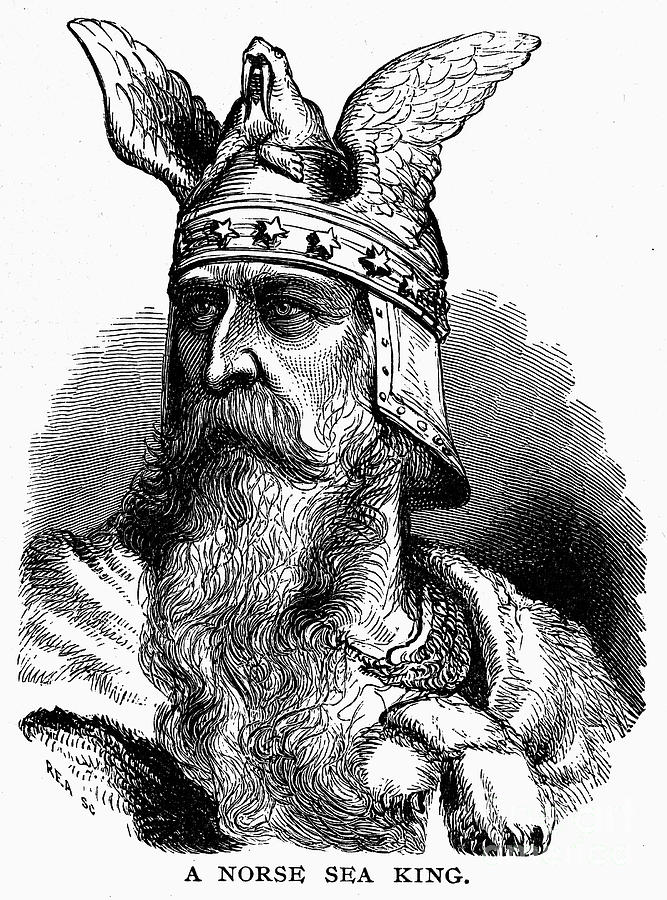
Viking Sea King Photograph by Granger

While France, England, and the Mediterranean regions formed the favorite visiting ground of the Norsemen, they did not fail to pay their respects in some measure to Germany, and during the ninth century, their period of most destructive activity, the latter country suffered considerably from their piratical ravages. Two German warriors who undertook to guard the coasts against their incursions are worthy of mention. One of these, Baldwin of the Iron Arm, Count of Flanders, distinguished himself by seducing Judith, daughter of Charles the Bald of France, who, young as she was, was already the widow of two English kings, Ethelwolf and his son Ethelbold. Charles was at first greatly enraged, but afterwards accepted Baldwin as his son-in-law, and made him lord of the district. The second was Robert the Strong, Count of Maine, a valiant defender of the country against the sea-kings. He was slain in a bloody battle with them, near Anvers, in 866. This distinguished warrior was the ancestor of Hugh Capet, afterwards king of France.

For some time after his death the Norsemen avoided Germany, paying their attentions to England, where Alfred the Great was on the throne. About 880 their incursions began again, and though they were several times defeated with severe slaughter, new swarms followed the old ones, and year by year fresh fleets invaded the land, leaving ruin in their paths.

Up the rivers they sailed, as in France, taking cities, devastating the country, doing more damage each year than could be repaired in a decade. Aix-la-Chapelle, the imperial city of the mighty Charlemagne, fell into their hands, and the palace of the great Charles, in little more than half a century after his death, was converted by these marauders into a stable. Well might the far-seeing emperor have predicted sorrow and trouble for the land from these sea-rovers, as he is said to have done, on seeing their many-oared ships from a distance. Yet even his foresight could scarcely have imagined that, before he was seventy years in the grave, the vikings of the north would be stabling their horses in the most splendid of his palaces.

1,846 Viking Raid Stock Photos, Pictures & Royalty-Free Images - iStock

The rovers attacked Metz, and Bishop Wala fell while bravely fighting them before its gates. City after city on the Rhine was taken and burned to the ground. The whole country between Liege, Cologne, and Mayence was so ravaged as to be almost converted into a desert. The besom of destruction, in the hands of the sea-kings, threatened to sweep Germany from end to end, as it had swept the greater part of France.

The impunity with which they raided the country was due in great part to the indolent character of the monarch. Charles the Fat, as he was entitled, who had the ambitious project of restoring the empire of Charlemagne, and succeeded in combining France and Germany under his sceptre, proved unable to protect his realm from the pirate rovers. Like his predecessor, Charles the Bald of France, he tried the magic power of gold and silver, as a more effective argument than sharpened steel, to rid him of these marauders. Siegfried, their principal leader, was bought off with two thousand pounds of gold and twelve thousand pounds of silver, to raise which sum Charles seized all the treasures of the churches. In consideration of this great bribe the sea-rover consented to a truce for twelve years. His brother Gottfried was bought off in a different method, being made Duke of Friesland and vassal of the emperor.

These concessions, however, did not put an end to the depredations of the Norsemen. There were other leaders than the two formidable brothers, and other pirates than those under their control, and the country was soon again invaded, a strong party advancing as far as the Moselle, where they took and destroyed the city of Treves. This marauding band, however, dearly paid for its depredations. While advancing through the forest of Ardennes, it was ambushed and assailed by a furious multitude of peasants and charcoal-burners, before whose weapons ten thousand of the Norsemen fell in death.

This revengeful act of the peasantry was followed by a treacherous deed of the emperor, which brought renewed trouble upon the land. Eager to rid himself of his powerful and troublesome vassal in Friesland, Charles invited Gottfried to a meeting, at which he had the Norsemen treacherously murdered, while his brother-in-law Hugo was deprived of his sight. It was an act sure to bring a bloody reprisal. No sooner had news of it reached the Scandinavian north than a fire of revengeful rage swept through the land, and from every port a throng of oared galleys put to sea, bent upon bloody retribution. Soon in immense hordes they fell upon the imperial realm, forcing their way in mighty hosts up the Rhine, the Maese, and the Seine, and washing out the memory of Gottfried’s murder in torrents of blood, while the brand spread ruin far and wide.

Vikings: Re-writing the legend of Ragnar for the TV age

The chief attack was made on Paris, which the Norsemen invested and besieged for a year and a half. The march upon Paris was made by sea and land, the marauders making Rouen their place of rendezvous. From this centre of operations Rollo—the future conqueror and Duke of Normandy, now a formidable sea-king—led an overland force towards the French capital, and on his way was met by an envoy from the emperor, no less a personage than the Count of Chartres, the once redoubtable Hasting, now a noble of the empire.

“Valiant sirs,” he said to Rollo and his chiefs, “who are you that come hither, and why have you come?”

( Rollo is a Carruthers Ancestor, and we have a large number of ancestors in Gutland, and they were considered Danes.   Gutland and Jutland were one in the same, and had land that connected them, now is water)

“We are Danes,” answered Rollo, proudly; “all of us equals, no man the lord of any other, but lords of all besides. We are come to punish these people and take their lands. And you, by what name are you called?”

23 Viking ship ideas | viking ship, vikings, norse vikings

“Have you not heard of a certain Hasting,” was the reply, “a sea-king who left your land with a multitude of ships, and turned into a desert a great part of this fair land of France?”

“We have heard of him,” said Rollo, curtly. “He began well and ended badly.”

“Will you submit to King Charles?” asked the envoy, deeming it wise, perhaps, to change the subject.

“We will submit to no one, king or chieftain. All that we gain by the sword we are masters and lords of. This you may tell to the king who has sent you. The lords of the sea know no masters on land.”

Hasting left with his message, and Rollo continued his advance to the Seine. Not finding here the ships of the maritime division of the expedition, which he had expected to meet, he seized on the boats of the French fishermen and pursued his course. Soon afterwards a French force was met and put to flight, its leader, Duke Ragnold, being killed. This event, as we are told, gave rise to a new change in the career of the famous Hasting. A certain Tetbold or Thibaud, of Northman birth, came to him and told him that he was suspected of treason, the defeat of the French having been ascribed to secret information furnished by him. Whether this were true, or a mere stratagem on the part of his informant, it had the desired effect of alarming Hasting, who quickly determined to save himself from peril by joining his old countrymen and becoming again a viking chief. He thereupon sold his countship to Tetbold, and hastened to join the army of Norsemen then besieging Paris. As for the cunning trickster, he settled down into his cheaply bought countship, and became the founder of the subsequent house of the Counts of Chartres.

The siege of Paris ended in the usual manner of the Norseman invasions of France,—that of ransom. Charles marched to its relief with a strong army, but, instead of venturing to meet his foes in battle, he bought them off as so often before, paying them a large sum of money, granting them free navigation of the Seine and entrance to Paris, and confirming them in the possession of Friesland. This occurred in 887. A year afterwards he lost his crown, through the indignation of the nobles at his cowardice, and France and Germany again fell asunder.

44 photos et images de Ragnar Vikings - Getty Images

The plundering incursions continued, and soon afterwards the new emperor, Arnulf, nephew of Charles the Fat, a man of far superior energy to his deposed uncle, attacked a powerful force of the piratical invaders near Louvain, where they had encamped after a victory over the Archbishop of Mayence. In the heat of the battle that followed, the vigilant Arnulf perceived that the German cavalry fought at a disadvantage with their stalwart foes, whose dexterity as foot-soldiers was remarkable. Springing from his horse, he called upon his followers to do the same. They obeyed, the nobles and their men-at-arms leaping to the ground and rushing furiously on foot upon their opponents. The assault was so fierce and sudden that the Norsemen gave way, and were cut down in thousands, Siegfried and Gottfried—a new Gottfried apparently—falling on the field, while the channel of the Dyle, across which the defeated invaders sought to fly, was choked with their corpses.

This bloody defeat put an end to the incursions of the Norsemen by way of the Rhine. Thenceforward they paid their attention to the coast of France, which they continued to invade until one of their great leaders, Rollo, settled in Normandy as a vassal of the French monarch, and served as an efficient barrier against the inroads of his countrymen.

As to Hasting, he appears to have returned to his old trade of sea-rover, and we hear of him again as one of the Norse invaders of England, during the latter part of the reign of Alfred the Great.

Carruthers crest on flag-v2 (1)

OFFICIAL AND REGISTEREDL CLAN CARRUTHERS CCIS SINCE 1983-CLAN OF OUR ANCESTORS

SCOTTISH CLAN – IRISH CLAN – NORSE CLAN

Preserving Our Past!    Recording Our Present!  Informing Our Future!

The Ancient and Honorable Carruthers Clan International Society LLC

carruthersclan1@gmail.com                carrothersclan@gmail.com

WIDE BANNER with NEW CREST

GERMANIC HISTORICAL FILES #5

CLAN CARRUTHERS INT SOCIETY CCIS HISTORIAN AND GENEALOGIST

You can find us on our main facebook pages at :

SILVER WINGS-https://www.facebook.com/CarruthersClanLLC/

GOLD WINGS – https://www.facebook.com/carrutherscarrothers.pat.9

CLAN CARRUTHERS FAMILY HISTORY – https://www.facebook.com/CarruthersClan

CLAN CARRUTHERS CCIS – https://www.facebook.com/groups/3878691252182714

CLAN CARRUTHERS INT SOCIETY- https://www.facebook.com/groups/394653845137709

CLAN CARRUTHERS – BORDER REIVERS – https://www.facebook.com/groups/434959914239094

Disclaimer Ancient and Honorable Carruthers Clan International Societ
Uncategorized, Varangians

Birka is the City of the Gotlanders

Birka was established as a Gotlandic (Varangian) trading Emporium at the northern point of the Rus-Varangian trading route to Bagdad


After Bagdad was founded in 762 and the capital of the Islamic Caliphate was
moved from Damascus to Bagdad the Gotlandic merchants traded with the
Islamic Caliphate which they called Særkland and the Khazar Khaganate with
their capital Atil on the Volga.
From end 700s silver from the Islamic Caliphate started to flow. The Gotlanders who knew the Russian rivers since earlier went all the way to the river
Volga and the Kaspian Sea. They were on the Russian rivers called Varangians and al-Rus’ (expeditions of rowing ships).


The Gotlanders founded, end 700s and
first half of the 800s, between the Baltic Sea and the Volga bases which today
are called the Rus’ Khaganate. This was a state, or a cluster of city-states all
through Russia to the Volga. The Spilling’s Treasure can be dated to the Rus’
Khaganate.
The first documented contact with a delegation of Gotlandic merchants (Rhos)
to visit Miklagarðr (Constantinople) is in 838. There are three separate written
sources that mention it and a coin with the emperor Theophilos was found in
the large silver hoard at Spillings. Miklagarðr means the large farm in contrast
to the small farms they had at home in Gotland.
About 860 most of these bases in the Rus’ Khaganate were destroyed and
sources tell that the Varangians were driven away. At the same time a Gotlandic
fleet with 200 ships besieged Constantinople for about 14 months in 860-861
with the outcome of longlasting agreemets between the Gotlanders and the
Byzantine Emperor.
On June 18, 860, at sunset, a fleet of about 200 Rhos vessels sailed into the
Bosporus and started pillaging the suburbs of Constantinople, Miklagarðr.
The attackers were setting homes on fire, drowning and stabbing the residents.
The attack took the Greeks by surprise, ‘like a thunderbolt from heaven’. The
Ecumenical Patriarch of Constantinople Photius (858-867 and 877-886) says that
it came suddenly and unexpectedly, ‘like a swarm of wasps’. Unable to do anything to repel the invaders, Patriarch Photius urged his flock to implore
the Theotokos to save the city. Emperor Michael III and the Imperial Army,
including the troops normally stationed closest to the capital, and the dreaded
fleet which discouraged with the deadly Greek Fire, fought against the Arabs in
Asia Minor. The exceptional time of the attack when the Rhos, Gotlandic Varangians, caught Constantinople unprepared suggests that the Rhos had information about the city’s weaknesses. It shows that the Rhos trade and communication with Miklagarðr continued into the 840s and 850s. We don’t know how
many Gotlanders took service in the Imperial Guard in 838 and if they were
involved from inside. Still, the attack by the Rhos in 860 came as a surprise. The
Rhos–Byzantine War of 860-861 was the only major military expedition from
the Rus’ Khaganate recorded in Byzantine and Western European sources.
Accounts vary regarding the events that took place around Constantinople.

There are discrepancies between contemporary and later sources, and the exact outcome is unknown. This event gave rise to a later Orthodox Christian
tradition, which ascribed the deliverance of Constantinople to a miraculous
intervention by the Theotokos, mother of God. The Rhos campaign of 860-
861 lasted ten months at least and ended some time in 861.
Evidently the hymn Acathistus was composed and first performed in moration of the solemn procession which has been described with many details and which, according to later local tradition led to the final cease of the
siege by the Rhos.
Since the yearly performance of the Acathistus was fixed for March 22, we may
consider this date as the day when the solemn procession with the sacred vestment of the Holy Virgin took place. In other words, at the close of March 861
the Rhos were already withdrawing from under the walls of Constantinople.
Their invasion left so deep an impression on the minds of the people that the
Acathistus has remained permanently fixed in the ritual of the Greek-Orhodox Church. Without doubt some of the most impressive moments during
the invasion of 860-861 were those of the solemn processions headed by the
Patriarch Photius, when the precious garment of the Virgin Mary, preserved in
the Chruch of the Virgin at Blanchernae, was borne round the walls of the city.
It was not the first time that this venerated relic was used during a critical experience for the capital. The best known occasion was during the siege of the
city by Avars, Scythians and Persians in 626 when, according to a legendary
tradition, the relic had saved the capital. Doubtless such religious performances
deeply impressed the superstitious populace and furnished them real consolation and comfort.
It is a very interesting question whether the Gotlandic Rhos invasion of 860-
861 ended in a definite agreement with the Byzanatine government or not.
Theophanes’ Continuator writes that shortly after the Rhos withdrawal a Rhos
embassy came to Constantinople beseeching to be converted to Christianity,
and that this conversion indeed took place. We can probably conclude that negotiations initiated by the Rhos took place at once after the campaign of
860-861 and ended in a friendly agreement.
Photius writings provide the earliest example of use of the name Rhos by the

Byzantines. He also mentions the foresaid contact in 838 between the Byzantine Empire and the Rhos.
Previously, the inhabitants of the countries north of the Black Sea had been
called ‘archaic’or ‘Tauroscyths’. The learned patriarch reports that the Rhos
has no supreme ruler and live in some remote northern country. Photius called
them ‘unknown people’, although some historians prefer to translate the phrase with ‘obscure people’.
In the year 911 a document was signed between the Byzantine Emperor Leo VI
and the Gotlandic Varangians: Karl, Ingjald, Farulf, Vermund, Hrollaf, Gunnar, Harold, Kami, Frithleif, Hroarr, Angantyr, Throand, Leithulf, Fast, and Steinvith.
One of the aims of the treaty was to maintain and proclaim the amity which
for many years had joined Christians, i.e, Greeks, and Rhos, Gotlanders. This
statement very well explains the peaceful relations between the two countries
that began in 861 or shortly thereafter. It is known that in the treaty of 911
there is a special clause which allows the Gotlandic Rhos who desire honoring
the Emperor to come at any time and to remain in his service. They shall be
permitted in this respect to act according to their desire. We must not forget
that Leo VI was the grandson of the Gotlandic Varangian Ingr and was well
aware of Gotlandic conditions.
Leo’s son Constantine VII Porphyrogennetos writes that the Krivichs and
other tribes transported hollowed-out sailboats, or monoxyla, which could accommodate thirty to forty people, to places along the rivers. These sailboats
were then transported along the Dnieper to Kiev. There they were sold to the
Varangians who re-equipped them and loaded them with merchandise.
The most authoritative source on the first Christianization of the Rhos is an
encyclical letter from the Patriarch Photius, datable to early 867. Referencing to
the Rhos-Byzantine War of 860-861, Photius informs the Oriental patriarchs
and bishops that, after the Bulgars turned to Christ in 864, the Rhos followed
suit so zealously that he found it prudent to send a bishop to their land.
The first church was according to Guta Saga in Kulstäde. It was burned down,
but in 897 the church in Visby, probably where the present St. Clemens stands,
was allowed to remain. We today know of 55 wooden churches, probably allfrom the 900s.

Red wooden church, Sweden, Europe

From the beginning of the 1000s the wooden churches were
replaced with Romanesque stone churches in Macedonian Renaissance art.
Macedonian Renaissance art (867-1056) was a period in Byzantine art which began in the period following the death of Emperor Theophilus in 842 and the
lifting of the ban on icons, iconoclasm. The Gotlanders were deeply involved
in Miklagar∂r during that time and the early Gotlandic churches are highly influenced by Armenian church buildings and the Byzantine art.
In 886 the grandson to the Gotlandic Varangian Ingr became Emperor under
the name Leo VI the Wise. The Gotlandic church was like the Armenian and
Georgian churches independant, directly under Gutna Althingi, and did never
submit to any bishop or the Catholic Pope. During the first 300 years the Gotlandic Church was Byzantine with Byzantine ritual and paintings. From 1164,
when the Catholic bishop in Linköping was hired to inaugurate churches, even
Catholic rituals came creeping in.
Later the Gotlanders settled in Garðaríki (Kievan-Rus’) and Holmgarðr (Novgorod) where Gotlandic Varangians became the first rulers. Gradually they opened Emporiums, ‘Gutagårdar’. Several such ‘Gutagårdar’ are known. They sold
furs, weapons and slaves and were paid in hard cash. Gotland has today the
worlds largest collection of coins from the Islamic Caliphate, most of them
minted in Bagdad.
We know from Arabic writers in the 800s that al-Rus’ were merchants from the
island in the Baltic Sea region, who came rowing on the Russian rivers. From
there comes later the name Russia. The etymology of the name al-Rus’/Rhos
needs clarification. Many scholars have wrongly maintained that the word alRus’ must be identical with the Finnish word Ruotsi and Estonian Rootsi. Sven Ekbo (1981) convincingly connects the word to Old Norse ro∂r meaning ‘expedition of rowing ships’. Accordingly there were on the Russian rivers in the
late 700s and 800s rowing Gotlandic merchants, Varangians, who the Arabic
writers called al-Rus’.
In the Baltic Sea and on the Russian rivers there were no Vikings. The Gotlandic merchants were called Varangians. Please note that there is no sign of
Scandinavians on the Russian rivers or in Kiev until Olof Skötkonung married
off his daughter Ingegerd to Jaroslav in Kiev in 1019. The large amount of

Scandinavians in Kiev come in the 1040s with Ingvar and his warriors.
Gotland is said to have been an unusually homogeneous society as the population structure is concerned. There has never been any feodal nobles on
Gotland. There were of course social inequalities. The Merchant Farmers, who
ran the trade and among other places visited outlying venues such as Aldeigjuborg, Atil, Bagdad, Bulgar, Holmga∂r, Kiev and Miklagarðr in the east and
Bardowick, Schleswig, Bergen, London and Spain in the west, formed a wealthy upper class, who surely had power in their hands, even in political terms. It
has been assumed that for instance judges were recruited mainly from these
lineages. An intermediate position holds ‘rural residents’, that the Guta Lagh
mentions. These were probably tenants. At the bottom of the scale of ranks we

find the serfs, who performed the heavy work, and who were for sale, mainly
in the eastern trading venues. Not least in this area came Christianity and the
Church to be significant, particularly in humanizing direction.
The Trade Treaty between the Gotlanders and the newly in the Lake Mälar
area immigrant Heruli (Svear), probably from second half of the 500s, means
that the Gotlanders could freely trade on the new kingdom in the Lake Mälar
area and its conquered lands east of the Baltic Sea. Instead of paying customs
duty every time they passed the border they paid a fixed amount every year and
could then trade freely in all areas controlled by the Svear. There were large
Gotlandic trading Emporiums, i. a. in Grobina (Latvia) ca 650- 850 CE, with
over 1000 Gotlandic graves, an area at that time was conquered by the Svear.
On Helgö was on the northeastern part of the island an ancient trade and
workshop site. The area consists of seven house groups, five burial fields and
an ancient castle from between 200 to 500. There are also clear traces of precocious cult on the island and an early temple building. The old trading place
at Helgö began to grow around 200, and is therefore about 500 years older
than Birka on Björkö. Already in the 400s there were skilled craftsmen in place with strong links to Gotland. Among other things, there are rich traces of
goldsmiths and other workshops. Helgö’s greatness period is considered to be
400-800 AD. The advanced bronze foundry and craft cease in the 600s and
Helgö assumes a more ordinary farm character. About 750 the Gotlanders
move their trade to Birka that dominates trade in the Lake Mälar area until the
late 900s, when Sigtuna probably takes over the trade. Evidence of long-term
trade in the form of a small Buddha from Swat Valley in India, an early Christian Coptic baptismal cup from Egypt, both dating back to the 500s, as well
as an Irish Crosier from the 800s and coins from Ravenna, Rome, Bysans and
Arabia shows the importance of the site. The island’s merchants may have had
the royal families from Vendel and Uppsala as customers for their luxury items,
such as jewelery, glass and spices.
The immigration of the Herul Royal family (Svear) to the Lake Mälar area in
the early 500s, when they bring a new ruling dynasty and a new religion to the
area, what we today know as the Ynglinga dynasty and the Æsir religion, is
mentioned in several sources. Their entrance on the stage changes the situation
in the Baltic Sea region. The wars between the Skilfings (Svear) and the Gotlanders are mentioned in the Beowulf epos and the Guta Saga. No traces of Æsir
religion is discernible on Gotland. The eight-legged horse that can be seen on
three Gotlandic picture stones is a Shaman horse that the Gotlanders came in
contact with in Khazaria. An eight-legged horse is not known in Scandinavia,
only on three picture stones from the 700-800s in Gotland. It is only mentioned by Snorre Sturlason in his Edda from the 1200s.
Ibn Rustah travelled to Novgorod with the al-Rus’, and compiled books relating to his own travels, as well as second-hand knowledge of the Khazars,
Magyars, Slavs, Bulgars, and other peoples. His impression of the al-Rus’ is
very favourable: ‘They carry clean clothes and the men adorn themselves with bracelets of gold. They treat their slaves well and they also carry exquisite
clothes, because they put great effort in trade. They have many towns. They
have a most friendly attitude towards foreigners and strangers who seek refuge.’
The establishment of the Varangian trading place Birka in the Lake Mälar area
and Sliesthorp in Denmark show a common special Gotlandic type, which in
ancient times developed in the Baltic Sea region. What we are talking about
here is the Gotlandic or Varangian commercial Emporiums across the Baltic
Sea e.g. Grobina and Paviken which are direct models. In a semicircle around
the old town area lie the three cemeteries and, like Birka, it has also had a
stronghold as support point.
Sliesthorp was a transit harbour and therefore terminus for the Frisian trade.
Frisian koggs did not reach Sliesthorp. They stayed in Hollingstedt. The goods
were then transported on trolleys between Hollingstedt and Sliestorp or vice
versa. From there Gotlandic merchants, the Varangians, took over the goods.

There are many links between Gotland and Birka. Birka is very centrally located
for trading in the Lake Mälar area and on the sea line from Gotland, which at
that time was open straight up to from Södertälje. The archaeologist Gustaf
Trotzig has in 1991 published a booklet on ‘Viking burial vessels of copper
and copper alloys from Birka and Gotland’. This type of grave finds are found

in the Baltic Sea region, Birka and on Gotland. Finds of such containers in
East Prussia occurs in combination with ceramics of the same type as found
on southern Gotland. If you go into individual find areas on Gotland you get
a picture on the graves location that is similar to the one in Birka. The graves
with metal containers are grouped in the same way. This is i.e. shown in the
cemetery at Barshaldar in Grötlingbo.
This type of graves in Birka are considered to accommodate foreign merchants,
while graves on Gotland would have Gotlanders. Of course, the Gotlanders
who died in Birka were also buried there. Another relation to Gotland is Adam
of Bremen’s words. He says in his history: “Birka is the city of the Gotlanders”

Elegant, pattern woven silk with Bahram Gur hunting scenes - a design that was hugely popular when the Vikings set out on trading and raiding expeditions where it was brought back to Scandinavia. #viking #silk #fabric #oseberg #grimfrost

Birka’s location in the Lake Mälar area made the city suitable as the pivot for
an internal trade in the winter markets on the Lake Mälar ice when the furs are
the best, and summer markets, where the ships could meet in the city’s harbour.
The presence of imported objects from the Orient and Western Europe in the
tombs are many. Uppland burial grounds could indicate that Birka to a large extent sold their imported goods, especially silk fabrics on the domestic market.
One must be cautious with the conclusions. There were other ways for the
trading ships, such as waterways through Roden (Roslagen) from the coast to the
interior of Uppland. It is howeveris quite clear that Birka traded with the rural
people. Bones of eider and other waterfowl in Birka’s garbage heaps show that
the residents in the archipelago provided merchants in Birka with food, and
reindeer testify trade to the north. The information in Ansgar’s biography, that
Birka had its own Thing, indicates that the city occupied a special position in
relation to the surrounding countryside and had remote commerce. Transit
trade between east, west and north was Birkas lifeblood. When it could not be
maintained any longer, the city disappeared or lost in any case its role shortly
after the middle of the 900s.

Viking kaftan Birka model.
Silk textiles from the Viking age are a small but exclusive group of archeological finds in Scandinavia. The silk fragments are produced in many different
qualities. The majority of silks have been interpreted as either Central Asian or
as made in the Byzantine production area, that is in Constantinople, or in associated areas in the eastern Mediterranean region. A few fragments from Birka
have been interpreted as Chinese silk. Great emphasis must be placed on the
Gotlandic merchants’, the Varangians or Rus as they are called in Arabic sources, strong ties to the Byzantine Empire in the 800s and 900s and thereby the
trade on the westernmost of the Russian waterways. Archaeological sources
give no reason to believe that the distribution of silk to the Baltic Sea areas is a
result of trading along one single route. The two major eastern trading routes
along the Russian rivers Dnjepr and the Volga-Oka region are likely routes for
the arrival of silk to both Oseberg and to Birka.
In Scandinavia so far 23 archaeological sites with finds of silks dating to the
800s and 900s have been registered, in most cases from graves. This includes
both silk fabrics and silk thread and lan-cores used in embroideries. In addition there are several graves with finds of fibres assumed to be silk but not yet identified. Many of the sites revealed only one or a few fragments of silk. The
largest concentration of graves is in Birka in the Lake Mälar area where 49 graves, according to Agnes Geijer, contained silk.
Based on these finds in the graves a project at Enköping museum has reconstructed silk fabrics with Islamic patterns.
The majority of graves containing silk from Birka are dated to the 900s. Of 49
graves, 37 are dated to this period while 12 date to the 800s. The fabric type
by Geijer called S4 dominates in both centuries and is the most common type
represented in all graves. This is a type of samite with z-spun main warps and
weft with no traces of spinning. Unlike the Oseberg silk fragments it has a
double main warp. The S4 group contains several different degrees of coarseness in the weave. Geijer noticed that some fragments seemed mono coloured
while others bore traces of pattern. This could very well be caused by differences in preserving condition, as seen in the Oseberg silks. Geijer explains the
arrival of the most common type called S4 with strong connections with the
Byzantine Empire. A coarser and more uneven woven quality of similar samite
was separated by Geijer in a singular group called S5 with patterns showing
similarities with some of the Oseberg fragments regarded as Central Asian
products.

5th c Iranian silk, prob samite; the Norse cut silk samite fabric into thin strips & appliqued it as trim onto clothing

In one of the Birka graves, a very special find appeared. This is a fabric of
two-coloured silk damask, with a pattern of stars and dots. The threads of raw
silk bear no traces of spinning in either warp or weft. This silk, the only one
of its kind so far found in Scandinavia, is probably produced in China. Two
different qualities of raw silk tabby were found in four of the graves in Birka.
The fabrics bear no traces of spinning in warp or weft.

Khazaria, Volga Bulgaria and the Silk Trade
The Khazars, a semi-nomadic Turkish people closely related to the Bulgarians,
established one of the largest polities of medieval Eurasia, with Atil as the capital. Their territory covered much of modern-day European Russia, western
Kazakhstan, eastern Ukraine, Azerbaijan, large portions of the northern Caucasus (Circassia, Dagestan), parts of Georgia, the Crimea, and northeastern Turkey.
They played a role in the balance of powers and destiny of the world civilization. After Kubrat’s Great Bulgaria was destroyed by the Khazars in the 600s,
some of the Bulgars fled to the west and founded a new Bulgar state (presentday
Bulgaria) near the Danubian Plain, under the command of Khan Asparukh. The
rest of the Bulgars fled to the north of the Volga River region and founded at
the big bend in the Volga in Russia’s heart, where the river Kama flows into the
Volga, the Volga Bulgaria kingdom with its capital Bolghar. Volga Bulgaria’s
heyday occurred in the 900s. At that time they adopted Muhammad’s teachings.
The area south of the kingdom of the Volga Bulgars, between the Caspian
and Black Seas, accordingly belonged to the Khazars. Khazaria had an ongoing
entente with Byzantium. The Khazars aided the Byzantine emperor Heraclius
(reigned 610–641) by sending an army of 40,000 soldiers in his campaign against
the Persians in the Byzantine–Sassanid War of 602–628. They also served their
partner in wars against the Abbasid Caliphate.
Sarkel, a Turkish word meaning White Fortress, was built in the 830s by a joint
team of Greek and Khazar architects to protect the north-western border of
the Khazar state. The chief engineer during the construction of Sarkel was Petronas Kamateros who later became the governor of Cherson. Khazaria was
the first feudal state to be established in Eastern Europe. According to ibn
Khordadhbeh the Khazarian Jewish merchants (Radhanites) were responsible for
the commerce between southwestern Asia and northern Europe, as well as
the connection to the Silk Road. The name ‘Khazar’ is found in numerous
languages and seems to be tied to a Turkish verb form meaning ‘wandering’
(modern Turkish: Gezer). Pax Khazarica is a term used by historians to refer to the
period during which Khazaria dominated the Pontic steppe and the Caucasus
Mountains.
The Gotlandic Varangians made regular commercial trips to the Khazar capital
Atil at the lower Volga and the city of Bolghar in the country of the Volga
Bulgars in the region of Kamas’ inflow in the Volga river.

After fighting the Arabs to a standstill in the North Caucasus, Khazars became increasingly interested in replacing their Tengriism with a state religion
that would give them equal religious standing with their Abrahamic neighbors.
During the 800s, the Khazar royalty and much of the aristocracy converted to
a form of Judaism. Yitzhak ha-Sangari is the name of the rabbi who converted the Khazars to Judaism according to Jewish sources. Khazaria became the
world’s largest Jewish kingdom. It is estimated today that 80% of those in the
world who confess to the Jewish religion are descended from there. They are
also called the ‘13th tribe’. In Khazaria the main languages were Turkish, various

Image result for The unique coin from the Spillings Hoard with the inscription ‘Moses is the prophet of God’ dated to 837-838. Photo: Kenneth Jonsson

Slavic languages and Gothic. If you mix these languages you get Jiddish.
Khazars were judged according to Tōra (orders of the Khagan; coming from the root
Tōr meaning customs; unwritten law of people in Old Turkic) (Modern Turkish: Töre), while the
other tribes were judged according to their own laws.
Being a surprisingly tolerant and pluralistic society, even its army incorporated
Jews, Christians, Muslims and Pagans at a time when religious warfare was the
order of the day around the Mediterranean and in Western Europe. By welcoming educated and worldly Jews from both Christian Europe and the Islamic
Middle East, Khazaria rapidly absorbed many of the arts and technologies of
civilization.

As a direct result of this cultural infusion, they became one of the very few
Asian steppe tribal societies that successfully made the transition from nomad
to urbanite. Settling in their newly created towns and cities between the Caspian
Sea and the Crimean Peninsula on the Black Sea, they became literate and multi-lingual agriculturalists, manufacturers and international traders.
The Islamic Bulgars in the Volga river bend and Khazaria were the two main
cross points for the trade routes to Europe. The main imported goods traded
in these markets were furs, slaves and weapons.
According to ibn Rustah and ibn Haukal, al-Rus’ delivered the first two mentioned in Khazaria and Volga Bulgaria. Ibn Rustah and Gurdesi explain that
the Varangians refused to accept anything else but jingling silver coins for their
goods.
In return they brought silk and other exotic products that they sold in Birka,
and these goods were handled by the Varangians (Rus) and came to the Baltic
Sea region through the Russian waterways.
Between 965 and 969, Khazar sovereignty was broken by the Kievan Rus’. Sviatoslav I of Kiev defeated them in 965 by conquering the Khazar fortress of
Sarkel. Two years later, Sviatoslav conquered Atil.
Archaeological finds of coins show a flow of Islamic dirhams mainly into Gotland dated to around c. 800 to the last quarter of the 900s. Gotland has the largest collection in the world of coins from the Islamic Caliphate, most of
them minted in Bagdad, and some from places well-known for silk production
like Samarkand and Tashkent.
The river systems of Volkhov-Lovat, Dniepr, Volga and Don formed a central
nerve in communication and trade. From the Rus (Varangian) northern strongholds you could go either to the south, sailing along Dnjepr to the Black sea
and finally reach Constantinople, or you could go further east, and along the
river Volga to the trading hub of Bulghar connecting the northern trade with
the northern silk roads in Central Asia and from there to China.
The Varangians took Kiev from the Khazarians in 882 and appointed one of
their own, Oleg, as ruler. Archaeological excavations show that a line of strongholds was established in the Kiev area along the Dnjepr in the last two decades
of the 800s. Tax collection was probably a motivation for establishing these
strongholds.
What about the eastern route along the river Volga? This route connected the
northern trade with the northern silk roads and the silk producing hubs in
Central Asia. The earliest archaeological traces of a Varangian (Rus) presence
in the Volga area dates to the early 800s, located south west of Rostov Velikij.
Later, at about the same time as the establishment of Varangian (Rus) strongholds on the shores of Dnjepr, settlements with distinct Gotlandic cultural
components were established not far from Volga nearby contemporary Yaroslavl. Even though they are not directly on the shores of the river, they show
a Gotlandic connection with the areas north of the trading hub of Bhulgar
situated about 30 km downstream from Volga’s confluence with the Kama
River near today’s Kazar.
It was in the town of Bulghar that Ibn Fadlan made his famous observation of a Varangian funeral in the 900s. Bulghar functioned as an eastern meeting point
between north and east, a melting pot of different cultures and languages. On
his journey to Bulghar, Ibn Fadlan travelled across the desert from Baghdad to
Bukhara, one of the main production centres for Persian silk in the 800s and
900s. Ibn Fadlan seems to have had a certain understanding of differences and
variations in luxury textiles. He brought with him a lot of different textiles to
be used as presents and tax payment on his journey. When describing the different textiles and clothing items, he uses the name of the place of production.

An example is his description of the presents he gave to an army commander
he met on his journey, who among other things was given cloth from Merv.
Not only expensive fabrics from Central Asia seem to have been transported
along this road. According to Ibn Fadlan, the Varangian chief buried in Bulghar was equipped with costly fabrics of Byzantine origin on his last journey at
the beginning of the 900s.
The complex trading relationship between areas of production in this period further complicates the interpretation of trading routes. In spite of strong
political rivalry and competition in trade and silk production, both preserved
silk fabrics and written sources show a strong interaction relating to pattern exchange and technology as well as trading and gift exchange between Byzantine
and Persian areas.
It is interesting to note that a trade regulation in Constantinople forbid merchants from Bhulgar to buy Persian silk of higher value when they were visiting
the town. According to the Book of Epharc silk fabrics and clothing from Baghdad were among goods brought by Syrian merchants to Constantinople in the
early 900s. In addition, Islamic fashion in the form of garments “tailored in the
Saracen style” was according to De Ceremoniis made in the Byzantine capital.
There is also reason to believe that many of the town markets were regarded
as multicultural meeting places. In several Arabic sources, towns like Baghdad
and Tashkent are described as cosmopolitan hubs of trade. A writer of the late
800s describes the thriving trade in Baghdad like this: “There are not a people
from any country but has a quarter in it, a place for the exchange of their produce, and a special district of their own. That what is not to be found in any
other town of the world is brought together here”.
Silk trade between the Caliphate and the Byzantine Empire also led to diffusion and imitation of fashion. Arab sources written in the 700s and 800s indicate a
clear consciousness of Byzantine fashion among the people of Baghdad. This
indicates that not only physical products but also ideas and fashion to some
extent were exchanged between the rivals. This makes it extremely diffcult to
know the specific trade routes the different types of silks came through.

Conclusion
Silk finds in Birka and surroundings show that luxury goods from both Central Asia and Byzans were traded by the Varangians in the 800s and 900s. The
archaeological and written sources show that the most plausible trading routes
for these silks went along the Russian rivers.
Great emphasis has been placed on the Varangians’ strong ties to the Byzantine
power. Nevertheless, both the excavations along the Volga and Gotlandic coin
finds minted in Central Asia also show a connection to the Central Asian production areas for silk through the Volga-Oka region. It is likely that both these
routes were used for trading silk by the Varangians. Silk trade and exchange
of fashion ideas between the main areas of production makes it even more
plausible that more than one trading route was used. Silk trade was probably
part of a complex and multidimensional system in which merchandise and gifts
changed hands.
As we know the Gotlanders were deeply involved in Miklagar∂r and the Macedonian Renaissance art from the end of Iconclasm. It is documented in Byzantine sources that from second half of the 800s and forward there were larger
Gotlandic contingents stationed in Miklagarðr.
The Gotlanders were related to the Byzantine Imperial Court from 867 when
the Gotlandic Varangian Ingr’s daughter Indrina became Empress Eudokia
Ingerina and in 886 when her son became Emperor Leo VI the Wise. The
Gotlandic Varangians were allocated their own living quarters to stay in St
Mamas outside the Theodosian wall.
On the trade route between the Baltic Sea and Constantinople Kiev was a
Slavic settlement. It was a tributary of the Khazars, until seized by the ians in 882. Under Varangian rule, Kiev became a capital of Kievan Rus’.
To understand the history of the Gotlandic Merchant Republic and its Medieval Churches, one must fully realize that Gotland was an independent Merchant
Republic, and the hub of the Baltic Sea region, which from time immemorial
had its relations mainly east and south and controlled trade on the Russian
rivers from time to time. There were no Vikings in the Baltic Sea or on the
Russian rivers and no Scandinavians in Russia before 1019.
Gotland has very little in common with Swedish history.   Tore Gannholm


Preserving Our Past, Recording Our Present, Informing Our Future

Ancient and Honorable Carruthers Clan Int Society LLC

carruthersclan1@gmail.com

cropped-coagraywide.jpg

Disclaimer Ancient and Honorable Carruthers Clan International Society CCIS LLC is the official licensed and registered Clan of the Carruthers Family.  This Clan is presently registered in the United States and Canada, and represents members worldwide.  All content provided on our web pages is for family history use only.  The CCIS is the legal owner of all websites, and makes no representation as to the accuracy or completeness of any information on these sites or by following any link provided. The CCIS will not be responsible for any errors or omissions or availability of any information. The CCIS will not be liable for any losses, injuries, or damages from the display or use of this information. We do not sell, trade or transfer to outside parties any personal identifications. For your convenience, we may provide links to various outside parties that may be of interest to you. The content on CCIS is design to support your research in family history.      ( CCIS -LLC copyright 2017 - 2020)

Uncategorized, Varangians

Viking or Varangian

There were no Vikings in the Baltic Sea Region.   The word Viking is not known there.  The vikings were warriors from Denmark, the west of Sweden and Norway, and the Viking Age started with the attack on Lindisfarne in 793.
There is a clear line in the River Elbe between Vikings and Varangians.  West of the River Elbe there is no mention of Vikings only Varangians.
In the Baltic Sea region the Gotlanders, after the signing of the trade and peace treaty in the 550’s also controlled trade and areas umder Svea protection.
At the end of the 700’s when silver was from the Islanic Caliphate started to flow, the Gotlanders entered the Russian Rivers all the way to Volga and the Hapsian Sea.
The Gotlandic Merchant Farmers were on the Russian Rivers called Varagians and al-Rus (rowing ships).  It is documented in Byzantine sources that there was a large trade delegation in Konstaninopole 838 , and that from late 800 and forward there were large trade Gotlandic contingents stationed in Miklagaror.
Constantinople and the Byzantine Empire has left its mark in the form of religious items, jewelry, and not least in coins. The trade treaty signed in 911 by a Gotlandic Varangian delegation and the Byzantine Emperor Leo VI testies that the Varangians were settled in the quarters of Saint Mamas. The Treasure from Ocksarve inHemse contains 123 Byzantine coins, representing Constantine VII913-959, Basileios II 976-1025, Romanus III 1028-1034 andConstantine IX 1042-1055 Photo Gotland’s Museum 

The fourth silver treasure on Stavar’s farmwas taken as preparation to be dug out
under laboratory conditions. The 205 silvercoins were packed together in rolls, as they once were transported in the 900s, may be all the way from the Orient.
The Russian rivers
Nearly 80% of all coins from the Islamic Caliphate found in present day
Sweden have been found on Gotland.
In the areas of the Svear no silver treasure from the Islamic Caliphate has been
found.
From the 500s until the 1000s the Gotlanders have, according to Swedish researchers, been considered rarely to be mentioned in ancient sources. The Gotlandic history was uninteresting from a Swedish perspective.
However, the Gotlanders were in Arabic and Byzantine sources from the 800s
well known as merchants from the island in the Baltic Sea region. They are in
these sources called al-Rus’, Rhos and Varangians.
Al-Rus’ / Rhos comes from the Old Norse word Ro∂r meaning rowing feets.
The Arab writers say that it is merchants from the island in the Baltic Sea who
came rowing on the Russian rivers. From there comes later the name Russia.
These Varangians emerged not only as slave hunters, but were primarily known
as merchants.
Ibn Khordadhbeh (c.820–912): ‘The al-Rus’come from the farthest corners of
the Slav’s country. They travel over the Roman Sea to Constantinople and sell
their goods, furs of beaver, black fox and swords’.
Al-Marwazi, reports that the al-Rus’ had abandoned their wild pagan ways and
raids and settled into Christianity.
Ibn Rustah’s description:
‘What al-Rus’ concern, they live on an island, surrounded by a lake. This island, on which they live, have an extent of three days’ journey. His information
on non-Islamic peoples of Europe and Inner Asia makes him a useful source
for these obscure regions. He was even aware of the existence of the British
Isles and of the Heptarchy of Anglo-Saxon England and the prehistory of the
Turks and other steppe peoples. Ibn Rustah travelled to Novgorod with the al-Rus’, and compiled books relating to his own travels, as well as second-hand
knowledge of the Khazars, Magyars, Slavs, Bulgars, and other peoples.
His impression of the al-Rus’ is very favourable:
‘They carry clean clothes and the men adorn themselves with bracelets of gold.
They treat their slaves well and they also carry exquisite clothes, because they
put great effort in trade. They have many towns. They have a most friendly
attitude towards foreigners and strangers who seek refuge.’
See also the picture stones from the 800s that probably tell about the Gotlanders’ contacts with Khazaria and the Islamic Caliphate.
Khazaria converted in the late 700s to Judaism and became the world’s largest
Jewish kingdom. It is estimated today that 80% of those in the world who
confess to the Jewish religion are descended from there. They are also called
the ‘13th tribe’, or Volga-Jews in contrast to Jordan-Jews. In Khazaria the main
languages were Turkish, various Slavic languages and Gothic. If you mix these
languages you get Jiddish.
When the Swedes a couple of hundred years later forcibly Christenized Finland
and Estonia they also came with rowing feets and are called Ruotsi and Rootsi.
But it has nothing to do with the Arabic writers much earlier name for the Gotlandic rowing merchants al-Rus’ and the Byzantines’ Rhos to do.    Tore Gannholm

Preserving Our Past, Recording Our Present, Informing Our Future

Ancient and Honorable Carruthers Clan Int Society LLC

carruthersclan1@gmail.com


cropped-coagraywide.jpg

 
Uncategorized, Varangians

The Varangians : Gotland and the Black Sea

Gotland and its Relations to the Black Sea Area

Gotland and its relations to the Black Sea area.
The Guta Saga like the Goths’ tribal saga speak of a southern migration from
Gotland to the Black Sea area and the Byzantine Empire. We know from Byzantine sources that the Goths settled in the Bosporian Kingdom and took
possession of its feet with which they for some time ravaged in the Mediterranean. As we have seen above, we have already in late Bronze Age Gotlandic
trading Emporiums on the Baltic Sea coast where the river roads lead down to
the Black Sea. Even at the time when the Guta Saga was recorded, in the early
1200s, it is not startling when the author of the Guta Saga notes that in Greece
(Crimea belonged to Greece with Miklagarðr, as its capital), there lived a group
that “settled and live there and even today they have in their speech track of
our language” .
One can therefore assume that the contemporaries with the Guta Saga, when
they traveled to the Black Sea area, without too much diffculty understood the
language of the Crimean Goths. It may not have been much more difference between their own language and that of the Crimean Gothic than between current Danish and Swedish. Especially silver fndings prove that the Gotlanders
during the Viking Age were frequent travelers to the area concerned.
Although the coins are minted further east in the Caliphate, they will in many
cases come just from this area, as they were used as means of payment there.
Other evidence that the Gotlanders travelled in the areas closest to the Crimea
is the rune stones on Gotland. It can be mentioned the stone from Pilgårds in
Boge, from the 900s, which tells about the Gotlander Ravn together with some
brothers who came to Aeiphor, a ford in the Dnieper, not far from the Crimea.
One of the attractions with the Byzantine Empire can be attributed to the
proximity of ancient Troy. A trip to the Byzantine Empire was not only a
trading trip, but could also be a pilgrimage to the region for the mythological
home of the Æsir even if the exact location was not known.
Saxo Grammaticus (1150-1220) describes how a gold image of Odin was sent
to Byzantium from the northern kings as an act of homage. This may have
been regarded as a visit by the God in his former homeland as is told in an
episode in Snorri’s Ynglinga Saga. There it tells how King Sveigdir travels to
the Turk country in search for Odin and the home of the gods. According to
Snorri Sturluson he was a descendant of Yngve, the king of the Turks. Several
other traditions show how well established the belief was that the Norse gods originally came from Troy.


Greekfire-madridskylitzes1.jpg

(Image from the Skylitzes illuminated manuscript in Madrid, showing Greek fre in use against an enemy feet.)

When the people in the Baltic Sea region went on crusades to the Holy Land
they followed the same road, and the journey went over Gotland, as it says in
Guta Saga: “Before Gutland in seriousness appointed a bishop, bishops came
to Gutland, who were pilgrims on their way to the holy Jerusalem, or went
home from there. At that time the road went east across Russia and Greece to
Jerusalem.”
Already Saxo in his chronicle tells how king Erik Ejegod from Denmark on his
pilgrimage to Jerusalem with his queen and a splendid retinue of knights and
attendants about the year 1103 pass Visby and inaugorates the St Olaf church.
The most detailed records of Byzantine court activity, diplomacy and administration are the compilations by Constantine VII Porphyrogennetos (945-59):
‘Book of Ceremonies; a treatise on Governing the Empire’, dedicated to his
son; and another ‘On the Themes’. These refect a practical need to prepare
Romanos II for his imperial role, and it draws on a long tradition of books of
guidance. The two treatises deal respectively with territories and rulers beyond
the empire, and the regions under imperial control, the themes. Both include
much geographical information about the different terrains, mountains, rivers
and the characteristics of their inhabitants.
In the section on Byzantium’s northern neighbors, Constantine gives a detailed
account of the way the people from Novgorod, Smolensk and other cities, who
gather in Kiev and sail down the river Dnieper to the Crimea, and thence across
the Black Sea to Miklagarðr.

Image result for seven rapids or cataracts on the lower Dnieper

He describes the seven rapids or cataracts on the lower Dnieper and how they may be negotiated. At the frst, which is called Essoupi, which means ‘Do not
sleep!’, the water crashes against rocks in the middle ‘with a mighty and terrifc
din’. To provide a sense of scale, he reports that this cataract is as narrow as
the polo ground in Miklagarðr. Here the Rus’ disembark the men and guide the
boats around the rocks in the middle of the river on foot, also punting them
with poles.
At the fourth barrage, the big one called in Rus’ Aeiphor and in Slavonic, Neasit, because the pelicans nest in the stones of the barrage … all put into
land. They conduct the slaves in their chains by land, six miles, until they are
through the barrage. Then partly dragging their boats, partly carrying them on
their shoulders, they convey them to the far side of the barrage.
They continue to the seventh barrage and on to Krarion, where there is a ford
as wide as the Hippodrome and as high as an arrow can reach if shot from the
bottom to the top. This is where the Pechenegs come down and attack the alRus’.
How did Constantine have such a detailed knowledge about the Varangians or
al- Rus’ (Gotlanders) when they travel to Miklagarðr (Byzantium)?
His father Leo VI was the grandson to the Gotlandic Varangian Ingr.
Kiev was a Slavic settlement on the trade route between the Baltic Sea and
Constantinople, and was a tributary of the Khazars, until seized by the Varangians in 882. Under Varangian rule, Kiev became a capital of Kievan Rus’.
The word Varangian was used by Greeks, Arabs and Kievan Rus’ for merchants
from the island in the Baltic Sea (Gotlanders).
The etymology of the name al-Rus’/Rhos (Rhos vocari dicebant) needs clarifcation.
Sven Ekbo (1981) convincingly connects the word to Old Norse ro∂r meaning
‘expedition of rowing ships’.
As early as 902 Varangians are mentioned as fghting as mercenaries for the
Byzantines. About 700 Varangians served along with Dalmatians as mariners
in Byzantine naval expeditions against the Emirate of Crete and a force of 629
returned to Crete under Constantine Porphyrogennetos in 949.


Preserving Our Past, Recording Our Present, Informing Our Future

Ancient and Honorable Clan Carruthers Int Society

carruthersclan1@gmail.com


carruthersCOA