
Gutland / Gotland, The History of Gutland, Uncategorized

HOW KING ROLF WON HIS WIFE – CLAN CARRUTHERS CCIS

cropped-wide-banner-with-new-crest

HOW KING ROLF WON HIS WIFE


At one time very many centuries ago, we cannot say just when, for this was in the days of the early legends, there reigned over Upsala in Sweden a king named Erik. He had no son and only one daughter, but this girl was worth a dozen sons and daughters of some kings. Torborg she was named, and there were few women so wise and beautiful and few men so strong and valiant. She cared nothing for women’s work, but was the equal of any man of the court in riding, fighting with sword and shield, and other athletic sports. This troubled King Erik very much, for he thought that the princess should sit in her maiden chamber like other kings’ daughters; but she told him that when she came to succeed him on the throne she would need to know how to defend her kingdom, and now was the time for her to learn.

That she might become the better fitted to rule, she asked him to give her some province to govern, and this he did, making her queen of a third of his kingdom, and giving her an army of stout and bold warriors. Her court was held at Ulleraker in Upland, and here she would not let any one treat her as a woman, dressing always in men’s clothing and bidding her men to call her King Torborg. To fail in this would be at risk of their heads. As her fame spread abroad, there were many who came to court her, for she was at once very beautiful and the heiress of a great kingdom. But she treated all such with laughter and contempt. It is even said that she put out the eyes of some, and cut off the hands and feet of others, but this we do not like to believe. At any rate, she drove away those who troubled her too much with lance and spear. So it was plain that only a strong and bold man could win this warlike maiden for his wife.

At that time King Götrik who ruled in Gothland, a country in southern Sweden, had sent his younger son Rolf to be brought up at the court of his foster-brother King Ring of Denmark. His elder son Kettil he kept at home, but did not love him much on account of his pride and obstinacy. So it happened that when Götrik was very old and like to die, he decided that Rolf, who was very tall and strong, and very fit and able, should succeed him, though he was the younger son. All agreed to this, even Kettil, so Rolf was sent for and made king of Gothland, which he ruled with skill and valor.

One day Rolf and Kettil, who loved each other as brothers should, were talking together, and Kettil said that one thing was wanting to the glory and honor of Rolf’s rule, and that was a queen of noble birth and goodly presence.

“And whom have you in mind?” asked Rolf.

“There is Torborg, the king of Upsala’s daughter. If you can win her for wife it will be the greatest marriage in the north.”

To this advice Rolf would not listen. He had heard of how the shrewish Torborg treated her suitors, and felt that wooing her would be like taking a wild wolf by the ears. So he stayed unmarried for several years more, though Kettil often spoke of the matter, and one day said to him contemptuously:

“Many a man has a large body with little courage, and I fear you are such a one; for though you stand as a man, you do not dare to speak to a woman.”

“I will show you that I am a man,” said Rolf, very angry at these words.

He sent to Denmark for his foster-brother Ingiald, son of King Ring, and when he came the two set out with sixty armed men for the court of King Erik in Upsala.

One morning, about this time, Queen Ingerd of Upsala awoke and told King Erik of a strange dream she had dreamed. She had seen in her sleep a troop of wolves running from Gothland towards Sweden, a great lion and a little bear leading them; but these, instead of being fierce and shaggy, were smooth-haired and gentle.

“What do you think it means?” asked the king.

“I think that the lion is the ghost of a king, and that the white bear is some king’s son, the wolves being their followers. I fancy it means that Rolf of Gothland and Ingiald of Denmark are coming hither, bent on a mission of peace, since they appear so tame. Do you think that King Rolf is coming to woo our daughter, Torborg?”

“Nonsense, woman; the king of so small a realm would show great assurance to seek for wife so great a princess as our daughter.”

So when Rolf and his followers came to Upsala King Erik showed his displeasure, inviting him to his table but giving him no seat of honor at the feast. Rolf sat silent and angry at this treatment, but when Erik asked him why he had come, he told him courteously enough the reason of his visit.

“I know how fond you Goths are of a joke,” said Erik, with a laugh. “You have a way of saying one thing when you mean another. But I can guess what brings you. Gothland is little and its revenues are small and you have many people to keep and feed. Food is now scarce in Gothland, and you have come here that you may not suffer from hunger. It was a good thought for you to come to Upsala for help, and you are welcome to go about my kingdom with your men for a month; then you can return home plump and well fed.”

This jesting speech made Rolf very angry, though he said little in reply. But when the king told Queen Ingerd that evening what he had said she was much displeased.

“King Rolf may have a small kingdom,” she said, “but he has gained fame by his courage and ability, and is as powerful as many kings with a wider rule. You did not well to mock him.”

The next day Erik, thus admonished, begged Rolf’s pardon, saying that the ale had made him speak foolishly, and thus he became reconciled with his guest. As for Rolf’s desire to win his daughter, he would first have to gain Torborg’s consent, which would be no easy matter. The king promised not to interfere but would do no more.

Soon after this Rolf and his men arrived at Ulleraker, reaching there when the whole of Torborg’s court were assembled in the great hall. Fearing a hostile reception, Rolf took wary precautions. He choose twelve of his stoutest men, with himself and Ingiald at their head, to enter the court with drawn swords in their hands. If they were attacked, they were to go out backward fighting, but they were bidden to conduct themselves like men and let nothing alarm them. The others remained outside, keeping the horses in readiness to mount.

When the party entered the hall, Rolf at their head, all there were struck with his great size and noble aspect. No one assailed them and he walked up the hall, on whose high seat at the front he saw what seemed a tall and finely formed man, dressed in royal robes. Knowing that this must be the haughty princess whose hand he had come to seek, he took off his helmet, bowed low before her, and began to tell what brought him to her court.

He had scarcely begun when she stopped him. She said that he must be joking; that she knew his real errand was to get food and that this she would give him; but he must apply for it to the chief of the kitchen, not to her.

Rolf had not come so far to be laughed out of the court, and he sturdily went on with what he had to say, speaking to her as a woman, and demanding her hand in marriage. At this she changed her jesting manner, her cheeks grew red with anger, and springing up, she seized her weapons and called upon her men to lay hold upon and bind the fool that had dared affront their monarch. Shouting and confusion followed and a sharp attack was made on the intruders, but Rolf put on his helmet and bade his men to retire, which they did in good order. He walked backward through the whole hall, shield on arm and sword in hand, parrying and dealing blows, so that when he left the room, though no blade had touched him, a dozen of the courtiers lay bleeding. But being greatly overmatched, he ordered his men to mount, and they rode away unscathed.

Back to West Gothland they went and told Kettil how poorly they had fared.

“You have suffered a sore insult and affront at a woman’s hand,” said Kettil, “and my advice is that it be speedily avenged,” but Rolf replied that he was not yet ready to act.

Torborg had not taken the trouble to ask the name of her wooer, but when she learned who it was she knew very well that the matter had not reached its end and that her would-be lover would return stronger than before. As she did not want him or any man for husband she made great preparations for an attack, gathering a large body of warriors and having a wall of great strength and the finest workmanship built round the town. It was so high and thick that no battering ram could shake it, while water-cisterns were built into it to put out the fire if any one sought to burn it. From this we may judge that the wall was of wood. This done, Torborg made merry with her court, thinking that no lover in the wide world would now venture to annoy her.

She did not know the kind of man she had to deal with in King Rolf. He had fought with men and fancied he was fit to conquer a woman. The next summer he had a battle with Asmund, son of the king of Scotland, and when it was over they became friends and foster-brothers and went on viking cruises together. Next spring Rolf armed and manned six ships and, taking Kettil and Ingiald and Asmund with him, set sail for Upsala. He proposed now to woo the warrior princess in another fashion.

Queen Ingerd about this time dreamed again, her dream being the same as before, except that this time there were two white bears, and a hog which was small but spiteful, its bristles pointing forward and its mouth snarling as if ready to bite anything that came before it. And the bears did not look as gentle as before, but seemed irritated.

She interpreted this dream to mean that Rolf was coming again to avenge the affront he had received, and that the fierce hog must stand for Kettil, of whose character she had been told.

When Rolf now arrived King Erik received him with honor, and again agreed to remain his friend, no matter how stormy a courtship he might have. From Upsala he set out for Ulleraker and sent a herald to Princess Torborg, asking speech with her. She presented herself at the top of the wall, surrounded by armed men. King Rolf renewed his suit, and told her plainly that if she did not accept his proposal he had come to burn the town and slay every man within its walls.

“You shall first serve as a goatherd in West Gothland before you get any power over me and mine,” answered Torborg haughtily.

Rolf lost no time in assailing the walls, but found them stoutly defended. The Swedes within poured boiling water and hot pitch on their assailants, threw down stones and beams, and hurled spears and arrows from the wall. For fourteen days the siege continued without effect, until the Goths, weary of their hard fighting and the mockery of the defenders, began to complain and wanted to return home. The townspeople derided them by showing costly goods from the ramparts and bidding them come and take them, and ridiculed them in many other ways.

King Rolf now saw that he must take other measures. He had a cover constructed of boards and brushwood and supported by stout beams, making a strong roof which was set against the wall and defied all the boiling water and missiles of the Swedes. Under its shelter a hole was dug through the wall and soon the Goths were in the queen’s citadel.

To their surprise they found it empty. Not a soul was to be seen, but in every room they found well-cooked food and many articles of value.

“This is a fine capture,” said Kettil. “Let us enjoy ourselves and divide the spoil.”

“Not so,” said Rolf. “It is a lure to draw us off. I will not rest till I have the princess in my power.”

They sought the palace through and through, but no one was there. Finally a secret passage was discovered, leading underground, and the king entered it, the others following. They emerged in a forest where they found Torborg and all her men and where a sharp battle began. No warrior could have fought more bravely than the man-like princess, and her men stood up for her boldly, but they gradually gave way before the onset of Rolf and his tried warriors.

Rolf now bade Kettil to take Torborg prisoner, but not to wound her, saying that it would be shameful to use arms against a woman. Kettil sprang forward and gave the princess a sharp blow with the flat of his sword, reviling her at the same time with rude words. In return, Torborg gave him so hard a blow on the ear with her battle-axe that he fell prostrate, with his heels in the air.

“That is the way we treat our dogs when they bark too loud,” she said.

Kettil sprang up, burning with anger, but at the same moment Rolf rushed forward and grasped the warlike princess in his powerful arms, so that she was forced to surrender.

He told her that she was his prisoner, but that he did not wish to win a wife in the viking manner and that he would leave it to her father to judge what should be done. Taken captive in his arms, there was nothing else for her to do, and she went with him to Upsala, where King Erik was delighted at Rolf’s success. As for the warlike princess, she laid down her arms at her father’s feet, put on a woman’s garments, and seemed glad enough to have been won as a bride in so warlike a manner and by so heroic a wooer.

Soon after this the marriage took place, the festivities being the grandest the court could afford and lasting for fourteen days, after which Rolf and his followers returned home, his new queen with him. The sagas say, as we can well believe after so strenuous a wooing, that afterwards King Rolf and Queen Torborg lived a long and happy life.
Carruthers crest on flag-v2 (1)


OFFICIAL AND OLDEST SCOTTISH  CLAN CARRUTHERS

 SINCE 1983-CLAN OF OUR ANCESTORS

MERITED TO CHIEF CARATOCUS  10AD

PRESENT CHIEF :  PAT E CARROTHERS USA

cropped-wide-banner-with-new-crest


TAMMY WISE CHS – USA

CHARLES MORRIS


CLAN CARRUTHERS  HISTORIAN AND GENEALOGIST
59ef7250711564a8761d3a0b23bc2353

New Blog Banner 05

Preserving Our Past, Recording Our Present, Informing Our Future

Ancient and Honorable Clan Carruthers

   clancarruthers1@gmail.com

You can find us on our main facebook pages at :

SILVER WINGS-https://www.facebook.com/CarruthersClanLLC/

GOLD WINGS – https://www.facebook.com/carrutherscarrothers.pat.9

COPPER WINGS    https://www.facebook.com/ClanCarruthers1/

CLAN CARRUTHERS FAMILY HISTORY – https://www.facebook.com/CarruthersClan

CLAN CARRUTHERS CCIS – https://www.facebook.com/groups/3878691252182714

CLAN CARRUTHERS INT SOCIETY- https://www.facebook.com/groups/394653845137709

CLAN CARRUTHERS – BORDER REIVERS – https://www.facebook.com/groups/434959914239094

Disclaimer Ancient and Honorable Carruthers Clan International Soci
OUR ANCESTORS, The Viking Age, Uncategorized

GUDRID – THE VIKING WOMAN WHO SAILED TO AMERICA AND WALKED TO ROME – CLAN CARRUTHERS CCIS

cropped-wide-banner-with-new-crestnorse

GUDRID THE FAR TRAVELER 

THE VIKING WOMAN WHO SAILED TO AMERICA AND WALKED TO ROME 

Cropped-Gudrid

Move over Erik the Red and Leif Erikson, and make room for Gudrid the Far-Traveled. She was the first European woman to give birth in America, as well as the first nun in Iceland. She roamed Vinland (in modern Canada) and visited Rome. No medieval woman traveled further than her.

he’s been called “the greatest female explorer of all time,” and the “best-traveled woman of the Middle Ages.” Just after the year 1000 AD, she gave birth to the first European baby in North America. And she concluded her global odyssey with a pilgrimage on foot to Rome. Yet few today can name this extraordinary Viking lady, even if they have heard of Erik the Red and Leif Erikson, her father- and brother-in-law.

Dangerous and deadly sea voyages

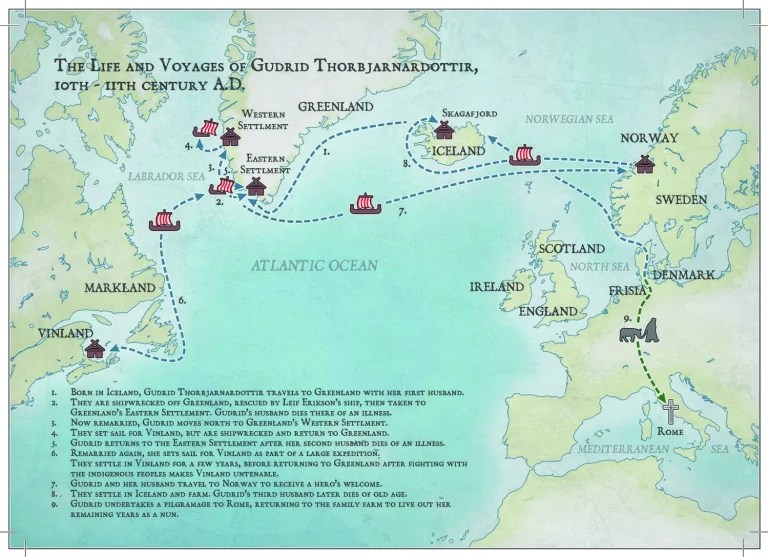
Her full name, in modern Icelandic, is Guðríður víðförla Þorbjarnardóttir — Gudrid the Far-Traveled, daughter of Thorbjorn. She was born around 985 AD on the Snæfellsnes peninsula in western Iceland and died around 1050 AD at Glaumbær in northern Iceland. This map shows the extraordinary extent of her travels in between those dates and places. In all, she made eight Atlantic sea voyages, at a time when those were very dangerous and often deadly.

 
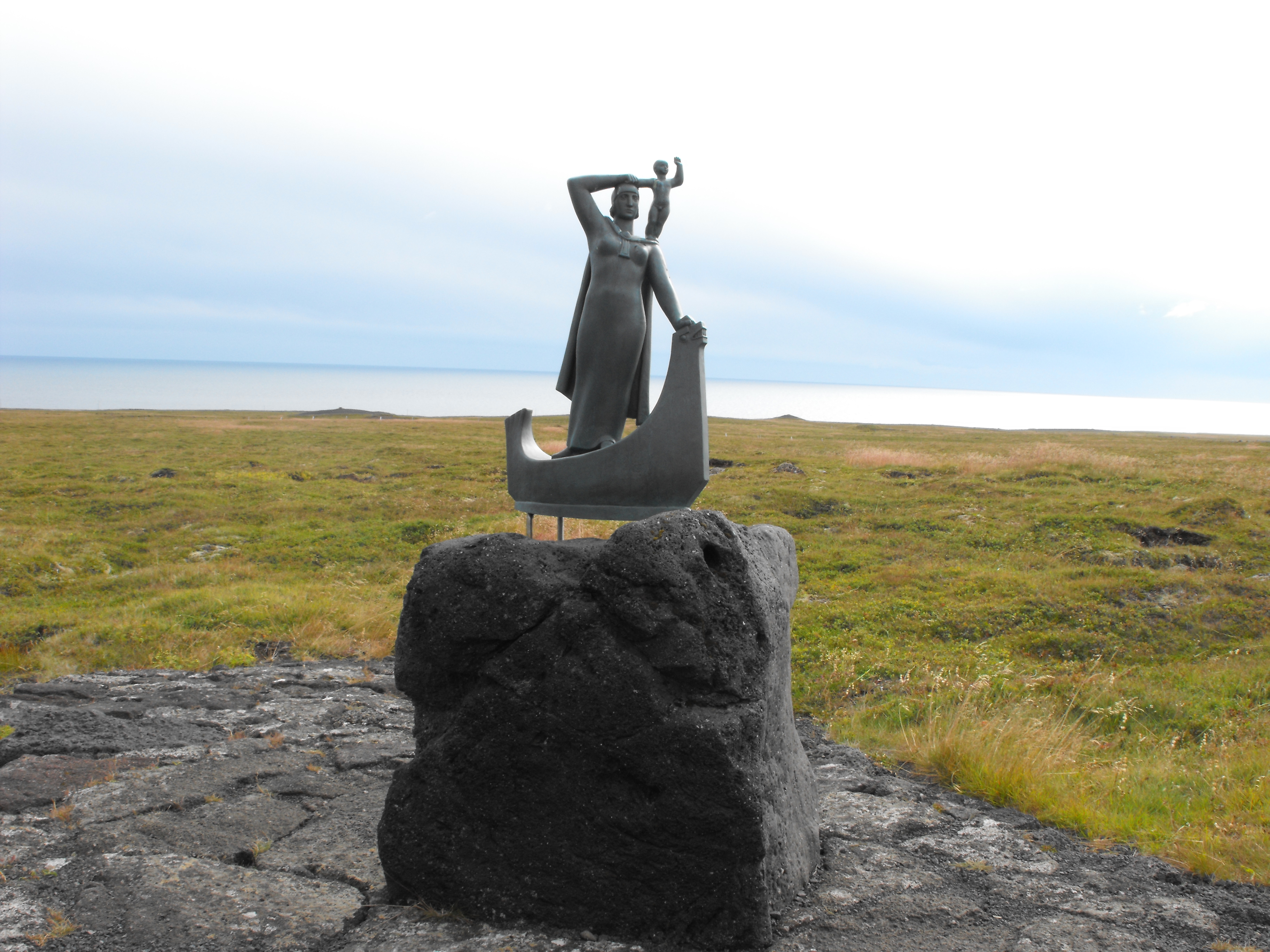
Gudrid at sea looking ahead, with little Snorri on her shoulder. One of three such statues, this one is at Glaumbær in northern Iceland. (Credit: diego_cue via Wikipedia / CC BY-SA 3.0)

What little we know of her comes from the Saga of Erik the Red and the Saga of the Greenlanders. These are collectively known as the Vinland Sagas, as they describe the Viking exploration and attempted settlement of North America — part of which the explorers called “Vinland,” after the wild grapes that grew there.

These sagas were told and retold from memory until they were committed to paper in the 13th century. Due to those 200 years of oral transmission, they likely contain numerous inconsistencies; Gudrid was married twice according to one saga, three times in the other, for example.

Gudrid’s spindle?
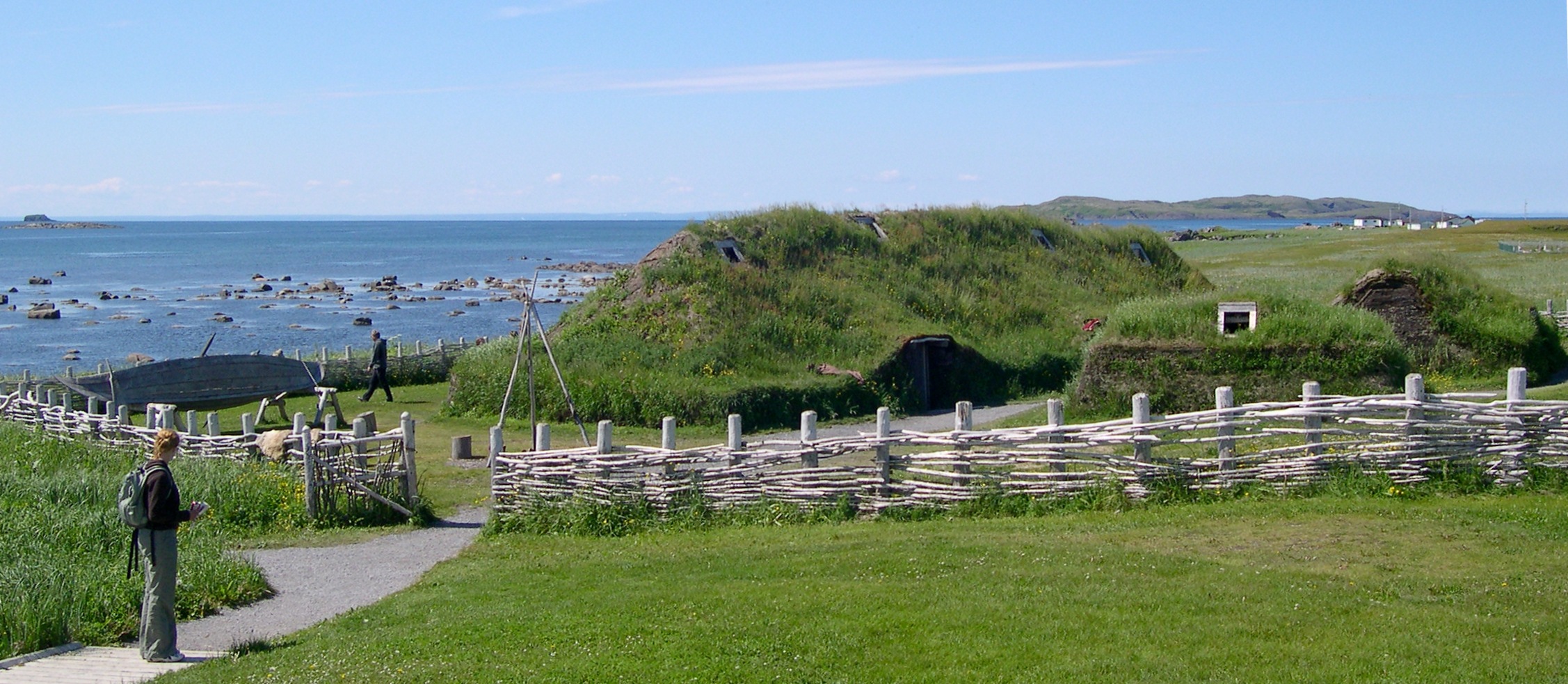
Also, they freely mix fact with fiction. Their pages crawl with dragons, trolls, and other things supernatural. But the central tenet of the sagas has been proven by archaeology: In the 1960s, the remains of a Viking outpost were dug up at L’Anse aux Meadows, on the northern tip of Newfoundland. Among the rubble was found a spindle, used for spinning yarn, which was typical women’s work and thus possibly handled by Gudrid herself.

Her character is so central to the Saga of Erik the Red that some have suggested it should rather be called Gudrid’s Saga. And in the Saga of the Greenlanders, Gudrid is called “a woman of striking appearance and wise as well, who knew how to behave among strangers.” That’s a trait that may have come in handy when dealing with the Native tribes of North America, whom the other Vikings dismissively called skrælings (“weaklings,” “barbarians”).

Gudrid-Map

gudrid
The length and breadth of Gudrid’s travels: as far west as Canada, as far east as Rome — and all just after the year 1000. (Credit: Richard Thomson / Richard Thomson Imagery)
Gudrid’s remarkable story starts when she is around 15, when she travels to Greenland with her father. According to one of the sagas, she is with her first husband Thorir, who died there the following winter (#1 on the map).

The emigrants suffer terribly on the way to Greenland, with half dying en route and the remainder shipwrecked on a small island off the mainland (#2). They are rescued by Leif Erikson, son of Erik the Red — a friend of her father’s, as it happens. It is from this event that Leif gets the nickname “Leif the Lucky.” (To this day, Icelanders believe that sea rescues bring the rescuers good luck.)

Gudrid then settles in Greenland (#3) and eventually marries Thorstein Erikson, brother of Leif and son of Erik. Leif has just returned from a strange new land he discovered across the ocean, and according to one saga, Gudrid joins Thorstein on an unsuccessful trip over to the other side (#4).

A corpse rising from its deathbed

Back in Greenland, the newlyweds spend a winter with Thorstein the Black and his wife Grimhild, whose settlement is decimated by a plague. Gudrid’s husband is among those carried off by the disease, but his corpse rises from its deathbed to foretell her future: She will marry an Icelander, with whom she will have many children and a long life; she will leave Greenland, visit Norway, make a pilgrimage south, and return to Iceland.

Gudrid returns to Greenland’s Eastern Settlement (#5) and marries Thorfinn Karlsefni, a merchant from Iceland. At her urging, the two lead an attempt to settle Vinland with a party of 60 men, five women, and some livestock (#6). In Vinland, Gudrid gives birth to Snorri Thorfinnsson, the first reported birth of a European in the New World. The year is uncertain, however: anywhere between 1005 and 1013 AD.

The attempt at settlement in America lasts just three years. Harsh conditions, isolation, and hostile relations with the Natives cause the Vikings to pull back. When Snorri is three, the family leaves Vinland for Europe. They receive a hero’s welcome at the royal court in Norway (#7), get rich from selling their exotic goods, and settle in Iceland at Glaumbær farm in Skagafjord (#8).

gUDRID222

Gudrid and Thorfinn in Vinland, as imagined in Our Country: a Household History for All Readers (1877) by Benson J. Lossing. (Art by Albert Bobbett.) (Credit: The Print Collector / Getty Images)
The family leads a peaceful, prosperous life. Thorfinn dies of old age. When Snorri marries, Gudrid goes on a pilgrimage to Rome (#9), apparently by herself and mainly on foot. When Gudrid returns from her last great voyage to Rome, she finds Snorri has built a church for her, as she requested. Here, she lives out the remainder of her life in solitude and contemplation: the first nun in Iceland, a final achievement in a unique life.

It is not known when exactly Gudrid died, but she did not die in obscurity. She established a powerful and influential family. Among her illustrious progeny were three early bishops of Iceland and a 14th-century compiler of Icelandic sagas, including the Saga of Erik the Red, which mentions his famous ancestor.

Fluid multiculturalism in the North Atlantic
Gudrid’s own ancestors were Gaelic servants of Unn the Wise, a former Viking queen of Dublin who fled to Iceland around 900 AD and settled her followers in an empty valley, Gudrid’s grandfather among them. It is possible this female pioneer was an example for Gudrid’s own attempt at group emigration.

Two anecdotes from the sagas shed some light on the fluid multiculturalism in the North Atlantic around the year 1000.

At that time, Christianity was starting to make inroads into Viking communities, which however remained largely pagan. It seems Gudrid herself was an early Christian convert, but not an inflexible one. At the home of a family friend, Gudrid is the only woman present who knows a “weird song” that will help the prophetess Thorbjorg perform a magic ritual. At first, Gudrid refuses to sing it, as she is a Christian woman. But she is easily convinced that it will help everybody present and not harm her status as a Christian. And it turns out she has a beautiful singing voice.

 
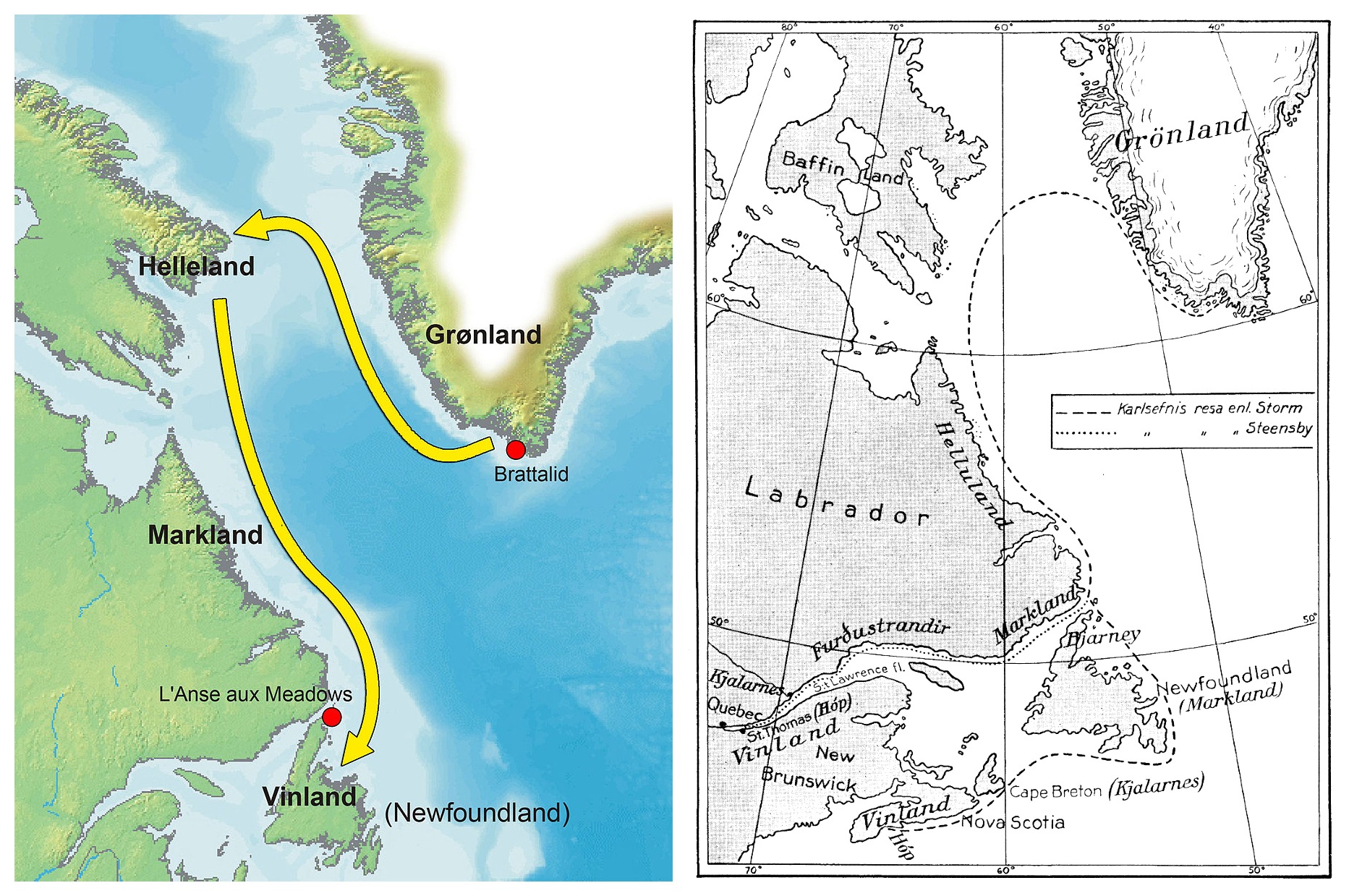
Two theories about Viking exploration in North America. On the left: Helluland is Baffin Island, Markland is Labrador, and Vinland is Newfoundland. On the right, a more “southerly” theory: Helluland is Labrador, Markland is Newfoundland, and Vinland is Nova Scotia. (Credit: Finn Bjørklid, CC BY-SA 2.5 (left); Nordisk Familjebok, public domain (right)).

Another story from the sagas that has mystified readers for centuries because it mentions two “Gudrids” and has traditionally been dismissed as a ghost story could in fact be the earliest recorded conversation between a European and an American. The incident is set in the second winter of the expedition, when the Viking settlement is again approached by Natives coming to trade. Gudrid is inside the palisades with her year-old son, Snorri. Then:

“a shadow fell upon the door, and a woman in black entered. She was short and wore a shawl over her head. Her hair was light red-brown, she was pale and her eyes were larger than any ever seen in a human head. She came to where Gudrid was sitting and said: ‘What is your name?’

“’My name is Gudrid,’ answered Gudrid, ‘but what is yours?’ To which the other woman replied: ‘My name is Gudrid.’ Gudrid, the mistress of the house, then motioned the other woman to sit down beside her, but at that very moment a great crash was heard and the woman disappeared.”

Encounter with a Beothuk woman

The story might not be as spooky as first reported. A more recent reading of events suggests the possibility of an encounter between Gudrid and a woman of the Beothuk, the main tribe in Newfoundland at the time. Perhaps the Native woman was merely repeating what the Viking woman said: Ek heiti Gudridr (“My name is Gudrid”). This is often what happens first between people who don’t speak each other’s language.

A statue of Gudrid, created for the 1939 New York World’s Fair, now stands at Glaumbær. The female explorer peers out over the bow of a ship, with the young boy Snorri on her shoulder. There are two copies of the statue, one at Laugarbrekka (on the Snæfellsnes peninsula), the other in the lobby of the National Archives of Canada in Ottawa.

 
Reconstruction of the Viking settlement at L’Anse aux Meadows on Newfoundland. (Credit: Dylan Kerechuk via Wikimedia Commons / CC BY 2.0)

Carruthers crest on flag-v2 (1)

OFFICIAL AND OLDEST SCOTTISH  CLAN CARRUTHERS

 SINCE 1983-CLAN OF OUR ANCESTORS

MERITED TO CHIEF CARATOCUS  10AD

PRESENT CHIEF :  PAT E CARROTHERS USA

WIDE BANNER with NEW CREST

TAMMY WISE CHS- USA

DR PATRICIA CARRUTHERS CHS


CLAN CARRUTHERS  HISTORIAN AND GENEALOGIST
59ef7250711564a8761d3a0b23bc2353

New Blog Banner 05

Preserving Our Past, Recording Our Present, Informing Our Future

Ancient and Honorable Clan Carruthers

   clancarruthers1@gmail.com

You can find us on our main facebook pages at :

SILVER WINGS-https://www.facebook.com/CarruthersClanLLC/

GOLD WINGS – https://www.facebook.com/carrutherscarrothers.pat.9

COPPER WINGS    https://www.facebook.com/ClanCarruthers1/

CLAN CARRUTHERS FAMILY HISTORY – https://www.facebook.com/CarruthersClan

CLAN CARRUTHERS CCIS – https://www.facebook.com/groups/3878691252182714

CLAN CARRUTHERS INT SOCIETY- https://www.facebook.com/groups/394653845137709

CLAN CARRUTHERS – BORDER REIVERS – https://www.facebook.com/groups/434959914239094

Disclaimer Ancient and Honorable Carruthers Clan International Soci


For more on Gudrid the Far-Traveled, check out:

Found Home of the Legendary Viking Woman Who Crossed the Atlantic 500 Years Before Columbus” in Arkeonews

The Mystery of the Two Gudrids: A Transcript of First Contact” in American Indian Magazine

The Far Traveler: Voyages of a Viking Woman by Nancy Marie Brown

Gudrid Thorbjarnadóttir, ca. 985-1050” at Wander Women Project

The Far Traveler (TV documentary, Danish/English) at DR.TV

A Short Biography of Gudrid Thorbjarnardóttir for Bostonians,” from McSweeney’s

DNA Gotland, Gutland / Gotland, The Viking Age

ARCHEOLOGICAL DNA SHOWS IMMIGRATION TO SCANDINAVIAN COUNTRIES EXCEPTIONAL – CLAN CARRUTHERS CCIS

cropped-wide-banner-with-new-crestnorse

ARCHEOLOGICAL DNA  REMAINS SHOWS THAT IMMIGRATION TO SCANDINACIAN COUNTRIES WAS EXCEPTIONAL DURING THE VIKING ERA

A new study based on 297 ancient Scandinavian genomes analysed together with the genomic data of 16,638 present day Scandinavians resolve the complex relations between geography, ancestry, and gene flow in Scandinavia — encompassing the Roman Age, the Viking Age and later periods. A surprising increase of variation during the Viking period indicates that gene flow into Scandinavia was especially intense during this period.

An international study coordinated from Stockholm and Reykjavik investigates the development of the Scandinavian gene pool over the latest 2000 years. In this effort the scientists relied on historic and prehistoric genomes, and from material excavated in Scandinavia. These ancient genomes were compared with genomic data from 16,638 contemporary Scandinavians. As the geographical origin and the datings were known for all these individuals, it was possible to resolve the development of the gene pool to a level never realised previously.

Dr Ricardo Rodríguez Varela at the Centre for Palaeogenetics*, who analysed all the data and extracted some of the ancient DNA used in the study, explains: “With this level of resolution we not only confirm the Viking Age migration. We are also able to trace it to the east Baltic region, the British-Irish Isles and southern Europe. But not all parts of Scandinavia received the same amounts of gene flow from these areas. For example, while British-Irish ancestry became widespread in Scandinavia the eastern-Baltic ancestry mainly reached Gotland and central Sweden.”   Gotland is where the Carruthers DNA was a wide-width match.  Please not that the Scandinavian Countries have a different DNA system than Europe proper.   They are working on combining, but have not succeeded to date.

The gene pool bounced back after the Viking period

Another new discovery in this study was what happened to the gene pool after the Viking period. The scientists were surprised to find that it bounced back in the direction of what it looked like before the Viking period migration.

Professor Anders Götherström at the Centre for Palaeogenetics, who is a senior scientist on the study, is intrigued: “Interestingly, the non-local ancestry peaks during the Viking period while being lower before and after. The drop in current levels of external ancestry suggests that the Viking-period migrants got less children, or somehow contributed proportionally less to the gene pool than the people who were already in Scandinavia.”

Viking Attack on Paris c.885

Yet a new discovery was the history of the northern Scandinavian gene pool. There is a genetic component in northern Scandinavia that is rare in central and western Europe, and the scientists were able to track this component in northern Scandinavia through the latest 1000 years.

Dr Ricardo Rodríguez Varela comments, “We suspected that there was a chronology to the northern Scandinavian gene pool, and it did indeed prove that a more recent influx of Uralic ancestry into Scandinavia define much of the northern gene pool. But if it is recent, it is comparatively so. For example, we know that this Uralic ancestry was present in northern Scandinavia as early as during the late Viking period.”

Based on well-known Swedish archaeological sites

The study is based on a number of well-known Swedish archaeological sites. For example, there are genomes from the 17th century warship Kronan, from the Viking and Vendel period boat burials in the lake Mälaren Valley, and from the migration period ring fortress Sandby borg on Öland.

Early Depiction of Ragnarok

Anders Götherström conclude: “We were working on a number of smaller studies on different archaeological sites. And at some point it just made sense to combine them into a larger study on the development of the Scandinavian gene pool.

Carruthers crest on flag-v2 (1)

OFFICIAL AND OLDEST SCOTTISH  CLAN CARRUTHERS

 SINCE 1983-CLAN OF OUR ANCESTORS

MERITED TO CHIEF CARATOCUS  10AD

PRESENT CHIEF :  PAT E CARROTHERS USA

cropped-wide-banner-with-new-crestnorse

Dr Tim Fraser SCOTLAND CHS

Reviewed by : Tammy Wise  USA  CHS

CLAN CARRUTHERS  HISTORIAN AND GENEALOGIST

59ef7250711564a8761d3a0b23bc2353

New Blog Banner 05

Preserving Our Past, Recording Our Present, Informing Our Future

Ancient and Honorable Clan Carruthers

   clancarruthers1@gmail.com

You can find us on our main facebook pages at :

SILVER WINGS-https://www.facebook.com/CarruthersClanLLC/

GOLD WINGS – https://www.facebook.com/carrutherscarrothers.pat.9

COPPER WINGS    https://www.facebook.com/ClanCarruthers1/

CLAN CARRUTHERS FAMILY HISTORY – https://www.facebook.com/CarruthersClan

CLAN CARRUTHERS CCIS – https://www.facebook.com/groups/3878691252182714

CLAN CARRUTHERS INT SOCIETY- https://www.facebook.com/groups/394653845137709

CLAN CARRUTHERS – BORDER REIVERS – https://www.facebook.com/groups/434959914239094

Disclaimer Ancient and Honorable Carruthers Clan International Soci

The study, published today in Cell, is an international effort with several collaborators, but it was led by Dr Ricardo Rodríguez Varela and Professor Anders Götherstörm at Stockholm University, and Professor Agnar Helgason, and Kristján Moore at deCODE in Reykavijk.

*The Centre for Palaeogenetics (CPG) is a joint venture between Stockholm University and the Swedish Museum of Natural History.

Source:Stockholm University. “DNA from archaeological remains shows that immigration to Scandinavia was exceptional during the Viking period.” ScienceDaily. ScienceDaily, 5 January 2023. <www.sciencedaily.com/releases/2023/01/230105151301.htm>.

OUR ANCESTORS, The Viking Age

A THOUSAND YEAR OLD VIKING HALL IN DENMARK – CLAN CARRUTHERS CCIS

cropped-wide-banner-with-new-crestnorse

A THOUSAND YEAR OLD VIKING HALL UNCOVERED IN DENMARK

Archaeologists located in Denmark recently discovered to their amazement the remains of a Vikings hall that would have been used at the height of the late Viking age between the ninth and eleventh centuries. The structure measures hundred-thirty feet long and twenty-six to thirty-two feet wide.

The hall’s structure includes a round of ten to twelve rectangular oak posts which are designed to hold up the roof securely. Researchers suspect the structure is larger than the average house of the time because it was a very prestigious building. This kind of hall usually had been owned by someone wealthy, powerful, and prominent. The building is remarkably intact.

“This is the largest Viking Age find of this nature in more than ten years, and we have not seen anything like it before here in North Jutland, even though it has only been partially excavated,” archaeologist and excavation leader Thomas Rune Knudsen said in recent statements. “We only had the opportunity to excavate part of the hall, but there are probably several houses hidden under the mulch to the east. A hall building of this nature rarely stands alone,” He adds detailing that there is still a lot of work ahead to unlock all the history it can reveal.

Researchers from the Historical Museum of Northern Jutland uncovered remains of the structure near Hune, a village in northern Denmark. This is the rarest and biggest building of its size found in more than a decade. The teams say that the structure dates to the era of Denmark’s king Harald Blåtand Gormsson, ( CARRUTHERS ANCESTOR) after whom modern Bluetooth technology was named.

The architecture of the hall corresponds to the style of castles constructed during Blåtand’s reign. Archaeologists suspect the land on which the hall was erected may have belonged to a well-known nobleman, conceivably Runulv den Rådsnilde whose name is inscribed on a local rune stone.

“It is difficult to prove that the found Viking hall belonged to the family of Runulv den Rådsnilde, but it is certainly a possibility,” said Knudsen. “If nothing else, the rune stone and hall represent the same social class and both belong to society’s elite.”

According to the archaeologist team who have been hard at work excavating part of the hall, this structure likely played a monumental role in the day-to-day agricultural functions and served as a place for Viking guild get-togethers that would have been responsible for political meetings. They are certain also that there are several houses hidden under the mulch to the east that connects to the main hall believing this discovery is only starting.


An artist’s impression of Harald “Bluetooth” Blåtand and the rune, which archaeologists believe may show a link between the hall and an area nobleman.

Radiocarbon dating will be used to determine the precise time period the building was actively used. This will occur as the team starts the second half of the hall excavation next year. Researchers from the team have confirmed that plans are already being prepared to remove a section of turf in order to get an exact and accurate idea of when the structure’s main hall was built.

The replica Viking hall located at Borghyden heights in Norway is a perfect example of how this hall might have looked like during the Late Viking era. According to the Lofotr Museum, a major joint Nordic excavation project was carried out in Borghøyden heights which discovered “a chieftain’s seat from the early Iron Age.” Buried and hidden among the ancient buildings.

Sarah Kuta, a correspondent for the Smithsonian writes how important this kind of discovery. “The seafaring Vikings inhabited many places from the 9th to the 11th centuries, including mainland Europe, Ireland, England, Scotland, Wales, Greenland, North America, the Faroe Islands and beyond. Archaeologists continue to find traces of their history, including swords, jewelry, longhouses, and coins.”

Carruthers crest on flag-v2 (1)

OFFICIAL AND OLDEST SCOTTISH  CLAN CARRUTHERS

 SINCE 1983-CLAN OF OUR ANCESTORS

MERITED TO CHIEF CAROTACUS 10 A

CURRENT :  CHIEF PAT E CARROTHERS USA

cropped-wide-banner-with-new-crestnorse

Dr Patricia Carrothers  CHS

Reviewed by : Tammy Wise  CHS

CLAN CARRUTHERS  HISTORIAN AND GENEALOGIST

New Blog Banner 05

Preserving Our Past, Recording Our Present, Informing Our Future

Ancient and Honorable Clan Carruthers

   clancarruthers1@gmail.com

You can find us on our main facebook pages at :

SILVER WINGS-https://www.facebook.com/CarruthersClanLLC/

GOLD WINGS – https://www.facebook.com/carrutherscarrothers.pat.9

COPPER WINGS    https://www.facebook.com/ClanCarruthers1/

CLAN CARRUTHERS FAMILY HISTORY – https://www.facebook.com/CarruthersClan

CLAN CARRUTHERS CCIS – https://www.facebook.com/groups/3878691252182714

CLAN CARRUTHERS INT SOCIETY- https://www.facebook.com/groups/394653845137709

CLAN CARRUTHERS – BORDER REIVERS – https://www.facebook.com/groups/434959914239094

Disclaimer Ancient and Honorable Carruthers Clan International Soci
OUR ANCESTORS, Uncategorized

ISOBEL – QUEEN CONSORT OF NORWAY-DRONNING AV NORGER-DE BRUCE – CLAN CARRUTHERS CCIS

WIDE BANNER with NEW CREST


Isobel (Queen Consort of Norway; dronning av Norge) de Bruce

BIRTH 1272  Carrick bay, Dumfries and Galloway

DEATH 13 APR 1358  Bergen, Bergen, Hordaland, Norway

 
CARRUTHERS ANCESTOR


Isabel Bruce (Isabella de Brus or Isobail a Brus, or Isabella Robertsdotter Brus) (c. 1272–1358) was Queen of Norway as the wife of King Eric II.


Isabel De Brus Queen Consort Of Norway (1272–1358) • FamilySearchIsabel was born in Carrick, Scotland. Her parents were Robert de Brus, 6th Lord of Annandale and Marjorie, Countess of Carrick. Her brothers included Robert the Bruce, King of Scots, and Edward Bruce who briefly was High King of Ireland. In 1293 at the age of 21, she traveled to Norway with her father and was married at Bergen to King Eric. Her dowry for the marriage was recorded at the time by Norwegian nobleman Audun Hugleiksson who noted she brought: precious clothes, 2 golden boiler, 24 silver plate, 4 silver salt cellars and 12 two-handled soup bowls (scyphus) to the marriage.

Isabella, Countess of Buchan: Andrew HillhouseOther historian note that Isabel was captured by enemies of her brother Robert, and was kept in a hanging cage for several years, and King Eric came to her aid, took her out of that cage, and brought her to Norway. 


Isabel was king Erik’s second wife, he having previously been married to the daughter of King Alexander III of Scotland, Margaret of Scotland, who died in childbirth in 1283. Upon the death of King Alexander three years later, his granddaughter, Eric’s daughter Margaret, Maid of Norway became heir to the throne of Scotland. King Eric arranged the marriage of his daughter to the English King Edward I’s son Edward, which became moot upon the child’s death in 1290. The death of Queen Margaret left Scotland without a monarch, and at the mercy of Edward I of England.

Soon, John Balliol tried to take the Scottish crown with the aid of John Comyn, the Red Comyn. The Bruce family captured strongholds in Galloway, and fighting in the name of the Maid of Norway (Margaret), suppressed the rebellion with many important families like the Stewards supporting them. At the time of Isabel’s marriage in 1293, her brother was one of the claimants to the Scottish throne. The Bruces were aligned with King Edward against King John Balliol and his Comyn allies. In 1306, Robert the Bruce was chosen to be King of Scotland. Scottish historian G.W.S. Barrow observed that King Eric’s renewed contacts with Scotland “increased the ties of friendship which bound him to the English king.

ArmsIsabel was widowed, at age 26, at the death of King Eric in 1299. Erik was succeeded by his brother, King Haakon V of Norway who reigned until his own death in 1319. Isabel never remarried, despite surviving her husband by 59 years. Their marriage did not produce a male heir, though it did produce a daughter, Ingeborg Eriksdottir of Norway, who, having firstly been engaged to Jon II, Earl of Orkney, married Valdemar Magnusson of Sweden, Duke of Finland, in 1312. Isabel herself arranged both engagements.

She did not return to Scotland, but lived in Bergen, Norway, the rest of her life, and died there. As a queen consort, there is little information about her life, but her life as a queen dowager is better documented. Queen Isabel participated in many official events and ceremonies and did not lack influence. She was present with the royal couple at the inauguration in 1305 of Bishop Arne Sigurdssön, the new Bishop of Bergen. She had a good relationship with the clerical powers in Bergen, made donations and in 1324, received several houses from the church. It has been suggested, that she participated as a mediator in the negotiations between Norway and Scotland regarding Orkney and Shetland during 1312 under which the Treaty of Perth was reaffirmed. In 1339, the king pardoned a prisoner at her request. She exchanged letters with her sister Christina Bruce and sent soldiers in her support. In 1357, she was one of the heirs of her daughter Ingebjorg, Duchess of Uppland, Öland and Finland


Carruthers crest on flag-v2 (1)

OFFICIAL AND OLDEST SCOTTISH  CLAN CARRUTHERS

 SINCE 1983-CLAN OF OUR ANCESTORS

SCOTTISH CLAN – IRISH CLAN – NORSE CLAN

cropped-wide-banner-with-new-crestnorse


Dr Patricia Carrothers  CHS

Reviewed by : Tammy Wise  CHS

CLAN CARRUTHERS  HISTORIAN AND GENEALOGIST

New Blog Banner 05

Preserving Our Past, Recording Our Present, Informing Our Future

Ancient and Honorable Clan Carruthers

   clancarruthers1@gmail.com

You can find us on our main facebook pages at :

SILVER WINGS-https://www.facebook.com/CarruthersClanLLC/

GOLD WINGS – https://www.facebook.com/carrutherscarrothers.pat.9

COPPER WINGS    https://www.facebook.com/ClanCarruthers1/

CLAN CARRUTHERS FAMILY HISTORY – https://www.facebook.com/CarruthersClan

CLAN CARRUTHERS CCIS – https://www.facebook.com/groups/3878691252182714

CLAN CARRUTHERS INT SOCIETY- https://www.facebook.com/groups/394653845137709

CLAN CARRUTHERS – BORDER REIVERS – https://www.facebook.com/groups/434959914239094

Disclaimer Ancient and Honorable Carruthers Clan International Soci
Gutland / Gotland, OUR ANCESTORS, The History of Gutland, The Viking Age, Uncategorized

PRINCE OF GARDERIGE – RUSSIA RANDVER, KING OF THE DANES. CLAN CARRUTHERS CCIS

cropped-wide-banner-with-new-crestnorse

Prince Of Garderige-Russia Randver, King of the Danes

CARRUTHERS ANCESTOR

Randver Randver was a legendary Danish king. In Nordic legends, according to Sögubrot and the Lay of Hyndla, he was the son of Ráðbarðr the king of Garðaríki and Auðr the Deep-Minded, the daughter of the Danish-Swedish ruler Ivar Vidfamne. In these two sources, Auðr had Randver’s brother, Harald Wartooth, in a previous marriage.

One of the genealogies in Hversu Noregr Byggðist seems to say that he is the son of Hrœrekr slöngvanbaugi and the brother of Harald Wartooth. Hrœrekr was, according to Sögubrot, a Danish king on Zealand who was killed by Ivar Vidfamne.

According to Hervarar saga both Randver and Harald Wartooth were the sons of Valdar and Alfhild, the daughter of Ivar Vidfamne. This saga relates that Ivar appointed Valdar as the king of Denmark, and when Valdar died, he was succeeded by Randver. Randver married Åsa Haraldsdottir of Agder (in other sagas said to be the wife of Gudrød the Hunter of Vestfold), who gave birth to a son, Sigurd Hring. After his brother Harald had reclaimed Götaland (or Gotland depending on the manuscript), Randver fell in battle in England.

The Hervarar saga says that Randver was succeeded as Danish king by his son Sigurd Hring (probably as Harald’s viceroy). However, Sögubrot says that Harald Wartooth elevated Sigurd Hring as sub-king of Sweden and Västergötland.The Danish chronicle of Saxo Grammaticus (c. 1200) does not clearly mention Randver, but rather asserts that Hring was the son of the Swedish king Ingjald and an unnamed sister of Harald Wartooth.

The Danish scholar Gudmund Schütte drew a parallel between the pair Ráðbarðr – Randver in Langfeðgatal and the pair Rædhere – Rondhere that is mentioned in line 123 in the Anglo-Saxon poem Widsith (7th century?). Schütte’s argument was that lists of heroic figures found in Widsith were reflected in the ordering of names in some later medieval sagas and chronicles.

Carruthers crest on flag-v2 (1)

OFFICIAL AND OLDEST SCOTTISH  CLAN CARRUTHERS

 SINCE 1983-CLAN OF OUR ANCESTORS

SCOTTISH CLAN – IRISH CLAN – NORSE CLAN

cropped-wide-banner-with-new-crestnorse


Dr Patricia Carrothers  CHS

CLAN CARRUTHERS  HISTORIAN AND GENEALOGIST

New Blog Banner 05

Preserving Our Past, Recording Our Present, Informing Our Future

Ancient and Honorable Clan Carruthers

   clancarruthers1@gmail.com

You can find us on our main facebook pages at :

SILVER WINGS-https://www.facebook.com/CarruthersClanLLC/

GOLD WINGS – https://www.facebook.com/carrutherscarrothers.pat.9

COPPER WINGS    https://www.facebook.com/ClanCarruthers1/

CLAN CARRUTHERS FAMILY HISTORY – https://www.facebook.com/CarruthersClan

CLAN CARRUTHERS CCIS – https://www.facebook.com/groups/3878691252182714

CLAN CARRUTHERS INT SOCIETY- https://www.facebook.com/groups/394653845137709

CLAN CARRUTHERS – BORDER REIVERS – https://www.facebook.com/groups/434959914239094

Disclaimer Ancient and Honorable Carruthers Clan International Soci


Gutland / Gotland, OUR ANCESTORS, Uncategorized

King Bjorn “Ironside” Ragnarsson of Sweden 1st Ruler of Munso Dynasty – CLAN CARRUTHERS CCIS

cropped-wide-banner-with-new-crestnorse

Bjorn Ironside: Son of Famed Viking Ragnar Lodbrok Became Legendary King of Sweden  777-859

CARRUTHERS ANCESTOR

Viking Bjorn Ironside

Bjorn Ironside was a famous Viking leader who legends say ruled Sweden as the first king from the House of Munsö. He lived during the 9th century AD and his father was the legendary Ragnar Lodbrok. Ironside followed family tradition in raiding and he used his skills to trick his way into the Eternal City, which he promptly looted.

King Bjorn “Ironside” Ragnarsson of Sweden was born in Denmark to Aslaug “Kraaka” (die Krähe) “Randalin” (Schildmaid) Sigurdsdatter “Königin von Dänemark” and Ragnar Lodbrok Von Dänemark Und Schweden.  He died in 859 in Stockholm, Stockholm, Sweden.

Following in the Family ‘Business’

According to The Saga of Ragnar Lodbrok and His Sons , Bjorn Ironside was the son of Ragnar Lodbrok and Aslaug. Bjorn had an older brother, Ivar the Boneless, and two younger ones, Hvitserk (speculated by some to have been the nickname of Halfdan Ragnarsson) and Sigurd Snake-in-the-Eye. He also had several half-brothers, including Eirik and Agnar.

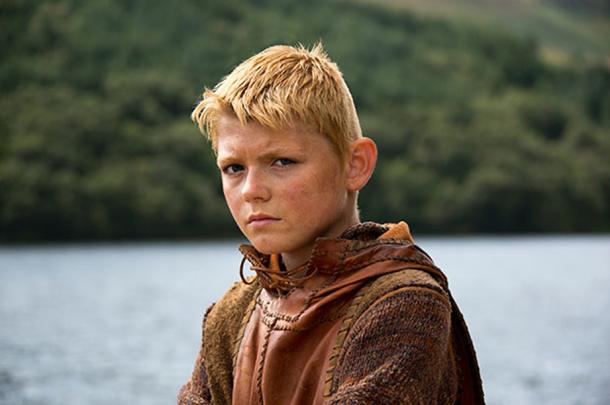
History’s ‘Vikings’ version of a young Bjorn Ironside. (CC BY SA)

History’s ‘Vikings’ version of a young Bjorn Ironside. ( CC BY SA )

Like their father, the sons of Ragnar Lodbrok conducted raids around Europe. In The Saga of Ragnar Lodbrok and His Sons , it is stated that Bjorn Ironside and his brothers continued their father’s raiding activities, and terrorized the areas of England, Normandy, France, and Lombardy.

It is also written that the furthest that the brothers got to was Luni, an Italian town on the border of Liguria and Tuscany. The story goes that the Vikings had heard of the wealth contained in the Eternal City and were bent on raiding it. Therefore, Bjorn teamed up with another Viking leader, Hastein, to launch an expedition into the Mediterranean.

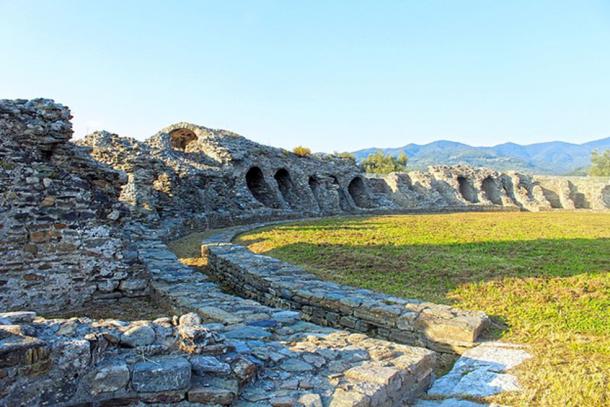
View of the Roman amphitheater in Luni, Italy. (CC BY SA 4.0)

View of the Roman amphitheater in Luni, Italy.

The Vikings sailed along the Atlantic coast of the Iberian Peninsula, though their raids met with little success in both Christian and Muslim territories. When they arrived in the Strait of Gibraltar, however, their luck changed, and they are recorded to have sacked several cities on both the North African coast as well as the southern part of the Iberian Peninsula. Sailing and raiding along the southern coast of the Frankish Empire, the Vikings eventually arrived on the northwestern coast of Italy. The first town that was sacked was Luni, which the Vikings had mistaken for Rome.

Trickery Works Where Sieging Fails
As the Vikings began to besiege Luni, they realized that the town’s fortifications were so sturdy, and foresaw that the siege would drag on for some time. Realizing that it would be futile to try to take the town by brute force, the Vikings resorted to trickery. There are two main versions of the story…

According to one, Bjorn (or Hastein) sent messengers to the bishop of Luni to inform him of their leader’s death. On his deathbed, however, he had converted to Christianity, and it was his dying wish to be buried on consecrated ground. Believing this to be true, the bishop allowed several Vikings to bring the body of their leader into the town. Once they entered Luni, Bjorn jumped out of his coffin, fought his way to the town’s gates, and opened it, thus allowing the Vikings to capture Luni. In a variation of the tale, Bjorn did not pretend to be dead, but rather that he was seriously ill, and intended to convert to Christianity before he died.

Bjorn Ironside Returns North
Having sacked Luni, Bjorn and his Vikings continued inland, sailing up the River Arno, and laying waste to Pisa and Fiesole. The Vikings’ movement become a little uncertain after this, and they are rumored to have sailed to the Eastern Mediterranean.

They reappear off the coast of the Iberian Peninsula, where they are recorded to have been defeated by a Muslim force whilst heading back home. As many as 40 Viking ships are said to have been destroyed by the Muslims, though Bjorn survived, and managed to bring home most of his loot.

Finally, The Saga of Ragnar Lodbrok and His Sons mentions that “Bjorn Ironside got Uppsala and central Sweden and all the lands that belong to that,” Thus, it has been claimed that Bjorn was a king of Sweden, and the founder of the House of Munsö.

During the 18th century, a barrow was discovered on the island of Munsö and antiquarians claimed that it belonged to Bjorn, thus naming his dynasty after this island.

Carruthers crest on flag-v2 (1)

OFFICIAL AND OLDEST SCOTTISH  CLAN CARRUTHERS

 SINCE 1983-CLAN OF OUR ANCESTORS

SCOTTISH CLAN – IRISH CLAN – NORSE CLAN

cropped-wide-banner-with-new-crestnorse


Dr Patricia Carrothers  CHS

CLAN CARRUTHERS  HISTORIAN AND GENEALOGIST

New Blog Banner 05

Preserving Our Past, Recording Our Present, Informing Our Future

Ancient and Honorable Clan Carruthers

   clancarruthers1@gmail.com

You can find us on our main facebook pages at :

SILVER WINGS-https://www.facebook.com/CarruthersClanLLC/

GOLD WINGS – https://www.facebook.com/carrutherscarrothers.pat.9

COPPER WINGS    https://www.facebook.com/ClanCarruthers1/

CLAN CARRUTHERS FAMILY HISTORY – https://www.facebook.com/CarruthersClan

CLAN CARRUTHERS CCIS – https://www.facebook.com/groups/3878691252182714

CLAN CARRUTHERS INT SOCIETY- https://www.facebook.com/groups/394653845137709

CLAN CARRUTHERS – BORDER REIVERS – https://www.facebook.com/groups/434959914239094

Disclaimer Ancient and Honorable Carruthers Clan International Soci
Gutland / Gotland, OUR ANCESTORS, The Viking Age

NORSE MYTHOLOGY IS BIBLE MYTHOLOGY – CLAN CARRUTHERS CCIS

cropped-wide-banner-with-new-crestnorse

NORSE MYTHOLODY IS BIBLE MYTHOLOGY

We have been learning that our own Caratocus was a Christian in 10ad.  The oldest cross and crucifix was found on Gutland, Sweden during an archeological dig.  Maybe this article will explain some of this.

The religion of the early Norse exhibits customs and rituals which bear an amazing correspondence to the religion of the Hebrew Old Testament. Can all of this be just a coincidence, or is there a connection? Here is the interesting evidence.

Does Bible prophecy actually speak to us of the Norse and related peoples of Europe? I believe that it does, and that these peoples are in fact the descendants of the lost tribes of the House of Israel, removed out of their land in Assyrian captivity two thousand seven hundred years ago, and lost to recorded history. As we will see, only the Caucasian peoples who migrated out of Asia into Europe, have fulfilled many of the prophecies in both the Old and New Testaments concerning Israel in the latter days. Let’s begin our study in the one of the foremost prophetic books of the New Testament, Revelation.

In Revelation chapter 12, there appears a spectacular vision which has intrigued Christians for centuries. The vision concerns “a woman.” Bible commentators see this woman as representing Israel, and the vision as prophetic of events which were to take place in world history.

We are told in verse two that this woman, Israel, was about to give birth. The child was none other than Jesus Christ, for we are told in verse five that he was “a man-child, who was to rule all nations with a rod of iron.” It is obvious here that the woman who gave birth to our Savior is Israel, for Christ was born of the Israel tribe of Judah, of the line of David.

The vision expands in verse three. We read, “And there appeared another wonder in heaven; and behold a great red dragon, having seven heads and ten horns…… the dragon stood before the woman which was ready to be delivered, for to devour her child as soon as it was born.” This should remind us of the prophet Daniel’s prophecy of four great beast kingdoms. They were: Babylon & Assyria, Medo-Persia, Macedonia, and Rome. They formed one continuous succession of four beast empires, each one “devouring” or absorbing the previous. Using the year-for-a-day principle of prophecy, the next verse speaks of Israel being attacked and persecuted for 1,260 years by the dragon-beast, a period which ended with the fall of Rome in 410 AD.

Verse six says, “And the woman fled into the WILDERNESS, where she hath a place prepared of God, that they should feed her there a thousand two hundred and threescore days.” Where in Israel’s history do we read of the chosen nation fleeing in dispersion into the wilderness? This occurred when Assyria, the first beast-empire, conquered them in 721 B.C., dispersing them out of Palestine, into the wilderness of Europe. This is the prophetic story of Israel in the wilderness going to a place prepared by God, and it is a fascinating account of how God’s prophecies have come to pass. (745 B.C. to 476 A.D. is a 1260 lunar year period!)

We read of Israel’s dispersion into the wilderness in the Old Testament apocryphal book of II Esdras, chapter 13 and verse 40. Here the prophet Esdras tells us this about their whereabouts: “These are the ten tribes, who were taken captive from their land in the days of King Hoshea, whom Shalmanesar, the King of the Assyrians, led away into captivity and transported them across the river Euphrates. But they decided to leave the multitude of peoples and proceed to a more remote region… The way to that country, which is called Arsareth, required a long trek of a year and a half.”

The Prophet Esdras gave us still another solid clue in tracing Israel’s northern trek when he said that they “passed through the narrow entrances of the Euphrates River.” (verse 43) This refers to the head­waters of the Euphrates, which were toward the north, in northern Mesopotamia. In fact, rivers always flow from north to south in the northern hemisphere.

So we know two things for sure about the land to which the Israelites migrated: it was northward toward the Caucasus and Europe, and it was a remote wilderness. As the late Bible scholar, Dr. Pascoe Goard, has stated, “We know sufficient of the history of all the territory south of the Caucasus to be able to say that they could find no such unsettled land there. But plains, forests and river valleys of Europe still remained which had not even been explored in the days of Herodotus, three and a half centuries later. To that country they took their way.” (“Post-captivity Names of Israel,” p. 35) Remember that Esdras said they traveled to “a more remote region,” a wilderness; and that this journey was a long one over a great distance, requiring “a year and a half” of travel.

Yes, northward from the upper reaches of the Assyrian Empire was the wilderness of Europe, and there is a river Sereth in southeastern Europe even today. Over six centuries after their dispersion, the Jewish historian Flavius Josephus wrote, “The ten tribes did not return to Palestine…There are but two tribes in Asia and Europe subject to the Romans, while the ten tribes are beyond the Euphrates till now, and are an immense multitude.” (Jos. Antiq., Ch. 11, pp. 2,5) The lost ten tribes were no longer in Palestine, and were outside the realm of the Roman Empire. Even though Israel had been hidden in the wilderness for six centuries when Josephus wrote, he informs us that they were an identifiable people and a great multitude which no man could number.

Where else in the annals of history is there a record of nearly an entire nation suddenly converging on a wilderness? Only the migrations of the Anglo-Saxon- Gothic tribes into early Europe, that land “where never mankind dwelt,” (II Esdras 13:41) can fit the picture, and that occurred at the very time that Israel was dispersed and became lost to history. The Angles, Saxons, Celts, and Goths, who overspread Europe, are said to have originated in the region of Medo- Persia, about 700 B.C., the very time and place in which the nation of Israel was lost to history.

The early Christian church noted a remarkable fact: There was a distinct resemblance between ancient Israel’s religion and that of the early inhabitants of Europe. Early Christian writers used the Latin phrase, “Preparacio Evangelica,” meaning that European mythology constituted a good “preparation for the Gospel.” We now know why Norse mythology, Celtic Druidism, and Greek mythology all bear such striking similarities to the Old Testament — it’s simply because these peoples were the physical descendants of ancient Israelites who migrated to Europe in ancient times, bringing deep- rooted traces of their religion with them when they came.

But other amazing parallels exist, as well. There was also an uncanny resemblance to ancient Canaanite religion, since ancient Israel corrupted themselves with that form of worship, according to the Bible account. In addition to that, early European mythology also bears traces of the religious customs of the Babylonians and Assyrians, as you might expect, since these peoples exerted some influence when they brought Israel in captivity out of Palestine. Let’s see how history offers proof of both Biblical and Babylonian influence among the people of early Europe.

6d8db67d1174b2cb96d563598a2e52c9

The central figure of Norse Mythology is the hero known as ODIN. He is believed to be an historic figure, the king who led his tribes northwestward from their former residence in a city called Asgard to their new home in Western Europe. Asgard literally means “city of God,” and perhaps by implication, “the city of God’s people.” Although it has never been identified by archaeologists, it is believed to have been located either in southern Russia or Northern Assyria, placing it in the region where the ten tribes were lost to history. After Odin’s death, his great deeds were expanded until he took on godhood in the folk memory of the people. But it is important to note that the name “Odin” shows unmistakable evidence of a Babylonian origin.

Alexander Hislop in his book, “The Two Babylons,” gives us a definite connection between Odin and the Middle East. ODIN was the great Norse war god. The Assyrians and Babylonians also had a war god known as “ADON,” and the Greeks later had a god named “ADONIS,” as well. The Babylonish Adon was the god of WINE. In the NORSE ELDER EDDA we are told that Odin ate no food but wine: “The illustrious father of armies, with his own hand, fattens his two wolves; but the victorious Odin takes no other nourishment to himself than what arises from the unintermittent quaffing of wine. For ’tis with WINE ALONE that Odin in arms renowned is nourished forever.”

It has also been established that the Norse religion involved worship in sacred groves, which were trees planted to simulate the walls of a temple. The Canaanites, too, had sacred groves for worship, and the disobedient nation of Israel had adopted this form of worship at the outset of their wanderings out of Palestine.

God Balder - God PicturesBut the similarity between middle-eastern and Norse mythology does not end there. One of Odin’s sons in Norse mythology was called, “BALDER,” which Hislop states comes from the Chaldee form of “Baal- zer,” meaning the SEED OF BAAL. Quoting Alexander Hislop, “The Hebrew z, as is well known, frequently, in the later Chaldee, becomes d. Now, Baal and Adon both alike signify ‘master’ or ‘lord;’ and, therefore, if Balder be admitted to be the seed or son of Baal, that is as much as to say that he is the son of Adon; and, consequently Adon and Odin must be the same.”

The name of Odin’s other well-known son is THOR. Again to quote Mr. Hislop: “Now as Odin had a son called Thor, so the second Assyrian Adon had a son called THOUROS (Cedrenus, vol. 1, p. 29). The name Thouros seems just to be another form of Zoro, or Doro, meaning, ‘the seed.’” So, as Professor Hislop points out, Odin’s son, Thor, is an exact parallel to the Assyrian god Adon’s son Thouros. Quite an amazing similarity! (Lexicon, pars 1, p. 93: “The D is often pronounced as Th; Adon in the pointed Hebrew, being Athon.”)

It is extremely doubtful that all of this parallel detail could be mere happenstance. A very definite cultural connection somehow took place between the ancient Assyrians and Babylonians and the early European Norse. Yet another author lends credence to this, the professor Hans Gunther, in his book, “Religious Attitudes of the Indo-Europeans.” He finds much to admire in the Norse mythology, yet is led to admit that, “one perceives in him (Odin) the voice of an alien non-Nordic race.” (page 11) Professor Gunther goes on to associate certain aspects of Norse mythology with Babylon, (page 57)

Yet one more proof of a connection between the Norse and the ancient Canaanites should be noted: the evidence we have of human sacrifice. For although human sacrifice appears to have been unknown in the British isles, it was definitely practised in early days on the continent of Europe by the Celts.

But it is appropriate at this point to show that there are also some undeniably distinct similarities between Norse religion and that of the ancient Israelites. In fact, from the Norse sagas we learn many facts which lead to a comparison of both God, and God in the flesh, Immanuel, Jesus Christ. The tribes of Israel, at the time of their dispersion, would have been familiar with the Old Testament prophecies of a coming Messiah. Many of these ancient beliefs could have remained with them in their traditions after their dispersion from Palestine. So let’s compare Bible prophecies with some of the basic beliefs cherished by the early Norse.

The Norse myths recount a remarkable account of creation, which differs from the Bible in that the flood was said to be caused by the blood of a slain giant. However, in Genesis 6, verse 4, the Bible does speak about the Nephilim, or giants, during the account of the flood. In the Norse account, the world is wiped out in this catastrophe, with the exception of one household who escaped on a skiff or boat, and from whom is descended the new race from which the god Odin came.

Odin is also called the “RAFNAGUD,” or Raven-god, because he is said to have two ravens named Hugin and Munin, which he sends out into the world each day, returning at nightfall to tell him what they observed. Quoting the Norse Elder Edda,

“Hugin and Munin

Fly each day

Over the spacious earth.

Ifear for Hugin

That he come not back

Yet more anxious am I for Munin ”

This bears an unmistakable similarity with the account in Genesis chapter eight of Noah sending two birds out into the world, one of them the raven which Noah was anxious for, because he did not return.

Thor - WikipediaThere are many other interesting legends in the Norse sagas, such as Thor conquering a serpent- monster, while dying in the process. This was prophesied of Israel’s Messiah in GENESIS 3:15, who conquered the serpent’s seed by his own death. Other Norse religious traditions come from the Old Testament, as well. As an example, Odin is referred to as “the law-giver.” This is a title our heavenly father, Yahveh, could well claim, who gave Moses upon Mount Sinai the laws for the nation.

Another important Norse god was LOKI, the author of all evil, who was said to be of a swarthy complexion and originated in a land to the south. This may well be Israel’s remembrance of the Edomites of Palestine. An interesting parallel exists between Loki, who is said to lead the forces of evil in the last great battle in Norse mythology, and the Edomites of Bible prophecy at the end of the age. In Ezekiel chapters 36 to 39, in the last great battle, the Edomites are prominent in the forces of evil which come against God’s Israel.

The number twelve also must have been held in sacred significance to the Norse, for we read in the book, “Germanic Origins,” that Odin arrived in Svithoid, or Scythia, with twelve chief priests. The presence of these twelve priests corresponds representatively to the twelve original tribal patriarchs of Israel.

Early Norse scholar, Snorri Sturluson, translator of many ancient Scandinavian legends, compiled the HEIMSKRINGLA, OR HOME CHRONICLES. He says that just before Odin died he let himself be marked or wounded with a spear-point and that he was the owner of all men slain with weapons, and would go to Godheim (the world of the gods) and there welcome his friends. The comparisons with the Bible are again unmistakable. The Old Testament contains over one hundred prophecies relating to the coming of our God in the flesh, our “Immanuel,” or “God with us.” We find many of these in Norse mythology transferred to the character, Odin. In our Bibles we read that our coming God was to be SACRIFICED, (Zechariah 13:7), that he was to be PIERCED (Zechariah 12:10), but would have NO BROKEN BONES (Psalm 34:20, and Exodus 12:46 where Passover is a type of Christ). And whereas our Savior was sacrificed on the tree (in 1 Peter 2:23, the word translated “cross” literally means a tree) for nine hours (Psalm 22 and Matthew 27:46), Odin is said to have hung on a tree for nine days. Compare those Bible prophecies with these lines from the Norse Elder Edda:

“I know that I hung

On a wind-rocked tree

Nine whole nights,

With a spear wounded

And to Odin offered

Myself to myself; ”

The Norse legends prominently refer to the end-times. They say that in the end of the world a great battle called Gotterdammerung, or the “Twilight of the gods,” will take place between the forces of good and evil. In this great battle, all of the forces of good will be killed except for one called the “All-father.”

This brings me to my most important point. “Bulfinch’s Mythology” states that “the Scandinavians had an idea of a deity superior to Odin, uncreated and eternal,” which they called the Alfadur or “ALL-­FATHER.” For although the Norse mythology allows for a pantheon of gods, yet only ONE GOD is said to be immortal. Thor, Odin, and the others I have mentioned are mortal and die at some point in the sagas.

But above Odin was said to be the one eternal true God – unnamed except to be called the “All-father,” meaning the “ever-lasting father,” as he is called in our Bibles in ISAIAH 9:6 and other places. In the original language of the Old Testament, God’s name was YAHVEH, which Ferrar Fenton translates as meaning, “the Ever-Living.” The Norse called the All­father’ by no other name, believing that his personal name was too sacred to be spoken, although they apparently didn’t have any record of what that name was. Compare this with the actions of the few Israelites of the House of Judah who returned to Palestine and removed God’s name, YAHVEH, from our Bibles, believing it too sacred to be spoken. Yes, I am convinced that although the Norse mythology was corrupted with the religion of Assyria and Canaan, yet the proofs are there that they were indeed “the people of the Book.”

Carruthers crest on flag-v2 (1)

OFFICIAL AND OLDEST SCOTTISH  CLAN CARRUTHERS

 SINCE 1983-CLAN OF OUR ANCESTORS

SCOTTISH CLAN – IRISH CLAN – NORSE CLAN

cropped-wide-banner-with-new-crestnorse

Dr Patricia Carrothers  CHS

CLAN CARRUTHERS  HISTORIAN AND GENEALOGIST

New Blog Banner 05

Preserving Our Past, Recording Our Present, Informing Our Future

Ancient and Honorable Clan Carruthers

   clancarruthers1@gmail.com

You can find us on our main facebook pages at :

SILVER WINGS-https://www.facebook.com/CarruthersClanLLC/

GOLD WINGS – https://www.facebook.com/carrutherscarrothers.pat.9

COPPER WINGS    https://www.facebook.com/ClanCarruthers1/

CLAN CARRUTHERS FAMILY HISTORY – https://www.facebook.com/CarruthersClan

CLAN CARRUTHERS CCIS – https://www.facebook.com/groups/3878691252182714

CLAN CARRUTHERS INT SOCIETY- https://www.facebook.com/groups/394653845137709

CLAN CARRUTHERS – BORDER REIVERS – https://www.facebook.com/groups/434959914239094

Disclaimer Ancient and Honorable Carruthers Clan International Soci
OUR ANCESTORS, The Viking Age, Uncategorized

WHEN ENGLAND WAS PART OF A VIKING EMPIRE – CLAN CARRUTHERS CCIS

cropped-wide-banner-with-new-crestnorse

WHEN ENGLAND WAS PART OF A VIKING EMPIRE


EVERY PERSON YOU READ ABOUT IS A CARRUTHERS ANCESTOR, INCLUDING WINSTON CHURCHILL IN THE SOURCES


The Saga of Ragnar Lothbrok refers to London as “the finest city in Scandinavia.”  This seems like quite a mistake, considering London is the capital of England and sits on the east coast of Britain.  However for the skalds who composed the old saga, London was indeed in Scandinavia, for England was once part of a Viking empire. 

This part of English history is almost always glossed over or simply not mentioned at all. The tidier narrative is that Vikings invaded Britain in the 9th century, quickly knocked down most of the Anglo-Saxon kingdoms, but were eventually halted by the founder of England, Alfred the Great.  Most history books are silent on what happens after that, before picking up the national story with the Norman Conquest in 1066.

But the whole story is a great deal more complicated.  England was indeed a part of a large North Sea Empire founded by Vikings long after Alfred’s death.  This does not diminish the accomplishments of Alfred and the English. Instead, the whole story helps us to appreciate how complex the reality of England is.  Read on, and it will soon all make more sense.


Back Story: The Great Army, Alfred, and their Legacy

A massive host of Vikings descended upon the kingdoms of Britain around the year 865.  According to the sagas, this army was led by the sons of Ragnar Lothbrok, seeking revenge for their father, who had been executed in a pit of vipers.  The historical and archaeological records do not commit to the saga narrative. Still, they state the Great Army was made up of Vikings from all over the north, who were suddenly united under tremendously effective leadership, and were remarkably successful.

To make a very long story short, the young ruler of the last Anglo-Saxon kingdom, Alfred of Wessex, stopped the Vikings and forced them into a lasting truce.  A border or “DMZ” was marked at the old Roman road, then known as Wattling Street.  The Vikings got the northeast of Britain, and the Anglo-Saxons got the southwest.

More waves of Vikings would try their luck at taking the whole of Britain, and Alfred would spend the rest of his days trying to make his enlarged kingdom Viking-proof.  His efforts to unify and defend his people earned him the title Alfred the Great.

After Alfred’s death, his son, Edward, and his daughter, Aethelflaed, worked to retake much of the land lost to the Vikings.  It would not be until the time of Alfred’s grandson, Aethelstan I, that the Vikings would be decisively defeated.  The borders of England were set to more-or-less their current form at the Battle of Brunanburh (937).  This is often thought of as the birth of a bona fide English nation.

This is not to say that all the Vikings in England just got up and left.  The northeast of Britain had become (and in some ways continues to be) distinctly Danish in character. Though these descendants of Vikings were more prone to farming than raiding, they still retained much of their culture and identity.  Viking Sea Kings like Erik Bloodaxe, Sihtric One-eyed, and Olaf the Shoe (Amlaíb Cuarán) often ruled their domains from York.  Essentially, the north was still Viking … and English at the same time.


Aethelred the Unready

Aethelstan, the grandson of Alfred and the hero of Brunanburh, only knew two years of peace after that great battle.  He died young around 939 and left his newly unified kingdom to his brother.  A few successful rulers followed, but a few decades later (978), a young king named Aethelred II came to the throne.  Aethelred (or Ethelred) was nowhere near the ruler his predecessors had been and was known even in his own time as Aethelred the Unready (also known as Ethelred II or Aethelred the Un-counseled).

Smelling weakness, the Vikings, Scotts, and Irish again began raiding England.  But while King Alfred had been ready to use arms, diplomacy, and Danegeld (bribes) to manage the Vikings, Aethelred only threw money at the problem.  Under Aethelred, the English paid vast quantities of silver to the Vikings, but so ineffective was Aethelred’s leadership that he sometimes broke the treaties this silver bought. 

In a final act of weakness, Aethelred the Unready ordered a massacre of all the Danes that could be caught, whether they be Viking marauders, traders, or even settlers.  This atrocity took place on Saint Brice’s Day, 1002.

Recently, archaeologists have found mass graves in Weymouth and Oxford dated to 975-1025.  Each contains the skeletal remains of up to 50 decapitated Vikings.  DNA analysis of these remains reveals that the victims were from Scandinavia, Iceland, Russia, and the Baltic.  The term “Danes” in English sources, as always, is a catch-all term for Vikings.  It is possible that these mass graves date to the Saint Brice’s Day massacre of 1002.  If so, it is likely but one of many others that lay undiscovered.

Aethelred’s bad decisions were compounding, though.  One of the massacre victims was a woman named Gunnhild, the wife of a Danish chief and the sister of none other than Svein Forkbeard. Of course, Vikings would never ignore such a brazen and cowardly act.  The murder of Svein’s own sister made retaliation inevitable. 

Sweyn Forkbeard: Warrior, King, and Slayer of Harald Bluetooth – BaviPower

Svein (Sweyn) Forkbeard

In the mid-tenth century, much of Denmark, Norway, and Sweden, were united by the great king, Harald Bluetooth.  Yes, this is the same Harald Bluetooth that Bluetooth technology is named for. However, Harald’s estranged son, Svein Forkbeard, led an open rebellion against his heavy-handed father starting in the late 970s.  Harald died or was killed sometime during that civil war.  After that, Svein became King of Denmark, though Norway and Sweden had already taken advantage of the instability and went their own way.

Svein Forkbeard was a powerful and charismatic leader who had already proved himself highly skilled in war.  Whether to take advantage of England’s disarray, avenge his people’s slaying, or both, Svein launched a series of attacks on England starting in 1004.  These culminated in a full-scale invasion of England in 1013.

The Vikings landed in the center and swept north, using the support of the entrenched Danish population there to quickly secure the area.  They then turned their attention to the wealthy southwest and the seat of Anglo-Saxon power.

 The dramatic conclusion of Svein’s invasion took place in London in the winter of 1013-1014. Svein Forkbeard’s forces assailed an English army supported by Viking mercenaries under Svein’s former ally, Thorkell the Tall.  This battle was the likely origin of the children’s nursery rhyme, “London Bridges Falling Down,” for the fortified bridges of London (like Paris before it) were crucial for resisting the Viking longships.  And yes, some elements of our collective culture really are that old (and older).

Svein Forkbeard won the day.  Aethelred the Unready fled to his wife’s family in Normandy.  Svein was crowned king, and for that brief moment, held England and Denmark along with parts of Norway and Sweden.  Svein Forkbeard was the most powerful man west of Byzantium.  He was no longer just a king … he was an emperor.

But life is uncertain, and this was especially true for the 11th century.  Svein only reigned in England for about five weeks before he suddenly died.  The English immediately recalled Aethelred the Unready (supporting his revered dynasty more so than the man who had so often failed them).  The reinvigorated English drove Svein’s son, Knut (or Canute), back to Denmark. 

The Vikings were not so easily scared off from what had been one of their most significant accomplishments, and Knut re-invaded England in 1015.  Aethelred also soon died and was replaced by his dynamic son, Edmund Ironside. 

Who was Canute, the viking who ruled England

Knut the Great


Edmund Ironside was a great warrior, charismatic leader, and heroic king.  But fate was not on his side, and he was up against one of the most successful Vikings of all time.  Knut scored a decisive victory over Edmund’s English in 1016, and the scion of Alfred died of wounds he sustained in that battle.

For the second time in two years, the crown of a united England was in the hands of a Viking. To underscore his legitimacy and emphasize that he was there to stay, Knut married Aethelred’s widow, Emma of Normandy. This move (bizarre and grim to the modern eye) was a 10th-11th century convention, with examples from Ireland to Russia.  The marriage of Knut to Emma was also to prove fateful.  It was partially on the grounds of this union that William the Conqueror would base his claim to the English throne half a century later.   

Circumstances continued to favor Knut.  Norway and other lands his father Svein had once controlled soon fell under his dominion, mainly through peaceful means.  His reign was long (almost 20 years), relatively tranquil, and prosperous. The effectiveness of Knut’s rule was even more evident by the disarray of the rest of western Europe at that time.  The death of Brian Boru in Ireland (1014) and the feebleness of the Capetian dynasty in France meant that Knut was almost peerless.  As his boundaries extended and his peace continued, he became known as Knut the Great.  Knut ruled his North Sea Empire primarily from England through it all, continuously presenting himself as “a true Christian monarch in the European style” (Price, 2020, p. 472).  His English and Norwegian subjects probably never loved him. Still, they eagerly accepted the stability he brought and the goodwill he was always eager to display.  


The Legacy of Knut the Great

Knut died in 1035.  He left several sons, including his successor by Emma, Harthacanute. Unfortunately, Knut’s heirs could not match their father’s political or military ability. As a result, the North Sea Empire quickly fell apart. Nevertheless, the urgency to rebuild it would serve as an impetus for many ambitious men over the following decades.  In 1066, both William the Conqueror and Harald Hardrada probably saw themselves as the heir to this tradition of a unified northwestern Europe.  

As for Knut’s memory, sources differ dramatically.  Almost everything from Knut’s lifetime is favorable (though much of it is deliberate propaganda, perhaps). In England, he was considered a good king, a patron of the Church, a generous and wise man, a lawgiver, and a law follower.  We are told Knut even disbanded his Viking bodyguard, entrusting himself to his English subjects. 

In Norse sources, such as the Heimskringla, a fuller picture emerges, with Knut displaying cunning, violence, and vindictiveness characteristic of the most ruthless rulers.  Later English folk tradition – perhaps embarrassed that their proud nation was dominated by a foreigner – turned on the man altogether.  They portray him in ridiculous tales recycled from old stories of Rome’s hated emperor, Caligula.  One of these paints Knut as a mad king, standing on the beach and commanding the waves not to roll up on shore. 

More often, though, Knut the Great is forgotten entirely – a footnote on the wrong side of history.  The legacy of a Viking England exists more in the fine print: for example, in Shakespeare’s Hamlet when the Danish prince is sent to England to “collect our long-neglected tribute.”

As Knut is connected to the foundations for 1066, he is a part of all of England’s remarkable history since that time.  Moreover, the legacy of the Vikings in England would prove to be inseparable from the nation itself.  Winston Churchill would later remark on the many contributions to England’s laws, legislature, industry, warfare, and its very personality that the Viking settlers would perpetually contribute.  He wrote, “the tribulations of [the years] had not reduced the strength of their original character, nor their attachment to the conquered soil.  All through English history, this strain plays a gleaming part” (1956, p. 111).  


Carruthers crest on flag-v2 (1)

OFFICIAL AND REGISTEREDL CLAN CARRUTHERS CCIS SINCE 1983-CLAN OF OUR ANCESTORS

SCOTTISH CLAN – IRISH CLAN – NORSE CLAN

Preserving Our Past!    Recording Our Present!  Informing Our Future!

The Ancient and Honorable Carruthers Clan CCIS

CLANCARRUTHERS1@GMAIL.COM

WIDE BANNER with NEW CREST


CLAN CARRUTHERS INT SOCIETY CCIS HISTORIAN AND GENEALOGIST


You can find us on our main facebook pages at :

SILVER WINGS-https://www.facebook.com/CarruthersClanLLC/

GOLD WINGS – https://www.facebook.com/carrutherscarrothers.pat.9

CLAN CARRUTHERS FAMILY HISTORY – https://www.facebook.com/CarruthersClan

CLAN CARRUTHERS CCIS – https://www.facebook.com/groups/3878691252182714

CLAN CARRUTHERS INT SOCIETY- https://www.facebook.com/groups/394653845137709

CLAN CARRUTHERS – BORDER REIVERS – https://www.facebook.com/groups/434959914239094

Disclaimer Ancient and Honorable Carruthers Clan International Socie

References

  1. Sir Winston Churchill. A History of the English Speaking Peoples: Book 1, the Birth of Britain. Reprint by Barnes and Noble. USA. 1993.
  2. Rodgers, D. & Noer, K. Sons of Vikings. KDP. The United States. 2018.
  3. Price, N. Children of Ash and Elm: A History of the Vikings. Basic Books, New York, 2020.


Gutland / Gotland, OUR ANCESTORS, The Viking Age, Uncategorized

DANI,ANI,SWITHEUDI,THURINGI AND AESIRS – CLAN CARRUTHERS CCIS

cropped-wide-banner-with-new-crestnorse

Dani, Switheudi, Thuringi and Aesirs

Dani, Switheudi, Thuringi and Aser

Dani, Switheudi, Thuringi and Aesirs were in all probability four groups of related people, who originally came from Asia, few in numbers.

At Tryggevælde Å (river) near Himlingøje, Valløby and Varpelev in Eastern Sjælland a number of large burial mounds have been excavated and many objects that differ significantly from the contemporary Iron Age culture’s other findings have been found. In addition, mound funerals had not been seen in Scandinavia since the first half of the Bronze Age; they were a marked break in tradition. These mounds are dated to around 200 AD, and one may assume that the represent Dani. One can imagine that they first arrived in Scania and drove the Heruls away from there. That could have taken place around 200 – 300 AD or even later.

Noble men and women have for generations been buried in large burial mounds at the Tryggevælde River with treasures such as unique silver cups, neck rings, pearl necklaces, game pieces and Roman-made cups and glass drinking horns and much more – but no weapons. Around the mounds have been found their servants and service people in more modest graves – with few or no grave goods.

Women's tomb from Himlingøje from around 200 AD. In front of the woman are seen gold jewelry and her long necklace

Women’s tomb from Himlingøje from around 200 AD found in 1949 and exhibited in the National Museum. In front of the woman are seen her gold jewelry and a long necklace with different colored beads. – Photo: Kulturjagt i Køge Bugt.

There have been noted a striking similarity between the graves at the Tryggevælde River and graves and grave goods in Thuringen and southern Saxony from the same time. It is also suggested that the Danish -lev in village names is connected to -leben in village names in Thuringen. It’s pretty likely that Dani and Thuringi were related people.

If Switheudi and Dani were of the same descent, and Dani and Thuringi were closely related peoples so all three people have been related. It is somewhat unsatisfactory for this theory that Jordanes also mentions Sweans, which are of a different race. The author has no certain knowledge, but he believes that Switheudi and Sweans are identical.

Ynglinga Saga says: “Sveigde became king after his father. He made the promise to search for Gudehjem (Gods’ Home – English: Gotham) and Odin the Old. He traveled with 12 men widely around the world; he came to Turkland and Great Svitjod and found there many kinsmen. On this journey he was away for five years, then he came back and stayed home for a while. He was out in Vanaheim and got a wife, who was named Vana; their son was named Vanlande.”

Findings from Fyn compared to
finds from Thuringen

Findings from Haagerup on the island of Fyn (1) compared with findings from Leuna in Thuringen (2). In the gold finger ring from Haagerup sits an onyx stone, and in the ring from Leuna sits a carnelian, but both are adorned with a Mercury motif. The Funen on is of Roman origin, while the South Germany one is producing outside the Roman Empire. Other examples of similarities include silver spoons, glasses and silver bowls. – From Gyldendals og Politikkens Danmarks Historie 2 by Lotte Hedager.

In Old Uppsala in Sweden, there are three large burial mounds and several smaller mounds from the Late Iron Age of similar size, as the mounds at the Tryggevælde river originally must have been. Two of the large mounds contained very rich cremations graves with royal power symbols from the 500s AD.

The Eastern mound contained a 12-year-old boy and a woman; the boy’s equipment included a warrior helmet, a gold decorated single-edged sword and a bronze mirror. In the West mound, there were a man and a woman; the man’s equipment included among other things a warrior helmet decorated with carved stones, a double-edged sword with gold hilt and probably a scepter. Following Snorri Sturlason the Ynglinge lineage was the royal family of the Svears, and Old Uppsala was their burial ground.

But as the Swedish mounds are from around the year 500 AD and the Danish are from around the year 200 AD it sounds unlikely that the Dani descended from Swedes, as it is said. One has to expect that ancestors lived before descendants.

Reconstruction of grave at Valløby south of Koege

Reconstruction of a grave at Valløby south of Køge. The deceased is a man, who is laid to rest with a rich equipment of silver goblets, glass and bronze vessels. The excavation in the 1800’s showed that the grave had been covered by a stone surrounded mound, as shown on the drawing over the existing mound with a dashed line. Drawing by Magnus Petersen 1873.

Snorri says in the introduction to Ynglinge Saga that “in the land east of the Tanakvisl (River Don) lay a castle, called Asgård. The chief of the castle was called Odin, and it was a great offer place for the Gods. Odin was a great army man, who travelled far around and won himself many kingdoms.” – “But because Odin was visionary and skilled in magic, he knew that his descendants should live and build in the Northern part of the world. Therefore he set his brothers Ve and Vilje in charge Asgård, but himself departed with all his dianes (?) with him and many other people. First, he headed west to Gardarige (Russia) and then south to Saxland; He had many sons, he won himself a kingdom over much of Saxland and set his sons to rule the country. So he headed against north to the sea and settled on an island, it is now called Odinsoye on Fyn,” which must be Odense, which city also has Odin’s name.

The burial mounds in Gamla Uppsala

The mounds in Gamla Uppsala – Photo Wikipedia.

There is no direct intelligence to that the Asia men, who settled on the island of Fyn, were related to Switheudi, Dani and Thuringi. But Snorri lets Odin continue to Sweden, where he became the Ynglinge lineage’s actual ancestor, and that is suggesting that there was a relation.

Game pieces of bone found in a man's grave in Varpelev from the end of the 200's

Game pieces of bone found in a man’s grave in Varpelev near Køge from the end of the 200’s – Photo: Kulturjagt i Køge Bugt.

It’s all quite speculative, but one can think that Thuringi means descendants after Thor, Thornings, so to say, in the same way as the Ynglings were descendants after Yngve. Snorre lists Odin’s ancestors in his preface to the Edda: “His famous ancestor was Thror, whom we call Thor, his son was Loridi, his son was Ejnridi, his son Vingethor, his son Vingener, his son Moda, his son Magni, his son Seskef, his son Bedvig, his son Atra, his son Itrmann, his son Heremod, his son Skjaldun called Skjold (shield), his son Bjaf, his son Jat, his son Gudolf, his son Finn, his son Frallaf and he had the son Vodin who was Odin.” Which must mean that Odin and his men, who settled on the island of Fyn, also regarded themselves as descendants of Thor, which one can think that Thuringi and probably Dani and Switheudi also did.

Dolichocephalic woman skull from Varpelev Stevns

Dolichocephalic woman skull from Varpelev Stevns. From “Danmarks Oldtid” by Johannes Brøndsted.

Many skeletons in graves in Denmark from precisely about 200-300 AD show that the deceased were quite tall and long skulled. Thus, one of the deceased in Himlingøje had been close to 180 cm tall. The historian Palle Lauring wrote about Dani’s ethnic characteristics: “The striking many dolichocephalic skulls in the graves have been associated with the coming of the Danes, and it is worth to emphasize that the particularly long-headed appearance pretty quickly disappear from the graves again and is replaced by roughly the same situation as before. It is distinctive upper-class tombs, and we must not forget that precisely with the Danes’ conquest of the land it is about their upper class, that is a very narrow group of bloodlines, perhaps only a few families, who probably have been so inter-married that a common appearance can be understood.”

Two silver cups from Valløby at Tryggevælde

Two silver cups from Valløby at Tryggevælde Å on Stevns. This is not Roman style, the cup’s design must represent a culture that Dani had with them when they came – from Asia. Photo: verasir.dk.

Snorri’s preface to the Edda tells us why this characteristics appearance rather quickly disappeared again: “The Aesirs took wives there in the country; some married their sons with local women. All these blood-lines were so numerous that they spread all around in Sax-land and all the northern countries, so that their, the Asian men’s, tongue became the real language of these countries. Thereof, as their ancestors’ names are recorded, it is thought that it can be believed that these names have followed with this tongue and that the Aesirs have brought them with them to the northern countries, to Norway and Sweden, to Denmark and Sax-land.” – Snorre exaggerates undoubtedly the Aesirs’ linguistic influence, as Scandinavian and German still today are Germanic language, resembling Gothic, but it is most likely true that the Aesir’s have made an important contribution to the Nordic countries’ language.

Thuringia quickly was conquered by the Franks. Gregory of Tours tells how: “So he (King Theodoric) summoned the Franks, and said to them: “Be angry, I beg of you, both because of my wrong and because of the death of your kinsmen, and recollect that the Thuringi once made a violent attack upon our kinsmen and inflicted much harm on them. And they gave hostages and were willing to conclude peace with them, but the Thuringi slew the hostages with various tortures, and made an attack upon our kinsmen, took away all their property, and hung youths by the sinews of their thighs to trees, and cruelly killed more than two hundred maidens, tying them by their arms to the necks of horses, which were then headed in opposite directions, and being started by a very sharp goad tore the maidens to pieces.”

The Uppaakra beaker

The Uppaakra cup from Uppaakra south of Lund in Scania. The cup is 165 mm. high. It is decorated with six relief band of gold in Nordic animal ornamentation style I. It is believed that the decoration on the cup is a further development of the decorations on the cups found at Tryggevælde on Sjælland. Photo: Bengt Almgren, Lund.

“And others were stretched out upon the city streets and stakes were planted in the ground, and they caused loaded wagons to pass over them, and having broken their bones they gave them to dogs and birds for food. And now Hermenfred has deceived me in what he promised and refuses to perform it at all. Behold, we have a plain word. Let us go with God’s aid against them.” They heard this and were angry at such a wrong, and with heart and mind they attacked Thuringia.”

But Thuringi did not follow the contemporary rules of fair warfare: “And the Thuringi prepared stratagems against the coming of the Franks. For they dug pits in the plain where the fight was to take place and covering the openings with thick turf they made it seem a level plain. So when they began to fight, many of the Frankish horsemen fell into these pits and it was a great obstacle to them.”

But the Franks won as always: “When finally the Thuringi saw that they were being fiercely cut to pieces and when their king Hermenfred had taken to flight, they turned their backs and came to the stream Unstrut. And there such a slaughter of the Thuringi took place that the bed of the stream was filled with heaps of corpses, and the Franks crossed upon them as if on a bridge to the further shore. After the victory was won they took possession of that country and brought it under their control.”

Grave gifts found in a
woman's grave at Kirkebakken in the village Aarslev on Fyn

Selection of grave goods found in a woman’s grave woman’s grave at Kirkebakken in the village Aarslev on Fyn about 1820. In addition to several bronze dishes, bronze buckets and silver spoons the dead woman got several unique pieces of jewelry to the grave, including seven pendants with lion masks pressed in gold, semiprecious stones and clothes pins of silver. It’s interesting that they knew this animal, lion. From Gyldendal og Politikkens Danmarkshistorie 2.

In Ynglinge Saga we get some information about Switheudi’s or Swear’s culture: “Odin made it law in his countries, which previously had been law among the Aesirs. Thus he ordered that they should burn all the dead and carry their belongings into the fire with them, he said that so much fortune should each one come to Valhal with, which he had got with him on the pyre, and what he himself had dug into the ground, should also be beneficial for him. The ash they should carry out into the sea or dig into the ground. In remembering of brave men they should build a mound to their memorial, and after all men, who had been menfolk to some degree, they should erect bauta-stones, and this custom was followed long after. By winter-day they should make sacrifices for good year, by midwinter for growth and fertility, but by summer-day only for victory. All over Svitjod people paid tax to Odin, one penny for each nose, but he had to defend the country from strife and unorder and make sacrifices for them to a good year.” – “Odin died from disease in Svitjod, but when he was near death, he let himself mark with spearhead and stated that all men, who died from weapons, should belong to him.”

Carruthers crest on flag-v2 (1)

OFFICIAL AND REGISTEREDL CLAN CARRUTHERS CCIS SINCE 1983-CLAN OF OUR ANCESTORS

SCOTTISH CLAN – IRISH CLAN – NORSE CLAN

Preserving Our Past!    Recording Our Present!  Informing Our Future!

The Ancient and Honorable Carruthers Clan International Society LLC

CLANCARRUTHERS1@GMAIL.COM

WIDE BANNER with NEW CREST

CLAN CARRUTHERS INT SOCIETY CCIS HISTORIAN AND GENEALOGIST

You can find us on our main facebook pages at :

SILVER WINGS-https://www.facebook.com/CarruthersClanLLC/

GOLD WINGS – https://www.facebook.com/carrutherscarrothers.pat.9

CLAN CARRUTHERS FAMILY HISTORY – https://www.facebook.com/CarruthersClan

CLAN CARRUTHERS CCIS – https://www.facebook.com/groups/3878691252182714

CLAN CARRUTHERS INT SOCIETY- https://www.facebook.com/groups/394653845137709

CLAN CARRUTHERS – BORDER REIVERS – https://www.facebook.com/groups/434959914239094

Disclaimer Ancient and Honorable Carruthers Clan International Socie