Gutland / Gotland, The Viking Age, Uncategorized

CLAN CARRUTHERS- TJELVARS

CLAN CARRUTHERS INT SOCIETY CCIS                  PROMPTUS ET FIDELIS

cropped-wide-banner-with-new-crest.jpg


A Bronze Age Burial Steeped in Legend: What Makes the Ship-Shaped Tjelvar’s Grave Unique?


Gotland, Sweden’s largest island, is home to medieval churches, cathedral ruins, as well as numerous pre-historic sites. The archaeological and historical sites that pepper this land make up a timeline of Gotland’s past.

One such site is known as Tjelvar’s grave. It is a ship-shaped stone setting found on the eastern coast of the island. Sites of this type can be found all over Scandinavia, they are typically dated to the early Viking Age, circa the late 8th century AD.

The “ship” has the length of 18 metres and a width of 5 metres. Nearby are also the remains of two Iron Age forts. From Slite drive south on the road 146 towards Gothem and look for the signs on the right hand side of the road.

However, Tjelvar’s grave can be dated all the way back to pre- Bronze Age, predating the other sites by nearly 2000 years. From the Bronze Age to the Viking Age, to our present age, this style has been resurrected and replicas continue to be built around Gotland and Scandinavia.

When excavated in the 1930’s the robbed cist revealed some cremated bones and pot sherds. The earliest skeleton found on Gotland so far has been dated to 8000 years ago.

The legend of Tjelvar being the first to discover Gotland has been interwoven with the existance of this Bronze Age ship burial site over the millenia. Just north of Aminne you pass through Tjälder and a few hundred metres further north take the gravel lane west towards Bäl and Bjärs. The site is approximately 2 kilometres down this lane. References: Riksantikvarieämbetet Fornsök: Boge 28:1; Site 66 Tjelvar’s Grave.

Since ancient times, Gotland has been the obvious link between the present and the past. Everywhere on the island you can still find traces from hundreds of years back in time. Gotland is a modern destination with a fascinating living history in a world heritage site.


Preserving Our Past, Recording Our Present, Informing Our Future

Ancient and Honorable Carruthers Clan Society International

carruthersclan1@gmail.com      carrothersclan@gmail.com

cropped-wider-banner-light-blue-1.jpg


MARK STEWART    LONDON ENGLAND

Clan Carruthers Int Society CCIS  Historian and Genealogist

You can find us on facebook at :

https://www.facebook.com/carrutherscarrothers.pat.9

https://www.facebook.com/CarruthersClan/

https://www.facebook.com/CarruthersClanLLC


Gutland / Gotland, Uncategorized

CLAN CARRUTHERS-ENGLISH TREASURE ON GOTLAND

CLAN CARRUTHERS INT SOCIETY  CCIS                                    PROMPTUS ET FIDELIS

cropped-wider-banner-light-blue-1.jpg


English Treasure on Gotland


And Irish treasure And Frankish treasure. And German treasure. And Arabic – most especially Arabic.

Through the Carruthers DNA studies, the Genetic Genealogist have shown us that our CTS DNA genome has shown up in two large waves of coming ashore in England and Scotland.  We are sure there have been more, but it takes a lot of money for testing.  One wave was in the middle to late 450 AD, in Winchester or Cinchester,   Dunbarton and along the Clyde River, and on the east coast of Scotland, around 850 AD.

The Carruthers Historians along with Mark Stewart, and Douglas Stewart, have shown possible travel routes between Scotland and Ireland for these same time periods.
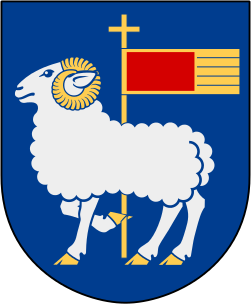
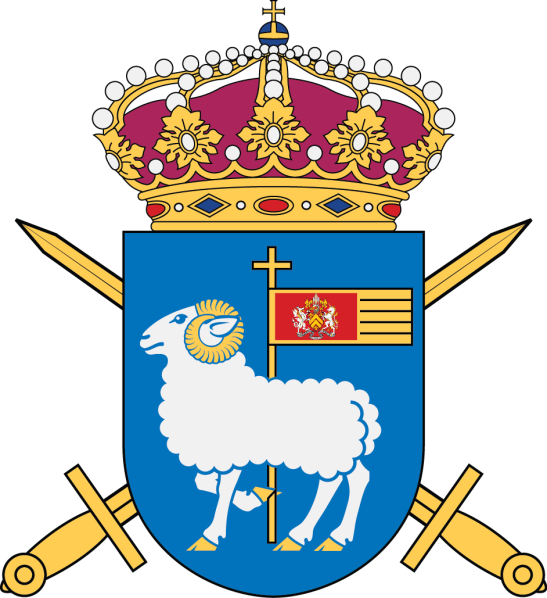
Gotland vapen


Gotland coat of arms; sheep, called
on Gotland “lamm” have always
been important to the local economy


More than 700 purposefully assembled collections, or hoards, of silver treasure have been found on the Baltic island of Gotland, most deposited in the ground for safe keeping during the Viking age (9th through mid-11th centuries).

A few of these hoards are of unequalled size, including the largest ever found. The Spillings Hoard, unearthed by a farmer in his field in north-eastern Gotland in July 1999, contains more than 14,300 silver coins, and much silver jewellery: hundreds of armlets, and numerous finger rings, as well as silver ingots, coils of rolled silver, and hack-silver, pieces of broken jewellery and cut-up coinage.

The Spillings Hoard was buried under the floorboards of a farmhouse about 881 CE, as the latest coin is dated to then. The house quite possibly was that belonging to a metalsmith – always a prosperous member of society in medieval times – judging by the other metal remains found on site. The earliest coins in the hoard are 6th c Sasanian. The vast majority of the coins are Arabic dirhams, not brought to the island as plunder but rather through the extensive trade around the Baltic basin that connected Gotland with the Silk Road and its fabled riches of silk, furs, and spices. The area where the Spillings Hoard was found abounded in well-to-do savers; a hoard was found in the same field in 1883 and numbered 5,922 coins.
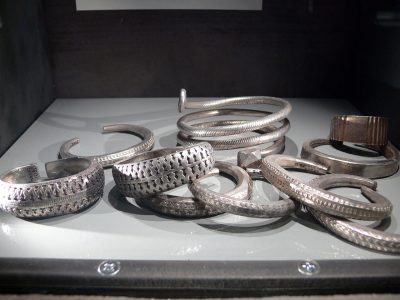
Fornsalen - Silberschatz von Spelling

Gotland is an island 109 miles long and 32 miles wide in the Baltic sea, and today is home to some 58,000 residents. An independent nation until captured by the Danish King Valdemar Atterdag in 1361, Gotland did not become part of Sweden until 1645.
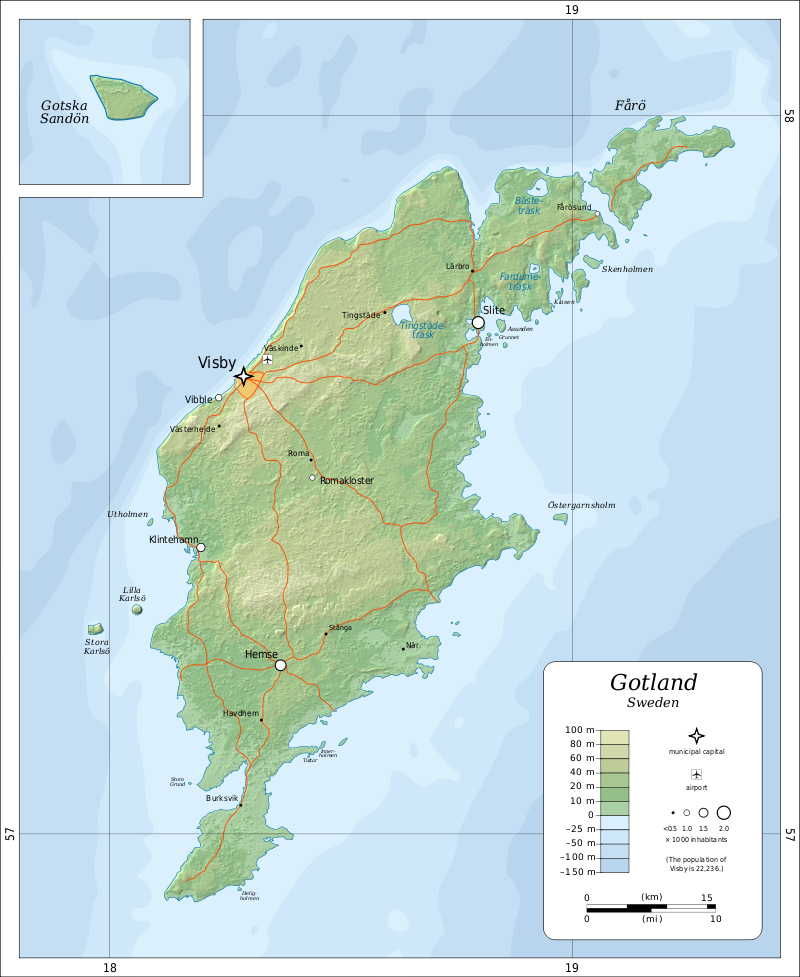
Topographic map of Gotland

The walled capital city of Visby, on the eastern coast, grew immensely rich in the later middle ages as part of the Hanseatic League, leaving it and all of Gotland dotted with impressive medieval buildings, including the 94 parish churches it is justly famed for.
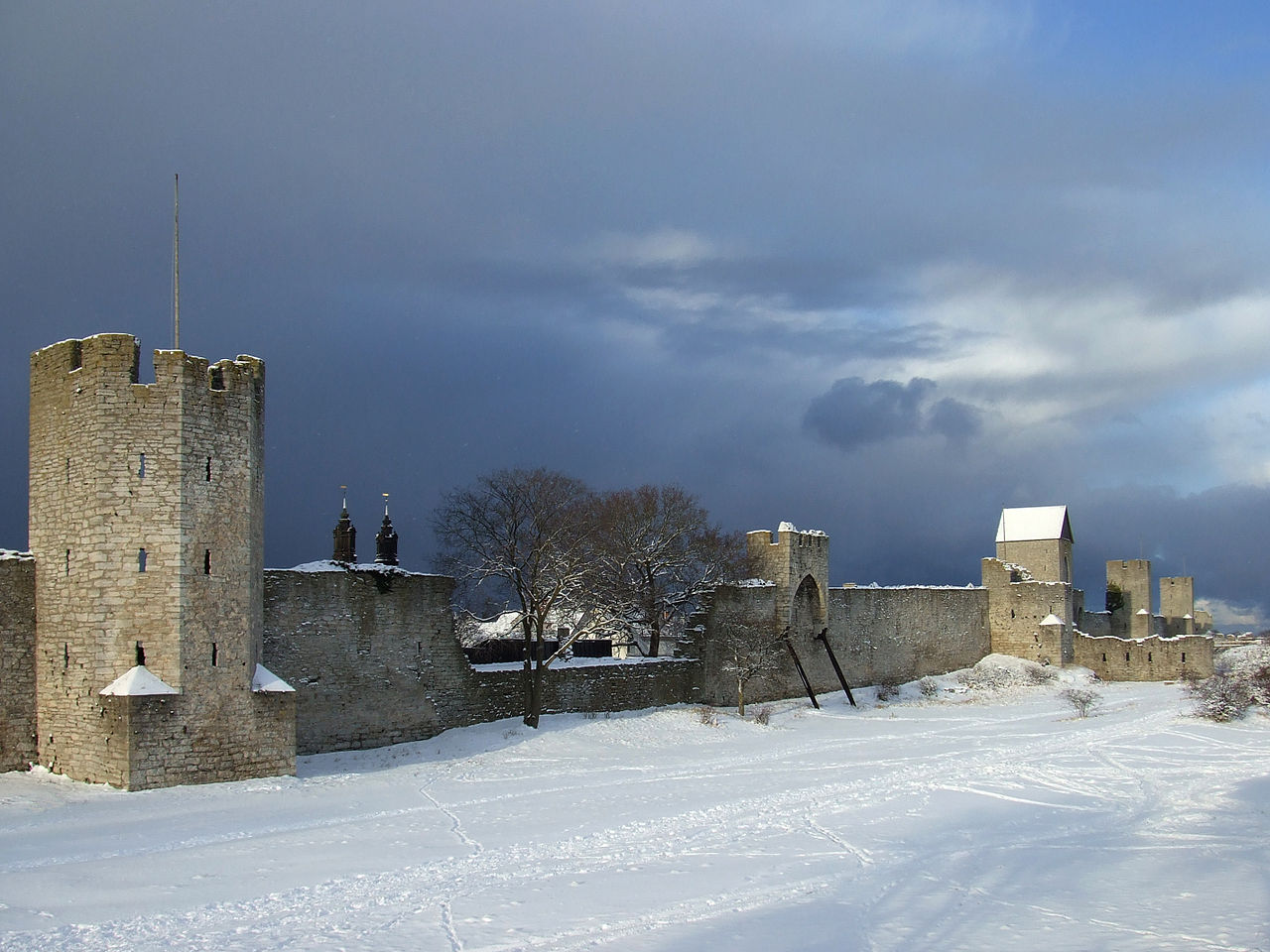
Visby ringmur östra delen norrut

It is a place of exceptional beauty, its extensive coast and many inlets dotted with rauk – wind- and water-swept limestone rock formations – and blessed with the sunniest location of all Sweden. The name “Gotland” – Gutland in Gutnish, the original language of the settlers, is “Goth-land”, land of the Goths. Although the official language politically is Swedish, Gutnish is still spoken amongst some residents, although sadly barely survives in written form. Swedish friends living and studying on Gotland tell me that when they overhear Gutnish it is unintelligible to them, so distinct a language it is.

Nearly 200,000 old coins have been found on Gotland, including more late Anglo-Saxon coins than have been found in Britain itself. Yes: more late Anglo-Saxon coins have been found on this small distant island than in England itself. Many of these English coins were almost certainly plunder, and from the payment of thousands of pounds of danegeld (the payments paid by Anglo-Saxon rulers to stave off the predations of the Vikings). But the Gotlanders themselves were not “Vikings” – they were prosperous and peaceful farmers and traders, highly independent, pragmatic, and successful. Gotland’s location in the Baltic Sea made it perfect for trading runs across to the eastern and southern shores, where tribes such as the Polanie, Pomerani, and Prus ran Summer trading posts. These connected to trade routes heading further East deep into Russia, South to present day Iraq and Uzbekistan, and West to the great trading towns of the Svear (Swedes) such as Birka, and Aros (Aarhus) of the Danes.

The Spillings Hoard, along with much more treasure and examples of Gotland’s famed standing memorial stones, are on view in Visby at the Gotlands Museum. An excellent book is available on the Hoard: The Spillings Hoard: Gotland’s Role in Viking Age World Trade, Visby, Gotlands Museum, 2009.
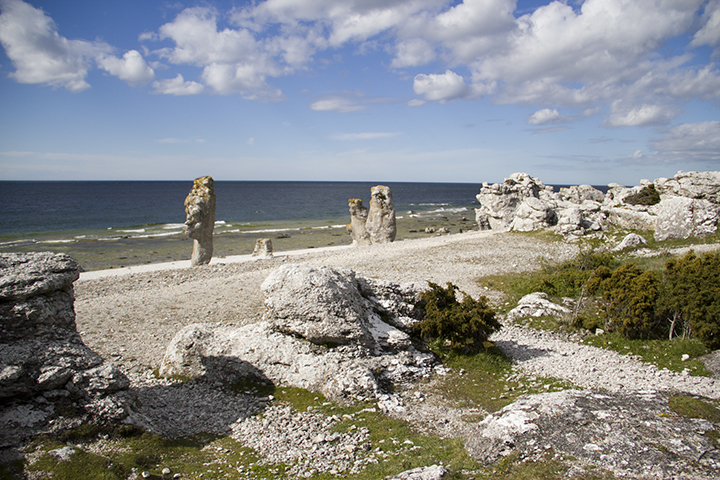
 

Fårö Rauk (limestone sea-stacks) at Langhammar


Preserving Our Past, Recording Our Present, Informing Our Future

Ancient and Honorable Clan Carruthers Int Society CCIS  LLc

carruthersclan1@gmail.com              carrothersclan@gmail.com

cropped-wider-banner-light-blue-1.jpg


Octavia Randolph


You can find us on facebook at :

https://www.facebook.com/carrutherscarrothers.pat.9

https://www.facebook.com/CarruthersClan/

https://www.facebook.com/CarruthersClanLLC


Disclaimer Ancient and Honorable Carruthers Clan International Society CCI

The Viking Age, Uncategorized

LET’S SEE IF RAGNAR LOTHBROK WAS REAL..

cropped-wide-banner-with-new-crest.jpg

LET’S SEE IF RAGNAR LOTHBROK WAS REAL..

Ragnarr Loðbrók, to give his name the proper spelling, has become America’s favorite badass Viking, thanks to the History Channel’s exciting series, “The Vikings.” But who was he really? Dr. Elizabeth Ashman Rowe has the answers. Rowe is University Lecturer in Scandinavian History of the Medieval Period at the University of Cambridge in England and author of a scholarly study published in 2012, Vikings in the West: The Legend of Ragnarr Loðbrók and His Sons. 

In the preface, she writes: “The Viking king Ragnarr Loðbrók and his sons feature in a variety of medieval stories, all of them highly dramatic.” In a French version, he is a noble king in Denmark, father of a fearsome Viking who ravages France. In an English story, he “wickedly inflames” his three sons with envy for the English King Edmund, provoking the Danish invasion of England and Edmund’s martyrdom.

Snorri Sturluson, subject of my book Song of the Vikings, wrote one of the 32 known Icelandic tales about Ragnarr. To Snorri, Ragnarr was famous as the first Norwegian king to keep a court poet, or skald. He was “the conqueror who established the definitive boundaries of the Scandinavian kingdoms,” Rowe writes, “and the symbol of the ancient heroism that would be eclipsed by the new heroism of the Icelanders.”

Concludes Rowe, “In short, Ragnarr and his sons were ciphers to which almost any characterization could be attached”–as the History Channel has effectively proved.

Was there a real Ragnarr Loðbrók? Rowe says no: “I do not think that there was ever a historical figure known as ‘Ragnarr Loðbrók.’” Mostly it’s the nickname she’s leery of, noting that “the deeds and fate” of an “extraordinarily ferocious” Danish Viking known as Reginheri, who attacked Paris in 845, hanged 111 Christians, and died of illness soon afterwards, “may have given rise to stories about someone named Ragnarr, but there is absolutely no contemporary evidence that he was nicknamed Loðbrók.”

He didn’t get his nickname until after he died–Loðbrók first appears in two sources, one Icelandic and one from France, in about 1120–and there are several explanations of what it means.

An English writer in about 1150 said it meant “loathesome brook”–just what it sounds like.

But in Old Norse, the nickname would have been understood as “hairy breeches” or “shaggy trousers.” The Icelander who wrote Ragnar’s Saga in the 13th century explained that Ragnarr got his nickname from the pants he put on to protect himself when fighting a poison-breathing serpent (or dragon): cowhide pants boiled in pitch and rolled in sand.
Professor Rowe has a better explanation. As I’ve mentioned, the real Ragnarr Loðbrók, the ferocious Reginheri, died of illness soon after attacking Paris in 845. And not just any illness. Reginheri died of dysentery. As one account in Latin explains, after Ragnarr returned to the Danish court of King Horik he suffered terribly from diarrhea: “diffusa … sunt omnia viscera ejus in terram” (which Rowe helpfully translates: “all his entrails spilled onto the ground.”)

Concludes Rowe: “I suggest that it was a similar report–one describing his diarrhea in terms of his feces-stained breeches–that gave rise to the posthumous nickname loðbrók. Ragnar’s Saga’s explanation ot the nickname loðbrók as derived from garments boiled in pitch comes startlingly close to reality, for one can imagine an onlooker at the court of King Horik telling someone later that Reginheri’s breeches looked black and sticky, as though they had been boiled in pitch.”

MORE INFORMATION ON THE CONNECTION OF RAGNOR AND THE CARRUTHERS CAN BE VIEWED AT : https://clancarruthers.home.blog/2021/02/05/clan-carruthers-ragnar-lodbrok-van-danemark/

PRESENTLY THIS IS A PASSWORD PROTECTED SITE, ONLY AVAILABLE TO CLAN CARRUTHERS CCIS VIP SOCIETY MEMBERS.  IF YOU WOULD LIKE MORE INFORMATION ON OUR VIP SOCIETY PLEASE WRITE TO US AT CARRUTHERSCLAN1@GMAIL.COM

Carruthers crest on flag-v2 (1)

CLAN CARRUTHERS CCIS – SINCE 1983

Preserving Our Past, Recording Our Present, Informing Our Future

Ancient and Honorable Clan Carruthers Int Society CCIS LLc

carruthersclan1@gmail.com

COAGRAYwide

DR PATRICIA CARROTHERS

TAMMY WISE CHS

CLAN SEANACHAIDHI

CLAN CARRUTHERS INT SOCIETY CCIS HISTORIAN AND GENEALOGIST

You can find us on facebook at :

https://www.facebook.com/carrutherscarrothers.pat.9

https://www.facebook.com/CarruthersClan/

https://www.facebook.com/CarruthersClanLLC

Disclaimer Ancient and Honorable Carruthers Clan International Society