


Gutland / Gotland, The History of Gutland, The Viking Age

CLAN CARRUTHERS CCIS-BEOWULF AND THE GUTA SAGA

cropped-wide-banner-with-new-crest.jpg

CONNECTING BEOWULF AND THE GUTA SAGA


In 2017 Clan Carruthers CCIS started part 2 of the Carruthers DNA projects.  For almost 15 years people have been contributing their DNA samples to make connections.    We took that data, and other data people had, to see where it took us.  At this point we found Forensic DNA would give us what we need, with a price of $800.00 – $1500.00 per test.  
 
We were interested in the Scottish line, but the Genetic Genealogist told us we were connected to the Beowulf Vikings.  Here we are 4 years later working on the Norse DNA project. 
 
There is something called the Beowulf epos, from the beginning of the 500s, which is the oldest known Germanic epos, by some regarded as the Germa-nic-speaking peoples counterpart to the Greek Iliad and Odyssey.
Historians and linguists have tried in various ways to interpret and t the epic
into the Swedish history without much success. However, it is now proven that it has its home in the Gotlandic history. Together with the Gotlandic picture stones and Guta Saga the Beowulf epos
constitutes Gotland’s nest historical records.
 The Gotlandic picture stones indicate intensive contacts with the literary world of the time. From these sources you can also read the historical relationship between the Gotlanders and they in the beginning of the 500s immigrating Heruls (Svear). The Beowulf epos is the ancient Germanic world’s great epic poem. 
 
According to professor Björn Collinder: “The Beowulf Epos argues well its place among epics in world literature. And it contains lyrical passages of great beauty”. ”A fastidious reader discovers in the Beowulf epos some contradicto-ry details. But the contradictions are not worse than those found in the Gospels and the Acts.”
 
“The Beowulf epos contains much that is difficult for contemporary people to
understand. The Epos writer could make do with hints when it came to events and inherited legends which were renowned for his audience. ”“To understand and appreciate the Beowulf epos we must put ourselves in the ancient Germanic view on life and death, danger and glory, and it should not be entirely impracticable.
Since several people, who figure in Beowulf, are also mentioned in other independent tales, we must assume that they are historical, and if so should the rest of the characters also be historical. From Gregory of Tours reference in Historia Francorum, we know that Hygelak died in battle in Friesland about the year 521. Although we have no other source that says that Beowulf has lived, it should still have been so. His name was probably not Beowulf but, according to Collinder, rather Älf-here (Alvar, Avair). He is the prototype of a Scandinavian hero, stronger and braver than any of the fighters of his time and wiser than most, and he is a good king, with all that it implies.
 The Sagas refer briefly to the wars between Gotlanders and Danes, and Gotlanders and Frisians, between Skilngs (Svear) and Danes, the Danes and Frisians and Danes and Heathobards. The only conflict told in detail is between Gotlanders and Skilngs (Svear),
 which is described in a story inside another story. Interestingly, in the verses 2472- 2473 it says: “There was hostility and strife
between Skilfings (Svear) and Gotlanders, discord and violence across wide
 waters.”
 
beastofgotlandmen

 We can now connect Beowulf with the Guta Saga
“Many kings fought against Gutland while it was thought to be heathen; the Gotlanders, however, always held the victory and constantly protected their rights. Later the Gotlanders sent a large number of messengers to the Svear, but none
of them could make peace before Avair Strabain from Alva. He made the first
peace with the king of the Svear. When the Gotlanders begged him to go he answered: “you know that I am now most doomed and ill-fated. Grant me then, if you wish me to expose myself to such peril, three wergilds ( “Mansbotwergild’, fines according to the old Nordic law was paid by a murderer or his kin to the slain family, which then declined to exact blood vengeance”), one for myself, a second for my begotten son and a third for my wife.’ Because he was wise and skilled in many things, just as the tales go about him. ”Beowulf has historically been dated to the beginning of the 500s.
 
 The battles between the Svear and Gotlanders should have been in the first
half of the 500s. Procopius information that the Heruls (Svear) would have
immigrated to the Lake Mälar area about the year 512 .
 
By comparing the various testimonies I have dated Avair Strabain to mid 500s.
In the Beowulf epos the geographical framing is Denmark and the land of the
Geats (older source Geta) Gotland. The main characters are Beowulf and to some extent, his uncle Hygelak, Rex Getarum.
 
The story begins by describing
the monster Grendel who haunts the Danish king. Then it tells how Beowulf decides to help the Danish king and makes his way on a two-day voyage across
the open sea, after which he kills Grendel. The story continues to talk about the wars between the Geats and the Svear, who are still at that time not known
as Svear but Skilfings, and ends with a description of the death of Beowulf
 when he tried to rob a grave
 
In the story it is presupposed that the audienceis familiar with contemporary history. Many people and events mentioned in
 This by wide waters has been difcult for previous researchers to explain as
they have not been aware that this was with the Gotlanders. However, if we talk about Svear and Gotlanders it falls completely natural. In addition, it says in verse 2954, when the Svear talk about the Gotlanders: “toresist the men from the sea.”
 

 Thus the audience was expected to know how Hama some hundred years earlier and in another part of the world had stolen the Brisinga jewel from the Gothic King Ermanarik. This suggests that the Geats stood in close relation to the Goths. Even the
Goths’ rich culture has given the Gotlanders a lot of new injections, reflected
in the Gotlandic society, when the Goths moved on to the Black Sea.
 
The archaeological and linguistic testimony suggests that the Goths, the oldest name is Gutans and their kingdom Gutthiuda, had close relationship with the Gotlanders. In addition, we must not forget that the Gotlanders, along with the tribal kinsmen the Ostro-goths were Christians of the Arian faith, and that parts of their bible are now preserved in Uppsala, the Silver Bible. It is therefore very likely that  Gotlanders were familiar with Christian doctrine already at this time. Even, according to several archaeologists, some contemporary burial customs on Gotland suggest Christian elements. It is interesting to note that the Bible was translated into Gotlandic by the Goths 1200 years before it was translated into Swedish. Since the Beowulf poem holds quite some Christian expressions
and thoughts, it did not fit into the idealized image of the Swedish pre-Chris
tian times that among others, Tegnér tried to produce. This should be a cause to the poor circulation of what we then thought was a Swedish epos. The Heruls (Svear) had at their immigration early 500s the Æsir belief and would therefore be promoted as ‘barbaric’. The archaeologist Gad Rausing has attacked the problem with Beowulf and the Geats in a very conscientious way. He has, as probably the only researcher,
actually traveled ‘Beowulf’s way’ and identied the geographic characteristics. He has published his findings in Fornvännen 80 (1985) . Already Grundtvig, Danish cultural personality from 1783 to 1872, guessed at
the time that the Geats in the Beowulf epos could be the same as the Gotland-ers. ( *** We now know that they are DNA matches ) Since he did not elaborate on this assumption and did not come with good reasons for this conclusion, other scholars regarded it as uninteresting. It was at that time the scholars had decided that the Geats ought to be the Götar in Västergötland. However, some scholars protested to this Västgöta position as it clearly says in the Beowulf epos that the battle between Svear and Geats occurred over open water and the Geats also were called the men from the sea. As we know, there are not any open water between the Lake Mälar area and Skara in Västergötland. We have, however, vast waters between Gotland and the Lake Mälar area.
 
210881934_1091563418036508_62323767751641818_n


“The lay of Beowulf describes the court of king Hrothgar, who resided in
the largest and most magnicent of halls, who rewarded his warriors with golden rings and with magnificent arms, among which ring-swords are specifically
mentioned (verse 2042), in terms which suggest the Roman Iron Age or the Migration Period.
 
 Apparently the Sköldunga kings had conquered Denmark some generations
earlier and the dynasty appeared well established when an enemy, Grendel, attacked. “So Grendel became ruler”. The war lasted for a long time, twelve years being mentioned. Finally Beowulf, with fourteen companions, came from  Geatland to Hrothgar’s aid. The description of his voyage and of his landfall is quite clear: Away she went over the wavy ocean, boat like a bird, breaking seas, wind-wet-ted, white-throated, till the curved prow had ploughed so far – the sun standing right on the second day that they might see land loom on the skyline, then the shimmer of cliffs, sheer fells behind, reaching capes.
 
Apparently they sailed across the open sea, making their landfall as planned onthe second day out on a coast of high white cliffs with capes reaching far outinto the sea. Modern commentators have always found this description incom-
patible with their ideas of Danish geography and topography, the site of He
orot usually thought to have been Leire, far inland from a coast conspiciouslylacking in cliffs and headlands.Few commentators, if any, have been sailors familiar with northern waters and
few, if any, appear to be familiar with Danish topography. The passage has been
taken to be a late addition to the saga, since it appears to describe a crossing
of the North Sea and a landing beneath the white cliffs of Dover. Actually, the
passage proves that the waters crossed were not to have been the Channel, andthus strongly suggests that the poem was not composed in Britain.
Either you cross at Dover, where the Channel is narrow and the crossing a
matter of hours, even in an open row-boat, to land beneath the famous cliffs,or you cross elsewhere, either north or south of the narrows, where the passagemight require two days, but where there are no white cliffs.
Can any conclusion be drawn from the actual distribution of the Danish archa
eological material of the Iron Age, in conjunction with the geographical features described in Beowulf? Obviously, mere map-reading is not good enough.
 
For any conclusion to be valid the observations must have been made in the
field or at sea. The geographical features being seen as Iron-Age man saw them,
on foot, from horse-back or from a comparatively small, open boat.
In Denmark, the richest burials of the early Iron Age are concentrated in the
southern part of Lolland island. This concentration of wealth probably mar-ked the political center of the country or, at least, the territory of the politically and economically dominant families.
In the Later Roman Iron Age, the fourth and fifth centuries, the rich burials
 were concentrated in south-east Sjaelland, with Himlingøje as the type locality, with seven ‘royal’ mounds and a great number of rich burials without mounds. There is a number of rich cemeteries in the area, such as Valløby, Varpelev and others. The same district, centering on Stevns, appears to have remained the
richest part of Denmark all through the Migration Period, 500s and 600s. At
least, it has yielded the greatest number of gold objects of this period, inclu-
ding the largest of all gold rings known from Denmark, found at Hellested on
Stevns. The numerous paved roads and fords which cross the valley and thestream almost separating Stevns from the rest of Sjaelland also indicate that thearea was of special importance, nothing similar having been found anywhereelse in Scandinavia. The center of economic and, probably also of political
power shifting from Lolland to east Sjaelland may have been caused by the first appearance of the Danes in the country. According to the sagas, they came
from central Sweden, where they can be traced in many placenames, such as
Dannemora, Danderyd and even Danmark, now a parish in Uppland.
 
Beowulf is silent on this point, even though Hrothgar only belonged to the
fifth generation of the Sköldunga family, (i.e.the fth generation after the con-quest?) and ve generations cover no more than 100-150years.
 
However, the riches described do t what we know of economic conditions on Stevns in late
Roman Times or in the early part of the Migration Period. Everything suggests that, at this time, the royal residence had not yet been moved to Leire but was still somewhere in southeast Sjaelland. The description of Beowulf’s landfall and of his subsequent march to Heorot leaves little doubt:… the shimmer of cliffs, sheer fells behind, reaching capes. A coastguard, usually posted on these cliffs, met the hero on the beach and accompanied him and his companions to Heorot. Paved Roman roads being still in use in 700s England, there would have been no particular reason for mentioning them, had the poem been composed in that country.
 
Denmark was different. There, paved roads of Iron Age date are few indeed,  

and there is but one single area in Scandinavia, corresponding to the description: high white cliffs jutting into the sea, a neighbouring beach for landing, a paved road leading to the royal residence of late Roman times or of the early part of the Migration Period: Stevns Klint in Denmark. The white chalk cliffs of Stevns rise straight out of the sea, more than 40 m high, facing east. Behind them stretch down, bordered in the west by a river valley about 500 m wide, running almost the whole way from Køge Bay to Faxe Bay, separating Stevns peninsula from the rest of Sjaelland. This valley and its river is crossed by a number of prehistoric paved roads and fords, those at Varpelev, Elverhøj, Harlevand Kari-se I dating from the end of the Late Roman Iron Age and the beginning of the
Migration Period.
 
Down one of these marched Beowulf and his companions
on their way to king Hrothgar.“There was stone paving on the path that brought the war band on its way.” This passage also proves that the scene can not have been set on Rügen, the only other place where white chalk cliffs face the Baltic Sea, since it lacks the paved roads and the rich Iron Age of Beowulf’s tale.
 The description fits the picture of the Iron Age settlement pattern outlined by
Nylén, a situation where sea-borne attacks might be expected at any moment and where, in consequence, farms and settlements were always at some distance from the shore 
 
But what conclusions can be drawn as to the land of the Geats, Beowulf’s country? As mentioned previously, the account of the voyage has been taken to describe a crossing of the North Sea and a landfall in Britain. The factual evidence of the saga having been thus disposed of, the land of the Geats could be located anywhere in south Sweden or in Denmark and it has even been suggested that the waters separating the land of the Geats from that of the Swedes might have been lake Vänern and the lakes of central Sweden.  But if we accept the description of the actual voyage, with the wind directions prevalent in the South Baltic Sea in early summer, and the time stated, a different explanation appears more plausible.
 
Apparently, Beowulf made his land fallon the second day out from the land of the Geats. It is expressly stated that he used sail. There is no indication as to the size of the ship. However, since the band comprised but fifteen men, the vessel must have been quite small, nothing
to compare with the Nydam boat or with the Sutton Hoo ship. The Nydam vessel, some 25 m between perpendiculars, and close on 18 m on the waterline,
appears to have had fifteen pairs of oars. The minimum crew must then have
been 62 men, two watches of 30 oarsmen and one helmsman each.
 
 The Sutton Hoo vessel appears to have had 20 pairs of oars, and consequently a minimum crew of 82.Beowulfs vessel must have been very much smaller, presumably a square-rigged boat with 3 pairs of oars, with an overall length in the order of 10 m. Such a boat would have had a waterline of about 7-7.5 m. The distance from Cape Hoburgen, the southern tip of Gotland, around the southern tip of Öland and Utklippan island, between the Hammers of Scaniaand of Bornholm, the latter a high cape visible from a great distance, and onwards, along the Scanian coast but largely out of sight of it, to the cliffs at Stevns, is 229 nautical miles. For this distance to be covered in 48 hours, an average speed of no more than 4.8 knots is required, well within the capability of a Gotlandic sixern (tremänning) of today in the prevailing fresh easter lies of early summer ,
 
However, when returning home, Beowulf is reported first to have sighted the
“cliffs of the Geats”, probably cape Hoburgen and the ”raukar” at its foot.  If Beowulf calculated his landfall as do modern sailors, i. e. from the moment
the 36 m high Hoburgen sank into the sea to the moment he raised 40 m high
cape Stevns and his eye-level, in an open boat, was about 2 m above the water-line, his sailed distance was no more than 198 nautical miles and the required average speed no more than 4.1 knots. It thus appears likely that the island of Gotland was the land of the Geats. Today, the natives of Gotland, in high Swedish the ‘Gotlänningar’, call them-selves ‘Gutar’.
 
 
In the early Middle Ages, the spelling of Guta lagh, the Gotland Law, proves the pronunciation to have been “Gutar”, without “au” diphtong. This has been taken to prove that the name “Geats” can not have referred to the Gutar but only to old norse ‘gautar’, modern high swedish ‘götar’, the peo-ple by the ‘Gautelfr’ in modern Västergötland. This may be true – but we do not know how Beowulf himself pronounced the word written ‘geat’. This spelling, which indicates a diphtong, is recorded from the Beowulf manuscript, whereas the Liber Monstrorum, also from an Anglo-Saxon scriptorium but older by 200 years, has ‘Getae’, without a diphtong. The scribes spelled the names as they, themselves, pronounced them, in their own local dialect. We can not draw any conclusion as to how the Geats of the early sixth centu-ry pronounced their name or that of their country from the way west-Saxonscribes of the eighth and tenth centuries spelled them.In Scandinavia, summer nights are very short and never quite dark. Even so, in
the days before light-houses, any prudent sailor would schedule his passage soas to pass cape Öland, Utklippan and the Hammers in daylight.
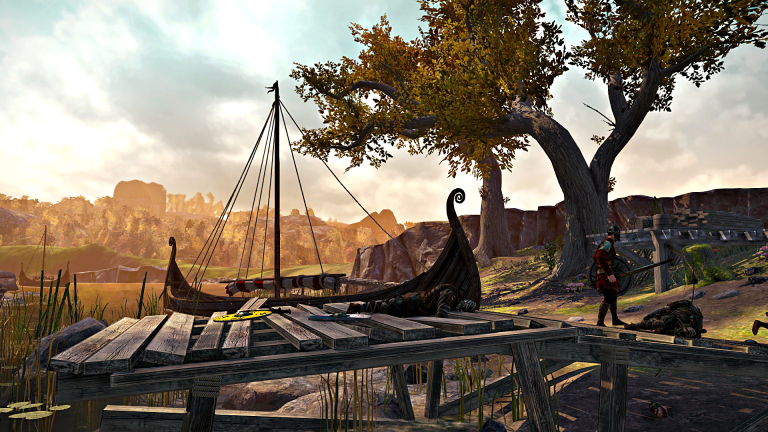
 
2396504-ss_warofthevikings.1920x1080.004_0
 
This means setting out from cape Hoburgen in the late afternoon, spending the rst night at
sea between Gotland and Öland, passing cape Öland and Utklippan in daylight, with a second night between Utklippan and the Hammers, passing the latter in the early morning hours and making a landfall at Stevns in the afternoon of the second day, at the expected time, “the sun standing right on the second day”. There are numerous large mounds and cairns on Gotland, mostly dating from
the Bronze Age. However, Ugglehaug in Stenkyrka parish dates from the Migration period and so probably also do the mounds at Havor in Hablingbo and
a few others, all of a size to compare favourably with the contemporary royal
mounds of Sweden, those of the Ynglinga kings, thus testifying to the power and wealth of the families who built them. There are but three kinds of men: the living, the dead and those who sail the
sea. After his final battle, lying mortally wounded on Earnanes, the cape of the
eagles, the childless Beowulf felt no ties to the living. He chose to rest where his monument could be seen from afar and where he would be remembered by his equals, those who sailed the sea, rather than being buried inland, close to the settlements, as was the usual custom. He ordered young Wiglaf.
Bid men of battle build me a tomb fair after fire, on the foreland by the sea
that shall stand as a reminder of me to my people, towering high above Hronesnes so that ocean travellers shall afterwards name it Beowulf’s barrow ,bending in the distance their masted ships through the mists upon the sea. Today, one of the southern parishes on Gotland is named Rone. Beowulf’s‘Hronesnes’ has been taken to be derived from Anglo-Saxon ‘hron’, whale. This word is not known from any other Germanic language. Although whalingis usually associated with the Atlantic, until recent times it played a very import-ant part in the economy of south Scania, of Öland and of Gotland. The dolphins, (Phocaena phocaena, L.) who enter the Baltic Sea in spring and leave in the autumn, were netted by the thousands. Their meat, fat, bone and hides were all utilized.
 
 The derivation of the name ‘Rone’ is not known. It appears as ‘Ronum’ and‘Rone’ in the fourteenth century (Karl Inge Sandred, pers. comm. 10.2.1984).It may be no more than a coincidence, there being no linguistic evidence either way: can possibly ‘Rone’ be derived from ‘hron’ as ‘the place where dolphinsare caught?’ It is suggestive that a hill on the next headland to the north, now called cape Nabbu, called Arnkull, Eagle Hill.
Carruthers crest on flag-v2 (1)

Preserving the Past, Recording the Present, Informing the Future

Ancient and Honorable Carruthers Clan Int Society 

carruthersclan1@gmail.com     carrothersclan@gmail.com

cropped-wide-banner-with-new-crest.jpg


Tore Gannholm

Reviewed by Tammy Wise CHS- Indiana USA

CLAN SEANACHAIDHI

CLAN CARRUTHERS INT SOCIETY CCIS HISTORIAN AND GENEALOGIST

You can find us on facebook at :

https://www.facebook.com/carrutherscarrothers.pat.9

https://www.facebook.com/CarruthersClan/

https://www.facebook.com/CarruthersClanLLC

Disclaimer Ancient and Honorable Carruthers Clan International Society
 

I

 
Gutland / Gotland, The Viking Age, Uncategorized

CLAN CARRUTHERS-WARRIORS OATHS TO THE CHIEF / KING

CLAN CARRUTHERS INT SOCIETY CCIS                        PROMPTUS ET FIDELIS

cropped-wider-banner-light-blue-1.jpg


Warriors’ Oaths To The Chief / King


Like rulers elsewhere, the Viking age king or jarl had warriors in his service, serving in a similar role to the High Medieval knight. Modern scholars have noted that Germanic kings from antiquity through the Viking Age collected about them a group of such warriors, often referred to using the Latin term comitatus, which might be translated as “war-band.”

In Old Norse, the term for the leader of such a war-band was dróttin, while the term for the war-band itself was drótt. The members of the comitatus were called húskarlar, “house-carls”, especially those found in King Knut’s Danelaw forces as described in Þingliði (Foote and Wilson, p. 100; Barfod, p. 717). Other terms used to describe members of a comitatus included O.N. drengr (“warrior member of a ship’s crew”) and O.N. þegn (“mature man, seasoned warrior”). The conduct of the comitatus was termed drenskapr in Old Norse, meaning “the ideal of conduct for warriors, roughly equivalent to the ideal of chivalry” (Foote and WIlson, pp. 425-426).

King from the Lewis ChessmenIf the leader of the comitatus was a powerful noble, such as a king or a jarl, the war-band might then be called a hirð in Old Norse (Foote and Wilson, p. 101; Bagge). The hirð had a special ceremony of reception for new members and held regular meetings, which functioned as a court of law for its members and as a council advising the king (Bagge). By the 12th and 13th centuries, there were three groups within the Norwegian hirð: the hirðmenn (“men of the hirð“); the gestir (“guests”), who served as a royal police force; and the kirtisveinar, young men who served as pages (Bagge). From the hirðmenn came the officers of the hirð. The highest officer of the hirð was the stallari (literally “marshall”) who served as the king’s champion and also as a sort of general of the comitatus forces. The second ranking officer in the hirð was the merkismaðr (standard-bearer) (Bagge; Foote and Wilson, p. 103). Ranking after these officers were the lendir menn, the “landed men”, equivalent to barons, and then finally the body of warriors who made up the bulk of the hirð (Bagge). The relationship between the king and his hirðmenn was based on a contract or reciprocal oath, and the king’s hirð was usually dissolved upon his death (Bagge).

It should be noted that the comitatus, dróttin or hirð was a fairly small, elite band. The Vikings did not maintain standing armies: when it was needful, a levy was called up of free men and farmers. The kings and jarls instead maintained only their small group of core troops between wars. Confusion on this topic is rampant, in large part due to chroniclers’ tendency to wildly exaggerate the numbers of enemy armies and the tally of the dead (Evans, p. 27). The size of the comitatus is put into sharp perspective when one examines the law code of Ine of Wessex at 13.1, which states:

Ðeofas we hatað oð VII men;
from VII hloð oð XXXV;
siððan bið here.

A party of armed men numbering less than seven are thieves;
between seven and thirty-five are a band;
more than that is an army.
(Attenborough, p. 41; Evans, p. 27)

Within the comitatus, the Germanic ruler’s primary duty was to lead his warriors in battle. The literature records that the ideal ruler was the foremost warrior and best of the men in the war-band (Cherniss p. 39). This idea gave rise to descriptions such as Old English cyning-bald which means “very brave” but literally reads “royally brave, brave as a king” (Klaeber, glossary s.v. cyning-bald, p. 314). As Stephen Evans notes:

The major duty of a Germanic or Celtic lord was the conduct of warfare, in which he was expected to take an active part. The lord of a comitatus was expected not only to fight, but to fight with a great deal of martial prowess. At least during his younger years, a lord was expected to be one of the most formidable and valiant warriors of his warband.
(Evans, p. 50)

This appears to have been true for Germanic kings and lords back into antiquity, since Tacitus reports in his Germania:

Cum ventum in aciem, turpe principi virtute vinci, turpe comitatui virtutem principis non adaequare. Iam vero infame in omnem vitam ac probrosum superstitem principi suo ex acie recessisse. Illum defendere, tueri, sua quoque fortia facta gloriae eius adsignare praecipuum sacramentum est. Principes pro victoria pugnant, comites pro principe.

When they go into battle, it is a disgrace for the chief to be surpassed in valour, a disgrace for his followers not to equal the valour of the chief. And it is an infamy and a reproach for life to have survived the chief, and returned from the field. To defend, to protect him, to ascribe one’s own brave deeds to his renown, is the height of loyalty. The chief fights for victory; his vassals fight for their chief.

Aside from the bonds that form between comrades-in-arms, there were specific bonds in the form of oaths and reciprocal rights and responsibilities from ruler to warrior and from warrior to his lord, much like the formal Oath of Fealty used between the king and a knight during the medieval period. “The bond between a Germanic lord and his retainer, in a hierarchical society, places specific, clearly differentiated, though nevertheless similar, responsibilities and privileges upon social superior and inferior, leader and follower” (Cherniss, pp. 30-31). In Skáldskarpamál 53 Snorri Sturluson says:

Konungar ok jarlar hafa til fylgðar með sér þá menn, er hirðmenn heita ok húskarlar, en lendir menn hafa ok sér handgengna menn, þá er í Danmörku ok í Svíðjóð eru hirðmenn kallaðir, en í Nóregi húskarlar, ok sverja þeir þó eiða svá sem hirðmenn konungum.

Kings and jarls have in their train men called hirðmenn and húskarlar, but lendir menn also have men in their service who in Denmark and Sweden are known as hirðmenn, but in Norway húskarlar, and yet they take oaths just as hirðmenn do to kings.
(Prose Edda, p. 129)

The first bond is that of the oath between king and his warriors. “All oaths are important in heroic society, but most important and most binding is the oath of loyalty to one’s lord. This oath takes precedence over any oath which may conflict with it” (Cherniss, p. 63).

The importance of this relationship between warrior and lord cannot be overstated:

The most important relationship within a warband, and the one that was most instrumental in protecting and strengthening its social and cultural integrity, was the lord-retainer relationship. It is the internal social relationship that best explains the structure of the comitatus, and provides us with the social and cultural context in which Dark-Age warbands functioned. At least for the warrior aristocracy, by the period of Germanic migrations to Britain, the bonds established between a lord and his men had become more important than traditional kinship ties and in fact had usurped some of the duties associated with the older social system. The lord-retainer relationship was one that bound the warriors of a warband to their lord, a relationship whose fundamental and underlying roots lay in a bedrock of personal loyalty, and one whose operational framework is reflected in the series of obligations and duties which the lord and his men owed to one another
(Evans, p. 52).

Vendel Era Ring-Hilted Sword


The Teutonic peoples used an oath sworn on a sword hilt since antiquity, as the custom is attested to in the writings of Ammianus Marcellinus (Ellis-Davidson, Sword in A-S England, p. 185). Many early Germanic swords are known to have had special rings set into their pommels, and it is believed that these rings were used as oath-rings (Ellis-Davidson, Sword in A-S England, p. 75), similar to the sacred arm rings made of silver or gold which were kept in the temples of Thórr. These oath-rings were used to swear oaths upon, by having the oath-giver place his hand upon the ring while swearing (Ellis-Davidson, Gods and Myths, pp. 76-77). Later, as ring-swords went out of fashion, the oath was sworn directly upon the sword itself rather than upon a ring associated with the sword.


Early Norwegian law codes, including Hirðskrá (ca. 1270)  describe the oath sworn by a warrior to his ruler. These sources state that the hilt of a king’s sword had to be presented to the man who entered his service, and that as the follower swore the oath of allegiance to his new lord he had to touch the hilt of the royal sword as it lay across the king’s knee: this is reminiscent of the kings of the Lewis chess-men, which all bear their swords across their laps as symbols of their temporal authority, and in a position where it may quickly be used for oath-swearing. A 13th century law, which is itself known to be a revision of an earlier 12th century law code, states:

At the time when the king appoints hirðmenn, no table shall stand before the king. The king shall have his sword upon his knee, the sword which he had for his crowning, and he shall turn it so the chape goes under his right arm, and the hilt is placed forward on his right knee. Then he shall move the buckle of the belt over the hilt, and grasp the hilt. so that his right arm is over everything. Then he who is to become a hirðsmaðr shall fall on both knees before the king on the floor … and shall put his right hand under the hilt, while he keeps his left arm down in front of him in the most comfortable position, and then he shall kiss the king’s hand.
(Ellis-Davidson, Sword in A-S England, pp. 76-77).

It is believed that the ritual used in this account was substantially the same during the Viking Age, two to three hundred years earlier, for there are similar accounts in Viking Age literature as well:

Oblato Wiggone perinde ac munere gratulatus, an sibi militare vellet, perquirit. Annuenti destrictum gladium offert. Ille cuspidem refutans capulum petit, hunc morem Rolvoni in porrigendo militibus ense exstitisse praefatus. Olim namque se regum clientelae daturi tacto gladii capulo obsequium polliceri solebant. Quo pacto Wiggo capulum complexus cuspidem per Hiarwarthum agit, ultionis compos, cuius Rolvoni ministerium pollicitus fuerat.
(Gesta Danorum 2.8.4)

Then Wigg came forth, and Hiartuar, as though he were congratulating him on the gift, asked him if he were willing to fight for him. Wigg assenting, he drew and proferred him a sword. But Wigg refused the point, and asked for the hilt, saying first that this had been Rolf’s custom when he handed forth a sword to his soldiers. For in old time those who were about to put themselves in dependence on the king used to promise fealty by touching the hilt of the sword. And in this wise Wigg clasped the hilt, and then drove the point through Hiartuar; thus gaining the vengeance which he had promised Hrólfr to accomplish for him.
(Danish History, Book II)

Snorri Sturluson’s Heimskringla tells how the Anglo-Saxon king Æthelstan played a trick on Harald Fairhair of Norway. Æthelstan sent a messenger to Harald:

Hann selur konungi sverð gullbúið með hjöltum og meðalkafla og öll umgerð var búin með gulli og silfri og sett dýrlegum gimsteinum. Hélt sendimaðurinn sverðshjöltunum til konungsins og mælti: “Hér er sverð er Aðalsteinn konungur mælti að þú skyldir við taka.” Tók konungur meðalkaflann og þegar mælti sendimaðurinn: “Nú tókstu svo sem vor konungur vildi og nú skaltu vera þegn hans er þú tókst við sverði hans.”
(Haraldar saga hárfagra, ch. 40)

The emissary went up to the king, handing him a sword adorned with gold and silver and set with precious stones. The emissary offered the king the sword hilt and spoke these words, “Here is the sword which King Aethelstan asks you to receive from him.” Then the king took hold of the hilt, whereupon the messenger said, “Now you seized the sword in the fashion our king desired you would, and now you shall be his leigeman since you seized hold of his sword.”
(Heimskringla, “Haralds saga Harfagra” ch. 38, p. 92).

Sveno in his Lex Castrensis records that the custom of Viking kings presenting swords to the men in his fealty persisted up until the time of King Knut (Ellis-Davidson, Sword in A-S England, p. 186).

A young man might also receive a sword from the lord whom he pledged himself to serve as a poet or warrior, thus Hallfred [Troublesome-skald] took a sword from King Olaf Tryggvason and Sigvat a sword from King Olaf the Holy. We know from one of Sigvat’s own poems what this gift meant to him: “I received thy sword with pleasure, O Njord of battle, nor have I reviled it since, for it is my joy. This is a glorious way of life, O Tree of Gold, we have both done well. Thou didst get a loyal housecarle, and I a good leige lord.”
(Ellis-Davidson, Sword in A-S England, pp. 212- 213).

The actual oath that was sworn probably varied from person to person and from place to place. The oath binding a warrior to his lord was of supreme importance within the warrior’s life: “All oaths are important in heroic society, but most important and most binding is the oath of loyalty to one’s lord. This oath takes precedence over any oath which may conflict with it (Cherniss, p. 63).

The typical vow or oath began with a declaration of the lineage of the warrior.

  • “I will make known my ancestry to one and all: I came from a mighty family of Mercian stock; my grandfather was Ealhelm, a wise ealdorman…” (The Battle of Maldon)
  • “I am Hygelac’s kinsman and thane…” (E. Talbot Donaldson, trans. Beowulf. New York: Norton. 1966. p. 8).

This condensed genealogy was then followed by a listing of the warrior’s past heroic deeds, especially those which had some bearing upon the deeds he hoped to perform in the immediate future.

  • “I came from the fight where I had bound five, destroyed a family of giants, and at night in the waves slain water-monsters, suffered great pain, avenged an affliction of the Weather-Geats on those who had asked for trouble – ground enemies to bits.” (Beowulf)

This collection of past feats recalled the warrior’s heroic exploits in order to project the heroic actions so described upon the future acts of the speaker: “the past is made present as it is brought to bear upon some future situation… the spirit of past deeds must be revived and renewed in future struggle” (Conquergood, pp. 27-29). This listing of deeds emphasized the speaker’s heroic virtues (I fought… I avenged… I endured… I ventured…) — never events that did not conform to the ideals of a warrior society (I hesitated… I weighed the alternatives… I surrendered…).

Heroic poetry gives a good idea of the actual promises made in the oaths that a warrior made to his lord or king. For instance, in the Old English poem, The Battle of Maldon, Earl Bryhtnoth’s men have sworn:

  • not to forget the goods and wealth received from their lord (ll. 185-197)
  • to always fight before their lord (i.e., in the van, ll. 15-16)
  • to wrest glory from the foemen they face (l. 129)
  • that they will not flee one foot-step from the battle (ll. 246-247, 275-276)
  • to avenge their lord if he is slain or die trying (ll. 207-208, 216-224)
  • to avenge their lord and fight themselves until slain (ll. 249-253, 288-294, 317-319)

Saxo Grammaticus records the theme of vengeance owed by the warrior to his lord’s slayer as well. After a young man named Wigg bestows King Hrólfr with his famous nickname, kraki, the king gifts the youth with a pair of arm-rings, and Wigg in turn makes an oath:

Nec Wiggoni rependendi beneficii cura defuit. Siquidem artissima voti nuncupatione pollicitus est, si Rolvonem ferro perire contingeret, ultionem se ab eius interfectoribus exacturum. (Gesta Danorum 2.6.12)

Nor was Wigg heedless to repay the kindness; for be promised, uttering a strict vow, that, if it befell Hrolfr to perish by the sword, he would himself take vengeance on his slayers (Danish History, Book II).

The warrior entering a lord’s service made an oath to fight for his lord, to support the lord in battle and protect him, and to avenge the lord if needed, dying if necessary while trying to exact vengeance. Some warriors may have vowed to die in battle if their lord died, taking as many of the foemen with them into death as possible to exact veneance for the ruler’s death (Cherniss, pp. 50, 62).

Another duty of the members of the Germanic lord’s war-band was serving as advisors and counsellors to their lord. While this duty may have fallen primarily to the veteran members of the comitatus based on their age and experience, still it was an important role:

Regardless of the precise constitutional underpinnings and authority of these advisors, it is clear that the chieftains and kings of this period did consult them, at least on matters in which they all had a vested interest; the initiation of hostilities, the course of a campaign, and other important matters pertaining to the kingdom
(Evans, p. 66).

This advice also extended to the selection of new members of the war-band, as is seen in Beowulf, where King Hrothgar’s warrior Wulfgar offers his lord advice on the newly-arrived war-band led by the redoubtable Beowulf, first suggesting that the king should hold audience with the Geatish warrior:

….. no ðu him wearne geteoh
ðinra gegncwida, glædman Hroðgar!

….. give no refusal to him
in your answer, gracious Hrothgar!
(Beowulf ll. 366-367; Evans, p. 66).

Then the Danish warrior assesses the worth of Beowulf and his men, advising his lord as to this assessment:

Hy on wiggetawum wyrðe þinceað
eorla geæhtlan; huru se aldor deah,
se þæm heaðorincum hider wisade.

In battle-gear, they seem worthy
of nobles’ esteem; surely that chief is strong,
who led these battle-warriors here.
(Beowulf ll. 366-367; Evans, p. 66).

In addition to the portion of the oath which specified what the warrior would do in his service to his lord, the sword-oath also was likely to contain a section defining penalties should the warrior fail to perform as he has sworn to do. Sigrun’s curse from Helgakviða Hundingsbana II v. 32 suggests the type of language that may have been used in this portion of the oath:

Bíti-a þér þat sverð
er þú bregðir
nema sjalfum þér
syngvi of höfði.

May that sword pierce thee
which thou dost draw!
May it sing only
round thy own head.

The effect of this type of penalty was that if the warrior should fail to uphold his oath sworn upon the king’s sword then the the sword itself will turn against him in battle, and wrath of the gods will be brought upon him Davidson, Sword in A-S England, p. 210).

The warrior’s oath would then be closed as formally as it was begun, acknowledging the audience as witnesses to the oath by mentioning that the warrior would have no need to fear the scorn or censure of his fellows:

  • “No thanes shall ever reproach me amongst the people with any desire to desert this troop and hurry home…” (Battle of Maldon).
  • “No loyal warrior living at Sturmere need reproach me for returning home lordless in unworthy retreat…” (Battle of Maldon).
  • “My liege lord Hygelac may be glad of me in his heart…” (Beowulf).

An interesting parellel oath structure is preserved in the Russian Primary Chronicle, where the activities of concluding peace treaties between the 10th century pagan Scandinavian Rus and the Christian Byzantine Emperor are recorded:

The first treaty was negotiated in 907 between Oleg, Prince of Rus, with five delegates on one side, and the Emperors Leo VI and Alexander on the other. Probably it was concluded after an attack by the northerners on Constantinople, which was bought off by payment of a tribute:

Thus the Emperors Leo and Alexander made peace with Oleg, and after agreeing upon the tribute and mutually binding themselves by oath, they kissed the cross, and invited Oleg and his men to swear an oath likewise. According to the religion of the Russes, the latter swore by their weapons and by their god Perun, as well as by Volos, the god of cattle, and thus confirmed the treaty.

The next treaty was made in 911 between Oleg, Prince of Rus, with 15 delegates, among them the five men of the previous treaty, and the Emperors Leo, Alexander and Constantine:

Our serenity, (…) deemed it proper to publish and confirm this amity not merely in words but also in writing and under a firm oath sworn upon our weapons according to our religion and our law. (…) to maintain as irrevocable and immutable henceforth and forever the amity thus proclaimed by our agreement with you Greeks and ratified by signature and oath.

In 941, a kinsman of Oleg, Igor, Prince of Rus, attacked Constantinople. The Rus assault was halted by Greek fire, which terrified the pagan Rus, who supposed the Greeks had the lightnings at their command. The resulting treaty was concludied with fifty Rus emissaries and confirmed on oath:

The unbaptised Russes shall lay down their shields, their naked swords, their armlets, and their other weapons, and shall swear to all that is inscribed upon this parchment, to be faithfully observed forever by Igor and his boyars, and all the people from the land of Rus. If any of the princes or any Russian subject, whether Christian or non-Christian, violates the terms of this instrument, he shall merit death by his own weapons, and be accursed of God and of Perun because he violated this oath. So be it good that the Great Prince Igor shall rightly maintain these friendly relations that they may never be interrupted, as long as the sun shines and the world endures henceforth and forevermore.

The last treaty reported by the Primary Chronicle was concluded by Sviatoslav, son of Igor, a definite pagan who had firmly rejected his mother’s Christian faith. In 960, Sviatoslav attacked the Bulgars on the river Danube in an attempt to create a more convenient shipping-route to the Black Sea, since the river Dnieper with its falls and predatory Pechenegs was a difficult route for Rus trade. As with the earlier Rus assaults against Byzantine territories, Sviatoslav was forced to bow to the greater might of the Greek armies and conclude a treaty:

I, Svyatoslav (…) confirm by oath upon this covenant that I desire to preserve peace and perfect amity with each of the great emperors, (…) until the end of the world.(…) But if we fail in the observance of any of the aforesaid stipulations, (…) may we be accursed of the god in whom we believe, namely, of Perun and Volos, the god of flocks, and we become yellow as gold, and be slain with our own weapons. Regard as truth what we have now covenanted (…), as it is inscribed upon this parchment and sealed with our seals

All four of the Rus oaths recorded in the Primary Chronicle follow familiar patterns seen in other Scandinavian oaths. Perun, god of weather, lightning and power, was worshipped by Slavs and Balts, but adopted by Rus as the local equivalent of the Scandinavian god Þórr. “Volos, the god of flocks” was surely considered as the local equivalent of the Scandinavian’s own god Freyr. These invocations are also seen in the Old Icelandic Úlfljót’s Law:

A ring of two ounces or more [the stallahringr] should lie on the altar of every main temple. (…). Every man who needed to perform legal acts before the court must first swear an oath on this ring and mention two or more witnesses. ‘I name witnesses’ he must say, ‘that I swear the oath on the ring, a lawful oath. So help me Freyr and Njörðr and the Almighty áss [god, often identified as Þórr, Óðinn, or Ullr]…’

The “laying down” of shields, weapons, and arm-rings by the Rus in the Primary Chronicle accounts may indicate the presence of a truce-area, since such areas were hallowed by the names of the gods Freyr and Njörðr elsewhere in Scandinavia, or it may reflect that, as in Úlfljót’s Law, the oath-swearers were actually swearing their own oaths upon these items, their weapons, which would turn against them should they fail the oath, and the sacred ring in the old pagan ritual of oath-giving.

One last common and interesting feature of the Rus oaths is the duration the oaths are sworn to run, “as long as the sun shines and the world endures henceforth and forevermore,” which echoes the Trygðamál, or “Peace Guarantee Speech” found in the Old Icelandic lawbook Grágás as formula for settling disputes:

But the one of you who tramples on treaties made or smites at sureties given, he shall be a wolf and be driven off as far and wide as ever men drive wolves off, Christians come to church, heathens hallow temples, fire flames, ground grows, son calls mother, mother bears son, men make fires, ship glides, shields flash, sun shines, snow drifts, Finn skis, fir tree grows, falcon flies a spring-long day with a fair wind beneath both wings’, and so on…

Once the warrior had sworn his oath to the king, the king in turn had to swear to his new retainer. As has already been mentioned, the most important role of the king in the war-band was as the foremost warrior, so it is possible that the king’s side of the oath would include a promise to lead in battle.

Arm-rings made of twisted gold wireAfter battle-prowess and leadership, the next most important virtue of the Germanic king or lord was generosity. The spoils of war which are captured in battle by the war-band belong entirely to the ruler. In turn, it is the duty of the lord to be open handed in the extreme with these riches. As the Old Norse proverb has it: Gjöf sér æ til gjalda, “A gift always looks for a return” — in return for service, the lord granted gifts, in return for gifts, the warrior granted service (Foote and Wilson, p. 424).

All of the treasures and favors which the retainers receive come directly from their lord, even though they have originally won these treasures in battle themselves. … Generosity towards his retainers is, along with prowess in battle, the most important virtue which a lord can possess, and is the quality most often praised in Germanic heroic poetry” (Cherniss, p. 41).

Therefore a second component in the oath sworn by the Viking king to his new warrior might be that the lord would reward his new liegeman generously, earning the epithets such as the Old English terms beag-gyfa or beaga brytta (“ring-giver”), gold-wine (“gold-friend, prince, king”), or hord-weard (“treasure-hoard warder”) to the point that these terms became synonyms for “king, lord, prince, ruler.” This motif occurs in Old Norse poetry as well, for example Þjóðólfr Arnórsson calling King Haraldr, Lét vingjafa veitir, varghollr (“The dispenser of gifts to friends, benificent to the wolf”), showing both the king’s generosity to his followers and using generosity as well in a kenning showing him as a warrior, leaving corpses upon which the wolves will dine (Poole, p. 62) or calling him snjóllum hrings, “giver of rings” (Poole, p. 63). Snorri Sturluson, in Skáldskarpamál 53, states that:

…þeir menn, er hersar heita. Kenna má þá sem konung eða jarl, svá at kalla þá gullbrjóta ok auðmildinga…

“…those men, who are called hersar (lords) can be referred to like a king or a jarl, by calling them gold-breakers and wealth-bountiful ones…”
(Prose Edda, p. 129).

By being open-handed with gifts and riches given to the warrior the king fulfilled his side of the contract enacted by the fealty oath:

He beot ne aleh,
beagas dælde,
sinc æt symle.

[King Hrothgar] did not leave unfulfilled his oath:
rings he dealt out,
and treasure at the ale-feast.
(Beowulf ll. 80-81)

The Germanic lord was also known as protector of his people. Many of the kennings for “lord” or “king” reflect this: for instance the Old English terms eþel-weard (“guardian of the native land”), eorla hleo (“protector of earls”), rices weard (“guardian of the kingdom”), folces hyrde (“folk-herd, guardian of the people”), rices hyrde (“kingdom-herd, guardian of the kingdom”). The lord protects his people directly, by his personal battle-prowess, and indirectly by forming advantageous alliances with other tribes, either by mutual exchange of gifts or intermarriage or by adopting a warrior of another tribe as a son:

The devotion of the lord to his followers, and the love of the followers for their lord, are at least partially the result of the role which the lord plays as protector of the people. The lord’s first duty towards the comitatus is to protect his followers from whatever harm might befall them were he not present.
(Cherniss, p. 44-46)

Finally, the ruler might cement the swearing by giving a gift to the new warrior, beginning the reciprocal relationship by his generosity. This gift might be a valuable arm-ring, embodying the oath within the circle of the ring, which has no beginning nor ending and which brought with it connotations of the sacred oath-ring of Thórr. Many times a king or lord would gift his new warrior with a sword, perhaps one captured in battle, or maybe even a famous sword with a lineage:

We know, however, that the gift of a sword from the king or leader to a warrior entering his service was considered to form a bond of mutual obligation and loyalty between them.”
(Ellis-Davidson, Sword in A-S England, pp. 75-76)

Warriors entering the war-band might also be given lands or a home: the Old Danish word for a member of the comitatus was hemþægi, literally “one who receives a home” (Foote and Wilson, p. 100).

Whatever gift was given by the lord to his new warrior, the gift served as a symbol of the warrior’s obligation – the treasure which was gifted to the retainer by the lord demands eventual repayment by the retainer via martial service.

SAMPLE FEALTY

Warrior: “(Lineage) I am Ragnar, son of Ulfgar, grandson of the mighty Snorri of whom many are the songs and stories! (History) I have come from the fight where I alone slew five, furious in the fell play of wound wands! From Skaggerak to Skye my sword is known, and in Skane and among the Skrit-Finns they sing dirge-songs where I’ve slain their sons! (Future deeds) Greater deeds than these shall I gain, garnering fame like grains of gold! In this war-band shall my wound-wand strike hard against the steel of byrnies, so all hear them sing their sad, dire song, if the guardian of the folk grants me the gift I ask, accepting my oath ay!”

Lord: A mighty man in byrnie are you, of proven bravery, bold in battle. Into my war-band will you come, to serve as warrior and counsel wise words?

Warrior: Aye!

Lord: (Calls for sword, which is kept in the sheath, hilt on the knee pointed toward the arrior with the length of the blade running along his leg, and the point passing between the right arm and the body. The buckle of the sword belt should rest upon the hilt, and the lord should grasp the hilt so that his arm lays on top of the sword along its length.) Speak then your oath!

Warrior: (The warrior shall kneel before the king and shall put his right hand under the hilt) I, Ragnar, make this oath: that I shall be in the forefront of fierce battle, forging ahead with my lord and friend, coming to the war-call carrying my weapons; and when no battle causes the war-horn to blow, I shall not forget the ring-giver’s generosity, but will offer wise counsel as I may. And though I had liefer lay down my life than see harm come to my lord, still should the poisoned point or aged edge strike him down, then I shall not flee a single footlength from the field, but rather shall advance into the enemy army, slaying as I might, to avenge the protector of the people. And by Freyr, and by Njordr, and the Almighty Ase, may this sword smite me upon which my hand rests, may my own edge twist and turn against me should I fail to keep this oath. (Leans forward and kisses the lord’s hand or the sword hilt).

Lord: I have heard your oath, as have the holy Aesir. Hear you then my vow to you: with red gold shall I gift you, granting good gifts as you merit, round rings rolling from my hand to yours; among my earls shall you sit in the sumbel, with sweet mead strong filling your stoup; if to the lawcourt you are called, in legal tangles twisted and tied, then I and all of my earls and kin shall stand as oath-helpers if you should need this; and finally, my sword shall stand between you and your enemies, my strength and my war-band beside you boldly, for bare is brotherless back. May Óðinn Allfather, God of Oaths listen, may Freyr and Njörðr witness my words, let Frigga hold me faithful, may Saga keep this oath in memory, and may Thórr, Almighty God hallow this vow! (Lord stands and hands sword to assistant, who in its place gives him an arm-ring or necklace of heavy gold chain, or a sword or other worthy gift, which the Lord gives to his new warrior.)


Preserving Our Past, Recording Our Present, Informing Our Future

Ancient and Honorable Clan Carruthers Int Society CCIS  LLc

carruthersclan1@gmail.com              carrothersclan@gmail.com

cropped-wider-banner-light-blue-1.jpg


You can find us on facebook at :

https://www.facebook.com/carrutherscarrothers.pat.9

https://www.facebook.com/CarruthersClan/

https://www.facebook.com/CarruthersClanLLC


Disclaimer Ancient and Honorable Carruthers Clan International Society CCI