
Subscribe to continue reading
Subscribe to get access to the rest of this post and other subscriber-only content.


CLAN CARRUTHERS – OUR NORSE ANCESTORS
Ancient & Honorable Clan Carruthers – Promptus et Fidelis -Since 1983

Subscribe to get access to the rest of this post and other subscriber-only content.

The Vikings are known for their ferocity in battle, but among their ranks were a group of elite warriors known as the Úlfhéðnar or wolf warriors. The Úlfhéðnar were a special breed of Viking warrior who were feared and revered by their enemies. They were known for their savagery in battle, their use of wolf skins and their ability to channel the power of the Norse god Odin.

Photo by BRAYDEN
The term Úlfhéðnar translates to “wolf coat” in Old Norse, and it is said that these warriors wore the hides of wolves into battle. The Úlfhéðnar were renowned for their berserker rage, a state of mind that allowed them to fight with incredible ferocity and disregard for their own safety. It was said that in this state, they were immune to pain and were driven by an intense desire to kill their enemies.
The origins of the Úlfhéðnar are shrouded in mystery, but it is believed that they were a select group of warriors who were chosen for their strength and bravery. They were often associated with the god Odin, who was known as the god of war and death. It was said that Odin himself would select the warriors who would become Úlfhéðnar and that he would visit them in their dreams, offering them his protection and guidance.
The Úlfhéðnar were not just skilled warriors, but also practiced shamanism and were believed to have the ability to shape-shift into wolves. This belief was strengthened by their use of wolf skins, which they wore into battle as a symbol of their connection to the spirit of the wolf. Some accounts even suggest that the Úlfhéðnar would go into battle without weapons, relying solely on their wolf-like strength and ferocity to overpower their enemies.
Despite their fearsome reputation, the Úlfhéðnar were not invincible. In fact, it is believed that their berserker rage could sometimes lead to their downfall. In this state, they would often lose all sense of reason and would attack anyone in their path, including their own comrades. This could lead to confusion and disarray on the battlefield, and many Úlfhéðnar were killed as a result.
The stories of the Úlfhéðnar have been largely forgotten over time, but their legend lives on in Norse mythology and in the annals of Viking history. It is believed that the Úlfhéðnar were present at many of the most important battles of the Viking age, including the Battle of Stamford Bridge in 1066, where they fought against the English army.
It is interesting to note that the practice of wearing wolf skins in battle was not unique to the Úlfhéðnar. In fact, it was a common practice among many Viking warriors, who believed that it would give them strength and protection in battle. This belief was based on the idea that the spirit of the animal would inhabit the warrior and imbue them with its strength and ferocity.
The use of berserker rage was also not unique to the Úlfhéðnar. It was a practice that was common among many Viking warriors, who believed that it would give them an advantage in battle. The berserker rage was often induced through the use of drugs or alcohol, which would alter the warrior’s state of mind and make them more susceptible to the influence of the Norse gods.
Today, the Úlfhéðnar have become a symbol of Viking strength and bravery, and their legacy can be seen in modern depictions of Vikings in popular culture. The use of wolf skins and the portrayal of berserker rage can be seen in movies, television shows, and video games that depict Vikings and their way of life.
In conclusion, the Úlfhéðnar were a unique and fearsome group of Viking warriors who were respected and feared by their enemies. Their use of wolf skins and their ability to channel the power of Odin made them a force to be reckoned with on the battlefield. While their stories may be shrouded in mystery, their legend lives on as a testament to the strength and bravery of the Viking people.
OFFICIAL AND OLDEST SCOTTISH CLAN CARRUTHERS
SINCE 1983-CLAN OF OUR ANCESTORS
MERITED TO CHIEF CAROTOCUS 10AD
PRESENT CHIEF : PAT E CARROTHERS USA

TAMMY WISE CHS
DR PATRICIA CARROTHERS
Preserving Our Past, Recording Our Present, Informing Our Future

GOLD WINGS – https://www.facebook.com/carrutherscarrothers.pat.9
COPPER WINGS https://www.facebook.com/ClanCarruthers1/
CLAN CARRUTHERS FAMILY HISTORY – https://www.facebook.com/CarruthersClan
CLAN CARRUTHERS CCIS – https://www.facebook.com/groups/3878691252182714
CLAN CARRUTHERS INT SOCIETY- https://www.facebook.com/groups/394653845137709
CLAN CARRUTHERS – BORDER REIVERS – https://www.facebook.com/groups/434959914239094
Disclaimer Ancient and Honorable Carruthers Clan International Soci
ERIC BLOODAXE AND EGIL THE ICELANDER
CARRUTHERS ANCESTOR
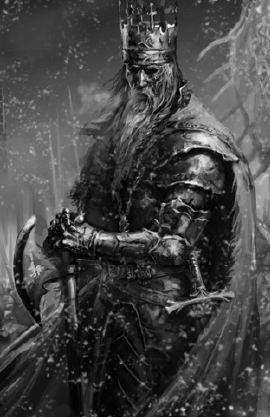 In the year 900 Harold the Fair-Haired, the famous monarch who made a kingdom of Norway, passed a law which was to work mischief for centuries to come. Erik, his favorite son, was named overlord of the kingdom, but with the proviso that his other sons should bear the kingly title and rule over provinces, while the sons of his daughters were to be made earls. Had the wise Harold dreamed of the trouble this unwise law was to make he would have cut off his right hand before signing it. It was to give rise to endless rebellions and civil wars which filled the kingdom with ruin and slaughter for many reigns and at last led to its overthrow and long disappearance from among the separate nations of the earth.
A bold and daring prince was Erik, with the old viking blood in his veins. When only twelve years of age his father gave him five ships, each with a sturdy crew of Norsemen, and sent him out to ravage the southern lands, in the manner of the sea-kings of those days. Many were the perilous exploits of the young viking admiral and when he came back to his father’s halls and told him of his daring deeds, the old king listened with delight. So fierce and fatal were many of his fights that he won the name of Blood-Axe, but for this his father loved him all the more and chose him to be his successor on the throne.
![[Illustration] from Historical Tales - Scandinavian by Charles Morris](https://www.heritage-history.com/books/morris/scandinavian/zpage050.gif "[Illustration] from Historical Tales - Scandinavian by Charles Morris") HOME OF PEASANTS, NORWAY |
Before his father died Erik had shown what was in him, by attacking and killing two of his brothers. But despite all that, when the old king was eighty years of age he led Erik to the throne and named him as his successor. Three years later Harold died and Norway fell under the young sea-king’s hand—a brave, handsome, stately ruler; but haughty, cruel, and pitiless in his wrath, and with the old viking wildness in his blood.
He had married a woman whom men called a witch—cruel, treacherous, loving money and power, and with such influence over him that she killed all the good in his soul and spurred him on to evil deeds.
Strange stories are told of the wicked Queen Gunhild. It was said that she had been sent to Finland to learn the arts of sorcery, in which the Finns of those days were well versed. Here Erik met her in one of his wanderings, and was taken captive by her bold beauty. She dwelt with two sorcerers, both bent on marrying her, while she would have neither of them. Prince Erik was a suitor more to her liking and she hid him in her tent, begging him to rescue her from her troublesome lovers.
This was no easy task, for sorcerers have arts of their own, but Erik proved equal to it, cut his way through all the difficulties in his path and carried Gunhild away to his ships, where he made her his wife. In her he had wed a dragon of mischief, as his people were to learn.
She was of small size but of wonderful beauty, and with sly, insinuating ways that fitted her well to gain the mastery over strong men. But all her arts were used for evil, and she won the hatred of the people by speaking words of ill counsel in her husband’s ears. The treachery and violence he showed were said to be the work of Gunhild the witch, and the nobles and people soon grew to hate Erik Blood-Axe and his cruel wife, and often broke out in rebellion against them.
His brothers, who had been made kings of provinces, were not ready to submit to his harsh rule, and barely was old King Harold dead before Halfdan the Swarthy—who bore the name of his grandfather—claimed to be monarch in Tröndelag, and Olaf, another brother, in Viken. Death came suddenly to Halfdan—men whispered that he had been poisoned by the queen—but his brother Sigfrid took his place and soon the flame of rebellion rose north and south. Erik proved equal to the difficulty. Sigfrid and Olaf were in Tunsberg, where they had met to lay plans to join their forces, when Erik, whose spies told him of their movements, took the town by surprise and killed them both.
Thus, so far, Erik Blood-Axe was triumphant. He had killed four of his brothers—men said five—and every one thought that Gunhild would not be content until all King Harold’s brood except her own husband were in the grave.
Trouble next came from a region far away, the frost-king’s land of Iceland in the northern seas, which had been settled from Norway in the early reign of Harold the Fair-Haired, some sixty years before. Here lived a handsome and noble man named Thorolf, who had met Erik in his viking days. He was the son of the stern old Icelander Bald Grim, and nephew of the noble Thorolf who had been basely slain by King Harold.
Bald Grim hated Harold and all his race, but Thorolf grew to admire Erik for his daring and made him a present of a large and beautiful ship. Thus Erik became his friend, and when Thorolf came to Norway the young prince begged his father to let him dwell there in peace. When he at length went home to Iceland he took with him an axe with a richly carved handle, which Erik had sent as a present to his father.
Old Bald Grim was not the man to be bought over by a present. The hate he felt for Harold he transferred to his son, and when Thorolf set sail again for Norway his father bade him take back the axe to the king and sang an insulting song which he bade him repeat to Erik. Thorolf did not like his errand. He thought it best to let the blood-feud die, so he threw the axe into the sea and when he met the king gave him his father’s thanks for the fine gift. If Thorolf had had his way the trouble would have been at an end, but with him came Egil, his younger brother, a man of different character.
Stern old Bald Grim seemed born again in his son Egil. A man of great size, swarthy face, harsh of aspect, and of fierce temper, in him was the old, tameless spirit of the Norse sea-kings, turbulent, passionate, owning no man master, he bent his strong soul to no man’s rule. Rash and adventurous, he had a long and stormy career, while nature had endowed him with a rich gift of song, which added to his fame. Such was the type of men who in those days made all Europe tremble before the Norsemen’s wrath, and won dominion for the viking warriors in many lands.
Thorold when in Norway before had gained powerful friends in the great nobles, Thore Herse and Björn the Yeoman. On this visit the brothers became Thore’s guests, and Egil and Arinbjörn, Thore’s son, became warm friends. The young Icelander’s hot temper soon brewed trouble. Sickness kept him from going with Thorolf to the house of Björn the Yeoman, whose daughter, Aasgard, he was to marry; but he soon got well and went on a visit to Baard, a steward of the king. As fortune decreed he met there King Erik and Queen Gunhild.
Egil was not the man to play the courtier and his hot blood was under little control. When Baard neglected him in favor of his royal visitor, he broke into such a rage that the queen, to quiet him, tried one of her underhand arts. She bade Baard to mix sleeping herbs with his beer.
Suspecting treachery from the taste of the beer Egil flung his flagon to the floor, struck Baard dead in his fury, and, fleeing for his life, swam to an island in the neighboring stream. When men were sent to search the island and capture him he killed some of them, seized their boat, and made his escape.
King Erik was furious, but Thore Herse got him to accept a money payment for Baard’s death—as was then the custom of the land—and he agreed to let Egil dwell in Norway unharmed.
This was not to the queen’s liking. She was fond of Baard and was deeply incensed at Egil for his murderous act, and she stormed at the king for his mildness of temper till he broke out:
“You are forever egging me on to acts of violence; but now you must hold your peace, for I have given my kingly word and cannot break it.”
Gunhild, thus repulsed, sought other means of revenge. A great feast of sacrifice to the old heathen gods was to be held at the temple of Gaule, and at her instigation her brother, Eyvind Skreyja, agreed to kill one of Bald Grim’s sons. Finding no opportunity for this, he killed one of Thorolf’s men, for which act Erik outlawed him.
The remainder of the story of Egil’s career is largely that of a viking, that is, a piratical rover, bent on spoil and plunder and the harrying of sea-coast lands. With Thorolf he took to the sea and cruised about in quest of wealth and glory, finally landing in England and fighting in a great battle under the banner of King Athelstan. He made his mark here, but Thorolf was slain, so Egil went back to Norway, married his brother’s widow, and sailed for his old home in Iceland, which he had not seen for twelve years.
Iceland was too quiet a land to hold the stirring sea-king long and news from Norway soon made him take ship again. Björn the Yeoman, his wife’s father, had died, and Queen Gunhild had given his estate to Berg-Anund, one of her favorites. Storming with rage, he reached Norway and hotly pleaded his claim to the estate before the assembly or thing at Gula, Erik and Gunhild being present. He failed in his purpose, the thing breaking up in disorder; and Egil, probably finding Norway too hot to hold him, went back to Iceland.
If King Erik now fancied he was rid of the turbulent Icelander he was mistaken. Rankling with a sense of injury and borne onward by his impetuous temper, Egil was soon in Norway again, sought the Björn estate, surprised and killed Berg-Anund, and went so far in his daring as to kill Ragnvald, the king’s son, who was visiting Berg. Carried to extremes by his unruly temper he raised what was called a shame-pole, or pole of dishonor, on a cliff top, to the king and queen. On it he thrust the head of a dead horse, crying out:
“I turn this dishonor against all the land-spirits of this land, that they may all stray bewildered and none of them find his home until they have driven King Erik and Queen Gunhild out of this land.”
This message of defiance he cut in runes—the letters of the Northland—into the pole, that all might read it, and then sailed back to Iceland.
Egil had not long to wait for his curse to take effect, for Erik’s reign was soon threatened from a new source. He had not killed all his brothers. In the old days of King Harold, when near seventy years old, he had married a new wife, who bore him a son whom he named Haakon,—destined in later life to reign with the popular title of Haakon the Good. This boy, perhaps for his safety, had been sent to England and given over to King Athelstan, who brought him up almost as his own son.
Erik had been four years on the throne when Haakon came back to Norway, a handsome, noble youth, kind of heart and gentle in disposition, and on all sides hailed with joy, for Erik and his evil-minded wife had not won the love of the people. Great nobles and many of the people gathered around Haakon, men saying that he was like King Harold come back again, gentler and nobler than of old and with all his old stately beauty and charm.
The next year he was crowned king. Erik tried to raise an army, but none of the people were willing to fight for him, and he was forced to flee with his wife and children. Only a few of his old friends went with him, but among them was Arinbjörn, Egil’s former friend.
Sudden had been King Erik’s fall. Lately lord of a kingdom, he had now not a foot of land he could call his own, and he sailed about as a sea-robber, landing and plundering in Scotland and England. At length, to rid himself of this stinging hornet of the seas, King Athelstan made him lord of a province in Northumberland, with the promise that he would fight for it against other vikings like himself. He was also required to be baptized and become a Christian.
Meanwhile Egil dwelt in Iceland, but in bitter discontent. He roamed about the strand, looking for sails at sea and seeming to care little for his wife and children. Men said that Gunhild had bewitched him, but more likely it was his own unquiet spirit. At any rate the time came when he could bear a quiet life no longer and he took ship and sailed away to the south.
Misfortune now went with him. A storm drove his ship ashore on the English coast at the mouth of the Humber, the ship being lost but he and his thirty men reaching shore. Inquiring in whose land he was, people told him that Erik Blood-Axe ruled that region.
Egil’s case was a desperate one. He was in the domain of his deadly foe, with little hope of escape. With his usual impetuous spirit, he made no attempt to flee, but rode boldly into York, where he found his old friend Arinbjörn. With him he went straight to Erik, like the reckless fellow he was.
“What do you expect from me?” asked Erik. “You deserve nothing but death at my hands.”
“Death let it be, then,” said the bold viking, in his reckless manner.
Gunhild on seeing him was eager for his blood. She had hated him so long that she hotly demanded that he should be killed on the spot. Erik, less bloodthirsty, gave him his life for one night more, and Arinbjörn begged him to spend the night in composing a song in Erik’s honor, hoping that in this way he might win his life.
Egil promised to do so and his friend brought him food and drink, bidding him do his best. Anxious to know how he was progressing Arinbjörn visited him in the night.
“How goes the song?” he asked.
“Not a line of it is ready,” answered Egil. “A swallow has been sitting in the window all the night, screaming and disturbing me, and do what I would I could not drive it away.”
At that Arinbjörn darted into the hall, where he saw in the dim light a woman running hastily away. Going back he found that the swallow had flown. He was sure now that Queen Gunhild had changed herself into a swallow by sorcery, and for the remainder of the night he kept watch outside that the bird should not return. When morning broke he found that Egil had finished his song.
Determined to save his friend’s life if he could, he armed himself and his men and went with Egil to the palace of the king, where he asked Erik for Egil’s life as a reward for his devotion to him when others had deserted him.
Erik made no reply, and then Arinbjörn cried out:
“This I will say. Egil shall not die while I or one of my men remain alive.”
“Egil has well deserved death,” replied Erik, “but I cannot buy his death at that price.”
As he stopped speaking Egil began to sing, chanting his ode in tones that rang loudly through the hall. Famed as a poet, his death song was one of the best he had ever composed, and it praised Erik’s valor in all the full, wild strains of the northern verse.
Erik heard the song through with unmoved face. When it was done he said:
“Your song is a noble one, and your friend’s demand for your life is nobler still. Nor can I be the dastard to kill a man who puts himself of his own will into my hands. You shall depart unharmed. But do not think that I or my sons forgive you, and from the moment you leave this hall never come again under my eyes or the eyes of my sons.”
Egil thus won his life by his song, which became known as the “Ransom of the Head.” Another of his songs, called “The Loss of the Son,” is held to be the most beautiful in all the literature of Iceland. He afterwards lived long and had many more adventures, and in the end died in his bed in Iceland when he was over ninety years of age. Erik died in battle many years earlier, and Gunhild then went to Denmark with her sons. She was to make more trouble for Norway before she died.
OFFICIAL AND OLDEST SCOTTISH CLAN CARRUTHERS
SINCE 1983-CLAN OF OUR ANCESTORS
MERITED TO CHIEF CAROTOCUS 10AD
PRESENT CHIEF : PAT E CARROTHERS USA
CHARLES MORRIS
TAMMY WISE CHS USA
Preserving Our Past, Recording Our Present, Informing Our Future
GOLD WINGS – https://www.facebook.com/carrutherscarrothers.pat.9
COPPER WINGS https://www.facebook.com/ClanCarruthers1/
CLAN CARRUTHERS FAMILY HISTORY – https://www.facebook.com/CarruthersClan
CLAN CARRUTHERS CCIS – https://www.facebook.com/groups/3878691252182714
CLAN CARRUTHERS INT SOCIETY- https://www.facebook.com/groups/394653845137709
CLAN CARRUTHERS – BORDER REIVERS – https://www.facebook.com/groups/434959914239094
Disclaimer Ancient and Honorable Carruthers Clan International Soci

NORSE MYTHOLODY IS BIBLE MYTHOLOGY
We have been learning that our own Caratocus was a Christian in 10ad. The oldest cross and crucifix was found on Gutland, Sweden during an archeological dig. Maybe this article will explain some of this.
The religion of the early Norse exhibits customs and rituals which bear an amazing correspondence to the religion of the Hebrew Old Testament. Can all of this be just a coincidence, or is there a connection? Here is the interesting evidence.
Does Bible prophecy actually speak to us of the Norse and related peoples of Europe? I believe that it does, and that these peoples are in fact the descendants of the lost tribes of the House of Israel, removed out of their land in Assyrian captivity two thousand seven hundred years ago, and lost to recorded history. As we will see, only the Caucasian peoples who migrated out of Asia into Europe, have fulfilled many of the prophecies in both the Old and New Testaments concerning Israel in the latter days. Let’s begin our study in the one of the foremost prophetic books of the New Testament, Revelation.
In Revelation chapter 12, there appears a spectacular vision which has intrigued Christians for centuries. The vision concerns “a woman.” Bible commentators see this woman as representing Israel, and the vision as prophetic of events which were to take place in world history.
We are told in verse two that this woman, Israel, was about to give birth. The child was none other than Jesus Christ, for we are told in verse five that he was “a man-child, who was to rule all nations with a rod of iron.” It is obvious here that the woman who gave birth to our Savior is Israel, for Christ was born of the Israel tribe of Judah, of the line of David.
The vision expands in verse three. We read, “And there appeared another wonder in heaven; and behold a great red dragon, having seven heads and ten horns…… the dragon stood before the woman which was ready to be delivered, for to devour her child as soon as it was born.” This should remind us of the prophet Daniel’s prophecy of four great beast kingdoms. They were: Babylon & Assyria, Medo-Persia, Macedonia, and Rome. They formed one continuous succession of four beast empires, each one “devouring” or absorbing the previous. Using the year-for-a-day principle of prophecy, the next verse speaks of Israel being attacked and persecuted for 1,260 years by the dragon-beast, a period which ended with the fall of Rome in 410 AD.
Verse six says, “And the woman fled into the WILDERNESS, where she hath a place prepared of God, that they should feed her there a thousand two hundred and threescore days.” Where in Israel’s history do we read of the chosen nation fleeing in dispersion into the wilderness? This occurred when Assyria, the first beast-empire, conquered them in 721 B.C., dispersing them out of Palestine, into the wilderness of Europe. This is the prophetic story of Israel in the wilderness going to a place prepared by God, and it is a fascinating account of how God’s prophecies have come to pass. (745 B.C. to 476 A.D. is a 1260 lunar year period!)
We read of Israel’s dispersion into the wilderness in the Old Testament apocryphal book of II Esdras, chapter 13 and verse 40. Here the prophet Esdras tells us this about their whereabouts: “These are the ten tribes, who were taken captive from their land in the days of King Hoshea, whom Shalmanesar, the King of the Assyrians, led away into captivity and transported them across the river Euphrates. But they decided to leave the multitude of peoples and proceed to a more remote region… The way to that country, which is called Arsareth, required a long trek of a year and a half.”
The Prophet Esdras gave us still another solid clue in tracing Israel’s northern trek when he said that they “passed through the narrow entrances of the Euphrates River.” (verse 43) This refers to the headwaters of the Euphrates, which were toward the north, in northern Mesopotamia. In fact, rivers always flow from north to south in the northern hemisphere.
So we know two things for sure about the land to which the Israelites migrated: it was northward toward the Caucasus and Europe, and it was a remote wilderness. As the late Bible scholar, Dr. Pascoe Goard, has stated, “We know sufficient of the history of all the territory south of the Caucasus to be able to say that they could find no such unsettled land there. But plains, forests and river valleys of Europe still remained which had not even been explored in the days of Herodotus, three and a half centuries later. To that country they took their way.” (“Post-captivity Names of Israel,” p. 35) Remember that Esdras said they traveled to “a more remote region,” a wilderness; and that this journey was a long one over a great distance, requiring “a year and a half” of travel.
Yes, northward from the upper reaches of the Assyrian Empire was the wilderness of Europe, and there is a river Sereth in southeastern Europe even today. Over six centuries after their dispersion, the Jewish historian Flavius Josephus wrote, “The ten tribes did not return to Palestine…There are but two tribes in Asia and Europe subject to the Romans, while the ten tribes are beyond the Euphrates till now, and are an immense multitude.” (Jos. Antiq., Ch. 11, pp. 2,5) The lost ten tribes were no longer in Palestine, and were outside the realm of the Roman Empire. Even though Israel had been hidden in the wilderness for six centuries when Josephus wrote, he informs us that they were an identifiable people and a great multitude which no man could number.
Where else in the annals of history is there a record of nearly an entire nation suddenly converging on a wilderness? Only the migrations of the Anglo-Saxon- Gothic tribes into early Europe, that land “where never mankind dwelt,” (II Esdras 13:41) can fit the picture, and that occurred at the very time that Israel was dispersed and became lost to history. The Angles, Saxons, Celts, and Goths, who overspread Europe, are said to have originated in the region of Medo- Persia, about 700 B.C., the very time and place in which the nation of Israel was lost to history.
The early Christian church noted a remarkable fact: There was a distinct resemblance between ancient Israel’s religion and that of the early inhabitants of Europe. Early Christian writers used the Latin phrase, “Preparacio Evangelica,” meaning that European mythology constituted a good “preparation for the Gospel.” We now know why Norse mythology, Celtic Druidism, and Greek mythology all bear such striking similarities to the Old Testament — it’s simply because these peoples were the physical descendants of ancient Israelites who migrated to Europe in ancient times, bringing deep- rooted traces of their religion with them when they came.
But other amazing parallels exist, as well. There was also an uncanny resemblance to ancient Canaanite religion, since ancient Israel corrupted themselves with that form of worship, according to the Bible account. In addition to that, early European mythology also bears traces of the religious customs of the Babylonians and Assyrians, as you might expect, since these peoples exerted some influence when they brought Israel in captivity out of Palestine. Let’s see how history offers proof of both Biblical and Babylonian influence among the people of early Europe.
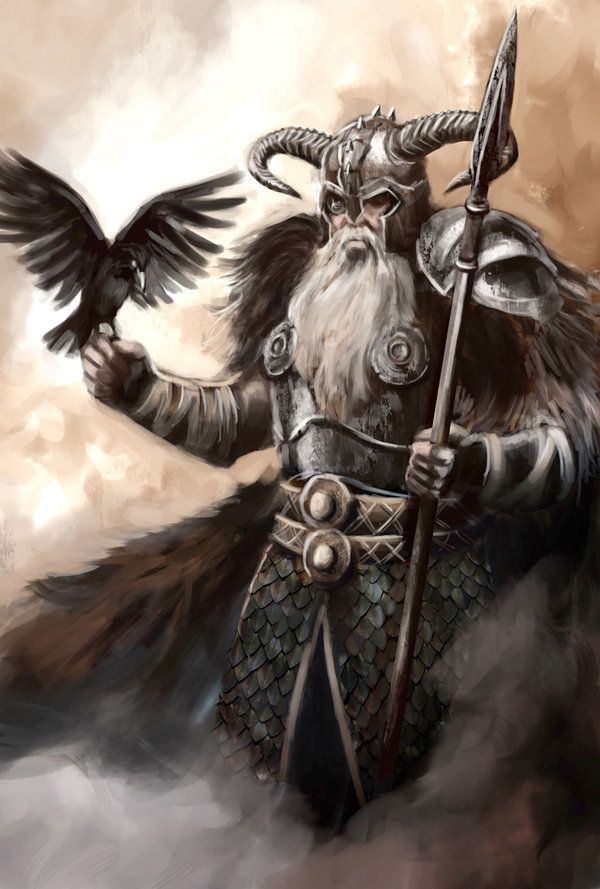
The central figure of Norse Mythology is the hero known as ODIN. He is believed to be an historic figure, the king who led his tribes northwestward from their former residence in a city called Asgard to their new home in Western Europe. Asgard literally means “city of God,” and perhaps by implication, “the city of God’s people.” Although it has never been identified by archaeologists, it is believed to have been located either in southern Russia or Northern Assyria, placing it in the region where the ten tribes were lost to history. After Odin’s death, his great deeds were expanded until he took on godhood in the folk memory of the people. But it is important to note that the name “Odin” shows unmistakable evidence of a Babylonian origin.
Alexander Hislop in his book, “The Two Babylons,” gives us a definite connection between Odin and the Middle East. ODIN was the great Norse war god. The Assyrians and Babylonians also had a war god known as “ADON,” and the Greeks later had a god named “ADONIS,” as well. The Babylonish Adon was the god of WINE. In the NORSE ELDER EDDA we are told that Odin ate no food but wine: “The illustrious father of armies, with his own hand, fattens his two wolves; but the victorious Odin takes no other nourishment to himself than what arises from the unintermittent quaffing of wine. For ’tis with WINE ALONE that Odin in arms renowned is nourished forever.”
It has also been established that the Norse religion involved worship in sacred groves, which were trees planted to simulate the walls of a temple. The Canaanites, too, had sacred groves for worship, and the disobedient nation of Israel had adopted this form of worship at the outset of their wanderings out of Palestine.
But the similarity between middle-eastern and Norse mythology does not end there. One of Odin’s sons in Norse mythology was called, “BALDER,” which Hislop states comes from the Chaldee form of “Baal- zer,” meaning the SEED OF BAAL. Quoting Alexander Hislop, “The Hebrew z, as is well known, frequently, in the later Chaldee, becomes d. Now, Baal and Adon both alike signify ‘master’ or ‘lord;’ and, therefore, if Balder be admitted to be the seed or son of Baal, that is as much as to say that he is the son of Adon; and, consequently Adon and Odin must be the same.”
The name of Odin’s other well-known son is THOR. Again to quote Mr. Hislop: “Now as Odin had a son called Thor, so the second Assyrian Adon had a son called THOUROS (Cedrenus, vol. 1, p. 29). The name Thouros seems just to be another form of Zoro, or Doro, meaning, ‘the seed.’” So, as Professor Hislop points out, Odin’s son, Thor, is an exact parallel to the Assyrian god Adon’s son Thouros. Quite an amazing similarity! (Lexicon, pars 1, p. 93: “The D is often pronounced as Th; Adon in the pointed Hebrew, being Athon.”)
It is extremely doubtful that all of this parallel detail could be mere happenstance. A very definite cultural connection somehow took place between the ancient Assyrians and Babylonians and the early European Norse. Yet another author lends credence to this, the professor Hans Gunther, in his book, “Religious Attitudes of the Indo-Europeans.” He finds much to admire in the Norse mythology, yet is led to admit that, “one perceives in him (Odin) the voice of an alien non-Nordic race.” (page 11) Professor Gunther goes on to associate certain aspects of Norse mythology with Babylon, (page 57)
Yet one more proof of a connection between the Norse and the ancient Canaanites should be noted: the evidence we have of human sacrifice. For although human sacrifice appears to have been unknown in the British isles, it was definitely practised in early days on the continent of Europe by the Celts.
But it is appropriate at this point to show that there are also some undeniably distinct similarities between Norse religion and that of the ancient Israelites. In fact, from the Norse sagas we learn many facts which lead to a comparison of both God, and God in the flesh, Immanuel, Jesus Christ. The tribes of Israel, at the time of their dispersion, would have been familiar with the Old Testament prophecies of a coming Messiah. Many of these ancient beliefs could have remained with them in their traditions after their dispersion from Palestine. So let’s compare Bible prophecies with some of the basic beliefs cherished by the early Norse.
The Norse myths recount a remarkable account of creation, which differs from the Bible in that the flood was said to be caused by the blood of a slain giant. However, in Genesis 6, verse 4, the Bible does speak about the Nephilim, or giants, during the account of the flood. In the Norse account, the world is wiped out in this catastrophe, with the exception of one household who escaped on a skiff or boat, and from whom is descended the new race from which the god Odin came.
Odin is also called the “RAFNAGUD,” or Raven-god, because he is said to have two ravens named Hugin and Munin, which he sends out into the world each day, returning at nightfall to tell him what they observed. Quoting the Norse Elder Edda,
“Hugin and Munin
Fly each day
Over the spacious earth.
Ifear for Hugin
That he come not back
Yet more anxious am I for Munin ”
This bears an unmistakable similarity with the account in Genesis chapter eight of Noah sending two birds out into the world, one of them the raven which Noah was anxious for, because he did not return.
 There are many other interesting legends in the Norse sagas, such as Thor conquering a serpent- monster, while dying in the process. This was prophesied of Israel’s Messiah in GENESIS 3:15, who conquered the serpent’s seed by his own death. Other Norse religious traditions come from the Old Testament, as well. As an example, Odin is referred to as “the law-giver.” This is a title our heavenly father, Yahveh, could well claim, who gave Moses upon Mount Sinai the laws for the nation.
Another important Norse god was LOKI, the author of all evil, who was said to be of a swarthy complexion and originated in a land to the south. This may well be Israel’s remembrance of the Edomites of Palestine. An interesting parallel exists between Loki, who is said to lead the forces of evil in the last great battle in Norse mythology, and the Edomites of Bible prophecy at the end of the age. In Ezekiel chapters 36 to 39, in the last great battle, the Edomites are prominent in the forces of evil which come against God’s Israel.
The number twelve also must have been held in sacred significance to the Norse, for we read in the book, “Germanic Origins,” that Odin arrived in Svithoid, or Scythia, with twelve chief priests. The presence of these twelve priests corresponds representatively to the twelve original tribal patriarchs of Israel.
Early Norse scholar, Snorri Sturluson, translator of many ancient Scandinavian legends, compiled the HEIMSKRINGLA, OR HOME CHRONICLES. He says that just before Odin died he let himself be marked or wounded with a spear-point and that he was the owner of all men slain with weapons, and would go to Godheim (the world of the gods) and there welcome his friends. The comparisons with the Bible are again unmistakable. The Old Testament contains over one hundred prophecies relating to the coming of our God in the flesh, our “Immanuel,” or “God with us.” We find many of these in Norse mythology transferred to the character, Odin. In our Bibles we read that our coming God was to be SACRIFICED, (Zechariah 13:7), that he was to be PIERCED (Zechariah 12:10), but would have NO BROKEN BONES (Psalm 34:20, and Exodus 12:46 where Passover is a type of Christ). And whereas our Savior was sacrificed on the tree (in 1 Peter 2:23, the word translated “cross” literally means a tree) for nine hours (Psalm 22 and Matthew 27:46), Odin is said to have hung on a tree for nine days. Compare those Bible prophecies with these lines from the Norse Elder Edda:
“I know that I hung
On a wind-rocked tree
Nine whole nights,
With a spear wounded
And to Odin offered
Myself to myself; ”
The Norse legends prominently refer to the end-times. They say that in the end of the world a great battle called Gotterdammerung, or the “Twilight of the gods,” will take place between the forces of good and evil. In this great battle, all of the forces of good will be killed except for one called the “All-father.”
This brings me to my most important point. “Bulfinch’s Mythology” states that “the Scandinavians had an idea of a deity superior to Odin, uncreated and eternal,” which they called the Alfadur or “ALL-FATHER.” For although the Norse mythology allows for a pantheon of gods, yet only ONE GOD is said to be immortal. Thor, Odin, and the others I have mentioned are mortal and die at some point in the sagas.
But above Odin was said to be the one eternal true God – unnamed except to be called the “All-father,” meaning the “ever-lasting father,” as he is called in our Bibles in ISAIAH 9:6 and other places. In the original language of the Old Testament, God’s name was YAHVEH, which Ferrar Fenton translates as meaning, “the Ever-Living.” The Norse called the Allfather’ by no other name, believing that his personal name was too sacred to be spoken, although they apparently didn’t have any record of what that name was. Compare this with the actions of the few Israelites of the House of Judah who returned to Palestine and removed God’s name, YAHVEH, from our Bibles, believing it too sacred to be spoken. Yes, I am convinced that although the Norse mythology was corrupted with the religion of Assyria and Canaan, yet the proofs are there that they were indeed “the people of the Book.”
OFFICIAL AND OLDEST SCOTTISH CLAN CARRUTHERS
SINCE 1983-CLAN OF OUR ANCESTORS
SCOTTISH CLAN – IRISH CLAN – NORSE CLAN

Preserving Our Past, Recording Our Present, Informing Our Future
GOLD WINGS – https://www.facebook.com/carrutherscarrothers.pat.9
COPPER WINGS https://www.facebook.com/ClanCarruthers1/
CLAN CARRUTHERS FAMILY HISTORY – https://www.facebook.com/CarruthersClan
CLAN CARRUTHERS CCIS – https://www.facebook.com/groups/3878691252182714
CLAN CARRUTHERS INT SOCIETY- https://www.facebook.com/groups/394653845137709
CLAN CARRUTHERS – BORDER REIVERS – https://www.facebook.com/groups/434959914239094
Disclaimer Ancient and Honorable Carruthers Clan International Soci
EVERY PERSON YOU READ ABOUT IS A CARRUTHERS ANCESTOR, INCLUDING WINSTON CHURCHILL IN THE SOURCES
The Saga of Ragnar Lothbrok refers to London as “the finest city in Scandinavia.” This seems like quite a mistake, considering London is the capital of England and sits on the east coast of Britain. However for the skalds who composed the old saga, London was indeed in Scandinavia, for England was once part of a Viking empire.

This part of English history is almost always glossed over or simply not mentioned at all. The tidier narrative is that Vikings invaded Britain in the 9th century, quickly knocked down most of the Anglo-Saxon kingdoms, but were eventually halted by the founder of England, Alfred the Great. Most history books are silent on what happens after that, before picking up the national story with the Norman Conquest in 1066.
But the whole story is a great deal more complicated. England was indeed a part of a large North Sea Empire founded by Vikings long after Alfred’s death. This does not diminish the accomplishments of Alfred and the English. Instead, the whole story helps us to appreciate how complex the reality of England is. Read on, and it will soon all make more sense.
Back Story: The Great Army, Alfred, and their Legacy
A massive host of Vikings descended upon the kingdoms of Britain around the year 865. According to the sagas, this army was led by the sons of Ragnar Lothbrok, seeking revenge for their father, who had been executed in a pit of vipers. The historical and archaeological records do not commit to the saga narrative. Still, they state the Great Army was made up of Vikings from all over the north, who were suddenly united under tremendously effective leadership, and were remarkably successful.
To make a very long story short, the young ruler of the last Anglo-Saxon kingdom, Alfred of Wessex, stopped the Vikings and forced them into a lasting truce. A border or “DMZ” was marked at the old Roman road, then known as Wattling Street. The Vikings got the northeast of Britain, and the Anglo-Saxons got the southwest.

More waves of Vikings would try their luck at taking the whole of Britain, and Alfred would spend the rest of his days trying to make his enlarged kingdom Viking-proof. His efforts to unify and defend his people earned him the title Alfred the Great.
After Alfred’s death, his son, Edward, and his daughter, Aethelflaed, worked to retake much of the land lost to the Vikings. It would not be until the time of Alfred’s grandson, Aethelstan I, that the Vikings would be decisively defeated. The borders of England were set to more-or-less their current form at the Battle of Brunanburh (937). This is often thought of as the birth of a bona fide English nation.
This is not to say that all the Vikings in England just got up and left. The northeast of Britain had become (and in some ways continues to be) distinctly Danish in character. Though these descendants of Vikings were more prone to farming than raiding, they still retained much of their culture and identity. Viking Sea Kings like Erik Bloodaxe, Sihtric One-eyed, and Olaf the Shoe (Amlaíb Cuarán) often ruled their domains from York. Essentially, the north was still Viking … and English at the same time.
Aethelred the Unready

Aethelstan, the grandson of Alfred and the hero of Brunanburh, only knew two years of peace after that great battle. He died young around 939 and left his newly unified kingdom to his brother. A few successful rulers followed, but a few decades later (978), a young king named Aethelred II came to the throne. Aethelred (or Ethelred) was nowhere near the ruler his predecessors had been and was known even in his own time as Aethelred the Unready (also known as Ethelred II or Aethelred the Un-counseled).
Smelling weakness, the Vikings, Scotts, and Irish again began raiding England. But while King Alfred had been ready to use arms, diplomacy, and Danegeld (bribes) to manage the Vikings, Aethelred only threw money at the problem. Under Aethelred, the English paid vast quantities of silver to the Vikings, but so ineffective was Aethelred’s leadership that he sometimes broke the treaties this silver bought.
In a final act of weakness, Aethelred the Unready ordered a massacre of all the Danes that could be caught, whether they be Viking marauders, traders, or even settlers. This atrocity took place on Saint Brice’s Day, 1002.
Recently, archaeologists have found mass graves in Weymouth and Oxford dated to 975-1025. Each contains the skeletal remains of up to 50 decapitated Vikings. DNA analysis of these remains reveals that the victims were from Scandinavia, Iceland, Russia, and the Baltic. The term “Danes” in English sources, as always, is a catch-all term for Vikings. It is possible that these mass graves date to the Saint Brice’s Day massacre of 1002. If so, it is likely but one of many others that lay undiscovered.
Aethelred’s bad decisions were compounding, though. One of the massacre victims was a woman named Gunnhild, the wife of a Danish chief and the sister of none other than Svein Forkbeard. Of course, Vikings would never ignore such a brazen and cowardly act. The murder of Svein’s own sister made retaliation inevitable.

Svein (Sweyn) Forkbeard
In the mid-tenth century, much of Denmark, Norway, and Sweden, were united by the great king, Harald Bluetooth. Yes, this is the same Harald Bluetooth that Bluetooth technology is named for. However, Harald’s estranged son, Svein Forkbeard, led an open rebellion against his heavy-handed father starting in the late 970s. Harald died or was killed sometime during that civil war. After that, Svein became King of Denmark, though Norway and Sweden had already taken advantage of the instability and went their own way.
Svein Forkbeard was a powerful and charismatic leader who had already proved himself highly skilled in war. Whether to take advantage of England’s disarray, avenge his people’s slaying, or both, Svein launched a series of attacks on England starting in 1004. These culminated in a full-scale invasion of England in 1013.
The Vikings landed in the center and swept north, using the support of the entrenched Danish population there to quickly secure the area. They then turned their attention to the wealthy southwest and the seat of Anglo-Saxon power.
The dramatic conclusion of Svein’s invasion took place in London in the winter of 1013-1014. Svein Forkbeard’s forces assailed an English army supported by Viking mercenaries under Svein’s former ally, Thorkell the Tall. This battle was the likely origin of the children’s nursery rhyme, “London Bridges Falling Down,” for the fortified bridges of London (like Paris before it) were crucial for resisting the Viking longships. And yes, some elements of our collective culture really are that old (and older).
Svein Forkbeard won the day. Aethelred the Unready fled to his wife’s family in Normandy. Svein was crowned king, and for that brief moment, held England and Denmark along with parts of Norway and Sweden. Svein Forkbeard was the most powerful man west of Byzantium. He was no longer just a king … he was an emperor.
But life is uncertain, and this was especially true for the 11th century. Svein only reigned in England for about five weeks before he suddenly died. The English immediately recalled Aethelred the Unready (supporting his revered dynasty more so than the man who had so often failed them). The reinvigorated English drove Svein’s son, Knut (or Canute), back to Denmark.
The Vikings were not so easily scared off from what had been one of their most significant accomplishments, and Knut re-invaded England in 1015. Aethelred also soon died and was replaced by his dynamic son, Edmund Ironside.

Knut the Great
Edmund Ironside was a great warrior, charismatic leader, and heroic king. But fate was not on his side, and he was up against one of the most successful Vikings of all time. Knut scored a decisive victory over Edmund’s English in 1016, and the scion of Alfred died of wounds he sustained in that battle.
For the second time in two years, the crown of a united England was in the hands of a Viking. To underscore his legitimacy and emphasize that he was there to stay, Knut married Aethelred’s widow, Emma of Normandy. This move (bizarre and grim to the modern eye) was a 10th-11th century convention, with examples from Ireland to Russia. The marriage of Knut to Emma was also to prove fateful. It was partially on the grounds of this union that William the Conqueror would base his claim to the English throne half a century later.
Circumstances continued to favor Knut. Norway and other lands his father Svein had once controlled soon fell under his dominion, mainly through peaceful means. His reign was long (almost 20 years), relatively tranquil, and prosperous. The effectiveness of Knut’s rule was even more evident by the disarray of the rest of western Europe at that time. The death of Brian Boru in Ireland (1014) and the feebleness of the Capetian dynasty in France meant that Knut was almost peerless. As his boundaries extended and his peace continued, he became known as Knut the Great. Knut ruled his North Sea Empire primarily from England through it all, continuously presenting himself as “a true Christian monarch in the European style” (Price, 2020, p. 472). His English and Norwegian subjects probably never loved him. Still, they eagerly accepted the stability he brought and the goodwill he was always eager to display.
The Legacy of Knut the Great
Knut died in 1035. He left several sons, including his successor by Emma, Harthacanute. Unfortunately, Knut’s heirs could not match their father’s political or military ability. As a result, the North Sea Empire quickly fell apart. Nevertheless, the urgency to rebuild it would serve as an impetus for many ambitious men over the following decades. In 1066, both William the Conqueror and Harald Hardrada probably saw themselves as the heir to this tradition of a unified northwestern Europe.
As for Knut’s memory, sources differ dramatically. Almost everything from Knut’s lifetime is favorable (though much of it is deliberate propaganda, perhaps). In England, he was considered a good king, a patron of the Church, a generous and wise man, a lawgiver, and a law follower. We are told Knut even disbanded his Viking bodyguard, entrusting himself to his English subjects.
In Norse sources, such as the Heimskringla, a fuller picture emerges, with Knut displaying cunning, violence, and vindictiveness characteristic of the most ruthless rulers. Later English folk tradition – perhaps embarrassed that their proud nation was dominated by a foreigner – turned on the man altogether. They portray him in ridiculous tales recycled from old stories of Rome’s hated emperor, Caligula. One of these paints Knut as a mad king, standing on the beach and commanding the waves not to roll up on shore.
More often, though, Knut the Great is forgotten entirely – a footnote on the wrong side of history. The legacy of a Viking England exists more in the fine print: for example, in Shakespeare’s Hamlet when the Danish prince is sent to England to “collect our long-neglected tribute.”
As Knut is connected to the foundations for 1066, he is a part of all of England’s remarkable history since that time. Moreover, the legacy of the Vikings in England would prove to be inseparable from the nation itself. Winston Churchill would later remark on the many contributions to England’s laws, legislature, industry, warfare, and its very personality that the Viking settlers would perpetually contribute. He wrote, “the tribulations of [the years] had not reduced the strength of their original character, nor their attachment to the conquered soil. All through English history, this strain plays a gleaming part” (1956, p. 111).
OFFICIAL AND REGISTEREDL CLAN CARRUTHERS CCIS SINCE 1983-CLAN OF OUR ANCESTORS
SCOTTISH CLAN – IRISH CLAN – NORSE CLAN


GOLD WINGS – https://www.facebook.com/carrutherscarrothers.pat.9
CLAN CARRUTHERS FAMILY HISTORY – https://www.facebook.com/CarruthersClan
CLAN CARRUTHERS CCIS – https://www.facebook.com/groups/3878691252182714
CLAN CARRUTHERS INT SOCIETY- https://www.facebook.com/groups/394653845137709
CLAN CARRUTHERS – BORDER REIVERS – https://www.facebook.com/groups/434959914239094
Disclaimer Ancient and Honorable Carruthers Clan International Socie
References
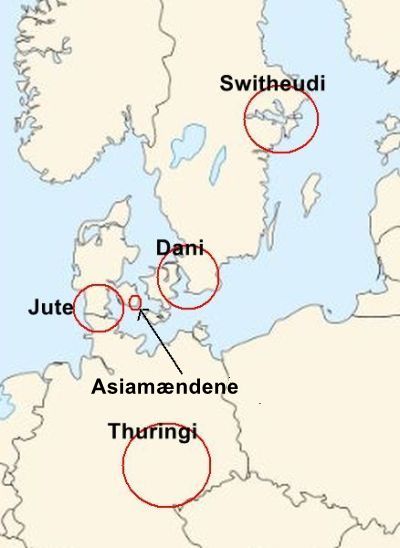
Dani, Switheudi, Thuringi and Aesirs were in all probability four groups of related people, who originally came from Asia, few in numbers.
At Tryggevælde Å (river) near Himlingøje, Valløby and Varpelev in Eastern Sjælland a number of large burial mounds have been excavated and many objects that differ significantly from the contemporary Iron Age culture’s other findings have been found. In addition, mound funerals had not been seen in Scandinavia since the first half of the Bronze Age; they were a marked break in tradition. These mounds are dated to around 200 AD, and one may assume that the represent Dani. One can imagine that they first arrived in Scania and drove the Heruls away from there. That could have taken place around 200 – 300 AD or even later.
Noble men and women have for generations been buried in large burial mounds at the Tryggevælde River with treasures such as unique silver cups, neck rings, pearl necklaces, game pieces and Roman-made cups and glass drinking horns and much more – but no weapons. Around the mounds have been found their servants and service people in more modest graves – with few or no grave goods.
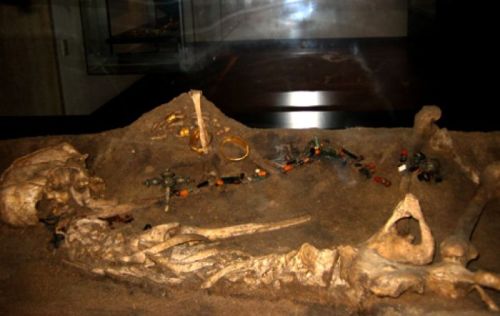 |
Women’s tomb from Himlingøje from around 200 AD found in 1949 and exhibited in the National Museum. In front of the woman are seen her gold jewelry and a long necklace with different colored beads. – Photo: Kulturjagt i Køge Bugt.
There have been noted a striking similarity between the graves at the Tryggevælde River and graves and grave goods in Thuringen and southern Saxony from the same time. It is also suggested that the Danish -lev in village names is connected to -leben in village names in Thuringen. It’s pretty likely that Dani and Thuringi were related people.
If Switheudi and Dani were of the same descent, and Dani and Thuringi were closely related peoples so all three people have been related. It is somewhat unsatisfactory for this theory that Jordanes also mentions Sweans, which are of a different race. The author has no certain knowledge, but he believes that Switheudi and Sweans are identical.
Ynglinga Saga says: “Sveigde became king after his father. He made the promise to search for Gudehjem (Gods’ Home – English: Gotham) and Odin the Old. He traveled with 12 men widely around the world; he came to Turkland and Great Svitjod and found there many kinsmen. On this journey he was away for five years, then he came back and stayed home for a while. He was out in Vanaheim and got a wife, who was named Vana; their son was named Vanlande.”
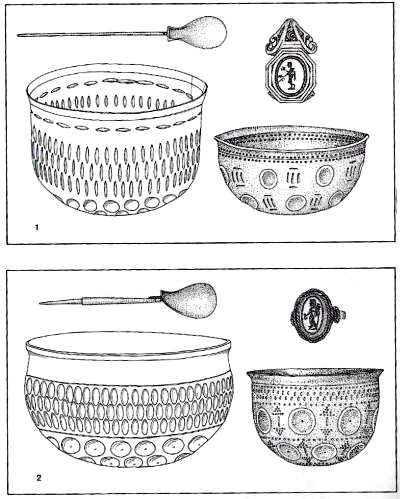
Findings from Haagerup on the island of Fyn (1) compared with findings from Leuna in Thuringen (2). In the gold finger ring from Haagerup sits an onyx stone, and in the ring from Leuna sits a carnelian, but both are adorned with a Mercury motif. The Funen on is of Roman origin, while the South Germany one is producing outside the Roman Empire. Other examples of similarities include silver spoons, glasses and silver bowls. – From Gyldendals og Politikkens Danmarks Historie 2 by Lotte Hedager.
In Old Uppsala in Sweden, there are three large burial mounds and several smaller mounds from the Late Iron Age of similar size, as the mounds at the Tryggevælde river originally must have been. Two of the large mounds contained very rich cremations graves with royal power symbols from the 500s AD.
The Eastern mound contained a 12-year-old boy and a woman; the boy’s equipment included a warrior helmet, a gold decorated single-edged sword and a bronze mirror. In the West mound, there were a man and a woman; the man’s equipment included among other things a warrior helmet decorated with carved stones, a double-edged sword with gold hilt and probably a scepter. Following Snorri Sturlason the Ynglinge lineage was the royal family of the Svears, and Old Uppsala was their burial ground.
But as the Swedish mounds are from around the year 500 AD and the Danish are from around the year 200 AD it sounds unlikely that the Dani descended from Swedes, as it is said. One has to expect that ancestors lived before descendants.
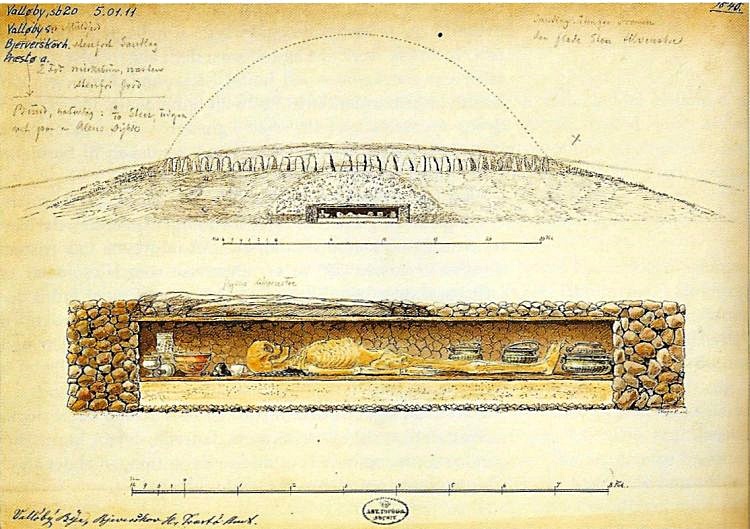 |
Reconstruction of a grave at Valløby south of Køge. The deceased is a man, who is laid to rest with a rich equipment of silver goblets, glass and bronze vessels. The excavation in the 1800’s showed that the grave had been covered by a stone surrounded mound, as shown on the drawing over the existing mound with a dashed line. Drawing by Magnus Petersen 1873.
Snorri says in the introduction to Ynglinge Saga that “in the land east of the Tanakvisl (River Don) lay a castle, called Asgård. The chief of the castle was called Odin, and it was a great offer place for the Gods. Odin was a great army man, who travelled far around and won himself many kingdoms.” – “But because Odin was visionary and skilled in magic, he knew that his descendants should live and build in the Northern part of the world. Therefore he set his brothers Ve and Vilje in charge Asgård, but himself departed with all his dianes (?) with him and many other people. First, he headed west to Gardarige (Russia) and then south to Saxland; He had many sons, he won himself a kingdom over much of Saxland and set his sons to rule the country. So he headed against north to the sea and settled on an island, it is now called Odinsoye on Fyn,” which must be Odense, which city also has Odin’s name.
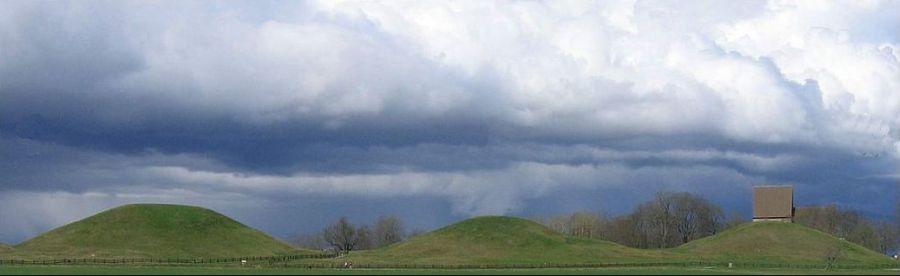 |
The mounds in Gamla Uppsala – Photo Wikipedia.
There is no direct intelligence to that the Asia men, who settled on the island of Fyn, were related to Switheudi, Dani and Thuringi. But Snorri lets Odin continue to Sweden, where he became the Ynglinge lineage’s actual ancestor, and that is suggesting that there was a relation.
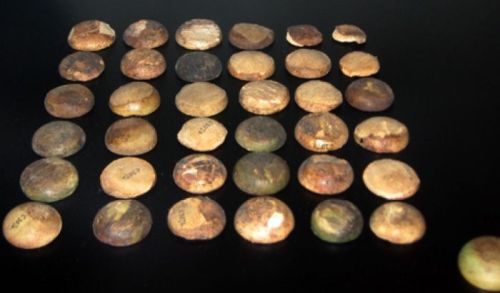 |
Game pieces of bone found in a man’s grave in Varpelev near Køge from the end of the 200’s – Photo: Kulturjagt i Køge Bugt.
It’s all quite speculative, but one can think that Thuringi means descendants after Thor, Thornings, so to say, in the same way as the Ynglings were descendants after Yngve. Snorre lists Odin’s ancestors in his preface to the Edda: “His famous ancestor was Thror, whom we call Thor, his son was Loridi, his son was Ejnridi, his son Vingethor, his son Vingener, his son Moda, his son Magni, his son Seskef, his son Bedvig, his son Atra, his son Itrmann, his son Heremod, his son Skjaldun called Skjold (shield), his son Bjaf, his son Jat, his son Gudolf, his son Finn, his son Frallaf and he had the son Vodin who was Odin.” Which must mean that Odin and his men, who settled on the island of Fyn, also regarded themselves as descendants of Thor, which one can think that Thuringi and probably Dani and Switheudi also did.
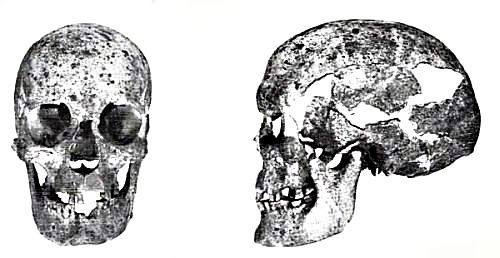 |
Dolichocephalic woman skull from Varpelev Stevns. From “Danmarks Oldtid” by Johannes Brøndsted.
Many skeletons in graves in Denmark from precisely about 200-300 AD show that the deceased were quite tall and long skulled. Thus, one of the deceased in Himlingøje had been close to 180 cm tall. The historian Palle Lauring wrote about Dani’s ethnic characteristics: “The striking many dolichocephalic skulls in the graves have been associated with the coming of the Danes, and it is worth to emphasize that the particularly long-headed appearance pretty quickly disappear from the graves again and is replaced by roughly the same situation as before. It is distinctive upper-class tombs, and we must not forget that precisely with the Danes’ conquest of the land it is about their upper class, that is a very narrow group of bloodlines, perhaps only a few families, who probably have been so inter-married that a common appearance can be understood.”
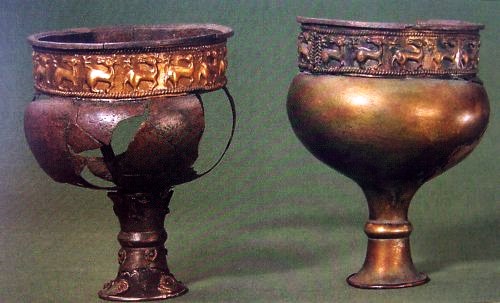
Two silver cups from Valløby at Tryggevælde Å on Stevns. This is not Roman style, the cup’s design must represent a culture that Dani had with them when they came – from Asia. Photo: verasir.dk.
Snorri’s preface to the Edda tells us why this characteristics appearance rather quickly disappeared again: “The Aesirs took wives there in the country; some married their sons with local women. All these blood-lines were so numerous that they spread all around in Sax-land and all the northern countries, so that their, the Asian men’s, tongue became the real language of these countries. Thereof, as their ancestors’ names are recorded, it is thought that it can be believed that these names have followed with this tongue and that the Aesirs have brought them with them to the northern countries, to Norway and Sweden, to Denmark and Sax-land.” – Snorre exaggerates undoubtedly the Aesirs’ linguistic influence, as Scandinavian and German still today are Germanic language, resembling Gothic, but it is most likely true that the Aesir’s have made an important contribution to the Nordic countries’ language.
Thuringia quickly was conquered by the Franks. Gregory of Tours tells how: “So he (King Theodoric) summoned the Franks, and said to them: “Be angry, I beg of you, both because of my wrong and because of the death of your kinsmen, and recollect that the Thuringi once made a violent attack upon our kinsmen and inflicted much harm on them. And they gave hostages and were willing to conclude peace with them, but the Thuringi slew the hostages with various tortures, and made an attack upon our kinsmen, took away all their property, and hung youths by the sinews of their thighs to trees, and cruelly killed more than two hundred maidens, tying them by their arms to the necks of horses, which were then headed in opposite directions, and being started by a very sharp goad tore the maidens to pieces.”
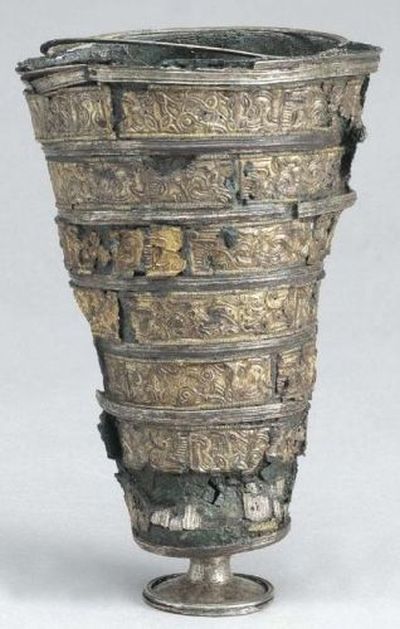
The Uppaakra cup from Uppaakra south of Lund in Scania. The cup is 165 mm. high. It is decorated with six relief band of gold in Nordic animal ornamentation style I. It is believed that the decoration on the cup is a further development of the decorations on the cups found at Tryggevælde on Sjælland. Photo: Bengt Almgren, Lund.
“And others were stretched out upon the city streets and stakes were planted in the ground, and they caused loaded wagons to pass over them, and having broken their bones they gave them to dogs and birds for food. And now Hermenfred has deceived me in what he promised and refuses to perform it at all. Behold, we have a plain word. Let us go with God’s aid against them.” They heard this and were angry at such a wrong, and with heart and mind they attacked Thuringia.”
But Thuringi did not follow the contemporary rules of fair warfare: “And the Thuringi prepared stratagems against the coming of the Franks. For they dug pits in the plain where the fight was to take place and covering the openings with thick turf they made it seem a level plain. So when they began to fight, many of the Frankish horsemen fell into these pits and it was a great obstacle to them.”
But the Franks won as always: “When finally the Thuringi saw that they were being fiercely cut to pieces and when their king Hermenfred had taken to flight, they turned their backs and came to the stream Unstrut. And there such a slaughter of the Thuringi took place that the bed of the stream was filled with heaps of corpses, and the Franks crossed upon them as if on a bridge to the further shore. After the victory was won they took possession of that country and brought it under their control.”
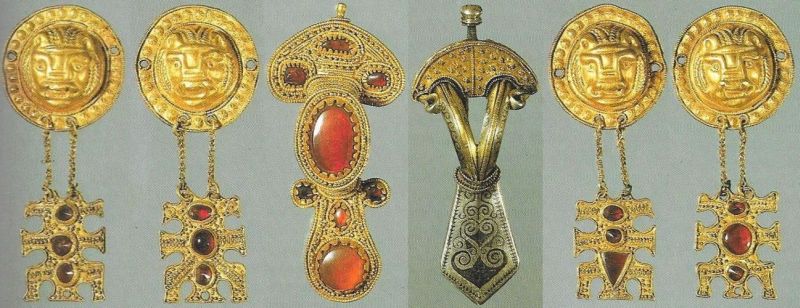 |
Selection of grave goods found in a woman’s grave woman’s grave at Kirkebakken in the village Aarslev on Fyn about 1820. In addition to several bronze dishes, bronze buckets and silver spoons the dead woman got several unique pieces of jewelry to the grave, including seven pendants with lion masks pressed in gold, semiprecious stones and clothes pins of silver. It’s interesting that they knew this animal, lion. From Gyldendal og Politikkens Danmarkshistorie 2.
In Ynglinge Saga we get some information about Switheudi’s or Swear’s culture: “Odin made it law in his countries, which previously had been law among the Aesirs. Thus he ordered that they should burn all the dead and carry their belongings into the fire with them, he said that so much fortune should each one come to Valhal with, which he had got with him on the pyre, and what he himself had dug into the ground, should also be beneficial for him. The ash they should carry out into the sea or dig into the ground. In remembering of brave men they should build a mound to their memorial, and after all men, who had been menfolk to some degree, they should erect bauta-stones, and this custom was followed long after. By winter-day they should make sacrifices for good year, by midwinter for growth and fertility, but by summer-day only for victory. All over Svitjod people paid tax to Odin, one penny for each nose, but he had to defend the country from strife and unorder and make sacrifices for them to a good year.” – “Odin died from disease in Svitjod, but when he was near death, he let himself mark with spearhead and stated that all men, who died from weapons, should belong to him.”
OFFICIAL AND REGISTEREDL CLAN CARRUTHERS CCIS SINCE 1983-CLAN OF OUR ANCESTORS
SCOTTISH CLAN – IRISH CLAN – NORSE CLAN
GOLD WINGS – https://www.facebook.com/carrutherscarrothers.pat.9
CLAN CARRUTHERS FAMILY HISTORY – https://www.facebook.com/CarruthersClan
CLAN CARRUTHERS CCIS – https://www.facebook.com/groups/3878691252182714
CLAN CARRUTHERS INT SOCIETY- https://www.facebook.com/groups/394653845137709
CLAN CARRUTHERS – BORDER REIVERS – https://www.facebook.com/groups/434959914239094
Disclaimer Ancient and Honorable Carruthers Clan International Socie
By the end of Procopius’ Book VI on the Gothic War in Italy, he loses interest in the war and writes instead about the Heruli, who was part of Belisarius’ army. He recounts among other things a decisive battle between Heruls and Langobards, which took place north of the Danube – possibly quite far north:
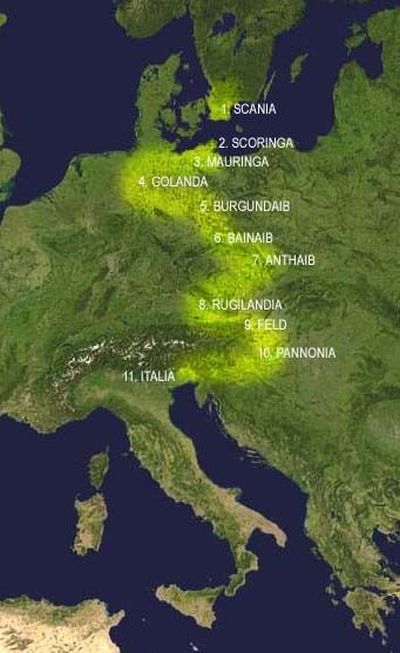
Reconstruction of the Langobards’ migrations – Langobards had given name to the region around Milan, Lombardy – Paul the Deacon mentions that the Lombards came from Scandia, but elsewhere he writes that they were not so numerous, because they came from only a small island, and this does not fit with Scandia. – Wikimedia Commons.
“And when the two armies came close to one another, it so happened that the sky above the Lombards was obscured by a sort of cloud, black and very thick, but above the Eruli it was exceedingly clear. And judging by this one would have supposed that the Eruli were entering the conflict to their own harm; for there can be no more forbidding portent than this for barbarians as they go into battle. However, the Eruli gave no heed even to this, but in absolute disregard of it, they advanced against their enemy with utter contempt, estimating the outcome of the war by mere superiority of numbers. But when the battle came to close quarters, many of the Eruli perished and Rodolphus himself also perished, and the rest fled at full speed, forgetting all their courage. And since their enemy followed them up, the most of them fell on the field of battle and only a few succeeded in saving themselves.”
“When the Eruli, being defeated by the Lombards in the above-mentioned battle, migrated from their ancestral homes, some of them, as has been told by me above, made their home in the country of Illyricum, but the rest were averse to crossing the Ister River, but settled at the very extremity of the world; at any rate, these men, led by many of the royal blood, traversed all the nations of the Sclaveni one after the other, and after next crossing a large tract of barren country, they came to the Varni, as they are called. After these, they passed by the nations of the Dani, without suffering violence at the hands of the barbarians there. Coming thence to the ocean, they took to the sea, and putting in at Thule, remained there on the island.”
Procopius was Belisarius’ secretary through three wars: against the Persians in Syria, against the Vandals in Africa and against the Goths in Italy. In all three wars, Heruls had been part of the Roman army. We must believe that Procopius had a very intimate relationship with them and that he had his information from the Heruli themselves. It is assumed that he published his reports on Emperor Justinian’s wars around 550 AD in Constantinople.
It is known from the Gothic chancellor Cassiodorus’ letters that the Goths in Italy tried to create an alliance with the Heruli, Thuringi and Varni against the Franks. Since he does not mention the Saxons, that we otherwise would expect, we must believe that Varni was an early name for the Saxons. We can imagine that the Saxons originally were called Varni and later got their name from their favorite weapon, the short single-edged sword, the sax; in the same way as the Langobards originally were called Vinil, but later was named after their favorite weapon, the long ax, langobard – bard as in the Danish name for halberd, hellebard.
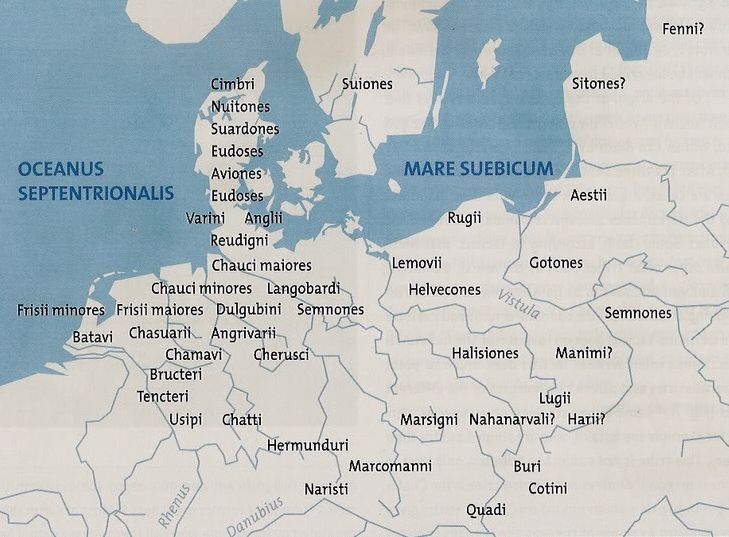 |
Reconstruction of the Germanic tribes following Tacitus. He did not create any map himself, but many writers have sought to place the tribes on a map following his description. As it can be seen Jutland and North West Germany are somewhat crowded at the expense of other areas. Tacitus mentions Varini after Anglii, and that is probably an error by Tacitus, who had all information on second hand. Varini must be the Saxons. From “The Spoils of Victory. The North in the Shadow of the Roman Empire”. Edited by L. Jorgensen, B. Storgaard and L.G. Thomsen. Nationalmuseet, Copenhagen.
In that case, the Herulian travel party had followed the Rhine or more likely the Elbe, crossed “a large distance of barren land”, perhaps Luneburger Heide, then traveled through the land of the Varni that most likely was Saxony, and from there through “the nations of the Dani” – notice that they are in plural – which must have been Jutland. Then they crossed the sea and landed in Thule, which is the Scandinavian Peninsula. As they traveled through Jutland through several of the Danes’ nations, we must believe that they traveled a good distance up in Jutland, before they sailed over to Halland and Scania.
The earliest mention of Varni is by Tacitus in “Germania”, in which he wrote: “Then follows in sequence and Reudignians, Aviones and Angles and Varinians and Eudoses and Suardones and Nuithones; all defended by rivers or forests.” This means that the Varinians were neighbors to the Angles, which fits very well with the idea that they were a kind early Saxons and lived south of the “the nations of the Dani”. Alternatively, it is suggested that Varni lived at the river Warnow and the city of Warnemünde, it would then lead to that the returning Heruls sailed from northern Germany to perhaps Blekinge and Scania, and that they not – as reported – “passed by the nations of the Dani” before they “took to the sea, and putting in at Thule”.
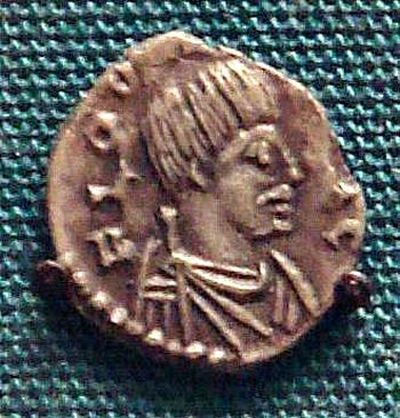
Coin with a portrait of Odovacar issued in Ravenna in 477 AD. He has a mustache following barbaric custom and maybe hair done up in a pillow. He was in all probability a Scirii, a Gothic-speaking people, but Consularia Italica calls him King of Heruli. Consularia Italica is a collection of documents published by Theodore Mommsen in 1892. Other sources claim he was of Gothic origin. But Heruls constituted a large part of his men, and he was Rex Italia, therefore he was actually King of Heruli, though he himself was not a Herul. Moreover, Scirii was a kind of Goths, and as Odovacar was a Scirii, one can also say that he was a Goth. Thus, all statements are true. Odovacar deposed the last Western Roman emperor, Romulus Augustulus, in 476 AD. Jordanes wrote about Odovacar: “Now that Augustus was appointed emperor in Ravenna by his father Orestes, it did not last long before Odoacer, King of Torcilingi (Thuringi), invaded Italy, as leader of Sciri, Heruli and allies of various races” – Photo Wikipedia.
In Procopius’ report on the Heruls, they assure him several times that they lived in their original homeland when they fought their destiny battle against the Longobards. They did not tell Procopius that they originated from Scandia or another island, as Jordanes says. However, the term “passed the nations of the Dani, without suffering violence at the hands of the barbarians there” reveals, however, a somewhat tense relationship with the Danes, which suggests that Jordanes was right. Perhaps it was too humiliating for them to admit to Procopius that they two times had been expelled.
Following Paul the Deacon, the Rugi who lived north of the Danube opposite the Roman province Noricum, were defeated by Odoacer, who reigned in Italy. This happened 487-88 AD. He says that the victor led the Rugians away in large quantities, and the Longobards moved into the now almost uninhabited Rugiland, which must have been northern Austria, some believe Moravia. Here they were attacked by the Heruli, who, however, lost the fateful battle that followed, so that they were forced to leave their own country, as they told Procopius. This battle must most likely have taken place around the year 500 AD – and according to Paul in an area immediately north of the Danube.
As previously explained, it is likely that some Heruls were expelled from Scandinavia by Dani maybe around 200-300 AD The returning Heruls thus came back through “the nations of the Dani” 200-300 years after they had been expelled the first time.
OFFICIAL AND REGISTEREDL CLAN CARRUTHERS CCIS SINCE 1983-CLAN OF OUR ANCESTORS
SCOTTISH CLAN – IRISH CLAN – NORSE CLAN
GOLD WINGS – https://www.facebook.com/carrutherscarrothers.pat.9
CLAN CARRUTHERS FAMILY HISTORY – https://www.facebook.com/CarruthersClan
CLAN CARRUTHERS CCIS – https://www.facebook.com/groups/3878691252182714
CLAN CARRUTHERS INT SOCIETY- https://www.facebook.com/groups/394653845137709
CLAN CARRUTHERS – BORDER REIVERS – https://www.facebook.com/groups/434959914239094
Disclaimer Ancient and Honorable Carruthers Clan International Socie
Saxo Grammaticus starts “Saxonis Grammatici Historia Danica” with: “Dan and Angel, Humble’s sons, from whom the Danish originate, was our people’s founders, although the French chronicle-writer Dudo will know that the Danes descend from the Greeks or, as they are also called, the Danas, and got their name from them.”

Saxo Grammaticus by Louis Moe.
This is probably not absolutely true but shows Saxo’s purpose of his work, namely, to create a history of Denmark that could unite the nation by creating or strengthening a common Danish identity.
Jordanes wrote that Dani expelled Herulos from their settlements, which we must believe, lay in Denmark. The Heruls are mentioned by many ancient writers, but they are not found in any written sources from Scandinavia, neither at Snorre, Saxo or in other sagas, old English poems or in any other handed down histories.
It must, therefore, be assumed that they were known in Scandinavia under a different name. Nobody knows for sure, who they were, and there is ample room for guesses and speculations. But it is tempting to think that they were the direct descendants of the dominating people in the old Bronze Age culture that still held out on Sjælland and in Skåne, until they were expelled by Dani. The Danish archaeologist Johannes Brøndsted noted that Sjælland and neighboring islands are strikingly poor in finds from the oldest Iron Age, it is as if the bronze age here continued yet another time, he argued.
Many believe that “danu” is an ancient proto-Indo-European word for river.
The Romans used mostly the Greek Ister for Danube, but Tacitus wrote Danubius. Pliny wrote: “Magnum est stare in Danubii ripa” meaning: “It’s magnificent to stand on the banks of the Danube”. In English and French, the river is still called Danube.
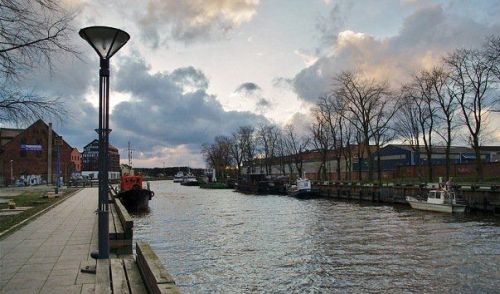 |
The river Dana through Klaipeda in Lithuania. Photo curiositu.ru.
In “The saga of Hervarar and King Heidrek” the Gothic capital is called Arheimar and is located at the Danpar river that is the Dnieper, which was also called Danapris or Danaper of Greeks and Romans. Dniester was in ancient times called Danastius or Danaster.
In the description of a Sclaweni people, the Antes, who lived in southern Ukraine between the rivers Dniestr and Dniepr, Jordanes calls the two rivers respectively Danastro and Danaprum (a Danastro extenduntur usque the Danaprum).
The river Don is called Tanais, among others by Strabo, and thus it is called also in Heimskringla by Snorre. Procopius tells that the Po River in northern Italy was called either Po or Eridanos. The French river Rhone is called Rodanus by several ancient writers, for example in “Historia Langobardorum” by Paul the Deacon, where we hear about some marauding Saxons, who came to the Rodanus river.
The river that runs through Klaipeda in Lithuania is called simply Dana, and is said that there are six rivers in the UK, called Don. It is also said that on Jacob Langebek’s maps from around 1755 the river Eider is called Døne.
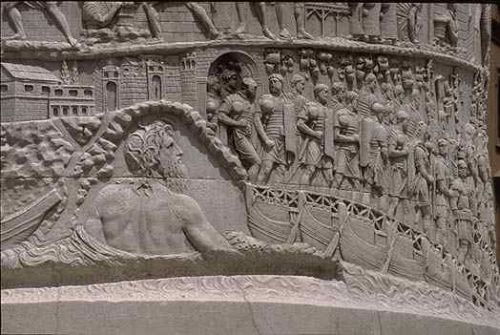
A relief on Trajan’s Column depicting the god Danubius watching Roman legionaries – Wikipedia.
Plinius (23-79 AC) wrote in Naturalis Historia: “There is the extremely great mountains Saevo not inferior to the high crags of Riphaeus, which make up a very large gulf called Codanus as far as to the Cimbrians’ Promontory, and it is full of islands, of which the most well known is Scandinavia, the magnitude whereof is not yet discovered.” At about the same time Pomponius Mela (died around 45 AD) wrote on Codanus Sinus and Codannovia, which was a large island in Codanus Sinus. Most assume that “sinus” means bay.
The same Pliny the Elder wrote: “Pytheas says that Gutones, a people in Germania, inhabits the banks of an estuary of the ocean called Mentonomon.” As the Goths really lived in southern Scandinavia, we must believe that he thought that the Danish straits and the Baltic Sea was a large estuary.
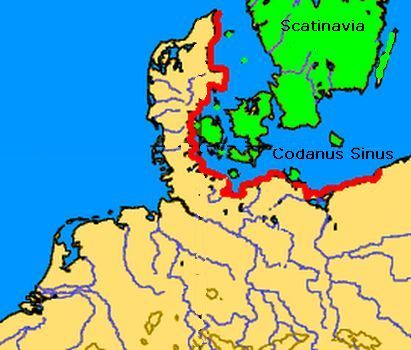
Pytheas says that the Gutones, a people in Germania, inhabits the banks of an estuary of the ocean called Mentonomon. Their territory extends over a distance of six thousand stadia (about 1.100 kilometers). From Wikipedia.
At first glance, we imagine that Codanus most likely was Latin, because it sounds Latin and Pliny and Mela wrote in Latin; but it is not. An online Latin-Danish dictionary gives the answer that Codan means “in Danish”, and it was probably not the intention.
It’s pretty likely that Codanus was the name of the inner Danish waters understood as a river or estuary in an original proto Indo-European language, like Eridanos, Rodanos and all the other river names that can be traced back to the term “dana” for “river” in an original language that probably was spoken from southern Russia to France and Scandinavia, most likely dating back to the Bronze Age. When Pliny and Mela wrote that the bay or estuary is called Codanus, then it was not a Latin name that they had given it, but more likely it was, what the inhabitants of the area called it themselves.
The ending -us in Codanhus is a mere gender- and casus-suffix.
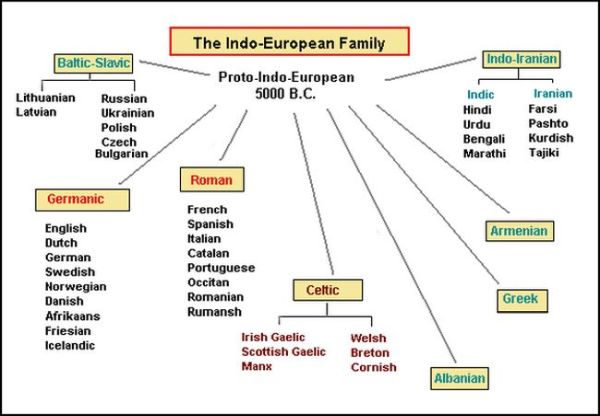 |
It is assumed that the Indo-European languages originate from an original proto Indo-European language. From Site for Language Management in Canada.
Many believe that Lithuanian is the modern language that is most close to an original Proto-Indo-European language. Lithuanians add -as to men’s names to indicate that this person is a man, quite like the Romans added -us to men’s names, like in Julius, Crassus, Augustus and so on.
I remember a former colleague, who strived to learn Lithuanian; he thought it was not so difficult, because many words recall corresponding Danish words.
But when dana, danu, dan, danos or danus meant river, what meant then “Co-“?
We recognize co- in many modern words denoting collaboration or cooperation between several agents, for example, company, coordinate, corporation – Codanus could then have meant something like “cooperating rivers”, which is not a bad description of the three Danish straits, which spew brackish water into the Western Ocean.
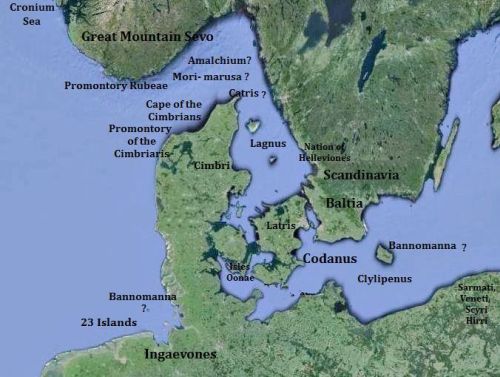 |
A traditional interpretation of Pliny’s place names.
In the “Naturalis Historia” section on the Baltic Sea, Southern Scandinavia and the North Sea, Pliny the Elder gives additional examples of names that may have originated in an original proto Indo-European language that was spoken in these parts of the World: “The rest of these coasts are only known in detail by reports of doubtful authority. To the north is the ocean; beyond the river Parapanisus, where it washes the coast of Scythia. Hecataeus calls it the Amalchian Sea, a name that in the language of the natives means “frozen”; Philemon says that the Cimbrian name for it is Morimarusa (that is “Dead Sea”) from the Parapanisus to Cape Rusbeae, and from that point onward the Cronian Sea. Xenophon of Lampsacus reports that three days’ sail from the Scythian coast there is an island of enormous size called Balcia; Pytheas gives its name as Basilia. Also, some islands called the Oeonae are reported of which the inhabitants live on birds’ eggs and oats.” These names are not Latin names, which the Romans have given islands and seas, but names that the people of these regions used themselves. Apart from “Oeonae” which recalls the Danish “ø” meaning island, they do not remind of Gothic or Germanic names.
Saxo wrote: “Dudo will know that the Danes descend from the Greeks or, as they also are called the Danas, and got their name from them.” But Greece reminds geographically on Denmark since it consists of a peninsula and numerous islands, where in between are flowing streams of less salty water from the many rivers that flow into the Black Sea; therefore, the country’s inhabitants were in a remote antiquity also called Danas in an original Indo-European language.
Homer called the Greeks for Danaans or Danai. When the Greeks had left the walls of Troy and left behind their wooden horse, the priest Laocoon said: “I fear Dana’ans, even those who bring gifts.”
OFFICIAL AND REGISTEREDL CLAN CARRUTHERS CCIS SINCE 1983-CLAN OF OUR ANCESTORS
SCOTTISH CLAN – IRISH CLAN – NORSE CLAN
GOLD WINGS – https://www.facebook.com/carrutherscarrothers.pat.9
CLAN CARRUTHERS FAMILY HISTORY – https://www.facebook.com/CarruthersClan
CLAN CARRUTHERS CCIS – https://www.facebook.com/groups/3878691252182714
CLAN CARRUTHERS INT SOCIETY- https://www.facebook.com/groups/394653845137709
CLAN CARRUTHERS – BORDER REIVERS – https://www.facebook.com/groups/434959914239094
Disclaimer Ancient and Honorable Carruthers Clan International Socie



Reviewed by Tammy Wise CHS- CHAIRMAN – Indiana USA
CLAN SEANACHAIDHI
CLAN CARRUTHERS INT SOCIETY CCIS HISTORIAN AND GENEALOGIST
https://www.facebook.com/CarruthersClan/
Disclaimer Ancient and Honorable Carruthers Clan International Society
I

Archaeology students from the Uppsala University have uncovered the remains of an Iron Age warrior in Sweden.
The find made during excavations in Buttle Änge on the Swedish island Gotland has been described as “rather unusual” and the deceased may not have been from Scandinavia.

The man who scientists think may have served in the Roman army was discovered in the midst of a limestone burial.
“I was present when the femur and a piece of the hip bone were excavated. You have to be very careful when digging this type of material so we had to carefully remove the soil with brushes. Eventually, we found spurs down at the feet. And when we brushed at the belly of this individual, it appeared as a piece of bronze that we carefully continued to brush forward”, student Gustav Randér told the newspaper Dagens Nyheter, describing the situation as “absolutely fantastic”.
The man who scientists think may have served in the Roman army was discovered in the midst of a limestone burial.
At the site there was also an 80-centimeter-long bronze sword with bronze fittings. In addition, part of the sword sheath was also preserved in the form of wood remains on both the top and bottom of the bronze sword. At the bottom is a decoration on the ski that has the shape of an acorn.
According to Alexander Andreeff Högfeldt, a doctor of archeology at Uppsala University the sword seems to be inspired by those used on the continent, and the object reveals interesting details about the life of the sword bearer.
“We know from written sources from the Mediterranean world that Germans, that is Scandinavians, served in the Roman army. So it is very possible that this person learned weapons technology from the Romans”, Alexander Andreeff Högfeldt mused.
Andreeff Högfeldt described the find as “rather unusual” and said that warrior skeletons like this may be found once every 30 years
he details about the owner of the sword, however, remain scarce. He appears to be a man with a strong jaw and solid bone structure, who lived sometime during the 300s-500s.
Scientists have announced further investigations and research will be carried out in the future.
Reviewed by Tammy Wise CHS- Indiana USA
CLAN SEANACHAIDHI
CLAN CARRUTHERS INT SOCIETY CCIS HISTORIAN AND GENEALOGIST
https://www.facebook.com/CarruthersClan/
Disclaimer Ancient and Honorable Carruthers Clan International Society
I
 CLAN CARRUTHERS - OUR NORSE ANCESTORS