Gutland / Gotland, OUR ANCESTORS, The History of Gutland, The Viking Age, Uncategorized

MAIL TROLLS AND ATGEIRS – THE MYSTERIOUS WORLD OF VIKING POLE WEAPONS-CLAN CARRUTHERS CCIS

cropped-wide-banner-with-new-crestnorse

MAIL TROLLS AND ATGEIRS – THE MYSTERIOUS WORLD OF VIKING POLE WEAPONS

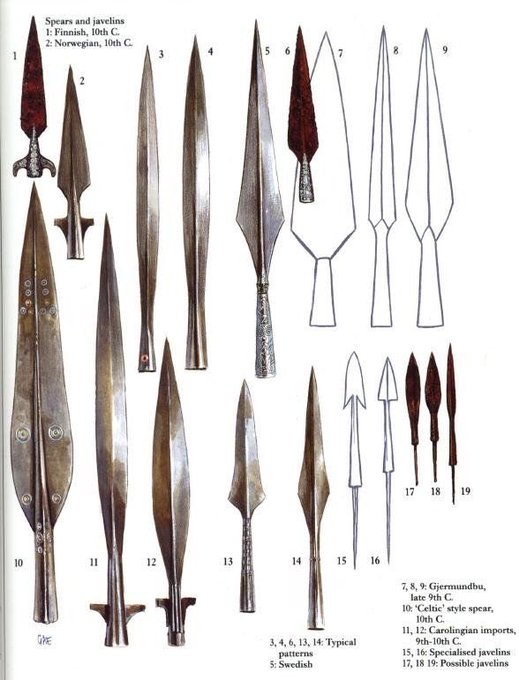
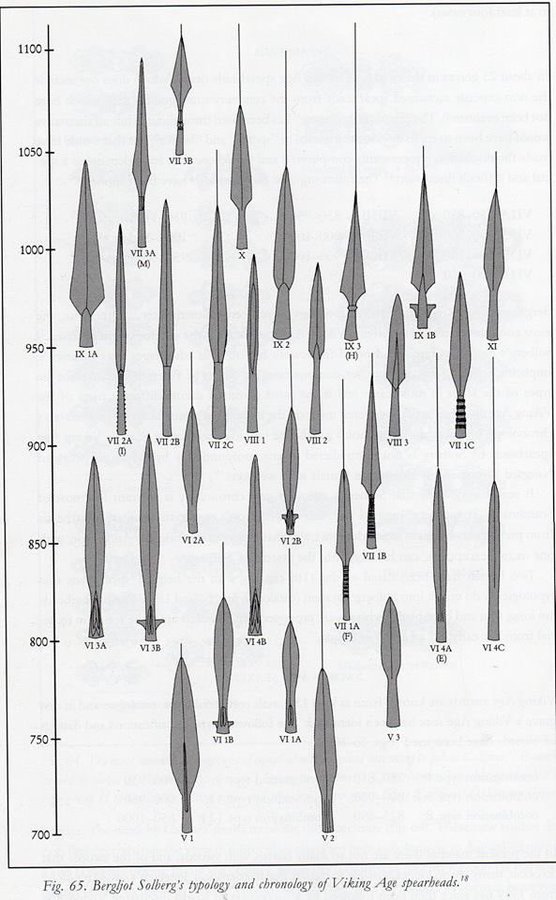
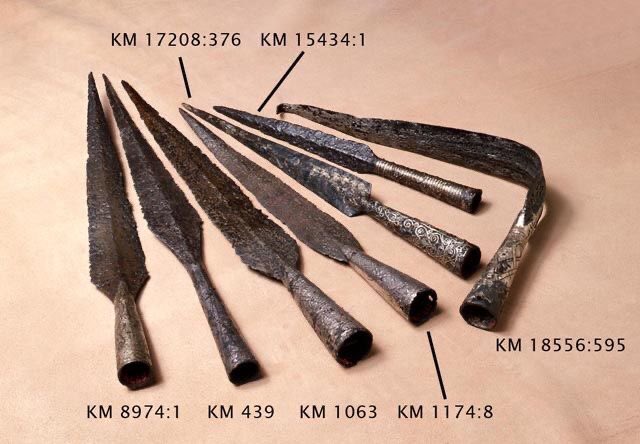
If you think of a Viking warband, the modern image would be one of men armed mainly with swords. However when you read Old Norse literature, the predominate weapon mentioned is the spear or more often, something usually translated as a “halberd”. In the original Old Norse, however, we find a variety of intriguingly named weapons being translated to that one term.

The usual Old Norse word for spear is geirr. Another common term often used is a kesja. The saga’s also name other, now obscure varieties of blades mounted on sticks, including atgeirr, höggspjót, brynþvarar and bryntroll.

That all of these are a type of blade on a stick, something we would otherwise call a “spear”, is not in doubt. However their use and appearance in medieval literature is sufficiently different to what our notion of a spear is to warrant translators from Victorian times to use a different term, usually “halberd” or “bill”.

This is itself raises an issue, as halberds, pikes and other pole-arms developed in the later middle ages, so were anachronistic to the Viking age when the characters in the sagas are described as wielding them. So the possibility exists that these are types of weapons now lost to history.

The saga writers have a frustrating tendency not to describe these weapons, hinting that they were very familiar to the audience they were writing for. However it means the we are left to seek for clues amid the texts for what they really were.

The atgeirr is probably the most famous of these. It was the weapon of choice for Gunnar Hámundarson, the Icelandic warrior and main character of Njal’s Saga, one which he uses to devastating affect on many characters in the saga. Apart from using it as a vaulting pole to leap, Lone Ranger-like, onto his horse for a quick get away, Gunnar kills many men with his atgeir.

Image

Compared with sword and axe, the spear was relatively cheap and effective to produce. Because of its length, it was probably the most important weapon in close combat. Together with arrows it also posed a big threat when it was thrown.

At one point in the saga Gunnar hoists an adversary impaled on the atgeirr aloft. When his enemies gang up on him and one tries to sneak onto the roof, Gunnar shoves his atgeirr out the window, catching Thorgrim in the stomach. The unfortunate man tumbles off the roof. His comrades ask him if Gunnar is at home.

“You can find that out for yourselves,” said Thorgrim; “but this I am sure of: His atgeirr is at home,” and with that he fell down dead.

Thorgrim’s last words, so typical of the black humour of the Sagas, also hint at the regard in which Gunnar’s weapon was held. Gunnar’s weapon is referred to as atgeirinn – “The atgeir”, which suggests it was a unique, special item – a magic weapon worthy of a Dungeons and Dragons quest – however atgeirrs are named in Laxdœla Saga and the Eyrbyggja Saga too. Gunnar’s was rumoured to have a life of its own, the blade ringing when it was lifted off its bracket on the wall if it was to taste blood soon.

Viking Weapons High Resolution Stock Photography and Images - Alamy

But what was it? Geirr is simply a very old word for spear, so as Jan H. Orkisz points out, the importance must lie in the “at” part of its name. The common interpretation of “at” appears to be as “excellent” or “very” – hence perhaps “most excellent” or “best” spear. However Orkisz points out that this ultimately derives from a Latin prefix ad-, and Old Norse had a poetic use of at- to denote fight, clash or attack. Hence atgeirr would be “battle spear” or “fighting spear”. The way Gunnar and others use it in the saga point towards a heavy spear used in hand-to-hand fighting, perhaps like a heavy board spear, rather than a javelin hurled at the enemy while they are still at a distance.

The höggspjót is another weapon appearing in the sagas. Spjót is again just another word for spear. Högg is a form of the verb höggva which means “to strike, to smite”. It’s tempting to again translate this as another “battle spear”, however the verb is often used in the context of cutting down a tree or wielding an axe, so the name “Hewing spear” might be more appropriate. Some of the descriptions of its use correlate with the idea of a long, heavy blade mounted on a pole, capable of slicing through shields and the flesh and bone of the unfortunates holding them. Egil Skallagrimsson carries a höggspjót on his ill-fated meeting with Rognvald, ( CARRUTHERS ANCESTOR)  the young son of King Eirik Bloodaxe  ( CARRUTHERS ANCESTOR)  of Norway.

Egil’s Saga also mentions another weapon, the brynþvarar and gives quite a detailed description of itThorolf strides into the Battle at Brunanburgh “armed like this”:

Kesju hafði hann í hendi. Fjöðrin var tveggja álna löng ok sleginn fram broddr ferstrendr, en upp var fjöðrin breið, falrinn bæði langr ok digr, skaftit var eigi hæra en taka mátti hendi til fals ok furðuliga digrt. Járnteinn var í falnum ok skaftit allt járnvafit. Þau spjót váru kölluð brynþvarar.

“He had a kesja [spear] in his hand…the feather-formed blade was two ells long, ending in a four-edged spike; the blade was broad above, the socket both long and thick. The shaft stood just high enough for the hand to grasp the socket, and was remarkably thick. The socket was fitted with an iron prong on the shaft, which was also wound round with iron. Such spears [spjót] were called brynþvarar.”

In the middle, a large bayonet-spear from the Gournay-sur-Aronde sanctuary in northern France.

An ell was the distance from the elbow to the tip of the middle finger, about 18 inches. Therefore at 2 ells the blade of this weapon was about 36 inches long, or 3 feet, which is impressive for a spear.  It would seem that this weapon has a short, thick shaft, and the impression is some sort of short implement, mostly blade, specifically designed for piercing mail. Though perhaps not very short. Later in the battle, gripped by berserker rage, Thorolf does a Vlad Tepeș. He lunges at an enemy Jarl’s chest with the brynþvarar, “driving it right through mail-coat and body, so that it came out at the shoulders; and he lifted him up on the halberd over his head, and planted the butt-end in the ground”. Ouch.

Image

The Old Norse word spjót (spear) is related to the Old French word espiet which means “the spy, one who stares from a long distance”.

The bryn part of the name refers to the brynja, the Old Norse name for a mail shirt. My Old Norse dictionary lists þvari as meaning a “bolt or spear”. In other words this was a special type of spear, specifically designed for piercing mail. Possibly closely related to the brynþvarar we have the bryntroll. We’ve already covered that bryn means mail and troll speaks for itself. It’s a monster, an enemy, a creature that destroys, so the weapon is a troll or moster for mail shirts. The effectiveness of medieval spears against mail is demonstrated in this video:

Image

There was also the rather horrible sounding “Hooked Spear”, the Krókspjót, a weapon so nasty a law was passed forbidding its use.

So at the end of the day these all appear to be varieties of spear. That they were not swords is underlined by the way in many sagas the hero is specifically mentioned as having a sword as well, either at his belt or, in Egil’s case, tied to his wrist.

That spears would be important to pagan Scandinavians should not be that surprising. The spear was the weapon sacred to the God Odin. Battles were traditionally started by one side hurling a spear over their opponents and yelling “Óðinn á yðr alla” – Odin owns you all. Being transfixed by a spear while also being hung appears to have been the way to sacrifice a human being to Odin.

Another other possibility is that these are all anachronisms. Medieval saga writers could have been giving impressive modern (for them) weapons to their heroes to make them look cool to a contemporary audience, or to use terms they were familiar with.

Carruthers crest on flag-v2 (1)

OFFICIAL AND REGISTERED CLAN CARRUTHERS  CCIS -1983-CLAN OF OUR ANCESTORS
SCOTTISH CLAN, IRISH CLAN,  NORSE CLAN

Preserving Our Past!    Recording Our Present!  Informing Our Future!

The Ancient and Honorable Carruthers Clan International Society CCIS

carruthersclan1@gmail.com                carrothersclan@gmail.com

Crest on Light Blue

TODD HODKINSON

http://timhodkinson.blogspot.com/2019/09/mail-trolls-and-atgeirs-mysterious.html?m=1

Reviewed by Tammy Wise CHS- CHAIRMAN – Indiana USA

CLAN SEANACHAIDHI

CLAN CARRUTHERS INT SOCIETY CCIS HISTORIAN AND GENEALOGIST

You can find us on our main facebook pages at :

SILVER WINGS-https://www.facebook.com/CarruthersClanLLC/

GOLD WINGS – https://www.facebook.com/carrutherscarrothers.pat.9

CLAN CARRUTHERS FAMILY HISTORY – https://www.facebook.com/CarruthersClan

CLAN CARRUTHERS CCIS – https://www.facebook.com/groups/3878691252182714

CLAN CARRUTHERS INT SOCIETY- https://www.facebook.com/groups/394653845137709

CLAN CARRUTHERS – BORDER REIVERS – https://www.facebook.com/groups/434959914239094

Disclaimer Ancient and Honorable Carruthers Clan International Society

References:

Gutland / Gotland, OUR ANCESTORS, The Viking Age, Uncategorized

SVEND I HARALDSSON THE FIRST VIKING KING OF ENGLAND – CARRUTHERS ANCESTOR – CLAN CARRUTHERS CCIS

WIDE BANNER with NEW CREST

SVEND I HARALDSSON THE FIRST VIKING KING OF ENGLAND WITH THE CONQUEST OF ENGLAND 1013

In 1012, England had finally secured peace and security against foreign attackers, having endured a three-year Viking raid which had culminated in the brutal murder of the Archbishop of Canterbury. But any hopes of enjoying a long spell of peace and quiet were rudely shattered in early 1013 by the arrival of an invasion force led by the King of Denmark, Svend Forkbeard.
Svend’s army conquered England so quickly that by Christmas he was in control of the kingdom, but how did he achieve this feat of arms? Was it through defeating English armies on the battlefield and subjugating the survivors? Or was it through a mass change of allegiance on the part of the English nobility and clergy?
Sweyn I of Denmark - Wikidata
The apocalypse was not slow in arriving. In the spring of 1013, less than a year after Thorkell
the Tall stopped attacking them, a new and more deadly enemy returned to menace the
English. Svend Forkbeard was back. No one knows exactly why Svend chose to invade
England in 1013. He had taken part in raids on England in the 990s and in the previous
decade, but those were plundering raids, whereas what he now proposed to do was outright
conquest. One leading theory is that he feared that AEthelred would fund an attempt by
Thorkell the Tall to become King of Denmark, like he funded Óláfr Tryggvason’s campaign
to become King of Norway in 995, which had disrupted Svend’s hegemonic rule over
Scandinavia. Óláfr ruled Norway for four years before being killed at the battle of Svolder by
a naval coalition comprised of Svend’s navy, his Norwegian son-in-law Eiríkr Hákonarson’s
forces, and Svend’s Swedish allies.
Whatever his reasons for invading England were, Svend and his invasion fleet initially sailed
to Sandwich on the south coast, before going north to the mouth of the river Humber in
northern England and landing at Gainsborough. At this point it became clear that Svend had
been in contact with several English nobles before his arrival as he was welcomed by the
locals with open arms. To secure their loyalty, Svend had his son Cnut marry AElgifu of
Northampton, the daughter of Ealdorman AElfhelm. Her family wielded a huge amount of
influence in northern Mercia and southern Northumbria at that time due to their large estates
and extended family networks. They had suffered a major setback during the palace coup at
AEthelred’s court in 1006 when Ealdorman AElfhelm was murdered, and his sons were
blinded. As a result, they had an axe to grind against AEthelred and his supporters,
particularly Eadric Streona, who had risen to prominence at their expense. In short order,
most of northern and eastern England joined Svend, and provided him with all the supplies he
needed.
Sweyn Forkbeard - Alchetron, The Free Social Encyclopedia
The reasons why the English people switched their allegiances go deeper than cultural links
and blood feuds between rival noble families though. They had suffered huge amounts of
death and destruction at the hands of Viking raiders in the previous twenty years, whilst
AEthelred had utterly failed to fulfil his duty as King and defend them from attack. When
Svend arrived, he offered them a new deal which was that if they accepted him as their king,
then in return he would stop the Viking raids. They were more than happy to accept it since
AEthelred had failed to uphold his responsibilities to them, and they thought Svend would be
able to keep his word. In addition to this, there were also family and cultural links with
Scandinavia in the Danelaw of eastern England which helped to smooth over any issues in
that region.
Svend and his army now moved south and started pillaging once they left the lands held by
his new subjects. This was enough to frighten the populations of Oxford and Winchester to
surrender without a fight in return for a promise of protection, and the rest of England soon
followed suit and surrendered to Svend. The only place which stayed loyal to AEthelred was
London. Thorkell the Tall also remained loyal to him, but that was scant consolation for
AEthelred as the rest of the kingdom decided that they would prefer to have Svend as their
king instead of him. AEthelred, along with Emma and their children, sailed with Thorkell the
Tall to the Isle of Wight where they spent Christmas, before sailing for Normandy and exile.
AEthelred’s sons by his first marriage stayed behind in England and lay low, awaiting
developments. After AEthelred had departed, London submitted to Svend, who then
demanded hostages from the entire English nobility as a safeguard against treachery.
Sweyn Forkbeard – First Viking King of Britain | Annoyz View
So, that was that. Svend had conquered England, a kingdom with far more people, money,
and land than his own, in a matter of months. The principal reason why he had been so
successful was because instead of fighting him, the English decided to change sides and join
him in his campaign against AEthelred. As the political and military momentum had shifted
in Svend’s favour due to his seemingly unending series of successes, he attracted more and
more defectors who were eager to join the winning side before it was too late. The result was
that as 1013 drew to a close, Svend enjoyed the support of most of the English nobility and
clergy, with no signs of resistance to his rule in sight.
As 1014 began, Svend was secure on the English throne. All he needed to do to make his new
title legitimate in the eyes of the rest of Christian Europe was to hold a coronation. AEthelred
was in exile in Normandy with his ducal in-laws, who were not particularly inclined to be
helpful in supporting a campaign to reconquer England. Even if AEthelred could gather an
army, cross the Channel, and get ashore without being intercepted, his chances of success
looked hopeless whilst Svend’s grip on England was so strong. But for all that things looked
set in stone, the wheel of fortune was still turning…
Carruthers crest on flag-v2 (1)

OFFICIAL AND REGISTERED CLAN CARRUTHERS SINCE 1983

Preserving the Past, Recording the Present, Informing the Future

Ancient and Honorable Carruthers Clan Int Society 

carruthersclan1@gmail.com     carrothersclan@gmail.com

cropped-wide-banner-with-new-crest.jpg

Andrew Rollo

Reviewed by Tammy Wise CHS- CHAIRMAN – Indiana USA

CLAN SEANACHAIDHI

CLAN CARRUTHERS INT SOCIETY CCIS HISTORIAN AND GENEALOGIST

You can find us on our main facebook pages at :

SILVER WINGS-https://www.facebook.com/CarruthersClanLLC/

GOLD WINGS – https://www.facebook.com/carrutherscarrothers.pat.9

CLAN CARRUTHERS FAMILY HISTORY – https://www.facebook.com/CarruthersClan

CLAN CARRUTHERS CCIS – https://www.facebook.com/groups/3878691252182714

CLAN CARRUTHERS INT SOCIETY- https://www.facebook.com/groups/394653845137709

CLAN CARRUTHERS – BORDER REIVERS – https://www.facebook.com/groups/434959914239094

Disclaimer Ancient and Honorable Carruthers Clan International Society
Gutland / Gotland, The History of Gutland, Uncategorized

MEGALITHIC GRAVE ON GOTLAND-CLAN CARRUTHERS CCIS

WIDE BANNER with NEW CREST

The Megalith Grave at Ansarve, Tofta Parish,Gotland

A megalith structure can be described as a collective grave built of large stones usually erected on end, close together, and covered with one or more capstones, thus forming an inner chamber where corpses were deposited. They were collective graves for an extended family or corporate decent group, and used over an extensive period. Such graves are found mainly in Western and Northern Europe (Portugal, Spain, France, Britain, Ireland, West Germany, Denmark and Sweden). They are often located close to the coast, and in Scandinavia they are often associated with a Neolithic way of life, including cultivation, domesticated animals and a certain type of pottery (Funnel Beaker Pottery). They usually have initial dates to the Scandinavian Early Neolithic3400–3300 BC.
The only megalith construction on Gotland (Fig. 3) which archaeological excavations confirm as being such a structure is located on the western part of the Island, in Tofta Parish, about 20km south of Visby. Due to shore line displacement and isostatic uplift ,it is situated about 1km from the current coastline, beside the road leading to the old fishing campsite at Gnisvärd (Fig. 2). When it was built and used, it was located directly on the shore. Today, the grave consists of four 1.2 metre high granite blocks. Three stones make up the wall of the chamber on the northern side (Fig. 4). Approximately 1.5m to the south stands a single large block, which comprises the southern wall of the same chamber. There are vertical entrance stones on the east corner side of the chamber, and the grave is bounded by a rectangular outline of limestone slabs bordering a stone pavement which surrounds the chamber stones. Based on its typological features, this structure is interpreted as a rectangular dolmen dating to the end of the Scandinavian Early Neolithic
c.3400–3300 BC(Bägerfeldt 1992.7)
Tab. 1. The Neolithic in Scandinavia (calibrated values). 
Fig. 1. Map of Gotland Island during the Scandinavian Early Neolithic, with the location of the An- sarvemegalith, the possible megalith at Licksarve, and other Funnel Beaker Settlements.
Despite the archaeological excavations and their conclusive results, the structure is still not entirely
recognised as being a megalith. It is situated close to two of the largest Bronze Agestone ship settings on the Island, which makes up one of Gotland’s main archaeological tourist sites. The County Administration
have set up a board which gives information about the stone ship settings and Bronze Age society, and as a small remark at the end of the text, the ‘possible’ mega-lith structure situated on the other side of the narrow road is mentioned: “…if it really is a Megalith, it is the most Eastern mega-lith structure found in Northern Europe”.In the Swedish archaeological digital site inventory, FMIS (hosted by the National Board of Antiquities), the grave is described as a ‘stone setting’, with a cist/chamber, and it is not indicated as a dolmen. The description was written in 1976, is vague, and has not been updated since, although earlier (1912) and subsequent (1984)archaeological investigations have been carried out at the site.
TOP – Fig. 2. Location of the ‘Tof-tadösen’ megalith situated  at the current 15 masl line.The light soil areas of Got-land indicated in white.
BOTTOM- The current state of the megalith at Ansarve(photo Paul Wallin)
Several archaeological excavations have been carried out on both the megalith and the stone ship set-tings at this important prehistoric site, but the results have not really been placed in a context together, since the structures have been treated separately, due to their disparate chronology. In a way, the narrow road which divides the large stone ship set-tings and the megalith structure today also divide this site, even though the remains are only thirty metres apart. However, the site, including all the re-mains, is collectively known as Ansarve hage (pastureland). It must have been an important ritual site, since monuments of a ritual nature from various periods are located here, and re-use of the dolmen is also indicated. It appears as if the stone ship settings are ‘moored’ at the megalith structure, and in doing so, they are both attached to an ancient important place, but also, due to the monumentality of the ships, distract attention from the older site.

The megalith: discovery, description, excavations and results
The megalith was first ‘discovered’ in the early 1900sby an army doctor
 Karl Bolin. He and a head-teacher, Hans Hansson, excavated the site in 1912. They excavated (scooped out!) (Fig. 5) the chamber and found three human lower jaw bones, which according to Nils Lithberg (1914.94 ) they collected from this excavation. They also mentioned a smaller cistin side the chamber made from sandstone plates (Lithberg 1914.94 ). Such internal structures are common in megalithic graves on the mainland (Blom- qvist 1989). Based on the geographical dispersal of flint artefacts on the Island of Lithberg, it was concluded that “As regards finding such megalithic graves on this island, this is the ultimate spot 
(Lith- berg 1914.94 ).
A few notes on the excavation from 1912 are inclu-ded in Lithberg’s dissertation Gotlands stenåder
(The Stone Age of Gotland, 1914), and additional in-formation on bone remains from the site was disco- vered by Lindqvist in 1990s (1997 ).
We recently rediscovered a note on these bones in a museum store-room, which states, “
Tofta parish, Ansarve hage, 3 graves with unburned bones (1717 and 2511 grams) and one grave divided in three divisions of (29, 38 and 76 grams). Found at excavation in1903. No osteological analysis. Stored in box 6818 
”.The 1903 date is nine years earlier than the excavation by Bolin and Hansson, which might indicate that an earlier excavation may have been carried out by Bolin and Hansson, or possibly Oscar Wennersten, who was active at that time. However, this is speculation, and the date may simply be a later error.
It was not until 1984 that the next archaeological investigation was carried out at the site. A rexcavation was initiated by Göran Burenhult within the project ‘Archaeological prospecting methods’, which was linked to Inger Österholm’s project ‘Stone Age Gotland’. The excavation was carried out by students from Stockholm University, including the authors of this paper (Wallin and Martinsson-Wallin 1997 ).The aim of the investigation was to “shed light on whether the megalith tradition had been adopted on Gotland ” (Bägerfeldt 1992.7 ).
The structure consisted of a rectangular chamber(approx. 1.5 x 3m) of four granite boulders on edge

One of the side stones and the cap stone are missing, but according to oral tradition, at least, the cap stone was removed to a nearby farm, probably during the second half of the 19th century (Lith- berg 1914.94 ).
The chamber is surrounded by a rectangular frame (approx. 5 x 7m) of limestone slabs on edge (Fig. 4). The structure was interpreted as a rectangular dolmen which on typological grounds was dated to the late Early Neolithic to Middle Neo-lithic,c.3600–2900 BC (Lang 1985.38–39; Bäger-  feldt 1992.7–22; Wallin and Martinsson-Wallin1997.23
). It has been suggested that the impetus to build such a monument (or a group of immigrants carrying this tradition) came from the nearby Island of Öland to the south, directly from Western Scania, or possibly from Schleswig-Holstein in North Germany
Among the interesting features found in situ in the structure are two lime stones placed on edge, indicating an entrance facing east (Fig. 6). A rectangular slab of sandstone with zigzag ornamentation was also found close to the short side enclosure (Bäger-  fält 1992.22)
. The artefacts from this excavaion consist of 249 flint flakes, of which three are of south Scandinavian flint (one scraper), four stone axes (trindyxor), and four amber fragments, of which two were found in the chamber. A bronze tutulus dated to Montelius period II (c.1500–1300 BC), was also found inside the chamber.
The main bulk of the bone remains recovered in the1984 excavation derived from the ‘scoop-out’ in the1912 excavation, found outside the chamber in the north to north-eastern sectors of the structure (Fig.5). Thus there is no way of knowing in what posi-tions the bodies were placed in the grave. The boneremains recovered in the excavation consisted of 547 teeth, and 5950 bone fragments, with the total weight of the latter being about 23kg (Wallin and  Martinsson 1986; 1992; Wallin and Martinsson- Wallin 1997 
).
These remains were osteologically analysed and were shown to derive from a total of thirty-one individuals, of whom sixteen were adults, four juveniles, eight infants II, and three infants I. Of the adults, four could be determined as female and three male. The dental condition was generally good: only five teeth had caries, although tartar was found more frequently, and heavily abraded teeth were very common. Only a few fragments were identified as faunal remains: pig (1), seal (8), dog (3), and fish(4) (
Wallin and Martinsson-Wallin 1997 )
A subsequent inventory in the store at The Historical Museum in Stockholm in the 1990s, yielded 4371grams of bone remains (SHM inv. 31173), which were analysed by Lindqvist (
1997.362
). This bone material consisted of fourteen teeth and 246 bone fragments, with the total weight of this material be-ing 4371 grams. Lindqvist did not mention or question the discrepancy regarding the years of discovery – 1903 was indicated for these bones, as mentioned above – but took for granted that the mate-rial came from the 1912 excavation. All types of bone from the human body are represented, but fragments of the large bones are most common, and small bones such as finger and toe bones are under-represented. Lindqvist (
1997.362
) was able to identify at least eight individuals among these bones. However, judging from the total MNI, this does not necessarily mean that there are individuals in addition to the thirty-one that the previous investigation indicated. The estimation is that the megalith was a collective burial site for between thirty to thirty-five individuals of both sexes and all age groups. The bones were generally in good condition, but ostephytis was found on vertebrae, scapulae and phalangespedis. A clavicle has a cut which had healed, and some of the cranial bones are unusually thick, which according to Lindqvist (
1997.364 
) could indicate an aemia due to tapeworm, for example, which that cause loss of vitamin B–12.
To the east of the chamber, but still within the out-line of the rectangular demarcation, a complete hu

man skeleton was discovered in the pavement. The remains are of a woman, aged approx. 40 years (Fig.8). She was on her back, and the remains differed from others in that her dental condition was poor –three molars showed traces of caries; all the lower molars on the left side were missing (pre-mortem),since the alveolus had re-ossified (closed). During re-construction of the crushed cranium, a rounded hole was noted in the left side of the parietal bone (Fig.9). The suggestion is that this was a trepanation, with signs of an ongoing infected healing process, which may have caused death. The skeleton was
14
C analysed, and dated to the late Bronze Age; if correct, this makes the burial an anomaly, since cremation was the prevailing method of disposing of the dead in this period. Trepanations occurred in Scandinavia
TOP:  Sandstone with zig zag pattern
MIDDLE  Skeleton of woman found in the pavement outside the chamber
BOTTOM :  Possible trepanation and infection area onthe skull of a woman found in the pavement out- side the chamber (photo Paul Wallin).
during the Neolithic, but as far as we know, they are not known in Bronze Age settings. This needs to be investigated further, and further dating of this skEleton is needed to verify the Bronze Age connection, since the date had a range of ±230 years, and may be erroneous. If the woman has a Bronze Age con-nection, this monument may have been re-used when the stone ship settings were being erected in the vicinity. The find of the bronze tutuli and the combined dating of bones from the chamber (c.1980–1400 BC) are also indicative of subsequent re-use of the site. The dating of the megalith is based on six bone samples that have been radiocarbon da-ted. Three were carried out by conventional 14C following the 1984 excavation, and three additional AMS-dates were carried out by Lindqvist on the earlier excavated material. The earliest date on mixed bone material from the 1984 excavation indicate a date to the early Bronze Age, a date in line with the bronze tutulus. A bone from the female outside the chamber indicates the late Bronze Age, which is inline with the stone ship settings erected directly adjacent to the megalith. A charcoal sample from under one of the stones indicates a date to around AD500, but seems to be out of context. However, the later AMS dates show great agreement with the typo-logical dating of the grave type, and all three dates fall within the time frame 3300–2900 BC cal. 2 sig-ma. The date of the bones indicates a late Early Neo-lithic or early Middle Neolithic initial phase of the structure (Lindqvist 1997.356 ). These bones also show 13C values that indicate a higher intake of terrestrial food in comparison with the analysed skeletal remains from the Pitted Ware burials (Eriksson 2004 ).
The investigations thus suggest that this site was utilised as a burial site, and possibly for ceremonial/ritual activities from the Late Early Neolithic/ Middle Neolithic until the Late Bronze Age. At least, the Bronze Age connection is reinforced by a stray find in the vicinity of another Bronze Age tutulus (Mn945, SHM inv. 6207) and an Early Bronze Age cairn situated in the vicinity. This gives us another perspective on the characteristics and complexity of this site that goes beyond the scope of this paper, and which has been discussed elsewhere.
Other possible megalith structures on Gotland –a detective story…
In the early 20th century, the archaeological literature on Stone Age sites on Gotland indicates that there may have been another megalith, situated at Licksarve farm (Fig. 1) approx. 3.5km north-east of the Ansarve site
( Lithberg 1914 ).
The following was written on a photo taken by the archaeologist O. Wennersten, which we found in the Gotland Museum archives: “A Dolmen at Tofta, Lixarve” . Further investigations in the archives and also a recent site visit have indicated that it is very likely that this was a megalith originally containing at least sixteen individuals of both sexes and various age groups (Sigvallius 2001; Wallin 2010).
TOP   Picture from the possible megalith at Licksarve (photo Gotland Museum Archives).
BOTTOM  Drawing of the possible megalith at Lick- sarve (from a letter sent to The Board of National An-tiquities – ATA, Antiquarian Topographic Archive).
In the site inventory, it is described as a destroyed stone ship setting (FMIS), which are very common on Got-land, whereas megaliths are not. Documents also indicate that a farmer requested permission to remove the structure to make way for a barn, and compensation if not granted permission. The Board of National Antiquities denied his request, and compensation, but since the barn was built the farmer probably moved the burials found at the structure and placed them in a heap of stones some 10–15m south of the megalith stones. Due to road works in 1999, the heap was excavated, revealing the skeletal remains of sixteen individuals.
The bones were analysed and found to come from both sexes and various age groups, thus fitting the megalith concept of a burial site for an extended family or corporate decent group. The bones have not yet been dated, but dating could solve the puzzle. Itis very likely that the farmer dared not move the actual stones, but moved the bones and surrounding pavement and heap of soil that is indicated to have been part of the structure. That the stones were sur-rounded by a heap of soil is indicated by a drawing in the letter to the authorities requesting the removal of the grave   This discovery also poses further questions regarding other sites that feature stones of megalith dimensions that have nevertheless been classified as destroyed stone ship settings. Dating the bones from this site and re-dating the bones from the Ansarve site – as well as an inventory of ‘suspicious’ stone ship settings – are on the agenda for further research
Megaliths and the Neolithic transition on Gotland Island
To conclude: it has now been established that there is one definite, and another very probable, megalith structure on Gotland Island, as well as at least ten locations with Funnel Beaker pottery. Both of these features are linked to the Neolithic process in Scandinavia. However, it is also possible that a complete Neolithic transition may not have occurred on Got-land, and due to the isolation of the place and the natural landscape and resources, it is likely that marine subsistence was important throughout prehistory. A combination of husbandry, small-scale farming and a hunting and gathering strategy probably prevailed even up to historical times. Gotland was populated c.9000 years ago, but we do not know  where these groups actually originated, and if the descendants of these original settlers were still in the majority on Gotland during the Neolithic and the Bronze Age. The finds from Gotland and the ancient DNA from people who lived on the Island in the mid-Neolithic point to the fact that Gotland had various contacts and interactions throughout prehistory. So far, it has been a matter of debate as to whether the Western Megalith Culture actually did spread to Gotland, but it has been established that this way of life did so, and that it probably originated from Öland, South Eastern Scania, or the German Baltic coastal areas. There might be other locations with megaliths that could feature destroyed structures that erroneously have been defined as destroyed stone ship settings. A new inventory of this type of site is also of interest in order to carry out more de-tailed osteological analyses, radiocarbon dating, isotope analyses and ancient DNA sampling on excava-ted bone material excavated from the Mesolithic and Neolithic, and the Bronze Age. This is needed to obtain in-depth understandings of the internal and external relationships of the people who populated Gotland and to see the importance of this island in the Baltic Sea region
Carruthers crest on flag-v2 (1)

OFFICIAL AND REGISTERED CLAN CARRUTHERS SINCE 1983

Preserving the Past, Recording the Present, Informing the Future

Ancient and Honorable Carruthers Clan Int Society 

carruthersclan1@gmail.com     carrothersclan@gmail.com

cropped-wide-banner-with-new-crest.jpg

Helene Martinsson-Wallin, Paul Wallin
Department of Archaeology and Osteology – Gotland University, SE

Reviewed by Tammy Wise CHS- CHAIRMAN – Indiana USA

CLAN SEANACHAIDHI

CLAN CARRUTHERS INT SOCIETY CCIS HISTORIAN AND GENEALOGIST

You can find us on facebook at :

https://www.facebook.com/carrutherscarrothers.pat.9

https://www.facebook.com/CarruthersClan/

https://www.facebook.com/CarruthersClanLLC

Disclaimer Ancient and Honorable Carruthers Clan International Society
Gutland / Gotland, The History of Gutland, The Viking Age, Uncategorized

VIKING ARTIFACTS – CLAN CARRUTHERS CCIS

cropped-wide-banner-with-new-crestnorse

VIKING ARTIFACTS


Shown here are four nice examples of the Urnes style of Norse decoration, which was the last major type to emerge in the Viking Period. I’d suggest that the earliest artifacts which can fairly be described as Urnes were made during the early 11th century, and the latest perhaps in the middle of the 12th century.
 
No photo description available.
It was characterized by fine and sometimes delicate tendrils in an interlaced form. Generally, the design was created in an asymmetrical shape, and often suggested a beast entwined or trapped in tentacle-like bonds.
The largest item is an openwork stirrup mount, which was used to fasten the stirrup to the leather strap leading to the saddle of a mounted rider. It still retains traces of a silver overlay which highlighted the G-clef shaped beast in the middle of the design.
The artifact at the top left was likely a belt buckle using a separate latch, featuring two beasts intertwined, which could have been loosened or tightened slightly for the comfort of the wearer.
The middle item was a brooch—with remains of a pin element and catchplate on the back, showing a fairly abstract beast head at the top right of the piece, and an entwined body.
The final artifact is a sturdy-looking mount which probably was fastened to a belt or strap, and might have been used to suspend another item from it.
All of these artifacts were cast in bronze, which would have required some really sophisticated metal-working skill, and all of them were found in England.
 
Carruthers crest on flag-v2 (1)


CLAN CARRUTHERS SINCE 1983


Preserving the Past, Recording the Present, Informing the Future

Ancient and Honorable Carruthers Clan Int Society 

carruthersclan1@gmail.com     carrothersclan@gmail.com

cropped-wide-banner-with-new-crest.jpg


Reviewed by Tammy Wise CHS- CHAIRMAN – Indiana USA

CLAN SEANACHAIDHI

CLAN CARRUTHERS INT SOCIETY CCIS HISTORIAN AND GENEALOGIST

You can find us on facebook at :

https://www.facebook.com/carrutherscarrothers.pat.9

https://www.facebook.com/CarruthersClan/

https://www.facebook.com/CarruthersClanLLC

Disclaimer Ancient and Honorable Carruthers Clan International Society
 

I

 
Gutland / Gotland, The History of Gutland

Unusual Iron Age Burial With Warrior And Sword Discovered In Gotland – Clan Carruthers CCIS


Unusual Iron Age Burial With Warrior And Sword Discovered In Gotland


Archaeology students from the Uppsala University have uncovered the remains of an Iron Age warrior in Sweden.


The find made during excavations in Buttle Änge on the Swedish island Gotland has been described as “rather unusual” and the deceased may not have been from Scandinavia.

Unusual Iron Age Burial With Warrior And Sword Discovered On Gotland, Sweden - Was He From The Roman Empire? - Ancient Pages

The man who scientists think may have served in the Roman army was discovered in the midst of a limestone burial.

“I was present when the femur and a piece of the hip bone were excavated. You have to be very careful when digging this type of material so we had to carefully remove the soil with brushes. Eventually, we found spurs down at the feet. And when we brushed at the belly of this individual, it appeared as a piece of bronze that we carefully continued to brush forward”, student Gustav Randér told the newspaper Dagens Nyheter, describing the situation as “absolutely fantastic”.


The man who scientists think may have served in the Roman army was discovered in the midst of a limestone burial.

At the site there was also an 80-centimeter-long bronze sword with bronze fittings. In addition, part of the sword sheath was also preserved in the form of wood remains on both the top and bottom of the bronze sword. At the bottom is a decoration on the ski that has the shape of an acorn.

According to Alexander Andreeff Högfeldt, a doctor of archeology at Uppsala University the sword seems to be inspired by those used on the continent, and the object reveals interesting details about the life of the sword bearer.

“We know from written sources from the Mediterranean world that Germans, that is Scandinavians, served in the Roman army. So it is very possible that this person learned weapons technology from the Romans”, Alexander Andreeff Högfeldt mused.

Andreeff Högfeldt described the find as “rather unusual” and said that warrior skeletons like this may be found once every 30 years

he details about the owner of the sword, however, remain scarce. He appears to be a man with a strong jaw and solid bone structure, who lived sometime during the 300s-500s.

Scientists have announced further investigations and research will be carried out in the future.


Preserving the Past, Recording the Present, Informing the Future

Ancient and Honorable Carruthers Clan Int Society 

carruthersclan1@gmail.com     carrothersclan@gmail.com

cropped-wide-banner-with-new-crest.jpg


Jan Bartek

Reviewed by Tammy Wise CHS- Indiana USA

CLAN SEANACHAIDHI

CLAN CARRUTHERS INT SOCIETY CCIS HISTORIAN AND GENEALOGIST

You can find us on facebook at :

https://www.facebook.com/carrutherscarrothers.pat.9

https://www.facebook.com/CarruthersClan/

https://www.facebook.com/CarruthersClanLLC

Disclaimer Ancient and Honorable Carruthers Clan International Society
 

I

 
The Viking Age, Uncategorized

CLAN CARRUTHERS – THE VIKINGS IN IRELAND – PART I

CLAN CARRUTHERS INT SOCIETY CCIS                    PROMPTUS ET FIDELIS

cropped-wider-banner-light-blue-1.jpg

THE VIKINGS IN IRELAND

795 – 1014

PART I


Few places suffered more at the hands of the Vikings than Ireland. For the best part of 200 years the Vikings systematically milked Ireland of its people to supply the slave trade, yet, for all their military success they failed to conquer and settle in any territory besides a few fortified coastal enclaves. This is the conundrum of Viking Age Ireland; it was a land that looked weak but was in reality strong and resilient.

Superficially, Ireland must have looked to the Vikings like an easy target. There is no doubt that in England and Francia internal divisions worked to the Vikings’ advantage, and if there, why not even more so in Ireland, which was the most divided country in western Europe? Early medieval Ireland was a complex mosaic of around 150 local kingdoms and a dozen over-kingdoms. The local kingdoms or túatha were usually very small – often less than 100 square miles with populations of only a few thousand – and were defined as a ‘people’ or ‘community’, rather than as territorial units. The people of a túath were, in theory at least, an extended kinship group, or clan, and the king was the head of the senior lineage. The king (rí túathe) was responsible to his people for the fertility of their land and cattle, hence their prosperity: this was a legacy of pagan times when a king who failed to deliver would be sacrificed to the gods. Kings also had duties of lawmaking, judgement and leadership in war. In return all the free families of the túath owed the king taxes (paid in kind) and military service. Local kings might themselves owe tribute (usually in cattle), hospitality and military service to an over-king (ruirí), who in turn might owe it to a high king (rí ruirech). Over-kings, therefore, did not exercise direct rule outside their own túath, their power rested upon their ability to call on the resources and services of their client kings. The most powerful over-king of the day might be described as High King of Ireland (rí Érenn), but this was not really a formal institution with defined rules of succession. The relationships between kingdoms were not fixed. A local king with military ability and ambition could build a strong war band and use it to make himself an over-king by forcing other local kings to become his tributaries. Nevertheless, by the eighth century some stable dynasties of over-kings had emerged, the most powerful of which were the Northern and Southern Uí Néill dynasties of north-east Ulster and Meath respectively. To an outsider, early medieval Ireland would have appeared to be a chaotic and deeply divided country and, indeed, small-scale warfare between its kingdoms was endemic. Yet this highly decentralised political structure was to prove incredibly resilient, well able to absorb the shock of Viking invasions and constantly renew resistance.

2396504-ss_warofthevikings.1920x1080.004_0

Few places suffered more at the hands of the Vikings than Ireland. For the best part of 200 years the Vikings systematically milked Ireland of its people to supply the slave trade, yet, for all their military success they failed to conquer and settle in any territory besides a few fortified coastal enclaves. This is the conundrum of Viking Age Ireland; it was a land that looked weak but was in reality strong and resilient.

Superficially, Ireland must have looked to the Vikings like an easy target. There is no doubt that in England and Francia internal divisions worked to the Vikings’ advantage, and if there, why not even more so in Ireland, which was the most divided country in western Europe? Early medieval Ireland was a complex mosaic of around 150 local kingdoms and a dozen over-kingdoms. The local kingdoms or túatha were usually very small – often less than 100 square miles with populations of only a few thousand – and were defined as a ‘people’ or ‘community’, rather than as territorial units. The people of a túath were, in theory at least, an extended kinship group, or clan, and the king was the head of the senior lineage. The king (rí túathe) was responsible to his people for the fertility of their land and cattle, hence their prosperity: this was a legacy of pagan times when a king who failed to deliver would be sacrificed to the gods. Kings also had duties of lawmaking, judgement and leadership in war. In return all the free families of the túath owed the king taxes (paid in kind) and military service. Local kings might themselves owe tribute (usually in cattle), hospitality and military service to an over-king (ruirí), who in turn might owe it to a high king (rí ruirech). Over-kings, therefore, did not exercise direct rule outside their own túath, their power rested upon their ability to call on the resources and services of their client kings. The most powerful over-king of the day might be described as High King of Ireland (rí Érenn), but this was not really a formal institution with defined rules of succession. The relationships between kingdoms were not fixed. A local king with military ability and ambition could build a strong war band and use it to make himself an over-king by forcing other local kings to become his tributaries. Nevertheless, by the eighth century some stable dynasties of over-kings had emerged, the most powerful of which were the Northern and Southern Uí Néill dynasties of north-east Ulster and Meath respectively. To an outsider, early medieval Ireland would have appeared to be a chaotic and deeply divided country and, indeed, small-scale warfare between its kingdoms was endemic. Yet this highly decentralised political structure was to prove incredibly resilient, well able to absorb the shock of Viking invasions and constantly renew resistance.

7748

In contrast to England and Francia where the Danes dominated, these raids were mainly the work of Norwegians, sailing to Ireland via the Northern Isles and the Hebrides. Viking activity in Ireland developed at first in much the same way as it did in England and Francia, beginning with small-scale hit-and-run raids on exposed coastal monasteries gradually escalating until the Vikings founded permanent bases and became a year-round presence plundering and captive-taking across the whole country. The first recorded Viking raids in Ireland took place in 795 when the same Viking band that sacked Iona sacked a monastery on Rechru, which may either be Lambay Island north of Dublin, or Rathlin Island off the northern Irish coast. In the 830s, larger fleets, numbering around sixty ships, began to arrive. Once its island monasteries had been plundered, Ireland’s wild and mountainous west coast, so similar to the west coast of Scotland, was generally shunned by the Vikings because of its poverty. The Vikings concentrated their efforts on the more fertile and densely populated east coast and the great midland plain. In 836, a fleet sailed for the first time far inland along Ireland’s longest river, the Shannon, and sacked the wealthy monasteries of Clonmacnoise and Clonfert. The following year, a Viking fleet sailed from Donegal Bay into Lough Erne to plunder monasteries around its shores. Another sacked the monastery of Áth Cliath – on the site of modern Dublin – while a third army ravaged on the Boyne, and a fourth was on the Shannon again. Nowhere was safe: ‘the sea cast floods of foreigners into Ireland, so there was not a point thereof that was without a fleet’, wrote one chronicler.

Although the Irish often fought fiercely, the Vikings’ advantage of mobility meant that they often escaped unchallenged: the saints slept and did not protect their monasteries. Monks trembled in their cells and prayed for bad weather to keep the Vikings off the seas. As kings were rarely inclined to help their rivals, the Vikings often benefited from the divisions between the Irish kingdoms. Indeed, most kings took a thoroughly pragmatic view of the Vikings, treating them as just another element in their country’s complex political geography, often welcoming them as allies who could help weaken a rival kingdom. Some bands of Irishmen took advantage of the disorder created by the Vikings to go plundering themselves ‘in the manner of the heathens’. One such band was destroyed by Máel Sechnaill mac Máele Ruanaid (r. 845 – 62), the powerful Southern Uí Néill high king of Meath, in 847.

The first longphuirt

In 839 there was a step-change in Viking activity. A Viking fleet sailed up the River Bann into Lough Neagh. Instead of plundering and leaving, the Vikings built a fortified ship camp on the lakeshore, which they used as a base to plunder the heart of Ulster for three successive summers. This was the first of many such bases – known as longphuirt by the Irish – that Viking armies were to build in Ireland over the next few years as they intensified their raids. The foundation of the longphuirt subtly changed the dynamics of Viking activity in Ireland. The Vikings were now a permanent presence in Ireland and could raid all year round, but at the same time, they lost some of their mobility, making them more vulnerable to Irish counterattack.

The leader of the fleet on Lough Neagh was a warlord who the Irish called Turgeis, that is probably Thórgestr or Thórgils in Old Norse. Turgeis’ origins are not known, but he may have come from the Hebrides as he had as his allies the Gall-Gaedhil, those ‘foreign Gaels’ who were the product of marriages between Norse settlers and the local Gaelic-speaking population. Turgeis’ greatest coup was plundering St Patrick’s monastery at Armagh three times in 840: after his final attack he burned it down for good measure. Armagh was an especially rich prize; apart from its precious reliquaries and sacred vessels, many Irish kings had their royal treasuries there, hoping that they would enjoy the protection of its powerful patron saint. It would not only have been monks who suffered in these attacks. Armagh was surrounded by a small town of craftsmen, merchants, estate managers and others who serviced the needs of this most prestigious of all Irish ecclesiastical centres. Turgeis’ activities are uncertain for the next few years, but he is thought by some historians to have been the leader of the Vikings who in 841 founded what would become the most successful of all the longphuirt at Dublin. In 844, Turgeis led his fleet up the River Shannon as far as Lough Ree, where he built another longphort from which he plundered widely in the midlands. The following year, in the first serious reverse suffered by the Vikings in Ireland, he was captured by Máel Sechnaill, who drowned him in Lough Owel in County Westmeath.

Turgeis’ reputation grew with the telling and after his death he became a symbol of everything that was wicked about the Vikings. In the colourful but unreliable twelfth-century history of Ireland’s Viking wars, Cogadh Gaedhel re Gallaibh (‘The War of the Irish with the Foreigners’), Turgeis has become the king of all the Vikings in Ireland, bent on conquering the whole island. This Turgeis is a militant pagan who expels the abbot from Armagh and sets himself up as a pagan high priest. His wife Ota (probably Auðr) is just as bad, performing acts of witchcraft on the altar of the abbey at Clonmacnoise. This story might not be wholly improbable as Ota may have been a völva, a Viking seeress with powers to predict the future. According to the Welsh churchman Gerald of Wales, who travelled in Ireland during the 1180s, Turgeis actually conquered Ireland but was lured to his death by his weakness for women. Turgeis took a fancy to Máel Sechnaill’s daughter. The king, ‘hiding his hatred in his heart’, agreed to hand her over to Turgeis on an island in Lough Owel along with fifteen other beautiful girls. Turgeis was delighted and went to the rendezvous with fifteen of his leading warriors, all of them expecting amorous encounters. But Máel Sechnaill had laid a trap for them. His daughter was waiting for Turgeis on the island not with fifteen girls but with fifteen hand-picked young men, all clean shaven and dressed in women’s clothing, under which they carried knives. Turgeis and his unsuspecting warriors were stabbed to death ‘in the midst of their embraces’. Gerald probably recorded the story not to flatter the Irish for their cunning but because it chimed comfortably with his own prejudices: he regarded the Irish as a thoroughly deceitful and untrustworthy bunch who always negotiated in bad faith.

More reverses for the Vikings followed. In 848 the Irish won four major battles against the Vikings, killing over 2,000 of them in the process, according the Annals of Ulster. Irish annalists described these battle casualties as ‘heads’: Irish warriors still practiced the ancient Celtic custom of taking enemy heads as war trophies and rarely took prisoners. Then, in 849, Máel Sechnaill captured and plundered Dublin. Discouraged by their defeats, many Vikings left to seek easier pickings in Francia. The Norwegians suffered another blow in 851when a large force of Danish Vikings expelled them from Dublin. The following year the Norwegians suffered another crushing defeat by the Danes in a three-day battle at Carlingford Lough in County Down. The Danish intervention in Ireland was short-lived. In 853 two brothers, Olaf and Ivar, recaptured Dublin for the Norwegians and expelled the Danes.

The kingdom of Dublin

The arrival of Olaf and Ivar at Dublin in 853 was a decisive moment in Ireland’s Viking Age. Olaf and Ivar (who are called Amláib and Ímhar in Irish annals) became the first kings of Dublin and under their rule it developed from a rough ship-camp into the dominant Viking power centre of the whole Irish Sea area. Irish sources describe Olaf and Ivar as sons of King Gofraid of Lochlann, which is the usual Gaelic name for Norway, but their origins remain uncertain. Most modern historians identify Olaf with Olaf the White, a king of Dublin who features in Icelandic saga traditions. Attempts to identify Ivar with the legendary Viking Ivar the Boneless are unconvincing: Ivar the Boneless’s father was the equally legendary Viking Ragnar Lodbrok who, if he existed at all, was most likely a Dane. What is more certain is that the descendants of Olaf and Ivar, known to the Irish as the Uí Ímair, would dominate the Irish Sea for the next 200 years.

There is not enough evidence about the careers of Turgeis and Tomrair to be sure of their motives: did they aspire to found Viking states in Ireland or were they really just out for the plunder? It is clear, however, that Olaf and Ivar were trying to create a kingdom for themselves because their first actions were to impose tribute on all the Viking armies operating in Ireland. It is hard to work out from the Irish annals exactly how many of these there were but there must have been at least three or four. In their efforts to build a secure power base, the brothers took full advantage of the complex political rivalries of the Irish kingdoms. In 859 Olaf and Ivar allied with Cerball mac Dúnlainge (r. 842 – 880), king of Osraige, against his overlord Máel Sechnaill. According to saga traditions, the alliance was sealed by a marriage between Olaf and one of Cerball’s daughters. A Christian king is unlikely to have married his daughters to pagans, so, if the tradition is true, it is likely that Olaf had at least been baptised. In 858, Ivar and Cerball campaigned together in Leinster, and in Munster against the Gall-Gaedhil. The next year Olaf, Ivar and Cerball together invaded Máel Sechnaill’s kingdom of Meath. After Cerball came to terms with Máel Sechnaill, he dropped his Norse allies. Olaf and Ivar soon found a new ally in Áed Finnliath (c. 855 – 79), the northern Uí Néill king of Ulster. Together they plundered Máel Sechnaill’s kingdom in 861 and 862. After Máel Sechnaill’s death in 862, Olaf and Ivar switched to supporting his successor Lorcán against Áed. The brothers did Lorcán’s standing no good at all when, in 863, they dug open the great Neolithic burial mounds at Knowth on the River Boyne to look for treasure. Although pagan in origin, these ancient mounds were rich in mythological significance for the Irish and this desecration was thought to be shocking behaviour even by the Viking’s low standards. The following year Áed captured the discredited Lorcán, blinded him and forced him to abdicate.

Olaf and his brothers had now run out of willing allies in Ireland and, in 866, they took their fleet across the Irish Sea to raid Pictland in alliance with the Gall-Gaedhil. Áed, now high king, took advantage of their absence to plunder and destroy all the Viking longphuirt in Ulster. After a victory over the Vikings on Lough Foyle, Áed took 240 heads home as trophies. The limited extent of Viking territorial control was starkly demonstrated in 867 when Áed’s ally Cennétig king of Loigis, destroyed Olaf’s border fortress at Clondalkin just 5 miles from Dublin, which he then went on to plunder. Olaf now allied with the southern Uí Néill and Leinster against Áed. Áed crushed the alliance at the Battle of Killineer (Co. Louth) in 868: among the dead was one of Olaf’s sons. Olaf struck back at Áed in 869, brutally sacking Armagh and leading off 1,000 captives for the slave markets. This was a severe blow to Áed’s prestige – he was supposed to be the monastery’s protector. After this success, Olaf and Ivar crossed the Irish Sea to Strathclyde and laid siege to its capital, Alt Clut, on the summit of Dumbarton Rock, overlooking the River Clyde. Alt Clut fell after four months and the brothers returned to Dublin with a hoard of treasure. They went back to Strathclyde for more the following year and this time returned ‘with a great prey of Angles, Britons and Picts’. Olaf and Ivar were back plundering in Meath in 872, but in the next year Ivar died of ‘a sudden, horrible disease’. Olaf survived until 874 or 875: he was killed in battle with Constantine I of Scotland at Dollar in Clackmannanshire.

****  We do have DNA evidence, not genealogical,  that the Carruthers ancestors from Gotland, landed in Winchester or Cinchester first around 400 AD.  They later were welcomed at Dumbarton Castle on the Clyde River, by Hael Ryddech.  King Hael gave them land across the River Clyde from the castle, and it was call Cair-muir.  ***

We also have DNA evidence of various times of our Gotland ancestors landing on the east coat of Scotland and the Northern islands. *****

The deaths of Ivar and Olaf began what the Cogadh Gaedhel re Gallaibh dubbed the ‘Forty Years’ Rest’, a long period of reduced Viking activity in Ireland that lasted until 914. Deprived of the strong military leadership provided by Olaf and Ivar, Dublin became politically unstable under a succession of short-lived successors. Olaf’s first successor as king of Dublin, his son Oystín (Eystein), lasted barely a year: he was killed when Dublin was captured by a Danish Viking who Irish annalists called Alband. Alband is most likely to have been Halfdan, the Danish king of York. Áed Finnliath came to the rescue of his Viking allies, quickly expelling Alband and placing Ivar’s son Bárðr on the throne. Alband returned to Ireland in 877, but was killed fighting the Dublin Vikings at Strangford Lough. However, his dream of uniting Dublin and York into a trans-Irish Sea kingdom survived. Bárðr died in 881 and was followed by six short-lived kings, none of whom was able to arrest the kingdom’s decline. In 902, Cerball mac Muirecáin, king of Leinster and Máel Finnia of Brega launched a co-ordinated pincer attack on Dublin from the north and south, forcing the Norse to flee for their ships after a fierce battle. The refugees fled mainly to North Wales and north-west England. Ireland’s first Viking Age was over.

From longphort to town

Most of the Vikings’ longphuirt were either abandoned, or were destroyed by the Irish, after relatively short periods of occupation. Dublin was one of a small group of longphuirt, which also included Wexford, Waterford, Cork and Limerick, which developed into permanent towns. These longphuirt all had in common good tidal harbours. The exact location of the original Viking longphort at Dublin now lies buried beneath later buildings. This has necessarily limited archaeological investigation of the city’s origins to rescue excavations on sites that have been temporarily cleared for redevelopment. Evidence for early Viking occupation, including warrior burials, buildings, ship rivets and a possible defensive rampart, excavated from sites at Ship Street Great and South Great George’s Street, suggest that the longphort was probably in the area where Dublin Castle now stands, close to the Dubhlinn, the ‘black pool’ from which the city got its English name. This was a now-vanished tidal pool at the confluence of the River Liffey and its small tributary the Poddle. Dublin was already a place of some importance before the longphort was built as a monastic centre and the site of the lowest ford across the River Liffey: its Gaelic name Áth Cliath means ‘the ford of the hurdles’. This ford made Dublin a natural focus of overland routes and, with its good harbour and short sailing distances to Wales, north-west England, Galloway and the Isle of Man, it was ideally situated to become a successful port and trading centre. The same geographical advantages also made Dublin an ideal base for raiding, not only in eastern Ireland but around the whole Irish Sea region. No other longphort in Ireland had the same combination of advantages: it was almost inevitable that Dublin would become Ireland’s dominant Viking centre.

Early Dublin was probably similar to the well-preserved longphort at Linn Duchaill, about 40 miles further north, near the village of Annagassan in County Louth. Founded in the same year as Dublin, this longphort was built on the site of a minor monastery on the banks of the River Glyde, close to its estuary into the Irish Sea. The Vikings occupied the longphort until 891, when the Irish expelled them. Vikings reoccupied the site c. 914 only for it to be abandoned for good in 927. The site has been open farmland ever since so, unlike Dublin, this longphort’s remains have seen little disturbance. Covering about 40 acres (16 hectares), the longphort at Linn Duachaill was large enough to accommodate an army that was several thousand strong. A rampart and ditch, ¾ of a mile long, protected the landward side of the fort and there was a small citadel on higher ground within the fort. Excavations yielded large numbers of ships’ rivets, testifying to ship repair and perhaps shipbuilding on the site. Pieces of hacksilver and the remains of scales show that loot was divided up here and an iron slave chain dredged from the river is evidence of slave raiding. A shuttle and spindle whorl provide evidence of spinning and weaving in the fort. As these were not occupations for Viking warriors, women must have lived there. Geophysical surveys suggest that the waterfront was densely built-up but this has not yet been confirmed by excavations. Linn Duachaill did not have the good harbour that Dublin had, and it was that which probably prevented it ever developing into a permanent town.

In contrast to England and Francia where the Danes dominated, these raids were mainly the work of Norwegians, sailing to Ireland via the Northern Isles and the Hebrides. Viking activity in Ireland developed at first in much the same way as it did in England and Francia, beginning with small-scale hit-and-run raids on exposed coastal monasteries gradually escalating until the Vikings founded permanent bases and became a year-round presence plundering and captive-taking across the whole country. The first recorded Viking raids in Ireland took place in 795 when the same Viking band that sacked Iona sacked a monastery on Rechru, which may either be Lambay Island north of Dublin, or Rathlin Island off the northern Irish coast. In the 830s, larger fleets, numbering around sixty ships, began to arrive. Once its island monasteries had been plundered, Ireland’s wild and mountainous west coast, so similar to the west coast of Scotland, was generally shunned by the Vikings because of its poverty. The Vikings concentrated their efforts on the more fertile and densely populated east coast and the great midland plain. In 836, a fleet sailed for the first time far inland along Ireland’s longest river, the Shannon, and sacked the wealthy monasteries of Clonmacnoise and Clonfert. The following year, a Viking fleet sailed from Donegal Bay into Lough Erne to plunder monasteries around its shores. Another sacked the monastery of Áth Cliath – on the site of modern Dublin – while a third army ravaged on the Boyne, and a fourth was on the Shannon again. Nowhere was safe: ‘the sea cast floods of foreigners into Ireland, so there was not a point thereof that was without a fleet’, wrote one chronicler.

Although the Irish often fought fiercely, the Vikings’ advantage of mobility meant that they often escaped unchallenged: the saints slept and did not protect their monasteries. Monks trembled in their cells and prayed for bad weather to keep the Vikings off the seas. As kings were rarely inclined to help their rivals, the Vikings often benefited from the divisions between the Irish kingdoms. Indeed, most kings took a thoroughly pragmatic view of the Vikings, treating them as just another element in their country’s complex political geography, often welcoming them as allies who could help weaken a rival kingdom. Some bands of Irishmen took advantage of the disorder created by the Vikings to go plundering themselves ‘in the manner of the heathens’. One such band was destroyed by Máel Sechnaill mac Máele Ruanaid (r. 845 – 62), the powerful Southern Uí Néill high king of Meath, in 847.

The first longphuirt

In 839 there was a step-change in Viking activity. A Viking fleet sailed up the River Bann into Lough Neagh. Instead of plundering and leaving, the Vikings built a fortified ship camp on the lakeshore, which they used as a base to plunder the heart of Ulster for three successive summers. This was the first of many such bases – known as longphuirt by the Irish – that Viking armies were to build in Ireland over the next few years as they intensified their raids. The foundation of the longphuirt subtly changed the dynamics of Viking activity in Ireland. The Vikings were now a permanent presence in Ireland and could raid all year round, but at the same time, they lost some of their mobility, making them more vulnerable to Irish counterattack.

The leader of the fleet on Lough Neagh was a warlord who the Irish called Turgeis, that is probably Thórgestr or Thórgils in Old Norse. Turgeis’ origins are not known, but he may have come from the Hebrides as he had as his allies the Gall-Gaedhil, those ‘foreign Gaels’ who were the product of marriages between Norse settlers and the local Gaelic-speaking population. Turgeis’ greatest coup was plundering St Patrick’s monastery at Armagh three times in 840: after his final attack he burned it down for good measure. Armagh was an especially rich prize; apart from its precious reliquaries and sacred vessels, many Irish kings had their royal treasuries there, hoping that they would enjoy the protection of its powerful patron saint. It would not only have been monks who suffered in these attacks. Armagh was surrounded by a small town of craftsmen, merchants, estate managers and others who serviced the needs of this most prestigious of all Irish ecclesiastical centres. Turgeis’ activities are uncertain for the next few years, but he is thought by some historians to have been the leader of the Vikings who in 841 founded what would become the most successful of all the longphuirt at Dublin. In 844, Turgeis led his fleet up the River Shannon as far as Lough Ree, where he built another longphort from which he plundered widely in the midlands. The following year, in the first serious reverse suffered by the Vikings in Ireland, he was captured by Máel Sechnaill, who drowned him in Lough Owel in County Westmeath.

Turgeis’ reputation grew with the telling and after his death he became a symbol of everything that was wicked about the Vikings. In the colourful but unreliable twelfth-century history of Ireland’s Viking wars, Cogadh Gaedhel re Gallaibh (‘The War of the Irish with the Foreigners’), Turgeis has become the king of all the Vikings in Ireland, bent on conquering the whole island. This Turgeis is a militant pagan who expels the abbot from Armagh and sets himself up as a pagan high priest. His wife Ota (probably Auðr) is just as bad, performing acts of witchcraft on the altar of the abbey at Clonmacnoise. This story might not be wholly improbable as Ota may have been a völva, a Viking seeress with powers to predict the future. According to the Welsh churchman Gerald of Wales, who travelled in Ireland during the 1180s, Turgeis actually conquered Ireland but was lured to his death by his weakness for women. Turgeis took a fancy to Máel Sechnaill’s daughter. The king, ‘hiding his hatred in his heart’, agreed to hand her over to Turgeis on an island in Lough Owel along with fifteen other beautiful girls. Turgeis was delighted and went to the rendezvous with fifteen of his leading warriors, all of them expecting amorous encounters. But Máel Sechnaill had laid a trap for them. His daughter was waiting for Turgeis on the island not with fifteen girls but with fifteen hand-picked young men, all clean shaven and dressed in women’s clothing, under which they carried knives. Turgeis and his unsuspecting warriors were stabbed to death ‘in the midst of their embraces’. Gerald probably recorded the story not to flatter the Irish for their cunning but because it chimed comfortably with his own prejudices: he regarded the Irish as a thoroughly deceitful and untrustworthy bunch who always negotiated in bad faith.

More reverses for the Vikings followed. In 848 the Irish won four major battles against the Vikings, killing over 2,000 of them in the process, according the Annals of Ulster. Irish annalists described these battle casualties as ‘heads’: Irish warriors still practiced the ancient Celtic custom of taking enemy heads as war trophies and rarely took prisoners. Then, in 849, Máel Sechnaill captured and plundered Dublin. Discouraged by their defeats, many Vikings left to seek easier pickings in Francia. The Norwegians suffered another blow in 851when a large force of Danish Vikings expelled them from Dublin. The following year the Norwegians suffered another crushing defeat by the Danes in a three-day battle at Carlingford Lough in County Down. The Danish intervention in Ireland was short-lived. In 853 two brothers, Olaf and Ivar, recaptured Dublin for the Norwegians and expelled the Danes.

The kingdom of Dublin

The arrival of Olaf and Ivar at Dublin in 853 was a decisive moment in Ireland’s Viking Age. Olaf and Ivar (who are called Amláib and Ímhar in Irish annals) became the first kings of Dublin and under their rule it developed from a rough ship-camp into the dominant Viking power centre of the whole Irish Sea area. Irish sources describe Olaf and Ivar as sons of King Gofraid of Lochlann, which is the usual Gaelic name for Norway, but their origins remain uncertain. Most modern historians identify Olaf with Olaf the White, a king of Dublin who features in Icelandic saga traditions. Attempts to identify Ivar with the legendary Viking Ivar the Boneless are unconvincing: Ivar the Boneless’s father was the equally legendary Viking Ragnar Lodbrok who, if he existed at all, was most likely a Dane. What is more certain is that the descendants of Olaf and Ivar, known to the Irish as the Uí Ímair, would dominate the Irish Sea for the next 200 years.

There is not enough evidence about the careers of Turgeis and Tomrair to be sure of their motives: did they aspire to found Viking states in Ireland or were they really just out for the plunder? It is clear, however, that Olaf and Ivar were trying to create a kingdom for themselves because their first actions were to impose tribute on all the Viking armies operating in Ireland. It is hard to work out from the Irish annals exactly how many of these there were but there must have been at least three or four. In their efforts to build a secure power base, the brothers took full advantage of the complex political rivalries of the Irish kingdoms. In 859 Olaf and Ivar allied with Cerball mac Dúnlainge (r. 842 – 880), king of Osraige, against his overlord Máel Sechnaill. According to saga traditions, the alliance was sealed by a marriage between Olaf and one of Cerball’s daughters. A Christian king is unlikely to have married his daughters to pagans, so, if the tradition is true, it is likely that Olaf had at least been baptised. In 858, Ivar and Cerball campaigned together in Leinster, and in Munster against the Gall-Gaedhil. The next year Olaf, Ivar and Cerball together invaded Máel Sechnaill’s kingdom of Meath. After Cerball came to terms with Máel Sechnaill, he dropped his Norse allies. Olaf and Ivar soon found a new ally in Áed Finnliath (c. 855 – 79), the northern Uí Néill king of Ulster. Together they plundered Máel Sechnaill’s kingdom in 861 and 862. After Máel Sechnaill’s death in 862, Olaf and Ivar switched to supporting his successor Lorcán against Áed. The brothers did Lorcán’s standing no good at all when, in 863, they dug open the great Neolithic burial mounds at Knowth on the River Boyne to look for treasure. Although pagan in origin, these ancient mounds were rich in mythological significance for the Irish and this desecration was thought to be shocking behaviour even by the Viking’s low standards. The following year Áed captured the discredited Lorcán, blinded him and forced him to abdicate.

Olaf and his brothers had now run out of willing allies in Ireland and, in 866, they took their fleet across the Irish Sea to raid Pictland in alliance with the Gall-Gaedhil. Áed, now high king, took advantage of their absence to plunder and destroy all the Viking longphuirt in Ulster. After a victory over the Vikings on Lough Foyle, Áed took 240 heads home as trophies. The limited extent of Viking territorial control was starkly demonstrated in 867 when Áed’s ally Cennétig king of Loigis, destroyed Olaf’s border fortress at Clondalkin just 5 miles from Dublin, which he then went on to plunder. Olaf now allied with the southern Uí Néill and Leinster against Áed. Áed crushed the alliance at the Battle of Killineer (Co. Louth) in 868: among the dead was one of Olaf’s sons. Olaf struck back at Áed in 869, brutally sacking Armagh and leading off 1,000 captives for the slave markets. This was a severe blow to Áed’s prestige – he was supposed to be the monastery’s protector. After this success, Olaf and Ivar crossed the Irish Sea to Strathclyde and laid siege to its capital, Alt Clut, on the summit of Dumbarton Rock, overlooking the River Clyde. Alt Clut fell after four months and the brothers returned to Dublin with a hoard of treasure. They went back to Strathclyde for more the following year and this time returned ‘with a great prey of Angles, Britons and Picts’. Olaf and Ivar were back plundering in Meath in 872, but in the next year Ivar died of ‘a sudden, horrible disease’. Olaf survived until 874 or 875: he was killed in battle with Constantine I of Scotland at Dollar in Clackmannanshire.

The deaths of Ivar and Olaf began what the Cogadh Gaedhel re Gallaibh dubbed the ‘Forty Years’ Rest’, a long period of reduced Viking activity in Ireland that lasted until 914. Deprived of the strong military leadership provided by Olaf and Ivar, Dublin became politically unstable under a succession of short-lived successors. Olaf’s first successor as king of Dublin, his son Oystín (Eystein), lasted barely a year: he was killed when Dublin was captured by a Danish Viking who Irish annalists called Alband. Alband is most likely to have been Halfdan, the Danish king of York. Áed Finnliath came to the rescue of his Viking allies, quickly expelling Alband and placing Ivar’s son Bárðr on the throne. Alband returned to Ireland in 877, but was killed fighting the Dublin Vikings at Strangford Lough. However, his dream of uniting Dublin and York into a trans-Irish Sea kingdom survived. Bárðr died in 881 and was followed by six short-lived kings, none of whom was able to arrest the kingdom’s decline. In 902, Cerball mac Muirecáin, king of Leinster and Máel Finnia of Brega launched a co-ordinated pincer attack on Dublin from the north and south, forcing the Norse to flee for their ships after a fierce battle. The refugees fled mainly to North Wales and north-west England. Ireland’s first Viking Age was over.

From longphort to town

Most of the Vikings’ longphuirt were either abandoned, or were destroyed by the Irish, after relatively short periods of occupation. Dublin was one of a small group of longphuirt, which also included Wexford, Waterford, Cork and Limerick, which developed into permanent towns. These longphuirt all had in common good tidal harbours. The exact location of the original Viking longphort at Dublin now lies buried beneath later buildings. This has necessarily limited archaeological investigation of the city’s origins to rescue excavations on sites that have been temporarily cleared for redevelopment. Evidence for early Viking occupation, including warrior burials, buildings, ship rivets and a possible defensive rampart, excavated from sites at Ship Street Great and South Great George’s Street, suggest that the longphort was probably in the area where Dublin Castle now stands, close to the Dubhlinn, the ‘black pool’ from which the city got its English name. This was a now-vanished tidal pool at the confluence of the River Liffey and its small tributary the Poddle. Dublin was already a place of some importance before the longphort was built as a monastic centre and the site of the lowest ford across the River Liffey: its Gaelic name Áth Cliath means ‘the ford of the hurdles’. This ford made Dublin a natural focus of overland routes and, with its good harbour and short sailing distances to Wales, north-west England, Galloway and the Isle of Man, it was ideally situated to become a successful port and trading centre. The same geographical advantages also made Dublin an ideal base for raiding, not only in eastern Ireland but around the whole Irish Sea region. No other longphort in Ireland had the same combination of advantages: it was almost inevitable that Dublin would become Ireland’s dominant Viking centre.

Early Dublin was probably similar to the well-preserved longphort at Linn Duchaill, about 40 miles further north, near the village of Annagassan in County Louth. Founded in the same year as Dublin, this longphort was built on the site of a minor monastery on the banks of the River Glyde, close to its estuary into the Irish Sea. The Vikings occupied the longphort until 891, when the Irish expelled them. Vikings reoccupied the site c. 914 only for it to be abandoned for good in 927. The site has been open farmland ever since so, unlike Dublin, this longphort’s remains have seen little disturbance. Covering about 40 acres (16 hectares), the longphort at Linn Duachaill was large enough to accommodate an army that was several thousand strong. A rampart and ditch, ¾ of a mile long, protected the landward side of the fort and there was a small citadel on higher ground within the fort. Excavations yielded large numbers of ships’ rivets, testifying to ship repair and perhaps shipbuilding on the site. Pieces of hacksilver and the remains of scales show that loot was divided up here and an iron slave chain dredged from the river is evidence of slave raiding. A shuttle and spindle whorl provide evidence of spinning and weaving in the fort. As these were not occupations for Viking warriors, women must have lived there. Geophysical surveys suggest that the waterfront was densely built-up but this has not yet been confirmed by excavations. Linn Duachaill did not have the good harbour that Dublin had, and it was that which probably prevented it ever developing into a permanent town.

Preserving Our Past, Recording Our Present, Informing Our Future

Ancient and Honorable Carruthers Clan Int Society LLC

carrothersclan@gmail.com   CARRUTHERSCLAN1@GMAIL.COM

cropped-wider-banner-light-blue-1.jpg


You can find us on facebook at :

https://www.facebook.com/carrutherscarrothers.pat.9

https://www.facebook.com/CarruthersClan/

https://www.facebook.com/CarruthersClanLLC


Disclaimer Ancient and Honorable Carruthers Clan International Society CCIS LLC



Gutland / Gotland, OUR ANCESTORS, SEA KINGS AND ROVERS, The History of Gutland, Uncategorized

THE SIX WIVES HARALD FAIRHAIR CLAN CARRUTHERS CCIS

WIDE BANNER with NEW CREST


ALL THE SONS OF HARALD FAIRHAIR

King Haraldr had many wives and many children- Haralds Saga – and a Carruthers ancestor.

Harald Fairhair, the legendary ruler of Norway who succeeded for the first time in uniting all the petty fiefdoms of his nation, inherited his father’s kingdom at a young age and proceeded to live an extraordinarily long and active life. During his time as a good looking adult with famously beautiful hairlocks, he wooed women from all different regions of Norway and produced many children accordingly,

.Although he cannot compete in importance with his Danish contemporary Ragnar Lodbrok, the list of his descendants is equally long and impressive. It includes among others, Ivan the Terrible of Russia, the Sun King Louis XIV of France and, via the House of Sachsen-Billung, our own Leopold II of Belgium.

Halfdan the Black handing over his kingdom to Harald ca. AD 860

Spouse no. 1    Ása    Haakonsdotter

In Chapter IX of his Heimskringla text, the Icelandic historian Snorri Sturluson, mentions that Harald eventually settled in Trondheim , which heal ways called his home, and where he built a very large establishment called Hladir (now Lade). That is where he met Aasa, the daughter of the important Jarl Haakon “the Rich” Grjotgardsson, who had nominal control over Trondelag and Halogaland.

Harald and Hakon came to an agreement dividing Norway between them except for the completely unruly Vestland. This first (political) marriage produced four sons, listed byname by Snorri In chapter XVII of the Heimskringla text:

“Then he began to have children. Harald and Àsa had these sons : Guthorm was the eldest, Halfdan svarti (the Black), Halfdan hviti (the White)–they were twins– the fourth Sigfròdr. They were all brought up in Trondheim in great honour”

Then Harald went after the Vikings of Vestland in Hafrsfjord whom hedefeated in a great naval battle in AD 872.

It is probably not a coincidence that the Viking Rollo, who was presumably born at Maere and who was a contemporary of Harald Fairhair, immediately after 872 what is since called Normandy. Many other Vikings, who did not want to be subjected to Harald, followed him there.

Image of the great battle of Hafrsfjord in 872

We can safely assume that Harald’s four children with Aasa were all born between the naval battles of 865 and 872.

Guthorm  (865-895)    Halvdan svarte ( (868-932)Halvdan hvite  (868-925)   Sigfrodr(872-?)

The eldest son Guthorm was named after Halfdan the Black’s best friend and right arm, Duke Guthorm, who took young Fairhair under his wings when he inherited the kingdom at the age of ten. After Duke Guthorm died of sickness ca. 890, Harald made his own son Guthorm king over Raanrike, which he had wrested from the Swedes, and gave him the responsibility of defending this south east region of Norway against his neighbor. However, Guthorm fell in a later fierce battle with the sea-king Solve Klove in 895, whose own father had been killed by Harald at the First Battle of Solskjel.

HalfdanII “the Black (named after his grandfather) later inherited the kingdom of Tróndelag. He may therefore have considered himself the rightful successor to his father as the king of whole Norway and must have been disappointed when Harald gave preference to the younger son Eric.

Halfdan III “the White”, shared Trondelag with his darker twin brother. He
fell in Eist land in 925, i.e. ten years before Harald’s death.
Sigfròdr is not mentioned again. We do not know what happened to him.

Spouse no. 2 Svanhild  Eysteinsdotter of Heidmark

After defeating the Vikings of Vestland, Harald turned his attention to Vestfold in Östland.Svanhild was the daughter of Eystein “the Noisy ” of Vestfold, who was also the grandfather of the before mentioned Rollo, the founder of Normandy. She was probably also chosen for political reasons.

Image of Eystein “Glumra” the Noisy Svanhild provided Harald Fairhair with three additional sons:

Olaf “Geirstadaalfer”                         Björn”formann”                     Ragnar“rykkill” 
(Elf of Geirstadir)                               (the merchant)                        (the Snatcher)
  (870- 932)                                         (875- 932)                                (878-932)

Svanhild possibly also died young because nothing is heard of her after 880. Björn the Merchent would later succeed his grandfather Eystein asking of Vestfold, and his brother Olaf succeeded him after his death ,while Sigurd inherited Trondheim from his father.

Spouse no. 3  Gyda   Eiriksdotter   of Hardaland

Around AD 870, when Harald was approaching the age of twenty, he started thinking of taking a young mistress. This was probably before his marriage with Asa. Harald had heard of beautiful Gyda, the daughter of king Eirik of Hardaland, who was being fostered in Valdres and he sent his men to fetch her.

However, she sent them back with the message that she would not sacrifice her virginity to take as husband a king who had no more of a realm than a few districts to administer. She might only agree to be his wife if he would first subject the whole of Norway.

This seems to have had a stimulating effect on Harald who swore to God not to cut or comb his fancy hair until he became ruler over all of Norway. It would take him another ten years to fulfill this ambition, but when he had completed his project, he remembered beautiful but proud Gyda. So tells Snorri in chapter XX of Heimskringla:

King Haraldr had now become sole ruler of all Norway. Then he called to mind what that proud girl had said to him. He then sent men for her and had her brought to him and made her his mistress. That were their children :

Hroerekr                Sigtrygg                 Frodi                 Torgils
(880- 932)            (882-932)              (885-938)             (890-932)

All four sons were born in Bergen, but both Frodi and Torgils are said tohave died in Dublin.

Spouse no. 4  Snaefrid“    Snowfair ”   Svasisdotter the Finn

In chapter XXV of Heimskringla, Snorri recounts the following story:

King Haraldr went one winter to attend banquets through Uppland and had a Yule banquet prepared for himself in Poptor. One Yule-eve Svási came to the door while the king was sitting at table, and sent the king a message that he was to come out to him.The King went out reluctantly and agreed to go to his home with him.

Snaefrid Swasisdottir - Historical records and family trees - MyHeritage

There Svasi’s daughter Snaefridr, a most beautiful woman, rose and served the king a goblet full of mead, and he took all into his grasp, including her hand, and it was immediately as if a fiery heat came into his flesh, and he wanted to have her straight away that night. But Svasi said that it should not be unless the king betrothed himself to Snaefridr and married her and got her lawfully. And the king betrothed himself to Snaefridr and married her and loved her so madly that his kingdom and all his duties he then neglected. They had four sons :

Sigurd “hrsi”          Halvdan”hàleggr”          Gudród“ljami”      Ragnvald“rettilbeini”
 
(the Grey)                (long legs)                     “Gleam”              (Straightleg)
(890-937)                (891-?)                            (893-?)                (895-?)

Then Snaefrid died and according to Snorri, Harald was inconsolable and sat over her continually hoping that she would return to life.Sigurd later became king of Hadafylke and was the ancestor of other notable kings, such as Harald Hardraade, who ruled Norway successfully from 1046 to 1066, but failed in his attempt to invade England just before William the Conqueror made his own landing at Hastings.

Spouse no. 5   Ragnhild           the Mighty” of Jutland”

(Jutland and Gutland were one in the same)

Ragnhild was born ca. 880 as daughter of King Eirik of Jutland and would bear Harald’s
most notorious son Eric (900-954) upon whom posterity bestowed the epithet “Bloodaxe”,
 presumably because he proceeded to eliminate his half-brothers in order to obtain the succession.
Ragnhild Sigurdsdotter - Wikipedia
 However, careful reading of Snorri’s Chapters 41-43reveals a different story:
King Harald was now 80 years of age; he now became so infirm that he felt he could not travel by land or manage the royal affairs. Then he took his son Eric to his high seat and gave him rule over the whole country. But when King Harold’s other sons heard about this, the Halfdan sorti set himself on the king’s high seat.
He then took the whole of Trondheim to rule over. All the Traendis backed him in his course of action. Two years later, Halfdan svarti died suddenly inland in Trondheim at some banquet, and it was rumored that Gunhilde (Eric’s wife) had bribed a warriors killed in magic to make him a poison drink. After that the Prendi’s took Sigurd as king.

All this shows is that Eric did not have an easy time taking hold of the situation, and that he was king by name only between 930 and 933.When in 934 his younger rival Haakon arrived from England to takeover the situation, Eric did not resist and moved to the Orkney Islands, which were already colonized by Norway. The English King Aethelstan, who had fostered Haakon and equipped his expedition, then entrusted Northumberland to Eric as under-king. Numismatic evidence found as recently as 2014 attests to his title as king of York between 952 and954.
Aethelstan’s successor Eadred put an end to his reign, and when Eric was travelling back to the Orkneys with his brother Ragnald and his son Haerekr, they were ambushed at Stainmore and all killed.

Coin of Eric as King of York AD 952-54

So who were the brothers who were supposedly killed by violent Eric?

1.South of Vinland: Norwegian History: Halfdanr Svarti (810-860), King of  Vestfold.


Halfdan svarti : we already saw that his death was caused by poisoning, no bloody ax involved. Halfdan had it coming by takingover Trondheim, the jewel in his father’s crown

 and had attempted himself first to kill Eric by burning down the house where he was staying. Eric managed to get out and went to see his father with news of these events. We cannot therefore exclude the possibility that it was Harald himself who ordered Halfdan’s poisoning as punishment

.2.


Bjòrn formann: succeeded his grandfather on his mother’s side as king of Vestfold. He was considered an intelligent person and very moderate and it seemed he might make a great ruler. However,Snorri recounts in chapter 41 of his book that when Eric returned from the eastern Baltic in 930, he visited Bjòrn to demand the revenues which were due to King Harald whlle he was still alive. It was when Bjòrn refused to pay, that he was killed in battle by Eric

3.
Olaf : after the fall of Bjòrn, his brother Olaf took rule over Vestfold and adopted Bjòrn’s son Gudròdr. When the Vikverjar heard that Harold had taken Eric as supreme king, they took Olaf as supreme king in the Vik, and he kept that kingdom. Eric was very displeased at this. The same Spring, Eric calls out a great army and ships and turns east to Vik. He had a much larger force and gained victory. Olaf and Sigurd both fell there
.4.
Sigurd: this was probably Sigfródr, son of the first marriage of Harald with Àsa

So there is no mention of direct murder by Eric of any of his half-brothers.
They had all four
revolted against their father’s decision and bore the consequences. Maybe their father, while he was still alive, did not disapprove of their forceful elimination. It is interesting to read that according to the Saga in which Eric figures, after his death he is welcomed by Odin without any criticism of the killings of his brothers.  When the other gods question Odin why he still welcomed Eric, Odin answers, well, he has traveled a lot and has seen many countries”  Sounds modern, does it not?

Spouse no. 6           Alshild   Ringsdotter   of Ringerike

Ring                     Dag                Gudród “Skirja”
(882-?)                (883-?)              (890-965)

Alshild was a princess from the prestigious kingdom of Hringaríkei (nowRingerike near Oslo). Snorri mentions that when King Harald married her, she proudly named her sons after her own father (Ring), grandfather (Dag)and ancestor (Gudród). Their son Dag later became king of Hedmark and Gudbrandsdal.

Beautiful Hedmark

Spouse no. 7   Thora  Mosterstang


When Fairhair reached the age of seventy, he retired to one of his farms in Hordaland where he is credited with impregnating beautiful Tora, who may have been only a handmaid. At the age of ten, her son Haakon wassent for safekeeping to the court of the English king Aethelstan where many sons of European princes were welcome to be taught the noble arts of statesmanship

 King Aethelstan is said to have loved him more than his own kin. Hákon was baptized there and taught the true faith and good morality and all kinds of courtly behavior. In 934, Hákon was invited by dissident nobles in his home country to takeover the throne of Norway. Aethelstan equipped him with ships and men and Hákon was able to expel his unpopular half-brother Eric Bloodaxe, who conceded without a fight and fled to the Orkney Islands Haakon proved to be a good and pragmatic king and reigned until 960when he had to face an attack at Fitjur by five sons of Eric. He won the battle, but was wounded and died shortly there after.Three sons of Eric took over the kingdom and were able to fulfill the dynastic designs of their grandfather.

Conclusion

By impregnating so many women from all parts of his kingdom, Harald may have had political considerations in mind. It was his way of obtaining the support of so many previously independent smaller kings who might otherwise have been reluctant to accept him as over-king. His marriages to a Danish and a Finnish princess may also be interpreted as protection against over-zealous neighbors. The only missing piece in his political puzzle was a princess from hostile Sweden. I think Martin Arnold is right when he suggests that Harald’s governing style of usurping traditional inheritance rights had to lead to civil war. Hisson Eric was not only contested by his brothers, but also by the regional lords. Maybe if Harald had gradually shared power with his designated successor at an earlier period, the transition might have been successful.

Carruthers crest on flag-v2 (1)

OFFICIAL AND OLDEST SCOTTISH  CLAN CARRUTHERS

 SINCE 1983-CLAN OF OUR ANCESTORS

SCOTTISH CLAN – IRISH CLAN – NORSE CLAN

WIDE BANNER with NEW CREST

Willy van Ryckeghem

REKNOWNED NORSE HISTORIAN

REVIEWED BY TAMMY WISE CHS

CLAN CARRUTHERS CCIS HISTORIAN AND GENEALOGIST

Preserving Our Past, Recording Our Present, Informing Our Future

Ancient and Honorable Clan Carruthers

   clancarruthers1@gmail.com

You can find us on our main facebook pages at :

SILVER WINGS-https://www.facebook.com/CarruthersClanLLC/

GOLD WINGS – https://www.facebook.com/carrutherscarrothers.pat.9

CLAN CARRUTHERS FAMILY HISTORY – https://www.facebook.com/CarruthersClan

CLAN CARRUTHERS CCIS – https://www.facebook.com/groups/3878691252182714

CLAN CARRUTHERS INT SOCIETY- https://www.facebook.com/groups/394653845137709

CLAN CARRUTHERS – BORDER REIVERS – https://www.facebook.com/groups/434959914239094

Disclaimer Ancient and Honorable Carruthers Clan International Socie
Gutland / Gotland, The Viking Age, Uncategorized

CLAN CARRUTEHRS – PAVIKEN GOTLAND CARRUTHERSLAND

Clan Carruthers Int Society CCIS

cropped-wider-banner-light-blue-1.jpg


Paviken Gotland, Carruthersland


The Paviken Research Project

viking hs

It was mentioned that all the Carruthers ancestors, no matter how it is spelled, have the same 32-36 DNA markers, and our earliest location is Gotland.  The same DNA takes us to 500 BC on the island of Gotland.”

This statement was made prior to the two year forensic Carruthers DNA Project.

“Our Ancestors were fierce shipbuilders. Because of their metal spinning craftsmanship, they could create the tools needed.   They made ships mainly out of Ash Trees, which became a very sacred tree to them. When a new life was created or one had left this world they always planted an ash tree.   When people from other regions saw the boats, they would put their order in, and thus it was quite profitable for the Ancestors.  This is where they made the most of their money.   Boats and ships were a major importance in everyday life and they were a symbol of wealth and power.  Our ancestors were advanced in wood carpentry and it is mentioned often that these ships were lighter, slimmer, stronger and faster.

Carruthers ancestors were given land, by the pope, which is just south of Gutland which would be today Northern France and Germany.  Papal lands were considered sacred and protected by such.  This area was referred to as Aachen.  Aachen is ahah in German meaning ” water”.  In Latin it translates to Aqua or “water”.  These were the men who come from the water.  Similar to the beginning of Carruthers, which was at one time Carr was Cair, meaning, large fair men who walked on water.

Because of the importance and sacredness of the Ash Tree, used for personal rituals and  for making these excellent ships, we were referred to as Ashman or Aachmen.  That was our name on Gotland, before coming to Scotland.  You will still see that name, mainly in Europe and what is interesting to me that many of the people who write books about ships, shipping, and in the shipping business are named Ashman.

We have basic live cell DNA matching up with people named Ashmen throughout northern Europe, Finland , Poland and Russia.


https://clancarruthers.home.blog/2019/07/30/carruthers-gotland-ashman/


After the Carruthers DNA Project of 2018, the genetic genealogist and the Genetic Historia both were able to match a lot of the forensic DNA found on the hoards of jewelry, coins, and even wood jewelry to the Carruthers DNA genome.   Many Carruthers researchers knew this ahead of 2018 through other methods, but this was the confirmation they were all looking for.


The Paviken Research Project


download (2)


Harbours and trading in the Baltic Sea during the Viking Age – an introduction
In our interpretation of prehistory we are highly influenced by the material we see in the landscape or by
coincidences found during archaeological surveys, and we forget or neglect to take into account the hidden
cultural landscape. This is particularly true when it comes to prehistory in Sweden.

Image result for Paviken research project 2013-2016. Investigation of a Viking Age trading and manufacturing site on Gotland, SwedenAs we completely lack written sources before the 12th century (with the exception of runic inscriptions) we have to rely on archaeological field material. An example of this problem is the question of Viking Age trade and its associated port activities. Extensive Viking material from Gotland suggests that the island had a lively exchange with the surrounding regions at that time in its history. This is reflected in the existence of numerous silver hoards; no area in northern Europe has such a concentration of silver from the Viking Age as Gotland. There are clear signs of an extensive and lively trade and exchange (or piracy, as some would argue), which in turn required docking points, ports and commercial centres. Despite a relatively large amount of good source material from the Viking Age, our knowledge of ports and trading centres as well as of the
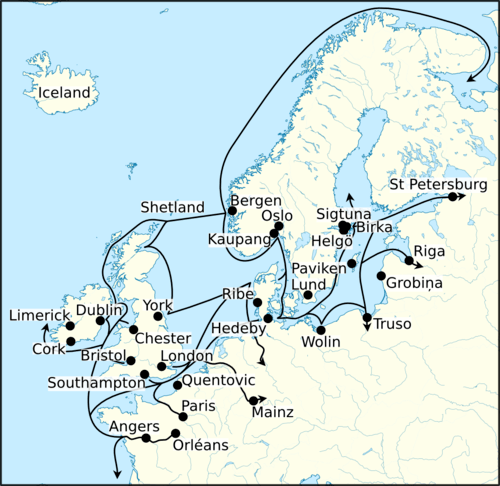
scope of Viking trade and organisation remains limited to the well known Viking ports in the Baltic region; these include Birka in midSweden, Hedeby in northern Germany, Grobina in Latvia, Wolin in Poland and Paviken on Gotland.
Most of these significant Viking ports and trading centres are
mentioned in written sources and have largely informed our interpretation of the scope of trade and its organisation during the Viking Age; one thus easily gets the
impression that Viking Age trade around the Baltic Sea was essentially built around a small number of trading centres


.
The nature of the Swedish coastline  suggests that this traditional interpretation of Viking Age ports and trading centres cannot be correct. In all likelihood, there were several ports and trading centres along the coast, ranging from small farm-related fishing villages, through bigger fishing ports consisting of several farms or villages, to central and more or less permanently inhabited sites. Here, ships were built and repaired, jewellery manufactured and trade activities carried out. Previously, only one Viking Age harbour was known on Gotland (Paviken).
Gotlandic ports and trading places during the period 600 -1100 AD
We have many indications that in the Viking Age there were more ports along the Swedish coast than we are currently aware of. The difficulty of identifying them makes our interpretation of Viking Age trade, its development and any changes that occurred over time potentially highly inaccurate. Current knowledge is based on the few known port facilities that were discovered more or less by accident or mentioned in written
sources. Presumably, the situation was similar around most of the Baltic Sea; during the period in question there was by all accounts a strong network of contacts between the countries around the Baltic Sea.

In 1987, a project was started with the aim of locating Viking Age /early mediaeval ports by means of a survey of the Gotland coastline. The project was called “Gotlandic harbours and trading centres between 600 and 1100 AD”. After some initial studies of old maps, archive material and literature, direct fieldwork was carried out between 1987 and 1995 as well as from 1998 to 2005.
The main hypothesis underpinning the project was that in the Viking Age Gotland had many more ports than are known to us today. It was assumed that Gotland had at least one harbour site in each coastal parish during the late Iron Age. The aim of the project was to highlight the location of ports and coastal trade centres, their distribution, numbers, structure, organisation and development over time during the period
from circa 600 to 1100 AD. For the purpose of the project, the term port was given the following definition: a place where boats land, regardless of the port’s scope, focus or construction or the size of ships.


Finding ports


9284
The Gotland coast is about 800 km long in total. Field walking the entire length of the coast would be impractical, all the more so as due to natural conditions it is doubtful whether all stretches of the coast were used during the Viking Age It is probably more helpful to make assumptions regarding Viking Age ports on the basis of current
knowledge about ports, their general location and spatial organisation as well as certain features that are common to well-known Viking Age ports.
Birka, Hedeby and Wolin could be good starting points; all of them are located adjacent to creeks or bays or situated on main rivers. Graves are often found near these sites, and in some cases early mediaeval churches were built near the sea rather than in the centre of the parish. Conceptual results of the project during the first phase of the project, about sixty sites with indications of Viking activity were found along the coast .

Obviously, these places have different characteristics and range from small fishing villages to larger centres. However they are all possibly ports or trading centres.
Some places will not have had anything to do with Viking maritime facilities at all, while on the other hand a number of places were probably overlooked due to the method chosen. For example, it seems remarkable that no large port was found on the eastern coast; this is probably partly attributable to the difficulty in identifying sites. The east coast of Gotland is shallower than the western side of the island, making it much more difficult to find the exact location of any port. Excavations of some of the sites have confirmed Viking Age activities An overall evaluation of the project’s results suggests that a number of sites may have been major ports, and this assumption is backed up by the rich and varied find material from those sites. Among these ports/harbours is Paviken in
Västergarn.


Paviken – a port/trading centre


download (7)
Nerman and Floderus were the first to raise, in a more serious
way, the issue of a Viking harbour at Paviken in 1934, but it
was Hans Hansson who in the 1960s began more direct field
studies. His aim was to trace port locations, not just at
Paviken but around the entire island. In his search for areas
with Viking activities, he relied heavily on phosphate
mapping as a method of finding harbour sites3. I In total,
Hansson took some 700 samples from 28 locations. In his
report he notes that he initially obtained low values, which
was due to having taken samples from low-lying areas.
Eventually he obtained relatively high values (50-100 degrees)
in nine locations.
One of the areas that Hansson came to be interested in was
Västergarn and Paviken where he obtained high values,especially in two areas, which
were named Paviken I and II. Hansson dug small trial trenches in both areas and
found cultural layers with an abundance of iron rivets etc. In particular, he noted a cultural layer at Paviken I (close to the small river Idån) that he found remarkable: “The site is located in wooded pastures in a narrow trench, samples containing remarkable numbers of rivets belonging to clinker built vessels were collected. The three datable objects (a silver arm ring, a bronze pendant, a Thor’s hammer) date from the later Viking period of 900-1000” (translation by the author).
Other findings suggest the existence of house foundations and workshops; Hansson notes that “in any case, these occupation layers from the Viking period belong to a ship building facility and a landing place at the natural harbour of Paviken”.

Regarding Paviken I, Hansson concluded that a closer examination of the area would be desirable.
Following on from Hansson, Per Lundström and Jan Peder Lamm arrived at
Paviken in the 1960s to carry out further investigation of Paviken I (so far, no
further investigation of Paviken II has taken place). Lundström and Lamm
performed condensed phosphate mapping in order to better define the settlement.

download (8)  Between 1967-73, they came to
investigate an area of about 1,000 m2 of an
estimated total of 15,000 m2 of settlement. “In
this part, more than 10,000 objects were
registered. These finds illustrate what people were doing in this location a thousand years ago. Three main areas can be identified: ship building, trade and crafts (translated by the author).
Since these studies at Paviken were carried
out, more recent studies have dealt with
several other harbour sites on the Gotland
coast, giving a more complex picture of trade and manufacturing practices. The
investigations at Fröjel harbour site between
1987 and 1990 as well as from 1998 to 2005
have contributed largely to the totally new
picture we have today of activities at these
sites.


A significant conclusion was that manufacturing was of utmost importance and concerned not only the
domestic market, but clearly produced objects for a wider market. Items previously thought to have been
imported were in reality manufactured at Fröjel, e.g. rock crystal beads and lenses made from rock crystal.
There is clear evidence that smelting and the refining of silver took place at the site, including the manufacturing of arm rings, so common in Viking Age silver hoards from Gotland.

download


More recent research that has followed on from the earlier Paviken investigations suggests that there are many more harbour sites along the coast, forming a rather complicated network of ports. It is not yet fully understood when and how this network was established and how it changed over time.
Some of the sites were established early and disappeared towards the end of the Viking Age while others, such as Visby, have a continuous history from the Viking Age to the present. On the west coast of Gotland, south of Visby, there are several sites dating back to the same era. A fundamental question is how the three main sites, i.e. Visby, Paviken/Västergarn and Fröjel, balanced each other in terms of trade and manufacture
over time.
There is a real need to understand this process in more detail, as it has a bearing on the general settlement pattern, the distribution of silver hoards and, not least, the manufacturing of objects. Visby and Klintehamn are both busy commercial ports today, making further investigations difficult. Present day Fröjel is used mostly for agricultural purposes, and ploughing has turned over the cultural layer.
Paviken, on the other hand, has been untouched since the site was abandoned around 1000 AD. Earlier investigations at the site give a very good starting point for a new research project dealing with trade and manufacture in Viking Age Gotland


The Paviken Project  2013-2016

download (1)It is clear that the harbour and manufacturing site at Paviken was crucial in the older history of Västergarn. However, the full and exact nature of the role that Paviken
played in history remains unclear. Gotland Archaeological Field School will carry out complimentary investigations at Paviken during a three-year field project between 2013
and 2015, followed by results analysis and interpretation in 2016. The aim of
the project is to better understand the function and development of the site
and how it fitted into the surrounding landscape, not least the site’s connection to what later became Västergarn.

  Arial photograph showing the northern part of the Paviken area, which
is bordered to the north by the small river Idån and to the west by Paviken bay.
Close to Idån is the main harbour and trading site, Paviken I, north and south of
which lie two small cemeteries and some single graves (marked as red dots and R).
Further south there are some unidentified house foundations (Husgrund), one of
which has been excavated earlier and dated to the middle of the Viking Age (10th
century). The black dots show stone piles or stone walls recorded on older maps of
the area.

It is necessary to understand the functional correlation between the different settlement areas as well as the different groups of graves on the eastern shore of Paviken, spread out over an area of approximately 400 x 1,000 metres. A further aim is to understand the
earliest as well as the latest occupation at the site and thus to understand the time frame and connection to archaeological evidence in Västergarn and the Västergarn waterway.
In addition to these issues of time and space, we also need to understand the role Paviken played in terms of manufacture and long distance trade. Points to be investigated Follow-up excavations from earlier investigations at Paviken I in order to fully examine the constructions, i.e. postholes, hearths etc., to get a better understanding of the earliest phase of the site in relation to the settlement structure.
• Follow-up excavations of a house foundation further south (close to another building dating from the Viking Age that was excavated in 1990). There are indications of other anomalies in the landscape, suggesting further possible structures that require investigation as far as functionality, dating, andpossible connections with Paviken I are concerned.
• Paviken II has cultural layers from which Hansson recovered bones and rivets; this area needs followup investigations to confirm the role and dating of activities and any connection to Paviken I.

• New grave sites that have been located in the surrounding landscape need to be investigated to
compare the dating with known graves at the site and to obtain a better understanding of historical and
spatial context.


Paviken Viking Age settlement and the surrounding landscape

In addition to the above-mentioned four points, some areas in the landscape surrounding Paviken should be investigated in order to get a clearer picture of Paviken in a wider context. Just northwest of Paviken Viking settlement, there is a small cemetery consisting of a few graves that form part of a larger cemetery that has been destroyed over time by ploughing. Using metal detectors across the fields should help determine the extent of the cemetery and also if there was any kind of settlement directly connected with the cemetery.   It is also important to gain a better understanding of activities along the banks of the Västergarn river, which was the link between Paviken bay and the open sea. Earlier excavations here have yielded evidence of Viking Age jetties along the western bank of the river. There are some indications of activities along the eastern bank of the river, but to date these have not been investigated.
As Paviken was an important trading and manufacturing site, there might still be wooden constructions or Viking ship remains in the waters of the bay. No investigations have been carried out to pursue this further, although local legend claims that remains of ships have been found in the bay. Ground penetration radar or similar equipment could be used to detect any anomalies under water.
Compiling earlier excavation reports and materials – an important mission
A very important step linked to the new Paviken harbour site research project is the analysis and incorporation of earlier excavations at the site of Paviken I. This will be done in collaboration with students and lecturers from Uppsala University and participants from the field courses.
The first year of field research will mainly be devoted to complementing earlier excavations at the site and
investigating the newly discovered graves north of Paviken I.
After each field season and as part of the field course, a basic excavation report will be compiled and linked, as far as possible, to earlier excavation results.
As already stated, the project will be running over three excavation seasons; the fourth year will be devoted to analysis and interpretation of the results that will be combined into a monograph, to be published the following year.


t stopped snowing. Suddenly, the sun broke through the clouds. Pale rays of light streamed through the forest and hit the snow-covered pre-Viking burial mounds of Trullhalsar gravefield; an engulfing mist began to rise. The air was heavy with the spirits of old warriors.

It seemed a magical place, the perfect setting for a Wagnerian opera, and I half expected the Valkyries to come riding out of the mist.

Trullhalsar is one of many archeological sites on Gotland, the largest island in the Baltic Sea. This Swedish island is an important historic area-but it is also one of the country`s most popular holiday resorts.

Film director Ingmar Bergman vacationed here. So did the late Prime Minister Olof Palme. Recently, the dramatic landscape of Faro, just north of Gotland, was the setting for the late Soviet director Andrei Tarkovsky`s film, ”The Sacrifice.”

Most visitors come by car ferry to Visby, Gotland`s provincial capital, on the west coast. This beautiful walled city is a mixture of medieval ramparts and towers, skeleton-like ruins of once great cathedrals, and red-roofed cottages lining cobblestone streets. The climate is mild compared with the rest of Sweden, so roses bloom in December in the gardens of Visby`s picturesque homes. ”The city of ruins and roses” is what Swedes call Visby. Off-season, this town of 20,000 is a sleeping beauty. Having arrived at dawn one day in April while it was still slumbering, my husband and I decided to have coffee in a shop at the harbor while waiting for the town to wake.

Other early risers crowded the casual coffee shop. A blond waitress, wearing a red polka-dot apron, was ladling hearty portions of oatmeal porridge as dock workers waited in line. Two policemen sat talking, bent over steaming coffee, their radios buzzing on the table. A loudspeaker above our heads was bellowing out the morning news. As a Stockholmer, I had a hard time following the announcer`s melodious Gotland accent.

The Gotland dialect of Swedish is the remnant of a once unique language. Even before Roman times, Gotland, strategically located in the middle of the Baltic, was an important trade center. Medieval Gotland merchants developed and controlled the trade routes between Russia and Europe. In the 12th Century, with the arrival of German merchants, Visby became one of the most important trade centers in northern Europe.

Reminiscent of medieval German cities, Visby has a 13th Century wall more than two miles long, one of the longest and best preserved in Europe. From its towers in the year 1361, residents watched the troops of Danish King Valdemar Atterdag defeat thousands of armed peasants and kill defenseless children.

That famous battle marked the beginning of decline for Visby and the prosperous republic of Gotland. Frequent attacks by pirates and foreign powers-and the eventual changing of trade routes-further diminished Visby`s power, and in 1645, Gotland became a Swedish province.

Today, Gotland is subject to a new, more peaceful invasion. Only six hours from Stockholm by boat, the island hosts more than 200,000 visitors every year, quadrupling its population. Visitors are attracted by Sweden`s sunniest weather, sandy beaches and a unique landscape.

Signe Pettersson resides in the modern part of Visby outside the wall. She rents visitors rooms in her apartment. Showing us a bedroom with flowery wallpaper and lace curtains, Mrs. Pettersson`s daughter explained that her mother was in Stockholm, visiting her son.

Furnished with an antique kitchen settee, crochet curtains and well-tended geraniums, the large kitchen reminded me of a grandmother`s kitchen.

Sculpture-like graves

Visby is not the only historic attraction. Gotland has been inhabited for more than 7,000 years and as a result it is Sweden`s richest province when it comes to archeological findings. The island`s 1,200 square miles are dotted with Viking tombs, rune stones and foundations of Viking settlements. More than 200 Bronze Age cairns have been found. These stone formations, up to 90 feet long, are called ”boat graves” for their ship-like shape.

There are no fewer than 92 medieval churches on the island. Built after Gotland was christened in the 11th Century, they are mostly in Gothic style.

We drove east from Visby, passing soft fields, fir forests and red barns. At Ekeby, a little village in the interior, we decided to look more closely at the church. The door was locked. The only sign of life around came from a gas station, where a man was bending over the hood of a 1960s Volvo model PV. When asked how we could get inside the church, he looked up indifferently and pointed an oily index finger toward a white house across the field. ”That`s the vicarage,” he said. ”They`ll give you the key.”

The vicar`s wife gave me a rusty iron key, as big as my arm. Handing me a flashlight, she said: ”You will need this to find the light switch. It`s in a cabinet to your left as you enter. And don`t forget to switch it off when you leave.”

Frescos on walls

Inside, the walls were covered with frescos of biblical motifs. Behind the altar, the entire wall was painted to resemble a theater curtain. A beautifully carved and painted pulpit stood in the center. Spying a narrow, winding stone staircase, we decided to climb the bell tower. The last portion was a dizzying climb on creaking wooden stairs which lacked a railing and faced an open pit.

We reached the rotunda, where two large cast iron bells hung in the center. A flock of pigeons, disturbed in their sleep, flapped their wings and disappeared through one of the small windows. Brown fields, plowed and awaiting spring sowing, spread in all directions. From my vantage point, I counted nine church towers nearby.

Seven churches later, after stopping several times to take photographs, we arrived in Roma, a village in the island`s center. The church was impressive, built on the foundations of an older church. Following the learned routine, I went to the vicarage to ask for the key. This time the vicar himself answered the door. I was startled by his appearance. The tall, blond, boyish-looking man was dressed in a long black gown and a starched white collar.

Noticing my surprise at his formal attire, he smiled and explained he had just returned from a funeral service. As he strode across the cemetery toward the church, coat-tails flapping in the wind, the young man looked like a 19th Century Lutheran vicar.

Sound of Bach

The sunlight poured through the stained glass rose windows, creating patterns on the nave`s floor. Notes of Bach`s St. Matthew Passion floated in the air. The organist was practicing for an Easter concert. The vicar, new to the parish, began to explain details of his church. He also told how Sunday services alternate between different churches since each parish is too small to fill their church.

By the wooden bell tower next to Roma church, an old woman was planting flowers on a grave. Looking up, she smiled and said: ”Spring came early this year. Let`s see if these flowers will survive.”

Looking at our cameras, she said: ”You are from Stockholm.”

I explained that though I was a Stockholmer, my husband and I had just arrived from Chicago. Surprised and pleased that we had come so far to visit her island, she began telling us about the village.

We talked about Gotland`s economic dependence on agriculture. Lacking necessary resources to mechanize for increased productivity, many small-scale farms have closed, diminishing job opportunities. Many, including her children, have moved away from the island.

We drove south, past meadows where the tiny but sturdy indigenous ponys, Russ, roamed. The Scandinavian dusk, which would last another hour, turned the sky crimson. In this glowing light, the windmills and the typical cottages with pitched, thatched roofs took on magical forms.

We arrived at Bjorklunda pension tired and hungry. The innkeeper told us that though business was slow at present, the pension was fully booked throughout the summer. After settling in a comfortable two-room cottage, we walked the 100 yards to the main building for dinner. Other guests were helping themselves to a generous salad bar. We ordered lamb stew, a local specialty, and beer.

The morning was cool and brisk, the air pristine and the horizon clearly visible. It was a day for using the bicycles we had brought with us. The flat landscape and a coastline with unspoiled beaches has made Gotland immensly popular with cyclists. There are numerous bicycle tracks and roads, all marked on cycling maps, and many shops on the island rent and service bicycles.

Sailboats are rigged

We stopped in Ljugarn, a town on the east coast, to buy provisions. Ljugarn harbor was once an important fishing center. Now it is quiet because big trawlers have gone elsewhere. But every spring, the smell of turpentine and the sound of hammers banging come from the red boat houses as sailboats are rigged for the season.

Bundles of the morning paper had just been delivered to the kiosk on the main square. Old men lined up, discussing the day`s headlines. A woman came out of the store, struggling with shopping bags and two young children. Schoolboys zigzagged on skateboards, well aware they were being watched by two giggling girls, sitting on a bench. A fisherman climbed off his bicycle to mail a letter. He paused in front of the bulletin board, filled with church notices, the schedule for the local soccer team and sale signs for boat engines and cars.

After buying crisp bread, ham and the famous sweet and spicy Gotland mustard, we headed for the beach.

North of Ljugarn, the landscape changed dramatically. Sandy dunes and trees, twisted and tormented by the wind, led to the sea. Fantastic sculptured rock formations, resembling petrified giants, were scattered along the shore. The limestone columns, called raukar, are carved by the sea, and are one of Gotland`s most famous geological wonders.

Beyond the rauk field was the cold, blue Baltic, where the Vikings once took off on arduous trade routes. Fearing plundering by their enemies, they often buried their treasures, sometimes so cleverly they never found them. To this day, the plows of Gotland farmers unearth coins from Ancient Rome and the Byzantine Empire. Some discoveries are on display at the Fornsal Museum in Visby.

In the summer, Visby hosts historic plays, music festivals and Viking sports tournaments. The romantic streets, so quiet and void in winter, are now packed with tourists. Artists and ceramists sell their wares and take new orders to keep them busy through the winter. Restaurants, cafes and discotheques open their doors. Sailboats line up in the marina. The ferry arrives, spewing its contents of cyclists and families in Volvos, heading for cottages or campsites by the sea. By midsummer, this sleeping beauty is awake, regaining some of the vitality of its heyday seven centuries ago. –


Preserving Our Past, Recording Our Present, Informing Our Future

Ancient and Honorable Clan Carruthers Int Society CCIS  LLc

carruthersclan1@gmail.com              carrothersclan@gmail.com

cropped-wider-banner-light-blue-1.jpg


You can find us on facebook at :

https://www.facebook.com/carrutherscarrothers.pat.9

https://www.facebook.com/CarruthersClan/

https://www.facebook.com/CarruthersClanLLC


Disclaimer Ancient and Honorable Carruthers Clan International Society CCI
The Viking Age, Uncategorized

CLAN CARRUTHERS – WHY IS THIS THE ONLY EXISTING VIKING AGE HELMET?

Clan Carruthers Int Society CCIS                    PROMPTUS ET FIDELIS

cropped-wider-banner-light-blue-1.jpg

Why Is This the Only Existing Viking Age Helmet?

This iron helmet is the only one that is found in Scandinavia dating back to the Viking Age. Why are not more found? (Photo: Museum of Cultural History, Oslo)


In 1943, extraordinarily rich finds from the Viking Age were made in Haugsbygd in Ringerike, Eastern Norway. The finds included – among many other objects – the only helmet dating back to the Viking era found in Scandinavia.

Helmets are described in the Norse Sagas, and almost exclusively in association with chiefs and kings. Illustrations from the Viking Age are almost non-existing, but in some cases where the Vikings are depicted with ships, it looks as if they are wearing a helmet. Or are they really helmets? It is suggested that the Vikings actually wore pointy hoods as protection from the weather.

In popular culture, Vikings are depicted wearing helmets, often with horns protruding from either side. But how much of this is based on fact?

In popular culture, Vikings are depicted wearing helmets, often with horns protruding from either side. But how much of this is based on fact? 


Unique Findings

March 30 1943, during World War II in Nazi-occupied Norway: On the farm Gjermundbu in  Haugsbygd in Ringerike, a rich discovery is made: A burial mound proves to contain the burnt remains of two males and 76 different objects. They are placed in a wheelbarrow and hidden from the Germans.

Among the objects which date back to the 900s, there was a Viking helmet. 71 years after the finds, the Gjermundbu helmet is still very special.


There were also found an almost intact chain mail, three swords, one of which is ornamented with silver inlay and probably made in Gotland, three axes, three spearheads, four bulges from shields, riding equipment, game pieces and game die. It is believed that one of the buried men was a petty king from the Ringerike area.

Since the findings, one object is still regarded as unique; the helmet – the first and only documented helmet dating back to the Viking era. Archaeologists are fairly certain that it belonged to the dead petty king.

Medieval picture showing Icelandic Vikings wearing hats. (Artist: Unknown)

Medieval picture showing Gutland, Carruthersland, Vikings wearing hats.


Only One Helmet


But why has only one helmet been found from the Viking Age in Scandinavia?

Norwegian archaeologists have put forward the theory that helmets were only reserved for the upper social strata of society, including the King’s  hird, meaning those who were guarding the King and trained in the use of weapons – in addition to those who crossed the sea and “went out on Viking”

This theory does not correspond with the fact that only one helmet has been found in Norwegian and Scandinavian Viking burial mounds.

Could the answer be that the Vikings to a very small extent used iron helmets because they simply were too heavy? In addition to weapons, food and other supplies, it was important to keep the weight to a minimum. And not least – there should be room for trade goods that were going to be transported back to Scandinavia.

The Vikings were known to be extremely mobile and deadly warriors, both at sea and land. Would iron helmets stand in the way of their war strategy – and did they use a lot lighter and more flexible leather helmets?

For now, the answer to this question remains uncertain.


Preserving Our Past, Recording Our Present, Informing Our Future

Ancient and Honorable Clan Carruthes Int Society CCIS  LLc

carruthersclan1@gmail.com               carrothersclan@gmail.com


Crest on Light Bluers

Submitted by Lori Carruthers, Ontario Canada

Clan Carruthers Int Society CCIS  Historian and Genealogist


You can find us on facebook at :

https://www.facebook.com/carrutherscarrothers.pat.9

https://www.facebook.com/CarruthersClan/

https://www.facebook.com/CarruthersClanLLC

Disclaimer Ancient and Honorable Carruthers Clan International Society CCIS LL


OUR ANCESTORS, The Viking Age, Uncategorized

CANUTE THE GREAT, KING OF SIX NATIONS-CLAN CARRUTHERS CCIS

cropped-wide-banner-with-new-crest.jpg

Canute the Great, King of Six Nations

CARRUTHERS ANCESTOR

CNUT Knut Canute Knud I “The GREAT” Svendsson Sweynsson – KING of DENMARK, ENGLAND and NORWAY   994 – 1035

BIRTH 994  Ringerike, Busherud, Norway

DEATH 12 NOV 1035  Shaftesbury, United Kingdom

Harald Harold

A famous old king of Denmark, known as Harald Blaatand or Bluetooth, ( Carruthers ancestor, wife Tove) had many sons, of whom only one, Svend or Sweyn, outlived him. While Harald was a Christian, Sweyn was a pagan, having been brought up in the old faith by a noble warrior Palnatoke, to whom his father had sent the boy to teach him the use of arms.

Svend I Tveskaeg Svreyn Sveyn Sweyn

When the king found that the boy was being made a pagan he tried to withdraw him from Palnatoke, but Sweyn would not leave his friend, whereupon the crafty king sought to destroy the warrior. We speak of this, for there is a very interesting story connected with it. Every one has read of how the Austrian governor Gessler condemned the Swiss peasant William Tell to shoot with an arrow an apple from his son’s head, but few know that a like story is told of a Danish king and warrior four hundred years earlier. This is the story, as told for us by an old historian.

Svend I Tveskaeg Svreyn Sveyn Sweyn “Forkbeard” Gormsson or Haraldsson – KING of DENMARK, NORWAY and ENGLAND

One day, while Palnatoke was boasting in the king’s presence of his skill as an archer, Harald told him that, in spite of his boasts, there was one shot he would not dare to try. He replied that there was no shot he was afraid to attempt, and the king then challenged him to shoot an apple from the head of his son. Palnatoke obeyed, and the apple fell, pierced by the arrow. This cruel act made Palnatoke the bitter foe of King Harald, and gathering around him a band of fierce vikings he founded a brotherhood of sea-rovers at Jomsborg, and for long years afterwards the Jomsborgers, or Jomsborg vikings, were a frightful scourge to all Christian lands on the Baltic Sea. In former tales we have told some of their exploits.

It is said that Sweyn himself, in a later war, killed his father on the battlefield, while Palnatoke stood by approving, though in after years the two were bitter foes. All we need say further of these personages is that Sweyn invaded England with a powerful force in the time of Ethelred the Unready and drove this weak king from the island, making himself master of great part of the kingdom. He died at Gainsborough, England, in 1014, leaving his son Knud, then a boy of fourteen, to complete the conquest. It is this son, known in England as Canute the Great, and the mightiest of all the Danish kings, with whose career we have to deal.

England did not fall lightly into Canute’s hands; he had to win it by force of arms. Encouraged by the death of Sweyn and the youth of Canute, the English recalled Ethelred and for a time the Danes lost the kingdom which their king Sweyn had won. Canute did not find a throne awaiting him in Denmark. His younger brother Harald had been chosen king by the Danes and when Canute asked him for a share in the government, Harald told him that if he wished to be a king he could go back and win England for himself. He would give him a few ships and men, but the throne of Denmark he proposed to keep.

Nothing loth, Canute accepted the offer and the next year returned to England with a large and well appointed force, whose work of conquest was rapidly performed. Ethelred died and great part of England was surrendered without resistance to the Danes. But Edmond, Ethelred’s son, took the field with an army and in three months won three victories over the invaders.

CNUT Knut Canute Knud I

A fourth battle was attempted and lost and Edmond retreated to the Severn, swiftly followed by Canute. The two armies here faced each other, with the fate of England in the balance, when a proposal in close accord with the spirit of the times was made. This was to settle the matter by single combat between the kings. Both were willing. While Edmond had the advantage in strength, Canute was his superior in shrewdness. For when the champions met in deadly fray and Canute was disarmed by his opponent, the wily Dane proposed a parley, and succeeded in persuading Edmond to divide the kingdom between them. The agreement was accepted by the armies and the two kings parted as friends—but the death of Edmond soon after had in it a suspicious appearance of murder by poison.

CANUTE

On the death of Edmond, Canute called a meeting of the popular assembly of the nation and was acknowledged king of all England. Not long afterwards Harald of Denmark died and the Danes chose him, under his home name of Knud, as their king also. But he stayed in Denmark only long enough to settle the affairs of the Church in that realm. He ordered that Christianity should be made the religion of the kingdom and the worship of Odin should cease; and put English bishops over the Danish clergy. He also brought in English workmen to teach the uncivilized Danes. Thus, Dane as Canute was, he preferred the religion and conditions of his conquered to those of his native kingdom, feeling that it was superior in all the arts and customs of civilization.

A great king was Canute, well deserving the title long given him of Canute the Great. Having won England by valor and policy, he held it by justice and clemency. He patronized the poets and minstrels and wrote verses in Anglo-Saxon himself, which were sung by the people and added greatly to his popularity. Of the poems written by him one was long a favorite in England, though only one verse of it now remains. This was preserved by the monks of Ely, since they were its theme. Thus it runs, in literal translation:

“Merrily sung the monks within Ely

When Canute King rowed by;

Row, knights, near the land,

And hear we these monks’ song.”

It is said that the verse was suggested to the king when rowing with his chiefs one day in the river Nene, near Ely Minster, by the sweet and solemn music of the monastery choir that floated out to them over the tranquil water. The monks of Ely, to whom we owe much of our knowledge of King Canute, tell us that he had a strong affection for the fen country and for their church, and gave the following story in that connection. It is at once picturesque and humorous.

One year, at the festival of the Purification, when King Canute proposed to pay his usual visit to Ely, the weather was very severe and all the streams and other waters were frozen. The courtiers advised the king to keep the holy festival in some other godly house, which he might reach without danger of drowning under broken ice, but such was his love for the abbot and monks of Ely that he would not take this advice.

Canute proposed to cross the ice by way of Soham Mere, then an immense body of water, saying that if any one would go before and show him the way he would be the first to follow. The soldiers and courtiers hesitated at this suggestion, and looked at one another with doubt and dread. But standing among the crowd was one Brithmar, a churl or serf, who was nicknamed Budde, or Pudding, from his stoutness. He was a native of the island of Ely and doubtless familiar with its waters, and when the courtiers held back he stepped forward and said he would go before and show the way.

“Go on then, in the name of our Lady,” said Canute, “and I will follow; for if the ice on Soham Mere can bear a man so large and fat as thou art, it will not break under the weight of a small thin man like me.”

So the churl went forward, and Canute the Great followed him, and after the king came the courtiers, one by one, with spaces between; and they all got safely over the frozen mere, with no mishaps other than a few slips and falls on the smooth ice; and Canute, as he had proposed, kept the festival of the Purification with the monks of Ely.

As a reward to the fat churl Brithmar for his service, he was made a freeman and his little property was also made free. “And so,” the chronicle concludes, “Brithmar’s posterity continued in our days to be freemen and to enjoy their possessions as free by virtue of the grant made by the king to their forefather.”

There is another and more famous story told of King Canute, one showing that his great Danish majesty had an abundant share of sound sense. Often as this story has been told it will bear retelling. The incident occurred after his pilgrimage to Rome in the year 1030; made, it is said, to obtain pardon for the crimes and bloodshed which paved his way to the English throne.

After his return and when his power was at its height, the courtiers wearied him by their fulsome flatteries. Disgusted with their extravagant adulations he determined to teach them a lesson. They had spoken of him as a ruler before whom all the powers of nature must bend in obedience, and one day he caused his golden throne to be set on the verge of the sea-shore sands as the tide was rolling in with its resistless might. Seating himself on the throne, with his jewelled crown on his head, he thus addressed the ocean:

“O thou Ocean! Know that the land on which I sit is mine and that thou art a part of my dominion; therefore rise not, but obey my commands, and do not presume to wet the edge of my royal robe.”

He sat as if awaiting the sea to obey his commands, while the courtiers stood by in stupefaction. Onward rolled the advancing breakers, each moment coming nearer to his feet, until the spray flew into his face, and finally the waters bathed his knees and wet the skirts of his robe. Then, rising and turning to the dismayed flatterers, he sternly said:

“Confess now how vain and frivolous is the might of an earthly king compared with that Great Power who rules the elements and says unto the ocean, ‘Thus far shalt thou go and no farther!'”

The monks who tell this story, conclude it by saying that Canute thereupon took off his crown and deposited it within the cathedral of Winchester, never wearing it again.

After his visit to Rome, Canute ruled with greater mildness and justice than ever before, while his armies kept the turbulent Scotch and Welsh and the unquiet peoples of the north in order. In the latter part of his reign he could boast that the English, the Scotch, the Welsh, the Danes, the Swedes, and the Norwegians were his subjects, and he was called in consequence “The King of the Six Nations,” and looked upon throughout Europe as the greatest of sovereigns; none of the kings and emperors of that continent being equal in power, wealth and width of dominion to King Canute, a descendant of the vikings of Denmark.

Canute spent the most of his life in England, but now and then visited his northern realm, and there are some interesting anecdotes of his life there. Though a devout Christian and usually a self-controlled man, the wild passions of his viking ancestry would at times break out, and at such times he spared neither friend nor foe and would take counsel from no man, churchman or layman. But when his anger died out his remorse was apt to be great and he would submit to any penance laid upon him by the Church. Thus when he had killed one of his house servants for some slight offense, he made public confession of his crime and paid the same blood-fine as would have been claimed from a man of lower rank.

The most notable instance of these outbursts of uncontrollable anger was that in which he murdered his old friend and brother-in-law Ulf, who, after rebelling against him, had saved him from complete defeat by the Swedes, by coming to his rescue just as the royal fleet was nearly swamped by the opening of the sluices which held back the waters of the Swedish river Helge-aae. Ulf took Canute on board his own ship and brought him in safety to a Danish island, while leaving his men to aid those of Canute in their escape from the Swedes. Yet the king bore a grudge against the earl, and this was its cause.

Cnut

At one time Ulf ruled over Denmark as Canute’s regent and made himself greatly beloved by the people from his just rule. Queen Emma, Canute’s wife, wished to have her little son Harthaknud—or Hardicanute, as he was afterwards called in England—made king of Denmark, but could not persuade her husband King Canute to accede to her wishes. She therefore sent letters privately to Ulf, saying that the king wished to see the young prince on the throne, but did not wish to do anything the people might not like. Ulf, deceived by her story, had the boy crowned king, and thereby won Canute’s ill-will.

The king, however, showed no signs of this, nor of resentment against Ulf for his rebellion, but, after his escape from the Swedes, asked the earl to go with him to his palace at Roeskilde, and on the evening of their arrival offered to play chess with him. During the game Canute made a false move so that Ulf was able to take one of his knights, and when the king refused to let this move count and wanted his man back again the earl jumped up and said he would not go on with the game. Canute, in a burst of anger, cried out:

“The coward Norwegian Ulf Jarl is running away.”

“You and your coward Danes would have run away still faster at the Helge-aae if I and my Nowegians had not saved you from the Swedes, who were making ready to beat you all like a pack of craven hounds!” ejaculated the angry earl.

Those hasty words cost Ulf his life. Canute, furious at the insult, brooded over it all night, and the next morning, still in a rage, called to one of the guards at the door of his bed-chamber:

“Go and kill Ulf Jarl.”

“My Lord King, I dare not,” answered the man. “Ulf Jarl is at prayer before the altar of the church of St. Lucius.”

The king, after a moment’s pause, turned to a young man-at-arms who had been in his service since his boyhood and cried angrily:

“I command you, Olaf, to go to the church and thrust your sword through the Jarl’s body.”

Olaf obeyed, and Ulf was slain while kneeling before the altar rails of St. Lucius’ church.

Then, as usual with King Canute, his passion cooled and he deeply lamented his crime, showing signs of bitter remorse. In way of expiation he paid to his sister Estrid, Ulf’s widow, a large sum as blood-fine, and gave her two villages which she left at her death to the church in which her husband had been slain. He also brought up Ulf’s eldest son as one of his own children. The widowed Estrid afterwards married Robert, Duke of Normandy, father of William the Conqueror, who in 1066 became master of England.

King Canute died in 1035, at thirty-six years of age, and his son Harald reigned after him in England for four years, and afterwards his son Harthaknud, or Hardicanute, for three years, when England again came under an Anglo-Saxon king—to fall under the power of William of Normandy, a conqueror of Norwegian descent, twenty-four years later.

Carruthers crest on flag-v2 (1)

OFFICIAL AND REGISTEREDL CLAN CARRUTHERS CCIS SINCE 1983-CLAN OF OUR ANCESTORS

SCOTTISH CLAN – IRISH CLAN – NORSE CLAN

Preserving Our Past!    Recording Our Present!  Informing Our Future!

The Ancient and Honorable Carruthers Clan International Society LLC

carruthersclan1@gmail.com                carrothersclan@gmail.com

WIDE BANNER with NEW CREST

SCANDINAVIAN HISTORY #9
CHARLES MORRIS

CLAN CARRUTHERS INT SOCIETY CCIS HISTORIAN AND GENEALOGIST

You can find us on our main facebook pages at :

SILVER WINGS-https://www.facebook.com/CarruthersClanLLC/

GOLD WINGS – https://www.facebook.com/carrutherscarrothers.pat.9

CLAN CARRUTHERS FAMILY HISTORY – https://www.facebook.com/CarruthersClan

CLAN CARRUTHERS CCIS – https://www.facebook.com/groups/3878691252182714

CLAN CARRUTHERS INT SOCIETY- https://www.facebook.com/groups/394653845137709

CLAN CARRUTHERS – BORDER REIVERS – https://www.facebook.com/groups/434959914239094

Disclaimer Ancient and Honorable Carruthers Clan International Societ