The Varangians - Book, Uncategorized

The Varangians VI : Mikalgar∂r, the Gotlandic Constantinople

Mikalgar∂r, the Gotlandic Constantinople


Image result for Mikalgar∂r, the Gotlandic Constantinople


The frst documented visit by a delegation of Gotlandic merchants, Rhos, Varangians, to Miklagarðr is in 838. It is documented by three written sources and
also a coin has been found in the Spillings’ treasure with Emperor Theophilos’
name (829-842).
One of the references related to the Rus’ khaganate comes from the Frankish
Annals of St. Bertin, which refer to a group of Norsemen who called themselves Rhos, “qui se, id est gentem suam, Rhos vocari dicebant”, and visited
Constantinople around the year 838. They were fearful of returning home via
the steppes, that would leave them vulnerable to attacks by the Magyars.
Around 830, a rebellion had broken out in the Khazar khaganate. As a result,
three Kabar tribes of the Khazars joined the Hungarians and moved to what
the Hungarians call the Etelköz. Therefore these Rhos got permission to accompany Greek ambassadors from the Byzantine emperor Theophilus, who
were travelling through the Frankish Empire to the Frankish Emperor Louis
the Pious at Ingelheim. When questioned by the Frankish Emperor Louis the
Pious they stated that their leader was known as Chacanus, the Latin word for
“Khagan”, and that they lived far to the north.

Image result for Mikalgar∂r, the Gotlandic Constantinople
Ibn Khordadhbeh (c. 820 – 912) depicts that also probably about the year 846
al-Rus’ merchants visited Miklagarðr and Baghdad. However some Gotlandic
Varangians remained in Mikagar∂r in 838 and joined the Emperor’s service and
took Byzantine wives.
So did the Gotlandic Varangian Ingr who married a Martiniakoi, a distant relative to the imperial family. In 840 a daughter Eudokia Ingerina (Greek: Ευδοκία
Ιγγερίνα) (c. 840 – c. 882) was borne.
On June 18, 860, at sunset, a feet of about 200 Rhos vessels sailed into the
Bosporus and started pillaging the suburbs of Constantinople, Miklagarðr. The
attackers were setting homes on fre, drowning and stabbing the residents. The
attack took the Greeks by surprise, ‘like a thunderbolt from heaven’.
The Ecumenical Patriarch of Constantinople Photius (858-867 and 877-886)
says that it came suddenly and unexpectedly, ‘like a swarm of wasps’. Unable to
do anything to repel the invaders, Patriarch Photius urged his fock to implore
the Theotokos to save the city.
Emperor Michael III and the Imperial Army, including the troops normally
stationed closest to the capital, and the dreaded feet, which discouraged with
the deadly Greek Fire, fought against the Arabs in Asia Minor. The exceptional time of the attack when the Rhos, Gotlandic Varangians, caught Constantinople unprepared suggests that the Rhos had information about the city’s
weaknesses. It shows that the Rhos trade and communication with Miklagarðr
continued into the 840s and 850s. We don’t know how many Gotlanders took
service in the Imperial Guard in 838 and if they were involved from inside.
Still, the attack by the Rhos in 860 came as a surprise.
The Rhos–Byzantine War of 860-861 was the only major military expedition
from the Rus’ Khaganate recorded in Byzantine and Western European sources.
At the same time all the centres of the Rus’ Khaganate in North-Western Russia were destroyed by fre. Archaeologists have found convincing evidence that
Aldeigjuborg, Alaborg, Holmgard, Izborsk and other local centres were burnt
to the ground in the 860s. Some of these settlements were permanently abandoned after the confagration.

Preserving Our Past, Recording Our Present, Informing Our Future

Ancient and Honorable Carruthers Clan Int Society

carruthersclan!@gmail.com


carruthersCOA

Uncategorized

The Varangians : The Rus Khaganate

The Rus’ Khaganate

Image result for Rus’ Khaganate


The Gotlandic merchants, as mentioned earlier, were in the Arabic sources on
the Russian rivers called al-Rus’, expeditions of rowing boats, and Wareng i.e.
Varangians.
By end 700s groups of Gotlandic Varangians had developed a powerful warrior-merchant system. They began probing south down the Russian waterways
controlled by the Khazars. They were in pursuit of the Arabic silver which fowed north through the Khazarian- Volga Bulgarian trading zones. The silver
coins were obtained as payment for among other things slaves, furs and swords.
Gotlandic mercantile feets passing Atil on the Volga had to pay tithe, as they
had to at Byzantine Cherson.

Related image
The Gotlandic Varangians settled inside the East Slavic area. They forced their
subordinates to feed them and obtain merchant goods.
There have been excavated a number of Gotlandic bases from end 700s to the
800s in present day Belarus and all the way to the Volga.
The early phase of this loosely structured Gotlandic Rus’ dominion is sometimes called the Rus’ Khaganate. The Rus’ Khaganate was a cluster of city-forts,
set up by the Gotlandic merchants.
The regions along the Russian rivers were the places of operation for these
adventurers and merchants. The population, where the al-Rus’, Gotlandic merchants, founded their bases, was at that time composed of Baltic, Slavic, Finnic
and Turkic peoples. The pattern with Gotlandic trading places from the Bronze
Age seems to be repeated.
The Gotlandic picture stones from that time tell us of long distance travelling
by the Gotlandic merchants on the Russian rivers.
The Rus’ Khaganate period marked the genesis of a distinct Rus’ ethnos. It was
a polity that fourished in what is today northern Russia, roughly from the late
700s to about 860 when the Gotlanders (Varangians) were thrown out.
‘The tributaries to the Varangians drove them back beyond the sea and, refusing them further tribute, set out to govern themselves’.

Related image
Lyubsha is an archaeological site situated on the right bank of the Volkhov,
about 1,500 metres downstream from Aldeigjuborg. The 1993 excavations
established that Lyubsha is the site for the earliest Varangian fort in Russia,
established in the frst half of the 700s, thus predating Aldeigjuborg.
The fortress was destroyed by fre towards the end of the 800s. Constantine
Zuckerman connects its destruction with a confict, Vadim’s uprising, that marked the downfall of the Rus’ Khaganate. Immediately north of Lyubsha lies
the village of Gorchakovshchina, which used to be a trading post at the head
of navigation on the Volkhov, near its ancient entry into Lake Ladoga.
Dmitry Machinsky ranks Gorchakovshchina, along with Aldeigjuborg and Alaborg, among the most important centres of the Rus’ Khaganate.
It is estimated that between 90 to 95% of all coins from the Islamic Caliphate
found in Gotland have passed through Aldeigjuborg. Tellingly, the oldest Islamic coin in Europe was unearthed in Aldeigjuborg. Dendrochronology suggests that Aldeigjuborg was founded about 753, about the same time as Bagdad that was founded on 30 July 762 by the new Muslin Abbasid dynasty.
Gotlandic merchant vessels sailed from the Baltic Sea through Aldeigjuborg to
the Caspian Sea and later also to Miklagarðr.
Other centres that have been excavated are Holmgar∂r, Sarskoye Gorodishche,
Gnezdovo at Smolensk and Timerevo in Yaroslavl. Typical for these centers is
that they are located on waterways, and that craft and trade is well developed,
and the material culture is international.

ruskur

According to contemporary sources, the population centers of the region were
under the rule of a chief using the Old Turkic title Khagan. The Rus’ Khaganate period marked the genesis of a distinct Rhos ethnos. It was succeded by
Kievan Rus’ and later states from which modern Russia, Belarus, and Ukraine
evolved.
According to Davidan the activities of the Varangians were mainly linked to
the proto urban centers of Eastern Europe and those that emerged along the
Volga river trail.
As mentioned Rhos (Rus’) comes from old Norse ro∂r meaning ‘expedition of
rowing ships’. They called their leader Khacanus.


Preserving Our Past, Recording Our Present, Informing Our Future

Ancient and Honorable Carruthers Clan Int Society

carruthersclan1@gmail.com

carruthersCOA

Uncategorized

The Varangians: Gotlandic Picture Stones

Gotlandic Picture Stones

Image result for gotland picture stones

No poets celebrate in song Gotlands’ peaceful or military exploits in the East.
On the other hand Gotland has plenty of beautiful and proud monuments in
form of picture stones, the only monumental art we possess from antiquity.
They were originally attached to the tombs and had certainly religious-magical functions. The earlier stones had the sacred form of the axe-blade and
were tastefully decorated with sun symbols and ship images, reminiscent of the
Bronze Age ornamentation. One of the finest of these picture stones, which
dates back to Roman Iron Age is embedded in Bro church tower wall (page 20).
Picture stones are a human expression, that in a single interpretation can provide a perspective far beyond the horizon of Gotland. If you compare the
picture stones from before and after the turbulent times about 520 CE we note
that there are two entirely different religions that exist.
The older picture stones up to the 500s describe sun and nature worship while
after that time there are new religious infuences emerging. In the Lake Mälar
area we have what Snorri Sturlusson calls Æsir religion.whilst it on Gotland are
traces of Christian infuences.
The idea to raise neatly carved, fat stone slabs on the graves, which frst meet
us in the Roman Iron Age, has lived through the storms of time.

Picture_Stone_from_Hunninge,_Klinte,_Gotland_(29630060325).jpg
The Gotlandic picture stones are unique and are nowhere else in Scandinavia
to be found. The older stones are elegantly shaped image blocks with a sparse geometric decoration of a symbolic nature, that is indicative of an artistic
balance and elegance in the alignment, which closest speaks of a sophisticated
culture. The sun wheel occupies a central place in this world of images. This is complemented with the symbolic images of animals and ships, drawn with
a few elegant lines. These show clear signs of inspiration from Roman culture.
Gotland’s main deities here and ever since ancient times have been the heavenly
bodies, mainly the sun and moon. There have apparently lived talented artists
on Gotland during this time and later times.

Image result for gotland picture stones
The earlier Gotlandic picture stones are mostly connected with the Iberian
peninsula and southern France. The Ibero-Celts are the most likely bearers of
the pictorial agenda that is introduced on Gotland for the earlier picture stones.
In the Iberian peninsula, the Vadenienses, an old Ibero-Celtic people have left
very special gravestones, decorated with blades of ivy, corn ears and specially
designed horses. It was a people of fghters and horsemen, who to every horse
had two warriors, one to ride and the other to fght on foot to help protect the
horse and knight. Their most common form of grave decoration during the
pre-Christian Roman period is exactly of the same character as the early stones
on Gotland. They contain a lot of signs that could be understood as sun and
moon. The moon is often made as bulls horns. This whole style is unique for
the Iberian peninsula and depends probably on Celtic infuence among the
Romans.

The Gotlandic picture stones correspond with the pre-Christian stones from
100-300 CE. The Vadenienses worked within the Roman legions, and were
also mercenaries fghting for whoever made it worth while. Their fghting techniques have been reported by Roman soldiers who observed it among their
German enemies. At other occasions they have also witnessed it with the eastern Goths in the time of Attila. They lived on the Asturian plateau and in the
mountains and further on in northern Italy, Austria and Bohemia. They were
a travelling people. They might have met the people from Gotland in the Bohemian area (see Marcomannic infuence).
We today know of about 570 Gotlandic picturestones, dated roughly to the
period 200-1100. Peter Manneke has shown roots of picturestones that date
back to the 1st century in certain cemeteries.
According to Peter Manneke: “The consummate mastery of the stonematerial
from the 300s and 400s in the form of perfect curbed stonecircles of dressed
sand- and limestone, and technical high-image blocks within these circles presupposes partly unknown, earlier stages on Gotland and partly the fact that the
craft as such, came to Gotland from outside. These early stages can be found
on Gotland. The idea to use cut stone as a material for edge- and picture stones
and the necessary technical skills came probably from the south and if so,
mainly from the vast Roman Empire with its perfect architecture in stone, with
whom Gotland had intensive trade and other relations.The idea for the older
image blocks and its imagery, with its compass-drawn geometric ornaments,
their burdensome ships and its fabulous animals that sometimes have rear-facing heads, probably stems from several areas in the south and southeast.
The fndings on the grave-felds, burial forms, etc. indicate that the stones date
back to the frst century. In the Duero valley in Spain/Portugal e.g. is a picture
stone from the frst century, showing among other things, two swivel wheels
(which is prevalent on the Gotlandic picture stones) and a rosette ornament resembling the basic shape of the Gotlandic highly developed spoke graves with
intricate stone circles outside the cairns, especially those at Duckarve in Linde
and Barshaldar in Grötlingbo.
The picture stones from the Duero area are from the days when Roman bronzes and silver coins began to appear on Gotland. On Gotland these offshoots
of different cultures and design worlds met Celtic, Germanic, Roman and that
from the Goths.”
It is clear that there is a considerable difference between the older Roman Iron Age mystical religious images, and the younger Germanic Iron Age more readable narrative picture scenes.
That the art in the 500s changed its expression is an important observation.
Similarities and differences in this shift should be compared with the transition
from a pre-Christian Gotlandic art to a Romanesque Byzantine Christian art
in the 900s.
Professor Nylén writes in the book ‘Stones, ships and symbols’ about some
sort of religious change around 500 CE.
In connection with possible disturbances it may also have been the bubonic
plague, known as the Justitian bubonic plague, that ravaged. It appeared in Italy
541-543 and harvested close to half the population of the Roman Empire. We
also know that the Flanders was hard hit.
The explanation for the burned foundations of the Gotlandic houses can be
that they had to burn away the evil disease. It is then natural to move to new
settlements, which also happened.
A distinctive feature of this later time is a particular art, the Nordic animal ornamental art, which only has survived in small metal objects, but that refects a
lost monumental art in wood.
Alongside these works, which certainly originally had a symbolic-magical signifcance, is a monumental group that gives us a very different conception of
the society of the time. It is the next face of Gotlandic picture stones. Here
we find the image part of the depictions that are repeated in the later Icelandic
sagas, but also scenes of ritual acts, whose meaning we only vaguely suspect.
Here is the Valhalla, the kingdom of death, and the battles that brought the heroes there, here are characters in the poems the bards sang, fragments we only
partially understand. From the circuit of the Niebelungen poems the Nordic
poets have downloaded material for their heroic songs, but their works are not
preserved, only the picture stones. We can trace them, perhaps also in the Gotlandic national epos Beowulf.
The stones grew in size and the ‘head’ had a stronger curvature. At the same
time they appear to some extent to have been freed from its connection with
the graves and may well largely be seen as memorials for seafarers who have
been gone. Their task was thus the same as the later Lake Mälar rune stones,
though they are much older than the rune stones and spoke with images instead
of words. They often depict on the stones an armed horseman, who from a
woman is offered a drinking horn, and a ship under sail.


ms stone

The relationship between Troy and Asgard and the religion of the Ynglinga dynasty may perhaps also be interpreted in these later Gotlandic picture stones. In
an article in the journal ‘Tor’ the British linguist Michael Srigley has interpreted
the image sequences of three of the best preserved Gotlandic picture stones
from the Vendel Period. He tries to show that the sequences on the picture
stones tell of the Trojan War. Even some not so well-preserved picture stones,
he believes, show episodes from the same events.
Why would one tell about the Trojan War on Gotlandic picture stones? According to the Edda the old Asgard was identifed with just Troy. The Heruls
who immigrated to the Lake Mälar area in the 500s and became the Ynglinga
kings lived there during a long time.
Although the Edda was written in the 1200s, it is based on traditional material
including the Gotlandic picture stones that go back hundreds of years. It was
not Snorri, who thought that Asgard and Troy would be the same thing. It can
be traced back to older sources. If you go to Islendingabók it tells about Yngve,
the frst king of the Ynglingar, that he was called ‘Turkia konungr’ i.e. the King
of Turks.
During the Vendel era these stones culminated. The stones were larger than
ever before, and they were produced in large quantities. Artistically and technically the stones from the Vendel era are very inferior to those from the Roman
Iron Age, in which classic taste and artistic sense come into play. They are often
of a very large format and with an abundance of rich images. They reproduce
the entire sequence of events from the fairy tales or the real world. They glorify
changes of weapons and heroic deeds. This is what one rightly could await after
a restless past flled with struggle.
From this period are derived the two large stones from Smiss in Stenkyrka and
Hunninge in Klinte, which are exhibited in Gotland’s fornsal. The largest of all
the Gotlandic picture stones, namely the one at Anga in Buttle measures from
the ground 3.9 metres.
If you compare the Roman Iron Age art with the art from the Germanic Iron
Age – Viking Age the differences can be interpreted as a shift in the 500s from
religious images with an enigmatic content to images, using religious motives to
legitimate a new power position.
These changes in image content can be seen in the development of the Gotlandic picture stones. The motifs of the frst group are primarily geometric and
ornamental with occasional human and animal fgures. Very commonly there is
a dominating ‘spiral whorl’ or similar design borrowed from the timeless patterns of woodcarving. An oared vessel, always similar in shape, is often carved below the dominating geometric motif.
The successors to these well-cut large frst generation stones were small ‘dwarf
stones’, sometimes trimmed and carved on both faces and with a more distinctly curved upper edge. The decoration is still geometric or heavily stylized.
Duck-like birds or ships with vestigial sails are common motifs. Stones of the
second group have been discovered in their original positions. They stood outside, yet connected with the outer edges of graves.
The third group of stones is the frst on which ‘free’ art was totally dominant.
The stones may be about the same size as the earlier ones but they are not so
well trimmed. They must have been very unstable when erected because of
their shallow bases. Their shape, like a split mushroom, has given rise to many
interpretations, the most common being that they are phallic symbols.
An older group of stones from the Roman Iron Age, which are decorated with
hard to understand symmetrically arranged fgures and abstract symbols are
followed by Vendel-Viking Age picture stones with storytelling, representations later documented in Norse mythology.
During the 700s and 800s the picture stone art had its heyday. The mighty monuments, some, as mentioned, over three metres high, now depict in horizontal
sequences an epic content. It might be an episode from the deceased’s life or
a passage from a Nordic hero poem, Helge Hundingsbanes saga or Brage the
Olds Ragnarsdrapa or something else. There are many suggested interpretations. The pictures appear in very poor relief, which was initially enhanced by
painting in vivid colors. The style is rigorously ornamentally decorative but
lives together with a fascinating expressionism. For the Gotlandic art history
these picture stones have an outstanding importance as fragments from the
ancient art we have had in wood and fabric, but that time has claimed.
A braided pattern is e.g. found around several of the Gotlandic picture stones
representing a style known already from Sutton Hoo. This woven pattern is
known from the Lindisfarne Gospels from about 698, produced in the monastery Lindisfarne in Northumberland. The Gotlandic stones are dated to the
400s.
Viking Age picture stones do not have the older sober style and decorative
security. The relief will be higher and is reminiscent of fat cutting in wood.
Finally, the picture fades, and on those with Christian cross, the rune sling comes in.
Why stones were hewn, carved and erected has long been the subject of discussion. To remember, honor and religion has had varying degrees of importance
in this context and is more than likely. The youngest stones are rune-inscribed
as are also several medieval grave slabs. The practice later to raise rune stones,
mainly occurring in the Lake Mälar area is, to judge, of a similar ornamentation,
concurrent with the youngest picture stones. About Swedish mainland rune
stones, which are later than the Gotlandic picture stones, we know that they
have been raised as memorials, but also had religious, magical and legal links.
The latter probably as a kind of death certifcate for the succession taking.
The role of religion in the picture stones’ genesis is interesting from the following standpoint. We know very little about ancient religion in Scandinavia.
Hypotheses and assumptions are based on too few facts. There are, however,
a few individual milestones. Finds of undoubted cult objects and motifs in the
rock carvings from the Bronze Age suggest that the sun was worshiped during
this time, perhaps along with other divinities. How long sun worship continued
is uncertain. The solar disk and the ship seem to have had symbolic value in
this religion.
In Scandinavia we know with certainty that Christianity fnally replaced the
Æsir religion around and after 1000 CE. It rather seems that the pre-Christian
religion has been pretty inconsistent but quickly consolidated itself during the
coming of pressure from Christianity. Obscure hints in the extant literature in
Iceland, which essentially has provided us with knowledge of the Æsir, may
provide a basis for speculation about some kind of religious change around the
year 500 AD.
Please note that Gotland has a completely different history from that of Scandinavia. Gotland was christinaized in Constantinople in 864. And it is the eastern Byzantine religon that is accepted by the Gotlanders (the Varangians).


Preserving Our Past, Recording Our Present, Informing Our Future

Ancient and Honorable Clan Carruthers Int Society 

carruthersclan1@gmail.com

carruthersCOA

Uncategorized, Varangians

The Varangians : Gotland and the Black Sea

Gotland and its Relations to the Black Sea Area

Gotland and its relations to the Black Sea area.
The Guta Saga like the Goths’ tribal saga speak of a southern migration from
Gotland to the Black Sea area and the Byzantine Empire. We know from Byzantine sources that the Goths settled in the Bosporian Kingdom and took
possession of its feet with which they for some time ravaged in the Mediterranean. As we have seen above, we have already in late Bronze Age Gotlandic
trading Emporiums on the Baltic Sea coast where the river roads lead down to
the Black Sea. Even at the time when the Guta Saga was recorded, in the early
1200s, it is not startling when the author of the Guta Saga notes that in Greece
(Crimea belonged to Greece with Miklagarðr, as its capital), there lived a group
that “settled and live there and even today they have in their speech track of
our language” .
One can therefore assume that the contemporaries with the Guta Saga, when
they traveled to the Black Sea area, without too much diffculty understood the
language of the Crimean Goths. It may not have been much more difference between their own language and that of the Crimean Gothic than between current Danish and Swedish. Especially silver fndings prove that the Gotlanders
during the Viking Age were frequent travelers to the area concerned.
Although the coins are minted further east in the Caliphate, they will in many
cases come just from this area, as they were used as means of payment there.
Other evidence that the Gotlanders travelled in the areas closest to the Crimea
is the rune stones on Gotland. It can be mentioned the stone from Pilgårds in
Boge, from the 900s, which tells about the Gotlander Ravn together with some
brothers who came to Aeiphor, a ford in the Dnieper, not far from the Crimea.
One of the attractions with the Byzantine Empire can be attributed to the
proximity of ancient Troy. A trip to the Byzantine Empire was not only a
trading trip, but could also be a pilgrimage to the region for the mythological
home of the Æsir even if the exact location was not known.
Saxo Grammaticus (1150-1220) describes how a gold image of Odin was sent
to Byzantium from the northern kings as an act of homage. This may have
been regarded as a visit by the God in his former homeland as is told in an
episode in Snorri’s Ynglinga Saga. There it tells how King Sveigdir travels to
the Turk country in search for Odin and the home of the gods. According to
Snorri Sturluson he was a descendant of Yngve, the king of the Turks. Several
other traditions show how well established the belief was that the Norse gods originally came from Troy.


Greekfire-madridskylitzes1.jpg

(Image from the Skylitzes illuminated manuscript in Madrid, showing Greek fre in use against an enemy feet.)

When the people in the Baltic Sea region went on crusades to the Holy Land
they followed the same road, and the journey went over Gotland, as it says in
Guta Saga: “Before Gutland in seriousness appointed a bishop, bishops came
to Gutland, who were pilgrims on their way to the holy Jerusalem, or went
home from there. At that time the road went east across Russia and Greece to
Jerusalem.”
Already Saxo in his chronicle tells how king Erik Ejegod from Denmark on his
pilgrimage to Jerusalem with his queen and a splendid retinue of knights and
attendants about the year 1103 pass Visby and inaugorates the St Olaf church.
The most detailed records of Byzantine court activity, diplomacy and administration are the compilations by Constantine VII Porphyrogennetos (945-59):
‘Book of Ceremonies; a treatise on Governing the Empire’, dedicated to his
son; and another ‘On the Themes’. These refect a practical need to prepare
Romanos II for his imperial role, and it draws on a long tradition of books of
guidance. The two treatises deal respectively with territories and rulers beyond
the empire, and the regions under imperial control, the themes. Both include
much geographical information about the different terrains, mountains, rivers
and the characteristics of their inhabitants.
In the section on Byzantium’s northern neighbors, Constantine gives a detailed
account of the way the people from Novgorod, Smolensk and other cities, who
gather in Kiev and sail down the river Dnieper to the Crimea, and thence across
the Black Sea to Miklagarðr.

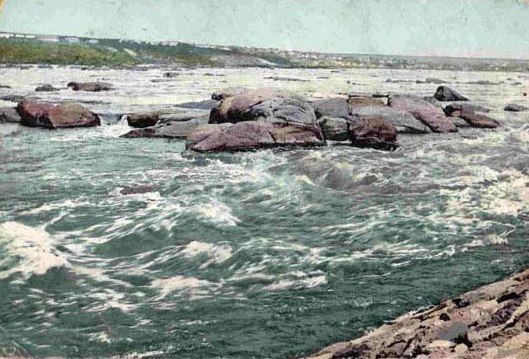
Image result for seven rapids or cataracts on the lower Dnieper

He describes the seven rapids or cataracts on the lower Dnieper and how they may be negotiated. At the frst, which is called Essoupi, which means ‘Do not
sleep!’, the water crashes against rocks in the middle ‘with a mighty and terrifc
din’. To provide a sense of scale, he reports that this cataract is as narrow as
the polo ground in Miklagarðr. Here the Rus’ disembark the men and guide the
boats around the rocks in the middle of the river on foot, also punting them
with poles.
At the fourth barrage, the big one called in Rus’ Aeiphor and in Slavonic, Neasit, because the pelicans nest in the stones of the barrage … all put into
land. They conduct the slaves in their chains by land, six miles, until they are
through the barrage. Then partly dragging their boats, partly carrying them on
their shoulders, they convey them to the far side of the barrage.
They continue to the seventh barrage and on to Krarion, where there is a ford
as wide as the Hippodrome and as high as an arrow can reach if shot from the
bottom to the top. This is where the Pechenegs come down and attack the alRus’.
How did Constantine have such a detailed knowledge about the Varangians or
al- Rus’ (Gotlanders) when they travel to Miklagarðr (Byzantium)?
His father Leo VI was the grandson to the Gotlandic Varangian Ingr.
Kiev was a Slavic settlement on the trade route between the Baltic Sea and
Constantinople, and was a tributary of the Khazars, until seized by the Varangians in 882. Under Varangian rule, Kiev became a capital of Kievan Rus’.
The word Varangian was used by Greeks, Arabs and Kievan Rus’ for merchants
from the island in the Baltic Sea (Gotlanders).
The etymology of the name al-Rus’/Rhos (Rhos vocari dicebant) needs clarifcation.
Sven Ekbo (1981) convincingly connects the word to Old Norse ro∂r meaning
‘expedition of rowing ships’.
As early as 902 Varangians are mentioned as fghting as mercenaries for the
Byzantines. About 700 Varangians served along with Dalmatians as mariners
in Byzantine naval expeditions against the Emirate of Crete and a force of 629
returned to Crete under Constantine Porphyrogennetos in 949.


Preserving Our Past, Recording Our Present, Informing Our Future

Ancient and Honorable Clan Carruthers Int Society

carruthersclan1@gmail.com


carruthersCOA

Uncategorized

The Varangians

The Varangians


There were no Vikings in the Baltic Sea region.
The word Viking is not known there.
The Vikings were warriors from Denmark, the west of Sweden and Norway, and the Viking Age starts with the attack on Lindisfarne in 793.
Image result for the varangians of gotland
There is a clear line in the river Elbe between Vikings and Varangians. East of
the river Elbe there is no mention of Vikings, only Varangians.
In the Baltic Sea region the Gotlanders, after the signing of the trade and peace
treaty in the 550s, also controlled trade on areas under Svea protection.
End 700s when silver from the Islamic Caliphate started to fow, the Gotlanders entered the Russian rivers all the way to river Volga and the Kaspian Sea.
The Gotlandic Merchant Farmers were on the Russian rivers called Varangians
and al-Rus’ (expeditions of rowing ships).
It is documented in Byzantine sources that there was a large trade delegation
in Konstantinople 838, and that from late 800s and forward there were large
Gotlandic contingents stationed in Miklagarðr.
Image result for e fourth silver treasure on Stavar’s farm
The Russian Rivers
Image result for e fourth silver treasure on Stavar’s farm
Nearly 80% of all coins from the Islamic Caliphate found in present day
Sweden have been found on Gotland.
In the areas of the Svear no silver treasure from the Islamic Caliphate has been
found.
Type Total number                       Sweden of which Gotland % Gotland
Roman silver denarii                   7500                         6500                86.7
Sasanian Empire  (500-651)        182                              78                  42.9
Islamic Caliphate (698-1013)        85                               67                78.6
Byzantine coins                            576                              491                85.2
Swedish coins (1013-1050)         781                             423                 54.2
German Coins (950-1140)       92890                        62144                  66.9
English coins                             41525                        25785                   62.1
From the 500s until the 1000s the Gotlanders have, according to Swedish researchers, been considered rarely to be mentioned in ancient sources. The Gotlandic history was uninteresting from a Swedish perspective.
However, the Gotlanders were in Arabic and Byzantine sources from the 800s
well known as merchants from the island in the Baltic Sea region. They are in
these sources called al-Rus’, Rhos and Varangians.
Al-Rus’ / Rhos comes from the Old Norse word Ro∂r meaning rowing feets.
The Arab writers say that it is merchants from the island in the Baltic Sea who
came rowing on the Russian rivers. From there comes later the name Russia.
These Varangians emerged not only as slave hunters, but were primarily known
as merchants.
Ibn Khordadhbeh (c.820–912): ‘The al-Rus’come from the farthest corners of
the Slav’s country. They travel over the Roman Sea to Constantinople and sell
their goods, furs of beaver, black fox and swords’.
Al-Marwazi, reports that the al-Rus’ had abandoned their wild pagan ways and
raids and settled into Christianity.
Ibn Rustah’s description:
‘What al-Rus’ concern, they live on an island, surrounded by a lake. This island, on which they live, have an extent of three days’ journey. His information
on non-Islamic peoples of Europe and Inner Asia makes him a useful source
for these obscure regions. He was even aware of the existence of the British
Isles and of the Heptarchy of Anglo-Saxon England and the prehistory of the
Turks and other steppe peoples. Ibn Rustah travelled to Novgorod with the al-Rus’, and compiled books relating to his own travels, as well as second-hand
knowledge of the Khazars, Magyars, Slavs, Bulgars, and other peoples.
His impression of the al-Rus’ is very favourable:
‘They carry clean clothes and the men adorn themselves with bracelets of gold.
They treat their slaves well and they also carry exquisite clothes, because they
put great effort in trade. They have many towns. They have a most friendly
attitude towards foreigners and strangers who seek refuge.’
See also the picture stones from the 800s that probably tell about the Gotlanders’ contacts with Khazaria and the Islamic Caliphate.
Khazaria converted in the late 700s to Judaism and became the world’s largest
Jewish kingdom. It is estimated today that 80% of those in the world who
confess to the Jewish religion are descended from there.
They are also called the ‘13th tribe’, or Volga-Jews in contrast to Jordan-Jews. In Khazaria the main  languages were Turkish, various Slavic languages and Gothic. If you mix these
languages you get Jiddish.
When the Swedes a couple of hundred years later forcibly Christenized Finland
and Estonia they also came with rowing feets and are called Ruotsi and Rootsi.
But it has nothing to do with the Arabic writers much earlier name for the Gotlandic rowing merchants al-Rus’ and the Byzantines’ Rhos to do.

Preserving Our Past, Recording Our Present, Informing Our Future

Ancient and Honorable Clan Carruthers Int Society

carruthersclan1@gmail.com

carruthersCOA
Uncategorized

CLAN CARRUTHERS – THE FORGE OF VIKINGS

CLAN CARRUTHERS INT SOCIETY CCIS

cropped-wider-banner-light-blue-1.jpg

The Forge Of Vikings

naeroyfjord-norway-3.jpg

There was a time,
long before we breathed in this place,
when the sea had cleft our mountains,
and before long, we rested there,
our souls forged of its very nature.
Then the sea and the oak formed a pact,
and the long boat came to be,
together we made our way across the seas.
At home we were blacksmiths, farmers, woodsmen,
but on foreign shores we were beserkers,
fearless, bringers of terror and death
as we plundered our way into history,
all the while the fjords a fire in our souls.

Paul Vincent Cannon


Preserving Our Past, Recording Our Present, Informing Our Future

Ancient and Honorable Clan Carruthers Int Society CCIS  LLc

carruthersclan1@gmail.com              carrothersclan@gmail.com

cropped-wider-banner-light-blue-1.jpg


You can find us on facebook at :

https://www.facebook.com/carrutherscarrothers.pat.9

https://www.facebook.com/CarruthersClan/

https://www.facebook.com/CarruthersClanLLC


Disclaimer Ancient and Honorable Carruthers Clan International Society CCI


Uncategorized

CLAN CARRUTHERS – VIKING CHIEF BURIED IN HIS BOAT.

CLAN CARRUTHERS INT SOCIETY CCIS

cropped-wider-banner-light-blue-1.jpg

Viking Chief Buried in His Boat

Found in Scotland

Journey Art - Viking Boat  by Corey Ford

The first intact Viking boat burial site to be found on the British mainland was discovered recently in Scotland, archaeologists announced.

“This is a very exciting find,” said project co-director Hannah Cole, who for six years has been leading digs on the remote Ardnamurchan peninsula in the Scottish highlands. “Though we have excavated many important artifacts over the years, I think it’s fair to say that this year the archaeology has really exceeded our expectations.”

Viking boat burials are extremely rare, in part because only prominent individuals received the reverent and elaborate sendoff. In the Norse religion, valiant warriors entered festive and glorious realms after death, and it was thought that the vessels that served them well in life would help them reach their final destination. Distinguished raiders were also equipped with weapons and valuable goods for the afterlife, even if they were to be cremated.

Reconstruction of what the burial site unearthed at Ardnamurchan might have looked like. (Credit: Geoff Robinson)

Reconstruction of what the burial site unearthed at Ardnamurchan might have looked like. (Credit: Geoff Robinson)


Although its wooden timbers decomposed long ago, the outline of a ship surrounds what’s left of the body—fragments of an arm bone and several teeth—found in the Ardnamurchan grave. Hundreds of metal rivets that once held the vessel together, some with wood shards still attached, also remain. The dig also revealed a knife, an axe, a sword with an ornate hilt, a shield, part of a bronze drinking horn, pottery and other possessions that the dead chief might have needed for the hereafter—all encrusted with centuries of rust but shown by X-rays to be in remarkable condition.

“A Viking boat burial is an incredible discovery, but in addition to that, the artifacts and preservation make this one of the most important Norse graves ever excavated in Britain,” said Cole. A handful of other boat burials have been unearthed on the UK mainland, but lack of expertise and outdated techniques made these early excavations unsuccessful. The best-preserved examples come from Norway, Denmark and Sweden.


The seafaring Scandinavians known as the Vikings raided and settled coastal sites in the British Isles and beyond between the ninth and 11th centuries. In the 10th century, when the Ardnamurchan Viking was laid to rest, Norsemen occupied Ireland, Scotland and northwest England, and some had already begun converting to Christianity. This was apparently not the case for the mourners who interred the newly discovered warrior, whose grave bears traces of pagan traditions including stones covering the body.


With support from several universities and organizations, archaeologists and students have uncovered a number of treasures at Ardnamurchan, a peninsula that is thought to have been an important site even in prehistoric times. Examples include graves dating back 6,000 years and an Iron Age fort, discovered earlier this year. Oliver Harris, another co-director of the project, said that previous digs focused on burial practices between 6,000 and 2,800 years ago, long before the Vikings pillaged Britain’s shores. But, he said, “the find we reveal today has got to be the icing on the cake.”


Preserving Our Past, Recording Our Present, Informing Our Future

Ancient and Honorable Clan Carruthers Int Society CCIS  LLc

carruthersclan1@gmail.com              carrothersclan@gmail.com

cropped-wider-banner-light-blue-1.jpg


You can find us on facebook at :

https://www.facebook.com/carrutherscarrothers.pat.9

https://www.facebook.com/CarruthersClan/

https://www.facebook.com/CarruthersClanLLC


Disclaimer Ancient and Honorable Carruthers Clan International Society CCI
Uncategorized

Gotlandic Picture Stones

Gotlandic Picture Stones

Perhaps the oldest Viking rune stone found in Södermanland, the vertical rune lines and lack of ornamentation tell us that this stone's inscription is from the second half of the 900s. Originally found inside a burial mound in 1856, this stone had probabl

( Oldest picture stone in Gutland)


No poets celebrate in song Gotlands’ peaceful or military exploits in the East.
On the other hand Gotland has plenty of beautiful and proud monuments in
form of picture stones, the only monumental art we possess from antiquity.
They were originally attached to the tombs and had certainly religious-magical functions.

Rune stone, Västra Ledinge, Uppland, Sweden.  The inscription says: "Torgärd and Sven, they had this stone raised in memory of Ormer and Ormulv and Fröger. He met his end in the sound of Sila (Selaön island), and the others abroad in Greece. May God help their spirits and souls". Photo taken in 1916The earlier stones had the sacred form of the axe-blade and
were tastefully decorated with sun symbols and ship images, reminiscent of the
Bronze Age ornamentation. One of the fnest of these picture stones, which
dates back to Roman Iron Age is embedded in Bro church tower wall (page 20).
Picture stones are a human expression, that in a single interpretation can provide a perspective far beyond the horizon of Gotland. If you compare the
picture stones from before and after the turbulent times about 520 CE we note
that there are two entirely different religions that exist.
The older picture stones up to the 500s describe sun and nature worship while
after that time there are new religious infuences emerging. In the Lake Mälar
area we have what Snorri Sturlusson calls Æsir religion.whilst it on Gotland are
traces of Christian infuences.
Image result for 400 AD viking Picture stonesThe idea to raise neatly carved, fat stone slabs on the graves, which frst meet
us in the Roman Iron Age, has lived through the storms of time.
The Gotlandic picture stones are unique and are nowhere else in Scandinavia
to be found. The older stones are elegantly shaped image blocks with a sparse geometric decoration of a symbolic nature, that is indicative of an artistic
balance and elegance in the alignment, which closest speaks of a sophisticated
culture. The sun wheel occupies a central place in this world of images. This is complemented with the symbolic images of animals and ships, drawn with
a few elegant lines. These show clear signs of inspiration from Roman culture.
Gotland’s main deities here and ever since ancient times have been the heavenly
bodies, mainly the sun and moon. There have apparently lived talented artists
on Gotland during this time and later times.
The earlier Gotlandic picture stones are mostly connected with the Iberian
peninsula and southern France. The Ibero-Celts are the most likely bearers of
the pictorial agenda that is introduced on Gotland for the earlier picture stones.
In the Iberian peninsula, the Vadenienses, an old Ibero-Celtic people have left
very special gravestones, decorated with blades of ivy, corn ears and specially
designed horses. It was a people of foghters and horsemen, who to every horse
had two warriors, one to ride and the other to foght on foot to help protect the
horse and knight. Their most common form of grave decoration during the
pre-Christian Roman period is exactly of the same character as the early stones
on Gotland. They contain a lot of signs that could be understood as sun and
moon. The moon is often made as bulls horns. This whole style is unique for
the Iberian peninsula and depends probably on Celtic infuence among the Romans.


Via hauntinggreveries( - p.mc.n.) Atlakviða (The Lay of Atli) is one of the heroic poems of the Poetic Edda. A 13th-century Scandinavian saga preserving and perpetuating oral traditions going back 1,500 years before, to the late Bronze Age. Atlakvith (literally, “The Punishment of Atla[ntis]“) poetically describes the Atlantean cataclysm in terms of Norse myth, with special emphasis on the celestial role played by “warring comets” in the catastrophe.


(Two picture stones from Tängelgårda in Lärbro parish, dated 700AD)

The Gotlandic picture stones correspond with the pre-Christian stones from
100-300 CE. The Vadenienses worked within the Roman legions, and were
also mercenaries fghting for whoever made it worth while. Their fghting techniques have been reported by Roman soldiers who observed it among their
German enemies. At other occasions they have also witnessed it with the eastern Goths in the time of Attila. They lived on the Asturian plateau and in the
mountains and further on in northern Italy, Austria and Bohemia. They were
a travelling people. They might have met the people from Gotland in the Bohemian area (see Marcomannic infuence).
We today know of about 570 Gotlandic picture stones, dated roughly to the
period 200-1100. Peter Manneke has shown roots of picture stones that date
back to the 1st century in certain cemeteries.
Sunwheel StoneAccording to Peter Manneke: “The consummate mastery of the stone material
from the 300s and 400s in the form of perfect curbed stone circles of dressed
sand- and limestone, and technical high-image blocks within these circles presupposes partly unknown, earlier stages on Gotland and partly the fact that the
craft as such, came to Gotland from outside. These early stages can be found
on Gotland. The idea to use cut stone as a material for edge- and picture stones
and the necessary technical skills came probably from the south and if so,
mainly from the vast Roman Empire with its perfect architecture in stone, with
whom Gotland had intensive trade and other relations.The idea for the older
image blocks and its imagery, with its compass-drawn geometric ornaments,
their burdensome ships and its fabulous animals that sometimes have rear-facing heads, probably stems from several areas in the south and southeast.
The findings on the grave-fields, burial forms, etc. indicate that the stones date
back to the frst century. In the Duero valley in Spain/Portugal e.g. is a picture
stone from the first century, showing among other things, two swivel wheels
(which is prevalent on the Gotlandic picture stones) and a rosette ornament resembling the basic shape of the Gotlandic highly developed spoke graves with
intricate stone circles outside the cairns, especially those at Duckarve in Linde
and Barshaldar in Grötlingbo.
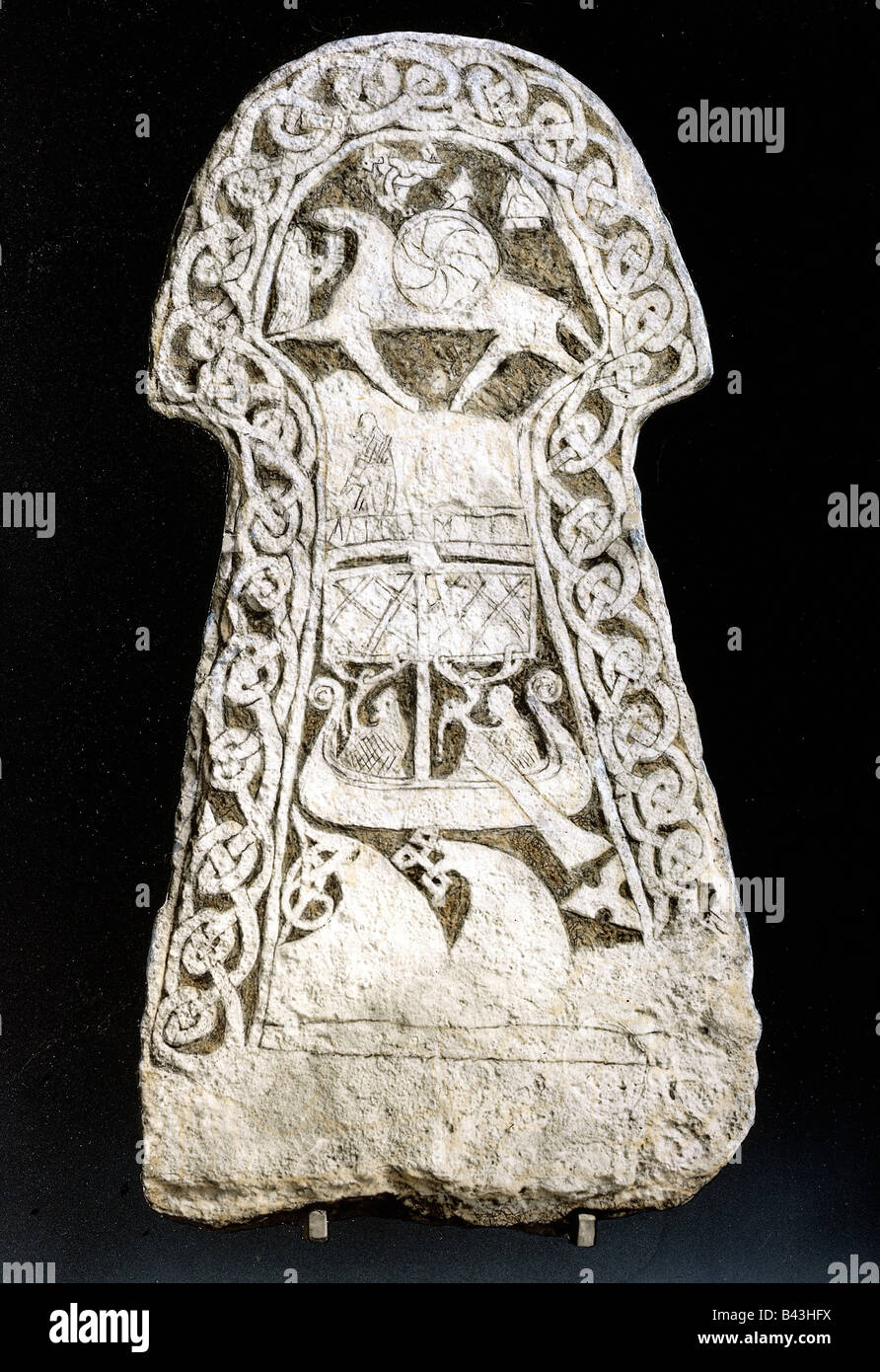
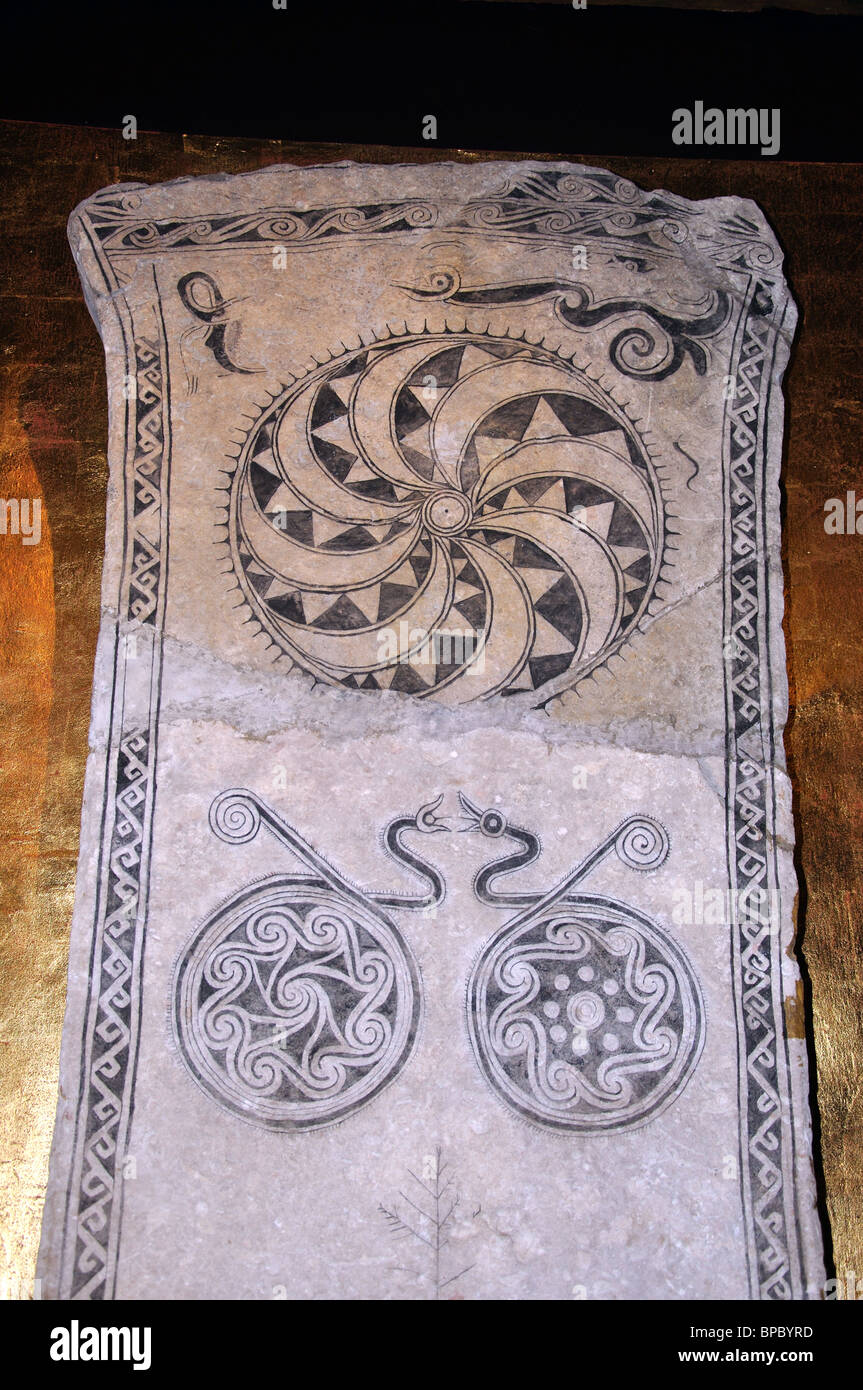
Image result for picture stones from the Duero area GutlandThe picture stones from the Duero area are from the days when Roman bronzes and silver coins began to appear on Gotland. On Gotland these offshoots
of different cultures and design worlds met Celtic, Germanic, Roman and that
from the Goths.”Age mystical religious images, and the younger Germanic Iron Age more readable narrative picture scenes.
That the art in the 500s changed its expression is an important observation.
Similarities and differences in this shift should be compared with the transition
from a pre-Christian Gotlandic art to a Romanesque Byzantine Christian art
in the 900s.
Professor Nylén writes in the book ‘Stones, ships and symbols’ about some
sort of religious change around 500 CE.
In connection with possible disturbances it may also have been the bubonic
plague, known as the Justitian bubonic plague, that ravaged. It appeared in Italy
541-543 and harvested close to half the population of the Roman Empire. We
also know that the Flanders was hard hit.
The explanation for the burned foundations of the Gotlandic houses can be
that they had to burn away the evil disease. It is then natural to move to new
settlements, which also happened.
A distinctive feature of this later time is a particular art, the Nordic animal ornamental art, which only has survived in small metal objects, but that refects a
lost monumental art in wood.
Alongside these works, which certainly originally had a symbolic-magical signifcance, is a monumental group that gives us a very different conception of
the society of the time. It is the next face of Gotlandic picture stones.

Image result for Valhalla, picture stone, gotland

(Arrival at Valhalla )


Here we fnd the image part of the depictions that are repeated in the later Icelandic
sagas, but also scenes of ritual acts, whose meaning we only vaguely suspect.
Here is the Valhalla, the kingdom of death, and the battles that brought the heroes there, here are characters in the poems the bards sang, fragments we only
partially understand. From the circuit of the Niebelungen poems the Nordic
poets have downloaded material for their heroic songs, but their works are not
It is clear that there is a considerable difference between the older Roman Iron

Image result for Valhalla, picture stone, gotland

( warriors in Valhalla)

Age mystical religious images, and the younger Germanic Iron Age more readable narrative picture scenes.
That the art in the 500s changed its expression is an important observation.
Similarities and differences in this shift should be compared with the transition
from a pre-Christian Gotlandic art to a Romanesque Byzantine Christian art
in the 900s.
Professor Nylén writes in the book ‘Stones, ships and symbols’ about some
sort of religious change around 500 CE.
In connection with possible disturbances it may also have been the bubonic
plague, known as the Justitian bubonic plague, that ravaged. It appeared in Italy
541-543 and harvested close to half the population of the Roman Empire. We
also know that the Flanders was hard hit.
The explanation for the burned foundations of the Gotlandic houses can be
that they had to burn away the evil disease. It is then natural to move to new
settlements, which also happened.

A distinctive feature of this later time is a particular art, the Nordic animal ornamental art, which only has survived in small metal objects, but that refects a
lost monumental art in wood.


Alongside these works, which certainly originally had a symbolic-magical signifcance, is a monumental group that gives us a very different conception of
the society of the time. It is the next face of Gotlandic picture stones. Here
we find the image part of the depictions that are repeated in the later Icelandic
sagas, but also scenes of ritual acts, whose meaning we only vaguely suspect.
Here is the Valhalla, the kingdom of death, and the battles that brought the heroes there, here are characters in the poems the bards sang, fragments we only
partially understand. From the circuit of the Niebelungen poems the Nordic
poets have downloaded material for their heroic songs, but their works are not preserved, only the picture stones. We can trace them, perhaps also in the Gotlandic national epos Beowulf.
Image result for Lake Mälar rune stonesThe stones grew in size and the ‘head’ had a stronger curvature. At the same
time they appear to some extent to have been freed from its connection with
the graves and may well largely be seen as memorials for seafarers who have
been gone. Their task was thus the same as the later Lake Mälar rune stones,
though they are much older than the rune stones and spoke with images instead
of words. They often depict on the stones an armed horseman, who from a
woman is offered a drinking horn, and a ship under sail.

Image result for Lake Mälar rune stones

The relationship between Troy and Asgard and the religion of the Ynglinga dynasty may perhaps also be interpreted in these later Gotlandic picture stones. In
an article in the journal ‘Tor’ the British linguist Michael Srigley has interpreted
the image sequences of three of the best preserved Gotlandic picture stones
from the Vendel Period. He tries to show that the sequences on the picture
stones tell of the Trojan War. Even some not so well-preserved picture stones,
he believes, show episodes from the same events.
Why would one tell about the Trojan War on Gotlandic picture stones? According to the Edda the old Asgard was identifed with just Troy. The Heruls
who immigrated to the Lake Mälar area in the 500s and became the Ynglinga
kings lived there during a long time.
Although the Edda was written in the 1200s, it is based on traditional material
including the Gotlandic picture stones that go back hundreds of years. It was
not Snorri, who thought that Asgard and Troy would be the same thing. It can
be traced back to older sources. If you go to Islendingabók it tells about Yngve,
the frst king of the Ynglingar, that he was called ‘Turkia konungr’ i.e. the King
of Turks.
During the Vendel era these stones culminated. The stones were larger than
ever before, and they were produced in large quantities. Artistically and technically the stones from the Vendel era are very inferior to those from the Roman
Iron Age, in which classic taste and artistic sense come into play. They are often
of a very large format and with an abundance of rich images. They reproduce
the entire sequence of events from the fairy tales or the real world. They glorify
changes of weapons and heroic deeds. This is what one rightly could await after
a restless past flled with struggle.
Image result for Smiss in StenkyrkaFrom this period are derived the two large stones from Smiss in Stenkyrka and
Hunninge in Klinte, which are exhibited in Gotland’s fornsal. The largest of all
the Gotlandic picture stones, namely the one at Anga in Buttle measures from
the ground 3.9 metres.
If you compare the Roman Iron Age art with the art from the Germanic Iron
Age – Viking Age the differences can be interpreted as a shift in the 500s from
religious images with an enigmatic content to images, using religious motives to
legitimate a new power position.
viking carving photography - Google   This is my favourite Norse design.These changes in image content can be seen in the development of the Gotlandic picture stones. The motifs of the first group are primarily geometric and
ornamental with occasional human and animal figures. Very commonly there is
a dominating ‘spiral whorl’ or similar design borrowed from the timeless patterns of woodcarving. An oared vessel, always similar in shape, is often carved below the dominating geometric motif.
The successors to these well-cut large first generation stones were small ‘dwarf
stones’, sometimes trimmed and carved on both faces and with a more distinctly curved upper edge. The decoration is still geometric or heavily stylized.
Duck-like birds or ships with vestigial sails are common motifs. Stones of the
second group have been discovered in their original positions. They stood outside, yet connected with the outer edges of graves.
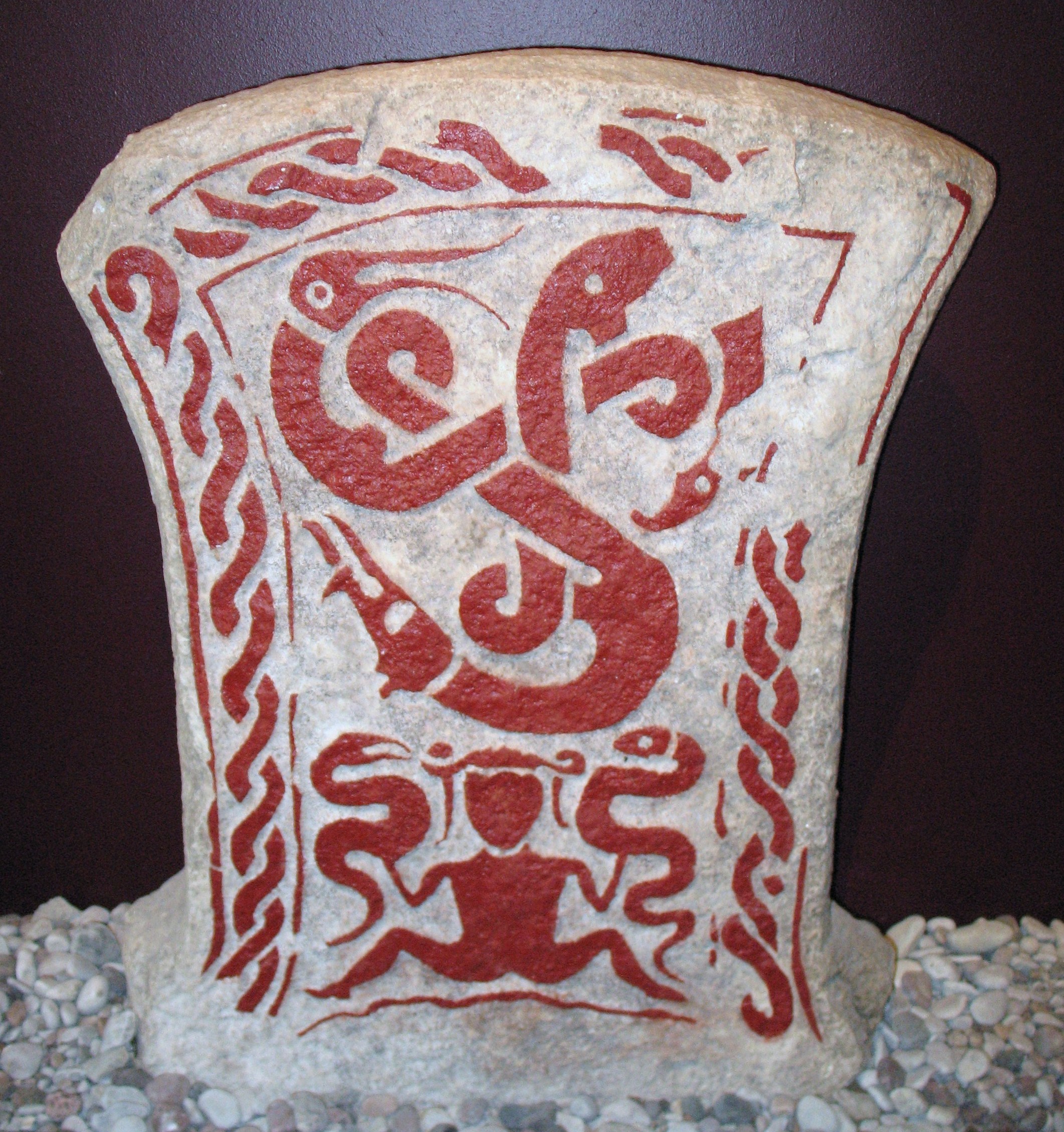
Image result for 400 AD viking Picture stonesThe third group of stones is the first on which ‘free’ art was totally dominant.
The stones may be about the same size as the earlier ones but they are not so
well trimmed. They must have been very unstable when erected because of
their shallow bases. Their shape, like a split mushroom, has given rise to many
interpretations, the most common being that they are phallic symbols.
An older group of stones from the Roman Iron Age, which are decorated with
hard to understand symmetrically arranged fgures and abstract symbols are
followed by Vendel-Viking Age picture stones with storytelling, representations later documented in Norse mythology.
During the 700s and 800s the picture stone art had its heyday. The mighty monuments, some, as mentioned, over three metres high, now depict in horizontal
sequences an epic content. It might be an episode from the deceased’s life or
a passage from a Nordic hero poem, Helge Hundingsbanes saga or Brage the
Olds Ragnarsdrapa or something else. There are many suggested interpretations. The pictures appear in very poor relief, which was initially enhanced by
painting in vivid colors. The style is rigorously ornamentally decorative but lives together with a fascinating expressionism. For the Gotlandic art history
these picture stones have an outstanding importance as fragments from the
ancient art we have had in wood and fabric, but that time has claimed.

Lindisfarne Stone (stone), Viking / Lindisfarne Priory Museum, Lindisfarne, Northumberland, UK / Ancient Art and Architecture Collection Ltd. / The Bridgeman Art Library.  Likely erected to commemorate the dead lost in 793 AD at the Lindisfarne Priory, an event considered to mark the beginning of the Viking Age; it is thought to depict the Viking raiders who attacked the monastery; [See ep 1 Vikings Series II ;-)]Lindisfarne Stone
A braided pattern is e.g. found around several of the Gotlandic picture stones
representing a style known already from Sutton Hoo. This woven pattern is
known from the Lindisfarne Gospels from about 698, produced in the monastery Lindisfarne in Northumberland. The Gotlandic stones are dated to the
400s.
.Viking Age picture stones do not have the older sober style and decorative
security. The relief will be higher and is reminiscent of fat cutting in wood.
Finally, the picture fades, and on those with Christian cross, the rune sling comes in.
Why stones were hewn, carved and erected has long been the subject of discussion. To remember, honor and religion has had varying degrees of importance
in this context and is more than likely. The youngest stones are rune-inscribed
as are also several medieval grave slabs. The practice later to raise rune stones,
mainly occurring in the Lake Mälar area is, to judge, of a similar ornamentation,
concurrent with the youngest picture stones.

About Swedish mainland rune stones, which are later than the Gotlandic picture stones, we know that they have been raised as memorials, but also had religious, magical and legal links. The latter probably as a kind of death certifcate for the succession taking.
The role of religion in the picture stones’ genesis is interesting from the following standpoint. We know very little about ancient religion in Scandinavia.
Hypotheses and assumptions are based on too few facts. There are, however,
a few individual milestones. Finds of undoubted cult objects and motifs in the
rock carvings from the Bronze Age suggest that the sun was worshiped during
this time, perhaps along with other divinities. How long sun worship continued
is uncertain. The solar disk and the ship seem to have had symbolic value in
this religion.
In Scandinavia we know with certainty that Christianity fnally replaced the
Æsir religion around and after 1000 CE. It rather seems that the pre-Christian
religion has been pretty inconsistent but quickly consolidated itself during the
coming of pressure from Christianity. Obscure hints in the extant literature in
Iceland, which essentially has provided us with knowledge of the Æsir, may
provide a basis for speculation about some kind of religious change around the
year 500 AD.
Please note that Gotland has a completely different history from that of Scandinavia. Gotland was christinaized in Constantinople in 864. And it is the eastern Byzantine religon that is accepted by the Gotlanders (the Varangians).


Avademia


Preserving Our Past, Recording Our Present, Informing Our Future

Ancient and Honorable Clan Carruthers Int Society LLC

carruthersclan1@gmail.com


carruthersCOA

Uncategorized

Viking Age Christmas Tradition

Viking Age Christmas Tradition


Everyone knows that a lot of the modern Christmas traditions stem from previous pagan cultural ones. What are the seasonal traditions that come from the Viking Age?

It is true to say that most of the year would be spent stocking up on food for the winter, preserving what you could, gathering salted and dried meats, winter berries and plentiful amounts of bread to last the long cold nights. But what of the ‘spirit’ of winter, the frost nipping at your nose and your nalbinded socks necessary to the cold out? It’s not just the physical hardships of surviving a winter in the 10th century – it’s the mythical beliefs that emerge to enthral you around the fire and teach you about your place in the world. There are many elements from Viking period sagas and histories which describe festive sprites and ghouls, and while over time these stories of course get embellished and added to, many of them do stem from the Viking Age.

The niðsi in Scandinavian folklore, are winter ancestral spirits which guard your home or farmstead. Seen as ancestral helpers who assist with the winter chores, the best way to ensure a happy nisse is to leave out a dish of milk or porridge. However, keeping these ancestral beings happy can be challenging if you have a mischievous or nasty nisse or tomte, and if you don’t look after your home, family and honour the spirits they can get aggressive and even violent, killing cattle and even sending draugrand haugboi from burial mounds to harass the living. So the moral of the sagas is to always keep your nisse well looked after this festive season.

Or Gryla, the mother of all the Yule Lads, will abduct you! In Icelandic folklore Grýla appears in the Poetic Edda as a troll-wife and throughout the 16th-17th century the evolution of her character appears to be associated more with Yule and the festive period. Residing in a cave in the Dimmuborgir lava fields of northern Iceland, Grýla is a witch who can sense naughty children throughout the year and especially around the festive season when she comes out of her cave to prowl. Certainly a festive folktale with a more sinister side, but in a practical sense it was most likely a good way of stopping children wandering off or playing out in the winter snowstorms for fear of them getting grabbed by Grýla. The moral of the story, behave or you get eaten!

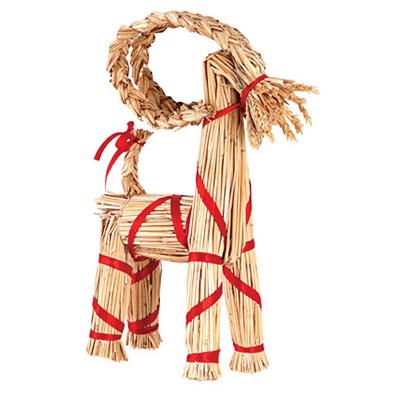
Image result for julebukkOne of my favourite Yuleblót traditions is the Yule Goat or Yulbukk, popular throughout Sweden. This tradition is believed to stem from Thor’s goats that pulled his cart, Tanngrisnir and Tanngnjóstr. These magical goats could be eaten for food and then magically regenerate and be born anew, so Thor always had a stash of food wherever he went. The last sheaf of grain to be harvested is kept and bound together in a ‘goat-shaped form’, and this symbol is meant to protect the family over winter and make sure that food always finds its way to your door.

The tradition of Julbukking is similar to the English tradition of Wassailing, whereby festive revellers tour round the houses of their friends and relatives with goat or animal masks on. Related imageThose opening the doors have to guess who is behind the mask, based on the antics of what they are doing, whether that be dancing, singing or performing festively in some way. If the guest guesses correctly the wassailer’s present the guest with a gift of food or drink, and then move onto the next house. The moral of this story, always be hospitable to guests, especially in the winter.

As you can see, there is a theme running through these folktales and sagas, which hint at Christmas traditions and themes most certainly coming from Norse mythology. To what extent these types of traditions were actively practiced during the Viking Age is difficult to say. All that can be stated, is that these stories and the morals, words of wisdom that come from them resonated then and are still relevant today. Throughout the medieval period and into the modern world these traditions have evolved. Some of them have kept their original meaning, some have changed with family tradition. Regardless, whatever traditions you follow this Christmas season, keep your family nisse happy, be good and hospitable and if you can share some merriment with those around you.

Preserving Our Past, Recording Our Present, Informing Our Future

Ancient and Honorable Carruthers Clan Int Society LLC

carruthersclan1@gmail.com

carruthersCOA


Uncategorized

Vikings Had Dark Sense of Humor

Vikings Had Dark Humor And Joked Even During Deadly Battles


Historical studies of Icelandic Sagas reveal Vikings had dark humor and joked even during deadly battles.

vikingsdarkhumor

It was a mixture of sarcasm, irony and unusual jokes. The Vikings approach was that, if you knew you were going to die, why not do it laughing.

Death was never something Viking feared because they believed that a warrior who died in battle was rewarded and could join all other great fighters in Valhalla, a majestic, enormous hall located in Asgard, ruled over by the great god Odin.

Written during the Middle Ages, Icelandic Sagas tell stories of Vikings and usually, the tales all centered around various kinds of disputes that ended in battles between the Vikings. Often two or more families could be involved in blood feuds that lasted decades or generations.

According to historian Trine Buhl at the Århus University in Denmark, authors of the Icelandic Sagas deliberately added dark humor to their tales, without it the stories would be boring.

icelandicsagas

There are several examples of sarcasm and dark humor in the Sagas. For example in the Droplaugarsona Saga, written sometime in the 13th century tells about Droplaug’s two sons, Grímr and Helgi.

When the Viking Helgi gets his lower lip cut off in a battle, he says to his opponent:

“I have never been particularly handsome and you haven’t exactly improved my attractiveness.”

vikingwarrior

This remark shows Viking Helgi possessed self-knowledge and self deprecating humor.

In the Gunnlaug Ormstungas Saga, a famous Icelandic saga that is over 1,000 year old, we encounter Viking Gunnlaug who falls in love with a young woman named Helga.

Gunnlaug embarks on a long and adventurous journey and when he retunrs home, he discovers that his beloved  Helga was forced to marry Hrafn, Gunnlaugs enemy.

This leads to a long, hard battle between the two men. After a while, Gunnlaug uses his sword to cut off Hrafn’s foot.

Gunnlaug is happy and feels this is the end of the battle which he one.  However, despite being mutilated his enemy Hrafn yelled:

” It’s true things are not going my way, but I can probably continue a while longer if I just get something to drink!”

The battle ended with the death of both Vikings.

Sarcasm, irony and dark humor was not restricted to Icelandic Sagas. In the Kings’ Sagas we encounter similar jokes often uttered when someone’s life was about to end.

icelandicsagas2In one chapter we can read about how the Danish King Harald Bluetooth refuses to accept
Sweyn Forkbeard (Sven Tveskägg) as his son. Sweyn Forkbeard is instead raised by Palnatoke,a legendary Danish hero, chieftain of the Island of Fyn and founder of the Jomsvikings Brotherhood.

Sweyn Forkbeard (Sven Tveskägg) is furious when he learns King Bluetooth calls him a bastard. He seeks revenge, gathers his followers and convinces them to wage war on King Harald Bluetooth.

One late evening, Forkbeard’s assassins see the King sitting, calmly relaxing by the fire. When the King bends forward, one of killer shoots with an arrow.
In the Norwegian King’s Sagas the event the author relates the event by writing” According to testimonies of those who knew and witnesses this event, the arrow flew straight into the King’s lowest point, continued through his body and came out of his mouth. Then the King collapsed and died.”

According to historian Trine Buhl, the most popular sagas were those with dark humor. Most researchers agree that the Sagas are based on oral traditions.
From about 900 A.D. to 1000 A.D., the sagas were told by storytellers from one generation to another.
Around the year 1200 A.D. literate men such as monks and other learned med started to write down the Sagas.
Over the years, when the Sagas spread among the Nordic countries the stories became more colorful and often slightly exaggerated.

Some of the stories can have been confirmed because the same verses have been found on rune stones from the Viking Age.              Ellen Lloyd


Preserving Our Past, Recording Our Present, Informing Our Future

Ancient and Honorable Carruthers Clan Int Society LLC

carrothersclan@gmail.com


carruthersCIA gootnote