DNA Gotland, Gutland / Gotland, OUR ANCESTORS, Uncategorized

CLAN CARRUTHERS-THE BEAST OF GUTLAND/GOTLAND

CLAN CARRUTHERS INT SOCIETY CCIS                    PROMPTUS ET FIDELIS

cropped-wider-banner-light-blue-1.jpg

The Beast of Gotland

beastofgotlandmenHere we start back in Gotland again.

If you do not understand what that means, please read the previous blogs.

Were the men of Gotland considered Beasts?

Oh hell yes!  And they were very nice and very good at it!

We have learned, the unforgettable memory, of these giants of men, ravaging and pillaging all of Europe, and wearing kilts, possibly so they can easily take it off, and fight in the buff.

Did you remember that our ancestors were generally accepted to have originated the  heiti for”men (of the tribe)”, with the literal meaning “they who pour their seed”.  This is one of the oldest mention of men from the same tribe or clan, or family who went off to battle together.

The Killing Beast

The short form of Gautigoths was the Old Norse Gautar, which originally referred to just the inhabitants of Västergötland, or the western parts of today’s Götaland, a meaning which is retained in some Icelandic and Norse sagas.

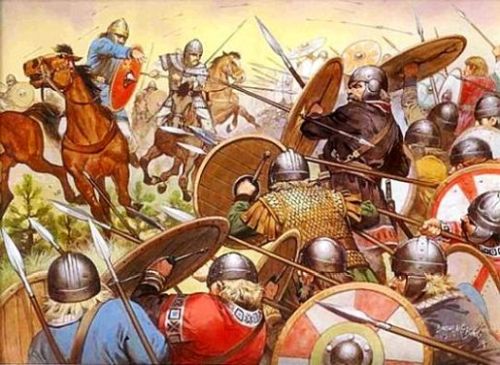
Beowulf is one of those Norse sagas, along with Gautar and Widsith.   Beowulf and the Norse sagas describe several battles, such as a raid into Frisia, ca 516, which is described in Beowulf, along with the events related in this epic, some described the Geats as a nation which was “bold, and quick to engage in war”.

Not only in the Story of Beowulf were they giants in battle, but the Gotalanders, were making a lot of gold for killing Romans, and protecting Romans.  They were developing a reputation for being quick to the fight!

labro

There remain picture stones of Gotland.  Hundreds of memorial stones were produced from the local limestone, in pre-viking and Viking times, which became richly informative. General themes are easily recognized: ships on a journey, men fighting in battle or defending a house, a warrior being welcomed home or into Valhalla, often by a woman who offers him a drinking horn, stories of gods and heroes.

These stones were the written stories of all the men that were lost, those that came home, and all that fought bravely.

One very interesting stone has been given the name Ardre VIII.   It stands about 7 feet tall, and is round at the top and is broken into different sections that depict some of the stories of battles.  There are two other stones to look into Larbro I, and the Klinte Hunninge.

They might have been Bold, and Quick to engage in war, but they were Ready and Faithful to the Heiti or tribe, they were the Beasts of Gotland.

Beauty and the Beast

The Grimm Brothers wrote many tales. Their tales were the first to be written of the beasts, but were stories orally told over and over again for centuries. Like playing telephone, and the stories change a bit here and there.   The Grimm Fairy tales were a collection of tales and stories told of old. The old monsters and beasts who lived on the land.

These stories were of big monsters, and mean women who ate little children.  Wicked people who were deep in the forest, and took children far away never to be seen from again.  Most of these stories carried through for hundreds of years, all telling of the Beasts of Gotland.

gulliver

Thankfully, along came Walt Disney and romanticized these stories.  Cinderella, Snow White and Hansel and Gretel. Well, Walt Disney did tame the beast and made the stories easier to experience than the Grimms Tales, but there are scenes in each one that can have us sitting on the edge of the chair. All stories of the terrible beasts that were from Gotland.  Finally, a good story about the beasts, Beauty and the Beast, and let us not forget Gulliver’s Travels.

The Beast become a Symbol 

gotlandwood

Our ancestors were experts in carving in wood and the beast is designed into many of their stylings.

They were the shipbuilders for most of Europe, but their own ships were decorated with beautiful hand carvings, most of which were that of beasts. Sometimes a different beast was used for a group of ships leaving for one war, or one battle.  Similar to a team of players all wearing the same ship and design.

beastofgotlandship

And of course, as early as 200 – 300 A.C.E. runic inscriptions are found on memorial stones and jewelry as well. These ancestors came through the stone age, the bronze age, the iron age and such, and their designs of the beasts come through their designs of jewelry.  One of my favorite of these rune memorial stones is found at Lund, and shows Hyrokkin riding on her wolf, and includes the wonderful serpent reins that she used to control the great beast.

hyroken

Viking Art has become very popular, and there are many different types of Viking Art, but the Urnes style has lasted through out the centuries.  You can see the BEAST, a symbol actually representing all the generations of Gotlanders who fought bravely for home, and yes for gold, but most importantly for their family in many works today.

beastofgotland

Every year in August, the people of Gotland dress in pre-viking and Viking garb, and you will see the flag of The Beast of Gotland, flying proudly throughout their villages.

Carruthers crest on flag-v2 (1)

OFFICIAL AND REGISTEREDL CLAN CARRUTHERS CCIS SINCE 1983-CLAN OF OUR ANCESTORS

SCOTTISH CLAN – IRISH CLAN – NORSE CLAN

Kingof the Goths, or Gutland

Preserving Our Past!    Recording Our Present!  Informing Our Future!

The Ancient and Honorable Carruthers Clan International Society LLC

carruthersclan1@gmail.com                carrothersclan@gmail.com

cropped-wider-banner-light-blue-1.jpg

CLAN CARRUTHERS INT SOCIETY CCIS HISTORIAN AND GENEALOGIST

You can find us on our main facebook pages at :

SILVER WINGS-https://www.facebook.com/CarruthersClanLLC/

GOLD WINGS – https://www.facebook.com/carrutherscarrothers.pat.9

CLAN CARRUTHERS FAMILY HISTORY – https://www.facebook.com/CarruthersClan

CLAN CARRUTHERS CCIS – https://www.facebook.com/groups/3878691252182714

CLAN CARRUTHERS INT SOCIETY- https://www.facebook.com/groups/394653845137709

CLAN CARRUTHERS – BORDER REIVERS – https://www.facebook.com/groups/434959914239094

Disclaimer Ancient and Honorable Carruthers Clan International Societ
Gutland / Gotland, The History of Gutland, The Viking Age

CLAN CARRUTHERS CCIS – ANCIENT HISTORY OF THE GOTHS AND GUTLAND

WIDE BANNER with NEW CREST

ANCIENT HISTORY OF THE GOTHS AND GOTLAND

The Goths were a number of Germanic tribes in the Migration Period, which appeared in written history in the third century in the areas north of the Black Sea between the rivers Danube and Don. Except for frequent raids, they invaded the Roman Empire first time in 268 AD, and later in 376 AD.
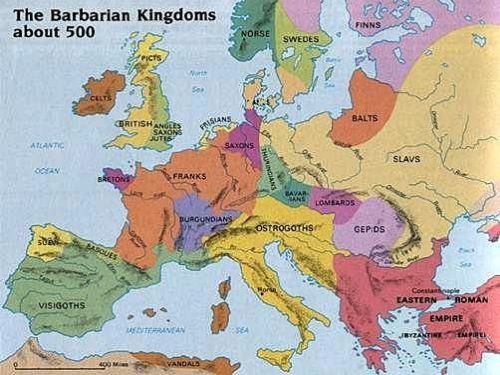
Europe around 500 AD

The Western Goths settled a few years in the Garonne valley in France until they conquered a kingdom, which included Spain and the South of France. In France, they were displaced by the Franks after a few years, and Spain was in 711 AD conquered by Muslim invaders – but the Goths descendants took the country back in the Middle Ages. The Eastern Goths established a thriving kingdom in Italy, but after only 67 years, they were defeated by armies sent by the emperor in Constantinople.

An artistic reproduction of the Goths in battle at Chalons

Top: A map of Europe showing the Germanic kingdoms that were established after the downfall of the Western Roman Empire. After numerous battles and long migrations, the Western Goths managed to settle in Spain and the Eastern Goths to take possession of Italy. However, it did not last forever. From ancientweb.org.
Bottom: An artistic reconstruction of the Western Goths in battle with Attila’s Huns at Chalons. From ancientweb.org.

When the first Goths arrived at the northern coast of the Black Sea about 170 AD, the climate was still influenced by the Roman Warm Period, which, however, ended about 400 AD. The Vandals crossed the frozen Rhine new year’s eve 406 AD, thus commencing the Migration time and heralding the downfall of the Western Roman Empire. The fact that the Rhine was frozen, testifies to a rather cold climate. I do not recall the Rhine has been frozen in modern times. From then on, until the disaster at Guadalete in Spain in 711 AD, when the Western Goths were defeated by invading Muslims, the climate was cold with snowy winters in northern and central Europe.

Goths can be traced further back in history to today’s northern Poland, and even in the distant past to their origins in Scandinavia and the Baltic area. Thus Jutland through thousand years was called Gotland.

Paul the Deacon tells about how the Langobards migrated from their original island in the ocean: “Now when the people living there had multiplied to such a number that they could no longer live together, they divided, it is told, their whole people into three parts and decided by casting lots, which of those, who were to leave the homeland and seek new places of residence.” Dudo confirmed many years later that it was a traditional way of solving problems of overpopulation in Scandinavia.

Also, the Gotland Gute Saga says that some of the people were taken for emigration by casting lot: “After a long time, the people have so increased that the country was not able to feed them all. So the land was distributed, on which every third tilled, each of these was allowed to keep and bring and take away everything, which he in his life had acquired.”

Pliny the Elder (23-79 AD) wrote: “Pytheas says that the Gutones, a people of Germania, inhabits the shores of an estuary of the Ocean called Mentonomon, their territory extending a distance of six thousand stadia; that, at one day’s sail from this territory, is the Isle of Abalus, upon the shores of which, amber is thrown up by the waves in spring, it being an excretion of the sea in a concrete form; as, also, that the inhabitants use this amber by way of fuel, and sell it to their neighbours, the Teutones.”
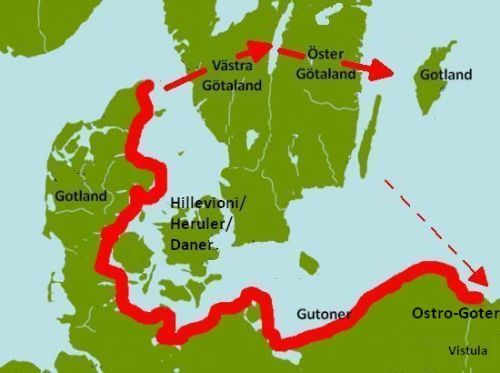
Gutones following Pytheas

Plinius wrote: “Pytheas says that the Gutones, a people of Germany, inhabit the shores of an estuary of the Ocean called Mentonomon, their territory extending a distance of six thousand stadia.” Other ancient writers also believed that the Baltic Sea and inner Danish waters was a major estuary.
Procopius wrote about the returning Heruls: “After these, they passed by the nations of the Dani, without suffering violence at the hands of the barbarians there. Coming thence to the ocean, they took to the sea, and putting in at Thule, remained there on the island.” – “And one of their most numerous nations is the Gauti, and it was opposite (next to?) them that the incoming Eruli settled at the time in question.” We must believe that Procopius shared the ancient authors believe that the Danish waters and the Baltic Sea was a large estuary, in which case it “opposite the Goths” can be understood: on the opposite side of the estuary. Alternatively, it should be translated “next to the Goths.” However, in both cases, suggesting that the Heruls were not Goths. The Heruls came before the Goths.

There is some uncertainty about how long a stadium was, the proposals vary between 160 and 192 m. That means that the coastline, which was inhabited by Gutones, was between 960 and 1.152 km. long. That gives a range from Skagen to the Vistula estuary at Gdansk.

gutlandmap1000ad

It suits very well with that the Jutland peninsula before the Viking Age was called Gotland, as it is the case in Ottar’s travelogue, added in Alfred the Great’s translation of Orosius’ Roman history from about 850 AC: “When he sailed there from Skíringssal (at Oslo), Denmark was on the port side and to starboard for three days was the open sea. And then, two days before he came to Hedeby, Gotland was to starboard (him wæs on þæt steorbord Gotland), and Sillende and many islands. The Angles dwelt in that area before they came here to this land.”

You could see Jutland/Gotland on the left and the light green marks where Jutland/Gotland spreads east and includes the Gotland Island that we know today.   There was very little water seperating Jutland/Gotland and Osterand Vistra Gotaland on the north.  It was called an estuary, and it is believe that this is why they made the longboats  as a narrow longboat.

Since the area was inhabited by Gutones in time before Christ – according to Pytheas – and as part of it still was called Gotland 800-900 AD, it is reasonable to assume that at least the coast along Kattegat and the Baltic Sea were the Goth’s original homeland.
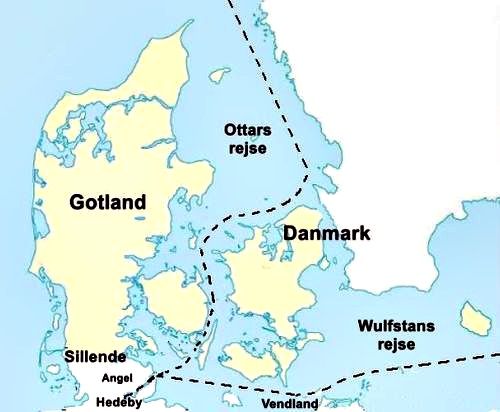
Ottar's and Wulfstan's journeys

Ottar’s and Wulfstan’s travels according to additions in Alfred the Great’s translation of Orosius’ Roman history. Both Jutland and the island in the Baltic Sea are called Gotland. (The island of Gotland is not shown on this map).

That will indicate that Cimbri, Teutons, Angles and all other tribes, who lived along this coastline, and whose names we are not sure about, all originally have thought of themselves as kinds of Goths speaking the same language, namely Gothic.

Some believe that the Gutones on the densely populated Jutland east coast very early crossed the Kattegat and gradually populated West and East Gøta Land – and from there the island of Gotland in the Baltic Sea.

In Alfred the Great’s translation of Orosius’ Roman history is also added Wulfstan’s travel report from a voyage from Hedeby to Truso in Vistula’s delta from about 850 AC, which reads: “Wulfstan said that he traveled from Hedeby, and that he was in Truso in seven days and nights, and that the ship all the way went under sail. Wendland was on his starboard side and to port, he had Langeland, Lolland, Falster and Scania. These countries all belong to Denmark. So we had Bornholm to port, and they have their own king. So after Bornholm we had the countries named first Blekinge, More, Oland and Gotland to port (and Gotland on bæcbord), and these countries belong to the Swedes. And we had Wendland to starboard all the way to the Vistula river mouth.” By Gotland is here obviously meant the island of Gotland or maybe the coast of Eastern Gøtaland.
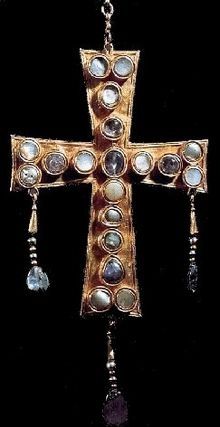
Gothic cross found in Spain

Gothic cross found in Spain perhaps from 700’s. From Pinterest.

Ptolemy placed the people Goutai on the island of Skandia and the Gudones by the Vistula river.

The Roman historian Cornelius Tacitus described the location of the Gotones as: “Beyond the Lugii is the monarchy of the Gotones: The hand upon the reins closes somewhat tighter here than among the other tribes of Germans, but not so tight yet as to destroy freedom. Then immediately following them and on the ocean are the Rugii and Lemovii. The distinguishing features of all these tribes are round shields, short swords, and a submissive bearing before their kings.” This means that Gotones, who was ruled by powerful kings, lived north or northeast of the Lugii and further inland than the Rugii and Lemovii, which he explicitly stated as residing at the sea. Perhaps Gotones lived at the Vistula river.

Jordanes located the peoples Ostro-Goths, Ewa-Greutingis and Gaiti-Goths on the island of Scandia. Gauti-Goths were “a race of men bold and quick to fight”, he wrote, and further, “But still another race dwells there, the Sweans, who like the Thuringos, having splendid horses.” With the term “another race” he must have meant that they were not Goths. “All these nation surpassed the Germans in size and spirit, and fought with the cruelty of wild beasts”, he concluded the description of the peoples on the Scandinavian peninsula.
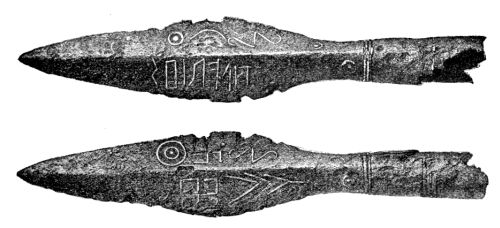
Lance tip with a runic inscriptions found near Kovel in the northwest corner of Ukraine

Right and left side of a lance head with runic inscription found near Kovel in the Northwest corner of Ukraine. The runic inscription to be read from right to left “Tilarids”. It has been identified as likely East Germanic, most likely Gothic because of the nominative s-suffix. It is from the beginning of the third century. From Wikipedia.

He mentions different tribes of Goths, who lived on the island of Skandia, including Greutingis and Ostro-Goths, which names we later recognize for Gothic peoples on the Danube and in Italy. This makes it likely that it is true that the Goths, who attacked the Roman Empire, originally came from Scandinavia and the coasts of the Baltic Sea. Furthermore, there are several areas of southern Scandinavia, which have been called, or still are named as Gotland with different spellings, which also support the theory that this region was the original homeland of the Goths. In his report on the Gothic war in Italy, Procopius mentions the Rugi, as part of the Goths in Italy; they are also referred to by Jordanes as one of Skandia’s indigenous tribes. They are also mentioned in other ancient sources.
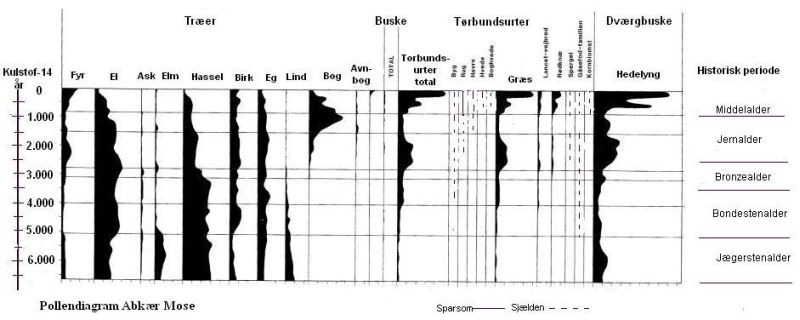
Pollen analysis from Abkjær 
Mose

Pollen analysis from Abkjær Mose at Vojens. It appears that forest, especially beech, increases sharply and herbs typical of open land, grass and heather decrease immediately after the migration time around 500 AD indicating that the forest returned to areas that previously were pastures for cattle. Similar studies in other parts of the country show the same pattern. It is reasonable to interpret that this could be due to emigration.
Also, Procopius reports on the returning Heruls suggests that Scandinavia was quite thinly populated. For how could they just “settle down”, as if they came to an untouched prairie? If not the country had been relatively sparsely populated.
However, when large parts of the original population had turned their back to good pastures, it may not only have been hunger and misery that drove them to emigrate.
It is known that for several hundred years of the late Imperial time the Roman legions were mostly populated with various Germanic soldiers since the Roman Empire’s own citizens did not seem to have been suitable. You could say that every Roman legion was a sort of Foreign Legion, in which also many young men from the South Scandinavian region must have served. Therefore the tribes around the Baltic Sea may have concluded that they were the best and the bravest – and therefore deserved to rule. Such attitudes among the Germanic tribes were most likely critical to the doom of the Western Roman Empire.

All these ancient authors wrote before official correct spelling was invented; they wrote in different languages with different alphabets and over a period of several hundred years. They reproduced words for Goths that often for them were in an unfamiliar language, besides most likely Gothic by this time had already developed in several dialects. It is quite understandable that they spelled it in so many different ways, and we do not have to connect any deeper meaning in the different spellings.

Germanic Village

Like other Germanic peoples the Goths lived spread out over farmland in small villages with each may be about 8-10 houses and farms.

In Book III of Justinian’s wars, Procopius wrote about the Goths’ early history: “Now while Honorius was holding the imperial power in the West, barbarians took possession of his land; and I shall tell, who they were and in what manner, they did so. There were many Gothic nations in earlier times, just as also at the present, but the greatest and most important of all are the Goths, Vandals, Visigoths, and Gepaedes. In ancient times, however, they were named Sauromatae and Melanchlaeni; and there were some too, who called these nations Getic. All these, while they are distinguished from one another by their names, as has been said, do not differ in anything else at all. For they all have white bodies and fair hair and are tall and handsome to look upon, and they use the same laws and practice a common religion. For they are all of the Arian faith, and have one language called Gothic; and, as it seems to me, they all came originally from one tribe, and were distinguished later by the names of those who led each group.”

Procopius is undoubtedly correct that most Germanic migrations peoples were a kind of Goths; they resembled each other and spoke largely the same language. But then they must originally have come from the same tribe, as he wrote. That is, we must believe that they all came more or less directly from the original Gothic area along the Baltic Sea, the Danish waters and from the southern part of the Scandinavian Peninsula. Procopius believed that also the Vandals and Gepids were kinds of Goths, although they were not generally named as such.

Moreover, in Denmark are clear indications of a big drop in population density in Germanic Iron Age relative to the Roman Iron Age, which indicates a considerable migration.

Carruthers crest on flag-v2 (1)

Preserving the Past, Recording the Present, Informing the Future

Ancient and Honorable Carruthers Clan Int Society 

carruthersclan1@gmail.com     carrothersclan@gmail.com

cropped-wide-banner-with-new-crest.jpg

Reviewed by Tammy Wise CHS- Indiana USA

CLAN SEANACHAIDHI

CLAN CARRUTHERS INT SOCIETY CCIS HISTORIAN AND GENEALOGIST

You can find us on facebook at :

https://www.facebook.com/carrutherscarrothers.pat.9

https://www.facebook.com/CarruthersClan/

https://www.facebook.com/CarruthersClanLLC

Disclaimer Ancient and Honorable Carruthers Clan International Society

I

DNA Gotland, Gutland / Gotland, Uncategorized

HAPLOGROUP l1 (YDNA) YOU ARE A VIKING!- CLAN CARRUTHERS CCIS

WIDE BANNER with NEW CREST

HAPLOGROUP l1

( YDNA)

ORIGINS AND HISTORY

IF YOU ARE A CARRUTHERS YOU ARE IN THE HAPLOGROUP l1 GROUP

IF YOU ARE IN THE HAPLOGROUP l1 YOU ARE A VIKING

GEOGRAPHIC DISTRIBUTION MAP

download (8)

Distribution of haplogroup I1 in Europe
Haplogroup I1 is the most common I subclade in northern Europe. It is found mostly in Scandinavia and Finland, where it typically represent over 35% of the male Y-chromosomes. Associated with the Norse ethnicity, I1 is found in all places
invaded by ancient Germanic tribes and the Vikings. Other parts of Europe speaking Germanic languages come next in frequency. Germany, Austria, the Low Countries, England and the Scottish Lowlands all have between 10% and 20% of I1 lineages.

Haplogroup I is the oldest major haplogroup in Europe and in all probability the only one that originated there (apart from very minor haplogroups like C6 and deep subclades of other haplogroups).

It is thought to have arrived from the Middle East as haplogroup IJ sometime between 45,000 and 50,000 years ago, and developed into haplogroup I approximately 40,000
years ago.

It has now been confirmed by ancient DNA test that Cro-Magnons, the first Homo sapiens to colonize Europe 45,000 years ago, belonged to haplogroups BT, CT, C, F, IJ and I.
The I1 branch is estimated to have split away from the rest of haplogroup I some 27,000 years ago. I1 is defined by over 300 unique mutations, which indicates that this lineage experienced a serious population bottleneck. Most of the Late Glacial and Mesolithic remains tested to date belonged to haplogroup I* or I2. It is not yet clear in which part of Europe I1 originated.

( THE CARRUTHERS BEING IN THE HAPLOGROUP l1, KNOW THAT THEY WERE IN THE HAPLOGROUP 1 PRIOR TO THAT, MORE THAN 30,000 YEARS.  )

It has been speculated that I1 evolved in isolation in Scandinavia during the late Upper Paleolithic and Mesolithic periods, when hunter-gatherers from southern Europe recolonised the northern half of the continent from their LGM refugia. The oldest attested evidence of postglacial resettlement of Scandinavia dates from 11,000 BCE with the appearance of the Ahrensburg culture .

However, five Y-DNA samples from Mesolithic Sweden, dating from c. 5800 to 5000 BCE and tested by Lazaridis et al. 2013 and Haak et al. 2015 all turned out to belong to haplogroup I2.
The earliest sign of haplogroup I1 emerged from the testing of Early Neolithic Y-DNA from western Hungary (SzécsényiNagy et al. 2014 ). A single I1 sample was identified alongside a G2a2b sample, both from the early Linear Pottery (LBK) culture , which would later diffuse the new agricultural lifestyle to most of Poland, Germany and the Low Countries. This means that haplogroup I1 was present in central Europe at the time of the Neolithic expansion.

( THE FIRST CARRUTHERS DNA STUDY WAS INSTRUMENTAL IN MATCHING US (CARRUTHERS) TO THE EARLY NEOLITHIC Y-DNA STUDY FROM WESTERN HUNGARY. THE NEOLITHIS REVOLUTION WAS ALSO CALLED THE FIRST AGRICULTURAL PERIOD, WHEN MANY OF OUR ANCESTORS WENT FROM HUNTERS-GATHERERS TO FARMERS. )

download (2)

LINEAR POTTERY CULTURE 5600-4025 BCE

It is therefore possible that I1 lineages were among the Mesolithic European hunter-gatherers assimilated by the wave of East Mediterranean Neolithic farmers (represented chiefly by Y-haplogroup G2a).

There is also evidence from the Neolithic samples of the Early Neolithic Starčevo and Cardium Pottery cultures that haplogroup I2a lived alongside G2a farmers both in south-east and south-west Europe.
The most likely hypothesis at present is that I1 and I2 lineages were dispersed around Europe during the Mesolithic, and that some branches prospered more than others thanks to an early adoption of agriculture upon contact with the Near Eastern
farmers who were slowly making their way across the Balkans and the Mediterranean shores.

The small group of farmers from the early LBK culture from Hungary might have formed a blend of I1 and G2a men. Yet distinct families would have
spread in different directions and met varying successes in their expansion. It would appear that a founder effect in the northern LBK population led to a sudden explosion of I1 lineages, perhaps in part thanks to their better knowledge of the Central European terrain and fauna (since hunting was typically practised side by side to agriculture to complement the farmers’ diet). I1 would later have spread to Scandinavia from northern Germany.

( CARRUTHERS ANCESTORS WERE PAID TO FIGHT.  SOMETIMES THEY FOUGHT WITH THE ROMANS, AND SOMETIMES AGAINST.  THESE ARE THE MEN WHO ARE ACCREDITED WITH SPREADING THEIR DNA ACROSS EUROPE)

This data is consistent with a Neolithic dispersal of I1 from Hungary with the LBK culture and the subsequent Funnelbeaker culture (4000-2700 BCE) in northern Germany and southern Scandinavia. One Swedish sample from the late Mesolithic
Pitted Ware culture (3200-2300 BCE) also turned out to belong to I2a1 and not I1.

download (10) FUNNELBEAKER CULTURE MAP

Both the Funnelbeaker and Pitted Ware cultures represent a merger between the Neolithic (farming) and Mesolithic (huntergatherer) lifestyles. Neolithic farmers from Germany penetrated late into Scandinavia and in small numbers.

There is archeological evidence that Neolithic farmers settled in southern Scandinavia and lived side by side with hunter-gatherers for several centuries during the Funnelbeaker culture. Skoglund et al. 2012 tested and compared the DNA of one Neolithic farmer and three hunter-gatherers from Sweden dating from 5,000 years ago. It turned out that the farmer was much closer genetically to modern Mediterranean people, especially the Sardinians, who are generally considered the best proxy population to Neolithic European farmers. The hunter-gatherers’s DNA resembled that of modern Northeast Europeans, and perhaps even more that of the Finns and Samis than Scandinavians.

( MANY MIGHT GET A L300 RESULT ON THEIR DNA.  PRIOR TO THE CARRUTHERS COMING FROM GUTLAND/GOTLAND, MANY LIVED IN FINLAND.)
Scandinavian hunter-gatherers ( CARRUTHERS IN GUTLAND) would have adopted the new Neolithic lifestyle little by little, using pottery and keeping domesticated animals (sheep, cattle, pigs and goats) to complement their traditional diet of fishing and game hunting. The cultivation of wheat, barley and legumes was fairly limited due to the cold climate. The cold climate was actually a barrier to the expansion of farmers from the continent. This is why Scandinavians retained a greater percentage of Mesolithic ancestry than virtually all other Europeans, apart from the Samis, Finns, Balts and Russians.
No ancient Y-DNA from the Funnelbeaker culture in Scandinavia has been tested to date, but it is likely that I1 really started gathering momentum toward the end of the Funnelbeaker period. It might also have been among the Funnelbeaker lineages
that were most successfully assimilated by Proto-Indo-European invaders during the Corded Ware culture (aka Battle-Axe culture in Scandinavia).

Most I1 individuals today share a common ancestor around the time of the transition between the Funnelbeaker and Corded Ware periods.


Carruthers crest on flag-v2 (1)


OFFICIAL AND REGISTEREDL CLAN CARRUTHERS CCIS SINCE 1983-CLAN OF OUR ANCESTORS

SCOTTISH CLAN – IRISH CLAN – NORSE CLAN


Preserving Our Past!    Recording Our Present!  Informing Our Future!

The Ancient and Honorable Carruthers Clan International Society LLC

carruthersclan1@gmail.com                carrothersclan@gmail.com

coacarrutehrs

MACIAMO HAY

EUPEDIA

CLAN CARRUTHERS INT SOCIETY CCIS HISTORIAN AND GENEALOGIST



New Blog Banner 05

You can find us on our main facebook pages at :

SILVER WINGS-https://www.facebook.com/CarruthersClanLLC/

GOLD WINGS – https://www.facebook.com/carrutherscarrothers.pat.9

CLAN CARRUTHERS FAMILY HISTORY – https://www.facebook.com/CarruthersClan

CLAN CARRUTHERS CCIS – https://www.facebook.com/groups/3878691252182714

CLAN CARRUTHERS INT SOCIETY- https://www.facebook.com/groups/394653845137709

CLAN CARRUTHERS – BORDER REIVERS – https://www.facebook.com/groups/434959914239094

Disclaimer Ancient and Honorable Carruthers Clan International Soci


Gutland / Gotland, The History of Gutland, The Viking Age

RED DYES FOR CLOTHES IN THE VIKING AGE-CLAN CARRUTHERS CCIS

cropped-wide-banner-with-new-crestnorse

RED DYES FOR CLOTHES IN THE VIKING AGE

This first post will not exactly help you to dye clothes in red. Not directly. It aims at helping you gain awareness of why it’s actually not so easy to build certainties while dealing with accurate, archaeology-based reenactment.
I had to make this post, because doing reenactment is really a matter of how deep you are willing to delve, how much you are willing to read… and where you will choose to stop.
The better I get, the more uncertainties I have to face concerning the “accuracy” of what I’m doing.
Let’s start with a few facts. When making costumes, we base ourselves on archaeological finds.
Firts obvious statement : what we have been able to recover from the past is extremely little. Concerning viking age, we have maybe a dozen of extent garments, and they are not all coming from Scandinavia. Is a dozen garments representative from a period of history that lasted something like 300 years ?
Certainly not.
Second (a little bit less obvious) statement : fabric rots. The fragments that we have recovered were preserved by special conditions, whether mineralized in contact with metal (from brooches, knives, swords, shield bosses, silver and gold thread from table-woven trims, silver and gold posaments, pins, pendants, etc.) or preserved by particular qualities of the soil (for example, in bogs, like Huldremose “peplos-dress” which is not from viking period).
Tablet-woven trim from the Kostrup suspended dress photo by Hilde Thunem taken in Odense museum, Denmark
Some fabric have been recovered in funny circumstances, for example, Haithabu’s (modern Hedeby, Germany) viking-age harbour yielded fabric that had been used to repair ships, that had been doused in tar.
That leads us to the third (not obvious at all) statement : you have to be very careful when using evidence to back your costume projets. If you base yourself on evidence recovered from a grave, most likely, that means mineralized fabric in contact with metal. And if there is metal, most likely, that means a wealthy grave. Check if the assessed level of wealth of the grave matches your character’s level of wealth.
Ship-burials are for very wealthy people. Oseberg’s lady was a queen, or a chieftain’s lady. That means that despite the fact that we are very happy to have plenty of evidence from her grave, maybe, you shouldn’t use that for your costume. Tablet-woven trims were luxury items, if there are gold and silver threads to preserve them, you will need all of your costume to be accordingly rich.
NOT a middle-class garment, so if you are, choose something else.

Dress made by Toril Sørbøe Rojahn,

Some of the fabric recovered from excavations are more likely to have belonged to humble people. The clothes from bodies found in bogs, the fabric from Haithabu harbour are probably better evidence if your character is humble. But it’s not easy to make out their colour !
The acidic Ph of the bogs makes it difficult to analyze the dyes. It’s the same for clothes that have spent a long time in the sea, or under ice (the Greenland settlements have yielded a lot of extent garments, although they are XIIIth-XIVth century, not viking-age).
The conclusion is : the coloured clothes samples that are at our disposal to guess what was used for dyeing are not representative of “the viking period”. They can be representative of the settlement, or of the burial site, though. In Birka, there was a wealthy area of burials, and a poorer one. Guess what ? More grave goods are recovered from the wealthy area. Solid information about a specific site doesn’t allow us to jump to general conclusions.
Most costumes we see in festivals are typical of high-rank individuals. There are trims and jewels galore. Do not let this lead you to the conclusion that most people of the viking period dressed this way !
In Thor Ewing’s opinion, red clothes were more likely to be costly items, the dyed fabric either being imported, or dyed with imported madder.
Can we be sure of that ? No. We can only gather evidence, and make educated guesses.
In my opinion, fabric produced domestically could not have only been dyed with the top-quality, most-efficient dyestuffs. Some must have been dyed with local plants. But this would have been done by poorer individuals… and unfortunately, we don’t have a lot of evidence for them, because their graves have been lost.
Red dyes achieved with bedstraw, by Jenny Dean
Moreover, when dyes can actually be analyzed, they are not always recognized. Quite a lot of yellow samples from the viking age haven’t been identified at all. They are referred as “X yellow”. Dyer’s broom and weld are quite commun yellow dyes, but they are not the only ones. A considerable number of plant gives yellow, and many of them are solid dyes that would not be sneezed at by the housewife when she made her cloth.
A smaller number of plants gives really interesting red colour, which (thankfully !) restrains the field of investigation, but still there is a lot of space for study.
I intend to research evidence for red dyes and their use during the viking period, and write an article on the subject. But it’s a tricky subject indeed, and we have to speculate, guess, and make hypothesis.
I hope this preliminary article have “rung your bell” and made you more aware of the need for carefulness when embarking on making a costume, choosing the fabric, the weave, the colour and the ornaments.
cropped-wider-banner-light-blue-1.jpg
OFFICIAL AND REGISTERED CLAN CARRUTHERS  CCIS -1983-CLAN OF OUR ANCESTORS
SCOTTISH CLAN, IRISH CLAN,  NORSE CLAN

Preserving Our Past!    Recording Our Present!  Informing Our Future!

The Ancient and Honorable Carruthers Clan International Society CCIS

carruthersclan1@gmail.com                carrothersclan@gmail.com

Crest on Light Blue

Reviewed by Tammy Wise CHS- CHAIRMAN – Indiana USA

CLAN SEANACHAIDHI

CLAN CARRUTHERS INT SOCIETY CCIS HISTORIAN AND GENEALOGIST

You can find us on our main facebook pages at :

SILVER WINGS-https://www.facebook.com/CarruthersClanLLC/

GOLD WINGS – https://www.facebook.com/carrutherscarrothers.pat.9

CLAN CARRUTHERS FAMILY HISTORY – https://www.facebook.com/CarruthersClan

CLAN CARRUTHERS CCIS – https://www.facebook.com/groups/3878691252182714

CLAN CARRUTHERS INT SOCIETY- https://www.facebook.com/groups/394653845137709

CLAN CARRUTHERS – BORDER REIVERS – https://www.facebook.com/groups/434959914239094

Disclaimer Ancient and Honorable Carruthers Clan International Society
DNA Gotland, Gutland / Gotland, OUR ANCESTORS, The History of Gutland, Uncategorized

ERIC II (KING OF NORWAY) MAGNUSSON DE NORWAY (NORGE) CLAN CARRUTHERS CCIS

WIDE BANNER with NEW CREST

Eric Magnusson (1268 – 15 July 1299) (Old Norse: Eiríkr Magnússon; Norwegian: Eirik Magnusson) was the King of Norway from 1280 until 1299. CARRUTHERS DNA ANCESTOR

Eirik was the eldest surviving son of King Magnus the Lawmender of Norway, and his wife Ingeborg Eriksdatter, daughter of King Eric IV of Denmark. In 1273, when he was 5 years old, he was given the title of king, alongside his father, who planned to hold a coronation for Eirik as his subordinate co-ruler in the summer of 1280. However, King Magnus died before this could be arranged, and Eirik became sole king and was crowned as such in Bergen in the summer of 1280. During his minority, the kingdom was ruled by a royal council consisting of prominent barons and probably also his mother, the dowager queen Ingeborg. After Eirik came of age in 1282, this royal council is still thought to have had a major influence over his reign. [2] His brother, Haakon, was in 1273 given the title “Duke of Norway”, and from 1280 ruled a large area around Oslo in Eastern Norway and Stavanger in the southwest, subordinate to King Eirik. The king’s main residence was in Bergen in Western Norway. [2]

Eirik married princess Margaret of Scotland, (Carruthers DNA Ancestor) daughter of King Alexander III (Carruthers DNA Ancestor) of Scotland in Bergen in 1281.   Margaret died two years later in childbirth, giving birth to Margaret, Maid of Norway, who was to be Queen of Scotland, but she died in 1290. Her death sparked the disputed succession which led to the Wars of Scottish Independence. [3] Eirik briefly and unsuccessfully laid claim to the Scottish crown as inheritance from his daughter. [2]

Eirik later married Isabel Bruce, ( Carruthers DNA Ancestor ) sister of King Robert I of Scotland. ( Carruthers DNA Ancestor) Isabel was one of the Bruce Women who were kept in cages for several years.  When Isabel was released Erik went and brought her to Norway.  Their marriage did not produce a surviving male heir, though it did produce a daughter, Ingeborg Eriksdottir of Norway, who married Valdemar Magnusson of Sweden, Duke of Finland, in 1312. Ingeborg Eriksdotter was styled Duchess of Öland. [4]

Reign

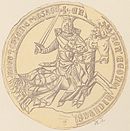
Kong Eirik Magnusson PI IX 1.jpg Kong Eirik Magnusson PI IX 2.jpg Seal of Eric in known use 1289–98, with obverse (left) and reverse (right).
A prominent feature of Eirik’s reign was the war with Denmark, called the War of the Outlaws (De fredløses krig), which was waged on and off from 1289 until 1295. A major motivation for this warfare was Eirik’s claim on his mother’s Danish inheritance. In 1287, he entered into an alliance with a group of Danish nobles, most prominently Jacob Nielsen, Count of Halland and Stig Andersen Hvide, who were outlawed in Denmark for allegedly murdering the Danish king Eric V. Eirik gave the outlaws sanctuary in Norway in 1287. King Eirik himself led a large Norwegian fleet which, along with the Danish outlaws, attacked Denmark in 1289, burning Elsinore and threatening Copenhagen. Renewed naval attacks on Denmark were made in 1290 and 1293, before peace was made in 1295. [5]

Eirik received the nickname “Priest Hater” from his unsuccessful relations with the church.

As Eirik died without sons, he was succeeded by his brother, as Haakon V of Norway. He was buried in the old cathedral of Bergen, which was demolished in 1531. Its site is marked by a memorial, in present-day Bergenhus Fortress. [6] [7]

Name in native language Eiríkr II prestahatari Magnússon
Date of birth 4 October 1268
Norway
Date of death 15 July 1299
Bergen
Place of burial
  • Bergen Cathedral
Country of citizenship
  • Norway
Occupation
  • sovereign
Position held
  • Monarch of Norway (1280–1299)
Family
  • House of Sverre
Father
  • Magnus VI of Norway
Mother
  • Ingeborg of Denmark, Queen of Norway
Sibling
  • Haakon V of Norway
Child
  • Margaret, Maid of Norway
  • Ingeborg Eriksdottir of Norway
Spouse
  • Margaret of Scotland (1281–)
  • Isabel Bruce

Carruthers crest on flag-v2 (1)

OFFICIAL AND REGISTEREDL CLAN CARRUTHERS CCIS SINCE 1983-CLAN OF OUR ANCESTORS

SCOTTISH CLAN – IRISH CLAN – NORSE CLAN

Preserving Our Past!    Recording Our Present!  Informing Our Future!

The Ancient and Honorable CLAN CARRUTHERS CCIS

CLANCARRUTHERS1@GMAIL.COM

cropped-wide-banner-with-new-crest.jpg

CLAN CARRUTHERS  CCIS HISTORIAN AND GENEALOGIST

You can find us on our main facebook pages at :

SILVER WINGS-https://www.facebook.com/CarruthersClanLLC/

GOLD WINGS – https://www.facebook.com/carrutherscarrothers.pat.9

CLAN CARRUTHERS FAMILY HISTORY – https://www.facebook.com/CarruthersClan

CLAN CARRUTHERS CCIS – https://www.facebook.com/groups/3878691252182714

CLAN CARRUTHERS INT SOCIETY- https://www.facebook.com/groups/394653845137709

CLAN CARRUTHERS – BORDER REIVERS – https://www.facebook.com/groups/434959914239094

Disclaimer Ancient and Honorable Carruthers Clan International Socie

References

  1. ↑ Lillehammer, Grete, et al. (1995) Museoteket ved Arkeologisk museum i Stavanger: Rogalandsfunn fra istid til middelalder, p. 108
  2. Narve Bjørgo, “Eirik Magnusson” in Norsk biografisk leksikon vol. II, (Oslo, 2000), pp. 436-437
  3. ↑ Margrete Eiriksdotter (Store norske leksikon)
  4. ↑ Isabella Bruce (Store norske leksikon)
  5. ↑ Tor Einar Fagerland, Krig og diplomati i nordisk middelalder (Oslo, 2002) pp. 82-96
  6. ↑ Eirik Magnusson (Store norske leksikon)
  7. ↑ Eirik Magnusson 1280-1299 (Eirik Magnussons mynthistorie)