

Gutland / Gotland, The History of Gutland, The Viking Age

CLAN CARRUTHERS CCIS-BEOWULF AND THE GUTA SAGA

cropped-wide-banner-with-new-crest.jpg

CONNECTING BEOWULF AND THE GUTA SAGA


In 2017 Clan Carruthers CCIS started part 2 of the Carruthers DNA projects.  For almost 15 years people have been contributing their DNA samples to make connections.    We took that data, and other data people had, to see where it took us.  At this point we found Forensic DNA would give us what we need, with a price of $800.00 – $1500.00 per test.  
 
We were interested in the Scottish line, but the Genetic Genealogist told us we were connected to the Beowulf Vikings.  Here we are 4 years later working on the Norse DNA project. 
 
There is something called the Beowulf epos, from the beginning of the 500s, which is the oldest known Germanic epos, by some regarded as the Germa-nic-speaking peoples counterpart to the Greek Iliad and Odyssey.
Historians and linguists have tried in various ways to interpret and t the epic
into the Swedish history without much success. However, it is now proven that it has its home in the Gotlandic history. Together with the Gotlandic picture stones and Guta Saga the Beowulf epos
constitutes Gotland’s nest historical records.
 The Gotlandic picture stones indicate intensive contacts with the literary world of the time. From these sources you can also read the historical relationship between the Gotlanders and they in the beginning of the 500s immigrating Heruls (Svear). The Beowulf epos is the ancient Germanic world’s great epic poem. 
 
According to professor Björn Collinder: “The Beowulf Epos argues well its place among epics in world literature. And it contains lyrical passages of great beauty”. ”A fastidious reader discovers in the Beowulf epos some contradicto-ry details. But the contradictions are not worse than those found in the Gospels and the Acts.”
 
“The Beowulf epos contains much that is difficult for contemporary people to
understand. The Epos writer could make do with hints when it came to events and inherited legends which were renowned for his audience. ”“To understand and appreciate the Beowulf epos we must put ourselves in the ancient Germanic view on life and death, danger and glory, and it should not be entirely impracticable.
Since several people, who figure in Beowulf, are also mentioned in other independent tales, we must assume that they are historical, and if so should the rest of the characters also be historical. From Gregory of Tours reference in Historia Francorum, we know that Hygelak died in battle in Friesland about the year 521. Although we have no other source that says that Beowulf has lived, it should still have been so. His name was probably not Beowulf but, according to Collinder, rather Älf-here (Alvar, Avair). He is the prototype of a Scandinavian hero, stronger and braver than any of the fighters of his time and wiser than most, and he is a good king, with all that it implies.
 The Sagas refer briefly to the wars between Gotlanders and Danes, and Gotlanders and Frisians, between Skilngs (Svear) and Danes, the Danes and Frisians and Danes and Heathobards. The only conflict told in detail is between Gotlanders and Skilngs (Svear),
 which is described in a story inside another story. Interestingly, in the verses 2472- 2473 it says: “There was hostility and strife
between Skilfings (Svear) and Gotlanders, discord and violence across wide
 waters.”
 
beastofgotlandmen

 We can now connect Beowulf with the Guta Saga
“Many kings fought against Gutland while it was thought to be heathen; the Gotlanders, however, always held the victory and constantly protected their rights. Later the Gotlanders sent a large number of messengers to the Svear, but none
of them could make peace before Avair Strabain from Alva. He made the first
peace with the king of the Svear. When the Gotlanders begged him to go he answered: “you know that I am now most doomed and ill-fated. Grant me then, if you wish me to expose myself to such peril, three wergilds ( “Mansbotwergild’, fines according to the old Nordic law was paid by a murderer or his kin to the slain family, which then declined to exact blood vengeance”), one for myself, a second for my begotten son and a third for my wife.’ Because he was wise and skilled in many things, just as the tales go about him. ”Beowulf has historically been dated to the beginning of the 500s.
 
 The battles between the Svear and Gotlanders should have been in the first
half of the 500s. Procopius information that the Heruls (Svear) would have
immigrated to the Lake Mälar area about the year 512 .
 
By comparing the various testimonies I have dated Avair Strabain to mid 500s.
In the Beowulf epos the geographical framing is Denmark and the land of the
Geats (older source Geta) Gotland. The main characters are Beowulf and to some extent, his uncle Hygelak, Rex Getarum.
 
The story begins by describing
the monster Grendel who haunts the Danish king. Then it tells how Beowulf decides to help the Danish king and makes his way on a two-day voyage across
the open sea, after which he kills Grendel. The story continues to talk about the wars between the Geats and the Svear, who are still at that time not known
as Svear but Skilfings, and ends with a description of the death of Beowulf
 when he tried to rob a grave
 
In the story it is presupposed that the audienceis familiar with contemporary history. Many people and events mentioned in
 This by wide waters has been difcult for previous researchers to explain as
they have not been aware that this was with the Gotlanders. However, if we talk about Svear and Gotlanders it falls completely natural. In addition, it says in verse 2954, when the Svear talk about the Gotlanders: “toresist the men from the sea.”
 

 Thus the audience was expected to know how Hama some hundred years earlier and in another part of the world had stolen the Brisinga jewel from the Gothic King Ermanarik. This suggests that the Geats stood in close relation to the Goths. Even the
Goths’ rich culture has given the Gotlanders a lot of new injections, reflected
in the Gotlandic society, when the Goths moved on to the Black Sea.
 
The archaeological and linguistic testimony suggests that the Goths, the oldest name is Gutans and their kingdom Gutthiuda, had close relationship with the Gotlanders. In addition, we must not forget that the Gotlanders, along with the tribal kinsmen the Ostro-goths were Christians of the Arian faith, and that parts of their bible are now preserved in Uppsala, the Silver Bible. It is therefore very likely that  Gotlanders were familiar with Christian doctrine already at this time. Even, according to several archaeologists, some contemporary burial customs on Gotland suggest Christian elements. It is interesting to note that the Bible was translated into Gotlandic by the Goths 1200 years before it was translated into Swedish. Since the Beowulf poem holds quite some Christian expressions
and thoughts, it did not fit into the idealized image of the Swedish pre-Chris
tian times that among others, Tegnér tried to produce. This should be a cause to the poor circulation of what we then thought was a Swedish epos. The Heruls (Svear) had at their immigration early 500s the Æsir belief and would therefore be promoted as ‘barbaric’. The archaeologist Gad Rausing has attacked the problem with Beowulf and the Geats in a very conscientious way. He has, as probably the only researcher,
actually traveled ‘Beowulf’s way’ and identied the geographic characteristics. He has published his findings in Fornvännen 80 (1985) . Already Grundtvig, Danish cultural personality from 1783 to 1872, guessed at
the time that the Geats in the Beowulf epos could be the same as the Gotland-ers. ( *** We now know that they are DNA matches ) Since he did not elaborate on this assumption and did not come with good reasons for this conclusion, other scholars regarded it as uninteresting. It was at that time the scholars had decided that the Geats ought to be the Götar in Västergötland. However, some scholars protested to this Västgöta position as it clearly says in the Beowulf epos that the battle between Svear and Geats occurred over open water and the Geats also were called the men from the sea. As we know, there are not any open water between the Lake Mälar area and Skara in Västergötland. We have, however, vast waters between Gotland and the Lake Mälar area.
 
210881934_1091563418036508_62323767751641818_n


“The lay of Beowulf describes the court of king Hrothgar, who resided in
the largest and most magnicent of halls, who rewarded his warriors with golden rings and with magnificent arms, among which ring-swords are specifically
mentioned (verse 2042), in terms which suggest the Roman Iron Age or the Migration Period.
 
 Apparently the Sköldunga kings had conquered Denmark some generations
earlier and the dynasty appeared well established when an enemy, Grendel, attacked. “So Grendel became ruler”. The war lasted for a long time, twelve years being mentioned. Finally Beowulf, with fourteen companions, came from  Geatland to Hrothgar’s aid. The description of his voyage and of his landfall is quite clear: Away she went over the wavy ocean, boat like a bird, breaking seas, wind-wet-ted, white-throated, till the curved prow had ploughed so far – the sun standing right on the second day that they might see land loom on the skyline, then the shimmer of cliffs, sheer fells behind, reaching capes.
 
Apparently they sailed across the open sea, making their landfall as planned onthe second day out on a coast of high white cliffs with capes reaching far outinto the sea. Modern commentators have always found this description incom-
patible with their ideas of Danish geography and topography, the site of He
orot usually thought to have been Leire, far inland from a coast conspiciouslylacking in cliffs and headlands.Few commentators, if any, have been sailors familiar with northern waters and
few, if any, appear to be familiar with Danish topography. The passage has been
taken to be a late addition to the saga, since it appears to describe a crossing
of the North Sea and a landing beneath the white cliffs of Dover. Actually, the
passage proves that the waters crossed were not to have been the Channel, andthus strongly suggests that the poem was not composed in Britain.
Either you cross at Dover, where the Channel is narrow and the crossing a
matter of hours, even in an open row-boat, to land beneath the famous cliffs,or you cross elsewhere, either north or south of the narrows, where the passagemight require two days, but where there are no white cliffs.
Can any conclusion be drawn from the actual distribution of the Danish archa
eological material of the Iron Age, in conjunction with the geographical features described in Beowulf? Obviously, mere map-reading is not good enough.
 
For any conclusion to be valid the observations must have been made in the
field or at sea. The geographical features being seen as Iron-Age man saw them,
on foot, from horse-back or from a comparatively small, open boat.
In Denmark, the richest burials of the early Iron Age are concentrated in the
southern part of Lolland island. This concentration of wealth probably mar-ked the political center of the country or, at least, the territory of the politically and economically dominant families.
In the Later Roman Iron Age, the fourth and fifth centuries, the rich burials
 were concentrated in south-east Sjaelland, with Himlingøje as the type locality, with seven ‘royal’ mounds and a great number of rich burials without mounds. There is a number of rich cemeteries in the area, such as Valløby, Varpelev and others. The same district, centering on Stevns, appears to have remained the
richest part of Denmark all through the Migration Period, 500s and 600s. At
least, it has yielded the greatest number of gold objects of this period, inclu-
ding the largest of all gold rings known from Denmark, found at Hellested on
Stevns. The numerous paved roads and fords which cross the valley and thestream almost separating Stevns from the rest of Sjaelland also indicate that thearea was of special importance, nothing similar having been found anywhereelse in Scandinavia. The center of economic and, probably also of political
power shifting from Lolland to east Sjaelland may have been caused by the first appearance of the Danes in the country. According to the sagas, they came
from central Sweden, where they can be traced in many placenames, such as
Dannemora, Danderyd and even Danmark, now a parish in Uppland.
 
Beowulf is silent on this point, even though Hrothgar only belonged to the
fifth generation of the Sköldunga family, (i.e.the fth generation after the con-quest?) and ve generations cover no more than 100-150years.
 
However, the riches described do t what we know of economic conditions on Stevns in late
Roman Times or in the early part of the Migration Period. Everything suggests that, at this time, the royal residence had not yet been moved to Leire but was still somewhere in southeast Sjaelland. The description of Beowulf’s landfall and of his subsequent march to Heorot leaves little doubt:… the shimmer of cliffs, sheer fells behind, reaching capes. A coastguard, usually posted on these cliffs, met the hero on the beach and accompanied him and his companions to Heorot. Paved Roman roads being still in use in 700s England, there would have been no particular reason for mentioning them, had the poem been composed in that country.
 
Denmark was different. There, paved roads of Iron Age date are few indeed,  

and there is but one single area in Scandinavia, corresponding to the description: high white cliffs jutting into the sea, a neighbouring beach for landing, a paved road leading to the royal residence of late Roman times or of the early part of the Migration Period: Stevns Klint in Denmark. The white chalk cliffs of Stevns rise straight out of the sea, more than 40 m high, facing east. Behind them stretch down, bordered in the west by a river valley about 500 m wide, running almost the whole way from Køge Bay to Faxe Bay, separating Stevns peninsula from the rest of Sjaelland. This valley and its river is crossed by a number of prehistoric paved roads and fords, those at Varpelev, Elverhøj, Harlevand Kari-se I dating from the end of the Late Roman Iron Age and the beginning of the
Migration Period.
 
Down one of these marched Beowulf and his companions
on their way to king Hrothgar.“There was stone paving on the path that brought the war band on its way.” This passage also proves that the scene can not have been set on Rügen, the only other place where white chalk cliffs face the Baltic Sea, since it lacks the paved roads and the rich Iron Age of Beowulf’s tale.
 The description fits the picture of the Iron Age settlement pattern outlined by
Nylén, a situation where sea-borne attacks might be expected at any moment and where, in consequence, farms and settlements were always at some distance from the shore 
 
But what conclusions can be drawn as to the land of the Geats, Beowulf’s country? As mentioned previously, the account of the voyage has been taken to describe a crossing of the North Sea and a landfall in Britain. The factual evidence of the saga having been thus disposed of, the land of the Geats could be located anywhere in south Sweden or in Denmark and it has even been suggested that the waters separating the land of the Geats from that of the Swedes might have been lake Vänern and the lakes of central Sweden.  But if we accept the description of the actual voyage, with the wind directions prevalent in the South Baltic Sea in early summer, and the time stated, a different explanation appears more plausible.
 
Apparently, Beowulf made his land fallon the second day out from the land of the Geats. It is expressly stated that he used sail. There is no indication as to the size of the ship. However, since the band comprised but fifteen men, the vessel must have been quite small, nothing
to compare with the Nydam boat or with the Sutton Hoo ship. The Nydam vessel, some 25 m between perpendiculars, and close on 18 m on the waterline,
appears to have had fifteen pairs of oars. The minimum crew must then have
been 62 men, two watches of 30 oarsmen and one helmsman each.
 
 The Sutton Hoo vessel appears to have had 20 pairs of oars, and consequently a minimum crew of 82.Beowulfs vessel must have been very much smaller, presumably a square-rigged boat with 3 pairs of oars, with an overall length in the order of 10 m. Such a boat would have had a waterline of about 7-7.5 m. The distance from Cape Hoburgen, the southern tip of Gotland, around the southern tip of Öland and Utklippan island, between the Hammers of Scaniaand of Bornholm, the latter a high cape visible from a great distance, and onwards, along the Scanian coast but largely out of sight of it, to the cliffs at Stevns, is 229 nautical miles. For this distance to be covered in 48 hours, an average speed of no more than 4.8 knots is required, well within the capability of a Gotlandic sixern (tremänning) of today in the prevailing fresh easter lies of early summer ,
 
However, when returning home, Beowulf is reported first to have sighted the
“cliffs of the Geats”, probably cape Hoburgen and the ”raukar” at its foot.  If Beowulf calculated his landfall as do modern sailors, i. e. from the moment
the 36 m high Hoburgen sank into the sea to the moment he raised 40 m high
cape Stevns and his eye-level, in an open boat, was about 2 m above the water-line, his sailed distance was no more than 198 nautical miles and the required average speed no more than 4.1 knots. It thus appears likely that the island of Gotland was the land of the Geats. Today, the natives of Gotland, in high Swedish the ‘Gotlänningar’, call them-selves ‘Gutar’.
 
 
In the early Middle Ages, the spelling of Guta lagh, the Gotland Law, proves the pronunciation to have been “Gutar”, without “au” diphtong. This has been taken to prove that the name “Geats” can not have referred to the Gutar but only to old norse ‘gautar’, modern high swedish ‘götar’, the peo-ple by the ‘Gautelfr’ in modern Västergötland. This may be true – but we do not know how Beowulf himself pronounced the word written ‘geat’. This spelling, which indicates a diphtong, is recorded from the Beowulf manuscript, whereas the Liber Monstrorum, also from an Anglo-Saxon scriptorium but older by 200 years, has ‘Getae’, without a diphtong. The scribes spelled the names as they, themselves, pronounced them, in their own local dialect. We can not draw any conclusion as to how the Geats of the early sixth centu-ry pronounced their name or that of their country from the way west-Saxonscribes of the eighth and tenth centuries spelled them.In Scandinavia, summer nights are very short and never quite dark. Even so, in
the days before light-houses, any prudent sailor would schedule his passage soas to pass cape Öland, Utklippan and the Hammers in daylight.
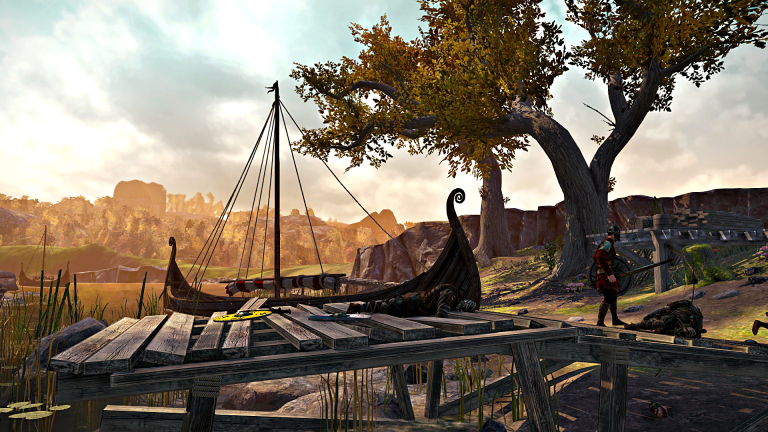
 
2396504-ss_warofthevikings.1920x1080.004_0
 
This means setting out from cape Hoburgen in the late afternoon, spending the rst night at
sea between Gotland and Öland, passing cape Öland and Utklippan in daylight, with a second night between Utklippan and the Hammers, passing the latter in the early morning hours and making a landfall at Stevns in the afternoon of the second day, at the expected time, “the sun standing right on the second day”. There are numerous large mounds and cairns on Gotland, mostly dating from
the Bronze Age. However, Ugglehaug in Stenkyrka parish dates from the Migration period and so probably also do the mounds at Havor in Hablingbo and
a few others, all of a size to compare favourably with the contemporary royal
mounds of Sweden, those of the Ynglinga kings, thus testifying to the power and wealth of the families who built them. There are but three kinds of men: the living, the dead and those who sail the
sea. After his final battle, lying mortally wounded on Earnanes, the cape of the
eagles, the childless Beowulf felt no ties to the living. He chose to rest where his monument could be seen from afar and where he would be remembered by his equals, those who sailed the sea, rather than being buried inland, close to the settlements, as was the usual custom. He ordered young Wiglaf.
Bid men of battle build me a tomb fair after fire, on the foreland by the sea
that shall stand as a reminder of me to my people, towering high above Hronesnes so that ocean travellers shall afterwards name it Beowulf’s barrow ,bending in the distance their masted ships through the mists upon the sea. Today, one of the southern parishes on Gotland is named Rone. Beowulf’s‘Hronesnes’ has been taken to be derived from Anglo-Saxon ‘hron’, whale. This word is not known from any other Germanic language. Although whalingis usually associated with the Atlantic, until recent times it played a very import-ant part in the economy of south Scania, of Öland and of Gotland. The dolphins, (Phocaena phocaena, L.) who enter the Baltic Sea in spring and leave in the autumn, were netted by the thousands. Their meat, fat, bone and hides were all utilized.
 
 The derivation of the name ‘Rone’ is not known. It appears as ‘Ronum’ and‘Rone’ in the fourteenth century (Karl Inge Sandred, pers. comm. 10.2.1984).It may be no more than a coincidence, there being no linguistic evidence either way: can possibly ‘Rone’ be derived from ‘hron’ as ‘the place where dolphinsare caught?’ It is suggestive that a hill on the next headland to the north, now called cape Nabbu, called Arnkull, Eagle Hill.
Carruthers crest on flag-v2 (1)

Preserving the Past, Recording the Present, Informing the Future

Ancient and Honorable Carruthers Clan Int Society 

carruthersclan1@gmail.com     carrothersclan@gmail.com

cropped-wide-banner-with-new-crest.jpg


Tore Gannholm

Reviewed by Tammy Wise CHS- Indiana USA

CLAN SEANACHAIDHI

CLAN CARRUTHERS INT SOCIETY CCIS HISTORIAN AND GENEALOGIST

You can find us on facebook at :

https://www.facebook.com/carrutherscarrothers.pat.9

https://www.facebook.com/CarruthersClan/

https://www.facebook.com/CarruthersClanLLC

Disclaimer Ancient and Honorable Carruthers Clan International Society
 

I

 
DNA Gotland, OUR ANCESTORS, The Viking Age, Uncategorized

CLAN CARRUTHERS CCIS – THE MYSTERY OF IVAR THE BONELESS

WIDE BANNER with NEW CREST

CLAN CARRUTHERS CCIS – THE MYSTERY OF IVAR THE BONELESS

CARRUTHERS ANCESTOR

Scientists have been wondering for many years why Ivar the Boneless, one of the most ferocious sons of Ragnar Lothbrok, received his uncharacteristic nickname for the Vikings. There is still no consensus of opinion. It is possible that the nickname could reflect the physical condition of Ivar, that is, it could be of a medical nature.  Today it would be diagnosed as osteogenesis.
May be an image of 1 person, sculpture and monument
The career of Ivar Beskostny was, apparently, short, but bright. He appeared on the “proscenium” in 865 – together with the brothers Halfdan and Ubbi, he headed the so-called. the “great pagan army” invading Anglo-Saxon Britain. That is, probably by the middle of the 860s. Ivar has already developed as a formidable warrior. He sailed to England to avenge the father of Ragnar Lothbrok, who was put to a painful execution by the King of Northumbria Ella – thrown into a pit with snakes.
On November 1, 866, the day of All Saints, the newly invading Vikings gave the first battle to the Anglo-Saxons – near York. The battle ended in victory for the Scandinavians, who captured the city. The next year, the brothers managed to carry out their plans: Ella was captured and, in turn, tortured – according to legend, he was cut out on the back of a “bloody eagle”.
After that, the Vikings gave the Anglo-Saxons several more large and not so battles, which ended mainly in favor of the Scandinavians. It is difficult to say in which battles Ivar took part. Most likely, he “had a hand” in the death of the last king of independent East Anglia Edmund in 869. Soon the name of Ivar ceases to be mentioned in the chronicles, although the Viking detachments of this wave have been surfing the British expanses for many years.
It is known that Ivar was famous for his ferocity, he was known almost as a “berserk”. But many experts believe that the nickname reflects his physical condition. According to one version, those who gave the nickname subtly hinted at the Viking’s impotence (it is known that many nicknames, if not most
Let me remind you that being called  a Viking, is not a culture or all one family.   Viking is a job.  Just like carpenter, blacksmith or farmer.    Sometimes people gathered by clan, yes, they called themselves a clan.
Carruthers crest on flag-v2 (1)

Preserving the Past, Recording the Present, Informing the Future

Ancient and Honorable Clan Carruthers CCIS

carruthersclan1@gmail.com     carrothersclan@gmail.com

cropped-wide-banner-with-new-crest.jpg

Reviewed by Tammy Wise CHS- Indiana USA

CLAN SEANACHAIDHI

CLAN CARRUTHERS INT SOCIETY CCIS HISTORIAN AND GENEALOGIST

You can find us on facebook at :

https://www.facebook.com/carrutherscarrothers.pat.9

https://www.facebook.com/CarruthersClan/

https://www.facebook.com/CarruthersClanLLC

Disclaimer Ancient and Honorable Carruthers Clan International Society

I

The Viking Age

CLAN CARRUTHERS – VIKINGS ONCE CALLED NORTH AMERICA HOME

WIDE BANNER with NEW CREST

VIKINGS ONCE CALLED NORTH AMERICA HOME


Centuries before Columbus, a small band of Norse people explored the Canadian coast. For now, the only proof is a single settlement. Here’s what’s known about how the Vikings came to North America, where they landed and why they left.

Vinland, or the land of wine,” isn’t listed on any modern map. A thousand years ago, however, it served as the stage for a monumental moment in world history. Icelandic sagas record it as the place where, 500 years before Columbus ever sailed a ship, the Vikings became the first Europeans to set foot on the so-called “New World,” even building a short-lived settlement.

By the late 980s A.D., these Norse seafarers had already established colonies in Iceland and Greenland, the Atlantic stepping stones that brought them within range of the Canadian coast. From there, according to the oral reports of the time (written down two centuries later in the Saga of the Greelanders and the Saga of Erik the Red), the Vikings stumbled upon North America around A.D. 1000. Over the next couple decades they made several expeditions to this new-to-them world. They built homes, harvested resources, traded — and clashed — with the natives. Then, as quickly as they arrived, they abandoned Vinland.

The Mystery Behind The Lost Vikings Of Greenland

The two accounts often differ. In the Saga of the Greenlanders, after the accidental sighting of unknown western lands, Leif Eriksson explores three distinct regions of Canada: Helluland, or “land of flat stones,” which was probably the barren Baffin Island; Markland, or “land of forests,” which was probably along the Labrador coast; and Vinland, a warm region in what is now the province of Newfoundland where Eriksson and a small crew wintered. In the Saga of Erik the Red, Eriksson is the accidental discoverer of Vinland, and an Icelandic merchant named Thorfinn Karlsefni is its explorer.

Details aside, we now know  these tales are at least broadly true: The Vikings did venture to North America in roughly the timeline the sagas describe, making them the first people to bridge the world’s oldest cultural divide.

THE REAL LIFE – VINLAND


For centuries, scholars lumped Vinland together with other fabled realms, like Atlantis or Avalon. But archaeologists kept looking, and in 1960, the search paid off when Anne Stine Ingstad and Helge Ingstad of Norway excavated a series of earthen structures located on Newfoundland’s northern edge, near the entrance to the Gulf of St. Lawrence. The site, L’Anse aux Meadows, proved to be of Norse origin. To date, it’s the only verified Viking settlement on the continent.


Birgitta Wallace, a Swedish-Canadian archaeologist who worked with the Ingstads and conducted further excavations for Parks Canada in the 1970s, is careful to note that there’s more to Vinland than this outpost. “Many people make the mistake of thinking that Vinland is just a point on the map,” she says, “but it’s a land, the same as Greenland [or] Iceland. It means a big area.” 

Norse History in Greenland - Greenland's history of the Norse - [Visit  Greenland!]

The first part of the word explains why this big area so enticed the Vikings — it was flush with wild grapes, the key ingredient in wine, which didn’t grow anywhere near their desolate homeland. “A chieftain’s power in Norse society was based primarily on how he could show off and be very impressive,” Wallace says. “Having wine would impress the hell out of anybody, because it was so rare.” According to the Saga of the Greenlanders, Eriksson loaded his ship with grapes during his first voyage. He and his followers were also drawn to the timber, since Greenland has virtually no trees. 


Why Did the Vikings Leave North America?

Given the long-term architecture at L’Anse aux Meadows and the bounty surrounding it, Wallace says, “I think this was a place they intended to use for a long time. But according to the archaeological evidence, they didn’t.” 

That, too, fits with the sagas — the Vikings seem to have stayed at L’Anse aux Meadows for a few decades at most, then returned to Greenland. For such a hardy culture, capable of surviving the harsh northern climate, it may seem strange that they failed in this relatively hospitable place. But experts have a few hypotheses to explain their sudden departure.

Viking settlement in "New World" attacked by "Skraelings", the Viking name  for the aboriginal people of North America. | Järnåldern, Viking, Antik


One idea is that they were simply driven out by the natives, which they called Skraelings — a problem they never faced in uninhabited Greenland and Iceland. Indeed, this is the reason given by the Saga of Erik the Red. Though trade between the two groups began amicably, the situation quickly devolved, and it seems the Vikings more or less fled in “a great shower of missiles.” After a deadly skirmish with the natives, the saga states, they “were now of the opinion that though the land might be choice and good, there would be always war and terror overhanging them, from those who dwelt there before them.”

Of all the artifacts at L’Anse aux Meadows, only one speaks to the relations between Viking and Native Americans: a single arrowhead lodged in the wall of a house. Even then, it’s impossible to say whether it arrived there directly via bow, or whether it was already in a piece of sod the Vikings later used in building the house. 

Four centuries scholars lumped Vinland together with other fabled realms, like Atlantis or Avalon. But archaeologists kept looking, and in 1960, the search paid off when Anne Stine Ingstad and Helge Ingstad of Norway excavated a series of earthen structures located on Newfoundland’s northern edge, near the entrance to the Gulf of St. Lawrence. The site, L’Anse aux Meadows, proved to be of Norse origin. To date, it’s the only verified Viking settlement on the continent.


More likely, a combination of factors forced them to sail back from whence they came. Wallace notes that their home base in Greenland was meager itself, and it may have been unsustainable to use a far-flung colony of just a few hundred to populate an even farther-flung colony. Climatic evidence suggests their retreat also coincided with a cold snap and, likely, an advance of sea ice, making it difficult to travel between Greenland and Vinland. Besides, they were gathering resources from a location almost as far from Greenland as Europe, their main source of trade — without the advantage of proximity, why reinvent the supply chain?


Are There More Viking Sites in North America?

L’Anse aux Meadows, the only proof that Vikings reached North America, matches the description of Straumfjord, the year-round settlement that, according to the Saga of Erik the Red, the Vikings used as a launching point for deeper journeys into Vinland. So if the saga speaks truly — and there’s no reason to think it doesn’t, broadly speaking — a second settlement remains undiscovered.

Hóp (pronounced “hope”) was a seasonal site, farther south, where they collected timber and grapes in the summer. Archaeologists have found no sign of it, but the sagas offer a few clues: Besides grapes, it was rich in salmon, and the natives made boats of animal hide. Based on those criteria, Wallace is confident Hóp was somewhere in what is now eastern New Brunswick, likely in the area around Miramichi and Chaleur Bay. It’s the northernmost extent of the wild grape range, and of the butternut trees whose wood has been found at L’Anse aux Meadows.

Other researchers have proposed locations along the Atlantic seaboard, as far south as Maine, Boston and New York. But wherever Hóp once stood, Wallace doubts any trace remains. As a light, temporary settlement, it likely wasn’t built sturdily enough to be detectable centuries later. 

In 2016, Sarah Parcak, a University of Alabama archaeologist who uses satellite imagery to locate buried structures, discovered what seemed a promising lead at Point Rosee on the southwest end of Newfoundland. While digging, her team found iron, but it turned out to be the kind that develops naturally in bogs, rather than smelted. Since then, there’s been no progress in the search.

*** there is a large excavation being done now, in Minnesota USA.   There are two locations one on the southwest corner of Minnesota, and another farther north, but on the west side of the state.  Pictographs, carvings, and what may look like a viking hall, all have been discovered  with some new equipment. ***


So, Wallace argues, Hóp may continue to elude us. “I think it would be extremely hard to find any kind of physical evidence,” she says. “And that’s a pity, but I certainly wouldn’t pay for an excavation.”

Nevertheless, archaeologists — amateur and professional — are on the lookout, especially in New Brunswick and Nova Scotia. And whatever they do or don’t reveal about the Norse in North America, one thing is certain: “People love Vikings,” Wallace says, adding that the subject is still ripe for research. Fifty years after she began work at L’Anse aux Meadows, she still keeps up on all the latest scholarly articles. “Every day I find one that is absolutely worth reading.”

Carruthers crest on flag-v2 (1)

Preserving the Past, Recording the Present, Informing the Future

Ancient and Honorable Carruthers Clan Int Society 

carruthersclan1@gmail.com     carrothersclan@gmail.com

cropped-wide-banner-with-new-crest.jpg

Dr Patricia Carrothers

Reviewed by Tammy Wise CHS

CLAN SEANACHAIDHI

CLAN CARRUTHERS INT SOCIETY CCIS HISTORIAN AND GENEALOGIST

You can find us on facebook at :

https://www.facebook.com/carrutherscarrothers.pat.9

https://www.facebook.com/CarruthersClan/

https://www.facebook.com/CarruthersClanLLC

Disclaimer Ancient and Honorable Carruthers Clan International Society


Gutland / Gotland, The History of Gutland, The Viking Age

CLAN CARRUTHERS-ROMANS AND GOTHS ON THE DANUBE AND BLACK SEA

cropped-wide-banner-with-new-crest.jpg

Romans and Goths on the Danube and Black Sea

It is said that around the year 245 AD the Ostro-Goths lived near the Danube estuary into the Black Sea led by their first king of the Amal lineage, Ostrogotha, who was famous for his patience. In any case, he was famous, his reputation reached all the way to England as he is mentioned in the famous Widsith poem from about 800 AD: “East-Gotan frodne and godue, fæder Unweness”. Jordanes calls, however, his son Hunuil.

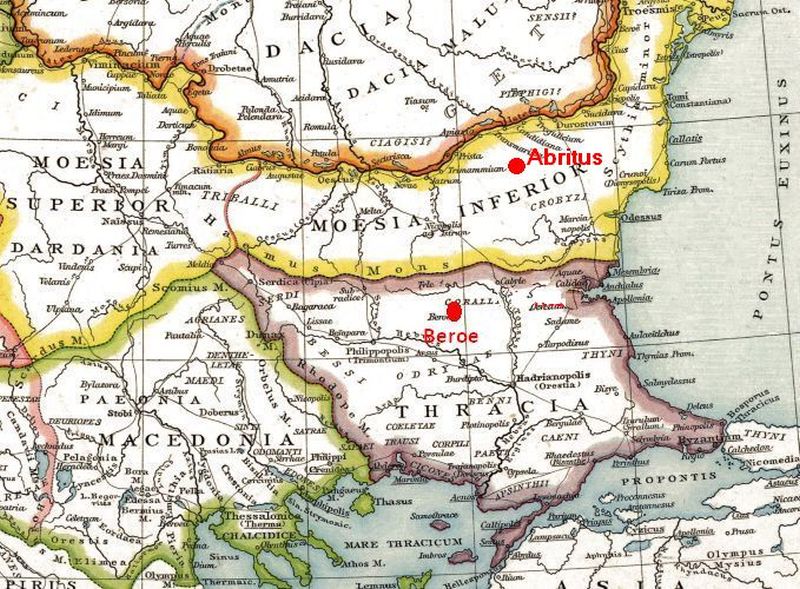
Roman provinces on 
Balkan

Dacia was a Roman province in the early Roman Empire, which stretched north of the Danube. Most of its area belongs to Romania today. Dacia was conquered by Emperor Trajan 101-106 AD but already in 270 AD Emperor Aurelian chose to evacuate Dacia and pull the border of the Roman Empire back to the Danube, which was far easier – and less expensive, to defend. Some sources say that the Romans effectively lost Dacia already around 250 AD – Dacia was fairly quickly taken over by the Western Goths, among which the Visi-Goths were the dominant tribe. Then, Moesia, Thracia and Macedonia became targets for Gothic plunder. Beroe and Abrittus are marked in red.

It is also said that the Goths through twenty years received an annual sum of money to protect the Roman border against the Sarmatians. But Emperor Philippus Arabs, who ruled 244-249 AC stopped payments, prompting the patient king Ostrogotha to lose patience and lead his Goths into the nearby Roman provinces, Dacia, Moesia and Thracia in order to loot.

In 249 AD the Roman general Decius made rebellion against Emperor Philippus and had himself declared emperor by his troops. Philippus was killed in a battle near Verona. Goths under King Cniva took advantage of the prevailing chaos and were preparing to lay siege to Nicopolis on the Danube, when they were surprised by the freshly made emperor and had to escape through the difficult terrain of Balkans, however, here they received reinforcements and turned surprisingly against their pursuers and attacked and plundered their camp near Beroe, which today is called Stara Zagora, and then it was the Romans, who had to flee. It was the first time a Roman emperor fled in a confrontation with the Gothic barbarians.

Then the Goths conquered Philippopolis, which today is called Plovdiv and returned to their homeland laden with booty and important prisoners.

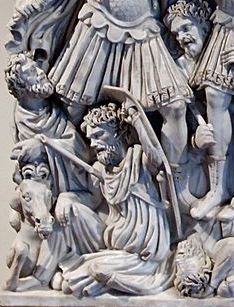
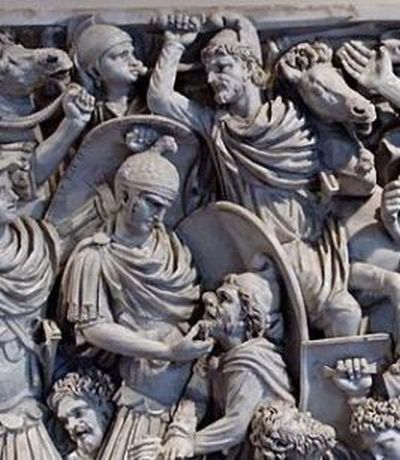
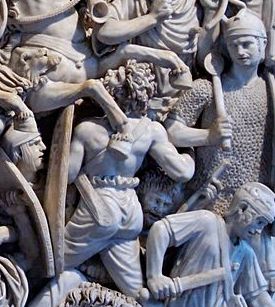
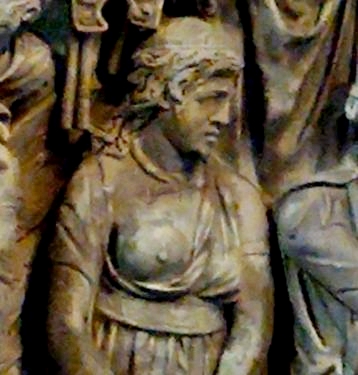
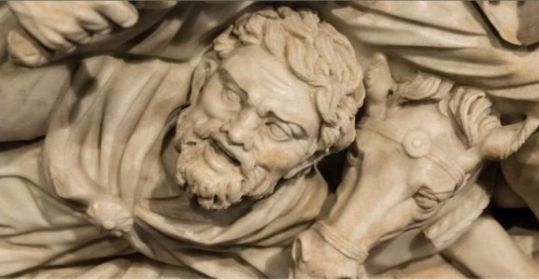
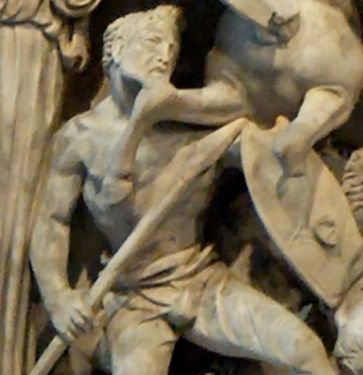
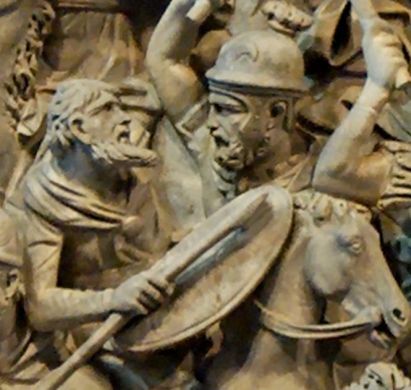
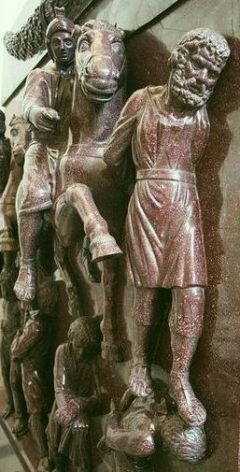
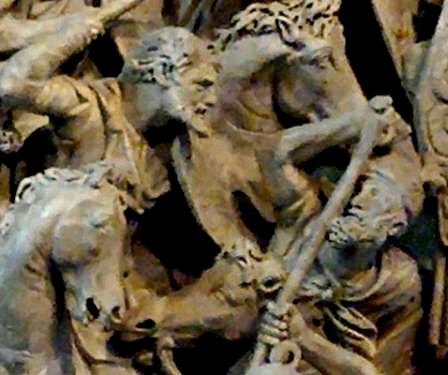
Detail of the Ludovisi sarcophagusDetail of the Ludovisi sarcophagusDetail of the Ludovisi sarcophagusDetail of the Ludovisi sarcophagus

Details from the Ludovisi sarcophagus, a Roman sarcophagus found in a grave near Porta Tiburtina in Rome. It is dated to around 250 AD. It was discovered in 1621 and named after its first modern owner, Ludovico Ludovisi. The sarcophagus is now displayed in Palazzo Altemps in Rome, which is a part of the National Museum in Rome. The motive is a Roman victory over barbarians, in all likelihood Goths. Note their curly hair; both Sidonius Apollinaris and Jordanes mention that the Goths had curly hair. All the Goths have beards. Photo Wikipedia.
From upper left to lower right:
A Goth is mortally wounded by a spear in the chest.
A Roman lifts the head of a dying Goth by the beard. Above a Got lifts his sword, he is wearing a kind of hat.
A Goth is struggling desperately against superior forces surrounded by fallen comrades.
A heap of fallen Goths in the bottom of the motive, all dressed in tight pants and with curly hair and beard.

Emperor Decius and his son Herennius Etruscus soon sought to wash away the humiliation at Beroe by moving their troops across the Danube and attack the Goths. The decisive battle took place in 251 AD on the swampy terrain of the small town, Abrittus, which today is called Razgrad, in northeastern Bulgaria. The Roman writer Sextus Aurelius Victor recounts: “After he had ruled for two years Decius and his son Abrittus died because of treason while pursuing the barbarians over the Danube. Many reports tell that his son fell in battle, while he pushed in a too daring attack; the father, however, strenuously argued that the loss of a single soldier seemed him too little to matter. And then he resumed the fight and died violently struggling in a similar way.” His body was never found. Decius was the first Roman emperor, who died in battle against the kingdom’s external enemies.

The Byzantine theologian and historian Zonaras narrated: ” – he and his son and a large number of Romans fell into the marshland; all of them perished there, none of their bodies to be found, as they were covered by the mud.”

Detail of the Portonaccio 
sarcophagusDetail of the Portonaccio 
sarcophagus

Details from the Portonaccio sarcophagus, which is a Roman sarcophagus found in the Portonaccio neighborhood of Rome It is dated 180-190 AD and can be seen in Museo Nazionale Romano.
Top: A barbarian woman with one breast exposed. In several columns and reliefs, Germanic women are shown with one breast exposed and the hair in disorder. It may be thought to have been a particularly advanced Germanic fashion from the Migration Period, but it is more likely that it should demonstrate the harsh treatment that the legionaries gave the subdued’s women, as a symbol of the Roman armies’ omnipotence.
Bottom: A barbarian warrior and his horse are in trouble in the bottom of the battle. All Germans, Goths and Dacians are shown with curly hair and beard. – Wikipedia.

The Romans raised an outcry when it became known that Gallus – the new emperor after the disaster at Abrittus – paid the Goths to keep the peace. However – unfaithful to their leaders’ agreements – some groups of Goths continued to loot in the Roman province Elyria (Albania). However, they were quickly beaten by a general named Aemilianus, who then was proclaimed emperor. Gallus was murdered by his own soldiers, who then joined the usurper’s army; but soon after he too was murdered, and the empire came into the hands of Valerian and his son Gallienus. But in 260 AD Valerian led a daring expedition in the war against the Persians and never came back.
Gothic warrior on the Portonaccio sarcophagus

Battle scene between Romans and Germans on the Portonaccio sarcophagus. One of the Germans, Dacian or possibly Gothic warriors is still standing. He could be a typical Gothic warrior armed with spear and shield – with curly beard and hair, dressed in tight pants held up by a belt, like the typical Germanic trousers found in Thorsbjerg Mose near Slesvig. Photo: Wikipedia.

During these fifteen years from Ostrogotha’s raids into Moesia and Thracia until Emperor Decius’ death in the battle of Abrittus, other Goths along with other barbarians conducted massacres and looting many places in the Roman Empire. Heruls, Goths and Eudoses, which probably also were Goths, from Crimea sailed across the Black Sea and captured the great city of Trebizond, where they abducted a large number of prisoners and took a big prey. The same fate befell the large and splendid cities of Bithynia, Chalcedon and Nicomedia. It is said that they were all fortified with strong garrisons, but for fear of Gothic terror, resistance was rarely attempted.

However, the most known and infamous Gothic raid was the conquest and looting of Athens in 262 AD. A fleet of five hundred ships – it is said – led a large army of Goths and Heruls through the Bosphorus and Hellespont. On their way to Athens, they destroyed the city of Cyzicus, which stood at the coast of Asia Minor between the Bosphorus and Hellespont, and they burned down the famous Temple of Diana in Ephesos, with its hundreds of tall marble columns and many beautiful statues – one of the ancient Seven Wonders.

Then the Gothic pirates crossed the Aegean Sea, anchored off Athens and plundered the famous city – Plato and Socrates’ birthplace – completely. But at least they did not burn the city, and we know that they left many distinguished and beautiful buildings and artworks, which first would be destroyed by the Turks many years later.

Gothic warrior on Portonaccio
sarcophagus

Battle scene between Romans and Goths on the Portonaccio sarcophagus. A bearded bareheaded Gothic warrior armed with shield and spear in battle against a similarly bearded Roman legionary equipped with helmet and sword. As several other Goths, he is wearing a cape held together by a buckle on the chest. Photo: Wikipedia.

When they had finished looting of Greece, they went to the coast of the Adriatic Sea. Maybe they thought of invading Italy. But however, Emperor Gallienus, Valerian’s son, had finally woken up to action and led a large army against them. The expedition leaders began to quarrel among themselves, and one of the Heruli leaders, Naulobatus, went into Roman service with all his men. He was very well received by the emperor, who gave him the rank of consul. The remaining Goths divided into two groups. One group went to Greece’s east coast and from there by ship to Thracia, and from there they traveled over land home to their villages. The other group continued to ravage Moesia another year without meeting significant resistance because of continued rivalry between the Roman generals.

In 268 AD, Emperor Gallienus was assassinated, and Claudius was appointed to emperor. In his time Greece was attacked by an invading army of thousands of Goths, who had emigrated from the area near the mouth of Dniester at the Black Sea, bringing their wives and children. The invasion army landed near Thessalonica and was soon engaged in grueling battles with Claudius forces. Thousands of Gothic prisoners were sold as slaves; many young men were enrolled in the imperial armies. A plague ravaged both Goths and Romans. The rest of the Goths fled into the Balkan mountains. For this victory, Emperor Claudius earned his name of honour, Gothicus.

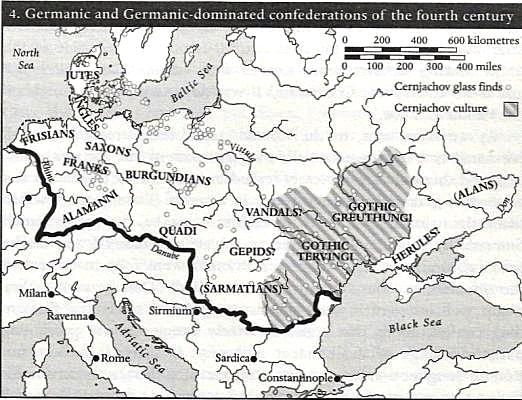
The barbarian peoples along
the borders of the Roman Empire in the fourth century

The barbarian peoples along the borders of the Roman Empire in the fourth century by Peter Heather: “The Fall of the Roman Empire – A new history”. Jordanes narrated that after the Goths had arrived in the Black Sea area, they divided themselves into two groups, which usually are called respectively Tervingi – Visigoths – Western Goths and Greutungi – Ostrogoths – Eastern Goths. But the most likely is that there were many Gothic tribes, who had emigrated from the overpopulated original Gothic area in South Scandinavia and around the Baltic. Tervingi and Greutungi were only the names of dominant tribes. It is not even sure that for example, Tervingi and Visigoths represented the same tribe. We know, for example, that also Eudoses and Rugi were part of the exodus. Moreover, as Procopius writes about the barbaric peoples, he had met: “All these, while they are distinguished from one another by their names, as has been said, do not differ in anything else at all. For they all have white bodies and fair hair and are tall and handsome to look upon, and they use the same laws and practice a common religion.” Vandals, Gepids, Scirii, Burgundians and Angles talked all a dialect of Gothic and also resembled each other, so technically one could call them all a kind of Goths.

On His deathbed, Claudius appointed a young man named Aurelian as emperor. Very soon the empire was again attacked by new hordes of Goths led by a chief named Cannabaudes. Aurelian concluded a settlement with the Goths so that the province of Dacia, which today mainly is made up by Romania and the eastern part of Pannonia, which is today’s Hungary, was finally abandoned to the Goths against that they provided two thousand cavalries to the Roman army, and sent young men and women of noble families to the Roman Empire as hostages. The result of these agreements were the Goths lived in peace with the Roman Empire in the following fifty years.

Captive Goth

A Goth – or could it be a Persian – is taken away captive of the Roman cavalry – Motif on Constantine’s mother Helena’s sarcophagus in Pio-Clementine Vatican Museum in Rome. He has curled hair and beard and is dressed in robe and pants. However, these pants are unusual being knee short – Wikipedia.

The Goths broke the peace in 322 AD when a unified army of Eastern and Western Goths and several Slavic tribes led by King Aliquaca invaded the Roman provinces south of Danube. But however, Emperor Constantine, who later earned the name of honour, “the Great,” responded by crossing the Danube and defeat them on their own territory. The emperor offered however honorable peace terms, the Goths were allowed to keep all their possessions and privileges against that the king should send his son as a hostage to Constantinople, and that Gothic forces should participate in the Imperial Army. When Constantine a year later fought the decisive battle against his rival, Licenius at Hadrianople, he was therefore assisted by a large Gothic army under Aliquaca. The victory at Hadrianople gave Konstantin power throughout the Roman Empire and made it possible that he could declare Christianity as the religion of the state.

Around 350 AD the Goths on the banks of the River Dnieper chose Ermanaric of the Amal lineage as king. Not since Ostrogotha, they had had an Amal as king. Ermanaric made no attempt to invade the provinces of the Roman Empire, but he made his Gothic kingdom to the center of a great empire. The Roman Ammianus Marcellinus wrote that he ruled “extensive large and fertile areas”; Jordanes wrote that he ruled the country Oium and compared him with Alexander the Great. Through many generations, his fame survived in Scandinavian, German and Anglo-Saxon sagas and poems. In “The saga of Hervarar and Kong Heidrek” the Goths’ capital is called Arheimar and located at the Danpar river, which is the Dnieper. The name Árheimar has been interpreted as Oium, as place names with the suffix -heim in many cases have been reduced to -um.
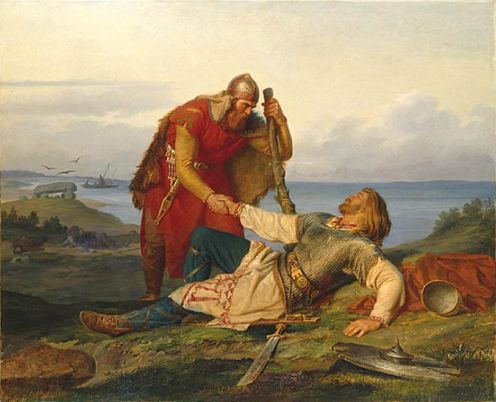
Hjalmar's farewell to Orvar
Odd after the fight on Samsø

Scene from Heidreks Saga – Hjalmar’s farewell to Orvar Odd after the fight on Samsø. Painted by Mårten Eskil Winge – Wikipedia.

In this saga, Heidrek unfairly usurps the throne of Reidgotaland. He kidnaps the Hunnish princess Sifka, rapes her and sends her pregnant back to the Huns, her son with Heidrek is given the name Hlød. When Heidrek dies in the Carpathians, he is succeeded by his son Angantyr. But his second son Hlød, who had grown up among the Huns, requires his heritage and attacks with a great Hunnish army of mounted warriors. The Goths are assisted by the old Geatian King Gissur, and the war ends in an epic battle on the plains of the Danube, where Angantyr kills his brother Hlød.

We can understand from sagas and poems that Ermanaric was admired as a great conqueror and ruler, but he was also bitterly hated by the subjugated peoples as a cruel tyrant.

In the western part of the Gothic area along the Black Sea, King Athanaric of the Western Goths reigned. Since the time of Constantine the Great, they had faithfully complied with the agreement to protect the empire’s eastern border and to send several thousand soldiers to the Roman army each year. However, Athanaric made the mistake to support the wrong emperor. A general named Procopius rebelled against Emperor Valens, and temporary he got the power in Constantinople. Athanaric sent his Gothic troops to Thrace to support Procopius in the belief that he was the real emperor. However, Valens came back strongly, overcame his rival and his Gothic troops, whom he reportedly sold as slaves. Moreover, Valens then went over the Danube with his legions and made war and plunder on the Goths, however, without he was able to win a decisive victory.

After three years of war between the Western Goths and the Romans King Athanaric met with Emperor Valens in 369 AD on a barge on the Danube and agreed to peace terms; among others, Valens agreed to Athanaric’s requirement to deliver the Gothic Christians, who had sought refuge in Constantinople.

Preserving the Past, Recording the Present, Informing the Future

Ancient and Honorable Carruthers Clan Int Society 

carruthersclan1@gmail.com     carrothersclan@gmail.com

cropped-wide-banner-with-new-crest.jpg

Dr Patricia Carrothers

Reviewed by Tammy Wise CHS

CLAN SEANACHAIDHI

CLAN CARRUTHERS INT SOCIETY CCIS HISTORIAN AND GENEALOGIST

You can find us on facebook at :

https://www.facebook.com/carrutherscarrothers.pat.9

https://www.facebook.com/CarruthersClan/

https://www.facebook.com/CarruthersClanLLC

Disclaimer Ancient and Honorable Carruthers Clan International Society
Gutland / Gotland, OUR ANCESTORS, The History of Gutland, The Viking Age

CLAN CARRUTHERS – EARLY HISTORY OF THE GOTHS

cropped-wide-banner-with-new-crest.jpg

EARLY HISTORY OF THE GOTHS

Jordanes describes how his own people, the Ostro-Goths, originally came from the interior of the Scandinavian Peninsula, perhaps from the Gøta lands: “The same mighty sea has also in its Arctic region, that is in the north, a great island named Scandia, from which my tale (by God’s grace) shall take its beginning. For the race, whose origin you ask to know, burst forth like a swarm of bees from the midst of this island and came into the land of Europe. But how or in what wise we shall explain hereafter, if it be the Lord’s will.”

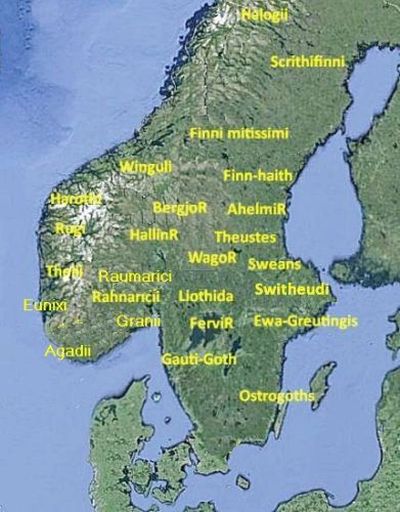
The tribes on the island of Scandia following Jordanes

The tribes on the island Scandza after Jordanes – quite randomly placed by the author. We can place Halogi, Scrithfinni, Finn Haith and Finni Mitissimi north after their names. Sweans and Switheudi around Malern – as we believe that they are the Swedes. Gautigoths and Ostrogoths in the Gøta lands, Dani in Scania and some people reminiscent of modern Norwegian place names, Raumarici and Agadii as well as possible in Norway. The rest I have placed pretty randomly.

Jordanes lived around 550 AD in Constantinople. It is assumed that the Ostrogoths left Scandza around 150 AD. If a generation is considered to 25 years, it will then be 16 generations since they left the Scandinavian Peninsula. In all that time they had preserved the memory of the country that they left long ago, orally from generation to generation. That witnesses of a strong sense of national identity. Another possibility is that they had a sporadic connection to their original homeland all the time.

“Now from this island of Scandia, as from a factory of races or a vagina of nations, the Goths are said to have come forth long ago under their king, Berig by name. As soon as they disembarked from their ships and set foot on the land, they straightway gave their name to the place. And even to-day it is said to be called Gutisk-Andja”

“Soon they moved from here to the abodes of the Hulm-Rugians, who then dwelt on the shores of the Ocean,” Jordanes continued, “where they pitched camp, joined battle with them and drove them from their homes. Next, they subdued their neighbors, the Vandals, and thus added to their victories.”

It is believed that the Ostro-Goths went ashore in what today is modern Poland, at the mouth of River Vistula. It happened around 150 AD

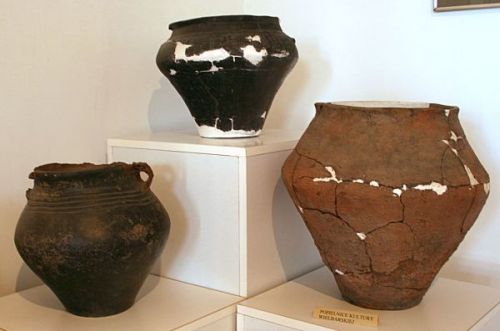
Archaeologists have unearthed burial sites in the Vistula River delta and lower reaches, which exhibit many common features with contemporary burial sites in southern Scandinavia. The culture has been baptized the Wielbark culture after the main findings place. There have been found both inhumation grave and cremations, just as is the case in Jutland and Gøta lands at the same time. The deceased is laid to rest in stone-built tombs, and they have rarely been given weapons, but sometimes spores, which is also a similarity with inhumation graves in Jutland at the same time. Most believe that the Wielbark culture can be attributed to the Goths and Getae, but not everyone is convinced. The graves have been dated from the first century until 300-400 AD.

Ceramics from the 
Wielbark culture

Ceramics from the Wielbark culture exhibited in the Polish Museum Odry

When the Goths had lived for a while at the Vistula River delta, they decided to go south, where, however, a disaster awaited them. Jordanes recounts: “But when the number of the people increased greatly and Filimer, son of Gadarik, reigned as king about the fifth since Berig, he settled on the plan that the army of the Goths with their families should move from that region. In search of suitable homes and pleasant places, they reached the lands of Scythia, which in their tongue are called Oium. Here they were delighted with the great richness of the country, and it is said that when half of the army had been brought over, the bridge, whereby they had crossed the river, collapsed irreparably, nor could anyone thereafter pass to or fro. For the place is said to be surrounded by quaking bogs and an encircling abyss, so that by this double obstacle nature has made it inaccessible. Indeed, one might give credence to the assertions of travelers even if they have heard it from afar that in that area even today the lowing of cattle is heard and traces of men are found.”

Normally, it is not expected of a king, a responsible leader, to abandon half of his people in the wilderness and just leave them to their fate. One must think that the situation was desperate.

In this way the Gothic army and their families became split into two parts, namely the group that already had crossed the river led by Filimer, and the remaining group, which did not manage to get across the river: “So having crossed the river, this part of the Goths which migrated with Filimer went into the territory of Aujom, they say, took possession of the desired land. There they quickly came upon the race of the Spali, joined battle with them and won victory.”

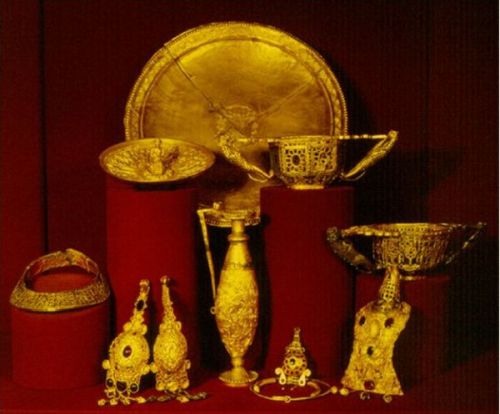
The Pietroasele treasure

The Pietroasele treasure was found in Pietroasele near Buzau in Romania in 1837. It is a Gothic treasure from the fourth century. It is on display at the National Museum of Romanian History in Bucharest. Originally it consisted of 22 pieces, but only 12 have been preserved including a neck ring with a Gothic runic inscription in older futhark – photo Wikipedia.

“Thence the victors hastened to the farthest part of Scythia, which is near the sea of Pontus; for so the story is generally told in their early songs, in almost historic fashion,” Jordanes recounts. “To return, then, to my subject. The aforesaid race of which I speak is known to have had Filimer as king, while they remained in their first home in Scythia near the Sea of Asov.”

Only now, Jordanes mentions that Filimer’s people were divided into two groups of Goths, led each by its own dynasty: “In their third dwelling place, which was above the Black Sea, they had now become more civilized and, as I have said before, were more learned. Then the people were divided under ruling families. The Visigoths served the family of the Balti and the Ostrogoths served the renowned Amali.”

Jordanes tells nothing about what became of the part of the original group that was cut off because of the disaster at the bridge.

Especially previously, most historians believed that Visigoths and Terwingi were only different names for Western Goths and Ostrogoths and Greuthungi were other names for the Eastern Goths. But we must remember that Jordanes told that both Ostrogothae and Ewa-Greutingi were tribes that populated the interior of the island Scandia; this alone makes it unlikely that Ostrogoths and Greutungi was one and the same.

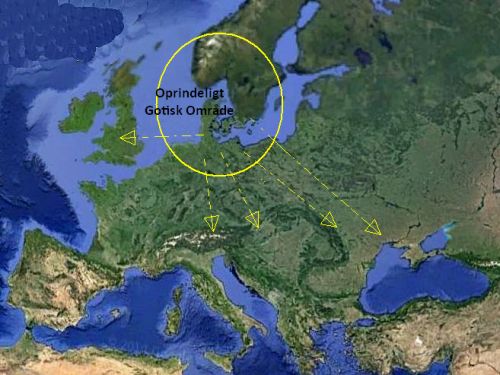
The original Gothic
area

They looked like each other and spoke the same language, as Procopius wrote. So they must also have had the same origin: the original Gothic area in Southern Scandinavia and around the Baltic Sea. Most likely it had been a bit by random if the ancient writers included Greutungi, Terwingi, Rugi, Vandals and Gepids in the group of Goths or not. Most of the tribes, who arrived into the Roman Empire through the Black Sea coast, were classified as Goths, while other, who did not come in contact with the Roman world via the Black Sea area, were not, even though they spoke Gothic.

It is tempting to recall that all Gothic areas on the southern Scandinavian peninsula and along the Baltic Sea and inner Danish waters were very densely populated in Roman Iron Age, if not overpopulated. One can easily imagine that other Gothic people tried their luck in the south. However, they did not have a chronicler, like the Ostrogoths had in Jordanes.

Jordanes wrote about the emigration from the Vistula delta that Filimer decided: “that the army of the Goths with their families should move from that region”, he did not write that the entire people emigrated. A migrant people like Filimer’s Goths, who went through relatively sparsely populated areas and even were halved by the disaster with the collapsed bridge, may, for logistical reasons, not have included much more than maybe a few thousand people.

In connection with the disaster at the bridge, the story mentions that long after, one could hear the roaring of cattle at the abyss; it indicates that the Goths brought their cattle. But there would have been limits on how much cattle and thus how many people, who could travel the same path, for there must be grass for the cattle.

They arrived at the northern coast of the Black Sea about 170 AD, and already around 250 AD – only three generations after – they were numerous enough to populate most of southern Ukraine and Romania, to conclude agreements with the Roman Empire and subsequent to attack the nearby Roman provinces. It must have required a Gothic population of several hundred thousand. This means that if Filimer’s Goths had been the only origin to the numerous Gothic population in the area, then they should have performed a bluntly miraculous fertility, which seems very unlikely also with the contemporary living conditions considered.

Battle scene on the Portonaccio sarcophagus

Battle scene between Romans and Germans or Dacians on the Portonaccio sarcophagus. The barbarians all have curly hair and beard, The man in bottom right has a kind of cap or helmet – which is said to be characteristic for Dacians – otherwise, only the Roman soldiers carry helmets. The sarcophagus is found in Rome and dated to the 2. century – Photo Wikipedia.

It is much more credible that the Gothic population in southern Ukraine was made up by many small groups – similar to Filimer’s Goths – which had emigrated from the over-populated original Gothic area in the north, but only Filimer’s Goths got their quest immortalized by a chronicler. The historian Peter Heather mentions, for example, at least seven different groups of Goths.

Amminius wrote about the reason for the Goth’s later wish to seek refuge in the Roman Empire: “Yet when the report spread widely among the other Gothic peoples, that a race of men hitherto unknown had now arisen from a hidden nook of the earth, like a tempest of snows from the high mountains, and was seizing or destroying everything in its way – ” The phrase: “the other Gothic peoples” clearly gives the impression that there were many Gothic peoples and not only two.

Moreover Athanaric, who was king of the Western Goths, wanted to establish a defense against the Huns, but other leaders, Alavivus and Fritigern, preferred to seek shelter inside the Roman Empire with their subgroups and left Athanaric and the rest of the Western Goths to their fate. If the Western Goths had been a homogeneous group, which Jordanes suggests, could we then imagine such desertion?

Likewise with the Eastern Goths, led by Alatheus and Saphrax; they ran away from it all and left the rest of the Eastern Goths face to face with the Huns. Would they have done this, if the Eastern Goths had been a homogenous group, one people with a common history? It is much more likely that both the Western and the Eastern Goths were coalitions of many original groups.

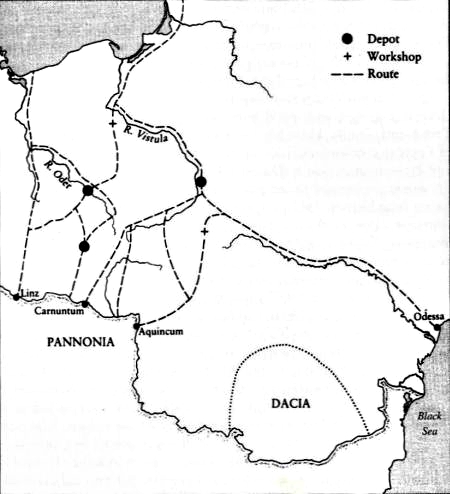
The ancient amber routes

The main route of the ancient amber trade went down along the river Vistula and then to Carnuntum in Austria halfway between Vienna and Bratislava, from there the route led to the River Po, which in ancient times was called Eridanos, where there was a market for amber. In addition, several other very old trade routes have been identified in Eastern Europe. Already in the Bronze Age amber, bronze and slaves were transported along these routes. We can imagine that the Cimbri and Teutons traveled down along the Oder to Linz on their infamous raid. We must believe that many groups of Goths with their kilometer long road trains followed the rivers Vistula and Dnieper to the coast of the Black Sea. The amber routes were well known even in Rome, for example Emperor Nero sent an agent to the Baltic to buy a large quantity of amber for decorations of the imperial palaces. – From “The Goths” by Peter Heather.

Ptolemy placed the people Goutai on the island of Skandia while the people Gudones at the Vistula River. It is most often explained as a kind of mistake or name confusion, but the right explanation is probably that already then were several groups of Goths; It is also historian Herwig Wolfram’s view.

The Gothic armies have likely been composed of many different groups of Goths, who identified themselves with the names of their original homes in the north or the names of their leaders as Procopius said; such as Ostro-Goths, Greuthungi Goths, Gaiti-Goths, Visi-Goths, Terwingi Goths, Rugi and Rheid-Goths. Eudoses has likely originated from Jutland. Scirii is said to have spoken a Gothic language, though no ancient sources call them Goths. One can imagine that the Gothic area north of the Black Sea was a kind of that time America, where different groups of emigrants from the original Gothic area became mixed together in alternating coalitions.

A very large Gothic group under Radagaisus went directly against Italy but was stopped at Florence by a Roman army of overwhelming strength. Nothing is said about them to be Eastern or Western Goths; they were only a kind of Goths, who came more or less directly from the Goth’s northern homeland.

Carruthers crest on flag-v2 (1)

Preserving the Past, Recording the Present, Informing the Future

Ancient and Honorable Carruthers Clan Int Society 

carruthersclan1@gmail.com     carrothersclan@gmail.com

cropped-wide-banner-with-new-crest.jpg

Dr Patricia Carrothers

Reviewed by Tammy Wise CHS

CLAN SEANACHAIDHI

CLAN CARRUTHERS INT SOCIETY CCIS HISTORIAN AND GENEALOGIST

You can find us on facebook at :

https://www.facebook.com/carrutherscarrothers.pat.9

https://www.facebook.com/CarruthersClan/

https://www.facebook.com/CarruthersClanLLC

Disclaimer Ancient and Honorable Carruthers Clan International Society
Gutland / Gotland, OUR ANCESTORS, The History of Gutland, The Viking Age

CLAN CARRUTHERS – THE GOTHS AND GOTLAND IN 500 AD.

cropped-wide-banner-with-new-crest.jpg

THE GOTS AND GOTLAND IN 500 AD

Who were the Goths?

The Goths were a number of Germanic tribes in the Migration Period, which appeared in written history in the third century in the areas north of the Black Sea between the rivers Danube and Don. Except for frequent raids, they invaded the Roman Empire first time in 268 AD, and later in 376 AD. The Western Goths settled a few years in the Garonne valley in France until they conquered a kingdom, which included Spain and the South of France. In France, they were displaced by the Franks after a few years, and Spain was in 711 AD conquered by Muslim invaders – but the Goths descendants took the country back in the Middle Ages. The Eastern Goths established a thriving kingdom in Italy, but after only 67 years, they were defeated by armies sent by the emperor in Constantinople.

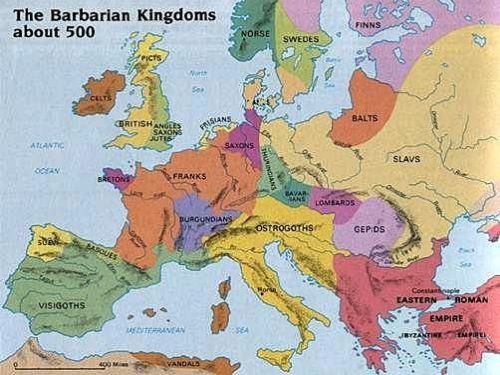
Europe around 500 AD

 A map of Europe showing the Germanic kingdoms that were established after the downfall of the Western Roman Empire. After numerous battles and long migrations, the Western Goths managed to settle in Spain and the Eastern Goths to take possession of Italy. However, it did not last forever. From ancientweb.org.
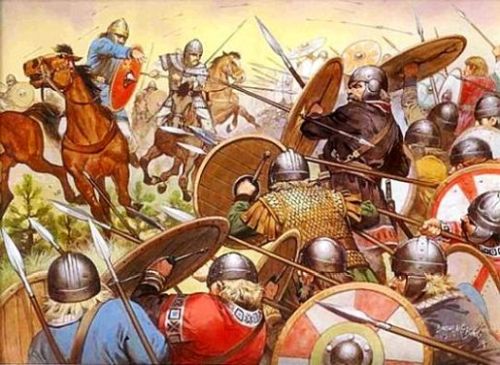
Bottom: An artistic reconstruction of the Western Goths in battle with Attila’s Huns at Chalons. From ancientweb.org.

When the first Goths arrived at the northern coast of the Black Sea about 170 AD, the climate was still influenced by the Roman Warm Period, which, however, ended about 400 AD. The Vandals crossed the frozen Rhine new year’s eve 406 AD, thus commencing the Migration time and heralding the downfall of the Western Roman Empire. The fact that the Rhine was frozen, testifies to a rather cold climate. I do not recall the Rhine has been frozen in modern times.

An artistic reproduction of the Goths in battle at ChalonsFrom then on, until the disaster at Guadalete in Spain in 711 AD, when the Western Goths were defeated by invading Muslims, the climate was cold with snowy winters in northern and central Europe.
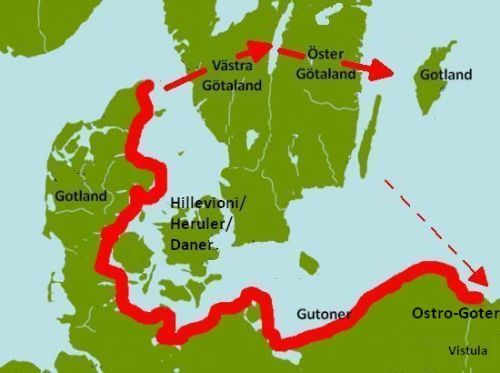
Goths can be traced further back in history to today’s northern Poland, and even in the distant past to their origins in Scandinavia and the Baltic area. Thus Jutland through thousand years was called Gotland.

Paul the Deacon tells about how the Langobards migrated from their original island in the ocean: “Now when the people living there had multiplied to such a number that they could no longer live together, they divided, it is told, their whole people into three parts and decided by casting lots, which of those, who were to leave the homeland and seek new places of residence.” Dudo confirmed many years later that it was a traditional way of solving problems of overpopulation in Scandinavia.

Also, the Gotland Gute Saga says that some of the people were taken for emigration by casting lot: “After a long time, the people have so increased that the country was not able to feed them all. So the land was distributed, on which every third tilled, each of these was allowed to keep and bring and take away everything, which he in his life had acquired.”

Pliny the Elder (23-79 AD) wrote: “Pytheas says that the Gutones, a people of Germania, inhabits the shores of an estuary of the Ocean called Mentonomon, their territory extending a distance of six thousand stadia; that, at one day’s sail from this territory, is the Isle of Abalus, upon the shores of which, amber is thrown up by the waves in spring, it being an excretion of the sea in a concrete form; as, also, that the inhabitants use this amber by way of fuel, and sell it to their neighbours, the Teutones.”

Gutones following Pytheas

Pytheas wrote: “Pytheas says that the Gutones, a people of Germany, inhabit the shores of an estuary of the Ocean called Mentonomon, their territory extending a distance of six thousand stadia.” Other ancient writers also believed that the Baltic Sea and inner Danish waters was a major estuary.
Procopius wrote about the returning Heruls: “After these, they passed by the nations of the Dani, without suffering violence at the hands of the barbarians there. Coming thence to the ocean, they took to the sea, and putting in at Thule, remained there on the island.” – “And one of their most numerous nations is the Gauti, and it was opposite (next to?) them that the incoming Eruli settled at the time in question.” We must believe that Procopius shared the ancient authors believe that the Danish waters and the Baltic Sea was a large estuary, in which case it “opposite the Goths” can be understood: on the opposite side of the estuary. Alternatively, it should be translated “next to the Goths.” However, in both cases, suggesting that the Heruls were Goths.

There is some uncertainty about how long a stadium was, the proposals vary between 160 and 192 m. That means that the coastline, which was inhabited by Gutones, was between 960 and 1.152 km. long. That gives a range from Skagen to the Vistula estuary at Gdansk.

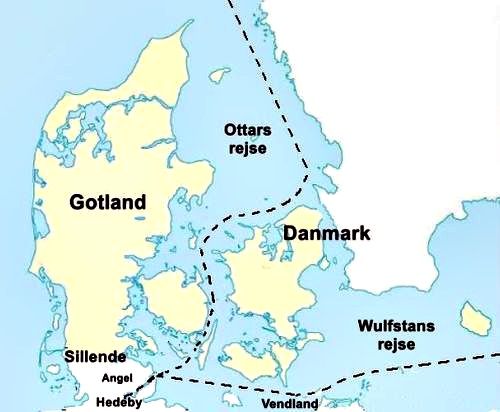
It suits very well with that the Jutland peninsula before the Viking Age was called Gotland, as it is the case in Ottar’s travelogue, added in Alfred the Great’s translation of Orosius’ Roman history from about 850 AC: “When he sailed there from Skíringssal (at Oslo), Denmark was on the port side and to starboard for three days was the open sea. And then, two days before he came to Hedeby, Gotland was to starboard (him wæs on þæt steorbord Gotland), and Sillende and many islands. The Angles dwelt in that area before they came here to this land.”

Since the area was inhabited by Gutones in time before Christ – according to Pytheas – and as part of it still was called Gotland 800-900 AD, it is reasonable to assume that at least the coast along Kattegat and the Baltic Sea were the Goth’s original homeland.

Ottar's and Wulfstan's journeys

Ottar’s and Wulfstan’s travels according to additions in Alfred the Great’s translation of Orosius’ Roman history. Both Jutland and the island in the Baltic Sea are called Gotland. (The island of Gotland is not shown on this map).

That will indicate that Cimbri, Teutons, Angles and all other tribes, who lived along this coastline, and whose names we are not sure about, all originally have thought of themselves as kinds of Goths speaking the same language, namely Gothic.

Some believe that the Gutones on the densely populated Jutland east coast very early crossed the Kattegat and gradually populated West and East Gøta Land – and from there the island of Gotland in the Baltic Sea.

In Alfred the Great’s translation of Orosius’ Roman history is also added Wulfstan’s travel report from a voyage from Hedeby to Truso in Vistula’s delta from about 850 AC, which reads: “Wulfstan said that he traveled from Hedeby, and that he was in Truso in seven days and nights, and that the ship all the way went under sail. Wendland was on his starboard side and to port, he had Langeland, Lolland, Falster and Scania. These countries all belong to Denmark. So we had Bornholm to port, and they have their own king. So after Bornholm we had the countries named first Blekinge, More, Oland and Gotland to port (and Gotland on bæcbord), and these countries belong to the Swedes. And we had Wendland to starboard all the way to the Vistula river mouth.” By Gotland is here obviously meant the island of Gotland or maybe the coast of Eastern Gøtaland.

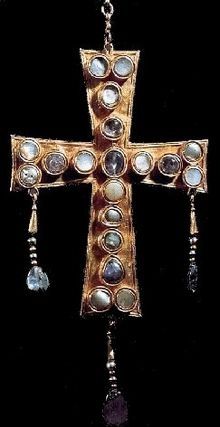
Gothic cross found in Spain

Gothic cross found in Spain perhaps from 700’s.

Ptolemy placed the people Goutai on the island of Skandia and the Gudones by the Vistula river.

The Roman historian Cornelius Tacitus described the location of the Gotones as: “Beyond the Lugii is the monarchy of the Gotones: The hand upon the reins closes somewhat tighter here than among the other tribes of Germans, but not so tight yet as to destroy freedom. Then immediately following them and on the ocean are the Rugii and Lemovii. The distinguishing features of all these tribes are round shields, short swords, and a submissive bearing before their kings.” This means that Gotones, who was ruled by powerful kings, lived north or northeast of the Lugii and further inland than the Rugii and Lemovii, which he explicitly stated as residing at the sea. Perhaps Gotones lived at the Vistula river.

Jordanes located the peoples Ostro-Goths, Ewa-Greutingis and Gaiti-Goths on the island of Scandia. Gauti-Goths were “a race of men bold and quick to fight”, he wrote, and further, “But still another race dwells there, the Sweans, who like the Thuringos, having splendid horses.” With the term “another race” he must have meant that they were not Goths. “All these nation surpassed the Germans in size and spirit, and fought with the cruelty of wild beasts”, he concluded the description of the peoples on the Scandinavian peninsula.

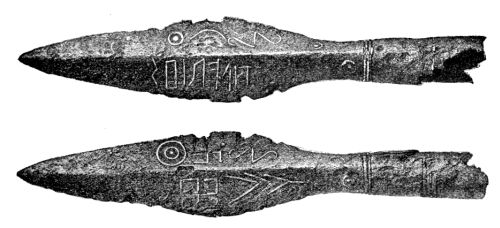
Lance tip with a runic inscriptions found near Kovel in the northwest corner of UkraineRight and left side of a lance head with runic inscription found near Kovel in the Northwest corner of Ukraine. The runic inscription to be read from right to left “Tilarids”. It has been identified as likely East Germanic, most likely Gothic because of the nominative s-suffix. It is from the beginning of the third century.
He mentions different tribes of Goths, who lived on the island of Skandia, including Greutingis and Ostro-Goths, which names we later recognize for Gothic peoples on the Danube and in Italy. This makes it likely that it is true that the Goths, who attacked the Roman Empire, originally came from Scandinavia and the coasts of the Baltic Sea. Furthermore, there are several areas of southern Scandinavia, which have been called, or still are named as Gotland with different spellings, which also support the theory that this region was the original homeland of the Goths. In his report on the Gothic war in Italy, Procopius mentions the Rugi, as part of the Goths in Italy; they are also referred to by Jordanes as one of Skandia’s indigenous tribes. They are also mentioned in other ancient sources.

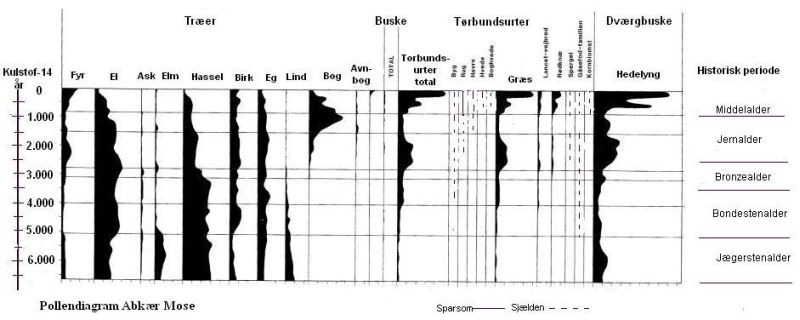
Pollen analysis from Abkjær 
Mose

Pollen analysis from Abkjær Mose at Vojens. It appears that forest, especially beech, increases sharply and herbs typical of open land, grass and heather decrease immediately after the migration time around 500 AD indicating that the forest returned to areas that previously were pastures for cattle. Similar studies in other parts of the country show the same pattern. It is reasonable to interpret that this could be due to emigration.
Also, Procopius reports on the returning Heruls suggests that Scandinavia was quite thinly populated. For how could they just “settle down”, as if they came to an untouched prairie? If not the country had been relatively sparsely populated.
However, when large parts of the original population had turned their back to good pastures, it may not only have been hunger and misery that drove them to emigrate.
It is known that for several hundred years of the late Imperial time the Roman legions were mostly populated with various Germanic soldiers since the Roman Empire’s own citizens did not seem to have been suitable. You could say that every Roman legion was a sort of Foreign Legion, in which also many young men from the South Scandinavian region must have served. Therefore the tribes around the Baltic Sea may have concluded that they were the best and the bravest – and therefore deserved to rule. Such attitudes among the Germanic tribes were most likely critical to the doom of the Western Roman Empire.

All these ancient authors wrote before official correct spelling was invented; they wrote in different languages with different alphabets and over a period of several hundred years. They reproduced words for Goths that often for them were in an unfamiliar language, besides most likely Gothic by this time had already developed in several dialects. It is quite understandable that they spelled it in so many different ways, and we do not have to connect any deeper meaning in the different spellings.

Germanic Village

The Goths lived spread out over farmland in small villages with each may be about 8-10 houses and farms.

In Book III of Justinian’s wars, Procopius wrote about the Goths’ early history: “Now while Honorius was holding the imperial power in the West, barbarians took possession of his land; and I shall tell, who they were and in what manner, they did so. There were many Gothic nations in earlier times, just as also at the present, but the greatest and most important of all are the Goths, Vandals, Visigoths, and Gepaedes. In ancient times, however, they were named Sauromatae and Melanchlaeni; and there were some too, who called these nations Getic. All these, while they are distinguished from one another by their names, as has been said, do not differ in anything else at all. For they all have white bodies and fair hair and are tall and handsome to look upon, and they use the same laws and practice a common religion. For they are all of the Arian faith, and have one language called Gothic; and, as it seems to me, they all came originally from one tribe, and were distinguished later by the names of those who led each group.”

Procopius is undoubtedly correct that most Germanic migrations peoples were a kind of Goths; they resembled each other and spoke largely the same language. But then they must originally have come from the same tribe, as he wrote. That is, we must believe that they all came more or less directly from the original Gothic area along the Baltic Sea, the Danish waters and from the southern part of the Scandinavian Peninsula. Procopius believed that also the Vandals and Gepids were kinds of Goths, although they were not generally named as such.

Moreover, in Denmark are clear indications of a big drop in population density in Germanic Iron Age relative to the Roman Iron Age, which indicates a considerable migration.

Carruthers crest on flag-v2 (1)

Preserving the Past, Recording the Present, Informing the Future

Ancient and Honorable Carruthers Clan Int Society 

carruthersclan1@gmail.com     carrothersclan@gmail.com

cropped-wide-banner-with-new-crest.jpg

Dr Patricia Carrothers

Reviewed by Tammy Wise CHS

CLAN SEANACHAIDHI

CLAN CARRUTHERS INT SOCIETY CCIS HISTORIAN AND GENEALOGIST

You can find us on facebook at :

https://www.facebook.com/carrutherscarrothers.pat.9

https://www.facebook.com/CarruthersClan/

https://www.facebook.com/CarruthersClanLLC

Disclaimer Ancient and Honorable Carruthers Clan International Society
OUR ANCESTORS

MANGUS III OF SWEDEN – CARRUTHERS ANCESTOR – CLAN CARRUTHERS CCIS

cropped-wide-banner-with-new-crest.jpg

MANGUS III OF SWEDEN

CARRUTHERS ANCESTOR

Magnus III (Swedish: Magnus Birgersson/Magnus Ladulås; ca. 1240 – 18 December 1290) was King of Sweden from 1275 until his death in 1290.[1]  He is a direct DNA match to the Carruthers line.

He was the “first Magnus” to rule Sweden for any length of time, not generally regarded as a usurper or a pretender (but third Magnus to have been proclaimed Sweden’s king and ruled there). Later historians ascribe his epithet “Ladulås” – Barnlock – to a royal decree of 1279 or 1280 freeing the yeomanry from the duty to provide sustenance for travelling nobles and bishops (“Peasants! Lock your barns!”); another theory is that it’s a corruption of Ladislaus, which could possibly have been his second name, considering his Slavic heritage. (Magnus’s maternal great-grandmother was Sophia of Minsk, a Rurikid princess.) This king has also been referred to as Magnus I, but that is not recognized by any Swedish historians today.[2]

Magnus III Barnlock of Sweden as Duke bust 2009 Skara (2).jpg

Magnus, whose birth year has never been confirmed in modern times, was probably the second son of Birger Jarl (1200–66) and Princess Ingeborg, herself the sister of the childless King Eric XI and daughter of King Eric X. Thus, Valdemar Birgersson (1239–1302) was the eldest son and ruled as Valdemar, King of Sweden from 1250–1275, succeeding King Eric, their maternal uncle who ruled until 1250. Birger Jarl had designated Magnus as Jarl, henceforth titled Duke of Sweden, and as Valdemar’s successor. Even after Valdemar’s coming of age in 1257, Birger Jarl kept his grip over the country. After Birger’s death in 1266 Valdemar came into conflict with Magnus who wanted the throne for himself. [3]

In 1275, Duke Magnus started a rebellion against his brother with Danish help, and ousted him from the throne. Valdemar was deposed by Magnus after the Battle of Hova in the forest of Tiveden on June 14, 1275. Magnus was elected king at the Stones of Mora (Mora stenar). In 1276, Magnus allegedly married a second wife Helwig, daughter of Gerard I of Holstein. Through her mother, Elizabeth of Mecklenburg, Helwig was a descendant of Christina, the putative daughter of King Sverker II. A papal annulment of Magnus’ alleged first marriage and a dispensation for the second (necessary because of consanguinity) were issued ten years later, in 1286. Haelwig later acted as regent, probably 1290–1302 and 1320–1327.[4] [5]

The deposed King Valdemar managed, with Danish help in turn, to regain provinces in Gothenland (Gotland) in the southern part of the kingdom, and Magnus had to recognize that in 1277. However, Magnus regained them about 1278 and assumed the additional title rex Gothorum, King of the Goths, starting the tradition of “King of the Swedes and the Goths”.
King Magnus’s youngest brother, Benedict (1254–1291), then archdeacon, acted as his Lord High Chancellor of Sweden, and in 1284 Magnus rewarded him with the Duchy of Finland.[6]

Magnus died when his sons were yet underage. Magnus ordered his kinsman Thurchetel Canuteson, the Lord High Constable of Sweden as the guardian of his heir, the future King Birger, who was about ten years old at father’s death.

Carruthers crest on flag-v2 (1)

CLAN CARRUTHERS CCIS – SINCE 1983

Preserving the Past, Recording the Present, Informing the Future

Ancient and Honorable Carruthers Clan Int Society 

carruthersclan1@gmail.com     carrothersclan@gmail.com

cropped-wide-banner-with-new-crest.jpg

Dr Patricia Carrothers

Reviewed by Tammy Wise CHS

CLAN SEANACHAIDHI

CLAN CARRUTHERS INT SOCIETY CCIS HISTORIAN AND GENEALOGIST

You can find us on facebook at :

https://www.facebook.com/carrutherscarrothers.pat.9

https://www.facebook.com/CarruthersClan/

https://www.facebook.com/CarruthersClanLLC

Disclaimer Ancient and Honorable Carruthers Clan International Society

References
Ulf Sundberg (1999). “Magnus Birgersson “Ladulås””. pennanochsvardet.se. Retrieved January 1, 2019.
John E. Morby, “The Sobriquets of Medieval European Princes”, Canadian Journal of History, 13:1 (1978), p. 12.
“Valdemar Birgersson, kung av Sverige”. KulturNav. Retrieved January 1, 2019.
“Mora Stenar”. knivstashistoria.se. Retrieved January 1, 2019.
“Magnus Ladulås (ca 1240–1290)”. Biografiskt lexikon för Finland. Retrieved January 1, 2019.
Sten Engström. “Bengt Birgersson”. Svenskt biografiskt lexikon. Retrieved January 1, 2019.
“Wrong persons found in King’s tomb”. Stockholm News. 9 December 2011. Archived from the original on 26 January 2012. Retrieved 17 December 2011.

The Viking Age

CLAN CARRUTHERS – THE HELM OF AWE

cropped-wide-banner-with-new-crest.jpg

THE HELM OF AWE

Powerful Viking Symbol For Physical, Mental And Spiritual Protection

The Helm of Awe is one of the most powerful protective Viking symbols used not only for the purpose of protection from disease, but even to encourage all people who might suffer from depression or anxiety.

In Norse myths it is said that the Helm of Awe symbol was worn between the eyes to cause fear in your enemies, and to protect against the abuse of power.

Aegishjàlmr or Helm of awe, icelandic magical stave.

The Norse word for this very important symbol (Ægishjálmr or Aegishjalmur) is translated in English “helm of awe” or “helm of terror.” The meaning of the name awe is to strike with fear and reverence; to influence by fear, terror or respect; as, his majesty awed them into silence.

Yggdrasil galdrastafirThe name ‘Aegishjalmur’ is derived from Aegir (Ægir in Old Norse “sea”), the god of the ocean of Jotunheim, the land of the frost giants and one of the nine realms of the ash tree, Yggdrasil.
There have been some archeologist who actually have interpreted this as a menorah.  No, it is not.  It is one of the earliest cave drawings on the Yggdrasil.   Later named the Tree of Life.  The Ash tree was their protection.

Ancestors of the Carruthers, who lived in Gotland , were given a large amount of papal land in what is now northern France and Germany, and it was called Aachen Forest. Aachenmen or Ashmen they were called.   These ancestors raised Ash Trees there, and then used that wood to build boats.  The Ash Tree would protect them as they sailed on the rough sea.

In the Poetic Edda, the Helm of Awe is mentioned when the shape-shifting dragon, Fafnir, claims to possess the power of invincibility that originates from the mysterious Helm of Awe symbol:

The Helm of Awe

I wore before the sons of men

In defense of my treasure;

Amongst all, I alone was strong,

I thought to myself,          

For I found no power a match for my own.

In Poeticl Edda, it is referred to as the helmet of a horror, but it does not have a form of helmet at all. The symbol rather invokes the ultimate protection of the wearer of this symbol, when it is inscribed on his/her forehead.

The symbol is also mentioned in Völsunga Saga and  the poem “Fáfnismál”, an Eddic poem, found in the Codex Regius manuscript.

According to ancient beliefs, the Helm of Awe does not only gives physical protection but also spiritual and mental strength to conquer one’s own fear. Then, it’s time to cause fear in the hearts of enemies who threaten the wearer of the Helm of Awe.

The symbol also helps to control and guards a person against abuse of his own power.

The power of the Helm of Awe was believed to have been most efficient when the symbol was inscribed (also on the inside of the helmet) with either blood or the wearer’s spit.

Many have used this symbol as a tatoo.

In the Viking Age, warriors would wear the symbol between their eyebrows as a sign of strength in battle, believing, like the dragon Fafnir, we mentioned earlier, that it would grant them victory in battle.

It was believed that the circle in the center of the symbol would symbolize the protection of those bearing the Helm of Awe.

Some believed that the center circle in the symbol would represent one’s soul.

Carruthers crest on flag

Perserving the Past, Recording the Present, Informing the Future

Ancient and Honorable Carruthers Clan Int Society 

carruthersclan1@gmail.com     carrothersclan@gmail.com

cropped-wide-banner-with-new-crest.jpg

LISA JOHNSON

CLAN CARRUTHERS INT SOCIETY CCIS HISTORIAN AND GENEALOGIST

You can find us on facebook at :

https://www.facebook.com/carrutherscarrothers.pat.9

https://www.facebook.com/CarruthersClan/

https://www.facebook.com/CarruthersClanLLC

Disclaimer Ancient and Honorable Carruthers Clan International Society
OUR ANCESTORS

CLAN CARRUTHERS CCIS – MARGARET OF WESSEX, ST MARGARET OF HUNGARY

cropped-wide-banner-with-new-crest.jpg

MARGARET OF WESSEX

ST MARGARET OF HUNGARY

The daughter of the Anglo-Saxon Edward the Atheling (heir to the throne) and Agatha kingswoman of Gisela, wife of St Stephen of Hungary, Margaret of Wessex was born in Hungary sometime around 1045, where her father Edward the Atheling had taken refuge during the reign of King Canute in England. As befit her status, she received a good education there, developing an appreciation of beautiful books and clothes.

In 1057, the childless Edward the Confessor, king of England from 1042 to 1066, summoned her father, then known as Edward the Exile, back to England, planning to proclaim him heir to the throne. Whether weakened from the journey or poisoned upon his arrival, sadly, Edward the Atheling died within his first days home. This predicament immediately changed the status of Margaret, her brother, sister and mother and with the arrival of William the Conqueror the Norman conquest would force them once again to flee for their safety. They sailed for the continent again, but while enroute their ship was blown off course landing them on the coast of Fife in Scotland, where they came under the protection and were welcomed by King Malcolm III Canmore.
Anyone familiar with historical artwork can immediately recall the lovely mural of Malcolm greeting Margaret at her arrival in Scotland by Victorian artist William Hole. The famous work portraying a gentlemanly greeting of a lovely princess is ripe with the romanticism of the artist’s time. Sadly, historical fact belies it. Margaret’s ship barely made it to shore in one piece midst a torrent of cold winds and rain and she and her family were dragged in through the mud and water by local fisherman. The political times of Scotland itself within its borders did not guarantee their safety and at this time the group had no idea whether they had made it far enough up the coast to be out of the Norman reach. Luckily, they had and the local fishermen took them safely to their village providing food and shelter for the several days while word of their arrival was sent to Malcolm.
With her brother rightfully in line for the English throne and hopeful for the Scottish king’s backing, Margaret herself was now one of his most important “bargaining chips.”
No photo description available.

St Margaret’s Cave as it appeared before a car park was built above it in the 1960s. The metal railings were added in the 1890s.

It is said that Margaret would often pray at a shrine in this small cave, located in the side of a steep, open valley.

After Margaret’s death and subsequent canonisation in 1250, the cave became a popular place of pilgrimage. In 1962, the valley was filled in by the town council to provide space for a new car park but thankfully, local protests ensured part of the cave was saved.

Today, an unassuming stone building in the car park in central Dunfermline marks the entrance to St Margaret’s Cave and and Her secret cave can be accessed via an 87-step tunnel descending deep below the car park.

The marriage, while traditionally touted as “romantic” and “love at first sight” as well pales in reality when looked at pragmatically. Malcolm, a widower, was no doubt attracted by the prospect of marrying one of the few remaining members of the Anglo-Saxon royal family and with the promise of the Scottish Kings protection and support firmly in place it was immediately seen as mutually beneficial by her brother.
Despite Margaret’s protests, the marriage took place about 1070 at the palace of Dunfermline, which served as the capital of Scotland until 1603.
Margaret would have been about 24 years of age and Malcolm about 47, and while Margaret had at first protested, she was well versed in her “duty” and would prove to be a civilising influence to the somewhat rough Scottish court and is credited with introducing English-style feudalism and parliament to Scotland.
A staunch Papist, she promoted Roman practices such as the observance of Lent and Easter and abstinence from servile work on Sundays. She established a ferry across the Firth of Forth for pilgrims travelling to St Andrews in Fife, which gave the towns of South Queensferry and North Queensferry their names.
At her bidding, it was during Margaret’s time Mass was changed from the many dialects of Gaelic spoken throughout Scotland to the unifying Latin and that by adopting Latin to celebrate the Mass Margaret believed that all Scots could worship together in unity, along with the other Christians of Western Europe. Many people believe that in doing this, it was not only Queen Margaret’s goal to unite the Scots, but also an attempt to end the bloody warfare between the Scotland and England.
Although the marriage had been arranged, it became clear that both Margaret and Malcolm developed a love for each other that grew stronger every day. Together they had six sons and two daughters, who would become three kings of Scotland, or four, if Edmund of Scotland (who ruled with his uncle, Donald III) is counted, and of a queen consort of England. Alexander and David followed their father to the throne, while their daughter, Edith (who changed her name to Matilda upon her marriage), brought the ancient Anglo-Saxon and Scottish Royal bloodline into the veins of the Norman Invaders of England when she married and bore children to King Henry I.
May be an image of 1 person
Diligent in caring for her husband, her children, and the poor, she also found time for reading and was an accomplished needlewoman. Malcolm never learned to read, but he appreciated books as beautiful objects and it was an established practice for the two to sit together daily where Margaret would read to the King as they supped their tea.
Terminally ill when her husband was killed at the Battle of Alnwick in Northumbia, and she herself died at age forty-seven shortly afterwards on this date, 16 November 1093 and soon after her death a popular cult focused upon the much loved Queen developed .
Pope Innocent IV canonised her in 1250 and her remains were reinterred in a shrine in Dunfermline Abbey in Fife, Scotland. Her relics were dispersed after the Scottish Reformation in 1560, when Dunfermline was sacked by the English. Margaret’s and Malcolm’s bodies passed into the possession of Mary Queen of Scots and were taken to Philip II’s palace of the Escorial, near Madrid. There, her head was separated, as was often done to allow more widespread veneration, and was taken first to Edinburgh and then subsequently preserved by Jesuits in the Scottish College, Douai, France, from where it was lost during the French Revolution.
In 1673, Queen Margaret of Scotland was named as patroness of Scotland, however, it must be noted that as always the case, popularity has two sides and in fact, the Celtic factions did altogether not appreciate her Anglicising influences. Thus, while some hold her as beloved “Saint Margaret of Scotland”, very often she is sometimes referred to in the Celtic traditions as Maighread nam Mallachd, or “Margaret of the Curses”.
No photo description available.

St Margaret’s Chapel in Edinburgh Castle is the oldest surviving building in Edinburgh, Scotland.] An example of Romanesque architecture, it is a category A listed building. It was constructed in the 12th century, but fell into disuse after the Reformation. In the 19th century the chapel was restored and today is cared for by the St Margaret’s Chapel Guild.

Several churches throughout the world are dedicated in honour of St Margaret. One of the oldest is St Margaret’s Chapel in Edinburgh Castle in Edinburgh, Scotland, which her son King David I founded. The Chapel was long thought to have been the oratory of Margaret herself, but is now thought to have been established in the 12th century. The oldest edifice in Edinburgh, it was restored in the 19th century and refurbished in the 1990s.
* * * * * * * *
* Margaret and Malcolm had eight children, six sons and two daughters:
Edward (c. 1071 — 13 November 1093), killed along with his father Malcolm III in the Battle of Alnwick
Edmund of Scotland (c.1071 – post 1097)
Ethelred of Scotland, Abbot of Dunkeld, Perth and Kinross, Scotland
Edgar of Scotland (c.1074 — 11 January 1107), King of Scotland, reigned 1097-1107
Alexander I of Scotland (c.1078 — 23 April 1124), King of Scotland, reigned 1107-24
Edith of Scotland (c. 1080 – 1 May 1118), also named “Matilda”, married King Henry I of England, Queen Consort of England
Mary of Scotland (1082-1116), married Eustace III of Boulogne
David I of Scotland (c.1084 – 24 May 1153), King of Scotland, reigned 1124-53
* * * * * * * *
Carruthers crest on flag-v2 (1)

Preserving the Past, Recording the Present, Informing the Future

Ancient and Honorable Carruthers Clan Int Society 

carruthersclan1@gmail.com     carrothersclan@gmail.com

cropped-wide-banner-with-new-crest.jpg

DIANE THOMPSON

CLAN SEANACHAIDHI

CLAN CARRUTHERS INT SOCIETY CCIS HISTORIAN AND GENEALOGIST

You can find us on facebook at :

https://www.facebook.com/carrutherscarrothers.pat.9

https://www.facebook.com/CarruthersClan/

https://www.facebook.com/CarruthersClanLLC

Disclaimer Ancient and Honorable Carruthers Clan International Society