The Viking Age

CLAN CARRUTHERS – VIKING INVASION – IRELAND

cropped-wide-banner-with-new-crest.jpg

VIKING INVASION OF IRELAND

Ireland had known no invaders since prehistoric times. The Vikings, who arrived quite suddenly at the end of the eighth century, sent shock waves through a society in which Christianity had been left to organize itself, exercise its influence, and cultivate its artistic treasures largely undisturbed for more than three centuries.

Marauding seafarers from Norway and Denmark brought ruin and confusion, but they also made a positive contribution to subsequent Irish history in founding the first towns. They tied the island to a continental empire of far-flung places where the Vikings raided and traded, launching both the first large-scale outside contacts and the beginnings of commercial life. In time, like their predecessors before them, they too conformed to Ireland’s demographic pattern in assimilating with the natives, becoming Christians, and adopting the Irish language and Irish customs. Initially an independent force sitting behind the defensive walls of their coastal and riverine settlements, they began trading with the interior and soon found themselves drawn into dynastic struggles, which marked the politics of this period just as they had politics for centuries before.

The Vikings brought a nautical technology and superior weaponry, which facilitated the ability to do battle across wider territories with more deadly means. Irish royal dynasties, fewer in number but richer in resources, fought to acquire whole kingdoms, and the first efforts to claim the title of high king by actually possessing the requisite geographical territory were made. Because the stakes were higher, the clashes grew more intense, and the bitterness engendered by those who found themselves on the losing end of the ceaseless dueling stung with more lasting effect. The enmity harbored by the king of Leinster, banished from Ireland in the summer of 1166, would lead to a train of events that carried consequences for the country unlike any other.

The Era of the Viking Wars

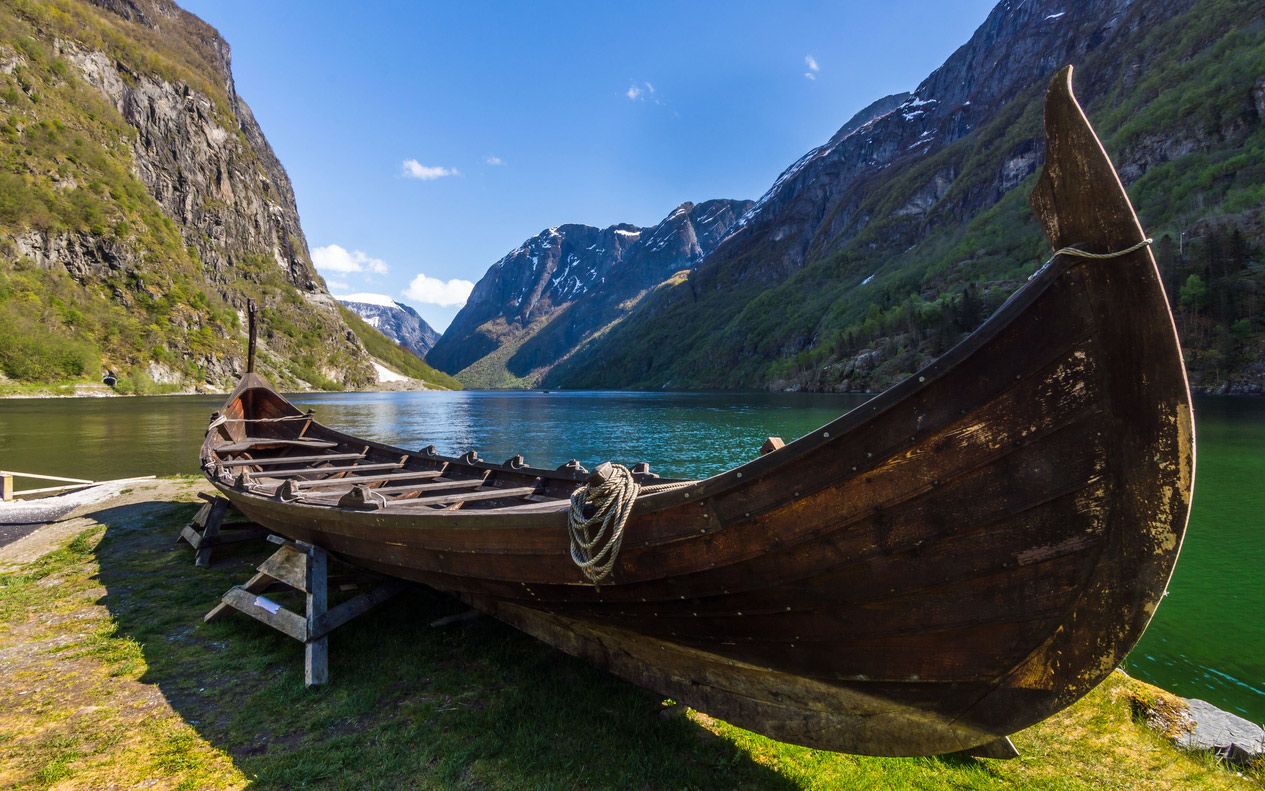
In 795 long low-slung ships, fitted with wide, decoratively patterned sails, appeared from off the ocean’s horizon and ran their pointed bows onto the rocky beach at Iona. Warriors wearing round or horned helmets, armed with heavy swords and iron spears, rushed into the monastic village and, in a frenzied fury, ransacked the settlement, carrying away slaves and booty, including altar shrines and vessels, their surfaces glittering with the gems with which they had been so painstakingly inlaid. In the same year, seafaring raiders burned the community at Rathlin and attacked those at Inishmurray and Inishbofin.

The Vikings were bands of warriors from Scandinavia who set sail from its shores with but one purpose in mind-to seize whatever plunder they could find. The ships they manned were the most technically advanced of their time, designed by skilled Nordic craftsmen to provide the maximum in mobility. Whatever the reasons that led the Vikings to set out on their quest for riches-and they remain obscure-raiding that had begun in the Baltic Sea spread outwards from there at the end of the eighth century. over time these men from the far North (Norsemen) ranged as far east as Moscow and Constantinople and as far west as the North American continent. In the 790s fleets attacked Ireland, Britain, and France simultaneously.

Pagan farmers and fishermen and, at home, many of them dexterous craftsmen, the Vikings were the penultimate pirates. led by their kings and nobles, they are said to have delighted in destruction for destruction’s sake. Wielding their terrifying signature weapon, the broad battleaxe, raiders returned to Iona in 802 and again in 806, this time murdering 68 of the monks. The great monasteries, the centers of wealth, were the targets of attacks again and again during the first 40 years of the ninth century. fear pervaded the atmosphere wherever they roamed, for the Vikings would appear suddenly without warning at any time, ready to wreak havoc without scruple.

By 823 they had completed the circumnavigation of the Irish coast, in 824 even sacking bleak Skellig Michael. Most of the raiders to Ireland came from the fjords of Norway, and during the first decades of the 800s they never tarried long, operating as small, quick-moving forces striking in hit-and-run attacks. The Irish fought back as best they could. Monks moved to inland areas. After the raid of 806 the abbot at Iona, Cellard, carrying with him the revered relics of Columbanus, traveled with his companions 20 miles inland from the Irish coast to Kells, where they founded a new monastery. Kings from Ulster to Munster battled the invaders when they could catch up with them.

In the end, however, the search for security proved elusive. Raids intensified in the 830s, and now roving bands began moving inland. In 836 the first Viking land raids on record occurred on lands of the southern Ui Néill, and much of Connacht was also devastated. The following year the course of invasions began to change character. A mighty fleet of 60 ships appeared on the river Boyne and another 60 on the Liffey. Norsemen pillaged churches, fortresses, and farms in the Liffey valley, and they sailed up the Shannon and the Erne as well, defeating the forces of the Irish kings wherever they went. Viking ships plied the Shannon lakes in the very heart of the country. They appeared to be unbeatable. In 841, at Linn Duachaill (present-day Annagassan, County lough) and at Dublin they set up defensive bases as footholds from which to mount invasions deep into the interior. At Dublin, the Vikings wintered for the first time in 841-42, building a stockade around their ships and thus laying the foundation of the city.

In the middle of the ninth century, Vikings from Denmark began to arrive, adding another element to the mayhem. The Vikings on the scene resented the interlopers and battled them in a fighting stew that included old and new combatants both native and foreign-Viking against Viking, Viking against Irish, and Irish against Irish.

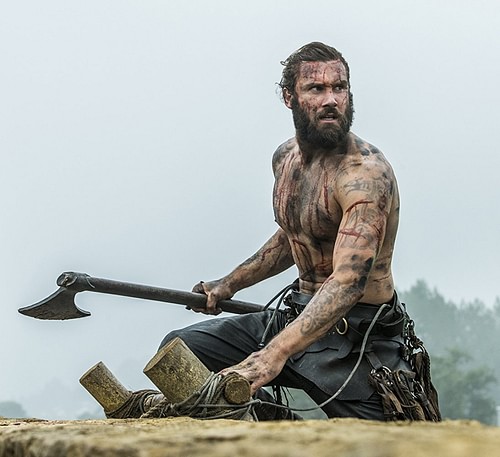
Viking warrior Jaroslav Novak by thecasperart.deviantart.com on @deviantART

No one anywhere was safe, but Irish kings kept up running battles against the invaders. They gradually began to achieve greater success, measured both by victories in battle and by a decline in the number of attacks. In 835 the Vikings were defeated at Derry, and in 845 Mael Sechnaill mac Maéle Runaid, king of Meath, captured and drowned the Viking leader, Turgeis. fleets were still arriving in 849-51, but by a decade later the great raids were over.

That the Irish had found it difficult to resist the invaders stemmed in part from their inability to unite to meet the common threat. The peak of the Viking incursions found the Ui Néill, based at Tara in Ulster, and the Eoganacht, at Cashel in Munster, clashing for the first time on a large scale. And the Scandinavians proved more than willing to join in the local strife. The Vikings very quickly-by the mid ninth century-assumed an active role in the local inter-dynastic warfare. The first Viking-Irish alliance is recorded in 842, and accounts speak increasingly of these pacts from 850 on.

Battles followed battles both within and between kingdoms, and the power of kings waxed and waned. The Ui Néill kings at Tara built up their power gradually in the second half of the ninth century, and the Vikings in Ulster were largely brought under control. The Vikings remained strongest at Dublin, where they frequently allied with surrounding rulers.

The close of the ninth century saw a slackening in Viking activity; however, the respite proved but a brief interlude. A second period of major incursions began in the second decade of the 10th century and lasted for 25 years. The storm to come gathered force in 914 when a great fleet of ships massed in Waterford harbor. In 915 they set out to attach Munster and, later, Leinster, yet again laying waste monasteries at Cork, Aghaboe, Lismore, and elsewhere. And once again, the Irish counterattacked. Niall glundub mac Aedo (d. 919), overking of the Ui Néill, chased the Viking raiders through Munster in 917 but failed to stop them, his allies from Leinster meeting heavy defeat. He himself fell victim two years later when he and many leading aristocrats of the Ui Néill were defeated and killed by the Vikings at the Battle of Dublin. Triumphant yet again, the Norsemen, secure in their base at Dublin, set about consolidating control of outlying settlements in limerick and Waterford. By about 950 the second great wave of raids was largely over.

What effect did the Viking invasions have on Irish society? Certainly considerable death and destruction occurred. Much cultural heritage disappeared, and the number of treasures that were irretrievably lost cannot be calculated.

Yet, while life was disrupted, it was not extinguished. The Vikings, in fact, also had a very positive impact. In founding settlements, they introduced commercial activity into a society hitherto based entirely on subsistence agriculture. once settled in Ireland, the Vikings did not become farmers and fishermen; rather, they became merchants and seamen. Unlike in Britain and France where they moved inland, those in Ireland contented themselves in remaining where they had landed. from their bases that hugged the coastline at Dublin, Cork, Waterford, and on the Shannon at limerick, they built up a system of seaborne commerce that linked Ireland with markets from Scandinavia to Spain.

Dublin retained its status as the most important Viking settlement, and the town grew swiftly in engaging in a far-flung trade that made it one of the richest in Viking Europe.

Dublin, together with York in Britain, became the most important of the westernmost trading posts. Trade became so significant that a cash-based economy was introduced in 953 when the first silver coins were minted. They continued to be issued until the arrival of the Normans. In introducing commercial life to the country, the Vikings set in motion the shift of the island’s political and social fulcrum from the central midlands to east coast urban centers, a move that has endured.

Viking Raids The most famous aspect of the Vikings in the modern sense was their Raids. The victims of the Vikings called them the “most vile people” while the Vikings did not hold that opinion. To the Vikings, raids were their honorable deeds and reasonable consequences of the ambitions of Viking expansions.

Expert traders and sailors, the Vikings introduced their advanced shipbuilding skills to Ireland. Busily plying the coastal waters, the warring wayfarers imprinted their presence on the island’s fringes. Not only settlements-Waterford, Wicklow, Strangford, and Dalkey-but also islands and bays-Blaskets, Smerwick, Salters, and Selskou-carry their names.

Although settlements might suffer repeated attacks throughout the upheavals of the ninth and 10th centuries, social life, while subject to disruptions, adhered to familiar patterns. Monastic communities rebuilt or moved to other locales. Irish kings were hard pressed by Viking incursions, and several small kingdoms near Norse settlements were overwhelmed, yet the strife that had for so long characterized native society never abated. Kings continued to war with kings.

The Norse invasions and their aftermath

The first appearance of the Norsemen on the Irish coast is recorded in 795. Thereafter the Norsemen made frequent plundering raids, sometimes far inland. In 838 they seized and fortified two ports, Annagassan and Dublin, and in the 840s they undertook a series of large-scale invasions in the north of the country. These invaders were driven out by Aed Finnliath, high king from 862 to 879, but meanwhile the Norse rulers of Dublin were reaching the zenith of their power. They took Waterford in 914 and Limerick in 920. Gradually, without quite abandoning piracy, the Vikings became traders in close association with the Irish, and their commercial towns became a new element in the life of the country. The decline of Norse power in the south began when they lost Limerick in 968 and was finally effected when the Scandinavian allies of the king of Dublin were defeated by High King Brian Boru at the Battle of Clontarf in 1014.

Although the Battle of Clontarf removed the prospect of Norse domination, it brought a period of political unsettlement. High kings ruled in Ireland but almost always “with opposition,” meaning they were not acknowledged by a minority of provincial kings. The Viking invasions had, in fact, shown the strength and the weakness of the Irish position. The fact that power had been preserved at a local level in Ireland enabled a maximum of resistance to be made; and, although the invaders established maritime strongholds, they never achieved any domination comparable to their control of eastern England or northwestern France. After Clontarf they remained largely in control of Ireland’s commerce but came increasingly under the influence of neighbouring Irish kings.

Carruthers crest on flag-v2 (1)

CLAN CARRUTHERS -1983

Preserving Our Past!    Recording Our Present!  Informing Our Future!

The Ancient and Honorable Carruthers Clan International Society CCIS

carruthersclan1@gmail.com                carrothersclan@gmail.com

WIDE BANNER with NEW CREST

WEAPONS AND WARFARE

CLAN CARRUTHERS INT SOCIETY CCIS HISTORIAN AND GENEALOGIST

download (12)

You can find us on facebook at :

https://www.facebook.com/carrutherscarrothers.pat.9

https://www.facebook.com/CarruthersClan

https://www.facebook.com/CarruthersClanLLC

Disclaimer Ancient and Honorable Carruthers Clan International Societ
OUR ANCESTORS, The History of Gutland, The Viking Age

CLAN CARRUTHERS – VIKING GAMES

VIKING GAMES


WIDE BANNER with NEW CREST


Gotland Island


Ahe Gotland is perhaps the most famous house in Sweden: Villekulla, known in this country as Villa Kunterbunt, the wooden house of Astrid Lindgren’s Pippi Longstocking. Those who visit the “Kneippbyns” amusement park – a magnet for visitors on the second largest island in the Baltic Sea – can visit the original setting of the “Pippi” films shot on Gotland.

Typical of Gotland: the many pretty fishing villages on the 800 km long coast with wide sandy beaches, ideal for walks. Gotland, island, municipality and historical province at the same time, is one of the sunniest spots in Sweden. Especially the Swedes themselves like to vacation on Gotland and the offshore islets, enjoy the almost Mediterranean climate: in the interior of the island even vines thrive.

THE LONG SHIPS UK/Yugoslavia 1963 Jack Cardiff EDWARD JUDD (left) as Sven BOX ||Rights=RM | Verwendung weltweit

Once the Goths gave the island its name, later the Vikings came, and during the Hanseatic League the island’s capital, Visby, became an important trading center. It offers the feeling of the Baltic Middle Ages: its old town is surrounded by a city wall from the 13th century, a UNESCO World Heritage Site since 1995.

Our Carruthers ancestors traveled from Gotland to Scotland in approximately 400 AD.  They were known as the Aachenman, or Ashman.   They were ship builders who used the sacred Ash Tree from the Aachen Forest.  They were given this land from the Papal Reign and thus protected by the Papal State. 


VIKING GAMES

Tree trunk throwing is part of pentathlon

Throwing a tree trunk as far as possible in Obelix fashion – sounds strange, but it is a serious discipline of Gotland pentathlon. It is part of the Gotland Olympic Games, which in turn have a long tradition. The competitions have been taking place since 1924, most recently with over 2000 participants, the roots going back to the Viking Age.

Viking Summer Raid Weekend 2019 | Viking Performance Training


STONE THROWING OR WARP THROWING

Stone throwing is also an old discipline of pentathlon Warp throwing, a kind of Scandinavian boules. Sprinting, jumping up and playing the ball are also measured. The winner is whoever wins the final wrestling match. 


VIKING SPEAR THROWING

Hurstwic: Viking Spear


The spear – Hurstwic –  was the most commonly used weapon in the Viking age. During this time, spear heads took many forms.


Hurstwic: Viking Spear


The spearheads were made of iron, and, like sword blades, were made using pattern welding techniques  during the early part of the Viking era . They were frequently decorated with inlays of precious metals or with scribed geometric patterns  The Carruthers /Aacheman/Ashman were excellent iron workers.   This trade was handed down to them from other ancestors who lived through the iron age.  Much of their weaponry and even jewelry was magnificent. 


Carruthers crest on flag-v2 (1)


Preserving the Past, Recording the Present, Informing the Future

Ancient and Honorable Carruthers Clan Int Society LLC

carruthersclan1@gmail.com


WIDE BANNER with NEW CREST


CLAN CARRUTHERS INT SOCIETY CCIS HISTORIAN AND GENEALOGIST

Gotland-flag

You can find us on facebook at :

https://www.facebook.com/carrutherscarrothers.pat.9

https://www.facebook.com/CarruthersClan/

https://www.facebook.com/CarruthersClanLLC

Disclaimer Ancient and Honorable Carruthers Clan International Society


Gutland / Gotland, The History of Gutland, Uncategorized

CLAN CARRUTHERS – TIONDELANDAN IN HABLINGBO, GOTLAND

WIDE BANNER with NEW CREST

Tiondeladan in Hablingbo, Gotland

Tiondeladan in Hablingbo


The vicarage environment in Hablingbo with a relatively open green area of ​​a park character constitutes a well-composed whole that is characterized by period-typical buildings characteristic of Gotland.

The manor house was built in 1759-60, possibly on an old foundation.

The rectory is built of stone on two floors and its compact building body’s smooth, simply designed facades with gables without roof overhangs and the highest roof, is an excellent example of the Gotland building condition in the middle of the 18th century.

Outbuilding

The brewery house was built of stone west of the main building, probably in 1869. It is built together with the limestone house built in 1810 with a meat, fish and mangel shed and a small cattle house.

In 1810, the outbuilding was added, also in limestone and containing small cattle houses and retirement.

The barn and the tithing barn

The barn previously consisted of three buildings on the other side of the road. Of these, Sliteladan, from 1875, as well as the “tithing barn” built in 1822, have been preserved to this day.

The latter is probably the only preserved tithe barn on Gotland.

Some of the buildings were renovated during the 1990s.


In affluent Hablingbo the priest had ordered it, who nevertheless scolded them for goats, see the church  , for the tithe in the picture is not small.

It was built in 1822 when the law was still in force that the parish should provide one for its pastor. But after 1862 the tithe did not have to be kept in the rectory and after 1910 the peasants were no longer obliged to keep tithes.

I do not know how the tithe was distributed in the 19th century, but Gutalagen contains a provision from the early Middle Ages on when and how tithing was to be paid. The boys also had an agreement with the pope himself on how it would be distributed: 1/3 to the church, 1/3 to the priest and 1/3 to the poor. The bishops of Linköping have several times during the course of time tried to change this distribution, and of course they wanted to seize part of the poor’s share for other purposes.


We explain how the people of the Middle Ages took care of each other on the side of the medieval society, care , and that is probably not what you have learned in school.

The tithe may not be much to see but it can be good to know what is written there.


Carruthers crest on flag-v2 (1)

Preserving the Past, Recording the Present, Informing the Future

Ancient and Honorable Carruthers Clan Int Society LLC

carruthersclan1@gmail.com


WIDE BANNER with NEW CREST

 Bernt Enderborg

CLAN CARRUTHERS INT SOCIETY CCIS HISTORIAN AND GENEALOGIST

Gotland-flag

You can find us on facebook at :

https://www.facebook.com/carrutherscarrothers.pat.9

https://www.facebook.com/CarruthersClan/

https://www.facebook.com/CarruthersClanLLC

Disclaimer Ancient and Honorable Carruthers Clan International Society
The Viking Age

CLAN CARRUTHERS – DNA STUDY REVEALS IMPACT THAT VIKINGS IRISH SLAVES HAD ON ICELAND.

WIDE BANNER with NEW CREST

DNA STUDY REVEALS IMPACT THAT VIKINGS IRISH SLAVES HAD ON ICELAND.


Genetic research offers an insight into the fate of thousands of ancient Irish women enslaved by the Vikings.


Icelandic genetic research reveals the fate of the thousands of Irish women, who were enslaved by the Vikings and brought overseas to colonize Iceland.

Mostly women were taken from Ireland and Scotland by the Nordic warriors some 1,000 years ago and settled in Iceland. Now, DNA mapping has now revealed that these Irish women did not play as much of an influence in the genetic make-up of modern-day Iceland as the Vikings who brought them there.

DNA research reveals the impact that Irish slaves had on Iceland\'s genetic makeup

In total, the genomes of 25 ancient Icelanders were analyzed by anthropologist Sunna Ebenesersdóttir of the University of Iceland and the company deCODE Genetics in Reykjavik, the Icelandic capital. The results were revealed in 2018. The skeletal remains of these settlers were found in various burial sites across the island.


Analysis on their teeth showed that the remains had an even mix of Nordic (now Norway and Sweden) and Gaelic ancestry, revealing for the first time the results of “admixture,” when the formation of a new population is investigated.

The research revealed that modern-day Icelanders draw up to 70 percent of their genes from this Norse ancestry with the Gaelic settlers having a significant lack of influence. The report, published in “Science,” believes this could be a result of the slavery in which these Gaelic people were brought to the island.


While the ancient settlers were “mainly Norse men and Gaelic women,” and their influence is seen in the genomes of Icelanders today, the population has become distinct over the past 1,000 years, however.

Irish women were brought to Iceland by the Vikings. Image: iStock.

“Repeated famines and epidemics led to a substantial loss of sequence diversity from the Icelandic gene pool, causing it to drift away from its source populations in Scandinavia and the British-Irish Isles,” explained researcher Kári Stefánsson, deCODE chief executive and co-author on the paper.


“This is a fascinating example of how a population is shaped by its environment, in this case, the harsh and marginal conditions of medieval Iceland,” Stefánsson added.

“It is also another demonstration of how our small but well-characterized population can continue to make important contributions to understanding the fundamental genetic and evolutionary processes that shape our species.”

Carruthers crest on flag-v2 (1)

Preserving the Past, Recording the Present, Informing the Future

Ancient and Honorable Carruthers Clan Int Society 

carruthersclan1@gmail.com     carrothersclan@gmail.com

cropped-wide-banner-with-new-crest.jpg

IRISH TIMES

Reviewed by Tammy Wise CHS

CLAN SEANACHAIDHI

CLAN CARRUTHERS INT SOCIETY CCIS HISTORIAN AND GENEALOGIST

You can find us on facebook at :

https://www.facebook.com/carrutherscarrothers.pat.9

https://www.facebook.com/CarruthersClan/

https://www.facebook.com/CarruthersClanLLC

Disclaimer Ancient and Honorable Carruthers Clan International Society


The Viking Age

CLAN CARRUTHERS – ORCADIAN RUNE CARVERS

WIDE BANNER with NEW CREST

ORCADIAN RUNE CARVERS


The highest density of Norse runic inscriptions in Scotland are from Orkney. But what can we tell from them about the people who carved them ?

Runic graffiti at the ring of Brodgar credit:MBell

 Viking Age in Orkney takes us from about 550AD through to the Golden Age of the 12th c.


In Orkney so far there are 56 examples of runic inscriptions – 33 in the Neolithic Maeshowe tomb alone- 7 in Shetland , 2 in Caithness and 13 in the rest of Scotland.

Maeshowe Neolithic Tomb Orkney where there are 33 distinct runic inscriptions

In England there are 19 examples of Norse runes and 0 in Wales.

Dr Freund suggested that the large number of runes found in Orkney indicates that it represents a very literate society. Orkney, Dr Freund said, was an important place in the power play at that time.

It then declined in importance during the 13th C, having backed the wrong side, and then eventually it came under Scottish rule in 1468/9. There had been much intermarriage between the Norse families of influence in Orkney and the Scottish nobility, in a lead up to the eventual take over by Scotland.

There is no complete runestone surviving in Orkney but there are many different examples carved into a variety of materials- stone, metal, 1 in steatite, bone and antler. The 33 in Maeshowe, of course, remain in situ, however, of the other artefacts they are spread across different sites and museums.

Last year Dr Freund was able to bring together some of these amazing objects in an exhibition at The Orkney Museum and it was wonderful to see them gathered together with the informative display panels. Revealing Runes – PhD Student Andrea Freund’s Exhibition

DrAndreaFreund at her exhibition in The Orkney Museum in 2019

The bear’s tooth carving was discovered at the Brough of Birsay, a tidal island, which had been a Pictish (and no doubt earlier settlement) and which was important in the Norse period.

Earls BU Drinking
Hall
Orphir credit: Bell

At The Earl’s Bu, Orphir, one of the main seats of Norse power in Orkney, a runic inscription was carved in Latin.

There is also an example of a lead amulet from Quoys in Deerness which is a mixture of a garbled form of Latin and Old Norse. This Dr Freund suggested indicates a literate people – and in at least two languages. The amulet is so tiny that it cannot be unfolded and we may never know what was written inside it.

Humour is also present and ribaldry in many of the runic carvings. Maeshowe where a group of Norse ‘travellers’ or ‘pilgrims’ broke in to shelter from a storm – or in some tales – on the search for treasure – contains several examples of bawdy inscriptions and the use of nicknames. There are also 6 mentions of women in the Maeshowe carvings with one claiming to be carved by a woman.

The Maeshow runes at Dr Freund’s exhibition at The Orkney Museum in 2019


We will never know how many runic inscriptions we have lost in Orkney which may have been written on materials which have since rotted away. And there may be more to be found .

The number, variety and the use of humour in the carvings would all indicate a high level of literacy.

One of the most thought provoking ideas that Dr Freund spoke of towards the end of her talk was of ‘mental geographies’. What did the people who carved these runes think about their surroundings ? The meaning of place to them.

Interestingly Orkney is not used as a point of reference but the carvers link back to their Norse lands. In Dr Freund’s words it looks like they were trying to be ‘Norser than Norway’. She suggests this is due to the increasing influence creeping in from Scotland and that the carvers were consciously restating their Norse heritage.

By the Golden Age of the Norse in Orkney we are also talking about a Christian world where Jerusalem is depicted as the spiritual centre. There are indeed 2 mentions of Jerusalem in the Maeshowe inscriptions.

The runes give us a glimpse into their world. A world where Orkney was not isolated but part of a wider Medieval Christendom.

This excellent online talk by Dr Andrea Freund, an expert in Norse runes, took place on Wednesday 26th of August.

Brough of Birsay, once an important Norse settlement Credit Bell

Carruthers crest on flag-v2 (1)

Perserving the Past, Recording the Present, Informing the Future

Ancient and Honorable Carruthers Clan Int Society LLC

carruthersclan1@gmail.com


WIDE BANNER with NEW CREST


You can find us on facebook at :

https://www.facebook.com/carrutherscarrothers.pat.9

https://www.facebook.com/CarruthersClan/

https://www.facebook.com/CarruthersClanLLC


Disclaimer Ancient and Honorable Carruthers Clan International Society

Perserving the Past, Recording the Present, Informing the Future

Ancient and Honorable Carruthers Clan Int Society LLC

carruthersclan1@gmail.com


You can find us on facebook at :

https://www.facebook.com/carrutherscarrothers.pat.9

https://www.facebook.com/CarruthersClan/

https://www.facebook.com/CarruthersClanLLC


Disclaimer Ancient and Honorable Carruthers Clan International Society
 
Gutland / Gotland, OUR ANCESTORS, Uncategorized, Varangians

CLAN CARRUTHERS-HARALD HARALDSSON “Fairheaded I”

CLAN CARRUTHERS INT SOCIETY CCIS                  PROMPTUS ET FIDELIS

cropped-wide-banner-with-new-crest.jpg


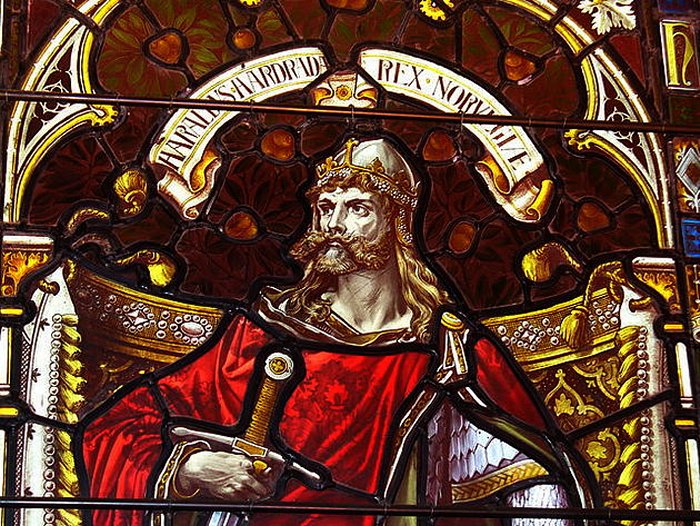
Mighty Viking Harald Hardrada -The Last Great Viking And Most Feared Warrior Of His Time


Ragnar Lobrok, Ivar the Boneless, Bjorn Ironside, Erik the Red, Eric “Bloodaxe” Haraldsson – we associate all those names with courageous and fearsome Viking warriors, but none of them can be compared to the greatest Viking warrior of all – King Harald Hardrada.

Mighty King Harald Hardrada was the last great Viking and the most feared warrior of his world and time.

Mighty King Harald Hardrarda - The Last Great Viking And Most Feared Warrior Of His Time

Viking Hardrada was an extraordinary man who lived an adventurous life. He fought in the deadliest battles and traveled to distant lands where he met exotic and powerful people. His courage and combat skills made him military commander in the Varangian Guard and Kievan Rus’.

Hardrada spent all his life as a professional soldier, and his reputation preceded him.

In the Icelandic Sagas, Viking Hardrada is portrayed as a great hero, but behind all the ancient legends we find a very complex figure, a man who was charismatic, daring, and resourceful. Viking warrior Hardrada became a patron of poets and he was known as ‘feeder of ravens’.

Harald Hardrada – A Great Viking Warrior Is Born

The most comprehensive accounts of King Harald Hardrada’s life can be found in the thirteenth-century collections of sagas of the Norwegian kings, of which the most respected is the one known as Heimskringla and reliably attributed to the Icelandic historian, poet, and politician Snorri Sturluson (1179 – 1241).

German churchman, Adam of Bremen also documented some of King Hardrada’s expeditions, but the cleric’s writings are hostile in nature and far from objective. He does, however, confirm the great Viking’s military skills and warlike reputation when he refers to Hardrada as the ‘thunderbolt of the north’.

Born as Harald Sigurdsson in Ringerike, Norway in 1015, he was the child of Åsta Gudbrandsdatter and her second husband Sigurd Syr, a king of Ringerike and one of the wealthiest chieftains of Upplands, the lands and forest regions to the north of Oslo in Norway. After his death, he was given the title “Hardrada” which means “hard ruler”.

Harald Haraldsson 'Fairheaded' I

The Carruthers are linked to this family genealogically. The biggest problem with genealogy is the correct dates this far back.

From her first marriage, Åsta Gudbrandsdatter was also the mother of King Olaf Haraldsson of Norway, who was later to become St. Olaf.

Hardrada admired his half-brother, King Olaf, very much and it could not have been easy, to see him die in a battle. This particular event was of great significance to Hardrada’s personal destiny and changed his life. Hardrada was loyal to his half-brother until the end.

Harald Hardrada Fought In The Battle Of Stiklestad When He Was 15 Years

When Hardrada was 15 years he engaged in his first battle under the command of his half-brother and hero King Olaf.  Snorri Sturluson’s Heimskringla describes what happened during the battle Stiklestad, and one can say this was the beginning of Viking Hardrada’s military carrier.

In 1028, there was a revolt and King Olaf lost the Norwegian throne to Cnut the Great, England’s Danish king, and ruler of one of the largest Nordic Empires.

Mighty King Harald Hardrarda - The Last Great Viking And Most Feared Warrior Of His Time

King Olaf who had been baptized made his best to convert Norway to Christianity. He also revived and revised the law code of Harald Fairhair, the king who united Norway into one kingdom in 872 AD. He affirmed his influence in the North Atlantic colonies, most importantly in the jarldom of Orkney and he prohibited plundering, but only within the country.

There is no doubt, King Olaf made many crucial changes, but his days were numbered. Cnut the Great had other plans. He wanted to reclaim the throne of Norway and King Olaf was forced into exile.

Two years later, in 1030, King Olaf returned to Norway with a force more than fourteen hundred strong and he was joined by Hardrada and his group of 700 hundred warriors. Together they engaged the army of Cnut the Great, but the battle did not end well. King Olaf was killed and Hardrada was badly wounded and forced to flee. Though he was only 15 years at the time, he showed great combat skills during the battle.

His appearance must have been striking to some. Snorri Sturluson described Harald Hardrada as physically “larger than other men and stronger”. He is said to have had light hair and beard, a long “upper beard” (mustache), and that one of his eyebrows was somewhat higher situated than the other. He also reportedly had big hands and feet and could measure five ells in height.

Viking Hardrada Joins Kievan Rus And The Varangian Guard

In one year, Hardrada managed to cross the Baltic together with other survivors of Olaf’s defeated army. After arriving in Russia, he visited his distant relative Yaroslav I, Grand Prince of Rus’, known as Yaroslav the WiseThe prince had helped King Olaf after the revolt. Being in need of skilled warriors, he employed Viking Hardrada who became captain of the forces of Prince Yaroslav of Kievan Rus. Hardrada fought many battles for Grand Prince Yaroslav the Wise.

You may recognize the name Varangian Guard from other postings on our blogs about the Carruthers ancestors. Gotland/Gutland was the center of the trading industry at this time, and if you sailed east you were a Rus Varangian, meaning River Warrior.

After spending some years in Prince Yaroslav’s army, Hardrada left Kiev together with his warriors and traveled to Constantinople, the capital of the Byzantine Empire. ‘

His goal was to join the impressive Varangian Guard that represented the elite heavy infantry regiment of the Roman (‘Byzantine’) Empire from AD 988 AD to around 1404 AD.

Roman Empire was in need of berserker warriors and hired them among northern mercenaries.

They were Vikings for hire, who successfully conquered territories across the Empire. They fought in Crete, Italy, and in Asia Minor.  To this day you will see Carruthers DNA markers show up in these places.

These professional warriors were highly valued for their courage and loyalty; they had also high fighting skills and the ability to carry out commands efficiently and without unnecessary questions. Harald Hardrada joined the Varangian Guard. He was the best berserker who became the “leader over all the Varangians”. Berserkers (in Old Norse: ‘berserkr’) were Icelandic Viking warriors who were feared by enemies and even their battle companions.  If you traveled west from Gotland, you were an Icelandic Warrior.

As commander, he fought in places as far apart as the Mediterranean, Asia Minor, Sicily, and the Holy Land. He was a famous and respected military leader. Hardrada had now enough earnings to marry Yaroslav’s daughter Princess Elisaveta (Elisiv), something he could not do earlier because he was too poor.

More About Vikings

Rich in combat experience and wealth Hardrada returned to Scandinavia in 1046. He had carefully prepared his campaign of reclaiming the Norwegian throne. Cnut the Great had died and Magnus I, also known as Magnus the Good was now king of Norway.

Mighty King Harald Hardrarda - The Last Great Viking And Most Feared Warrior Of His Time

Harada reached an agreement to share the rule of Norway with Magnus I. When Magnus I died, Harada became the sole King of Norway.

Harada was not happy with only being the king of Norway. He wanted to rule over Denmark as well, and he and his warriors plundered the country repeatedly, but the Danish King Svein Estridsson who lost almost every battle against Harald, managed to stain in power. In 1064, Harald and Sweyn reached a peace agreement.

Knowing, Denmark could not be his, the warrior King Hardrada sought new grounds that he and his men could conquer. Hardrada was now keeping his eye on England.

Battle At Stamford Bridge And The Death Of King Hardrada

After the death of Edward the Confessor, the English throne passed to Harold Godwinson. King Hardrada allied himself with Tostig Godwinson, Harold’s brother, who had been deprived of the earldom of Northumbria by Edward in 1065.

In 1066, Saxon troops of Mercia and Northumbria commanded by brothers Earl Edwin and Earl Morcar and met a Norse army under command of King Harald Hardrada accompanied by Earl Tostig.

The Battle Of Stamford Bridge

Both King Hardrada and William, Duke of Normandy wanted the throne of England. William gathered a fleet and was ready to sail across the Channel to the south coast of England, Harald gathered an invasion force in the north. The Norman army had only 7,000 men. King Hardrada’s Viking warriors met the troops from Mercia and Northumbria, at Fulford, on the outskirts of York and the battle took place.

It was a terrible fight, in which the armies of Mercia and Northumbria were defeated. York surrendered to the invaders, and Harald did not enter the city but retired to Stamford Bridge to await the gathering of hostages from around the region.

This was a huge mistake. The Norse warriors had only 5 days to enjoy their victory at Fulford.

On 25 September, King Harold, the last Anglo-Saxon king of England, surprised Harald Hardrada of Norway at Stamford Bridge and defeated the Norsemen. Hardrada and Tostig were killed. Harald Hardrada’s death was caused by an arrow that struck his neck. He was buried at the Mary Church in Nidaros, Norway.

In a way, it’s a bit ironic that a great warrior like Hardrada who traveled to distant lands and fought in deadliest battles died after spending only a few days on British soil.

Mighty Warrior King Hardrada As A Person

With the death of King Hardrada, the Viking Age ended. Hardrada was a harsh ruler who often solved disputes with force, but his reign was one of peace and progress for Norway. He advanced Christianity in Norway, built churches, imported bishops, developed a Norwegian currency, and viable coin economics. His contacts with the Byzantine Empire and Kiev helped Norway to expand its international trade. King Hardrada also founded the capital Oslo.

Harald Hardrada was the last great Viking.

Carruthers crest on flag


Preserving Our Past!    Recording Our Present!  Informing Our Future!

The Ancient and Honorable Carruthers Clan International Society LLC

carruthersclan1@gmail.com                carrothersclan@gmail.com

cropped-wider-banner-light-blue-1.jpg

Ellen Lloyd Ancient Historian

CLAN CARRUTHERS INT SOCIETY CCIS  HISTORIAN AND GENEALOGIST


You can find us on facebook at :

https://www.facebook.com/carrutherscarrothers.pat.9

https://www.facebook.com/CarruthersClan/

https://www.facebook.com/CarruthersClanLLC


Disclaimer Ancient and Honorable Carruthers Clan International Society CCIS L


OUR ANCESTORS, Uncategorized

GUNNHILD KONUNGAMODIR- CLAN CARRUTHERS CCIS

CLAN CARRUTHERS INT SOCIETY CCIS                         PROMPTUS ET FIDELIS

cropped-wide-banner-with-new-crest.jpg

Gunnhild Konungamóðir

CARRUTHERS ANCESTOR

jorvik (2).png

Wife of Eric Bloodaxe, mother of kings, and king-maker – Gunnhild was one of the most politically active women in Norway, Orkney and Jorvik, featuring prominently in several sagas.

The 12th century Historia Norwegiæ tells us that Gunnhild was the daughter of Gorm the Old, King of Denmark, and so her marriage to Erik was a union between two great houses, the Norwegian Ynglings and the early Danish monarchy. This version of events is largely accepted by modern scholars, though Heimskringla and Egil’s Saga have Gunnhild as the daughter of Ozur Toti, a military commander from Halogaland. Whichever version is true, Gunnhild and Erik had a fruitful marriage with several children, as rulers over Norway.

During their time in Norway, Gunnhild and Erik were embroiled in an intense enmity with Egil Skallagrimsson, and as a result are portrayed particularly negatively in his saga and poetry. Egil killed one of the king’s retainers, prompting Gunnhild to order her two brothers to kill Egil in revenge. But Egil killed Gunnhild’s brothers too, and Erik declared him an outlaw in Norway; initiating further deaths as the king’s men hunted Egil, and Egil killed them in turn.

Eventually Egil fled Norway, cursing the royal couple with a horse’s head upon a pole:

“Here I set up a níð-pole, and declare this níð against King Erik and Queen Gunnhildr”, — he turned the horse-head to face the mainland — “I declare this níð at the land-spirits there, and the land itself, so that all will fare astray, not to hold nor find their places, not until they wreak King Erik and Gunnhild from the land.” He set up the pole of níð in the cliff-face and left it standing; he faced the horse’s eyes on the land, and he rist runes upon the pole, and said all the formal words of the curse.”

Gunnhild and Erik were themselves expelled from Norway after a rebellion by nobles in favour of Erik’s half-brother, Haakon the Good. The couple settled in Orkney, then in Jorvik, where Erik became king over northern England, and where Gunnhild and Erik may have been baptized. Jorvik was also the scene of a final encounter between Egil and Gunnhild, around AD 948.  Egil was shipwrecked and brought before Erik, who sentenced him to death – but Egil wrote and recited a poem singing the king’s praises, which won him his freedom, much against Gunnhild’s wishes.

After Erik’s loss of Jorvik and death at the Battle of Stainmore in AD 954, Gunnhild eventually returned to Denmark, finding a home at the court of Harald Bluetooth. Her son Harald was fostered by the king and her other sons much favoured, all fighting in the war against the Norwegian King Haakon. When he died in battle, Gunnhild’s sons were able to exploit the power vacuum and established rule over Norway.

Gunnhild became a key player at court, known from this time as konungamóðir, mother of kings. Heimskringla says that she ‘mixed herself much in the affairs of the country’. It was a turbulent time, with Gunnhild’s sons killing or deposing many provincial rulers, and famine stalking the country.

Unrest eventually led to more civil war, and Gunnhild’s son Harald was killed by his once-foster father Harald Bluetooth. Gunnhild and her remaining two sons once more fled to Orkney; but she seems to have sought a quiet life there after her years of political machinations. According to Jómsvíkingasaga (and with similar stories in other sources), Gunnhild returned to Denmark around 977 but was killed at the orders of King Harald by being drowned in a bog.

A fascinating coda to Gunnhild’s story came in 1835, when a murdered female body was found in a bog in Jutland and mistakenly identified as the queen. Contemporary King Frederick VI commanded a regal sarcophagus to house the body, but later radiocarbon dating proved that the woman lived much earlier, in the 6th century BCE.

Carruthers crest on flag

Preserving Our Past!    Recording Our Present!  Informing Our Future!

The Ancient and Honorable Carruthers Clan International Society LLC

carruthersclan1@gmail.com                carrothersclan@gmail.com

cropped-wider-banner-light-blue-1.jpg

CLAN CARRUTHERS INT SOCIETY CCIS  HISTORIAN AND GENEALOGIST

You can find us on facebook at :

https://www.facebook.com/carrutherscarrothers.pat.9

https://www.facebook.com/CarruthersClan/

https://www.facebook.com/CarruthersClanLLC

Disclaimer Ancient and Honorable Carruthers Clan International Society CCIS L
Gutland / Gotland, The Viking Age, Uncategorized

CLAN CARRUTHERS – GOTLAND-AN ISLAND IN THE MIDDLE OF AN ISLAND

cropped-wide-banner-with-new-crest.jpg


AN ISLAND IN THE MIDDLE OF AN ISLAND- GOTLAND/GUTLAND

On Cult, Law s and Authority in Viking Age

** Our norse ancestors came from the Island of Gotland, east of Sweden.  They were considered Christians from the earliest times.  Please notice the acceptance of monastery’s, meeting places on the west coast of Scotland, and the fact that they had Clans and used the term Chieftain .  Some will say that their are only clans in Scotland, and we know that is not truthful. ***


The present-day small village of Roma on Gotland in the Baltic Sea was the
physical and symbolic centre of the island in the Iron Age and into Medieval
times (Fig. 1). The Cistercian monastery and the meeting place of the island’s
assembly, the all-thing, two well-known features of medieval Roma, have often
been taken as indications of an egalitarian and non-stratified society on Gotland during the Viking Age and Middle Ages. It is here proposed, however,
that an older Iron Age cult site at Roma eventually came under the control of
a chieftain or major landowner who introduced Christianity, founded a monastery and inaugurated the thing in Roma in Viking or early medieval times,
just as his equals did elsewhere in Scandinavia. While the later medieval thing
was probably located near the monastery, an alternative site is suggested for
the older all-thing.
T he A ll -thin g of Gotland
In Medieval times (i.e. from c. 1100 onwards in local terms) Gotland was organised into 20 thing districts. These legal entities are mentioned in the Guta
Lagh (Gotlandic Law) and Guta Saga (printed edition Gannholm 1984), which
were written down at the beginning of the 13th century (but may contain older
strata, see Kyhlberg 1991). It is not certain whether the things were prehistoric
or belonged to an early medieval re-organisation of the island (Steffen 1943,
pp. 3 ff, 48 f; Hyenstrand 1989, pp. 15f , 108 ff; Rönnby 1995, p. 103),

page_2 (2)

but they served as means of organizing both societal relations and the physical space.
Lag means ‘law’, but was also used for the community of people who lived by
a given law, and for the physical area in which this community lived (Gurevich
1985, p. 157; Brink 2002, p. 99). As the judicial entities in that sense also constituted social and territorial boundaries, they thus defined much of the human movement that took place within the local society
The all-thing of Gotland, the island’s central assembly and supreme legal
instance, is of particular interest since it has been suggested (notably by Yrwing 1940, 1978) that its existence points to an egalitarian society of free farmers on Gotland during the Viking Age and Middle Ages.

This picture of the internal organisation of the island has been questioned on several occasions (e.g. Carlsson 1983; Hyenstrand 1989; Rönnby 1995), but it is still common and
is continuously being communicated to the public. The existence of a central
assembly on the island is mentioned in the Guta Lagh and Guta Saga (e.g. GL
§31, GS §9), and it is also likely by analogy with the medieval organization of
other Scandinavian-dominated areas such as Iceland. The image of Gotland as
an egalitarian farming and trading society nevertheless needs to be called into
question once more.
The area of Roma in the centre of the island was first named as the site of
the Gotlandic all-thing assemblies in the 1401 translation of the Guta Lagh
into German: “gutnaldhing das ist czu Rume” (Pernler 1977, p. 61; Yrwing 1978,
p. 80), while according to taxation records for 1699, some of the land around
the monastery of Roma may have belonged to several things (Östergren 1990,
2004) (Fig. 2). That this was the place where the Medieval all-thing gathered
might also be indicated by the name of the Cistercian monastery founded
there in 1164, Sancta Marie de Guthnalia, as suggested by Lindström (1895).
In his interpretation, Guthnalia could be a Latinized form of *gutnalþing, the
all-thing of the Gutar (Gotlanders), so that the name of the monastery was
derived from the all-thing itself, which may indeed have initiated the foundation of the monastery (Lindström 1895, p. 170 ff ). This suggestion and interpretation could imply that the all-thing took an active interest in the introduction of Christianity to Gotland, and thus may bear witness to the democratic character of early medieval Gotlandic society.

The endowment of land for the monastery could have been made out of land held in common by the Gotlanders and thus controlled by the all-thing (Östergren 2004, p. 44).
It should be remembered, however, that Christianization and the foundation of churches and monasteries were in all other cases initiated and dominated by individuals, normally major landowners or petty kings. The interpretation is thus based on a pre-supposed difference between Gotland and the rest of Scandinavia, namely the existence of a particularly egalitarian society on Gotland. Since this hypothesis or presupposition relies to an extent on the fact that it is used to explain, we are here dealing with a classic example of a circular argument. Luckily, archaeology can provide some more input that should be taken into consideration when discussing this matter.
images


Guldåkern and Kräklige  Tingsäng
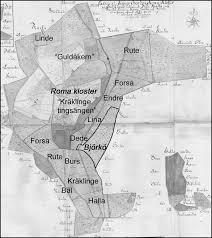
The 1699 taxation map shows several plots of land with names referring to
things surrounding the monastery of Roma (Fig. 4), and Östergren suggests
that this was where the representatives attending the thing slept and kept their
animals during the meetings. Thus the area around the Roma monastery may
have been land held in common, where the different things held rights over
certain areas. In order to be at the centre of these dwelling places, the all-thing
itself must have assembled within the area of the later monastery (Östergren
1990, 2004, p. 40 ff ).
About 600 m northeast of the monastery lies the Guldåkern (the ‘Golden
Field’, named after three solidi coins found there in 1848, Fig. 2). This area, c. 200 x 300 m in size, was investigated with metal detectors in 1990 and was interpreted as a Viking Age trading place on the basis of finds of silver fragments, silver coins and weights, most of the material being from the 10th century AD.

The adjacent Kräklinge tingsängen (meadow of the Kräklinge thing)
was investigated on the same occasion and yielded silver coins, melted silver
and bronze, fragments of bronze jewellery and a casting cone, indicating metalworking at the site, and was considered to be a farmstead from the Vendel
or Viking period (Östergren 1992, p. 42 f ). Roman denarii were found at both
sites, indicating that they were connected in terms of their use during the period prior to the Vendel and Viking ages (all the Roman coins probably ended
up there during the fourth century AD). Unfortunately, the area was much
disturbed during the Second World War and it is thus difficult to say exactly
how and where the artefacts were initially deposited.
Guldåkern, Kräklinge tingsängen, and the other plots with thing names, are
all interesting sites, but neither has been suggested as the actual location of the
thing itself. The thing was not the scene of either trade or metalworking, nor
did people live there. It has been suggested that the Vendel and Viking Age
material found on Guldåkern and Kräklinge tingsängen results from the fines
and fees paid and exchanged during negotiations at the thing (Domeij 2000, p.
36 f ). If this is so, it would be the most tangible proof so far for a pre-medieval
thing actually having been located in the area.
The central location of the monastery within the semi-circle of properties
named after things may be a result of the monastery having been founded on
land held in common, and would thus indicate that this land was given to the
Cistercians by the things in 1164. But the distribution of these properties may
just as well result from their being secondary to the monastery, and demonstrate
that the monastery is the older feature and the localizing factor.

T he G u tnal þ in g
The word Gutnalia in the name of the Cistercian monastery at Roma first
appeared in written sources in the 13th century and was subsequently used
on the seals of the monastery and its abbot (Ortved 1933, p. 305), so that the
place-names Roma and Gutnalia are used interchangeably in the documents
(Lindström 1895, p. 171; Ortved 1933, p. 304 f ). It has been suggested that this
(Latinized) name of the monastery refers to the all-thing. But why would the
monastery take its name from an administrative assembly? And if the thing
was indeed so important, why is the place not named ‘Allthingia’? One significant point is that the Guta Saga does not actually read gutna alltþing, but gutnal þing (e.g. GS §9), as pointed out by Hjalmar Lindroth (1915) while discussing the linguistic basis of the name Gutnalia.

He concluded that Gutnal is an independent place-name, Gutna al (al of the Gotlanders) (Lindroth 1915, p.66 f ). Most Cistercian monasteries and churches were dedicated to the Virgin Mary, and thus the epithet “…de Gutnalia” served to distinguish the monastery of Roma from its sister institutions. The name Gutnalia itself, though,
must have been derived from a place-name containing the element -al.
A place denoted by al should be understood as a ‘protected area’, but there
is also a connection between al and assembly places (Vikstrand 2001, p. 192
ff ). Most al names denote natural features, but a few may have a cultic or
sacral meaning: Götala, Gutnal, Fröjel, Alsike and a few others. These names
derive from the Germanic alh-, ‘protection’ (Brink 1992, p. 111 ff ). The word
has connotations such as ‘defended’, ‘shielded’, ‘consecrated’ and ‘sanctified’.
Furthermore, al is apparently found where there was a building of great social
distinction (ibid, p. 116). In German non-religious texts the word was used in
the sense of ‘house’, ‘protection’, ‘a fenced, protected area’ or ‘a legally protected
place’ (settlement) (Schmidt-Wiegand 1967, 1989). It is known through texts
such as a runic inscription in Oklunda that cultic places were under some kind
of legal protection (see below), and also from passages in the Guta Lagh and
Guta Saga (GL §13, GS §11). The notion is also found in a Christian context,
in the idea that the sanctity of churches should not be violated.
The gutn(a) part of Gutnalia ties the name and the place to the Gotlandic
people. In that sense the interpretation of a pre-Christian cultic al-place of
importance to the Gotlanders does not disagree with the notion of the name
being connected with the all-thing. Cults and legal/regal authority may have
been even more intertwined in earlier times than later during the Medieval
period. The difference is that in one case, Latinized Gutnalia would refer to al,
the physical ‘(cult-? central-? thing-?) place of the Gutar’, perhaps connected
with a prominent house or hall. In the other case, the name Gutnalia would
refer to all as in the all-thing (‘-thing’ simply being omitted from the name)
and would imply that the thing wanted to found a Christian monastery, and
had the authority to do so. I will proceed to argue that the first explanation is
the more likely one.
The setting of the all -thin g

download (1)
The exact locations of ancient thing assemblies are rarely known, but in several cases there is at least some information deriving from historical sources, folk
tradition or place-names. Such assemblies were often thought to have been held at prehistoric monuments such as great mounds, or ‘judge’s rings’ (Sw.
domarring, an Iron Age grave type consisting of a circle of boulders or vertical stones). But more frequently the meeting places are hard to identify, and
it is generally difficult to determine the age of a thing site or to locate it by
archaeological means (cf. Sanmark 2004).

Viking Archaeology - Law Ting Holm

The Law Ting Holm in Loch Tingwall, Shetland, Scotland

Prehistoric assembly places are generally found in areas with a high concentration of rune-stones and prehistoric graves, often on the “periphery” of a settled area. Also, assembly places were often moved on one or more occasions in the later Middle Ages (although, as far as is known, never more than 10 km) to comply with new situations or
demands on accessibility, but the old locations apparently influenced the allocation of later assembly places up until late historical times (Sanmark 2008, p. 15). Thing sites were often not situated near settlements, but rather at communication nodes in the landscape (Vikstrand 2001, p. 412; cf. Wilson 1994,
p. 67).
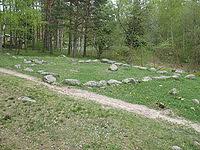
Arkils tingstad - WikipediaThe morphology of thing sites also shows much variation: open places,
mounds, or a rectangular stone-setting such as Arkil’s thing site in Uppland
(Nordén 1938; Lönnroth 1982). The excavated remains of Þingnes in Iceland
revealed a concentric circular structure surrounded by farmhouses (Ólafsson
1987, p. 343 ff ).
downloadThe physical assembly place has thus often been connected with prehistoric
monuments and manifest remnants such as procession roads, both prehistoric
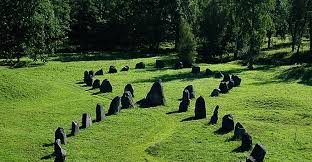
and Medieval. The majestic Anundshög [Anund’s mound] in Middle Sweden
is one well-known example where a great mound, a procession road flanked
by large stones, and several monumental prehistoric graves (stone ships) are
combined, making a profound impression on the visitor even today. There is
no real proof, however, that these “thing” mounds were indeed once settings
for prehistoric assemblies. That may well be an invention of later times, connecting the impressive monuments with the forefathers and people of the past.
It is simply difficult to tell which one was the localizing factor: the thing site
for the monument, or the monument for the idea of how a thing was staged?
The known thing sites suggest there was in reality a considerable amount of
morphological variation.
Islands as settings for things
download (1)There are similar traditions attached to thing and assembly places in northern
Britain and in Scandinavia, with mounds or stone circles being identified as
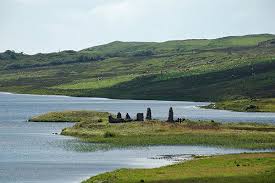
gathering places (Driscoll 2004). On Islay, off the west coast of Scotland, an
important medieval meeting place was situated on a small island in a lake
(Eilean na Comhairle, ‘the council isle’, in loch Finlaggan).

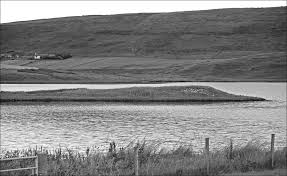
Scalloway - Vidlin | Shetland.orgDuring the negotiations the lord and his attendants would live on a larger island nearby, just off the shore, in a royal complex that included a monastery (Caldwell 2003). On
Shetland, the Law Ting Holm in the lake of Tingwall was a small island close
to the shore which was used for assemblies in the Norse (Viking/Medieval)
period . The most important medieval church of Shetland was on the
shore, and both Eilean na Comhairle and Law Ting Holm were connected to
the shore by a causeway.
download (2)
Islands, an islet or holm as it may have been, have so far not been much
discussed as possible thing sites in a Scandinavian context. Þingnes in Iceland
was apparently situated on a promontory or peninsula (also reflected in its
name), but I have found no discussion on ‘island’ settings as such. Still, bearing
in mind the similarities between the assembly place traditions of the (Norsedominated) British Isles and Scandinavia in other respects, the suggestion can
be put forward that islets or small peninsulas should be evaluated in a new
light in the search for the elusive Scandinavian thing sites of the Late Iron Age
(Viking Age) and early medieval times.
Before and during the Iron Age the whole area of present-day Roma was in
the nature of a promontory, surrounded partly by wetlands and partly by open
water , and it was probably possible to reach the Roma area by boat all
the way from both coasts. At the south end of the complex of waterways surrounding Roma is the narrowest point, a small strait, with Gotland’s largest Iron Age burial ground (Broa, in the parish of Halla) and the Viking or Medieval fortifications of Hallegårda just across the water.

To the northwest and southeast the land is much higher, and the area of Roma thus lay ‘sunk’ between the two halves of Gotland. The peninsula of Roma was like an ‘island in
the middle of the island’ which had to be passed through no matter whether
one was travelling in a north-south or east-west direction, on land or by boat.
Roma parish church, a prominent three-aisled hall church erected in the mid-13th century, is situated on a high point north of the monastery and by a crossroads. It was preceded by a stone church from the 12th century (which was already there when the monastery was founded), which in its turn was perhaps preceded by a wooden church.
Broa (‘the bridge’) about 1.5 km southwest of the Roma monastery on the
other side of the bog, is the largest burial ground on Gotland and one of the
best sources of material of a typical high-status character. The cemetery was in
use from the Roman Iron Age to the Viking period, and the artefacts found
include numerous weapons and four prestigious helmets from the Vendel period as well as an equestrian grave from the early Viking period. In particular
the helmets indicate connections with high-status graves outside Gotland,
such as those of Vendel in Central Sweden or the British Sutton Hoo ship
burial. This distinguishes the Broa area from the other large centres and burial
grounds on northern and southern Gotland. The area stretches away on both
sides of the road southeast of the present bridge, and along the road running
north to Halla and Hallegårda (Fig. 4). The latter is a fortification of concentric circular walls with a stone building inside, probably of late Viking or early Medieval origin and has been interpreted as a centre inhabited by a local chieftain (Broberg et al. 1990).

This complex is situated south and southeast of the Roma monastery, on the other side of the wetland. There was once a small island or islet, Björkö, in the northeast mouth of the
strait, a feature which is still visible on late 19th-century maps drawn before
the draining of the bog began. The name of the island incites curiosity, since
Björkö is also the present name of the famous Viking Age town of Birka in
Lake Mälaren. In medieval Scandinavia the word Birka (Bjärka, Björkö) denoted a certain type of legislation, Bjärköarätt (the early legislation of many
early towns), and more generally ‘special jurisdiction’ (KHL, p. 656, entry Bjärköarätt). This may have nothing to do with the small island near Roma, but the
island is still interesting in its own right. Considering the similar traditions
surrounding thing and other assembly places in northern Britain and in Scandinavia, one may wonder if we are not looking here at a Scandinavian parallel
to the islands in the Finlaggan and Tingwall lakes.
The British examples of island thing sites, with churches, manors and accommodations for the attending parties on the shore, evoke the question of
whether the semicircle of properties bearing the names of things to be found
around the Roma monastery was in fact not relating to the waterfront at the
time, and that they faced the islet of Björkö rather than the monastery. It may
indeed be suggested that, at least in prehistoric and early Medieval times, the
assemblies may have been held on Björkö rather than in an area now beneath the monastery ruins or in any of the adjacent meadows. The Broa cemetery and
perhaps also the Hallegårda fortifications behind the island would have been
clearly visible from the shore, offering a view of the centre of power and the
resting place of the great forefathers as a background.
Unfortunately there is nothing left to prove that Björkö was an assembly
place, since the islet itself has been almost totally destroyed through draining
and digging in the bog during the past decade. There are now dams where the
island was until the beginning of the last century. This hypothesis will thus
remain unconfirmed unless new evidence is uncovered to prove it. This setting
for the assembly place makes far more sense, however, and conforms better to
other historically known settings such as Þingnes or Law Thing Holm than
does the previously proposed location on the site later taken over by the monastery.

The staging of the thing
According to written sources such as the Icelandic Sagas, negotiations at a
thing took place within a demarcated area and most of the agents attached to
the assembly had to remain outside. The law-court was probably marked out
with vébond, strings or ropes tied between rods stuck into the ground, or running through iron rings attached to the rods, as seems to have been the case at
the recently excavated site of Ullevi in central Sweden (Blomkvist & Jackson
1999, p. 21; Vikstrand 2001, p. 332; Brink 2002, p. 90; Svenska Dagbladet June
22 2008, p. 24 f ).

The word vébond is connected to the concept of vi, appearing
as a place-name in itself or as part of one (as in Ullevi, meaning ‘the Vi of
the god Ull’). ‘Vi’ denotes a protected area where there was a right of asylum
(Vikstrand 2001, p. 323 ff ), and has been interpreted as meeting place consecrated to the supernatural powers, an arena for cult and common ritual under
divine protection (ibid, p. 332). ‘Vi’ often appears in pairs with the toponym
lund [grove]¸ which denotes the cultplace proper, the sacrificial grove (a famous Lunda excavated recently outside Strängnäs in central Sweden, yielded
spectacular finds of gold figurines and more than 4 kilogrammes of burnt and
crushed human bones; see Andersson 2003, 2004). The locations for meetings
of a thing thus seem to have been very complex places, including several nodes
and combining legal actions with various cult and ritual elements.
Concepts of peace and inside/outside were also connected with the assembly place and with the ideology of the thing, as also with the vi. Inside
the vébond sphere there was friðr (‘peace’), and outside there was úfriðr (‘unpeace’) (Blomkvist & Jackson 1999, p. 21 f ). This was manifested through the demarcation of an area. The concept was not exclusive to the thing, but an individual could also legally seek asylum and protection by drawing a ‘circle of peace’ for himself. This is described in the medieval Gotlandic Guta Lagh (GL§13), but was probably also a legal feature in other parts of Scandinavia much earlier than the 13th century. Such an event is described in a 9th-century runic inscription in Oklunda (Sweden) (Lönnqvist & Widmark 1997, p. 151; Gustavson 2003, p. 187), where one Gunnar states that he has fled to this vi, inside
the circle of peace. This runic inscription may be regarded as a legal document
(Brink 2002, p. 96) but it may also have had a magical meaning, since the carving is shaped like a tied bond (Lönnqvist & Widmark 1997, p. 156 f ).
The vébond strings served a double purpose: they created a restricted area
where peace had to be kept, and they divided the lawmen from the ordinary
delegates during the meeting. The apparent tension between these two groups,
as reflected in the Icelandic law compilation Grágás, Egils saga Skallagrimsónar,
and Viga-Glúms saga, for example (Holmgren 1929, pp. 22, 25 ff ), may have
been due to the innate tension between those who enforced the law and siðr
(old custom) and those who had to accept their judgements. Respect for the
law-courts was just as fundamental as it is today, and infringement of it was
punishable by exile in Iceland (ibid, p. 25). Runes on a large 9th-century ring
from Forsa in northern Sweden (interpreted as an oath ring for use at the
thing) describe what will happen to the one who fails to respect the law-courts
and the asylum granted by the vi. This involved fines and the suspension of
property rights (Ruthström 1990; Brink 2002, p. 97 f; cf. Myrberg 2008, p.
146).
Rings were obviously important within the context of the thing, as indicated by the phrase ‘bringing something a þing ok a ring [to the thing and to the
ring]’ which is found in medieval laws (Holmgren 1929, p. 22 ff; Blomkvist &
Jackson 1999, p. 21). This may be a reference to an oath ring, kept in the temple
and brought out by the cult leader during legal negotiations (cf. Habbe 2005, p.
134 f ), such as the Forsa ring, or to the numerous smaller rings found on Ullevi
and originally probably attached to poles around the sacred area. “All is bound
in rings” the Guta Saga states solemnly, probably giving some kind of authentication to the text. References to band, ring and baugr (ring) in the sagas may
have a religious and/or judicial significance (Blomkvist & Jackson 1999, p. 20
ff ), and the tying of knots and giving away of rings are accordingly frequent
themes in the mythology and sagas as metaphors for the giving of promises or
establishment of relations.
The staging, ritual and ideology of the prehistoric or early medieval thing
thus seem to be much concerned with concepts of peace, inside/outside and rings, as well as with social reproduction, the community and the maintenance
of old customs, siðr. Ritual meals and communal feasting are thought to have
been part of the thing meetings and of the associated cultic activity (e.g. the
sjudning, ritual meals consumed with one’s suþnautar, ‘cooking brothers’, described in the Guta Saga (GS §5; cf. Yrwing 1951, p. 13; 1978, p. 82).

The thing may have represented a social ideology of equality in a time that otherwise
demonstrated great social differences. As a parallel, one may look at Iceland,
where the early laws and sagas helped to create and maintain a mythology and
ideal of an equal society which was not the real situation even in the earliest
landnám period (Rafnsson 1974, p. 187 f; Durrenberger 1992; Meulengracht
Sørensen 1993, p. 149; Smith 1995).
Gutnal , the monastery , and the all -thin g of Roma
It is easy to imagine that the low-lying promontory surrounded by lakes and
bogs in the middle of the island held a particular fascination for the people
of Gotland, especially at a time when waterfronts and bogs were of central
importance for cultic and votive activities, as seems to have been the case for
example at Tuna, southwest of Roma, and in the Roma mire itself. Gold and
wild boar tusks were found in the Roma mire during drainage work in the
1930s (SHM 17815, SHM 32811). Tuna has yielded a number of spectacular
finds, such as Roman coins, gold bracteates and a mass of golden rings, mostly
belonging to the Migration period, c. 400–550 AD (Hildeberg 1999, p. 24),
although the Roman denarii point to use of the site having begun around AD
300 (Roman Iron Age).
If the promontory was indeed an Iron Age al place, this would have sustained its function as a central meeting place for many centuries. But the archaeological and historical evidence also demonstrates the influence of local chieftains, as visible in matters ranging from burials and the deposition of Iron Age valuables in these to the building of private churches and the granting of land for a monastery. Explicitly referred to as a ‘chieftain’ can be detected in the written documents concerned with the founding of the monastery, and the initiative and endowment for all the other Swedish monasteries is known to have come from a major landowner or petty king with ambitions.
The role of a bishop in the process may have been decisive in some cases (Nyberg 2000, p. 211 f ), but this usually resulted from the bishops’ close family
connections with the nobility. The building of churches and monasteries was a
means by which the elite could act like continental kings and associate themselves with the expanding Church, and thus legitimize their claims to power
and retain their ideological influence within society (cf. Nyberg 2000, p. 81 ff;
Tagesson 2002, p. 237).
Such elite figures or chieftains are detectable in the Gotlandic archaeological record, and are also mentioned in the Guta Saga, being described as rich
landowners or lawmen, as being ‘wise’, or as acting as emissaries abroad. A
few kilometres northwest of Roma one still finds Akebäck and Kulstäde , where, according to the Guta Saga (§10), the first church on the island was
built by a private patron, probably in the 11th century.

This patron, Botair, actually had two churches built, since the people of the island burned the first one down, and tried to burn the second one as well. Botair was sufficiently influential, however, to build his churches in two prominent places: one (Kulstäde)

Vall Parish, Gotland, Sweden Genealogy Genealogy - FamilySearch Wiki
within a few kilometres of the Gutnal, and the other at Vi (often interpreted as
the present-day Visby). The prominence and significance of vi places has been
pointed out above. It may be that Botair’s self-confidence was partly based on
the fact that he was the son-in-law of Likair the Wise, a man who according to
the Guta Saga “reth mest um than tima” (ruled/advised most in that time) (GS
§11). Likair was thus either a petty king or the island’s highest legal authority,
and Botair must accordingly have been considered a mighty person himself to
conclude such a good marriage. Apparently he controlled land very close to
the Gutnal, most likely through inheritance, and it was there that he built his
first church.

102 Best gutland images in 2020 | Vikings, Norse, Viking age
The period of Botair, and of the Iron Age-medieval centre of Broa-Hallegårda, is close to the time when the monastery in Roma was established.
That is, to the time when the all-thing is thought to have been in command
of the land in the Roma area. Yet close to the monastery there was land in
one direction that was controlled by one of the most influential (and probably wealthiest) men on the island (Botair), and in another direction there
was the (now anonymous) owner of the fortified Hallegårda.

‘Botair’ may be only an imaginary figure in the saga, but the Hallegårda-Broa complex bears archaeological witness to the fact that such persons must have existed there at
the time. At least the early 13th-century author of the Guta Saga takes their
existence for granted. The thing as an institution has been regarded as having
been dominated by small farmers, so that it remained independent of the great
landowners, since this is the picture inferred from the medieval laws (Brink
1998, p. 300; Vikstrand 2001, p. 412). Again, archaeology gives us a different
picture, in particular regarding the Viking period. Jarlabanke, a major landowner in central Sweden, inaugurated a thing site in the 11th century, as did
Arkil and his brothers some generations earlier to commemorate their father Ulf, also a great landowner (Nordén 1938; Lönnroth 1982; U 212, 225, 226).

TheÞingnes assembly place, Iceland’s first, was founded around 900 AD by the
‘supreme chieftain’, the Allsherjargodi, next to his house (Ólafsson 1987). Thus
archaeology shows us that an upper class of landowners took an active part in
developing the thing as an institution and influenced its location.
Is it plausible that the Gotland all-thing could actually have owned land
and been able to dispose of it as it wished? And if it did – why would the
all-thing give away as an endowment for a monastery the very spot that was
most central to its own activities – the assembly place itself? It appears more
likely that the endowment for the monastery was made by an individual great
landowner or chieftain in the area. To locate it in a setting which alluded to
older ritual behaviour and the great ancestors would comply better with what
we know about the nature of prehistoric power and the thing ideology. This
was the way of behaving and of displaying individual power in other areas of
Scandinavia. Likewise, the inauguration of a thing assembly place may well
have been influenced by individual members of the elite class who had external
connections and internal ambitions for power.
The Guta Saga and Guta Lagh regulate in detail other important matters of
concern to the community. The Christianization of the island, the first churches and their relation to the Church and the bishop are all mentioned, but
not the foundation of the monastery, which must have happened as part of the
same process (and at about the same time). This suggests that the latter was
not a matter of common concern. The name Gutnalia does not, as was suggested in the past, tell us that the monastery was founded by the all-thing, but
that it was once a sacred place of social distinction: the Al of Gotland.

Carruthers crest on flag


PRESERVING OUR PAST, RECORDING OUR PRESENT,INFORMING OUR FUTURE

ANCIENT AND  HONORABLE CARRUTHERS CLAN INT SOCIETY CCIS

CARROTHERSCLAN@GMAIL.COM    CARRUTHERSCLAN1@GMAIL.COM

cropped-wider-banner-light-blue-1.jpg

Nanouschka Myrberg Burström | Stockholm University - Academia.edu     Nanouschka Myrberg, University of Sweden

CLAN CARRUTHERS INT SOCIETY CCIS HISTORIAN AND GENEALOGIST

Article in Regner, E., von Heijne, C., Kitzler Åhfeldt, L. & Kjellström, A. (eds.). 2009. From Ephesos to Dalecarlia. Reflections on Body, Space and Time in Medieval and Early Modern Europe. The Museum of National Antiquities, Stockholm. Studies 11. Stockholm Studies in Archaeology 48. Stockholm. ISBN 978-91-89176-37-9

References
Andersson, G. 2003. Lunda – delområde E: “Lunden” – en plats för aktiviteter under förhistorisk och historisk tid. UV Mitt Dokumentation av fältarbetsfasen, 2003:6.
Stockholm
Andersson, G. 2004. Att föra gudarnas talan: figurinerna från Lunda. Stockholm
Blomkvist, T. & Jackson, P. 1999. Alt ir baugum bundit. Scaldic Poetry on Gotland in
a Pan-Scandinavian and Indo-European Context. Arkiv för nordisk filologi 114.
Brink, S. 1992. Har vi haft ett kultiskt *al i Norden? In Fellows-Jensen, G. & Holmberg, B. (eds.). Sakrale navne. Rapport fra NORNAs sekstende symposium i Gilleleje
30.11 – 2.12 1990. Uppsala

Brink, S. 1998. Land, bygd, distrikt och centralort i Sydsverige: några bebyggelsehistoriska nedslag. In Larsson, L. & Hårdh, B. (eds.). Centrala platser, centrala frågor:
samhällsstrukturen under järnåldern. En vänbok till Berta Stjernquist. Lund
Brink, S. 2002. Law and legal customs in Viking Age Scandinavia. In Jesch, J. (ed.).
The Scandinavians from the Vendel period to the tenth century – an ethnographic perspective. Woodbridge
Broberg, A. et al. 1990. Hallegårda i Halla – social stratifiering eller bara en tillfällighet? META 3/1990.
Caldwell, D. H. 2003. Finlaggan, Islay – stones and inauguration ceremonies. In Welander, R. et al. (eds.). The stone of destiny – artefact and icon. Edinburgh
Carlsson, A. 1983. Djurhuvudformiga spännen och gotländsk vikingatid. Stockholm
Domeij, M. 2000. Människor och silver: samhällsideologi och sociala strategier på Gotland
ca 700–1150. Lund
Driscoll, S. 2004. The archaeological context of assembly in early medieval Scotland
– Scone and its comparanda. In Pantos, A. & Semple, S. (eds.). Assembly places and
Practices in Medieval Europe. Dublin
Durrenberger, P. E. 1992. The Dynamics of Medieval Iceland. Political Economy & Literature. Iowa
Gannholm, T. 1984. Guta Lagh med Gutasagan. Stånga
Gurevich, A. J. 1985. Categories of medieval culture. London
Gustavson, H. 2003. Oklundainskriften sjuttio år efteråt. In Heizmann, W. & van
Nahl, A. (eds.). Runica – Germanica – Mediaevalia. Berlin
Habbe, P. 2005. Att se och tänka med ritual. Kontrakterande ritualer i de isländska släktsagorna. Lund
Hildeberg, S. 1999. Tuna offerplats på Gotland: ett folkvandringstida fynd i ny belysning.
Arkeologiska institutionen, Stockholms universitet. Stockholm
Holmgren, G. 1929. Ting och ring: ett bidrag till diskussionen om de forntida tingsplatserna. Rig 12.
Hyenstrand, Å. 1989. Socknar och stenstugor. Stockholm
Kyhlberg, O. 1991. Gotland mellan arkeologi och historia. Stockholm
Lindroth, H. 1915. Gutnal þing och Gutnalia. Från Filologiska föreningen i Lund.
Språkliga Uppsatser IV. Lund

Lindström, G. 1895. Anteckningar om Gotlands medeltid II. Stockholm
Lönnqvist, O. & Widmark, G. 1997. Den fredlöse och Oklundaristningens band.
Saga och sed 1996/97.
Lönnroth, E. 1982. Administration och samhälle i 1000-talets Sverige. Bebyggelsehistorisk Tidskrift 4/1982.
Meulengracht Sørensen, P. 1993. Fortælling og ære. Studier i islændingasagaerne. Aarhus
Moberg, I. 1938. Gotland um das Jahr 1700: eine kulturgeographische Kartenanalyse.
Stockholm
Myrberg, N. 2008. Room for All? Spaces and places for thing assemblies: the case of
the all-thing on Gotland, Sweden. Viking and Medieval Scandinavia 2008.
Nordén, A. 1938. Tingfjäl och bäsing. En studie över rätter tingstads inrättning. Fornvännen 1938.
Nyberg, T. 2000. Monasticism in north-western Europe, 800–1200. Aldershot
Ólafsson, G. 1987. Þingnes by Elliđavatn: The First Local Assembly in Iceland? In
Knirk, J.E. (ed.). Proceedings of the Tenth Viking Congress. Oslo
Ortved, E. 1933. Cistercieordenen og dens klostre i Norden. Bog 2, Sveriges klostre. København
Pernler, S.-E. 1977. Gotlands medeltida kyrkoliv. Biskop och prostar: en kyrkorättslig studie. Visby
Rafnsson, S. 1974. Studier i Landnámabók. Kritiska bidrag till den isländska fristatstidens historia. Lund
Ruthström, B. 1990. Oklunda-ristningen i rättslig belysning. Arkiv för nordisk filologi
1988.
Rönnby, J. 1995. Bålverket: om samhällsförändring och motstånd med utgångspunkt från
det tidigmedeltida Bulverket i Tingstäde träsk på Gotland. Stockholm
Sanmark, A. 2004. Tingsplatsen som arkeologiskt problem. Etapp I: Aspa: arkeologisk provundersökning, forskning: Raä 62, Aspa 2:11, Ludgo socken, Nyköpings
kommun. SAU rapport 2004:25. Uppsala
Sanmark, A. 2008. Tingsplatsen – scen för maktutövning. Populär arkeologi 2/2008.
Schmidt-Wiegand, R. 1967. Alach. Zur Bedeutung eines rechtstopografischen Begriffs der frankischen Zeit. Beiträge zur Namenforschung. NF 2.

Schmidt-Wiegand, R. 1989. Frühmittelalterliche Siedlungsbezeichnungen und Ortnamen im nordwestlichen Mitteleuropa. Studia Onomastica. Festskrift till Thorsten
Andersson den 23 februari 1989. Stockholm
Smith, K. P. 1995. Landnám: the settlement of Iceland in an archaeological and historical perspective. World Archaeology 26:3.
Steffen, R. 1943. Gotlands administrativa, rättsliga och kyrkliga organisation från äldsta
tider till år 1645. Lund
Svenska Dagbladet. Stockholm
Tagesson, G. 2002. Biskop och stad. Aspekter av urbanisering och sociala rum i medeltidens Linköping. Stockholm
U + nr = nr in UR
UR = Upplands runinskrifter. Granskade och tolkade av Elias Wessén och Sven B. F.
Jansson. 1940-58. (SRI. 6–9.) Stockholm
Vikstrand, P. 2001. Gudarnas platser. Förkristna sakrala ortnamn i Mälarlandskapen.
Uppsala
Wessén, E. & Jansson, S. B. F. 1940–58. Sveriges runinskrifter Bd 6 – 9, Upplands runinskrifter. Stockholm
Wilson, L. 1994. Runstenar och kyrkor. En studie med utgångspunkt från runstenar som
påträffats i kyrkomiljö i Uppland och Södermanland. Uppsala
Yrwing, H. 1940. Gotland under äldre medeltid: studier i baltisk-hanseatisk historia.
Lund
Yrwing, H. 1951. Gotlandskyrkan i äldre tid. In Hejneman, E. et al. (eds.). Visby stift i
ord och bild. Stockholm
Yrwing, H. 1978. Gotlands medeltid. Visby
Östergren, M. 1990. Det gotländska landstinget och cistercienserklostret i Roma.
META 3/1990.
Östergren, M. 1992. Det gotländska alltinget och cistercienserklostret i Roma. Gotländskt Arkiv 64.
Östergren, M. 2004. Det gotländska alltinget och cistercienserklostret i Roma. Gotland Vikingaön – Gotländskt Arkiv 76.

Abbreviations
ATA: Antiquarian-Topographical Archive (ATA), Stockholm.
DGK: Danmarks gamle købstadslovgivning. Erik Kroman 1951.
Dipl. Dal.: Diplomatarium Dalecarlicum: urkunder rörande landskapet Dalarne. Sam
lade och utgifne av C.G. Kröningssvärd & J. Lidén. Stockholm 1842–1853.
Dnr: Registration number.
DR+nr: Runic inscription in L. Jacobsen & E Moltke (eds.). Danmarks runeindskrifter. København 1941–42.
DS: Diplomatarium Suecanum. Utgivet af J. G. Liljegren m fl. 1828–. Stockholm
G+nr: Runic inscription in E. Brate och E. Wessén (eds.). Gotlands runinskrifter. Stockholm 1962.
GS: Guta Saga (The Gotlandic Saga), published in Gannholm, T. 1984. Guta
Lagh med Gutasagan. Stånga
GL: Guta Lagh (The Gotlandic law), published in Gannholm, T. 1984. Guta
Lagh med Gutasagan. Stånga
KHL: Kulturhistoriskt lexikon för nordisk medeltid från vikingatid till reformationstid. Malmö.
KMK: Kungl. Myntkabinettet (The Royal Coin Cabinet), Stockholm.
NE: Nationalencyklopedin. Höganäs 1993.
O.N.: Old Norse
RAp: Riksarkivet pergamentbrev. National Archive of Sweden, parchment letter.
RApp: Riksarkivet pappersbrev. National Archive of Sweden, letter.
RAÄ: The Swedish National Heritage Board
RAÄ+nr: Site nr in the Ancient monuments survey of the Swedish National Heri-
tage Board
SD: Svenskt Diplomatarium från och med år 1401 (täcker åren 1401–1420). Utg.
Av Riksarkivet och Kungl. Vitterhets- Historie- och Antikvitetesakademien. Stockholm 1875–1904.
SHM: Statens Historiska Museum (The Museum of National Antiquities), Stockholm.
277
INTRODUCTION
SML Nä: Sveriges Mynthistoria Landskapsinventeringen. Part 5, Närke. M. Golabiewski Lannby 1990. The Royal Coin Cabinet and the Numismatic Institute, Stockholm.
SRI: Sveriges runinskrifter. Utg. av Kungl. Vitterhets Historie och Antikvitets
Akademien 1–. 1900 ff. Stockholm.
SSAp: Stockholms stadsarkiv pergamentbrev. Municipal archive of Stockholm parchment letter.
Sö+nr: Runic inscription in E. Brate and E. Wessén, (eds.). Södermanlands runinskrifter. Stockholm 1924–36.
U+nr: Runic inscription in E. Wessén and S. B. F. Jansson, (eds.). Upplands runinskrifter. Stockholm 1940–58.
VG+nr: Runic inscription in H. Jungner and E Svärdström (eds). Västergötlands
runinskrifter. Stockholm 1940–1970
Webster: Webster´s Third New International Dictionary, 2000.
Ög+nr: Runic inscription in E. Brate, (ed.). Östergötlands runinskrifter. Stockholm
1911–18

 

OUR ANCESTORS, The Viking Age, Uncategorized

CLAN CARRUTHERS : KING ROLLO THE VIKING

CLAN CARRUTHERS INT SOCIETY CCIS                 PROMPTUS ET FIDELIS

cropped-wide-banner-with-new-crest.jpg


KING ROLLO THE VIKING

Image result for Rollo as a warrior picture


Robert I Rollo “The Viking” Prince of Norway & Duke of Normandy “Count of Rouen” Ragnvaldsson

BIRTH 14 OCT 846  Maer, Jutland, Nord-Trondelag, Norway
DEATH 17 DEC 932  Rouen, Seine, Maritime, Haute-Normandy, France


Married:

Poppa Lady Duchess of Normany De Senlis De Valois De Rennes De Bayeux

BIRTH 872  Bayeux, Calvados, Basse-Normandie, France
DEATH 930  Rouen, Seine-Maritime, Haute-Normandie, France


Rollo as a Warrior


History has many cunning passages”. – T. S. Eliot

“History . . . the portrayal of crimes and misfortunes.” – Voltaire.


Image result for Rollo as a warrior pictureThe Normans have evoked great interest from the Middle Ages to the present. Vikings who settled in Normandy, were later called Normans. A phrase, A furore normannorum, libera nos, domine (From the violence of the men from the north, O Lord, deliver us), sums up how historians of the early middle ages looked on the Vikings, for they threatened the progress of western civilization for quite some time (Logan 2003, 15).


The founder of Normandy, Rollo, was the chief of a small band of ravaging Vikings. He once had a dream where he seemed to behold himself placed on a mountain far higher than the highest, in a Frankish dwelling. And on the summit of this mountain he saw a spring of sweet-smelling water flowing, and himself washing in it, and by it made whole from the contagion of leprosy . . . and finally, while he was still staying on top of that mountain, he saw about the base of it many thousands of birds of different kinds and various colours, but with red wings extending in such numbers and so far and so wide that he could not catch sight of where they ended, however hard he looked. And they went one after the other in harmonious incoming flights and sought the spring on the mountain, and washed themselves, swimming together as they do when rain is coming; and when they had all been anointed by this miraculous dipping, they all ate together in a suitable place, without being separated into genera or species, and without any disagreement or dispute, as if they were friends sharing food. And they carried off twigs and worked rapidly to build nests; and willing[ly] yielded to his command in the vision. (From Hicks, 2016, Introduction).

In Dudo of Saint-Quentin’s History of the Normans, Rollo took heed of the omens in the dream and founded a territory that became the duchy of Normandy, uniting various groups under his lead. Later chroniclers recounted how Rollo’s descendants and those of his followers conquered and ruled kingdoms in England and Sicily and Antioch and further, and led armies on crusade. (Ibid.)

Norwegian-Icelandic sources too tell of a large Viking called Rolv Ganger (Rolv Walker), aka Rollo (English) or Rollon (French). Outlawed in Viking Norway for raiding where he was not allowed to by King Harld Fairhair, Rollo was banished from Norway. He was too big for small horses to carry him, a saga tells. Viking horses may have been quite small.

Rolv and his soldiers secured a permanent foothold on Frankish soil in the valley of the lower Seine, and Rolv became the first ruler of Normandy, France, after King Charles the Simple ceded lands to Rollo and his folks in a charter of 918. In exchange, Rollo agreed to end his brigandage and protect the Franks against future Viking raids along the Seine and around it. He also converted to Christianity in 912, and probably died between 928 and 932. Rollo’s descendants were dukes of Normandy until 1202, and his granson’s grandson’s son Guillaume (dead 1087) conquered England in 1066 (William the Conqueror). (Claus Krag, SNL/Norsk biografisk leksikon, “Rollo Gange-Rolv Ragnvaldsson”.

Two more grants followed; one in 924 and one in 933 – land between the Epte and the sea and parts of Brittany. Relatives of Rollo and his men as well as other Northmen followed, for the pastures were green and lush, there was fish in the sea and rivers, and the climate better than in the North. The formerly raided Normandy became protected and became the best part of France for centuries. Normans also took over England and Wales after a descendant of Rollo, known as William the Conqueror, took over England in 1066 fra 1066 and became king of England. Normans also conquered the southern, richest half of Italy, including Sicily, and several other areas bordering on the Mediterranean Sea. (WP, “Rollo”)

Rollo reigned over the duchy of Normandy until at least 928. He was succeeded by his son, William Longsword. The offspring of Rollo and his followers became known as Normans, “North-men”, men from the North.

After the Norman conquest of England in 1066 and their conquest of southern Italy and Sicily over the following two centuries, their descendants came to rule Norman England (the House of Normandy), the Kingdom of Sicily (the Kings of Sicily) as well as the Principality of Antioch from the 10th to 12th century. To enlarge on that: Bohemond I (ca. 1054–1111) of the Norman Hauteville family was the Prince of Taranto from 1089 to 1111 and the Prince of Antioch from 1098 to 1111. He was a leader of the First Crusade. The Norman monarchy he founded in Antioch outlasted those of England and of Sicily. (WP, “Bohemond I of Antioch”)

Two spouses are reported for Rollo:

(1) Poppa, said by chronicler Dudo of Saint-Quentin to have been a daughter of Count Berenger, captured during a raid at Bayeux. She was his concubine or wife. They had children: (a) William Longsword, born “overseas” (b) Gerloc, wife of William III, Duke of Aquitaine; Dudo fails to identify her mother, but the later chronicler William of Jumieges makes this explicit. (c) (perhaps) Kadlin, said by Ari the Historian to have been daughter of Ganger Hrolf, traditionally identified with Rollo. She married a Scottish King called Bjolan, and had at least a daughter called Midbjorg. She was taken captive by and married Helgi Ottarson.

(2) (traditionally) Gisela of France (d. 919), the daughter of Charles III of France – according to the Norman chronicler Dudo of St. Quentin. However, this marriage and Gisela herself are unknown to Frankish sources. Some details can be hard to verify.


Clive Standen as Rollo of Normandy (by Jonathan Hession, Copyright, fair use)

ROLLO RULED WITH A VIKING CODE OF LAW BASED UPON THE CONCEPT OF PERSONAL HONOR & INDIVIDUAL RESPONSIBILITY.


Was Rollo Other than Norwegian?

The Rollo story is largely historical – and that he and his men were Northmen is taken to men they were of Scandinavian origin. Norwegian-Icelandic sources have it that Rollo was Hrolf from Norway, one of the Viking raiders.

  1. The oldest evidence is in the Latin Historia Norvegiae (ca. 1180). It was written in Norway. A quotation from it follows right below the array of Norse sources.
  2. Fagrskinna‘s chapter 74 tells of William and his ancestor Rolf Ganger (Rollo). This work was written around 1220, estimatedly, and was an immediate source for the Heimskringla of Snorri Sturluson’s Heimskringla. Fagrskinna contains a vernacular history of Norway from the ninth to the twelfth centuries, and includes skaldic verses that in part have been preserved nowhere else. It has a heavy emphasis on battles. The book may have been written in Norway, either by an Icelander or a Norwegian. (Cf. Finlay 2004)
  3. In the early 1200s, the Icelander Snorri Sturluson writes about this Hrolf, in Heimskringla, Book 3, section 24; Book 7, section 19, There are stories about the arsonist father and the brothers of Rolf Ganger, at one time rulers of the Orkneys and Moere in Norway. Their tales start somewhere during the reign of King Harald Fairhair (Chaps. 27, 30-32) and say it was he who settled in Normandy. Snorri also tells that Rolv Ganger – also known as Rollo – became one ancestor of the British royal house.
  4. Other Icelandic sagas from medieval times tell of Hrolf too, as the Orkneyingers’ Saga, section 4.
  5. From the Icelandic Landnama Book (Ellwood 1898): “Rögnvald, Earl of Mæri, son of Eystein Glumra, the son of Ivar, an Earl of the Upplendings, the son of Halfdan the Old, had for wife Ragnhild, the daughter of Hrolf the Beaked; their son was Ivar, who fell in the Hebrides, fighting with King Harald Fairhair. Another son was Gaungu-Hrolf who conquered Normandy; from him are descended the Earls of Rouen and the Kings of England.” (Part 4, ch. 7)

From Historia Norvegiae, the oldest of the Norse works where Rollo is mentioned:

When Haraldr hárfagri ruled in Norway some vikings of the kin of a very mighty prince, Rognvaldr, crossed the Sólund Sea with a large fleet, drove the Papar [monks and the picts, called Peti here] from their long-established homes [the Orkney Islands], destroyed them utterly and subdued the islands under their own rule. With winter bases thus provided, they sallied forth all the more securely in summer and imposed their harsh sway now on the English, now on the Scots, and sometimes on the Irish, so that Northumbria in England, Caithness in Scotland, Dublin and other coastal towns in Ireland were brought under their rule. In this company was a certain Hrólfr, called Gongu-Hrólfr by his comrades because he always travelled on foot, his immense size making it impossible for him to ride. With a few men and by means of a marvellous stratagem he took Rouen, a city in Normandy. He came into a river with fifteen ships, where each crew member dug his part of a trench which was then covered by thin turves, simulating the appearance of firm ground. They then arrayed themselves on the landward side of the trenched ground and advanced prepared for battle. When the townsmen saw this, they met the enemy in head-on attack, but these feigned flight as if racing back to their ships. The mounted men, pursuing them faster than the rest, all fell in heaps into the hidden trenches, their armoured horses with them, where the Norwegians slaughtered them with deadly hand. So, with the flight of the townsmen, they freely entered the city and along with it gained the whole region, which has taken its name of Normandy from them. Having obtained rule over the realm, this same Hrólfr married the widow of the dead count, by whom he had William, called Longspear, the father of Richard, who also had a son with the same name as himself. The younger Richard was the father of William the Bastard, who conquered the English. He was the father of William Rufus and his brother Henry . . . When established as count of Normandy Hrólfr invaded the Frisians with a hostile force and won the victory, but soon afterwards he was treacherously killed in Holland by his stepson. (Phelpstead 2008, 8-9)

Dr Claus Krag (born 1943) is a Norwegian specialist in medieval Norwegian history, and at present (2018) professor emeritus at Telemark University College. Krag maintains that what Dudo writes of Rollo – Dudo tells he was a Viking from an alpine Dacia – is “totally unreliable”, and that Dudo’s historic and geographic information “is by no means right”. Dr Krag also notes that in French works younger than Dudo’s book, Rollo is presented as a Norwegian.

Based on the much unclear Dudo about an alps-surrounded “Dacia”, some Danes say Rollo was Danish. However, Denmark is flat. Attempts to settle the question by analysis of DNA profiles of likely Rollo descendants have failed so far. [◦”Skeletal shock for Norwegian researchers at Viking hunting”]


Folk Stories Around Rollo

Several Scandinavian folktales front similar basic “success recipes” as those of battling tribes in search of new areas – Saxons, Angles, Danes and other Vikings. It suggests that many folktale heroes walk in shoes quite like those of Rollo by degrees and through much similar stages where success often depends on combat and getting valuables. Those were the times.

In the course of centuries, stories and myths may grow for such as glorifying ends. Norman bards developed romances that venerated kings. However, having a king is not a great good, according to 1 Samuel 8; 10 in the Old Testament: the king is portrayed as a stealing enemy on top. Taxes continue a tradition . . . Also, immodest royalty may breed dependence and un-normal subservience with or without near-symbiotic and half-neurotic servility.


In 1 Samuel 8:11-18 we read how bad a Jewish king will be:

This is what the king who will reign over you will claim as his rights: He will take your sons and make them serve with his chariots and horses, and they will run in front of his chariots. Some he will assign to be commanders of thousands and commanders of fifties, and others to plow his ground and reap his harvest, and still others to make weapons of war and equipment for his chariots. He will take your daughters to be perfumers and cooks and bakers. He will take the best of your fields and vineyards and olive groves and give them to his attendants. He will take a tenth of your grain and of your vintage and give it to his officials and attendants. Your male and female servants and the best of your cattle and donkeys he will take for his own use. He will take a tenth of your flocks, and you yourselves will become his slaves. When that day comes, you will cry out for relief from the king you have chosen, but the Lord will not answer you in that day.

But the people refused to listen to Samuel. “No!” they said. “We want a king over us.” [Highlighting added]


Rollo In Normandie


Map of France, 10th Century CE

The historian Reginald Allen Brown (1924–89) has written extensively about Normans and the Norman conquest. He is rendered in the following:

Normandy was created by the three consecutive grants of 911, 924 and 933″. (Brown 1985, 15) Normandy was massively colonised by Scandinavians. Rollo and his successors, as rulers of Normandy, obtained the title of count and valuable rights from before, along with widespread domains. (Cf. Brown 1985, 17-18)

Their buildings seem to document remarkable strength or solidity. The churches were much like bastions. But the duke of Rouen controlled the whole church and his bishops owed him military service for their lands – (Brown 1985, 26)

“From (their) Scandinavian inheritance the Normans derived their sea-faring, much of their trade and commercial prosperity which they shared with the Nordic world, their love of adventure, their wanderlust which led to the great period of Norman emigration in the eleventh century, their dynamic energy, and above all perhaps, their powers of assimilation, of adoption and adaptation.” (Brown 1985,18-19.)

(In AD 911) Charles the Simple, king of the west Franks, granted to a band of Vikings, operating in the Seine valley under Rollo their leader, territory corresponding to Upper or Easter Normandy. To this was subsequently added by two further grants, first the district of Bayeux, and the districts of Exmes and Seez in 924, and second the districts of Coutances and Avranches in 933 in the time of William Longsword, son and successor of Rollo. (Brown 1985, 15) (2)

And from the French Histoire de la Normandie (1862) we find, in the fourth chapter, how Rollo, son of the Norwegian Rognevald, was made an outlaw by the Norwegian king Harald Harfager. He arrived at Rouen with his companions. The inhabitants spontaneously submitted to the him and his men. King Charles at first wanted to fight the Viking, but dropped it. Instead they bargained – Rollo won, he got land and permanent welcome. (Barthelemy 1862, 80 ff)

Rollo of Normandy Statue

Rollo of Normandy Statue


Brown puts the matter into relief: “Normans were pagans when they came (and they continued to come long after 911).” (Brown 1985, 24). But their leader, the Viking Rollo, agreed to getting baptised, and many others followed. “The Seine Vikings became Christian Normans, the poachers turned gamekeepers. Revival, characteristically in this monastic age, came first to the monasteries. Jumieges was restored by William Longsword (927–43), son of Rollo, who is said to have wanted to become a monk there himself.” (Brown 1985, 21)

In short time the Normans got the back-up of their astute castles and strongholds, helped themselves to most of it – often they were served by ditches and stockades too. (Brown 1985, 37, 37n)

[It is thought that Rollo showed exceptional skills in navigation, warfare, leadership, and administration. He abdicated to his son Guillame (William) and died in a monastery in 933. Among his people he was for hundreds of years the personification of justice and good government under law. Others, who thought differently, found him cruel and arrogant.]

His son Guillame Longue-Epee (William Longsword) succeeded him. The third duke was Richard sans Peur (the Fearless), and there were many intrigues and hard fights. This Richard died and was succeeded by Richard 2 who massacred Saxons in England at war. The French king Robert became the ally of Richard 2. After his death, Richard 3 succeeded him and died prematurely. Robert le Diable succeeded him and, before he died in Terre-Sainte, became the father of Guillame le Conquerant: William the Conqueror. (Barthelemy 1862, 80 ff)

We find the family tree of William the Conqueror in the book of the historian R. Allen Brown. It looks like this:

  • Richard 1 (ruled: 942–96)
  • Richard 2 the Good (ruled: 996-1026)
  • Richard 3 (ruled: 1026–27)
  • Robert 1 the Magnificent /le Diable (ruled: 1027–35)
  • William the Bastard / the Conqueror (ruled: 1035–87).

Rollo’s great-granddaughter, Emma married two kings of England, Æhelred the Unready and Knut who was also king of Norway and Denmark. Her son, Edward the Confessor, from the first marriage, was King of England from 1042 to 1066.

A few more dukes of Normandy may be added for the sake of survey of that dynasty line that ruled over Normandy and its English (British) domain:

  • Robert 2 (ruled from 1087)
  • Henry 1 (ruled from 1106, King of the English (1100-35)
  • Henry II, 1135, King of the English (1135-)

“The origins of Normandy in the first decades of the tenth century also reveal the double inheritance of the Normans, from the Scandinavian world from whence they came and from the ancient province of Roman, Frankish and Carolingian Gaul which now they colonised.” (Brown 1985, 17)

“[I]n Normandy by the mid-eleventh century . . . they had adopted Frankish religion and law, Frankish social customs, political organisation and warfare, the new monasticism.” (Brown 1985, 19)

“The Norman monasteries were, by and large, distinguished . . . new . . . vibrant with . . . careless rapture of spiritual endeavour”. The (Normans) became great spirituals – intensely aristocratic. (Brown 1985, 23)

Normans restored and built on monasticism and left robust architectural monuments. Some are still there, more or less intact. The Tower of London was started by Normans, for example. King William had much of it built. “The tower at Rouen was built by Richard 1 (943Rw11;96) and is glimpsed from time to time in the reign of his successor and thereafter . . .. It may have been the prototype for the great Norman towers at Colchester and London. (Brown 1969, 37, 37n) (4)

Normans went on and built monastic churches at such places as Jumieges and many other places. “They added their cathedrals at Rouen, Bayeux [etc.] Many of these major works of Norman Romanesque architecture survive in whole or part”. (Brown 1985, 26)

Some Normans (including Norman clergy) were patrons of the arts and scholarship . . . and almost all of them were mighty builders.” (Brown 1985, 25)


The French Version


Statue of Rollo of Normandy, Falaise

Statue of Rollo of Normandy, Falaise


In 820 peasants . . .along the Seine saw in the distance ten or so curious war ships called—Drakkar because of the animal sculpted into the prow or the stern, which was actually a dragon—the men from the North didn’t travel with their women as they could easily find them on the spot!

Swearing by the names of Thor and Odin—Vikings plundered, pillaged, raped and slaughtered up until 911 when the famous treaty of Saint Clair sur Epte was signed between the Frank king Charles the Simple and Rollon or Rolf, chief of the men from the North.

On the whole our invaders calmed down, adopting a somewhat bourgeois attitude to life in this beautiful region which was to become Normandy.

Soon it was the time for William the Conqueror who, on October 14th, 1066 won the battle of Hastings along with a kingdom—William’s heirs were known as the Plantagenets, and they reigned over Normandy and England. In 1189, Richard the Lionheart divided the double crown.


Rollo and Dudo

Rollo was the son of Earl Ragnvald of More, Norse sagas tell. Two of his brothers were Ivar and Tore. Three more were Hallad, Einar and Rollaug. Hallad and Einar in due time became earls of the Orkneys, each in his turn. [eg, Harald Fairhair’s Saga]

After being made an outcast by the tyrant king Harald Harfager, Rolf voyaged to the western isles. Obviously he could count on support from relatives. The earl of the Orkneys was his paternal uncle, succeeded by that uncle’s son, that is, Rollo’s cousin, and later again by his own brothers Hallad and Einar.

The old sources hold that Rolv took his residence in certain tracts of what today is the domain of Scotland. The Landnamaboka mentions Rolv got a daughter, Kathleen:

Helgi . . . harried Scotland, and took thence captives, Midbjorg, the daughter of Bjolan the King, and Kadlin, the daughter of Gaungu Hrolf or Rolf the Ganger; he married her. (Part 2, ch. 11).

Before Helgi had harried and married, Rolv of the Sagas had travelled from Scotland and the isles near it, to Valland, near the English Channel. The Vikings’ Valland consisted of the southern Netherlands, Belgium and parts of Normandy, roughly said. He took over Normandy in three steps. The Sagas identify him with the Rollo that the Frank king Charles the Simple bestowed it on.

Rollo in Alesund, Norway


Rolv Ganger converted and settled in Rouen. Next he granted many of his Viking companions ample landed property. It was feasible to go north and fetch one’s women and children and kin to the new land, for the soil was fit, there was much fish, and as members of the ruling class they were much safer or freer than those who submitted to the tyranny of Harald Fairhair and his family in Norway and its colonies in several western islands (cf. Simonnaes 1994, 43).

Normans built fortresses on strategic places, and many rustic castles were to come along with them in a short time. All able men had to serve in the Norman military forces. The formerly ruined, marauded region was turned into one of the foremost in France, and Rouen became the second largest city in France, while Hrolf became the originator of the Norman duchy. [Simonnaes 1994 39, 45-46]

Dudos’ Work

Dudo was a visiting French scholar who wrote in verse and prose about the first three rulers of Normandy and their origins. His poetry is different from that of skalds, the Norse bards. It is not complex, as theirs, and he does not glorify war so much either. He is moralistic like earlier Christian eulogists and writers of biographies of saints (Christiansen 1998, xviii). “It was hagiography that moulded his work,” Eric Christiansen aptly sums up (ibid, xxi), and, “there is no sign that Old Norse poetry was ever composed or appreciated in Normandy (1998, xvii; cf. Ross 2005).”

Dudo’s eulogising chronicle (ibid. xxv) is about one family’s rise from defeat and exile in the world of Vikings to an honoured place among the great territorial rulers of France. Dudo recounts two campaigns in England by the founder, Rollo, and a series of stirring events otherwise, including the murder of Rollo’s son William, and the kidnapping, escape and precarious early career of Dudo’s first patron, Count Richard I.

Historians on the whole have doubted much in Dudo’s book, for its historical details are inaccurate. Yet it it is virtually the only source for very early Norman history. Recently, some scholars maintain that Dudo had better be seen as a propagandist.

Dudo’s work has the nature of a romance, and has been regarded as untrustworthy on this ground by such critics as Ernst Dümmler and Georg Waitz. Further, Leah Shopkow has more recently argued that Carolingian writing, particularly two saints’ lives, the ninth-century Vita S. Germani by Heiric of Auxerre and the early tenth-century Vita S. Lamberti by Stephen of Liége, provided models for Dudo’s work. (WP, “Dudo of Saint-Quentin”)

Rollo Grave at the Cathederal of Rouen


New editions of central Norman chronicles have surfaced over the last thirty years. The History of the Normans in Eric Christiansen’s English translation (1998) is said to be “fairly true to Dudo’s often pompous, bloated style” while at the same time being readable, and accompanied by copious, explanatory notes. Christiansen recognises that Dudo is unreliable as a historical source, and he acknowledges the Scandinavian side of the early Normans. Histories of Normans have a potentially broad appeal. On the Internet there has been a version edited by Felice Lifshitz (1996).

Dudo’s content: A few observations

O thou the magnanimous, pious, and moderate!
O thou the extraordinary God-fearing man!
O thou the mangificent, upright and kindly!
O thou miraculous, goodly just man!
O thou peace-maker and offspring of God!
O thou the munificent, holy and moderate!
O thou the incarnadine merciful Richard!
O thou the the long-suffering, Richard the prudent!
O thou most famous one, Richard the comely!
O thou justiciar, Richard the mild!
– All manner of nations duly declare.
Mild one, remember what you see in the book,
Nourish your heart and your soul on these things
That you may be joined to the matter you read.

– Verses to Richard, son of the great Richard (in Christiansen 1998, 8)

A clergy view shines through.


The commisioned chronicler of the Norman dukes, Dudo, tells in Latin (ca. 1015–20) that Rollo was the son of an uncertain king in “Dacia”. ◦Gesta Normannorum:

Spread over the plentiful space from the Danube to the neighborhood of the Scythian Black Sea, do there inhabit fierce and barbarous nations, which are said to have burst forth in manifold variety like a swarm of bees from a honeycomb or a sword from a sheath, as is the barbarian custom, from the island of Scania, surrounded in different directions by the ocean. For indeed there is there a tract for the very many people of Alania, and the extremely well-supplied region of Dacia, and the very extensive passage of Greece. Dacia is the middle-most of these. Protected by very high alps in the manner of a crown and after the fashion of a city. – [From chapter 2, second paragraph in Gesta Normannorum by the chronicler Dudo ca. 1015]

Extracts from Dudo of St. Quintin’s

One thing that stand out from Dudo’s obscure and glorifying marvel is this: If what is called Dacia is surrounded by very high alps, it isn’t Denmark. His Dacia stands out as some very fertile, southern Alp tract (Balcanlike). (Steenstrup 1876, 30, 31)

Against a claim by the Danish Johannes Steenstrup in 1876, there is not one mention of Rollo in classical Danish sources. DNA analyses of Norman descendants of Rollo could have helped in finding out about his origin, but so far no fit DNA has been detected.

The Danish historian Saxo Grammaticus from about 1200, has no mention of any Danish Rollo in ◦The Danish History.

In Normandy, Rollo is celebrated as a real Viking from More on the west coast of Norway [Cf. Simonnaes 1994 35]


Rollo in Fargo, North Dakota


Lessons

In 1911, during the Norman Millennium celebrations, the city of Rouen in Normandy decided to create two copies of its Rollo statue. One replica was sent as a gift to Ålesund, Norway. The earls of Moere were headquartered somewhere nearby Ålesund, it is suggested.

The other replica went to Fargo in North Dakota. The two bronze statues were copied from an original stone statue sculpted in 1863 by Arsene Letellier, erected in Rouen in 1865.

In Fargo, the dedication ceremony in 1912 included a speaker from the French embassy in Washington. A proclamation by the mayor of Rouen, bound in leather with gold seal of the city, gold leaf and other ornamentation, read in part,

“Since these ancient times, these fierce warriors have populated and have become a hard-working people whose importance is shown by the powerful association of the Sons of Norway which has preserved the cult of memory, and which participated last year in the celebrations in the ancient Duchy of Normandy.”

The celebrations were concluded with a parade down Broadway. The Rollo statue was relocated in the 1980s and now stands in a little park. [Simonnaes 1994 39, 48, 40]


Preserving Our Past, Recording Our Present, Informing Our Future

Ancient and Honorable Clan Carruthers Int Society CCIS  LLc

carruthersclan1@gmail.com              carrothersclan@gmail.com


cropped-wider-banner-light-blue-1.jpg

You can find us on facebook at :

https://www.facebook.com/carrutherscarrothers.pat.9

https://www.facebook.com/CarruthersClan/

https://www.facebook.com/CarruthersClanLLC


Disclaimer Ancient and Honorable Carruthers Clan International Society CCIS LL


Gutland / Gotland, The Viking Age, Uncategorized

CLAN CARRUTHERS- TJELVARS

CLAN CARRUTHERS INT SOCIETY CCIS                  PROMPTUS ET FIDELIS

cropped-wide-banner-with-new-crest.jpg


A Bronze Age Burial Steeped in Legend: What Makes the Ship-Shaped Tjelvar’s Grave Unique?


Gotland, Sweden’s largest island, is home to medieval churches, cathedral ruins, as well as numerous pre-historic sites. The archaeological and historical sites that pepper this land make up a timeline of Gotland’s past.

One such site is known as Tjelvar’s grave. It is a ship-shaped stone setting found on the eastern coast of the island. Sites of this type can be found all over Scandinavia, they are typically dated to the early Viking Age, circa the late 8th century AD.

The “ship” has the length of 18 metres and a width of 5 metres. Nearby are also the remains of two Iron Age forts. From Slite drive south on the road 146 towards Gothem and look for the signs on the right hand side of the road.

However, Tjelvar’s grave can be dated all the way back to pre- Bronze Age, predating the other sites by nearly 2000 years. From the Bronze Age to the Viking Age, to our present age, this style has been resurrected and replicas continue to be built around Gotland and Scandinavia.

When excavated in the 1930’s the robbed cist revealed some cremated bones and pot sherds. The earliest skeleton found on Gotland so far has been dated to 8000 years ago.

The legend of Tjelvar being the first to discover Gotland has been interwoven with the existance of this Bronze Age ship burial site over the millenia. Just north of Aminne you pass through Tjälder and a few hundred metres further north take the gravel lane west towards Bäl and Bjärs. The site is approximately 2 kilometres down this lane. References: Riksantikvarieämbetet Fornsök: Boge 28:1; Site 66 Tjelvar’s Grave.

Since ancient times, Gotland has been the obvious link between the present and the past. Everywhere on the island you can still find traces from hundreds of years back in time. Gotland is a modern destination with a fascinating living history in a world heritage site.


Preserving Our Past, Recording Our Present, Informing Our Future

Ancient and Honorable Carruthers Clan Society International

carruthersclan1@gmail.com      carrothersclan@gmail.com

cropped-wider-banner-light-blue-1.jpg


MARK STEWART    LONDON ENGLAND

Clan Carruthers Int Society CCIS  Historian and Genealogist

You can find us on facebook at :

https://www.facebook.com/carrutherscarrothers.pat.9

https://www.facebook.com/CarruthersClan/

https://www.facebook.com/CarruthersClanLLC