(…) Viking raiding or diplomatic expedition has left direct archaeological traces, at Salme in Estonia, Orkney in Scotland, and Antrim Northern Ireland.
In Salme, 41 Swedish Vikings who died violently were buried in two boats accompanied by high-status weaponry. Importantly, the Salme boat-burial predates the first textually documented raid (in Lindisfarne in 793) by nearly half a century. Comparing the genomes of 34 individuals from the Salme burial using f4 and f5 kinship analyses, we find that these elite warriors included four brothers buried side by side and a 3rd degree relative of one of the four brothers. In addition, members of the Salme group had very similar ancestry profiles, in comparison to the profiles of other Viking burials.
This suggests that this raid was conducted by genetically homogeneous people of high status, including close kin. Isotope analyses indicate that the crew descended from the Mälaren area in Eastern Sweden thus confirming that the Baltic-Mid-Swedish interaction took place early in the VA.
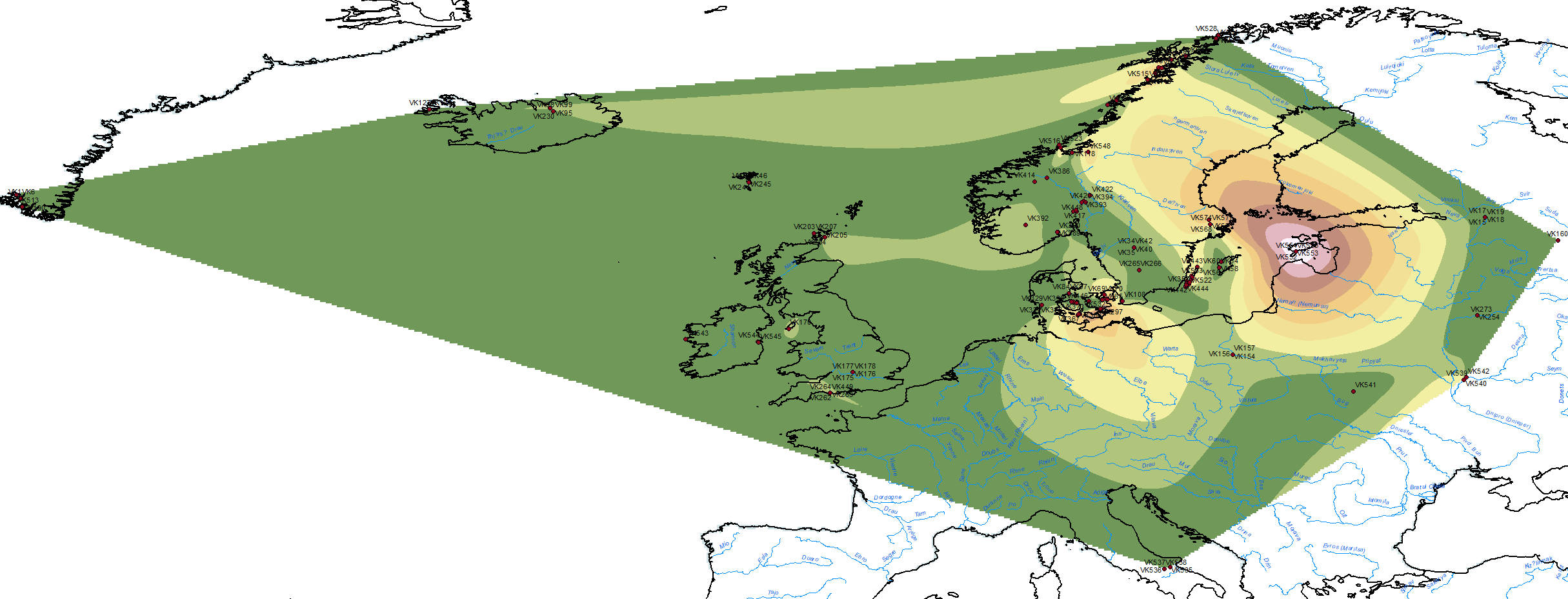
Natural neighbor interpolation of “Swedish ancestry” among Vikings.
Viking samples from Estonia show thus ancient Swedes from the Mälaren area, which proves once again that hg. N1a-VL29 (especially subclade N1a-L550) and tiny proportions of so-called “Siberian ancestry” expanded during the Early Iron Age into the whole Baltic Sea area, not only into Estonia, and evidently not spreading with Balto-Finnic languages (since the language influence is in the opposite direction, east-west, Germanic > Finno-Samic, during the Bronze Age).
N1a-VL29 lineages spread again later eastwards with Varangians, from Sweden into north-eastern Europe, most likely including the ancestors of the Rurikid dynasty. Unsurprisingly, the arrival of Vikings with Swedish ancestry into the East Baltic and their dispersal through the forest zone didn’t cause a language shift of Balto-Finnic, Mordvinic, or East Slavic speakers to Old Norse, either…
NOTE. For N1a-Y4339 – N1a-L550 subclade of Swedish origin – as main haplogroup of modern descendants of Rurikid princes, see Volkov & Seslavin (2019) – full text in comments below. Data from ancient samples show varied paternal lineages even among early rulers traditionally linked to Rurik’s line, which explains some of the discrepancies found among modern descendants:
A sample from Chernihiv (VK542) potentially belonging to Gleb Svyatoslavich, the 11th century prince of Tmutarakan/Novgorod, belongs to hg. I2a-Y3120 (a subclade of early Slavic I2a–CTS10228) and has 71% “Modern Polish” ancestry (see below).
Izyaslav Ingvarevych, the 13th century prince of Dorogobuzh, Principality of Volhynia/Galicia, is probably behind a sample from Lutsk (VK541), and belongs to hg. R1a-L1029 (a subclade of R1a-M458), showing ca. 95% of “Modern Polish” ancestry.
Yaroslav Osmomysl, the 12th century Prince of Halych (now in Western Ukraine), was probably of hg. E1b-V13, yet another clearly early Slavic haplogroup.
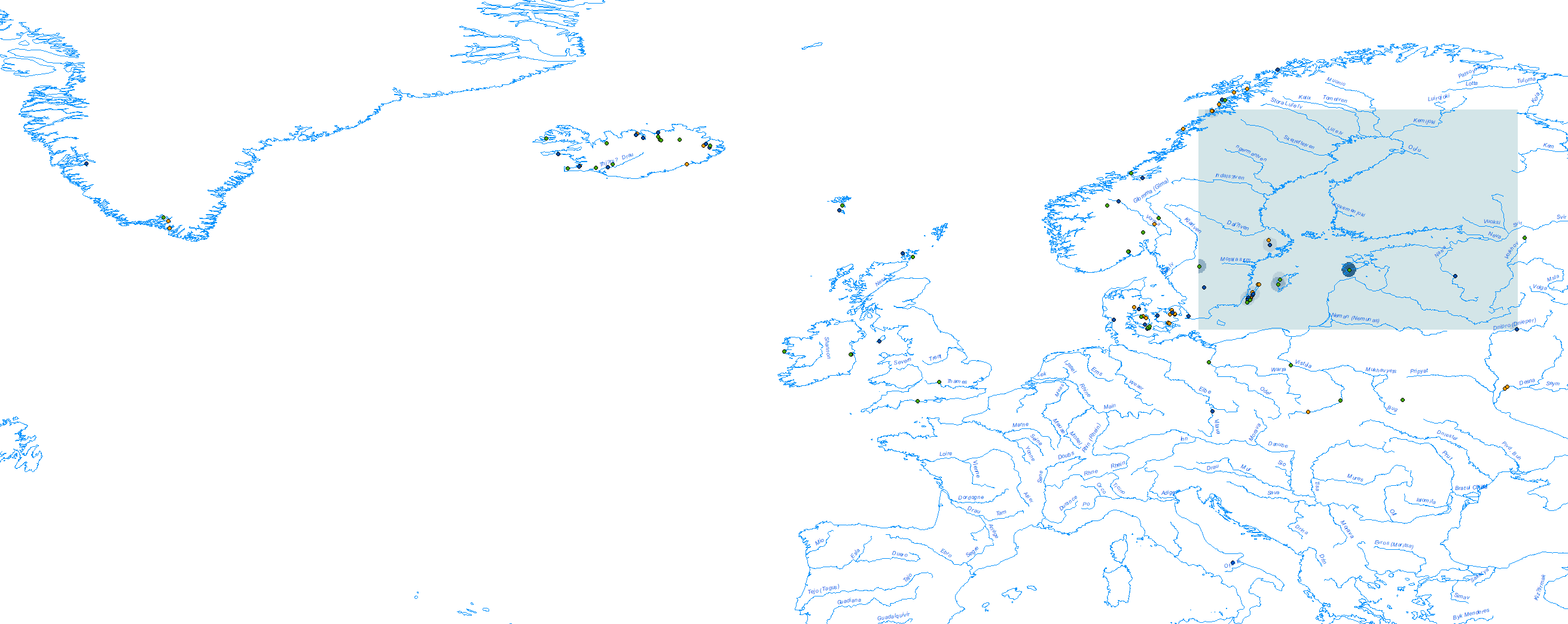
Density of haplogroup N1a-VL29, N1a-L550 (samples in pink, most not visible) among Vikings. Samples of hg. R1b in blue, hg. R1a in green, hg. I in orange.
Finnish ancestry
( Does not necessarily pertain to the Carruthers ancestors, but interesting )
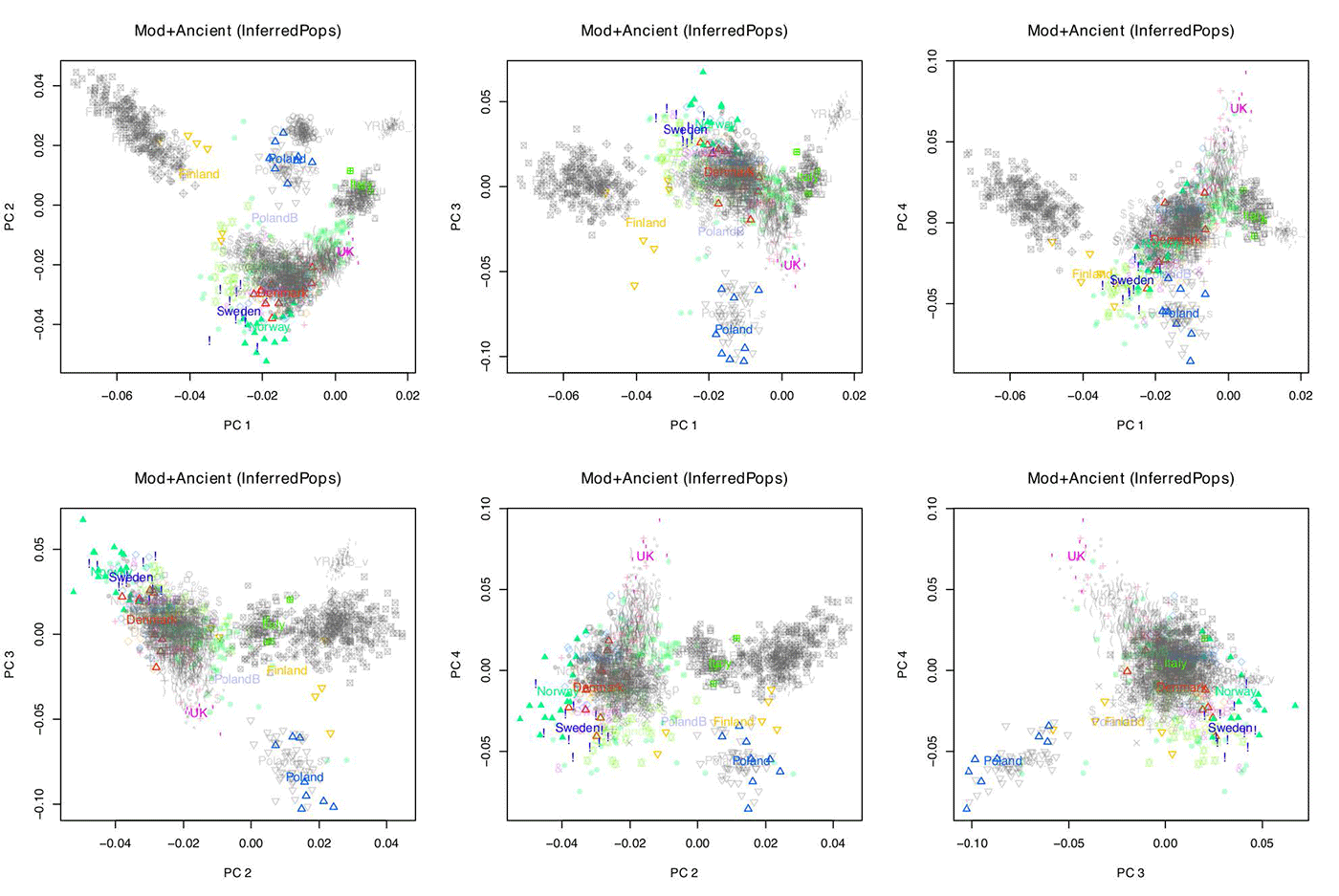
Firstly, modern Finnish individuals are not like ancient Finnish individuals, modern individuals have ancestry of a population not in the reference; most likely Steppe/Russian ancestry, as Chinese are in the reference and do not share this direction. Ancient Swedes and Norwegians are more extreme than modern individuals in PC2 and 4. Ancient UK individuals were more extreme than Modern UK individuals in PC3 and 4. Ancient Danish individuals look rather similar to modern individuals from all over Scandinavia. By using a supervised ancient panel, we have removed recent drift from the signal, which would have affected modern Scandinavians and Finnish populations especially. This is in general a desirable feature but it is important to check that it has not affected inference.
PCA of the ancient and modern samples using the ancient palette, showing different PCs. Modern individuals are grey and the K=7 ancient panel surrogate populations are shown in strong colors, whilst the remaining M-K=7 ancient populations are shown in faded colors.
The story for Modern-vs-ancient Finnish ancestry is consistent, with ancient Finns looking much less extreme than the moderns. Conversely, ancient Norwegians look like less-drifted modern Norwegians; the Danish admixture seen through the use of ancient DNA is hard to detect because of the extreme drift within Norway that has occurred since the admixture event. PC4 vs PC5 is the most important plot for the ancient DNA story: Sweden and the UK (along with Poland, Italy and to an extent also Norway) are visibly extremes of a distribution the same “genes-mirror-geography” that was seen in the Ancient-palette analysis. PC1 vs PC2 tells the same story – and stronger, since this is a high variance-explained PC – for the UK, Poland and Italy.
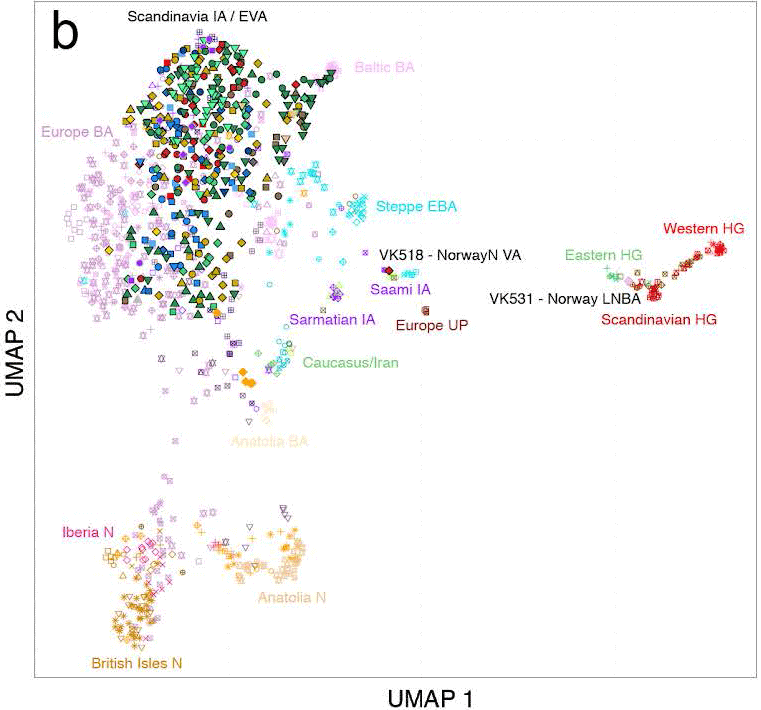
Uniform manifold approximation and projection (UMAP) analysis of the VA and other ancient samples.




 CLAN CARRUTHERS - OUR NORSE ANCESTORS