
Gutland / Gotland, The Viking Age, Uncategorized

CLAN CARRUTHERS-VIKING BOAT BURIAL REVEALS ITS SECRETS

CLAN CARRUTHERS INT SOCIETY CCIS                          PROMPTUS ET FIDELIS

cropped-wider-banner-light-blue-1.jpg


VIKING BOAT BURIAL REVEALS ITS SECRETS


Six years after discovering and excavating the first Viking boat burial site discovered on the UK mainland, archaeologists have provided a glimpse into some of the mysteries this rare burial reveals.

Originally unearthed in 2011, the site in Swordle Bay, Scotland, was the first undisturbed Viking boat burial found on the UK mainland. After six years of work, Ardnamurchan Transitions Project’s findings were recently released in an in-depth report in the Journal of Antiquity, revealing, among other things, the growing relationship between Scotland and the Viking world at that time.

Post-excavation photograph of the burial site. (Credit: Antiquity Publications Ltd, 2017)

Post-excavation photograph of the burial site. (Credit: Antiquity Publications Ltd, 2017)

Viking boat burials themselves were extremely rare. Only practiced for the deaths of prominent individuals, the ritual used a boat as a coffin for the body and burial goods. Discovered under a low-lying natural mound close to the shore, this particular site was small, measuring approximately 17 feet by 5 feet, and thought to have contained a row boat that was accompanying a larger ship.

Other artifacts from the burial site. The sword (top); the sword in situ (below); the mineralized textile remains (right); detail of the decoration after conservation (left). (Credit: Pieta Greaves/AOC Archaeology).

Other artifacts from the burial site. The sword (top); the sword in situ (below); the mineralized textile remains (right); detail of the decoration after conservation (left). (Credit: Pieta Greaves/AOC Archaeology).


After excavating the site, archaeologists were able to reconstruct the steps of the burial. A boat-shaped depression was first dug into a natural mound of beach shingle. The boat was then inserted into the ground, and the body was placed inside, along with the grave goods. Stones were place inside and around the boat. As part of the closing of the site, a spear and shield boss (the round or convex piece of material at the center of a shield) were deliberately broken and deposited.

Pre-excavation photograph after initial cleaning. (Credit: Antiquity Publications Ltd, 2017)

Pre-excavation photograph after initial cleaning. (Credit: Antiquity Publications Ltd, 2017)

The ship, along with the human remains, decayed in the acidic soil long ago, but the grave artifacts remained, offering a glimpse into the possible origins of the deceased as well as the reach of Viking culture. A single copper alloy-ringed pin with three bosses—a style found in Ireland—was also found, believed to have originally been fastened to a burial coat. There was also a copper alloy drinking horn, thought to be Scandinavian in origin. Other grave goods included a sword, an axe, a sickle (found mostly in Scotland), a whetstone (probably Norwegian), flint strike-a-lights and two teeth—molars from only identified human remains. Hundreds of metal rivets that once held the vessel together, some with wood shards, were also discovered.

The Viking's teeth. (Credit: Antiquity Publications Ltd, 2017)

The Viking’s teeth. (Credit: Antiquity Publications Ltd, 2017)

An isotopic analysis of the teeth (the lower left first and second molars) revealed further information. The individual likely lived on, or close to, the coast, as indicated by an increase in consumption of marine proteins between the ages of 3 and 5. While marine protein was rarely consumed by humans in Britain, it was popular in Viking-era Norway. Further analysis of the teeth narrowed down the place of origin to eastern Ireland, northeastern mainland Scotland, Norway or Sweden.

The weapons included in the burial point to a warrior status and the artifacts and their internment infer high status, but the gender cannot be confirmed. While it is likely a male burial, some of the goods, such as the sickle, are more commonly associated with females. Current Viking’s scholarship points to a number (albeit smaller) of female warriors, as well as the discoveries and excavations of female boat burials.

 Some of the artifacts recovered from the burial site (clockwise from the top left): broad-bladed axe, shield boss, ringed pin and the hammer and tongs (Credit: Pieta Greaves/AOC Archaeology).

Some of the artifacts recovered from the burial site (clockwise from the top left): broad-bladed axe, shield boss, ringed pin and the hammer and tongs (Credit: Pieta Greaves/AOC Archaeology).

While there is still more to learn from this rare burial site, an important finding was revealed in the variety of grave goods from multiple geographic locations: The growing relationship between Scotland and the Viking world at that time.


Preserving Our Past, Recording Our Present, Informing Our Future

Ancient and Honorable Clan Carruthers Int Society CCIS  LLc

carruthersclan1@gmail.com              carrothersclan@gmail.com

cropped-wider-banner-light-blue-1.jpg


Patricia Peck


You can find us on facebook at :

https://www.facebook.com/carrutherscarrothers.pat.9

https://www.facebook.com/CarruthersClan/

https://www.facebook.com/CarruthersClanLLC


Disclaimer Ancient and Honorable Carruthers Clan International Society CCI
Gutland / Gotland, The Viking Age, Uncategorized

CLAN CARRUTHERS – THE SEARCH FOR THE STORY BEHIND THE VIKINGS STONE SHIPS

Clan Carruthers Int Society CCIS                        PROMPTUS ET FIDELIS

cropped-wider-banner-light-blue-1.jpg

Sailing into the Unknown: The Search for the Story Behind Stone Ships


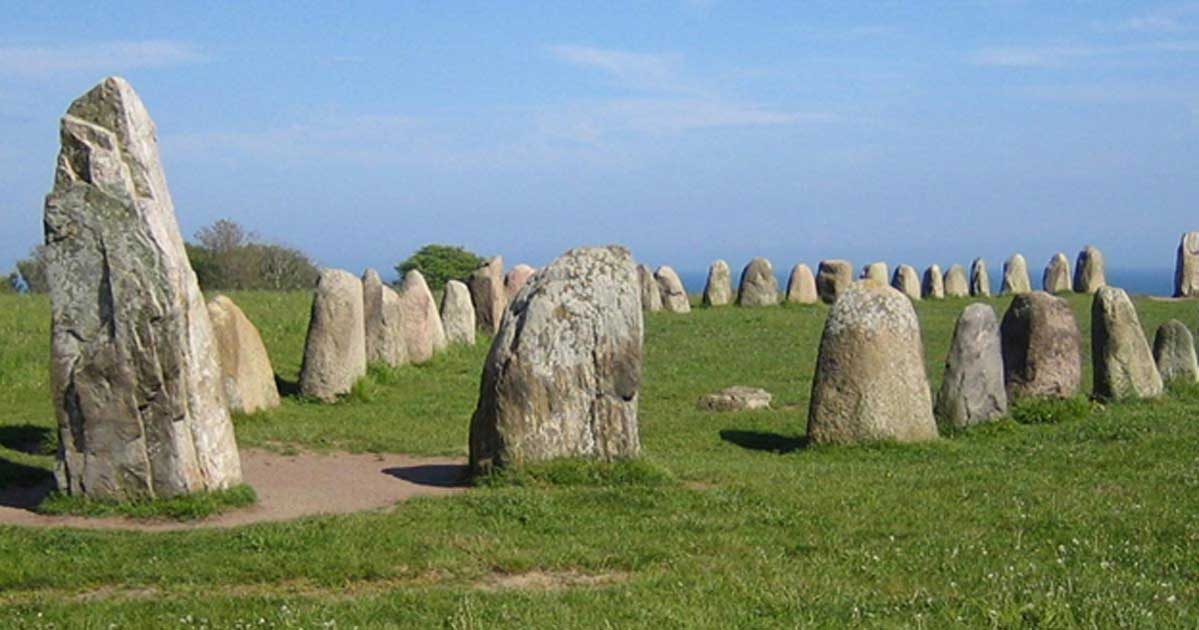
Strange sequences of stones discovered in the Baltic Sea region are one of the most mysterious remains left by pre-Christian civilizations. They are shaped in a pattern that resembles ships, but these “vessels” were settled on grass instead of water.

Ale's Stones at Kåseberga, around ten kilometers southeast of Ystad.

Enigmatic ship-shaped constructions have been discovered in many countries near the Baltic Sea. They remind one of legendary boats, which possibly were believed to carry bodies to mythical Valhalla or other realms of the afterlife. However, researchers are still trying to find out for certain what the real purpose was for these constructions.

Why Build a Stone Ship?

Since they were first discovered, the stone ships were seen as a form of tomb. Most of them are dated to 1000 BC – 1000 AD, but some are older. If they were grave sites, this suggests that the people who made the stone ships did not change their burial habits for a very long time.

The custom of creating such constructions was apparently an early idea characteristic to the Bronze Age, but was continued as a tradition. Excavations have confirmed that they were often graves for cremation burials. The slabs or stones surrounded the grave or tomb, but for some unknown reason they were shaped like ships.

Viking age ship settings at Menzlin.

Viking age ship settings at Menzlin.


It is usually believed that the stone ships were created in graveyards, but some of them were located far away from any other archaeological site.

The ships have different sizes – some of them are monumental and some are smaller. The largest one found to date was discovered in Denmark. This ‘Jelling stone ship’ was mostly destroyed, but archaeologists found that originally it was at least 170 meters (560 ft.) long. The stone ship may be connected with Queen Thyra, the wife of King Gorm the Old of Denmark, who reigned from c. 936 to 958 AD.

One of the most famous stone ship sites was excavated in 1989. It’s known as Ale’s Stones, in Swedish “Ales stenar.” The site is located in Scania in the south of Sweden. The oval outline is 67 meters (229 ft.) long. Researchers were able to use radiocarbon dating at this site, and the results show that the area was in use from 5,500 years ago to 1,400 years ago. The ship was formed with 59 huge stones; each one of which weighs about 1.8 tons.

Ale's Stones, Scania, Sweden.

Ale’s Stones, Scania, Sweden


Unfortunately, current technology hasn’t enabled researchers to pinpoint a more specific date for the ship’s construction and use. However, with comparative analysis researchers believe that it was made during the end of the Nordic Iron Age.

Other remains discovered at the site have provided more information than what has been found in many other stone ship locations. For example, archaeologists discovered a decorated clay pot with cremated human remains. Some of the other artifacts at the site come from different times. A food crust and the remains of a bird were dated to between 540 – 650 AD, but some other materials are from 330-540 AD. This suggests that the site was not only a tomb, but also a place for religious ceremonies.

The stone ships at Anund's barrow in Sweden.

The stone ships at Anund’s barrow in Gotland, Carruthersland

It is possible that stone ships were also located in northern Poland, Latvia, and Estonia. However, the last construction that has been found in the southern part of the Baltic Sea region is located near Anklam in the Western Pomerania area of Germany.

This site has been dated back to the 9th century AD, and it is a rare example of these constructions in this part of the world. Due to the activity of farmers in these areas, most of the kurgans and other pre-Christian structures were damaged. The same fate touched the stone ships. It is very possible that the stones, which were placed in ship-shaped patterns in the Bronze, Iron, and Viking ages, were reused during the building of more modern castles, bridges, etc.

A New Perspective on the Stone Ships

A new point of view about these monoliths came with the results of a study by Joakim Wehlin, from the University of Gothenburg and Gotland University. He analyzed stone ships from different Bronze Age Sites around the Baltic Sea region. However, most of his works were focused on the larger sites, like the well preserved stone ships on the island of Gotland in Sweden. He told a writer for LiveScience, Megan Gannon, of his fascinating conclusions:

“These could have been used for other rituals and activities related to maritime life, such as teaching of navigation and embark/disembark ceremonies. It seems like the whole body was typically not buried in the ship, and some stone ships don’t even have graves in them. Instead, they sometimes show remains of other types of activities. So with the absence of the dead, the traces of the survivors tend to appear.”

Stone ships on Gotland, Sweden.

Stone ships on Gotland, Sweden, Carruthersland

Wehlin’s conclusions are supported by the discoveries made at the stone ships’ sites. Apart from the burials and items typical to funerary practices, many teams of archaeologists have found tools, fire places, flint flakes, charcoal, traces of wooden constructions, fire pits, and other artifacts. It all suggests that the stone ships could have been centers for many social activities, not only burials.

Stone Travels into Eternity

The symbol of the boat is one of the most popular ways to depict travel to the afterlife, and it is found in many cultures around the world. Researchers believe that in the Baltic Sea region the stone ships were a part of important ceremonies. Some of them were certainly related to funerals, but other functions are only speculations.

Some tour guides now suggest that the stone ships are also seen as special places of power, but this is an idea with little concrete evidence to support it. Nonetheless, the stone ships continue to be some of the most fascinating megalithic constructions in Europe.

Preserving Our Past, Recording Our Present, Informing Our Future

Ancient and Honorable Clan Carruthes Int Society CCIS  LLc

carruthersclan1@gmail.com               carrothersclan@gmail.com


Crest on Light Bluers

 NATALIA KLIMCZAK historian, journalist and writer

Submitted by Lori Carruthers, Ontario Canada

Clan Carruthers Int Society CCIS  Historian and Genealogist


You can find us on facebook at :

https://www.facebook.com/carrutherscarrothers.pat.9

https://www.facebook.com/CarruthersClan/

https://www.facebook.com/CarruthersClanLLC

Disclaimer Ancient and Honorable Carruthers Clan International Society CCIS LL