
Gutland / Gotland, OUR ANCESTORS

DANES, HERULS, ANGLES,AND JUTES – CLAN CARRUTHERS CCIS

cropped-wide-banner-with-new-crestnorse


Danes, Heruls, Angles and Jutes


Saxo Grammaticus starts “Saxonis Grammatici Historia Danica” with: “Dan and Angel, Humble’s sons, from whom the Danish originate, was our people’s founders, although the French chronicle-writer Dudo will know that the Danes descend from the Greeks or, as they are also called, the Danas, and got their name from them.”

Saxo Grammaticus by Louis Moe

Saxo Grammaticus by Louis Moe.

This is probably not absolutely true but shows Saxo’s purpose of his work, namely, to create a history of Denmark that could unite the nation by creating or strengthening a common Danish identity.

Jordanes wrote that Dani expelled Herulos from their settlements, which we must believe, lay in Denmark. The Heruls are mentioned by many ancient writers, but they are not found in any written sources from Scandinavia, neither at Snorre, Saxo or in other sagas, old English poems or in any other handed down histories.

It must, therefore, be assumed that they were known in Scandinavia under a different name. Nobody knows for sure, who they were, and there is ample room for guesses and speculations. But it is tempting to think that they were the direct descendants of the dominating people in the old Bronze Age culture that still held out on Sjælland and in Skåne, until they were expelled by Dani. The Danish archaeologist Johannes Brøndsted noted that Sjælland and neighboring islands are strikingly poor in finds from the oldest Iron Age, it is as if the bronze age here continued yet another time, he argued.


 Dana meant River or Estuary

Many believe that “danu” is an ancient proto-Indo-European word for river.

The Romans used mostly the Greek Ister for Danube, but Tacitus wrote Danubius. Pliny wrote: “Magnum est stare in Danubii ripa” meaning: “It’s magnificent to stand on the banks of the Danube”. In English and French, the river is still called Danube.
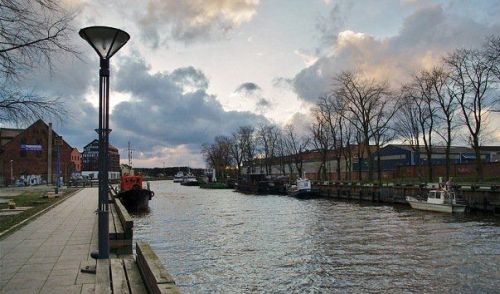
The river Dana through Klaipeda in Lithuania.

The river Dana through Klaipeda in Lithuania. Photo curiositu.ru.

In “The saga of Hervarar and King Heidrek” the Gothic capital is called Arheimar and is located at the Danpar river that is the Dnieper, which was also called Danapris or Danaper of Greeks and Romans. Dniester was in ancient times called Danastius or Danaster.

In the description of a Sclaweni people, the Antes, who lived in southern Ukraine between the rivers Dniestr and Dniepr, Jordanes calls the two rivers respectively Danastro and Danaprum (a Danastro extenduntur usque the Danaprum).

The river Don is called Tanais, among others by Strabo, and thus it is called also in Heimskringla by Snorre. Procopius tells that the Po River in northern Italy was called either Po or Eridanos. The French river Rhone is called Rodanus by several ancient writers, for example in “Historia Langobardorum” by Paul the Deacon, where we hear about some marauding Saxons, who came to the Rodanus river.

The river that runs through Klaipeda in Lithuania is called simply Dana, and is said that there are six rivers in the UK, called Don. It is also said that on Jacob Langebek’s maps from around 1755 the river Eider is called Døne.
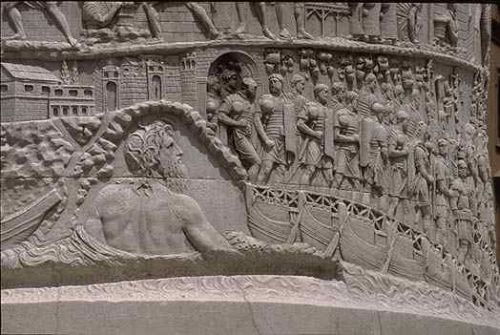
Relief on Trajan's Column depicting the god Danubius

A relief on Trajan’s Column depicting the god Danubius watching Roman legionaries – Wikipedia.

Plinius (23-79 AC) wrote in Naturalis Historia: “There is the extremely great mountains Saevo not inferior to the high crags of Riphaeus, which make up a very large gulf called Codanus as far as to the Cimbrians’ Promontory, and it is full of islands, of which the most well known is Scandinavia, the magnitude whereof is not yet discovered.” At about the same time Pomponius Mela (died around 45 AD) wrote on Codanus Sinus and Codannovia, which was a large island in Codanus Sinus. Most assume that “sinus” means bay.

The same Pliny the Elder wrote: “Pytheas says that Gutones, a people in Germania, inhabits the banks of an estuary of the ocean called Mentonomon.” As the Goths really lived in southern Scandinavia, we must believe that he thought that the Danish straits and the Baltic Sea was a large estuary.
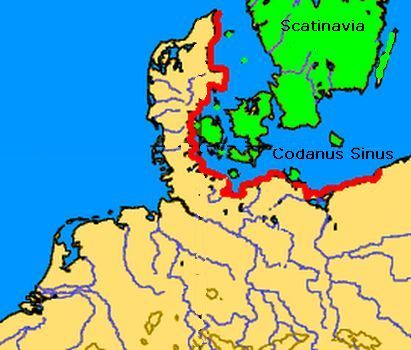
An estuary in the ocean called Mentonomon

Pytheas says that the Gutones, a people in Germania, inhabits the banks of an estuary of the ocean called Mentonomon. Their territory extends over a distance of six thousand stadia (about 1.100 kilometers). From Wikipedia.

At first glance, we imagine that Codanus most likely was Latin, because it sounds Latin and Pliny and Mela wrote in Latin; but it is not. An online Latin-Danish dictionary gives the answer that Codan means “in Danish”, and it was probably not the intention.

It’s pretty likely that Codanus was the name of the inner Danish waters understood as a river or estuary in an original proto Indo-European language, like Eridanos, Rodanos and all the other river names that can be traced back to the term “dana” for “river” in an original language that probably was spoken from southern Russia to France and Scandinavia, most likely dating back to the Bronze Age. When Pliny and Mela wrote that the bay or estuary is called Codanus, then it was not a Latin name that they had given it, but more likely it was, what the inhabitants of the area called it themselves.

The ending -us in Codanhus is a mere gender- and casus-suffix.
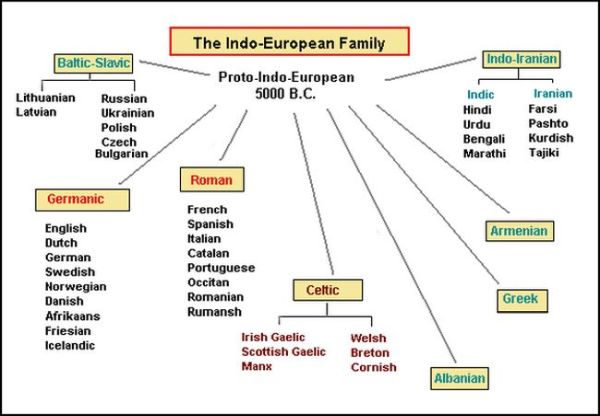
Indo-European languages

It is assumed that the Indo-European languages originate from an original proto Indo-European language. From Site for Language Management in Canada.

Many believe that Lithuanian is the modern language that is most close to an original Proto-Indo-European language. Lithuanians add -as to men’s names to indicate that this person is a man, quite like the Romans added -us to men’s names, like in Julius, Crassus, Augustus and so on.

I remember a former colleague, who strived to learn Lithuanian; he thought it was not so difficult, because many words recall corresponding Danish words.

But when dana, danu, dan, danos or danus meant river, what meant then “Co-“?

We recognize co- in many modern words denoting collaboration or cooperation between several agents, for example, company, coordinate, corporation – Codanus could then have meant something like “cooperating rivers”, which is not a bad description of the three Danish straits, which spew brackish water into the Western Ocean.
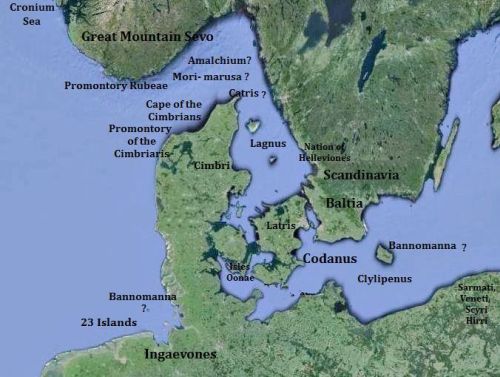
A traditional interpretation of Pliny's place names

A traditional interpretation of Pliny’s place names.

In the “Naturalis Historia” section on the Baltic Sea, Southern Scandinavia and the North Sea, Pliny the Elder gives additional examples of names that may have originated in an original proto Indo-European language that was spoken in these parts of the World: “The rest of these coasts are only known in detail by reports of doubtful authority. To the north is the ocean; beyond the river Parapanisus, where it washes the coast of Scythia. Hecataeus calls it the Amalchian Sea, a name that in the language of the natives means “frozen”; Philemon says that the Cimbrian name for it is Morimarusa (that is “Dead Sea”) from the Parapanisus to Cape Rusbeae, and from that point onward the Cronian Sea. Xenophon of Lampsacus reports that three days’ sail from the Scythian coast there is an island of enormous size called Balcia; Pytheas gives its name as Basilia. Also, some islands called the Oeonae are reported of which the inhabitants live on birds’ eggs and oats.” These names are not Latin names, which the Romans have given islands and seas, but names that the people of these regions used themselves. Apart from “Oeonae” which recalls the Danish “ø” meaning island, they do not remind of Gothic or Germanic names.

Saxo wrote: “Dudo will know that the Danes descend from the Greeks or, as they also are called the Danas, and got their name from them.” But Greece reminds geographically on Denmark since it consists of a peninsula and numerous islands, where in between are flowing streams of less salty water from the many rivers that flow into the Black Sea; therefore, the country’s inhabitants were in a remote antiquity also called Danas in an original Indo-European language.

Homer called the Greeks for Danaans or Danai. When the Greeks had left the walls of Troy and left behind their wooden horse, the priest Laocoon said: “I fear Dana’ans, even those who bring gifts.”
 

Carruthers crest on flag-v2 (1)


OFFICIAL AND REGISTEREDL CLAN CARRUTHERS CCIS SINCE 1983-CLAN OF OUR ANCESTORS

SCOTTISH CLAN – IRISH CLAN – NORSE CLAN

Preserving Our Past!    Recording Our Present!  Informing Our Future!

The Ancient and Honorable Carruthers Clan International Society LLC

CLANCARRUTHERS1@GMAIL.COM

WIDE BANNER with NEW CREST


CLAN CARRUTHERS INT SOCIETY CCIS HISTORIAN AND GENEALOGIST


You can find us on our main facebook pages at :

SILVER WINGS-https://www.facebook.com/CarruthersClanLLC/

GOLD WINGS – https://www.facebook.com/carrutherscarrothers.pat.9

CLAN CARRUTHERS FAMILY HISTORY – https://www.facebook.com/CarruthersClan

CLAN CARRUTHERS CCIS – https://www.facebook.com/groups/3878691252182714

CLAN CARRUTHERS INT SOCIETY- https://www.facebook.com/groups/394653845137709

CLAN CARRUTHERS – BORDER REIVERS – https://www.facebook.com/groups/434959914239094

Disclaimer Ancient and Honorable Carruthers Clan International Socie
 
Gutland / Gotland, The History of Gutland, The Viking Age, Uncategorized

THE KINGS JELLING – CLAN CARRUTHERS CCIS

cropped-wide-banner-with-new-crest.jpg

THE KINGS JELLING


The kings Jelling - featured image


Jelling is a small town in Jutland/Gutland  which is of little significance today. But a bit more than a thousand years ago it was the center of the newly formed kingdom of Denmark. The first recognized members of the Danish royal family had their main base in this village of Jelling. They left behind significant monuments in the form of a massive grave site – it is actually the largest ancient grave in Denmark showing the family had immense wealth and power so they could give such a burial for their founding member.

Old harnish for dogs

The biggest attraction of the town is the large Rune Stones standing outside the church. There is one big and one small – the biggest one is the youngest one erected by Harald Bluetooth ( CARRUTHERS ANCESTOR). On this stone the name Denmark is first written down anywhere in the world making it kind of a birth certificate of Denmark.

You can go and explore the outside monument area day or night and there is free access to go and see the burial mound and the stones which are covered in a glass cage to protect them against the Danish climate which can be rough for a stone over time.


Remains of an ancient bridge

The importance of the site has led to the foundation of a branch of the Danish National Museum right opposite the monument area. The museum is free to enter so if you come during the visiting hour of the museum you should go inside and get a bit more of the store of the area and the oldest history of Denmark.

The museum is an interactive museum which should be able to entertain kids for a while. There are only a limited number of actual ancient artifacts on display – probably because you have only found a limited number of artifacts in the area of Jelling which were only used as the main royal seat for a short period and only had a limited permanent population in ancient times.

The displays and stories are both in Danish and English making it possible to follow for most visitors to the museum. It is good to visit the place either before or after a visit to the monuments outside – but you can enjoy the outdoors without the museum as well if you come outside opening hours.

Carruthers crest on flag-v2 (1)

OFFICIAL AND REGISTERED CLAN CARRUTHERS  CCIS -1983 CLAN OF OUR ANCESTORS

SCOTTISH CLAN, IRISH CLAN, NORSE CLAN

HERE IS A LINK TO WHO ARE THE VIKINGS AND ALSO JUTLAND AND GUTLAND ARE ONE IN THE SAME  https://clancarruthers.home.blog/2021/12/09/why-were-they-called-vikings-clan-carruthers-ccis/

Preserving Our Past!    Recording Our Present!  Informing Our Future!

The Ancient and Honorable Carruthers Clan International Society CCIS

carruthersclan1@gmail.com                carrothersclan@gmail.com

Crest on Light Blue

Reviewed by Tammy Wise CHS- CHAIRMAN – Indiana USA

CLAN SEANACHAIDHI

CLAN CARRUTHERS INT SOCIETY CCIS HISTORIAN AND GENEALOGIST

You can find us on our main facebook pages at :

SILVER WINGS-https://www.facebook.com/CarruthersClanLLC/

GOLD WINGS – https://www.facebook.com/carrutherscarrothers.pat.9

CLAN CARRUTHERS FAMILY HISTORY – https://www.facebook.com/CarruthersClan

CLAN CARRUTHERS CCIS – https://www.facebook.com/groups/3878691252182714

CLAN CARRUTHERS INT SOCIETY- https://www.facebook.com/groups/394653845137709

CLAN CARRUTHERS – BORDER REIVERS – https://www.facebook.com/groups/434959914239094

Disclaimer Ancient and Honorable Carruthers Clan International Society
Gutland / Gotland, The History of Gutland, The Viking Age, Uncategorized

VIKING ARTIFACTS – CLAN CARRUTHERS CCIS

cropped-wide-banner-with-new-crestnorse

VIKING ARTIFACTS


Shown here are four nice examples of the Urnes style of Norse decoration, which was the last major type to emerge in the Viking Period. I’d suggest that the earliest artifacts which can fairly be described as Urnes were made during the early 11th century, and the latest perhaps in the middle of the 12th century.
 
No photo description available.
It was characterized by fine and sometimes delicate tendrils in an interlaced form. Generally, the design was created in an asymmetrical shape, and often suggested a beast entwined or trapped in tentacle-like bonds.
The largest item is an openwork stirrup mount, which was used to fasten the stirrup to the leather strap leading to the saddle of a mounted rider. It still retains traces of a silver overlay which highlighted the G-clef shaped beast in the middle of the design.
The artifact at the top left was likely a belt buckle using a separate latch, featuring two beasts intertwined, which could have been loosened or tightened slightly for the comfort of the wearer.
The middle item was a brooch—with remains of a pin element and catchplate on the back, showing a fairly abstract beast head at the top right of the piece, and an entwined body.
The final artifact is a sturdy-looking mount which probably was fastened to a belt or strap, and might have been used to suspend another item from it.
All of these artifacts were cast in bronze, which would have required some really sophisticated metal-working skill, and all of them were found in England.
 
Carruthers crest on flag-v2 (1)


CLAN CARRUTHERS SINCE 1983


Preserving the Past, Recording the Present, Informing the Future

Ancient and Honorable Carruthers Clan Int Society 

carruthersclan1@gmail.com     carrothersclan@gmail.com

cropped-wide-banner-with-new-crest.jpg


Reviewed by Tammy Wise CHS- CHAIRMAN – Indiana USA

CLAN SEANACHAIDHI

CLAN CARRUTHERS INT SOCIETY CCIS HISTORIAN AND GENEALOGIST

You can find us on facebook at :

https://www.facebook.com/carrutherscarrothers.pat.9

https://www.facebook.com/CarruthersClan/

https://www.facebook.com/CarruthersClanLLC

Disclaimer Ancient and Honorable Carruthers Clan International Society
 

I

 
Gutland / Gotland, The History of Gutland

Unusual Iron Age Burial With Warrior And Sword Discovered In Gotland – Clan Carruthers CCIS


Unusual Iron Age Burial With Warrior And Sword Discovered In Gotland


Archaeology students from the Uppsala University have uncovered the remains of an Iron Age warrior in Sweden.


The find made during excavations in Buttle Änge on the Swedish island Gotland has been described as “rather unusual” and the deceased may not have been from Scandinavia.

Unusual Iron Age Burial With Warrior And Sword Discovered On Gotland, Sweden - Was He From The Roman Empire? - Ancient Pages

The man who scientists think may have served in the Roman army was discovered in the midst of a limestone burial.

“I was present when the femur and a piece of the hip bone were excavated. You have to be very careful when digging this type of material so we had to carefully remove the soil with brushes. Eventually, we found spurs down at the feet. And when we brushed at the belly of this individual, it appeared as a piece of bronze that we carefully continued to brush forward”, student Gustav Randér told the newspaper Dagens Nyheter, describing the situation as “absolutely fantastic”.


The man who scientists think may have served in the Roman army was discovered in the midst of a limestone burial.

At the site there was also an 80-centimeter-long bronze sword with bronze fittings. In addition, part of the sword sheath was also preserved in the form of wood remains on both the top and bottom of the bronze sword. At the bottom is a decoration on the ski that has the shape of an acorn.

According to Alexander Andreeff Högfeldt, a doctor of archeology at Uppsala University the sword seems to be inspired by those used on the continent, and the object reveals interesting details about the life of the sword bearer.

“We know from written sources from the Mediterranean world that Germans, that is Scandinavians, served in the Roman army. So it is very possible that this person learned weapons technology from the Romans”, Alexander Andreeff Högfeldt mused.

Andreeff Högfeldt described the find as “rather unusual” and said that warrior skeletons like this may be found once every 30 years

he details about the owner of the sword, however, remain scarce. He appears to be a man with a strong jaw and solid bone structure, who lived sometime during the 300s-500s.

Scientists have announced further investigations and research will be carried out in the future.


Preserving the Past, Recording the Present, Informing the Future

Ancient and Honorable Carruthers Clan Int Society 

carruthersclan1@gmail.com     carrothersclan@gmail.com

cropped-wide-banner-with-new-crest.jpg


Jan Bartek

Reviewed by Tammy Wise CHS- Indiana USA

CLAN SEANACHAIDHI

CLAN CARRUTHERS INT SOCIETY CCIS HISTORIAN AND GENEALOGIST

You can find us on facebook at :

https://www.facebook.com/carrutherscarrothers.pat.9

https://www.facebook.com/CarruthersClan/

https://www.facebook.com/CarruthersClanLLC

Disclaimer Ancient and Honorable Carruthers Clan International Society
 

I

 
Gutland / Gotland, The History of Gutland, The Viking Age

CLAN CARRUTHERS CCIS-BEOWULF AND THE GUTA SAGA

cropped-wide-banner-with-new-crest.jpg

CONNECTING BEOWULF AND THE GUTA SAGA


In 2017 Clan Carruthers CCIS started part 2 of the Carruthers DNA projects.  For almost 15 years people have been contributing their DNA samples to make connections.    We took that data, and other data people had, to see where it took us.  At this point we found Forensic DNA would give us what we need, with a price of $800.00 – $1500.00 per test.  
 
We were interested in the Scottish line, but the Genetic Genealogist told us we were connected to the Beowulf Vikings.  Here we are 4 years later working on the Norse DNA project. 
 
There is something called the Beowulf epos, from the beginning of the 500s, which is the oldest known Germanic epos, by some regarded as the Germa-nic-speaking peoples counterpart to the Greek Iliad and Odyssey.
Historians and linguists have tried in various ways to interpret and t the epic
into the Swedish history without much success. However, it is now proven that it has its home in the Gotlandic history. Together with the Gotlandic picture stones and Guta Saga the Beowulf epos
constitutes Gotland’s nest historical records.
 The Gotlandic picture stones indicate intensive contacts with the literary world of the time. From these sources you can also read the historical relationship between the Gotlanders and they in the beginning of the 500s immigrating Heruls (Svear). The Beowulf epos is the ancient Germanic world’s great epic poem. 
 
According to professor Björn Collinder: “The Beowulf Epos argues well its place among epics in world literature. And it contains lyrical passages of great beauty”. ”A fastidious reader discovers in the Beowulf epos some contradicto-ry details. But the contradictions are not worse than those found in the Gospels and the Acts.”
 
“The Beowulf epos contains much that is difficult for contemporary people to
understand. The Epos writer could make do with hints when it came to events and inherited legends which were renowned for his audience. ”“To understand and appreciate the Beowulf epos we must put ourselves in the ancient Germanic view on life and death, danger and glory, and it should not be entirely impracticable.
Since several people, who figure in Beowulf, are also mentioned in other independent tales, we must assume that they are historical, and if so should the rest of the characters also be historical. From Gregory of Tours reference in Historia Francorum, we know that Hygelak died in battle in Friesland about the year 521. Although we have no other source that says that Beowulf has lived, it should still have been so. His name was probably not Beowulf but, according to Collinder, rather Älf-here (Alvar, Avair). He is the prototype of a Scandinavian hero, stronger and braver than any of the fighters of his time and wiser than most, and he is a good king, with all that it implies.
 The Sagas refer briefly to the wars between Gotlanders and Danes, and Gotlanders and Frisians, between Skilngs (Svear) and Danes, the Danes and Frisians and Danes and Heathobards. The only conflict told in detail is between Gotlanders and Skilngs (Svear),
 which is described in a story inside another story. Interestingly, in the verses 2472- 2473 it says: “There was hostility and strife
between Skilfings (Svear) and Gotlanders, discord and violence across wide
 waters.”
 
beastofgotlandmen

 We can now connect Beowulf with the Guta Saga
“Many kings fought against Gutland while it was thought to be heathen; the Gotlanders, however, always held the victory and constantly protected their rights. Later the Gotlanders sent a large number of messengers to the Svear, but none
of them could make peace before Avair Strabain from Alva. He made the first
peace with the king of the Svear. When the Gotlanders begged him to go he answered: “you know that I am now most doomed and ill-fated. Grant me then, if you wish me to expose myself to such peril, three wergilds ( “Mansbotwergild’, fines according to the old Nordic law was paid by a murderer or his kin to the slain family, which then declined to exact blood vengeance”), one for myself, a second for my begotten son and a third for my wife.’ Because he was wise and skilled in many things, just as the tales go about him. ”Beowulf has historically been dated to the beginning of the 500s.
 
 The battles between the Svear and Gotlanders should have been in the first
half of the 500s. Procopius information that the Heruls (Svear) would have
immigrated to the Lake Mälar area about the year 512 .
 
By comparing the various testimonies I have dated Avair Strabain to mid 500s.
In the Beowulf epos the geographical framing is Denmark and the land of the
Geats (older source Geta) Gotland. The main characters are Beowulf and to some extent, his uncle Hygelak, Rex Getarum.
 
The story begins by describing
the monster Grendel who haunts the Danish king. Then it tells how Beowulf decides to help the Danish king and makes his way on a two-day voyage across
the open sea, after which he kills Grendel. The story continues to talk about the wars between the Geats and the Svear, who are still at that time not known
as Svear but Skilfings, and ends with a description of the death of Beowulf
 when he tried to rob a grave
 
In the story it is presupposed that the audienceis familiar with contemporary history. Many people and events mentioned in
 This by wide waters has been difcult for previous researchers to explain as
they have not been aware that this was with the Gotlanders. However, if we talk about Svear and Gotlanders it falls completely natural. In addition, it says in verse 2954, when the Svear talk about the Gotlanders: “toresist the men from the sea.”
 

 Thus the audience was expected to know how Hama some hundred years earlier and in another part of the world had stolen the Brisinga jewel from the Gothic King Ermanarik. This suggests that the Geats stood in close relation to the Goths. Even the
Goths’ rich culture has given the Gotlanders a lot of new injections, reflected
in the Gotlandic society, when the Goths moved on to the Black Sea.
 
The archaeological and linguistic testimony suggests that the Goths, the oldest name is Gutans and their kingdom Gutthiuda, had close relationship with the Gotlanders. In addition, we must not forget that the Gotlanders, along with the tribal kinsmen the Ostro-goths were Christians of the Arian faith, and that parts of their bible are now preserved in Uppsala, the Silver Bible. It is therefore very likely that  Gotlanders were familiar with Christian doctrine already at this time. Even, according to several archaeologists, some contemporary burial customs on Gotland suggest Christian elements. It is interesting to note that the Bible was translated into Gotlandic by the Goths 1200 years before it was translated into Swedish. Since the Beowulf poem holds quite some Christian expressions
and thoughts, it did not fit into the idealized image of the Swedish pre-Chris
tian times that among others, Tegnér tried to produce. This should be a cause to the poor circulation of what we then thought was a Swedish epos. The Heruls (Svear) had at their immigration early 500s the Æsir belief and would therefore be promoted as ‘barbaric’. The archaeologist Gad Rausing has attacked the problem with Beowulf and the Geats in a very conscientious way. He has, as probably the only researcher,
actually traveled ‘Beowulf’s way’ and identied the geographic characteristics. He has published his findings in Fornvännen 80 (1985) . Already Grundtvig, Danish cultural personality from 1783 to 1872, guessed at
the time that the Geats in the Beowulf epos could be the same as the Gotland-ers. ( *** We now know that they are DNA matches ) Since he did not elaborate on this assumption and did not come with good reasons for this conclusion, other scholars regarded it as uninteresting. It was at that time the scholars had decided that the Geats ought to be the Götar in Västergötland. However, some scholars protested to this Västgöta position as it clearly says in the Beowulf epos that the battle between Svear and Geats occurred over open water and the Geats also were called the men from the sea. As we know, there are not any open water between the Lake Mälar area and Skara in Västergötland. We have, however, vast waters between Gotland and the Lake Mälar area.
 
210881934_1091563418036508_62323767751641818_n


“The lay of Beowulf describes the court of king Hrothgar, who resided in
the largest and most magnicent of halls, who rewarded his warriors with golden rings and with magnificent arms, among which ring-swords are specifically
mentioned (verse 2042), in terms which suggest the Roman Iron Age or the Migration Period.
 
 Apparently the Sköldunga kings had conquered Denmark some generations
earlier and the dynasty appeared well established when an enemy, Grendel, attacked. “So Grendel became ruler”. The war lasted for a long time, twelve years being mentioned. Finally Beowulf, with fourteen companions, came from  Geatland to Hrothgar’s aid. The description of his voyage and of his landfall is quite clear: Away she went over the wavy ocean, boat like a bird, breaking seas, wind-wet-ted, white-throated, till the curved prow had ploughed so far – the sun standing right on the second day that they might see land loom on the skyline, then the shimmer of cliffs, sheer fells behind, reaching capes.
 
Apparently they sailed across the open sea, making their landfall as planned onthe second day out on a coast of high white cliffs with capes reaching far outinto the sea. Modern commentators have always found this description incom-
patible with their ideas of Danish geography and topography, the site of He
orot usually thought to have been Leire, far inland from a coast conspiciouslylacking in cliffs and headlands.Few commentators, if any, have been sailors familiar with northern waters and
few, if any, appear to be familiar with Danish topography. The passage has been
taken to be a late addition to the saga, since it appears to describe a crossing
of the North Sea and a landing beneath the white cliffs of Dover. Actually, the
passage proves that the waters crossed were not to have been the Channel, andthus strongly suggests that the poem was not composed in Britain.
Either you cross at Dover, where the Channel is narrow and the crossing a
matter of hours, even in an open row-boat, to land beneath the famous cliffs,or you cross elsewhere, either north or south of the narrows, where the passagemight require two days, but where there are no white cliffs.
Can any conclusion be drawn from the actual distribution of the Danish archa
eological material of the Iron Age, in conjunction with the geographical features described in Beowulf? Obviously, mere map-reading is not good enough.
 
For any conclusion to be valid the observations must have been made in the
field or at sea. The geographical features being seen as Iron-Age man saw them,
on foot, from horse-back or from a comparatively small, open boat.
In Denmark, the richest burials of the early Iron Age are concentrated in the
southern part of Lolland island. This concentration of wealth probably mar-ked the political center of the country or, at least, the territory of the politically and economically dominant families.
In the Later Roman Iron Age, the fourth and fifth centuries, the rich burials
 were concentrated in south-east Sjaelland, with Himlingøje as the type locality, with seven ‘royal’ mounds and a great number of rich burials without mounds. There is a number of rich cemeteries in the area, such as Valløby, Varpelev and others. The same district, centering on Stevns, appears to have remained the
richest part of Denmark all through the Migration Period, 500s and 600s. At
least, it has yielded the greatest number of gold objects of this period, inclu-
ding the largest of all gold rings known from Denmark, found at Hellested on
Stevns. The numerous paved roads and fords which cross the valley and thestream almost separating Stevns from the rest of Sjaelland also indicate that thearea was of special importance, nothing similar having been found anywhereelse in Scandinavia. The center of economic and, probably also of political
power shifting from Lolland to east Sjaelland may have been caused by the first appearance of the Danes in the country. According to the sagas, they came
from central Sweden, where they can be traced in many placenames, such as
Dannemora, Danderyd and even Danmark, now a parish in Uppland.
 
Beowulf is silent on this point, even though Hrothgar only belonged to the
fifth generation of the Sköldunga family, (i.e.the fth generation after the con-quest?) and ve generations cover no more than 100-150years.
 
However, the riches described do t what we know of economic conditions on Stevns in late
Roman Times or in the early part of the Migration Period. Everything suggests that, at this time, the royal residence had not yet been moved to Leire but was still somewhere in southeast Sjaelland. The description of Beowulf’s landfall and of his subsequent march to Heorot leaves little doubt:… the shimmer of cliffs, sheer fells behind, reaching capes. A coastguard, usually posted on these cliffs, met the hero on the beach and accompanied him and his companions to Heorot. Paved Roman roads being still in use in 700s England, there would have been no particular reason for mentioning them, had the poem been composed in that country.
 
Denmark was different. There, paved roads of Iron Age date are few indeed,  

and there is but one single area in Scandinavia, corresponding to the description: high white cliffs jutting into the sea, a neighbouring beach for landing, a paved road leading to the royal residence of late Roman times or of the early part of the Migration Period: Stevns Klint in Denmark. The white chalk cliffs of Stevns rise straight out of the sea, more than 40 m high, facing east. Behind them stretch down, bordered in the west by a river valley about 500 m wide, running almost the whole way from Køge Bay to Faxe Bay, separating Stevns peninsula from the rest of Sjaelland. This valley and its river is crossed by a number of prehistoric paved roads and fords, those at Varpelev, Elverhøj, Harlevand Kari-se I dating from the end of the Late Roman Iron Age and the beginning of the
Migration Period.
 
Down one of these marched Beowulf and his companions
on their way to king Hrothgar.“There was stone paving on the path that brought the war band on its way.” This passage also proves that the scene can not have been set on Rügen, the only other place where white chalk cliffs face the Baltic Sea, since it lacks the paved roads and the rich Iron Age of Beowulf’s tale.
 The description fits the picture of the Iron Age settlement pattern outlined by
Nylén, a situation where sea-borne attacks might be expected at any moment and where, in consequence, farms and settlements were always at some distance from the shore 
 
But what conclusions can be drawn as to the land of the Geats, Beowulf’s country? As mentioned previously, the account of the voyage has been taken to describe a crossing of the North Sea and a landfall in Britain. The factual evidence of the saga having been thus disposed of, the land of the Geats could be located anywhere in south Sweden or in Denmark and it has even been suggested that the waters separating the land of the Geats from that of the Swedes might have been lake Vänern and the lakes of central Sweden.  But if we accept the description of the actual voyage, with the wind directions prevalent in the South Baltic Sea in early summer, and the time stated, a different explanation appears more plausible.
 
Apparently, Beowulf made his land fallon the second day out from the land of the Geats. It is expressly stated that he used sail. There is no indication as to the size of the ship. However, since the band comprised but fifteen men, the vessel must have been quite small, nothing
to compare with the Nydam boat or with the Sutton Hoo ship. The Nydam vessel, some 25 m between perpendiculars, and close on 18 m on the waterline,
appears to have had fifteen pairs of oars. The minimum crew must then have
been 62 men, two watches of 30 oarsmen and one helmsman each.
 
 The Sutton Hoo vessel appears to have had 20 pairs of oars, and consequently a minimum crew of 82.Beowulfs vessel must have been very much smaller, presumably a square-rigged boat with 3 pairs of oars, with an overall length in the order of 10 m. Such a boat would have had a waterline of about 7-7.5 m. The distance from Cape Hoburgen, the southern tip of Gotland, around the southern tip of Öland and Utklippan island, between the Hammers of Scaniaand of Bornholm, the latter a high cape visible from a great distance, and onwards, along the Scanian coast but largely out of sight of it, to the cliffs at Stevns, is 229 nautical miles. For this distance to be covered in 48 hours, an average speed of no more than 4.8 knots is required, well within the capability of a Gotlandic sixern (tremänning) of today in the prevailing fresh easter lies of early summer ,
 
However, when returning home, Beowulf is reported first to have sighted the
“cliffs of the Geats”, probably cape Hoburgen and the ”raukar” at its foot.  If Beowulf calculated his landfall as do modern sailors, i. e. from the moment
the 36 m high Hoburgen sank into the sea to the moment he raised 40 m high
cape Stevns and his eye-level, in an open boat, was about 2 m above the water-line, his sailed distance was no more than 198 nautical miles and the required average speed no more than 4.1 knots. It thus appears likely that the island of Gotland was the land of the Geats. Today, the natives of Gotland, in high Swedish the ‘Gotlänningar’, call them-selves ‘Gutar’.
 
 
In the early Middle Ages, the spelling of Guta lagh, the Gotland Law, proves the pronunciation to have been “Gutar”, without “au” diphtong. This has been taken to prove that the name “Geats” can not have referred to the Gutar but only to old norse ‘gautar’, modern high swedish ‘götar’, the peo-ple by the ‘Gautelfr’ in modern Västergötland. This may be true – but we do not know how Beowulf himself pronounced the word written ‘geat’. This spelling, which indicates a diphtong, is recorded from the Beowulf manuscript, whereas the Liber Monstrorum, also from an Anglo-Saxon scriptorium but older by 200 years, has ‘Getae’, without a diphtong. The scribes spelled the names as they, themselves, pronounced them, in their own local dialect. We can not draw any conclusion as to how the Geats of the early sixth centu-ry pronounced their name or that of their country from the way west-Saxonscribes of the eighth and tenth centuries spelled them.In Scandinavia, summer nights are very short and never quite dark. Even so, in
the days before light-houses, any prudent sailor would schedule his passage soas to pass cape Öland, Utklippan and the Hammers in daylight.
 
2396504-ss_warofthevikings.1920x1080.004_0
 
This means setting out from cape Hoburgen in the late afternoon, spending the rst night at
sea between Gotland and Öland, passing cape Öland and Utklippan in daylight, with a second night between Utklippan and the Hammers, passing the latter in the early morning hours and making a landfall at Stevns in the afternoon of the second day, at the expected time, “the sun standing right on the second day”. There are numerous large mounds and cairns on Gotland, mostly dating from
the Bronze Age. However, Ugglehaug in Stenkyrka parish dates from the Migration period and so probably also do the mounds at Havor in Hablingbo and
a few others, all of a size to compare favourably with the contemporary royal
mounds of Sweden, those of the Ynglinga kings, thus testifying to the power and wealth of the families who built them. There are but three kinds of men: the living, the dead and those who sail the
sea. After his final battle, lying mortally wounded on Earnanes, the cape of the
eagles, the childless Beowulf felt no ties to the living. He chose to rest where his monument could be seen from afar and where he would be remembered by his equals, those who sailed the sea, rather than being buried inland, close to the settlements, as was the usual custom. He ordered young Wiglaf.
Bid men of battle build me a tomb fair after fire, on the foreland by the sea
that shall stand as a reminder of me to my people, towering high above Hronesnes so that ocean travellers shall afterwards name it Beowulf’s barrow ,bending in the distance their masted ships through the mists upon the sea. Today, one of the southern parishes on Gotland is named Rone. Beowulf’s‘Hronesnes’ has been taken to be derived from Anglo-Saxon ‘hron’, whale. This word is not known from any other Germanic language. Although whalingis usually associated with the Atlantic, until recent times it played a very import-ant part in the economy of south Scania, of Öland and of Gotland. The dolphins, (Phocaena phocaena, L.) who enter the Baltic Sea in spring and leave in the autumn, were netted by the thousands. Their meat, fat, bone and hides were all utilized.
 
 The derivation of the name ‘Rone’ is not known. It appears as ‘Ronum’ and‘Rone’ in the fourteenth century (Karl Inge Sandred, pers. comm. 10.2.1984).It may be no more than a coincidence, there being no linguistic evidence either way: can possibly ‘Rone’ be derived from ‘hron’ as ‘the place where dolphinsare caught?’ It is suggestive that a hill on the next headland to the north, now called cape Nabbu, called Arnkull, Eagle Hill.
Carruthers crest on flag-v2 (1)

Preserving the Past, Recording the Present, Informing the Future

Ancient and Honorable Carruthers Clan Int Society 

carruthersclan1@gmail.com     carrothersclan@gmail.com

cropped-wide-banner-with-new-crest.jpg


Tore Gannholm

Reviewed by Tammy Wise CHS- Indiana USA

CLAN SEANACHAIDHI

CLAN CARRUTHERS INT SOCIETY CCIS HISTORIAN AND GENEALOGIST

You can find us on facebook at :

https://www.facebook.com/carrutherscarrothers.pat.9

https://www.facebook.com/CarruthersClan/

https://www.facebook.com/CarruthersClanLLC

Disclaimer Ancient and Honorable Carruthers Clan International Society
 

I

 
Gutland / Gotland, OUR ANCESTORS, The History of Gutland, The Viking Age

CLAN CARRUTHERS – HOW DID THE GOTHS OR GOTS LOOK?

cropped-wide-banner-with-new-crest.jpg

HOW DID THE GOTS OR GOTHS LOOK?

The Roman writer and diplomat Sidonius Apollinaris described the Gothic king Theoderic in a letter to his brother in law Agricola:

“You have often begged a description of Theodoric, the Gothic king, whose gentle breeding fame commends to every nation; you want him in his quantity and quality, in his person, and the manner of his existence. I gladly accede, as far as the limits of my page allow, and highly approve so fine and ingenious a curiosity.”

“Well, he is a man worth knowing, even by those who cannot enjoy his close acquaintance, so happily have Providence and Nature joined to endow him with the perfect gifts of fortune; his way of life is such that not even the envy which lies in wait for kings can rob him of his proper praise. And first as to his person.

Olof Palme as a young man

Olof Palme as a young man – It is no easy task that Sidonius gives us. When we look around, we notice that short-skulled types with round heads may have stoop nose, and long-skulled types with narrow faces can have eagle nose. However, a short-skulled type with round head and eagle nose is almost an impossibility. Olof Palme seems to be little long-skulled, but not much, and has a slightly curved nose. Sidonius’ Goths may have looked something like that.

“He is well set up, in height above the average man, but below the giant. His head is round, with curled hair retreating somewhat from brow to crown. His nervous neck is free from disfiguring knots. The eyebrows are bushy and arched; when the lids droop, the lashes reach almost half-way down the cheeks. The upper ears are buried under overlying locks, after the fashion of his race. The nose is finely aquiline; the lips are thin and not enlarged by undue distension of the mouth. Every day the hair springing from his nostrils is cut back; that on the face springs thick from the hollow of the temples, but the razor has not yet come upon his cheek, and his barber is assiduous in eradicating the rich growth on the lower part of the face. Chin, throat, and neck are full, but not fat, and all of fair complexion; seen close, their colour is fresh as that of youth; they often flush, but from modesty, and not from anger. His shoulders are smooth, the upper- and forearms strong and hard; hands broad, breast prominent; waist receding. The spine dividing the broad expanse of back does not project, and you can see the springing of the ribs; the sides swell with salient muscle, the well-girt flanks are full of vigour. His thighs are like hard horn; the knee-joints firm and masculine; the knees themselves the comeliest and least wrinkled in the world. A full ankle supports the leg, and the foot is small to bear such mighty limbs.”

He does not mention anything about how the rank and file Goths look like, but in the middle of the description he switches to plural; then we must believe that they have resembled their king.

In a letter to a senator named Catullinus, Sidonius tells about how it felt like for a Roman to be surrounded by barbarians: “Why – even supposing I had the skill – do you bid me compose a song dedicated to Venus the lover of Fescennine (city in Etruria known for scurrilous and joking verses) mirth, placed as I am among long-haired hordes, having to endure German speech, praising oft with vry face the song of the gluttonous Burgundian who spreads rancid butter on his hair? Do you want me to tell you what Tecks all poetry? Driven away by barbarian thrumming the Muse has spurned the six-footed exercise ever since she beheld these patrons seven feet high. I am fain to call your eyes and ears happy, happy too your nose, for you do not have a reek of garlic and foul onions discharged upon you at early morning from ten breakfast, and you are not invaded even before dawn, like an old grandfather or a foster-father, by a crowd of giants, so many and so big that not even the kitchen of Alcinous could support them (Alcinous supplied Jason and the Argonauts with food on their return from Colchis).”

Young Germans sign up for
service in the Roman legions

The drawing could imagine young Goths, who got paid to serve in the Roman legions – Throughout the late Roman Empire, the real Roman combat troops consisted of the Huns, Alans, Goths and other Germans. One could say that they were a kind of foreign legions. Units with soldiers recruited within the Roman Empire were largely reduced to perform secondary tasks, such as guarding.

Sidonius says nothing about his Goths’ hair and eye color, so we can believe that it has been the usual in Gaul at this time. Maybe their hair had different medium and dark blonde shades, as is the case with many of today’s Scandinavians. It is not because Sidonius was not interested in eye colors, it can be seen from one of his poems. But maybe he did not find it opportune to irritate the king by dwelling too much by the fact that many Goths had this unattractive blue eye color.

The Romans did not think that it was nice to have blue eyes. They often used the term “threatening blue eyes”.

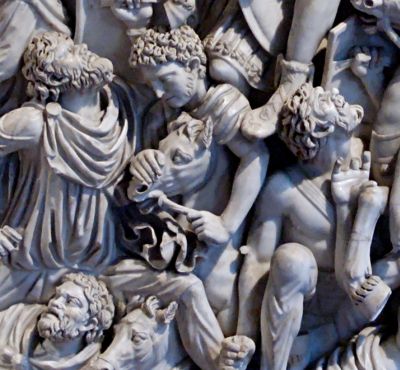
Motive from the Ludovisi sarcophagus

Motive from the Ludovisi sarcophagus, showing dying Goths in the bottom of the battle. They all have curly hair and beard. – Wikipedia.

Sidonius was allowed to keep his estates after the Western Goths had taken over the South of France. In gratitude, he wrote a little poem to King Euric. He wrote it allegedly for his friend Lampridius, but certainly with the ulterior motive that he would show the poem to the King: “We see in his courts the blue-eyed Saxon, lord of the seas, but a timid landsman here. – We see thee, aged Sygambrian (poetic name for the Franks) warrior, the back of the head shaven in sign of thy defeat – Here strolls the Herulian with his glaucous cheeks, inhabitant of Ocean’s furthest shore, and of a complexion with its weedy deeps. Here the Burgundian bends his seven feet of stature on suppliant knee, imploring peace. – And here, O Roman, thou also seekest thy protection – “.

The reason why that perhaps not all Goths had blue eyes, we can find in Ammianus, who wrote about the Western Goths’ initial looting in Thrace a few hundred years before: “For without distinction of age or sex all places were ablaze with slaughter and great fires, sucklings were torn from the very breasts of their mothers and slain, matrons and widows, whose husbands had been killed before their eyes, were carried off, boys of tender or adult age were dragged away over the dead bodies of their parents. Finally, many aged men, crying that they had lived long enough after losing their possessions and their beautiful women, were led into exile with their arms pinioned behind their backs, and weeping over the glowing ashes of their ancestral homes – .” All these matrons, widows and boys would probably have been used for something; they got Gothic children, not all had blue eyes.

Procopius also wrote about the appearance of the Goths in his book on the Justinian Wars: “All these, while they are distinguished from one another by their names (Goths and other migration people), as has been said, do not differ in anything else at all. For they all have white bodies and fair hair, and are tall and handsome to look upon, and they use the same laws and practise a common religion. For they are all of the Arian faith, and have one language called Gothic; and, as it seems to me, they all came originally from one tribe, and were distinguished later by the names of those who led each group.”

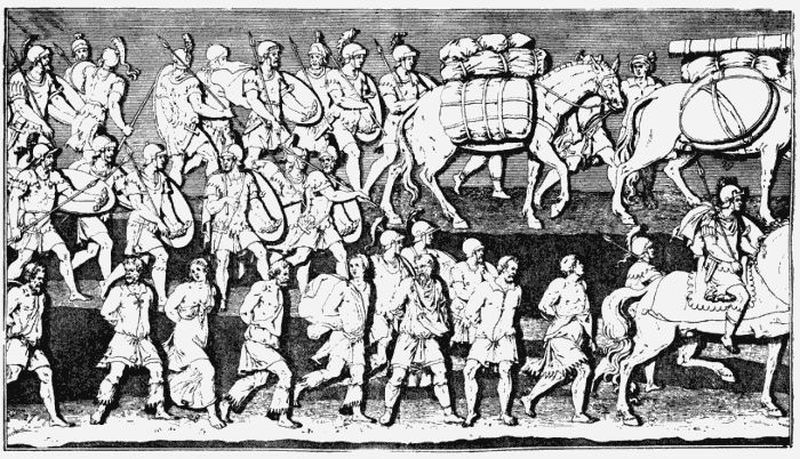
Motive from the  Arcadius column in Konstantinopel

Motive from the Arcadius column in Konstantinopel. It shows Gothic prisoners taken away pinioned by Roman soldiers. The men have beard and half-long hair. They are dressed in traditional Germanic coats and pants. The woman is wearing a dress without sleeves over a kind of skirt. The dress is in disorder and shows her one bared breast, like on the Marcus Aurelius column in Rome. The hair is hanging loose. Perhaps these bared breasts and loose hair symbolize something, for example rape, as a demonstration of the Roman Empire’s power.
The Arcadius column in Constantinople was erected to celebrate the Emperor Arcadius’ victory over the Goths under king Gainas around the year 400 AD. The Goths, who are pictured on the column, was dressed in pants and Tunic very similar to the clothing, which was taken from Thorbjerg Mose near the city of Slesvig. The women are shown dressed in sleeveless clothes and with hair in disorder.

Jordanes tells about Deceneus, who was a sort of philosopher and sage for a group of early Goths: “But he ordered them to call the rest of their race Capillati (hairy, ie, long-haired, them with curls). This name the Goths accepted and prized highly, and they retain it on the day to day in their songs (Jordanes).” And indeed, on many depictions, the Western Goths are shown with curly hair.

Carruthers crest on flag-v2 (1)

Preserving the Past, Recording the Present, Informing the Future

Ancient and Honorable Carruthers Clan Int Society 

carruthersclan1@gmail.com     carrothersclan@gmail.com

cropped-wide-banner-with-new-crest.jpg

Dr Patricia Carrothers

Reviewed by Tammy Wise CHS

CLAN SEANACHAIDHI

CLAN CARRUTHERS INT SOCIETY CCIS HISTORIAN AND GENEALOGIST

You can find us on facebook at :

https://www.facebook.com/carrutherscarrothers.pat.9

https://www.facebook.com/CarruthersClan/

https://www.facebook.com/CarruthersClanLLC

Disclaimer Ancient and Honorable Carruthers Clan International Society

Gutland / Gotland, OUR ANCESTORS, The History of Gutland, The Viking Age

CLAN CARRUTHERS – LANGUAGE OF THE GOTS

cropped-wide-banner-with-new-crest.jpg

LANGUAGE OF THE GOTS / GOTHS

In the Gothic Bible is a Lord’s Prayer, as we well know.  No, the Gots or Goths of Gutland / Gotland are no heathen pagans.  They were some of the early Christians.    The Lords prayer is written in two of the Gots dialects and English.

ramme

Atta unsar þu in himinam,
Fader vor du i himlen.
Father our, you in heaven,
Weihnai namo þein.
Helligt være navnet dit.
hallowed be the name yours,
Qimai þiudinassus þeins.
(lad) Komme kongeriget dit.
(let) come kingdom yours.
Wairþai wilja þeins,
(lad) ske viljen din,
(let) be done will yours,
swe in himina jah ana airþai.
Som i himlen og på jorden.
As in heaven and on earth.
Hlaif unsarana þana sinteinan gif uns himma daga.
brød vort dette daglig giv os (i) disse dage.
bread our daily give us in these days.
Jah aflet uns þatei skulans sijaima,
og forlad os hvilken skyld vi måtte være (have).
And forgive us which guilts we may (have).
Swaswe jah weis afletam þaim skulam unsaraim.
Samt vi forlader skyldene vore.
And we forgive them that have guilts against us.
jah ni briggais uns in fraistubnjai,
og ikke bring os i fristelse,
And not bring us into temptation.
ak lausei uns af þamma ubilin.
Men løs os fra det onde.
but deliver us from evil.
Unte þeina ist þiudangardi jah mahts jah wulþus in aiwins.
thi dit er kongedømme og magt og herlighed i evighed.
For yours is kingdom and power and glory in eternity.
Amen.
Amen.
Amen

ramme

Gothic text from “Deutche Sprache gestern und heute” by Astrid Stedje.
Gothic – Danish – English

Gothic, as spoken by both the Western as the Eastern Goths was a Germanic language closely connected to modern Scandinavian, German and English. Thanks to the Gothic Wulfila Bible, which was written in Italy in the sixth century and the Fleming Busbeccq’s notes about his meeting with representatives of a small group of long-surviving Goths in the Crimea, whom he met in Constantinople in the 16. century, we have a fairly good knowledge of the Gothic language.

The Gothic Bible is a translation from Greek to Gothic of the four Gospels in the New Testament, as well as a part of Paul’s letters. It contains almost nothing of the Old Testament.

We recognize the majority of words from German and Scandinavian. Atta means father as in “æt”, the old Danish word for family or lineage. Unsar we find the German “uns” (us). þu we find in Danish and German “du” and English “you”, in similar to “in” German and English and “i” in Danish. Himian similar to “himmel” (sky) in Danish and German. In the first syllable of Weinai we recognize the German Weinacht (Christmas Eve) Namo means “name” as in English and German and “navn” in Danish. Wilja is corresponding to “vilje” in Danish, “will” in English and “wille” in German. The preposition ana is corresponding to the German “an”, which also has been used in Danish and is still in use in compound words and phrases as “anledning” (occasion), “angive” (inform) and “anliggende” (matter) as well as the English “on”. Hlaif corresponds to “leve”, an old Danish word for bread, as well as the English “loaf”. Aflet and afletam gives associations to the Danish “aflede” (divert). Gif is equivalent to “giv” in Danish, “to give” in English and “geben” in German. Himma corresponds to the old Danish “hine” (these) Daga corresponds to “dage” in Danish, “days” in English and “Tage” in German. Skulans means guilt, as a scowling (“skule” in Danish) person may look like a guilty person. Ak means “but”, indicating that a traditional Danish or German exclamation of sorry “ak-ak” or “ach-ach” originally could have ment “but-but”. Lausei corresponds to the Danish “løse”, German lösen and English “lose”. Ubilin corresponds to “Übel” (evil) in German. Mahts corresponds to “magt” in Danish, “might” in English and “Macht” in German. þiudan-gardi has two parts, the first one is something with þiu , which is “king” in Gothic, and the other has to do with -gardi , which is “gård” (farm or enclosure) in Danish, geard in Old English and “gard” in Old Saxon – here it refers to a type of category.

The Gothic Bible also includes the Christmas story from Luke ch. 2: Warþ þan in dagans jainans, urrann gagrefts fram kaisara Agustau, gameljan allana midjungard.

Literal translation: It came to pass and in days those, (that) there went out decree from Caesar Augustus (that) should be taxed all (in) the world.

Crimean-
Gothic
Flemish
Danish
German
English
broe
brood
brød
brot
bread
plut
bloed
blod
blut
blood
stul
stoel
stol
stuhl
chair
hus
huys
hus
haus
house
wingart
wijgaert
vin
wein
wine
reghen
regen
regn
regen
rain
bruder
broeder
broder
bruder
brother
schwester
zuster
søster
schwester
sister
alt
oud
gammel
alt
old
vintch
wind
vind
wind
wind
silvir
zilver
sølv
silber
silver
golltz
goud
guld
gold
gold
kor
koren
korn
korn
grain
salt
zout
salt
salt
salt
fisct
visch
fisk
fisch
fish
hoef
hoofd
hoved
kopf
head
thurn
deure
dør
tür
door
stern
star
stjerne
stern
star
sune
zon
sol
sonne
sun
mine
maen
måne
mond
moon
tag
dag
dag
tag
day
oeghene
oogen
øjne
augen
eyes
bars
baert
skæg
bart
beard
handa
hand
hånd
hand
hand

Extract from the list of words that the Fleming Ogier Ghislain de Busbecq heard from two representatives of the Goths on the Crimea during a dinner in Constantinople around 1560. Krimgotisk by Poul Erik Jørgensen.

Note that the word for world, midjungard, is very similar to the Scandinavian Midgard.

There are three genders in Gothic namely masculine, feminine and neuter, as in modern German and old Danish. There are two times, past and present, as well as four kasus, namely nominative, accusative, genitive and dative and also, of course, singular and plural.

In Crimea lived Goths until about the 16. century. The Flemish Ogier Ghislain de Busbecqs, who was ambassador of the Holy Roman Empire in Constantinople 1560-62, has in his report provided us with knowledge of their language. He became aware that two representatives of the Goths on Crimea, whom he had heard of, were visiting Constantinople to present some cases for the Sultan. He managed to invite them to a dinner, during which he questioned them about their language and culture.

The definite article in Gothic was very similar to English. Busbecq told: “in front of all the words he puts tho or the”.

In Danish, we have retained the “sw” sound associated with sister in the names for the spouse family, “svoger” (brother in-law), “svigerfar” (father in-law), “svigermor” (mother in-law) and “svigerfamilie” (family in-law).

The two Gothic representatives also told Busbecq several other words that were not so similar to Flemish and German.

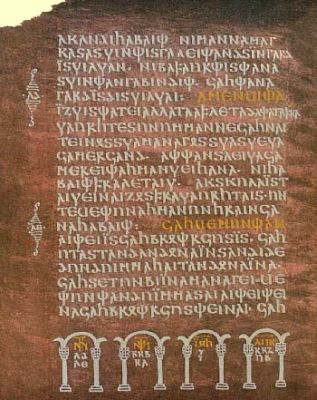
A page of Codex Argenteus

A page of the Wulfila Bible. It is also called “codex argenteus”, which means “Silver Bible”. It is believed that it was written for the Ostrogothic king of Italy, Theodoric the Great. Originally the Bible was translated from Greek to Gothic by Bishop Wulfila in the Balkans in the third century. It is written with the special Gothic alphabet, which was also created by Wulfila. It is called the silver bible because it is written with ink, which contains silver and gold on costly thin parchment. It was originally stored in the Benedictine monastery in Werden in Germany. It was looted by the Swedes in the Thirty Years’ War, and after a turbulent period it ended up in the University Library in Uppsala in Sweeden.

It is seen that Gothic differs from Danish and other Germanic languages by a number of words ending with -a, giving the language an exotic southern touch. The famous king of the Ostro-Goths was for example called Totilla and it sounds almost Mexican at least Spanish. It is believed that this frequent -a ending was an abbreviation, which replaced older, longer and more laborious endings. It is very imaginable that Spanish and to some extent Italian have the frequent -a endings from Gothic. Jordanes, who himself was a Goth, called occasionally the Heruls for “Erulos” which -os ending also sounds Spanish and Mediterranean, but Jordanes had never been to Spain, so it originates probably also from Gothic.

Carruthers crest on flag-v2 (1)

Preserving the Past, Recording the Present, Informing the Future

Ancient and Honorable Carruthers Clan Int Society 

carruthersclan1@gmail.com     carrothersclan@gmail.com

cropped-wide-banner-with-new-crest.jpg

Dr Patricia Carrothers

Reviewed by Tammy Wise CHS

CLAN SEANACHAIDHI

CLAN CARRUTHERS INT SOCIETY CCIS HISTORIAN AND GENEALOGIST

You can find us on facebook at :

https://www.facebook.com/carrutherscarrothers.pat.9

https://www.facebook.com/CarruthersClan/

https://www.facebook.com/CarruthersClanLLC

Disclaimer Ancient and Honorable Carruthers Clan International Society

Gutland / Gotland, OUR ANCESTORS, The History of Gutland, The Viking Age

CLAN CARRUTHERS – THE GOTHS AND GOTLAND IN 500 AD.

cropped-wide-banner-with-new-crest.jpg

THE GOTS AND GOTLAND IN 500 AD

Who were the Goths?

The Goths were a number of Germanic tribes in the Migration Period, which appeared in written history in the third century in the areas north of the Black Sea between the rivers Danube and Don. Except for frequent raids, they invaded the Roman Empire first time in 268 AD, and later in 376 AD. The Western Goths settled a few years in the Garonne valley in France until they conquered a kingdom, which included Spain and the South of France. In France, they were displaced by the Franks after a few years, and Spain was in 711 AD conquered by Muslim invaders – but the Goths descendants took the country back in the Middle Ages. The Eastern Goths established a thriving kingdom in Italy, but after only 67 years, they were defeated by armies sent by the emperor in Constantinople.

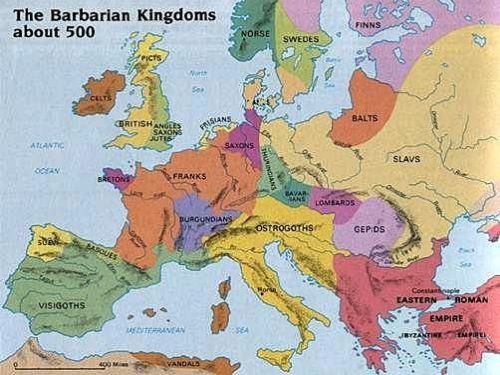
Europe around 500 AD

 A map of Europe showing the Germanic kingdoms that were established after the downfall of the Western Roman Empire. After numerous battles and long migrations, the Western Goths managed to settle in Spain and the Eastern Goths to take possession of Italy. However, it did not last forever. From ancientweb.org.
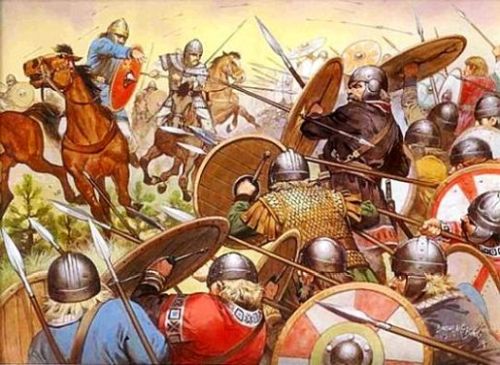
Bottom: An artistic reconstruction of the Western Goths in battle with Attila’s Huns at Chalons. From ancientweb.org.

When the first Goths arrived at the northern coast of the Black Sea about 170 AD, the climate was still influenced by the Roman Warm Period, which, however, ended about 400 AD. The Vandals crossed the frozen Rhine new year’s eve 406 AD, thus commencing the Migration time and heralding the downfall of the Western Roman Empire. The fact that the Rhine was frozen, testifies to a rather cold climate. I do not recall the Rhine has been frozen in modern times.

An artistic reproduction of the Goths in battle at ChalonsFrom then on, until the disaster at Guadalete in Spain in 711 AD, when the Western Goths were defeated by invading Muslims, the climate was cold with snowy winters in northern and central Europe.
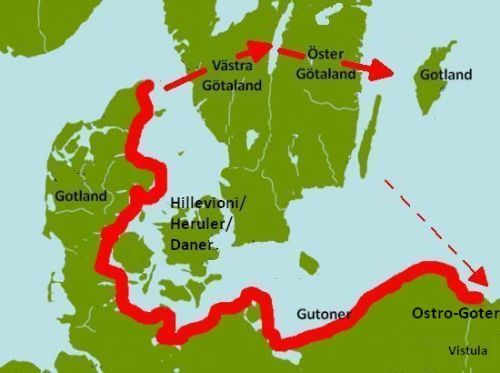
Goths can be traced further back in history to today’s northern Poland, and even in the distant past to their origins in Scandinavia and the Baltic area. Thus Jutland through thousand years was called Gotland.

Paul the Deacon tells about how the Langobards migrated from their original island in the ocean: “Now when the people living there had multiplied to such a number that they could no longer live together, they divided, it is told, their whole people into three parts and decided by casting lots, which of those, who were to leave the homeland and seek new places of residence.” Dudo confirmed many years later that it was a traditional way of solving problems of overpopulation in Scandinavia.

Also, the Gotland Gute Saga says that some of the people were taken for emigration by casting lot: “After a long time, the people have so increased that the country was not able to feed them all. So the land was distributed, on which every third tilled, each of these was allowed to keep and bring and take away everything, which he in his life had acquired.”

Pliny the Elder (23-79 AD) wrote: “Pytheas says that the Gutones, a people of Germania, inhabits the shores of an estuary of the Ocean called Mentonomon, their territory extending a distance of six thousand stadia; that, at one day’s sail from this territory, is the Isle of Abalus, upon the shores of which, amber is thrown up by the waves in spring, it being an excretion of the sea in a concrete form; as, also, that the inhabitants use this amber by way of fuel, and sell it to their neighbours, the Teutones.”

Gutones following Pytheas

Pytheas wrote: “Pytheas says that the Gutones, a people of Germany, inhabit the shores of an estuary of the Ocean called Mentonomon, their territory extending a distance of six thousand stadia.” Other ancient writers also believed that the Baltic Sea and inner Danish waters was a major estuary.
Procopius wrote about the returning Heruls: “After these, they passed by the nations of the Dani, without suffering violence at the hands of the barbarians there. Coming thence to the ocean, they took to the sea, and putting in at Thule, remained there on the island.” – “And one of their most numerous nations is the Gauti, and it was opposite (next to?) them that the incoming Eruli settled at the time in question.” We must believe that Procopius shared the ancient authors believe that the Danish waters and the Baltic Sea was a large estuary, in which case it “opposite the Goths” can be understood: on the opposite side of the estuary. Alternatively, it should be translated “next to the Goths.” However, in both cases, suggesting that the Heruls were Goths.

There is some uncertainty about how long a stadium was, the proposals vary between 160 and 192 m. That means that the coastline, which was inhabited by Gutones, was between 960 and 1.152 km. long. That gives a range from Skagen to the Vistula estuary at Gdansk.

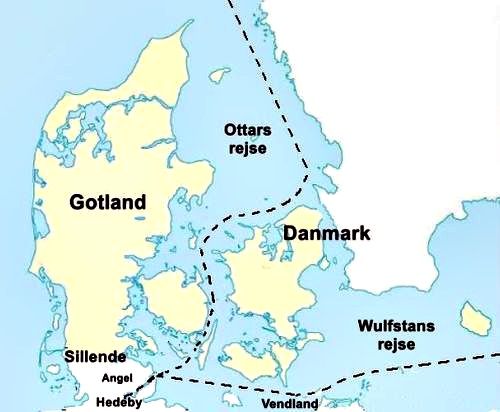
It suits very well with that the Jutland peninsula before the Viking Age was called Gotland, as it is the case in Ottar’s travelogue, added in Alfred the Great’s translation of Orosius’ Roman history from about 850 AC: “When he sailed there from Skíringssal (at Oslo), Denmark was on the port side and to starboard for three days was the open sea. And then, two days before he came to Hedeby, Gotland was to starboard (him wæs on þæt steorbord Gotland), and Sillende and many islands. The Angles dwelt in that area before they came here to this land.”

Since the area was inhabited by Gutones in time before Christ – according to Pytheas – and as part of it still was called Gotland 800-900 AD, it is reasonable to assume that at least the coast along Kattegat and the Baltic Sea were the Goth’s original homeland.

Ottar's and Wulfstan's journeys

Ottar’s and Wulfstan’s travels according to additions in Alfred the Great’s translation of Orosius’ Roman history. Both Jutland and the island in the Baltic Sea are called Gotland. (The island of Gotland is not shown on this map).

That will indicate that Cimbri, Teutons, Angles and all other tribes, who lived along this coastline, and whose names we are not sure about, all originally have thought of themselves as kinds of Goths speaking the same language, namely Gothic.

Some believe that the Gutones on the densely populated Jutland east coast very early crossed the Kattegat and gradually populated West and East Gøta Land – and from there the island of Gotland in the Baltic Sea.

In Alfred the Great’s translation of Orosius’ Roman history is also added Wulfstan’s travel report from a voyage from Hedeby to Truso in Vistula’s delta from about 850 AC, which reads: “Wulfstan said that he traveled from Hedeby, and that he was in Truso in seven days and nights, and that the ship all the way went under sail. Wendland was on his starboard side and to port, he had Langeland, Lolland, Falster and Scania. These countries all belong to Denmark. So we had Bornholm to port, and they have their own king. So after Bornholm we had the countries named first Blekinge, More, Oland and Gotland to port (and Gotland on bæcbord), and these countries belong to the Swedes. And we had Wendland to starboard all the way to the Vistula river mouth.” By Gotland is here obviously meant the island of Gotland or maybe the coast of Eastern Gøtaland.

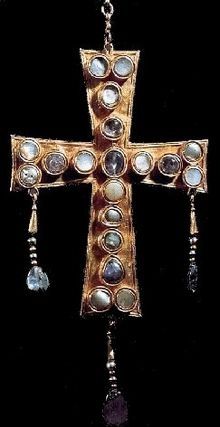
Gothic cross found in Spain

Gothic cross found in Spain perhaps from 700’s.

Ptolemy placed the people Goutai on the island of Skandia and the Gudones by the Vistula river.

The Roman historian Cornelius Tacitus described the location of the Gotones as: “Beyond the Lugii is the monarchy of the Gotones: The hand upon the reins closes somewhat tighter here than among the other tribes of Germans, but not so tight yet as to destroy freedom. Then immediately following them and on the ocean are the Rugii and Lemovii. The distinguishing features of all these tribes are round shields, short swords, and a submissive bearing before their kings.” This means that Gotones, who was ruled by powerful kings, lived north or northeast of the Lugii and further inland than the Rugii and Lemovii, which he explicitly stated as residing at the sea. Perhaps Gotones lived at the Vistula river.

Jordanes located the peoples Ostro-Goths, Ewa-Greutingis and Gaiti-Goths on the island of Scandia. Gauti-Goths were “a race of men bold and quick to fight”, he wrote, and further, “But still another race dwells there, the Sweans, who like the Thuringos, having splendid horses.” With the term “another race” he must have meant that they were not Goths. “All these nation surpassed the Germans in size and spirit, and fought with the cruelty of wild beasts”, he concluded the description of the peoples on the Scandinavian peninsula.

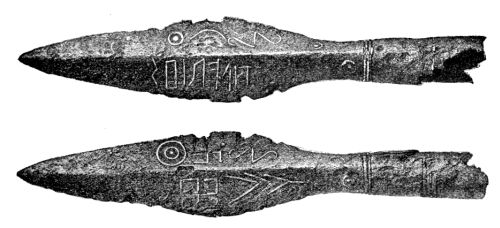
Lance tip with a runic inscriptions found near Kovel in the northwest corner of UkraineRight and left side of a lance head with runic inscription found near Kovel in the Northwest corner of Ukraine. The runic inscription to be read from right to left “Tilarids”. It has been identified as likely East Germanic, most likely Gothic because of the nominative s-suffix. It is from the beginning of the third century.
He mentions different tribes of Goths, who lived on the island of Skandia, including Greutingis and Ostro-Goths, which names we later recognize for Gothic peoples on the Danube and in Italy. This makes it likely that it is true that the Goths, who attacked the Roman Empire, originally came from Scandinavia and the coasts of the Baltic Sea. Furthermore, there are several areas of southern Scandinavia, which have been called, or still are named as Gotland with different spellings, which also support the theory that this region was the original homeland of the Goths. In his report on the Gothic war in Italy, Procopius mentions the Rugi, as part of the Goths in Italy; they are also referred to by Jordanes as one of Skandia’s indigenous tribes. They are also mentioned in other ancient sources.

Pollen analysis from Abkjær 
Mose

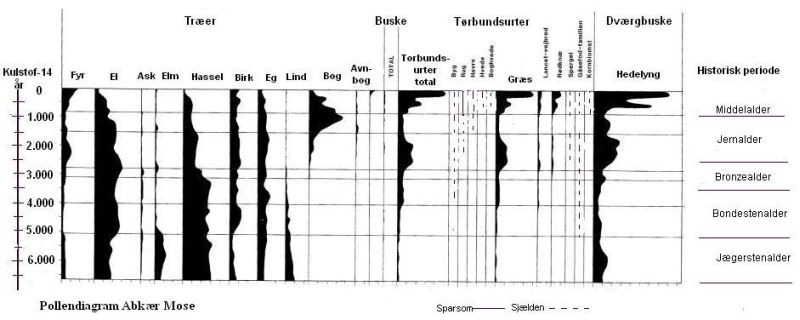
Pollen analysis from Abkjær Mose at Vojens. It appears that forest, especially beech, increases sharply and herbs typical of open land, grass and heather decrease immediately after the migration time around 500 AD indicating that the forest returned to areas that previously were pastures for cattle. Similar studies in other parts of the country show the same pattern. It is reasonable to interpret that this could be due to emigration.
Also, Procopius reports on the returning Heruls suggests that Scandinavia was quite thinly populated. For how could they just “settle down”, as if they came to an untouched prairie? If not the country had been relatively sparsely populated.
However, when large parts of the original population had turned their back to good pastures, it may not only have been hunger and misery that drove them to emigrate.
It is known that for several hundred years of the late Imperial time the Roman legions were mostly populated with various Germanic soldiers since the Roman Empire’s own citizens did not seem to have been suitable. You could say that every Roman legion was a sort of Foreign Legion, in which also many young men from the South Scandinavian region must have served. Therefore the tribes around the Baltic Sea may have concluded that they were the best and the bravest – and therefore deserved to rule. Such attitudes among the Germanic tribes were most likely critical to the doom of the Western Roman Empire.

All these ancient authors wrote before official correct spelling was invented; they wrote in different languages with different alphabets and over a period of several hundred years. They reproduced words for Goths that often for them were in an unfamiliar language, besides most likely Gothic by this time had already developed in several dialects. It is quite understandable that they spelled it in so many different ways, and we do not have to connect any deeper meaning in the different spellings.

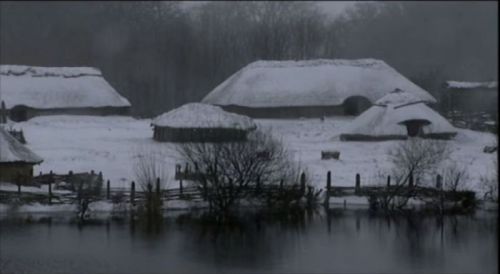
Germanic Village

The Goths lived spread out over farmland in small villages with each may be about 8-10 houses and farms.

In Book III of Justinian’s wars, Procopius wrote about the Goths’ early history: “Now while Honorius was holding the imperial power in the West, barbarians took possession of his land; and I shall tell, who they were and in what manner, they did so. There were many Gothic nations in earlier times, just as also at the present, but the greatest and most important of all are the Goths, Vandals, Visigoths, and Gepaedes. In ancient times, however, they were named Sauromatae and Melanchlaeni; and there were some too, who called these nations Getic. All these, while they are distinguished from one another by their names, as has been said, do not differ in anything else at all. For they all have white bodies and fair hair and are tall and handsome to look upon, and they use the same laws and practice a common religion. For they are all of the Arian faith, and have one language called Gothic; and, as it seems to me, they all came originally from one tribe, and were distinguished later by the names of those who led each group.”

Procopius is undoubtedly correct that most Germanic migrations peoples were a kind of Goths; they resembled each other and spoke largely the same language. But then they must originally have come from the same tribe, as he wrote. That is, we must believe that they all came more or less directly from the original Gothic area along the Baltic Sea, the Danish waters and from the southern part of the Scandinavian Peninsula. Procopius believed that also the Vandals and Gepids were kinds of Goths, although they were not generally named as such.

Moreover, in Denmark are clear indications of a big drop in population density in Germanic Iron Age relative to the Roman Iron Age, which indicates a considerable migration.

Carruthers crest on flag-v2 (1)

Preserving the Past, Recording the Present, Informing the Future

Ancient and Honorable Carruthers Clan Int Society 

carruthersclan1@gmail.com     carrothersclan@gmail.com

cropped-wide-banner-with-new-crest.jpg

Dr Patricia Carrothers

Reviewed by Tammy Wise CHS

CLAN SEANACHAIDHI

CLAN CARRUTHERS INT SOCIETY CCIS HISTORIAN AND GENEALOGIST

You can find us on facebook at :

https://www.facebook.com/carrutherscarrothers.pat.9

https://www.facebook.com/CarruthersClan/

https://www.facebook.com/CarruthersClanLLC

Disclaimer Ancient and Honorable Carruthers Clan International Society
OUR ANCESTORS, Uncategorized, Varangians

THE SEA KINGS – CLAN CARRUTHERS CCIS

cropped-wide-banner-with-new-crestnorse

THE SEA KINGS

The Sea-Kings and their Daring Feats

From the word vik, or bay, comes the word viking, long used to designate the sea-rovers of the Northland, the bold Norse wanderers who for centuries made their way to the rich lands of the south on plundering raids. Beginning by darting out suddenly from hiding places in bays or river mouths to attack passing craft, they in the end became daring scourers of the seas and won for themselves kingdoms and dominions in the settled realms of the south.

Nothing was known of them in the early days. The people of southern Europe in the first Christian centuries hardly knew of the existence of the race of fair-skinned and light-haired barbarians who dwelt in the great peninsula of the north. It was not until near the year 800 B.C. that these bold brigands learned that riches awaited those who dared seize it on the shores of France, England, and more southern lands. Then they came in fleets and spread terror wherever they appeared. For several centuries the realms of civilization trembled before their very name.

“From the fury of the Northmen, Good Lord deliver us!” prayed the priests, and the people joined fervently in the prayer.

Long before this period the sea was the favorite hunting ground of the daring sons of the north, but the small chiefs of that period preyed upon each other, harrying their neighbors and letting distant lands alone. But as the power of the chiefs, and their ability to protect themselves increased, this mode of gaining wealth and fame lost its ease and attraction and the rovers began to rove farther afield.

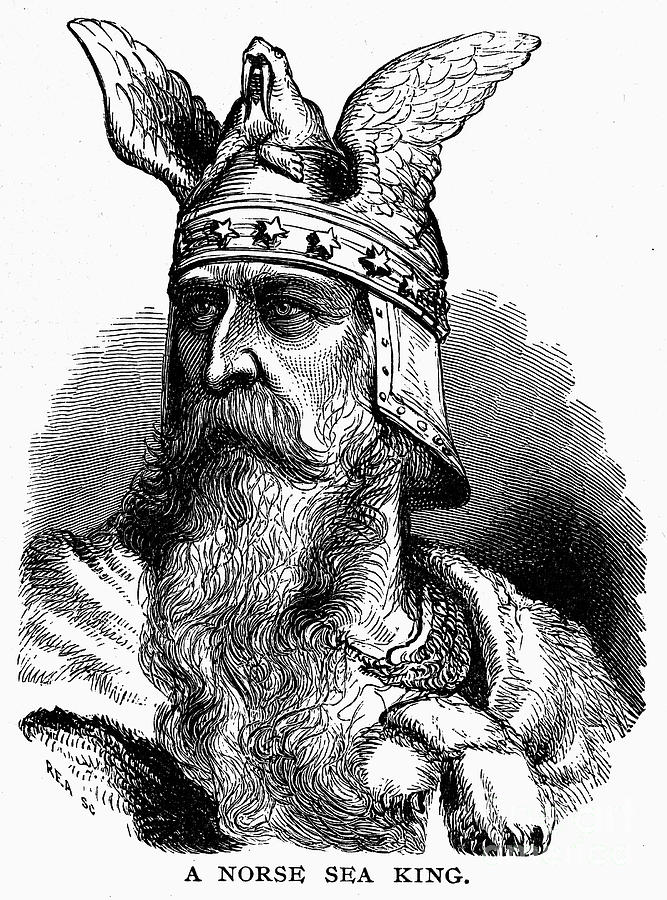
Sveidi 'Sveiði' “The Sea King” HEYTIRSSON – The Lives of my Ancestors

Sea-kings they called themselves. On land the ruler of a province might be called either earl or king, but the earl who went abroad with his followers on warlike excursions was content with no less name than king, and the chiefs who set out on plundering cruises became from the first known as sea-kings. Pirates and freebooters we would call them to-day, but they were held in high distinction in their native land, and some of the most cruel of them, on their return home, became men of influence, with all the morality and sense of honor known in those early days. Their lives of ravage and outrage won them esteem at home and the daring and successful sea-king ranked in fame with the noblest of the home-staying chiefs. We have seen how King Erik began his career as a viking and ended it in the same pursuit; how Rollo, a king’s son, adopted the same profession; and from this it may be seen that the term was one of honor instead of disgrace.

From all the lands of the north they came, these dreaded sons of the sea, from Norway, Sweden, and Denmark alike, fierce heathens they who cared nought for church or priest, but liked best to rob chapels and monasteries, for there the greatest stores of gold and silver could be found. When the churches were plundered they often left them in flames, as they also did the strong cities they captured and sacked. The small, light boats with which they dared the sea in its wrath were able to go far up the rivers, and wherever these fierce and bloodthirsty rovers appeared wild panic spread far around. So fond were they of sword-thrust and battle that one viking crew would often challenge another for the pure delight of fighting. A torment and scourge they were wherever they appeared.

Ivar Halfdansson + Thyra Eysteinsdoittir

The first we hear in history of the sea-kings is in the year 787, when a small party of them landed on the English coast. In 794 came another flock of these vultures of the sea, who robbed a church and a monastery, plundering and killing, and being killed in their turn when a storm wrecked their ships and threw them on shore. As a good monk writes of them: “The heathen came from the northern countries to Britain like stinging wasps, roamed about like savage wolves, robbing, biting, killing not only horses, sheep, and cattle, but also priests, acolytes, monks, and nuns.”

The Norsemen had found a gold mine in the south and from this time on they worked it with fierce hands. Few dared face them, and even in the days of the great Charlemagne they ravaged the coast lands of France. Once, when the great emperor was in one of his cities on the Mediterranean coast, a fleet of the swift viking ships, known by their square sails, entered the harbor. Soon word was brought that they had landed and were plundering. Who they were the people knew not, some saying that they were Jews, others Africans, and others that they were British merchants.

“No merchants they,” said the emperor. “Those ships do not bring us goods, but fierce foes, bloody fighters from the north.”

The warriors around him at once seized their weapons and hurried to the shore, but the vikings had learned that the great emperor was in the city and, not daring to face him, had sought their ships and spread their sails again. Tears came to the eyes of Charlemagne as he watched them in their outward flight. He said to those around him:

“It is not for fear that these brigands can do me any harm that I weep, but for their daring to show themselves on this coast while I am alive. Their coming makes me foresee and fear the harm they may do to my descendants.”

This story may be one of those legends which the monks were fond of telling, but it serves to show how the dread Norsemen were feared. France was one of their chief fields of ravage and slaughter. First coming in single ships, to rob and flee, they soon began to come in fleets and grew daring enough to attack and sack cities. Hastings, one of the most renowned of them all, did not hesitate to attack the greatest cities of the south.

In 841 this bold freebooter sailed up the Loire with a large fleet, took and burned the city of Amboise, and laid siege to Tours. But here the inhabitants, aided, it is said, by the bones of their patron saint, drove him off. Four years later he made an attack on Paris, and as fortune followed his flag he grew so daring that he sought to capture the city of Rome and force the Pope to crown him emperor.

For an account of this remarkable adventure of the bold Hastings see the article, “The Raids of the Sea-Rovers,”  https://clancarruthers.home.blog/2022/01/12/the-raids-of-the-sea-kings-clan-carruthers-ccis/

In that account are also given the chief exploits of the vikings in France and Germany. We shall therefore confine ourselves in the remainder of this article to their operations in other lands, and especially in Ireland.

This country was a common field for the depredations of the Norse rovers. For some reason not very clear to us the early vikings did not trouble England greatly, but for many years they spread terror through the sister isle, and in the year 838 Thorgisl, one of their boldest leaders, came with a fleet of one hundred and twenty ships, with which he attacked and captured the city of Dublin, and afterwards, as an old author tells us, he conquered all Ireland, securing his conquest with stone forts surrounded with deep moats.

Sveide Sveidasson - Historical records and family trees - MyHeritage

But the Irish at length got rid of their conqueror by a stratagem. It was through love that the sea-king was lost. Bewitched with the charms of the fair daughter of Maelsechnail, one of the petty kings of the land, he bade this chieftain to send her to him, with fifteen young maidens in her train. He agreed to meet her on an island in Loch Erne with as many Norsemen of high degree.

Maelsechnail obeyed, but his maidens were beardless young men, dressed like women but armed with sharp daggers. Thorgisl and his men, taken by surprise, were attacked and slain. The Irish chief had once before asked Thorgisl how he should rid himself of some troublesome birds that had invaded the island. “Destroy their nests,” said the Norseman. It was wise advice, and Maelsechnail put it in effect against the nests of the conquerors, destroying their stone strongholds, and killing or driving them away, with the aid of his fellow chieftains.

Thus for a time Ireland was freed. It was conquered again by Olaf the White, who in 852 defeated some Danes who had taken Dublin, and then, like Thorgisl, began to build castles and tax the people. Two other viking leaders won kingdoms in Ireland, but Olaf was the most powerful of them all, and the kingdom founded by him lasted for three hundred and fifty years. From Dublin Olaf sailed to Scotland and England, the booty he won filling two hundred ships.

The sea-rovers did not confine their voyages to settled lands. Bold ocean wanderers, fearless of man on shore and tempest on the waves, they visited all the islands of the north and dared the perils of the unknown sea. They rounded the North Cape and made their way into the White Sea as early as 750. The Faroe, the Orkney and the Shetland Islands were often visited by them after 825, and in 874 they discovered Iceland, which had been reached and settled by Irishmen or Scots about 800. The Norsemen found here only some Irish hermits and monks, and these, disturbed in their peaceful retreat by the turbulent newcomers, made their way back to Ireland and left the Norsemen lords of the land. From Iceland the rovers reached Greenland, which was settled in 986, and about the year 1000 they discovered North America, at a place they named Vinland.

Such is, briefly told, the story of the early Norse wanderers. They had a later tale, of which we have told part in their conquest of Ireland. Though at first they came with a few ships, and were content to attack a town or a monastery, they soon grew more daring and their forces larger. A number of them would now fortify themselves on some coast elevation and make it a centre for plundering raids into the surrounding country. At a later date many of them ceased to pose as pirates and took the rôle of invaders and conquerors, storming and taking cities and founding governments in the invaded land.

The Sea King | Art UK

( The Carrruthers have many ancestors who were Sea Kings, as far back as 200 AD.  In our line we only know of the King or Chief , of a large group of big men who wore a lot of chain male.  They were identified as big, tall, huge men with no roof.   We had ancestors later on who were  called Varigians.)

Such was the work of Thorgisl and Olaf in Ireland and of Rollo in Normandy. England was a frequent field of invasion after 833, which continued until 851, when King Ethelwulf defeated them with great slaughter. Fifteen years later they came again, these new invaders being almost all Danes. During all his reign Alfred the Great fought with them, but in spite of his efforts they gained a footing in the island, becoming its masters in the north and east. A century later, in 1016, Canute, the king of Denmark, completed the conquest and became king of all England.

This is not the whole story of the sea-kings, whose daring voyages and raids made up much of the history of those centuries. One of the most important events in viking history took place in 862, when three brother chiefs, probably from Sweden, who had won fame in the Baltic Sea, were invited by the Russian tribes south of Lake Ladoga to come and rule over them. They did so, making Novgorod their capital. From this grew the empire of Russia, which was ruled over by the descendants of Rurik, the principal of these chiefs, until 1598.

Other vikings made their way southward through Russia and, sailing down the Dnieper, put Constantinople in peril. Only a storm which scattered their fleet saved the great city from capture. Three times later they appeared before Constantinople, twice (in 904 and 945) being bought off by the emperors with large sums of money. Later on the emperors had a picked body-guard of Varangians, as they called the Northmen, and kept these till the fall of the city in 1453. It was deemed a great honor in the north to serve in this choice cohort at Myklegaard (Great City), and those who returned from there doubtless carried many of the elements of civilization to the Scandinavian shores.

To some of these Varangians was due the conquest of Sicily by the Northmen. They were in the army sent from Constantinople to conquer that island, and seeing how goodly a land it was they aided in its final conquest, which was made by Robert Guiscard, a noble of Normandy, whose son Roger took the title of “King of Sicily and Italy.” Thus it was that the viking voyages led within a few centuries to the founding of kingdoms under Norse rulers in England, Ireland, Sicily, Russia, and Normandy in France.

Carruthers crest on flag-v2 (1)

OFFICIAL AND REGISTEREDL CLAN CARRUTHERS CCIS SINCE 1983-CLAN OF OUR ANCESTORS

SCOTTISH CLAN – IRISH CLAN – NORSE CLAN

Preserving Our Past!    Recording Our Present!  Informing Our Future!

The Ancient and Honorable Carruthers Clan International Society LLC

carruthersclan1@gmail.com                carrothersclan@gmail.com

WIDE BANNER with NEW CREST

 SCANDINAVIAN HISTORY
CHARLES MORRIS

CLAN CARRUTHERS INT SOCIETY CCIS HISTORIAN AND GENEALOGIST

You can find us on our main facebook pages at :

SILVER WINGS-https://www.facebook.com/CarruthersClanLLC/

GOLD WINGS – https://www.facebook.com/carrutherscarrothers.pat.9

CLAN CARRUTHERS FAMILY HISTORY – https://www.facebook.com/CarruthersClan

CLAN CARRUTHERS CCIS – https://www.facebook.com/groups/3878691252182714

CLAN CARRUTHERS INT SOCIETY- https://www.facebook.com/groups/394653845137709

CLAN CARRUTHERS – BORDER REIVERS – https://www.facebook.com/groups/434959914239094

Disclaimer Ancient and Honorable Carruthers Clan International Societ
OUR ANCESTORS, SEA KINGS AND ROVERS, The Viking Age, Uncategorized, Varangians

THE RAIDS OF THE SEA KINGS – CLAN CARRUTHERS CCIS

cropped-wide-banner-with-new-crestnorse

SEA KINGS

RAIDS OF THE SEA ROVERS

While Central and Southern Europe was actively engaged in wars by land, Scandinavia, that nest of pirates, was as actively engaged in wars by sea, sending its armed galleys far to the south, to plunder and burn wherever they could find footing on shore. Not content with plundering the coasts, they made their way up the streams, and often suddenly appeared far inland before an alarm could be given. Wherever they went, heaps of the dead and the smoking ruins of habitations marked their ruthless course. They did not hesitate to attack fortified cities, several of which fell into their hands and were destroyed. They always fought on foot, but such was their strength, boldness, and activity that the heavy-armed cavalry of France and Germany seemed unable to endure their assault, and was frequently put to flight. If defeated, or in danger of defeat, they hastened back to their ships, from which they rarely ventured far and rowed away with such speed that pursuit was in vain. For a long period they kept the Atlantic and Mediterranean coasts of Europe in such terror that prayers were publicly read in the churches for deliverance from them, and the sight of their dragon beaked ships filled the land with terror.

On This Day In History: 'Sea King' Ragnar Lodbrok Seizes Paris - On March  28, 845 - Ancient Pages

SEA KINGS SEIZE PARIS

In 845 a party of them assailed and took Paris, from which they were bought off by the cowardly and ineffective method of ransom, seven thousand pounds of silver being paid them. In 853 another expedition, led by a leader named Hasting, one of the most dreaded of the Norsemen, again took Paris, marched into Burgundy, laying waste the country as he advanced, and finally took Tours, to which city much treasure had been carried for safe-keeping. Charles the Bald, who had bought off the former expedition with silver, bought off this one with gold, offering the bold adventurer a bribe of six hundred and eighty-five pounds of the precious metal, to which he added a ton and a half of silver, to leave the country.

River Kings — were the Vikings really violent? | Financial Times

From France, Hasting set sail for Italy, where his ferocity was aided by a cunning which gives us a deeper insight into his character. Rome, a famous but mystical city to the northern pagans, whose imaginations invested it with untold wealth and splendor, was the proposed goal of the enterprising Norseman, who hoped to make himself fabulously wealthy from its plunder. With a hundred ships, filled with hardy Norse pirates, he swept through the Strait of Gibraltar and along the coasts of Spain and France, plundering as he went till he reached the harbor of Lucca, Italy.

As to where and what Rome was, the unlettered heathen had but the dimmest conception. Here before him lay what seemed a great and rich city, strongly fortified and thickly peopled. This must be Rome, he told himself; behind those lofty walls lay the wealth which he so earnestly craved; but how could it be obtained? Assault on those strong fortifications would waste time, and perhaps end in defeat. If the city could be won by stratagem, so much the better for himself and his men.

The shrewd Norseman quickly devised a promising plan within the depths of his astute brain. It was the Christmas season, and the inhabitants were engaged in the celebration of the Christmas festival, though, doubtless, sorely troubled in mind by that swarm of strange-shaped vessels in their harbor, with their stalwart crews of blue-eyed plunderers.

Word was sent to the authorities of the city that the fleet had come thither from no hostile intent, and that all the mariners wished was to obtain the favor of an honorable burial-place for their chieftain, who had just died. If the citizens would grant them this, they would engage to depart after the funeral without injury to their courteous and benevolent friends. The message—probably not expressed in quite the above phrase—was received in good faith by the unsuspecting Lombards, who were glad enough to get rid of their dangerous visitors on such cheap terms, and gratified to learn that these fierce pagans wished Christian burial for their chief. Word was accordingly sent to the ships that the authorities granted their request, and were pleased with the opportunity to oblige the mourning crews.

Not long afterwards a solemn procession left the fleet, a coffin, draped in solemn black, at its head, borne by strong carriers. As mourners there followed a large deputation of stalwart Norsemen, seemingly unarmed, and to all appearance lost in grief. With slow steps they entered the gates and moved through the streets of the city, chanting the death-song of the great Hasting, until the church was reached, and they had advanced along its crowded aisle to the altar, where stood the priests ready to officiate at the obsequies of the expired freebooter.

The coffin was set upon the floor, and the priests were about to break into the solemn chant for the dead, when suddenly, to the surprise and horror of the worshippers, the supposed corpse sprang to life, leaped up sword in hand, and with a fierce and deadly blow struck the officiating bishop to the heart. Instantly the seeming mourners, who had been chosen from the best warriors of the fleet, flung aside their cloaks and grasped their arms, and a carnival of death began in that crowded church.

It was not slaughter, however, that Hasting wanted, but plunder. Rushing from the church, the Norsemen assailed the city, looting with free hand, and cutting down all who came in their way. No long time was needed by the skilful freebooters for this task, and before the citizens could recover from the mortal terror into which they had been thrown, the pagan plunderers were off again for their ships, laden with spoil, and taking with them as captives a throng of women and maidens, the most beautiful they could find.

This daring affair had a barbarous sequel. A storm arising which threatened the loss of his ships, the brutal Hasting gave orders that the vessels should be lightened by throwing overboard plunder and captives alike. Saved by this radical method, the sea-rovers quickly repaid themselves for their losses by sailing up the Rhone, and laying the country waste through many miles of Southern France.

The end of this phase of Hasting’s career was a singular one. In the year 860 he consented to be baptized as a Christian, and to swear allegiance to Charles the Bald of France, on condition of receiving the title of Count of Chartres, with a suitable domain. It was a wiser method of disarming a redoubtable enemy than that of ransoming the land, which Charles had practised with Hasting on a previous occasion. He had converted a foe into a subject, upon whom he might count for defence against those fierce heathen whom he had so often led to battle.

Viking Sea King Photograph by Granger

While France, England, and the Mediterranean regions formed the favorite visiting ground of the Norsemen, they did not fail to pay their respects in some measure to Germany, and during the ninth century, their period of most destructive activity, the latter country suffered considerably from their piratical ravages. Two German warriors who undertook to guard the coasts against their incursions are worthy of mention. One of these, Baldwin of the Iron Arm, Count of Flanders, distinguished himself by seducing Judith, daughter of Charles the Bald of France, who, young as she was, was already the widow of two English kings, Ethelwolf and his son Ethelbold. Charles was at first greatly enraged, but afterwards accepted Baldwin as his son-in-law, and made him lord of the district. The second was Robert the Strong, Count of Maine, a valiant defender of the country against the sea-kings. He was slain in a bloody battle with them, near Anvers, in 866. This distinguished warrior was the ancestor of Hugh Capet, afterwards king of France.

For some time after his death the Norsemen avoided Germany, paying their attentions to England, where Alfred the Great was on the throne. About 880 their incursions began again, and though they were several times defeated with severe slaughter, new swarms followed the old ones, and year by year fresh fleets invaded the land, leaving ruin in their paths.

Up the rivers they sailed, as in France, taking cities, devastating the country, doing more damage each year than could be repaired in a decade. Aix-la-Chapelle, the imperial city of the mighty Charlemagne, fell into their hands, and the palace of the great Charles, in little more than half a century after his death, was converted by these marauders into a stable. Well might the far-seeing emperor have predicted sorrow and trouble for the land from these sea-rovers, as he is said to have done, on seeing their many-oared ships from a distance. Yet even his foresight could scarcely have imagined that, before he was seventy years in the grave, the vikings of the north would be stabling their horses in the most splendid of his palaces.

1,846 Viking Raid Stock Photos, Pictures & Royalty-Free Images - iStock

The rovers attacked Metz, and Bishop Wala fell while bravely fighting them before its gates. City after city on the Rhine was taken and burned to the ground. The whole country between Liege, Cologne, and Mayence was so ravaged as to be almost converted into a desert. The besom of destruction, in the hands of the sea-kings, threatened to sweep Germany from end to end, as it had swept the greater part of France.

The impunity with which they raided the country was due in great part to the indolent character of the monarch. Charles the Fat, as he was entitled, who had the ambitious project of restoring the empire of Charlemagne, and succeeded in combining France and Germany under his sceptre, proved unable to protect his realm from the pirate rovers. Like his predecessor, Charles the Bald of France, he tried the magic power of gold and silver, as a more effective argument than sharpened steel, to rid him of these marauders. Siegfried, their principal leader, was bought off with two thousand pounds of gold and twelve thousand pounds of silver, to raise which sum Charles seized all the treasures of the churches. In consideration of this great bribe the sea-rover consented to a truce for twelve years. His brother Gottfried was bought off in a different method, being made Duke of Friesland and vassal of the emperor.

These concessions, however, did not put an end to the depredations of the Norsemen. There were other leaders than the two formidable brothers, and other pirates than those under their control, and the country was soon again invaded, a strong party advancing as far as the Moselle, where they took and destroyed the city of Treves. This marauding band, however, dearly paid for its depredations. While advancing through the forest of Ardennes, it was ambushed and assailed by a furious multitude of peasants and charcoal-burners, before whose weapons ten thousand of the Norsemen fell in death.

This revengeful act of the peasantry was followed by a treacherous deed of the emperor, which brought renewed trouble upon the land. Eager to rid himself of his powerful and troublesome vassal in Friesland, Charles invited Gottfried to a meeting, at which he had the Norsemen treacherously murdered, while his brother-in-law Hugo was deprived of his sight. It was an act sure to bring a bloody reprisal. No sooner had news of it reached the Scandinavian north than a fire of revengeful rage swept through the land, and from every port a throng of oared galleys put to sea, bent upon bloody retribution. Soon in immense hordes they fell upon the imperial realm, forcing their way in mighty hosts up the Rhine, the Maese, and the Seine, and washing out the memory of Gottfried’s murder in torrents of blood, while the brand spread ruin far and wide.

Vikings: Re-writing the legend of Ragnar for the TV age

The chief attack was made on Paris, which the Norsemen invested and besieged for a year and a half. The march upon Paris was made by sea and land, the marauders making Rouen their place of rendezvous. From this centre of operations Rollo—the future conqueror and Duke of Normandy, now a formidable sea-king—led an overland force towards the French capital, and on his way was met by an envoy from the emperor, no less a personage than the Count of Chartres, the once redoubtable Hasting, now a noble of the empire.

“Valiant sirs,” he said to Rollo and his chiefs, “who are you that come hither, and why have you come?”

( Rollo is a Carruthers Ancestor, and we have a large number of ancestors in Gutland, and they were considered Danes.   Gutland and Jutland were one in the same, and had land that connected them, now is water)

“We are Danes,” answered Rollo, proudly; “all of us equals, no man the lord of any other, but lords of all besides. We are come to punish these people and take their lands. And you, by what name are you called?”

23 Viking ship ideas | viking ship, vikings, norse vikings

“Have you not heard of a certain Hasting,” was the reply, “a sea-king who left your land with a multitude of ships, and turned into a desert a great part of this fair land of France?”

“We have heard of him,” said Rollo, curtly. “He began well and ended badly.”

“Will you submit to King Charles?” asked the envoy, deeming it wise, perhaps, to change the subject.

“We will submit to no one, king or chieftain. All that we gain by the sword we are masters and lords of. This you may tell to the king who has sent you. The lords of the sea know no masters on land.”

Hasting left with his message, and Rollo continued his advance to the Seine. Not finding here the ships of the maritime division of the expedition, which he had expected to meet, he seized on the boats of the French fishermen and pursued his course. Soon afterwards a French force was met and put to flight, its leader, Duke Ragnold, being killed. This event, as we are told, gave rise to a new change in the career of the famous Hasting. A certain Tetbold or Thibaud, of Northman birth, came to him and told him that he was suspected of treason, the defeat of the French having been ascribed to secret information furnished by him. Whether this were true, or a mere stratagem on the part of his informant, it had the desired effect of alarming Hasting, who quickly determined to save himself from peril by joining his old countrymen and becoming again a viking chief. He thereupon sold his countship to Tetbold, and hastened to join the army of Norsemen then besieging Paris. As for the cunning trickster, he settled down into his cheaply bought countship, and became the founder of the subsequent house of the Counts of Chartres.

The siege of Paris ended in the usual manner of the Norseman invasions of France,—that of ransom. Charles marched to its relief with a strong army, but, instead of venturing to meet his foes in battle, he bought them off as so often before, paying them a large sum of money, granting them free navigation of the Seine and entrance to Paris, and confirming them in the possession of Friesland. This occurred in 887. A year afterwards he lost his crown, through the indignation of the nobles at his cowardice, and France and Germany again fell asunder.

44 photos et images de Ragnar Vikings - Getty Images

The plundering incursions continued, and soon afterwards the new emperor, Arnulf, nephew of Charles the Fat, a man of far superior energy to his deposed uncle, attacked a powerful force of the piratical invaders near Louvain, where they had encamped after a victory over the Archbishop of Mayence. In the heat of the battle that followed, the vigilant Arnulf perceived that the German cavalry fought at a disadvantage with their stalwart foes, whose dexterity as foot-soldiers was remarkable. Springing from his horse, he called upon his followers to do the same. They obeyed, the nobles and their men-at-arms leaping to the ground and rushing furiously on foot upon their opponents. The assault was so fierce and sudden that the Norsemen gave way, and were cut down in thousands, Siegfried and Gottfried—a new Gottfried apparently—falling on the field, while the channel of the Dyle, across which the defeated invaders sought to fly, was choked with their corpses.

This bloody defeat put an end to the incursions of the Norsemen by way of the Rhine. Thenceforward they paid their attention to the coast of France, which they continued to invade until one of their great leaders, Rollo, settled in Normandy as a vassal of the French monarch, and served as an efficient barrier against the inroads of his countrymen.

As to Hasting, he appears to have returned to his old trade of sea-rover, and we hear of him again as one of the Norse invaders of England, during the latter part of the reign of Alfred the Great.

Carruthers crest on flag-v2 (1)

OFFICIAL AND REGISTEREDL CLAN CARRUTHERS CCIS SINCE 1983-CLAN OF OUR ANCESTORS

SCOTTISH CLAN – IRISH CLAN – NORSE CLAN

Preserving Our Past!    Recording Our Present!  Informing Our Future!

The Ancient and Honorable Carruthers Clan International Society LLC

carruthersclan1@gmail.com                carrothersclan@gmail.com

WIDE BANNER with NEW CREST

GERMANIC HISTORICAL FILES #5

CLAN CARRUTHERS INT SOCIETY CCIS HISTORIAN AND GENEALOGIST

You can find us on our main facebook pages at :

SILVER WINGS-https://www.facebook.com/CarruthersClanLLC/

GOLD WINGS – https://www.facebook.com/carrutherscarrothers.pat.9

CLAN CARRUTHERS FAMILY HISTORY – https://www.facebook.com/CarruthersClan

CLAN CARRUTHERS CCIS – https://www.facebook.com/groups/3878691252182714

CLAN CARRUTHERS INT SOCIETY- https://www.facebook.com/groups/394653845137709

CLAN CARRUTHERS – BORDER REIVERS – https://www.facebook.com/groups/434959914239094

Disclaimer Ancient and Honorable Carruthers Clan International Societ