Uncategorized

CLAN CARRUTHERS – 13 HORRIFYING GOTLAND CHRISTMAS TROLLS – THE YULE LADS

cropped-wide-banner-with-new-crest.jpg

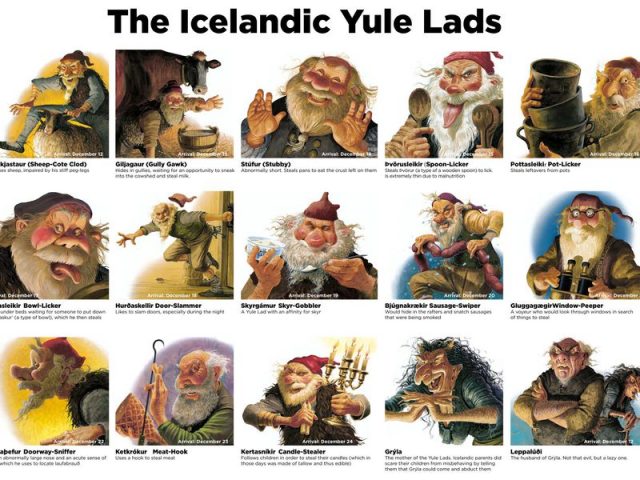
13 Horrifying Gotland Christmas Trolls

yule lads

They leave the nice children gifts and the naughty children ROTTING POTATOES.

Stekkjarstaur (Sheep Cote Clod)

Sheep Cote Clod gets his name because of his affinity for harassing sheep. He’s easily identified by his stiff peg legs.

Fear Level: Standing over a subway grate.

Giljagaur (Gully Gawk)

Giljagaur (Gully Gawk) | Community Post: The 13 Horrifying Christmas Trolls Of Iceland

Gully Gawk is famous for hiding in gullies and waiting for his chance to sneak into the cowshed to steal milk.

Fear Level: Running into an ex.

Stúfur (Stubby)

Icelandic Santa Claus - the 13 Yule Lads - Iceland with a View

He’s called Stubby because he’s really short. But what he’s really known for is stealing pans to eat the crust out of them.

Fear Level: Watching Pee-Wee Herman’s Big Adventure.

Þvörusleikir (Spoon Licker)

Guess who might be passing by your window tonight? ⠀ Þvörusleikir (Spoon-Licker) is on his way to town and estimated time of arrival is unknown! 😛⠀ ⠀ He steals "Þvörur" or some sorts of wooden spoons to lick. Poor guy is extremely thin due to malnutrition. So, if you want to be nice, you should just give him a wooden spoon if you have one with your open heart 💓⠀ ⠀ It's Christmas after all right? 🎄Image via Brian Pilkinton from the book The Yule Lads •⠀ •⠀ •⠀ •⠀ #Iceland #Icelandic #inspiredby

This sticky-fingered troll steals wooden spoons for the purpose of licking them. He’s easily identified by his malnourished appearance.

Fear Level: Waking up right before your alarm goes off.

Pottaskefill (Pot Licker)

<img class="aligncenter" src="https://i.pinimg.com/236x/60/b4/9d/60b49d9989099a36e73e2f046caadc9c.jpg&quot; alt="They leave the nice children gifts and the naughty children ROTTING POTATOES.” width=”574″ height=”435″>

Not to be confused with Spoon Licker, Pot Licker steals leftovers out of pots. Also not to be confused with Stubby, who steals PANS.

Fear Level: Jaywalking.

Askasleikir (Bowl Licker)

Askasleikir (Bowl Licker) | Community Post: The 13 Horrifying Christmas Trolls Of Iceland

Not to be confused with Spoon Licker or Pot Licker, Bowl Licker hides under your bed until you put your bowl down. Then he steals it and then, presumably, licks it.

Fear Level: Waiting for test results.

Hurðaskellir (Door Slammer)

7. Hurðaskellir - door slammer

He slams doors. Especially at night.

Fear Level: Doors slamming. Especially at night.

Skyrgámur (Skyr Gobbler)

<img class="aligncenter" src="https://i.pinimg.com/236x/d5/cf/d2/d5cfd27b2b4d70b40840f3d5e2489b67.jpg&quot; alt="They leave the nice children gifts and the naughty children ROTTING POTATOES.” width=”526″ height=”414″>

Skyr is a traditional Icelandic dairy product similar to strained yogurt.

Fear Level: Broken escalators.

Bjúgnakrækir (Sausage Swiper)

Bjúgnakrækir (Sausage Swiper) | Community Post: The 13 Horrifying Christmas Trolls Of Iceland

Sausage Swiper hides in the rafters and pilfers pork links while they’re smoking.

Fear Level: Standing under scaffolding.

Gluggagægir (Window Peeper)

Gluggagægir (Window Peeper)

This troll looks through your windows in search of things to steal. Pretty sure this is a felony.

Fear Level: Driving with the doors unlocked.

Gáttaþefur (Doorway Sniffer)

Gáttaþefur (Doorway Sniffer)

Easily identified by his abnormally large nose, Doorway Sniffer uses his acute sense of smell to find Laufabrauo, a traditional Icelandic bread.

Fear Level: Sniff-testing the milk.

Ketkrókur (Meat Hook)

#12. Iceland Christmas troll arrives Dec. 23 - Meat Hook - he steals meat with his hook.

Meat Hook uses a hook to steal meat. Pretty self explanatory.

Fear Level: Standing really close to a large animal.

Kertasníkir (Candle Stealer)

Kertasníkir (Candle Stealer)

This troll follows children so he can steal their candles and then eat them. Pretty sure this is also a felony.

Fear Level: Clowns.

Have a Very Happy Holiday and Be Good…

Or Gryla, the mother of all the Yule Lads, will abduct you!  And EAT YOU!

YOU CAN READ ABOUT GRYLA AT :  https://clancarruthers.home.blog/2018/12/15/clan-carruthers-gryla-the-gruesome-christmas-witch/

Carruthers crest on flag-v2 (1)

Preserving Our Past, Recording Our Present, Informing Our Future

Ancient and Honorable Carruthes Clan Int Society LLC

carruthersclan1@gmail.com

cropped-wide-banner-with-new-crest.jpg

ALL PICTURES FROM PINTEREST

Uncategorized

Saxons, Goths, Gauls, Scoti and all

Clan Carruthers Int Society CCIS                               Promptus et Fidelis

ESSAY ON THE

Countries, Religion, Learning, Numbers, Forms of Government, and the chief’ Cause of the Succefles of| the Nations,

By which the ROMAN EMPIRE Was pulled Down.


This was written in 1714, and though interesting, not accurate as the information that we have today.


TH E Saxom, having been by the Greeks and Romans reckoned Superiour to all other barbarous Nations, as they were pleased to call them, for Wit, for Strength of Body, and the Enduring of the Toils of War, I should be unjust to our Ancestors, if I did not give them the Precedency here.

They were Originally a People in the CmIncus Cbersotiefus, and did live all along the Eastern Coast of the German, and the Southern Coast of the Baltick Seas. They were divided into several Nations, as the Attgliy who lived in the Country where the City of Slefwick Sleswick is now; the Juta, the Heruli, the Vemi, the Vandali, the Longobardi; and to which, the tfcofi, may, I believe, be added.

The Saxons having more Wit and Courage than their Neighbours, might think it hard that the wisest and bravest Men should have the worst Countries; so they invaded the Frifijt and having made themselves Masters of their Country, which was, Freezland, Holland, slanders, &c. or of all the Sea Coast at least, they wisely incorporated themselves with that Nation, and by that means they became stronger than they were before. And which the greatest Conquests do never make any People, but rather the Weaker, if the Natives be totally destroy’d, or drove away, or be preserved, but still as a distinct People, from those that conquered them.

The Saxons finding, that the employing of their Strength by Land against their Neighbours the Gauls, who were supported by the Romans, did turn to no Account, they applied themselves wholly to the Sea, of which they had now a very long Coast. And on that Element, Orofius saith, they were terrible, both for their Courage and their Agility; and being absolute Masters at Sea, they frequently visited the Coasts of Gaul and Britain; where having made Descents, they plundred the Country, returned Home, laden den with Spoils. And tho’ they now and then met with Blows ashore, at Sea they were in no Danger but from Storms j by this Means the Sea-Coast of Britain was better known to the Saxons than to the Britains themselves, long before they were invited by the Britains into it.

Of all the Saxons, or at least of all those that conquered the Southern Part of Britain, the Angli were the most considerable; and which Conquest, was, for that Reason called England, after their Name.

Celtic Warriors.


The Scoti are generally believed to be Irish, and to have come from Ireland into Britain. But tho’ it is certainly true of the High-Land Scots, who to this Day speak the Irijb Language, the Low-Land Scots do seem to have been a Saxon, or German, and not an Irish Nation. And that for three Reasons:

The First is, Its being manifest from the Notitia Imperii, that there was a German Nation called Acchaeni, and who are by Ammianus Marce Bintts said to have together with the Scoti much molested Britain. Now, besides the Affinity which there is betwixt these two Names, the Scoti and Acchaeni are spoke of by that Contemporary Learned Historian, as Neighbours and Confederates.

Secondly, The Scoti are by Giraldus Cam’ Irenfis, believing them to be a German People, called Goths.   (  *** Carruthers  *** )

ArtStation - Senons gaul warriors, Jose Daniel Cabrera Peña-French museum illustrations- Jose Daniel Cabrera Peña

Goth Warrior

But the Last, and chief Reason is, The Saxon Language being spoken all over the Low-lands of Scotland, to the most Northern Part of the Ifland. The very Name Scotland, and the Names of its Metropolis, and of its other great Towns and Counties, are plainly Saxon; and which could not have been, if that Country had not been Peopled by a Saxon Nation; no, not if they had conquered it, if they had not peopled it too: For tho* a Conquering Sword can change the Religion, the Government, and the Laws in its Conquests, their Languages will not be changed by it, whilst the Conquered do continue to be the Body of the People. So the Britains having been all either destroyed, or driven into a Corner of the Ifland, and their Country Peopled by Saxons, the Saxon Language came of course into it; whereas the Normans, who did likewise conquer England, and did all that was in their Power to have brought the French Language into it, were not able to do it; and the Reason was, because the English did, under the Norman Government, still continue to be the Body of the Nation; few Normans, besides those that were in their Armies, having come to settle themselves in England.

Celtic Warrior


So,for the same Reason the Goths, sandals, and Suevi, tho’ they conquered Spain, were not able to bring their Language into it ;. nor the Franci into Gaul, nor the Longobardi into Italy, their Languages, in defiance of their Swords, having been vanquished so by the Languages which they found in those Countries, as to be quite lost in the Second Generation. And in truth, the Saxons were the only Conquerors that brought their Language to be the Language of their Conquests, and to which they gave their Name also; as all the rest have done, except the Gcthi and Suevi. Gaul having been called France, from the Franks; the Southern Part of Spain, Andalufia, or Vandalufia, from the Vandals; the Cisalpine Gaul, Lombard) from the Longobards; one Part of Pannonia, Hungary, from the Huns; and another Part of it Sclavonia, from the Sclavi: The Normans likewise gave the Name of Normandy to that Part of France which they conquered, but were not able to change the Name of England. The Saxons gave the Name of Walish, that is Gaulish, to the Britains that remained, and from thence they came to be called Welch, and their Country Wales. The same Name was given to the Cisalpine Gauls by the Lombards when they conquered them ; and to this Day the People of that Country are called Walsh by the Germans,

But if the Britains were by the Saxons called Welch, or WaUaish, to signifie they were Foreigners or Strangers, as many say they were; it is a notable Instance of how I i little little a Superiour Power is concerned, whether what it saith be reasonable or not.


                                Goth Lowland Warrior

Tho’ we are not told when the Low-lands of Scotland were Conquered and Peopled by a Saxon Nation, call’d Scoti; yet since \*e do no where read of the Saxons, by whom the Southern Parts of Britain were Conquered, having ever Conquered, and much less Peopled those Northern Parts of it; there is great Reason to believe that it must have been done before the Time of that Southern Saxon Conquest; and that the Scoti spoken of in Britain before that time, were those Saxons who having destroy’d the Ficli, whom I do reckon to have been the Northern Britains, did, in process of time possess themselves of those Low lands.

Neither is Ireland having been formerly called Scotia Major, any Proof to the contrary: For as it is by later Historians that Ireland is called so, (o it is most probable that Ireland in latter times had that Name given it to distinguish it from the Scots High-lands which retained its Language, Habit, and Customs, and which having been conquered, tho* not Peopled by the Scoti, had come to be called Scotland.  ( The Carruthers ancestors of Gutland/Gotland are now know to have lived and battled in Ireland, Scotia Major and Lowlands of Scotland, Scoti prior to 400 A. D.)

But tho’ I am at present fully perswaded that this is the true Account of the Origine ot the Low land Scots; yet if any of the Learned Persons that are of another Opinion, will but (hew’ how the Saxon Language could be brought into that Country without its having been Peopled by Saxons, it will go a great way towards the bringing me over to them. The Time when the Scott came first into the Low-lanJs, and the Irish into the High-lands being unknown to me, I shall leave the Settling of that time to those who have looked into the Ancient Records of that Kingdom; tho’ I cannot but say, that Genuin Records, reaching to their Origine, are scarce Commodities in all Nations, tho’ there are few or none that do not pretend to have them.

(*** The Carruthers ancestors came before the time of the Saxons )

The Goths were a People of Scythia, on the North-side of the Euxine Sea; but having in Process of Time flitted, or removed from thence to Boryflenis, and the Mouths of the Ifter, they were there divided into Ostro-Gotbi, or Eastem-Goths, and Vifi-Gothi, or WellernGoths; and having been driven from those Seats by the Huns and Alans, they had leave from the Emperor Valence to settle themselves in Thracia and the adjacent Countries, as Confederates of the Roman Empire 5 and it was out of those Parts that the Goths did come, who made that Name so Famous by their great Conquests. I know there is a Royal Argument for the Conquering Goths having been a People of Denmark, and of Sweden, and of the adjacent Islands. The Sovereign Princes of those two Kingdoms, having upon that Supposition, taken upon I i z them the Title of the King of the Goths. But tho’ Crowns are great Things, Truth is greater, and which being more likely to be found in Contemporary Historians, than in Heralds, it must not, being met with in them, be sacrificed to any Deferences: Not that there might not be a People in those Northern Countries which were called Goths; but supposing there was, it is pretty certain that they were not the Famous Goths who erected the Great Monarchy in Spain and Gaul; and of this Magma Got bus was so sensible, that without any tolerable Authority he. will have his Country Gothsy to have Conquered and Peopled Scythia to^he very Palus Meotis, and to have been the Ancestors of the Goths, which came many Ages after from those Parts, and did raise that Name so high. Besides, that there is no Authority for all this, it has a natural Improbability in it, that renders it almost incredible: Which is, That People should go so sar, and toil and fight so much for no other purpose, but that they might settle themselves in worse Countries than their own, which they left. And if Gotht be a Corruption of Getœ, as probably it is, their first Country will be found about the Euxine, and not near the Baltick Sea, notwithstanding the Island that is in it, and the Country that is near it, called Gotland, or Gutland, for so they are called by their Inhabitants. Now, whether Goty or

Gut, Gut, in the beginning of those Names, was derived from the Goths, or from some other Word, I shall leave to the Enquiry of those who understand the SweJi/h Tongue: But this I am sure of, that in English there are Names that begin with Goth and Got, as Gotheridge, Gothill, and Gotacre, that were not called so from that People, but were, I suppose, called so from the Word God, or the Word Good.

The Vandals, of whom the two fore-mentioned Princes do likewise stile themselves • Kings, were not of any of their Countries, tho’ they were much nearer to them than the Goths; the Vandals being a Nation of the Saxens, and did all live on the South Side of the Baltick Sea.

The Franci were several German Nations, who lived on the East-fide of the Lower-Rhine; and who having Confederated together, did all take upon them the Name of Franci, or Freemen; thereby declaring, That they were resolved to perish, rather.than become Tributaries to the Romans, as their Neighbours the Gauls were.

The Suevi were a great German People oil the Upper-Rhine; reaching from the top of that River, to the River Albis; they and their neighbouring Nations did take on them the Name of Alamans, much about the same time, and with the same generous Intention that the German Nations on the Lower-Rine, took on them the Name of Fraud; and as , if they reckoned, that a conquered People did not deserve the Name of Men, by that new Name of Alamans, or All men, they declared they would die, rather than be conquered.

The Longobardi, called so by the Romans, for their Long Beards, were a Saxon Nation, who lived in that Country which is now called Brandenburg; and who having in Italy conquered G a Ilia Cisalpina, did give it the Name of Longobardi, now Lombardy.

Besides these I have mentioned, there were Twenty German Nations more, but which having all long ago funk into some of the fore-mentioned, I thought it was needless to name them here.

The Sclavi were a People that lived in the Countries, which are now called Poland and Lithuania; and it is very plain from their Language, and which is spoke to this Day in those Countries, that they were no German Nation; in process of time they either conquered, or dipt into Sclavonia, and the Countries about it; when the former Inhabitants had left them in a manner, and were gone with the Goth in quest of better Countries: Many of the Sclavi having been taken, and made Bond-men in the Time of Charles the Great, did in France, and in other Parts, give the Name of Slaves to- all Bond’ men.

The

The Huns were an Afiatick Scythian Nation, who lived beyond the Palus Mœotis, as did the Alans also, who having been beat by the • Huns, joyned with them when they swarmed into the European Scythia • where driving the Gotbs before them, they advanced as sar as Fannonia, and having fixed their Seat there, did give it the Name of Hungary.

Gallic cavalry charging into battleThe Gauls were for Numbers and Extent of Land, the greatest People we read of any where; for of that Nation I do reckon the Spaniards, Britains and Irish, to have been, no less than the Inhabitants of the two GalHas, one of which is now called Lombardy, and the other which is now called France, did reach from the Atlantick Ocean, to the Western Banks of the Rhine. And whose Language is spoke no where now but in Wales, Ireland^ and the Highlands of Scotland, and in those Countries in Dialects so different, that I am told the Welsh and Irish do not understand one another.

[ocr errors]

Of the Religion and Learning of these Countries.

SU C H of these Nations as Were German, did all speak the same Language, and worship the same Gods 5 the Memory of four of which Gods is still preserved, in all Parts where the German Tongue is spoke, in the Names of Four of the Days of the Week; to wit, Tuesday, Wednesday, Thursday and Friday. Verfi ‘tgan will have the other three Days of the Week to have had their Names likewise from the Three German Gods, Sun, Moon and Seater: But considering, that these Days among the Romans, did bear the Names of the same Three Gods; it is more probable that the Germans had those Names from the Romans, than that the Romans had them from the Germans.

In their Worship they were all involved in the Inhumanity of offering Men, Women and Children alive in Sacrifice to their Gods,• in which, tho’ it was an abominable Barbarity, they were so sar from being singular, that it was the Practice of the Gauls likewise, and at one time or another of all the Idolatrous Nations on the Earth; and we fee that to keep the Jews from it, was not an easy Matter.

For Learning it does not appear that they had any, no not so much as the Knowledge of Letters; tho’ a certain Romantick Writer, will have them to have been great Masters in the Vithagorean Philosophy; but tho* they had among them no Clergy or Learning, it appears from their excellent Constitution of Government, that they wanted not Mother-Wit, or true Wisdom. The Laws brought by them into their Conquests, which were the Feudal, are likewise a plain Proof, that tho’ they wanted Learning, and for that Reason were called Barbarians, by the4 Nations that abounded with it; yet that they wanted not Policy.

The Huns and Alans who were A/iaticks, are by Jornandes said to have had no Religion nor Superstition, or if they did worship any God, that it was their Sword to which, sticking it in the Ground, they did use to pay some Reverences.

The First of these Nations that turned Christian, were the Goths and Suevi; but they having been converted to that Faith by Arian Bishops, sent to them by the Emperor Vaknsy who was himself an. Arian, did long adhere to that Heresy, but were converted from it about an hundred Years before their great Monarchy in Spain was destroy’d by the Moors. The Franks were likewise converted early, and in Process of Time the Saxws, and all the rest of these Nations; and notwithstanding before several of their Conversions, Christianity was corrupted with a Mixa Mixture of divers Heathenish Superstitions; its true and genuine Doctrines, were nevertheless so powerful, as to mollifie their natural Ferity and Savagenefs very much, and to civilize their Manners in all the Relations of Life.

Of these Nations great Numbers.

IT has been long a Matter of some Wonder, how the barren Countries out of which the Swarms of Men came, that lighted lo heavy on the Roman Empire, should then be so much more fertil of People, than they have ever been since; and this prodigious Fertility having been looked on as a thing certain, there have been divers Speculations about the Causes of it. It is by Mariana attributed to two Things, the one is the Northern People being, by reason of the Cold of their Climate, more prolifick than the Southern; and the other is promiscuous Veneries having been in use among them. The First is no Realon at all, for those Countries being then more populous than they are now, the Climate being still the same, and as cold as ever it was. And the Second, however it may appear in Speculation, does seem to have Experience against it. The Countries in which Plurality of Wives, and pro: promiscuous Venery are allowed, being observed not to be so populous, as the Countries where both those Liberties are prohibited.

It was the finding it not to be easy, to give a satissactory Reason for this supposed extraordinary Fertility, that first led me to examine the Evidences upon which it has been so generally believed; and upon as severe an Enquiry as I was able to make, those Evidences did not appear to me to be strong enough, to make that Matter indubitable, and that for the three following Reasons.

First, Because unless we knew the certain Bounds of those Countries, and which we are very sar from knowing, we cannot judge by the great Armies that went out of them, whether they were extraordinary populous, or no: For tho’ a Country that is certainly known to be small, having sent forth great Armies, is a Proof of its being very populous at that Time; it is no Evidence at all, of a vast Country’s being so.

Secondly, Because tho the chief Nation in those Expeditions did bear the Name of the whole, yet since several neighbouring Nations, the Extent of whose Lands is not known, might joyn with them in the forming of those great Armies; as in Fact they did, their having cast such great Swarms, can be no Evidence of their having been extraordinary populous.

Thirdly, If in tjiose Countries, all that were fit to bear Arms went into the Armies, as it is very probable they did, their Armies might be as great ,as any of them are said to have been, and yet their Countries not have been very populous: Considering, how by reason of their simple, rustick, and frousy Way of living, they had few or no Artificers or Trades-men among them; and who in polite Countries, are a great Part of the People; so that they had none among them, that had Strength enough to carry Arms, that were not fit to use them; having been all bred up to Hunting, and to other man-like Exercises, which fitted them for Soldiers. Besides, great Multitudes of Women, and who are said to have been as warlike as the Men, went along with those Armies; and who, whether they fought or not, would to the Eye make them look more numerous, than they would have looked otherwise. Neither have we any Reason to think, that the Persons from whom we have the Accounts of the Numbers that were in those Armies, did ever either muster them, or tell them, but did guess at their Numbers by their own, or other Peoples Eyes; and there is not any thing our Eyes so grofly impose on us in, as in Numbers, which if great, are judged by the Eye to be double to what they are. Now adding to all this, that those Countries have in them at this Time, many great great Cities and Towns, filled with Artificers and Trades-Men, and which they had not then; one may, I think, venture to affirm, that it was not unlikely that they have more People in them now, than they had in those Days, tho’ not so many that are fit for Soldiers: For it must be no great Country now, that has not zooooo Men in it, strong enough to carry Arms, and that was the Number of one of the greatest of thoseeA.rmies, and which we have Reason to believe was taken by the Eye, and not by the Poll, and that Provinces were emptied so by their having gone out of them, that if double that Number of People went out of the lame Provinces now, they would leave more behind them. So the High-lands of Scotland, tho’ they are by much the least populous Parts of that Kingdom, yet by Reason of the same simple and course way of Living, and their Peoples being bred up to the same Exercises, will in Proportion to their Numbers, presently furnish more that are fit to be Soldiers, than the more populous Low-lands; and it is for the same Reason the same with the Irish, and the Provinces in which they are planted.

MICHAEL GEDDES, L. L.D. and Chancellor of the Church of Sarum.
written in 1714
Gutland / Gotland, The History of Gutland, The Viking Age, Uncategorized

CLAN CARRUTHERS – ANCIENT HISTORY OF GUTLANDERS/ CARRUTHERS

CLAN CARRUTHERS INT SOCIETY CCIS

cropped-wider-banner-light-blue-1.jpg

Ancient History of Gutlanders / Carruthers

3swords


There is strong evidence that one group of Swedish/ Gutland predecessors were migratory Thracians, an aggressive refugee “boat-people” who came from the ancient city of Troy.  Located in northwest Asia Minor (present-day northwest Turkey), the ruins of Troy were discovered in 1870.  In the period beginning about 2500 BC, Troy was populated by an “invasion of peoples on the sea” according to the Egyptians.  These people were called Thracians by the Greeks, and were early users of ships, iron weapons and horses.  Troy (also called Troi, Toas or Ilium) was known as a center of ancient civilizations.  Its inhabitants became known as Trojans (also Trajans/Thracians, later called Dardanoi by Homer, Phrygians or Anatolians by others), and their language was Thracian or Thraco-Illyrian.  Evidence shows the city of Troy endured years of war, specifically with Greek and Egyptian armies.  The famous Trojan War was fought between the Greeks and Trojans with their allies.  Troy was eventually laid in ruins after 10 years of fighting with the Greeks, traditionally dated from around 1194 to 1184 BC, and is historically referred to as the Fall of Troy.  The city was completely devastated, which is verified by the fact that the city was vacant to about 700 BC.

Thousands of Trojans left Troy immediately after the war, beginning about 1184 BC.  Others remained about 30 to 50 years after the war, when an estimated 30,000 Trojans/Thracians suddenly abandoned the city of Troy, as told by Homer (Greek writer/poet, eighth century BC) and various sources (Etruscan, Merovingian, Roman and later Scandinavian).  The stories corroborate the final days of Troy, and describe how, after the Greeks sacked the city, the remaining Trojans eventually emigrated.  Over half of them went up the Danube river and crossed over into Italy, establishing the Etruscan culture (the dominating influence on the development of Rome), and later battled the Romans for regional dominance.  The remaining Trojans, mainly chieftains and warriors, about 12,000 in all with their clans, went north across the Black Sea into the Mare Moetis or “shallow sea” where the Don River ends (Caucasus region in southern Russia), and established a kingdom called Sicambria about 1150 BC.  The Romans would later refer to the inhabitants as Sicambrians.  The locals (nomadic Scythians) named these Trojan conquerors the “Iron people,” or the Aes in their language.  The Aes (also As, Asa, Asas, Asen, Aesar, Aesir, Aesire, Æsir or Asir) soon built their famous fortified city Aesgard or Asgard, described as “Troy in the north.”  Various other sources collaborate this, stating the Trojans landed on the eastern shores with their superior weaponry, and claimed land.  The area became known as Asaland (Land of the Aesir) or Asaheim (Home of the Aesir). 

Some historians suggest that Odin, who was later worshipped as a god by pagan Vikings, was actually a Thracian/Aesir leader who reigned in the Sicambrian kingdom and lived in the city of Asgard in the first century BC.  He appointed chieftains after the pattern of Troy, establishing rulers to administer the laws of the land, and he drew up a code of law like that in Troy and to which the Trojans had been accustomed.  Tradition knows these Aesir warriors as ancient migrants from Troy, formidable fighters who inspired norse mythology and as the ancestors of the Vikings.  They were feared for their warships, as well as their ferocity in battle, and thus quickly dominated the northern trades using the Don river as their main route to the north.

Historians refer to the Aesir people as the Thraco-Cimmerians, since the Trojans were of Thracian ancestry.  The Cimmerians were an ancient people who lived among Thracians, and were eventually absorbed into Thracian culture.  Greek historian Herodotus of Halicarnassus noted about 440 BC that the Thracians were the second most numerous people in the world, outnumbered only by the (East) Indians, and that the Thracian homeland was huge.  Ancient maps describe the region as Thrace or Thracia, present-day southeast Europe and northeast Greece.  Thracian homelands included the Ukrainian steppes and much of the Caucasus region.  According to Flavius Josephus, Jewish & Roman historian in the 1st century AD, the descendants of Noah’s grandson Tiras were called Tirasians.  They were known to the Romans as Thirasians.  The Greeks called them Thracians and later Trajans, the original people of the city of Troas (Troy), whom they feared as marauding pirates.  History attests that they were indeed a most savage race, given over to a perpetual state of “tipsy excess”, as one historian put it.  They are also described as a “ruddy and blue-eyed people.”  World Book Encyclopedia states they were “…savage Indo-Europeans, who liked warfare and looting.”  Russian historian Nicholas L. Chirovsky describes the arrival of the Thracians, and how they soon dominated the lands along the eastern shores of the river Don.  These people were called Aes locally, according to Chirovsky, and later the Aesir (plural).

Evidence that the Aesir (Iron people) were Trojan refugees can be confirmed from local and later Roman historical sources, including the fact that the inner part of the Black Sea was renamed from the Mare Maeotis to the “Iron Sea” or “Sea of Aesov”, in the local tongue.  The name remains today as the Sea of Azov, an inland sea in southern European Russia, connected with the Black Sea.  The Aesir were known for their fighting with iron weapons.  They were feared for their warships, as well as their ferocity in battle, and thus quickly dominated the northern trades, using the Don river as their main route for trading. 

The Aesir people dominated the area around the Sea of Azov for nearly 1000 years, though the surrounding areas to the north and east were known as the lands of the Scythians.  The Aesir fought with the Scythians for regional dominance, but eventually made peace.  They established trade with the Scythians, and even strong cultural ties, becoming united in religion and law.  The Aesir began trading far to the north as well. 

The land far north was first described about 330 BC by the Greek explorer Pytheas of Massalia.  He called the region “Thule,” which was described as the outermost of all countries, probably part of the Norwegian coast, where the summer nights were very short.  Pytheas translated Thule as “the place where the Sun goes to rest”, which comes from the Germanic root word “Dhul-” meaning “to stop in a place, to take a rest.”  Pytheas described the people as barbarians (Germanic/Teutonic tribes) having an agricultural lifestyle, using barns and threshing their grains.  These people had already established trade with the Aesir who later began migrating north around 90 BC from the Caucasus region, during the time of Roman expansion in Europe.  The Germanic/Teutonic tribes first made a name for themselves about 100 BC after aggressively fighting against the Romans.  Not much is known about the Germanic tribes prior to this.  When writing the “Gallic Wars,” Julius Caesar described encounters with those Germanic peoples and distinguishes them from the Celts.  During this time period, many Germanic tribes were migrating out of Scandinavia to Germany and the Baltic region, placing continuous stress on Roman defenses. 

Migrating groups were normally smaller groups of different people or tribes, often following a strong leader.  The “nationality” of the leaders would usually appear as the nationality of the migrating group, until later when the group was separated again.  The migrations could take place over several decades, and often when the Germanic tribes were mentioned in the written sources, the Romans had only met raiding groups occupying warriors or mercenaries operating far away from their people.

Around the same time, about 90 BC, the Aesir began their exodus from the Black Sea/Caucasus region.  Their arrival at the Baltic Sea in Scandinavia has been supported by several scholars and modern archaeological evidence.  As told by Snorri Sturluson (a 13th century Nordic historiographer) and confirmed by other data, the Aesir felt compelled to leave their land to escape Roman invasions by Pompeius, and local tribal wars.  Known as Thracian warrior tribes, the aggressive Indo-European nomadic Aesir came north, moving across Europe, bringing all their weapons and belongings in their boats on the rivers of Europe, in successive stages.  Historians note that Odin, who was a very popular Thracian ruler, led a migration about 70 BC with thousands of followers from the Black Sea region to Scandinavia.  It is also told that another Thracian tribe came along with them, a people called the Vanir (also Vaner ,Vans, Vanargians or Varangians).  Odin’s first established settlement became known as Odense (Odin’s Sanctuary or Odin’s Shrine), inspiring religious pilgrimages to the city through the Middle Ages.  These tribes first settled in present-day Denmark, and then created a power-center in what is now southern Sweden / Gutland.  About 800 years later during the Viking era, Odin, the Aesir and Vanir had become gods, and Asgard/Troy was the home of those gods—the foundation for Viking religion.  The Aesir warrior gods, and the religious deities of Odin (also Odinn, Wodan, Woden, Wotan Vodin) and Thor, were an integral part of the warlike nature of the Vikings, even leading them back down the waterways of Europe to their tribal origins along the Black Sea and Asia Minor. 

Aesir became the Old Norse word for the divine (also, the Old Teutonic word “Ase” was a common word for “god”), and “Asmegir” was the Icelandic term for “god maker”—a human soul on its way to becoming divine in the course of evolution.  The Vanir represented fertility and peace gods.  Not unlike Greeks and Romans, the Scandinavians also deified their ancestors.  The Egyptians adopted the practice of deifying their kings, just as the Babylonians had deified Nimrod.  The same practice of ancestor worship was passed on to the Greeks and Romans and to all the pagan world, until it was subdued by Christianity.

Snorri Sturluson wrote the Prose Edda (Norse history and myths) about 1223 AD, where he made an interesting comparison with the Viking Aesir gods to the people in Asia Minor (Caucasus region), particular to the Trojan royal family .  The Prose Edda is one of the first attempts to devise a rational explanation for mythological and legendary events of the Scandinavians.  Unfortunately, many historians acknowledge only what academia accepts as history, often ignoring material that might be relevant.  For example, Snorri wrote that the Aesir had come from Asia Minor, and he compared the Ragnarok (Norse version of the first doom of the gods and men) with the fall of Troy.  Sturluson noted that Asgard, home of the gods, was also called Troy.  Although Snorri was a Christian, he treated the ancient religion with great respect.  Snorri was writing at the time when all of Scandinavia (including Iceland) had converted to Christianity by 11th century, and he was well aware of classical Greek and Roman mythology.  Stories of Troy had been known from antiquity in many cultures.  The Trojan War was the greatest conflict in Greek mythology, a war that was to influence people in literature and arts for centuries.  Snorri mentioned God and the Creation, Adam and Eve, as well as Noah and the flood.  He also compared a few of the Norse gods to the heroes at the Trojan War. 

The Aesir/Asir were divided into several clans that in successive stages emigrated to their new Scandinavian homeland.  Entering the Baltic Sea, they sailed north to the Scandinavian shores, only to meet stubborn Germanic tribes who had been fighting the Romans.  The prominent Germanic tribes in the region were the Gutar, also known as the GutaGutansGautsGotarne or Goths by Romans.  These Germanic tribes were already known to the Aesir, as trade in the Baltic areas was well established prior to 100 BC.  The immigrating Aesir had many clans and tribes, and one prominent tribe that traveled along with them were the Vanir (the Vanir later became known as the Varangians, and subsequently the Guts, Guta, GutansGautsGotarne or Goths , who settled in what is now present-day Gutland).  They were, the most prominent clan to travel with the Asir , the Eril warriors or the “Erilar,” meaning “wild warriors.”  The Asir sent Erilar (or Irilar) north as seafaring warriors to secure land and establish trade (these warriors were called “Earls” in later Scandinavian society, then became known as JarlarEruls and Erils or Heruls and Heruli by Romans, also Eruloi or Elouroi by Greek historian Dexippos, and Heruler, Erullia and Aerulliae by others).  The clans of Erilar enabled the Asir clans (later called Svi, SviarSvea, Svear or Svioner by Romans) to establish settlements throughout the region, but not without continuous battles with other migrating Germanic tribes.  The Eruls/Heruls eventually made peace with those who ruled the region.  The tribes of Svear, Vanir, and Heruli soon formed their own clans and dominated the Baltic/Scandinavian region.  The Gothic historian Jordanes (or Jordanis), who was a notary of Gothic kings, told about 551 AD that the Erils were from the same stock as the Svear, both taller and fairer than any other peoples of the North.  He called the Svear, “Sve’han.”

The Svear population flourished, and with the Heruls and Goths, formed a powerful military alliance of well-known seafarers.  The Svear and Heruls then gradually returned to their ancestral land, beginning in the 2nd century AD.  Sometimes sailing with the Goths, they terrorized all of the lands and peoples of the Black Sea and parts of the Mediterranean, even the Romans.  They were the pre-Vikings.  Roman annals tell of raids of Goths and Heruli in 239-266 AD in the territory of Dacia (where the Danube river runs into the Black Sea).  Having built a fleet of 500 sailing ships, the Heruls completed their raids in 267-268 AD, and controlled all of the Roman-occupied\ Black Sea and parts of the eastern Mediterranean.  There are several accounts about how the Herul warriors returned to ravage the shores of the Black Sea and the Mediterranean, alone and together with the Goths.  The Romans noted that “the Heruls, a Scandinavian people, together with the Goths, were, from the 3rd century AD, ravaging the Black Sea, Asia Minor and the Mediterranean.”  While the the Romans called the Scandinavian region “Thule” (after Pytheas), the Greeks called it “Scandia” (from ancient times), and others called the area “Scandza.”  The term Scandia comes from the descendants of Ashkenaz (grandson of Noah in the Bible).  Known as the Askaeni, they were the first peoples to migrate to northern Europe, naming the land Ascania after themselves.  Latin writers and Greeks called the land Scandza or Scandia (now Scandinavia).  The peoples in that region would be called Scandians or Scandinavians.  Germanic tribes, such as the Teutons and Goths, are considered the descended tribes of the Askaeni and their first settlements.

The first time Thule (Scandinavia) was mentioned in Roman written documents was in the 1st century (79 AD) by the Roman citizen Plinius senior.  He wrote about an island peninsula in the north populated by “Sviar,” “Sveonerna” or “Svearnas” people, also called “Sveons,” Svianar,””Svetidi or Suetidi” by others.  Later in 98 AD the learned civil servant Cornelius Tacitus wrote about northern Europe.  Tacitus writes in the Latin book Germania about tribes of “Sviones” or “Suiones” (Latin Sviones was derived from Sviar) in Scandinavia, who live off the ocean, sailing in large fleets of boats with a prow at either end, no sail, using paddles, and strong, loyal, well-armed men with spikes in their helmets.  They drove both the Goths and Lapps out of Scandinavia.  Archaeological finds have provided a vivid record of the evolution of their longships from about the 4th century BC.  Tacitus further wrote, “And thereafter, out in the ocean comes Sviones (also “Svionernas” or “Svioner”) people, which are mighty not only in manpower and weaponry but also by its fleets”.  He also mentions that “the land of Svionerna is at the end of the world.”  In the 2nd century (about 120 AD) the first map was created where Scandinavia (Baltic region) could be viewed.  Greek-Egyptian astronomer and geographer Ptolemaios (Ptolemy of Alexandria) created the map, and at the same time wrote a geography where he identified several different people groups, including the “Gotarne,” “Heruls,” “Sviar” and “Finnar” who lived on peninsula islands called “Scandiai.”  During the Roman Iron Age (1-400 AD), evidences are convincing for a large Baltic seafaring culture in what is now Sweden, Denmark, Finland and Estonia.

Many clans of Aesir and Germanic peoples were united by settlements.  For example, the Aesir clan Suevi (also Suebi) settled among Germanic peoples in a region called Swabia (named after themselves), which is now southwest Germany.  Those clans became known as the Alemanni, first mentioned about 213 AD after attacking the Romans.  Called Suevic tribes by historians, they formed an alliance for mutual protection against other Germanic tribes and the Romans, and retained their tribal designation until the late Middle Ages.  They settled as far south as present-day Spain and Portugal.

By the 5th century, the Aesir Heruls were in great demand as soldiers in the Roman Imperial Guards.  The Romans were impressed with the war-like Heruls, and recruited them to fight as mercenaries in the Roman Army.  About 459 AD Bishop Hydatius (Idacius) of the Roman province of Gallaecia (present day Spain and Portugal) wrote that the Heruls were Vikings (from Viking raids on the coast of Spain).  Herul factions were making settlements throughout Europe, fighting and battling everywhere they went.  Their pay in gold coins tell of their Scandinavian history, even battling Attila the Hun.  In the late 5th century, the Heruls formed a state in upper Hungary under the Roman ruler Cæsar Anastasius (491-518 AD).  Later they attacked the Lombards, but were beaten, according to Greek-Roman author Prokopios (born at the end of the 5th century).  He was a lawyer in Constantinople and from the year 527 private secretary to the Byzantine military commander Belisarius on his campaigns against the Ostrogoths.  Prokopios says by the early 6th century (about 505), the remaining Heruls in upper Hungary were forced to leave.  Some of them crossed the Danube into Roman territory, where Anastasius allowed them to settle.  Historians mention that remaining clans of Heruls (Herulians) sailed northwards, back to Thule to reunite with their Svear brethren.  Prokopios noted that there were 13 populous tribes in Thule (the Scandinavian peninsula), each with its own king.  He said, “A populous tribe among them was the Goths, next to where the returning Heruls settled.”  Prokopios also mentions that “the Heruls sent some of their most distinguished men to the island Thule in order to find and if possible bring back a man of royal blood.  When they came to the island they found many of royal blood.” 

Evidence of their existence during this time period can be found on the frequent appearance of runic inscriptions with the name ErilaR “the Herul.”  While it is thought that the ancient Scandinavian alphabet, called futhork or runes, is of Latin origin, the evidence suggests that it was used far to the northeast of Rome where Roman influence did not reach.  The runes are a corruption of an old Greek alphabet, used by Trojans along the northwest coast of the Black Sea.  From examples of Etruscan, Greek, and early Roman scripts, it is not difficult to see that earlier runes resemble archaic Greek and Etruscan rather than Latin.  The Heruls used runes in the same way their ancestors did, which have been discovered throughout Europe and Scandinavia.  Scandinavian sagas tell us that the Scandinavian languages began when men from central Asia settled in the north.  Sometime after 1300 AD runes were adjusted to the Roman alphabet.

The Heruls brought with them a few Roman customs, one being the Julian calendar, which is known to have been introduced to Scandinavia at this time, the early 6th century AD.  When the Heruls returned to join again with the Svear in Scandinavia, the Svear state with its powerful kings suddenly emerges.  Their ancestors were the warring bands of Aesir (sometimes called Eastmen) who became known as the Svear or Suines.  They became the dominant power and waged war with the Goths, winning rule over them.  By the middle of the 6th century, the first all-Swedish kings emerged.  This royal dynasty became immensely powerful and dominated not only Sweden but also neighboring countries.  Gothic historian Jordanes writes of the Suines or Suehans (Sve’han) of Scandinavia, with fine horses, rich apparel and trading in furs around 650 AD.  The Swedish nation has its roots in these different kingdoms, created when the king of the Svenonians (Svears) assumed kingship over the Goths.  The word Sweden comes from the Svenonians, as Sverige or Svearike means “the realm of the Svenonians”.  The English form of the name is probably derived from an old Germanic form, Svetheod, meaning the Swedish people. 

By the 7th century, the Svear and Goth populations dominated the areas of what is now Sweden, Denmark and Norway.  However, the term Norway came later.  Latin texts from around 840 AD called the area Noruagia, and Old English texts from around 880 AD used Norweg.  The oldest Nordic spelling was Nuruiak, written in runes on a Danish stone from around 980 AD.  The Old Norse (Old Scandinavian) spelling became Nordvegr, meaning “the country in the north” or “the way to the north,” and the people were called Nordes.  All of the names were given by people south of Norway to signify a place far to the north.  The people of Norway now call themselves Nynorsk, a name decided by linguists in the 1880s.  The name Denmark originated from the people called the Vanir (or Vaner) who settled the region with the Aesir in the first century BC.  The Vanir were later called Danir (or Daner), and eventually Danes.  By the 9th century AD, the name Danmark (Dan-mörk, “border district of the Danes”) was used for the first time.  In Old Norse, mörk meant a “forest,” and forests commonly formed the boundaries of tribes.  In Modern Danish, mark means a “field,” “plain,” or “open country.”   Hence, Denmark once meant  literally “forest of the Danes.”  During this period, their language Dönsk tunga (Danish tongue) was spoken throughout northern Europe, and would later be called Old Norse or Old Scandinavian during the Viking period.  Old Norse was spoken by the people in Denmark, Norway, Sweden, Iceland, and parts of Germany.

The ancestor of all modern Scandinavian languages, beginning with the Germanic form, was developed from the languages of the Aesir (Thracian tribes) and Goths (Germanic tribes).  When the Aesir integrated with the people of the lands, their families became so numerous in Scandinavia and Germany that their language became the language of all the people in that region.  The linguistic and archaeological data seem to indicate that the final linguistic stage of the Germanic languages took place in an area which has been located approximately in southern Sweden, southern Norway, Denmark and the lower Elbe river which empties into the North Sea on the northwest coast of Germany.  Germanic tribes began arriving in the area about 1000 BC.  Later, the Aesir brought their language to the north of the world, to Norway, Sweden, Denmark and Germany.  The future rulers of Sweden, Denmark, Norway and Iceland trace their names and genealogies back to the Aesir.  The most ancient inscriptions in Old Norse/Scandinavian are from the 3rd and 5th century centuries AD, with other inscriptions dating up to the 12th century.  They were short signs written in the futhork runic alphabet, which had 24 letters (though many variations were used throughout the region).  By the end of the Viking era (11th century AD), the Old Norse language dialect varieties grew stronger until two separate languages appeared, Western Scandinavian, the ancestor of Norwegian and Icelandic, and Eastern Scandinavian, the the ancestor of Swedish and Danish.  Many Old Norse words were borrowed by English, and even the Russian language, due to expansion by Vikings.

The next Svear conquests began in the early 8th century.  By 739 AD the Svear and Goths dominated the Russian waterways, and together they were called Varyagans or Varangians, according to written records of the Slavs near the Sea of Azov.  Like their ancestors, the Svear lived in large communities where their chiefs would send out maritime warriors to trade and plunder.  Those fierce warriors were called the Vaeringar, which meant literally “men who offer their service to another master”.  We later know them by their popularized name, the Vikings.  Thus began the era known as the Viking Age, spanning more than 300 years from about 700 AD to 1066 AD.  Once again the Svear began returning to the places of their Thracian ancestors in the Caucasus region, sailing rivers which stretched deep into Russia and the Black Sea, establishing trading stations and principalities.  They often navigated the Elbe river, one of the major waterways of central Europe.  They also navigated, as a primary route, the Danube river, a vital connection between Germany and the Black Sea.  Their ships were the best in all of Europe—sleek, durable and could travel by both sail or oars.  To the east of the Elbe they were known as Varangians, and west of the Elbe they were called Vikings.  Many called them Norse, Norsemen or Northmen—those from the Scandinavian countries, which consisted of Sweden, Norway and Denmark.  In northern France they would later be called Normans, eventually recognized as the rulers of what became Normandy.  In England they were known as Danes, although some may well have been from Norway, where they became rulers of the Danelaw.  Vikings raids in western Europe and the British Isles are noted in this Old English prayer:  “A furore Normannorum libra nos, Domine” (From the fury of the Northmen deliver us, Oh Lord). 

Vikings never called themselves Vikings.  Unlike Varangian, the term Viking probably originated from Frankish chroniclers who first called them “Vikverjar” (travelers by sea), Nordic invaders who attacked the city of Nantes (in present-day France) in 843 AD.  The word “vik” or “vic” (from “wic”) meant river estuary, bay or fjord in Old Norse (a popular avenue for attack), and later meant “one who came out from or frequented inlets to the sea”.  Viking and Varangian eventually became synonymous, meaning “someone who travels or is passing through,” whether merchant, mercenary, or marauder.  Their activities consisted of trading, plundering and making temporary settlements .  Finnish peoples referred to the Swedish voyagers as RuotsiRotsi or Rus in contrast with Slavic peoples, which was derived from the name of the Swedish maritime district in Uppland, called “Roslagen,” and its inhabitants, known as “Rodskarlar.”  Rodskarlar or Rothskarlar meant “rowers” or “seamen.”  Those Swedish conquerors settled in eastern Europe, adopted the names of local tribes, integrated with the Slavs, and eventually the word “Rusi,” “Rhos” or “Rus” came to refer to the inhabitants.  The Arab writer Ibn Dustah wrote that Swedish Vikings were brave and valiant, utterly plundering and vanquishing all people they came against.  Later, the Arabic diplomat Ibn Fadlan, while visiting Bulgar (Bulgaria) during the summer of 922 AD, saw the Swedish Vikings (Rus) arrive, and he wrote:  “Never before have I seen people of more perfect physique; they were tall like palm trees, blonde, with a few of them red.  They do not wear any jackets or kaftaner (robes), the men instead wear dress which covers one side of the body but leaves one hand free.  Every one of them brings with him an ax, a sword and a knife.”  Their descriptions mirror the physique, dress and armor of Trojan warriors—the Viking ancestors.  The various ancestors of the Vikings included the Thracian tribes (Asir) and the Gutland tribes (Goths).

The Vikings included many tribes and kingdoms from around the Baltic Sea, including the Svear from Sweden, the Norde from Norway, the Danes from Denmark, the Jutes from Juteland (now part of Denmark), the Goths from Gotland (now part of Sweden), the Alands from Åland (now part of Finland), the Finns from Finland, and others.  The Svear Vikings traveled primarily east to the Mediterranean (what is now Russia and Turkey), where they had been returning regularly since leaving the region 900 years earlier.  Subsequent Viking raids and expeditions covered areas deep into Russia, the Middle East, Europe and America, ending in the 11th century (about 1066 AD) after the introduction of Christianity around the year 1000 AD.  Dudo of Saint Quentin, a Norman historian, wrote between 1015 and 1030 AD “The History of the Normans” where he called the Vikings “cruel, harsh, destructive, troublesome, wild, ferocious, lustful, lawless, death-dealing, arrogant, ungodly and more monstrous than all the rest.”  When Christianity ended the Viking Age, kingships and provinces of Sweden combined to form one country.  The dominant king during the Viking Age was from the Erik family of Uppsala.  One of the first Swedish monarchs in recorded history was Olof Skotkonung, a descendant of the Erik family.  Olof and his descendants ruled Sweden from about 995 to 1060 AD.  Sweden’s first archbishop arrived in the 12th century (1164).                          http://www.osterholm.net

*** Not to make this article too long, we are stopping here since we do know that the Carruthers DNA shows two large groups came to Scotland, one in the 400 AD and one in the 900 AD.


Preserving Our Past, Recording Our Present, Informing Our Future

Ancient and Honorable Carruthers Clan Int Society CCIS

carruthersclan1@gmail.com


COAGRAYwide

Disclaimer Ancient and Honorable Carruthers Clan International Society CCIS LLC is the official licensed and registered Clan of the Carruthers Family.  This Clan is presently registered in the United States and Canada, and represents members worldwide.  All content provided on our web pages is for family history use only.  The CCIS is the legal owner of all websites, and makes no representation as to the accuracy or completeness of any information on these sites or by following any link provided. The CCIS will not be responsible for any errors or omissions or availability of any information. The CCIS will not be liable for any losses, injuries, or damages from the display or use of this information. We do not sell, trade or transfer to outside parties any personal identifications. For your convenience, we may provide links to various outside parties that may be of interest to you. The content on CCIS is design to support your research in family history.      ( CCIS -LLC copyright 2017 - 2020)

Uncategorized, Varangians

Birka is the City of the Gotlanders

Birka was established as a Gotlandic (Varangian) trading Emporium at the northern point of the Rus-Varangian trading route to Bagdad


After Bagdad was founded in 762 and the capital of the Islamic Caliphate was
moved from Damascus to Bagdad the Gotlandic merchants traded with the
Islamic Caliphate which they called Særkland and the Khazar Khaganate with
their capital Atil on the Volga.
From end 700s silver from the Islamic Caliphate started to flow. The Gotlanders who knew the Russian rivers since earlier went all the way to the river
Volga and the Kaspian Sea. They were on the Russian rivers called Varangians and al-Rus’ (expeditions of rowing ships).


The Gotlanders founded, end 700s and
first half of the 800s, between the Baltic Sea and the Volga bases which today
are called the Rus’ Khaganate. This was a state, or a cluster of city-states all
through Russia to the Volga. The Spilling’s Treasure can be dated to the Rus’
Khaganate.
The first documented contact with a delegation of Gotlandic merchants (Rhos)
to visit Miklagarðr (Constantinople) is in 838. There are three separate written
sources that mention it and a coin with the emperor Theophilos was found in
the large silver hoard at Spillings. Miklagarðr means the large farm in contrast
to the small farms they had at home in Gotland.
About 860 most of these bases in the Rus’ Khaganate were destroyed and
sources tell that the Varangians were driven away. At the same time a Gotlandic
fleet with 200 ships besieged Constantinople for about 14 months in 860-861
with the outcome of longlasting agreemets between the Gotlanders and the
Byzantine Emperor.
On June 18, 860, at sunset, a fleet of about 200 Rhos vessels sailed into the
Bosporus and started pillaging the suburbs of Constantinople, Miklagarðr.
The attackers were setting homes on fire, drowning and stabbing the residents.
The attack took the Greeks by surprise, ‘like a thunderbolt from heaven’. The
Ecumenical Patriarch of Constantinople Photius (858-867 and 877-886) says that
it came suddenly and unexpectedly, ‘like a swarm of wasps’. Unable to do anything to repel the invaders, Patriarch Photius urged his flock to implore
the Theotokos to save the city. Emperor Michael III and the Imperial Army,
including the troops normally stationed closest to the capital, and the dreaded
fleet which discouraged with the deadly Greek Fire, fought against the Arabs in
Asia Minor. The exceptional time of the attack when the Rhos, Gotlandic Varangians, caught Constantinople unprepared suggests that the Rhos had information about the city’s weaknesses. It shows that the Rhos trade and communication with Miklagarðr continued into the 840s and 850s. We don’t know how
many Gotlanders took service in the Imperial Guard in 838 and if they were
involved from inside. Still, the attack by the Rhos in 860 came as a surprise. The
Rhos–Byzantine War of 860-861 was the only major military expedition from
the Rus’ Khaganate recorded in Byzantine and Western European sources.
Accounts vary regarding the events that took place around Constantinople.

There are discrepancies between contemporary and later sources, and the exact outcome is unknown. This event gave rise to a later Orthodox Christian
tradition, which ascribed the deliverance of Constantinople to a miraculous
intervention by the Theotokos, mother of God. The Rhos campaign of 860-
861 lasted ten months at least and ended some time in 861.
Evidently the hymn Acathistus was composed and first performed in moration of the solemn procession which has been described with many details and which, according to later local tradition led to the final cease of the
siege by the Rhos.
Since the yearly performance of the Acathistus was fixed for March 22, we may
consider this date as the day when the solemn procession with the sacred vestment of the Holy Virgin took place. In other words, at the close of March 861
the Rhos were already withdrawing from under the walls of Constantinople.
Their invasion left so deep an impression on the minds of the people that the
Acathistus has remained permanently fixed in the ritual of the Greek-Orhodox Church. Without doubt some of the most impressive moments during
the invasion of 860-861 were those of the solemn processions headed by the
Patriarch Photius, when the precious garment of the Virgin Mary, preserved in
the Chruch of the Virgin at Blanchernae, was borne round the walls of the city.
It was not the first time that this venerated relic was used during a critical experience for the capital. The best known occasion was during the siege of the
city by Avars, Scythians and Persians in 626 when, according to a legendary
tradition, the relic had saved the capital. Doubtless such religious performances
deeply impressed the superstitious populace and furnished them real consolation and comfort.
It is a very interesting question whether the Gotlandic Rhos invasion of 860-
861 ended in a definite agreement with the Byzanatine government or not.
Theophanes’ Continuator writes that shortly after the Rhos withdrawal a Rhos
embassy came to Constantinople beseeching to be converted to Christianity,
and that this conversion indeed took place. We can probably conclude that negotiations initiated by the Rhos took place at once after the campaign of
860-861 and ended in a friendly agreement.
Photius writings provide the earliest example of use of the name Rhos by the

Byzantines. He also mentions the foresaid contact in 838 between the Byzantine Empire and the Rhos.
Previously, the inhabitants of the countries north of the Black Sea had been
called ‘archaic’or ‘Tauroscyths’. The learned patriarch reports that the Rhos
has no supreme ruler and live in some remote northern country. Photius called
them ‘unknown people’, although some historians prefer to translate the phrase with ‘obscure people’.
In the year 911 a document was signed between the Byzantine Emperor Leo VI
and the Gotlandic Varangians: Karl, Ingjald, Farulf, Vermund, Hrollaf, Gunnar, Harold, Kami, Frithleif, Hroarr, Angantyr, Throand, Leithulf, Fast, and Steinvith.
One of the aims of the treaty was to maintain and proclaim the amity which
for many years had joined Christians, i.e, Greeks, and Rhos, Gotlanders. This
statement very well explains the peaceful relations between the two countries
that began in 861 or shortly thereafter. It is known that in the treaty of 911
there is a special clause which allows the Gotlandic Rhos who desire honoring
the Emperor to come at any time and to remain in his service. They shall be
permitted in this respect to act according to their desire. We must not forget
that Leo VI was the grandson of the Gotlandic Varangian Ingr and was well
aware of Gotlandic conditions.
Leo’s son Constantine VII Porphyrogennetos writes that the Krivichs and
other tribes transported hollowed-out sailboats, or monoxyla, which could accommodate thirty to forty people, to places along the rivers. These sailboats
were then transported along the Dnieper to Kiev. There they were sold to the
Varangians who re-equipped them and loaded them with merchandise.
The most authoritative source on the first Christianization of the Rhos is an
encyclical letter from the Patriarch Photius, datable to early 867. Referencing to
the Rhos-Byzantine War of 860-861, Photius informs the Oriental patriarchs
and bishops that, after the Bulgars turned to Christ in 864, the Rhos followed
suit so zealously that he found it prudent to send a bishop to their land.
The first church was according to Guta Saga in Kulstäde. It was burned down,
but in 897 the church in Visby, probably where the present St. Clemens stands,
was allowed to remain. We today know of 55 wooden churches, probably allfrom the 900s.

Red wooden church, Sweden, Europe

From the beginning of the 1000s the wooden churches were
replaced with Romanesque stone churches in Macedonian Renaissance art.
Macedonian Renaissance art (867-1056) was a period in Byzantine art which began in the period following the death of Emperor Theophilus in 842 and the
lifting of the ban on icons, iconoclasm. The Gotlanders were deeply involved
in Miklagar∂r during that time and the early Gotlandic churches are highly influenced by Armenian church buildings and the Byzantine art.
In 886 the grandson to the Gotlandic Varangian Ingr became Emperor under
the name Leo VI the Wise. The Gotlandic church was like the Armenian and
Georgian churches independant, directly under Gutna Althingi, and did never
submit to any bishop or the Catholic Pope. During the first 300 years the Gotlandic Church was Byzantine with Byzantine ritual and paintings. From 1164,
when the Catholic bishop in Linköping was hired to inaugurate churches, even
Catholic rituals came creeping in.
Later the Gotlanders settled in Garðaríki (Kievan-Rus’) and Holmgarðr (Novgorod) where Gotlandic Varangians became the first rulers. Gradually they opened Emporiums, ‘Gutagårdar’. Several such ‘Gutagårdar’ are known. They sold
furs, weapons and slaves and were paid in hard cash. Gotland has today the
worlds largest collection of coins from the Islamic Caliphate, most of them
minted in Bagdad.
We know from Arabic writers in the 800s that al-Rus’ were merchants from the
island in the Baltic Sea region, who came rowing on the Russian rivers. From
there comes later the name Russia. The etymology of the name al-Rus’/Rhos
needs clarification. Many scholars have wrongly maintained that the word alRus’ must be identical with the Finnish word Ruotsi and Estonian Rootsi. Sven Ekbo (1981) convincingly connects the word to Old Norse ro∂r meaning ‘expedition of rowing ships’. Accordingly there were on the Russian rivers in the
late 700s and 800s rowing Gotlandic merchants, Varangians, who the Arabic
writers called al-Rus’.
In the Baltic Sea and on the Russian rivers there were no Vikings. The Gotlandic merchants were called Varangians. Please note that there is no sign of
Scandinavians on the Russian rivers or in Kiev until Olof Skötkonung married
off his daughter Ingegerd to Jaroslav in Kiev in 1019. The large amount of

Scandinavians in Kiev come in the 1040s with Ingvar and his warriors.
Gotland is said to have been an unusually homogeneous society as the population structure is concerned. There has never been any feodal nobles on
Gotland. There were of course social inequalities. The Merchant Farmers, who
ran the trade and among other places visited outlying venues such as Aldeigjuborg, Atil, Bagdad, Bulgar, Holmga∂r, Kiev and Miklagarðr in the east and
Bardowick, Schleswig, Bergen, London and Spain in the west, formed a wealthy upper class, who surely had power in their hands, even in political terms. It
has been assumed that for instance judges were recruited mainly from these
lineages. An intermediate position holds ‘rural residents’, that the Guta Lagh
mentions. These were probably tenants. At the bottom of the scale of ranks we

find the serfs, who performed the heavy work, and who were for sale, mainly
in the eastern trading venues. Not least in this area came Christianity and the
Church to be significant, particularly in humanizing direction.
The Trade Treaty between the Gotlanders and the newly in the Lake Mälar
area immigrant Heruli (Svear), probably from second half of the 500s, means
that the Gotlanders could freely trade on the new kingdom in the Lake Mälar
area and its conquered lands east of the Baltic Sea. Instead of paying customs
duty every time they passed the border they paid a fixed amount every year and
could then trade freely in all areas controlled by the Svear. There were large
Gotlandic trading Emporiums, i. a. in Grobina (Latvia) ca 650- 850 CE, with
over 1000 Gotlandic graves, an area at that time was conquered by the Svear.
On Helgö was on the northeastern part of the island an ancient trade and
workshop site. The area consists of seven house groups, five burial fields and
an ancient castle from between 200 to 500. There are also clear traces of precocious cult on the island and an early temple building. The old trading place
at Helgö began to grow around 200, and is therefore about 500 years older
than Birka on Björkö. Already in the 400s there were skilled craftsmen in place with strong links to Gotland. Among other things, there are rich traces of
goldsmiths and other workshops. Helgö’s greatness period is considered to be
400-800 AD. The advanced bronze foundry and craft cease in the 600s and
Helgö assumes a more ordinary farm character. About 750 the Gotlanders
move their trade to Birka that dominates trade in the Lake Mälar area until the
late 900s, when Sigtuna probably takes over the trade. Evidence of long-term
trade in the form of a small Buddha from Swat Valley in India, an early Christian Coptic baptismal cup from Egypt, both dating back to the 500s, as well
as an Irish Crosier from the 800s and coins from Ravenna, Rome, Bysans and
Arabia shows the importance of the site. The island’s merchants may have had
the royal families from Vendel and Uppsala as customers for their luxury items,
such as jewelery, glass and spices.
The immigration of the Herul Royal family (Svear) to the Lake Mälar area in
the early 500s, when they bring a new ruling dynasty and a new religion to the
area, what we today know as the Ynglinga dynasty and the Æsir religion, is
mentioned in several sources. Their entrance on the stage changes the situation
in the Baltic Sea region. The wars between the Skilfings (Svear) and the Gotlanders are mentioned in the Beowulf epos and the Guta Saga. No traces of Æsir
religion is discernible on Gotland. The eight-legged horse that can be seen on
three Gotlandic picture stones is a Shaman horse that the Gotlanders came in
contact with in Khazaria. An eight-legged horse is not known in Scandinavia,
only on three picture stones from the 700-800s in Gotland. It is only mentioned by Snorre Sturlason in his Edda from the 1200s.
Ibn Rustah travelled to Novgorod with the al-Rus’, and compiled books relating to his own travels, as well as second-hand knowledge of the Khazars,
Magyars, Slavs, Bulgars, and other peoples. His impression of the al-Rus’ is
very favourable: ‘They carry clean clothes and the men adorn themselves with bracelets of gold. They treat their slaves well and they also carry exquisite
clothes, because they put great effort in trade. They have many towns. They
have a most friendly attitude towards foreigners and strangers who seek refuge.’
The establishment of the Varangian trading place Birka in the Lake Mälar area
and Sliesthorp in Denmark show a common special Gotlandic type, which in
ancient times developed in the Baltic Sea region. What we are talking about
here is the Gotlandic or Varangian commercial Emporiums across the Baltic
Sea e.g. Grobina and Paviken which are direct models. In a semicircle around
the old town area lie the three cemeteries and, like Birka, it has also had a
stronghold as support point.
Sliesthorp was a transit harbour and therefore terminus for the Frisian trade.
Frisian koggs did not reach Sliesthorp. They stayed in Hollingstedt. The goods
were then transported on trolleys between Hollingstedt and Sliestorp or vice
versa. From there Gotlandic merchants, the Varangians, took over the goods.

There are many links between Gotland and Birka. Birka is very centrally located
for trading in the Lake Mälar area and on the sea line from Gotland, which at
that time was open straight up to from Södertälje. The archaeologist Gustaf
Trotzig has in 1991 published a booklet on ‘Viking burial vessels of copper
and copper alloys from Birka and Gotland’. This type of grave finds are found

in the Baltic Sea region, Birka and on Gotland. Finds of such containers in
East Prussia occurs in combination with ceramics of the same type as found
on southern Gotland. If you go into individual find areas on Gotland you get
a picture on the graves location that is similar to the one in Birka. The graves
with metal containers are grouped in the same way. This is i.e. shown in the
cemetery at Barshaldar in Grötlingbo.
This type of graves in Birka are considered to accommodate foreign merchants,
while graves on Gotland would have Gotlanders. Of course, the Gotlanders
who died in Birka were also buried there. Another relation to Gotland is Adam
of Bremen’s words. He says in his history: “Birka is the city of the Gotlanders”

Elegant, pattern woven silk with Bahram Gur hunting scenes - a design that was hugely popular when the Vikings set out on trading and raiding expeditions where it was brought back to Scandinavia. #viking #silk #fabric #oseberg #grimfrost

Birka’s location in the Lake Mälar area made the city suitable as the pivot for
an internal trade in the winter markets on the Lake Mälar ice when the furs are
the best, and summer markets, where the ships could meet in the city’s harbour.
The presence of imported objects from the Orient and Western Europe in the
tombs are many. Uppland burial grounds could indicate that Birka to a large extent sold their imported goods, especially silk fabrics on the domestic market.
One must be cautious with the conclusions. There were other ways for the
trading ships, such as waterways through Roden (Roslagen) from the coast to the
interior of Uppland. It is howeveris quite clear that Birka traded with the rural
people. Bones of eider and other waterfowl in Birka’s garbage heaps show that
the residents in the archipelago provided merchants in Birka with food, and
reindeer testify trade to the north. The information in Ansgar’s biography, that
Birka had its own Thing, indicates that the city occupied a special position in
relation to the surrounding countryside and had remote commerce. Transit
trade between east, west and north was Birkas lifeblood. When it could not be
maintained any longer, the city disappeared or lost in any case its role shortly
after the middle of the 900s.

Viking kaftan Birka model.
Silk textiles from the Viking age are a small but exclusive group of archeological finds in Scandinavia. The silk fragments are produced in many different
qualities. The majority of silks have been interpreted as either Central Asian or
as made in the Byzantine production area, that is in Constantinople, or in associated areas in the eastern Mediterranean region. A few fragments from Birka
have been interpreted as Chinese silk. Great emphasis must be placed on the
Gotlandic merchants’, the Varangians or Rus as they are called in Arabic sources, strong ties to the Byzantine Empire in the 800s and 900s and thereby the
trade on the westernmost of the Russian waterways. Archaeological sources
give no reason to believe that the distribution of silk to the Baltic Sea areas is a
result of trading along one single route. The two major eastern trading routes
along the Russian rivers Dnjepr and the Volga-Oka region are likely routes for
the arrival of silk to both Oseberg and to Birka.
In Scandinavia so far 23 archaeological sites with finds of silks dating to the
800s and 900s have been registered, in most cases from graves. This includes
both silk fabrics and silk thread and lan-cores used in embroideries. In addition there are several graves with finds of fibres assumed to be silk but not yet identified. Many of the sites revealed only one or a few fragments of silk. The
largest concentration of graves is in Birka in the Lake Mälar area where 49 graves, according to Agnes Geijer, contained silk.
Based on these finds in the graves a project at Enköping museum has reconstructed silk fabrics with Islamic patterns.
The majority of graves containing silk from Birka are dated to the 900s. Of 49
graves, 37 are dated to this period while 12 date to the 800s. The fabric type
by Geijer called S4 dominates in both centuries and is the most common type
represented in all graves. This is a type of samite with z-spun main warps and
weft with no traces of spinning. Unlike the Oseberg silk fragments it has a
double main warp. The S4 group contains several different degrees of coarseness in the weave. Geijer noticed that some fragments seemed mono coloured
while others bore traces of pattern. This could very well be caused by differences in preserving condition, as seen in the Oseberg silks. Geijer explains the
arrival of the most common type called S4 with strong connections with the
Byzantine Empire. A coarser and more uneven woven quality of similar samite
was separated by Geijer in a singular group called S5 with patterns showing
similarities with some of the Oseberg fragments regarded as Central Asian
products.

5th c Iranian silk, prob samite; the Norse cut silk samite fabric into thin strips & appliqued it as trim onto clothing

In one of the Birka graves, a very special find appeared. This is a fabric of
two-coloured silk damask, with a pattern of stars and dots. The threads of raw
silk bear no traces of spinning in either warp or weft. This silk, the only one
of its kind so far found in Scandinavia, is probably produced in China. Two
different qualities of raw silk tabby were found in four of the graves in Birka.
The fabrics bear no traces of spinning in warp or weft.

Khazaria, Volga Bulgaria and the Silk Trade
The Khazars, a semi-nomadic Turkish people closely related to the Bulgarians,
established one of the largest polities of medieval Eurasia, with Atil as the capital. Their territory covered much of modern-day European Russia, western
Kazakhstan, eastern Ukraine, Azerbaijan, large portions of the northern Caucasus (Circassia, Dagestan), parts of Georgia, the Crimea, and northeastern Turkey.
They played a role in the balance of powers and destiny of the world civilization. After Kubrat’s Great Bulgaria was destroyed by the Khazars in the 600s,
some of the Bulgars fled to the west and founded a new Bulgar state (presentday
Bulgaria) near the Danubian Plain, under the command of Khan Asparukh. The
rest of the Bulgars fled to the north of the Volga River region and founded at
the big bend in the Volga in Russia’s heart, where the river Kama flows into the
Volga, the Volga Bulgaria kingdom with its capital Bolghar. Volga Bulgaria’s
heyday occurred in the 900s. At that time they adopted Muhammad’s teachings.
The area south of the kingdom of the Volga Bulgars, between the Caspian
and Black Seas, accordingly belonged to the Khazars. Khazaria had an ongoing
entente with Byzantium. The Khazars aided the Byzantine emperor Heraclius
(reigned 610–641) by sending an army of 40,000 soldiers in his campaign against
the Persians in the Byzantine–Sassanid War of 602–628. They also served their
partner in wars against the Abbasid Caliphate.
Sarkel, a Turkish word meaning White Fortress, was built in the 830s by a joint
team of Greek and Khazar architects to protect the north-western border of
the Khazar state. The chief engineer during the construction of Sarkel was Petronas Kamateros who later became the governor of Cherson. Khazaria was
the first feudal state to be established in Eastern Europe. According to ibn
Khordadhbeh the Khazarian Jewish merchants (Radhanites) were responsible for
the commerce between southwestern Asia and northern Europe, as well as
the connection to the Silk Road. The name ‘Khazar’ is found in numerous
languages and seems to be tied to a Turkish verb form meaning ‘wandering’
(modern Turkish: Gezer). Pax Khazarica is a term used by historians to refer to the
period during which Khazaria dominated the Pontic steppe and the Caucasus
Mountains.
The Gotlandic Varangians made regular commercial trips to the Khazar capital
Atil at the lower Volga and the city of Bolghar in the country of the Volga
Bulgars in the region of Kamas’ inflow in the Volga river.

After fighting the Arabs to a standstill in the North Caucasus, Khazars became increasingly interested in replacing their Tengriism with a state religion
that would give them equal religious standing with their Abrahamic neighbors.
During the 800s, the Khazar royalty and much of the aristocracy converted to
a form of Judaism. Yitzhak ha-Sangari is the name of the rabbi who converted the Khazars to Judaism according to Jewish sources. Khazaria became the
world’s largest Jewish kingdom. It is estimated today that 80% of those in the
world who confess to the Jewish religion are descended from there. They are
also called the ‘13th tribe’. In Khazaria the main languages were Turkish, various

Image result for The unique coin from the Spillings Hoard with the inscription ‘Moses is the prophet of God’ dated to 837-838. Photo: Kenneth Jonsson

Slavic languages and Gothic. If you mix these languages you get Jiddish.
Khazars were judged according to Tōra (orders of the Khagan; coming from the root
Tōr meaning customs; unwritten law of people in Old Turkic) (Modern Turkish: Töre), while the
other tribes were judged according to their own laws.
Being a surprisingly tolerant and pluralistic society, even its army incorporated
Jews, Christians, Muslims and Pagans at a time when religious warfare was the
order of the day around the Mediterranean and in Western Europe. By welcoming educated and worldly Jews from both Christian Europe and the Islamic
Middle East, Khazaria rapidly absorbed many of the arts and technologies of
civilization.

As a direct result of this cultural infusion, they became one of the very few
Asian steppe tribal societies that successfully made the transition from nomad
to urbanite. Settling in their newly created towns and cities between the Caspian
Sea and the Crimean Peninsula on the Black Sea, they became literate and multi-lingual agriculturalists, manufacturers and international traders.
The Islamic Bulgars in the Volga river bend and Khazaria were the two main
cross points for the trade routes to Europe. The main imported goods traded
in these markets were furs, slaves and weapons.
According to ibn Rustah and ibn Haukal, al-Rus’ delivered the first two mentioned in Khazaria and Volga Bulgaria. Ibn Rustah and Gurdesi explain that
the Varangians refused to accept anything else but jingling silver coins for their
goods.
In return they brought silk and other exotic products that they sold in Birka,
and these goods were handled by the Varangians (Rus) and came to the Baltic
Sea region through the Russian waterways.
Between 965 and 969, Khazar sovereignty was broken by the Kievan Rus’. Sviatoslav I of Kiev defeated them in 965 by conquering the Khazar fortress of
Sarkel. Two years later, Sviatoslav conquered Atil.
Archaeological finds of coins show a flow of Islamic dirhams mainly into Gotland dated to around c. 800 to the last quarter of the 900s. Gotland has the largest collection in the world of coins from the Islamic Caliphate, most of
them minted in Bagdad, and some from places well-known for silk production
like Samarkand and Tashkent.
The river systems of Volkhov-Lovat, Dniepr, Volga and Don formed a central
nerve in communication and trade. From the Rus (Varangian) northern strongholds you could go either to the south, sailing along Dnjepr to the Black sea
and finally reach Constantinople, or you could go further east, and along the
river Volga to the trading hub of Bulghar connecting the northern trade with
the northern silk roads in Central Asia and from there to China.
The Varangians took Kiev from the Khazarians in 882 and appointed one of
their own, Oleg, as ruler. Archaeological excavations show that a line of strongholds was established in the Kiev area along the Dnjepr in the last two decades
of the 800s. Tax collection was probably a motivation for establishing these
strongholds.
What about the eastern route along the river Volga? This route connected the
northern trade with the northern silk roads and the silk producing hubs in
Central Asia. The earliest archaeological traces of a Varangian (Rus) presence
in the Volga area dates to the early 800s, located south west of Rostov Velikij.
Later, at about the same time as the establishment of Varangian (Rus) strongholds on the shores of Dnjepr, settlements with distinct Gotlandic cultural
components were established not far from Volga nearby contemporary Yaroslavl. Even though they are not directly on the shores of the river, they show
a Gotlandic connection with the areas north of the trading hub of Bhulgar
situated about 30 km downstream from Volga’s confluence with the Kama
River near today’s Kazar.
It was in the town of Bulghar that Ibn Fadlan made his famous observation of a Varangian funeral in the 900s. Bulghar functioned as an eastern meeting point
between north and east, a melting pot of different cultures and languages. On
his journey to Bulghar, Ibn Fadlan travelled across the desert from Baghdad to
Bukhara, one of the main production centres for Persian silk in the 800s and
900s. Ibn Fadlan seems to have had a certain understanding of differences and
variations in luxury textiles. He brought with him a lot of different textiles to
be used as presents and tax payment on his journey. When describing the different textiles and clothing items, he uses the name of the place of production.

An example is his description of the presents he gave to an army commander
he met on his journey, who among other things was given cloth from Merv.
Not only expensive fabrics from Central Asia seem to have been transported
along this road. According to Ibn Fadlan, the Varangian chief buried in Bulghar was equipped with costly fabrics of Byzantine origin on his last journey at
the beginning of the 900s.
The complex trading relationship between areas of production in this period further complicates the interpretation of trading routes. In spite of strong
political rivalry and competition in trade and silk production, both preserved
silk fabrics and written sources show a strong interaction relating to pattern exchange and technology as well as trading and gift exchange between Byzantine
and Persian areas.
It is interesting to note that a trade regulation in Constantinople forbid merchants from Bhulgar to buy Persian silk of higher value when they were visiting
the town. According to the Book of Epharc silk fabrics and clothing from Baghdad were among goods brought by Syrian merchants to Constantinople in the
early 900s. In addition, Islamic fashion in the form of garments “tailored in the
Saracen style” was according to De Ceremoniis made in the Byzantine capital.
There is also reason to believe that many of the town markets were regarded
as multicultural meeting places. In several Arabic sources, towns like Baghdad
and Tashkent are described as cosmopolitan hubs of trade. A writer of the late
800s describes the thriving trade in Baghdad like this: “There are not a people
from any country but has a quarter in it, a place for the exchange of their produce, and a special district of their own. That what is not to be found in any
other town of the world is brought together here”.
Silk trade between the Caliphate and the Byzantine Empire also led to diffusion and imitation of fashion. Arab sources written in the 700s and 800s indicate a
clear consciousness of Byzantine fashion among the people of Baghdad. This
indicates that not only physical products but also ideas and fashion to some
extent were exchanged between the rivals. This makes it extremely diffcult to
know the specific trade routes the different types of silks came through.

Conclusion
Silk finds in Birka and surroundings show that luxury goods from both Central Asia and Byzans were traded by the Varangians in the 800s and 900s. The
archaeological and written sources show that the most plausible trading routes
for these silks went along the Russian rivers.
Great emphasis has been placed on the Varangians’ strong ties to the Byzantine
power. Nevertheless, both the excavations along the Volga and Gotlandic coin
finds minted in Central Asia also show a connection to the Central Asian production areas for silk through the Volga-Oka region. It is likely that both these
routes were used for trading silk by the Varangians. Silk trade and exchange
of fashion ideas between the main areas of production makes it even more
plausible that more than one trading route was used. Silk trade was probably
part of a complex and multidimensional system in which merchandise and gifts
changed hands.
As we know the Gotlanders were deeply involved in Miklagar∂r and the Macedonian Renaissance art from the end of Iconclasm. It is documented in Byzantine sources that from second half of the 800s and forward there were larger
Gotlandic contingents stationed in Miklagarðr.
The Gotlanders were related to the Byzantine Imperial Court from 867 when
the Gotlandic Varangian Ingr’s daughter Indrina became Empress Eudokia
Ingerina and in 886 when her son became Emperor Leo VI the Wise. The
Gotlandic Varangians were allocated their own living quarters to stay in St
Mamas outside the Theodosian wall.
On the trade route between the Baltic Sea and Constantinople Kiev was a
Slavic settlement. It was a tributary of the Khazars, until seized by the ians in 882. Under Varangian rule, Kiev became a capital of Kievan Rus’.
To understand the history of the Gotlandic Merchant Republic and its Medieval Churches, one must fully realize that Gotland was an independent Merchant
Republic, and the hub of the Baltic Sea region, which from time immemorial
had its relations mainly east and south and controlled trade on the Russian
rivers from time to time. There were no Vikings in the Baltic Sea or on the
Russian rivers and no Scandinavians in Russia before 1019.
Gotland has very little in common with Swedish history.   Tore Gannholm


Preserving Our Past, Recording Our Present, Informing Our Future

Ancient and Honorable Carruthers Clan Int Society LLC

carruthersclan1@gmail.com

cropped-coagraywide.jpg

Disclaimer Ancient and Honorable Carruthers Clan International Society CCIS LLC is the official licensed and registered Clan of the Carruthers Family.  This Clan is presently registered in the United States and Canada, and represents members worldwide.  All content provided on our web pages is for family history use only.  The CCIS is the legal owner of all websites, and makes no representation as to the accuracy or completeness of any information on these sites or by following any link provided. The CCIS will not be responsible for any errors or omissions or availability of any information. The CCIS will not be liable for any losses, injuries, or damages from the display or use of this information. We do not sell, trade or transfer to outside parties any personal identifications. For your convenience, we may provide links to various outside parties that may be of interest to you. The content on CCIS is design to support your research in family history.      ( CCIS -LLC copyright 2017 - 2020)

Gutland / Gotland, OUR ANCESTORS, Uncategorized

CLAN CARRUTHERS-WHO WERE THE ANCIENT GOTHS?

CLAN CARRUTHERS INT SOCIETY CCIS                  PROMPTUS ET FIDELIS

cropped-wide-banner-with-new-crest.jpg


WHO WERE THE ANCIENT GOTHS?


The Goths were a people who flourished in Europe throughout ancient times and into the Middle Ages. Referred to at times as “barbarians,” they are famous for sacking the city of Rome in A.D. 410.

Ironically, however, they are often credited with helping preserve Roman culture. After the sacking of Rome, a group of Goths moved to Gaul (in modern-day France) and Iberia and formed the Visigothic Kingdom. This kingdom would eventually incorporate Catholic Christianity, Roman artistic traditions and other aspects of Roman culture. The last Gothic kingdom fell to the Moors in A.D. 711.

Today, the meaning of the word “Goth” has evolved beyond any direct relationship to the ancient Goths. In the late Middle Ages, a style of architecture arose, characterized by large, imposing cathedrals and castles. The term “Gothic” was applied to the style as a critique, the word even at that time being a synonym for “barbaric.”

During the 18th and 19th centuries, a genre of dark, romantic literature called “Gothic fiction” flourished. Characterized by novels such as Bram Stoker’s “Dracula,” Mary Shelley’s “Frankenstein” and the works of Edgar Allen Poe, the genre got its name from the Gothic locations in which the stories took place — for example, Dracula’s dark, foreboding castle.

In modern times, “Goth” has been used for a subculture with its own style of music, aesthetic and fashion. The dark, often gloomy Goth imagery was influenced by Gothic fiction, particularly horror movies.

From an island in the north?

In the sixth century A.D., the writer Jordanes (who was likely Gothic himself) wrote a history of the Goths. He claimed that the Goths came from a cold island called “GUTLANDIA,”  modern-day Gotland.

Beric Dondarrion, GvArt GV on ArtStation at https://www.artstation ...


“Now from the island of Gotlandia, as from a hive of races or a womb of nations, the Goths are said to have come forth long ago under their king, Berig by name,” he wrote (translation by Charles Mierow). After a series of migrations south, they found themselves living close to the borders of the Roman Empire. The Roman Empire began just south of the Papal lands in northern Europe.

Pic: King Berig

Our knowledge about the Goths before they interacted extensively with the Romans is limited. They had a written language of sorts that made use of runic inscriptions; however, few of these inscriptions have been found and those that survive are quite short. Their religion may have made use of shamans, people who could have acted as intermediaries between themselves and the gods.

Goths vs. Greeks

During the third century, the Goths launched a series of invasions against Roman-controlled Greece.  They were paid mercenaries, who marched or fought with the region that paid them. Fragments of a text discussing these attacks, written by a third-century Athens writer named Dexippus, were recently discovered in the Austrian National Library and detailed in the Journal of Roman Studies.

Dexippus said that the Roman Emperor Decius (who reigned A.D. 249–251) led the Roman army against the Goths but suffered a series of defeats, losing both territory and men. The text also tells of a battle between the Goths and Greeks that took place at the pass of Thermopylae. The Goth army was trying to reach Athens while a Greek force had fortified the pass in an attempt to stop them. The fragment ends before the outcome of the battle is known.

Contact with Rome

Also in the third century A.D., the Goths launched a series of raids into the Roman Empire. “The first known attack came in 238, when Goths sacked the city of Histria at the mouth of the river Danube. A series of much more substantial land incursions followed a decade later,” writes Peter Heather, a professor at King’s College London, in his book “The Goths” (Blackwell Publishers, 1996).

He notes that in A.D. 268, a massive expedition of Goths, along with other groups also called barbarians, broke into the Aegean Sea, wreaking havoc. They attacked a number of settlements, including Ephesus (a city in Anatolia inhabited by Greeks), where they destroyed a temple dedicated to the goddess Diana.

“The destruction wrought by this combined assault on land and sea were severe, and prompted a fierce Roman response. Not only were the individual groups defeated, but no major raid ever again broke through the Dardanelles,” writes Heather.

The Goths’ tumultuous relationship with Rome would continue into the fourth century. While Goths served as Roman soldiers, and trade took place across the Danube River, there was plenty of conflict.

Heather notes that a Gothic group called the Tervingi intervened in Roman imperial politics, supporting two unsuccessful claimants to the emperorship. In A.D. 321, they supported Licinius against Constantine, and in A.D. 365, they supported Procopius against Valens. In both instances this backfired, with Constantine and Valens launching attacks against the Tervingi after becoming emperor.

The Goths had adopted Catholic Christianity much earlier, and many claim that their contact with the Roman Empire, helped intensified Christianity among the Romans.  This form of Christianity  was known as Arianism among the Romans.  Later the Romans would adopt Catholic Christianity also.

“In the 340s, the Gothic bishop Ulfilas or Wulfila (d. 383) translated the Bible into the Gothic language in a script based chiefly upon the uncial Greek alphabet and said to have been invented by Ulfilas for the purpose,” writes Robin Sowerby, a lecturer at the University of Stirling, in an article in the book “A New Companion to the Gothic” (Wiley, 2012).


Pushed out by the Huns

This complicated relationship would be forever altered with the appearance north of the Danube of a new group, called the Huns, around A.D. 375. The Huns pushed the Goths, who were in what is now southern Germany, into Roman territory.

The Goths, seeking refuge among the Romans, were treated poorly. Lacking food, they were forced to sell their children into slavery at humiliating prices. 

“When the barbarians after their crossing were harassed by lack of food, those most hateful [Roman] generals devised a disgraceful traffic; they exchanged every dog that their insatiability could gather from far and wide for one slave each, and among these were carried off also sons of the chieftains,” wrote Ammianus Marcellinus who lived in the fourth century A.D. (translation by John C. Rolfe).

After being refused entry to the city of Marcianople, the Goths ( Germanic) revolted, roaming across the Balkans, plundering Roman towns.

Emperor Valens, who ruled the eastern half of the Roman Empire, personally led an army into the Balkans to subdue the Goths. On August 9, A.D. 378, this army engaged the Goths near the city of Adrianople (also called Hadrianopolis). Valens underestimated the size of the Gothic force. As a result, his army was outflanked by the Goths and annihilated, the emperor himself killed.

“Just when it first became dark, the emperor being among a crowd of common soldiers, as it was believed — for no one said either that he had seen him, or been near him — was mortally wounded with an arrow, and, very shortly after, died, though his body was never found,” wrote Marcellinus (translation by C.D. Yonge).

Valens’ successor, Theodosius, made a treaty with the Goths that lasted up until his death in A.D. 395.

Rise of Alaric


After A.D. 395, the treaty with Rome fell apart. A Gothic leader named Alaric rose to pre-eminence, leading the Goths into battle against both the eastern and western halves of the Roman Empire.


The conflict that followed was complicated. Alaric wanted to make a deal that would result in the Goths under his command getting good farmland and monetary rewards. He undertook raids to pressure the Romans.

Heather writes that by A.D. 403, Alaric was in the Balkans, finding himself an “outlaw rejected by both halves of the Empire.” An attempt by Alaric to move the Goths into Italy had failed, and there had been a massacre of the Gothic inhabitants of Constantinople in A.D. 400.

Fortunes changed for Alaric and the Goths when the Western Roman Empire began to crumble. The emperor Honorius faced rebellion among his army and a usurper named Constantine III amassed territory in Britain and Gaul. In the wake of these problems, Honorius had his general, Stilicho, killed in A.D. 408.

Seeing weakness, Alaric advanced into Italy a second time, finding support from Stilicho’s former supporters as well as runaway slaves. He was camped outside of Rome by A.D. 410, using the city as a bargaining chip in an effort to get concessions from Honorius’ government. After a series of unsuccessful negotiations, Alaric sacked the city on Aug. 24.

Two kingdoms

Alaric would die a few months after the sacking of Rome. During the fifth century A.D., as the Western Roman Empire faded, two Gothic kingdoms would rise up. In Iberia and southwest Gaul, the Visigothic Kingdom would be formed. This kingdom would last until A.D. 711, when it fell to an invasion by the Moors. However, they slowly regained control and in 718 founded the Kingdom of Asturias, which evolved into modern Portugal and Spain.

Meanwhile in Italy, the Kingdom of the Ostrogoths came into existence by the end of the fifth century A.D., eventually dominating the entire peninsula. This kingdom was short-lived, falling to Justinian I, emperor of the Byzantine Empire, within a few decades.

As Europe entered the Dark Ages, the Visigothic Kingdom would help preserve many aspects of Roman culture including its religion and artistic traditions. It’s ironic that the Goths, the people who had sacked Rome in A.D. 410, helped carry Roman culture into the time to come.

The Carruthers were known at this time as Ashman.  Ashman and Ashmen last name is still seen in much of eastern Europe and Russia.  They do carry the same DNA genome as the Carruthers.  About 450 A.D., the Carruthers DNA shows up in the southern portion of the United Kingdom, in archeological digs of military battles.  We also know that at this same time the Carruthers/Ashman went up the western coast of the United Kingdom to Dunbarton Castle.  There is some evidence showing they may have stopped in Ireland first.

Everyday it seems we have a new piece of our DNA showing up somewhere, and it just adds to the story of the historians.


Perserving the Past, Recording the Present, Informing the Future

Ancient and Honorable Carruthers Clan Int Society LLC

carruthersclan1@gmail.com  carrothersclan@gmail.com


cropped-wider-banner-light-blue-1.jpg


CLAN CARRUTHERS INT SOCIETY CCIS HISTORIAN AND GENEALOGIST


You can find us on facebook at :

https://www.facebook.com/carrutherscarrothers.pat.9

https://www.facebook.com/CarruthersClan/

https://www.facebook.com/CarruthersClanLLC


Disclaimer Ancient and Honorable Carruthers Clan International Societ
Uncategorized

Viking Voyages to Vinland

Viking Voyages to Vinland


Did you know that the Scandinavian Vikings visited Newfoundland and Labrador Canada approximately five centuries before John Cabot or Christopher Columbus sailed to North America? Vinland or Wine-land was discovered by Leif Erickson, covered the area from the Gulf of St. Lawrence to the northeastern New Brunswick known for its grapevines, then all the way up to Newfoundland.

Photo below: Reenactment of Viking ships at L’Anse aux Meadows

330px-Viking_landing

Vikings were known for their raiding and trading in unknown lands such as L’Anse aux Meadows located at the Northern tip of Newfoundland. In 1960 archaeological artifacts were found there. This site’s discovery and dig was lead by Archaeologist Anne Stine Ingstad with her husband Helge Ingstad. Vineland or Wine-land was written about in the Icelandic Sagas. This site was named an Archaeological and Historical site by the Government of Canada in 1968. Over time, the Vikings left the area due to the extreme cold and lack of food during the winter months, they returned home.

Photo: Archaeologist, Anne Ingstad at L’Anse aux Meadows, 1963.

255px-Anne_Stine_Moe_Ingstad_(1918-1997)_(5494474208)

Photo below: L’Anse aux Meadows site at the North tip of Newfoundland.

375px-Authentic_Viking_recreation

L’Anse aux Meadows may be the camp Straumfjörd  meaning stream-fjord described by the famous Viking, Erik The Red in The Saga of Erik The Red.
This site dates back six thousand years earlier before the Vikings, where The DorsetPaleo-Eskimo peoples lived from 500 BCE to 1500 CE.
Source & Reference:
  • Hreinsson, Vidar (1997) The Complete Sagas of Icelanders (Leifur Eiriksson Publishing, Reykjavik, Iceland) ISBN 978-9979-9293-0-7
  • Wahlgren, Erik (2000). The Vikings and America. Thames & Hudson. ISBN 978-0-500-28199-4.
  •  Wallace, Birgitta (2003). “The Norse in Newfoundland: L’Anse aux Meadows and Vinland”. The New Early Modern Newfoundland. 
  • All photos in Public Domain

Preserving Our Past, Recording Our Present, Informing Our Future

Ancient and Honorable Carruthers Clan Int Society LLC

carruthersclan1@gmail.com


cropped-coagraywide.jpg


Gutland / Gotland, Uncategorized

Gotland and The Black Sea Area

Gotland and its relations to the Black Sea area


Artist's Conception of Varangian Guardsman

The Guta Saga like the Goths’ tribal saga speak of a southern migration from Gotland to the Black Sea area and the Byzantine Empire. We know from Byzantine sources that the Goths settled in the Bosporian Kingdom and took possession of its feet with which they for some time ravaged in the Mediterranean. As we have seen above, we have already in late Bronze Age Gotlandic trading Emporiums on the Baltic Sea coast where the river roads lead down to the Black Sea. Even at the time when the Guta Saga was recorded, in the early1200s, it is not startling when the author of the Guta Saga notes that in Greece (Crimea belonged to Greece with Miklagarðr, as its capital), there lived a group
that “settled and live there and even today they have in their speech track of our language”.

One can therefore assume that the contemporaries with the Guta Saga, when they traveled to the Black Sea area, without too much diffculty understood the language of the Crimean Goths. It may not have been much more difference between their own language and that of the Crimean Gothic than between current Danish and Swedish. Especially silver findings prove that the Gotlanders during the Viking Age were frequent travelers to the area concerned.

Although the coins are minted further east in the Caliphate, they will in many
cases come just from this area, as they were used as means of payment there.
Other evidence that the Gotlanders travelled in the areas closest to the Crimea is the rune stones on Gotland. It can be mentioned the stone from Pilgårds in Boge, from the 900s, which tells about the Gotlander Ravn together with some brothers who came to Aeiphor, a ford in the Dnieper, not far from the Crimea.

One of the attractions with the Byzantine Empire can be attributed to the
proximity of ancient Troy. A trip to the Byzantine Empire was not only a
trading trip, but could also be a pilgrimage to the region for the mythological
home of the Æsir even if the exact location was not known.
Saxo Grammaticus (1150-1220) describes how a gold image of Odin was sent to Byzantium from the northern kings as an act of homage. This may have been regarded as a visit by the God in his former homeland as is told in an episode in Snorri’s Ynglinga Saga. There it tells how King Sveigdir travels to the Turk country in search for Odin and the home of the gods.

According to Snorri Sturluson he was a descendant of Yngve, the king of the Turks. Several other traditions show how well established the belief was that the Norse gods originally came from Troy.

Holm fishing village, Holmhällar in VamlingboHolm fishing village, Holmhällar in Vamlingbo

The ‘Snäck’ harbor Snäckhusvik in Vamlingbo. There may have been an activity similar to that in Paviken.
Painting by Erik Olsson
When the people in the Baltic Sea region went on crusades to the Holy Land
they followed the same road, and the journey went over Gotland, as it says in
Guta Saga: “Before Gutland in seriousness appointed a bishop, bishops came
to Gutland, who were pilgrims on their way to the holy Jerusalem, or went
home from there. At that time the road went east across Russia and Greece to
Jerusalem.”
Already Saxo in his chronicle tells how king Erik Ejegod from Denmark on his
pilgrimage to Jerusalem with his queen and a splendid retinue of knights and
attendants about the year 1103 pass Visby and inaugorates the St Olaf church.
The most detailed records of Byzantine court activity, diplomacy and administration are the compilations by Constantine VII Porphyrogennetos (945-59):
‘Book of Ceremonies; a treatise on Governing the Empire’, dedicated to his
son; and another ‘On the Themes’. These refect a practical need to prepare
Romanos II for his imperial role, and it draws on a long tradition of books of
guidance. The two treatises deal respectively with territories and rulers beyond
the empire, and the regions under imperial control, the themes. Both include
much geographical information about the different terrains, mountains, rivers
and the characteristics of their inhabitants.
In the section on Byzantium’s northern neighbors, Constantine gives a detailed
account of the way the people from Novgorod, Smolensk and other cities, who
gather in Kiev and sail down the river Dnieper to the Crimea, and thence across
the Black Sea to Miklagarðr.

Rush on Dnieper near Aleshki, 1857 - Ivan Aivazovsky

Denieper River

He describes the seven rapids or cataracts on the lower Dnieper and how they may be negotiated. At the frst, which is called Essoupi, which means ‘Do not sleep!’, the water crashes against rocks in the middle ‘with a mighty and terrifc
din’. To provide a sense of scale, he reports that this cataract is as narrow as
the polo ground in Miklagarðr. Here the Rus’ disembark the men and guide the
boats around the rocks in the middle of the river on foot, also punting them
with poles.
At the fourth barrage, the big one called in Rus’ Aeiphor and in Slavonic, Neasit, because the pelicans nest in the stones of the barrage … all put into
land. They conduct the slaves in their chains by land, six miles, until they are
through the barrage. Then partly dragging their boats, partly carrying them on
their shoulders, they convey them to the far side of the barrage.
They continue to the seventh barrage and on to Krarion, where there is a ford
as wide as the Hippodrome and as high as an arrow can reach if shot from the
bottom to the top. This is where the Pechenegs come down and attack the alRus’.
How did Constantine have such a detailed knowledge about the Varangians or
al- Rus’ (Gotlanders) when they travel to Miklagarðr (Byzantium)?
His father Leo VI was the grandson to the Gotlandic Varangian Ingr.
Kiev was a Slavic settlement on the trade route between the Baltic Sea and Constantinople, and was a tributary of the Khazars, until seized by the VaranThe free trade on the Gotlandic coast. In the time of the Sagas when the Gotlanders were a free people, the Gotlandic
Merchant Farmers sailed and traded with whomever they wished. At that time the Gotlanders decided that the
island’s trade would be free for all mariners. It was the free trade that made us rich!

Tore Gannholm


Preserving Our Past, Recording Our Present, Informing Our Future

Ancient and Honorable Carruthers Clan Int Society LLC

carruthersclan1@gmail.com

cropped-coagraywide.jpg


Uncategorized, Varangians

Viking or Varangian

There were no Vikings in the Baltic Sea Region.   The word Viking is not known there.  The vikings were warriors from Denmark, the west of Sweden and Norway, and the Viking Age started with the attack on Lindisfarne in 793.
There is a clear line in the River Elbe between Vikings and Varangians.  West of the River Elbe there is no mention of Vikings only Varangians.
In the Baltic Sea region the Gotlanders, after the signing of the trade and peace treaty in the 550’s also controlled trade and areas umder Svea protection.
At the end of the 700’s when silver was from the Islanic Caliphate started to flow, the Gotlanders entered the Russian Rivers all the way to Volga and the Hapsian Sea.
The Gotlandic Merchant Farmers were on the Russian Rivers called Varagians and al-Rus (rowing ships).  It is documented in Byzantine sources that there was a large trade delegation in Konstaninopole 838 , and that from late 800 and forward there were large trade Gotlandic contingents stationed in Miklagaror.
Constantinople and the Byzantine Empire has left its mark in the form of religious items, jewelry, and not least in coins. The trade treaty signed in 911 by a Gotlandic Varangian delegation and the Byzantine Emperor Leo VI testies that the Varangians were settled in the quarters of Saint Mamas. The Treasure from Ocksarve inHemse contains 123 Byzantine coins, representing Constantine VII913-959, Basileios II 976-1025, Romanus III 1028-1034 andConstantine IX 1042-1055 Photo Gotland’s Museum 

The fourth silver treasure on Stavar’s farmwas taken as preparation to be dug out
under laboratory conditions. The 205 silvercoins were packed together in rolls, as they once were transported in the 900s, may be all the way from the Orient.
The Russian rivers
Nearly 80% of all coins from the Islamic Caliphate found in present day
Sweden have been found on Gotland.
In the areas of the Svear no silver treasure from the Islamic Caliphate has been
found.
From the 500s until the 1000s the Gotlanders have, according to Swedish researchers, been considered rarely to be mentioned in ancient sources. The Gotlandic history was uninteresting from a Swedish perspective.
However, the Gotlanders were in Arabic and Byzantine sources from the 800s
well known as merchants from the island in the Baltic Sea region. They are in
these sources called al-Rus’, Rhos and Varangians.
Al-Rus’ / Rhos comes from the Old Norse word Ro∂r meaning rowing feets.
The Arab writers say that it is merchants from the island in the Baltic Sea who
came rowing on the Russian rivers. From there comes later the name Russia.
These Varangians emerged not only as slave hunters, but were primarily known
as merchants.
Ibn Khordadhbeh (c.820–912): ‘The al-Rus’come from the farthest corners of
the Slav’s country. They travel over the Roman Sea to Constantinople and sell
their goods, furs of beaver, black fox and swords’.
Al-Marwazi, reports that the al-Rus’ had abandoned their wild pagan ways and
raids and settled into Christianity.
Ibn Rustah’s description:
‘What al-Rus’ concern, they live on an island, surrounded by a lake. This island, on which they live, have an extent of three days’ journey. His information
on non-Islamic peoples of Europe and Inner Asia makes him a useful source
for these obscure regions. He was even aware of the existence of the British
Isles and of the Heptarchy of Anglo-Saxon England and the prehistory of the
Turks and other steppe peoples. Ibn Rustah travelled to Novgorod with the al-Rus’, and compiled books relating to his own travels, as well as second-hand
knowledge of the Khazars, Magyars, Slavs, Bulgars, and other peoples.
His impression of the al-Rus’ is very favourable:
‘They carry clean clothes and the men adorn themselves with bracelets of gold.
They treat their slaves well and they also carry exquisite clothes, because they
put great effort in trade. They have many towns. They have a most friendly
attitude towards foreigners and strangers who seek refuge.’
See also the picture stones from the 800s that probably tell about the Gotlanders’ contacts with Khazaria and the Islamic Caliphate.
Khazaria converted in the late 700s to Judaism and became the world’s largest
Jewish kingdom. It is estimated today that 80% of those in the world who
confess to the Jewish religion are descended from there. They are also called
the ‘13th tribe’, or Volga-Jews in contrast to Jordan-Jews. In Khazaria the main
languages were Turkish, various Slavic languages and Gothic. If you mix these
languages you get Jiddish.
When the Swedes a couple of hundred years later forcibly Christenized Finland
and Estonia they also came with rowing feets and are called Ruotsi and Rootsi.
But it has nothing to do with the Arabic writers much earlier name for the Gotlandic rowing merchants al-Rus’ and the Byzantines’ Rhos to do.    Tore Gannholm

Preserving Our Past, Recording Our Present, Informing Our Future

Ancient and Honorable Carruthers Clan Int Society LLC

carruthersclan1@gmail.com


cropped-coagraywide.jpg

 
Gutland / Gotland, Uncategorized

Gotland: Pearl of the Baltic Sea

Gotland: Pearl of the Baltic Sea


medieval walls of Visby, Gotland

medieval walls of Visby, Gotland


We spotted the towers of Visby’s medieval cathedral as we approached Sweden’s island of Gotland. We were there to see the Old Town, a medieval Viking and Hanseatic trading post with a ring wall, towers, and moat. It is so well preserved that it seems to have come to life from a fairy tale.

Visby, Gotland

Today, Visby is a modern municipality and cultural center, a fusion of the best of the old and new. You can shop for innovative local goods and modern Scandinavian designs in historic buildings along winding 13th century cobbled lanes.

medieval wall, Visby, Gotland

The medieval city is well tended by the affluent residents who treasure the historic sites and ensure an abundance of cultural, gastronomic, entertainment, and recreational options. Visby has the most restaurants per capita of all towns of Sweden.

Visby, Gotland

Artists and musicians flourish. Locals and visitors alike enjoy the attractions and party atmosphere that radiates from the main street, Strandgatan.

Visby from the sea

Gotland, the largest island in the Baltic, is about 56 miles off the east coast of Sweden. It was ideally situated to rise to greatness as a center of trade between Russia and Western Europe.

Its history is a tale of Viking traders, German merchants, riches, buried treasures, churches, kings, pirates and knights. In 1995 it was named a UNESCO World Heritage Site.

Visby, Gotland

Known as the Pearl of the Baltic Sea, Gotland is one of Sweden’s best places to live and top vacation destinations. It has the most hours of sun of all of Sweden and a milder climate the mainland.

Gotland is a little larger than Rhode Island, but has only about 5% of the population. As an island, it has an abundance of beaches, stunning seascapes, and soaring cliffs with spectacular views.

Limestone outcroppings are often carpeted in flowers. Many, like the over forty kinds of orchids, are not found in other parts of Sweden. Taxonomist Carl Linnaeus was here in 1741.

Gotland’s main industry, agriculture, makes for a bucolic countryside. Little wonder tourism is the next largest segment of the economy. About a million people visit each year, mostly between June and August.

Gotland is flat, making it ideal for walking or cycling along its paths. It’s eco-friendly, with electricity-generating windmills in the southern part of the island.

History: Location, location, location

In the 8th and 9th centuries, Viking was a name used to describe the farmers, tradesmen, and fishermen who lived here in wooden houses in Gotland’s protected bay, or vik. Viking traders journeyed through Russia to Byzantium and the Caliphate, trading things like Greenland furs for silver, silks, and glass. Visby enjoyed great prosperity as a transit town and merchants’ hub.

Visby joined the medieval Hanseatic League (Hansa) to consolidate power and interests with the German merchants who expanded into the Baltic, and by the 12th century, Visby was the center of Hanseatic League trade. With all Baltic commercial routes passing through here, the 12th to 14th centuries are considered to be Visby’s Golden Age.

Construction boomed when German and other wealthy merchants expanded their interests and came to live in Visby. They tore down the simple wooden buildings and built stone guild houses and stately homes.

Visby’s harbor area

The 13th century Hanseatic stone warehouses along the harbor were built to impress. As high as five to seven stories, they were the medieval equivalent of skyscrapers. So many churches were built–for the parish, guilds, monasteries, and as hospitals–that there were more churches here than in any other town in Sweden.
former warehouses, Visby
The German and Gotlandic communities coexisted, each with its own bailiff and mayor. Laws were written in both languages. Danish and Russian merchants also settled here, and despite language and cultural differences, tradespeople worked cooperatively, united in the common goal of making a profit. Merchants sent family members to other Hanseatic trading communities, and marriages within the trade network were common.
city walls, Visby

However, resentment was brewing. Visby merchants had rejected their long-standing Gotlandic union for the laws of Hanseatic League. In 1288 a civil war erupted between people inside and outside the wall.

Word of Gotland’s wealth also attracted raiders and plunderers. Treasures buried for safekeeping continue to be discovered in fields and gardens throughout the island. Over 700 Viking Age hoards of Arabic and European coins and silver have been found.

In the 14th century, a series of disastrous events occurred. The island was struck by the Black Death in 1350. In 1361, King Valdemar Atterdag of Denmark attacked, slaughtering the people of the countryside, demanding vast ransom from the horrified people within the walls, and declaring himself King of Gotland.

By the end of the century, the Baltic pirates and former mercenaries known as the Vitalie brothers took control of the island. They were ousted by the next occupiers, the Teutonic knights. In 1525 Visby was attacked and the northern part of town was burned by an army from Lübeck in present-day Germany.

When Gotland reverted to Swedish rule, the Danes blew up Visborg Castle before leaving. In the 17th century, women convicted in Europe’s witch trials were imprisoned here.

By the 18th century, trade and industry returned. Gotland has continued to prosper happily ever after.

What to See

Visby, Gotland

Visby, City of Roses and Ruins, is known for fragrant gardens and remains that include twenty-three churches and abbeys.


garden lanes, Visby, Gotland

garden lanes, Visby, Gotland


The ring wall, ringmuren, is one of the best preserved in the world. When it was constructed along the shore in 1221 existing structures were built right into it.

Visby’s ring wall

The wall was rebuilt around 1300 to its present height and towers were added. The wall is strongest on the side facing the rest of the island, designed to keep those in the countryside out and extract tolls from those allowed in.

charming houses in Visby, Gotland

There are over 200 medieval stone warehouses and merchants’ homes inside Visby’s city walls. Most are limestone, tall and rectangular, with the gabled end facing the street. Designs are simple, with perhaps quoins, brick or stepped gables. There are also charming little 17th and 18th century wooden houses, all of which seem to have with colorful flower gardens.

One of the best preserved buildings is Gamla Apoteket, the Old Pharmacy on Strandvagan, which has a medieval well and an example of Visby’s state-of-the-art latrine system in the cellar. The 17th century Burmeister House, also on Strandvagan, is worth a stop to see its elaborately painted burgher interior.

Almedalen, or Elm Tree Park, Visby, Gotland

Almedalen, or Elm Tree Park, Visby, Gotland

The area known as Almedalen, or Elm Tree Park, is in the filled-in old medieval harbor. This was a protected bay and trading center when Visby was a Hanseatic partner. It is a meticulously landscaped setting for special events, picnics, and a summer amusement park.

The 35 meter high Gun Powder Tower, Kruttornet, was built into the ring wall. This fortress is thought to be from the mid-12th century, making it one of the oldest secular buildings in Scandinavia.

Legend has it that a wealthy merchant’s daughter was walled up alive in Jungfrutornet–(Maiden’s Tower). It is said she betrayed the town by falling in love with a Danish king.

Visby Cathedral, now known as St. Mary’s Church

Visby Cathedral, now known as St. Mary’s Church, was built by the Germans and has a carved walnut pulpit from Lübeck. It is the only medieval church in Visby still used for worship.

The Gotland Museum houses treasures from the Stone Age, Viking Age, and Middle Ages to the present. It’s a place to see unique picture stones, gold, and silver.

Visby’s Botanical Garden has specimens from around the world and over 200 kinds of roses. It is one of best botanical gardens in Sweden.

There are many shopping areas in the walled city offering local art, brightly painted wooden handicrafts, ceramics, and woolen throws. Local specialties include lamb with local herbs, smoked fish, ice cream or coffee and pastry. Or make your own picnic of limpa (rye) bread, lingonberry or cloudberry jam, fall truffles, and dill-flavored cheeses.

Outside Visby

At Tofta, about 1 1/2 hours from the city, there are small restaurants, sandy beaches and a recreation of a Viking village. The village is a place to learn crafts, prepare food, or try a competitive sport, all Viking-style. The shoreline is a popular spot for camping.

fishing village, Gotland

Fishing villages dot the coast. In the 19th century, island farmers built cabins by the sea for their farm employees to use during the busy autumn fishing season. These cabins are now popular vacation rentals.

Christianity was brought to Gotland in the 1st century, by its own residents, and, yet because of generational differences, it took fifty or sixty years spread throughout the island. This was a time when wealthy farmers ruled, and each built a church, often with a defense tower. There are 92 churches from the 12th and 13th centuries here, all in good condition, that continue to be used for ceremonies like marriages and funerals.

Fröjel Socken’s “saddle style” church, Gotland

Fröjel Socken’s “saddle style” church, Gotland

We visited Fröjel Socken’s “saddle style” church, so named for the 12th century Roman-style area in the middle. Its defense tower was built around the same time as the Powder Tower in Visby. In the mid-13th century, a Gothic-style section with windows was added.

Gannarve ship grave, Gotland

Gannarve ship grave, Gotland


There are over 300 historic ship graves on Gotland, and we stopped at one known as Gannarve. Bronze Age people of importance were buried in stone coffins with food, weapons, and tools for the afterlife. Stones outline the gravesite in the shape of a ship sailing to a new life.

A royal crown marks the entrance to Fridhem, the former summer home of Princess Eugenie, daughter of Swedish King Oscar I. Health concerns brought her here for the fresh air and mild climate beginning in the summer of 1860. She welcomed writers and painters and made this a cultural time for Gotland. Fridhem is now a hotel. A youth hostel and rental cottages have been added.

 traditional red stuga, Gotland

traditional red stuga, Gotland


Our ride through the countryside took us past sheep farms, modern houses and charming traditional red and white houses known as stugas. There were people picking small Gotland berries for jam. Swedes enjoy a typically egalitarian policy known as allamansrätt, “all man’s right”, which allows everyone the right to roam private land to picnic, pick wild mushrooms and berries and such, so long as they leave the land as they found it and respect privacy.

With more time

There are many leisure attractions like Kneippbyn’s Summer & Waterland with Villekulla Cottage. The cottage was used in a television series and movies based on Astrid Lindgren’s Pippi Longstocking books.

Lummelunda Cave, just a mile north of Visby, has underground lakes and rivers.

With Gotland’s mild climate, it is often possible to play golf year-round.

Just north of Gotland is Fårö, the tiny island where Ingmar Bergman lived and filmed some of his movie scenes.

Events

The twenty-seventh week of each year is known as Almedalen Week. Representatives of Sweden’s major political parties participate in political forums and give speeches in Almedalen Park.

The highlight of the year is Medieval Week, held the first week of August. Visby reverts to its medieval roots with jousting tournaments, knights on on horseback, fairy tales, crafts, a medieval market, pageants, lectures, educational events, banquets, theater, and concerts from hurdy-gurdy to classical in the old ruins. Step back to the Middle Ages and the sights and sounds of Hanseatic League days. Wear a medieval costume if you like. Book well in advance and be prepared to pay high-season prices.


flag of Gotland

flag of Gotland

Linda Fasteson


Preserving Our Past, Recording Our Present, Informing Our Future

Ancient and Honorable Carruthers Clan Int Society LLC

carruthersclan1@gmail.com


cropped-coagraywide.jpg


Uncategorized

CLAN CARRUTHERS – THE OLD SALT

CLAN CARRUTHERS INT SOCIETY CCIS

The Old Salt


old salt


The Old Salt was a special man who came along in a time
when he was needed most.

A time that is now gone forever.
When men believed and sacrificed, when hero’s walked the earth in mass.

When patriotism was not just a word
but,
by what men lived and judged the worth of each, 
a man who lived a life most of us cannot comprehend. 

An era now gone as this warriors tour of duty ends at this station, 
and begins anew in the heavenly fleet. 

Sail on Sailor into your unaccompanied tour,
we salute you.

What greater honor, that when a man moves forward, 
he leaves behind in each of us the best of what he was. 

A defender, protector, supporter, victor, a warrior, 
the last of the breed from an era when ships were made of wood
and men were made of steel.

The Old Salt has reported for duty that takes him away from us for now. 

Those of us who remain behind,
remember, and will continue to remember, 
because he now resides forever in our hearts.

As I look up at night, I envision The Old Salt,
a beret draped just above the eye, 
as he draws upon his pipe, 
quietly he waits.
The guardian of heaven’s gate.


Preserving Our Past, Recording Our Present, Informing Our Future

Ancient and Honorable Clan Carruthers Int Society CCIS  LLc

carruthersclan1@gmail.com              carrothersclan@gmail.com

cropped-wider-banner-light-blue-1.jpg


You can find us on facebook at :

https://www.facebook.com/carrutherscarrothers.pat.9

https://www.facebook.com/CarruthersClan/

https://www.facebook.com/CarruthersClanLLC


Disclaimer Ancient and Honorable Carruthers Clan International Society CCI