

The Viking Age, Uncategorized

CLAN CARRUTHERS – VIKING BOAT BURIAL

cropped-wide-banner-with-new-crest.jpg

VIKING BOAT BURIAL REVEALS ITS SECRETS

Six years after discovering and excavating the first Viking boat burial site discovered on the UK mainland, archaeologists have provided a glimpse into some of the mysteries this rare burial reveals.

Originally unearthed in 2011, the site in Swordle Bay, Scotland, was the first undisturbed Viking boat burial found on the UK mainland. After six years of work, Ardnamurchan Transitions Project’s findings were recently released in an in-depth report in the Journal of Antiquity, revealing, among other things, the growing relationship between Scotland and the Viking world at that time.

Post-excavation photograph of the burial site. (Credit: Antiquity Publications Ltd, 2017)

Post-excavation photograph of the burial site. (Credit: Antiquity Publications Ltd, 2017)

Viking boat burials themselves were extremely rare. Only practiced for the deaths of prominent individuals, the ritual used a boat as a coffin for the body and burial goods. Discovered under a low-lying natural mound close to the shore, this particular site was small, measuring approximately 17 feet by 5 feet, and thought to have contained a row boat that was accompanying a larger ship.

Other artifacts from the burial site. The sword (top); the sword in situ (below); the mineralized textile remains (right); detail of the decoration after conservation (left). (Credit: Pieta Greaves/AOC Archaeology).

Other artifacts from the burial site. The sword (top); the sword in situ (below); the mineralized textile remains (right); detail of the decoration after conservation (left). (Credit: Pieta Greaves/AOC Archaeology).

After excavating the site, archaeologists were able to reconstruct the steps of the burial. A boat-shaped depression was first dug into a natural mound of beach shingle. The boat was then inserted into the ground, and the body was placed inside, along with the grave goods. Stones were place inside and around the boat. As part of the closing of the site, a spear and shield boss (the round or convex piece of material at the center of a shield) were deliberately broken and deposited.

Pre-excavation photograph after initial cleaning. (Credit: Antiquity Publications Ltd, 2017)

Pre-excavation photograph after initial cleaning. (Credit: Antiquity Publications Ltd, 2017)

The ship, along with the human remains, decayed in the acidic soil long ago, but the grave artifacts remained, offering a glimpse into the possible origins of the deceased as well as the reach of Viking culture. A single copper alloy-ringed pin with three bosses—a style found in Ireland—was also found, believed to have originally been fastened to a burial coat. There was also a copper alloy drinking horn, thought to be Scandinavian in origin. Other grave goods included a sword, an axe, a sickle (found mostly in Scotland), a whetstone (probably Norwegian), flint strike-a-lights and two teeth—molars from only identified human remains. Hundreds of metal rivets that once held the vessel together, some with wood shards, were also discovered.


The Viking's teeth. (Credit: Antiquity Publications Ltd, 2017)

The Viking’s teeth. (Credit: Antiquity Publications Ltd, 2017)

An isotopic analysis of the teeth (the lower left first and second molars) revealed further information. The individual likely lived on, or close to, the coast, as indicated by an increase in consumption of marine proteins between the ages of 3 and 5. While marine protein was rarely consumed by humans in Britain, it was popular in Viking-era Norway. Further analysis of the teeth narrowed down the place of origin to eastern Ireland, northeastern mainland Scotland, Norway or Sweden.

The weapons included in the burial point to a warrior status and the artifacts and their internment infer high status, but the gender cannot be confirmed. While it is likely a male burial, some of the goods, such as the sickle, are more commonly associated with females. Current Viking’s scholarship points to a number (albeit smaller) of female warriors, as well as the discoveries and excavations of female boat burials.

 Some of the artifacts recovered from the burial site (clockwise from the top left): broad-bladed axe, shield boss, ringed pin and the hammer and tongs (Credit: Pieta Greaves/AOC Archaeology).

Some of the artifacts recovered from the burial site (clockwise from the top left): broad-bladed axe, shield boss, ringed pin and the hammer and tongs (Credit: Pieta Greaves/AOC Archaeology).

While there is still more to learn from this rare burial site, an important finding was revealed in the variety of grave goods from multiple geographic locations: The growing relationship between Scotland and the Viking world at that time.
Carruthers crest on flag-v2 (1)

Perserving the Past, Recording the Present, Informing the Future

Ancient and Honorable Carruthers Clan Int Society 

carruthersclan1@gmail.com     carrothersclan@gmail.com

cropped-wide-banner-with-new-crest.jpg

LISA JOHNSON – HISTORY CHANNEL

CLAN CARRUTHERS INT SOCIETY CCIS HISTORIAN AND GENEALOGIST

You can find us on facebook at :

https://www.facebook.com/carrutherscarrothers.pat.9

https://www.facebook.com/CarruthersClan/

https://www.facebook.com/CarruthersClanLLC

Disclaimer Ancient and Honorable Carruthers Clan International Society

DNA Gotland, Gutland / Gotland, OUR ANCESTORS, The History of Gutland, Uncategorized

ERIC II (KING OF NORWAY) MAGNUSSON DE NORWAY (NORGE) CLAN CARRUTHERS CCIS

WIDE BANNER with NEW CREST

Eric Magnusson (1268 – 15 July 1299) (Old Norse: Eiríkr Magnússon; Norwegian: Eirik Magnusson) was the King of Norway from 1280 until 1299. CARRUTHERS DNA ANCESTOR

Eirik was the eldest surviving son of King Magnus the Lawmender of Norway, and his wife Ingeborg Eriksdatter, daughter of King Eric IV of Denmark. In 1273, when he was 5 years old, he was given the title of king, alongside his father, who planned to hold a coronation for Eirik as his subordinate co-ruler in the summer of 1280. However, King Magnus died before this could be arranged, and Eirik became sole king and was crowned as such in Bergen in the summer of 1280. During his minority, the kingdom was ruled by a royal council consisting of prominent barons and probably also his mother, the dowager queen Ingeborg. After Eirik came of age in 1282, this royal council is still thought to have had a major influence over his reign. [2] His brother, Haakon, was in 1273 given the title “Duke of Norway”, and from 1280 ruled a large area around Oslo in Eastern Norway and Stavanger in the southwest, subordinate to King Eirik. The king’s main residence was in Bergen in Western Norway. [2]

Eirik married princess Margaret of Scotland, (Carruthers DNA Ancestor) daughter of King Alexander III (Carruthers DNA Ancestor) of Scotland in Bergen in 1281.   Margaret died two years later in childbirth, giving birth to Margaret, Maid of Norway, who was to be Queen of Scotland, but she died in 1290. Her death sparked the disputed succession which led to the Wars of Scottish Independence. [3] Eirik briefly and unsuccessfully laid claim to the Scottish crown as inheritance from his daughter. [2]

Eirik later married Isabel Bruce, ( Carruthers DNA Ancestor ) sister of King Robert I of Scotland. ( Carruthers DNA Ancestor) Isabel was one of the Bruce Women who were kept in cages for several years.  When Isabel was released Erik went and brought her to Norway.  Their marriage did not produce a surviving male heir, though it did produce a daughter, Ingeborg Eriksdottir of Norway, who married Valdemar Magnusson of Sweden, Duke of Finland, in 1312. Ingeborg Eriksdotter was styled Duchess of Öland. [4]

Reign

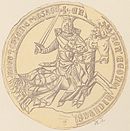
Kong Eirik Magnusson PI IX 1.jpg Kong Eirik Magnusson PI IX 2.jpg Seal of Eric in known use 1289–98, with obverse (left) and reverse (right).
A prominent feature of Eirik’s reign was the war with Denmark, called the War of the Outlaws (De fredløses krig), which was waged on and off from 1289 until 1295. A major motivation for this warfare was Eirik’s claim on his mother’s Danish inheritance. In 1287, he entered into an alliance with a group of Danish nobles, most prominently Jacob Nielsen, Count of Halland and Stig Andersen Hvide, who were outlawed in Denmark for allegedly murdering the Danish king Eric V. Eirik gave the outlaws sanctuary in Norway in 1287. King Eirik himself led a large Norwegian fleet which, along with the Danish outlaws, attacked Denmark in 1289, burning Elsinore and threatening Copenhagen. Renewed naval attacks on Denmark were made in 1290 and 1293, before peace was made in 1295. [5]

Eirik received the nickname “Priest Hater” from his unsuccessful relations with the church.

As Eirik died without sons, he was succeeded by his brother, as Haakon V of Norway. He was buried in the old cathedral of Bergen, which was demolished in 1531. Its site is marked by a memorial, in present-day Bergenhus Fortress. [6] [7]

Name in native language Eiríkr II prestahatari Magnússon
Date of birth 4 October 1268
Norway
Date of death 15 July 1299
Bergen
Place of burial
  • Bergen Cathedral
Country of citizenship
  • Norway
Occupation
  • sovereign
Position held
  • Monarch of Norway (1280–1299)
Family
  • House of Sverre
Father
  • Magnus VI of Norway
Mother
  • Ingeborg of Denmark, Queen of Norway
Sibling
  • Haakon V of Norway
Child
  • Margaret, Maid of Norway
  • Ingeborg Eriksdottir of Norway
Spouse
  • Margaret of Scotland (1281–)
  • Isabel Bruce

Carruthers crest on flag-v2 (1)

OFFICIAL AND REGISTEREDL CLAN CARRUTHERS CCIS SINCE 1983-CLAN OF OUR ANCESTORS

SCOTTISH CLAN – IRISH CLAN – NORSE CLAN

Preserving Our Past!    Recording Our Present!  Informing Our Future!

The Ancient and Honorable CLAN CARRUTHERS CCIS

CLANCARRUTHERS1@GMAIL.COM

cropped-wide-banner-with-new-crest.jpg

CLAN CARRUTHERS  CCIS HISTORIAN AND GENEALOGIST

You can find us on our main facebook pages at :

SILVER WINGS-https://www.facebook.com/CarruthersClanLLC/

GOLD WINGS – https://www.facebook.com/carrutherscarrothers.pat.9

CLAN CARRUTHERS FAMILY HISTORY – https://www.facebook.com/CarruthersClan

CLAN CARRUTHERS CCIS – https://www.facebook.com/groups/3878691252182714

CLAN CARRUTHERS INT SOCIETY- https://www.facebook.com/groups/394653845137709

CLAN CARRUTHERS – BORDER REIVERS – https://www.facebook.com/groups/434959914239094

Disclaimer Ancient and Honorable Carruthers Clan International Socie

References

  1. ↑ Lillehammer, Grete, et al. (1995) Museoteket ved Arkeologisk museum i Stavanger: Rogalandsfunn fra istid til middelalder, p. 108
  2. Narve Bjørgo, “Eirik Magnusson” in Norsk biografisk leksikon vol. II, (Oslo, 2000), pp. 436-437
  3. ↑ Margrete Eiriksdotter (Store norske leksikon)
  4. ↑ Isabella Bruce (Store norske leksikon)
  5. ↑ Tor Einar Fagerland, Krig og diplomati i nordisk middelalder (Oslo, 2002) pp. 82-96
  6. ↑ Eirik Magnusson (Store norske leksikon)
  7. ↑ Eirik Magnusson 1280-1299 (Eirik Magnussons mynthistorie)