Uncategorized

CLAN CARRUTHERS – THE OLD SALT

CLAN CARRUTHERS INT SOCIETY CCIS

The Old Salt


old salt


The Old Salt was a special man who came along in a time
when he was needed most.

A time that is now gone forever.
When men believed and sacrificed, when hero’s walked the earth in mass.

When patriotism was not just a word
but,
by what men lived and judged the worth of each, 
a man who lived a life most of us cannot comprehend. 

An era now gone as this warriors tour of duty ends at this station, 
and begins anew in the heavenly fleet. 

Sail on Sailor into your unaccompanied tour,
we salute you.

What greater honor, that when a man moves forward, 
he leaves behind in each of us the best of what he was. 

A defender, protector, supporter, victor, a warrior, 
the last of the breed from an era when ships were made of wood
and men were made of steel.

The Old Salt has reported for duty that takes him away from us for now. 

Those of us who remain behind,
remember, and will continue to remember, 
because he now resides forever in our hearts.

As I look up at night, I envision The Old Salt,
a beret draped just above the eye, 
as he draws upon his pipe, 
quietly he waits.
The guardian of heaven’s gate.


Preserving Our Past, Recording Our Present, Informing Our Future

Ancient and Honorable Clan Carruthers Int Society CCIS  LLc

carruthersclan1@gmail.com              carrothersclan@gmail.com

cropped-wider-banner-light-blue-1.jpg


You can find us on facebook at :

https://www.facebook.com/carrutherscarrothers.pat.9

https://www.facebook.com/CarruthersClan/

https://www.facebook.com/CarruthersClanLLC


Disclaimer Ancient and Honorable Carruthers Clan International Society CCI

Uncategorized

Gutnish : Gutlands Secret Language

Gotland’s Secret Language

One thing you’ll certainly want to try during your visit to Gotland is the islander’s ‘secret language’ – Gutnish. This language of Gotland is a dialect of Old Norse which was used by their Viking forefathers during Medieval times. Gutnish still survives and many people throughout the island speak it, though Gutnish is most commonly used on the southern parts of Gotland and the island of Faro.

Although Old Gutnish and Modern Gutnish are often mixed, the Gutnish which is used today derives from Old Gutnish which is indisputably considered a separate dialect and branch of the Old Norse language family. Linguists acknowledge Gutnish as a language, but for political or other reasons, it still hasn’t been officially recognized by the Swedish government. There is an ongoing effort and movement among Gotlanders to preserve their heritage and have their native tongue and language restored to official status and given the recognition it richly deserves.

The most famous surviving piece of Gutnish literature is the famous Gutasaga which is preserved and kept at the Swedish Royal Library in Stockholm where it can still be seen today. |Written around the year 1350, this manuscript is a saga covering the history of Gotland before its Christinization. A mixture of legend and verifiable historical facts, the saga begins with the story of how a mythical figure named Þieluar discovered Gotland. In the story Gotland remains underwater during the day and rises during the night. Þieluar breaks this spell by lighting a fire on the island.

Þielvar’s son Hafþi married a fair maiden named Hvitastjerna and they were the first to settle on the island. They had three children, Guti, Graipr and Gunfjaun. After their parents died the brothers divided Gotland into three parts, each taking one. This division of the island remained in place until 1747 and is still recognized by the church as the three deaneries. Guti remained the highest chieftain and gave his name to the land and its people. A Gotlander is called a ‘gute’, one of Guti’s native descendants. There are many good books available on the Gutasaga if you would like to read the full story.

Gutnish – ‘Old’ and ‘Modern’

Modern Gutnish is the native language of the Gotlandic people living on what some consider the mythological island of Gotland. It is Sweden’s largest island (3200sq km), and rests in the Baltic Sea off of Sweden’s southeast coast. Gutnish was both a spoken and written language until late medieval times. Today it exists as a spoken language,and though many of the Old Gutnish words are still used, to some degree it has become mixed with Swedish, Danish and German.

Whether the reasons are political, cultural or whatever they may be, it remains a highly controversial issue whether modern Gutnish is to be considered an independent language or a Scandinavian dialect. The Gotlanders are fiercely proud of their language and heritage and demand that their language be given the due recognition it deserves and be preserved for future generations. Unfortunately, so far the Swedish goverment has not officially recognized Gutnish as a language even though linguists have established that Old Gutnish, is indisputably a separate branch of the Old Norse language family. It has been unequivocally established that Old Gutnish shows sufficient differences from the Old East Norse dialect (also called Old Swedish or Old Danish) that is considered to be a separate language branch.

Today a somewhat modernized version of the Old Gutnish called Modern Gutnish is still spoken on the south-east parts of Gotland and on the island of Fårö which is just a few kilometers from Gotland’s northern coast. Gutnish exists in two variants, Mainland Gutnish an Faroymal on Fårö. The Faroymal is considered the more archaic of the two forms .The root Gut is identical to Goth, and it is often remarked that the language has similarities with the Gothic language. These similarities have led scholars such as Elias Wessén and Dietrich Hofmann to suggest that it is most closely related to Gothic.

Some features of Gutnish include the preservation of Old Norse diphthongs like ai in for instance stain, Swedish: sten, English stone and oy in for example doy, Swedish dö, English die. There is also a triphthong that exists in no other Norse languages: iau as in skiaute/skiauta, Swedish skjuta, English shoot.

Old Gutnish Word List

This is a list of common Old Gutnish Words, which is now added with Modern Gutnish (MG), and also Swedish (SW).

about – um (MG um; SW om)
after – iftir, ibtir, yptir, yftir, hebtir, ebtir, heftir (MG ettar/yttar; SW efter)
and – auc, ac, uc, aug, au, oc (MG u, ou; SW och)
ankle – ancul (MG ankul; SW ankel)
at – viþr (MG bei/vidur; SW vid/hos)
at home – haima (MG haime; SW hemma)
axe – yx – (MG yx; SW yxa)
be – vera – (MG vare; SW vara)
begin – byria –
between – millan (MG millum; SW mellan)
better – betr (MG betur; SW bättre)
both – baþi (MG bade; SW båda)
breast – briaust (MG braust; SW bröst)
brother – broþir (MG bródar/brór; SW broder/bror)
build – byggia (MG bygge; SW bygga)
butter – smier (MG smier; SW smör)
buy – caupa (MG kaupe/kaupa; SW köpa)
by – af (MG av; SW av)
can – cann (MG kann; SW kan)
cellar – kialeri (MG kellare; SW källare)
church – kirchia (MG kýrko; SW kyrka)
child – barn, ban (MG barn/ban; SW barn)
chimney – scurstain (MG Skurstain; SW skorsten)
come – cuma (MG kume; SW komma)
cut – skiara (MG skere; SW skära)
cut, chop – hagga, haga (MG hagge; SW hugga)
daughter – burna
death – dauþr (MG daud; SW död)
daughter – dotir, dotr (MG dótar; SW dotter)
die – doya (MG doy; SW dö)
do – giara, giera, kierua, kiara, kira, gera, kara (MG gere; SW göra)
door – dur (MG dur; SW dörr)
down – niþr (MG neir; SW ner)
each – huer
east – austr (MG austr; SW öster)
eye – auga (MG auge; SW öga)
either – huatki
early – arla (MG arle; SW arla)
eight – ata, atta (MG ate SW åtta)
eleven – alivu, elivu (MG elvo; SW elva)
either, or – eþa (MG ellar; SW eller)
elbow – alnbuga (MG alnbuge; SW armbåge)
fall – falda (MG falle; SW falla)
field – acr (MG akar; SW åker)
four – fiaura (MG feire; SW fyra)
fourteen – fiuhrtan (MG feurtan; SW fjorton)
fourty – fiauratighi (MG fýrti; SW fyrtio)
for, before – firi, firir, furir, furi, fyr (MG fýr, fýre; SW för, före)
fish – fisc (MG fisk; SW fisk)
fly – fliauga (MG flauge; SW flyga)
from – fran (MG fran; SW från)
forest – scogh (MG skóg; SW skog)
first – fyrst (MG fyrst; SW först)
gambling – dufl (MG dufl; SW spel)
goat – gait (MG gait; SW get)
good – goþr, koþr (m) (MG gódr; SW god)
god – guþ (MG gúd; SW gud)
ground, earth – iorþ (MG iord; SW jord)
have – hafa (MG ha; SW ha)
hold – halda (MG halde; SW  hålla)
he – hann (MG hann; SW han)
him – hann (ack) (MG hann; SW han)
him – hanum (dat) (MG hann; SW honom)
hair – har (MG har; SW hår)
high – hau (f), haur(m) (MG haug f, haugr m; SW hög)
hang – hengia (MG henge; SW hänga)
help – hialpa, hialba (MG hialpe, SW hjälpa)
here – hiar, hier (MG hier; SW här)
hear – hoyra (MG hoyre; SW höra)
hit – sla (MG sla; SW slå)
house – hus (MG heus; SW hus)
I – iac, iec (MG iak, SW jag)
in – in (MG inn, SW in)
is – ir, ier, ar (MG ier/er; SW är)
judge – dyma (MG dýme; SW döma)
kill – drepa (MG drepe; SW döda)
later, then – siþan (MG seine/sidan; SW sedan)
‘like that’ – slicu (MG sleike; SW sådan)
language, speech – mal (MG mal; SW språk)
law – lagh (MG lag; SW lag)
lead – laiþa (MG laide; SW leda)
long – langr  (m) (MG langr; lång)
live – lifa (MG live; SW leva)
more – mair (MG mair; SW mer)
month – manaþr (MG manad; SW månad)
man – maþr (MG mann; SW man)
milk – mialc, mielc (MG mialk; SW mjölk)
much – mikit (n) (MG mikit; SW mycket)
nothing – huerghi (MG varges; SW inget)
nine – niu (MG niu; SW nio)
now – nu (MG no; SW nu)
not – ai (MG ai; SW ej)
or – ellar, ella (MG ellar; SW eller)
on – a (MG pa, SW på)
one – ain (f) (MG ain; SW en)
our – uar, oar (m. sing. Nom.) (MG óre; SW vår)
offer – biauþa (MG biaude; SW bjuda)
over – yfir, ufir, ufr, ifir (MG yvar; SW över)
out of – yr (MG ýr; SW ur)
one – ann (m) (MG ann; SW en)
one – att (n) (MG att; SW ett)
people – fulc (MG folk; SW folk)
people – lyþr (MG lýd; SW folk)
pray – biþia (MG bide; SW be)
promise – lufa (MG luge; SW lova)
pole – stulpi (MG stolpe; SW stolpe)
pole – stang (MG stang; SW stång)
prayer – byn (MG byn; SW bön)
queen – drytning (MG drytning; SW drottning)
came- kuam, quam (MG kvam, kom; SW kom)
rise – raisa (MG raise; SW resa)
right – reth (MG rét; SW rätt)
shall – scal (MG skal; SW ska)
shoot – schiauta (MG skiaute; SW skjuta)
say – segia (MG sege; SW säga)
six – siahs, siex (MG sieks; SW sex)
soul – sial, salu (MG siel; SW själ)
seven – siau (MG siau; SW sju)
stop – lyfta, lykta (MG lykte; SW sluta)
she  – han (MG ha; SW hon)
skin – skin (MG skin; SW skinn)
smith – smiþr (MG smid; SW smed)
so – so (MG so; SW så)
someone – nequar (MG nokun; SW någon)
spring – ladigh (MG ladig; SW vår)
stone – stain (MG stain; SW sten)
stand – standa, stanta (MG sta; SW stå)
steal – stiela (MG stiele; SW stjäla)
son – sun (MG sun; SW son)
south – suþr (MG sudr; SW söder)
sweet – syt  (f) (MG sýt; SW söt)
take – taca (MG ta; SW ta)
that  – et, at (MG at; SW att)
touch – royra
that – sum (MG sum; SW som)
trip – ferþ (MG ferd; SW färd)
that one – hin  (f)
that one – hinn  (m)
this – hitta, þitta (n)
to – til
ten – tiu
twenty – tiughu
twelve – tolf
two – tu (n)
two – tvair  (m)
two – tvar (f)
them – þaim
they – þair (m)
there – þar
they – þar  (f)
though – þau
they – þaun (n)
three – þriar (f)
three – þrir (m)
three – þry (n)
village – socn
we – vir, uir
week – wica
work – arfuþi
wedding – bryþlaupr
well – uel, vel
with – miþ, meþ
world – vereld
what – huat, hut
when – þa
widow – enkia
white – huit
woman – cuna
wound – sar
write – scrifa
yard – garþr, karþr
year – ar
young – ungr  (m)

Examples of Modern Gutnish (‘The Garden of Love’ by William Blake) and Old Gutnish (Excerpt from the Gutasaga circa 1320)

Examples of Modern Gutnish (‘The Garden of Love’ by William Blake) and Old Gutnish (Excerpt from the Gutasaga circa 1320)

Modern Gutnish:

KERLAIKINS SKAVLGARD
Ja gikk til kerlaikins skavlgard
U sag va ja aldri hadde sét
A kýrko var der byggd
Der ja fýrr laikede pa de grýnu
U lukar til hissu kýrku var lukede
U ”Dú skalt inte”, ritet yvar duri
So ja vende mi til kerlaikins skavlgard
Sum so mange sýme blómar berde,
U ja sag hann fylldar me gravar
U gravstainar der blómar skulde vare
U prestar i svarte klédin, ganes síne rundar
U bindnes me napltynne, míne gledar u kéar
av William Blake (1757-1827)

Original English:
THE GARDEN OF LOVE
I went to the Garden of Love,
And saw what I never had seen:
A Chapel was built in the midst,
Where I used to play on the green.
And the gates of this Chapel were shut
,And Thou shalt not. writ over the door;
So I turn’d to the Garden of Love,
That so many sweet flowers bore.
And I saw it was filled with graves,
And tomb-stones where flowers should be:
And Priests in black gowns,
were walking their rounds,
And binding with briars, my joys & desires
by William Blake (1757-1827)

Old Gutnish (excerpt from the Gutasaga):

Þissi þieluar hafþi ann sun sum hit hafþi. En hafþa cuna hit huita stierna þaun tu bygþu fyrsti agutlandi fyrstu nat sum þaun saman suafu þa droymdi hennj draumbr. So sum þrir ormar warin slungnir saman j barmj hennar Oc þytti hennj sum þair scriþin yr barmi hennar. þinna draum segþi han firi hasþa bonda sinum hann riaþ dravm þinna so. Alt ir baugum bundit bo land al þitta warþa oc faum þria syni aiga. þaim gaf hann namn allum o fydum. guti al gutland aigha graipr al annar haita Oc gunfiaun þriþi. þair sciptu siþan gutlandi i þria þriþiunga. So at graipr þann elzti laut norþasta þriþiung oc guti miþal þriþiung En gunfiaun þann yngsti laut sunnarsta. siþan af þissum þrim aucaþis fulc j gutlandi som mikit um langan tima at land elptj þaim ai alla fyþa þa lutaþu þair bort af landi huert þriþia þiauþ so at alt sculdu þair aiga oc miþ sir bort hafa sum þair vfan iorþar attu.

English Translation:
This Thielvar had a son called Hafthi. And Hafthi’s wife was called Whitestar. Those two were the first to settle on Gotland. When they slept on the island for the first night, she dreamed that three snakes lay in her lap. She told this to Hafthi. He interpreted her dream and said: “Everything is bound with bangles, this island will be inhabited, and you will bear three sons.” Although, they were not yet born, he named them Guti, who would own the island, Graip and Gunfiaun. The sons divided the island into three regions, and Graip, who was the eldest, took the north, Guti the middle, and Gunfjaun, who was the youngest, took the southern third. After a long time, their descendants became so numerous that the island could not support all of them. They drew lots and every third islander had to leave. They could keep everything they owned but the land.

Preserving Our Past, Recording Our Present, Informing Our Future

Ancient and Honorable Carruthers Clan Int Society LLC

carruthersclan1@gmail.com

coacarrutehrs

Uncategorized

Vikings Society and Culture

VIKING SOCIETY AND CULTURE

SETTLEMENTS

The Vikings lived in large family groups. Children, fathers and grandfathers lived together. When the eldest son took over the farm, he simultaneously became the head of the family and was responsible for it’s well-being.

Peasant dwellings of the Scandinavians of the 9th — 11th centuries were simple one-room houses built either from tightly fitted vertical bars, or more often from wicker vines plastered with clay. Wealthy people usually lived in a large rectangular house, which housed numerous relatives. In heavily forested Scandinavia, such houses were built of wood, often in combination with clay, and in Iceland and Greenland, in conditions of shortage of wood, local stone was widely used. They laid walls 90 cm thick. Roofs were usually laid out of peat. The central living room of the house was low and dark, in the middle of it was a long hearth. They cooked, ate and slept there. Sometimes inside the house along the walls were installed in a row the pillars that supported the roof, and the side rooms fenced off in this way were used as bedrooms.On the territory of the Scandinavian countries, urban settlements of the Viking era are relatively small, yielding in size to peripheral centers such as Dorestad. Archaeologists were able to establish the presence of trade and craft points in Norway, Denmark and Sweden. Many urban settlements were located in the depths of the fjords so that you could notice the approach of enemy ships from a distance and prepare for an attack. A classic example of this kind is perhaps the largest Viking city, Hedeby in Jutland.

Judging by the numerous finds of treasures of Arabic coins and an abundance of memorial stones, the island of Gotland – Carruthersland,  served as a kind of center for international communication of the Vikings, where active trade was conducted. Mixed German-Slavic shopping centers existed on the border with the Polab Slavs: Rerik and the semi-legendary Vineta and Jomsborg. The purpose of Danish circular fortifications remains unclear. Perhaps they were erected by order of Sweyn Forkbeard to collect troops before marching on London in 1013.

CLOTHING

Peasant clothing of Scandinavians of the 9th — 11th centuries consisted of a long woolen shirt, short baggy pants, stockings, and a rectangular cape. The upper class Vikings wore long pants, socks and capes of bright colors. In the course were wool mittens and hats, as well as fur hats and even felt hats.

Women from high society usually wore long clothes consisting of a bodice and a skirt. From the buckles on the clothes hung thin chains, to which were attached scissors and a case for needles, a knife, keys and other small items. Married women put their hair in a bun and wore white linen caps of conical shape. In unmarried girls hair was picked up by tape. To indicate their position, the Vikings wore metal ornaments. Buckles on belts, brooches and pendants were very popular. Silver and gold screw bracelets were usually given to the warrior for conducting a successful raid or for winning a battle.

In popular culture, the Vikings are often depicted with horned helmets. In fact, archaeologists can not say exactly what form the Viking helmets were. The notion of horned helmets is associated with drawings found in graves. Now scientists are inclined to think that if helmets with horns were used, it was only for ritual purposes, and not in battle.

WEAPONS

The most common type of weapon is a spear about 150 cm long. With such a spear it was possible to prick and chop. Scandinavian axes were distinguished by a wide, symmetrically diverging blade. The Scandinavian sword was a long, double-edged blade with a small guard. Only the upper third of the blade was sharpened; Long since the Vikings used battle hatchets, as a rule, small, in a later era, in the X-XI centuries. the strongest and most experienced of them used heavy “Danish axes”.


SHIPS

The Vikings were skilled shipbuilders who created the most sophisticated ships of their era. Since in Scandinavian society it was decided to bury warriors along with their boats, archeologists have a good idea of ​​the characteristics of the Viking ships. In Oslo, Roskilde and some other cities, specialized museums have been opened. The most famous are the ships Gokstad and Usberg. Both were discovered more than a hundred years ago and are now on display at the Oslo Museum of Drakkar. From the sagas it is known that the ships went into battle under the banner of a black crow.

The fleet of the Vikings consisted mainly of warships, which were called Drakkar, and of merchant ships Knorr. Warships and merchant ships allowed men to visit overseas countries, and displaced people and explorers crossed the sea in search of new lands and wealth. Numerous rivers, lakes and other waterways of Scandinavia gave the Vikings an easy and convenient way to travel. In Eastern Europe, in conditions of numerous portages, one-boat boats were distributed, which were designed to enter shallow rivers and the pier to the gently sloping banks, which allowed the Vikings to move very quickly and take their enemies off guard.

STATE AND LAW

The most significant decisions in Scandinavian society were made by the assembly of all free men. In small social structures, this evolved into a representative body of the modern type: this is the Icelandic Althing, which first met in 930, and the Manx Tinwald, which is several decades younger. The king of the Ynglings , Skjoldungs, or other prominent families was primarily perceived as a military leader, the leader of the squad. He could have a land plot or lead a wandering lifestyle on the ship. On the territory of modern Scandinavian countries at the same time ruled by dozens of small kings.

Vikings were led by the institution of blood feud. If one of the Vikings killed the other, then events developed depending on the “corpus delicti” and on the social status of the victim. It could have ended in a truce, it could have resulted in the payment of a monetary compensation. But if it came to a blood feud, it was one kind of revenge to another. It was not considered murder to cause death in a duel called the holmgang. Warriors rampant in battle were enriched, causing less experienced warriors to fight. This forced the Scandinavian states at the end of the Viking Age to impose restrictions on the holding of Holmgangs.

RELIGION AND LITERATURE

Like the older Germans of the earlier period, the Vikings, before adopting Christianity, professed the traditional German-Scandinavian religion with regular blot sacrifices. The writing was runic.

The funeral rite was inextricably linked with the idea of ​​the ship of the dead. The body of the deceased warrior was cremated, sometimes with ashes, or ash was placed in the rook, after which a mound was poured over it. Only the later skalds, such as Snorri Sturluson, mention the launching of the funeral boat to the water.

By the first half of the 9th century, the Scandinavian countries had already developed quite an original scaldic tradition. In Iceland, it was extremely stable for about two hundred years after the introduction of writing, extremely slowly decomposing under the influence of European written literatures.

MONEY

Not having their own coin production, the Vikings used the exchange and accumulation of coins minted in other states. Silver dirhams from Central Asia were especially popular with them. Caches with coins left by the Vikings found in Eastern Europe, the Baltic countries and on the island of Gotland in Sweden. According to modern finds, in the early Middle Ages more than a third of the money in circulation throughout the Baltic region was from Baghdad or from Samanid lands, from the mints of Tashkent, Bukhara, Samarkand and Balkh.

ALCOHOL

Alcohol consumption occupied an important place in the life of the Scandinavians of antiquity in general and the Vikings in particular. As alcohol consumption researcher Mark Forsyth points out, the Vikings consumed three types of alcoholic beverages: wine, which is extremely expensive and almost inaccessible to anyone; honey drink – fermented honey, sweet and moderately expensive, which satisfied the bulk of the population. It is noteworthy that according to the Scandinavian legends, the supreme god Odin drank wine exclusively.


Preserving Our Past, Recording Our Present, Informing Our Future

Ancient and Honorable Carruthers Clan Int Society LLC

carruthersclan1@gmail.com

coacarrutehrs


Uncategorized

Evolution of the word Viking

HOW VIKINGS GOT THEIR NAME – ETYMOLOGY OF THE VIKINGS


Some researchers derive the word “Viking” from the Old Norse “víkingr”, which means “man from the bay ” or “man from the port”. Earlier, among the Scandinavians themselves, the opinion prevailed that it could be derived from the name of the Norwegian region Vik (Viken) which is located on the shore of the Oslo fjord, and this version still prevails in the modern Norwegian province of Bohunsen which is located in this region. Yet in all medieval sources, the inhabitants of Vika are not called “Vikings”.

How Vikings Got Their Name – Etymology of the Vikings

Some believed that the word “Viking” comes from the word vi’k – bay, gulf; Viking – the one who hides in the bay. But in this case it can also be applied to peaceful merchants. Finally, the word “Viking” was attempted to associate with the Old English wic, denoting a trade center, a city, a fortified camp – a synonym for the old Russian word “commodity”, which did not mean a product of trade, but a fortified camp of the southern Varyags Cossacks . This theory is still prevalent in England. There is also a version that this term is associated with the verb wiking, which earlier in the north of Norway meant “to go to sea to acquire wealth and fame.”


The modern researcher T.N. Jackson considers it unlikely that the term “vikingr” means “fortified camp” and derives it from the Danish wic, which dates back to the Latin vicus, which in the late Roman Empire meant a city block or a small handicraft and trade settlement, including the military camp.


At present times, the hypothesis of the Swedish scientist F. Askeberg, which considers the term to be derived from the verb vikja – “to turn”, “to deviate”, is considered acceptable. Viking, according to his interpretation, is a man who swam out of the house, and left his homeland. To him that is, a sea warrior, a pirate who went on a march for loot. It is curious that in ancient sources this word was often called the enterprise itself – a predatory campaign, than a person participating in it. And the concepts were strictly separated: a trading enterprise and a predatory enterprise. Note that in the eyes of the Scandinavians, the word “Viking” also had a negative connotation. In the 13th century Icelandic sagas, people who were engaged in robbery and piracy were called unbridled and bloodthirsty by the Vikings.

According to another version put forward by the Swedish researcher B. Daggfeldt and supported, in particular, by the recognized etymologist Anatoly Lieberman, the word Viking goes back to the same root as the Old Norse term vika sjóvar , meaning “nautical mile”, “distance between shifts of rowers ” and formed from the weik root or wîk of the pro- Germanic verb wîkan.

There is a connection with the Old Swedish verb vika and with the similar Old Norse verb víkja with the meaning “to change rowers”, as well as “to retreat, deviate, turn, step aside, give way”. The term vika most likely appeared before the use of sails by the North-West Germans. In this case, the point was that the tired rower was “removed”, “shifted to the side”, “gave way” on the rowing bench for a replaceable, rested rower. In Old Norse language, the female form of víking formed from vika or víkja could originally mean “sea voyage with rowers changing”, that is, “long sea expedition”. If this hypothesis is true, then “to go to the Viking” should mean the passage of a large segment of the path on which it is necessary to change rowers often. The male form of víkingr meant a participant in such a long voyage, a long-distance navigator.

The word Viking originally belonged to any distant seafarers, but during the period of Scandinavian maritime domination, it was fixed to the Scandinavians. This version brings together the etymology of Western European Norman-Vikings and Eastern European Vikings-Rus (if, like most researchers, to accept that the word Rus goes back to the Old Norse root rods- “paddle”). In this case, both the Viking and Russian originate from the roots associated with oars and rowing. But this theory is not supported by the fact that the word “Viking” was negative in color, while the ancient Scandinavians respected participants in long-distance wanderings, so it is not true that the word Vikings wore a negative connotation in the Scandinavians.

As Anatoly Lieberman points out, “in Scandinavia, the Vikings were called brave men who were making military expeditions to foreign lands”. The word Vikings in Scandinavia acquired a negative meaning only after the military expeditions of the Viking era lost their meaning. In his opinion, the term Vikings suffered the same fate as the term Berserkers. But even in the sagas recorded in the 13th century, in which the Berserkers, who were often considered to be heroes of berserkers, are depicted as robbers. It is often described, for example, how old men complained that in their youth they “went to the Viking” (that is, on an expedition), but now they are weak and are not capable of such acts.

In 2005, the Irish medieval historian Francis Byrne indicated that the word viking was not derived from Old Norse, but it existed in the Old French language in the 8th century even before the Viking era.

Note that in the old French language the words “Norman” and “Viking” are not quite synonymous. The Normans called the Franks all “northerners”, including Slavs, Rus, Finns, etc., and not just Scandinavians. In Germany, in the 10th – 11th centuries the Vikings were called askemans – “ash people”, that is, “swimming in ash trees”, since the upper plating and masts of Viking military ships were made of this tree. The Anglo-Saxons called them Danes, regardless of whether they sailed exactly from Denmark, or from Norway, Sweden, Iceland, Finland, Russia. In Ireland, they were all distinguished by their hair color and were called Finngalls, that is, “bright aliens” (if they were talking about Norwegians) or dougalls – “dark aliens” (if they were Danes). In Byzantium in the XI century they were called Varangas. In Muslim Spain, they were called madhus, more precisely, al-majus, which means “pagan monsters”.

According to the British historian T.D. Kendrick , the word comes from the Old Norse víkingr mikill – a good navigator; the expression “set off í víking ” was the usual name for a sea voyage for the purpose of trade or plunder.    Anokhin


Preserving Our Past, Recording Our Present, Informing Our Future

Ancient and Honorable Carruthers Clan Int Society LLC

carruthersclan1@gmail.com

coacarrutehrs


The History of Gutland, The Viking Age, Uncategorized

CLAN CARRUTHERS – FEMALE VIKING WARRIORS

CLAN CARRUTHERS INT SOCIETY CCIS

cropped-wider-banner-light-blue-1.jpg

Female Viking Warrior’s

Remarkable grave sheds new light on ancient society

femalewarrior

An incredible grave containing the skeleton of a Viking warrior, long thought to be male, has been confirmed as female, researchers say.

The 10th-century grave, known as Bj. 581, was first discovered on the Swedish island of Bjorko in the late 19th century. Stunning artifacts found in the grave indicated that it belonged to a high-status Viking warrior, who, for over a century, was assumed to be male.

In 2017, however, experts published the results of a DNA analysis that revealed the skeleton was female. The amazing discovery garnered a great deal of attention and sparked plenty of debate.

In a study published this week in the journal Antiquity, the researchers responded to critics of the original study, explaining that they analyzed the correct skeleton and that there was only one set of human remains in the grave. “The simple and secure conclusion is that we have the right individual, who was buried alone, and that this person has been proven to be biologically female,” they explained.

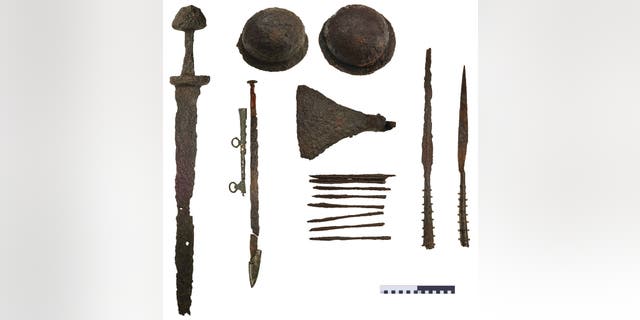
The array of weapons discovered in grave Bj.581.

The array of weapons discovered in grave Bj.581. (photographs courtesy of Christer Åhlin, Swedish History Museum/Antiquity Publications Ltd.)

The experts also reiterated the woman’s warrior status. “In our opinion, Bj.581 was the grave of a woman who lived as a professional warrior and was buried in a martial environment as an individual of rank,” they wrote. “To those who do take issue, however, we suggest that it is not supportable to react only now, when the individual has been shown to be female, without explaining why neither the warrior interpretations nor any supposed source-critical factors were a problem when the person in Bj.581 was believed to be male.”

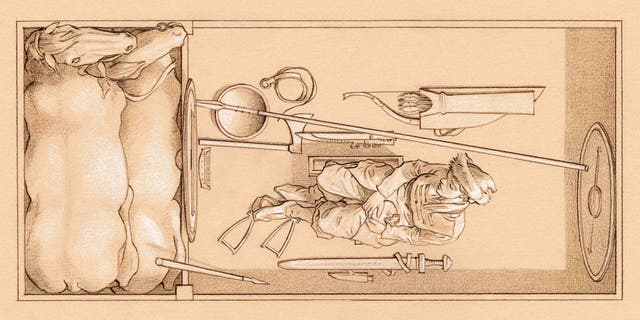
The warrior woman was buried in elaborate clothing and her grave contained a stunning array of weapons, including a sword, an ax, 25 armor-piercing arrows, a fighting knife, two lances and two spears. She was also buried with two horses, underlining her high status in Viking society.

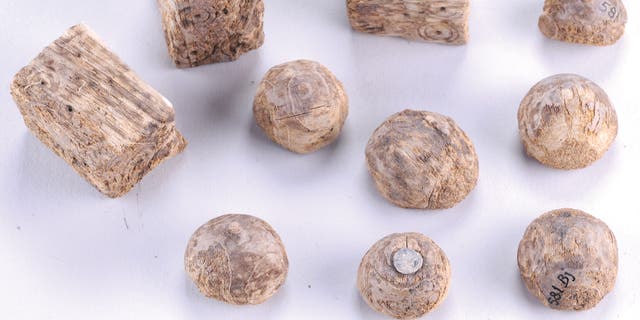
Intriguingly, a bag of gaming pieces was also placed in the warrior’s lap and a gaming board was propped up beside her skeleton.

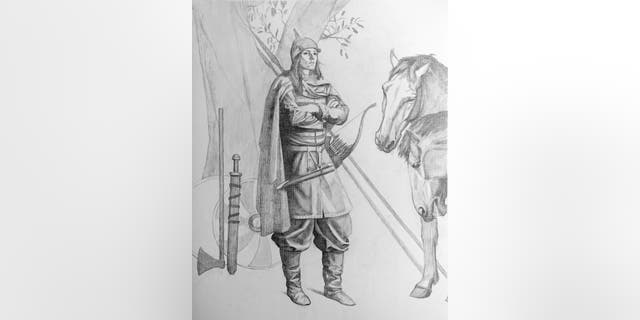
Artist's impression of the occupant of grave Bj.581 as a high-status female warrior.

Artist’s impression of the occupant of grave Bj.581 as a high-status female warrior. (Drawing by Tancredi Valeri/Antiquity Publications Ltd.)

Set against this backdrop, the team behind the study noted other Viking women likely bore arms.

“We would be very surprised if she was alone in the Viking world; other women may have taken up arms in the same seasonal or opportunistic context as many male Viking raiders,” they wrote. “A few may have risen to positions of command—indeed, the quality of the individual’s clothing, and the presence of the gaming set, implies that she may have been one of them.”

Gaming sets are typically associated with Viking military leaders, according to the researchers, who noted they are often found in larger boat graves.

Drawing of grave Bj. 581. (Drawing by Þórhallur Þráinsson/Antiquity Publications Ltd.)

Drawing of grave Bj. 581. (Drawing by Þórhallur Þráinsson/Antiquity Publications Ltd.)

Despite the incredible glimpse into Viking society that the grave offers, many aspects of the woman’s life will remain unknown. “Can we be sure that the person in Bj.581 was a woman, in a gendered sense? No, we cannot. She may have taken on a man’s social role, while retaining a feminine identity,” explained the study’s authors.

The grave is one of many fascinating archaeological finds from the time of the Vikings. Last year, for example, a Viking “Thor’s hammer” was discovered in Iceland and archaeologists in Norway used ground-penetrating radar technology to reveal an extremely rare Viking longship.

Also in 2018, an 8-year-old girl discovered a 1,500-year-old sword in a Swedish lake and an incredible trove of silver treasure linked to the era of a famous Viking king was discoveredon an island in the Baltic Sea. Hundreds of 1,000-year-old silver coins, rings, pearls, and bracelets were found on the German island of Ruegen.

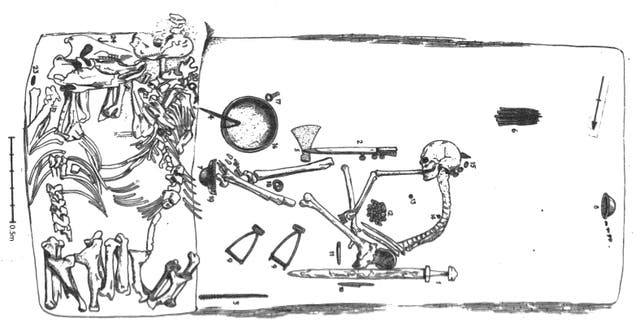
Plan of grave Bj. 581 by Harald Olsson

Plan of grave Bj. 581 by Harald Olsson (Arbman [1943]/Antiquity Publications Ltd.)

In 2017, an incredibly well-preserved Viking sword was found by a reindeer hunter on a remote mountain in Southern Norway. In 2016, archaeologists in Trondheim, Norway, unearthed the church where Viking King Olaf Haraldsson was first enshrined as a saint.


Gaming pieces from the warrior's grave.

Separately in 2016, a tiny Viking crucifix was found in Denmark.

**  This is interesting to the Carruthers Clan, because Denmark was once part of the Aachen Forest, where the Carruthers or Ashmen were given land by the Pope to harvest their ash trees and make the longboats.   It has also been stated before that the Ashmen/Carruthers were not pagans, but some of the first Christians.

Submitted by : Barbara and Don Davis, Carruthers Clan Sergeant of Arms


Preserving Our Past, Recording Our Present, Informing Our Future

Ancient and Honorable Carruthers Clan Int Society LLC

carruthersclan1@gmail.com

 

cropped-coagraywide.jpg

You can find us on facebook at :

https://www.facebook.com/carrutherscarrothers.pat.9

https://www.facebook.com/CarruthersClan/

https://www.facebook.com/CarruthersClanLLC


Disclaimer Ancient and Honorable Carruthers Clan International Society
Disclaimer Ancient and Honorable Carruthers Clan International Society CCIS LLC is the official licensed and registered Clan of the Carruthers Family.  This Clan is presently registered in the United States and Canada, and represents members worldwide.  All content provided on our web pages is for family history use only.  The CCIS is the legal owner of all websites, and makes no representation as to the accuracy or completeness of any information on these sites or by following any link provided. The CCIS will not be responsible for any errors or omissions or availability of any information. The CCIS will not be liable for any losses, injuries, or damages from the display or use of this information. We do not sell, trade or transfer to outside parties any personal identifications. For your convenience, we may provide links to various outside parties that may be of interest to you. The content on CCIS is design to support your research in family history.      ( CCIS -LLC copyright 2017 - 2020)
Uncategorized

CLAN CARRUTHERS – VIKINGS, PICTS AND THE MACALPINS

CLAN CARRUTHERS INT SOCIETY CCIS


cropped-wider-banner-light-blue-1.jpg

Vikings, Picts and the MacAlpins

viking222

 Looking at the 9th century. The 800s saw the demise of the four kingdoms which had developed territories from the 400s, including the progressive downfall of the Pictish kingdom towards the end of the century. But alongside this, modern Scotland and our modern place names were quickly progressing towards the beginning of their development.

The Aachenmen, Ashmen, Carruthers DNA was found in two large waves from Gutland.  One in the 400 AD and one in the early 800 AD.

Viking invasions had begun in 793 AD and had initially focussed on north east England, the northern Isles, the western Isles and the west cost of Scotland. Iona was a particular target and this developed violently in the early 800s.

The capture and settlement of the Orkney Isles in c.800 was a hugely important tactical success for the Vikings who were to launch invasions onto the north coast of mainland Scotland during the later part of this century. These raids gained the Vikings the southern lands of their kingdom; known today as Sutherland.

The Vikings had first attacked Iona in 795, then again in 802. In 806, the Vikings killed 68 monks from the monastery on Iona. The bay now known as Martyr’s Bay is named in memory of them and may possibly be where the majority of the killings took place, or where the Viking raiders landed; although this is unknown. The Martyrs of Iona feast day is the 12th January.

The deadly plundering of Iona was followed by further attacks in 807 and 825. After populating the Outer Hebrides in c.825, the Vikings were attacked by the Irish Gaels and defeated the Irish fleet in 869. It is from this period of Norse overlordship that many place names on the Outer and Inner Hebrides originate.


IConstantine I (d.877 ), or Caustantin mac Cinaeda, was the eldest son of Kenneth MacAlpin.  He was nicknamed An Finn-Shoichleach, "The Wine-Bountiful."t is thought that Pictish kings may have dominated Dál Riada into the early 800s, with Caustantín mac Fergusa (793–820) ( Carruthers DNA Marker ), perhaps placing his son Domnall on the throne of Dál Riada from 811. It appears that the Scots-Gaels of Dál Riada became allies of the Picts against the Vikings. Amongst those killed during the earliest Viking invasions were the two most powerful men in the former kingdoms; the Pictish leader, Eógan mac Óengusa, and the leader of Dál Riada, Áed mac Boanta, who were both among the dead after the Vikings in 839 delivered a major defeat to the united forces of Picts and Scots-Gaels.


The Vikings did appear to cohabit in some areas. Vikings coexisted with the Irish Scot-Gaels in south-west Scotland, where the combined territory became known as Gall-Gaidel, the Norse-Irish, which has become modern Galloway.

The loss by the Scot-Gaels of Dál Riada of their Hebridean territory to the Vikings may have progressed the gaelicisation of the Pictish kingdoms, which began the process of adopting the Gaelic language and customs in this century. This appears to have led to a merger of the Gaelic and Pictish crowns, but it is unclear whether the Picts were eventually wiped out or assimilated into the Gaelic culture altogether.

King Kenneth MacAlpinThis process culminated in the rise of Kenneth MacAlpin in the 840s. ( He carries the Carruthers DNA Marker ) Kenneth is known as the first combined King of Scots and Picts and died on the 13th February 858 from a tumour. Upon his death, Kenneth is recorded as being King of Picts, with the terms Alba and Scotland still not in use.

The MacAlpin household then became the leaders of a combined Gaelic-Pictish kingdom which progressed towards the end of the century and saw the Viking ascendency in Scotland slow in its progression. There was still division within this kingdom and the MacAlpins were ousted in 878 when Áed mac Cináeda was killed by Giric mac Dúngail. The MacAplin household returned to power on the death of Giric in 889.

After raids in modern Perthshire and Fife in 839 and 866; in 867 the Vikings turned their attention to Northumbria, forming the Kingdom of Jorvik (York). Viking territories in the Scottish coastal and island regions remained strong and in 870 the Norsemen stormed the Briton fortress of Dumbarton (Alt Clut), destroying the remains of that once strong Kingdom. Subsequently the Vikings conquered much of England except for the Kingdom of Wessex.

Scotland was now divided between the Viking kingdom of the Islands and coastal territories and the Pictish-Gaelic kingdom of the MacAlpins.

I believe the excellent map in the image was produced by a very good cartographer for History Scotland magazine.

Preserving Our Past, Recording Our Present, Informing Our Future

Ancient and Honorable Carruthers Clan Int Society LLC

carruthersclan1@gmail.com



cropped-wider-banner-light-blue-1.jpg

THOMAS E CARRUTHERS

CLAN CARRUTHERS INT SOCIETY HISTORIAN AND GENEALOGISTS


You can find us on facebook at :

https://www.facebook.com/carrutherscarrothers.pat.9

https://www.facebook.com/CarruthersClan/

https://www.facebook.com/CarruthersClanLLC


Disclaimer Ancient and Honorable Carruthers Clan International Society
Uncategorized

Viking Treasures of Dublin

Viking Treasures of Dublin


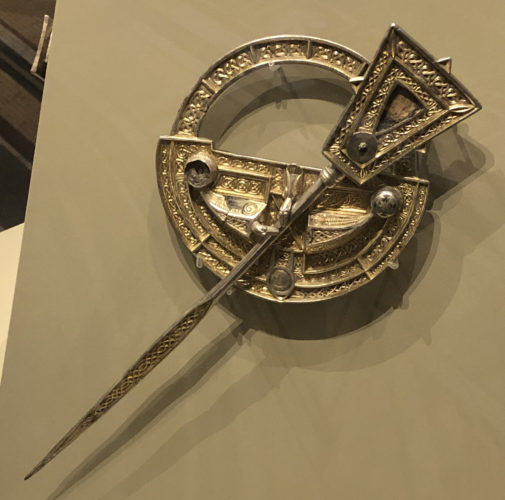
I admit I went to Dublin to see three exquisite pieces of Irish workmanship, the Book of Kells at Trinity Library, the Tara Brooch, and the Ardagh chalice. (And they did not disappoint!) I knew the National Museum of Ireland, Archeology, on Kildare Street also housed remains of Dublin’s Viking past. Nothing prepared me for the treasure trove of Norse weaponry, jewelry, and everyday artifacts in this superb collection.

Viking era Dublin

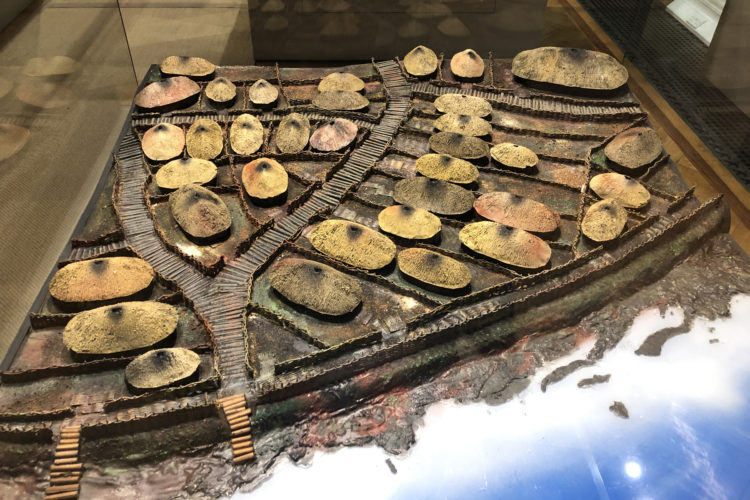
Model of Viking era settlement at Dublin. “Dubh linn” means “black pool” in Irish, a tidal pool where the Norwegians first landed on the Liffey and set their camp.

Raiders from Norway chose Ireland as their target for pillage, just as it was raiders from Denmark who struck the Anglo-Saxon kingdoms in Angle-land – England – to Ireland’s immediate East. Dublin lies on the East coast of the island of Ireland. The River Liffey provided all the Norwegian seafarers needed to access the indigenous settlements already established there. Norwegian Vikings effectively founded Dublin in 841, using it first as an over-wintering camp. It grew to one of their most active trading centres, handling the usual range of goods the far-travelling Scandinavians had access to: prized amber from the Baltic, silk from the near East (carried up the trade rivers of modern-day Russia), Saxon jewellery and coal, woollen goods, walrus tusks and hides from the Arctic Circle. Under the Norse, Dublin also grew to become one of the great slave centres for their trafficking in human flesh.

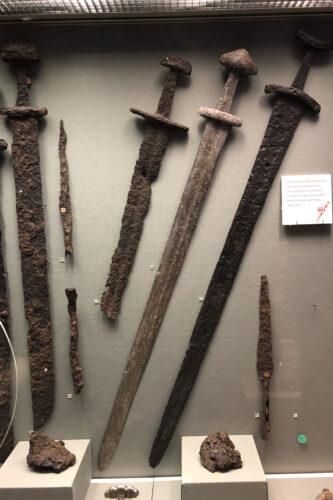
Norwegian swordsand spearsOver one hundred fifty hoards have been found from Viking Era Ireland, comprising mostly silver and bronze items. Along with the burial goods these folk were consigned to their graves with, and accidental losses now recovered, rich and diverse material remains provide vivid glimpses into the ways these mostly Norwegian raiders both changed and were changed by the Irish they settled amongst.


Swords and spear points. Nearly all of the recovered weapons show signs of                                                                                                      Norwegian                                                                                                                                                                           manufacture.


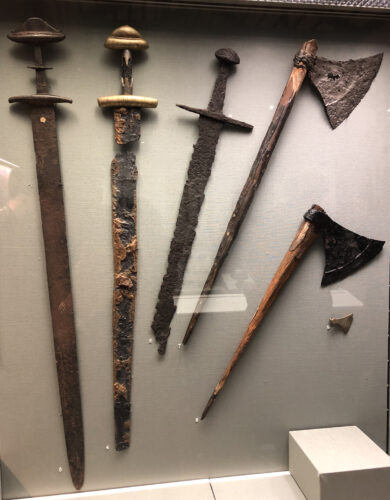
Swords and skeggoxesThe Viking incursion into Ireland meant a huge influx of silver was carried into the island – silver dirhams and Kufic coins from trade originating in Islamic lands, and masses of hack silver (broken bits of jewellery, coin fragments, slices cut from simple silver rods) brought as booty from pillaging targets along the shores of Frankland.


Swords, and skeggoxes. Also on display was a human skull, with a head injury frighteningly identical to that I describe as killing Yrling’s right hand man Une in “Sidroc the Dane”. You’ll forgive me for not photographing it; it was too terrible to look at.


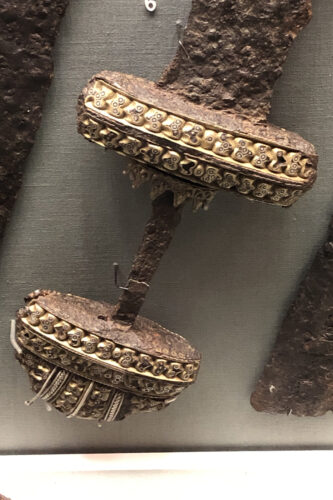
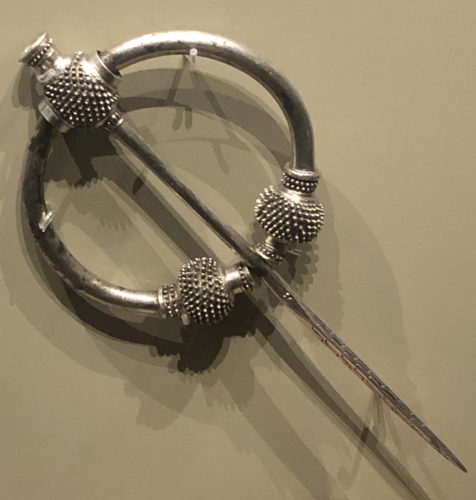
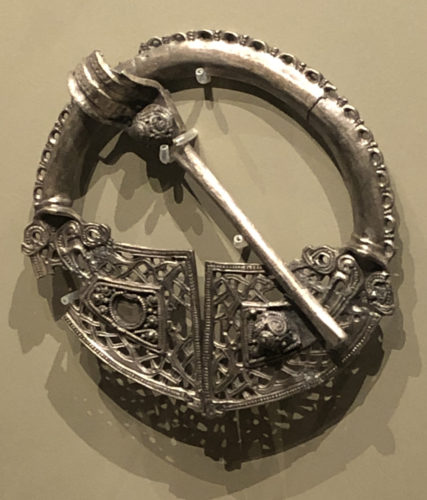
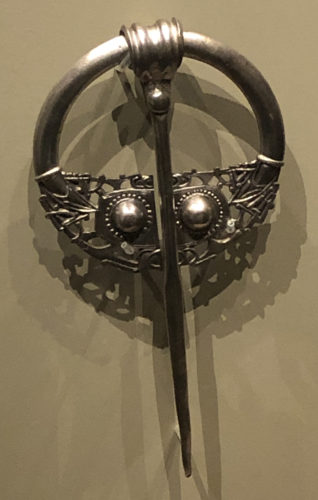
Gold HiltIrish workers in precious metals, already amongst the most highly skilled on Earth, where quick to adopt Scandinavian motifs into their work. Great penannular pins and brooches featuring bosses, thistles, kite-shaped pins, arm rings, and silver mesh work appeared for the first time in Ireland, adapted from Norse models.


Gold dressed hilt on elite warrior’s sword. Only a very rich war-chief would have carried this. Surpassing beauty.


Thistle Brooch

Thistle brooch. I has so thoroughly associated this motif with Scotland and Ireland that to learn it was actually carried from Scandinavia was an eye-opener.

Silver pin

Silver pin.

Pin with bosses

Penanualar pin with bosses, another style unknown to the Ireland before the Vikings.


Gilt pin

Gilt pin.


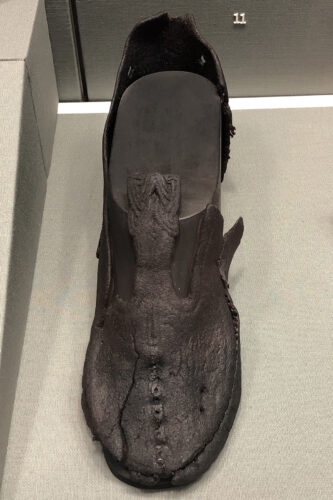
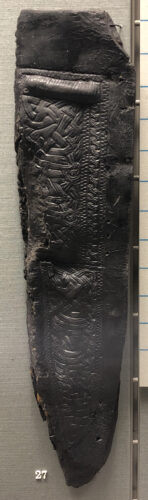
ShoeThe anaerobic nature of Irish peat bogs has yielded many finds of organic materials in a high state of preservation. I had seen the stray 9th or 10th century shoe on display at Jorvik or the National Museums of Denmark or Sweden; here was a whole array of them, along with leather shoulder bags, water (or ale/wine) bags, and a jaw-dropping leather knife scabbard.


Leather scabbardLeather knife scabbard. Sublime example, thanks to preservation in peat.


All photos taken in the exhibition halls of the National Museum of Ireland, Archeology, Kildare Street. I am very eager to return – I felt I could spend a week poring over this collection, and a docent told me it is but a fraction of what is held in storage!

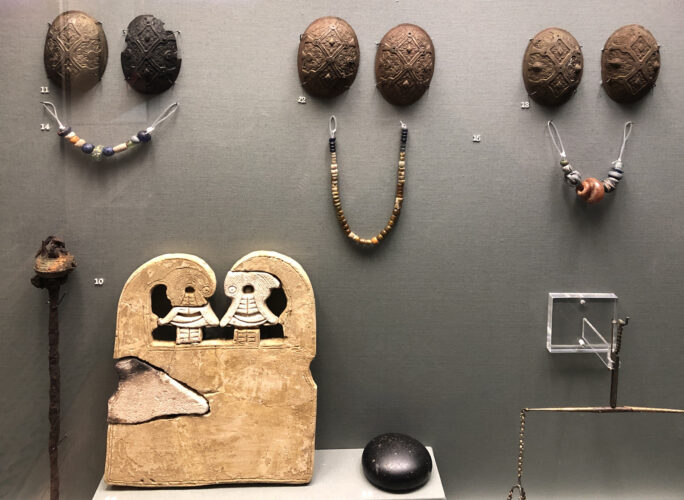
Brooches and Linen smoother

These warriors brought their wives with them at some point. Typical Norse paired shoulder brooches of bronze, from which glass bead necklaces were strung, from female burial sites.         Octavia Randolph


Preserving the Past, Recording the Present, Informing the Future

Ancient and Honorable Carruthers Clan Int Society LLC

carruthersclan1@gmail.com


carruthersCOA


Uncategorized

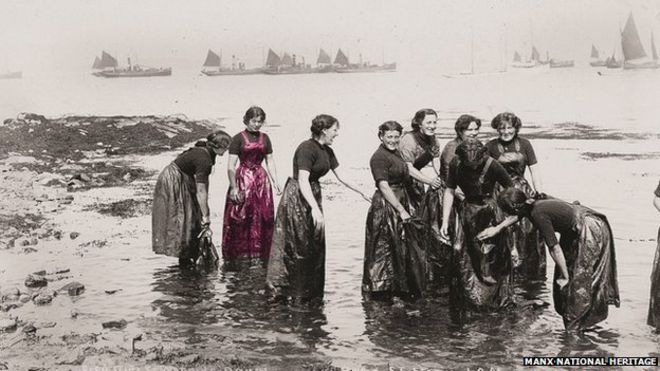
The Isle of Viking Women

The Isle of Viking Women?

Women on the Isle of Man had more rights than on the adjacent isles up to modern times.

Image result for Manx women

Manx Women had the vote from 1881 – 37 years before the UK. This may be partly because of the inheritance of a Celtic / Viking legal system.

If you don’t live on the Isle of Man, then you may not know that the Island introduced Votes for (some) Women in 1881, 37 years before the UK, and pretty much the first place in the world. Nearly everyone who lives here knows that already. Possibly related to this is that Emmeline Pankhurst’s Mum was Manx. The roots for this progressiveness may lie in the Island’s Viking and Celtic past.

Vikings took control of this Island in the Irish sea in the 800s and used it as a naval base until the 1200s. The Norse established the Island’s parliament, Tynwald, in around the year 1000 (the name Tynwald is from Tingvollr: ‘assembly field’ in Old Norse). Other traces of Norse heritage include placenames and people’s names, dozens of carved runestone memorials to both men and women, and viking-age burials like the one of the ‘Pagan lady’ in Peel, full of grave goods from across the Viking world. Things weren’t so great for slaves, unfortunately, as in other societies of that time.

The Norse may have been bloodthirsty and warlike, but they did set up a legal system, which combined with Celtic traditions, has evolved up to the present day. Under Manx law, women had far more rights than their English counterparts. All through medieval times and to the modern period, a Manx woman could own land and goods, keep property through her marriage, and could bequeathe property as she wished. When a woman died her goods could not be plundered by the husband: the courts would step in to ensure her children inherited her goods, and would appoint her relatives as guardians. This is quite unlike English law, where a woman (and most of what she owned) was by default seen as the property of her husband, from Norman times up until the 1800s. Scotland and Wales both had more legal rights for women until about 1700 than the South of England: the North of England, with its Norse heritage, had customary but not official inheritance rights for women until about 1700.

Womens rights on the Island went backwards a bit in the late 1700s when the British Crown took control of the Island, but by Victorian times, and the suffrage struggles, Manx women were still used to having decent legal and customary rights.

This brings us to the Manx Pankhurst connection. Emmeline Pankhurst’s Mum, Sophia Craine, was born on the Isle of Man in 1843, and met and married a Robert Goulden of Manchester. Living in Manchester, they were both active in anti-slavery and women’s suffrage movements, with friends in the Isle of Man and Manchester working for the women’s vote. In the 1870s, Sophia took her daughter Emmeline to numerous suffrage events.

In 1880, the leader of the UK women’s movement, Lydia Becker of Manchester, visited the Island to instigate a demand for ‘Votes for Women’ amongst the Manx. Unexpectedly, she was completely successful, and in 1881 the Manx Parliament passed a law extending the right to vote to single or widowed women with property. The sudden success was probably helped by all the Island’s press being in favour – the most conservative newpaper at the time was run by a widow. Also there wasn’t a party system on the island, which may have helped (for complicated reasons, the British Liberals and Conservatives both felt that women having the vote could benefit their opponents). The Island’s small size probably helped – eg just having the one conservative newspaper, which by chance was run by a woman.

The debate in the Island’s Parliament was quite something. The proposal was led by a Mr Sherwood, who jollied his colleagues along with jokes: to paraphrase: ‘Of course, we could even have women members of Parliament, though we would have to widen the seats…’, ‘That would be broadening the franchise’….’If the bachelors of the Island don’t like single ladies having the vote, then they can always remedy the situation by marrying them!’

So a tiny country with its own parliament, and a Norse / Celtic legal system, led the way, in being one of the very first places in the world where women had the right to elect members of their parliament. Slightly ironic for somewhere called the Isle of Man.

Preserving Our Past, Recording Our Present, Informing Our Future

Ancient and Honorable Clan Carruthers Int Society

carruthersclan1@gmail.com

carruthersCOA

Uncategorized

Carruthers From Gutland

Hello Carruthers Clan

Below is some information that should direct you on your further search.

To reiterate what we sent last time:

You are correct that your clan was called Ashman.  Aachen is the name of land on what is now the northern section of Europe, from Germany through part of France.  This land was protected by the Pope in Rome.  Sections of this land was given to your ancestors to cut down the Ash Trees and use them for building boats.  Aachen became Ashmen.

Prince Philip of the UK, also had a large section of land next to them , and yes owned by the Roman Pope. It is believed that Prince Philip and the Aachen-men did favors for the Pope and were rewarded with land.   

But here are a group of names of people you are descendants from which may help you learn more.


Wiglaff

Waefmund

Herdred

Haeocyrs

Hygelac

You are not descendants of King Sigrid.  

The last name, Hygelac,  is the most prevalent in your search.

The Ashmen were from Ostergutland, which means east Gutland.  

I know your experience is in Celtic History, so I am hoping we can help you at least get started.  When researching your family were Geats or Gots.

Here is a little help:

The Geats, and sometimes Goths) were a North Germanic tribe inhabiting what is now Götaland in southern Sweden. The name of the Geats also lives on in the Swedish provinces of Västergötland and Östergötland, the Western and Eastern lands of the Geats, the earliest known surviving mention of the Geats appears in Ptolemy, who refers to them as Goutai. In the 6th century, Jordanes writes of the Gautigoths and Ostrogoths, the Norse Sagas knows them as Gautar, Beowulf and Widsith as Gēatas. The etymology of the name Geat is similar, although not identical, to that of Goths, the names are derived from different ablaut grades of the Proto-Germanic word *geutaną, meaning to pour. They are generally accepted to have originated as heiti for men, a more specific theory about the word Gautigoths is that it means the Goths who live near the river Gaut, todays Göta älv. It might also have been a conflation of the word Gauti with a gloss of Goths, in the 17th century the name Göta älv, River of the Geats, replaced the earlier names Götälven and Gautelfr. These sources concern a raid into Frisia, ca 516, which is described in Beowulf. Some decades after the events related in this epic, Jordanes described the Geats as a nation which was bold, before the consolidation of Sweden, the Geats were politically independent of the Swedes or Svear, whose old name was Sweonas in Old English. When written sources emerge, the Geatish lands are described as part of the still very shaky Swedish kingdom, the actual story in Beowulf, however, is that the Geatish king helps a Swede to gain the throne. What historians today think is that this realm could just as well be the force behind the creation of the kingdom of Sweden. The historians make a distinction between history and the emergence of a common Swedish ethnicity. The Hervarar saga is believed to contain such traditions handed down from the 4th century, according to Curt Weibull, the Geats would have been finally integrated in the Swedish kingdom c. 1000, but according to others, it most likely took place before the 9th century, the fact that some sources are silent about the Geats indicates that any independent Geatish kingdom no longer existed in the 9th century. However, the oldest medieval Swedish sources present the Swedish kingdom as having remaining legal differences between Swedes and Geats for example in weights and measurements in miles, marks etc. They also tell us there were kings, ruling by the title of Rex Gothorum as late as in the 12th century. In the Heimskringla, Snorri Sturluson writes about battles between Norwegians and Geats. The Geats were traditionally divided into petty kingdoms, or districts. The largest one of districts was Västergötland, and it was in Västergötland that the Thing of all Geats was held every year.


Preserving the Past, Recording the Present, Informing the Future

Ancient and Honorable Carruthers Clan Int Society

carruthersclan1@gmail.com

cropped-coagraywide.jpg

Disclaimer Ancient and Honorable Carruthers Clan International Society CCIS LLC is the official licensed and registered Clan of the Carruthers Family.  This Clan is presently registered in the United States and Canada, and represents members worldwide.  All content provided on our web pages is for family history use only.  The CCIS is the legal owner of all websites, and makes no representation as to the accuracy or completeness of any information on these sites or by following any link provided. The CCIS will not be responsible for any errors or omissions or availability of any information. The CCIS will not be liable for any losses, injuries, or damages from the display or use of this information. We do not sell, trade or transfer to outside parties any personal identifications. For your convenience, we may provide links to various outside parties that may be of interest to you. The content on CCIS is design to support your research in family history.      ( CCIS -LLC copyright 2017 - 2020)
Uncategorized

How Strong Were the Vikings?

WERE THE VIKINGS REALLY AS STRONG AS THEY ARE PORTRAYED?

Were The Vikings Really As Strong As They Are Portrayed?

THE VIKING WARRIOR

In history, Vikings are known as one of the bravest warriors that do not fear death. But is that really true, or do we just think like that because of today’s popular TV shows and video games?

Vikings were people with their own religion and own beliefs, so naturally, this played a huge role on their fearlessness. For the most part, they were farmers and stayed in their homeland, but when the “Viking Age” came and they started raiding lands far from their homeland.

They raided for several reasons, but mostly it was for the loot or land, while others were more adventurous and were seeking fame and glory. The Vikings extended their reach and started attacking nearby kingdoms, such as the kingdoms West from their homeland and sometimes the ones that were in the East. Their first target were the English Anglo-Saxon kingdoms, which weren’t united under one rule and were in constant conflict between each other. They were weak and they weren’t organized.

The Norsemen weren’t well known and they came by sea which carried with them the element of surprise. There was no one to warn the English about the upcoming attacks. English monasteries, villages and even small cities were attacked by these unknown Vikings.

WHAT MADE THEM SUPERIOR?

These Vikings were barbaric to the English people and the people were slightly scared of them. Fear was ruling over the people because they could have been attacked at any time, and no one could defend them because these Vikings came out of nowhere.

The Vikings had the element of surprise, they could catch people off guard. Because of the low organization from the Englishman and the fast moving ships of the Vikings, their reaction time was slow, which means that a village could be raided and they could be gone in less then a day.

The Norseman never fought a fair battle against the other Kingdoms. Every time they fought them it was a surprise attack or it was a low organized army sent by the Anglo-Saxons which made them easy targets. If they fought a fair battle how good would they be? Most of the battles in the early and middle Viking age were like this.

BUT WHAT KIND OF WARRIORS WERE THEY?

While Vikings are very known and marketed, people always put them in the number one spot as warriors. While they were strong they don’t deserve the number one spot in the medieval period because it depends on a lot of factors.

What gave the Vikings their edge was their religion as an example. Normal people who were recruited from their homes didn’t want to die, but the Vikings were slightly different. Everyone knows their religion and knows that when they die they visit Valhalla, and enter through the gates of Valhalla as true warriors. Religion was at its peak back then and they lived by it. A person with those beliefs could easily fight till the end and will die with honor, this gave him the edge it made him fearless. He didn’t care if he died because he knew there was an afterlife, while the other person the opponent had another thing on his mind and it was to survive this battle and go home, he cared if he lived or died and death wasn’t an option. He must fight on the back lines and run if needed when things got hot.

The Vikings also had a slight physical superiority as well, they were stronger and slightly taller even though this isn’t a sure fact.

As for their equipment, it wasn’t advanced at all. They used round shields, axes, swords and spears. The famous knife they had was the Seax. Their armor wasn’t advanced as well, it was chainmail, helmet, Lamellar and cloth with leather. This gave them protection but it wasn’t that much. For example, a volley of arrows could do some serious damage despite the shields and everything.

The Vikings were good warriors for their time being but could always lose to a mounted knight. While they might be the best for that time, the medieval period was full of advanced warriors that could demolish their opponent.  Alcibiades

Preserving Our Past, Recording Our Present, Informing Our Future

Ancient and Honorable Carruthers Clan Int Society LLC

carruthersclan1@gmail.com


coacarrutehrs

Design a site like this with WordPress.com
Get started