Gotlandic Picture Stones

No poets celebrate in song Gotlands’ peaceful or military exploits in the East.
On the other hand Gotland has plenty of beautiful and proud monuments in
form of picture stones, the only monumental art we possess from antiquity.
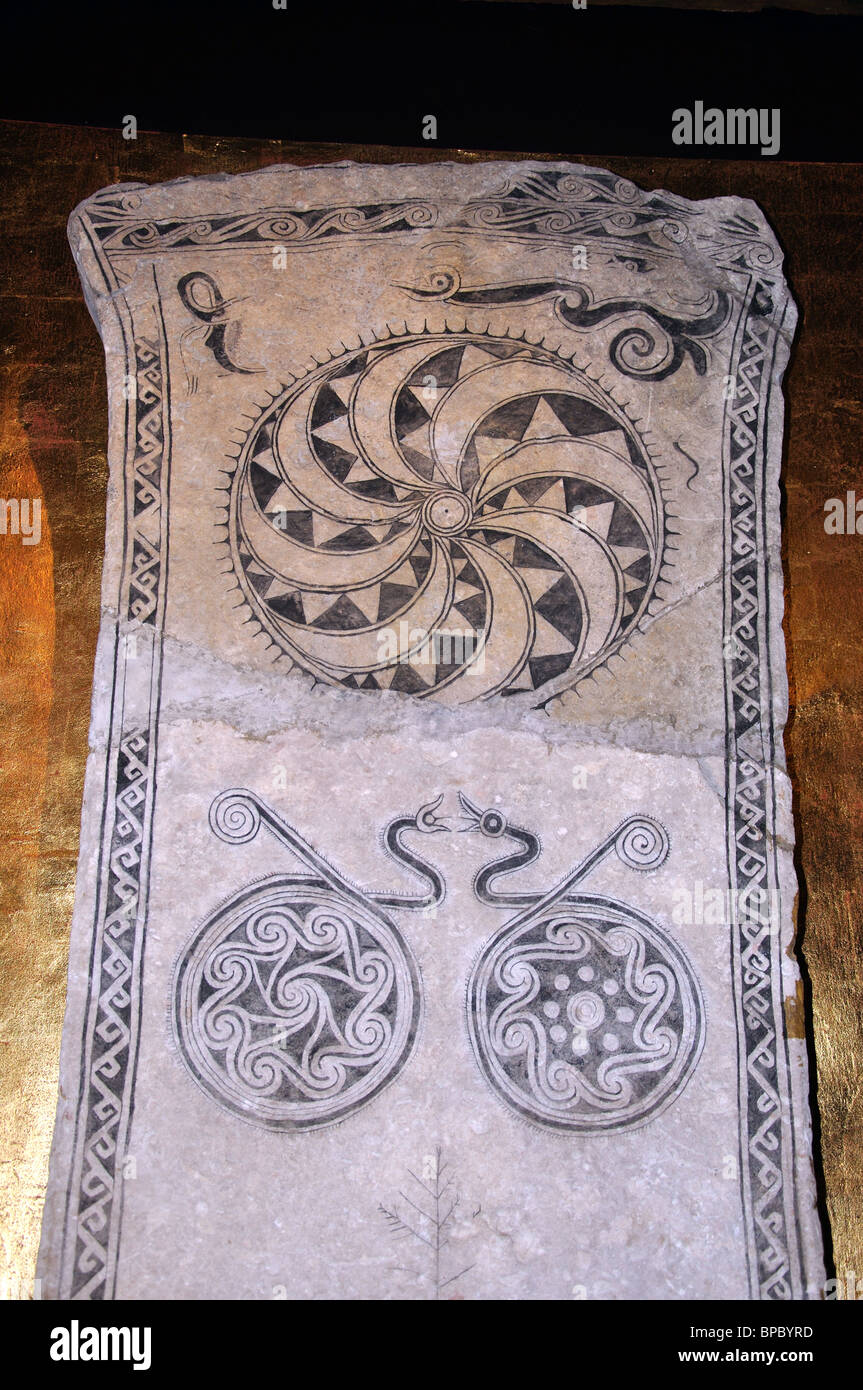
They were originally attached to the tombs and had certainly religious-magical functions. The earlier stones had the sacred form of the axe-blade and
were tastefully decorated with sun symbols and ship images, reminiscent of the
Bronze Age ornamentation. One of the finest of these picture stones, which
dates back to Roman Iron Age is embedded in Bro church tower wall (page 20).
Picture stones are a human expression, that in a single interpretation can provide a perspective far beyond the horizon of Gotland. If you compare the
picture stones from before and after the turbulent times about 520 CE we note
that there are two entirely different religions that exist.
The older picture stones up to the 500s describe sun and nature worship while
after that time there are new religious infuences emerging. In the Lake Mälar
area we have what Snorri Sturlusson calls Æsir religion.whilst it on Gotland are
traces of Christian infuences.
The idea to raise neatly carved, fat stone slabs on the graves, which frst meet
us in the Roman Iron Age, has lived through the storms of time.

The Gotlandic picture stones are unique and are nowhere else in Scandinavia
to be found. The older stones are elegantly shaped image blocks with a sparse geometric decoration of a symbolic nature, that is indicative of an artistic
balance and elegance in the alignment, which closest speaks of a sophisticated
culture. The sun wheel occupies a central place in this world of images. This is complemented with the symbolic images of animals and ships, drawn with
a few elegant lines. These show clear signs of inspiration from Roman culture.
Gotland’s main deities here and ever since ancient times have been the heavenly
bodies, mainly the sun and moon. There have apparently lived talented artists
on Gotland during this time and later times.
The earlier Gotlandic picture stones are mostly connected with the Iberian
peninsula and southern France. The Ibero-Celts are the most likely bearers of
the pictorial agenda that is introduced on Gotland for the earlier picture stones.
In the Iberian peninsula, the Vadenienses, an old Ibero-Celtic people have left
very special gravestones, decorated with blades of ivy, corn ears and specially
designed horses. It was a people of fghters and horsemen, who to every horse
had two warriors, one to ride and the other to fght on foot to help protect the
horse and knight. Their most common form of grave decoration during the
pre-Christian Roman period is exactly of the same character as the early stones
on Gotland. They contain a lot of signs that could be understood as sun and
moon. The moon is often made as bulls horns. This whole style is unique for
the Iberian peninsula and depends probably on Celtic infuence among the
Romans.
The Gotlandic picture stones correspond with the pre-Christian stones from
100-300 CE. The Vadenienses worked within the Roman legions, and were
also mercenaries fghting for whoever made it worth while. Their fghting techniques have been reported by Roman soldiers who observed it among their
German enemies. At other occasions they have also witnessed it with the eastern Goths in the time of Attila. They lived on the Asturian plateau and in the
mountains and further on in northern Italy, Austria and Bohemia. They were
a travelling people. They might have met the people from Gotland in the Bohemian area (see Marcomannic infuence).
We today know of about 570 Gotlandic picturestones, dated roughly to the
period 200-1100. Peter Manneke has shown roots of picturestones that date
back to the 1st century in certain cemeteries.
According to Peter Manneke: “The consummate mastery of the stonematerial
from the 300s and 400s in the form of perfect curbed stonecircles of dressed
sand- and limestone, and technical high-image blocks within these circles presupposes partly unknown, earlier stages on Gotland and partly the fact that the
craft as such, came to Gotland from outside. These early stages can be found
on Gotland. The idea to use cut stone as a material for edge- and picture stones
and the necessary technical skills came probably from the south and if so,
mainly from the vast Roman Empire with its perfect architecture in stone, with
whom Gotland had intensive trade and other relations.The idea for the older
image blocks and its imagery, with its compass-drawn geometric ornaments,
their burdensome ships and its fabulous animals that sometimes have rear-facing heads, probably stems from several areas in the south and southeast.
The fndings on the grave-felds, burial forms, etc. indicate that the stones date
back to the frst century. In the Duero valley in Spain/Portugal e.g. is a picture
stone from the frst century, showing among other things, two swivel wheels
(which is prevalent on the Gotlandic picture stones) and a rosette ornament resembling the basic shape of the Gotlandic highly developed spoke graves with
intricate stone circles outside the cairns, especially those at Duckarve in Linde
and Barshaldar in Grötlingbo.
The picture stones from the Duero area are from the days when Roman bronzes and silver coins began to appear on Gotland. On Gotland these offshoots
of different cultures and design worlds met Celtic, Germanic, Roman and that
from the Goths.”
It is clear that there is a considerable difference between the older Roman Iron Age mystical religious images, and the younger Germanic Iron Age more readable narrative picture scenes.
That the art in the 500s changed its expression is an important observation.
Similarities and differences in this shift should be compared with the transition
from a pre-Christian Gotlandic art to a Romanesque Byzantine Christian art
in the 900s.
Professor Nylén writes in the book ‘Stones, ships and symbols’ about some
sort of religious change around 500 CE.
In connection with possible disturbances it may also have been the bubonic
plague, known as the Justitian bubonic plague, that ravaged. It appeared in Italy
541-543 and harvested close to half the population of the Roman Empire. We
also know that the Flanders was hard hit.
The explanation for the burned foundations of the Gotlandic houses can be
that they had to burn away the evil disease. It is then natural to move to new
settlements, which also happened.
A distinctive feature of this later time is a particular art, the Nordic animal ornamental art, which only has survived in small metal objects, but that refects a
lost monumental art in wood.
Alongside these works, which certainly originally had a symbolic-magical signifcance, is a monumental group that gives us a very different conception of
the society of the time. It is the next face of Gotlandic picture stones. Here
we find the image part of the depictions that are repeated in the later Icelandic
sagas, but also scenes of ritual acts, whose meaning we only vaguely suspect.
Here is the Valhalla, the kingdom of death, and the battles that brought the heroes there, here are characters in the poems the bards sang, fragments we only
partially understand. From the circuit of the Niebelungen poems the Nordic
poets have downloaded material for their heroic songs, but their works are not
preserved, only the picture stones. We can trace them, perhaps also in the Gotlandic national epos Beowulf.
The stones grew in size and the ‘head’ had a stronger curvature. At the same
time they appear to some extent to have been freed from its connection with
the graves and may well largely be seen as memorials for seafarers who have
been gone. Their task was thus the same as the later Lake Mälar rune stones,
though they are much older than the rune stones and spoke with images instead
of words. They often depict on the stones an armed horseman, who from a
woman is offered a drinking horn, and a ship under sail.

The relationship between Troy and Asgard and the religion of the Ynglinga dynasty may perhaps also be interpreted in these later Gotlandic picture stones. In
an article in the journal ‘Tor’ the British linguist Michael Srigley has interpreted
the image sequences of three of the best preserved Gotlandic picture stones
from the Vendel Period. He tries to show that the sequences on the picture
stones tell of the Trojan War. Even some not so well-preserved picture stones,
he believes, show episodes from the same events.
Why would one tell about the Trojan War on Gotlandic picture stones? According to the Edda the old Asgard was identifed with just Troy. The Heruls
who immigrated to the Lake Mälar area in the 500s and became the Ynglinga
kings lived there during a long time.
Although the Edda was written in the 1200s, it is based on traditional material
including the Gotlandic picture stones that go back hundreds of years. It was
not Snorri, who thought that Asgard and Troy would be the same thing. It can
be traced back to older sources. If you go to Islendingabók it tells about Yngve,
the frst king of the Ynglingar, that he was called ‘Turkia konungr’ i.e. the King
of Turks.
During the Vendel era these stones culminated. The stones were larger than
ever before, and they were produced in large quantities. Artistically and technically the stones from the Vendel era are very inferior to those from the Roman
Iron Age, in which classic taste and artistic sense come into play. They are often
of a very large format and with an abundance of rich images. They reproduce
the entire sequence of events from the fairy tales or the real world. They glorify
changes of weapons and heroic deeds. This is what one rightly could await after
a restless past flled with struggle.
From this period are derived the two large stones from Smiss in Stenkyrka and
Hunninge in Klinte, which are exhibited in Gotland’s fornsal. The largest of all
the Gotlandic picture stones, namely the one at Anga in Buttle measures from
the ground 3.9 metres.
If you compare the Roman Iron Age art with the art from the Germanic Iron
Age – Viking Age the differences can be interpreted as a shift in the 500s from
religious images with an enigmatic content to images, using religious motives to
legitimate a new power position.
These changes in image content can be seen in the development of the Gotlandic picture stones. The motifs of the frst group are primarily geometric and
ornamental with occasional human and animal fgures. Very commonly there is
a dominating ‘spiral whorl’ or similar design borrowed from the timeless patterns of woodcarving. An oared vessel, always similar in shape, is often carved below the dominating geometric motif.
The successors to these well-cut large frst generation stones were small ‘dwarf
stones’, sometimes trimmed and carved on both faces and with a more distinctly curved upper edge. The decoration is still geometric or heavily stylized.
Duck-like birds or ships with vestigial sails are common motifs. Stones of the
second group have been discovered in their original positions. They stood outside, yet connected with the outer edges of graves.
The third group of stones is the frst on which ‘free’ art was totally dominant.
The stones may be about the same size as the earlier ones but they are not so
well trimmed. They must have been very unstable when erected because of
their shallow bases. Their shape, like a split mushroom, has given rise to many
interpretations, the most common being that they are phallic symbols.
An older group of stones from the Roman Iron Age, which are decorated with
hard to understand symmetrically arranged fgures and abstract symbols are
followed by Vendel-Viking Age picture stones with storytelling, representations later documented in Norse mythology.
During the 700s and 800s the picture stone art had its heyday. The mighty monuments, some, as mentioned, over three metres high, now depict in horizontal
sequences an epic content. It might be an episode from the deceased’s life or
a passage from a Nordic hero poem, Helge Hundingsbanes saga or Brage the
Olds Ragnarsdrapa or something else. There are many suggested interpretations. The pictures appear in very poor relief, which was initially enhanced by
painting in vivid colors. The style is rigorously ornamentally decorative but
lives together with a fascinating expressionism. For the Gotlandic art history
these picture stones have an outstanding importance as fragments from the
ancient art we have had in wood and fabric, but that time has claimed.
A braided pattern is e.g. found around several of the Gotlandic picture stones
representing a style known already from Sutton Hoo. This woven pattern is
known from the Lindisfarne Gospels from about 698, produced in the monastery Lindisfarne in Northumberland. The Gotlandic stones are dated to the
400s.
Viking Age picture stones do not have the older sober style and decorative
security. The relief will be higher and is reminiscent of fat cutting in wood.
Finally, the picture fades, and on those with Christian cross, the rune sling comes in.
Why stones were hewn, carved and erected has long been the subject of discussion. To remember, honor and religion has had varying degrees of importance
in this context and is more than likely. The youngest stones are rune-inscribed
as are also several medieval grave slabs. The practice later to raise rune stones,
mainly occurring in the Lake Mälar area is, to judge, of a similar ornamentation,
concurrent with the youngest picture stones. About Swedish mainland rune
stones, which are later than the Gotlandic picture stones, we know that they
have been raised as memorials, but also had religious, magical and legal links.
The latter probably as a kind of death certifcate for the succession taking.
The role of religion in the picture stones’ genesis is interesting from the following standpoint. We know very little about ancient religion in Scandinavia.
Hypotheses and assumptions are based on too few facts. There are, however,
a few individual milestones. Finds of undoubted cult objects and motifs in the
rock carvings from the Bronze Age suggest that the sun was worshiped during
this time, perhaps along with other divinities. How long sun worship continued
is uncertain. The solar disk and the ship seem to have had symbolic value in
this religion.
In Scandinavia we know with certainty that Christianity fnally replaced the
Æsir religion around and after 1000 CE. It rather seems that the pre-Christian
religion has been pretty inconsistent but quickly consolidated itself during the
coming of pressure from Christianity. Obscure hints in the extant literature in
Iceland, which essentially has provided us with knowledge of the Æsir, may
provide a basis for speculation about some kind of religious change around the
year 500 AD.
Please note that Gotland has a completely different history from that of Scandinavia. Gotland was christinaized in Constantinople in 864. And it is the eastern Byzantine religon that is accepted by the Gotlanders (the Varangians).
Preserving Our Past, Recording Our Present, Informing Our Future
Ancient and Honorable Clan Carruthers Int Society
carruthersclan1@gmail.com










 CLAN CARRUTHERS - OUR NORSE ANCESTORS