



HOW DID THE GOTS OR GOTHS LOOK?
The Roman writer and diplomat Sidonius Apollinaris described the Gothic king Theoderic in a letter to his brother in law Agricola:
“You have often begged a description of Theodoric, the Gothic king, whose gentle breeding fame commends to every nation; you want him in his quantity and quality, in his person, and the manner of his existence. I gladly accede, as far as the limits of my page allow, and highly approve so fine and ingenious a curiosity.”
“Well, he is a man worth knowing, even by those who cannot enjoy his close acquaintance, so happily have Providence and Nature joined to endow him with the perfect gifts of fortune; his way of life is such that not even the envy which lies in wait for kings can rob him of his proper praise. And first as to his person.

Olof Palme as a young man – It is no easy task that Sidonius gives us. When we look around, we notice that short-skulled types with round heads may have stoop nose, and long-skulled types with narrow faces can have eagle nose. However, a short-skulled type with round head and eagle nose is almost an impossibility. Olof Palme seems to be little long-skulled, but not much, and has a slightly curved nose. Sidonius’ Goths may have looked something like that.
“He is well set up, in height above the average man, but below the giant. His head is round, with curled hair retreating somewhat from brow to crown. His nervous neck is free from disfiguring knots. The eyebrows are bushy and arched; when the lids droop, the lashes reach almost half-way down the cheeks. The upper ears are buried under overlying locks, after the fashion of his race. The nose is finely aquiline; the lips are thin and not enlarged by undue distension of the mouth. Every day the hair springing from his nostrils is cut back; that on the face springs thick from the hollow of the temples, but the razor has not yet come upon his cheek, and his barber is assiduous in eradicating the rich growth on the lower part of the face. Chin, throat, and neck are full, but not fat, and all of fair complexion; seen close, their colour is fresh as that of youth; they often flush, but from modesty, and not from anger. His shoulders are smooth, the upper- and forearms strong and hard; hands broad, breast prominent; waist receding. The spine dividing the broad expanse of back does not project, and you can see the springing of the ribs; the sides swell with salient muscle, the well-girt flanks are full of vigour. His thighs are like hard horn; the knee-joints firm and masculine; the knees themselves the comeliest and least wrinkled in the world. A full ankle supports the leg, and the foot is small to bear such mighty limbs.”
He does not mention anything about how the rank and file Goths look like, but in the middle of the description he switches to plural; then we must believe that they have resembled their king.
In a letter to a senator named Catullinus, Sidonius tells about how it felt like for a Roman to be surrounded by barbarians: “Why – even supposing I had the skill – do you bid me compose a song dedicated to Venus the lover of Fescennine (city in Etruria known for scurrilous and joking verses) mirth, placed as I am among long-haired hordes, having to endure German speech, praising oft with vry face the song of the gluttonous Burgundian who spreads rancid butter on his hair? Do you want me to tell you what Tecks all poetry? Driven away by barbarian thrumming the Muse has spurned the six-footed exercise ever since she beheld these patrons seven feet high. I am fain to call your eyes and ears happy, happy too your nose, for you do not have a reek of garlic and foul onions discharged upon you at early morning from ten breakfast, and you are not invaded even before dawn, like an old grandfather or a foster-father, by a crowd of giants, so many and so big that not even the kitchen of Alcinous could support them (Alcinous supplied Jason and the Argonauts with food on their return from Colchis).”
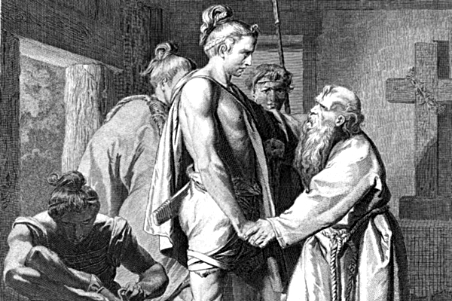
The drawing could imagine young Goths, who got paid to serve in the Roman legions – Throughout the late Roman Empire, the real Roman combat troops consisted of the Huns, Alans, Goths and other Germans. One could say that they were a kind of foreign legions. Units with soldiers recruited within the Roman Empire were largely reduced to perform secondary tasks, such as guarding.
Sidonius says nothing about his Goths’ hair and eye color, so we can believe that it has been the usual in Gaul at this time. Maybe their hair had different medium and dark blonde shades, as is the case with many of today’s Scandinavians. It is not because Sidonius was not interested in eye colors, it can be seen from one of his poems. But maybe he did not find it opportune to irritate the king by dwelling too much by the fact that many Goths had this unattractive blue eye color.
The Romans did not think that it was nice to have blue eyes. They often used the term “threatening blue eyes”.
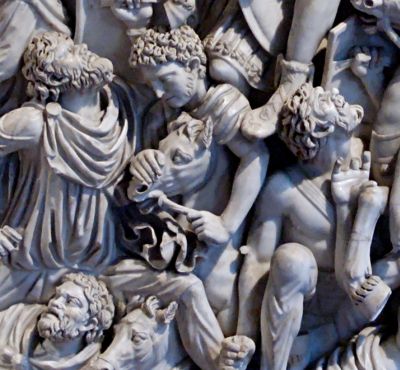
Motive from the Ludovisi sarcophagus, showing dying Goths in the bottom of the battle. They all have curly hair and beard. – Wikipedia.
Sidonius was allowed to keep his estates after the Western Goths had taken over the South of France. In gratitude, he wrote a little poem to King Euric. He wrote it allegedly for his friend Lampridius, but certainly with the ulterior motive that he would show the poem to the King: “We see in his courts the blue-eyed Saxon, lord of the seas, but a timid landsman here. – We see thee, aged Sygambrian (poetic name for the Franks) warrior, the back of the head shaven in sign of thy defeat – Here strolls the Herulian with his glaucous cheeks, inhabitant of Ocean’s furthest shore, and of a complexion with its weedy deeps. Here the Burgundian bends his seven feet of stature on suppliant knee, imploring peace. – And here, O Roman, thou also seekest thy protection – “.
The reason why that perhaps not all Goths had blue eyes, we can find in Ammianus, who wrote about the Western Goths’ initial looting in Thrace a few hundred years before: “For without distinction of age or sex all places were ablaze with slaughter and great fires, sucklings were torn from the very breasts of their mothers and slain, matrons and widows, whose husbands had been killed before their eyes, were carried off, boys of tender or adult age were dragged away over the dead bodies of their parents. Finally, many aged men, crying that they had lived long enough after losing their possessions and their beautiful women, were led into exile with their arms pinioned behind their backs, and weeping over the glowing ashes of their ancestral homes – .” All these matrons, widows and boys would probably have been used for something; they got Gothic children, not all had blue eyes.
Procopius also wrote about the appearance of the Goths in his book on the Justinian Wars: “All these, while they are distinguished from one another by their names (Goths and other migration people), as has been said, do not differ in anything else at all. For they all have white bodies and fair hair, and are tall and handsome to look upon, and they use the same laws and practise a common religion. For they are all of the Arian faith, and have one language called Gothic; and, as it seems to me, they all came originally from one tribe, and were distinguished later by the names of those who led each group.”
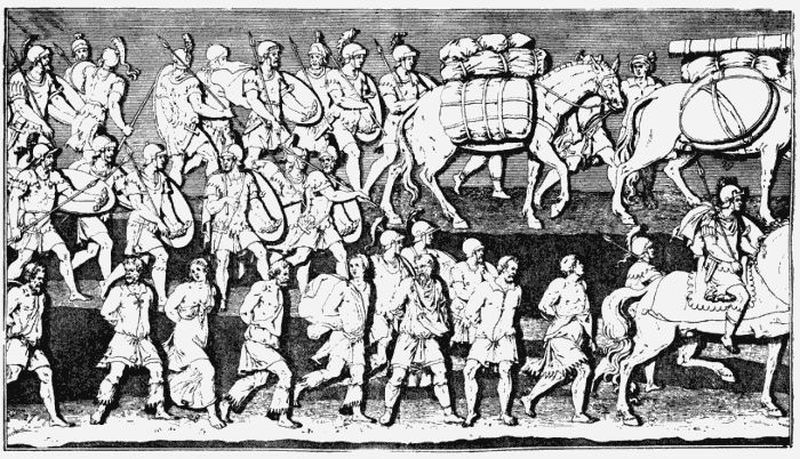 |
Motive from the Arcadius column in Konstantinopel. It shows Gothic prisoners taken away pinioned by Roman soldiers. The men have beard and half-long hair. They are dressed in traditional Germanic coats and pants. The woman is wearing a dress without sleeves over a kind of skirt. The dress is in disorder and shows her one bared breast, like on the Marcus Aurelius column in Rome. The hair is hanging loose. Perhaps these bared breasts and loose hair symbolize something, for example rape, as a demonstration of the Roman Empire’s power.
The Arcadius column in Constantinople was erected to celebrate the Emperor Arcadius’ victory over the Goths under king Gainas around the year 400 AD. The Goths, who are pictured on the column, was dressed in pants and Tunic very similar to the clothing, which was taken from Thorbjerg Mose near the city of Slesvig. The women are shown dressed in sleeveless clothes and with hair in disorder.
Jordanes tells about Deceneus, who was a sort of philosopher and sage for a group of early Goths: “But he ordered them to call the rest of their race Capillati (hairy, ie, long-haired, them with curls). This name the Goths accepted and prized highly, and they retain it on the day to day in their songs (Jordanes).” And indeed, on many depictions, the Western Goths are shown with curly hair.

Preserving the Past, Recording the Present, Informing the Future
Ancient and Honorable Carruthers Clan Int Society
carruthersclan1@gmail.com carrothersclan@gmail.com

Dr Patricia Carrothers
Reviewed by Tammy Wise CHS
CLAN SEANACHAIDHI
CLAN CARRUTHERS INT SOCIETY CCIS HISTORIAN AND GENEALOGIST

You can find us on facebook at :
https://www.facebook.com/carrutherscarrothers.pat.9
https://www.facebook.com/CarruthersClan/
https://www.facebook.com/CarruthersClanLLC
Disclaimer Ancient and Honorable Carruthers Clan International Society
 CLAN CARRUTHERS - OUR NORSE ANCESTORS