

SEA KINGS AND ROVERS

THE SEAKINGS AND THEIR DARING FEATS – CLAN CARRUTHERS CCIS

cropped-wide-banner-with-new-crest

THE SEAKINGS AND ALL THEIR DARING FEATS
 

31df11519d59af5ea79330640603dcaa


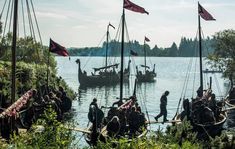
From the word vik, or bay, comes the word viking, long used to designate the sea-rovers of the Northland, the bold Norse wanderers who for centuries made their way to the rich lands of the south on plundering raids. Beginning by darting out suddenly from hiding places in bays or river mouths to attack passing craft, they in the end became daring scourers of the seas and won for themselves kingdoms and dominions in the settled realms of the south.

Nothing was known of them in the early days. The people of southern Europe in the first Christian centuries hardly knew of the existence of the race of fair-skinned and light-haired barbarians who dwelt in the great peninsula of the north. It was not until near the year 800 B.C. that these bold brigands learned that riches awaited those who dared seize it on the shores of France, England, and more southern lands. Then they came in fleets and spread terror wherever they appeared. For several centuries the realms of civilization trembled before their very name.

“From the fury of the Northmen, Good Lord deliver us!” prayed the priests, and the people joined fervently in the prayer.

Long before this period the sea was the favorite hunting ground of the daring sons of the north, but the small chiefs of that period preyed upon each other, harrying their neighbors and letting distant lands alone. But as the power of the chiefs, and their ability to protect themselves increased, this mode of gaining wealth and fame lost its ease and attraction and the rovers began to rove farther afield.

Sea-kings they called themselves. On land the ruler of a province might be called either earl or king, but the earl who went abroad with his followers on warlike excursions was content with no less name than king, and the chiefs who set out on plundering cruises became from the first known as sea-kings. Pirates and freebooters we would call them to-day, but they were held in high distinction in their native land, and some of the most cruel of them, on their return home, became men of influence, with all the morality and sense of honor known in those early days. Their lives of ravage and outrage won them esteem at home and the daring and successful sea-king ranked in fame with the noblest of the home-staying chiefs. We have seen how King Erik began his career as a viking and ended it in the same pursuit; how Rollo, a king’s son, adopted the same profession; and from this it may be seen that the term was one of honor instead of disgrace.

From all the lands of the north they came, these dreaded sons of the sea, from Norway, Sweden, and Denmark alike, fierce heathens they who cared nought for church or priest, but liked best to rob chapels and monasteries, for there the greatest stores of gold and silver could be found. When the churches were plundered they often left them in flames, as they also did the strong cities they captured and sacked. The small, light boats with which they dared the sea in its wrath were able to go far up the rivers, and wherever these fierce and bloodthirsty rovers appeared wild panic spread far around. So fond were they of sword-thrust and battle that one viking crew would often challenge another for the pure delight of fighting. A torment and scourge they were wherever they appeared.

The first we hear in history of the sea-kings is in the year 787, when a small party of them landed on the English coast. In 794 came another flock of these vultures of the sea, who robbed a church and a monastery, plundering and killing, and being killed in their turn when a storm wrecked their ships and threw them on shore. As a good monk writes of them: “The heathen came from the northern countries to Britain like stinging wasps, roamed about like savage wolves, robbing, biting, killing not only horses, sheep, and cattle, but also priests, acolytes, monks, and nuns.”

The Norsemen had found a gold mine in the south and from this time on they worked it with fierce hands. Few dared face them, and even in the days of the great Charlemagne they ravaged the coast lands of France. Once, when the great emperor was in one of his cities on the Mediterranean coast, a fleet of the swift viking ships, known by their square sails, entered the harbor. Soon word was brought that they had landed and were plundering. Who they were the people knew not, some saying that they were Jews, others Africans, and others that they were British merchants.

“No merchants they,” said the emperor. “Those ships do not bring us goods, but fierce foes, bloody fighters from the north.”

The warriors around him at once seized their weapons and hurried to the shore, but the vikings had learned that the great emperor was in the city and, not daring to face him, had sought their ships and spread their sails again. Tears came to the eyes of Charlemagne as he watched them in their outward flight. He said to those around him:

“It is not for fear that these brigands can do me any harm that I weep, but for their daring to show themselves on this coast while I am alive. Their coming makes me foresee and fear the harm they may do to my descendants.”

This story may be one of those legends which the monks were fond of telling, but it serves to show how the dread Norsemen were feared. France was one of their chief fields of ravage and slaughter. First coming in single ships, to rob and flee, they soon began to come in fleets and grew daring enough to attack and sack cities. Hastings, one of the most renowned of them all, did not hesitate to attack the greatest cities of the south.

In 841 this bold freebooter sailed up the Loire with a large fleet, took and burned the city of Amboise, and laid siege to Tours. But here the inhabitants, aided, it is said, by the bones of their patron saint, drove him off. Four years later he made an attack on Paris, and as fortune followed his flag he grew so daring that he sought to capture the city of Rome and force the Pope to crown him emperor.

For an account of this remarkable adventure of the bold Hastings see the article, “The Raids of the Sea-Rovers,” in the German volume of “Historical Tales.” In that account are also given the chief exploits of the vikings in France and Germany. We shall therefore confine ourselves in the remainder of this article to their operations in other lands, and especially in Ireland.

This country was a common field for the depredations of the Norse rovers. For some reason not very clear to us the early vikings did not trouble England greatly, but for many years they spread terror through the sister isle, and in the year 838 Thorgisl, one of their boldest leaders, came with a fleet of one hundred and twenty ships, with which he attacked and captured the city of Dublin, and afterwards, as an old author tells us, he conquered all Ireland, securing his conquest with stone forts surrounded with deep moats.

But the Irish at length got rid of their conqueror by a stratagem. It was through love that the sea-king was lost. Bewitched with the charms of the fair daughter of Maelsechnail, one of the petty kings of the land, he bade this chieftain to send her to him, with fifteen young maidens in her train. He agreed to meet her on an island in Loch Erne with as many Norsemen of high degree.

Maelsechnail obeyed, but his maidens were beardless young men, dressed like women but armed with sharp daggers. Thorgisl and his men, taken by surprise, were attacked and slain. The Irish chief had once before asked Thorgisl how he should rid himself of some troublesome birds that had invaded the island. “Destroy their nests,” said the Norseman. It was wise advice, and Maelsechnail put it in effect against the nests of the conquerors, destroying their stone strongholds, and killing or driving them away, with the aid of his fellow chieftains.

Thus for a time Ireland was freed. It was conquered again by Olaf the White, who in 852 defeated some Danes who had taken Dublin, and then, like Thorgisl, began to build castles and tax the people. Two other viking leaders won kingdoms in Ireland, but Olaf was the most powerful of them all, and the kingdom founded by him lasted for three hundred and fifty years. From Dublin Olaf sailed to Scotland and England, the booty he won filling two hundred ships.

The sea-rovers did not confine their voyages to settled lands. Bold ocean wanderers, fearless of man on shore and tempest on the waves, they visited all the islands of the north and dared the perils of the unknown sea. They rounded the North Cape and made their way into the White Sea as early as 750. The Faroe, the Orkney and the Shetland Islands were often visited by them after 825, and in 874 they discovered Iceland, which had been reached and settled by Irishmen or Scots about 800. The Norsemen found here only some Irish hermits and monks, and these, disturbed in their peaceful retreat by the turbulent newcomers, made their way back to Ireland and left the Norsemen lords of the land. From Iceland the rovers reached Greenland, which was settled in 986, and about the year 1000 they discovered North America, at a place they named Vinland.

Such is, briefly told, the story of the early Norse wanderers. They had a later tale, of which we have told part in their conquest of Ireland. Though at first they came with a few ships, and were content to attack a town or a monastery, they soon grew more daring and their forces larger. A number of them would now fortify themselves on some coast elevation and make it a centre for plundering raids into the surrounding country. At a later date many of them ceased to pose as pirates and took the rôle of invaders and conquerors, storming and taking cities and founding governments in the invaded land.

Such was the work of Thorgisl and Olaf in Ireland and of Rollo in Normandy. England was a frequent field of invasion after 833, which continued until 851, when King Ethelwulf defeated them with great slaughter. Fifteen years later they came again, these new invaders being almost all Danes. During all his reign Alfred the Great fought with them, but in spite of his efforts they gained a footing in the island, becoming its masters in the north and east. A century later, in 1016, Canute, the king of Denmark, completed the conquest and became king of all England.

This is not the whole story of the sea-kings, whose daring voyages and raids made up much of the history of those centuries. One of the most important events in viking history took place in 862, when three brother chiefs, probably from Sweden, who had won fame in the Baltic Sea, were invited by the Russian tribes south of Lake Ladoga to come and rule over them. They did so, making Novgorod their capital. From this grew the empire of Russia, which was ruled over by the descendants of Rurik, the principal of these chiefs, until 1598.

Other vikings made their way southward through Russia and, sailing down the Dnieper, put Constantinople in peril. Only a storm which scattered their fleet saved the great city from capture. Three times later they appeared before Constantinople, twice (in 904 and 945) being bought off by the emperors with large sums of money. Later on the emperors had a picked body-guard of Varangians, as they called the Northmen, and kept these till the fall of the city in 1453. It was deemed a great honor in the north to serve in this choice cohort at Myklegaard (Great City), and those who returned from there doubtless carried many of the elements of civilization to the Scandinavian shores.

To some of these Varangians was due the conquest of Sicily by the Northmen. They were in the army sent from Constantinople to conquer that island, and seeing how goodly a land it was they aided in its final conquest, which was made by Robert Guiscard, a noble of Normandy, whose son Roger took the title of “King of Sicily and Italy.” Thus it was that the viking voyages led within a few centuries to the founding of kingdoms under Norse rulers in England, Ireland, Sicily, Russia, and Normandy in France.
Carruthers crest on flag-v2 (1)


OFFICIAL AND OLDEST SCOTTISH  CLAN CARRUTHERS

 SINCE 1983-CLAN OF OUR ANCESTORS

MERITED TO CHIEF CAROTOCUS  10AD

PRESENT CHIEF :  PAT E CARROTHERS USA

cropped-wide-banner-with-new-crestnorse


Dr Tim Fraser SCOTLAND CHS

 Tammy Wise  USA  CHS

CLAN CARRUTHERS  HISTORIAN AND GENEALOGIST
59ef7250711564a8761d3a0b23bc2353

New Blog Banner 05

Preserving Our Past, Recording Our Present, Informing Our Future

Ancient and Honorable Clan Carruthers

   clancarruthers1@gmail.com

You can find us on our main facebook pages at :

SILVER WINGS-https://www.facebook.com/CarruthersClanLLC/

GOLD WINGS – https://www.facebook.com/carrutherscarrothers.pat.9

COPPER WINGS    https://www.facebook.com/ClanCarruthers1/

CLAN CARRUTHERS FAMILY HISTORY – https://www.facebook.com/CarruthersClan

CLAN CARRUTHERS CCIS – https://www.facebook.com/groups/3878691252182714

CLAN CARRUTHERS INT SOCIETY- https://www.facebook.com/groups/394653845137709

CLAN CARRUTHERS – BORDER REIVERS – https://www.facebook.com/groups/434959914239094

Disclaimer Ancient and Honorable Carruthers Clan International Soci



The Viking Age

CLAN CARRUTHERS – VIKINGS ONCE CALLED NORTH AMERICA HOME

WIDE BANNER with NEW CREST

VIKINGS ONCE CALLED NORTH AMERICA HOME


Centuries before Columbus, a small band of Norse people explored the Canadian coast. For now, the only proof is a single settlement. Here’s what’s known about how the Vikings came to North America, where they landed and why they left.

Vinland, or the land of wine,” isn’t listed on any modern map. A thousand years ago, however, it served as the stage for a monumental moment in world history. Icelandic sagas record it as the place where, 500 years before Columbus ever sailed a ship, the Vikings became the first Europeans to set foot on the so-called “New World,” even building a short-lived settlement.

By the late 980s A.D., these Norse seafarers had already established colonies in Iceland and Greenland, the Atlantic stepping stones that brought them within range of the Canadian coast. From there, according to the oral reports of the time (written down two centuries later in the Saga of the Greelanders and the Saga of Erik the Red), the Vikings stumbled upon North America around A.D. 1000. Over the next couple decades they made several expeditions to this new-to-them world. They built homes, harvested resources, traded — and clashed — with the natives. Then, as quickly as they arrived, they abandoned Vinland.

The Mystery Behind The Lost Vikings Of Greenland

The two accounts often differ. In the Saga of the Greenlanders, after the accidental sighting of unknown western lands, Leif Eriksson explores three distinct regions of Canada: Helluland, or “land of flat stones,” which was probably the barren Baffin Island; Markland, or “land of forests,” which was probably along the Labrador coast; and Vinland, a warm region in what is now the province of Newfoundland where Eriksson and a small crew wintered. In the Saga of Erik the Red, Eriksson is the accidental discoverer of Vinland, and an Icelandic merchant named Thorfinn Karlsefni is its explorer.

Details aside, we now know  these tales are at least broadly true: The Vikings did venture to North America in roughly the timeline the sagas describe, making them the first people to bridge the world’s oldest cultural divide.

THE REAL LIFE – VINLAND


For centuries, scholars lumped Vinland together with other fabled realms, like Atlantis or Avalon. But archaeologists kept looking, and in 1960, the search paid off when Anne Stine Ingstad and Helge Ingstad of Norway excavated a series of earthen structures located on Newfoundland’s northern edge, near the entrance to the Gulf of St. Lawrence. The site, L’Anse aux Meadows, proved to be of Norse origin. To date, it’s the only verified Viking settlement on the continent.


Birgitta Wallace, a Swedish-Canadian archaeologist who worked with the Ingstads and conducted further excavations for Parks Canada in the 1970s, is careful to note that there’s more to Vinland than this outpost. “Many people make the mistake of thinking that Vinland is just a point on the map,” she says, “but it’s a land, the same as Greenland [or] Iceland. It means a big area.” 

Norse History in Greenland - Greenland's history of the Norse - [Visit  Greenland!]

The first part of the word explains why this big area so enticed the Vikings — it was flush with wild grapes, the key ingredient in wine, which didn’t grow anywhere near their desolate homeland. “A chieftain’s power in Norse society was based primarily on how he could show off and be very impressive,” Wallace says. “Having wine would impress the hell out of anybody, because it was so rare.” According to the Saga of the Greenlanders, Eriksson loaded his ship with grapes during his first voyage. He and his followers were also drawn to the timber, since Greenland has virtually no trees. 


Why Did the Vikings Leave North America?

Given the long-term architecture at L’Anse aux Meadows and the bounty surrounding it, Wallace says, “I think this was a place they intended to use for a long time. But according to the archaeological evidence, they didn’t.” 

That, too, fits with the sagas — the Vikings seem to have stayed at L’Anse aux Meadows for a few decades at most, then returned to Greenland. For such a hardy culture, capable of surviving the harsh northern climate, it may seem strange that they failed in this relatively hospitable place. But experts have a few hypotheses to explain their sudden departure.

Viking settlement in "New World" attacked by "Skraelings", the Viking name  for the aboriginal people of North America. | Järnåldern, Viking, Antik


One idea is that they were simply driven out by the natives, which they called Skraelings — a problem they never faced in uninhabited Greenland and Iceland. Indeed, this is the reason given by the Saga of Erik the Red. Though trade between the two groups began amicably, the situation quickly devolved, and it seems the Vikings more or less fled in “a great shower of missiles.” After a deadly skirmish with the natives, the saga states, they “were now of the opinion that though the land might be choice and good, there would be always war and terror overhanging them, from those who dwelt there before them.”

Of all the artifacts at L’Anse aux Meadows, only one speaks to the relations between Viking and Native Americans: a single arrowhead lodged in the wall of a house. Even then, it’s impossible to say whether it arrived there directly via bow, or whether it was already in a piece of sod the Vikings later used in building the house. 

Four centuries scholars lumped Vinland together with other fabled realms, like Atlantis or Avalon. But archaeologists kept looking, and in 1960, the search paid off when Anne Stine Ingstad and Helge Ingstad of Norway excavated a series of earthen structures located on Newfoundland’s northern edge, near the entrance to the Gulf of St. Lawrence. The site, L’Anse aux Meadows, proved to be of Norse origin. To date, it’s the only verified Viking settlement on the continent.


More likely, a combination of factors forced them to sail back from whence they came. Wallace notes that their home base in Greenland was meager itself, and it may have been unsustainable to use a far-flung colony of just a few hundred to populate an even farther-flung colony. Climatic evidence suggests their retreat also coincided with a cold snap and, likely, an advance of sea ice, making it difficult to travel between Greenland and Vinland. Besides, they were gathering resources from a location almost as far from Greenland as Europe, their main source of trade — without the advantage of proximity, why reinvent the supply chain?


Are There More Viking Sites in North America?

L’Anse aux Meadows, the only proof that Vikings reached North America, matches the description of Straumfjord, the year-round settlement that, according to the Saga of Erik the Red, the Vikings used as a launching point for deeper journeys into Vinland. So if the saga speaks truly — and there’s no reason to think it doesn’t, broadly speaking — a second settlement remains undiscovered.

Hóp (pronounced “hope”) was a seasonal site, farther south, where they collected timber and grapes in the summer. Archaeologists have found no sign of it, but the sagas offer a few clues: Besides grapes, it was rich in salmon, and the natives made boats of animal hide. Based on those criteria, Wallace is confident Hóp was somewhere in what is now eastern New Brunswick, likely in the area around Miramichi and Chaleur Bay. It’s the northernmost extent of the wild grape range, and of the butternut trees whose wood has been found at L’Anse aux Meadows.

Other researchers have proposed locations along the Atlantic seaboard, as far south as Maine, Boston and New York. But wherever Hóp once stood, Wallace doubts any trace remains. As a light, temporary settlement, it likely wasn’t built sturdily enough to be detectable centuries later. 

In 2016, Sarah Parcak, a University of Alabama archaeologist who uses satellite imagery to locate buried structures, discovered what seemed a promising lead at Point Rosee on the southwest end of Newfoundland. While digging, her team found iron, but it turned out to be the kind that develops naturally in bogs, rather than smelted. Since then, there’s been no progress in the search.

*** there is a large excavation being done now, in Minnesota USA.   There are two locations one on the southwest corner of Minnesota, and another farther north, but on the west side of the state.  Pictographs, carvings, and what may look like a viking hall, all have been discovered  with some new equipment. ***


So, Wallace argues, Hóp may continue to elude us. “I think it would be extremely hard to find any kind of physical evidence,” she says. “And that’s a pity, but I certainly wouldn’t pay for an excavation.”

Nevertheless, archaeologists — amateur and professional — are on the lookout, especially in New Brunswick and Nova Scotia. And whatever they do or don’t reveal about the Norse in North America, one thing is certain: “People love Vikings,” Wallace says, adding that the subject is still ripe for research. Fifty years after she began work at L’Anse aux Meadows, she still keeps up on all the latest scholarly articles. “Every day I find one that is absolutely worth reading.”

Carruthers crest on flag-v2 (1)

Preserving the Past, Recording the Present, Informing the Future

Ancient and Honorable Carruthers Clan Int Society 

carruthersclan1@gmail.com     carrothersclan@gmail.com

cropped-wide-banner-with-new-crest.jpg

Dr Patricia Carrothers

Reviewed by Tammy Wise CHS

CLAN SEANACHAIDHI

CLAN CARRUTHERS INT SOCIETY CCIS HISTORIAN AND GENEALOGIST

You can find us on facebook at :

https://www.facebook.com/carrutherscarrothers.pat.9

https://www.facebook.com/CarruthersClan/

https://www.facebook.com/CarruthersClanLLC

Disclaimer Ancient and Honorable Carruthers Clan International Society


Gutland / Gotland

CLAN CARRUTHERS-GRYLA THE GRUESOME CHRISTMAS WITCH

cropped-wide-banner-with-new-crest.jpg

GRYLA

THE GRUESOME SCANDINAVIA CHRISTMAS WITCH

The Icelandic answer to Santa is sure to put a chill in people’s bones! Grýla, also referred to as “the Christmas Witch”, has a colorful and gory history.

Gryla Christmas witch

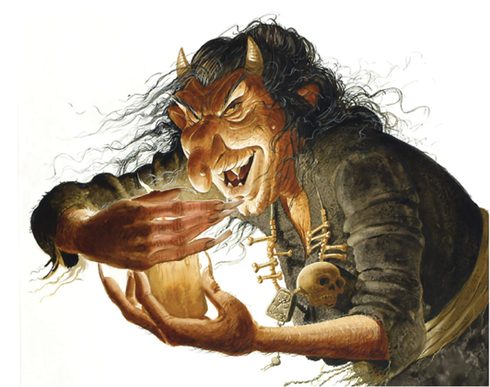
Krampus’s sour seasonal antics may have gotten their own movie but some think Grýla would do equally well as a horror villain. She’s been known about since roughly the 13th century, when tales of her exploits spread via word of mouth. The name Grýla translates as “Growler”, making her even scarier.

Smithsonian quotes a historic passage about the tinsel-hating troll: “Down comes Grýla from the outer fields / With forty tails / A bag on her back, a sword in her hand, / Coming to carve out the stomachs of the children / Who cry for meat during Lent.” Certainly a contrast to “Sleigh bells ring, are you listening?”

Actually she didn’t become associated with Christmas till several centuries later, when the idea of a rampaging witch punishing naughty children fused with the yuletide atmosphere. Jól (Yule) is the title often given to an Icelandic Christmas. Smithsonian describes this ancient take on the festival as “a time not only to bring together relatives, living and deceased, but also elves, trolls and other magical and spooky creatures believed to inhabit the landscape.” Grýla definitely fits into that category. She’s called an “ogress” by some, though presumably not to her face.

Gryla witch

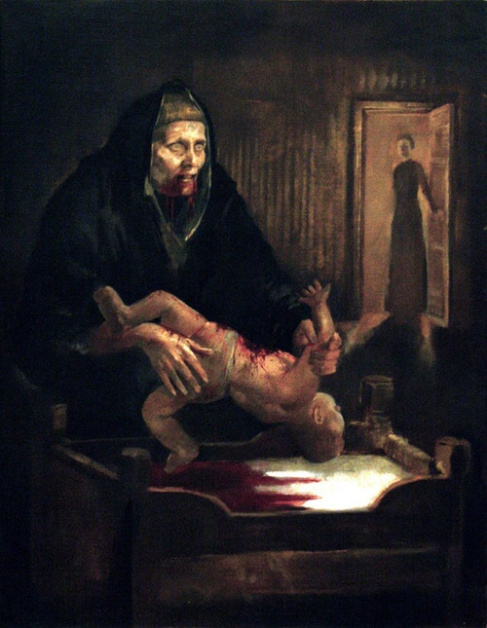
Speaking of her face, what exactly does she look like? Accounts, such as they are, vary. “One rhyme says she has 15 tails, each of which holds 100 bags with 20 children in each bag, doomed to be a feast for the troll’s family”, according to Mental Floss, who highlight the bleak yet mind-boggling folk history.

Poems “describe eyes in the back of her head, ears that hang so long that they hit her in the nose, a matted beard, blackened teeth, and hooves.” Safe to say, should an unlucky reveller run into Grýla, they wouldn’t forget her in a hurry.

Poster wrote:  "...Then all of a sudden walks in the Icelandic horrifying monster "Grýla".  She is said to come from the mountains at Christmas in search of naughty children.  But this one  didn't found any naughty children around, so she choose her second favorite option, a Lasagna and i guess a Diet Coke, because its  sugar-free, so she can keep her skin healthy.  en.wikipedia.org/wiki/Gr%C3%BDla"

Is this seasonal savage really so different to the mortals she preys on? There’s a case that she isn’t, as evidenced by her family. For starters someone agreed to marry this twisted creature! She “comes down from her cave in the mountains to gather up ill-behaved kids for her and her lazy and browbeaten husband Leppalúði to make into stew”.

And Leppalúði wasn’t the only man to slide a ring onto that wizened finger. “She ate one of her husbands when she got bored with him,” reveals Terry Gunnell of the University of Iceland, talking to Smithsonian.

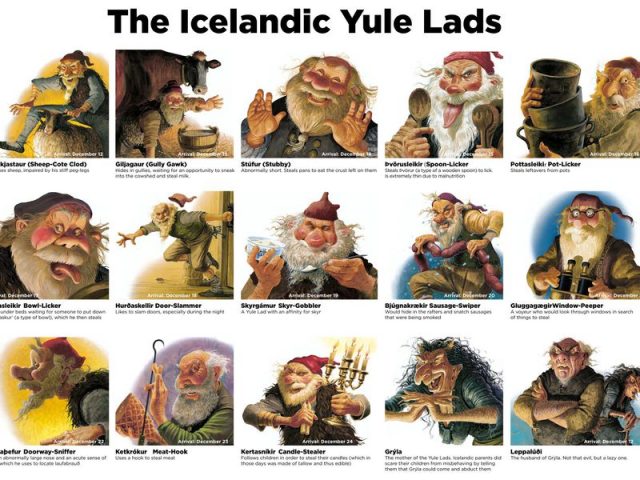
Then there are the Yule Lads. This bizarre band of brothers existed in their own right to begin with. Gradually however they were incorporated into Grýla’s legend, to form a clan of child catchers and festive buzz killers. Gunnell thinks of them as “looking like aged Hell’s Angels without bikes”. There was a Santa-oriented makeover, but the grittier approach appears to be taking hold again in the Icelandic consciousness.

yule lads

YOU CAN READ ALL ABOUT THE YULE LADS AT THIS LINK:  https://clancarruthers.home.blog/2019/07/31/13-horrifying-gotland-christmas-trolls/

The fearsome fam even have pets. Lovers of felines may be surprised to hear about the Jólakötturinn, or Yule Cat. Seems there’d be one hell of a flap to accommodate this malevolent moggy!

Merriment aside, institutions such as the National Museum view Grýla as an essential part of Iceland’s cultural history, one that can be easily forgotten about with all those baubles and “yo ho ho”s. And even though America loves Saint Nick, a TV show recently brought the amoral antics of the Christmas witch to life.

Netflix’s Chilling Adventures of Sabrina included her in the special episode A Midwinter’s Tale. This saw the Yule Lads arrive in Greendale, with the literal mother from hell on hand to rein them in. Billed as Grýla’s first ever appearance onscreen, the role was played by Heather Doerksen.

She’s a menace to society at Christmas, yet it’s clear without the likes of Grýla the holiday season would be a bit too sickly to bear.

Carruthers crest on flag-v2 (1)

CLAN CARRUTHERS -1983

Preserving Our Past!    Recording Our Present!  Informing Our Future!

The Ancient and Honorable Carruthers Clan International Society CCIS

carruthersclan1@gmail.com                carrothersclan@gmail.com

WIDE BANNER with NEW CREST

STEVE PALACE

CLAN CARRUTHERS INT SOCIETY CCIS HISTORIAN AND GENEALOGIST

download (12)

You can find us on facebook at :

https://www.facebook.com/carrutherscarrothers.pat.9

https://www.facebook.com/CarruthersClan

https://www.facebook.com/CarruthersClanLLC

Disclaimer Ancient and Honorable Carruthers Clan International Societ