Gutland / Gotland, OUR ANCESTORS, The Viking Age

NORSE MYTHOLOGY IS BIBLE MYTHOLOGY – CLAN CARRUTHERS CCIS

cropped-wide-banner-with-new-crestnorse

NORSE MYTHOLODY IS BIBLE MYTHOLOGY

We have been learning that our own Caratocus was a Christian in 10ad.  The oldest cross and crucifix was found on Gutland, Sweden during an archeological dig.  Maybe this article will explain some of this.

The religion of the early Norse exhibits customs and rituals which bear an amazing correspondence to the religion of the Hebrew Old Testament. Can all of this be just a coincidence, or is there a connection? Here is the interesting evidence.

Does Bible prophecy actually speak to us of the Norse and related peoples of Europe? I believe that it does, and that these peoples are in fact the descendants of the lost tribes of the House of Israel, removed out of their land in Assyrian captivity two thousand seven hundred years ago, and lost to recorded history. As we will see, only the Caucasian peoples who migrated out of Asia into Europe, have fulfilled many of the prophecies in both the Old and New Testaments concerning Israel in the latter days. Let’s begin our study in the one of the foremost prophetic books of the New Testament, Revelation.

In Revelation chapter 12, there appears a spectacular vision which has intrigued Christians for centuries. The vision concerns “a woman.” Bible commentators see this woman as representing Israel, and the vision as prophetic of events which were to take place in world history.

We are told in verse two that this woman, Israel, was about to give birth. The child was none other than Jesus Christ, for we are told in verse five that he was “a man-child, who was to rule all nations with a rod of iron.” It is obvious here that the woman who gave birth to our Savior is Israel, for Christ was born of the Israel tribe of Judah, of the line of David.

The vision expands in verse three. We read, “And there appeared another wonder in heaven; and behold a great red dragon, having seven heads and ten horns…… the dragon stood before the woman which was ready to be delivered, for to devour her child as soon as it was born.” This should remind us of the prophet Daniel’s prophecy of four great beast kingdoms. They were: Babylon & Assyria, Medo-Persia, Macedonia, and Rome. They formed one continuous succession of four beast empires, each one “devouring” or absorbing the previous. Using the year-for-a-day principle of prophecy, the next verse speaks of Israel being attacked and persecuted for 1,260 years by the dragon-beast, a period which ended with the fall of Rome in 410 AD.

Verse six says, “And the woman fled into the WILDERNESS, where she hath a place prepared of God, that they should feed her there a thousand two hundred and threescore days.” Where in Israel’s history do we read of the chosen nation fleeing in dispersion into the wilderness? This occurred when Assyria, the first beast-empire, conquered them in 721 B.C., dispersing them out of Palestine, into the wilderness of Europe. This is the prophetic story of Israel in the wilderness going to a place prepared by God, and it is a fascinating account of how God’s prophecies have come to pass. (745 B.C. to 476 A.D. is a 1260 lunar year period!)

We read of Israel’s dispersion into the wilderness in the Old Testament apocryphal book of II Esdras, chapter 13 and verse 40. Here the prophet Esdras tells us this about their whereabouts: “These are the ten tribes, who were taken captive from their land in the days of King Hoshea, whom Shalmanesar, the King of the Assyrians, led away into captivity and transported them across the river Euphrates. But they decided to leave the multitude of peoples and proceed to a more remote region… The way to that country, which is called Arsareth, required a long trek of a year and a half.”

The Prophet Esdras gave us still another solid clue in tracing Israel’s northern trek when he said that they “passed through the narrow entrances of the Euphrates River.” (verse 43) This refers to the head­waters of the Euphrates, which were toward the north, in northern Mesopotamia. In fact, rivers always flow from north to south in the northern hemisphere.

So we know two things for sure about the land to which the Israelites migrated: it was northward toward the Caucasus and Europe, and it was a remote wilderness. As the late Bible scholar, Dr. Pascoe Goard, has stated, “We know sufficient of the history of all the territory south of the Caucasus to be able to say that they could find no such unsettled land there. But plains, forests and river valleys of Europe still remained which had not even been explored in the days of Herodotus, three and a half centuries later. To that country they took their way.” (“Post-captivity Names of Israel,” p. 35) Remember that Esdras said they traveled to “a more remote region,” a wilderness; and that this journey was a long one over a great distance, requiring “a year and a half” of travel.

Yes, northward from the upper reaches of the Assyrian Empire was the wilderness of Europe, and there is a river Sereth in southeastern Europe even today. Over six centuries after their dispersion, the Jewish historian Flavius Josephus wrote, “The ten tribes did not return to Palestine…There are but two tribes in Asia and Europe subject to the Romans, while the ten tribes are beyond the Euphrates till now, and are an immense multitude.” (Jos. Antiq., Ch. 11, pp. 2,5) The lost ten tribes were no longer in Palestine, and were outside the realm of the Roman Empire. Even though Israel had been hidden in the wilderness for six centuries when Josephus wrote, he informs us that they were an identifiable people and a great multitude which no man could number.

Where else in the annals of history is there a record of nearly an entire nation suddenly converging on a wilderness? Only the migrations of the Anglo-Saxon- Gothic tribes into early Europe, that land “where never mankind dwelt,” (II Esdras 13:41) can fit the picture, and that occurred at the very time that Israel was dispersed and became lost to history. The Angles, Saxons, Celts, and Goths, who overspread Europe, are said to have originated in the region of Medo- Persia, about 700 B.C., the very time and place in which the nation of Israel was lost to history.

The early Christian church noted a remarkable fact: There was a distinct resemblance between ancient Israel’s religion and that of the early inhabitants of Europe. Early Christian writers used the Latin phrase, “Preparacio Evangelica,” meaning that European mythology constituted a good “preparation for the Gospel.” We now know why Norse mythology, Celtic Druidism, and Greek mythology all bear such striking similarities to the Old Testament — it’s simply because these peoples were the physical descendants of ancient Israelites who migrated to Europe in ancient times, bringing deep- rooted traces of their religion with them when they came.

But other amazing parallels exist, as well. There was also an uncanny resemblance to ancient Canaanite religion, since ancient Israel corrupted themselves with that form of worship, according to the Bible account. In addition to that, early European mythology also bears traces of the religious customs of the Babylonians and Assyrians, as you might expect, since these peoples exerted some influence when they brought Israel in captivity out of Palestine. Let’s see how history offers proof of both Biblical and Babylonian influence among the people of early Europe.

6d8db67d1174b2cb96d563598a2e52c9

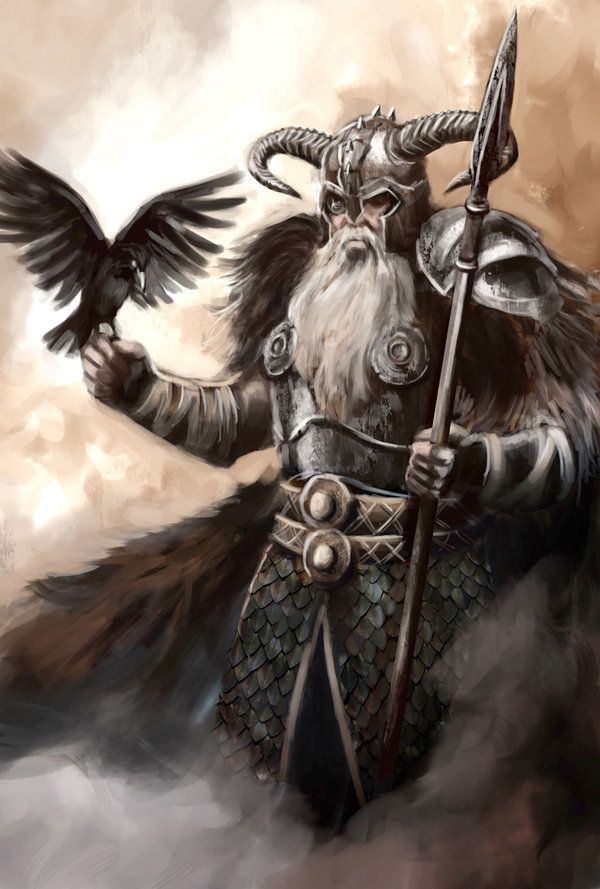
The central figure of Norse Mythology is the hero known as ODIN. He is believed to be an historic figure, the king who led his tribes northwestward from their former residence in a city called Asgard to their new home in Western Europe. Asgard literally means “city of God,” and perhaps by implication, “the city of God’s people.” Although it has never been identified by archaeologists, it is believed to have been located either in southern Russia or Northern Assyria, placing it in the region where the ten tribes were lost to history. After Odin’s death, his great deeds were expanded until he took on godhood in the folk memory of the people. But it is important to note that the name “Odin” shows unmistakable evidence of a Babylonian origin.

Alexander Hislop in his book, “The Two Babylons,” gives us a definite connection between Odin and the Middle East. ODIN was the great Norse war god. The Assyrians and Babylonians also had a war god known as “ADON,” and the Greeks later had a god named “ADONIS,” as well. The Babylonish Adon was the god of WINE. In the NORSE ELDER EDDA we are told that Odin ate no food but wine: “The illustrious father of armies, with his own hand, fattens his two wolves; but the victorious Odin takes no other nourishment to himself than what arises from the unintermittent quaffing of wine. For ’tis with WINE ALONE that Odin in arms renowned is nourished forever.”

It has also been established that the Norse religion involved worship in sacred groves, which were trees planted to simulate the walls of a temple. The Canaanites, too, had sacred groves for worship, and the disobedient nation of Israel had adopted this form of worship at the outset of their wanderings out of Palestine.

God Balder - God PicturesBut the similarity between middle-eastern and Norse mythology does not end there. One of Odin’s sons in Norse mythology was called, “BALDER,” which Hislop states comes from the Chaldee form of “Baal- zer,” meaning the SEED OF BAAL. Quoting Alexander Hislop, “The Hebrew z, as is well known, frequently, in the later Chaldee, becomes d. Now, Baal and Adon both alike signify ‘master’ or ‘lord;’ and, therefore, if Balder be admitted to be the seed or son of Baal, that is as much as to say that he is the son of Adon; and, consequently Adon and Odin must be the same.”

The name of Odin’s other well-known son is THOR. Again to quote Mr. Hislop: “Now as Odin had a son called Thor, so the second Assyrian Adon had a son called THOUROS (Cedrenus, vol. 1, p. 29). The name Thouros seems just to be another form of Zoro, or Doro, meaning, ‘the seed.’” So, as Professor Hislop points out, Odin’s son, Thor, is an exact parallel to the Assyrian god Adon’s son Thouros. Quite an amazing similarity! (Lexicon, pars 1, p. 93: “The D is often pronounced as Th; Adon in the pointed Hebrew, being Athon.”)

It is extremely doubtful that all of this parallel detail could be mere happenstance. A very definite cultural connection somehow took place between the ancient Assyrians and Babylonians and the early European Norse. Yet another author lends credence to this, the professor Hans Gunther, in his book, “Religious Attitudes of the Indo-Europeans.” He finds much to admire in the Norse mythology, yet is led to admit that, “one perceives in him (Odin) the voice of an alien non-Nordic race.” (page 11) Professor Gunther goes on to associate certain aspects of Norse mythology with Babylon, (page 57)

Yet one more proof of a connection between the Norse and the ancient Canaanites should be noted: the evidence we have of human sacrifice. For although human sacrifice appears to have been unknown in the British isles, it was definitely practised in early days on the continent of Europe by the Celts.

But it is appropriate at this point to show that there are also some undeniably distinct similarities between Norse religion and that of the ancient Israelites. In fact, from the Norse sagas we learn many facts which lead to a comparison of both God, and God in the flesh, Immanuel, Jesus Christ. The tribes of Israel, at the time of their dispersion, would have been familiar with the Old Testament prophecies of a coming Messiah. Many of these ancient beliefs could have remained with them in their traditions after their dispersion from Palestine. So let’s compare Bible prophecies with some of the basic beliefs cherished by the early Norse.

The Norse myths recount a remarkable account of creation, which differs from the Bible in that the flood was said to be caused by the blood of a slain giant. However, in Genesis 6, verse 4, the Bible does speak about the Nephilim, or giants, during the account of the flood. In the Norse account, the world is wiped out in this catastrophe, with the exception of one household who escaped on a skiff or boat, and from whom is descended the new race from which the god Odin came.

Odin is also called the “RAFNAGUD,” or Raven-god, because he is said to have two ravens named Hugin and Munin, which he sends out into the world each day, returning at nightfall to tell him what they observed. Quoting the Norse Elder Edda,

“Hugin and Munin

Fly each day

Over the spacious earth.

Ifear for Hugin

That he come not back

Yet more anxious am I for Munin ”

This bears an unmistakable similarity with the account in Genesis chapter eight of Noah sending two birds out into the world, one of them the raven which Noah was anxious for, because he did not return.

Thor - WikipediaThere are many other interesting legends in the Norse sagas, such as Thor conquering a serpent- monster, while dying in the process. This was prophesied of Israel’s Messiah in GENESIS 3:15, who conquered the serpent’s seed by his own death. Other Norse religious traditions come from the Old Testament, as well. As an example, Odin is referred to as “the law-giver.” This is a title our heavenly father, Yahveh, could well claim, who gave Moses upon Mount Sinai the laws for the nation.

Another important Norse god was LOKI, the author of all evil, who was said to be of a swarthy complexion and originated in a land to the south. This may well be Israel’s remembrance of the Edomites of Palestine. An interesting parallel exists between Loki, who is said to lead the forces of evil in the last great battle in Norse mythology, and the Edomites of Bible prophecy at the end of the age. In Ezekiel chapters 36 to 39, in the last great battle, the Edomites are prominent in the forces of evil which come against God’s Israel.

The number twelve also must have been held in sacred significance to the Norse, for we read in the book, “Germanic Origins,” that Odin arrived in Svithoid, or Scythia, with twelve chief priests. The presence of these twelve priests corresponds representatively to the twelve original tribal patriarchs of Israel.

Early Norse scholar, Snorri Sturluson, translator of many ancient Scandinavian legends, compiled the HEIMSKRINGLA, OR HOME CHRONICLES. He says that just before Odin died he let himself be marked or wounded with a spear-point and that he was the owner of all men slain with weapons, and would go to Godheim (the world of the gods) and there welcome his friends. The comparisons with the Bible are again unmistakable. The Old Testament contains over one hundred prophecies relating to the coming of our God in the flesh, our “Immanuel,” or “God with us.” We find many of these in Norse mythology transferred to the character, Odin. In our Bibles we read that our coming God was to be SACRIFICED, (Zechariah 13:7), that he was to be PIERCED (Zechariah 12:10), but would have NO BROKEN BONES (Psalm 34:20, and Exodus 12:46 where Passover is a type of Christ). And whereas our Savior was sacrificed on the tree (in 1 Peter 2:23, the word translated “cross” literally means a tree) for nine hours (Psalm 22 and Matthew 27:46), Odin is said to have hung on a tree for nine days. Compare those Bible prophecies with these lines from the Norse Elder Edda:

“I know that I hung

On a wind-rocked tree

Nine whole nights,

With a spear wounded

And to Odin offered

Myself to myself; ”

The Norse legends prominently refer to the end-times. They say that in the end of the world a great battle called Gotterdammerung, or the “Twilight of the gods,” will take place between the forces of good and evil. In this great battle, all of the forces of good will be killed except for one called the “All-father.”

This brings me to my most important point. “Bulfinch’s Mythology” states that “the Scandinavians had an idea of a deity superior to Odin, uncreated and eternal,” which they called the Alfadur or “ALL-­FATHER.” For although the Norse mythology allows for a pantheon of gods, yet only ONE GOD is said to be immortal. Thor, Odin, and the others I have mentioned are mortal and die at some point in the sagas.

But above Odin was said to be the one eternal true God – unnamed except to be called the “All-father,” meaning the “ever-lasting father,” as he is called in our Bibles in ISAIAH 9:6 and other places. In the original language of the Old Testament, God’s name was YAHVEH, which Ferrar Fenton translates as meaning, “the Ever-Living.” The Norse called the All­father’ by no other name, believing that his personal name was too sacred to be spoken, although they apparently didn’t have any record of what that name was. Compare this with the actions of the few Israelites of the House of Judah who returned to Palestine and removed God’s name, YAHVEH, from our Bibles, believing it too sacred to be spoken. Yes, I am convinced that although the Norse mythology was corrupted with the religion of Assyria and Canaan, yet the proofs are there that they were indeed “the people of the Book.”

Carruthers crest on flag-v2 (1)

OFFICIAL AND OLDEST SCOTTISH  CLAN CARRUTHERS

 SINCE 1983-CLAN OF OUR ANCESTORS

SCOTTISH CLAN – IRISH CLAN – NORSE CLAN

cropped-wide-banner-with-new-crestnorse

Dr Patricia Carrothers  CHS

CLAN CARRUTHERS  HISTORIAN AND GENEALOGIST

New Blog Banner 05

Preserving Our Past, Recording Our Present, Informing Our Future

Ancient and Honorable Clan Carruthers

   clancarruthers1@gmail.com

You can find us on our main facebook pages at :

SILVER WINGS-https://www.facebook.com/CarruthersClanLLC/

GOLD WINGS – https://www.facebook.com/carrutherscarrothers.pat.9

COPPER WINGS    https://www.facebook.com/ClanCarruthers1/

CLAN CARRUTHERS FAMILY HISTORY – https://www.facebook.com/CarruthersClan

CLAN CARRUTHERS CCIS – https://www.facebook.com/groups/3878691252182714

CLAN CARRUTHERS INT SOCIETY- https://www.facebook.com/groups/394653845137709

CLAN CARRUTHERS – BORDER REIVERS – https://www.facebook.com/groups/434959914239094

Disclaimer Ancient and Honorable Carruthers Clan International Soci
Gutland / Gotland, The History of Gutland, The Viking Age, Uncategorized

THE KINGS JELLING – CLAN CARRUTHERS CCIS

cropped-wide-banner-with-new-crest.jpg

THE KINGS JELLING


The kings Jelling - featured image


Jelling is a small town in Jutland/Gutland  which is of little significance today. But a bit more than a thousand years ago it was the center of the newly formed kingdom of Denmark. The first recognized members of the Danish royal family had their main base in this village of Jelling. They left behind significant monuments in the form of a massive grave site – it is actually the largest ancient grave in Denmark showing the family had immense wealth and power so they could give such a burial for their founding member.

Old harnish for dogs

The biggest attraction of the town is the large Rune Stones standing outside the church. There is one big and one small – the biggest one is the youngest one erected by Harald Bluetooth ( CARRUTHERS ANCESTOR). On this stone the name Denmark is first written down anywhere in the world making it kind of a birth certificate of Denmark.

You can go and explore the outside monument area day or night and there is free access to go and see the burial mound and the stones which are covered in a glass cage to protect them against the Danish climate which can be rough for a stone over time.


Remains of an ancient bridge

The importance of the site has led to the foundation of a branch of the Danish National Museum right opposite the monument area. The museum is free to enter so if you come during the visiting hour of the museum you should go inside and get a bit more of the store of the area and the oldest history of Denmark.

The museum is an interactive museum which should be able to entertain kids for a while. There are only a limited number of actual ancient artifacts on display – probably because you have only found a limited number of artifacts in the area of Jelling which were only used as the main royal seat for a short period and only had a limited permanent population in ancient times.

The displays and stories are both in Danish and English making it possible to follow for most visitors to the museum. It is good to visit the place either before or after a visit to the monuments outside – but you can enjoy the outdoors without the museum as well if you come outside opening hours.

Carruthers crest on flag-v2 (1)

OFFICIAL AND REGISTERED CLAN CARRUTHERS  CCIS -1983 CLAN OF OUR ANCESTORS

SCOTTISH CLAN, IRISH CLAN, NORSE CLAN

HERE IS A LINK TO WHO ARE THE VIKINGS AND ALSO JUTLAND AND GUTLAND ARE ONE IN THE SAME  https://clancarruthers.home.blog/2021/12/09/why-were-they-called-vikings-clan-carruthers-ccis/

Preserving Our Past!    Recording Our Present!  Informing Our Future!

The Ancient and Honorable Carruthers Clan International Society CCIS

carruthersclan1@gmail.com                carrothersclan@gmail.com

Crest on Light Blue

Reviewed by Tammy Wise CHS- CHAIRMAN – Indiana USA

CLAN SEANACHAIDHI

CLAN CARRUTHERS INT SOCIETY CCIS HISTORIAN AND GENEALOGIST

You can find us on our main facebook pages at :

SILVER WINGS-https://www.facebook.com/CarruthersClanLLC/

GOLD WINGS – https://www.facebook.com/carrutherscarrothers.pat.9

CLAN CARRUTHERS FAMILY HISTORY – https://www.facebook.com/CarruthersClan

CLAN CARRUTHERS CCIS – https://www.facebook.com/groups/3878691252182714

CLAN CARRUTHERS INT SOCIETY- https://www.facebook.com/groups/394653845137709

CLAN CARRUTHERS – BORDER REIVERS – https://www.facebook.com/groups/434959914239094

Disclaimer Ancient and Honorable Carruthers Clan International Society
Gutland / Gotland, OUR ANCESTORS, The History of Gutland, The Viking Age, Uncategorized

WHY WERE THEY CALLED VIKINGS-CLAN CARRUTHERS CCIS

cropped-wide-banner-with-new-crest.jpg

WHY WERE THEY CALLED VIKINGS

Everybody knows what a Viking is. Well … more or less. These images may vary widely in detail and accuracy, but the general idea is there. There have been many magnificent warrior cultures in history – the Scythians, the Visigoths, the Sarmatians, the Pechenegs, the Mamelukes, and on and on – but very few have attained the household name status the Vikings have.

But what does the word “Viking” actually mean? It may come as a surprise to some, but this very question has become the topic of intense debate recently. It is increasingly common to find posts with comments lighting up over “Viking” being a verb not a noun, or Vikings not really being Scandinavian, or any number of challenges to what has long been taken for granted.

Here is an example of the online articles implying that the word Vikings should not be used as a noun:

Other articles erroneously state that the term Viking did not appear until centuries after the Viking age ended.

There is just one problem. Multiple Viking runestones would say otherwise.

Aside from proving that people will argue about anything – even 9th century grammar or the DNA of a 1000 year-old grave – what can we learn from a closer look at some of these issues? How did Vikings come to be called Vikings? What did they call themselves, and what were they called by the people around them?

‘Viking’ in Old Norse

‘Viking’ was used as both a verb and a noun. The noun and plural versions in Old Norse were spelled víkingum, víkingar and víkingr.  The ‘r’ on the end is a grammatical feature of Old Norse for denoting a masculine noun. Today the spellings (such as the “r”) is dropped in English transliteration. For example, today people write the name of the god Freyr as Frey. In Old Norse spelling, víkingr was an individual who was a seaborne raider/adventurer …which today is properly spelled as Viking. Víkingum and víkingar were the plural spellings …which again, today is properly spelled as Vikings.

There has been a lot of discussion over the origins of this word. One of the most prevalent explanations is that it derives from the root word vík, which meant a bay (somewhere víkingr were likely to launch out of). A similar theory links it to the geographical location in southwest Norway called Vík, where many Vikings hailed from. However, Vikings were also from Sweden, Denmark, and numerous other places, so the “Vík region” theory is not especially satisfactory.

It should be noted that there are several other Old Norse aquatic terms that also contain the root vík (such as vika – a sea mile, or víkja – to travel by sea ), and so it is fair enough to say that the word víkingr arose from this general family of vík terms, without expecting much more specificity than that.

Noun usage seen on runestones

Víkingr and other forms of the word, such as víkingum or víkingar (plural version of the word Viking), appear as nouns describing Scandinavian seaborne raiders in the sagas, Eddic poetry, and runestones. Just a few examples of such Viking Age runestone inscriptions include:

“Tóki, Tóki the Viking, raised the stone in memory of Gunnarr, Grímr’s son. May God help his soul!” (Sm 10 runestone)

“Hvatarr and Heilgeirr(?) raised the stone in memory of Helgi, their father. He traveled to the west with the Vikings.” (G 370 runestone)

“Asrathr and Hildung/Hildvig/Hildulf erected this stone after Fretha, their kinsman, … he died in Sweden and was first …. of every Viking.” (DR 216 runestone)

There are many other examples besides these, but here we see literally carved in stone the term “Viking” being used as a noun denoting people. From the context, it does not seem that “Viking” referred to everybody, though, but specifically to some type of traveling warrior / raider / pirate (and eventually trader and settler).

Common misunderstandings of the verb usage

In English, words that end in ‘–ing’ are usually verbs in progress, such as talking, walking, writing, and so forth. However, the word ‘Viking’ is a “loan word” coming to us from another language. So, it is a mistake to attach such a meaning from this ‘–ing’ suffix, just as it is a mistake to see ‘-king’ as the suffix describing the Viking as the king (or superlative) of whatever “vi” might be. That being said, víking could also be a verb in Old Norse. This verb meant the act of seaborne raiding or adventuring. So, Vikings would go víking, or in other words, a seaborne raider would go out and raid by sea. In many historical fiction books, this is rendered “to go viking.”

There is no evidence to suggest that the verb was more prevalent than the noun or adjective.

What Vikings Called Themselves, and What Other People Called Them

People tend to look at the past through the lens of their current cultural values, beliefs, and expectations. However, it is essential to remember that in our ancestors’ times many of the ideals, concepts, and information we now take for granted had not developed yet. Today, one of the strongest ways people identify is by their nationality – we are Americans, Norwegians, Irish, and so forth. But, while many of Europe’s nations began to form and organize in the Viking Age (circa 793-1066), national identity was then only in its embryonic stages.

At the dawn of the Viking Age, the Nordic peoples of Scandinavia shared a common language, culture, and faith (though with significant regional variations). However, they did not share a strong sense of common identity, as evidenced by their constant wars, raiding, and competition – even within the geographical boundaries of their homeland. They were divided into numerous tribes (such as the Jutes, the Zealanders, the Svear, the Geats, and many more). Their societies were arranged in small units (usually with strong kinship bonds), and their allegiance was to local chieftains or petty kings. The first “King of All Norway,” Harald Fairhair (who inspired the TV character of a similar name), did not consolidate power until a century into the Viking Age, and the political boundaries of Denmark, Norway, and Sweden would not solidify for several centuries after that.

So, while Vikings used the term víkingr for a seaborne adventurer, early medieval Scandinavian peoples had no overarching name for themselves. They did not think that way. Instead, they identified themselves by family, clan, and tribal loyalties. During the Viking Age, these intimate groups formed larger and larger networks and affected greater and greater changes far from home.

Vikings might not have had a common term for themselves, but their enemies had many. The English and the French tended to call them all Danes. Archeology is abundantly clear, though, that the “Great Heathen Army,” the “Army of the Seine,” and these other large forces were not just Danes but mixed companies from locations wherever Vikings roamed.

English monks, writing in Latin, also adopted the word, Wiccinga/Wiccingi (the Old English form of ‘viking’ in Latinized singular and plural forms). This capitalization in the manuscripts strongly suggests the Vikings were known by that name, and that it is not just a generic descriptor. One of the few named Viking groups from the period, the Jomsvikings (Vikings of Joms), also had chosen the name for themselves.

There were other names in other places. In Ireland, the Vikings were called “the Foreigners.” In the east – Russia, Ukraine, Belarus, the Byzantine Empire, Bulgaria, and the Mediterranean – Vikings were called Varangians (“sworn companions”) and Rus’. To the Moors of Spain and the Arabs around the Caspian, they were called Majūs.

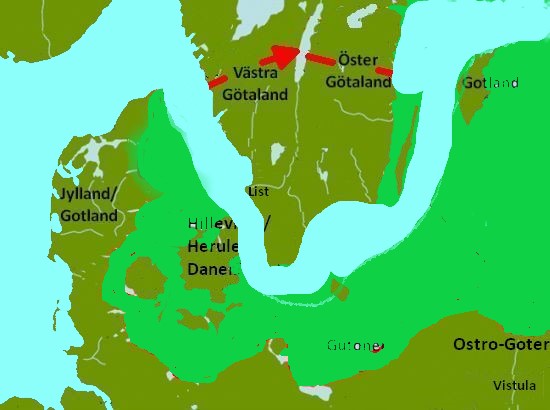
Looking at this map your see Denmark and then on the other side of Sweden you see the Island of Gotland.   Denmark was called Jutland and gotland was Gutland.     Jutland and Gutland were one in the same. The lighter green area was all land.  It is assumed that the longboats that our ancestors made, were made so they could get through those narrow paths from one end of Gutland to the others.

was gutlandmap1000ad

The Viking Diaspora

Within a few centuries of the first raids, Vikings controlled significant holdings in more than a dozen lands and had traveled through what are now more than 40 countries. In every case, the Vikings wasted no time in blending with local populations. We have accounts of Vikings being Norse-Irish and Norse-Slavic by the mid-9th century. The Vikings became an indelible part of England and even ruled it for a time. Desperate to control their Viking problem, the French gave Rollo Normandy – only for these “Normans” to spread to Italy and even the Holy Land. Vikings founded Iceland, colonized Greenland, and set up lasting residence in islands all over the North Atlantic.

This dynamic movement did not just occur in one direction. Though thousands of Vikings stayed abroad and formed new, permanent communities, many others brought their loot and military experience back home to Scandinavia. This influx of wealth and warriors created the political and martial power that gave rise to kings like Harald Fairhair, Harald Bluetooth, Gorm the Old, and Saint Olaf the Stout.

For our present discussion, though, this dramatic and dynamic movement of people introduces problems of terminology. It is cumbersome and anachronistic to refer to these people by names such as Danes, Norwegians, or Swedes when they were from many different places in the Viking world, like Dublin, the Danelaw, the Orkneys, Novgorod, the Faroes, or Iceland.

The terms ‘Norse’ and ‘Nordic’ are useful when describing the Vikings as an ethnicity or discussing their culture, but these terms are imprecise in terms of time (that is, we could be speaking of the Norse of the year 1000 or the year 1).  Also, the term ‘Norse’ has traditionally been used primarily for Norway or western Scandinavia. Indeed, the term “Norsemen” taken narrowly as “Norwegians” excludes Danes, Swedes, and even women. “Northmen,” too, is quite vague. In many ways, we are at the same disadvantage in labeling these people as their contemporaries were.

Were Vikings Exclusively Scandinavian?

In the fall of 2020, a news story was picked up by a large number of mainstream media outlets describing newly-published DNA research suggesting that Vikings were not exclusively “blonde” Scandinavians, but included individuals from southern Europe and beyond. This was a sensational story that got a lot of traction.  We know that in 500 ad, they were most blondes and red headed men and women.   In the 900’s dark haired people were showing up on their boats.

However, it is really nothing new. Vikings traveled very widely and took people with them (voluntarily and involuntarily) as they went. Their society was ultimately a meritocracy (that is, a person’s place was based on what they offered to the society), especially in diaspora. It should come as no surprise whatsoever that Viking bands were diverse, especially compared to settlements inland.

The sagas and Eddas have always described the back and forth flow of people in and out of Scandinavia. The biggest hero in the Vikings’ favorite story, Sigurd Fafnir’s Bane, was a Hun (that is, a people who were originally horsemen from the plains of Asia). Snorri Sturluson and Saxo Grammaticus (medieval writers who give us some of our oldest written Viking lore) both try to tie the Yngling Dynasty of Sweden to the survivors of Troy.

However, despite this level of integration (stated in the broadest and vaguest terms by the news stories) the Viking bands were still overwhelmingly Scandinavian, as their culture, technology, and two centuries of archeology maintain. The Viking Age was a phenomenon generated from northern seas, and it is in that context that the term ‘Viking’ makes sense. At the same time that Europe was experiencing Viking expansion, there was also raiding (by land and sea) from the Moors, Saracens, Turks, and Magyars. The Medieval Europeans did not call these other threats by the same names they called Vikings, but understood them to be different peoples. In this regard, “Vikings” and the other titles they were known by have long been an indicator of a specific people.

The Modern Coining of the Name, “Viking”

In the late 18th-early 20th centuries, the western world started to branch out from its obsession with Greece and Rome and take a fresh look at their medieval past. Fueled by the Romantic aesthetic, the rediscovery and translation of the Eddas and by amazing archeological discoveries like the sensational Oseberg ship burial, the Vikings took the popular imagination by storm. But while the historical importance of their contributions was reappraised and the value of their artistry reestablished, there was still the same uncertainty of what to call them.

It was at this time that historians and writers (including the popular Romantic novelist, Sir Walter Scott) began the wholesale application of the term ‘Vikings.’ Yes, the term used to mean a seaborne adventurer, but it was their longships and their profound ethos that had led to this unprecedented time of exploration, trade, conquest, communication, and influence. It seemed fitting that these people should be called after their own word for what made them so powerful and impactful. The term ‘Viking’ was never meant to replace the term ‘Scandinavian’ (or any other term). It was meant to specifically refer to those 8th-11th century Scandinavian adventurers who shattered their world’s boundaries and catalyzed global history. But we know from archeology and the written record that these adventurers were not just ‘raiders’ on longships. Instead, they were also traders and settlers, made up of entire families of pioneers and armed migratory communities. In this way, men, women, children, and the elderly were all ‘Vikings.’

The name stuck. Today, it is the most common name by which they are known in popular culture. It is also accepted and used by most scholars, museums, universities, writers, and experts (though these same scholars fully understand the term’s limitations).

Controversy

Not everyone is happy, though. A movement insists that calling Vikings “Vikings” is inappropriate because only seaborne raiders were Vikings and only when they were raiding (i.e. to be used as a verb or “vocation” only). Detractors point out that most people living in Scandinavia in the 8th-11th century were farmers and shepherds and probably never went anywhere. Thus, they attack the term Vikings for being imprecise and misapplied. Unfortunately, they can only offer alternatives that are also imprecise and misapplied

Scandinavian society of the Viking Age was divided into three classes – jarls (aristocrats), karls (free landholders) and thralls (slaves and servants). The majority of society were free landholders. This central class’s rhythm of life was to tend their farms and plant their crops in the spring, then go raiding and trading (that is, “go viking”) in the summer to increase their wealth and status, and then return to their farms for harvest. They would shelter indoors for the winter, telling stories which reinforced the whole process. There were professional soldiers in Viking times, but it was these free landholders that formed the bulk of the armies. That is how the Viking assaults on Europe grew so exponentially – they had skilled manpower available that could provide for themselves. While some of the larger armies after 830 deviated from this model, it was still normative throughout the Viking Age.

Thus, many, many Scandinavian males in the Viking Age had indeed been víkingar, and this was a vital part of their personal identity. Archaeology also maintains that women and families played a role in these efforts, especially in the Viking Diaspora. So, it is not unreasonable that the term ‘Viking’ could be applied to them, too.

Conclusion

Today, an American man or woman might spend their early twenties in the Marine Corps. Even this relatively small percentage of their life makes them a Marine forever. They will always carry the pride, identity, and skills, and you will always see the marks of those experiences in how they dress, how they talk, and how they carry themselves. It would have been the same for Vikings. We see in the sagas, people are referred to as “a great Viking,” even when they have settled down in a farm in Iceland. That kind of pride is permanent.

The Vikings have always been a mysterious and misunderstood people. They have been known by many names – Foreigners, Heathens, Varangians, Rus, Majūs, Wiccingi, Danes, Northmen, and now Vikings. What they were called was always based on how they were perceived and what aspect of their character the reaction was based on. For us today, it is their impact on the history of the world, their boldness, ethos, determination, and their ability to bend realities to their will that are their most important features. It is not their tribal identities but rather their collective achievements and common contribution that makes them special, and that is why they are called Vikings.

So to be called a Viking meant you had a job, you were a Pirate!

Carruthers crest on flag-v2 (1)

OFFICIAL AND REGISTERED CLAN CARRUTHERS  CCIS -1983

Preserving Our Past!    Recording Our Present!  Informing Our Future!

The Ancient and Honorable Carruthers Clan International Society CCIS

carruthersclan1@gmail.com                carrothersclan@gmail.com

Crest on Light Blue

Reviewed by Tammy Wise CHS- CHAIRMAN – Indiana USA

CLAN SEANACHAIDHI

CLAN CARRUTHERS INT SOCIETY CCIS HISTORIAN AND GENEALOGIST

You can find us on our main facebook pages at :

SILVER WINGS-https://www.facebook.com/CarruthersClanLLC/

GOLD WINGS – https://www.facebook.com/carrutherscarrothers.pat.9

CLAN CARRUTHERS FAMILY HISTORY – https://www.facebook.com/CarruthersClan

CLAN CARRUTHERS CCIS – https://www.facebook.com/groups/3878691252182714

CLAN CARRUTHERS INT SOCIETY- https://www.facebook.com/groups/394653845137709

CLAN CARRUTHERS – BORDER REIVERS – https://www.facebook.com/groups/434959914239094

Disclaimer Ancient and Honorable Carruthers Clan International Society

References

  1. Rodgers, D. G. & Noer, K. Sons of Vikings: History, Legends, and Impact of the Viking Age. Kindle Direct Press, United States.
  2. Price, N. Children of Ash and Elm: A History of the Vikings. Basic Books, New York, 2020.
  3. Brownworth, L. The Sea Wolves: A History of the Vikings. Crux Publishing, Ltd. The United Kingdom. 2014.
  4. The Russian Primary Chronicle by Nestor the Chronicler (1113). The Internet Archive. https://archive.org/details/TheRussianPrimaryChronicle
  5. Ibn Fadlan and the Land of Darkness: Arab Travelers in the Far North. (Translated by Lunde, P. & Stone, C.). Penguin. London. 2012.
  6. Crawford, J. The Word “Viking” (Quick Takes). March 9, 2019. https://www.youtube.com/watch?v=IoEaxlLCSjg&t=17s
Gutland / Gotland, The History of Gutland, The Viking Age

CLAN CARRUTHERS CCIS – THE VIKING SHIP

WIDE BANNER with NEW CREST

THE VIKING SHIP

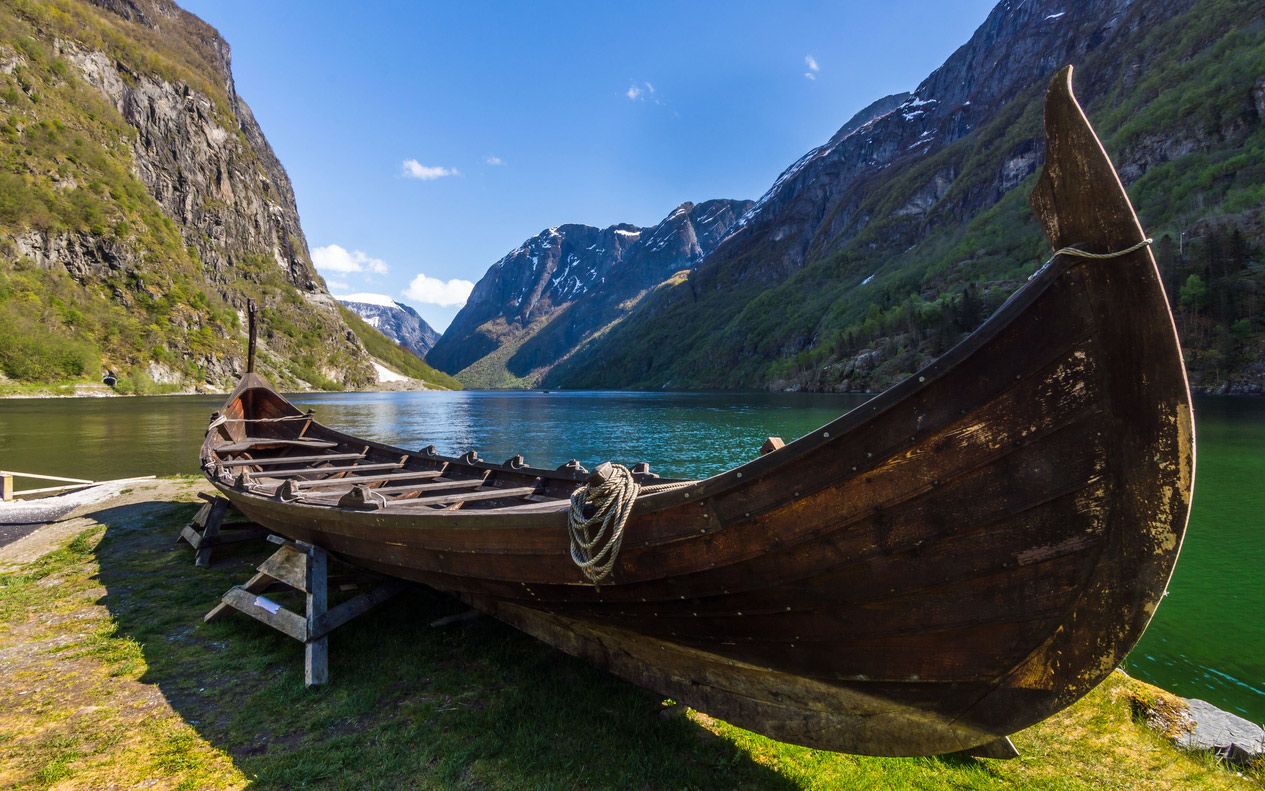
Most archaeological studies on Viking Age vessels focus on technological a aspects, on building and using the ships. While such questions are basic to the understanding of the ship itself it should be supplemented with the cognitive representations of those who used it, not only by sailing it but also as a metaphor and a symbol. There are a number of salient angles, e.g.anthropological, religious, pictorial, linguistic and literary, some of which have been treated before. This paper concentrates on three aspects: the horse and the ship, the significance of the sail and stories of portage in literature.

Introduction

The ship/boat is indeed at the origin of any cognitive aspect of the humans who use it, not only an extension of their corporeal means. This is a com-plex topic generally worthy of study. In this case pagan ideas may be as re-levant as Christian ones, since we are at a transitional period. A first impression could be that neither before nor afterwards had ships in Scandinavia been as important as during the Viking Age (e.g. in Wes-terdahl 1993). This would be based on the emblematic long ship shaping the post-mortem picture of the extensive journeys of the Viking Age. The significance of the boat to ordinary people is, therefore, underplayed. Judit Jesch put it in these words:

 Although the words `viking´ and `ships´ so often seem to go together, ships were not necessarily more important to the Scandinavians in the Viking Age than in any other time in their history. The Viking Age may just have been when other nations became more keenly aware of Scandinavian nautical prowess” (Jesch 2001: 275).

In the literary aftermath of that heroic age the ship is always in focus. The following conclusion is from a review by the Swedish historian Erik Lönn- Christer Westerdahl 

The Viking Ship in Your Mind: Some comments on its cognitive roles

by F.G. Bengtsson; Lönnroth 1961/1959/ the conclusion):

It is a magnificent testimony that the scalds offer on the spirit of the Viking Age. Butit is monotonous and its meaning is terrible. Behind the gorgeous imagery is a sea and a world as desolate as the empty eyes of the dragon heads, where the long ships rested as little as wind, waves and the rapaciousness of men. (my translation)

Who were the Vikings?

The Vikings, in the popular sense, were pirates, robbers and fought for payment as mercenaries in the service of lords, their own or foreign ones. There may have been a small streak of the tradesman in them, but that is may be just another side of the same rapacity, negotiation being simply a gesture of necessity. If you cannot rob you trade. In fact this transition iseven recorded in some historical sources (e.g. Arab sources on the Majjus  ,translations in Birkeland 1954).

The reason why we study the Viking Age so intensely and thereby exaltit as being more interesting than other periods is also relevant. Another confrontational issue to address could be the reason why we call it the Vi-king Age. Presumably there were other salient historical processes during this period which has been bound up with the current concept Viking.

THE VIKING AGE

The Viking Age is part of the European Middle Ages but in its context it represents the final centuries of the Iron Age. It is interesting as a transitional period, in certain important dimensions, which while mainly connected with power are all interconnected with each other, such as Christianization and the all-pervading appearance of kings, sea and land, in rudimentary kinds of realms (not states), what Hodges (1989: 187)calls `cyclical chiefdoms´(which could, just as well be called `cyclical king-doms´).This line of thought points to the periods before (Merovingian/ Vendel,c. AD 550-800) and after (Early Nordic Middle Ages c. AD 1050-1150),of which we should know much more after so many years of study. The processes of the 12th century may have much more to on the primary growth of royal power and organization as well as the internal colonisation of new lands and population growth. There are, from the beginning, nationalist and romanticist ideas be-hind this exaltation of Vikings. This Age was probably the only niche in European history when the North played a role of primary initiators. This is the basic reason for Nordic nostalgia around it. The term Viking Age appears above all as an ethnocentric niche  in the history of the European orbit(Westerdahl 2004: 27). This dynamic role has made us believe that Nordic institutions started there, built on local foundations. It could be shown that many of the elements unfolding in the North during the 11th-12thcenturies were more or less European phenomena and must often be understood against that background rather than an exclusively indigenous one (the huseby phenomenon; cf Westerdahl and Stylegar 2004).

Of even greater interest is how this European connection enables us to contrast and capture the interplay between events played out on both the large and small stages. Curiously this line has perhaps been avoided by some scholars as it would show more effectively that the Viking Age itself was a rather isolated event, never to be repeated. The first step towards social progress in the continental sense, Europeanization, may, however, have started there and not earlier. In a sense the traditional direction of thinking about Vikings is logical and follows the research material at hand.

The sources at hand, historical, literary and archaeological, pinpoint exactly those strata in Nordic societies from which were recruited the “Vikings”. In other words we mean those possessing the resources to equip expeditions and crews, to colonize and to trade their surplus goods with others. They were certainly a minority in a repressive and highly hierarchical society. They are the personalactors (rather than agents) of the Viking Age in more than one sense.

But,then curiously enough, most of the authors, mostly Icelanders and Norwegians, who describe the situation during the Viking Age lived in another, different, age, the 12th-13th centuries. This text will not be about what we do have or what we do know, since there are so many authors who have treated the subject much more competently and also more in detail than I could ever do.

For example Judith Jesch has made a critical and very valuable study of scaldic and runic texts  on ships and men during the late Viking Age (Jesch 2001).Certain elements in any assessment of the role of the ship are more self-evident than others. By way of their mastery of their ships and boats the Viking Age Norse were able to expand as “Vikings”. This means that the ship´s social significance, in that sense, was self-evident. But, perhaps less obviously, an array of symbolic aspects will show how society and social aspects were intertwined with human cognition. In fact they possibly give you a better measure of the degree of human significance of the ship, both as a metaphor and as a reality. This includes the metaphor of a ship-shape society, of the leding type and its probable ancestors (e.g. Varenius 1992: 27f; 1998: 36f; 2002: 254f; cf. also Lund 1996: 245f and passim). This is conducive to the potential application of the symbolic principle of pars-  pro-toto, the part (stands) for the whole,´ displayed in texts, language,iconography including graffiti, and in ritualized behaviour of almost any detail of the ship: the keel, the stem (figures 1 and 2), the stern, the sail and the area around the mast, maybe even the weathervane, so typical of the Viking Age (Falk 1955 [1912]: 55; Westerdahl 1995: 46).

We know less about the immaterial associations, in living language and parlance, but they certainly must have been as strong as the material ones. The poetical versions are obvious. Thus, the Viking Age was not the only period when ships had a particular social and symbolic significance in Northern Europe, nor was that small section of society, that we call the Vikings, the only part of society that was dependent on ships and boats. Nonetheless there is plenty of information in both history and archaeology on the importance of the vessels during the Viking Age (and before and later). Waterways were the primary networks for any communication and maritime culture was ap-parent everywhere: transport, fishing, hunting sea mammals, grazing cattle and exploiting sea-fowl.
The procurement of the wood for the ships, the bog finds of ship parts, the role of the boat houses and the meaning of boat launching should be mentioned. A general, but partly functionalist and fairly traditionalist, overview on ships, waterways and sea routes was made in Swedish (Westerdahl 1993), stressing the maritime character, but also the river traffic, of the Viking Age of the North.

The general significance of vessels

That said, it must, however, be admitted that the ships are a special case ,simply because the culture of the North in general was maritime. Perhaps one should call it a maritime civilization rather than a maritime culture. Gunilla Larsson uses maritime ideology as an over-arching concept for the Central Swedish Iron Age (Larsson 2007). That realization does not stem only from the use of the warships but also from the already mentioned necessities. This part of society we only meet in the occasional mention of competition between chieftains or the exploitation of subjects. Maritime warfare is characterized by Björn Varenius as an organizing principle in the North from the Viking Age onward (Varenius 2002).There must be something particular about the Nordic ship: the ship-formed stone settings point to this. They are multiperiod, but common also during the Viking Age (Capelle 1986; 1995), sometimes even made of wood, e.g. in the boat-grave field of Valsgärde, Sweden (cf Arwidsson1942, 1954). There are numerous bog finds of vessels or parts of vessels(e.g. Shetelig/ johannessen 1929).

Some have undoubtedly been put there for preservation. Another probable explanation is that some were parsprototo offerings. There are ships carved on picture stones and on runic stones in various contexts (on context Andrén 1993; Crumlin-Pedersen 1991b: 183 fig 2; Lindquist 1941-42; Varenius 1992: 51f, 86f;1995; Imer 2003).The evidence of the ritual use of ships, especially in graves, burnt or unburnt, is striking (Müller-Wille 1970; 1974; 1995). Many questions arise, that are still fundamentally unaddressed and unanswered. They may concern, for example, the ship form as a grave. Is a symbolic transfer of vessel from water to land intended? Is it a question of the space of the vessel, or the proportions of the boat? Others relate to the plunder of these graves. What are the meanings of this haugbrót ? (e.g. Brendalsmo og Röthe1992). Why were not more burials with valuables (of any kind) plundered? Were these ships/containers, if they were thought of as that, considered more protective than other containers? We can be fairly sure that the grave-plunderers were not after the boats in the grave. Or were they? Is the burning of the deceased and his/her vessel a way of avoiding haugbrot ?

Such questions are relevant in this context, but they will not be treated fur-ther in this text.

The Horse and The Ship as Metaphors

By other authors the horse was recently supposed to be a kind of tool to help cross cognitive borders (Oma 2000; Opedal 2005: 78). Other scholars see the horse as a psychopomp , and some view the ship in the same light(esp. Ellmers 1986; 1995: 169f). Their twin-like appearance together, the counterparts in mythology probably being Sleipnir and Skiðblaðnir , on picture stones is possibly a good contemporary guide (figures 3a and 4; e.g.Crumlin-Pedersen 1995: 94; Ellmers 1995: 168 mentions Naglfarthe vessel of the dead).

The present author agrees with the idea that the horse and the ship are related in some way in the prehistoric pagan psyche, butt here is a further aspect to it. In my recent research, I refer to both as

liminal agents 

(Westerdahl 2005a: 8f; 2005b: 26f). According to this perspective they appear in the maritime sphere to incarnate land and sea,respectively.

Figure 1. Graffiti on a loose deck plank from the Oseberg ship: a horsefight (cf figure 4) and a ship stem. After Shetelig 1917: 317.

It is suggested that the ethnohistorical material in maritime culture il-lustrates a structural opposition between sea and land. I have partly gathered this material myself recently by carrying out interviews in the field. This dual relationship is marked by the transition, the shore, which appears as a liminal area. The border between a social compulsion for different behaviour is drawn here. This compulsion is at work immediately on board the boat lying on the shore and from there out at sea. It is taboo to name things in the same way as on land.

This goes for things, living creatures, weather phenomena as well as place names. The best documentation and analysis of the Nordic area, including Estonia, was made by Solheim (1940). An earlier regional survey is, for example, Jakobsen´s striking dictionary from Shetland (1921). Normally this is nowadays, in its presumably fragmented state, referred to as “prejudice” and “superstition” .Perhaps it has rather been a consistent system of belief.

Figure 2. Gaming piece, reverse side, with ship stem and weathervane, 13th century AD,Lödöse, Sweden. Foto: Ola Erikson, Vänersborgs museum/Västarvet.

Figure 2. Gaming piece, reverse side, with ship stem and weathervane, 13th century AD,Lödöse, Sweden. Foto: Ola Erikson, Vänersborgs museum/Västarvet

The shore area, or the area aligned with it, is the main location in the North for the remains of

a number of prehistoric ritual activities, including rock carvings, burial cairns 

and in later, historical, times by stone mazes. 

 A probable inference would be that this recurrent dual cognitive set, sea to land, was present also in prehistory. One of several cognitive equivalents to the abstract division between sea and land appear to be the horse and ship in agrarian cultures. Both are strongly represented as symbols in depictions on rock carvings and standing stones. The predecessors in hunting and gathering groups would have applied the boats, sea mammals, seals and whales, and above all the elk

Figure 3b. The bracing hanfot system of the ship depiction on a picture stone from Smiss I in Stenkyrka parish, Gotland. Probably the deceased person to which the erection of the stone is devoted is sitting at the stern. It seems that all crew members are holding the ends of the braces. After Nylén & Lamm 1988: 109  (figure 5, note the ship) and to some extent the stag, in the same cognitive roles.

Fragments of other ethnohistorical material reflect related conceptions.This cosmology is not the only possible one. Symbols are notoriously polysemic, or polyvocal, i.e. they represent different cognitive factors at different times and to different people. In this case the solar cosmology (Kaul 1998; Kaul 2004) of the Bronze Age certainly belongs to the ruling class, coloured as it is by foreign prestige-laden elements, but the under-lying magic and ritual modelled on the liminal shore and its two elementsis presumably indigenous, with deep roots in the past. The first ship formed graves appear
before the Bronze Age. 

Figure 4. Two parts to put together: Both sides of the Häggeby picture stone, at the parish church, Uppland, Sweden. A horse-fight (cf fig 1) and a rowing ship (cf depictions of Gotlandic Early Migration Age rowing ships). This is the only picture stone of the Swedish mainland from this time. Photos: the author 1972

 It could even be maintained that the subsequent behaviour was in itself an expression of a counter-ideology of the underdog maritime people to the ruling powers on land.  The dual structure unfolds in two-sided representations of fundamental opposites in human culture, between which interaction strengthens their application: such as gender, male to female, fundamentals, life to death, even colours such as black to white.

In Gaelic cosmology we find Tír na nÓg, `the land of Youth,´ as the realm of death out in the WesternSea (Rolleston 2004: 105 and passim).

Figure 5. A small stone amulet with depictions on both sides, a ship and an elk (stag?). They have been brought together to the same side by Hans Drake, Stockholm after two prototype drawings by Werner Karrasch, the Viking Ship Museum, Roskilde. Observe the weathervane of the ship and cf fig. 10 of c. 800 AD. The amulet was found on the beach at Karlby,Djursland (E. Jutland), Denmark.

It is to be observed that fairly recent folklore identifies precisely these opposites are associated with sea and land, respectively. The Mermaid is the mistress of the sea; black is the colour of the land and must not appear on board. Between them transfer is most obviously made in the case of life to death by the main liminal agents in the Bronze and Iron Age, the ship and the horse. The ritual or ceremonial transfer of the ship and its form to land has, so far, no such direct archaeological parallel with a transfer of the horse to the sea, except in the striking application of horse´s heads to ships brow.

Figure 6. The Bronze Age rock carving of Brandskog, Boglösa, Uppland, Sweden. Its length is c. 4,8 ms. Observe the horseheads on the stem and stern, the paddlers and “the boat-lifting feat” (Ohlmarks 1946) to the right. This scene recurs in a considerable number of rock car-vings and not only in this area, but in the west as well. It seems that it could not be a miniature boat model since the paddlers are onboard. A mythological portage or a transfer to land of the boat as symbol? Drawing by the author

This is seen most clearly in ship depictions of the Bronze Age and Early Iron Age (figure 6). Perhaps this is the background for the problematic names of the legendary Saxon invaders of Britain,
Hengist (stallion) and his brother Horsa (horse) (Ward 1949; Turville-Petre 1956). Weshould remember from the saga literature the defiant act of Egil Skalla-grimsson when he puts a horse head on a pole as a nid stong turned towards land, explicitly to scare the land vættir
(Egils Saga 1933: 171f). Very likely, this is an expression of age-old magic. But in recent folklore the naming of land forms such as (the) Horse, in different languages, is also a strong factor indicating still largely unknown and unexplored fields (Beck 1973: 119f).

Hydroliminality, the extension of the possible, and indeed probable, significance of the sea to all forms of water is an intriguing problem to be discussed further. There are also problems of interpretation to be analysed inconnection with the cognitive function of, for example,
the horse-fight (fig-ures 1 and 4). Perhaps is best to suggest at this stage that the cosmological universe was multi-layered, and that the dual components ultimately were also individualized more or less as divine, with accompanying complex rituals expressing myth and rituals explained by myths.

Human beings seemingly interceded in the same way between opposites, passed the border, and could be considered as liminal agents. Normally we refer to them as shamans or wizards, but other categories may also be considered in this light. It is interesting to note that two of themost infamous wizard groups at sea were the Finns and the Saamis. Thenotoriety in this regard of the Finns was recorded in Europe already at thebeginning of the 13th
century (Saint Olaf´s Saga, in Heimskringla 1964:VIII: 121; De Anna 1992; Toivanen 1993; Toivanen 1995). The Saamisemerged as wizards at least as early in Nordic texts. In such a capacity they are mentioned possibly before 1200 (Historia Norvegie 2003: IV, 59ff).The reason may be that they were both, in popular representations, very much anchored to the land, being inland peoples and belonging to moun-tains and forests. This idea was and is still incorrect but still alive. But thiscould have been the reason why they were thought to be stronger at sea than all other people.

Figure 7. The Roman ship carved in a cattle bone thrown in the river Weser, Germany,dated to the 5
th
century AD. Legible runes of the 24-type variety tell us (probably) that “we are coaxing them (the Romans?) here.” After Pieper 1989, Abb. 29: 117, remade by the author: the object is rounded (a bone) and the figure unites three of the illustrated four sides

The Sail as metaphor
The present state of archaeological research tells us that the sail was adop-ted first during the Viking Age in the North. In 1995 I published a texton the possible consequences of this apparent fact (Westerdahl 1995).Some further comments will be made in retrospect. Especially interesting was the question as to why the sail was adopted so late and seemingly he-sitantly by the peoples of the North (not only North Germanic groups).The technical advantages of sail to oar propulsion appears so obvious to our time and our context. The North was well aware of the existence of the sail, even its technicalities, among the Romans (figure 7).In 1995 I suggested three contextual ideas as explanations, two were functional and made mainly military sense: the first maintained that the kind of society under consideration was still certainly very much a martial one, but its basis was surprise raids where you did not want to be seen in advance. A sail would spoil stealth. The second was the apparent need for coordination in such raids, which you could not expect in a fleet driven by fickle winds (figure 8). Rowing time could nearly always be computed, especially provided with a high degree of technical sophistication in the process of rowing, something that can be safely assumed for this period. The transition from the other method of manual propulsion, paddling, may have taken place a thousand year searlier, since it is difficult to find an adequate ancient word for `paddling´and `paddle´ in the Scandinavian languages (Sandström 2015).The third was a strong social and cognitive conservatism: to be part of a particular rowing crew, a comitatus-type segment of a fundamentally rowing society owing allegiance to a chieftain; one man, one oar, one row-lock. In the ships of Nydam c. AD 400 it appears that all rowlocks are individually made, perhaps even the oars (generally Rieck 1995; Rieck 2002: 76, 77, 80; the standard work Rieck et al. 2013).

Maybe the depiction of the first sails on some Gotlandic picture stones of a
hanfot system of braces (figure 3b) in the hands of almost all the members of the crew is a nostalgic remembrance of rowing as a social act?I suggested further in my paper that during the Viking Age, the sought-for legitimacy of the new royal rulers paved the way for a new paradigm
where the leaders wanted to be seen,
where the display of large fleets was a prerequisite for intimidation and enforced domination of a totally differ-ent kind than what came out of former hit-and-run (row) tactics.

Figure 8.
Two parts to put together:
Contrasting rowing (Nydam) and sailing ships (Gok- stad). Drawing: Sune Villum- Nielsen. After Westerdahl 1995: 44-45, Fig. 4.

The metaphor of rowing must, however, have been strong even in the days of sail. In much later medieval provincial laws, attempting to implement efficient taxation, a metaphorical rowing ship society is conjured upas its basis, very probably petrified and archaized, but still functional as such. We know that ships, basically meant to be rowed, were in fact still used as
leding  vessels into the 14th and 15th  centuries in some cases. Arable lands in the Nordic countries were divided by the kingdoms into units corresponding to the “archaic” principle of one man, one oar, one bench.

Hå/ hamna (and equivalents) which literally meant rowlock and fastening for the oar in the ledung of the medieval provincial laws, was the smallest unit, a couple of farmsteads, sometimes a hamlet. This complex has resulted in an extensive literature (for references, see Lund 1996; 1997;2002; Varenius 2002; Sandström 2015).

But this metaphor need not hark back entirely to the period before the Viking Age. Crumlin-Pedersen(1997b: 189f) has pointed out that the drastic widening of ship beams to provide stability in the first period of the sail was followed by a return to pre-Viking long and slender warships (in combination with sails) precisely to maximize the effect of rowing in the last period of the Viking Age (10th-11th centuries).

Variations of size and function are pointed out as well by the same author (Crumlin-Pedersen 2002).In a sailing ship the crew is inactive, sails propelling the ships. The winds are governed by superior powers rather than men. Only kings would thrive in such a system. And in fact they do, according to the imagery of royal court poetry (e.g. Malmros 2002; 2010). Only they would depend on chance and a divine intervention, or on Grace from the Lord himself. The last major ship find without any arrangement for a mast are the sacrificial Kvalsund boats of West Norway, cal 14C AD 690, probably indi-cating their use well into the 8th century. A later find, but obviously from the last part of the same century is the burial ship of Storhaug, Karmøy, Rogaland, but still without a mast arrangement (Opedal 1998: 40f; fore-seen by Christensen 1998; dating in Bonde and Stylegar 2009). The first find with a mast-step, although rather a weak one, is the famous burial ship of Oseberg of Vestfold, South-eastern Norway, dendrochronologically dated to AD 815-820, but deposited AD 834. The burial chambers of the ship finds of Oseberg, Gokstad and Tune were dated in 1993(Bonde and Christensen 1993a & b). All agree that the oldest depictions of sailing ships in the North are thoseof the Gotlandic picture stones (a late group of them: figure 3a and 3b).Less known abroad seems, irritatingly, to be that Varenius’ (1992: 80ff) re-dating of the scheme once offered by Lindquist (1941-42, part I: 108ff)has been confirmed and made even younger by way of research by Imer(2003). None of these works are available in English, except relevant sum-maries.

The groups of Gotlandic picture stones with sails all belong to the Viking Age
; whether it started AD 750 or AD 800 is still an open question. But it is still quite common in literature that the alleged datings of thesesailing ships and boats still bring us back to the 6th and 7th centuries AD(Thier 2003: 184 still cites Lindqvist 1941-42).Thus, despite efforts to put the innovation back in time among theNorth Germanic peoples this seems to be the generally accepted opinion.I still stand by my explanations. However, some of my other ideas in thearticle (1995: 47f) on the use of the sail as a medium for symbols and he-raldic figures have faded into relative obscurity, although still applicable in the case of the cross on the sail of the Sparlösa stone (figure 10; Wester-dahl 1996; 2011:33f). On the Carolingian background and function of this cross see Horstmann 1971. But it is obvious that the Gotlandic de-pictions of sails (figure 3a and 3b) contain information of a symbolic char-acter from the very beginning. If they connote the divine ship – parallelin this context to the divine horse Sleipnir –that ship may indeed bethought of as Skiðblaðnir, always provided with a fair wind (Westerdahl1995: 46).Critics have approached the dating of the first Nordic sail by archaeo-logy in different ways.

Sailing enthusiasts of modern times are sceptical(e.g.Gifford & Gifford 1999 on Saxon ships). The Sutton Hooship in the 7th century, they claim, could have been sailed. Timm Weski thinks thatthe journeys of the Saxon invaders of Britain could not reasonably have been made only by rowing, despite the testimony of Procopius (c AD 550;Prokop 1978: 870f). He points to a very early find: a hole in a rib in thestem part of the Lecker Au find of Dithmarschen in Northern Germany,a log boat, 14C 1790 BP=ca AD 160, a long (c 13,5 m) and slender construction (Weski 1998: 68). However, the general character of this findand its context makes it rather improbable. A step for a hauling pole in these shallow and narrow canals seems fairly appropriate. Other voices point to alleged Saxon sailing mentioned during the 5th and 6th centuries AD (Haywood 1991: 62f; cf Thier 2003: 184). But these details are found only in a few (three) fairly obscure texts, and only one seems at all possible. The others appear to use such ambiguous meanings as could be applied to sailing as a general term for `travelling at sea´ or`using a boat´. Another possible way of approach would be the dating of the appea-rance of a mast stone in the middle of a stone setting of a ship. Such casesare known, but appear to be at least Late Iron Age or rather Viking Age(Capelle 1986: 29, Abb. 18, p 31; on Bronze Age ship settings in Capelle1995). However, the objection weighs heavily, I think, that a symbolicship in the ground might have had cosmological connotations where thecentre of “vessel” space could be marked for other reasons.The Irish hermits using hide boats, curraghs, could have been, in fact,the first to use sail in the area (on the undated Broighter model see Farrell and Penney 1975; see Marcus 1980 part I: 3ff on these pioneers).Maybe their type of large hide boats were easier to adapt to sailing thanthe existing types of slender, wooden rowing boats? An informed philolo-gical discussion on the introduction of the Germanic word sail has been provided by Katrin Thier (2003: 187) where she points to a possible transfer from Celtic-speaking areas along the Rhine. But nothing new on the dating of the sail in the North has come out of this. The state of the present research remains.

Thus, any human conception of ships must have been heavily influenced by the introduction of the sail in the period AD 750-820. It could be rewarding to look at the re-action of by-standers to this development, which might have been fairly rapid. In the North, Saamis recorded Nordic ships in recently found rock carvings in inland mountains in Northern Sweden (Mulk and Bayliss Smith 2006). These motives (figure 9) are, so far, unique in their setting,and it has been suggested by me that they belong to an early part of the Viking Age (cf the ship of the Sparlösa runic stone of Västergötland datedc. 800, figure 10) (Westerdahl 1996; 2011: 33f) and thus that the first sail-ing ships truly were thought remarkable by the Saamis. The coastal Saamis were experienced in boat culture long before that. The magic use of ship depictions may have a background not only in the Saami cultural world on its own, but also in the attitude of the Norse towards them: their aura of (inland) wizards at sea (above and Westerdahl 2005: 17ff).The Viking Age sails were made of wool (Andersen and Andersen 1989; Andersen, Milland and Myhre 1989; Andersson 2007; Möller-Wiering 2003, 2007, Rast-Eicher and Bender Jørgensen 2013 on the use of woolin the European Bronze and Iron Age; cf Waetzoldt 2007 on the material for other purposes in Mesopotamia). It is obvious that a prerequisite for sailing was a large-scale surplus production of wool. The technology of

this production and the refinement of such cloth was indeed not created overnight. It is probable that the original coastal heather landscapes of western Scandinavia and other parts of northern Europe – the grazing lands of sheep – are a result of this. Some 14C datings of the first burning of the coastal heaths in Western Norway point to the middle of the 8th century AD (Bender Jørgensen 2005; 2012; Cooke & Christiansen 2003;Zagal-Mach 2013).

The immediate candidates for an innovation from the outside are the Frisian sailing merchants (Lebecq 1983: 177ff). Their appearance coincides with the rise of the first preurban sites in the North, i.e. Ribe c. AD710-20 and Birka, Hedeby and Kaupang following suit rapidly. On theother hand the sailing arrangements of the North – keelson with mast step –and the terminology of the Northerners were accepted as loan words elsewhere in Western Europe, as far as we know in a different way as compared to what we know about Frisian ships (though very little is known).I

f so, the idea may have been received from Frisians but the actual shaping of it was at least partly a native one. It is probably less likely that sails of the river boats of the East were taken over by Scandinavians. But of course the possibility exists of a two-way process (Larsson 2000; 2007: 97ff on possible Byzantine mushroom-shape sail forms on early Gotlandic picture stones with Russian parallels).

Even though the production of sails took some time to be efficient for large fleets the time for sails may have been ripe in another way: it has been noted that both of the Kvalsund finds, up to now almost the last known rowing ships/boats, had developed a Nordic T-formed keel, which is normally considered an important step towards reducing leeway (She-telig and Johannessen 1929; figure 11).The kind of sail adopted was the square sail. What it looked like in the beginning and the veracity of iconographic sources has been a matter of debate in recent years (Kastholm 2009a; 2009b; Crumlin-Pedersen 2010).In northern Europe the square sail on one mast would reign supreme intothe Late Middle Ages. To put this into perspective: in the (Eastern) Medi-terranean the square sail had existed since at least the 3rd millennium BC.Then the lateen sail was adopted a little earlier than the square sail in theNorth. During the 7th century AD it seems to have been used in Egypt(Basch 1997). But it is interesting to note that it took at least 600 years before the Mediterranean maritime cultures reintroduced the square sailin earnest, this time together with other innovations from the Northerncog, such as the stern rudder.


Figure10. The Sparlösa picture stone, carved on all four sides, also with an extensive runic inscription, the ship and rider scene with a house on top resemble the structure of severalGotlandic stones. The archaeological dating is c AD 800. Note the cross on the sail, and the weathervane, cf fig 5. Photo: the author 1999.

Portage as a metaphor
I have chosen to treat yet another interesting metaphoric issue, partly based on my own specialties. It is not specifically related to the Viking Age, but is documented by medieval records referring to that period. The phenomenon of portage is still of current interest to me, since my conference on this theme in 2004 (Westerdahl (ed.) 2006a). Portages are mentioned several times in medieval sources, mostly in connection with military tactics. Place names indicating transport over land, sometimes explicitly with boats carried or dragged are prolific. An everyday practice certainly existed into our own times with smaller vessels, both at the coastand inland (Westerdahl 2006b: 44). It is even possible that there has been an ancient ritual or mythological side to it, to judge from depictions of a man carrying a boat in a number of rock carvings (figure 6). The transfer of a boat or ship form to land is, as mentioned above, not just a metaphor but was a living reality in the past: it occurs in ship graves, offerings, ship settings and rock carvings. As the obligatory ancestral introduction to the Orkneyinga saga, (Ork-neyinga saga, transl. Pálsson & Edwards 1978: 23-26) we meet a medie-val romance of the fornaldar saga type. Two brothers, called Nor & Gor, descended from a primeval king of Finland called Fornjot, set out to find their sister, who has disappeared. Nor and Gor appear to be entirely invented rhyming names, Nor (maybe Gor as well?) presumably being part of the literary etymology for Norvegr, Norway. They explore the whole of the North. Gor goes south by ship, searching the islands down to Denmark. Nor walks across the watershed of Scandinavia, the
Kilir, to Norway. Now they divide the peninsula. “Nor was to have all the mainland and Gor the islands, wherever a ship with a fixed rudder could be sailed between them and the mainland.” (Orkneyinga saga, 1978: 25). Gor thus became a Sea King and begat two aggressive Viking type sons. One of them was Beiti, who came up with a ruse based on the agreement:
Beiti sailed for plunder up Trondheim Fjord. He used to anchor his ships at a place called Beitstad, or Beitstadfjord. He had one of his ships hauled over from Beitstadnorth across Namdalseid to Namsen on the far side, with Gor sitting aft, his hand on the tiller. So he laid claim to all the land lying to port, a sizeable area with many settlement. (Orkneyinga saga 1978: 26)
This has indeed a lot of the ingredients of a lygisaga (lie saga). But as Bruce

Lincoln (1995) demonstrates by way of Gautrek´s and Rolf´s saga, there is a medieval cognitive world to be explored in the structures of these sagas. The land that is connected to the mainland by the long “portage” valley of Namdalseid would refer to the peninsula of Fosen, a fairly large and to a certain extent well-settled area in the Iron Age. 

This resembles the Scottish adventures of Magnus Barefot (figure 12).He uses the same ruse (but no agreement is mentioned there). According to the Heimskringla (here in English translation, Snorri Sturluson 1961[1930]), using sources which are close to the event, such as the Morkinskinnams c AD 1210, Magnus sailed west from Norway with a strong fleet in AD 1098. He went to Orkney and further south, conquering Anglesey after successfully fighting “Breton” (of course rather Norman: earls, those of Chester and Shrewsbury) earls in the Menai strait: 

Now when King Magnus came north to Kintire, he had a skiff drawn over the neckat Kintire and shipped the rudder of it. The king himself sat in the stern-sheets, and held the tiller; and thus he appropriated to himself the land that lay on the larboard side. Kintire is a great district, better than the best of the southern Isles of the Hebrides, excepting Man; and there is a small neck of land between it and the mainland of Scotland, over which long-ships are often drawn. (Saga of Magnus Barefoot, SnorriSturluson 1961: 264.)

***  The Carruthers CTS DNA matched with King Magnus.   Eric II, King of Norway, Magnus, married Isobel , Queen consort of Norway, de Bruce, on 25 Sept 1293. Isabel du Bruce died 13 Apr 1358, Bergen Hordland, Norway.  Margaret, King consort of Scotland, Dunkeld also married Eric II.  I bring this up because King Magnus might have gone to Scotland many times. ***

The peninsula of Kintyre has one of the most well-known Tarbert(appx `portage´) sites of Scotland (MacCullough 2000; Phillips 2004; 2006).But it seems that the gesture of king Magnus, if it really took place like this, was an empty one. The king of Scots did not alienate Kintyre and there are virtually no signs of Norse settlement on the peninsula (Cheape1984: 213, 217). But even if the event was without actual political importance at the time it obviously had symbolic implications, as a prophecy for the future (below).In the case of Kintyre it might be that the domination of Kintyre, often understood or referred to as an island rather than as a peninsula, was a metaphor for the dominance of the entire island world of Scotland? Thusas Gor would have it, the Norwegian islands.

Already in 1796 the Scottish historian David MacPherson indicated a direct connection with another portage to sustain a similar claim, that made by King Robert Bruce in or around the year AD 1315. Bruce had then succeeded in beating back the English at the famous battle of Ban-nockburn close to Stirling: “The tradition of this event probably produ-ced the prophecy, that the isles should be subdued by him, who should sail

Figure 12. King Magnus Barfot is hauled in his ship across the Kintyre peninsula in Western Scotland in AD 1098. Drawing by Christian Krogh from illustrated versions of Heimskringla/Norges Kongesagaer 1979: 233.

across the Tarbat; to fulfil which king Robert I had his vessels with sails hoisted dragged over into the western loch.”(i.e. the bay of the sea; Mac-Pherson quoted after Cheape 1984: 209). The prophecy was that of John Barbour, the author of the patriotic epic The Bruce (finished c AD 1375;Cheape 1984: 214). According to this poem Bruce ordered sails to be seton his galleys (plural in contrast to the other cases) to take advantage of a good wind blowing in the right direction. A striking local tradition adds that one ship was even blown off course and foundered at a place called in Gaelic Lag na Luinge `The Hollow of the Ship´, Cheape 1984: 215).

There are several interesting reflections to be made. The point is made above in the quotation that the ship in both Norse cases has to be used in a functional way, with a fixed rudder. The kings are holding the rudder dur-ing the haul. A side-rudder that is still in its functional position requiressome draught in this case in the air. The Bruce story uses sails and transports more or less a whole fleet over land. This may be understood as a symbolic reflection of the truly royal claim of the past. Another fleeting reflection must be made on the watershed in the first,case of the Orkneyinga saga.

This watershed is called Kilir, the Keel(s),which is still Kjølen (Kölen) in Norwegian or Swedish. It means that this mountain ridge (and several others, in fact; cf Lindberg 1941) could have been likened in common cognition to an upturned boat´s keel At least it must be asked whether all these stories mean that by inference any vessel in a metaphorical sense could mark a border-line. At leastthe portage appears as a metaphor, for the claims of a sea king in the three cases of Namdalseid and Kintyre. Obviously a new territorial border can be demarcated by a moving vessel across a portage/valley.

By definition this is found at the lowest land.However, the watershed Kilir runs along the length of the Scandinavian Peninsula, following the exact opposite, the protruding and highest land. An additional difference between these two would be that in most cases the portages run right through the land and across its watersheds. On the other hand, a portage could be a watershed, sometimes in a transferred sense.The notion of a boat being used to demarcate a border in a much smaller context is proposed by Gunilla Larsson in her recent thesis (Larsson2007: 298, 359). In the early Viking Age towns the area of the specialtownship jurisdiction had to be marked.

The low rampart or the shallow ditch that we know from Birka or Ribe would reasonably serve no effi-cient defence purposes. They would rather demarcate the “lawful” area of the town. The rampart of Hedeby is of course more substantial, but maybe because it was more or less a part of the Danevirke defence wall system ,built before the Viking Age. In the symbolic ramparts of Birka were in fact found three unburnt boats. Two had no connection with a grave, but one may have. They could have been put there as fill, as if they were actually forming the barriers of sailing routes, where they certainly served a defensive purpose (which seemingly they did not in this diminutive bank). However, these boat shad been placed in the rampart almost complete and not in pieces, which would have been more functional if they were only complements to the earth. Larsson finds that it is quite plausible that the boats had a particular significance in this border, which perhaps only could be crossed with a payment/customs due. In her text, Larsson mentions other markings of borders, of sanctity, territory etc (Larsson 2007: 298, 359). An even less empirically based idea is that of a certain sequential building structure of the vessel as describing a border. Mary Helms finds that constructing the shell, or planking first, which is the only procedure known in prehistory, e.g. in Bronze Age Britain or in the Nordic area much later, may express the basic integrity of the shell of the boat as a boundary form in and of itself (Helms 2009).On the contrary the Romano-Celtic (Gallo-Roman) boats were built skeleton, i.e. frame, first. This is an early and isolated instance of what during the later Middle Ages and Early Modern Times will be dominant:

These contrasting approaches to boatbuilding are not trivial differences. They seem to imply two fundamentally different perspectives regarding basic principles of construction that may well go beyond boat building per se to express contrasts in fundamental principles relative to the ordering of space and experience, including even landscape organization and cosmic construction (such as enclosures, henges etc). The Romano-Celtic boat seems to signify an `internal´ mode of building in which inter-ior structural forms are primary, while the Bronze Age sewn plank boat gives primacy to creation of a barrier that will separate and distinguish between interior space and exterior space, that which is within from that which is without. (Helms 2009: 154)

A particular jurisdiction on board ship was known in Nordic provinciallaws in connection with the leding. There are many markings of “extra-territoriality” for trading and shipping in societies similar to that of the Viking Age (e.g. Westerdahl 2003).In this case the trading settlers may also have secured divine sanction for breach of the market peace. Thus her interpretation could touch on Crumlin-Pedersen´s idea on the tradition of the ship as an icon of the divinepagan family of the Vanir in connection with the origins of boat burial(Crumlin-Pedersen 1991a; Crumlin-Pedersen 1995; see Ingstad 1995:253f on the association with Freya in the Oseberg find). Another interpretation referred to is my own concept above of liminal agent , the boat passing the two elements of sea and land and acquiring particular magic strength from this transition (Westerdahl 2005: 8f; 2008:21f), which in fact is done often during the life-time of a boat (Larsson2007: e.g. 297f).The portages, on the other hand, appear to have been transit places inmore than one sense (figure 13). They could, for example, be characteri-zed generally as monuments in the landscape – landscape portals (at leastsome), transit points in transport zones, meeting places, nodes of powerand control of transportation, catalysts of the adaptation of transport vessel types and sizes and techniques and finally as watersheds (borders) of the cognitive world of mobile Man (Westerdahl 2006a).


Figure 13. The portage of Listeid in Vest-Agder, Southern Norway. By way of this important passage the exposed seaboard of the dangerously shallow peninsula of Lista can be avoided.The protected course from the west can be followed to the other important portage of Spange- reid in the same fylke. Photo: the author 2004.

If a portage or watershed is used as a metaphor it could allude to any of these aspects. Probably the territorial and topographical border is still a natural association, even though the current line may run along or transverse to the run of transport.In the age of established kings during the latter part of the Viking Age,it seems plausible that the ship, as a means of power, has been given placein stories on making borders. In earlier contexts personal allegiance wouldbe more interesting than territorial boundaries. The ships of the Viking Age carried sails for the first time in the North and they are contemporary with the rise of kingship in the whole of Scandinavia. Thus, sailing fleetsappear to be more associated with kings than any former chieftainship(Westerdahl 1995: 45f). These ideas apply well to our stories that is of the Orkneyinga saga as well as the two stories of the Kintyre Tarbert.

Carruthers crest on flag-v2 (1)

Preserving the Past, Recording the Present, Informing the Future

Ancient and Honorable Carruthers Clan Int Society 

carruthersclan1@gmail.com     carrothersclan@gmail.com

cropped-wide-banner-with-new-crest.jpg

Christer Westerdahl 

Reviewed by Tammy Wise CHS- Indiana USA

CLAN SEANACHAIDHI

CLAN CARRUTHERS INT SOCIETY CCIS HISTORIAN AND GENEALOGIST

You can find us on facebook at :

https://www.facebook.com/carrutherscarrothers.pat.9

https://www.facebook.com/CarruthersClan/

https://www.facebook.com/CarruthersClanLLC

Disclaimer Ancient and Honorable Carruthers Clan International Society

I

Oma, Kristin: 2000.
Hesten i nordisk jernalder. Ei kontekstuell analyse avden symbolske sfære kontra den materielle røynda.
Upublisert hoved-fagsopgave, unpublished MA Diss. Universitetet i Oslo.Opedal, Arnfrid: 1998.
De glemte skipsgravene. Makt og myter på Avalds- nes.
 AmS-Småtrykk 47. Stavanger.Opedal, Arnfrid: 2005. Båten og det maritime i religiöse forestillinger frayngre jernalder. In: Selsing, L. et al eds:
Fra Galta till Geitungen. Kyst- kultur og fjæresteinsarkeologi i Sørvest-Norge: 
76-80. Ams-Nettpubli-kationer nr 7: 76-80. Stavanger. Net publication.
Orkneyinga saga. The History of the Earls of Orkney.
Transl. by HermannPálsson & Paul Edwards. Penguin. Harmondsworth 1981 (1978).Phillips, Christine: 2004.
Route-ways and History: Portages in early Medie- val Scotland.
Unpubl. MA diss, Department of Archaeology, Univ.of York.Phillips, Christine: 2006. Portages in Early Medieval Scotland. The GreatGlen route and the Forth-Clyde Isthmus. In: Westerdahl, C.(ed)1995: 191-198. Oxford.Pieper, P.: 1989.
Die Weser-Runenknochen. Neue Untersuchungen zur Pro- blematik: Original oder Fälschung.
 Archäologische Mitteilungen audNordwestdeutschland Beiheft 2 1989. Oldenburg.Prokop. 1978 [1966].
Gotenkriege.
Griechisch-Deutsch ed. Otto Veh. Hei-meran Verlag, München.Rast-Eicher, A. & L. Bender-Jørgensen: 2013. Sheep wool in Bronze Ageand Iron Age Europe. In:
 Journal of Archaeological Science 40 (2013):
1224-1241.Rieck, Flemming: 1995. Ships and Boats in the Bog Finds of Scandina via. In: Crumlin-Pedersen/ Munch Thye 1995: 125-129.Rieck, Flemming: 2002. The Iron Age Ships from Nydam- Age, Equip-ment and Capacity. In: Nørgård Jørgensen, A, J.Pind, L. Jørgensen& B. Blausen:
Maritime Warfare in Northern Europe. Technology,organisation, logistics and asdministration 500 BC-1500 AD.
Publi-cations of the National Museum. Studies in Archaeology & HistoryVol. 6, Copenhagen: 73-81.Rieck, F. (et al): 2013.
Nydam mose 4. Die Schiffe. Beiträge zu Form, Tech- nik und Historie.
 Jysk Arkæologisk Selskab, skrifter 78. Højbjerg.Rolleston, T.W.: 2004.
Myths and Legends of the Celtic Race.
CRW Pub-lishing, London.
Sandström, Åke: 2015.
Hå och hamna. Ordhistoriska och ordgeografiskastudier av paddlingens och roddens äldsta terminologi i Norden.
 Acta Academiæ Regæ Gustavi Adolphi CXXXV. Studier till en svenskdialektgeografisk atlas 8. Uppsala. Diss.Saxo Grammaticus Books X-XVI. Vol I: Books X, XI, XII and XIII. BARInt. Ser. 84, 1980. Vol II. Books XIV, XV and XVI. Text and Trans-lation Eric Christiansen. BAR Int. Ser 118(I) 1981. Vol III: Books XIV, XV and XVI. Commentary and Notes. BAR Int Ser 118 (II)1981. Oxford.Shetelig, Haakon: 1917. Skipet. In:
Oseberg-funnet I.
Kristiania.Shetelig, Haakon/ Fredrik Johannessen: 1929.
Kvalsundsfunnet og andrenorske myrfund av fartøier.
Bergens Museums Skrifter Ny Rekke BindII Nr 2. Bergen.Snorri Sturluson: 1961 (1930).
Heimskringla: Saga of the Norse Kings.
Transl. By Samuel Lang, revised with introd & notes by Peter Foote.Everyman`s Library 847. Dent & Dutton, London.Solheim, Svale: 1940. Nemningsfordommer ved fiske. Det Norske Vi-denskaps Akademi. Oslo. Diss.Thier, Katrin.: 2003. Sails in the North- New Perspectives on an OldProblem. In:
International Journal of Nautical Archaeology Vol 32,No. 2:
182-190.Toivanen, Pekka: 1993. Wind Merchants, Storm raisers and Birds of IllFortune. I:
Nautica Fennica 1993: 
88-91. Helsinki.Toivanen, Pekka: 1995. Vindsäljare, stormbesvärjare och olyckskorpar. Definländska sjömännen i litteraturen. I: Ala-Pöllänen, A.(red):
De nor- diska sjöfartsmuseernas 14:e samarbetsmöte i Finland, Helsingfors och Åbo den 15-17 augusti 1994: 
33-49.Turville-Petre, Joan: 1956. Hengest and Horsa. In:
Saga-Book of the VikingSociety 14, 1955-56: 
273-90.Varenius, Björn: 1992.
Det nordiska skeppet. Teknologi och samhällsstrategii vikingatid och medeltid.
Stockholms Studies in Archaeology 10.Hft, 219 s. Diss.Varenius, Björn: 1998.
Han ägde bo och skeppslid.
Studia ArchaeologicaUniversitatis Umensis 10. Umeå.Varenius, Björn: 2002. Maritime warfare as an organising principle inScandinavian society 1000-1300 AD. In: Nørgård Jørgensen (et al.,eds): 2002: 249-256.
68
 Waetzoldt, Hartmut. 2007. The Use of Wool for the Production ofStrings, Ropes, Braided Mats and Similar Fabrics. Gillis , C./M-L B.Nosch (eds):
 Ancient Textiles. Production, Craft and Society.
Proceed-ings of the First International Conference on Ancient Textiles, heldin Lund, Sweden, and in Copenhagen, Denmark, on March 19-23,2003: 112-121. Oxbow, Oxford: Ward, G.: 1949.
Hengest. An Historical Study of his Danish Origins and ofhis Campaigns in Frisia and South-East England.
The Anglo-DanishPublishing Co. London. Weski, Timm. 1998. Anmerkungen zum Wasserverkehr während derrömischen Kaiserzeit im Odergebiet und auf der Ostsee. In:
Beiträgezum Oder-Projekt 5.
Deutsches Archäologisches Institut. Römisch-Germanische Kommission: 59-74. Berlin. Westerdahl, Christer. 1993. Skepp och Farleder. In: Lund, N (red):
Norden og Europa i vikingetid og tidlig middelalder.
København 1993:69-90. Fransk övers Les Bateux des Vikings. Les Journées maritimesinternationaux, Musée de la Marine, Paris 1993. Westerdahl, Christer. 1995. Society and Sail. On symbols as specificsocial values and ships as catalysts of social units. In: Crumlin-Pedersen, Ole/ Munch Thye, Birgitte (eds) 1995: 41-50. Copen-hagen. Westerdahl, Christer. 1996, Sparlösa-stenen. Symboler och “politiska”attityder i tidig vikingatid, I:
Västgötabygden 
51, 5, 16-21. Skara. Westerdahl, Christer. 2003. Holy, profane and political. Territoriality-extraterritoriality. A problem with borders. Some notes and reflec-tions. In: Bäärnhielm, G (et al., ed.):
 Accurata descriptio. Studier ikartografi, numismatik, orientalistik och biblioteksväsen tillägnade UllaEhrensvärd.
Kungliga Biblioteket, Stockholm 2002: 467-495. Westerdahl, Christer. 2004. Scando-Baltic Contacts during during theViking Age. In. Litwin, Jerzy (Ed.):
Baltic Sea Identity. Common Sea- Common Culture? First Cultural Heritage Forum. Gdansk 3 
rd 
-6 
th 
 April2003 at the Polish Maritime Museum in Gdansk: 
27-34 . Westerdahl, Christer. 2005a. Seal on Land, Elk at Sea. Notes on and Applications of the Ritual Landscape at the Seaboard. In:
Internatio- nal Journal of Nautical Archaeology (IJNA) 34.1. 2005: 
2-23. Westerdahl, Christer. 2005b. Maritime cosmology and archaeology. In:
Deutsches Schiffahrtsarchiv 28, 2005: 
7-54. Westerdahl, Christer. 2006a. On the Significance of Portages. A survey ofa new research theme. In: Westerdahl, C.(ed): 2006b: 15-51.
Westerdahl, C.(ed). 2006b.
The Significance of Portages.
Proceedings ofthe First International Conference on the Significance of Portages,29
th
Sept-2
nd
Oct. 2004. British Archaeological Reports (BAR) Inter-national Series 1499: 15-51. Oxford. Westerdahl, Christer. 2008. Boats Apart. Building and Equipping an Iron- Age and Early-Medieval Ship in Northern Europe. In:
The Inter- national Journal of Nautical Archaeology 2008 37.1: 
17-31. Westerdahl, Christer. 2011. Sparlösa, Rök och Kälvesten. Symboler ochsamhälle. In:
Västgötalitteratur. Föreningen för Västgötalitteratur: 
13-50. Westerdahl, Christer og Frans-Arne Stylegar. 2004. Husebyene i Norden.In:
Viking 
2004: 101-138.Zagal-Mach, Ulla Isabel. 2013.
Grasping Technology, Assessing craft. Deve- loping a Research Method for the Study of Craft Tradition.
 Acta Archaeologica Lundensia Ser. in 8:o, N. 63. Lund. Diss.
The Viking Age

CLAN CARRUTHERS – DNA STUDY REVEALS IMPACT THAT VIKINGS IRISH SLAVES HAD ON ICELAND.

WIDE BANNER with NEW CREST

DNA STUDY REVEALS IMPACT THAT VIKINGS IRISH SLAVES HAD ON ICELAND.


Genetic research offers an insight into the fate of thousands of ancient Irish women enslaved by the Vikings.


Icelandic genetic research reveals the fate of the thousands of Irish women, who were enslaved by the Vikings and brought overseas to colonize Iceland.

Mostly women were taken from Ireland and Scotland by the Nordic warriors some 1,000 years ago and settled in Iceland. Now, DNA mapping has now revealed that these Irish women did not play as much of an influence in the genetic make-up of modern-day Iceland as the Vikings who brought them there.

DNA research reveals the impact that Irish slaves had on Iceland\'s genetic makeup

In total, the genomes of 25 ancient Icelanders were analyzed by anthropologist Sunna Ebenesersdóttir of the University of Iceland and the company deCODE Genetics in Reykjavik, the Icelandic capital. The results were revealed in 2018. The skeletal remains of these settlers were found in various burial sites across the island.


Analysis on their teeth showed that the remains had an even mix of Nordic (now Norway and Sweden) and Gaelic ancestry, revealing for the first time the results of “admixture,” when the formation of a new population is investigated.

The research revealed that modern-day Icelanders draw up to 70 percent of their genes from this Norse ancestry with the Gaelic settlers having a significant lack of influence. The report, published in “Science,” believes this could be a result of the slavery in which these Gaelic people were brought to the island.


While the ancient settlers were “mainly Norse men and Gaelic women,” and their influence is seen in the genomes of Icelanders today, the population has become distinct over the past 1,000 years, however.

Irish women were brought to Iceland by the Vikings. Image: iStock.

“Repeated famines and epidemics led to a substantial loss of sequence diversity from the Icelandic gene pool, causing it to drift away from its source populations in Scandinavia and the British-Irish Isles,” explained researcher Kári Stefánsson, deCODE chief executive and co-author on the paper.


“This is a fascinating example of how a population is shaped by its environment, in this case, the harsh and marginal conditions of medieval Iceland,” Stefánsson added.

“It is also another demonstration of how our small but well-characterized population can continue to make important contributions to understanding the fundamental genetic and evolutionary processes that shape our species.”

Carruthers crest on flag-v2 (1)

Preserving the Past, Recording the Present, Informing the Future

Ancient and Honorable Carruthers Clan Int Society 

carruthersclan1@gmail.com     carrothersclan@gmail.com

cropped-wide-banner-with-new-crest.jpg

IRISH TIMES

Reviewed by Tammy Wise CHS

CLAN SEANACHAIDHI

CLAN CARRUTHERS INT SOCIETY CCIS HISTORIAN AND GENEALOGIST

You can find us on facebook at :

https://www.facebook.com/carrutherscarrothers.pat.9

https://www.facebook.com/CarruthersClan/

https://www.facebook.com/CarruthersClanLLC

Disclaimer Ancient and Honorable Carruthers Clan International Society


The History of Gutland, The Viking Age, Uncategorized

CLAN CARRUTHERS-MESSAGES FROM PICTURE STONES

CLAN CARRUTHERS INT SOCIETY CCIS                                   PROMPTUS ET FIDELIS

cropped-wider-banner-light-blue-1.jpg

Messages from Ancient Stones


Gotland Picture Stones from the Viking Era

Ancient stories that belong to a world far removed from technology have horses and great ships as modes of transport on this ancient Picture Stone. A round disc with six points on a shield held by a warrior on horseback represents the Sun. The carved stones were limestone and there were three notable periods with different styles.


Ancient Carved Stone GotlandThis Gotland Picture Stone was created over a thousand years ago, about 700 – 800 CE and like many other stones on the island still holds secrets that are yet to be uncovered or confirmed. The story on this stone is in pictures and decoding the meaning is a complex task for history and iconography. Picture motifs were inscribed on gravestones, road markers, weapons and amulets. Norse myths and legends were not written down in words and so the pictures on stone are very precious records.

My painted drawing was sketched from one ornate carved Picture Stone, one of about four hundred known today, mostly from the island of Gotland, Sweden.  I have tried to be accurate with the detail. The Stones belonged to the Viking Age in Scandinavia and often reference Norse myths and legends. Ancient Stones and sometimes Rune Stones with Runic letters were erected and inscribed to commemorate fallen warriors, rituals, myths and legends.

In this keyhole shaped Picture Stone there are several panels above each other.  At the top the rider could be the God Odin astride the horse Sleipnir from Norse mythology. Sleipnir was the fastest of all horses and with Odin could travel between realms. The triple triangle or Valknut behind the horseman is the magical symbol in Nordic paganism for Odin. The horseman is welcomed by a female Valkyrie offering a drinking horn, possibly as a welcome to the Otherworld paradise or afterlife known as Valhalla.  Some believe it could be the Goddess Freya holding a cornucopia or cup of abundance.

In the middle band there are Runic letters from the ancient Runic Alphabet below what looks like a figure walking. The Runic alphabet originated among the Nordic peoples of Europe about two or three centuries before the Christian Era. Carved runic inscriptions sometimes issued warnings about the future or issued messages but mostly the letters on these Gotland Picture Stones simply named the memorialized person.

In the panel below this we see a common theme on Picture Stones: a Viking long ship with a crisscross sail. This time there are two figures on board, possibly representing the soul being transported to the afterlife. Below that are big abstracted shapes with an extending interlace pattern that could represent the waves carrying the ship to another realm. All the picture story panels are enclosed by a plait knotwork border.

Messages in these Picture Stones tell us about a different Age, an Age when horses were thought to carry the Sun across the sky and ships were the key to adventure and trade for an island people. The messages inspire the imagination and leave us with a sense of wonder about a pagan life before Christianity, a world of beliefs in gods and goddesses connected to the natural world.


Preserving Our Past, Recording Our Present, Informing Our Future

Ancient and Honorable Clan Carruthers Int Society CCIS  LLc

carruthersclan1@gmail.com              carrothersclan@gmail.com

cropped-wider-banner-light-blue-1.jpg


LIZ THORNE


You can find us on facebook at :

https://www.facebook.com/carrutherscarrothers.pat.9

https://www.facebook.com/CarruthersClan/

https://www.facebook.com/CarruthersClanLLC


Disclaimer Ancient and Honorable Carruthers Clan International Society CCI
Gutland / Gotland, The Viking Age, Uncategorized

CLAN CARRUTHERS -THE VIKINGS IN SCOTLAND AND IRELAND IN THE NINTH CENTURY

Clan Carruthers Int Society CCIS                       PROMPTUS ET FIDELIS

cropped-wider-banner-light-blue-1.jpg

THE VIKINGS IN SCOTLAND AND IRELAND IN THE NINTH CENTURY


swordsandcandlesThis study attempts to provide a new framework for ninth-century Irish
and Scottish history. Viking Scotland, known as Lothlend, Laithlinn, Lochlainn and
comprising the Northern and Western Isles and parts of the mainland, especially
Caithness, Sutherland and Inverness, and Scotland Lowlands, was settled by  Norse Vikings in the early ninth century. By the mid-century it was ruled by an effective royal dynasty that was not connected to Norwegian/Norse Vestfold. In the second half of the century it made Dublin its headquarters, engaged in warfare with Irish kings, controlled most Viking activity in Ireland, and imposed its overlordship and its tribute on Pictland and
Strathclyde. When expelled from Dublin in 902 it returned to Scotland and from there
it conquered York and re-founded the kingdom of Dublin in 917.


I propose to reconsider the Viking attack on Scotland and Ireland
and I argue that the most plausible and economical interpretation of the historical
record is as follows. A substantial part of Scotland—the Northern and Western Isles
and large areas of the coastal mainland from Caithness and Sutherland to Argyle—
was conquered by the Vikings in the first quarter of the ninth century and a Viking
kingdom was set up there earlier than the middle of the century. The occupation of
this part of Scotland corresponds chronologically to what I call the prelude to the
Viking wars in Ireland (from c.795 to c.825). This involved raids on Ireland directly
from south-western Norway and, very likely, some from settlements in Scotland in the
later part of that period. The main thrust of the ninth-century Viking attack on Ireland
(c.825 to c.850) was mounted from Scotland, Laithlinn was the name of Viking
Scotland, and the dynasty that imposed itself on Dublin, and that later dominated
York and threatened to dominate England, originated in Viking Scotland. This, it
itself, is not a novel idea. It has been suggested in a somewhat vague way, amongst others, by R. H. M. Dolley, but he was thinking mainly of the tenth century.
Professor Peter Sawyer largely concurs and he has explicitly rejected the notion (put forward, for example, by N. K. Chadwick) that the ninth-century attack on Ireland was planned and implemented from south-western Norway by the king of Lochlainn.

Professor A. A. M. Duncan pushes the Scottish argument much further and surmises that the Olaf who came to Dublin in 853 was `the son of Hebridean chief’, but he cites no
evidence. That evidence is complex and will bear re-examination.

The first thing that must be done is to detach the Viking dynasty of Scotland and
Ireland from Norway itself. Historians, for over a century and a half—perhaps
longer—have been keen to attach the Viking kings whose names are mentioned in the
ninth-century Irish annals to the genealogy of the kings of Vestfold in Norway. The
Vestfold genealogies that historians in the past have compiled are based on
the Ynglingasaga, but they tend to flesh them out by adding materials
from ( f) :Íslendingabók, Landnámabók and Heimskringla, Old-Norse historical and
literary works of the twelfth century and later. Effectively, since the days of
Todd, the hypothesis had been advanced that Amlaíb, called Amlaíb Conung, from
Old Norse konungr `king’ in F, is identical with Óláfr in hvíti of Íslendingabók and
Óláfr Guðrøðarson of Ynglingasaga. This view is expressed eloquently (and with
complicated genealogical tables) by Professor A. P. Smyth and he
cites Landnámabók as the source that gives the fullest account of him.
I quote Smyth’s translation of Landnámabók: Óláfr inn hvíti harried in the Western Seas and he won Dublin in Ireland and the district of Dublin, and there he established himself as king. He married Auðr inn djúpauðga, the daughter of Ketill flatnefr. Their son was called Þhosteinn rauðr. Óláfr fell in battle in Ireland, but Auðr and Þorsteinn went to the Hebrides. … Þorsteinn became a warrior-king. He entered into an alliance with jarl Sigurðr inn ríki [of Orkney] the son of Eysteinn glumra. They won Caithness and Sutherland, Ross and Moray, and more than half of Scotland. Þorsteinn became king over that region, but the Scots soon slew him and he fell there in battle.

This narrative may appear legendary—even fantastic—but if Óláfr’s descent is
historical the Dublin dynasty was directly descended from the Norwegian Vestfold
kings, and the direct connection with Norwegian/Norse royalty is genuine. However, as
Smyth and others admit, there are formidable chronological problems about this.
Nonetheless, he affirms that `there can be no doubt that the so-called Óláfr inn hvíti of
Icelandic sources was the same king as Amlaíbh, the ninth-century ruler of Dublin’ 104
.
Jón Steffensen examined these genealogies in careful detail and he concluded that
they are a chronological morass. Nonetheless, he still tried—in vain, I think—to save them for history. The link between the Old-Norse genealogies and the Irish annals is
provided by an annal in ( F) Fragmentary Irish Annals, but it is not reliable. This sole
connection, the genealogy found in F §401—Iomhar mc. Gothfraidh mc. Ragnaill mc.
Gothfraidh Conung mc Gofraidh—has no independent value: it is merely another
variant of the Icelandic material, and this is not the only fragment of its kind in F. It is
likely that the father of Amlaíb (Óláfr) and Ímar (Ívarr) is Gothfraidh (Guðrøðr) and
that he is a historical person and dynastic ancestor (see table 1), but his genealogical
ascent is a construct without historical value.
6dbe7845b1102d290e0c3ab2eb3ff0fbIn the matter of possible dynastic connections between the dynasty of Dublin and
Norwegian dynasties important historiographical progress was made in the early
nineties, and this provides a new critical context for the analysis of the problem. Dr
Claus Krag has shown that the Ynglingatal (once believed to have been composed a
little before AD 900, and thus early and intrinsically valuable) is not much older or
more authoritative than Ynglingasaga, that it reflects concepts current in the twelfth
century, that the genealogies are qualitative rather than chronological, and that they
come in 14-generation sequences like the Anglo-Saxon ones (both based formally on
the structure of Matthew’s genealogy of Christ). In his view, these are `products of the
imagination, the extant texts are remnants of the historical literature of the 12th and
13th centuries, concerning what were held to be the ancestors of what was then the
Norwegian royal house … the idea that the Norwegian kings descend from Harald
hárfagri and the monarchy was held to the property of his dynasty, is no more than a
construction … the conclusion is that the Yngling tradition is entirely a part of the
historicising method, partly cast in artistic form, which Icelandic learned men
developed’.

Peter Sawyer has argued convincingly that Ynglingasaga is fiction, not
history, but a fiction whose learned creators drew on what they knew (or thought they
knew) of Scandinavian history in the tenth and eleventh centuries. Kings who may
originally have ruled Norwegian Oppland are transformed into kings of Vestfold and
dubious king-lists are turned into genealogies. We find the historian Ari Þorgilsson
doing just this in early twelfth century: he derives his own descent from a variant of
this very genealogy.14 So much for the Dublin dynasty’s genealogical background in
Vestfold.
The early raids on Ireland seem to have been aristocratic free enterprise, and named
leaders appear in the Irish annals—Saxolb (So[hook]xulfr) in 837, Turges (Þurgestr,
not Þorgisl or ÞorgeRR) in 845, Agonn (Hákon) in 847. Only towards the middle of
the ninth century was there any attempt by any Viking kings to coordinate attacks and
settlement in Ireland, and these kings appear to belong in the Viking settlements in
Scotland.
Three important annalistic entries record the activity of Viking royals in Ireland in
848, 849 and 853. All three have connections with a kingdom
called Lothlend, Laithlind, Laithlinn, later Lochlainn. The first occurs in the Annals of
Ulster: U 848.  Bellum re nOlcobur, ri Muman, & re Lorggan m. Cellaig co Laighniu for
gennti ecc Sciaith Nechtain in quo ceciderunt Tomrair erell, tanise righ Laithlinne, &
da cet dec imbi `A battle was won by Ólchobar king of Munster and Lorcán m.
Cellaig with the Leinstermen against the pagans at Sciath Nechtain in which fell
Tomrair (Þórir) the earl, heir-designate of the king of Laithlind and 1200 about him’.
This took place at a strategic place, Castledermot, Co Kildare, not far from Dublin
where a Viking settlement had been established in 841-42. The Irish leaders were
amongst the most powerful provincial kings in the country, the troops involved were
numerous, and the slaughter was immense. Þórir the earl17 was evidently a very
important person, even if the identity of the king whose heir-designate he was remains
unclear . He was leading a large army. This was a battle of major
significance, even if we take the annalist’s estimate of the slain (as we ought) to be
merely a conventional expression for a very large number.

31df11519d59af5ea79330640603dcaa
The next entry that has reference to an overseas `king of the Foreigners’ occurs in
849: Muirf[.]echt .uii.xx. long di muinntir righ Gall du thiachtain du tabairt
greamma forsna Gaillu ro badur ara ciunn co commascsat hErinn n-uile iarum `A
sea-going expedition of 140 ships of the people of the king of the Foreigners came to
exercise authority over the Foreigners who were in Ireland before them and they upset
all Ireland afterwards’.
Evidently, this was a violent attempt by a King/Chief of the Vikings, using large forces, to
compel the independent Vikings in Ireland to submit to royal authority, and it was
fiercely resisted.
The next and final entry in this series occurs four years later: U 853.2. Amhlaim m. righ Laithlinde do tuidhecht a nErinn coro giallsat Gaill Erenn
dó & cis o Goidhelaib `Amlaíb (Óláfr) son of the king of Laithlind came to Ireland
and the Foreigners of Ireland gave him hostages and he got tribute from the Irish’.
The differing treatment of Irish and Viking as tribute payers and hostage givers
respectively may be significant. Within the conventions of Irish politics, the Viking
settlers are treated as free, the Irish as a subject population.It is likely that only a
small number of Irish kingdoms submitted to Viking overlordship.
An entry in F evidently refers to these same events and contains some
supplementary information. This appears well-founded and the source of F may be
taken to be reliable on the whole in regard to these events.
F §239. Isin mbliadain-si bhéos .i. in sexto anni regni Maoil Seaclainn, tainig
Amhlaoibh Conung .i. mac rígh Lochlainne i nEirinn & tug leis erfhuagra cíosa &
canadh n-imdha ó a athair & a fagbhail-sidhe go h-obann. Tainig dno Iomhar an
brathair ba sóo ‘na deaghaidh-sidhe do thobhach na ccios ceadna `Also in this year,
i.e. the sixth year of the reign of Mael Sechnaill, Amlaíb Conung (Óláfr konungr), son
of the king of Lochlainn, came to Ireland, and he brought with him a proclamation
imposing many tributes and taxes from his father, and he left suddenly. Then his
younger brother Ímar (Ívarr), came after him to levy the same tributes.

Vikings in Ireland: Recent Discoveries Shedding New Light on the Fearsome Warriors that Invaded Irish Shores | Ancient Origins
The expression `also in this year’ could be taken to refer back to F §238 which is
firmly dated to 849. However, this does not fit well with `the sixth year of the reign of
Mael Sechnaill’. His predecessor Niall Caille died in 846 and certainly by 847 (if not
by 846) Mael Sechnaill was recognised as king of Tara—and this would tend to place
these events in 852/53. This dating fits well with U and is to be preferred.
11. All these entries refer to major expeditions to Ireland by leaders who were
recognized as royal by the Irish annalists. Very large numbers of troops and ships
were involved and their purpose was conquest, control of the Vikings already settled
in Ireland, and the imposition of taxes on Irish kingdoms. All are associated with the
kingdom of Lothlend, Laithlind or Lochlainn whose king appears to be directing the
operations.
There are other references to Lothlend/Laithlind. One that belongs certainly to the
ninth century occurs in a well-known poem—quoted so often that it has become
trite—preserved uniquely as a marginal entry in Sankt Gallen, Stiftsbibliothek, MS
904, a copy of Priscian’s Institutiones grammaticae, heavily glossed in Old Irish.
According to Bruno Güterbock, this manuscript was written in Ireland in the midninth century: he dates it by reference to marginal notes that he thinks were written in
845 or 856.22 Robin Flower dated it more closely to the years 845-46

Professor David Dumville has recently re-examined the dating criteria and, whilst he is agnostic about many things, the central ninth-century date stands: he thinks that it was written after the death of St Diarmait ua Aeda Róin of Castledermot in 825 and before its
appearance in Cologne some time anterior to 859, and he holds with Traube and
Gerard Murphy that the book is to be associated with the circle of Sedulius Scottus
who was active on the Continent between the 840s and the 860s.

However, his suggestion, on slight palaeographical grounds, that the manuscript was written on the Continent `where its associations might be with Liège or Cologne, with Sankt Gallen, or even with northern Italy’ is speculative and the quatrain must be located in an Irish context unless more convincing evidence to the contrary can be produced.
Is acher in gaíth in-nocht
fu-fúasna fairggæ findf[.]olt;
ní ágor réimm mora minn
dond láechraid lainn úa Lothlind27
The wind is fierce to-night
it tosses the sea’s white mane
I do not fear the coursing of a quiet sea
by the fierce warriors of Lothlend.
A second example occurs in a verse appended to the entry in the Annals of the Four
Masters on the battle of Cell Ua nDaigri (Killineer, at Drogheda on the Boyne) in 868.
Here the king of Tara, Aed Finnliath mac Néill (r. 862-79), defeated the kings of
Brega and Leinster and a large Viking force (of which one of the leaders was Carlus,
son of Amlaíb of Dublin).28
Dos-fail dar Findabhair find
fiallach grinn dond Laithlind luind—
as ar chédaibh rimhter Goill—
do cath fri righ nEtair n-uill.29
There comes over fair Findabair
a keen host from fierce Laithlind—
the Foreigners are counted in hundreds—
to do battle against the king of great Étar.
Whether this quatrain had to with this battle originally may, one could argue, be a
little uncertain. However, one can read rí Étair as a kenning for king of Tara (i.e. Aed
Finnliath) and Findabair is probably Findabair na n-Ingen, now Fennor in the parish of
Donore at Drogheda and quite near to Killineer. For what it is worth, F states that the Vikings had arrived at the mouth of the Boyne with a great fleet and they were
induced by the king of Brega to join in the attack on the king of Tara.
Where, then, is Lothlend, Laithlinn, later Lochlainn? Heinrich Zimmer thought it
was Lolland (Låland), the Danish island, but Alexander Bugge decisively disproved
that unlikely hypothesis in 1900. A decade or so later, Carl Marstrander suggested
that it derived from Rogaland, the district about Stavanger in Norway—and we know
from good archaeological evidence that the early Viking raids on Ireland originated
here.

For phonological reasons he had to posit that the forms Lothlend and Lochlann existed side by side, though only the first is attested for the ninth century.33 By 1915 he had come to have serious reservations about this, but the distinguished Norwegian linguist Alf Sommerfelt continued to accept it as late as 1950.

There are two main objections to this etymology: there is no other example of
inital r becoming l in an Irish borrowing from Old Norse, and loth- not loch- is the
earliest form. It was left to David Greene to reject Marstrander’s etymology firmly,
but his suggestion that loth/lath is from the Irish word meaning `quagmire, marsh’, is
to say least weak, as Greene freely admits. One should, perhaps, posit an Old-Norse
rather than an Old-Irish name. The second element is likely to be -land`land’ (which
would develop regularly into -lann and -lainn). Is it possible that the first element
is loð- (which would regularly give Irish *loth) `shaggy, woolly, covered with or thick
with long grass and that the term is, in origin, simply a geographical descriptive,
appropriate to the fertile Orkneys and north-eastern Scottish mainland?

Jarlshof Shetlands– Wikipedia

In time, folk etymology may have replaced loth-, laith- with loch-, and Lochlainn may have been understood as `land of sea-loughs’, a fair description of the Western and Northern Isles and west coast of Scotland. There may have been no Irish name for
Scandinavia or its parts. In Greene’s view, `We must conclude that the Irish had no
specific word for Norway until the eleventh century when Lochlann comes to be
specialised in that meaning. … For the first two centuries of contact with the Vikings,
there is no strong evidence that the Irish learned much about Scandinavia proper; this
need not surprise us, since the connections of the Vikings of Ireland were
predominantly with the Atlantic area rather than with the homeland’.
Lothlend/Laithlind is Viking Scotland (and probably includes Man) and I believe
one can deduce this from a close reading of a reliable and dated Irish source: the
account of the battle of Clontarf in the Annals of Ulster.
U 1014. Sloghud la Brian m. Cenneitigh m. Lorcain, la righ n-Erenn, & la Mael
Sechlainn m. Domnaill, la righ Temhrach, co h-Ath Cliath. Laighin uile do leir i tinol
ar a cinn & Gaill Atha Cliath & a coimlin do Ghallaib Lochlainne leó. .i. x.c. luirech.
Gnithir cath crodha etorra … In quo bello cecidit ex adhuersa caterua Gallorum Mael Mordha m. Murchada ri Laigen, & Domnall m. Fergaile rí na Fortuath: cecidit
uero a Gallis Dubghall m. Amlaim, Siuchraidh m. Loduir iarla Innsi Orcc, & Gilla
Ciarain m. Gluin Iairnn rigdomna Gall, & Oittir Dub, & Suartgair, & Donnchad h.
Eruilb, & Grisene, & Luimne, & Amlaim m. Laghmaind, & Brotor qui occidit Brian,
.i. toisech na loingsi Lochlannaighi, & .ui. mile iter marbad & bathad `Brian son of
Cennétig son of Lorcán, king of Ireland, and Mael Sechnaill son of Domnall, king of
Tara, led an army to Dublin. All the Leinstermen were assembled to meet them and
the Foreigners of Dublin and an equal number of the Foreigners of Lochlainn i.e. 1000
mail-clad men. A valiant battle was fought between them … In this battle there fell on
the side of the opposing troop of the Foreigners Mael Mórda son of Murchad king of
Leinster and Domnall son of Fergal king of the Fortuatha; of the Foreigners there fell
Dubgall son of Amlaíb, Sigurðr son of Hlo[hook]ðver jarl of the Orkneys, and Gilla
Ciaráin son of Glún Iairn heir-designate of the Foreigners, and Ottir Dub and
Suartgair and Donnchad ua Eruilb and Griséne and Luimne and Amlaíb son of
Lagmann and Broðar who killed Brian, commander of the fleet of the Lochlannaig,
and 6000 who were killed and drowned’.
The argument turns on the identification of leading persons killed on the Viking side
(other than those who were self-evidently Irish kings). Dubgall m. Amlaim was the
son of Amlaíb Cuarán, king of Dublin. Amlaíb Cuarán, otherwise Óláfr Sigtriggson
Kváran, ruled as king of Dublin from 945 to his abdication after the battle of Tara in
980. He died in religious retirement in Iona in 981. Dubgall was brother of Sitric
Silkenbeard, otherwise Sigtryggr Óláfsson Silkiskeggi, king of Dublin from 989 until
his deposition in 1036. Siuchraidh m. Loduir iarla Innsi Orcc is Sigurðr digri son of
Hlo[hook]ðver, earl of Orkney—the first earl for whom we have a precise date (that
of his death)—and of whom there are detailed accounts in the sagas (though these are
probably not reliable). Gilla Ciarain m. Gluin Iairnn rígdomna Gall is son of Glún
Iairn (otherwise Járnkné Óláfsson, king of Dublin, who ruled from 980 to 989),
grandson of Amlaíb Cuarán, and nephew of Sitric Silkenbeard. In Brjáns
saga (which survives in Njáls saga, dates to within a few years of 1100, and belongs
to Viking Dublin) the associations of Brotor, otherwise Bróðir, the commander of
the loinges Lochlannach `the Viking fleet’ (Lochlannach is simply an adjective
fromLochlainn) are with the Isle of Man.Cogad (which also dates to c.1100) links
him with Amlaíb mac ri Locland `son of the king of Lochlainn’, and states that both
were earls of York and of all the north of England—and though this is wildly
anachronistic it firmly connects both with the British Isles while retaining some vague
memory of the Dublin-Viking kingship of York in the early tenth century.
Donnchad ua Eruilb is probably not Viking. Marstrander derived Erulb from Old
Norse Heriulfr rather than Hio[hook]rulfr or Hiorulfr. There is, however, a
historical objection to this derivation: the eponymous Erulb belonged to Cenél Eogain and he was grandson of Mael Dúin (ÿar788), king of Ailech, and son of Murchad,
king of Ailech, who was deposed in 823. He was born, then, in the early ninth
century, far too to early to bear an Old-Norse name. Meyer suggests that the name is
derived from Old English Herewulf, Herulf and the implication is that it had been
borrowed before the Viking wars began. Suartgair derives from Old Norse *Suartgeirr, *Suartgarr which corresponds to Old English Sweartgar.
In Cogad Suartgair (miswritten Snadgair) is represented as one
of the four king’s deputies and admirals of the Vikings (cetri irrig Gall & cetri toisig
longsi)—the others being Oittir Dub, Grisene and Luimne. If these are `king’s
deputies’, they are likely to be deputies of the king of Dublin—no other Viking king is
known to have been involved. Oittir, a name well attested in the Irish annals in the
tenth century, derives from Old Norse Óttarr.

Irish countryside, Ballykeel dolmen | 10 Beautiful Places in Ireland
His Irish soubriquet Dub `the Black’ points to an Irish or Scottish background. Grisine, better Grísín(e) is the Old Norse personal name Gríss with the Irish diminutive ending -ín, -íne -éne, and this indicates that he belonged to Gaelic-speaking Ireland or Scotland. In Marstrander’s view, the use of such diminutives is `a fact that throws an extraordinary light on the close linguistic and social connections between Norsemen and Irishmen at the outset of the eleventh century’. The provenance of Luimne (Lummin, Luiminin in Cogad) is uncertain: Marstrander and Stokes do not suggest an Old Norse etymology and it may be Irish Lommíne.
Amlaim mac Laghmaind belongs to the Hiberno-Norse world of the Isles and
Man. Lagmann is derived from Old-Norse lo[hook]gmaðr `lawman’. This name of a
profession became a personal name in the Orkneys (and, as we know from the Irish
annals, in the Hebrides), but not in Scandinavia proper.It is attested (in the
plural, Lagmainn) as the name of an aristocratic kindred or group in the Hebrides in
962 who engaged in late Viking attacks on Ireland. The same Lagmainn, led by
Magnus mac Arailt, lord of the Isles, again appeared as raiders in Ireland in 974. It
must, therefore, have become a personal name some generations earlier. It also occurs
as a personal name among the descendants of Godred Crovan, king of Man and the
Isles. And it is attested in the twelfth century amongst the Uí Duib Dírma, a minor
branch of the Northern Uí Néill, who were lords of a petty kingdom called In Brétach
in Inis Eogain. The Scottish surnames Lamont and MacLamond derive from it..

Not one of the leaders of `the Foreigners of Lochlainn’ can be shown to have come
from Scandinavia. They all belong in the Northern and Western Isles, Scotland, Man
and Ireland, yet all have Norse names. This is precisely what the Annals of Inisfallen say of Brian’s opponents slain in the battle: ocus ar Gall Iarthair Domain isin chath chetna `and the Foreigners of the Western World were slaughtered in the same battle’ at 1014 AD.

In the usage of the Irish annalists, the term `Western World’ refers to the Gaelic world and does not extend in any case beyond the British Isles. It has long been recognised that Cogad adds names from much later and indeed fictional literary sources but
when we weed out a few of the more improbable ones we have the following as the
principal foreign confederate forces at Clontarf:
Ro tochured cucu dna Siucraid mac Lotair, iarla Insi Orc & na nInnsi archena, &
comtionol sloig buirb barbarda dicheillid dochisc dochomaind do Gallaib Insi Orc &
Insi Cat, a Manaind & a Sci & a Leodus, a Cind Tiri agus a hAirer Goedel … `They
invited to them also Sigurðr son of Hlo[hook]ðver, earl of Orkney and the Hebrides as
well, and an assembled host of uncouth, barbarous, berserk, stubborn, treacherous
Foreigners from Orkney, Shetland, Man, Skye, Lewis, Kintyre and Argyle …’
This fits well with what we know of the leadership from U and confirms one in the
impression that, for the contemporary annalist, Laithlinn/Lochlainn meant no more
than the Norse Viking settlements in the British Isles, and more particularly
those in Scotland and Man.
This conclusion is supported by two literary texts. The first is Cath Maige
Tuired, a text dated in essentials to the ninth century, and very probably to the
second half. The surviving text is not unitary. There is general agreement that §§1-7,
9-13 are late and derive from the historicist text, Lebor Gabála;
fragment §8 is not the beginning of an independent tale and is hardly integral to the text; and the tale breaks off imperfectly.66 No evidence cited here is taken from these interpolations.
Some difficulties about dating and interpretation remain. T. F. O’Rahilly argued that
`the extant text of Cath Maige Tuired, though doubtless based on and incorporating
the earlier account, is comparatively late, for it contains some loan-words from Norse
and applies the name Insi Gall to the Hebrides’—late enough to indicate that its author
may have belonged to the late tenth century. This date may have been suggested to
O’Rahilly by the first contemporary annalistic attestation of Insi Gall as a term for the
Hebrides in 989,68 and buttressed by the Norse/English borrowings in the text. Of
these, there is one clear Old-Norse borrowing: fuindeóc (§133) `window’, from OldNorse vindauga.
Rútshellir | Rútshellir, a cave near Skógar in southern Icel… | FlickrTwo other borrowed words, scildei, scitle, scilte(§§28-30) `coins’
(<scill) and bossán (§28) `purse’ (<púse) derive from Old English, not Old
Norse, and while one cannot say that they had not been borrowed into Irish before
the Viking period they fit well with the expanding commercial activity of Viking
Ireland and the increased circulation of coin. The linguistic evidence and the historical
references to Insi Gall and Lochlainn indicate that the text was written at a point when
the Vikings had made a serious impression on Ireland. A terminus ante quem is
provided by Cormac’s Glossary, which excerpted the text and which dates to
c.900. Incidentally, the paganism of the Vikings and its treatment in a fictional
manner enabled the creator of the text to make full use of what he knew (or thought he
knew) of mythology and pagan practices. However, while using the Tuatha Dé in a
subtly allusive way to represent the Irish and while presenting their magic as benevolently defensive, he expressly distances himself from pagan mythology by
depicting the Dagda as a gross figure of fun, a scandalous and unsavoury Father of the
Gods, whose licentious behaviour is offensive to good christians—and this contains
a conscious christian programmatic aspect that may be read as ridicule of paganism in
general, and of that of the Vikings in particular.
As Dr Gray has pointed out, `the Fomorian threat is described as if it were a vast
alliance among various Scandinavian forces, all bent upon the conquest of
Ireland’. Dr Carey has argued cogently that the text was written in the second half of
the ninth century—possibly in the reigns of Mael Sechnaill (r. 846-62) and Aed
Finnliath (r. 862-79)—and that it represents (amongst other things) a reaction,
expressed in symbolic literary terms, to the Viking attack and he sees no need to take
the references to Insi Gall as the work of a later interpolator.

I agree. One might add hat the sea-inlets, lakes, and rivers of Ireland, whose waters the cupbearers of the Tuatha Dé promise to hide from the Fomoire, have (with few exceptions) a clear contemporary reference—the Shannon and its lakes and estuary, the Bann and Lough Neagh, the Boyne, the Liffey, the Munster Blackwater, and Strangford, Belfast Lough and Lough Foyle were amongst the principal areas of ninth-century Viking activity.
However, the important passage for our purposes is:
Faíthius íar sin cusan trénfer, co Balor húa Néitt, co rígh na n-Innsi, & co hIndech
mac Dé Domnand, co ríg Fomoire; & nos-taireclamsat-side do neoch buí ó Lochlainn
síar do slúag doqum n-Érenn, do astad a císa & a rígi ar éigin foruib, gur’ba
háondroichet long ó Insdib Gallad co hÉirinn leo. Ní tánic doqum n-Érenn drem bud
mó gráin nó adhúath indá in slóg-sin na Fomoiridhi. Ba combág ogond fir o Sgiathia
Lochlaindi & a hInnsib Gall immon slógad-sin `Thereafter he sent him to the
champion, to Balor grandson of Nét, the king of the Hebrides and to Indech son of Dé
Domnand, the king of the Fomoire and these gathered all the forces
from Lochlainn westwards into Ireland to impose their tribute and their rule over them
[i.e. Tuatha Dé] by force, so that they made one bridge of ships from the Hebrides to
Ireland. No host ever came to Ireland that was more hateful or more terrifying than
that host of the Fomuire. The man from Skye of Lochlainn and the man from Insi
Gall were rivals over that expedition.
The text artfully merges the Fomuire and the Vikings, and places the Fomuire in the
Scottish territories of the Vikings, as ninth-century Ireland knew them. Sciathia of the
text is a learned latinisation of Scí `Skye’ (nom. Scí, gen. Sceth, Old-Norse Skíð), and
it is clear that it is part of Lochlainn. The final sentence conveys that there was rivalry
between the king of Skye (who would have controlled the Inner Hebrides) and the
king of Insi Gall, which we can read as the Outer Hebrides in the present context. It is,
of course, quite uncertain whether there is anything historical in this, perhaps a reference to rivalry amongst Viking sub-kings in Scandinavian Scotland that would
have made good sense to contemporaries, but historicity cannot be ruled out.
The literary reflexes of the battle of Clontarf and of other aspects of Viking history
in Ireland in the saga Cath Ruis na Ríg bear out the equation of Lochlainn with
Scandinavian Scotland. We owe the first thorough discussion of this text, and an
edition and translation of the relevant passage, to the pioneering work of Heinrich
Zimmer.

Thurneysen dated it to the first third of the twelfth century and would
attribute the Book of Leinster Táin bó Cúailgne and Mesca Ulad to the same author.
Áine de Paor reached like conclusions about authorship. However, Dr Uaitéar Mac
Gearailt argues convincingly against common authorship and dates the text `possibly
mid way through the second half of the twelfth century’. The opening of the tale is as
follows: after the overthrow of the Ulaid in Táin bó Cuailgne, king Conchobar fell
into a decline and languished because of his defeat. His druid urged him to send for
his absent friends to help him, and to resume the struggle. His overseas friends divide
into two groups: the Ulster warrior Conall Cernach who is levying tribute abroad, and
the Viking forces of Scotland.

Vikings, Country: Ireland | Canada Language: French | Arabic | English | Old English | Norse, Old | Latin, watch trailors
Acus faítti fessa & tecta uaitsiu chena cot chairdib écmaissi .i. co Conall crúaid
coscorach commaidmech cathbuadach claidebderg co airm i fail ac tobuch a chisa &
a chanad i crichaib Leódús i n-insib Cadd & i n-Insib Or[c]. & i críchaib Scithia &
Dacia & Gothia & Northmannia ac tastel Mara Ict & Mara Torrián & ic slataigecht
sliged Saxan. & faítte fessa & tecta uait no cot chairddib écmaisse co iathaib
Gallecda co Gallíathaib na nGall .i. co Amlaíb uel Ólaib hua Inscoa rig Lochlainne,
co Findmór mac Rofhir co ríg sechtmad rainne de Lochlainn, co Báre na Sciggire co
dunud na Piscarcarla, co Brodor Roth & co Brodor Fiúit, & co Siugraid Soga [co]
ríg Súdiam, co Sortabud Sort co ríg Insi Orc. Co secht maccaib Romrach (co hIl, co
hÍle, co Mael, co Muile, co Abram mac Romrach, co Cet mac Romrach, co Celg mac
Romrach), co Mod mac Herling, co Conchobar coscarach mac Artuir meic Bruide
meic Dungail, co mac ríg Alban `Let tidings and messages be sent from you forthwith
to your absent friends, namely, to Conall, the stern, the triumphant, the exultant, the
victorious, the red-sworded, to where he is raising his tax and tribute in the territories
of Lewis, in the Shetlands and in the Orkneys, and in the lands of Scythia, Dacia,
Gothia, and Northmannia, voyaging the Ictian Sea and the Tyrrhenian Sea, and
plundering the ways of the Saxons. Let tidings and messages be sent from you, too, to
your absent friends to the lands of the Foreigners, to the foreign lands of the
Foreigners, namely, to Amlaíb (or Ólaib) ua Inscoa, king of Lochlainn, to Findmór
son of Hróarr, king of the seventh part of Lochlainn, to Báre of the Faroe Islands, that
is, to the fortress of the Piscarcarla, to Brotor Roth and Brotor Fiúit, and to Siugraid
Soga, king of the Hebrides, to Sortabud Sort, king of the Orkneys, to the seven sons of
Romra (to Il, to Íle, to Mael, to Muile, to Abram mac Romrach, to Cet mac Romrach,to Celg mac Romrach), to Mod mac Herling, to Concobar the Victorious son of
Arthur, son of Brude, son of Dúngal, the son of the king of Scotland’.
The heroic Conall Cernach is levying tribute, firstly in Viking Scotland (Lewis,
Shetlands, and Orkneys), and secondly, in more distant parts of Europe (Scythia,
Dacia, Gothia, and Northmannia).

One may take Scythia to be Svealand (Sweden), Dacia to be Denmark, Gothia to be Gotland and Northmannia to be Norway: they are listed with the English Channel and the Mediterranean and the author is concerned to represent Conall Cernach as putting the most remote lands under tribute. If these are to be understood as continental Scandinavia, it is interesting that Latin-derived learned names are used for these regions and, evidently, in the mind of the writer, they are quite different from the Lochlainn of which Amlaíb ua Inscoa is king.

The Viking allies, with the exception of Báre of the Faroes, all belong
in Lochlainn or in places identifiable as being in Scotland. Siugraid Soga, Old
Norse Sigrøðr sugga (`big, strong man’), a clear reflex of Sigurðr digri `the Stout’
son of Hlo[hoook]ðver, is called rí Súdiam, a place name that derives from OldNorse Suðrøyjom, the dative plural of Suðrøyjar, the normal name for the Hebrides,
usually called Inse Gall in Irish. The historical Sigurðr was earl of Orkney and
apparently was overlord of the Hebrides as well. Sortadbud Sort, in Old
Norse Suarthofuð86 suartr, is represented as king of Orkney—and this personage
seems unhistorical. Brotor Roth (Old Norse Bróðir rauðr) and Brotor Fiúit (Old
Norse Bróðir hvítr) are a duplicated reflex of the historical Brotor who slew king
Brian.

The seven sons of Romra (Il, Íle, Mael, Muile, Abram, Cet and Celg) are
puzzling, and appear to have place-name aetiologies: Trácht Romra is said to be the
Solway Firth and some of them seem to be eponyms of places (Islay, Mull of
Kintire) in Scotland. Findmór son of Rofher, king of the seventh part of Lochlainn,
looks odd but this term may reflect the division of Scotland into sevenths in De situ
Albanie and may refer to Viking Caithness: Septima enim pars est Cathanesia citra
montem et ultra montem; quia mons Mound diuidit Katanesiam per medium `The
seventh part is Caithness, to this side of the mountain and beyond the mountain;
because the mountain of Mound divides Caithness through the middle’.88 Caithness
was, of course, heavily settled by the Vikings. The most important figure in this text,
however, is Amlaíb uel Ólaib hua Inscoa rí Lochlainne who is a literary reflex of
Amlaíb Cuarán. Inscoa is a rendering of Old-Norse Skórinn `the shoe’ (with postposed
article) and corresponds to Irish cúarán `shoe, slipper’, the by-name of Amlaíb
Cuarán, father of Sitric Silkenbeard. Amlaíb Cuarán was well-known by his Irish
name in Norse-speaking circles (see, for example, `er var með Óláfi kvarán í
Dyflinni’ in Landnámabók) but the Old-Norse form Skór, Skórinn can be readily
reconstructed from the Irish and therefore was used by speakers of Old Norse.

It passed from them to the author of Cath Ruis na Ríg, who turned it to literary purposes, and the name recurs in the twelfth-century Acallam na senórach: Aiffi ingen
Ailb (vl. Alaib) meic Scoa, ingen rig Lochlainn atuaid.  The historical Amlaíb
Cuarán was king of York for a brief period c.943 before his reign as king of Dublin
(945-80), and has a direct connection with Gotland. All the associations of the
derived literary persona constructed from the historical figure are with Viking
Scotland, and rí Lochlainne in Cath Ruis na Ríg must mean, for its author, king of
Viking Scotland. One notes, too, that when Conall Cernach musters the troops of
this alliance, he does so at Lewis in the Hebrides. Furthermore, as Sophus Bugge
suggests, on the basis of the Old-Norse forms of names of people and places in the
mustering of the Viking fleet, it is very likely that the author of Cath Ruis na Ríg is
drawing on a pre-existing historical tale in Old Norse, inspired by Irish-Viking history
and the battle of Clontarf, and circulating in Dublin and in Viking Scotland in the
twelfth century. And it is likely that this Old-Norse tale existed in written form.

The earliest precisely datable historical example of Lochlainn meaning `Norway or Norse’ occurs in a chronological poem of 58 quatrains by Gilla Cóemáin mac Gilla
Samthainde, `Annálad anall uile’.

This poem was written in 1072: the author gives
the date of writing in quatrains 6-7, 56-57—and he gives the ferial for the year twice.
§55
Dá bliadain—ní bréc i ngliaid—
ó éc Donnchada meic Briain
cath Saxan—seól co nglaine—
i torchair rí Lochlainne.
`Two years—it is no falsehood in battle—
from the death of Donnchad son of Brian
to the battle of the Saxons—pure course—
in which fell the king of Lochlainn.

Traveling to United Kingdom - image
Donnchad mac Briain, king of Munster and claimant to the kingship of Ireland, went
on pilgrimage to Rome in 1064 and died there in that year. The `battle of the Saxons
… in which fell the king of Lochlainn’ refers, of course, to the victory of Harold II
Godewinesson at Stamford Bridge, on 25 September 1066 and the death in that battle
of Harald harðráði, king of Norway, whom Marianus Scottus called `rex
Normanndorum’.
The next example is provided by the Annals of Ulster: 1102.7: Maghnus ri Lochlainni co longais moir do thuidhecht i Manainn & sith mbliadhna do denum doibh & do feraib Erenn `Magnus king of Lochlainn came with a
great fleet to Man and a year’s peace was made by them and the men of Ireland’. A third example occurs in Magnus’s death notice in the same annals:
1103.6: Maghnus ri Lochlainni do marbad for creich i nUlltaib `Magnus, king of
Lochlainn, was killed on a raid in Ulster’.
These entries refer to Magnus III berfœttr, king of Norway (r. 1093-1103) and his
famous expeditions to the West.97 Magnus was son of Óláfr kyrri and grandson of
Harald harðráði. In 1098, perhaps profiting from several years of disorder in Man and
the Isles, which included intervention by Muirchertach Ua Briain, king of
Ireland, Magnus came west and established his overlordship there—over the
Orkneys, and perhaps over Kintyre, Galloway and, briefly, Gwynedd. He harried the
Ulster coast and not altogether successfully, for he apparently lost three ships and
about 120 men. Magnus left his son Sigurðr in Orkney, and returned to Norway in
the spring. He came back to the west, perhaps in 1101, certainly by 1102, and he
caused a great deal of anxiety.

The Irish annals report that he had come to capture Ireland, and here they agree with such later sources as Ordericus Vitalis and the Norse sagas. Magnus occupied Man and meddled in Irish and Norman politics. The Annals of the Four Masters state that `the men of Ireland made a hosting to Dublin against Magnus’. `Men of Ireland’ refers to Ua Briain and his supporters, and the context suggests that Ua Briain felt under serious threat. Soon after that a truce was agreed. Magnus and Muirchertach exchanged hostages and a marriage alliance was arranged.
The peace with Magnus looks very much like a holding operation on Ua Briain’s part
until he decided how to cope with this emergency. I believe that Cogad Gáedel re
Gallaib, an eloquent historicist assertion of Ua Briain power, addressed to the
Dubliners and to other political opponents, including Mac Lochlainn who was king of
the North and Ua Briain’s chief rival, belongs to this period of crisis.
It is evident that Laithlind/Lochlainn took on the new meaning `Norway’ only
when there were kings of Norway and when these posed a serious military threat in
the British Isles. Effective control of the Northern and Western Isles would inevitably
be a pre-condition of that threat, and the change of meaning evidently took place in
that context.

Bardr mac Imair (c. 873-881 CE, also known as Barid mac Imair, Barith, Baraid) was a Viking king of Dublin, son of the Viking king Imair (Imar, Ivan) who founded the Ui Imair Dynasty in Ireland. Bardr became king in Dublin after Imair’s death.
We now return to the ninth century. The evidence of the Irish annals is that there
was a king of Viking Scotland whose heir-designate, Tomrair or Thórir, was in
Ireland with a very large army in 848, and he fell battling against two of the most
powerful Irish provincial kings. In 849 this king sent a fleet of 140 ships to establish
his authority over the Vikings in Ireland, and upset the whole country. In 851 the Irish
annals report another dramatic development: Danish Vikings came to Dublin,
slaughtered the Vikings of Dublin and plundered their fortress. They tried to do the
same to the Viking settlement at Annagassan, but they were heavily defeated and
many of them were killed.102 According to the Welsh annals, Anglesey was plundered by Danes (perhaps the same force) in 853 or so.103 What may be a reply from Viking
Scotland to the Danish attacks in Ireland came in 852: 160 ships and their crews came
to Carlingford Lough to do battle with the Danes but the Danes won, and their
opponents abandoned their ships to them.

Two Norse Viking leaders are mentioned: Stain who fled and Iercne who was beheaded.  And next year, Amlaíb, `son of the king of Laithlind’, came to Ireland and got the submission of the Vikings of Ireland and he received taxes from the Irish. From now on, Amlaíb and Ímar (with their brother, Auisle (Auisl), first mentioned in 863, and murdered by his brothers in 867) evidently ruled in Dublin and engaged in significant wars with the Irish kings.
We now need to consider the homeland and origins of these kings. The written
sources reveal little. In 795 Skye and Iona were attacked, in 798 there were `great
incursions both in Ireland and in Alba’. However, as far as Scotland is concerned,
there is no indigenous record for the early ninth century—silence only. Apart from the
raids on Iona (802, 806 and the final reported raid in 825, when Blathmac was
martyred) nothing much is known of any Viking raids on any Scottish churches in
the early ninth century, apart from a raid by Danari (probably Danes, hardly
Norwegian Vikings from the Western Isles) as far as Dunkeld in the reign of Cináed
mac Ailpín or Kenneth I (r. 843-58), reported in the Scottish Chronicle.
That is not to say that such raids did not take place. Evidently, Iona came to an early
understanding with the new power in the Western and Northern Isles: the only
untoward ecclesiastical incident reported for the rest of the ninth century is that the
shrine and halidoms of Columba were brought to Ireland `in flight before the Vikings’
in 878. Only for Ireland are there details of the early years of Viking raiding. We can
only guess that northern Britain had similar experiences. Hardly anything is known
about raids on England from the plundering of a Northumbrian monastery in
794 and the churches of Hartness and Tynemouth in 800 until the raid on
Sheppey in 835.

Orkney Viking 1 Day Itinerary - Adventures Around Scotland( Viking settlement on Orkney, Scotland)

When and how the Vikings conquered and occupied the Isles is unknown, perhaps
unknowable. To my mind, occupation and colonization are different (if often
sequential) processes. The first involves the establishment of lordly or royal control
over a subject population and very often the imposition of a new aristocracy. The
second involves settlement of the land and the dispossession or part dispossession of
the previous occupiers. Some areas may have been occupied, others (for example the
Shetlands and the Orkneys)  were colonised. Dr Myhre has re-opened the question
of possible settlement (and here colonisation seems to be in question) of
Scandinavians in the Northern and Western Isles in the eighth century and, indeed, the
much disputed matter of early settlement as a whole.
Sommerfelt cites linguistic evidence for contact between the Picts and the Scandinavians before AD 700, but this is no evidence for settlement or indeed for the kind of raiding that is characteristic of the Viking Age. This problem is perhaps beyond satisfactory solution. Given the lack of written records, scholars must depend mainly on archaeology, but archaeology cannot give dates as refined as decades, unless one is lucky with dendrochronology or writing in the form of coin hoards. The other fall-back is toponomy, but toponomy is a surly, inarticulate and ambiguous witness, even in the hands of the best counsel. Add to this the rebarbative Scottish indigenous written sources for the ninth century and chronology becomes very difficult. Given the evidence of the few contemporary Irish annals and inferences one can make from the pattern of raiding on Ireland, the likeliest course of events is that the Isles—Northern and Western—and their
contiguous mainland territories were occupied between 790 and 825 (towards the
earlier part of this time-span).

This period corresponds to the prelude to the Viking wars in Ireland. One detailed annalistic entry in U points to a significant development n Scotland: in 839 the Vikings inflicted a crushing defeat on Fortriu and killed the most important Scottish leaders.What Fortriu was at this time is the subject of some recent discussion, but it is likely that it is identical with Southern Pictland, Pictland south of the Mounth. One possible interpretation of the defeat of 839 is that the Vikings were by now fully in possession of the Northern and Western Isles, and were attacking South Pictland because they had already established themselves over North Pictland or, at least, had placed it under tribute. I believe the attacking Vikings were the Norse Vikings of the Isles, and not Danes. And this lone annalistic entry is likely to be a mere pointer to long-term and intense Viking pressure on the central lowlands of Scotland.
Meanwhile, in Ireland, the prelude to the Viking attack proper is marked by
desultory coastal raiding that slowly becomes more frequent. The annals do not, of
course, report all raids and acts of violence, nor does anyone expect them to do so, but
it is probably right to take the annals to be a reliable general indication of what
happened. First came the attacks on Rathlin and Skye in 795. These were followed in
798 by the burning of the church on St Patrick’s Island (off Skerries), and the bórime
na crích `cattle-tribute of the territories’ taken by the Vikings must refer to a forced
levy for provisions on the mainland nearby. In the same entry the annalist refers in a
general way to great incursions in Ireland and in Britain. In 807, raiders rounded the
north coast of Ireland and attacked western coastal monasteries—Inishmurray off the
Sligo coast and Roscam in the inner waters of Galway Bay. For the first time, the
annals begin to report fighting between the Irish and the Vikings—skirmishes rather
than battles: 811 (a defeat of the Vikings by the Ulaid), 812 (their defeat by the
Éoganacht Locha Léin in the south-west), later in 812 (their defeat by Fir Umaill, near
Clew Bay), followed by a slaughter of Conmaicne of west Galway by the Vikings.
Small groups of two or three ships apiece may have been active on the west coast.
They were back in 813 when they slaughtered Fir Umaill on the west coast and killed
their king.

By now, the Vikings had learned all they needed to know about most of Ireland’s
coastline and its possibilities for plunder, occupation or colonization, but suddenly
there is silence. There are no reports of activities on the west coast or anywhere else in
Ireland for eight years. Attacks begin to be reported again in 821 in the Irish Sea
(raids on Howth and on the churches in the islets of Wexford Harbour) and on the
south coast, Cork and Inis Doimle in 822. In the distant south-west, Vikings raided the
remote monastery of Skellig, 14 kilometres off the Kerry coast and so ill-treated its
superior that he died as their prisoner. In the north-east, there were concerted attacks
on coastal monasteries of the Ulaid: Bangor was struck in 823 and savagely plundered
in 824. In 825 Down and Moville were hit, and the Ulaid defeated those who had
attacked the most prestigious of their monasteries. From this point, there are terse
annalistic reports of severe attacks along the east coast on churches and local coastal
kingdoms and significant engagements with local kings. The prelude was over: the
first Viking Age proper had begun. It is possible that the earliest raids, those that
occur up to the second decade of the ninth century, were mounted from south-west
Norway. The more vigorous and destructive attacks in 821 and later, evidently made
by larger and better organised forces, are a different matter. Because of the logistical
problem of bringing large fleets from Norway and because of the large numbers one
can infer from their activities, these probably came from nearby, and the Viking
settlements in the Northern and Western Isles of Scotland are the most likely bases. It
is possible that the time of calm in Ireland between 813 and 821 corresponds to a
period of intense activity in Scotland.

Orkney standing stones #orkney # scotland #sunset
In the 830s, the raids on Ireland became more ominous and from 836 large-scale
attacks began with `the first prey of the pagans from Southern Brega [south Co
Meath] … and they carried off many prisoners and killed many and took very many
captives’. In the autumn, the annalist reports `a most cruel devastation of all the lands
of Connacht by the pagans’. Clonmore, Co Carlow—a monastery patronised by the
dynasty of south Leinster—was burned on Christmas Eve, and many captives were
taken. Mid-winter raiding for slaves proves that the Vikings were already overwintering, possibly on islands, and could hold numerous prisoners. The Life of St Fintan of Rheinau indicates that they were already slaving, and taking captives for
sale in mid-century.


In 837, a fleet of sixty ships appeared on the Boyne and another on the Liffey—
very likely from the Scottish settlements—each bringing about 1500 men. They
ravaged the east-coast kingdoms. Though the Uí Néill kings routed them at first, they
were soon defeated `in a countless slaughter’. The Vikings now began to appear
regularly on the inland waterways—the Shannon, Lough Derg, the Erne, the Boyne,
Lough Neagh and the Bann. They overwintered on Lough Neagh for the first time in
840-41. They now began to build longphoirt, fortresses that protected them and their ships, and some of these became permanent. There was one at Linn Dúachaill
(Annagassan, Co Louth) by 841 and another at Duiblinn (on the Liffey at or near
Dublin). From Annagassan they raided deep into the midlands, from Dublin they
attacked Leinster and Uí Néill. They first overwintered in Dublin in 841-42.
These large-scale raids—the beginning of the occupation of the Irish east
midlands—were mounted from Scandinavian Scotland, apparently by aristocratic
freebooters and adventurers, some of whom (as we have seen) are named in the Irish
annals. This may be a re-run of what one infers happened in Scotland a generation
earlier. First, small exploratory raids, then heavy plundering and slaving to break the
resistance of the population, and finally occupation and colonization. However,
sometime before the mid-ninth century, a kingship of Viking Scotland had come into
being and, as we have seen, that kingdom began to exercise authority over the Vikings
and their settlements in Ireland, though not of course over all, for the annals continue
to report the activities of freewheeling adventurers. And this brings us back to Amlaíb
and Ímar, who took control of the kingdom of Dublin, certainly from 853.
Some time in the 850s or early 860s the dynasty moved its main operations to
Dublin. We find Amlaíb, Ímar and their brother Auisle (he is first mentioned in the
Irish annals in 863), extremely active in Ireland, engaging in warfare and politics with
the major Irish kings. Only two aspect of their activities will be considered here:
their dealings with the Gall-Goídil `Foreigner-Irish’ and their impact on monastic
raiding.
The Gall-Goídil `Viking-Irish’ make their appearance in the Irish annals in the
period 856-58, and then disappear from the record just as suddenly. It is likely that
they originated in Viking Scotland, and were war bands aristocratically led by men of
mixed Scottish and Viking descent, operating independently of the dynasty and
adventuring on their own account in Ireland. By the middle of the ninth century, a
generation (and perhaps a second generation) of such aristocrats would have come to
military age in Scotland. The interpolator of F is particularly interested in them, and
his preoccupations—and his views—have been ill-advisedly shared by some modern
historians. The interpolator is extremely hostile to them:
… Scuit íad, & daltai do Normainnoibh íad, & tan ann adbearar cid Normainnigh
friú. Maidhidh forra ré nd-Aodh, & cuirthear a ndeargár na nGall-Ghaoidheal, &
cinn imdha do bhreith do Aodh leis; & ra dhlighsiot na hEireannaigh an marbhadh
soin, uair amhail do-nidis na Lochlannaig, do-nidis-siomh `… they are Gaels and
foster-children of the Vikings, and sometimes they are even called Vikings. Aed
defeated them and slaughtered the Gall-Goídil, and Aed brought many heads away
with him; and the Irish were entitled to do that killing for as the Vikings did, so also
did they [the Gall-Goídil]’.

Elsewhere, in an addition to the account of the expedition of Mael Sechnaill, king of
Tara, to Munster in 858, he accuses them of being apostates and of being much more
hostile to the church than the Vikings themselves:
Gen go ttíosadh Maol Seachlainn an turus so do ghabháil ríghe Mumhan do fén, ro
bo thuidheachta do mharbadh an ro marbadh do Ghall-Ghaoidhealaibh ann, úair
daoíne ar ttregadh a mbaiste iad-saidhe, & ad-bertais Normannaigh friú, uair bés
Normannach aca, & a n-altrum forra, & ger bó olc na Normannaigh bunaidh dona heaglaisibh, bá measa go mór iad-saidhe, .i. an lucht sa, gach conair fo Eirinn a
mbidís `Although Mael Sechnaill did not make this expedition to take the kingship of
Munster for himself, it was worth coming to kill what he killed of Gall-Goídil there,
for these were people who had forsaken their baptism, and they were called Vikings
because they behaved like Vikings and they had been fostered by them; and though
the real Vikings were evil towards the churches, these were much worse wherever
they were in Ireland’.

Calanais Standing Stones central stone circle, at sunset, erected between 2900-2600BC measuring 11 metres wide. At the centre of the ring stands a huge monolith stone 4.8 metres high weighing about 7 tonnes, which is perfectly orientated so that its widest sides face due north south. Calanais Neolithic Standing Stone (Tursachan Chalanais) , Isle of Lewis, Outer Hebrides, Scotland.
None of this moralising occurs in the uninterpolated annals. Here the Gall-Goídil first
appear as the allies of Mael Sechnaill, king of Tara, against the Vikings, evidently
those led by Ímar and Amlaíb, kings of Dublin: Cocadh mor etir gennti & Mael
Sechlainn co nGall-Goidhelaibh lais `Great warfare between the Vikings and Mael
Sechnaill, who was supported by the Gall-Goídil’. In the same year, they were in
the north, where Aed Finnliath mac Néill, king of Ailech, heavily defeated them far
inland at Glenn Foichle (Glenelly, in the barony of Upper Strabane). They may
have come from Lough Neagh and the Bann. In 857, a leader of theirs, Caitill Find
(whose name is appropriately partly Old Norse, partly Old Irish), is mentioned: he
was routed in battle by Ímar and Amlaíb in Munster.This enmity continued into the
next year. The Gall-Goídil allied with Cenél Fiachach (a sub-kingdom of Southern Uí
Néill) and both were defeated by Ímar of Dublin and Cerball, king of Osraige in Araid
Tíre (to the east of Lough Derg and the Shannon in Co Tipperary). Evidently, the
kings of Dublin did not like free-wheeling Vikings (or look-alikes) in their space.
36. In fact, they made serious attempts to exercise royal control. This appears in a new
pattern in the Viking plundering of Irish monasteries. This change has often been
noted and has been the subject of a recent study that seeks to show that the fall off
in monastic plundering in the second half of the ninth century is due, in large part, to a
marked decline in annalistic recording, though some real decrease in raiding may have
occurred. However, a more plausible explanation suggests itself. The large-scale
plundering of monasteries stops quite suddenly about the time that the dynasty
established itself in Dublin. In the fifteen years between 855 and the end of 870 the
annals report ten incidents that can be regarded as attacks on monasteries (Lusk and
Slane 856, Leighlin c.864, Clonfert 866, Lismore 867, Armagh and Castledermot 869,
the islands of Lough Ree and the surrounding lands, where there were many monasteries c.873, Kilmore near Armagh 874, and the capture of the superior and
lector of Armagh in 879, which is not conclusive evidence for a raid).

The Last Viking Returns Held on last Tuesday of January at the end of Yule season. Europe's Largest Fire Festival...Shetland's "Up Helly Aa" Fire Festival.What do you do if you live in the Shetland Islands of Scotland on the last Tuesday of January? Well 1000 men dress up like a Viking and march through the town and city..

Of these, at east three were carried out by the royal dynasty itself: the assault on Lismore in 867, Amlaíb’s major attack on Armagh in 869 (which can be understood as revenge on the Northern Uí Néill, the patrons of Armagh, for the death of his son at the battle of Cell
Ua nDaigri the year before), and Barid’s plundering of Lough Ree and its
surroundings. Between 881 and 902, the annals report some fourteen attacks on
monasteries. Of these, three were certainly done by the royal dynasty: Duleek 881,
Lismore 883 and Armagh 895. Nine others are likely, given their nearness to Dublin:
Kildare (886), Ardbracken, Donaghpatrick, Dulane and Glendalough (all in 890) and
Kildare and Clonard in 891. Some monastic raiding by Vikings evidently not under
the control of Dublin occurs mainly in the periphery, for example, the attack on
Cloyne in 888. And there is another consideration: plundering monasteries is a crude
and cost-inefficient method of generating income from rich and politically subservient
institutions: regular payments of fixed tribute are much more effective and suit both
sides better, but this will occur only if the dynasty exercises real control. This appears
to be the case, and monastic plundering by the dynasty occurs as political punishment
(for example Armagh in 869), or when arrangements for the payment of tribute broke
down (perhaps Lismore in 867), or when there is strife amongst the branches of the
dynasty as happened towards the end of the ninth century.

The annalistic record is, of course, partial and incomplete; there are changes over time in its nature, and some diminution in its extent. However, it does indicate a general trend that fits well with the emergence of kingly power amongst the Vikings in Ireland. Kings and their henchmen do not like professional trouble-makers competing for the same scarce resources in their area of jurisdiction and causing general disorder and loss. Evidently the dynasty kept good control for the most part and was usually (though not always) able to exclude independent operators in the later ninth century, certainly from its own central areas of interest.
Important evidence for the move of the dynastic centre to Ireland is to be found in
Dublin’s dealings with Scotland, as reported in the Irish annals. And this evidence is
corroborated by the Scottish Chronicle.
U 866.1: Amlaiph & Auisle do dul i Fortrenn co nGallaib Erenn & Alban cor innriset
Cruithentuaith n-uile & tucsat a ngiallo `Amlaíb and Auisle went to Fortriu with the
Foreigners of Ireland and Scotland and they ravaged the whole of Pictland and took
their hostages’.
The meaning of this entry is clear enough. The Dublin dynasty, commanding the
Vikings of Ireland and Scotland, invaded Southern Pictland, ( Southern Lowlands )then plundered the whole of Pictland, and took hostages as overkings should when enforcing their political authority over other kings. This leaves no room for independent kings: Constantine I (r. 862-76), called `rex Pictorum’ in his obit, will have given hostages
with the rest. One infers that, as part of this operation, they imposed a tribute on
Pictland-and this inference is supported by F §328: `they took many hostages with
them as a pledge for tribute; for a long time afterwards they continued to pay them
tribute’. This attack is recorded independently and accurately in the annals in
the Scottish Chronicle:
ac post duos annos uastauít Amlaib cum gentibus suis Pictauíam et habitauit eam a
kl’. Ianuar’ usque ad festum sancti Patricíí `And two years later Amlaíb and his
gentiles plundered Pictland and occupied it from the first of January to the feast of St
Patrick’.
It is clear from the annals that they returned to Dublin, and for the next four years
there is a fairly detailed account of their activities-enough to show that Dublin was
their base of operations. In 866 Aed Finnliath, king of Tara, destroyed
the longphoirt of the Vikings all along the north coast of Ireland and defeated them in
battle at Lough Foyle-and here he may have taken advantage of the absence of much
of the Viking manpower in Scotland. The annals tell us nothing of the relationship
of these settlements to the Dublin dynasty but, given their strategic position in the
direct line of communication between the Western Isles and Ireland and their location
on the littoral of the most powerful kingdoms in the north, it is likely that they were
under the direct control of Dublin. In 867 there was a struggle within the dynasty:
Auisle was murdered by his brothers and this conflict may have been the occasion for
an Irish attack. A force led by Cennétig mac Gaíthéne, king of Loígis, burned the
fortress of Amlaíb at Clondalkin near Dublin (it was within the monastic enclosure)
and killed 100 of his followers. They followed this up with a successful attack on
Dublin itself. Some time in the same year, Amlaíb committed (in the words of the
annalist) `treachery on Lismore’137—as if he had broken an agreement of immunity in
return for tribute. As we have seen, the Dublin dynasty played a role in the battle of
Cell Ua nDaigri in 868 in which Aed Finnliath king of Tara defeated the Uí Néill of
Brega and killed their king who had the Leinstermen and the Vikings of Dublin as
allies. Carlus, son of Amlaíb of Dublin, was amongst the slain. In reply, Amlaíb
raided Armagh in 869 and burned its oratories; a great deal of plunder was taken and
1000 of its inhabitants were either killed or taken prisoner. In effect, this was a
proxy attack on Aed Finnliath whose dynasty saw itself as the protector of Armagh.

The Vikings in Dublin: A new book looks back on the history of the Nordic explorers in Ireland.
However, in 870-71 the Dublin leadership turned again to Scotland.
U 870.6. Obsesio Ailech Cluathe a Norddmannis .i. Amlaiph & Imhar, duo reges
Norddmannorum obsederunt arcem illum & distruxerunt in fine .iiii. mensium arcem
& praedauerunt `The siege of Dumbarton by the Nordmanni i.e. Amlaíb and Ímar the two kings of the Nordmanni besieged that fortress and at the end of four months they
destroyed the fortress and plundered it’.
U 871.2. Amhlaiph & Ímar do thuidecht afrithisi du Ath Cliath a Albain dibh cetaibh
long & praeda maxima hominum Anglorum & Britonum & Pictorum deducta est
secum ad Hiberniam in captiuitate `Amlaíb and Ímar came back to Dublin from
Scotland with 200 ships and they brought with them in captivity to Ireland a great
prey of Angles, Britons and Picts’.
In any reckoning, this was a major military and political event. A siege of four months
was a most unusual undertaking in the ninth century, and the plunder taken from
Scotland was vast. The Dublin kings smashed the power of the Strathclyde Britons
and established their authority over them. Given the captives they took, they may also
have re-asserted their authority over Pictland as a whole and, if the Anglian captives
were taken in their homeland, they may have been raiding some of Lothian as well.
Effectively, this was the beginning of the end for the Strathclyde dynasty.

In 872 Artgal, king of the Stathclyde Britons, was killed at the instigation of Constantine I
who, whatever about his own precarious position as king of South Pictland under
Viking overlordship, clearly took advantage of the defeat of Strathclyde to further his
own interests. Artgal’s son, Rhun, is the last name in the genealogy of the Strathclyde
dynasty. This Rhun was married to a daughter of Constantine and their son Eochaid
was joint king of the Scots from 878 to 889, at a period of segmentary dislocation
brought on by the Viking attack and at a time when Scotland was still under Viking
tribute. After him, the Strathclyde dynasty disappears from the record and rulers of
the sub-kingdom of Strathclyde in the tenth century belong to the Scottish royal
dynasty.
A plausible account of the events leading to the further involvement of Amlaíb
with Scotland and his death can be pieced together if one reads Lochlainn as Viking
Scotland.
F §400. Amhlaoibh do dhol a hEirinn i Lochlainn do chogadh ar Lochland-achaibh &
do cognamh rá a athair, .i. Gofridh, uair ra bhattar na Loch-lannaigh ag cogadh ‘na
cheann-saidhe, ar ttiachtain ó a athair ara cheann `Amlaíb went from Ireland to
Lochlainn to fight the Vikings and to help his father, Gofraidh, for the the Vikings
were warring against him, his father having sent for him’.
This entry is undated in F. However, an approximate date can be worked out. Amlaíb
had returned after the sacking of Dumbarton in 871, and probably early in that year if
we may judge by the position of the annal in U. The entry (§401) immediately
following the one in F cited above states that `in the tenth year of the reign of Aed
Finnliath, Ímar … and the son of the man who left Ireland (i.e. Amlaíb) plundered Ireland from east to west and from north to south’. The `son of Amlaíb’ in question
here is almost certainly Oistin who was killed in 875. The tenth year of Aed
Finnliath’s reign is 871 (counting inclusively) or 872. In fact, the annals report a good
deal of Viking activity in Ireland in 871-72. It is likely, then, that Amlaíb had left
Ireland by 872, summoned by his father to Viking Scotland to help put down a revolt
against himself. This entry has led to many speculations, some wilder than others but
since nearly all depend on equating Lochlainn with Norway and linking the kings of
Dublin to the Vestfold dynasty, there is no great need to discuss them in detail here.
Amlaíb is next and finally mentioned in the Scottish Chronicle in an entry that
appears to be corrupt:
Tercio iterum anno Amlaíb trahens centum a Constantino occisus est.
There are several difficulties with this. For tercio one may read tercio decimo on the
assumption that the scribe dropped .x. from the .xiii. of his exemplar—the third year
of Constantine is 865/66 and Amlaíb was certainly alive long after that. If one may
accept this emendation and count inclusively (as the writer certainly does in the next
entry in the Scottish Chronicle) one arrives at the very likely date 874. The
expression trahens centum seems corrupt and the emendation trahens censum,
`levying tribute’, while apt is uncertain. One may possibly interpret the entry as
follows: Amlaíb was killed by Constantine I in 874, very likely whilst levying or reimposing tribute on Southern Pictland/ Lowlands of Scotland. The next entry in the Scottish Chronicle is firmly dated to 875: the battle of Dollar between the Danish Vikings and the Scots, in which the Scots were driven in defeat to Atholl. The date is confirmed by an independent entry in U for 875:Congressio Pictorum fri Dubghallu & strages magna
Pictorum facta est `An encounter of the Picts and the Danish Vikings and there was a
great slaughter of the Picts’ (despite the terminology of U, the Scots are here intended
and both entries refer to the same event). Now the Norwegian Vikings of the West
evidently took a hand in events and profited from the Danish victory: Normanni
annum integrum degerunt in Píctavía `the Norwegian Vikings spent a whole year in
Pictland’. This fits well into the year 875/76 and one may infer that their activities
in Scotland led to the death of Constantine I in 876 (the date is that of U), as reported
in regnal list D: Constantinus mac Kynat. xv a. reg. et interemptus est a
Noruagensibus in bello de Merdo fatha et sepultus est in Iona insula `Constantine
mac Cináeda ruled for fifteen years and he was killed by the Norwegian Vikings in
the battle of de Merdo fatha and he was buried in the island of Iona’.One other
unique entry in F appears to bear on the death of Gøðrøðr:
F §409. Ég righ Lochlainne .i. Gothfraid do tedmaimm grána opond. Sic quod placuit
Deo `The death of the king of Lochlainn i.e. Gothfraid of a sudden and horrible fit. So
it pleased God’.

This entry has caused a great deal of trouble for historians: for example, Radner
suggests that the text is in error, and Ímar (a873) of Dublin is meant; and Hunter
Blair thinks that the entry is seriously misplaced and refers to Gothfrid ua hÍmair
(a934). First, the date. The marginal date of 873 is an editorial conjecture but
probably a sound one. It follows two entries that are dated in more or less satisfactory
ways. The first (§407) recounts a successful Viking expedition to Slieve Bloom, and a
virtually identical text of this entry occurs in M which dates it to 872. The second
(§408) is an account of the placing of a fleet on Loch Ree on the Shannon by the
Viking leader Barith and his plundering of that area. It is dated to the eleventh year of
Aed Finnliath, that is, 872 (counting inclusively) or 873, but since the entry is unique
there is no independent confirmation of these precise events from other annals.
However, there is some contextual support for a dating to 873: M records `the
plundering of Munster by the Vikings of Dublin’ in 873 and I relates that `Barid went
with a great fleet from Dublin westwards by sea and plundered Ciarraige
Luachra’. His activities on Lough Ree may have been an extension of his expedition
to Ciarraige Luachra into the Shannon and its lakes. The year 873 looks plausible
enough, though the case is not helped by the fact that the entry is followed in F by a
short undated entry (§410) that could at a pinch be taken to refer to events in Wales in
876-77 and then a large chasm in the text. This much-emended entry appears to be
the death notice of Gøðrøðr, king of the Vikings in Scotland, and father of Ímar and
Amlaíb. This is no chronological impossibility: his sons first appeared in Ireland 25
years before, very likely in their twenties or younger, and we may infer from this that
he may have been in his sixties when he died.

Vikings in Ireland
Ímar had continued to rule in Dublin and when he died in 873, his annalistic death
notice is as follows:
U 873.3. Imhar rex Nordmannorum totius Hibernie[hook] & Brittanie uitam
finiuit `Ímar king of the Norwegians/ Norse of the whole of Ireland and Britain ended his life.
There is no good reason why this entry cannot be taken literally as meaning that Ímar
was overking of all the Norwegian/Norse Vikings in Ireland and Britain. Though one cannot be absolutely certain what `Brittania’ meant for the annalist, the examples in U
indicate that it meant the island of Britain as a whole. His brother, Amlaíb, had
returned to the homeland in Scotland and was now involved in local events there. One
may infer from the terms used in this obit that Dublin had come to be regarded as the
dynastic caput. The evidence suggests that Dublin was the capital of a sea-kingdom:
Man and Viking Scotland in the narrower sense-the Orkneys, Caithness, Sutherland,
the Western Isles and Argyle and the coastline of Inverness and Ross and Cromarty. It
also included overlordship of Pictland and of the Strathclyde Britons. It is probable
that Galloway and Cumbria from the Solway Firth to the Mersey formed part of the
same overlordship. Generally, the extent of Norse settlement in Galloway is disputed;the evidence of place-names is, as usual, ambiguous, and it is best to think that the
area was British in population with strong Irish, Hebridean and Anglian influences
and probably Dublin-Norse overlordship. The connection between Galloway and
the Gall-Goídil (Old-Norse Gaddgeðlar) is uncertain: the word is the same, the people
need not be. The role of the Dublin Vikings as colonists in Cumbria is obscure, but it
is likely that many settlers in the Wirrall came from Dublin, its hinterland and
dependencies. Wainwright thought there was a great colonising movement that led
to intense and largely peaceful settlement from the Dee to the Solway and beyond,
and eastwards towards Yorkshire north of the Humber. The problem is chronology, and only a vague answer can be given.
When Dublin was fell to Irish attack in 902 and when its dynasty was expelled,
some of the Dubliners went to Anglesea, and from there to Chester. They may
have been going to their own kinsmen. If so, the settlement in Cumbria must be at
least as early as the later ninth century.
The members of the dynasty went to Scotland, back to where they started from
and to territories that had long been their dependencies. In 903 we next find them not
in the Isles and in the west of Scotland (where, one assumes, their control remained
effective), but engaged in warfare in Southern Pictland. As the Scottish
Chronicle relates:
Constantinus filius Edii tenuit regnum .xl. annos. Cujus tertio anno Normanni
predaverunt Duncalden, omnemque Albaniam. In sequenti utique anno occisi sunt in
Sraithherni Normanni … `Constantine son of Aed ruled for 40 years. In his third year
[903], the Norwegian/Norse Vikings plundered Dunkeld and the whole of Albania. In the
following year [904] the Norwegian Vikings were slaughtered at Strathearn’.

Vikings in Ireland
The attack on Dunkeld is nothing less than an attack on the king of South Pictland,
Constantine II (r. 900-43), the most important ruler in Scotland. Very likely, he had
been considered a dependent king by the dynasty of Dublin, and the fall of Dublin was
the signal for his revolt. The presence of the Dublin dynasty in Scotland is confirmed
by the Irish records. In 904 Ímar grandson of Ímar, the king of Dublin until his
expulsion, was killed by the men of South Pictland with great slaughter,  but this
setback did not halt the Dublin dynasty. In the same year, Ead, whom the annalist
calls rí Cruithentuaithe `king of Pictland’, was killed by two grandsons of Ímar and
one Ketill with a loss of 500 men. Evidently, the Dublin dynasty was fighting for
control of South Pictland. Some time between 904 and about 914 (when historical
sources again become available), the exiled Dublin dynasty reached what one could
call critical mass in North Britain and embarked on another career of conquest, in
northern England and Ireland. Professor Alfred P. Smyth has thrown a flood of light
on these and subsequent events that led to the re-establishment of the Viking kingdom of Dublin, the taking of York by the same dynasty, and the establishment of close
relationships between Dublin, York and northern England generally.
In Ireland, the second Viking age began suddenly with `the arrival of a great seafleet of pagans in Waterford Harbour’ in 914. In 917 two leaders of the exiled Dublin
dynasty joined in the renewed attack and, though their relationship to the Waterford
fleets of 914-15 is not clear, they took control of Viking activities in Ireland. Ragnall
grandson of Ímar who is called rí Dubgall `king of the Danes’ because he had made
himself king of Danish Northumbria, came with a fleet to Waterford. His kinsman,
Sitric Caech, defeated the Leinstermen in 917, re-captured Dublin, and re-established
the Viking kingdom. In 918 Ragnall led his Waterford fleet to North Britain and made
himself king of York and ruler of Northumbria and probably of Cumbria. He died in
921 and in his obit he is called ri Finngall & Dubgall `king of the Norse and the
Danes’—an accurate description of his mixed Scandinavian kingdom. The DublinYork axis that was to have such influence in Ireland and England for over half a
century, had been established, and the dynasty of Dublin was now more powerful than
ever.
Viking Scotland, known variously as Lothlend, Laithlind, Laithlinn, Lochlainn in
Irish literary and historical sources, played a major if unsung role in the history of
Britain and Ireland in the ninth and tenth centuries. While Norwegian/Norse in origin, its dynasty cannot be convincing attached to any Norwegian/Norse royal line. The sagas and genealogies that do so belong to twelfth century or later, and have little value for the
early Viking age. Much of the raiding on Ireland in the first half of the ninth century
was mounted from Viking Scotland, and in the middle of that century the kings that
controlled Viking Scotland made Dublin their headquarters. Though they had limited
success in winning land in Ireland, they were overlords of far-flung dependencies in
Scotland , Wales and England, some of which they ruled indirectly through dependent
kings. From these they extracted tribute and military service. When the kings of
Dublin were expelled in 902 they returned to Scotland where they engaged in the reconquest of Southern Pictland and the taking of Northumbria. From here, they again
attacked Ireland and re-established the kingdom of Dublin.


Preserving Our Past, Recording Our Present, Informing Our Future

Ancient and Honorable Clan Carruthes Int Society CCIS  LLc

carruthersclan1@gmail.com               carrothersclan@gmail.com


Crest on Light Bluers

Donnchadh Ó Corráin, Department of History, University College, Cork , Ireland

Clan Carruthers Int Society CCIS  


You can find us on facebook at :

https://www.facebook.com/carrutherscarrothers.pat.9

https://www.facebook.com/CarruthersClan/

https://www.facebook.com/CarruthersClanLLC

Disclaimer Ancient and Honorable Carruthers Clan International Society CCIS LL