CLAN CARRUTHERS CCIS – THE MYSTERY OF IVAR THE BONELESS
CARRUTHERS ANCESTOR
Scientists have been wondering for many years why Ivar the Boneless, one of the most ferocious sons of Ragnar Lothbrok, received his uncharacteristic nickname for the Vikings. There is still no consensus of opinion. It is possible that the nickname could reflect the physical condition of Ivar, that is, it could be of a medical nature. Today it would be diagnosed as osteogenesis.
The career of Ivar Beskostny was, apparently, short, but bright. He appeared on the “proscenium” in 865 – together with the brothers Halfdan and Ubbi, he headed the so-called. the “great pagan army” invading Anglo-Saxon Britain. That is, probably by the middle of the 860s. Ivar has already developed as a formidable warrior. He sailed to England to avenge the father of Ragnar Lothbrok, who was put to a painful execution by the King of Northumbria Ella – thrown into a pit with snakes.
On November 1, 866, the day of All Saints, the newly invading Vikings gave the first battle to the Anglo-Saxons – near York. The battle ended in victory for the Scandinavians, who captured the city. The next year, the brothers managed to carry out their plans: Ella was captured and, in turn, tortured – according to legend, he was cut out on the back of a “bloody eagle”.
After that, the Vikings gave the Anglo-Saxons several more large and not so battles, which ended mainly in favor of the Scandinavians. It is difficult to say in which battles Ivar took part. Most likely, he “had a hand” in the death of the last king of independent East Anglia Edmund in 869. Soon the name of Ivar ceases to be mentioned in the chronicles, although the Viking detachments of this wave have been surfing the British expanses for many years.
It is known that Ivar was famous for his ferocity, he was known almost as a “berserk”. But many experts believe that the nickname reflects his physical condition. According to one version, those who gave the nickname subtly hinted at the Viking’s impotence (it is known that many nicknames, if not most
Let me remind you that being called a Viking, is not a culture or all one family. Viking is a job. Just like carpenter, blacksmith or farmer. Sometimes people gathered by clan, yes, they called themselves a clan.
Preserving the Past, Recording the Present, Informing the Future
Vikings were feared and respected. Some viewed and portrayed them as godless pagans, barbarian invaders. Others looked up to them, regarding them as brave, fearless legendary warriors.
Viking Ship found carved in stone on Gotland (Swedish island)
Vikings formed part of a complex and sophisticated Scandinavian culture. They originated from what are now Norway, Sweden and Denmark, though there are mentions in historical records of Finnish, Estonian Varaginian and Saami Vikings as well.
As well as raiders they were traders, reaching as far east as the rivers of Russia and the Caspian Sea, far across the Atlantic where they would land on the coastline of North America ten centuries before Columbus; poets, composing verse and prose sagas of great power, and artists, creating works of astonishing beauty. While the Vikings had the runic alphabet, they didn’t have written history, it was transmitted orally. These seafaring warriors known collectively as Vikings or Norsemen (“Northmen”) began by raiding coastal sites, especially undefended monasteries, in the British Isles in 793 CE.
Terror descended on the coast of Northumbria (U.K), as armed raiders attacked the defenceless monastery of St Cuthbert on Lindisfarne. The terrified monks watched helplessly as these invaders made off with a haul of treasure and a clutch of captives, mainly monks most likely. It was the first recorded raid by the Vikings, who would prey on coastal communities in north-western Europe as well as parts of modern-day Russia, Iceland, Greenland and Newfoundland for more than two centuries. The attack and plunder of Lindisfarne echoed throughout the next 300 years of European history, what historians refer to as The Viking Age, had begun.
Lindisfarne Raid: Viking Ships arriving in Britain as depicted in an English illuminated manuscrpit, c. 1130.
The exact reasons for Vikings to leave their homeland remain unclear, but we do know that at first they were looking for riches and not land which out rules the theory that they were overpopulated. It is a historic fact that Europe was growing richer, fuelling the growth of trading centres such as Dorestad and Quentovic on the Continent and Hamwic (now Southampton), London, Ipswich and York in England. Scandinavian furs were highly prized in the new trading markets. Their knowledge on new sailing technology and inner conflicts between European kingdoms would be used to expand their fortune-seeking activities into the North Sea and beyond. Special ship construction techniques made the long ships and larger dragon ships versatile enough to sail great distances, carry up to 200 men, withstand rough seas while still being light enough to drag over land or carry through portages. They traded all the goods of the north – furs, amber, iron and timber – for all the goods of the south – silver, gold, silks and spices. And all along the trade routes, the Vikings traded in slaves. It is worth noting that women in Viking society had more power than most other European women of the time. They could divorce their husbands, own some property and sell their own handicrafts. Some women became wealthy landowners too.
So Vikings took to raiding towns, churches and monasteries in Christian faith countries, e.g. Francia; many of the attacks took place on the coasts as they were easiest to reach. With their swift and easily landed ships, they quickly swarm over the communities, killing and looting, and just as fast returned to their ships and left. They were gone before any defence or counter-attack could be made. Strangely enough, for most of the men who went plundering, it was only part time. They often returned in time for harvest in the fall. However, raiding was very profitable and many farmers did become full time pirates and raiders.
Vikings presence in Britain
Gradually, Viking raiders began to stay, first in winter camps, then settling in land they had seized, mainly in the east and north of England. Outside Anglo-Saxon England, to the north of Britain, the Vikings took over and settled in Iceland, the Faroes and Orkney (an archipelago in the Northern Isles of Scotland), becoming farmers and fishermen, and sometimes going on summer trading or raiding voyages. Orkney became powerful, and from there the Earls of Orkney ruled most of Scotland. To this day, especially on the north-east coast, many Scots still bear Viking names.
To the west of Britain, the Isle of Man became a Viking kingdom. The island still has its Tynwald, or ting-vollr (assembly field), a reminder of Viking rule. In Ireland, the Vikings raided around the coasts and up the rivers. They founded the cities of Dublin, Cork and Limerick as Viking strongholds. Meanwhile, back in England, the Vikings took over Northumbria, East Anglia and parts of Mercia. In 866 they captured modern York (Viking name: Jorvik) and made it their capital. They continued to press south and west. The kings of Mercia and Wessex resisted as best they could, but with little success until the time of Alfred of Wessex, the only king of England to be called ‘the Great’.
Portrait of King Alfred the Great (849-899 AD).
King Alfred ruled from 871-899 AD and after many trials and tribulations he defeated the Vikings at the Battle of Edington in 878. After the battle, the Viking leader Guthrum converted to Christianity. In 886 Alfred took London from the Vikings and fortified it. The same year he signed a treaty with Guthrum. The treaty partitioned England between Vikings and English. The Viking territory became known as the Danelaw. It comprised the north-west, the north-east and east of England. Here, people would be subject to Danish laws. Alfred became king of the rest. Alfred’s grandson, Athelstan, became the first true King of England. He led an English victory over the Vikings at the Battle of Brunaburh in 937, and his kingdom for the first time included the Danelaw. In 954, Eirik Bloodaxe, the last Viking king of York, was killed and his kingdom was taken over by English earls.
England, 878 AD.
Moreover, in 991, during the reign of Aethelred ‘the Unready’ (‘ill-advised’), Olaf Tryggvason’s Viking raiding party defeated the Anglo-Saxon defenders (recorded in the poem The Battle of Maldon), with Aethelred responding by paying ‘Danegeld’ in an attempt to buy off the Vikings. So the Vikings were not permanently defeated – England was to have four Viking kings between 1013 and 1042. The greatest of these was King Cnut, who was king of Denmark as well as of England. As a Christian, he did not force the English to obey Danish law; instead he recognised Anglo-Saxon law and customs. He worked to create a north Atlantic empire that united Scandinavia and Britain. Unfortunately, he died at the age of 39, and his sons had short, troubled reigns.
The final Viking invasion of England came in 1066, when Harald Hardrada sailed up the River Humber and marched to Stamford Bridge with his men. His battle banner was called Land-waster. The English king, Harold Godwinson, marched north with his army and defeated Hardrada in a long and bloody battle. The English had repelled the last invasion from Scandinavia. Nonetheless, immediately after the battle, King Harold heard that William of Normandy had landed in Kent with yet another invading army. With no time to rest, Harold’s army marched swiftly back south to meet this new threat. The exhausted English army fought the Normans at the Battle of Hastings on 14th October, 1066. At the end of a long day’s fighting the Normans had won, King Harold was dead, and William was the new king of England. The irony is that William was of Viking descent: his great-great-great-grandfather Rollo was a Viking who in 911 had invaded Normandy. ** Carruthers have a genealogy link to King Robert I also know as King Rollo ). His people had become French over time, but in one sense this final successful invasion of England was another Viking one.
Interesting facts:
Viking Age Scandinavia’s runic alphabet, the Futhark, is named after its first six symbols (f, u, th, a, r, and k). During the Viking Age (800-1050 CE), runestones were often painted and the carved lettering filled in with bright colors. Runestones were raised along waterways and property boundaries, by road intersections, and on hilltops so people could find and read them.
English and Frankish Christian priests and monks had begun missionary tours to the Viking lands from the 700s to 800s but it wasn’t until King Harald Bluetooth was baptized in 965 that Christianity took a firmer hold in Denmark.
Viking warriors usually went into battle bareheaded. The whole horned-helm idea came about in Victorian times when Vikings were romanticized.
In English speaking countries, names for days of the week come mainly from Norse gods – Tuesday from Tiw or Týr, Wednesday from Woden (Odin), Thursday from Thor and so on. Many of their other words have also become part of English, for example egg, steak, law, die, bread, down, fog, muck, lump and scrawny.
Æthelflæd: The Anglo-Saxon Iron Lady Who Showed the Vikings No Fear
CARRUTHERS ANCESTOR
The UK now has a female prime minister and Elizabeth II has been queen for more than six decades, but few would associate Anglo-Saxon England with powerful women. Nearly 1,100 years ago, however, Æthelflæd, “Lady of the Mercians”, died in Tamworth – as one of the most powerful political figures in tenth-century Britain.
Although she has faded from English history, and is often seen as a bit-part player in the story of the making of England, Æthelflæd was in fact a hugely important figure before her death in 918, aged around 50. Indeed, the uncontested succession of her daughter, Ælfwynn, as Mercia’s leader was a move of successful female powerplay not matched until the coronation of Elizabeth I after the death of her half-sister Mary in 1558. So, while Bernard Cornwell’s novels and the BBC series The Last Kingdom are cavalier with the historical facts, perhaps they are right to give Æthelflæd a major role.
Æthelflæd as depicted in the cartulary of Abingdon Abbey
Æthelflæd was born in the early 870s. Her father, Alfred “the Great” had become King of the West Saxons in 871, while her mother, Eahlswith, may have been from Mercian royal kindred. At the time, Anglo-Saxon “England” was made up of a series of smaller kingdoms, including Wessex in the south, Mercia in the Midlands and Northumbria in the far north. All faced encroachment by Viking forces that were growing in strength and ambition, as outlined in Charles Insley’s article The Strange End of the Mercian Kingdom and Mercia and the Making of England by Ian Walker.
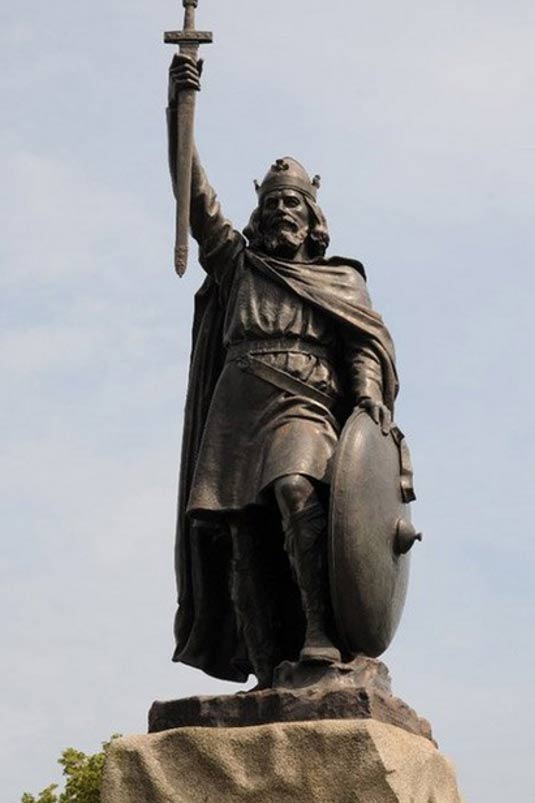
Famous statue of King Alfred the Great on Broadway in Winchester
Æthelflæd spent most of her life in the Kingdom of Mercia married to its de facto ruler, Æthelred. Mercia had seen some dark days by the time of her marriage. In the eighth and early ninth centuries, the Mercian kings had had good cause to consider themselves the most powerful rulers in southern Britain. But by the 870s, the kingdom had suffered dramatically from the Viking assaults which had swept across England.
One king, Burgred, had fled to Rome, and his successor, Ceolwulf II, was seen as a mere puppet by the West-Saxon compiler of the Anglo-Saxon Chronicle and disappeared between 878 and 883. Soon, the East Midlands were ruled by Scandinavians – what became known as the “Danelaw” – and so the kingdom ruled by Æthelflæd and Æthelred was by then just the western rump of the old Mercia.
Nevertheless, Æthelflæd and Æthelred together engaged in massive rebuilding projects at Gloucester, Worcester, Stafford and Chester, overseeing the refounding of churches, new relic collections and saints’ cults. Famously, in 909, the relics of the seventh-century saint, Oswald were moved from Bardney, deep in Scandinavian-controlled Lincolnshire, to a new church at Gloucester. Perhaps appropriately, for a couple facing the Vikings, Æthelflæd and her husband had a great attachment to the saint, a warrior king and Christian martyr. Æthelred was buried alongside Oswald in 911, and Æthelflæd joined him seven years later.
Remains of St Oswalds Priory, Gloucester, burial place of Æthelflæd and Æthelred
Powerplay and Politics
At the time, Athelred and Æthelflæd did not call themselves king or queen, nor do the official documents or coins refer to them as such. Instead, they used the title “Lord/Lady of the Mercians”, because Alfred had extended his authority over Mercia and styled himself “King of the Anglo-Saxons”.
But they acted like rulers. Æthelflæd, with her husband and her brother Edward the Elder, King of the Anglo-Saxons, launched a series of military campaigns in the early tenth century. These brought all of England south of the Humber and Mersey river under Anglo-Saxon control and rolled up the Scandinavian lordships which had been established in the East Midlands and East Anglia.
These advances were backed up by an energetic programme of fortification, with burhs (fortified towns) built in places such as Bridgnorth, Runcorn, Chester and Manchester.
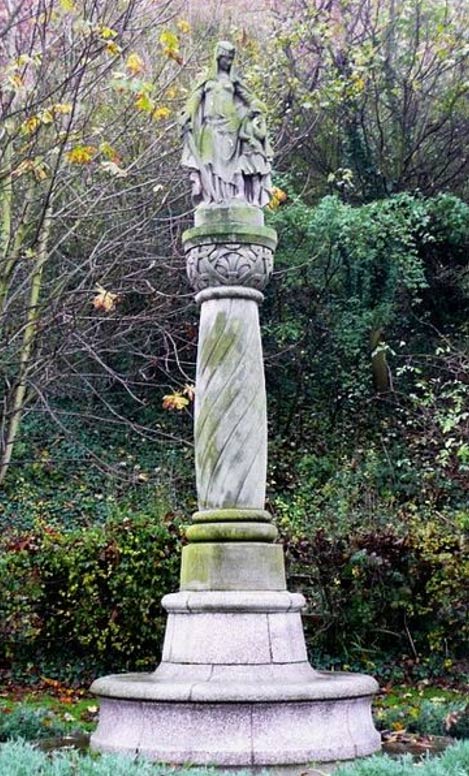
Statue in Tamworth of Æthelflæd with her nephew Æthelstan, erected in 1913 to commemorate the millennium of her fortification of the town.
But while she called herself a “lady”, outsiders, especially the Welsh and Irish, saw Æthelflæd as a “queen” and she surely wasn’t just her husband’s subservient wife. As Alfred the Great’s daughter, the role Mercia and the Mercians would play in the kingdom of the Anglo-Saxons was at stake.
A Potent Widow
But Æthelflæd really came into her own following her husband’s death in 911, although it seems that he had been in poor health for the best part of the previous decade. The Mercian Register in the Anglo-Saxon Chronicle , certainly celebrates her deeds from 910 onwards.
In 915, she successfully campaigned against the Welsh and the major Welsh kings, and in England she began further to expand her kingdom. In 917-8, her army took control of Viking-occupied Derby and Leicester, and just before her death, the “people of York” – that is, the Scandinavian lords of southern Northumbria – also agreed to submit to her.
For a brief moment, she had authority not just over her own territory in Mercia, but over the Welsh, the Scandinavian East Midlands and possibly part of Northumbria, making her perhaps one of the three most important rulers in mainland Britain – the others being her brother Edward king of the Anglo-Saxons and Constantin II macAeda, King of the Scots.
This made her a major political actor in her own right, but also a respected and feared figure. Even more remarkably, she passed her authority on to her daughter, Ælfwynn, who was around 30 when her mother died. The rule of Ælfwynn in Mercia, which attracts virtually no comment at all from historians, lasted about six months before her uncle Edward launched a coup d’état, deprived her of all authority and took her into Wessex.
Æthelflæd’s legacy is enigmatic, wrapped up in the “making of England”. But she was a ruler of consequence in an era defined by male authority. Indeed, her project to rebuild the kingdom of Mercia and the Mercians might have placed midland England at the heart of later history.













 CLAN CARRUTHERS - OUR NORSE ANCESTORS