

Uncategorized

EARL HAAKON AND THE JOMS VIKINGS – CLAN CARRUTHERS CCIS

cropped-wide-banner-with-new-crest

EARL HAAKON AND THE JOMSVIKINGS

Chief among the nobles of Haakon the Good, of Norway, was Earl Sigurd of Hlade; and first among those who followed him was Earl Haakon, Sigurd’s son. After the death of Haakon the Good, the sons of Gunhild became the masters of Norway, where they ruled like tyrants, murdering Sigurd, whom they most feared. This made the young Earl Haakon their bitter foe.

A young man then, of twenty-five, handsome, able in mind and body, kindly in disposition, and a daring warrior, he was just the man to contend with the tyrant murderers. When he was born Haakon the Good had poured water on his head and named him after himself and he was destined to live to the level of the honor thus given him.

It is not our purpose to tell how, with the aid of the king of Denmark, he drove the sons of Gunhild from the realm, and how, as the sagas tell, the wicked old queen was enticed to Denmark by the king, under promise of marriage, and by his orders was drowned in a swamp. Her powers of sorcery did not avail her then, if this story is true.

Haakon ruled Norway as a vassal of Harald Bluetooth, king of Denmark, to whom he agreed to pay tribute. He also consented to be baptized as a Christian and to introduce the Christian faith into Norway. But a heathen at heart and a Norseman in spirit, he did not intend to keep this promise. After a meeting with the Danish king in which his baptism took place, he sailed for his native land with his ship well laden with priests. But the heathen in him now broke out. With bold disdain of King Harald, he put the priests on shore, and sought to counteract the effect of his baptism by a great feast to the old gods, praying for their favor and their aid in the war that was sure to follow. He looked for an omen, and it came in the shape of two ravens, which followed his ships with loud clucking cries. These were the birds sacred to Odin and he hailed their coming with delight. The great deity of the Norsemen seemed to promise him favor and success.

Turning against the king to whom he had promised to act as a vassal, he savagely ravaged the Danish coast lands. Then he landed on the shores of Sweden, burnt his ships, and left a track of fire and blood as he marched through that land. Even Viken, a province of Norway, was devastated by him, on the plea of its being under a Danish ruler. Then, having done his utmost to show defiance to Denmark and its king, he marched northward to Drontheim, where he ruled like a king, though still styling himself Earl Haakon.

Harald Bluetooth was not the man to be defied with impunity, and though he was too old to take the field himself, he sought means to punish his defiant vassal. Men were to be had ready and able to fight, if the prize offered them was worth the risk, and men of this kind Harald knew where to seek.

[Illustration] from Historical Tales - Scandinavian by Charles Morris

BUSY FARMERS IN A HILLSIDE FIELD ABOVE ARE, SWEDEN.

In the town of Jomsborg, on the island of Wollin, near the mouth of the Oder, dwelt a daring band of piratical warriors known as the Jomsvikings, who were famed for their indomitable courage. War was their trade, rapine their means of livelihood, and they were sworn to obey the orders of their chief, to aid each other to the utmost, to bear pain unflinchingly, dare the extremity of danger, and face death like heroes. They kept all women out of their community, lest their devotion to war might be weakened, and stood ready to sell their swords to the highest bidder.

To this band of plunderers Harald appealed and found them ready for the task. Their chief, Earl Sigvalde, brought together a great host of warriors at a funeral feast to his father, and there, while ale and mead flowed abundantly, he vowed, flagon in hand, that he would drive Earl Haakon from the Norse realm or perish in the attempt. His viking followers joined him in the vow. The strong liquor was in their veins and there was no enterprise they were not ready to undertake. When their sober senses returned with the next morning, they measured better the weight of the enterprise; but they had sworn to it and were not the men to retreat from a vow they had taken.

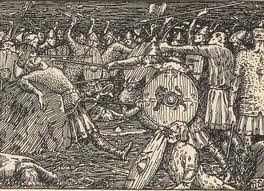
Erik, an unruly son of Earl Haakon, had fled from his father’s court in disgrace and was now in Viken, and here the rumor of the vikings’ oath reached his ears. At once, forgetting his quarrel with his father, he hastened north with all the men he could gather to Earl Haakon’s aid, preceding the Jomsvikings, who were sailing slowly up the shores of Norway, plundering as they went in their usual fashion. They had a fleet of sixty ships and a force of over seven thousand well-trained warriors. Haakon, warned by his son, met them with three times their number of ships, though these were smaller and lighter craft. On board were about ten thousand men. Such were the forces that met in what the sagas call the greatest battle that had ever been fought in Norway.

Soon the embattled ships met and the conflict grew fast and furious, hurtling weapons filling the air and men falling on all sides. Great was the carnage and blood flowed in streams on the fighting ships. Earl Haakon stood in the prow of his ship in the heat of the fight, arrows and spears whirling around him in such numbers that his shirt of mail became so torn and rent that he threw it off as useless. The high ships of the vikings gave them an advantage which told heavily against their antagonists, spears and arrows being poured down from their sides.

In the height of the battle Earl Haakon disappeared. As the legends tell he went ashore with his youngest son Erling, whom he sacrificed to the heathen gods to win their aid in the battle. Hardly had he done this deed of blood when a dense black cloud arose and a violent hail-storm broke over the ships, the hail-stones weighing each two ounces and beating so fiercely in the faces of the Jomsvikings as nearly to blind them. Some say that the Valkyries, the daughters of Odin, were seen in the prow of the earl’s ship, filling the air with their death-dealing arrows.

Despite the storm and the supernatural terrors that they conjured up, the Jomsvikings continued to fight, though their decks were slippery with blood and melting hail. Only one coward appeared among them, their chief Earl Sigvalde, who suddenly turned his ship and fled. When Vagn Aakesson, the most daring of the Jomsvikings, saw this recreant act he was frantic with rage.

“You ill-born hound,” he cried, “why do you fly and leave your men in the lurch? Shame on you, and may shame cling to you to your death!”

A spear hurtled from his hand and pierced the man at the helm, where Sigvalde had stood a moment before. But the ship of the dastard earl kept on and a general panic succeeded, all the ships in the fleeing earl’s line following his standard. Only Vagn Aakesson and Bue the Big were left to keep up the fight.

Yet they kept it up in a way to win them fame. When Earl Haakon’s ship drew up beside that of Bue, two of the viking champions, Haavard the Hewer and Aslak Rock-skull, leaped on deck and made terrible havoc. In the end an Icelander picked up an anvil that was used to sharpen their spears and hurled it at Aslak, splitting his skull, while Haavard had both legs cut off. Yet the indomitable viking fought on, standing on his knees.

The onset of the Jomsvikings was so terrific in this last fierce fight that the earl’s men gave back, and might have been all slain had not his son Erik boarded Bue’s ship at this crisis and made an irresistible charge. A terrible cut across the face severed Bue’s nose.

“Now,” he cried, “the Danish maidens will kiss me no more.”

Seeing that all was at an end, he seized two chests of gold to prevent their capture by the victors, and sprang with them into the sea, shouting:

“Overboard all Bue’s men!”

On Vagn’s ship a similar fierce fight was taking place, ending only when all but thirty of the vikings were slain.

Then a savage scene was enacted, one worthy only of those barbarous times. The captives were taken ashore and seated on a long log, their feet bound, their hands free. At the funeral feast in Sigvalde’s hall Vagn had boasted that he would kill Thorkill Laiva, one of Erik’s chief warriors, and this threatened man was now chosen as executioner.

At the captives he rushed, with uplifted axe, and savagely struck off their heads, one after another. Vagn was to be left to the last, that he might suffer from fear, but instead of this he sat joking and laughing with his men. One of them sang and laughed so loudly that Erik asked him if he would like to live.

“That depends on who it is that asks me.”

“He who offers has the power to grant. I am Earl Erik.”

“Then I gladly accept.”

Another made a pun which so pleased the earl that he, too, was set free.

One of the captives had long, beautiful hair, and as Thorkill came near him on his bloody errand he twisted his hair into a coil and asked the executioner not to soil it with his blood. To humor him Thorkill asked one of the bystanders to hold the coil while he struck. The man did so, but as the axe came down the captive jerked his head aside so that the axe fell on the wrists of the coil-holder, both his hands being cut off.

“Some of the Jomsvikings are still alive,” laughed the captive.

“Who are you?” asked Erik.

“I am said to be a son of Bue.”

“Do you wish to live?”

“What other choice have I?”

At Erik’s command he, too, was released.

Angry at being thus robbed of his prey, Thorkill now sprang towards Vagn, determined that at least his special enemy should fall. As he came near, however, one of the men on the log threw himself forward in such a way that Thorkill stumbled over him and dropped his axe. In an instant Vagn was on his feet, seized the axe, and dealt Thorkill a deadly blow. His boast was kept; Thorkill had fallen by his hand.

Erik saw the bold feat with such admiration that he ordered Vagn to be freed, and the prisoners who remained alive were also set free at his order.

While this was going on Earl Haakon sat apart conversing with his chieftains. As they did so they heard a bow-string twang, and before a hand could be raised a keen-pointed arrow pierced the body of Gissur the White, one of the chiefs, and he fell over dead. The arrow had come from the ship of Bue the Big, and thither men ran in haste. What they saw was Haavard the Hewer, still standing on his knees, though his blood flowed freely.

“Tell me,” he cried, “did any one fall at the tree yonder?”

“Yes; Gissur the White.”

“Then luck failed me, for that arrow was aimed for Earl Haakon.”

And he fell over on the deck, with death at his heart-strings. The viking had sent a herald on before, to announce his coming at Odin’s court.

It was Haakon who had ordered the murder of the captives, and Erik his son who gave life to so many of them. The time was near at hand when the earl was to meet the bloody fate which he had dealt out to others. Though Erik had done so much to help him in the battle, he was furious with his son for sparing the life of Vagn Aakesson. As a result they parted in anger, Erik going south again. Here Vagn joined him and from that day forward the two were warm friends and comrades.

But Haakon fell into ways of vice as he grew older, and at length he did a deed that led him to a shameful death. He had his men bring by force to his palace the wife of a rich peasant, and sent them for another, who was famed for her beauty. Orm, her husband, refused to let her go and sent news of the outrage to all the peasants in the valley. From farm to farm flew the tidings, and the peasants, furious at the shameful deeds of the earl, seized their arms and gathered in a great band, which marched upon him at Medalhus.

Earl Haakon was taken by surprise. He had not dreamed of a revolt and only a few men were with him. These he dismissed and fled for safety, only one man, his old servant Kark, going with him. Reaching the Gaul River in his flight, he rode his horse into a deep hole and left his cloak on the ice, so that his pursuers, finding the dead horse and the cloak, might think he was drowned.

From there he sought the nearby home of Thora of Rimul, a faithful woman friend, told her of the hot pursuit and begged her to hide him from his furious enemies. The only hiding place she could provide was a deep ditch under her pig-sty, and in this filthy hole the great earl was hidden, with food, candles, and bedding. Then boards were laid over the ditch and covered with earth and upon this the pigs were driven.

To Rimul the peasants soon came, filled with fury, and with them came a man of note who had just landed and was seeking to win the throne. This was Olaf, a great-grandson of Harold the Fair-Haired, whose claim to the crown of Norway was far better than that of Haakon. Thinking that Thora had hidden the fleeing earl the pursuers searched the whole place. The fugitive not being found, Olaf stood on a large stone near the pig-sty and called the peasants around him, loudly announcing that any man who should find and slay Earl Haakon would be given a large reward.

His words were plainly heard in the damp and unpleasant underground den where Haakon sat shivering. He looked at Kark, the thrall, whose face showed that he, too, had heard the promise of reward.

“What ails you?” asked the earl. “Your face changes from pale to dark and gloomy. Do you propose to betray me?”

“No,” said Kark.

“We were born on the same night, and if one of us dies the other will soon follow,” said the earl warningly.

For a long time they sat, listening to the sounds above. At length all grew still and they felt that the night had come. Kark fell asleep, but the earl sat awake, watching him in deep distrust. The slumbering thrall tossed about as if in pain and the earl wakened him, asking of what he had dreamt.

“I dreamed that you and I were on shipboard and that I was at the helm.”

“That means that you rule over both our lives. Therefore, Kark, you must be true and faithful to me, as duty bids you. Better days will soon come to us both and then you shall be richly rewarded.”

Again the thrall fell asleep and again he seemed to dream. The earl woke him again.

“Of what did you dream?” he asked.

“I dreamed that I was at Hlade and that Olaf Tryggvesson put a golden ring around my neck.”

“That means,” said the earl, “that if you seek Olaf he will put a red ring [a ring of blood] around your neck. Beware of him, Kark, and trust in me. Be faithful to me and you will find in me a faithful friend.”

The night dragged slowly on. The earl dared not let himself sleep, but sat staring at Kark, who stared back at him. When morning was near at hand weariness lay so heavily on the earl that he could no longer keep awake. But his sleep was sorely disturbed by the terrors of that dreadful night. He tossed about and screamed out in distress and at length rose on his knees with the horrors of nightmare in his face.

Then Kark, who had all night been meditating treachery, killed him with a thrust of his knife. Cutting off his head, he broke out of the dark den and sought Olaf, with the grisly trophy in his hand.

Olaf heard his story with lowering face. It was not to traitors like this that he had offered reward. In the end, burning with indignation at the base deed, he ordered the thrall’s head to be struck off. Thus Kark’s dream, as interpreted by Haakon, came true. The ring put by Olaf around his neck was not one of gold, but one of blood.
Carruthers crest on flag-v2 (1)

OFFICIAL AND OLDEST SCOTTISH  CLAN CARRUTHERS

 SINCE 1983-CLAN OF OUR ANCESTORS

MERITED TO CHIEF CAROTOCUS  10AD

PRESENT CHIEF :  PAT E CARROTHERS USA

cropped-wide-banner-with-new-crestnorse

TAMMY WISE CHS

DR PATRICIA CARRUTHERS CHS

CLAN CARRUTHERS  HISTORIAN AND GENEALOGIST
59ef7250711564a8761d3a0b23bc2353

New Blog Banner 05

Preserving Our Past, Recording Our Present, Informing Our Future

Ancient and Honorable Clan Carruthers

   clancarruthers1@gmail.com

You can find us on our main facebook pages at :

SILVER WINGS-https://www.facebook.com/CarruthersClanLLC/

GOLD WINGS – https://www.facebook.com/carrutherscarrothers.pat.9

COPPER WINGS    https://www.facebook.com/ClanCarruthers1/

CLAN CARRUTHERS FAMILY HISTORY – https://www.facebook.com/CarruthersClan

CLAN CARRUTHERS CCIS – https://www.facebook.com/groups/3878691252182714

CLAN CARRUTHERS INT SOCIETY- https://www.facebook.com/groups/394653845137709

CLAN CARRUTHERS – BORDER REIVERS – https://www.facebook.com/groups/434959914239094

Disclaimer Ancient and Honorable Carruthers Clan International Soci
SEA KINGS AND ROVERS

THE SEAKINGS AND THEIR DARING FEATS – CLAN CARRUTHERS CCIS

cropped-wide-banner-with-new-crest

THE SEAKINGS AND ALL THEIR DARING FEATS


31df11519d59af5ea79330640603dcaa


From the word vik, or bay, comes the word viking, long used to designate the sea-rovers of the Northland, the bold Norse wanderers who for centuries made their way to the rich lands of the south on plundering raids. Beginning by darting out suddenly from hiding places in bays or river mouths to attack passing craft, they in the end became daring scourers of the seas and won for themselves kingdoms and dominions in the settled realms of the south.

Nothing was known of them in the early days. The people of southern Europe in the first Christian centuries hardly knew of the existence of the race of fair-skinned and light-haired barbarians who dwelt in the great peninsula of the north. It was not until near the year 800 B.C. that these bold brigands learned that riches awaited those who dared seize it on the shores of France, England, and more southern lands. Then they came in fleets and spread terror wherever they appeared. For several centuries the realms of civilization trembled before their very name.

“From the fury of the Northmen, Good Lord deliver us!” prayed the priests, and the people joined fervently in the prayer.

Long before this period the sea was the favorite hunting ground of the daring sons of the north, but the small chiefs of that period preyed upon each other, harrying their neighbors and letting distant lands alone. But as the power of the chiefs, and their ability to protect themselves increased, this mode of gaining wealth and fame lost its ease and attraction and the rovers began to rove farther afield.

Sea-kings they called themselves. On land the ruler of a province might be called either earl or king, but the earl who went abroad with his followers on warlike excursions was content with no less name than king, and the chiefs who set out on plundering cruises became from the first known as sea-kings. Pirates and freebooters we would call them to-day, but they were held in high distinction in their native land, and some of the most cruel of them, on their return home, became men of influence, with all the morality and sense of honor known in those early days. Their lives of ravage and outrage won them esteem at home and the daring and successful sea-king ranked in fame with the noblest of the home-staying chiefs. We have seen how King Erik began his career as a viking and ended it in the same pursuit; how Rollo, a king’s son, adopted the same profession; and from this it may be seen that the term was one of honor instead of disgrace.

From all the lands of the north they came, these dreaded sons of the sea, from Norway, Sweden, and Denmark alike, fierce heathens they who cared nought for church or priest, but liked best to rob chapels and monasteries, for there the greatest stores of gold and silver could be found. When the churches were plundered they often left them in flames, as they also did the strong cities they captured and sacked. The small, light boats with which they dared the sea in its wrath were able to go far up the rivers, and wherever these fierce and bloodthirsty rovers appeared wild panic spread far around. So fond were they of sword-thrust and battle that one viking crew would often challenge another for the pure delight of fighting. A torment and scourge they were wherever they appeared.

The first we hear in history of the sea-kings is in the year 787, when a small party of them landed on the English coast. In 794 came another flock of these vultures of the sea, who robbed a church and a monastery, plundering and killing, and being killed in their turn when a storm wrecked their ships and threw them on shore. As a good monk writes of them: “The heathen came from the northern countries to Britain like stinging wasps, roamed about like savage wolves, robbing, biting, killing not only horses, sheep, and cattle, but also priests, acolytes, monks, and nuns.”

The Norsemen had found a gold mine in the south and from this time on they worked it with fierce hands. Few dared face them, and even in the days of the great Charlemagne they ravaged the coast lands of France. Once, when the great emperor was in one of his cities on the Mediterranean coast, a fleet of the swift viking ships, known by their square sails, entered the harbor. Soon word was brought that they had landed and were plundering. Who they were the people knew not, some saying that they were Jews, others Africans, and others that they were British merchants.

“No merchants they,” said the emperor. “Those ships do not bring us goods, but fierce foes, bloody fighters from the north.”

The warriors around him at once seized their weapons and hurried to the shore, but the vikings had learned that the great emperor was in the city and, not daring to face him, had sought their ships and spread their sails again. Tears came to the eyes of Charlemagne as he watched them in their outward flight. He said to those around him:

“It is not for fear that these brigands can do me any harm that I weep, but for their daring to show themselves on this coast while I am alive. Their coming makes me foresee and fear the harm they may do to my descendants.”

This story may be one of those legends which the monks were fond of telling, but it serves to show how the dread Norsemen were feared. France was one of their chief fields of ravage and slaughter. First coming in single ships, to rob and flee, they soon began to come in fleets and grew daring enough to attack and sack cities. Hastings, one of the most renowned of them all, did not hesitate to attack the greatest cities of the south.

In 841 this bold freebooter sailed up the Loire with a large fleet, took and burned the city of Amboise, and laid siege to Tours. But here the inhabitants, aided, it is said, by the bones of their patron saint, drove him off. Four years later he made an attack on Paris, and as fortune followed his flag he grew so daring that he sought to capture the city of Rome and force the Pope to crown him emperor.

For an account of this remarkable adventure of the bold Hastings see the article, “The Raids of the Sea-Rovers,” in the German volume of “Historical Tales.” In that account are also given the chief exploits of the vikings in France and Germany. We shall therefore confine ourselves in the remainder of this article to their operations in other lands, and especially in Ireland.

This country was a common field for the depredations of the Norse rovers. For some reason not very clear to us the early vikings did not trouble England greatly, but for many years they spread terror through the sister isle, and in the year 838 Thorgisl, one of their boldest leaders, came with a fleet of one hundred and twenty ships, with which he attacked and captured the city of Dublin, and afterwards, as an old author tells us, he conquered all Ireland, securing his conquest with stone forts surrounded with deep moats.

But the Irish at length got rid of their conqueror by a stratagem. It was through love that the sea-king was lost. Bewitched with the charms of the fair daughter of Maelsechnail, one of the petty kings of the land, he bade this chieftain to send her to him, with fifteen young maidens in her train. He agreed to meet her on an island in Loch Erne with as many Norsemen of high degree.

Maelsechnail obeyed, but his maidens were beardless young men, dressed like women but armed with sharp daggers. Thorgisl and his men, taken by surprise, were attacked and slain. The Irish chief had once before asked Thorgisl how he should rid himself of some troublesome birds that had invaded the island. “Destroy their nests,” said the Norseman. It was wise advice, and Maelsechnail put it in effect against the nests of the conquerors, destroying their stone strongholds, and killing or driving them away, with the aid of his fellow chieftains.

Thus for a time Ireland was freed. It was conquered again by Olaf the White, who in 852 defeated some Danes who had taken Dublin, and then, like Thorgisl, began to build castles and tax the people. Two other viking leaders won kingdoms in Ireland, but Olaf was the most powerful of them all, and the kingdom founded by him lasted for three hundred and fifty years. From Dublin Olaf sailed to Scotland and England, the booty he won filling two hundred ships.

The sea-rovers did not confine their voyages to settled lands. Bold ocean wanderers, fearless of man on shore and tempest on the waves, they visited all the islands of the north and dared the perils of the unknown sea. They rounded the North Cape and made their way into the White Sea as early as 750. The Faroe, the Orkney and the Shetland Islands were often visited by them after 825, and in 874 they discovered Iceland, which had been reached and settled by Irishmen or Scots about 800. The Norsemen found here only some Irish hermits and monks, and these, disturbed in their peaceful retreat by the turbulent newcomers, made their way back to Ireland and left the Norsemen lords of the land. From Iceland the rovers reached Greenland, which was settled in 986, and about the year 1000 they discovered North America, at a place they named Vinland.

Such is, briefly told, the story of the early Norse wanderers. They had a later tale, of which we have told part in their conquest of Ireland. Though at first they came with a few ships, and were content to attack a town or a monastery, they soon grew more daring and their forces larger. A number of them would now fortify themselves on some coast elevation and make it a centre for plundering raids into the surrounding country. At a later date many of them ceased to pose as pirates and took the rôle of invaders and conquerors, storming and taking cities and founding governments in the invaded land.

Such was the work of Thorgisl and Olaf in Ireland and of Rollo in Normandy. England was a frequent field of invasion after 833, which continued until 851, when King Ethelwulf defeated them with great slaughter. Fifteen years later they came again, these new invaders being almost all Danes. During all his reign Alfred the Great fought with them, but in spite of his efforts they gained a footing in the island, becoming its masters in the north and east. A century later, in 1016, Canute, the king of Denmark, completed the conquest and became king of all England.

This is not the whole story of the sea-kings, whose daring voyages and raids made up much of the history of those centuries. One of the most important events in viking history took place in 862, when three brother chiefs, probably from Sweden, who had won fame in the Baltic Sea, were invited by the Russian tribes south of Lake Ladoga to come and rule over them. They did so, making Novgorod their capital. From this grew the empire of Russia, which was ruled over by the descendants of Rurik, the principal of these chiefs, until 1598.

Other vikings made their way southward through Russia and, sailing down the Dnieper, put Constantinople in peril. Only a storm which scattered their fleet saved the great city from capture. Three times later they appeared before Constantinople, twice (in 904 and 945) being bought off by the emperors with large sums of money. Later on the emperors had a picked body-guard of Varangians, as they called the Northmen, and kept these till the fall of the city in 1453. It was deemed a great honor in the north to serve in this choice cohort at Myklegaard (Great City), and those who returned from there doubtless carried many of the elements of civilization to the Scandinavian shores.

To some of these Varangians was due the conquest of Sicily by the Northmen. They were in the army sent from Constantinople to conquer that island, and seeing how goodly a land it was they aided in its final conquest, which was made by Robert Guiscard, a noble of Normandy, whose son Roger took the title of “King of Sicily and Italy.” Thus it was that the viking voyages led within a few centuries to the founding of kingdoms under Norse rulers in England, Ireland, Sicily, Russia, and Normandy in France.

Carruthers crest on flag-v2 (1)


OFFICIAL AND OLDEST SCOTTISH  CLAN CARRUTHERS

 SINCE 1983-CLAN OF OUR ANCESTORS

MERITED TO CHIEF CAROTOCUS  10AD

PRESENT CHIEF :  PAT E CARROTHERS USA

cropped-wide-banner-with-new-crestnorse


Dr Tim Fraser SCOTLAND CHS

 Tammy Wise  USA  CHS

CLAN CARRUTHERS  HISTORIAN AND GENEALOGIST
59ef7250711564a8761d3a0b23bc2353

New Blog Banner 05

Preserving Our Past, Recording Our Present, Informing Our Future

Ancient and Honorable Clan Carruthers

   clancarruthers1@gmail.com

You can find us on our main facebook pages at :

SILVER WINGS-https://www.facebook.com/CarruthersClanLLC/

GOLD WINGS – https://www.facebook.com/carrutherscarrothers.pat.9

COPPER WINGS    https://www.facebook.com/ClanCarruthers1/

CLAN CARRUTHERS FAMILY HISTORY – https://www.facebook.com/CarruthersClan

CLAN CARRUTHERS CCIS – https://www.facebook.com/groups/3878691252182714

CLAN CARRUTHERS INT SOCIETY- https://www.facebook.com/groups/394653845137709

CLAN CARRUTHERS – BORDER REIVERS – https://www.facebook.com/groups/434959914239094

Disclaimer Ancient and Honorable Carruthers Clan International Soci


Gutland / Gotland, OUR ANCESTORS, SEA KINGS AND ROVERS, The History of Gutland, Uncategorized

THE SIX WIVES HARALD FAIRHAIR CLAN CARRUTHERS CCIS

WIDE BANNER with NEW CREST


ALL THE SONS OF HARALD FAIRHAIR

King Haraldr had many wives and many children- Haralds Saga – and a Carruthers ancestor.

Harald Fairhair, the legendary ruler of Norway who succeeded for the first time in uniting all the petty fiefdoms of his nation, inherited his father’s kingdom at a young age and proceeded to live an extraordinarily long and active life. During his time as a good looking adult with famously beautiful hairlocks, he wooed women from all different regions of Norway and produced many children accordingly,

.Although he cannot compete in importance with his Danish contemporary Ragnar Lodbrok, the list of his descendants is equally long and impressive. It includes among others, Ivan the Terrible of Russia, the Sun King Louis XIV of France and, via the House of Sachsen-Billung, our own Leopold II of Belgium.

Halfdan the Black handing over his kingdom to Harald ca. AD 860

Spouse no. 1    Ása    Haakonsdotter

In Chapter IX of his Heimskringla text, the Icelandic historian Snorri Sturluson, mentions that Harald eventually settled in Trondheim , which heal ways called his home, and where he built a very large establishment called Hladir (now Lade). That is where he met Aasa, the daughter of the important Jarl Haakon “the Rich” Grjotgardsson, who had nominal control over Trondelag and Halogaland.

Harald and Hakon came to an agreement dividing Norway between them except for the completely unruly Vestland. This first (political) marriage produced four sons, listed byname by Snorri In chapter XVII of the Heimskringla text:

“Then he began to have children. Harald and Àsa had these sons : Guthorm was the eldest, Halfdan svarti (the Black), Halfdan hviti (the White)–they were twins– the fourth Sigfròdr. They were all brought up in Trondheim in great honour”

Then Harald went after the Vikings of Vestland in Hafrsfjord whom hedefeated in a great naval battle in AD 872.

It is probably not a coincidence that the Viking Rollo, who was presumably born at Maere and who was a contemporary of Harald Fairhair, immediately after 872 what is since called Normandy. Many other Vikings, who did not want to be subjected to Harald, followed him there.

Image of the great battle of Hafrsfjord in 872

We can safely assume that Harald’s four children with Aasa were all born between the naval battles of 865 and 872.

Guthorm  (865-895)    Halvdan svarte ( (868-932)Halvdan hvite  (868-925)   Sigfrodr(872-?)

The eldest son Guthorm was named after Halfdan the Black’s best friend and right arm, Duke Guthorm, who took young Fairhair under his wings when he inherited the kingdom at the age of ten. After Duke Guthorm died of sickness ca. 890, Harald made his own son Guthorm king over Raanrike, which he had wrested from the Swedes, and gave him the responsibility of defending this south east region of Norway against his neighbor. However, Guthorm fell in a later fierce battle with the sea-king Solve Klove in 895, whose own father had been killed by Harald at the First Battle of Solskjel.

HalfdanII “the Black (named after his grandfather) later inherited the kingdom of Tróndelag. He may therefore have considered himself the rightful successor to his father as the king of whole Norway and must have been disappointed when Harald gave preference to the younger son Eric.

Halfdan III “the White”, shared Trondelag with his darker twin brother. He
fell in Eist land in 925, i.e. ten years before Harald’s death.
Sigfròdr is not mentioned again. We do not know what happened to him.

Spouse no. 2 Svanhild  Eysteinsdotter of Heidmark

After defeating the Vikings of Vestland, Harald turned his attention to Vestfold in Östland.Svanhild was the daughter of Eystein “the Noisy ” of Vestfold, who was also the grandfather of the before mentioned Rollo, the founder of Normandy. She was probably also chosen for political reasons.

Image of Eystein “Glumra” the Noisy Svanhild provided Harald Fairhair with three additional sons:

Olaf “Geirstadaalfer”                         Björn”formann”                     Ragnar“rykkill” 
(Elf of Geirstadir)                               (the merchant)                        (the Snatcher)
  (870- 932)                                         (875- 932)                                (878-932)

Svanhild possibly also died young because nothing is heard of her after 880. Björn the Merchent would later succeed his grandfather Eystein asking of Vestfold, and his brother Olaf succeeded him after his death ,while Sigurd inherited Trondheim from his father.

Spouse no. 3  Gyda   Eiriksdotter   of Hardaland

Around AD 870, when Harald was approaching the age of twenty, he started thinking of taking a young mistress. This was probably before his marriage with Asa. Harald had heard of beautiful Gyda, the daughter of king Eirik of Hardaland, who was being fostered in Valdres and he sent his men to fetch her.

However, she sent them back with the message that she would not sacrifice her virginity to take as husband a king who had no more of a realm than a few districts to administer. She might only agree to be his wife if he would first subject the whole of Norway.

This seems to have had a stimulating effect on Harald who swore to God not to cut or comb his fancy hair until he became ruler over all of Norway. It would take him another ten years to fulfill this ambition, but when he had completed his project, he remembered beautiful but proud Gyda. So tells Snorri in chapter XX of Heimskringla:

King Haraldr had now become sole ruler of all Norway. Then he called to mind what that proud girl had said to him. He then sent men for her and had her brought to him and made her his mistress. That were their children :

Hroerekr                Sigtrygg                 Frodi                 Torgils
(880- 932)            (882-932)              (885-938)             (890-932)

All four sons were born in Bergen, but both Frodi and Torgils are said tohave died in Dublin.

Spouse no. 4  Snaefrid“    Snowfair ”   Svasisdotter the Finn

In chapter XXV of Heimskringla, Snorri recounts the following story:

King Haraldr went one winter to attend banquets through Uppland and had a Yule banquet prepared for himself in Poptor. One Yule-eve Svási came to the door while the king was sitting at table, and sent the king a message that he was to come out to him.The King went out reluctantly and agreed to go to his home with him.

Snaefrid Swasisdottir - Historical records and family trees - MyHeritage

There Svasi’s daughter Snaefridr, a most beautiful woman, rose and served the king a goblet full of mead, and he took all into his grasp, including her hand, and it was immediately as if a fiery heat came into his flesh, and he wanted to have her straight away that night. But Svasi said that it should not be unless the king betrothed himself to Snaefridr and married her and got her lawfully. And the king betrothed himself to Snaefridr and married her and loved her so madly that his kingdom and all his duties he then neglected. They had four sons :

Sigurd “hrsi”          Halvdan”hàleggr”          Gudród“ljami”      Ragnvald“rettilbeini”
 
(the Grey)                (long legs)                     “Gleam”              (Straightleg)
(890-937)                (891-?)                            (893-?)                (895-?)

Then Snaefrid died and according to Snorri, Harald was inconsolable and sat over her continually hoping that she would return to life.Sigurd later became king of Hadafylke and was the ancestor of other notable kings, such as Harald Hardraade, who ruled Norway successfully from 1046 to 1066, but failed in his attempt to invade England just before William the Conqueror made his own landing at Hastings.

Spouse no. 5   Ragnhild           the Mighty” of Jutland”

(Jutland and Gutland were one in the same)

Ragnhild was born ca. 880 as daughter of King Eirik of Jutland and would bear Harald’s
most notorious son Eric (900-954) upon whom posterity bestowed the epithet “Bloodaxe”,
 presumably because he proceeded to eliminate his half-brothers in order to obtain the succession.
Ragnhild Sigurdsdotter - Wikipedia
 However, careful reading of Snorri’s Chapters 41-43reveals a different story:
King Harald was now 80 years of age; he now became so infirm that he felt he could not travel by land or manage the royal affairs. Then he took his son Eric to his high seat and gave him rule over the whole country. But when King Harold’s other sons heard about this, the Halfdan sorti set himself on the king’s high seat.
He then took the whole of Trondheim to rule over. All the Traendis backed him in his course of action. Two years later, Halfdan svarti died suddenly inland in Trondheim at some banquet, and it was rumored that Gunhilde (Eric’s wife) had bribed a warriors killed in magic to make him a poison drink. After that the Prendi’s took Sigurd as king.

All this shows is that Eric did not have an easy time taking hold of the situation, and that he was king by name only between 930 and 933.When in 934 his younger rival Haakon arrived from England to takeover the situation, Eric did not resist and moved to the Orkney Islands, which were already colonized by Norway. The English King Aethelstan, who had fostered Haakon and equipped his expedition, then entrusted Northumberland to Eric as under-king. Numismatic evidence found as recently as 2014 attests to his title as king of York between 952 and954.
Aethelstan’s successor Eadred put an end to his reign, and when Eric was travelling back to the Orkneys with his brother Ragnald and his son Haerekr, they were ambushed at Stainmore and all killed.

Coin of Eric as King of York AD 952-54

So who were the brothers who were supposedly killed by violent Eric?

1.South of Vinland: Norwegian History: Halfdanr Svarti (810-860), King of  Vestfold.


Halfdan svarti : we already saw that his death was caused by poisoning, no bloody ax involved. Halfdan had it coming by takingover Trondheim, the jewel in his father’s crown

 and had attempted himself first to kill Eric by burning down the house where he was staying. Eric managed to get out and went to see his father with news of these events. We cannot therefore exclude the possibility that it was Harald himself who ordered Halfdan’s poisoning as punishment

.2.


Bjòrn formann: succeeded his grandfather on his mother’s side as king of Vestfold. He was considered an intelligent person and very moderate and it seemed he might make a great ruler. However,Snorri recounts in chapter 41 of his book that when Eric returned from the eastern Baltic in 930, he visited Bjòrn to demand the revenues which were due to King Harald whlle he was still alive. It was when Bjòrn refused to pay, that he was killed in battle by Eric

3.
Olaf : after the fall of Bjòrn, his brother Olaf took rule over Vestfold and adopted Bjòrn’s son Gudròdr. When the Vikverjar heard that Harold had taken Eric as supreme king, they took Olaf as supreme king in the Vik, and he kept that kingdom. Eric was very displeased at this. The same Spring, Eric calls out a great army and ships and turns east to Vik. He had a much larger force and gained victory. Olaf and Sigurd both fell there
.4.
Sigurd: this was probably Sigfródr, son of the first marriage of Harald with Àsa

So there is no mention of direct murder by Eric of any of his half-brothers.
They had all four
revolted against their father’s decision and bore the consequences. Maybe their father, while he was still alive, did not disapprove of their forceful elimination. It is interesting to read that according to the Saga in which Eric figures, after his death he is welcomed by Odin without any criticism of the killings of his brothers.  When the other gods question Odin why he still welcomed Eric, Odin answers, well, he has traveled a lot and has seen many countries”  Sounds modern, does it not?

Spouse no. 6           Alshild   Ringsdotter   of Ringerike

Ring                     Dag                Gudród “Skirja”
(882-?)                (883-?)              (890-965)

Alshild was a princess from the prestigious kingdom of Hringaríkei (nowRingerike near Oslo). Snorri mentions that when King Harald married her, she proudly named her sons after her own father (Ring), grandfather (Dag)and ancestor (Gudród). Their son Dag later became king of Hedmark and Gudbrandsdal.

Beautiful Hedmark

Spouse no. 7   Thora  Mosterstang


When Fairhair reached the age of seventy, he retired to one of his farms in Hordaland where he is credited with impregnating beautiful Tora, who may have been only a handmaid. At the age of ten, her son Haakon wassent for safekeeping to the court of the English king Aethelstan where many sons of European princes were welcome to be taught the noble arts of statesmanship

 King Aethelstan is said to have loved him more than his own kin. Hákon was baptized there and taught the true faith and good morality and all kinds of courtly behavior. In 934, Hákon was invited by dissident nobles in his home country to takeover the throne of Norway. Aethelstan equipped him with ships and men and Hákon was able to expel his unpopular half-brother Eric Bloodaxe, who conceded without a fight and fled to the Orkney Islands Haakon proved to be a good and pragmatic king and reigned until 960when he had to face an attack at Fitjur by five sons of Eric. He won the battle, but was wounded and died shortly there after.Three sons of Eric took over the kingdom and were able to fulfill the dynastic designs of their grandfather.

Conclusion

By impregnating so many women from all parts of his kingdom, Harald may have had political considerations in mind. It was his way of obtaining the support of so many previously independent smaller kings who might otherwise have been reluctant to accept him as over-king. His marriages to a Danish and a Finnish princess may also be interpreted as protection against over-zealous neighbors. The only missing piece in his political puzzle was a princess from hostile Sweden. I think Martin Arnold is right when he suggests that Harald’s governing style of usurping traditional inheritance rights had to lead to civil war. Hisson Eric was not only contested by his brothers, but also by the regional lords. Maybe if Harald had gradually shared power with his designated successor at an earlier period, the transition might have been successful.

Carruthers crest on flag-v2 (1)

OFFICIAL AND OLDEST SCOTTISH  CLAN CARRUTHERS

 SINCE 1983-CLAN OF OUR ANCESTORS

SCOTTISH CLAN – IRISH CLAN – NORSE CLAN

WIDE BANNER with NEW CREST

Willy van Ryckeghem

REKNOWNED NORSE HISTORIAN

REVIEWED BY TAMMY WISE CHS

CLAN CARRUTHERS CCIS HISTORIAN AND GENEALOGIST

Preserving Our Past, Recording Our Present, Informing Our Future

Ancient and Honorable Clan Carruthers

   clancarruthers1@gmail.com

You can find us on our main facebook pages at :

SILVER WINGS-https://www.facebook.com/CarruthersClanLLC/

GOLD WINGS – https://www.facebook.com/carrutherscarrothers.pat.9

CLAN CARRUTHERS FAMILY HISTORY – https://www.facebook.com/CarruthersClan

CLAN CARRUTHERS CCIS – https://www.facebook.com/groups/3878691252182714

CLAN CARRUTHERS INT SOCIETY- https://www.facebook.com/groups/394653845137709

CLAN CARRUTHERS – BORDER REIVERS – https://www.facebook.com/groups/434959914239094

Disclaimer Ancient and Honorable Carruthers Clan International Socie