


CLAN CARRUTHERS INT SOCIETY CCIS

First Churches of Gotland


The ruins of the small church or chapel traditionally called the Church of Saint Olaf are quite small, the remains of the wall not reaching higher than c. 0.6 metres (2.0 ft). Adjacent to the church ruins lie the remains of a cemetery.

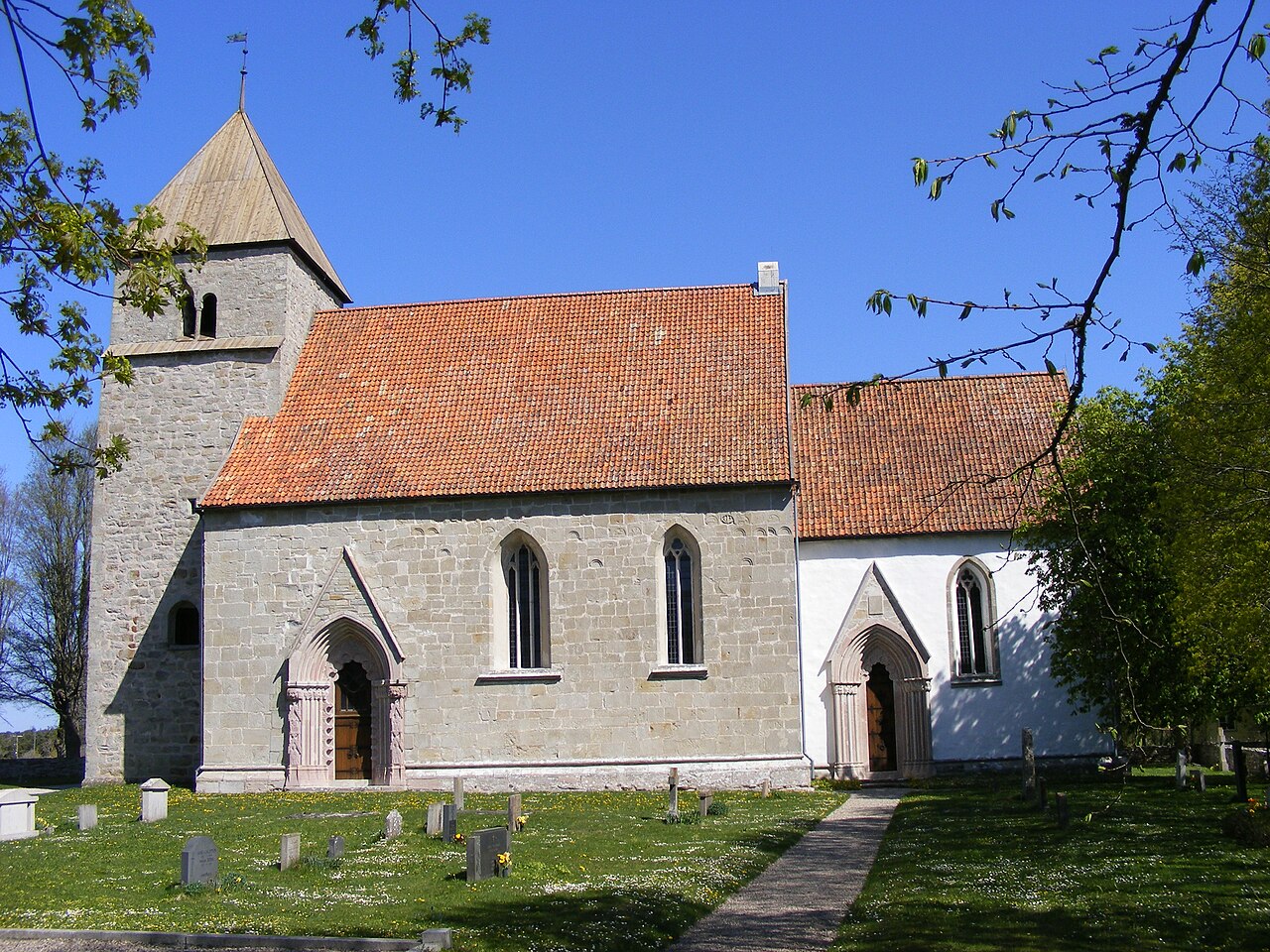
 Then a third was built in Fardhemin the southernmost third. From those, church
es spread everywhere in Gotland, since men built themselves churches for greater convenience.Both the events described by the final decision, that the Church would remain, are apparently linked to one time and one place, namely Visby. If we dare connect it to the Patriarc Photius circular letter of 867, the Kulstäde incident should have taken place in the 870s, and the church in Vi built in 897, as
 The decision can thus be compared with the later Icelandic Althing decision of the year 1000, when Christianity was offcially introduced in Iceland. The seafaring Arab al-Tartûschî visited Hedeby, Visby, about the year 973 and says that there were a few Christians and a small church. He should have recognized this for he came nearest from Christian countries. Didal-Tartûschî , Botair’s church?
Solberga Abbey was a Cistercian nunnery, founded circa 1246. It was the only nunnery on Gotland. It remains unclear when the nuns abandoned the convent, but they did so at latest at the time of the Reformation. Nearby a medieval cross marks the spot of the Battle of Visby, fought in 1361
Cemetery finds
On Gotland is a find category, called cemetery finds. Since the 1800s, on a wide range of Gotland’s more than 90 rural cemeteries, the grave digging and excavation for lightning conductors, etc. have come across skeletons of corpses. These have been buried with full sets of costume buckles and other jewelry, combs, knives, keys, etc., all in late Viking Age forms. This find category has puzzled the scientific researchers. However the cemetery finds on Gotland seem to be Christian, as evidenced by the fact that one can observe a strict separation of the graves of women north of the church, and the men in the south. This can not be done until there has been a church building.Similar tombs are found on Björkö, usually locally separated from the usual non-Christian graves.
List of church ruins on Gotland
There are in total nineteen known ruined churches on the Swedish island of Gotland, in the Baltic Sea twelve of which lie in Visby, the island’s main town. Of these, ten lie within the medieval city walls. Three additional church ruins in Visby are known through written sources, but today completely vanished.
Gotland began to gradually abandon Norse religion and adopt Christianity during the 11th century. While the earliest churches were wooden, construction of stone churches began during the 12th century. The church building period was fairly short; in the countryside stone churches were erected between the early 12th and mid-14th centuries, while in Visby the last churches were inaugurated during the 15th century.
Some of these churches have since fallen into ruin. Of the 94 medieval parish churches in the countryside, 91 are still in use. Three were abandoned following the Reformation, when parishes were merged, and some churches became superfluous. There are in addition three chapel ruins, or ruins of small churches, in the countryside. There are also the ruins of two Cistercian abbeys, one in the countryside and one just outside the city wall of Visby.
Although the exact number of churches that existed in Visby during the Middle Ages is unknown, there were certainly more than in any other Swedish city, and at least twelve within the city walls. Visby grew to become an important trading port during the Middle Ages, and most of the churches in the city were built during the 12th and 13th centuries.The churches were not, as in the countryside, only parish churches. Some belonged to abbeys, alms houses or served groups of traders of a specific nationality, such as the Russian Church or present-day Visby Cathedral, which was originally a church used by German traders.
Following the Black Death, the invasion of Gotland by Valdemar IV of Denmark and the Battle of Visby in 1361, and a general decrease in trade, Gotland entered a period of decline. From about 1361, building activity therefore dropped. The inauguration of Sankta Karin in 1412 marks the end of church building activity in Visby. When troops from Lübeck pillaged the city in 1525, and probably damaged several of the churches, the social and economic rationale for sustaining them had vanished. With the advent of the Reformation soon afterwards, the religious rationale to sustain the upkeep of the many churches also permanently disappeared. All monasteries were abolished and all churches within the city walls except one (present-day Visby Cathedral) were abandoned and left to decay. During the following centuries, some church ruins were used as quarries. In 1805 the church ruins were protected by law and in 1863 the Swedish state for the first time allocated money for their conservation.
 Ardre Church Ruin, also known as the chapel of Gunfjaun, was built during the 14th century in the medieval marketplace. According to tradition, the church was built in memory of Gunfjaun, the son of a local chieftain named Hafder. It is doubtful whether the church building ever was completed
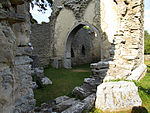 Bara Church Ruin seems to have been abandoned already in the 16th century. In 1588 the local population demanded that it should be re-opened and repaired. The parish was however merged with that of Hörsne Church and Bara Church left to decay. The church was built in the 13th century and shares some characteristics with Anga Church.

Ellinghem Church Ruin consists of the remains of a 13th-century church. The medieval altar has been preserved in place, and in 1923–24 the remains of the baptismal font were found during an archaeological excavation of the church. It is not known when the church was abandoned, but this probably happened at the beginning of the 17th century.
 Gann Church Ruin is a well-preserved ruin of a church probably abandoned during the 16th century. The choir and nave of the ruined church date from the middle of the 13th century, while the tower was added slightly later (late 13th century). The remains were renovated in 1924.
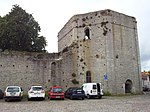 The ruins of the church dedicated to the Holy Spirit are one of the most unusual of the church ruins in Visby. They consists of an octagonal two-storeyed nave and a protruding choir. The church was erected during the 13th century. According to one theory, the church was built for Bishop Albert of Riga, who is known to have been on Gotland in the early 13th century to gather crusaders and missionaries to go with him to Livonia. The church became the almshouse of Visby in 1532, but by the early 17th century was apparently in a ruinous state and used as a barn.
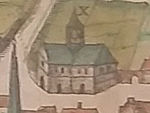 No visible remains exist above ground of the so-called Russian Church. Archaeological excavations carried out in 1971 revealed the foundations of a small church under the floor of a house on Södra kyrkogatan street. It may have been one of possibly two churches for Russian traders in Visby during the Middle Ages
 The church of Saint Catherine was the church of a Franciscan convent. The convent was founded in 1233 and a first construction period took place c. 1235–1250. During the early 14th century reconstruction work on the church began, and was not finished until 1412, when the church was re-inaugurated. The abbey was disbanded during the 1520s, and the buildings were for a short while used as an almshouse before being completely abandoned.
 The church dedicated to Saint Clement was probably erected during the middle of the 13th century, but its history remains opaque. It was probably preceded by a smaller, 12th-century church. In its present state, it is still considered a typical representative of 13th-century Visby churches
 The church was dedicated to the Holy Trinity but called Drotten after an old Norse word meaning Lord or King, i.e. referring to God. It is similar to Sankt Clemens but smaller and probably older. It seems to have been constructed mainly during the 13th and 14th centuries
 The church of Saint Nicholas was the abbey church of a Dominican abbey, founded before 1230. Its most famous prior was Petrus de Dacia. The church is possibly older than the abbey; the monks may have acquired an already existing church, or one under construction. Enlargement and reconstruction works were carried out until the late 14th century. The church and abbey were probably destroyed by troops from Lübeck in 1525

This small church or chapel was dedicated to Saint Gertrude of Nivelles. It is the smallest of the former churches in Visby. An excavation carried out in 1935 determined that it dates from the second half of the 15th century.
 The church was dedicated to Saint George and lies about 300 metres (980 ft) outside the city walls. It was originally tied to an almshouse for lepers nearby. The church is lacking in decorative elements and has therefore been difficult to date. The choir and nave probably date from different periods. The choir is the oldest, perhaps from the late 12th or early 13th century, and the nave may date from the 13th century. The almshouse was shut down in 1542, but the cemetery continued to be used occasionally, e.g. during an outbreak of plague in 1711–12 and following an outbreak of cholera in the 1850s.
 The patron saint of the church was Saint Lawrence. Construction of the church began during the second quarter of the 13th century. It was built by local stonemasons but in an unusual, cross-shaped form. Inspiration for this form probably came from Byzantine architecture and may have reached Gotland following the siege of Constantinople in 1204.

Three walls of a medieval chapel dedicated to Saint Olaf have been incorporated into a 19th-century barn. North east of the church a memorial cross was erected in 1959

Very little remains of the church once dedicated to Saint Olaf in Visby. It was probably a basilica built at the beginning of the 13th century
Preserving Our Past, Recording Our Present, Informing Our Future
Ancient and Honorable Clan Carruthers Int Society CCIS LLc
carruthersclan1@gmail.com carrothersclan@gmail.com

You can find us on facebook at :
https://www.facebook.com/carrutherscarrothers.pat.9
https://www.facebook.com/CarruthersClan/
https://www.facebook.com/CarruthersClanLLC
Disclaimer Ancient and Honorable Carruthers Clan International Society CCIS LLC is the official licensed and registered Clan of the Carruthers Family. This Clan is presently registered in the United States and Canada, and represents members worldwide. All content provided on our web pages is for family history use only. The CCIS is the legal owner of all websites, and makes no representation as to the accuracy or completeness of any information on these sites or by following any link provided. The CCIS will not be responsible for any errors or omissions or availability of any information. The CCIS will not be liable for any losses, injuries, or damages from the display or use of this information. We do not sell, trade or transfer to outside parties any personal identifications. For your convenience, we may provide links to various outside parties that may be of interest to you. The content on CCIS is design to support your research in family history. ( CCIS -LLC copyright 2017 - 2020)
 CLAN CARRUTHERS - OUR NORSE ANCESTORS