
Gutland / Gotland, The History of Gutland, The Viking Age, Uncategorized

PROCOPIUS ON HERULS AND DANES CLAN CARRUTHERS CCIS

cropped-wide-banner-with-new-crestnorse

By the end of Procopius’ Book VI on the Gothic War in Italy, he loses interest in the war and writes instead about the Heruli, who was part of Belisarius’ army. He recounts among other things a decisive battle between Heruls and Langobards, which took place north of the Danube – possibly quite far north:
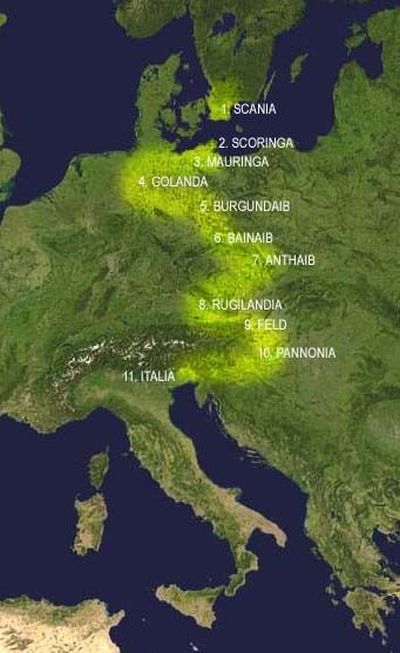
The Langobards' migrations

Reconstruction of the Langobards’ migrations – Langobards had given name to the region around Milan, Lombardy – Paul the Deacon mentions that the Lombards came from Scandia, but elsewhere he writes that they were not so numerous, because they came from only a small island, and this does not fit with Scandia. – Wikimedia Commons.

“And when the two armies came close to one another, it so happened that the sky above the Lombards was obscured by a sort of cloud, black and very thick, but above the Eruli it was exceedingly clear. And judging by this one would have supposed that the Eruli were entering the conflict to their own harm; for there can be no more forbidding portent than this for barbarians as they go into battle. However, the Eruli gave no heed even to this, but in absolute disregard of it, they advanced against their enemy with utter contempt, estimating the outcome of the war by mere superiority of numbers. But when the battle came to close quarters, many of the Eruli perished and Rodolphus himself also perished, and the rest fled at full speed, forgetting all their courage. And since their enemy followed them up, the most of them fell on the field of battle and only a few succeeded in saving themselves.”

“When the Eruli, being defeated by the Lombards in the above-mentioned battle, migrated from their ancestral homes, some of them, as has been told by me above, made their home in the country of Illyricum, but the rest were averse to crossing the Ister River, but settled at the very extremity of the world; at any rate, these men, led by many of the royal blood, traversed all the nations of the Sclaveni one after the other, and after next crossing a large tract of barren country, they came to the Varni, as they are called. After these, they passed by the nations of the Dani, without suffering violence at the hands of the barbarians there. Coming thence to the ocean, they took to the sea, and putting in at Thule, remained there on the island.”

Procopius was Belisarius’ secretary through three wars: against the Persians in Syria, against the Vandals in Africa and against the Goths in Italy. In all three wars, Heruls had been part of the Roman army. We must believe that Procopius had a very intimate relationship with them and that he had his information from the Heruli themselves. It is assumed that he published his reports on Emperor Justinian’s wars around 550 AD in Constantinople.

It is known from the Gothic chancellor Cassiodorus’ letters that the Goths in Italy tried to create an alliance with the Heruli, Thuringi and Varni against the Franks. Since he does not mention the Saxons, that we otherwise would expect, we must believe that Varni was an early name for the Saxons. We can imagine that the Saxons originally were called Varni and later got their name from their favorite weapon, the short single-edged sword, the sax; in the same way as the Langobards originally were called Vinil, but later was named after their favorite weapon, the long ax, langobard – bard as in the Danish name for halberd, hellebard.
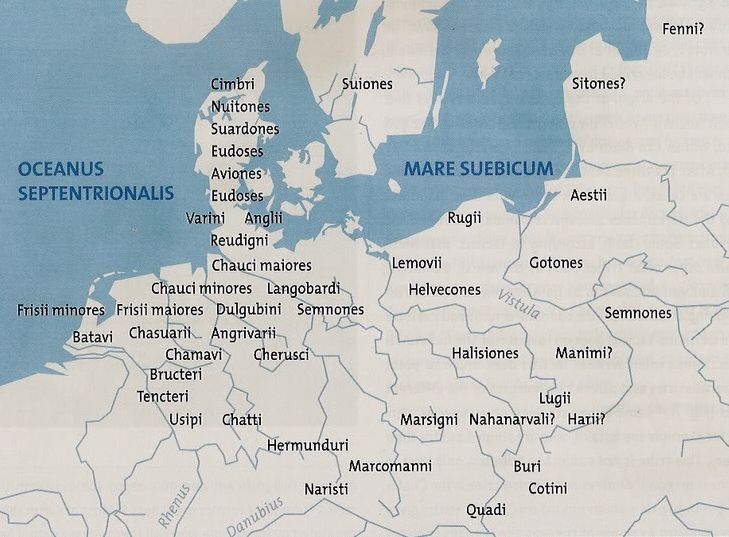
Germanic tribes after Taticus

Reconstruction of the Germanic tribes following Tacitus. He did not create any map himself, but many writers have sought to place the tribes on a map following his description. As it can be seen Jutland and North West Germany are somewhat crowded at the expense of other areas. Tacitus mentions Varini after Anglii, and that is probably an error by Tacitus, who had all information on second hand. Varini must be the Saxons. From “The Spoils of Victory. The North in the Shadow of the Roman Empire”. Edited by L. Jorgensen, B. Storgaard and L.G. Thomsen. Nationalmuseet, Copenhagen.

In that case, the Herulian travel party had followed the Rhine or more likely the Elbe, crossed “a large distance of barren land”, perhaps Luneburger Heide, then traveled through the land of the Varni that most likely was Saxony, and from there through “the nations of the Dani” – notice that they are in plural – which must have been Jutland. Then they crossed the sea and landed in Thule, which is the Scandinavian Peninsula. As they traveled through Jutland through several of the Danes’ nations, we must believe that they traveled a good distance up in Jutland, before they sailed over to Halland and Scania.

The earliest mention of Varni is by Tacitus in “Germania”, in which he wrote: “Then follows in sequence and Reudignians, Aviones and Angles and Varinians and Eudoses and Suardones and Nuithones; all defended by rivers or forests.” This means that the Varinians were neighbors to the Angles, which fits very well with the idea that they were a kind early Saxons and lived south of the “the nations of the Dani”. Alternatively, it is suggested that Varni lived at the river Warnow and the city of Warnemünde, it would then lead to that the returning Heruls sailed from northern Germany to perhaps Blekinge and Scania, and that they not – as reported – “passed by the nations of the Dani” before they “took to the sea, and putting in at Thule”.
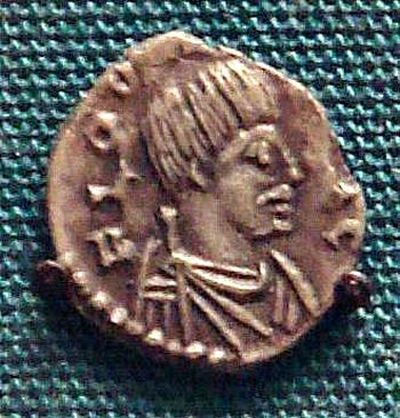
Coin with a portrait of Odovacar issued in Ravenna in 477 AD

Coin with a portrait of Odovacar issued in Ravenna in 477 AD. He has a mustache following barbaric custom and maybe hair done up in a pillow. He was in all probability a Scirii, a Gothic-speaking people, but Consularia Italica calls him King of Heruli. Consularia Italica is a collection of documents published by Theodore Mommsen in 1892. Other sources claim he was of Gothic origin. But Heruls constituted a large part of his men, and he was Rex Italia, therefore he was actually King of Heruli, though he himself was not a Herul. Moreover, Scirii was a kind of Goths, and as Odovacar was a Scirii, one can also say that he was a Goth. Thus, all statements are true. Odovacar deposed the last Western Roman emperor, Romulus Augustulus, in 476 AD. Jordanes wrote about Odovacar: “Now that Augustus was appointed emperor in Ravenna by his father Orestes, it did not last long before Odoacer, King of Torcilingi (Thuringi), invaded Italy, as leader of Sciri, Heruli and allies of various races” – Photo Wikipedia.

In Procopius’ report on the Heruls, they assure him several times that they lived in their original homeland when they fought their destiny battle against the Longobards. They did not tell Procopius that they originated from Scandia or another island, as Jordanes says. However, the term “passed the nations of the Dani, without suffering violence at the hands of the barbarians there” reveals, however, a somewhat tense relationship with the Danes, which suggests that Jordanes was right. Perhaps it was too humiliating for them to admit to Procopius that they two times had been expelled.

Following Paul the Deacon, the Rugi who lived north of the Danube opposite the Roman province Noricum, were defeated by Odoacer, who reigned in Italy. This happened 487-88 AD. He says that the victor led the Rugians away in large quantities, and the Longobards moved into the now almost uninhabited Rugiland, which must have been northern Austria, some believe Moravia. Here they were attacked by the Heruli, who, however, lost the fateful battle that followed, so that they were forced to leave their own country, as they told Procopius. This battle must most likely have taken place around the year 500 AD – and according to Paul in an area immediately north of the Danube.

As previously explained, it is likely that some Heruls were expelled from Scandinavia by Dani maybe around 200-300 AD The returning Heruls thus came back through “the nations of the Dani” 200-300 years after they had been expelled the first time.
Carruthers crest on flag-v2 (1)

OFFICIAL AND REGISTEREDL CLAN CARRUTHERS CCIS SINCE 1983-CLAN OF OUR ANCESTORS

SCOTTISH CLAN – IRISH CLAN – NORSE CLAN

Preserving Our Past!    Recording Our Present!  Informing Our Future!

The Ancient and Honorable Carruthers Clan International Society LLC

CLANCARRUTHERS1@GMAIL.COM

WIDE BANNER with NEW CREST

CLAN CARRUTHERS INT SOCIETY CCIS HISTORIAN AND GENEALOGIST

You can find us on our main facebook pages at :

SILVER WINGS-https://www.facebook.com/CarruthersClanLLC/

GOLD WINGS – https://www.facebook.com/carrutherscarrothers.pat.9

CLAN CARRUTHERS FAMILY HISTORY – https://www.facebook.com/CarruthersClan

CLAN CARRUTHERS CCIS – https://www.facebook.com/groups/3878691252182714

CLAN CARRUTHERS INT SOCIETY- https://www.facebook.com/groups/394653845137709

CLAN CARRUTHERS – BORDER REIVERS – https://www.facebook.com/groups/434959914239094

Disclaimer Ancient and Honorable Carruthers Clan International Socie
OUR ANCESTORS, The Viking Age

EARL HAAKON AND THE JOMSVIKINGS – CLAN CARRUTHERS CCIS

cropped-wide-banner-with-new-crestnorse

EARL HAAKON AND THE JOMSVIKINGS

CARRUTHERS ANCESTOR

Earl Haaken The Good Haraldsson Adalsteinfostre

BIRTH 920

DEATH 961  Battle of Fittar

Earl Haakon and the Jomsvikings

ACV_Promotional_Screenshot_31

Chief among the nobles of Haakon the Good, of Norway, was Earl Sigurd of Hlade; and first among those who followed him was Earl Haakon, Sigurd’s son. After the death of Haakon the Good, the sons of Gunhild became the masters of Norway, where they ruled like tyrants, murdering Sigurd, whom they most feared. This made the young Earl Haakon their bitter foe.

A young man then, of twenty-five, handsome, able in mind and body, kindly in disposition, and a daring warrior, he was just the man to contend with the tyrant murderers. When he was born Haakon the Good had poured water on his head and named him after himself and he was destined to live to the level of the honor thus given him.

It is not our purpose to tell how, with the aid of the king of Denmark, he drove the sons of Gunhild from the realm, and how, as the sagas tell, the wicked old queen was enticed to Denmark by the king, under promise of marriage, and by his orders was drowned in a swamp. Her powers of sorcery did not avail her then, if this story is true.

download (12)

Haakon ruled Norway as a vassal of Harald Bluetooth, king of Denmark, to whom he agreed to pay tribute. He also consented to be baptized as a Christian and to introduce the Christian faith into Norway. But a heathen at heart and a Norseman in spirit, he did not intend to keep this promise. After a meeting with the Danish king in which his baptism took place, he sailed for his native land with his ship well laden with priests. But the heathen in him now broke out. With bold disdain of King Harald, he put the priests on shore, and sought to counteract the effect of his baptism by a great feast to the old gods, praying for their favor and their aid in the war that was sure to follow. He looked for an omen, and it came in the shape of two ravens, which followed his ships with loud clucking cries. These were the birds sacred to Odin and he hailed their coming with delight. The great deity of the Norsemen seemed to promise him favor and success.

Turning against the king to whom he had promised to act as a vassal, he savagely ravaged the Danish coast lands. Then he landed on the shores of Sweden, burnt his ships, and left a track of fire and blood as he marched through that land. Even Viken, a province of Norway, was devastated by him, on the plea of its being under a Danish ruler. Then, having done his utmost to show defiance to Denmark and its king, he marched northward to Drontheim, where he ruled like a king, though still styling himself Earl Haakon.

Harald Bluetooth was not the man to be defied with impunity, and though he was too old to take the field himself, he sought means to punish his defiant vassal. Men were to be had ready and able to fight, if the prize offered them was worth the risk, and men of this kind Harald knew where to seek.

[Illustration] from Historical Tales - Scandinavian by Charles Morris

BUSY FARMERS IN A HILLSIDE FIELD ABOVE ARE, SWEDEN.

In the town of Jomsborg, on the island of Wollin, near the mouth of the Oder, dwelt a daring band of piratical warriors known as the Jomsvikings, who were famed for their indomitable courage. War was their trade, rapine their means of livelihood, and they were sworn to obey the orders of their chief, to aid each other to the utmost, to bear pain unflinchingly, dare the extremity of danger, and face death like heroes. They kept all women out of their community, lest their devotion to war might be weakened, and stood ready to sell their swords to the highest bidder.

How to Get all Unique Jomsvikings in Assassin's Creed Valhalla - ZetGaming

To this band of plunderers Harald appealed and found them ready for the task. Their chief, Earl Sigvalde, brought together a great host of warriors at a funeral feast to his father, and there, while ale and mead flowed abundantly, he vowed, flagon in hand, that he would drive Earl Haakon from the Norse realm or perish in the attempt. His viking followers joined him in the vow. The strong liquor was in their veins and there was no enterprise they were not ready to undertake. When their sober senses returned with the next morning, they measured better the weight of the enterprise; but they had sworn to it and were not the men to retreat from a vow they had taken.

Erik, an unruly son of Earl Haakon, had fled from his father’s court in disgrace and was now in Viken, and here the rumor of the vikings’ oath reached his ears. At once, forgetting his quarrel with his father, he hastened north with all the men he could gather to Earl Haakon’s aid, preceding the Jomsvikings, who were sailing slowly up the shores of Norway, plundering as they went in their usual fashion. They had a fleet of sixty ships and a force of over seven thousand well-trained warriors. Haakon, warned by his son, met them with three times their number of ships, though these were smaller and lighter craft. On board were about ten thousand men. Such were the forces that met in what the sagas call the greatest battle that had ever been fought in Norway.

Soon the embattled ships met and the conflict grew fast and furious, hurtling weapons filling the air and men falling on all sides. Great was the carnage and blood flowed in streams on the fighting ships. Earl Haakon stood in the prow of his ship in the heat of the fight, arrows and spears whirling around him in such numbers that his shirt of mail became so torn and rent that he threw it off as useless. The high ships of the vikings gave them an advantage which told heavily against their antagonists, spears and arrows being poured down from their sides.

Legendary Vikings - The History Of The Jomsvikings

In the height of the battle Earl Haakon disappeared. As the legends tell he went ashore with his youngest son Erling, whom he sacrificed to the heathen gods to win their aid in the battle. Hardly had he done this deed of blood when a dense black cloud arose and a violent hail-storm broke over the ships, the hail-stones weighing each two ounces and beating so fiercely in the faces of the Jomsvikings as nearly to blind them. Some say that the Valkyries, the daughters of Odin, were seen in the prow of the earl’s ship, filling the air with their death-dealing arrows.

Despite the storm and the supernatural terrors that they conjured up, the Jomsvikings continued to fight, though their decks were slippery with blood and melting hail. Only one coward appeared among them, their chief Earl Sigvalde, who suddenly turned his ship and fled. When Vagn Aakesson, the most daring of the Jomsvikings, saw this recreant act he was frantic with rage.

“You ill-born hound,” he cried, “why do you fly and leave your men in the lurch? Shame on you, and may shame cling to you to your death!”

A spear hurtled from his hand and pierced the man at the helm, where Sigvalde had stood a moment before. But the ship of the dastard earl kept on and a general panic succeeded, all the ships in the fleeing earl’s line following his standard. Only Vagn Aakesson and Bue the Big were left to keep up the fight.

Yet they kept it up in a way to win them fame. When Earl Haakon’s ship drew up beside that of Bue, two of the viking champions, Haavard the Hewer and Aslak Rock-skull, leaped on deck and made terrible havoc. In the end an Icelander picked up an anvil that was used to sharpen their spears and hurled it at Aslak, splitting his skull, while Haavard had both legs cut off. Yet the indomitable viking fought on, standing on his knees.

The onset of the Jomsvikings was so terrific in this last fierce fight that the earl’s men gave back, and might have been all slain had not his son Erik boarded Bue’s ship at this crisis and made an irresistible charge. A terrible cut across the face severed Bue’s nose.

“Now,” he cried, “the Danish maidens will kiss me no more.”

Seeing that all was at an end, he seized two chests of gold to prevent their capture by the victors, and sprang with them into the sea, shouting:

“Overboard all Bue’s men!”

Viking history : 986 - Sweyn Forkbeard became king

On Vagn’s ship a similar fierce fight was taking place, ending only when all but thirty of the vikings were slain.

Then a savage scene was enacted, one worthy only of those barbarous times. The captives were taken ashore and seated on a long log, their feet bound, their hands free. At the funeral feast in Sigvalde’s hall Vagn had boasted that he would kill Thorkill Laiva, one of Erik’s chief warriors, and this threatened man was now chosen as executioner.

At the captives he rushed, with uplifted axe, and savagely struck off their heads, one after another. Vagn was to be left to the last, that he might suffer from fear, but instead of this he sat joking and laughing with his men. One of them sang and laughed so loudly that Erik asked him if he would like to live.

“That depends on who it is that asks me.”

“He who offers has the power to grant. I am Earl Erik.”

“Then I gladly accept.”

Another made a pun which so pleased the earl that he, too, was set free.

Jomsvikings | Medieval history, Vikings, Norse

One of the captives had long, beautiful hair, and as Thorkill came near him on his bloody errand he twisted his hair into a coil and asked the executioner not to soil it with his blood. To humor him Thorkill asked one of the bystanders to hold the coil while he struck. The man did so, but as the axe came down the captive jerked his head aside so that the axe fell on the wrists of the coil-holder, both his hands being cut off.

“Some of the Jomsvikings are still alive,” laughed the captive.

“Who are you?” asked Erik.

“I am said to be a son of Bue.”

“Do you wish to live?”

“What other choice have I?”

At Erik’s command he, too, was released.

Vinland Saga Wiki on Twitter: "The Jomsvikings led by Floki Background on  who they are: "The Jomsvikings were an order of Viking mercenaries or  brigands of the 10th century and 11th century.

Angry at being thus robbed of his prey, Thorkill now sprang towards Vagn, determined that at least his special enemy should fall. As he came near, however, one of the men on the log threw himself forward in such a way that Thorkill stumbled over him and dropped his axe. In an instant Vagn was on his feet, seized the axe, and dealt Thorkill a deadly blow. His boast was kept; Thorkill had fallen by his hand.

Erik saw the bold feat with such admiration that he ordered Vagn to be freed, and the prisoners who remained alive were also set free at his order.

While this was going on Earl Haakon sat apart conversing with his chieftains. As they did so they heard a bow-string twang, and before a hand could be raised a keen-pointed arrow pierced the body of Gissur the White, one of the chiefs, and he fell over dead. The arrow had come from the ship of Bue the Big, and thither men ran in haste. What they saw was Haavard the Hewer, still standing on his knees, though his blood flowed freely.

“Tell me,” he cried, “did any one fall at the tree yonder?”

“Yes; Gissur the White.”

“Then luck failed me, for that arrow was aimed for Earl Haakon.”

And he fell over on the deck, with death at his heart-strings. The viking had sent a herald on before, to announce his coming at Odin’s court.

Jomsvikings - Wikipedia

It was Haakon who had ordered the murder of the captives, and Erik his son who gave life to so many of them. The time was near at hand when the earl was to meet the bloody fate which he had dealt out to others. Though Erik had done so much to help him in the battle, he was furious with his son for sparing the life of Vagn Aakesson. As a result they parted in anger, Erik going south again. Here Vagn joined him and from that day forward the two were warm friends and comrades.

But Haakon fell into ways of vice as he grew older, and at length he did a deed that led him to a shameful death. He had his men bring by force to his palace the wife of a rich peasant, and sent them for another, who was famed for her beauty. Orm, her husband, refused to let her go and sent news of the outrage to all the peasants in the valley. From farm to farm flew the tidings, and the peasants, furious at the shameful deeds of the earl, seized their arms and gathered in a great band, which marched upon him at Medalhus.

Earl Haakon was taken by surprise. He had not dreamed of a revolt and only a few men were with him. These he dismissed and fled for safety, only one man, his old servant Kark, going with him. Reaching the Gaul River in his flight, he rode his horse into a deep hole and left his cloak on the ice, so that his pursuers, finding the dead horse and the cloak, might think he was drowned.

From there he sought the nearby home of Thora of Rimul, a faithful woman friend, told her of the hot pursuit and begged her to hide him from his furious enemies. The only hiding place she could provide was a deep ditch under her pig-sty, and in this filthy hole the great earl was hidden, with food, candles, and bedding. Then boards were laid over the ditch and covered with earth and upon this the pigs were driven.

To Rimul the peasants soon came, filled with fury, and with them came a man of note who had just landed and was seeking to win the throne. This was Olaf, a great-grandson of Harold the Fair-Haired, whose claim to the crown of Norway was far better than that of Haakon. Thinking that Thora had hidden the fleeing earl the pursuers searched the whole place. The fugitive not being found, Olaf stood on a large stone near the pig-sty and called the peasants around him, loudly announcing that any man who should find and slay Earl Haakon would be given a large reward.

His words were plainly heard in the damp and unpleasant underground den where Haakon sat shivering. He looked at Kark, the thrall, whose face showed that he, too, had heard the promise of reward.

“What ails you?” asked the earl. “Your face changes from pale to dark and gloomy. Do you propose to betray me?”

“No,” said Kark.

“We were born on the same night, and if one of us dies the other will soon follow,” said the earl warningly.

For a long time they sat, listening to the sounds above. At length all grew still and they felt that the night had come. Kark fell asleep, but the earl sat awake, watching him in deep distrust. The slumbering thrall tossed about as if in pain and the earl wakened him, asking of what he had dreamt.

“I dreamed that you and I were on shipboard and that I was at the helm.”

“That means that you rule over both our lives. Therefore, Kark, you must be true and faithful to me, as duty bids you. Better days will soon come to us both and then you shall be richly rewarded.”

Again the thrall fell asleep and again he seemed to dream. The earl woke him again.

“Of what did you dream?” he asked.

“I dreamed that I was at Hlade and that Olaf Tryggvesson put a golden ring around my neck.”

“That means,” said the earl, “that if you seek Olaf he will put a red ring [a ring of blood] around your neck. Beware of him, Kark, and trust in me. Be faithful to me and you will find in me a faithful friend.”

Jomsvikings - Wikipedia

The night dragged slowly on. The earl dared not let himself sleep, but sat staring at Kark, who stared back at him. When morning was near at hand weariness lay so heavily on the earl that he could no longer keep awake. But his sleep was sorely disturbed by the terrors of that dreadful night. He tossed about and screamed out in distress and at length rose on his knees with the horrors of nightmare in his face.

Then Kark, who had all night been meditating treachery, killed him with a thrust of his knife. Cutting off his head, he broke out of the dark den and sought Olaf, with the grisly trophy in his hand.

Olaf heard his story with lowering face. It was not to traitors like this that he had offered reward. In the end, burning with indignation at the base deed, he ordered the thrall’s head to be struck off. Thus Kark’s dream, as interpreted by Haakon, came true. The ring put by Olaf around his neck was not one of gold, but one of blood.Carruthers crest on flag-v2 (1)

OFFICIAL AND REGISTEREDL CLAN CARRUTHERS CCIS SINCE 1983-CLAN OF OUR ANCESTORS

SCOTTISH CLAN – IRISH CLAN – NORSE CLAN

Preserving Our Past!    Recording Our Present!  Informing Our Future!

The Ancient and Honorable Carruthers Clan International Society LLC

carruthersclan1@gmail.com                carrothersclan@gmail.com

WIDE BANNER with NEW CREST

SCANDINAVIAN HISTORY #9
CHARLES MORRIS

CLAN CARRUTHERS INT SOCIETY CCIS HISTORIAN AND GENEALOGIST

You can find us on our main facebook pages at :

SILVER WINGS-https://www.facebook.com/CarruthersClanLLC/

GOLD WINGS – https://www.facebook.com/carrutherscarrothers.pat.9

CLAN CARRUTHERS FAMILY HISTORY – https://www.facebook.com/CarruthersClan

CLAN CARRUTHERS CCIS – https://www.facebook.com/groups/3878691252182714

CLAN CARRUTHERS INT SOCIETY- https://www.facebook.com/groups/394653845137709

CLAN CARRUTHERS – BORDER REIVERS – https://www.facebook.com/groups/434959914239094

Disclaimer Ancient and Honorable Carruthers Clan International Socie
Gutland / Gotland, OUR ANCESTORS, The History of Gutland, The Viking Age, Uncategorized

MAIL TROLLS AND ATGEIRS – THE MYSTERIOUS WORLD OF VIKING POLE WEAPONS-CLAN CARRUTHERS CCIS

cropped-wide-banner-with-new-crestnorse

MAIL TROLLS AND ATGEIRS – THE MYSTERIOUS WORLD OF VIKING POLE WEAPONS

If you think of a Viking warband, the modern image would be one of men armed mainly with swords. However when you read Old Norse literature, the predominate weapon mentioned is the spear or more often, something usually translated as a “halberd”. In the original Old Norse, however, we find a variety of intriguingly named weapons being translated to that one term.

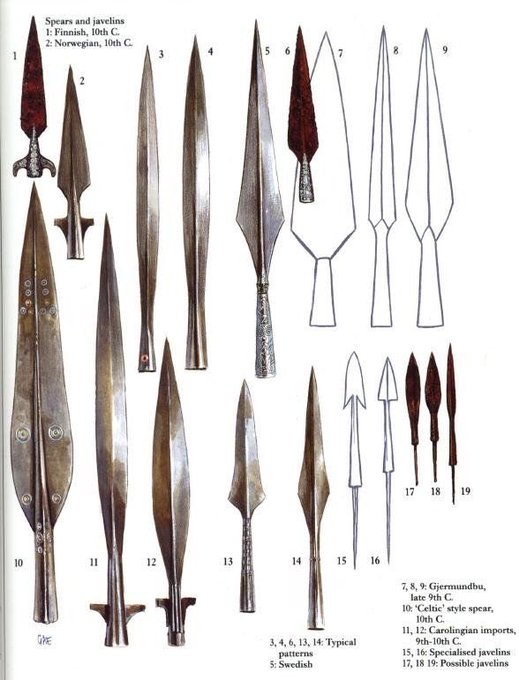
The usual Old Norse word for spear is geirr. Another common term often used is a kesja. The saga’s also name other, now obscure varieties of blades mounted on sticks, including atgeirr, höggspjót, brynþvarar and bryntroll.

That all of these are a type of blade on a stick, something we would otherwise call a “spear”, is not in doubt. However their use and appearance in medieval literature is sufficiently different to what our notion of a spear is to warrant translators from Victorian times to use a different term, usually “halberd” or “bill”.

This is itself raises an issue, as halberds, pikes and other pole-arms developed in the later middle ages, so were anachronistic to the Viking age when the characters in the sagas are described as wielding them. So the possibility exists that these are types of weapons now lost to history.

The saga writers have a frustrating tendency not to describe these weapons, hinting that they were very familiar to the audience they were writing for. However it means the we are left to seek for clues amid the texts for what they really were.

The atgeirr is probably the most famous of these. It was the weapon of choice for Gunnar Hámundarson, the Icelandic warrior and main character of Njal’s Saga, one which he uses to devastating affect on many characters in the saga. Apart from using it as a vaulting pole to leap, Lone Ranger-like, onto his horse for a quick get away, Gunnar kills many men with his atgeir.

Image

Compared with sword and axe, the spear was relatively cheap and effective to produce. Because of its length, it was probably the most important weapon in close combat. Together with arrows it also posed a big threat when it was thrown.

At one point in the saga Gunnar hoists an adversary impaled on the atgeirr aloft. When his enemies gang up on him and one tries to sneak onto the roof, Gunnar shoves his atgeirr out the window, catching Thorgrim in the stomach. The unfortunate man tumbles off the roof. His comrades ask him if Gunnar is at home.

“You can find that out for yourselves,” said Thorgrim; “but this I am sure of: His atgeirr is at home,” and with that he fell down dead.

Thorgrim’s last words, so typical of the black humour of the Sagas, also hint at the regard in which Gunnar’s weapon was held. Gunnar’s weapon is referred to as atgeirinn – “The atgeir”, which suggests it was a unique, special item – a magic weapon worthy of a Dungeons and Dragons quest – however atgeirrs are named in Laxdœla Saga and the Eyrbyggja Saga too. Gunnar’s was rumoured to have a life of its own, the blade ringing when it was lifted off its bracket on the wall if it was to taste blood soon.

Viking Weapons High Resolution Stock Photography and Images - Alamy

But what was it? Geirr is simply a very old word for spear, so as Jan H. Orkisz points out, the importance must lie in the “at” part of its name. The common interpretation of “at” appears to be as “excellent” or “very” – hence perhaps “most excellent” or “best” spear. However Orkisz points out that this ultimately derives from a Latin prefix ad-, and Old Norse had a poetic use of at- to denote fight, clash or attack. Hence atgeirr would be “battle spear” or “fighting spear”. The way Gunnar and others use it in the saga point towards a heavy spear used in hand-to-hand fighting, perhaps like a heavy board spear, rather than a javelin hurled at the enemy while they are still at a distance.

The höggspjót is another weapon appearing in the sagas. Spjót is again just another word for spear. Högg is a form of the verb höggva which means “to strike, to smite”. It’s tempting to again translate this as another “battle spear”, however the verb is often used in the context of cutting down a tree or wielding an axe, so the name “Hewing spear” might be more appropriate. Some of the descriptions of its use correlate with the idea of a long, heavy blade mounted on a pole, capable of slicing through shields and the flesh and bone of the unfortunates holding them. Egil Skallagrimsson carries a höggspjót on his ill-fated meeting with Rognvald, ( CARRUTHERS ANCESTOR)  the young son of King Eirik Bloodaxe  ( CARRUTHERS ANCESTOR)  of Norway.

Egil’s Saga also mentions another weapon, the brynþvarar and gives quite a detailed description of itThorolf strides into the Battle at Brunanburgh “armed like this”:

Kesju hafði hann í hendi. Fjöðrin var tveggja álna löng ok sleginn fram broddr ferstrendr, en upp var fjöðrin breið, falrinn bæði langr ok digr, skaftit var eigi hæra en taka mátti hendi til fals ok furðuliga digrt. Járnteinn var í falnum ok skaftit allt járnvafit. Þau spjót váru kölluð brynþvarar.

“He had a kesja [spear] in his hand…the feather-formed blade was two ells long, ending in a four-edged spike; the blade was broad above, the socket both long and thick. The shaft stood just high enough for the hand to grasp the socket, and was remarkably thick. The socket was fitted with an iron prong on the shaft, which was also wound round with iron. Such spears [spjót] were called brynþvarar.”

In the middle, a large bayonet-spear from the Gournay-sur-Aronde sanctuary in northern France.
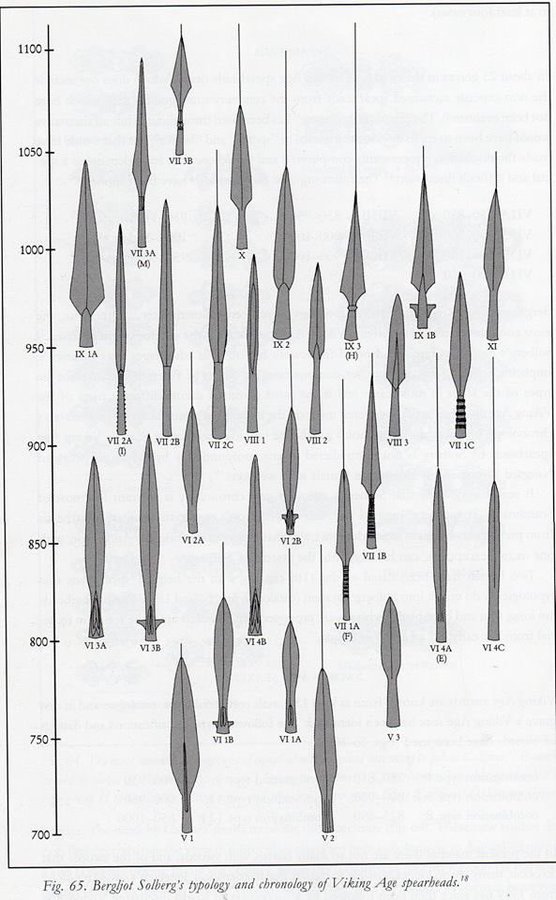
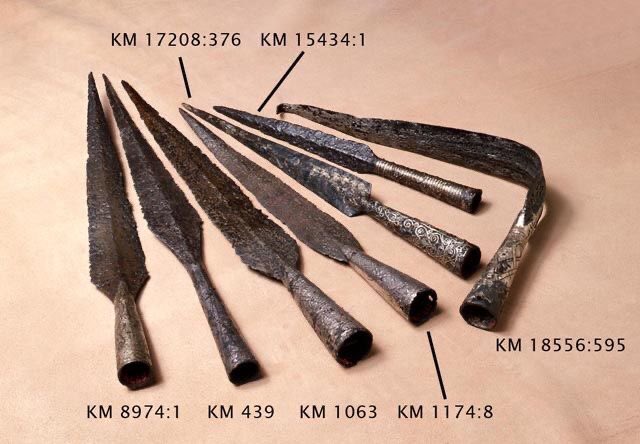
An ell was the distance from the elbow to the tip of the middle finger, about 18 inches. Therefore at 2 ells the blade of this weapon was about 36 inches long, or 3 feet, which is impressive for a spear.  It would seem that this weapon has a short, thick shaft, and the impression is some sort of short implement, mostly blade, specifically designed for piercing mail. Though perhaps not very short. Later in the battle, gripped by berserker rage, Thorolf does a Vlad Tepeș. He lunges at an enemy Jarl’s chest with the brynþvarar, “driving it right through mail-coat and body, so that it came out at the shoulders; and he lifted him up on the halberd over his head, and planted the butt-end in the ground”. Ouch.

Image

The Old Norse word spjót (spear) is related to the Old French word espiet which means “the spy, one who stares from a long distance”.

The bryn part of the name refers to the brynja, the Old Norse name for a mail shirt. My Old Norse dictionary lists þvari as meaning a “bolt or spear”. In other words this was a special type of spear, specifically designed for piercing mail. Possibly closely related to the brynþvarar we have the bryntroll. We’ve already covered that bryn means mail and troll speaks for itself. It’s a monster, an enemy, a creature that destroys, so the weapon is a troll or moster for mail shirts. The effectiveness of medieval spears against mail is demonstrated in this video:

Image

There was also the rather horrible sounding “Hooked Spear”, the Krókspjót, a weapon so nasty a law was passed forbidding its use.

So at the end of the day these all appear to be varieties of spear. That they were not swords is underlined by the way in many sagas the hero is specifically mentioned as having a sword as well, either at his belt or, in Egil’s case, tied to his wrist.

That spears would be important to pagan Scandinavians should not be that surprising. The spear was the weapon sacred to the God Odin. Battles were traditionally started by one side hurling a spear over their opponents and yelling “Óðinn á yðr alla” – Odin owns you all. Being transfixed by a spear while also being hung appears to have been the way to sacrifice a human being to Odin.

Another other possibility is that these are all anachronisms. Medieval saga writers could have been giving impressive modern (for them) weapons to their heroes to make them look cool to a contemporary audience, or to use terms they were familiar with.

Carruthers crest on flag-v2 (1)

OFFICIAL AND REGISTERED CLAN CARRUTHERS  CCIS -1983-CLAN OF OUR ANCESTORS
SCOTTISH CLAN, IRISH CLAN,  NORSE CLAN

Preserving Our Past!    Recording Our Present!  Informing Our Future!

The Ancient and Honorable Carruthers Clan International Society CCIS

carruthersclan1@gmail.com                carrothersclan@gmail.com

Crest on Light Blue

TODD HODKINSON

http://timhodkinson.blogspot.com/2019/09/mail-trolls-and-atgeirs-mysterious.html?m=1

Reviewed by Tammy Wise CHS- CHAIRMAN – Indiana USA

CLAN SEANACHAIDHI

CLAN CARRUTHERS INT SOCIETY CCIS HISTORIAN AND GENEALOGIST

You can find us on our main facebook pages at :

SILVER WINGS-https://www.facebook.com/CarruthersClanLLC/

GOLD WINGS – https://www.facebook.com/carrutherscarrothers.pat.9

CLAN CARRUTHERS FAMILY HISTORY – https://www.facebook.com/CarruthersClan

CLAN CARRUTHERS CCIS – https://www.facebook.com/groups/3878691252182714

CLAN CARRUTHERS INT SOCIETY- https://www.facebook.com/groups/394653845137709

CLAN CARRUTHERS – BORDER REIVERS – https://www.facebook.com/groups/434959914239094

Disclaimer Ancient and Honorable Carruthers Clan International Society

References:

Gutland / Gotland, OUR ANCESTORS, The History of Gutland

WEAPONS OF THE VIKINGS – CLAN CARRUTHERS

cropped-wide-banner-with-new-crestnorse

WEAPONS OF THE VIKINGS

Viking Weapons

The weapons found at Viking sites tend to be swords, axes, spears and bows – warriors were buried with their weapons. Interestingly, we have less evidence from Denmark because their earlier adoption of Christianity stopped this practice, which continued for a longer period in Sweden and Norway.

The Sword

Viking swords were long, straight and double-edged (over 2,000 found in Scandinavia) Viking swords were not particularly sharp at the end as some varieties were, as they were used primarily for hacking and slashing, not for stabbing.

Image courtesy of Grimfrost – where you can buy your own!

There were local variants of the longsword – the long-sax which was around 3 feet long and single edged.

Swords were very expensive and so poorer freemen would have an axe or spear. However, raiding was so lucrative for the Vikings that after one raid, anyone would have enough to afford their own sword. As such, most raiders in a Viking warband would carry their own sword. The wealth and status was then demonstrated not by owning a sword, but by how decorated it was – different metals inlaid on the pommel for example.

The Axe

A replica of a 10th century Viking axe head found in England. This was a very common style

Aswell as swords, axes were decorated to reflect the status of its owner. As with most romanticised periods, there are some embellishments in popular culture and the huge two handed, double or wide bladed axe was not a common weapon through much of the period and was a specialised fighting implement. By the end of the Viking era though, they were a distinguishing mark of the Huscarls who would use them to fight against the mail-clad soldiers of their adversaries.

The Spear

Tim Hodkinson, author of Odin’s Game shared this brilliant blog post he wrote on the use of spears and polearms, check it out here!

The Bow

The bow was used by Vikings fairly commonly, though you don’t hear as much about them with the focus on their axes. Vikings utilised both long and shortbows, and they are mentioned in the sagas. If you look to the right on the below image (of the Bayeux Tapestry) you can see the anglo-saxon shieldwall, flanked by a bowman. This is generally the technique used by the Vikings too, as supporting troops to back up the shield wall. An arrow was often fired over the heads of the enemy troops on Viking battles to signify the start of the battle.


Carruthers crest on flag-v2 (1)

OFFICIAL AND OLDEST SCOTTISH  CLAN CARRUTHERS

 SINCE 1983-CLAN OF OUR ANCESTORS

SCOTTISH CLAN – IRISH CLAN – NORSE CLAN

cropped-wide-banner-with-new-crestnorse

Reviewed by Tammy Wise CHS   –    Indiana USA

CLAN SEANACHAIDHI

CLAN CARRUTHERS HISTORIAN AND GENEALOGIST

Carruthers crest on flag-v2

Preserving Our Past!    Recording Our Present!  Informing Our Future!

The Ancient and Honorable Clan Carruthers 

clancarruthers1@gmail.com

This image has an empty alt attribute; its file name is 59ef7250711564a8761d3a0b23bc2353.jpg

You can find us on our main facebook pages at :

SILVER WINGS-https://www.facebook.com/CarruthersClanLLC/

GOLD WINGS – https://www.facebook.com/carrutherscarrothers.pat.9

CLAN CARRUTHERS FAMILY HISTORY – https://www.facebook.com/CarruthersClan

CLAN CARRUTHERS CCIS – https://www.facebook.com/groups/3878691252182714

CLAN CARRUTHERS INT SOCIETY- https://www.facebook.com/groups/394653845137709

CLAN CARRUTHERS – BORDER REIVERS – https://www.facebook.com/groups/434959914239094

Disclaimer Ancient and Honorable Carruthers Clan International Society
Gutland / Gotland, The History of Gutland, The Viking Age, Uncategorized

THE KINGS JELLING – CLAN CARRUTHERS CCIS

cropped-wide-banner-with-new-crest.jpg

THE KINGS JELLING


The kings Jelling - featured image


Jelling is a small town in Jutland/Gutland  which is of little significance today. But a bit more than a thousand years ago it was the center of the newly formed kingdom of Denmark. The first recognized members of the Danish royal family had their main base in this village of Jelling. They left behind significant monuments in the form of a massive grave site – it is actually the largest ancient grave in Denmark showing the family had immense wealth and power so they could give such a burial for their founding member.

Old harnish for dogs

The biggest attraction of the town is the large Rune Stones standing outside the church. There is one big and one small – the biggest one is the youngest one erected by Harald Bluetooth ( CARRUTHERS ANCESTOR). On this stone the name Denmark is first written down anywhere in the world making it kind of a birth certificate of Denmark.

You can go and explore the outside monument area day or night and there is free access to go and see the burial mound and the stones which are covered in a glass cage to protect them against the Danish climate which can be rough for a stone over time.


Remains of an ancient bridge

The importance of the site has led to the foundation of a branch of the Danish National Museum right opposite the monument area. The museum is free to enter so if you come during the visiting hour of the museum you should go inside and get a bit more of the store of the area and the oldest history of Denmark.

The museum is an interactive museum which should be able to entertain kids for a while. There are only a limited number of actual ancient artifacts on display – probably because you have only found a limited number of artifacts in the area of Jelling which were only used as the main royal seat for a short period and only had a limited permanent population in ancient times.

The displays and stories are both in Danish and English making it possible to follow for most visitors to the museum. It is good to visit the place either before or after a visit to the monuments outside – but you can enjoy the outdoors without the museum as well if you come outside opening hours.

Carruthers crest on flag-v2 (1)

OFFICIAL AND REGISTERED CLAN CARRUTHERS  CCIS -1983 CLAN OF OUR ANCESTORS

SCOTTISH CLAN, IRISH CLAN, NORSE CLAN

HERE IS A LINK TO WHO ARE THE VIKINGS AND ALSO JUTLAND AND GUTLAND ARE ONE IN THE SAME  https://clancarruthers.home.blog/2021/12/09/why-were-they-called-vikings-clan-carruthers-ccis/

Preserving Our Past!    Recording Our Present!  Informing Our Future!

The Ancient and Honorable Carruthers Clan International Society CCIS

carruthersclan1@gmail.com                carrothersclan@gmail.com

Crest on Light Blue

Reviewed by Tammy Wise CHS- CHAIRMAN – Indiana USA

CLAN SEANACHAIDHI

CLAN CARRUTHERS INT SOCIETY CCIS HISTORIAN AND GENEALOGIST

You can find us on our main facebook pages at :

SILVER WINGS-https://www.facebook.com/CarruthersClanLLC/

GOLD WINGS – https://www.facebook.com/carrutherscarrothers.pat.9

CLAN CARRUTHERS FAMILY HISTORY – https://www.facebook.com/CarruthersClan

CLAN CARRUTHERS CCIS – https://www.facebook.com/groups/3878691252182714

CLAN CARRUTHERS INT SOCIETY- https://www.facebook.com/groups/394653845137709

CLAN CARRUTHERS – BORDER REIVERS – https://www.facebook.com/groups/434959914239094

Disclaimer Ancient and Honorable Carruthers Clan International Society
Gutland / Gotland, The History of Gutland, The Viking Age

CLAN CARRUTHERS CCIS-BEOWULF AND THE GUTA SAGA

cropped-wide-banner-with-new-crest.jpg

CONNECTING BEOWULF AND THE GUTA SAGA


In 2017 Clan Carruthers CCIS started part 2 of the Carruthers DNA projects.  For almost 15 years people have been contributing their DNA samples to make connections.    We took that data, and other data people had, to see where it took us.  At this point we found Forensic DNA would give us what we need, with a price of $800.00 – $1500.00 per test.  
 
We were interested in the Scottish line, but the Genetic Genealogist told us we were connected to the Beowulf Vikings.  Here we are 4 years later working on the Norse DNA project. 
 
There is something called the Beowulf epos, from the beginning of the 500s, which is the oldest known Germanic epos, by some regarded as the Germa-nic-speaking peoples counterpart to the Greek Iliad and Odyssey.
Historians and linguists have tried in various ways to interpret and t the epic
into the Swedish history without much success. However, it is now proven that it has its home in the Gotlandic history. Together with the Gotlandic picture stones and Guta Saga the Beowulf epos
constitutes Gotland’s nest historical records.
 The Gotlandic picture stones indicate intensive contacts with the literary world of the time. From these sources you can also read the historical relationship between the Gotlanders and they in the beginning of the 500s immigrating Heruls (Svear). The Beowulf epos is the ancient Germanic world’s great epic poem. 
 
According to professor Björn Collinder: “The Beowulf Epos argues well its place among epics in world literature. And it contains lyrical passages of great beauty”. ”A fastidious reader discovers in the Beowulf epos some contradicto-ry details. But the contradictions are not worse than those found in the Gospels and the Acts.”
 
“The Beowulf epos contains much that is difficult for contemporary people to
understand. The Epos writer could make do with hints when it came to events and inherited legends which were renowned for his audience. ”“To understand and appreciate the Beowulf epos we must put ourselves in the ancient Germanic view on life and death, danger and glory, and it should not be entirely impracticable.
Since several people, who figure in Beowulf, are also mentioned in other independent tales, we must assume that they are historical, and if so should the rest of the characters also be historical. From Gregory of Tours reference in Historia Francorum, we know that Hygelak died in battle in Friesland about the year 521. Although we have no other source that says that Beowulf has lived, it should still have been so. His name was probably not Beowulf but, according to Collinder, rather Älf-here (Alvar, Avair). He is the prototype of a Scandinavian hero, stronger and braver than any of the fighters of his time and wiser than most, and he is a good king, with all that it implies.
 The Sagas refer briefly to the wars between Gotlanders and Danes, and Gotlanders and Frisians, between Skilngs (Svear) and Danes, the Danes and Frisians and Danes and Heathobards. The only conflict told in detail is between Gotlanders and Skilngs (Svear),
 which is described in a story inside another story. Interestingly, in the verses 2472- 2473 it says: “There was hostility and strife
between Skilfings (Svear) and Gotlanders, discord and violence across wide
 waters.”
 
beastofgotlandmen

 We can now connect Beowulf with the Guta Saga
“Many kings fought against Gutland while it was thought to be heathen; the Gotlanders, however, always held the victory and constantly protected their rights. Later the Gotlanders sent a large number of messengers to the Svear, but none
of them could make peace before Avair Strabain from Alva. He made the first
peace with the king of the Svear. When the Gotlanders begged him to go he answered: “you know that I am now most doomed and ill-fated. Grant me then, if you wish me to expose myself to such peril, three wergilds ( “Mansbotwergild’, fines according to the old Nordic law was paid by a murderer or his kin to the slain family, which then declined to exact blood vengeance”), one for myself, a second for my begotten son and a third for my wife.’ Because he was wise and skilled in many things, just as the tales go about him. ”Beowulf has historically been dated to the beginning of the 500s.
 
 The battles between the Svear and Gotlanders should have been in the first
half of the 500s. Procopius information that the Heruls (Svear) would have
immigrated to the Lake Mälar area about the year 512 .
 
By comparing the various testimonies I have dated Avair Strabain to mid 500s.
In the Beowulf epos the geographical framing is Denmark and the land of the
Geats (older source Geta) Gotland. The main characters are Beowulf and to some extent, his uncle Hygelak, Rex Getarum.
 
The story begins by describing
the monster Grendel who haunts the Danish king. Then it tells how Beowulf decides to help the Danish king and makes his way on a two-day voyage across
the open sea, after which he kills Grendel. The story continues to talk about the wars between the Geats and the Svear, who are still at that time not known
as Svear but Skilfings, and ends with a description of the death of Beowulf
 when he tried to rob a grave
 
In the story it is presupposed that the audienceis familiar with contemporary history. Many people and events mentioned in
 This by wide waters has been difcult for previous researchers to explain as
they have not been aware that this was with the Gotlanders. However, if we talk about Svear and Gotlanders it falls completely natural. In addition, it says in verse 2954, when the Svear talk about the Gotlanders: “toresist the men from the sea.”
 

 Thus the audience was expected to know how Hama some hundred years earlier and in another part of the world had stolen the Brisinga jewel from the Gothic King Ermanarik. This suggests that the Geats stood in close relation to the Goths. Even the
Goths’ rich culture has given the Gotlanders a lot of new injections, reflected
in the Gotlandic society, when the Goths moved on to the Black Sea.
 
The archaeological and linguistic testimony suggests that the Goths, the oldest name is Gutans and their kingdom Gutthiuda, had close relationship with the Gotlanders. In addition, we must not forget that the Gotlanders, along with the tribal kinsmen the Ostro-goths were Christians of the Arian faith, and that parts of their bible are now preserved in Uppsala, the Silver Bible. It is therefore very likely that  Gotlanders were familiar with Christian doctrine already at this time. Even, according to several archaeologists, some contemporary burial customs on Gotland suggest Christian elements. It is interesting to note that the Bible was translated into Gotlandic by the Goths 1200 years before it was translated into Swedish. Since the Beowulf poem holds quite some Christian expressions
and thoughts, it did not fit into the idealized image of the Swedish pre-Chris
tian times that among others, Tegnér tried to produce. This should be a cause to the poor circulation of what we then thought was a Swedish epos. The Heruls (Svear) had at their immigration early 500s the Æsir belief and would therefore be promoted as ‘barbaric’. The archaeologist Gad Rausing has attacked the problem with Beowulf and the Geats in a very conscientious way. He has, as probably the only researcher,
actually traveled ‘Beowulf’s way’ and identied the geographic characteristics. He has published his findings in Fornvännen 80 (1985) . Already Grundtvig, Danish cultural personality from 1783 to 1872, guessed at
the time that the Geats in the Beowulf epos could be the same as the Gotland-ers. ( *** We now know that they are DNA matches ) Since he did not elaborate on this assumption and did not come with good reasons for this conclusion, other scholars regarded it as uninteresting. It was at that time the scholars had decided that the Geats ought to be the Götar in Västergötland. However, some scholars protested to this Västgöta position as it clearly says in the Beowulf epos that the battle between Svear and Geats occurred over open water and the Geats also were called the men from the sea. As we know, there are not any open water between the Lake Mälar area and Skara in Västergötland. We have, however, vast waters between Gotland and the Lake Mälar area.
 
210881934_1091563418036508_62323767751641818_n


“The lay of Beowulf describes the court of king Hrothgar, who resided in
the largest and most magnicent of halls, who rewarded his warriors with golden rings and with magnificent arms, among which ring-swords are specifically
mentioned (verse 2042), in terms which suggest the Roman Iron Age or the Migration Period.
 
 Apparently the Sköldunga kings had conquered Denmark some generations
earlier and the dynasty appeared well established when an enemy, Grendel, attacked. “So Grendel became ruler”. The war lasted for a long time, twelve years being mentioned. Finally Beowulf, with fourteen companions, came from  Geatland to Hrothgar’s aid. The description of his voyage and of his landfall is quite clear: Away she went over the wavy ocean, boat like a bird, breaking seas, wind-wet-ted, white-throated, till the curved prow had ploughed so far – the sun standing right on the second day that they might see land loom on the skyline, then the shimmer of cliffs, sheer fells behind, reaching capes.
 
Apparently they sailed across the open sea, making their landfall as planned onthe second day out on a coast of high white cliffs with capes reaching far outinto the sea. Modern commentators have always found this description incom-
patible with their ideas of Danish geography and topography, the site of He
orot usually thought to have been Leire, far inland from a coast conspiciouslylacking in cliffs and headlands.Few commentators, if any, have been sailors familiar with northern waters and
few, if any, appear to be familiar with Danish topography. The passage has been
taken to be a late addition to the saga, since it appears to describe a crossing
of the North Sea and a landing beneath the white cliffs of Dover. Actually, the
passage proves that the waters crossed were not to have been the Channel, andthus strongly suggests that the poem was not composed in Britain.
Either you cross at Dover, where the Channel is narrow and the crossing a
matter of hours, even in an open row-boat, to land beneath the famous cliffs,or you cross elsewhere, either north or south of the narrows, where the passagemight require two days, but where there are no white cliffs.
Can any conclusion be drawn from the actual distribution of the Danish archa
eological material of the Iron Age, in conjunction with the geographical features described in Beowulf? Obviously, mere map-reading is not good enough.
 
For any conclusion to be valid the observations must have been made in the
field or at sea. The geographical features being seen as Iron-Age man saw them,
on foot, from horse-back or from a comparatively small, open boat.
In Denmark, the richest burials of the early Iron Age are concentrated in the
southern part of Lolland island. This concentration of wealth probably mar-ked the political center of the country or, at least, the territory of the politically and economically dominant families.
In the Later Roman Iron Age, the fourth and fifth centuries, the rich burials
 were concentrated in south-east Sjaelland, with Himlingøje as the type locality, with seven ‘royal’ mounds and a great number of rich burials without mounds. There is a number of rich cemeteries in the area, such as Valløby, Varpelev and others. The same district, centering on Stevns, appears to have remained the
richest part of Denmark all through the Migration Period, 500s and 600s. At
least, it has yielded the greatest number of gold objects of this period, inclu-
ding the largest of all gold rings known from Denmark, found at Hellested on
Stevns. The numerous paved roads and fords which cross the valley and thestream almost separating Stevns from the rest of Sjaelland also indicate that thearea was of special importance, nothing similar having been found anywhereelse in Scandinavia. The center of economic and, probably also of political
power shifting from Lolland to east Sjaelland may have been caused by the first appearance of the Danes in the country. According to the sagas, they came
from central Sweden, where they can be traced in many placenames, such as
Dannemora, Danderyd and even Danmark, now a parish in Uppland.
 
Beowulf is silent on this point, even though Hrothgar only belonged to the
fifth generation of the Sköldunga family, (i.e.the fth generation after the con-quest?) and ve generations cover no more than 100-150years.
 
However, the riches described do t what we know of economic conditions on Stevns in late
Roman Times or in the early part of the Migration Period. Everything suggests that, at this time, the royal residence had not yet been moved to Leire but was still somewhere in southeast Sjaelland. The description of Beowulf’s landfall and of his subsequent march to Heorot leaves little doubt:… the shimmer of cliffs, sheer fells behind, reaching capes. A coastguard, usually posted on these cliffs, met the hero on the beach and accompanied him and his companions to Heorot. Paved Roman roads being still in use in 700s England, there would have been no particular reason for mentioning them, had the poem been composed in that country.
 
Denmark was different. There, paved roads of Iron Age date are few indeed,  

and there is but one single area in Scandinavia, corresponding to the description: high white cliffs jutting into the sea, a neighbouring beach for landing, a paved road leading to the royal residence of late Roman times or of the early part of the Migration Period: Stevns Klint in Denmark. The white chalk cliffs of Stevns rise straight out of the sea, more than 40 m high, facing east. Behind them stretch down, bordered in the west by a river valley about 500 m wide, running almost the whole way from Køge Bay to Faxe Bay, separating Stevns peninsula from the rest of Sjaelland. This valley and its river is crossed by a number of prehistoric paved roads and fords, those at Varpelev, Elverhøj, Harlevand Kari-se I dating from the end of the Late Roman Iron Age and the beginning of the
Migration Period.
 
Down one of these marched Beowulf and his companions
on their way to king Hrothgar.“There was stone paving on the path that brought the war band on its way.” This passage also proves that the scene can not have been set on Rügen, the only other place where white chalk cliffs face the Baltic Sea, since it lacks the paved roads and the rich Iron Age of Beowulf’s tale.
 The description fits the picture of the Iron Age settlement pattern outlined by
Nylén, a situation where sea-borne attacks might be expected at any moment and where, in consequence, farms and settlements were always at some distance from the shore 
 
But what conclusions can be drawn as to the land of the Geats, Beowulf’s country? As mentioned previously, the account of the voyage has been taken to describe a crossing of the North Sea and a landfall in Britain. The factual evidence of the saga having been thus disposed of, the land of the Geats could be located anywhere in south Sweden or in Denmark and it has even been suggested that the waters separating the land of the Geats from that of the Swedes might have been lake Vänern and the lakes of central Sweden.  But if we accept the description of the actual voyage, with the wind directions prevalent in the South Baltic Sea in early summer, and the time stated, a different explanation appears more plausible.
 
Apparently, Beowulf made his land fallon the second day out from the land of the Geats. It is expressly stated that he used sail. There is no indication as to the size of the ship. However, since the band comprised but fifteen men, the vessel must have been quite small, nothing
to compare with the Nydam boat or with the Sutton Hoo ship. The Nydam vessel, some 25 m between perpendiculars, and close on 18 m on the waterline,
appears to have had fifteen pairs of oars. The minimum crew must then have
been 62 men, two watches of 30 oarsmen and one helmsman each.
 
 The Sutton Hoo vessel appears to have had 20 pairs of oars, and consequently a minimum crew of 82.Beowulfs vessel must have been very much smaller, presumably a square-rigged boat with 3 pairs of oars, with an overall length in the order of 10 m. Such a boat would have had a waterline of about 7-7.5 m. The distance from Cape Hoburgen, the southern tip of Gotland, around the southern tip of Öland and Utklippan island, between the Hammers of Scaniaand of Bornholm, the latter a high cape visible from a great distance, and onwards, along the Scanian coast but largely out of sight of it, to the cliffs at Stevns, is 229 nautical miles. For this distance to be covered in 48 hours, an average speed of no more than 4.8 knots is required, well within the capability of a Gotlandic sixern (tremänning) of today in the prevailing fresh easter lies of early summer ,
 
However, when returning home, Beowulf is reported first to have sighted the
“cliffs of the Geats”, probably cape Hoburgen and the ”raukar” at its foot.  If Beowulf calculated his landfall as do modern sailors, i. e. from the moment
the 36 m high Hoburgen sank into the sea to the moment he raised 40 m high
cape Stevns and his eye-level, in an open boat, was about 2 m above the water-line, his sailed distance was no more than 198 nautical miles and the required average speed no more than 4.1 knots. It thus appears likely that the island of Gotland was the land of the Geats. Today, the natives of Gotland, in high Swedish the ‘Gotlänningar’, call them-selves ‘Gutar’.
 
 
In the early Middle Ages, the spelling of Guta lagh, the Gotland Law, proves the pronunciation to have been “Gutar”, without “au” diphtong. This has been taken to prove that the name “Geats” can not have referred to the Gutar but only to old norse ‘gautar’, modern high swedish ‘götar’, the peo-ple by the ‘Gautelfr’ in modern Västergötland. This may be true – but we do not know how Beowulf himself pronounced the word written ‘geat’. This spelling, which indicates a diphtong, is recorded from the Beowulf manuscript, whereas the Liber Monstrorum, also from an Anglo-Saxon scriptorium but older by 200 years, has ‘Getae’, without a diphtong. The scribes spelled the names as they, themselves, pronounced them, in their own local dialect. We can not draw any conclusion as to how the Geats of the early sixth centu-ry pronounced their name or that of their country from the way west-Saxonscribes of the eighth and tenth centuries spelled them.In Scandinavia, summer nights are very short and never quite dark. Even so, in
the days before light-houses, any prudent sailor would schedule his passage soas to pass cape Öland, Utklippan and the Hammers in daylight.
 
2396504-ss_warofthevikings.1920x1080.004_0
 
This means setting out from cape Hoburgen in the late afternoon, spending the rst night at
sea between Gotland and Öland, passing cape Öland and Utklippan in daylight, with a second night between Utklippan and the Hammers, passing the latter in the early morning hours and making a landfall at Stevns in the afternoon of the second day, at the expected time, “the sun standing right on the second day”. There are numerous large mounds and cairns on Gotland, mostly dating from
the Bronze Age. However, Ugglehaug in Stenkyrka parish dates from the Migration period and so probably also do the mounds at Havor in Hablingbo and
a few others, all of a size to compare favourably with the contemporary royal
mounds of Sweden, those of the Ynglinga kings, thus testifying to the power and wealth of the families who built them. There are but three kinds of men: the living, the dead and those who sail the
sea. After his final battle, lying mortally wounded on Earnanes, the cape of the
eagles, the childless Beowulf felt no ties to the living. He chose to rest where his monument could be seen from afar and where he would be remembered by his equals, those who sailed the sea, rather than being buried inland, close to the settlements, as was the usual custom. He ordered young Wiglaf.
Bid men of battle build me a tomb fair after fire, on the foreland by the sea
that shall stand as a reminder of me to my people, towering high above Hronesnes so that ocean travellers shall afterwards name it Beowulf’s barrow ,bending in the distance their masted ships through the mists upon the sea. Today, one of the southern parishes on Gotland is named Rone. Beowulf’s‘Hronesnes’ has been taken to be derived from Anglo-Saxon ‘hron’, whale. This word is not known from any other Germanic language. Although whalingis usually associated with the Atlantic, until recent times it played a very import-ant part in the economy of south Scania, of Öland and of Gotland. The dolphins, (Phocaena phocaena, L.) who enter the Baltic Sea in spring and leave in the autumn, were netted by the thousands. Their meat, fat, bone and hides were all utilized.
 
 The derivation of the name ‘Rone’ is not known. It appears as ‘Ronum’ and‘Rone’ in the fourteenth century (Karl Inge Sandred, pers. comm. 10.2.1984).It may be no more than a coincidence, there being no linguistic evidence either way: can possibly ‘Rone’ be derived from ‘hron’ as ‘the place where dolphinsare caught?’ It is suggestive that a hill on the next headland to the north, now called cape Nabbu, called Arnkull, Eagle Hill.
Carruthers crest on flag-v2 (1)

Preserving the Past, Recording the Present, Informing the Future

Ancient and Honorable Carruthers Clan Int Society 

carruthersclan1@gmail.com     carrothersclan@gmail.com

cropped-wide-banner-with-new-crest.jpg


Tore Gannholm

Reviewed by Tammy Wise CHS- Indiana USA

CLAN SEANACHAIDHI

CLAN CARRUTHERS INT SOCIETY CCIS HISTORIAN AND GENEALOGIST

You can find us on facebook at :

https://www.facebook.com/carrutherscarrothers.pat.9

https://www.facebook.com/CarruthersClan/

https://www.facebook.com/CarruthersClanLLC

Disclaimer Ancient and Honorable Carruthers Clan International Society
 

I

 
The Viking Age

CLAN CARRUTHERS – VIKINGS ONCE CALLED NORTH AMERICA HOME

WIDE BANNER with NEW CREST

VIKINGS ONCE CALLED NORTH AMERICA HOME


Centuries before Columbus, a small band of Norse people explored the Canadian coast. For now, the only proof is a single settlement. Here’s what’s known about how the Vikings came to North America, where they landed and why they left.

Vinland, or the land of wine,” isn’t listed on any modern map. A thousand years ago, however, it served as the stage for a monumental moment in world history. Icelandic sagas record it as the place where, 500 years before Columbus ever sailed a ship, the Vikings became the first Europeans to set foot on the so-called “New World,” even building a short-lived settlement.

By the late 980s A.D., these Norse seafarers had already established colonies in Iceland and Greenland, the Atlantic stepping stones that brought them within range of the Canadian coast. From there, according to the oral reports of the time (written down two centuries later in the Saga of the Greelanders and the Saga of Erik the Red), the Vikings stumbled upon North America around A.D. 1000. Over the next couple decades they made several expeditions to this new-to-them world. They built homes, harvested resources, traded — and clashed — with the natives. Then, as quickly as they arrived, they abandoned Vinland.

The Mystery Behind The Lost Vikings Of Greenland

The two accounts often differ. In the Saga of the Greenlanders, after the accidental sighting of unknown western lands, Leif Eriksson explores three distinct regions of Canada: Helluland, or “land of flat stones,” which was probably the barren Baffin Island; Markland, or “land of forests,” which was probably along the Labrador coast; and Vinland, a warm region in what is now the province of Newfoundland where Eriksson and a small crew wintered. In the Saga of Erik the Red, Eriksson is the accidental discoverer of Vinland, and an Icelandic merchant named Thorfinn Karlsefni is its explorer.

Details aside, we now know  these tales are at least broadly true: The Vikings did venture to North America in roughly the timeline the sagas describe, making them the first people to bridge the world’s oldest cultural divide.

THE REAL LIFE – VINLAND


For centuries, scholars lumped Vinland together with other fabled realms, like Atlantis or Avalon. But archaeologists kept looking, and in 1960, the search paid off when Anne Stine Ingstad and Helge Ingstad of Norway excavated a series of earthen structures located on Newfoundland’s northern edge, near the entrance to the Gulf of St. Lawrence. The site, L’Anse aux Meadows, proved to be of Norse origin. To date, it’s the only verified Viking settlement on the continent.


Birgitta Wallace, a Swedish-Canadian archaeologist who worked with the Ingstads and conducted further excavations for Parks Canada in the 1970s, is careful to note that there’s more to Vinland than this outpost. “Many people make the mistake of thinking that Vinland is just a point on the map,” she says, “but it’s a land, the same as Greenland [or] Iceland. It means a big area.” 

Norse History in Greenland - Greenland's history of the Norse - [Visit  Greenland!]

The first part of the word explains why this big area so enticed the Vikings — it was flush with wild grapes, the key ingredient in wine, which didn’t grow anywhere near their desolate homeland. “A chieftain’s power in Norse society was based primarily on how he could show off and be very impressive,” Wallace says. “Having wine would impress the hell out of anybody, because it was so rare.” According to the Saga of the Greenlanders, Eriksson loaded his ship with grapes during his first voyage. He and his followers were also drawn to the timber, since Greenland has virtually no trees. 


Why Did the Vikings Leave North America?

Given the long-term architecture at L’Anse aux Meadows and the bounty surrounding it, Wallace says, “I think this was a place they intended to use for a long time. But according to the archaeological evidence, they didn’t.” 

That, too, fits with the sagas — the Vikings seem to have stayed at L’Anse aux Meadows for a few decades at most, then returned to Greenland. For such a hardy culture, capable of surviving the harsh northern climate, it may seem strange that they failed in this relatively hospitable place. But experts have a few hypotheses to explain their sudden departure.

Viking settlement in "New World" attacked by "Skraelings", the Viking name  for the aboriginal people of North America. | Järnåldern, Viking, Antik


One idea is that they were simply driven out by the natives, which they called Skraelings — a problem they never faced in uninhabited Greenland and Iceland. Indeed, this is the reason given by the Saga of Erik the Red. Though trade between the two groups began amicably, the situation quickly devolved, and it seems the Vikings more or less fled in “a great shower of missiles.” After a deadly skirmish with the natives, the saga states, they “were now of the opinion that though the land might be choice and good, there would be always war and terror overhanging them, from those who dwelt there before them.”

Of all the artifacts at L’Anse aux Meadows, only one speaks to the relations between Viking and Native Americans: a single arrowhead lodged in the wall of a house. Even then, it’s impossible to say whether it arrived there directly via bow, or whether it was already in a piece of sod the Vikings later used in building the house. 

Four centuries scholars lumped Vinland together with other fabled realms, like Atlantis or Avalon. But archaeologists kept looking, and in 1960, the search paid off when Anne Stine Ingstad and Helge Ingstad of Norway excavated a series of earthen structures located on Newfoundland’s northern edge, near the entrance to the Gulf of St. Lawrence. The site, L’Anse aux Meadows, proved to be of Norse origin. To date, it’s the only verified Viking settlement on the continent.


More likely, a combination of factors forced them to sail back from whence they came. Wallace notes that their home base in Greenland was meager itself, and it may have been unsustainable to use a far-flung colony of just a few hundred to populate an even farther-flung colony. Climatic evidence suggests their retreat also coincided with a cold snap and, likely, an advance of sea ice, making it difficult to travel between Greenland and Vinland. Besides, they were gathering resources from a location almost as far from Greenland as Europe, their main source of trade — without the advantage of proximity, why reinvent the supply chain?


Are There More Viking Sites in North America?

L’Anse aux Meadows, the only proof that Vikings reached North America, matches the description of Straumfjord, the year-round settlement that, according to the Saga of Erik the Red, the Vikings used as a launching point for deeper journeys into Vinland. So if the saga speaks truly — and there’s no reason to think it doesn’t, broadly speaking — a second settlement remains undiscovered.

Hóp (pronounced “hope”) was a seasonal site, farther south, where they collected timber and grapes in the summer. Archaeologists have found no sign of it, but the sagas offer a few clues: Besides grapes, it was rich in salmon, and the natives made boats of animal hide. Based on those criteria, Wallace is confident Hóp was somewhere in what is now eastern New Brunswick, likely in the area around Miramichi and Chaleur Bay. It’s the northernmost extent of the wild grape range, and of the butternut trees whose wood has been found at L’Anse aux Meadows.

Other researchers have proposed locations along the Atlantic seaboard, as far south as Maine, Boston and New York. But wherever Hóp once stood, Wallace doubts any trace remains. As a light, temporary settlement, it likely wasn’t built sturdily enough to be detectable centuries later. 

In 2016, Sarah Parcak, a University of Alabama archaeologist who uses satellite imagery to locate buried structures, discovered what seemed a promising lead at Point Rosee on the southwest end of Newfoundland. While digging, her team found iron, but it turned out to be the kind that develops naturally in bogs, rather than smelted. Since then, there’s been no progress in the search.

*** there is a large excavation being done now, in Minnesota USA.   There are two locations one on the southwest corner of Minnesota, and another farther north, but on the west side of the state.  Pictographs, carvings, and what may look like a viking hall, all have been discovered  with some new equipment. ***


So, Wallace argues, Hóp may continue to elude us. “I think it would be extremely hard to find any kind of physical evidence,” she says. “And that’s a pity, but I certainly wouldn’t pay for an excavation.”

Nevertheless, archaeologists — amateur and professional — are on the lookout, especially in New Brunswick and Nova Scotia. And whatever they do or don’t reveal about the Norse in North America, one thing is certain: “People love Vikings,” Wallace says, adding that the subject is still ripe for research. Fifty years after she began work at L’Anse aux Meadows, she still keeps up on all the latest scholarly articles. “Every day I find one that is absolutely worth reading.”

Carruthers crest on flag-v2 (1)

Preserving the Past, Recording the Present, Informing the Future

Ancient and Honorable Carruthers Clan Int Society 

carruthersclan1@gmail.com     carrothersclan@gmail.com

cropped-wide-banner-with-new-crest.jpg

Dr Patricia Carrothers

Reviewed by Tammy Wise CHS

CLAN SEANACHAIDHI

CLAN CARRUTHERS INT SOCIETY CCIS HISTORIAN AND GENEALOGIST

You can find us on facebook at :

https://www.facebook.com/carrutherscarrothers.pat.9

https://www.facebook.com/CarruthersClan/

https://www.facebook.com/CarruthersClanLLC

Disclaimer Ancient and Honorable Carruthers Clan International Society


OUR ANCESTORS

MANGUS III OF SWEDEN – CARRUTHERS ANCESTOR – CLAN CARRUTHERS CCIS

cropped-wide-banner-with-new-crest.jpg

MANGUS III OF SWEDEN

CARRUTHERS ANCESTOR

Magnus III (Swedish: Magnus Birgersson/Magnus Ladulås; ca. 1240 – 18 December 1290) was King of Sweden from 1275 until his death in 1290.[1]  He is a direct DNA match to the Carruthers line.

He was the “first Magnus” to rule Sweden for any length of time, not generally regarded as a usurper or a pretender (but third Magnus to have been proclaimed Sweden’s king and ruled there). Later historians ascribe his epithet “Ladulås” – Barnlock – to a royal decree of 1279 or 1280 freeing the yeomanry from the duty to provide sustenance for travelling nobles and bishops (“Peasants! Lock your barns!”); another theory is that it’s a corruption of Ladislaus, which could possibly have been his second name, considering his Slavic heritage. (Magnus’s maternal great-grandmother was Sophia of Minsk, a Rurikid princess.) This king has also been referred to as Magnus I, but that is not recognized by any Swedish historians today.[2]

Magnus III Barnlock of Sweden as Duke bust 2009 Skara (2).jpg

Magnus, whose birth year has never been confirmed in modern times, was probably the second son of Birger Jarl (1200–66) and Princess Ingeborg, herself the sister of the childless King Eric XI and daughter of King Eric X. Thus, Valdemar Birgersson (1239–1302) was the eldest son and ruled as Valdemar, King of Sweden from 1250–1275, succeeding King Eric, their maternal uncle who ruled until 1250. Birger Jarl had designated Magnus as Jarl, henceforth titled Duke of Sweden, and as Valdemar’s successor. Even after Valdemar’s coming of age in 1257, Birger Jarl kept his grip over the country. After Birger’s death in 1266 Valdemar came into conflict with Magnus who wanted the throne for himself. [3]

In 1275, Duke Magnus started a rebellion against his brother with Danish help, and ousted him from the throne. Valdemar was deposed by Magnus after the Battle of Hova in the forest of Tiveden on June 14, 1275. Magnus was elected king at the Stones of Mora (Mora stenar). In 1276, Magnus allegedly married a second wife Helwig, daughter of Gerard I of Holstein. Through her mother, Elizabeth of Mecklenburg, Helwig was a descendant of Christina, the putative daughter of King Sverker II. A papal annulment of Magnus’ alleged first marriage and a dispensation for the second (necessary because of consanguinity) were issued ten years later, in 1286. Haelwig later acted as regent, probably 1290–1302 and 1320–1327.[4] [5]

The deposed King Valdemar managed, with Danish help in turn, to regain provinces in Gothenland (Gotland) in the southern part of the kingdom, and Magnus had to recognize that in 1277. However, Magnus regained them about 1278 and assumed the additional title rex Gothorum, King of the Goths, starting the tradition of “King of the Swedes and the Goths”.

King Magnus’s youngest brother, Benedict (1254–1291), then archdeacon, acted as his Lord High Chancellor of Sweden, and in 1284 Magnus rewarded him with the Duchy of Finland.[6]

Magnus died when his sons were yet underage. Magnus ordered his kinsman Thurchetel Canuteson, the Lord High Constable of Sweden as the guardian of his heir, the future King Birger, who was about ten years old at father’s death.

Carruthers crest on flag-v2 (1)

CLAN CARRUTHERS CCIS – SINCE 1983

Preserving the Past, Recording the Present, Informing the Future

Ancient and Honorable Carruthers Clan Int Society 

carruthersclan1@gmail.com     carrothersclan@gmail.com

cropped-wide-banner-with-new-crest.jpg

Dr Patricia Carrothers

Reviewed by Tammy Wise CHS

CLAN SEANACHAIDHI

CLAN CARRUTHERS INT SOCIETY CCIS HISTORIAN AND GENEALOGIST

You can find us on facebook at :

https://www.facebook.com/carrutherscarrothers.pat.9

https://www.facebook.com/CarruthersClan/

https://www.facebook.com/CarruthersClanLLC

Disclaimer Ancient and Honorable Carruthers Clan International Society

References
Ulf Sundberg (1999). “Magnus Birgersson “Ladulås””. pennanochsvardet.se. Retrieved January 1, 2019.
John E. Morby, “The Sobriquets of Medieval European Princes”, Canadian Journal of History, 13:1 (1978), p. 12.
“Valdemar Birgersson, kung av Sverige”. KulturNav. Retrieved January 1, 2019.
“Mora Stenar”. knivstashistoria.se. Retrieved January 1, 2019.
“Magnus Ladulås (ca 1240–1290)”. Biografiskt lexikon för Finland. Retrieved January 1, 2019.
Sten Engström. “Bengt Birgersson”. Svenskt biografiskt lexikon. Retrieved January 1, 2019.
“Wrong persons found in King’s tomb”. Stockholm News. 9 December 2011. Archived from the original on 26 January 2012. Retrieved 17 December 2011.

Gutland / Gotland, The Viking Age

RAIDERS OR TRADERS – CLAN CARRUTHERS CCIS

cropped-wide-banner-with-new-crest.jpg

RAIDERS OR TRADERS

A replica Viking vessel sailing the North Sea has helped archaeologists figure out what the stalwart Norsemen were really up to

Sea Stallion

From his bench toward the stern of the Sea Stallion from Glendalough, Erik Nielsen could see his crewmates’ stricken faces peering out of bright-red survival suits. A few feet behind him, the leather straps holding the ship’s rudder to its side had snapped. The 98-foot vessel, a nearly $2.5 million replica of a thousand-year-old Viking ship, was rolling helplessly atop waves 15 feet high.

With the wind gusting past 50 miles an hour and the Irish Sea just inches from the gunwales, “I thought we’d be in the drink for sure,” says Nielsen, now 63, a retired Toronto geologist.

It was August 6, 2007, and the Sea Stallion’s crew of 63 had been underway for five weeks, sailing from Roskilde, Denmark, to Dublin, Ireland, on a voyage that would culminate 35 years’ research—“the best living-archaeology experiment ever conducted anywhere,” Pat Wallace, director of the National Museum of Ireland, calls it.

As Nielsen and some of his crewmates struggled to keep the Sea Stallion upright, four others went to work at the stern. Kneeling on the ship’s heaving, rain-slicked deck, they hauled the 11-foot rudder out of the water, replaced the broken leather straps with jury-rigged nylon ones and reattached the new assembly.

Reducing the sail to a minimum, the crew proceeded at nine knots. As the ship plowed from wave to wave, a full third of the Sea Stallion’s hull was often out of the water. Ahead lay the Isle of Man, 15 hours away.

Two weeks later, its crew exhausted, the Sea Stallion limped into the port of Dublin for a nine-month refurbishment in dry dock at the National Museum of Ireland. In July 2008, it sailed, relatively uneventfully, back to Denmark. Ever since, researchers have been poring over reams of data from both voyages, gathered from electronic sensors on the ship, to learn more about the Vikings’ sailing prowess. Their findings will follow a host of recent discoveries by historians, archaeologists and even biologists that have led to a new understanding of the Vikings as a people who were as adept at trading as they were at raiding.

Norsemen have been seen as intrepid seafarers and fierce warriors—a sort of Hell’s Angels of the early Middle Ages—since A.D. 793, when they raided the rich island monastery at Lindisfarne off the northeastern coast of England. “The ravages of heathen men miserably destroyed God’s church on Lindisfarne,” according to the annals known as the Anglo-Saxon Chronicle. ( This may be in error, since the oldest crucifix and cross were unearth on Gutland )  In 845, the Viking raider and extortionist extraordinary Ragnar Lothbrok slipped up the Seine with 120 ships—an estimated 5,000 men—to Paris, where King Charles the Bald paid him 7,000 pounds of gold and silver to leave in peace. (A contemporary wrote that “never had [Ragnar] seen, he said, lands so fertile and so rich, nor ever a people so cowardly.”)

Viking raiders traveled thousands of miles to the east and south: across the Baltic, onto the rivers of modern-day Russia and across the Black Sea to menace Constantinople in 941. “Nobody imagines they were there to capture the city,” says Cambridge University historian Simon Franklin. “It was more terroristic—all about instilling fear and extracting concessions for trade.”

At the same time, the new research suggests that the Vikings pouring out of Denmark, Sweden and Norway 1,200 years ago had more than raiding on their minds. Buying and selling goods from places as distant as China and Afghanistan, they also wove a network of trade and exploration from Russia to Turkey to Canada. “They were people without boundaries,” says Wladyslaw Duczko, an archaeologist at the Institute of Anthropology and Archaeology in Pultusk, Poland. “I think that’s why Vikings are so popular in America.”

Recent climate research has led Duczko and others to posit that a warming trend around the ninth century led to a population boom in Scandinavia, causing more and more landless young Norsemen to seek their fortunes elsewhere. Not everyone agrees. The National Museum of Ireland’s Wallace says the Vikings may have had a simpler motive: “They had the best iron in the world, trees to cut down and build ships, the best swords and edges on their blades. All the factors were there. They could do it, and they did.”

Whatever the causes for the Vikings’ explorations, evidence of the range of their trading networks began turning up about 150 years ago, when their elaborate burial mounds were first excavated. Well-preserved graves in Birka, Sweden, for example, contained fragments of Chinese silk, and in Norway, the ships in which wealthy Vikings were customarily buried were painted with pigments that may have come from India and the Middle East.

In the 1970s, archaeologists in Dublin found a Viking settlement spread over several acres—and in it more than 3,000 pieces of amber that were probably imported from Denmark. Excavation at Staraya Ladoga, outside St. Petersburg, unearthed a multiethnic settlement that included Viking jewelry, weapons and tools buried amid 1,000-year-old houses. And elsewhere in Russia, archaeologists have uncovered hundreds of Scandinavian graves containing artifacts from the Viking era; in 2006, they found one in the province of Kaliningrad, 500 miles from Norway.

Almost all these sites share a common artifact: thin, silver coins called dirhams. Most of them were made in Baghdad, which was the center of the Arab world from 750 to 950, and they were usually stamped with the year they were minted. Vikings apparently traded furs, amber, ivory and slaves for dirhams, which they then carried with them on their ships. As a result, the coins mark Viking trade routes like shiny silver bread crumbs.

In January 2007, metal-detector hobbyists in Harrogate, England, uncovered a treasure worth millions of dollars that one or more Vikings buried around 927; it included 617 coins, 15 of which were dirhams. Thousands of dirhams dating from 780 to 1050 were found at Viking sites near St. Petersburg. In Poland, archaeologists excavating a Viking settlement near Gdansk found nearly 800 coins dating from 780 to 840, almost all of them Arabic. Other Arabic coins made their way to France, Ireland, Iceland and Greenland. “What we’re seeing is the remnants of an extremely intricate network of barter trade,” says historian Jonathan Shepard of St. Kliment Ohrid University in Sofia, Bulgaria. “It’s a weird combination of coercion and tribute side by side and intermingled with bartering.”

By the 11th century, Vikings began adopting the languages and customs of local peoples, even settling in and intermarrying from Ireland to Russia. Researchers at the universities of Leicester and Nottingham, in England, found that up to half the DNA from men in northwest England matches Scandinavian genetic types.

Sea Stallion

All that wandering would have been impossible without ships—which is where Erik Nielsen and the rest of the Sea Stallion’s crew come in. For much of the 20th century, archaeologists assumed that Viking ships all resembled a vessel excavated in Norway in 1880. Known as the Gokstad ship, for the farm on which it was found, it dated to the year 900. The ship was “clinker-built,” meaning it was constructed of overlapping planks, which made it stout, flexible and light, with a sail and room for 32 oarsmen. In 1893, Magnus Andersen sailed a replica from Norway to Chicago for the World’s Fair. “Gokstad was thought to be universal, whether trader or raider,” says Niels Lund, a Viking historian at the University of Copenhagen. But a 1962 discovery forced researchers to abandon the idea that the Vikings had only one kind of ship.

At the bottom of a fjord near Roskilde, archaeologists found remnants of five Viking ships piled one atop the other. Dubbed the Skuldelev ships, for a nearby town, each had had a specialized role. One had been a fishing boat; two were cargo ships, so easy to handle that a crew of eight or nine could move 20-ton loads; and one was a warship that could carry about 30 people. The fifth ship, a raider named the Skuldelev, was the largest.

It was 98 feet long but just 12 feet wide. Its keel reached just three feet below the surface, and its masts and sail could be lowered so the ship could approach fortifications and settlements with stealth. It could accommodate 65 armed men. “This is a boat for warriors,” says Soren Nielsen, head boat builder at the Viking Ship Museum in Roskilde.

Because only about 20 percent of the Skuldelev 2 could be recovered, the only way to determine its capabilities for certain was to reconstruct it and put it to sea. In 2000, Nielsen and his colleagues at the ship museum began working with scientists to build an accurate replica. They used thousand-year-old methods and reproductions of tools from that time, which meant carving each of the ship’s 90 oak planks with axes, wedges and hammers. After four years and almost $2.5 million, the eight builders had their replica. They called it Sea Stallion From Glendalough for the Irish village where Vikings used to procure oak for their ships. With its narrow beam and shallow draft, the Sea Stallion could navigate just about any river in Europe. But how would it fare on the open sea?

In the summer of 2006, the Sea Stallion sailed under sunny skies and gentle winds to Norway and back in four weeks—a virtual pleasure cruise. A test sail in May 2007 around the Roskilde Fjord enjoyed similar conditions. “We like to say we’ve been cursed with good weather,” said Carsten Hvid, the Sea Stallion’s skipper. But the six-week voyage that began in July 2007— from Roskilde north to Norway, west to Scotland and south to Dublin—proved a tougher test. Fully loaded, the ship weighed 24 tons—eight of ship, eight of rock for ballast and eight of crew and gear. In ideal conditions, the Sea Stallion could travel 160 nautical miles in a day; it could sprint at 13 knots, or almost 15 miles an hour. (A high-tech America’s Cup racer might hit 20 knots.) “It ranks as one of the fastest warships in history,” says Anton Englert, an archaeologist at the ship museum.

For the July 2007 voyage, the ship set sail under dark skies that presaged Northern Europe’s coldest and wettest summer in decades. Nighttime temperatures plunged into the 30s. Three days into the voyage, two crew members had to be treated for hypothermia, and, to stay on schedule, Hvid had to accept a 24-hour tow across part of the North Sea because of weak winds. “It kept on raining and raining and raining,” says crew member Henrik Kastoft, in his day job a spokesman for the United Nations Development Program. “There were so many nights I just sat there shivering for hours.” Each crew member had about eight square feet of space. “I really suffered from being so close to people for so long. I got edgy, cranky,” says Erik Nielsen. “Maybe the modern analogue would be a submarine.”

Carruthers crest on flag-v2 (1)

Preserving the Past, Recording the Present, Informing the Future

Ancient and Honorable Clan Carruthers

Official and Oldest Scottish  Clan of Our Ancestors – 1983

clancarruthers1@gmail.com

carruthersclan1@gmail.com     carrothersclan@gmail.com

cropped-wide-banner-with-new-crest.jpg

LISA JOHNSON

CLAN SEANACHAIDHI

CLAN CARRUTHERS INT SOCIETY CCIS HISTORIAN AND GENEALOGIST

New Blog Banner 05

You can find us on facebook at :

https://www.facebook.com/carrutherscarrothers.pat.9

https://www.facebook.com/CarruthersClan/

https://www.facebook.com/CarruthersClanLLC

Disclaimer Ancient and Honorable Carruthers Clan International Society
The Viking Age

CLAN CARRUTHERS – THE REALM OF JOTUNHEIMR

cropped-wide-banner-with-new-crest.jpg

THE REALM OF JOTUNHEIMR

The Home Of The Norse Giants

Be careful and watch your steps when you enter the realms of Jötunheimr, the home of the fearful giants in Norse mythology. You might think twice before undertaking a journey to this dark, inhospitable place surrounded by dark forests and mountain peaks. Even the most courageous Norse Gods feared this place where winter never sleeps.

Jötunheimr was the dwelling place of the giants, (Old Norse Jötnar meaning giant man). It was one of the nine worlds of Norse cosmology. It was also known as Utgard which means “Beyond the Fence.”

The Realms Of Jötunheimr – The Home Of The Fearful Giants In Norse Mythology

According to ancient myths and legends, the first living being that walked the Earth was a Jotun called Ymir and it was from him the world was created.

Since there was no fertile land where Jötunheimr was located, the Jotuns lived from the fish in the water and the animals from the dense forests.

The superhuman fearful giants living in Jötunheimr were enemies of the Aesir gods and goddesses and there were frequent battles between the two races. Nonetheless, three Jotun giants did enter the Asgard, the realm of the Norse gods, and they were accepted. These three giants were Aegit, the trickster god, Loki, and Karl.

The Realms Of Jötunheimr – The Home Of The Fearful Giants In Norse Mythology

Norse myths and legends tell that Asgard was separated by the river Irving which never freezes, but is always flowing. This world is located in the snowy regions of the furthest shores of the ocean. The well of wisdom, Mimir, is located beneath the Midgard root of Yggdrasil, the Tree of Life. It’s the well of Jötunheimr.

Yggdrasil galdrastafirTo read more on the Yggdrasil please follow the link : https://clancarruthers.home.blog/2020/12/20/clan-carruthers-the-helm-of-awe/

The old presence of the Old Norse Gods, goddess, and giants can still be felt throughout entire Scandinavia. Many places are named after places and beings that played a vital role in myths and legends.

Jotun Mountains

Jotun Mountains, Norway

Carruthers crest on flag-v2 (1)

Perserving the Past, Recording the Present, Informing the Future

Ancient and Honorable Carruthers Clan Int Society 

carruthersclan1@gmail.com     carrothersclan@gmail.com

cropped-wide-banner-with-new-crest.jpg

LISA JOHNSON

CLAN CARRUTHERS INT SOCIETY CCIS HISTORIAN AND GENEALOGIST

You can find us on facebook at :

https://www.facebook.com/carrutherscarrothers.pat.9

https://www.facebook.com/CarruthersClan/

https://www.facebook.com/CarruthersClanLLC

Disclaimer Ancient and Honorable Carruthers Clan International Society
Design a site like this with WordPress.com
Get started