The Viking Age, Uncategorized

CLAN CARRUTHERS – WHY IS THIS THE ONLY EXISTING VIKING AGE HELMET?

Clan Carruthers Int Society CCIS                    PROMPTUS ET FIDELIS

cropped-wider-banner-light-blue-1.jpg

Why Is This the Only Existing Viking Age Helmet?

This iron helmet is the only one that is found in Scandinavia dating back to the Viking Age. Why are not more found? (Photo: Museum of Cultural History, Oslo)


In 1943, extraordinarily rich finds from the Viking Age were made in Haugsbygd in Ringerike, Eastern Norway. The finds included – among many other objects – the only helmet dating back to the Viking era found in Scandinavia.

Helmets are described in the Norse Sagas, and almost exclusively in association with chiefs and kings. Illustrations from the Viking Age are almost non-existing, but in some cases where the Vikings are depicted with ships, it looks as if they are wearing a helmet. Or are they really helmets? It is suggested that the Vikings actually wore pointy hoods as protection from the weather.

In popular culture, Vikings are depicted wearing helmets, often with horns protruding from either side. But how much of this is based on fact?

In popular culture, Vikings are depicted wearing helmets, often with horns protruding from either side. But how much of this is based on fact? 


Unique Findings

March 30 1943, during World War II in Nazi-occupied Norway: On the farm Gjermundbu in  Haugsbygd in Ringerike, a rich discovery is made: A burial mound proves to contain the burnt remains of two males and 76 different objects. They are placed in a wheelbarrow and hidden from the Germans.

Among the objects which date back to the 900s, there was a Viking helmet. 71 years after the finds, the Gjermundbu helmet is still very special.


There were also found an almost intact chain mail, three swords, one of which is ornamented with silver inlay and probably made in Gotland, three axes, three spearheads, four bulges from shields, riding equipment, game pieces and game die. It is believed that one of the buried men was a petty king from the Ringerike area.

Since the findings, one object is still regarded as unique; the helmet – the first and only documented helmet dating back to the Viking era. Archaeologists are fairly certain that it belonged to the dead petty king.

Medieval picture showing Icelandic Vikings wearing hats. (Artist: Unknown)

Medieval picture showing Gutland, Carruthersland, Vikings wearing hats.


Only One Helmet


But why has only one helmet been found from the Viking Age in Scandinavia?

Norwegian archaeologists have put forward the theory that helmets were only reserved for the upper social strata of society, including the King’s  hird, meaning those who were guarding the King and trained in the use of weapons – in addition to those who crossed the sea and “went out on Viking”

This theory does not correspond with the fact that only one helmet has been found in Norwegian and Scandinavian Viking burial mounds.

Could the answer be that the Vikings to a very small extent used iron helmets because they simply were too heavy? In addition to weapons, food and other supplies, it was important to keep the weight to a minimum. And not least – there should be room for trade goods that were going to be transported back to Scandinavia.

The Vikings were known to be extremely mobile and deadly warriors, both at sea and land. Would iron helmets stand in the way of their war strategy – and did they use a lot lighter and more flexible leather helmets?

For now, the answer to this question remains uncertain.


Preserving Our Past, Recording Our Present, Informing Our Future

Ancient and Honorable Clan Carruthes Int Society CCIS  LLc

carruthersclan1@gmail.com               carrothersclan@gmail.com


Crest on Light Bluers

Submitted by Lori Carruthers, Ontario Canada

Clan Carruthers Int Society CCIS  Historian and Genealogist


You can find us on facebook at :

https://www.facebook.com/carrutherscarrothers.pat.9

https://www.facebook.com/CarruthersClan/

https://www.facebook.com/CarruthersClanLLC

Disclaimer Ancient and Honorable Carruthers Clan International Society CCIS LL


DNA Gotland, Uncategorized

CLAN CARRUTHERS – VIKING DNA IN ESTONIA AND FINLAND

Clan Carruthers Int Society CCIS

cropped-wider-banner-light-blue-1.jpg

Viking DNA in Estonia and Finland


Vikings in Estonia

(…)   Viking raiding or diplomatic expedition has left direct archaeological traces, at Salme in Estonia, Orkney in Scotland, and Antrim Northern Ireland.

In Salme, 41 Swedish Vikings who died violently were buried in two boats accompanied by high-status weaponry. Importantly, the Salme boat-burial predates the first textually documented raid (in Lindisfarne in 793) by nearly half a century. Comparing the genomes of 34 individuals from the Salme burial using f4 and f5 kinship analyses, we find that these elite warriors included four brothers buried side by side and a 3rd degree relative of one of the four brothers. In addition, members of the Salme group had very similar ancestry profiles, in comparison to the profiles of other Viking burials.

This suggests that this raid was conducted by genetically homogeneous people of high status, including close kin. Isotope analyses indicate that the crew descended from the Mälaren area in Eastern Sweden thus confirming that the Baltic-Mid-Swedish interaction took place early in the VA.

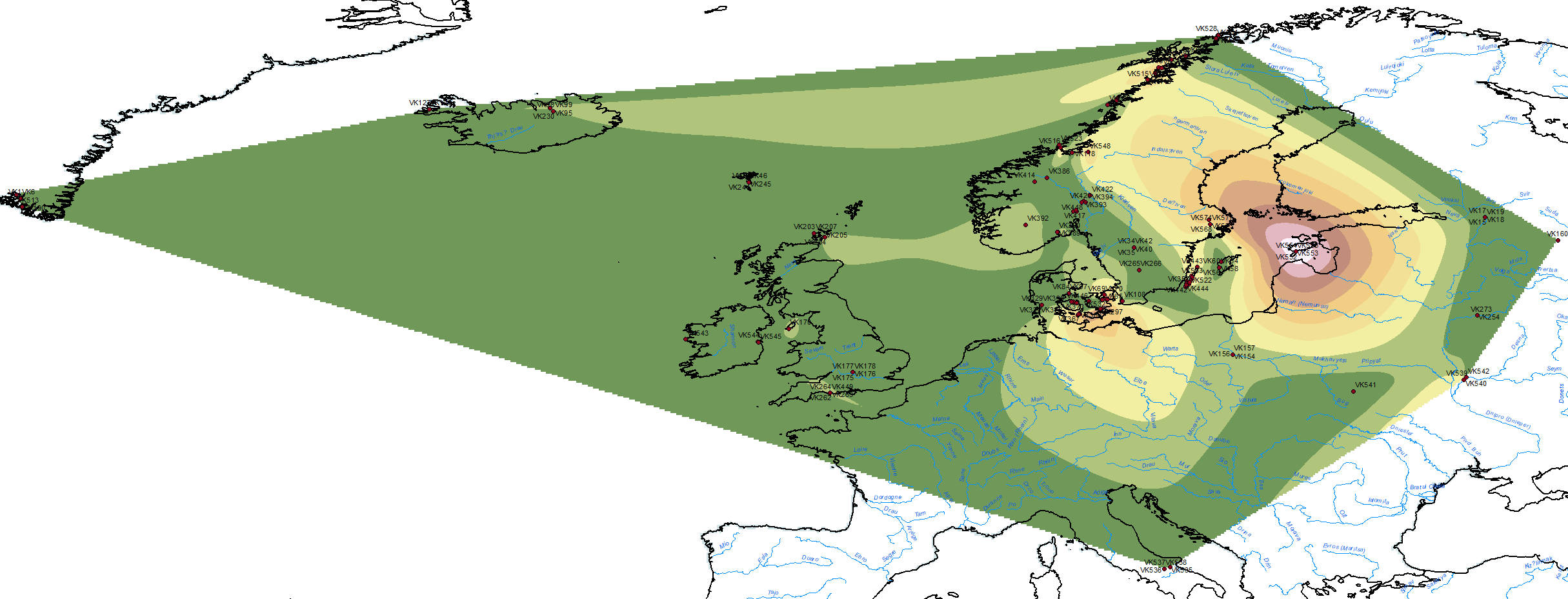
vikings-swedish-ancestry
Natural neighbor interpolation of “Swedish ancestry” among Vikings.


Viking samples from Estonia show thus ancient Swedes from the Mälaren area, which proves once again that hg. N1a-VL29 (especially subclade N1a-L550) and tiny proportions of so-called “Siberian ancestry” expanded during the Early Iron Age into the whole Baltic Sea area, not only into Estonia, and evidently not spreading with Balto-Finnic languages (since the language influence is in the opposite direction, east-west, Germanic > Finno-Samic, during the Bronze Age).

N1a-VL29 lineages spread again later eastwards with Varangians, from Sweden into north-eastern Europe, most likely including the ancestors of the Rurikid dynasty. Unsurprisingly, the arrival of Vikings with Swedish ancestry into the East Baltic and their dispersal through the forest zone didn’t cause a language shift of Balto-Finnic, Mordvinic, or East Slavic speakers to Old Norse, either…

NOTE. For N1a-Y4339 – N1a-L550 subclade of Swedish origin – as main haplogroup of modern descendants of Rurikid princes, see Volkov & Seslavin (2019) – full text in comments below. Data from ancient samples show varied paternal lineages even among early rulers traditionally linked to Rurik’s line, which explains some of the discrepancies found among modern descendants:

  • A sample from Chernihiv (VK542) potentially belonging to Gleb Svyatoslavich, the 11th century prince of Tmutarakan/Novgorod, belongs to hg. I2a-Y3120 (a subclade of early Slavic I2aCTS10228) and has 71% “Modern Polish” ancestry (see below).
  • Izyaslav Ingvarevych, the 13th century prince of Dorogobuzh, Principality of Volhynia/Galicia, is probably behind a sample from Lutsk (VK541), and belongs to hg. R1a-L1029 (a subclade of R1a-M458), showing ca. 95% of “Modern Polish” ancestry.
  • Yaroslav Osmomysl, the 12th century Prince of Halych (now in Western Ukraine), was probably of hg. E1b-V13, yet another clearly early Slavic haplogroup.
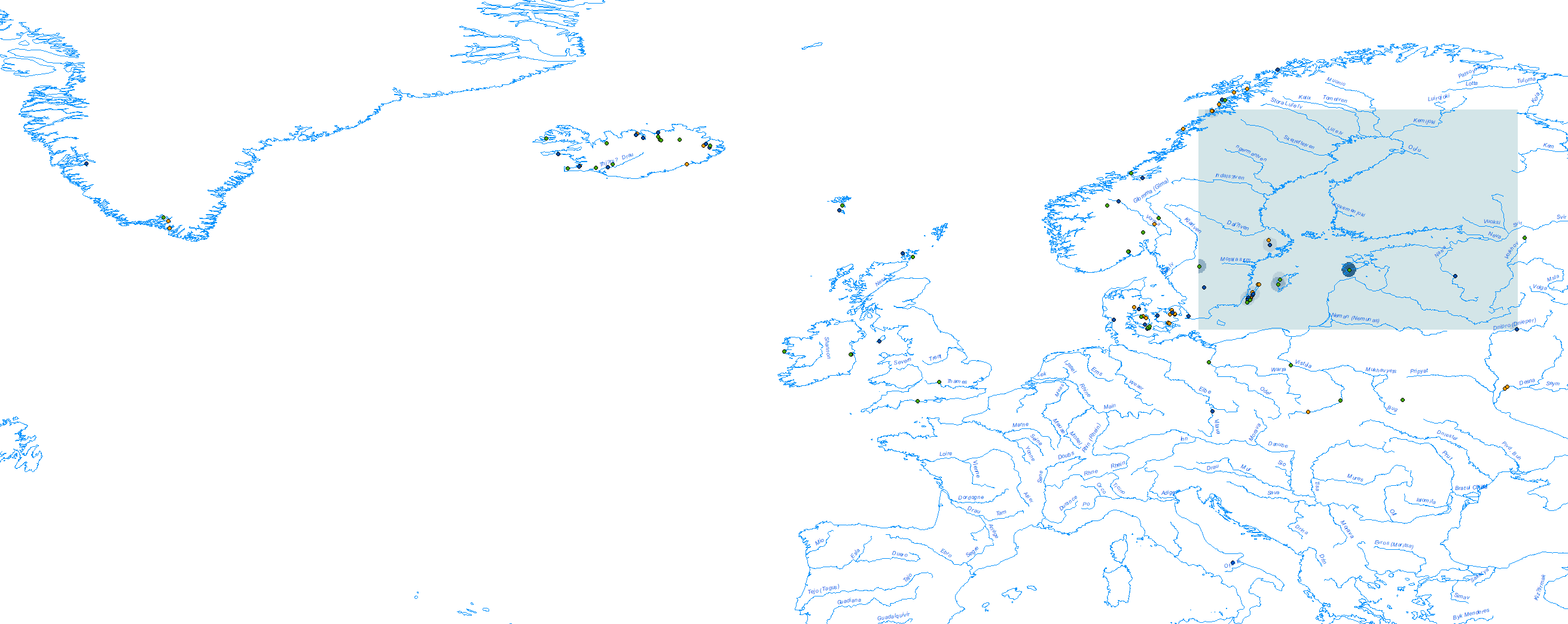
vikings-y-dna-haplogroup-n1a
Density of haplogroup N1a-VL29, N1a-L550 (samples in pink, most not visible) among Vikings. Samples of hg. R1b in blue, hg. R1a in green, hg. I in orange.

Finnish ancestry

( Does not necessarily pertain to the Carruthers ancestors, but interesting )

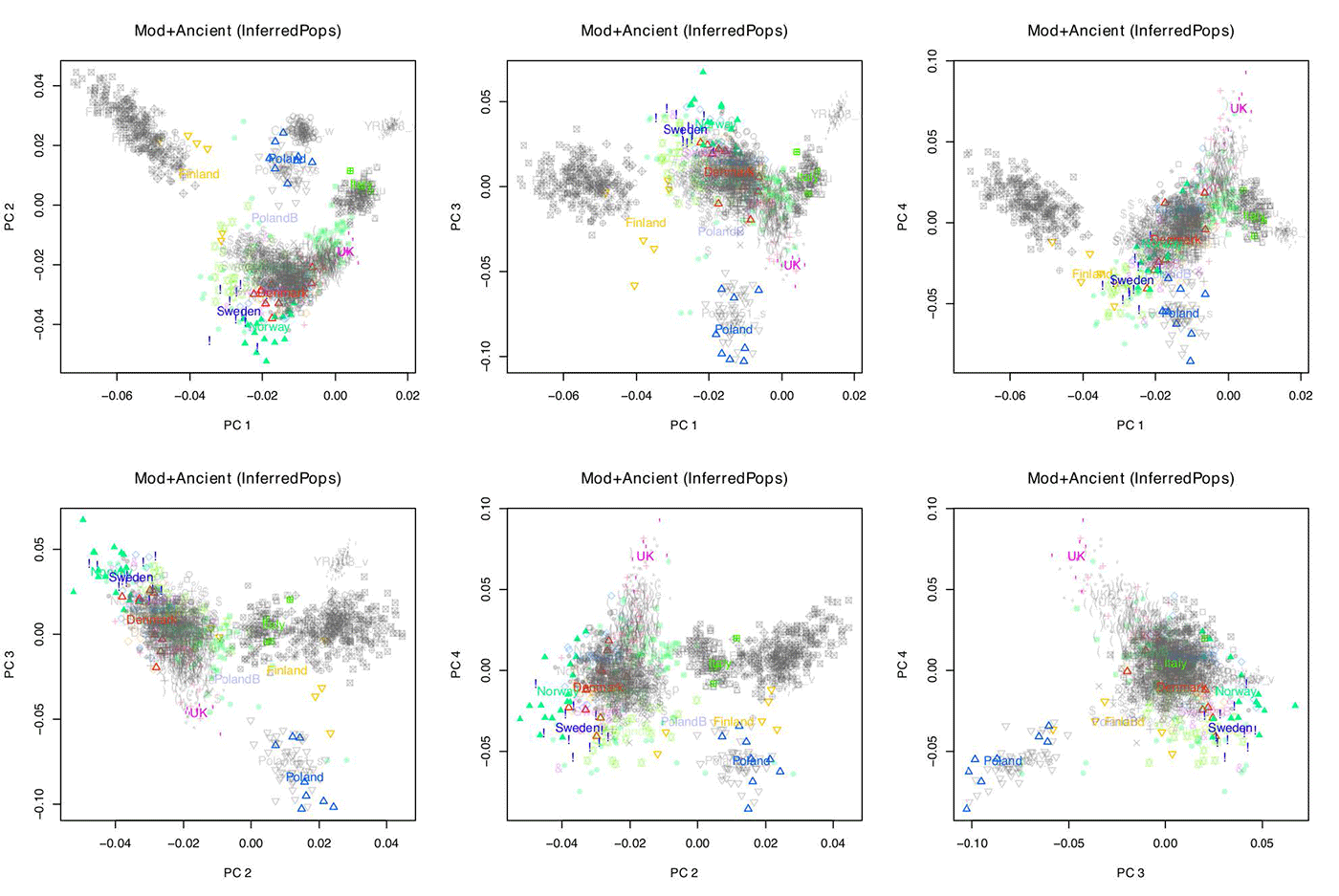
Firstly, modern Finnish individuals are not like ancient Finnish individuals, modern individuals have ancestry of a population not in the reference; most likely Steppe/Russian ancestry, as Chinese are in the reference and do not share this direction. Ancient Swedes and Norwegians are more extreme than modern individuals in PC2 and 4. Ancient UK individuals were more extreme than Modern UK individuals in PC3 and 4. Ancient Danish individuals look rather similar to modern individuals from all over Scandinavia. By using a supervised ancient panel, we have removed recent drift from the signal, which would have affected modern Scandinavians and Finnish populations especially. This is in general a desirable feature but it is important to check that it has not affected inference.

ancient-modern-finns-steppe
PCA of the ancient and modern samples using the ancient palette, showing different PCs. Modern individuals are grey and the K=7 ancient panel surrogate populations are shown in strong colors, whilst the remaining M-K=7 ancient populations are shown in faded colors.

The story for Modern-vs-ancient Finnish ancestry is consistent, with ancient Finns looking much less extreme than the moderns. Conversely, ancient Norwegians look like less-drifted modern Norwegians; the Danish admixture seen through the use of ancient DNA is hard to detect because of the extreme drift within Norway that has occurred since the admixture event. PC4 vs PC5 is the most important plot for the ancient DNA story: Sweden and the UK (along with Poland, Italy and to an extent also Norway) are visibly extremes of a distribution the same “genes-mirror-geography” that was seen in the Ancient-palette analysis. PC1 vs PC2 tells the same story – and stronger, since this is a high variance-explained PC – for the UK, Poland and Italy.

Uniform manifold approximation and projection (UMAP) analysis of the VA and other ancient samples.

Preserving Our Past, Recording Our Present, Informing Our Future

Ancient and Honorable Clan Carruthes Int Society CCIS  LLc

carruthersclan1@gmail.com               carrothersclan@gmail.com


Crest on Light Bluers


You can find us on facebook at :

https://www.facebook.com/carrutherscarrothers.pat.9

https://www.facebook.com/CarruthersClan/

https://www.facebook.com/CarruthersClanLLC

Disclaimer Ancient and Honorable Carruthers Clan International Society CCIS LL

Gutland / Gotland, Uncategorized

CLAN CARRUTHERS – HOARDS OF THE GUTLAND VIKINGS.

CLAN CARRUTHERS INT SOCIETY CCIS

cropped-wider-banner-light-blue-1.jpg

Hoards of the Gutland Vikings


Evidence of trade, diplomacy, and vast wealth on an unassuming island in the Baltic Sea


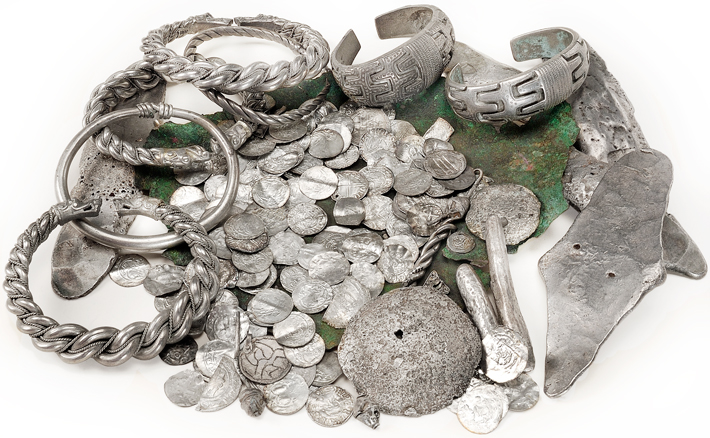
Gotland Viking Lummelunda Hoard

Gabriel Hildebrand/The Royal Coin Cabinet, Sweden)
This array of silver coins, bracelets, and other forms of Viking wealth typifies the hoards found deposited at numerous sites across the island of Gotland.


The accepted image of the Vikings as fearsome marauders who struck terror in the hearts of their innocent victims has endured for more than 1,000 years. Historians’ accounts of the first major Viking attack, in 793, on a monastery on Lindisfarne off the northeast coast of England, have informed the Viking story. “The church of St. Cuthbert is spattered with the blood of the priests of God,” wrote the Anglo-Saxon scholar Alcuin of York, “stripped of all its furnishings, exposed to the plundering of pagans….Who is not afraid at this?” The Vikings are known to have gone on to launch a series of daring raids elsewhere in England, Ireland, and Scotland. They made inroads into France, Spain, and Portugal. They colonized Iceland and Greenland, and even crossed the Atlantic, establishing a settlement in the northern reaches of Newfoundland.


But these were primarily the exploits of Vikings from Norway and Denmark. Less well known are the Vikings of Sweden. Now, the archaeological site of Fröjel on Gotland, a large island in the Baltic Sea around 50 miles east of the Swedish mainland, is helping advance a more nuanced understanding of their activities. While they, too, embarked on ambitious journeys, they came into contact with a very different set of cultures—largely those of Eastern Europe and the Arab world. In addition, these Vikings combined a knack for trading, business, and diplomacy with a willingness to use their own brand of violence to amass great wealth and protect their autonomy.


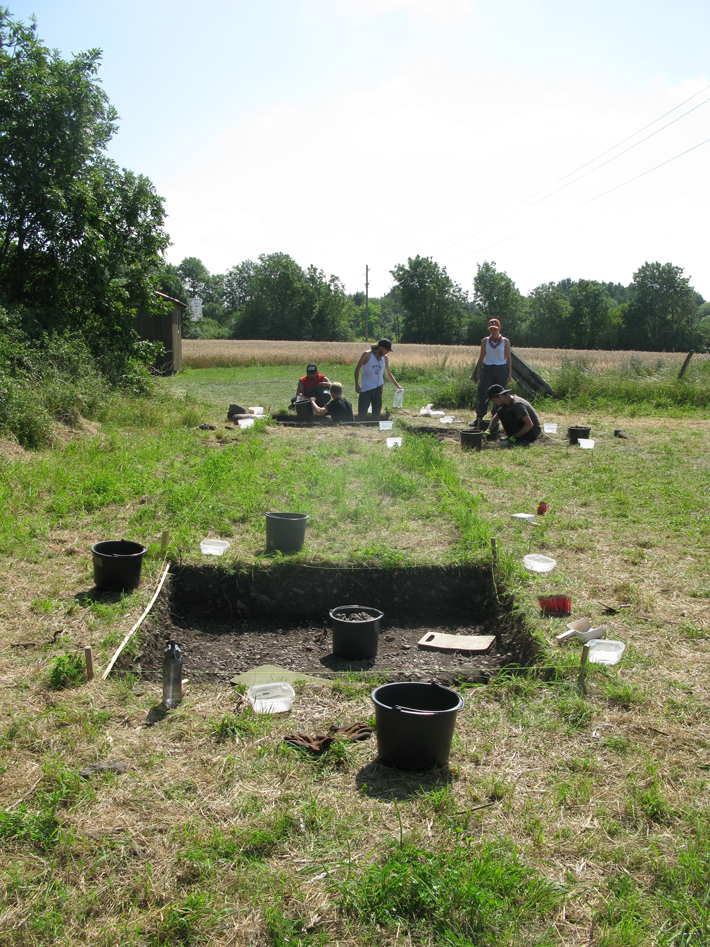
Gotland Viking Frojel Site

At Fröjel, a Viking Age site on the west coast of Gotland, archaeologists search for evidence of a workshop that included a silver-smelting operation.

Gotland today is part of Sweden, but during the Viking Age, roughly 800 to 1150, it was independently ruled. The accumulation of riches on the island from that time is exceptional. More than 700 silver hoards have been found there, and they include around 180,000 coins. By comparison, only 80,000 coins have been found in hoards on all of mainland Sweden, which is more than 100 times as large and had 10 times the population at the time. Just how an island that seemed largely given over to farming and had little in the way of natural resources, aside from sheep and limestone, built up such wealth has been puzzling. Excavations led by archaeologist Dan Carlsson, who runs an annual field school on the island through his cultural heritage management company, Arendus, are beginning to provide some answers.


Traces of around 60 Viking Age coastal settlements have been found on Gotland, says Carlsson. Most were small fishing hamlets with jetties apportioned among nearby farms. Fröjel, which was active from around 600 to 1150, was one of about 10 settlements that grew into small towns, and Carlsson believes that it became a key player in a far-reaching trade network. “Gotlanders were middlemen,” he says, “and they benefited greatly from the exchange of goods from the West to the East, and the other way around.”


Situated between the Swedish mainland and the Baltic states, Gotland was a natural stopping-off point for trading voyages, and Carlsson’s excavations at Fröjel have turned up an abundance of materials that came from afar: antler from mainland Sweden, glass from Italy, amber from Poland or Lithuania, rock crystal from the Caucasus, carnelian from the East, and even a clay egg from the Kiev area thought to symbolize the resurrection of Jesus Christ. And then, of course, there are the coins. Tens of thousands of the silver coins found in hoards on the island came from the Arab world.

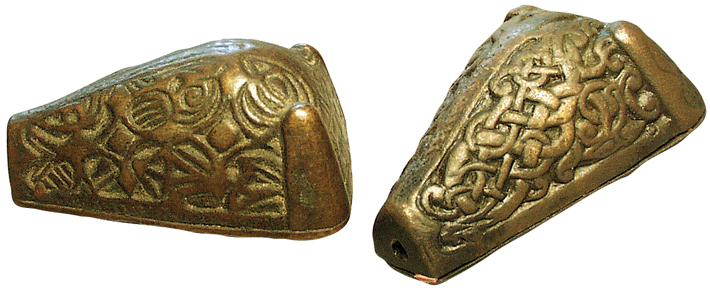
Gotland Viking Brooch

(Courtesy Dan Carlsson)
Brooches found in a graveyard in Visby, Gotland’s largest town, were used by Viking women to hold their clothing in place.


Many Gotlanders themselves plied these trade routes. They would sail east to the shores of Eastern Europe and make their way down the great rivers of western Russia, trading and raiding along the way at least as far south as Constantinople, the capital of the Byzantine Empire, via the Black Sea. Some reports suggest that they also crossed the Caspian Sea and traveled all the way to Baghdad, then the capital of the Abbasid Caliphate.


Entire Viking families are believed to have made their way east. “In the beginning, we thought it was just for trading,” says Carlsson, “but now we see there was a kind of settlement. You find Viking cemeteries far away from the main rivers, in the uplands.” Other evidence of Scandinavian presence in the region is plentiful. As early as the seventh century, there was a Gotlandic settlement at Grobina in Latvia, just inland from the point on the coast closest to Gotland. Large numbers of Scandinavian artifacts have been excavated in northwest Russia, including coin hoards, brooches, and other women’s bronze jewelry. The Rus, the people that gave Russia its name, were made up in part of these Viking transplants. The term’s origins are unclear, but it may have been derived from the Old Norse for “a crew of oarsmen” or a Greek word for “blondes.”


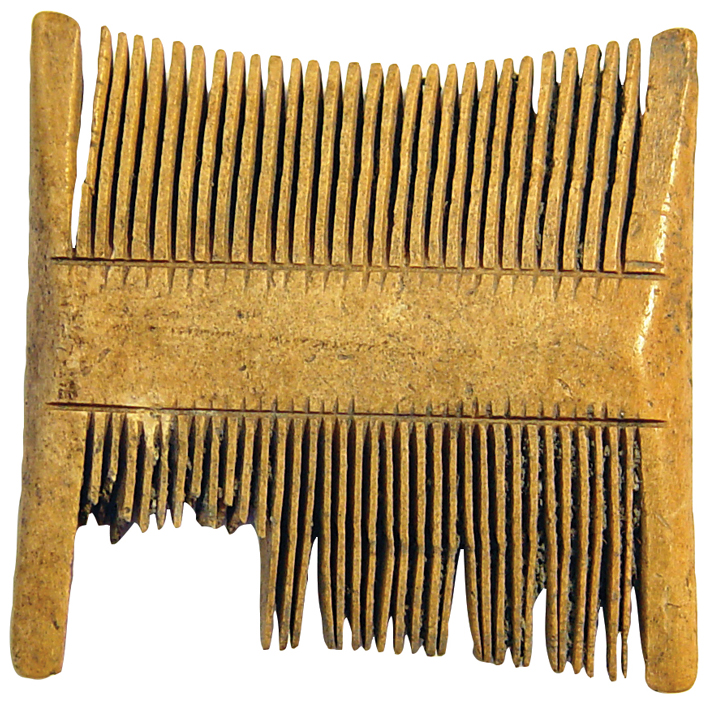
Gotland Viking Comb

Combs such as this one, excavated at Fröjel, were made locally of antler imported from mainland Sweden.

To investigate the links between the Gotland Vikings and the East, Carlsson turned his attention to museum collections and archaeological sites in northwest Russia. “It is fascinating how many artifacts you find in every small museum,” he says. “If they have a museum, they probably have Scandinavian artifacts.” For example, at the museum in Staraya Ladoga, east of St. Petersburg, Carlsson found a large number of Scandinavian items, oval brooches from mainland Sweden, combs, beads, pendants, and objects with runic inscriptions, and even three brooches in the Gotlandic style dating to the seventh and eighth centuries. Scandinavians were initially drawn to the area to obtain furs from local Finns, particularly miniver, the highly desirable white winter coat of the stoat, which they would then trade in Western Europe. As time went on, Staraya Ladoga served as a launching point for Viking forays to the Black and Caspian Seas.


These journeys entailed a good deal of risk. The route south from Kiev toward Constantinople along the Dnieper River was particularly hazardous. A mid-tenth-century document by the Byzantine emperor Constantine VII Porphyrogenitus tells of Vikings traveling this stretch each year after the spring thaw, which required portaging around a series of dangerous rapids and fending off attacks by local bandits known as the Pechenegs. The name of one of these rapids—Aifur, meaning “ever-noisy” or “impassable”—appears on a runestone on Gotland dedicated to the memory of a man named Hrafn who died there.

Gotland Viking Spillings Hoard

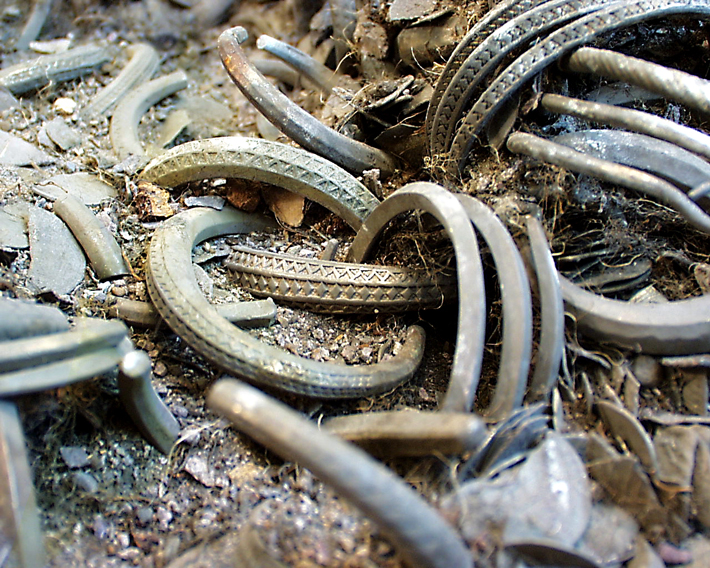
Silver arm rings with a zigzag pattern, believed to have been manufactured on Gotland, are part of an enormous hoard unearthed on the island.


People from the East may have traveled back to Gotland with the Vikings as well. At Fröjel, Carlsson has uncovered two Viking Age cemeteries, one dating from roughly 600 to 900, and the other from 900 to 1000. In all, Carlsson has excavated around 60 burials there, and isotopic analysis has shown that some 15 percent of the people whose graves have been excavated—all buried in the earlier cemetery—came from elsewhere, possibly the East.


In their voyages, the Vikings of Gotland are thought to have traded a broad range of goods such as furs, beeswax, honey, cloth, salt, and iron, which they obtained through a combination of trade and violent theft. This activity, though, doesn’t entirely account for the wealth that archaeologists have uncovered. In recent years, Carlsson and other experts have begun to suspect that a significant portion of their trade may have consisted of a commodity that has left little trace in the archaeological record: slaves. “We still have some problems in explaining what made this island so rich,” says Carlsson. “We know from written Arabic sources that the Rus—the Scandinavians in Russia—were transporting slaves. We just don’t know how big their trading in slaves was.”


According to an early tenth-century account by Ibn Rusta, a Persian geographer, the Rus were nomadic raiders who would set upon Slavic people in their boats and take them captive. They would then transport them to Khazaria or Bulgar, a Silk Road trading hub on the Volga River, where they were offered for sale along with furs. “They sell them for silver coins, which they set in belts and wear around their waists,” writes Ibn Rusta. Another source, Ibn Fadlan, a representative of the Abbasid Caliph of Baghdad who traveled to Bulgar in 921, reports seeing the Rus disembark from their boats with slave girls and sable skins for sale. The Rus warriors, according to his account, would pray to their gods: “I would like you to do me the favor of sending me a merchant who has large quantities of dinars and dirhams [Arab coins] and who will buy everything that I want and not argue with me over my price.” Whenever one of these warriors accumulated 10,000 coins, Ibn Fadlan says, he would melt them down into a neck ring for his wife.


It is unclear whether the Vikings transported Slavic slaves back to Gotland, but the practice of slavery appears to have been well established there. The Guta Lag, a compendium of Gotlandic law thought to have been written down in 1220 includes rules regarding purchasing slaves, or thralls. “The law says that if you buy a man, try him for six days, and if you are not satisfied, bring him back,” says Carlsson. “It sounds like buying an ox or a cow.” Burials belonging to people who came from places other than Gotland are generally situated on the periphery of the graveyards with fewer grave goods, suggesting that they may have occupied a secondary tier of society—perhaps as slaves.

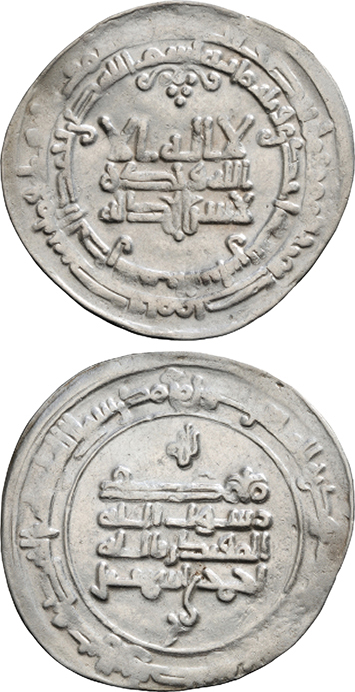
Gotland Arab Coin VerticalFor the Gotland Vikings, accumulation of wealth in the form of silver coins was clearly a priority, but they weren’t interested in just any coins. They were unusually sensitive to the quality of imported silver and appear to have taken steps to gauge its purity. Until the mid-tenth century, almost all the coins found on Gotland came from the Arab world and were around 95 percent pure. According to Stockholm University numismatist Kenneth Jonsson, beginning around 955, these Arab coins were increasingly cut with copper, probably due to reduced silver production. Gotlanders stopped importing them. Near the end of the tenth century, when silver mining in Germany took off, Gotlanders began to trade and import high-quality German coins. Around 1055, coins from Frisia in northern Germany became debased, and Gotlanders halted imports of all German coins. At this juncture, ingots from the East became the island’s primary source of silver.


A silver coin from the early 10th century (obverse, top; reverse, above) is one of tens of thousands excavated on Gotland that had originated in the Arab world.


Interestingly, when a silver source from the Arab or German world slipped in quality, Jonsson points out, and the Gotlanders rapidly cut off the debased supplies, their contemporaries on mainland Sweden and in areas of Eastern Europe did not. “Word must have spread around the island, saying, ‘Don’t use these German coins anymore!’” says Jonsson. To test imported silver, Gotlanders would shave a bit of the metal with a knife so its contents could be assessed based on color and consistency, says Ny Björn Gustafsson of the Swedish National Heritage Board. He notes that many imported silver items found on Gotland were “pecked” in this way, and that Gotlanders may also have tested imported coins by bending them. By contrast, silver items thought to have been made on Gotland—including heavy arm rings with a zigzag pattern pressed into them—were not generally pecked or otherwise tested. “My interpretation,” Gustafsson says, “is that this jewelry acted as a traditional form of currency and was assumed to contain pure silver.”


These arm rings are among the most commonly found items in Gotland’s hoards, along with coins, and experts had long assumed they were made on the island, but no evidence of their manufacture had been found until Carlsson’s team uncovered a workshop area at Fröjel. “We found the artifacts exactly where they had been dropped,” says Carlsson. There are precious stones: amber, carnelian, garnet. There are half-finished beads, cracked during drilling and discarded. There is elk antler for crafting combs. There is also a large lump of iron, as well as rivets for use in boats, coffins, and storage chests. And, providing evidence of a smelting operation, there are drops of silver.


Researchers found that the metalworkers of Fröjel used an apparatus called a cupellation hearth to transform a suspect source of imported silver, such as coins or ingots, into jewelry or decorated weapons with precisely calibrated silver content. They would melt the silver source with lead and blow air over the molten mélange with a bellows, causing the lead and other impurities to oxidize, separate from the silver, and attach to the hearth lining. The resulting pure silver would then be combined with other metals to produce a desired alloy. The cupellation technique is known from classical times, says Gustafsson, but so far this is the first and only time such a hearth has been found on Gotland. Only one other intact example from the Viking Age has been found in Sweden, at the mainland settlement of Sigtuna.


Gotland Viking Imported Silver

(Photo by: Ny Björn Gustafsson/The Swedish History Museum)

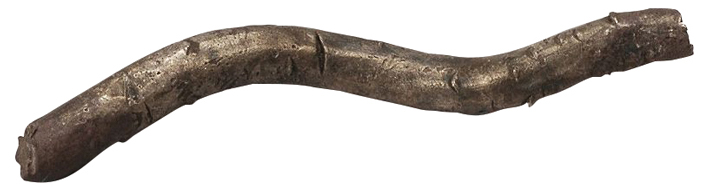
This imported silver piece found on Gotland shows signs of “pecking,” where a bit of metal was gouged out to test its purity.

Traces of lead and other impurities were found embedded in pieces of the cupellation hearth among the material excavated from the workshop area at Fröjel. The hearth has been radiocarbon dated to around 1100. Also unearthed from the workshop area were fragments of molds imprinted with the zigzag patterns found on Gotlandic silver arm rings, establishing that they were, in fact, made on the island—and that the workshop was the site of the full chain of production, from metal refinement to casting. “We have these silver arm rings in many hoards all over Gotland,” says Carlsson. “But we never before saw exactly where they were making them.”

During the Viking Age, Gotland seems to have been a more egalitarian society than mainland Sweden, which had a structure of nobles led by a king dating from at least the late tenth century. On Gotland, by contrast, farmers and merchants appear to have formed the upper class and, while some were more prosperous than others, they shared in governance through a series of local assemblies called things, which were overseen by a central authority called the Althing. According to the Guta Saga, the saga of the Gotlanders, which was written down around 1220, an emissary from Gotland forged a peace treaty with the Swedish king, ending a period of strife with the mainland Swedes. The treaty, believed to have been established in the eleventh century, required Gotland to pay an annual tax in exchange for continued independence, protection, and freedom to travel and trade.

Stratification did increase on the island as time passed, though. Archaeologists have found that, throughout the ninth and tenth centuries, silver hoards were distributed throughout Gotland, suggesting that wealth was more or less uniformly shared among the island’s farmers. But around 1050, this pattern shifted. “In the late eleventh century, you start to have fewer hoards overall, but, instead, there are some really massive hoards, usually found along the coast, containing many, many thousands of coins,” says Jonsson. This suggests that trading was increasingly controlled by a small number of coastal merchants.


This stratification accelerated near the end of the Viking Age, around 1140, when Gotland began to mint its own coins, becoming the first authority in the eastern Baltic region to do so. “Gotlandic coins were used on mainland Sweden and in the Baltic countries,” says Majvor Östergren, an archaeologist who has studied the island’s silver hoards. Whereas Gotlanders had valued foreign coins based on their weight alone, these coins, though hastily hammered out into an irregular shape, had a generally accepted value. More than eight million of these early Gotlandic coins are estimated to have been minted between 1140 and 1220, and more than 22,000 have been found, including 11,000 on Gotland alone.


Gotland Minted Coin Horizontal

(Nanouschka Myrberg Burström)
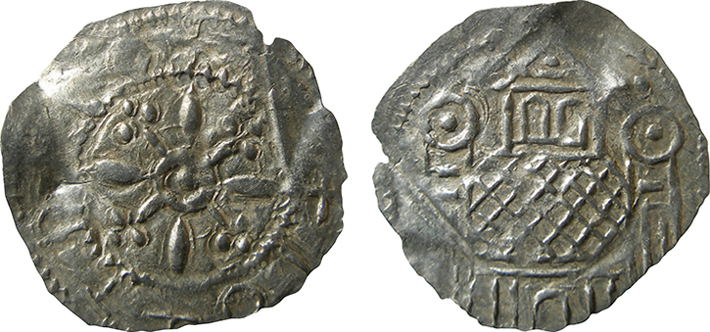
An example of one of the earliest silver coins minted on Gotland (obverse, left; reverse, right) dates from around 1140.


Gotland is thought to have begun its coinage operation to take advantage of new trading opportunities made possible by strife among feuding groups on mainland Sweden and in western Russia. This allowed Gotland to make direct trading agreements with the Novgorod area of Russia and with powers to the island’s southwest, including Denmark, Frisia, and northern Germany. Gotland’s new coins helped facilitate trade between its Eastern and Western trading partners, and brought added profits to the island’s elite through tolls, fees, and taxes levied on visiting traders. In order to maintain control over trade on the island, it was limited to a single harbor, Visby, which remains the island’s largest town. As a result, the rest of Gotland’s trading harbors, including Fröjel, declined in importance around 1150.


Gotland remained a wealthy island in the medieval period that followed the Viking Age, but, says Carlsson, “Gotlanders stopped putting their silver in the ground. Instead, they built more than 90 stone churches during the twelfth and thirteenth centuries.” Although many archaeologists believe that the Gotland Vikings stashed their wealth in hoards for safekeeping, Carlsson thinks that, just as did the churches that were built later, they served a devotional purpose. In many cases, he argues, hoards do not appear to have been buried in houses but rather atop graves, roads, or borderlands. Indeed, some were barely buried at all because, he argues, others in the community knew not to touch them. “These hoards were not meant to be taken up,” he says, “because they were meant as a sort of sacrifice to the gods, to ensure a good harvest, good fortune, or a safer life.” In light of the scale, sophistication, and success of the Gotland Vikings’ activities, these ritual depositions may have seemed to them a small price to pay.


Preserving Our Past, Recording Our Present, Informing Our Future

Ancient and Honorable Clan Carruthes Int Society CCIS  LLc

carruthersclan1@gmail.com               carrothersclan@gmail.com

WIDER BANNER Grey


Daniel Weiss is a senior editor at ARCHAEOLOGY.


You can find us on facebook at :

https://www.facebook.com/carrutherscarrothers.pat.9

https://www.facebook.com/CarruthersClan/

https://www.facebook.com/CarruthersClanLLC

Disclaimer Ancient and Honorable Carruthers Clan International Society CCIS LLC


OUR ANCESTORS, The History of Gutland, The Viking Age, Uncategorized

KING GORM III “THE OLD” DE GAMEL OF DENMARK – CLAN CARRUTHERS CCIS

cropped-wide-banner-with-new-crestnorse

KING GORM III “THE OLD” DE GAMEL OF DENMARK

CARRUTHERS ANCESTOR

In ancient times Denmark was not a kingdom, but a multitude of small provinces ruled over by warlike chiefs who called themselves kings. It was not until the ninth century that these little king-ships were combined into one kingdom, this being done by a famous chieftain, known by the Danes as Gorm den Gamle, or Gorm the Old. A great warrior he was, a viking of the vikings, and southern Europe felt his heavy hand. A famous story of barbarian life is that of Gorm, which well deserves to be told.

KING GORM “THE OLD”

He was the son of a fierce pagan of Norway, Hardegon, who was of royal blood, being a grandson of the half-fabulous Ragnar Lodbrok. A prince with only his sword for kingdom, Hardegon looked around for a piece of land to be won by fighting, and fixed upon Lejre, in the fruitful Danish island of Sjölland, which was just then in a very inviting state for the soldier of fortune. Some time before it had fallen into the hands of a Swedish fortune-seeker named Olaf, who left it to his two sons. These in turn had just been driven out by Siegric, the rightful king, when Hardegon descended upon it and seized it for himself. Dying, he left it to his son Gorm.

It was a small kingdom that Gorm had fallen heir to. A lord’s estate we would call it to-day. But while small in size, it stood high in rank, for it was here that the great sacrifices to Odin, the chief Scandinavian deity, were held, and it was looked upon as one of the most sacred of spots. Hither at Yuletide came the devotees of Odin from all quarters to worship at his shrine, and offer gifts of gold and silver, precious stones and costly robes, to the twelve high priests of whom the king of Lejre was the chief. And every worshipper, whether rich or poor, was expected to bring a horse, a dog, or a cock, these animals being sacred to Odin and sacrificed in large numbers annually at his shrine. In the special nine-year services, people came in great numbers, and it is probable that on these occasions human sacrifices were made, captives taken in war or piratical excursions being saved for this purpose.

As one may see, the king of Lejre had excellent opportunity to acquire wealth, and young Gorm, being brave, clever, and ambitious, used his riches to increase his landed possessions. At least, the Danish historians tell us that he began by buying one bit of land, getting another by barter, seizing on one district, having another given him, and so on. But all this is guess-work, and all we actually know is that Gorm, the son of a poor though nobly-born sea-rover, before his death gained control of all Denmark, then much larger than the Denmark of to-day, and changed the small state with which he began into a powerful kingdom, bringing all the small kings under his sway.

The ambitious chief did not content himself with this. Long before his kingdom was rounded and complete he had become known as one of the most daring and successful of the viking adventurers who in those days made all Europe their prey.

Early in his reign he made a plundering cruise along the shores of the Baltic and joined in a piratical invasion of Russia, penetrating far inward and pillaging as he went. We hear of him again in 882 as one of the chiefs of a daring band which made a conquering raid into Germany, intrenched itself on the river Maas, sallied forth on plundering excursions whose track was marked by ruined fields and burnt homesteads, villages and towns, and even assailed and took Aix-la-Chapelle, one of the chief cities of the empire of Charlemagne and the seat of his tomb. The reckless freebooters stalled their horses in the beautiful chapel in which the great emperor lay buried and stripped from his tomb its gilded and silvered railings and everything of value which the monks had not hidden.

The whole surrounding country was similarly ravaged and desolated by the ruthless heathens, monasteries were burned, monks were killed or captured, and the emperor, Charles the Fat, was boldly defied. When Charles brought against the plunderers an army large enough to devour them, he was afraid to strike a blow against them, and preferred to buy them off with a ransom of two thousand pounds of gold and silver, all he got in return being their promise to be baptized.

Finding that they had a timid foe to deal with, the rapacious Norsemen asked for more, and when they finally took to their ships two hundred transports were needed to carry away their plunder. The cowardly Charles, indeed, was so wrought upon by fear of the pagan Danes that he even passed the incredible law that any one who killed a Norseman should have his eyes put out and in some cases should lose his life.

All this was sure to invite new invasions. A wave of joy passed through the north when the news spread of the poltroonery of the emperor and the vast spoil awaiting the daring hand. Back they came, demanding and receiving new ransom, and in 885 there began a great siege of Paris by forty thousand Danes.

King Gorm was one of the chiefs who took part in this, and when Henry of Neustria, whom the emperor had sent with an army against them, was routed and driven back, it was Gorm who pursued the fugitives into the town of Soissons, where many captives and a great booty were taken.

The dastard emperor again bought them off with money and freedom to ravage Burgundy, Paris being finally rescued by Count Eudes. In 891 they were so thoroughly beaten by King Arnulf, of Germany, that their great leaders fell on the field and only a remnant of the Norsemen escaped alive, the waters of the river Dyle running red with the blood of slain thousands.

RUNE STONES OF KING GORM

Gorm was one of the chiefs who took part in this disastrous battle of Louvaine and was one of the fortunate few who lived to return to their native land. Apparently it was not the last of his expeditions, his wife, Queen Thyra, taking care of the kingdom in his many long absences.

Thyra needed ability and resolution to fitly perform this duty, for those were restless and turbulent times, and the Germans made many incursions into Sleswick and Jutland and turned the borderlands on the Eyder into a desert. This grew so hard to bear that the wise queen devised a plan to prevent it. Gathering a great body of workmen from all parts of Denmark, she set them to building a wall of defense from forty-five to seventy-five feet high and eight miles long, crossing from water to water on the east and west. This great wall, since known as the Dannevirke, took three years to build. There were strong watch-towers at intervals and only one gate, and this was well protected by a wide and deep ditch, crossed by a bridge that could readily be removed.

For ages afterwards the Danes were grateful to Queen Thyra for this splendid wall of defense and sang her praises in their national hymns, while they told wonderful tales of her cleverness in ruling the land while her husband was far away. Fragments of Thyra’s rampart still remain and its remains formed the groundwork of all the later border bulwarks of Denmark.

QUEEN THYRA

Queen Thyra, while a worshipper of the northern gods, showed much favor to the Christians and caused some of her children to be signed with the cross. But King Gorm was a fierce pagan and treated his Christian subjects so cruelly that he gained the name of the “Church’s worm,” being regarded as one who was constantly gnawing at the supports of the Church. Henry I. the Fowler, the great German emperor of that age, angry at this treatment of the Christians, sent word to Gorm that it must cease, and when he found that no heed was paid to his words he marched a large army to the Eyder, giving Gorm to understand that he must mend his ways or his kingdom would be overrun.

Gorm evidently feared the loss of his dominion, for from that time on he allowed the Archbishop of Bremen to preach in his dominions and to rebuild the churches which had been destroyed, while he permitted his son Harald, who favored the Christians, to be signed with the cross. But he kept to the faith of his forefathers, as did his son Knud, known as “Dan-Ast,” or the “Danes’-joy.”

Harald I 'Bluetooth' Gornsson b 911, King of Denmark – Black Family

HARALD BLUETOOTH GORMSSON = CARRUTHERS ANCESTOR

The ancient sagas tell us that there was little love between Knud and Harald; and that Gorm, fearing ill results from this, swore an oath that he would put to death any one who attempted to kill his first-born son, or who should even tell him that Knud had died.

While Harald remained at home and aided his mother, Knud was of his father’s fierce spirit and for years attended him on his viking expeditions. On one of these he was drowned, or rather was killed while bathing, by an arrow shot from one of his own ships. Gorm was absent at the time, and Thyra scarcely knew how the news could be told him without incurring the sworn penalty of death.

Finally she put herself and her attendants into deep mourning and hung the chief hall of the palace with the ashy-grey hangings used at the grave-feasts of Northmen of noble birth. Then, seating herself, she awaited Gorm’s return. On entering the hall he was struck by these signs of mourning and by the silence and dejection of the queen, and broke out in an exclamation of dismay:

“My son, Knud, is dead!”

“Thou hast said it, and not I, King Gorm,” was the queen’s reply. The news of the death had thus been conveyed to him without any one incurring the sworn penalty. Soon after that—in 936—King Gorm died, and the throne of Denmark was left to his son Harald, a cruel and crafty man whom many of the people believed to have caused the murder of his brother.

Carruthers crest on flag-v2 (1)

OFFICIAL AND REGISTEREDL CLAN CARRUTHERS CCIS SINCE 1983-CLAN OF OUR ANCESTORS

SCOTTISH CLAN – IRISH CLAN – NORSE CLAN

Preserving Our Past!    Recording Our Present!  Informing Our Future!

The Ancient and Honorable Carruthers Clan International Society LLC

carruthersclan1@gmail.com                carrothersclan@gmail.com

WIDE BANNER with NEW CREST


SCANDINAVIAN HISTORY #9
CHARLES MORRIS

CLAN CARRUTHERS INT SOCIETY CCIS HISTORIAN AND GENEALOGIST


You can find us on our main facebook pages at :

SILVER WINGS-https://www.facebook.com/CarruthersClanLLC/

GOLD WINGS – https://www.facebook.com/carrutherscarrothers.pat.9

CLAN CARRUTHERS FAMILY HISTORY – https://www.facebook.com/CarruthersClan

CLAN CARRUTHERS CCIS – https://www.facebook.com/groups/3878691252182714

CLAN CARRUTHERS INT SOCIETY- https://www.facebook.com/groups/394653845137709

CLAN CARRUTHERS – BORDER REIVERS – https://www.facebook.com/groups/434959914239094

Disclaimer Ancient and Honorable Carruthers Clan International Societ
The History of Gutland, The Viking Age, Uncategorized

VIKING WOMEN WARRIORS – CLAN CARRUTHERS CCIS

cropped-wide-banner-with-new-crestnorse

VIKING WOMEN WARRIORS


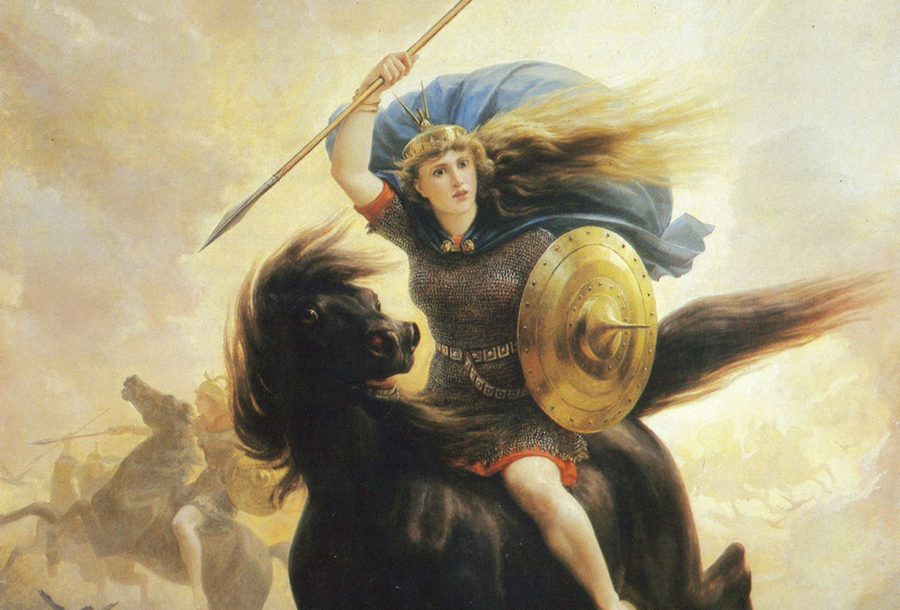
Warrior women appear frequently in Scandinavian folklore, whether as pirates, fighters, leaders of armies or avengers. In sagas and poetry, women who chose to live as warriors were called ‘warrior women’. These were women who had chosen to stand outside the traditional gender role, and they seem to have been an accepted part of Old Norse society. In many of the stories and the poems they are referred to a ‘shield maidens’, meaning young women who had chosen to work as warriors. This expression is often used in the texts without further explanation, which suggests that the readers and listeners were well acquainted with the phenomenon The shield maidens must not be confused with the Valkyries, who were divine beings associated with the battlefield.

The question is whether warrior women are literary fantasies, myths, or a historical reality. Warrior women are not mentioned in any contemporary Nordic rune inscriptions, but that is perhaps not so surprising if they comprised only a small part of the Scandinavian warrior groups. Also, we know that rune stones often functioned as documentary records of inheritance and were usually raised by widows or mothers of fallen husbands and sons. Nor are warrior women named in French and Anglo-Saxon annals and chronicles.13 They are not mentioned either in the Irish chronicles in connection with the Vikings, but the phenomenon was not unfamiliar to the Irish themselves. The most famous were the protagonists Scáthach and Aífe, who probably had Scottish-Celtic origins and lived in the 5th or 6th century.

Who Were The Viking Warrior Women? | All About History

Several older sources claim that warrior women were found in northern Europe and Scandinavia around the time of Christ’s birth. Historians such as Strabo and Plutarch (1st century BC), Dio Cassius (49 AD) and Tacitus (100 AD) all say that there were warrior women among the tribes in northern and eastern Europe. In the 1st century AD, Saxon men and women were regarded by the Romans as of equal value. According to Tacitus, when a man married he gave to the woman oxen and a horse with its bridle, together with shield, spear and sword. She gave him the weapons back. Such reports, probably based on witness observation, surely contributed to reinforcing the Romans’ view of Germanic women as warlike. Such a ritual does not automatically imply that all women fought in war, or that all women bore weapons, but it can mean that Saxon men and women had shared responsibility for defending their nearest and dearest if necessary, and that fighting was part of life.

Two particular features recur in all Roman descriptions of the Germans: their appearance, with powerful bodies and reddish-blond hair and beard; and their women. According to the sources, the women supported their men in war and sometimes took part in the battles themselves.

Roman war reports regularly told of warrior women being found among the enemy’s dead. This can mean that some of the women fought in war, especially if the reports are from conflicts where the Romans were attacked, but it can also mean that women defended themselves with weapons when the tribe was attacked, just as Saxon women apparently did. As we do not know what types of conflict were being described, it is difficult to distinguish if these were warrior women who attacked the Romans, or whether they were taking part in a defence, or if they did both.

At the end of the 3rd century AD, 30 captured ‘Gothic warrior women’ were paraded in front of the populace when Emperor Aurelian (emperor 270–275 AD) held a triumphal procession in Rome. It is quite possible that these women really were warrior women, but the Roman triumphal processions were theatre and these ‘Gothic warrior women’ may also have just been the result of the Romans wishing that such women did exist. The Romans, with their severe and puritanical view of women and their double moral standards regarding sex, must have been terrified and aroused at the same time by the thought that they could be attacked by women. Such emotions certainly led to many stories and fantasies being played out in the gladiatorial arenas and the triumphal processions.

Mighty Women from Norse Mythology - BaviPower Blog

Eastern Roman historians also mention warrior women among their European enemies. In Procopius’ account of the war against the Goths (535–552) there is a story about an English princess who led an invasion of Jutland and captured the young king, Radigis, because he had deceived her. This story is characteristic of Saga material, and it can hardly be used as a reliable source to prove the existence of the warrior woman. On the other hand, another Byzantine historian, Johannes Skylitzes, tells in his historical writing from the 12th century that warrior women took part in the fighting when Prince Svjatoslav of Kiev lost a battle against the Byzantines in Bulgaria in 971. He says that the Byzantines were amazed when they found armed women among the fallen warriors.

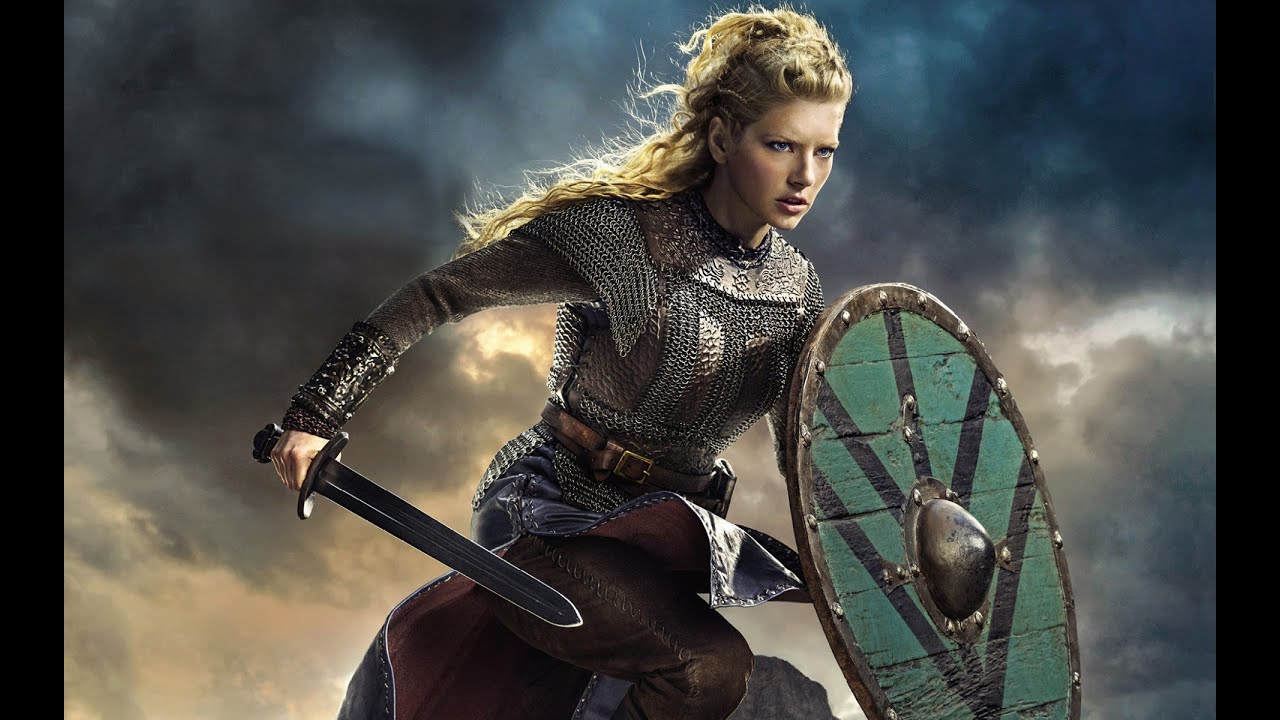
Vikings - Lagertha - YouTube

Even though Skylitzes was writing 200 years after the events, it is possible that he had access to contemporary archives. Just like the West Romans, the East Romans were prolific writers of reports. In this context, we must also consider the social structures among the rus. Svjatoslav and his warriors were almost nomadic. They could be absent from Kiev for years, and therefore would have their women, female slaves and children with them when they went raiding. It may have been these women who were killed in the battles, as they tried to defend themselves and their families.

Nearly all the descriptions of warrior women are in texts from the Middle Ages. They were written several centuries after the events they describe. Some of these reports are of events said to have taken place in the time of tribal migrations, which was even more remote.

The Fornalder sagas (‘Sagas of Earlier Times’) comprise a collection of legendary sagas which were gathered together at the end of the 14th century. Among others, they include Hervor’s and Hedrek’s Saga, which is about the magic sword, Tyrfing, with the action taking place in the 5th century. Hervor, Angantyr’s daughter, dressed like a man and learned to use weapons in her youth, and went on plundering raids in search of valuables.

Warrior Women : r/armoredwomen

In Rolf Gautreksons Saga, which was written down in the 13th century, we find Torbjørg the shield-maiden. She was daughter of a King Erik in Uppsala and preferred to spend her days in fighting and athletic activities than in womanly activities. She even had her own guard troops. In oral tradition she was known as ‘King Torberg’.

A number of women warriors also appear in Saxo’s 13th-century Gesta Danorum (‘Chronicle of the Danes’). It is important to note that all the warrior women in the Fornalder sagas and in Saxo’s writings are upper-class women. In fact, this makes the stories appear more authentic. Even if they had wanted to do so, women from other layers of society would not have had the same opportunity to distinguish themselves in masculine arenas. In theory, upper-class women had the time and the authority to be able to assert themselves outside the wholly traditional role model.

According to Saxo, the warrior women were so numerous that he needed to explain to the reader why this was so. In Book Seven, which mainly deals with events at the end of the 8th century and beginning of the 9th, he says that he will explain how some women behaved in older times:

In olden days there were among the Danes, women who dressed like men and used nearly every moment of their time in battle-training so as not to run the risk that the sickness of luxurious life would drain away their courage. They hated luxury, preferring to harden both body and soul with toil and endurance (…) they forced their womanly nature to act with manly ruthlessness. And they absorbed the art of warfare with such zeal that one would not believe they were women any longer. It was especially those with a strong personality or a tall, handsome body who chose such a life.

vikingshistory | Viking woman, Viking costume, Fantasy fashion

After his introduction, Saxo turns back to the story itself, which is an account of the line of Danish kings. Warrior women appear again in Book Eight. In the battle of Brävall, between the Danish King Harald Hildetann and the Swedish King Ring, there are among the leaders of the Danish army two woman warriors, Hede and Visna, ‘to whom nature has given manly courage in women’s bodies’. These two women led a force from Slesvig in the battle. Visna carried the unit’s banner and is described by Saxo as ‘a tough woman with good knowledge of the arts of warfare’. Hede led Harald’s right flank.

Vebjørg was another woman warrior who took part on the Danish side. She led a group of ‘battlethirsty men’ and was herself a feared warrior. She felled a giant called Sote during the battle, but when she began to challenge further warriors to individual combat she was killed by a well-aimed arrow. The other women were all killed in the battle too. Among other wounds, Visna had her hand chopped off. On King Ring’s side, it is mentioned briefly among other things that Gerd den glade (‘Gerd the Happy’) fought for him together with a group of warriors from Värmland.

There is nothing in the reports to indicate that a warrior woman lost her femininity in the eyes of men. In the written sources it appears that the warrior women were desired by men and that they married and had children.

Saxo’s histories are exciting reading and good entertainment, but most people agree that his presentation of historic facts cannot be relied upon as accurate. He wrote in ponderous Latin and was inspired by classical texts, and many of his female characters have classic precedents, such as the Amazons and Camilla in The Aeneid. However, Saxo’s warrior women are not just classic models transferred to a Scandinavian scene. Saxo based his material on Scandinavian sources, mainly Icelandic. He himself says that he had copied much of this material in his presentation, especially from the heroic poetry. Many of Saxo’s stories about the warrior women have literary parallels in the heroic poems in The Older Edda and elsewhere. The events in these lays are mostly supposed to have taken place in the time of the tribal migrations, and they are preserved in Icelandic parchment manuscripts from the 13th and 14th centuries.

Viking Women Warriors | Weapons and Warfare

A good example of such parallel stories is Saxo’s account of Hagbart, who in his struggle to win Signe pretended to be a woman warrior, and the story of Helge in Det andre kvadet om Helge Hundingsbane (‘The second poem about Helge Hundingsbane’). In Saxo’s account, Hagbart is asked why he is so masculine. ‘She’ replies that it is not usual for warrior women to concern themselves with feminine arts. In The Older Edda, Helge is asked the same question when he pretends to be a slave girl. His patron explains that the slave girl is so masculine because she was previously a warrior woman from a noble family:

The grinding-stone groans

On the grinding-bench

When a prince’s daughter

Turns the quern.

Once she rode

Above the clouds;

Ventured to fight

Like a Viking;

Until Helge

Captured her;

Sister is she

To Sigar and Hognes;

Quick and sharp-eyed,

Our quern-girl.

We don’t know who wrote these poems, but they are thought to be survivals from an oral folk tradition that existed for hundreds of years before the Viking Age. We know them from early written sources including excavations at Bryggen in Bergen where a number of runic inscriptions from the 12th century have been found, containing verses from the Edda poems. They are also found in fragments of the German Hildebrandslied (‘Song of Hildebrand’) from the 9th century.

Do the Roman and Norse stories reflect an actual reality, namely that warrior women existed in Germanic tribal culture in northern Europe and Scandinavia until well into the Viking Age? Alternatively, are the stories of warrior women just based on misunderstanding, or are they pure literary fantasy?

Women also feature outside their established roles in the Old Norse sagas about events in Iceland; not directly as warrior women, but as women who take up arms. Here, however, they are often punished for this, or have to tolerate social criticism. In the Laksdøla Saga we hear about Aud, who attacked her husband, Tord, with a sword. She was called Broka-Aud (‘Trousered Aud’) because she preferred to wear men’s clothes rather than skirts. This led to Tord divorcing her, because her lack of femininity offended his manly honour. She herself didn’t think there was anything noteworthy or dishonourable in wearing trousers. When Tord found himself a new woman, Aud took the sword and wounded him as an act of revenge. In Gisle Surson’s Saga, Tordis took upon herself the role of avenger when her family was offended. She wielded a sword against Øyolv and injured him to avenge the killing of her brother.

Elorfin & Frøydis | The Laurelin Archives

 FROYDIS AND ELORFIN


In The Greenland Saga and Eirik Raude’s Saga we meet Frøydis, who was Eirik Raude’s daughter. She was a very determined woman who didn’t hesitate to take up a weapon. She killed five women with an axe after first having their men killed. In Vinland she grasped a sword and displayed her breasts and pregnant abdomen to show the Indian warriors that she was a woman. She hit herself on the breasts with the flat of a sword when they attacked the new settlements. Frøydis’s aim in doing this was probably not to fight with the Indians, but first and foremost to demonstrate that she was a woman and pregnant, and that she was prepared to defend herself and her child.

Neither Aud, Tordis nor Frøydis were warrior women, but as participants in these dramas they were in a theatre where it was considered legitimate for women to handle weapons. These women were also to a certain extent upper-class women. They were married to independent farmers. In Iceland, where there was no king, the free farmers constituted the upper class and the landless, the tenant farmers, the freed serfs and the slaves made up the lower classes. It is possible that the Icelandic family sagas are pure fiction and should really be regarded as intended to combine the telling of good stories with imparting to the readers the kind of behaviour that was accepted in Icelandic society in the Middle Ages.

Gender roles in Viking times were clearly defined and separated. Men and women each related to their symbolic world of rights, values and attributes. A free man had weapons as his symbol, with which to defend himself and his family. The woman held the keys to the rooms and storage chests on the farm. Another symbolic distinction of both sex and status was clothing and appearance. One Icelandic legal decision specified that women who wore men’s clothing, cut their hair or carried weapons could be condemned as outlaws, and the same applied to men who wore women’s clothes. The distinction was most acute in the social milieu of the warriors, which promoted a purely masculine culture.

In the daily toil on the farm, by contrast, many of the areas of responsibility overlapped. The gender distinctions were manifested instead in cultural practices and symbolism.

Marriage between a man and a woman was one of the most important social institutions of the Viking Age. Getting married was a symbolically important decision which affected the whole extended family, and a man had to consult his friends and relatives before he could choose a bride. In theory the woman had no say in the matter but in practice it was probably usual for both bride and groom to give their consent. Women in the aristocratic classes, though, differed from farming-class women in being largely pawns in the game of politics.

A description of a marriage ceremony tells us that the man gave the family sword to the woman as a wedding present, to be passed on thereafter to a male heir. She also received and gave to the man gifts of weapons, as the Germanic women had done in Tacitus’s time.

Viking Women Warriors | Weapons and Warfare

Weaponry in female burials

Remains of weapons have been found in many sites of female burial from Roman, Germanic migration and Viking times. In some instances, where there is evidence of more than one weapon, this could be interpreted as indicating that the weapons were actually used by the women. There are several female burials in northern Germany which contain evidence of military gear, shields, spears and swords. Two of these are dated between 450 and 650 AD. More usually, however, the graves contain a single weapon rather than the whole equipment. Moreover, it is often difficult to be certain that the surviving artefacts really are the remains of a weapon.

In 1867 a Scandinavian female burial from the Viking Age was found in Norfolk, England. In addition to a pair of oval brooches this contained an object resembling a sword. This obviously made headlines, but it is equally likely that it was a weaving shuttle.

Weapons have been found with greater certainty in other burials from Viking times. In 1981, during an excavation in the neighbourhood of the village of Gerdrup in Denmark, a female skeleton was found buried with a needle-case, an iron knife and a spear. This grave dates from the beginning of the 9th century. It has been suggested that she was either a warrior woman or a woman with ‘man-status’, serving as head of a household which lacked a man to fulfil this role. In such circumstances it was legitimate for a woman to be buried with symbols of manhood. But this does not tell us anything about whether she actually fought with the spear.

In Sountaka (Hämne) in Finland a decorated sword has been found associated with a female burial dated to the 10th century. Perhaps here too we have a woman carrying out a manly role? However, later investigations seem to connect the sword to a secondary grave and not the female burial. Weapons have also been found in two female burials from Kaupang in Norway. In a boat burial from the last quarter of the 9th century, an axe, eight knives, a quiver for holding arrows and a whetstone were found in addition to a pair of oval brooches and other feminine accessories. In addition to these two, nearly 20 burials have been found in Norway containing both women’s and men’s equipment. Many of these were excavated during the 19th and early 20th centuries and are therefore not so well documented as the Gerdrup and Kaupang graves. As documentation is scantly or entirely lacking, we cannot be sure whether there was more than one skeleton in each of these graves. So they cannot be used as a source.

In the light of corresponding finds, it is not unthinkable that many of these Norwegian ‘undocumented’ burials were single female burials with a weapon. The finds are obviously not evidence that these women were warrior women, but they are evidence that women and weaponry were not incompatible in the Viking Age.

Was it possible for women in the Viking Age to appear as warriors in the battle line alongside men? Even though the Edda poems and many sagas should perhaps be interpreted as allegories conveying moral values in the form of parables rather than as factual accounts, and the warrior women should be seen as fictitious, there are many archaeological finds which associate women with weapons. As we have seen, such finds of weapons can be explained other than as weapons for use by women in battle. We have also seen that the gender roles in Viking society were normally kept strictly separate, and that it was associated with shame and dishonour to break those boundaries, though it was still possible for men and woman to break out of such bonds if the conditions were right.

It is however difficult to say anything about why some women in Viking society wanted to appear as warriors and about how some of them seem to have acquired the right to do so. There is much research still to be done in this area, but the preliminary conclusion is that women warriors would probably have represented too big a deviation from the gender roles of the Viking Age.

Carruthers crest on flag-v2 (1)

OFFICIAL AND REGISTERED CLAN CARRUTHERS  CCIS -1983-CLAN OF OUR ANCESTORS
SCOTTISH CLAN, IRISH CLAN,  NORSE CLAN

Preserving Our Past!    Recording Our Present!  Informing Our Future!

The Ancient and Honorable Carruthers Clan International Society CCIS

carruthersclan1@gmail.com                carrothersclan@gmail.com

Crest on Light Blue


Reviewed by Tammy Wise CHS- CHAIRMAN – Indiana USA

CLAN SEANACHAIDHI

CLAN CARRUTHERS INT SOCIETY CCIS HISTORIAN AND GENEALOGIST

You can find us on our main facebook pages at :

SILVER WINGS-https://www.facebook.com/CarruthersClanLLC/

GOLD WINGS – https://www.facebook.com/carrutherscarrothers.pat.9

CLAN CARRUTHERS FAMILY HISTORY – https://www.facebook.com/CarruthersClan

CLAN CARRUTHERS CCIS – https://www.facebook.com/groups/3878691252182714

CLAN CARRUTHERS INT SOCIETY- https://www.facebook.com/groups/394653845137709

CLAN CARRUTHERS – BORDER REIVERS – https://www.facebook.com/groups/434959914239094

Disclaimer Ancient and Honorable Carruthers Clan International Society
OUR ANCESTORS

CLAN CARRUTHERS CCIS – ROBERT I ROLLO AND THE CARRUTHERS GENEALOGY

WIDE BANNER with NEW CREST

ROBERT I ROLLO AND THE CARRUTHERS GENEALOGY

CARRUTHERS ANCESTOR

I.

Robert I Rollo “The Viking” Prince of Norway & Duke of Normandy “Count of Rouen” Ragnvaldsson    846–932

BIRTH 14 OCT 846  Maer, Jutland, Nord-Trondelag, Norway
DEATH 17 DEC 932  Rouen, Seine, Maritime, Haute-Normandy, France

Robert is mainly a germanic translation of his original name Hrodebert.  This was pronounced Ro-Ho.   Thus his last name of Rollo.  They really did not have a first and last name then.

To date the DNA for Robert I Rollo is U 1 – 5.  You can tell that this is primative testing since it has only one letter in it.

2. Son of Robert I Rollo was:

William I Longsword Guillaume (Count of Rouen 2nd Duke of Normandy) DeNormandy 891–942

BIRTH 891  Rouen, Seine-Maritime, Haute-Normandie, France
DEATH 17 DEC 942  Island Picquigny, Somme River, Normandy

3. Son of William I Longsworth

Richard I “The Fearless” “Sans Peur” Duke of Normandy DE NORMANDIE

BIRTH 28 AUG 933  Fécamp, Seine-Maritime, Haute-Normandie, France
DEATH 20 NOV 996  Fécamp, Seine-Maritime, Haute-Normandie, France

4.  Son of Richard I

Richard (‘The Good Duke’ First William of le Bon Archbishop Rouen Robert Normandy ‘The 4th Duke of Normandy’) De Normandie

BIRTH 20 NOVEMBER 0958  Rouen, Seine-Maritime, Haute-Normandie, France
DEATH 28 AUG 1027  Fécamp, Seine-Maritime, Haute-Normandie, France

5. Son of Richard ( The Good Duke)

Robert I ‘the Magnificent’ FitzRichard Duke of Normandy

BIRTH 04 OCT 1003  Falaise, Calvados, Normandy, France
DEATH 22 JUL 1035  Nice, Alpes-Maritimes, Provence-Alpes-Cote d’Azur, France

6. Son of Robert I  ” The Magnificent”

William I De Normandie, Duk Beauclerc (‘The Conqueror’ King of England) ‘The Bastard’ Guillaume Peverel)

BIRTH 14 OCT 1024  Falaise, Calvados, Basse-Normandie, France
DEATH 9 SEP 1087  Rouen, Seine-Maritime, Haute-Normandie, France

7. Son of William I De Normandi

King Henry I “Lion of Justice” Beauclerc

BIRTH 1 SEPTEMBER 1068  Selby, Yorkshire, England
DEATH 1 DECEMBER 1135  St Denis, Cher, Centre, France

Married :

Matilda (Edith) “Good Maud” Aetheling Caenmore Duchess of Normandy, Princess of Scotland, Queen Consort of England       1079–1118

BIRTH 1 JUNE 1079  Dunfermline, Fife, Scotland
DEATH 1 MAY 1118  Westminster, Middlesex, England

Matilda Aehtheling Caenmore  carries the Carruthers genome of CTS-11603

her father is :

Malcolm III (“Long Neck” Canmore King of Scotland) MacDonnchada Canmore, Dunkheld King of Scotland    1031–1093

BIRTH 26 MAR 1031  Blair Atholl, Perthshire, Scotland
DEATH 13 NOV 1093  Malcolms Cross, Killed in battle whilst besieging Alnwick Castle, Northumberland, by the English King of, Scotland

He too was tested and carrys the Carruthers genome of CTS-11603

IF YOU NEED ANY HELP WITH YOUR FAMILY HISTORY SEARCH, PLEASE CONTACT US AT CARRUTHERSCLAN1@GMAIL.COM OR CARROTHERSCLAN@GMAIL.COM

Carruthers crest on flag-v2 (1)

Preserving Our Past, Recording Our Present, Informing Our Future

Ancient and Honorable Clan Carruthers Int Society CCIS  LLc

carruthersclan1@gmail.com              carrothersclan@gmail.com

Many thanks to the Carruthers – Stiles Family

California USA

Crest on Light Blue

You can find us on facebook at :

https://www.facebook.com/carrutherscarrothers.pat.9

https://www.facebook.com/CarruthersClan/

https://www.facebook.com/CarruthersClanLLC

Disclaimer Ancient and Honorable Carruthers Clan International Society CCIS LL
OUR ANCESTORS

CLAN CARRUTHERS CCIS – KING ROLLO THE VIKING

WIDE BANNER with NEW CREST

KING ROLLO THE VIKING

CARRUTHERS ANCESTOR

Image result for Rollo as a warrior picture

Robert I Rollo “The Viking” Prince of Norway & Duke of Normandy “Count of Rouen” Ragnvaldsson

BIRTH 14 OCT 846  Maer, Jutland, Nord-Trondelag, Norway
DEATH 17 DEC 932  Rouen, Seine, Maritime, Haute-Normandy, France

Married:

Poppa Lady Duchess of Normany De Senlis De Valois De Rennes De Bayeux

BIRTH 872  Bayeux, Calvados, Basse-Normandie, France
DEATH 930  Rouen, Seine-Maritime, Haute-Normandie, France

Rollo as a Warrior

History has many cunning passages”. – T. S. Eliot

“History . . . the portrayal of crimes and misfortunes.” – Voltaire.

Image result for Rollo as a warrior pictureThe Normans have evoked great interest from the Middle Ages to the present. Vikings who settled in Normandy, were later called Normans. A phrase, A furore normannorum, libera nos, domine (From the violence of the men from the north, O Lord, deliver us), sums up how historians of the early middle ages looked on the Vikings, for they threatened the progress of western civilization for quite some time (Logan 2003, 15).

The founder of Normandy, Rollo, was the chief of a small band of ravaging Vikings. He once had a dream where he seemed to behold himself placed on a mountain far higher than the highest, in a Frankish dwelling. And on the summit of this mountain he saw a spring of sweet-smelling water flowing, and himself washing in it, and by it made whole from the contagion of leprosy . . . and finally, while he was still staying on top of that mountain, he saw about the base of it many thousands of birds of different kinds and various colours, but with red wings extending in such numbers and so far and so wide that he could not catch sight of where they ended, however hard he looked. And they went one after the other in harmonious incoming flights and sought the spring on the mountain, and washed themselves, swimming together as they do when rain is coming; and when they had all been anointed by this miraculous dipping, they all ate together in a suitable place, without being separated into genera or species, and without any disagreement or dispute, as if they were friends sharing food. And they carried off twigs and worked rapidly to build nests; and willing[ly] yielded to his command in the vision. (From Hicks, 2016, Introduction).

In Dudo of Saint-Quentin’s History of the Normans, Rollo took heed of the omens in the dream and founded a territory that became the duchy of Normandy, uniting various groups under his lead. Later chroniclers recounted how Rollo’s descendants and those of his followers conquered and ruled kingdoms in England and Sicily and Antioch and further, and led armies on crusade. (Ibid.)

Norwegian-Icelandic sources too tell of a large Viking called Rolv Ganger (Rolv Walker), aka Rollo (English) or Rollon (French). Outlawed in Viking Norway for raiding where he was not allowed to by King Harld Fairhair, Rollo was banished from Norway. He was too big for small horses to carry him, a saga tells. Viking horses may have been quite small.

Rolv and his soldiers secured a permanent foothold on Frankish soil in the valley of the lower Seine, and Rolv became the first ruler of Normandy, France, after King Charles the Simple ceded lands to Rollo and his folks in a charter of 918. In exchange, Rollo agreed to end his brigandage and protect the Franks against future Viking raids along the Seine and around it. He also converted to Christianity in 912, and probably died between 928 and 932. Rollo’s descendants were dukes of Normandy until 1202, and his granson’s grandson’s son Guillaume (dead 1087) conquered England in 1066 (William the Conqueror). (Claus Krag, SNL/Norsk biografisk leksikon, “Rollo Gange-Rolv Ragnvaldsson”.

Two more grants followed; one in 924 and one in 933 – land between the Epte and the sea and parts of Brittany. Relatives of Rollo and his men as well as other Northmen followed, for the pastures were green and lush, there was fish in the sea and rivers, and the climate better than in the North. The formerly raided Normandy became protected and became the best part of France for centuries. Normans also took over England and Wales after a descendant of Rollo, known as William the Conqueror, took over England in 1066 fra 1066 and became king of England. Normans also conquered the southern, richest half of Italy, including Sicily, and several other areas bordering on the Mediterranean Sea. (WP, “Rollo”)

Rollo reigned over the duchy of Normandy until at least 928. He was succeeded by his son, William Longsword. The offspring of Rollo and his followers became known as Normans, “North-men”, men from the North.

After the Norman conquest of England in 1066 and their conquest of southern Italy and Sicily over the following two centuries, their descendants came to rule Norman England (the House of Normandy), the Kingdom of Sicily (the Kings of Sicily) as well as the Principality of Antioch from the 10th to 12th century. To enlarge on that: Bohemond I (ca. 1054–1111) of the Norman Hauteville family was the Prince of Taranto from 1089 to 1111 and the Prince of Antioch from 1098 to 1111. He was a leader of the First Crusade. The Norman monarchy he founded in Antioch outlasted those of England and of Sicily. (WP, “Bohemond I of Antioch”)

Two spouses are reported for Rollo:

(1) Poppa, said by chronicler Dudo of Saint-Quentin to have been a daughter of Count Berenger, captured during a raid at Bayeux. She was his concubine or wife. They had children: (a) William Longsword, born “overseas” (b) Gerloc, wife of William III, Duke of Aquitaine; Dudo fails to identify her mother, but the later chronicler William of Jumieges makes this explicit. (c) (perhaps) Kadlin, said by Ari the Historian to have been daughter of Ganger Hrolf, traditionally identified with Rollo. She married a Scottish King called Bjolan, and had at least a daughter called Midbjorg. She was taken captive by and married Helgi Ottarson.

(2) (traditionally) Gisela of France (d. 919), the daughter of Charles III of France – according to the Norman chronicler Dudo of St. Quentin. However, this marriage and Gisela herself are unknown to Frankish sources. Some details can be hard to verify.
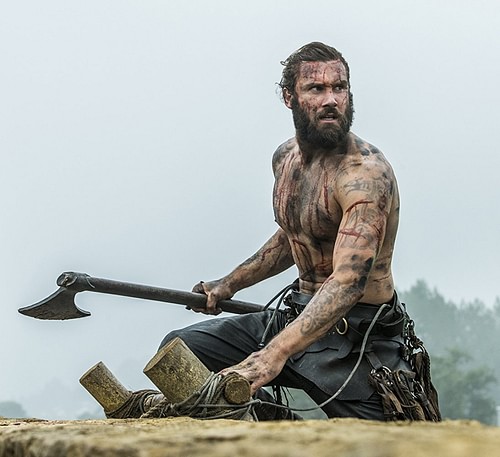
Clive Standen as Rollo of Normandy (by Jonathan Hession, Copyright, fair use)

ROLLO RULED WITH A VIKING CODE OF LAW BASED UPON THE CONCEPT OF PERSONAL HONOR & INDIVIDUAL RESPONSIBILITY.

Was Rollo Other than Norwegian?

The Rollo story is largely historical – and that he and his men were Northmen is taken to men they were of Scandinavian origin. Norwegian-Icelandic sources have it that Rollo was Hrolf from Norway, one of the Viking raiders.

  1. The oldest evidence is in the Latin Historia Norvegiae (ca. 1180). It was written in Norway. A quotation from it follows right below the array of Norse sources.
  2. Fagrskinna‘s chapter 74 tells of William and his ancestor Rolf Ganger (Rollo). This work was written around 1220, estimatedly, and was an immediate source for the Heimskringla of Snorri Sturluson’s Heimskringla. Fagrskinna contains a vernacular history of Norway from the ninth to the twelfth centuries, and includes skaldic verses that in part have been preserved nowhere else. It has a heavy emphasis on battles. The book may have been written in Norway, either by an Icelander or a Norwegian. (Cf. Finlay 2004)
  3. In the early 1200s, the Icelander Snorri Sturluson writes about this Hrolf, in Heimskringla, Book 3, section 24; Book 7, section 19, There are stories about the arsonist father and the brothers of Rolf Ganger, at one time rulers of the Orkneys and Moere in Norway. Their tales start somewhere during the reign of King Harald Fairhair (Chaps. 27, 30-32) and say it was he who settled in Normandy. Snorri also tells that Rolv Ganger – also known as Rollo – became one ancestor of the British royal house.
  4. Other Icelandic sagas from medieval times tell of Hrolf too, as the Orkneyingers’ Saga, section 4.
  5. From the Icelandic Landnama Book (Ellwood 1898): “Rögnvald, Earl of Mæri, son of Eystein Glumra, the son of Ivar, an Earl of the Upplendings, the son of Halfdan the Old, had for wife Ragnhild, the daughter of Hrolf the Beaked; their son was Ivar, who fell in the Hebrides, fighting with King Harald Fairhair. Another son was Gaungu-Hrolf who conquered Normandy; from him are descended the Earls of Rouen and the Kings of England.” (Part 4, ch. 7)

From Historia Norvegiae, the oldest of the Norse works where Rollo is mentioned:

When Haraldr hárfagri ruled in Norway some vikings of the kin of a very mighty prince, Rognvaldr, crossed the Sólund Sea with a large fleet, drove the Papar [monks and the picts, called Peti here] from their long-established homes [the Orkney Islands], destroyed them utterly and subdued the islands under their own rule. With winter bases thus provided, they sallied forth all the more securely in summer and imposed their harsh sway now on the English, now on the Scots, and sometimes on the Irish, so that Northumbria in England, Caithness in Scotland, Dublin and other coastal towns in Ireland were brought under their rule. In this company was a certain Hrólfr, called Gongu-Hrólfr by his comrades because he always travelled on foot, his immense size making it impossible for him to ride. With a few men and by means of a marvellous stratagem he took Rouen, a city in Normandy. He came into a river with fifteen ships, where each crew member dug his part of a trench which was then covered by thin turves, simulating the appearance of firm ground. They then arrayed themselves on the landward side of the trenched ground and advanced prepared for battle. When the townsmen saw this, they met the enemy in head-on attack, but these feigned flight as if racing back to their ships. The mounted men, pursuing them faster than the rest, all fell in heaps into the hidden trenches, their armoured horses with them, where the Norwegians slaughtered them with deadly hand. So, with the flight of the townsmen, they freely entered the city and along with it gained the whole region, which has taken its name of Normandy from them. Having obtained rule over the realm, this same Hrólfr married the widow of the dead count, by whom he had William, called Longspear, the father of Richard, who also had a son with the same name as himself. The younger Richard was the father of William the Bastard, who conquered the English. He was the father of William Rufus and his brother Henry . . . When established as count of Normandy Hrólfr invaded the Frisians with a hostile force and won the victory, but soon afterwards he was treacherously killed in Holland by his stepson. (Phelpstead 2008, 8-9)

Dr Claus Krag (born 1943) is a Norwegian specialist in medieval Norwegian history, and at present (2018) professor emeritus at Telemark University College. Krag maintains that what Dudo writes of Rollo – Dudo tells he was a Viking from an alpine Dacia – is “totally unreliable”, and that Dudo’s historic and geographic information “is by no means right”. Dr Krag also notes that in French works younger than Dudo’s book, Rollo is presented as a Norwegian.

Based on the much unclear Dudo about an alps-surrounded “Dacia”, some Danes say Rollo was Danish. However, Denmark is flat. Attempts to settle the question by analysis of DNA profiles of likely Rollo descendants have failed so far. [◦”Skeletal shock for Norwegian researchers at Viking hunting”]

Folk Stories Around Rollo

Several Scandinavian folktales front similar basic “success recipes” as those of battling tribes in search of new areas – Saxons, Angles, Danes and other Vikings. It suggests that many folktale heroes walk in shoes quite like those of Rollo by degrees and through much similar stages where success often depends on combat and getting valuables. Those were the times.

In the course of centuries, stories and myths may grow for such as glorifying ends. Norman bards developed romances that venerated kings. However, having a king is not a great good, according to 1 Samuel 8; 10 in the Old Testament: the king is portrayed as a stealing enemy on top. Taxes continue a tradition . . . Also, immodest royalty may breed dependence and un-normal subservience with or without near-symbiotic and half-neurotic servility.

In 1 Samuel 8:11-18 we read how bad a Jewish king will be:

This is what the king who will reign over you will claim as his rights: He will take your sons and make them serve with his chariots and horses, and they will run in front of his chariots. Some he will assign to be commanders of thousands and commanders of fifties, and others to plow his ground and reap his harvest, and still others to make weapons of war and equipment for his chariots. He will take your daughters to be perfumers and cooks and bakers. He will take the best of your fields and vineyards and olive groves and give them to his attendants. He will take a tenth of your grain and of your vintage and give it to his officials and attendants. Your male and female servants and the best of your cattle and donkeys he will take for his own use. He will take a tenth of your flocks, and you yourselves will become his slaves. When that day comes, you will cry out for relief from the king you have chosen, but the Lord will not answer you in that day.

But the people refused to listen to Samuel. “No!” they said. “We want a king over us.” [Highlighting added]

Rollo In Normandie

Map of France, 10th Century CE

The historian Reginald Allen Brown (1924–89) has written extensively about Normans and the Norman conquest. He is rendered in the following:

Normandy was created by the three consecutive grants of 911, 924 and 933″. (Brown 1985, 15) Normandy was massively colonised by Scandinavians. Rollo and his successors, as rulers of Normandy, obtained the title of count and valuable rights from before, along with widespread domains. (Cf. Brown 1985, 17-18)

Their buildings seem to document remarkable strength or solidity. The churches were much like bastions. But the duke of Rouen controlled the whole church and his bishops owed him military service for their lands – (Brown 1985, 26)

“From (their) Scandinavian inheritance the Normans derived their sea-faring, much of their trade and commercial prosperity which they shared with the Nordic world, their love of adventure, their wanderlust which led to the great period of Norman emigration in the eleventh century, their dynamic energy, and above all perhaps, their powers of assimilation, of adoption and adaptation.” (Brown 1985,18-19.)

(In AD 911) Charles the Simple, king of the west Franks, granted to a band of Vikings, operating in the Seine valley under Rollo their leader, territory corresponding to Upper or Easter Normandy. To this was subsequently added by two further grants, first the district of Bayeux, and the districts of Exmes and Seez in 924, and second the districts of Coutances and Avranches in 933 in the time of William Longsword, son and successor of Rollo. (Brown 1985, 15) (2)

And from the French Histoire de la Normandie (1862) we find, in the fourth chapter, how Rollo, son of the Norwegian Rognevald, was made an outlaw by the Norwegian king Harald Harfager. He arrived at Rouen with his companions. The inhabitants spontaneously submitted to the him and his men. King Charles at first wanted to fight the Viking, but dropped it. Instead they bargained – Rollo won, he got land and permanent welcome. (Barthelemy 1862, 80 ff)

Rollo of Normandy Statue

Rollo of Normandy Statue

Brown puts the matter into relief: “Normans were pagans when they came (and they continued to come long after 911).” (Brown 1985, 24). But their leader, the Viking Rollo, agreed to getting baptised, and many others followed. “The Seine Vikings became Christian Normans, the poachers turned gamekeepers. Revival, characteristically in this monastic age, came first to the monasteries. Jumieges was restored by William Longsword (927–43), son of Rollo, who is said to have wanted to become a monk there himself.” (Brown 1985, 21)

In short time the Normans got the back-up of their astute castles and strongholds, helped themselves to most of it – often they were served by ditches and stockades too. (Brown 1985, 37, 37n)

[It is thought that Rollo showed exceptional skills in navigation, warfare, leadership, and administration. He abdicated to his son Guillame (William) and died in a monastery in 933. Among his people he was for hundreds of years the personification of justice and good government under law. Others, who thought differently, found him cruel and arrogant.]

His son Guillame Longue-Epee (William Longsword) succeeded him. The third duke was Richard sans Peur (the Fearless), and there were many intrigues and hard fights. This Richard died and was succeeded by Richard 2 who massacred Saxons in England at war. The French king Robert became the ally of Richard 2. After his death, Richard 3 succeeded him and died prematurely. Robert le Diable succeeded him and, before he died in Terre-Sainte, became the father of Guillame le Conquerant: William the Conqueror. (Barthelemy 1862, 80 ff)

We find the family tree of William the Conqueror in the book of the historian R. Allen Brown. It looks like this:

  • Richard 1 (ruled: 942–96)
  • Richard 2 the Good (ruled: 996-1026)
  • Richard 3 (ruled: 1026–27)
  • Robert 1 the Magnificent /le Diable (ruled: 1027–35)
  • William the Bastard / the Conqueror (ruled: 1035–87).

Rollo’s great-granddaughter, Emma married two kings of England, Æhelred the Unready and Knut who was also king of Norway and Denmark. Her son, Edward the Confessor, from the first marriage, was King of England from 1042 to 1066.

A few more dukes of Normandy may be added for the sake of survey of that dynasty line that ruled over Normandy and its English (British) domain:

  • Robert 2 (ruled from 1087)
  • Henry 1 (ruled from 1106, King of the English (1100-35)
  • Henry II, 1135, King of the English (1135-)

“The origins of Normandy in the first decades of the tenth century also reveal the double inheritance of the Normans, from the Scandinavian world from whence they came and from the ancient province of Roman, Frankish and Carolingian Gaul which now they colonised.” (Brown 1985, 17)

“[I]n Normandy by the mid-eleventh century . . . they had adopted Frankish religion and law, Frankish social customs, political organisation and warfare, the new monasticism.” (Brown 1985, 19)

“The Norman monasteries were, by and large, distinguished . . . new . . . vibrant with . . . careless rapture of spiritual endeavour”. The (Normans) became great spirituals – intensely aristocratic. (Brown 1985, 23)

Normans restored and built on monasticism and left robust architectural monuments. Some are still there, more or less intact. The Tower of London was started by Normans, for example. King William had much of it built. “The tower at Rouen was built by Richard 1 (943Rw11;96) and is glimpsed from time to time in the reign of his successor and thereafter . . .. It may have been the prototype for the great Norman towers at Colchester and London. (Brown 1969, 37, 37n) (4)

Normans went on and built monastic churches at such places as Jumieges and many other places. “They added their cathedrals at Rouen, Bayeux [etc.] Many of these major works of Norman Romanesque architecture survive in whole or part”. (Brown 1985, 26)

Some Normans (including Norman clergy) were patrons of the arts and scholarship . . . and almost all of them were mighty builders.” (Brown 1985, 25)

The French Version

Statue of Rollo of Normandy, Falaise

Statue of Rollo of Normandy, Falaise

In 820 peasants . . .along the Seine saw in the distance ten or so curious war ships called—Drakkar because of the animal sculpted into the prow or the stern, which was actually a dragon—the men from the North didn’t travel with their women as they could easily find them on the spot!

Swearing by the names of Thor and Odin—Vikings plundered, pillaged, raped and slaughtered up until 911 when the famous treaty of Saint Clair sur Epte was signed between the Frank king Charles the Simple and Rollon or Rolf, chief of the men from the North.

On the whole our invaders calmed down, adopting a somewhat bourgeois attitude to life in this beautiful region which was to become Normandy.

Soon it was the time for William the Conqueror who, on October 14th, 1066 won the battle of Hastings along with a kingdom—William’s heirs were known as the Plantagenets, and they reigned over Normandy and England. In 1189, Richard the Lionheart divided the double crown.

Rollo and Dudo

Rollo was the son of Earl Ragnvald of More, Norse sagas tell. Two of his brothers were Ivar and Tore. Three more were Hallad, Einar and Rollaug. Hallad and Einar in due time became earls of the Orkneys, each in his turn. [eg, Harald Fairhair’s Saga]

After being made an outcast by the tyrant king Harald Harfager, Rolf voyaged to the western isles. Obviously he could count on support from relatives. The earl of the Orkneys was his paternal uncle, succeeded by that uncle’s son, that is, Rollo’s cousin, and later again by his own brothers Hallad and Einar.

The old sources hold that Rolv took his residence in certain tracts of what today is the domain of Scotland. The Landnamaboka mentions Rolv got a daughter, Kathleen:

Helgi . . . harried Scotland, and took thence captives, Midbjorg, the daughter of Bjolan the King, and Kadlin, the daughter of Gaungu Hrolf or Rolf the Ganger; he married her. (Part 2, ch. 11).

Before Helgi had harried and married, Rolv of the Sagas had travelled from Scotland and the isles near it, to Valland, near the English Channel. The Vikings’ Valland consisted of the southern Netherlands, Belgium and parts of Normandy, roughly said. He took over Normandy in three steps. The Sagas identify him with the Rollo that the Frank king Charles the Simple bestowed it on.

Rollo in Alesund, Norway

Rolv Ganger converted and settled in Rouen. Next he granted many of his Viking companions ample landed property. It was feasible to go north and fetch one’s women and children and kin to the new land, for the soil was fit, there was much fish, and as members of the ruling class they were much safer or freer than those who submitted to the tyranny of Harald Fairhair and his family in Norway and its colonies in several western islands (cf. Simonnaes 1994, 43).

Normans built fortresses on strategic places, and many rustic castles were to come along with them in a short time. All able men had to serve in the Norman military forces. The formerly ruined, marauded region was turned into one of the foremost in France, and Rouen became the second largest city in France, while Hrolf became the originator of the Norman duchy. [Simonnaes 1994 39, 45-46]

Dudos’ Work

Dudo was a visiting French scholar who wrote in verse and prose about the first three rulers of Normandy and their origins. His poetry is different from that of skalds, the Norse bards. It is not complex, as theirs, and he does not glorify war so much either. He is moralistic like earlier Christian eulogists and writers of biographies of saints (Christiansen 1998, xviii). “It was hagiography that moulded his work,” Eric Christiansen aptly sums up (ibid, xxi), and, “there is no sign that Old Norse poetry was ever composed or appreciated in Normandy (1998, xvii; cf. Ross 2005).”

Dudo’s eulogising chronicle (ibid. xxv) is about one family’s rise from defeat and exile in the world of Vikings to an honoured place among the great territorial rulers of France. Dudo recounts two campaigns in England by the founder, Rollo, and a series of stirring events otherwise, including the murder of Rollo’s son William, and the kidnapping, escape and precarious early career of Dudo’s first patron, Count Richard I.

Historians on the whole have doubted much in Dudo’s book, for its historical details are inaccurate. Yet it it is virtually the only source for very early Norman history. Recently, some scholars maintain that Dudo had better be seen as a propagandist.

Dudo’s work has the nature of a romance, and has been regarded as untrustworthy on this ground by such critics as Ernst Dümmler and Georg Waitz. Further, Leah Shopkow has more recently argued that Carolingian writing, particularly two saints’ lives, the ninth-century Vita S. Germani by Heiric of Auxerre and the early tenth-century Vita S. Lamberti by Stephen of Liége, provided models for Dudo’s work. (WP, “Dudo of Saint-Quentin”)
Rollo Grave at the Cathederal of Rouen

New editions of central Norman chronicles have surfaced over the last thirty years. The History of the Normans in Eric Christiansen’s English translation (1998) is said to be “fairly true to Dudo’s often pompous, bloated style” while at the same time being readable, and accompanied by copious, explanatory notes. Christiansen recognises that Dudo is unreliable as a historical source, and he acknowledges the Scandinavian side of the early Normans. Histories of Normans have a potentially broad appeal. On the Internet there has been a version edited by Felice Lifshitz (1996).

Dudo’s content: A few observations

O thou the magnanimous, pious, and moderate!
O thou the extraordinary God-fearing man!
O thou the mangificent, upright and kindly!
O thou miraculous, goodly just man!
O thou peace-maker and offspring of God!
O thou the munificent, holy and moderate!
O thou the incarnadine merciful Richard!
O thou the the long-suffering, Richard the prudent!
O thou most famous one, Richard the comely!
O thou justiciar, Richard the mild!
– All manner of nations duly declare.
Mild one, remember what you see in the book,
Nourish your heart and your soul on these things
That you may be joined to the matter you read.

– Verses to Richard, son of the great Richard (in Christiansen 1998, 8)

A clergy view shines through.

The commisioned chronicler of the Norman dukes, Dudo, tells in Latin (ca. 1015–20) that Rollo was the son of an uncertain king in “Dacia”. ◦Gesta Normannorum:

Spread over the plentiful space from the Danube to the neighborhood of the Scythian Black Sea, do there inhabit fierce and barbarous nations, which are said to have burst forth in manifold variety like a swarm of bees from a honeycomb or a sword from a sheath, as is the barbarian custom, from the island of Scania, surrounded in different directions by the ocean. For indeed there is there a tract for the very many people of Alania, and the extremely well-supplied region of Dacia, and the very extensive passage of Greece. Dacia is the middle-most of these. Protected by very high alps in the manner of a crown and after the fashion of a city. – [From chapter 2, second paragraph in Gesta Normannorum by the chronicler Dudo ca. 1015]

Extracts from Dudo of St. Quintin’s

One thing that stand out from Dudo’s obscure and glorifying marvel is this: If what is called Dacia is surrounded by very high alps, it isn’t Denmark. His Dacia stands out as some very fertile, southern Alp tract (Balcanlike). (Steenstrup 1876, 30, 31)

Against a claim by the Danish Johannes Steenstrup in 1876, there is not one mention of Rollo in classical Danish sources. DNA analyses of Norman descendants of Rollo could have helped in finding out about his origin, but so far no fit DNA has been detected.

The Danish historian Saxo Grammaticus from about 1200, has no mention of any Danish Rollo in ◦The Danish History.

In Normandy, Rollo is celebrated as a real Viking from More on the west coast of Norway [Cf. Simonnaes 1994 35]

Rollo in Fargo, North Dakota

Historical | Fargo Public Art

In 1911, during the Norman Millennium celebrations, the city of Rouen in Normandy decided to create two copies of its Rollo statue. One replica was sent as a gift to Ålesund, Norway. The earls of Moere were headquartered somewhere nearby Ålesund, it is suggested.

The other replica went to Fargo in North Dakota. The two bronze statues were copied from an original stone statue sculpted in 1863 by Arsene Letellier, erected in Rouen in 1865.

In Fargo, the dedication ceremony in 1912 included a speaker from the French embassy in Washington. A proclamation by the mayor of Rouen, bound in leather with gold seal of the city, gold leaf and other ornamentation, read in part,

“Since these ancient times, these fierce warriors have populated and have become a hard-working people whose importance is shown by the powerful association of the Sons of Norway which has preserved the cult of memory, and which participated last year in the celebrations in the ancient Duchy of Normandy.”

The celebrations were concluded with a parade down Broadway. The Rollo statue was relocated in the 1980s and now stands in a little park. [Simonnaes 1994 39, 48, 40]
Carruthers tartan map poster-01

CLAN CARRUTHERS SINCE 1983

Preserving Our Past, Recording Our Present, Informing Our Future

Ancient and Honorable Clan Carruthers Int Society CCIS  LLc

carruthersclan1@gmail.com              carrothersclan@gmail.com

WIDER BANNER Black

CLAN CARRUTHERS INT SOCIETY CCIS HISTORIAN AND GENEALOGIST
New Blog Banner 05

You can find us on facebook at :

https://www.facebook.com/carrutherscarrothers.pat.9

https://www.facebook.com/CarruthersClan/

https://www.facebook.com/CarruthersClanLLC

Disclaimer Ancient and Honorable Carruthers Clan International Society CCIS LL
The Viking Age, Uncategorized

CLAN CARRUTHERS – VIKING BOAT BURIAL

cropped-wide-banner-with-new-crest.jpg

VIKING BOAT BURIAL REVEALS ITS SECRETS

Six years after discovering and excavating the first Viking boat burial site discovered on the UK mainland, archaeologists have provided a glimpse into some of the mysteries this rare burial reveals.

Originally unearthed in 2011, the site in Swordle Bay, Scotland, was the first undisturbed Viking boat burial found on the UK mainland. After six years of work, Ardnamurchan Transitions Project’s findings were recently released in an in-depth report in the Journal of Antiquity, revealing, among other things, the growing relationship between Scotland and the Viking world at that time.

Post-excavation photograph of the burial site. (Credit: Antiquity Publications Ltd, 2017)

Post-excavation photograph of the burial site. (Credit: Antiquity Publications Ltd, 2017)

Viking boat burials themselves were extremely rare. Only practiced for the deaths of prominent individuals, the ritual used a boat as a coffin for the body and burial goods. Discovered under a low-lying natural mound close to the shore, this particular site was small, measuring approximately 17 feet by 5 feet, and thought to have contained a row boat that was accompanying a larger ship.

Other artifacts from the burial site. The sword (top); the sword in situ (below); the mineralized textile remains (right); detail of the decoration after conservation (left). (Credit: Pieta Greaves/AOC Archaeology).

Other artifacts from the burial site. The sword (top); the sword in situ (below); the mineralized textile remains (right); detail of the decoration after conservation (left). (Credit: Pieta Greaves/AOC Archaeology).

After excavating the site, archaeologists were able to reconstruct the steps of the burial. A boat-shaped depression was first dug into a natural mound of beach shingle. The boat was then inserted into the ground, and the body was placed inside, along with the grave goods. Stones were place inside and around the boat. As part of the closing of the site, a spear and shield boss (the round or convex piece of material at the center of a shield) were deliberately broken and deposited.

Pre-excavation photograph after initial cleaning. (Credit: Antiquity Publications Ltd, 2017)

Pre-excavation photograph after initial cleaning. (Credit: Antiquity Publications Ltd, 2017)

The ship, along with the human remains, decayed in the acidic soil long ago, but the grave artifacts remained, offering a glimpse into the possible origins of the deceased as well as the reach of Viking culture. A single copper alloy-ringed pin with three bosses—a style found in Ireland—was also found, believed to have originally been fastened to a burial coat. There was also a copper alloy drinking horn, thought to be Scandinavian in origin. Other grave goods included a sword, an axe, a sickle (found mostly in Scotland), a whetstone (probably Norwegian), flint strike-a-lights and two teeth—molars from only identified human remains. Hundreds of metal rivets that once held the vessel together, some with wood shards, were also discovered.


The Viking's teeth. (Credit: Antiquity Publications Ltd, 2017)

The Viking’s teeth. (Credit: Antiquity Publications Ltd, 2017)

An isotopic analysis of the teeth (the lower left first and second molars) revealed further information. The individual likely lived on, or close to, the coast, as indicated by an increase in consumption of marine proteins between the ages of 3 and 5. While marine protein was rarely consumed by humans in Britain, it was popular in Viking-era Norway. Further analysis of the teeth narrowed down the place of origin to eastern Ireland, northeastern mainland Scotland, Norway or Sweden.

The weapons included in the burial point to a warrior status and the artifacts and their internment infer high status, but the gender cannot be confirmed. While it is likely a male burial, some of the goods, such as the sickle, are more commonly associated with females. Current Viking’s scholarship points to a number (albeit smaller) of female warriors, as well as the discoveries and excavations of female boat burials.

 Some of the artifacts recovered from the burial site (clockwise from the top left): broad-bladed axe, shield boss, ringed pin and the hammer and tongs (Credit: Pieta Greaves/AOC Archaeology).

Some of the artifacts recovered from the burial site (clockwise from the top left): broad-bladed axe, shield boss, ringed pin and the hammer and tongs (Credit: Pieta Greaves/AOC Archaeology).

While there is still more to learn from this rare burial site, an important finding was revealed in the variety of grave goods from multiple geographic locations: The growing relationship between Scotland and the Viking world at that time.

Carruthers crest on flag-v2 (1)

Perserving the Past, Recording the Present, Informing the Future

Ancient and Honorable Carruthers Clan Int Society 

carruthersclan1@gmail.com     carrothersclan@gmail.com

cropped-wide-banner-with-new-crest.jpg

LISA JOHNSON – HISTORY CHANNEL

CLAN CARRUTHERS INT SOCIETY CCIS HISTORIAN AND GENEALOGIST

You can find us on facebook at :

https://www.facebook.com/carrutherscarrothers.pat.9

https://www.facebook.com/CarruthersClan/

https://www.facebook.com/CarruthersClanLLC

Disclaimer Ancient and Honorable Carruthers Clan International Society
OUR ANCESTORS, The Viking Age

CLAN CARRUTHERS CCIS – Return of Edwini

WIDE BANNER with NEW CREST


Return of Edwini


When the Pictish king Elphin lost two battles against the formidable Onuist in 728 the Annals of Clonmacnoise tell us ‘the nobles and people of the Picts turned their back’ on him. Elphin had become what the Anglo-Saxons would call a winelas guma, a ‘friendless man’, doomed to walk the wræclastas, ‘paths of exile’. A clue to where he found sanctuary might be found in the 758 obituary of an Elpin of Glasnevin, a monastery in County Dublin. If this was the same man as the discredited Elphin then he had chosen the safest, but by no means risk-free, path — that of monastic retirement.

The other main path open to a wræcca was to try to make a powerful ally. Around 604 the Bernician king Aethilfrith subjugated neighbouring Deira, a kingdom broadly co-extensive with the modern counties of Yorkshire and Lancashire. Deira’s evicted ruler Edwini sought refuge at the court of Rædwald, king of the East Angles. Aethilfrith asked Rædwald to kill the exile, promising him great riches if he did but war if he didn’t. According to the tradition Bede received, Rædwald was set to comply until his queen dissuaded him, arguing that to do so would be dishonourable. So instead, there was war; Rædwald slew Aethilfrith and returned Edwini to power.


The reconstructed helmet found at Sutton Hoo which many historians believe may have belonged to Rædwald.

The East Anglian queen’s distaste for the assassination plot has echoes of a story from the time of St Columba. According to Adomnán, Columba had arranged for an exiled Pictish nobleman, Tarain, to live under the protection of a man named Feradach of Islay. Feradach soon had Tarain killed and Columba’s subsequent outrage likely reflects the breaking of a fundamental social convention.

Linguistic differences were no barrier to serving your exile under another lord. When Edwini returned to Deira he took his revenge by banishing the sons of Aethilfrith. One of them, Eanfrith, fled to Pictland where he later married and fathered at least one son, Talorcan, who became a king of Picts in the 650s.

Furthermore, whether exiles or mere opportunists, at least two Picts joined the Britons of the Gododdin in their failed assault against the Anglo-Saxons at Catraeth.

Carruthers crest on flag-v2 (1)


Preserving Our Past, Recording Our Present, Informing Our Future

Ancient and Honorable Clan Carruthers Int Society CCIS  LLc

carruthersclan1@gmail.com                       carrothersclan@gmail.com

cropped-wider-banner-light-blue-1.jpg


Neil Carruthers

CLAN CARRUTHERS INT SOCIETY CCIS HISTORIAN AND GENEALOGIST



You can find us on facebook at :

https://www.facebook.com/carrutherscarrothers.pat.9

https://www.facebook.com/CarruthersClan/

https://www.facebook.com/CarruthersClanLLC


Disclaimer Ancient and Honorable Carruthers Clan International Society CCIS LLC is the official licensed and registered Clan of the Carruthers Family.  This Clan is presently registered in the United States and Canada, and represents members worldwide.  All content provided on our web pages is for family history use only.  The CCIS is the legal owner of all websites, and makes no representation as to the accuracy or completeness of any information on these sites or by following any link provided. The CCIS will not be responsible for any errors or omissions or availability of any information. The CCIS will not be liable for any losses, injuries, or damages from the display or use of this information. We do not sell, trade or transfer to outside parties any personal identifications. For your convenience, we may provide links to various outside parties that may be of interest to you. The content on CCIS is design to support your research in family history.      ( CCIS -LLC copyright 2017 - 2020)
Gutland / Gotland, The History of Gutland, The Viking Age

RED DYES FOR CLOTHES IN THE VIKING AGE-CLAN CARRUTHERS CCIS

cropped-wide-banner-with-new-crestnorse

RED DYES FOR CLOTHES IN THE VIKING AGE

This first post will not exactly help you to dye clothes in red. Not directly. It aims at helping you gain awareness of why it’s actually not so easy to build certainties while dealing with accurate, archaeology-based reenactment.
I had to make this post, because doing reenactment is really a matter of how deep you are willing to delve, how much you are willing to read… and where you will choose to stop.
The better I get, the more uncertainties I have to face concerning the “accuracy” of what I’m doing.
Let’s start with a few facts. When making costumes, we base ourselves on archaeological finds.
Firts obvious statement : what we have been able to recover from the past is extremely little. Concerning viking age, we have maybe a dozen of extent garments, and they are not all coming from Scandinavia. Is a dozen garments representative from a period of history that lasted something like 300 years ?
Certainly not.
Second (a little bit less obvious) statement : fabric rots. The fragments that we have recovered were preserved by special conditions, whether mineralized in contact with metal (from brooches, knives, swords, shield bosses, silver and gold thread from table-woven trims, silver and gold posaments, pins, pendants, etc.) or preserved by particular qualities of the soil (for example, in bogs, like Huldremose “peplos-dress” which is not from viking period).
Tablet-woven trim from the Kostrup suspended dress photo by Hilde Thunem taken in Odense museum, Denmark
Some fabric have been recovered in funny circumstances, for example, Haithabu’s (modern Hedeby, Germany) viking-age harbour yielded fabric that had been used to repair ships, that had been doused in tar.
That leads us to the third (not obvious at all) statement : you have to be very careful when using evidence to back your costume projets. If you base yourself on evidence recovered from a grave, most likely, that means mineralized fabric in contact with metal. And if there is metal, most likely, that means a wealthy grave. Check if the assessed level of wealth of the grave matches your character’s level of wealth.
Ship-burials are for very wealthy people. Oseberg’s lady was a queen, or a chieftain’s lady. That means that despite the fact that we are very happy to have plenty of evidence from her grave, maybe, you shouldn’t use that for your costume. Tablet-woven trims were luxury items, if there are gold and silver threads to preserve them, you will need all of your costume to be accordingly rich.
NOT a middle-class garment, so if you are, choose something else.

Dress made by Toril Sørbøe Rojahn,

Some of the fabric recovered from excavations are more likely to have belonged to humble people. The clothes from bodies found in bogs, the fabric from Haithabu harbour are probably better evidence if your character is humble. But it’s not easy to make out their colour !
The acidic Ph of the bogs makes it difficult to analyze the dyes. It’s the same for clothes that have spent a long time in the sea, or under ice (the Greenland settlements have yielded a lot of extent garments, although they are XIIIth-XIVth century, not viking-age).
The conclusion is : the coloured clothes samples that are at our disposal to guess what was used for dyeing are not representative of “the viking period”. They can be representative of the settlement, or of the burial site, though. In Birka, there was a wealthy area of burials, and a poorer one. Guess what ? More grave goods are recovered from the wealthy area. Solid information about a specific site doesn’t allow us to jump to general conclusions.
Most costumes we see in festivals are typical of high-rank individuals. There are trims and jewels galore. Do not let this lead you to the conclusion that most people of the viking period dressed this way !
In Thor Ewing’s opinion, red clothes were more likely to be costly items, the dyed fabric either being imported, or dyed with imported madder.
Can we be sure of that ? No. We can only gather evidence, and make educated guesses.
In my opinion, fabric produced domestically could not have only been dyed with the top-quality, most-efficient dyestuffs. Some must have been dyed with local plants. But this would have been done by poorer individuals… and unfortunately, we don’t have a lot of evidence for them, because their graves have been lost.
Red dyes achieved with bedstraw, by Jenny Dean
Moreover, when dyes can actually be analyzed, they are not always recognized. Quite a lot of yellow samples from the viking age haven’t been identified at all. They are referred as “X yellow”. Dyer’s broom and weld are quite commun yellow dyes, but they are not the only ones. A considerable number of plant gives yellow, and many of them are solid dyes that would not be sneezed at by the housewife when she made her cloth.
A smaller number of plants gives really interesting red colour, which (thankfully !) restrains the field of investigation, but still there is a lot of space for study.
I intend to research evidence for red dyes and their use during the viking period, and write an article on the subject. But it’s a tricky subject indeed, and we have to speculate, guess, and make hypothesis.
I hope this preliminary article have “rung your bell” and made you more aware of the need for carefulness when embarking on making a costume, choosing the fabric, the weave, the colour and the ornaments.
cropped-wider-banner-light-blue-1.jpg
OFFICIAL AND REGISTERED CLAN CARRUTHERS  CCIS -1983-CLAN OF OUR ANCESTORS
SCOTTISH CLAN, IRISH CLAN,  NORSE CLAN

Preserving Our Past!    Recording Our Present!  Informing Our Future!

The Ancient and Honorable Carruthers Clan International Society CCIS

carruthersclan1@gmail.com                carrothersclan@gmail.com

Crest on Light Blue

Reviewed by Tammy Wise CHS- CHAIRMAN – Indiana USA

CLAN SEANACHAIDHI

CLAN CARRUTHERS INT SOCIETY CCIS HISTORIAN AND GENEALOGIST

You can find us on our main facebook pages at :

SILVER WINGS-https://www.facebook.com/CarruthersClanLLC/

GOLD WINGS – https://www.facebook.com/carrutherscarrothers.pat.9

CLAN CARRUTHERS FAMILY HISTORY – https://www.facebook.com/CarruthersClan

CLAN CARRUTHERS CCIS – https://www.facebook.com/groups/3878691252182714

CLAN CARRUTHERS INT SOCIETY- https://www.facebook.com/groups/394653845137709

CLAN CARRUTHERS – BORDER REIVERS – https://www.facebook.com/groups/434959914239094

Disclaimer Ancient and Honorable Carruthers Clan International Society